
Question 1
Fig. 1.1 shows part of the Periodic Table.
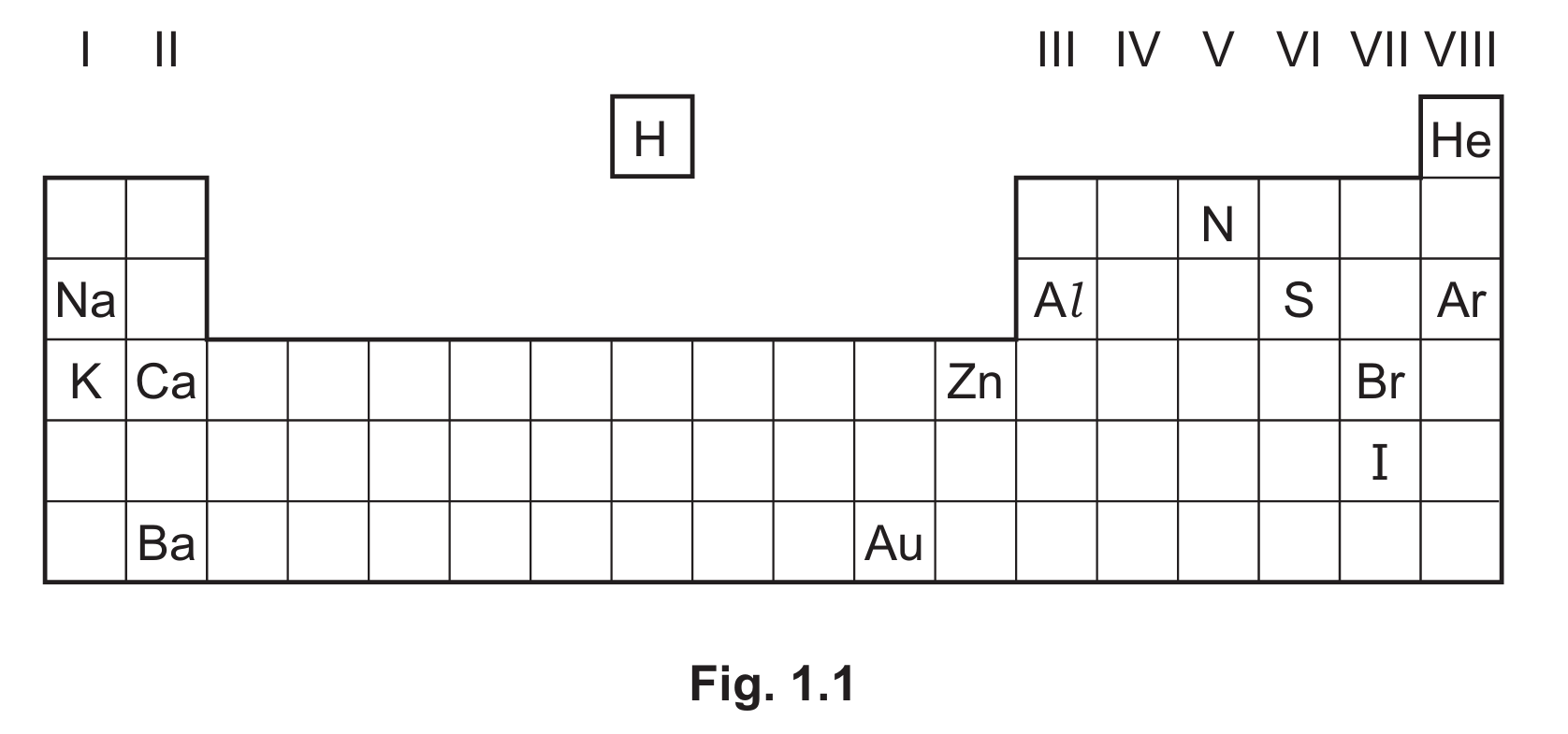
Answer the following questions using only the elements in Fig. 1.1. Each symbol of the element may be used once, more than once or not at all.
(a) Give the symbol of the element that:
(i) is 78% of clean, dry air
(ii) forms an ion with a charge of 3+
(iii) has an atom with only five occupied electron shells
(iv) forms an ion that gives a light green colour in a flame test
(v) is used in food containers because of its resistance to corrosion
(vi) is the metal with the lowest reactivity.
(b) Helium is a monatomic gas.
(i) State the meaning of the term monatomic.
(ii) Explain in terms of electronic configuration why helium is unreactive.
Most-appropriate topic codes (Cambridge IGCSE Chemistry 0620):
• Topic 10.3 — Air quality and climate (Part (a)(i))
• Topic 8.1 — Arrangement of elements (Part (a)(ii))
• Topic 2.2 — Atomic structure and the Periodic Table (Part (a)(iii))
• Topic 12.5 — Identification of ions and gases (flame tests) (Part (a)(iv))
• Topic 9.2 — Uses of metals (Part (a)(v))
• Topic 9.4 — Reactivity series (Part (a)(vi))
• Topic 2.1 — Elements, compounds and mixtures / Topic 8.5 — Noble gases (Part (b))
▶️ Answer/Explanation
(a)(i) N
The symbol is N for nitrogen. According to Topic 10.3, clean, dry air is approximately 78% nitrogen and 21% oxygen.
(a)(ii) Al
The symbol is Al for aluminium. Aluminium is in Group III, so it loses three electrons to form an Al³⁺ ion (Topic 8.1).
(a)(iii) I
The symbol is I for iodine. Iodine is in Period 5 of the Periodic Table, meaning its atoms have electrons occupying five shells (Topic 2.2).
(a)(iv) Ba
The symbol is Ba for barium. The flame test for barium ions (Ba²⁺) produces a characteristic light green colour (Topic 12.5).
(a)(v) Al
The symbol is Al for aluminium. Aluminium is resistant to corrosion due to its protective oxide layer, making it suitable for food containers (Topic 9.2).
(a)(vi) Au
The symbol is Au for gold. Gold is positioned very low in the reactivity series (below copper and silver) and is the least reactive metal shown (Topic 9.4).
(b)(i) Monatomic means consisting of single atoms.
A monatomic substance is made of individual atoms not chemically bonded to each other, unlike diatomic molecules like O₂ or N₂.
(b)(ii) Helium has a full outer electron shell (2 electrons).
Helium’s electronic configuration is 1s² (duplet rule). This stable configuration means it has no tendency to gain, lose, or share electrons, making it chemically inert (Topic 8.5).
Question 2
(ii) Choose the correct statement that describes the structure and bonding in diamond.
- simple covalent molecule
- giant covalent
- simple ionic
- giant ionic
Most-appropriate topic codes (Cambridge IGCSE Chemistry 0620):
• Topic 2.5 — Simple molecules and covalent bonds (Parts a, b)
• Topic 2.6 — Giant covalent structures (Part c)
▶️ Answer/Explanation
(a)(i)
Low melting/boiling points and poor electrical conductivity.
Simple molecular structures consist of individual molecules held by weak intermolecular forces, requiring little energy to overcome, resulting in low melting/boiling points. They lack free electrons or ions, making them poor electrical conductors.
(a)(ii)
electrons.
A covalent bond is specifically defined as a shared pair of electrons between two non-metal atoms, allowing both to achieve stable noble gas electronic configurations.
(a)(iii)
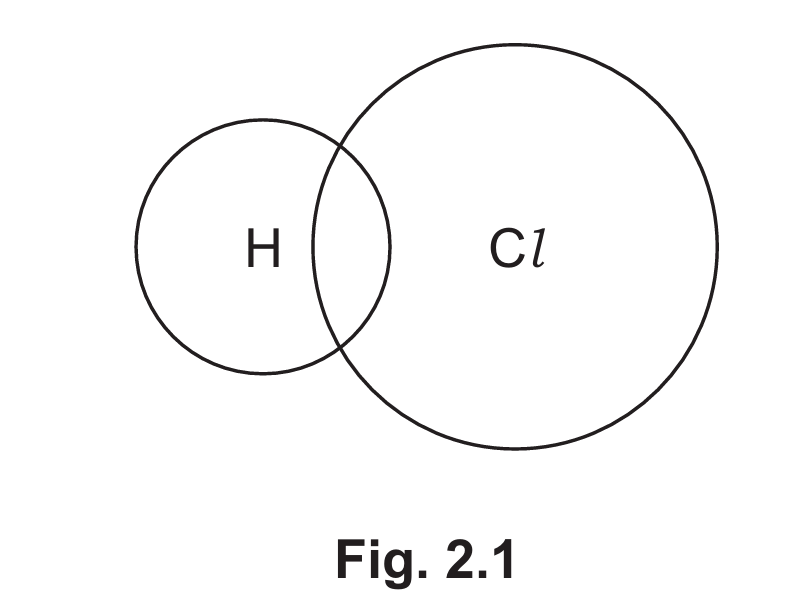
Diagram must show one shared pair (bonding pair) and three lone pairs (six electrons) around the chlorine atom.
Hydrogen (H) contributes 1 electron; Chlorine (Cl) contributes 7 outer electrons. The shared pair gives H a duplet and Cl an octet. The remaining three non-bonding pairs on Cl represent 6 electrons drawn as dots or crosses.
(b)
Anion.
A negative ion is formed when an atom gains electrons. The general name for any negatively charged ion, regardless of its composition, is an ‘anion’.
(c)(i)
Cutting tools (or drill bits, saw blades).
Diamond is the hardest known natural material due to its giant covalent lattice structure. This property makes it ideal for industrial applications such as cutting, grinding, and drilling.
(c)(ii)
Giant covalent.
Diamond consists of a continuous three-dimensional network of carbon atoms each covalently bonded to four others. It does not form small molecules, so ‘giant covalent’ is the correct classification.
Question 3
calcium compounds
plastics
harmful microbes


Most-appropriate topic codes (Cambridge IGCSE Chemistry 0620):
• Topic 10.1 — Water (Parts a, b, c, d, e)
• Topic 7.3 — Preparation of salts (Part f)
▶️ Answer/Explanation
(a)
calcium compounds
Calcium compounds provide essential minerals like calcium ions that aquatic organisms need for building shells, bones, and vital biological structures.
(b)
(lead to) deoxygenation (of water)
Phosphates cause excessive algal growth; when algae die, their decomposition by bacteria consumes large amounts of dissolved oxygen, creating dead zones where aquatic life cannot survive.
(c)(i)
hydrogencarbonate
With a mass of 10.0 mg in 1000 cm³, the HCO₃⁻ ion has the highest concentration among all negative ions listed, exceeding chloride (8.0 mg) and sulfate (4.0 mg).
(c)(ii)
nitrate
The NO₃⁻ ion is called nitrate, a common polyatomic ion containing one nitrogen atom bonded to three oxygen atoms, frequently found in fertilisers and industrial waste.
(c)(iii)
0.4 mg
Calculation: (2.0 mg × 200 cm³) / 1000 cm³ = 0.4 mg. The mass of phosphate ions is directly proportional to the volume of water sampled.
(d)(i)
to remove solids
Sedimentation allows large, insoluble solid particles like sand and clay to settle out of the water by gravity, making the water clearer before further filtration steps.
(d)(ii)
to kill (harmful) microbes
Chlorine acts as a disinfectant that kills harmful bacteria, viruses, and other pathogens, ensuring the drinking water is safe for human consumption.
(e)
Heat the water sample to boiling and measure the temperature accurately.
Pure water boils at exactly 100°C at standard atmospheric pressure; if the boiling point is above 100°C or varies during boiling, the water contains dissolved impurities and is impure.
(f)
\( 3H_2O \) and \( 2HCl \)
The balanced equation is \( S_2Cl_2 + 3H_2O \rightarrow 2HCl + H_2SO_3 + H_2S \), which balances with 2 sulfur atoms, 2 chlorine atoms, 3 oxygen atoms, and 6 hydrogen atoms on each side.
Question 4
Most-appropriate topic codes (Cambridge IGCSE Chemistry 0620):
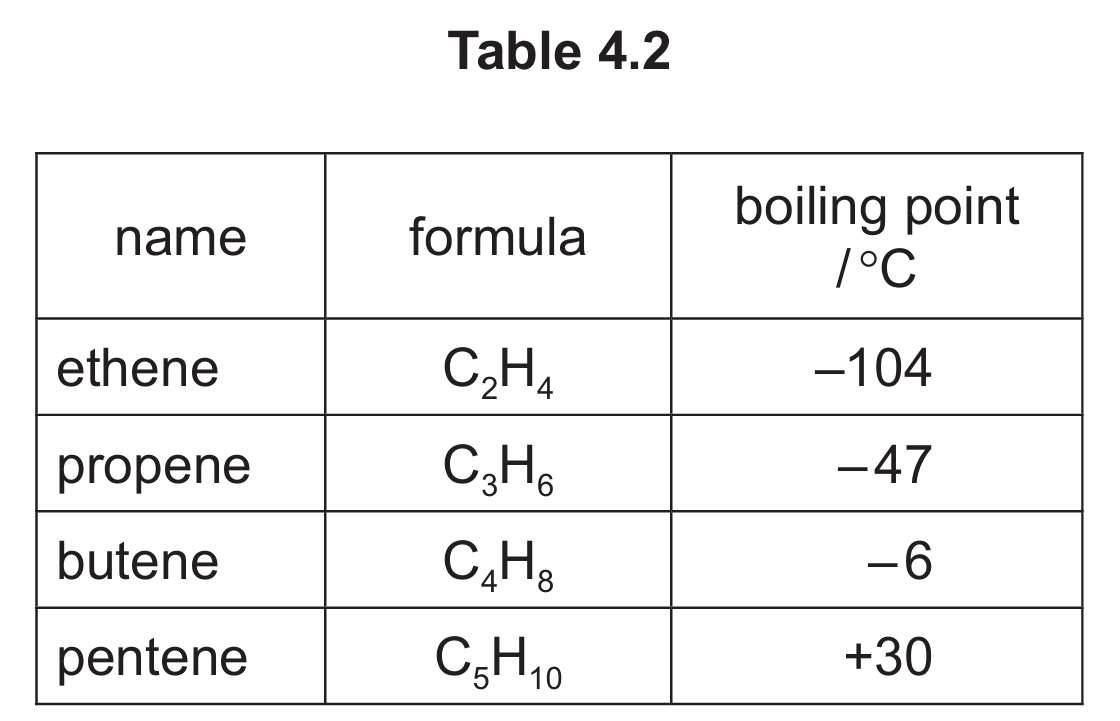
• Topic 11.1 — Formulae, functional groups and terminology (Part (a))
• Topic 3.2 — Relative masses of atoms and molecules (Part (b))
• Topic 11.6 — Alcohols (Part (c))
• Topic 11.1 & 11.5 — Homologous series & Alkenes (Part (d))
• Topic 11.5 — Alkenes (Part (e))
▶️ Answer/Explanation
(a)(i)
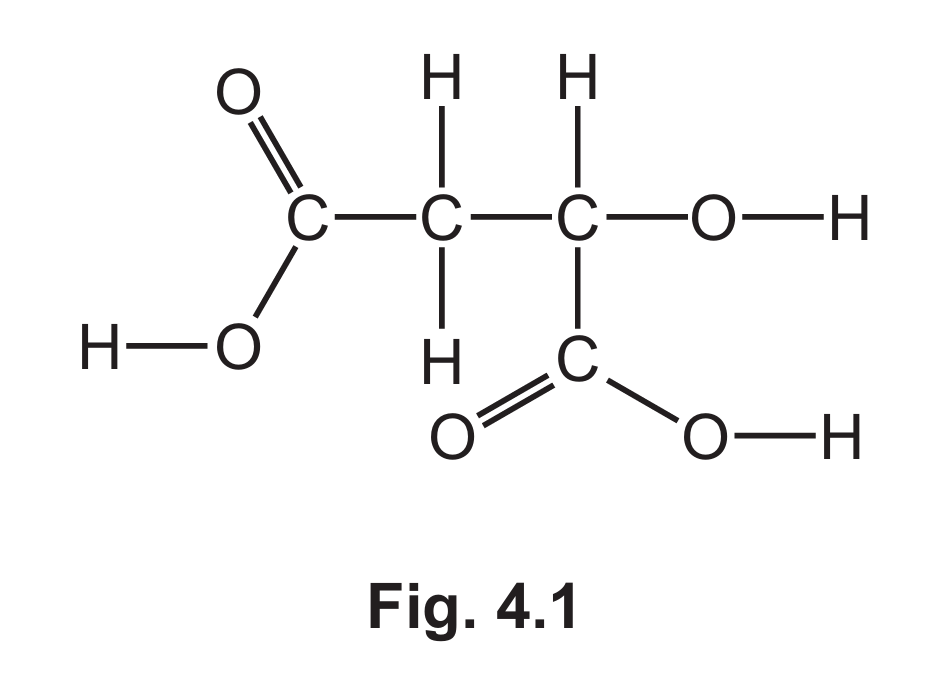
For the correct answer: O-H group circled.
The alcohol functional group is the hydroxyl (-OH) group. In the displayed formula, this is represented by the oxygen atom singly bonded to a hydrogen atom, which is attached to a carbon atom. Circling this specific O-H bond correctly identifies the functional group.
(a)(ii)
C4H6O5
By counting the atoms in the displayed formula: there are 4 carbon atoms, 6 hydrogen atoms (noting the H in the -OH groups), and 5 oxygen atoms. Therefore, the molecular formula is C4H6O5.
(b)
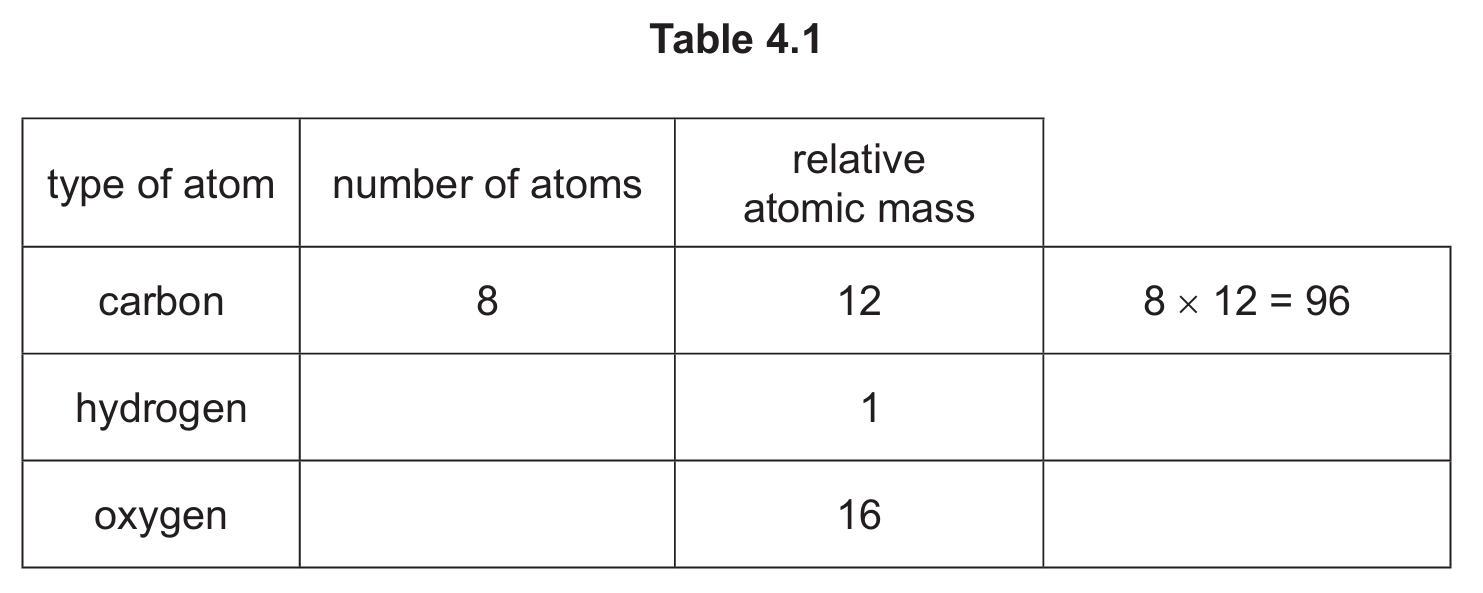
190
Relative molecular mass (Mr) is calculated by summing the relative atomic masses (Ar) of all atoms. Using Ar values: C=12, H=1, O=16. Mr = (8×12) + (14×1) + (5×16) = 96 + 14 + 80 = 190.
(c)
carbon dioxide + water
Complete combustion of an organic fuel occurs in excess oxygen. The carbon atoms are fully oxidised to carbon dioxide (CO2), and the hydrogen atoms are oxidised to water (H2O).
(d)(i)
alkenes
The homologous series is identified by the names ending in “-ene” (ethene, propene, butene), which indicates the presence of a carbon-carbon double bond (C=C), the defining feature of alkenes.
(d)(ii)
CnH2n
For ethene (C=2, H=4), propene (C=3, H=6), butene (C=4, H=8), the number of hydrogen atoms is always twice the number of carbon atoms, giving the general formula CnH2n.
(d)(iii)
boiling point increases
As the carbon chain length increases (from 2 to 5 carbons), the molecular size and surface area increase. This leads to stronger London (dispersion) forces between molecules, requiring more energy to overcome, hence the boiling point rises.
(e)(i)
Cracking involves heating long-chain alkanes (from petroleum fractions) to a high temperature (typically 400-700°C), often in the presence of a catalyst like zeolite or aluminium oxide, to break C-C and C-H bonds, producing smaller, more useful molecules like ethene and other alkenes.
The large hydrocarbon molecules are vaporised and passed over a hot catalyst. The thermal energy breaks the covalent bonds, resulting in a mixture of smaller alkanes and alkenes. Ethene is then separated by fractional distillation.
(e)(ii)
To produce more useful (higher demand) hydrocarbons, such as alkenes for making plastics, or to produce smaller, more flammable molecules for fuels.
Short-chain alkenes like ethene are in high demand as starting materials (feedstocks) for the petrochemical industry (e.g., to make polymers like poly(ethene)). Cracking converts less useful, long-chain alkanes into these valuable products.
Question 5
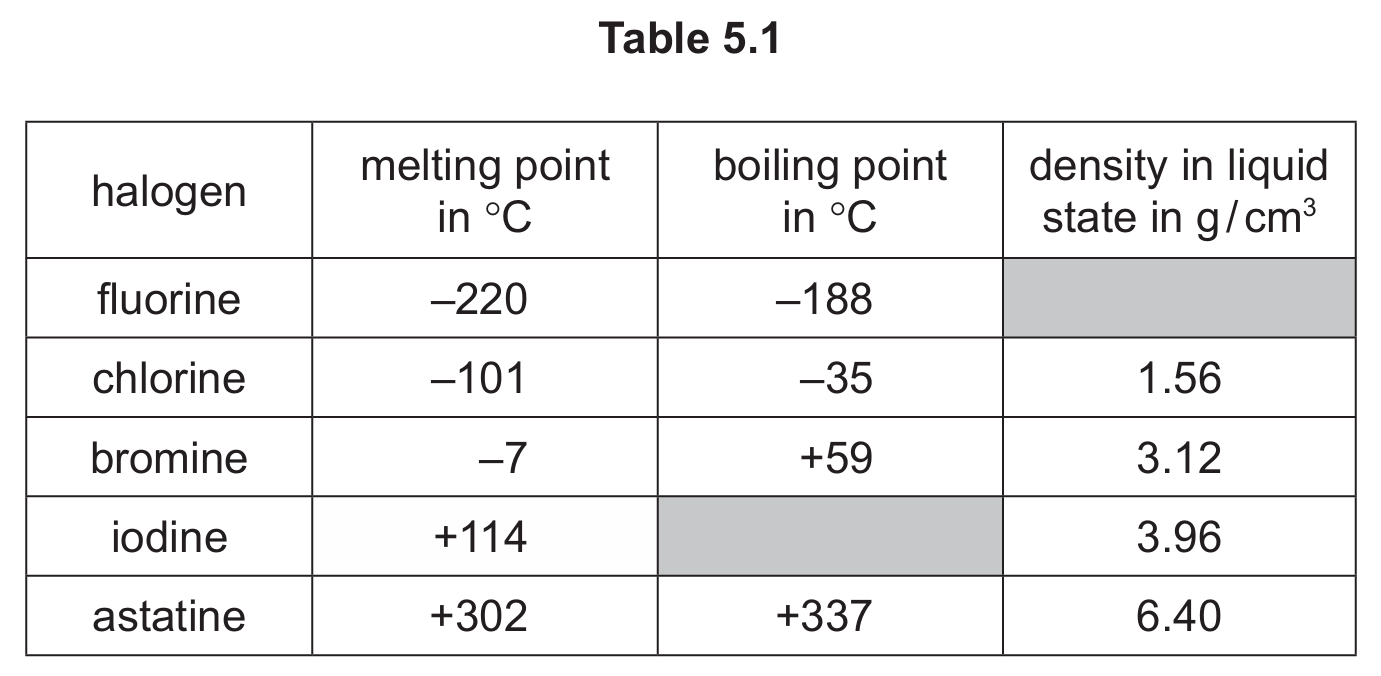
Use the information in Table 5.1 to predict:
(i) the boiling point of iodine
(ii) the density of liquid fluorine
(iii) the physical state of chlorine at -20°C. Give a reason for your answer.
(b) Aqueous chlorine reacts with aqueous lithium bromide.
(i) Complete the word equation for this reaction.
(ii) Explain why aqueous iodine does not react with aqueous lithium bromide.
(iii) Describe a test for chlorine.
(c) Fluorine reacts with ammonia to produce hydrogen fluoride and nitrogen.
Most-appropriate topic codes (Cambridge IGCSE Chemistry 0620):
• Topic 8.3 — Group VII properties (Parts a, b)
• Topic 12.5 — Identification of ions and gases (Part b(iii))
• Topic 6.4 — Redox / Balancing equations (Part c)
▶️ Answer/Explanation
(a)(i)
Between 116°C and 335°C (inclusive).
Boiling points increase down Group VII. Since iodine lies between bromine (59°C) and astatine (337°C), its boiling point must fall within this range.
(a)(ii)
Between 0.05 and 1.55 g/cm³ (inclusive).
Density increases down the group. Fluorine is above chlorine (1.56 g/cm³), so its density must be lower than chlorine’s, hence between 0.05 (theoretical minimum) and 1.55.
(a)(iii)
Gas. Chlorine’s boiling point is -35°C; at -20°C (which is above -35°C), chlorine exists as a gas.
(b)(i)
bromine + lithium chloride.
Chlorine is more reactive than bromine, so it displaces bromine from lithium bromide, forming lithium chloride and bromine.
(b)(ii)
Iodine is less reactive than bromine. A halogen can only displace a halide that is below it in the reactivity series. Since bromine is above iodine, no reaction occurs.
(b)(iii)
Test: Damp litmus paper. Observation: It turns red then is bleached white. Chlorine is an acidic and oxidizing gas that bleaches dyes.
(c)
3F₂ + 2NH₃ → 6HF + N₂. To balance, the left requires 6 F atoms (3F₂) and 6 H atoms (6HF), and the nitrogen balances with N₂.
Question 6
This question is about metals.

Most-appropriate topic codes (Cambridge IGCSE Chemistry 0620):
• Topic 9.1 — Properties of metals (Part (a))
• Topic 2.2 — Atomic structure and the Periodic Table (Part (b))
• Topic 8.4 & 8.2 — Transition elements vs Group I properties (Part (c))
• Topic 9.4 — Reactivity series (Part (d))
• Topic 6.4 — Redox (Part (e))
▶️ Answer/Explanation
(a)
Metals are typically malleable (can be hammered into sheets), ductile (can be drawn into wires), and good conductors of electricity. These properties arise because the delocalized ‘sea of electrons’ allows layers of positive ions to slide over each other while maintaining metallic bonding, and the mobile electrons facilitate the flow of charge.
(b)(i)
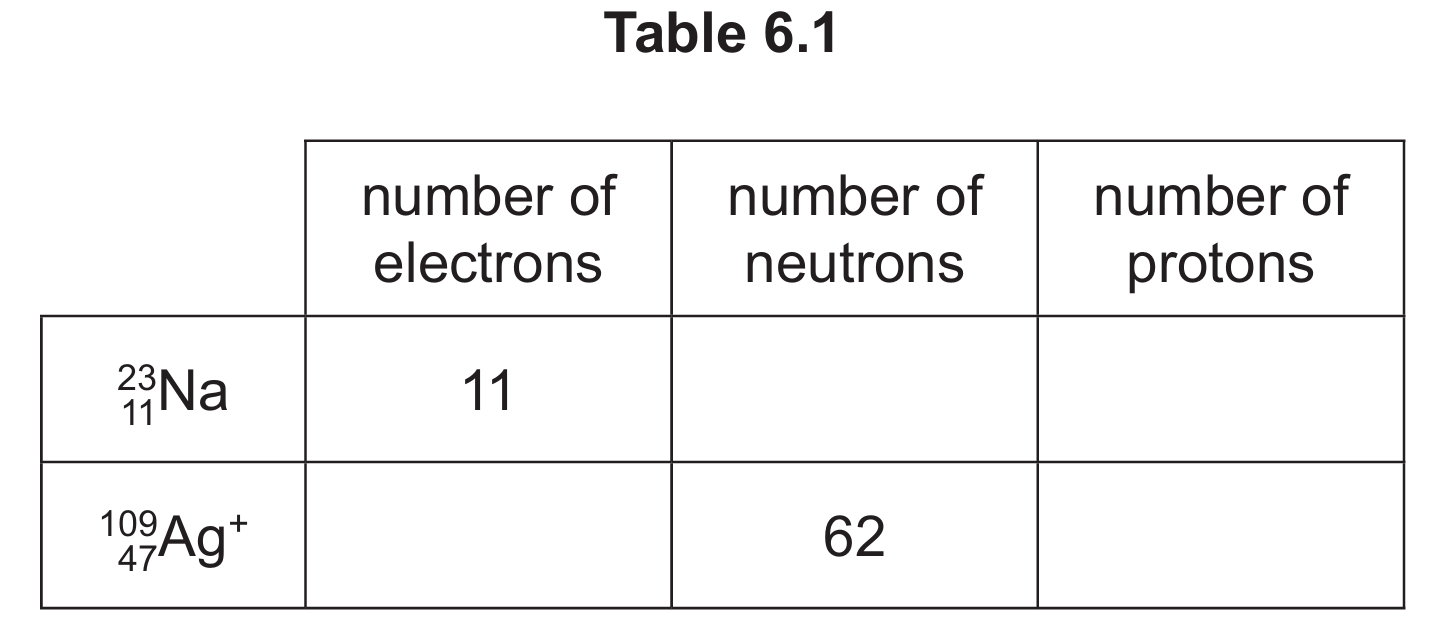
For sodium atom (\( \frac{23}{11}\text{Na} \)): electrons = 11, neutrons = 12 (23−11), protons = 11. For silver ion (\( \frac{109}{47}\text{Ag}^+ \)): electrons = 46 (47−1), neutrons = 62 (109−47), protons = 47. The positive charge on the silver ion indicates it has lost one electron compared to the neutral atom.
(b)(ii)
The electronic configuration of a sodium atom is 2,8,1. This shows that electrons fill the first energy level (K shell) with 2 electrons, the second (L shell) with 8 electrons, and the third (M shell) with the single valence electron responsible for its chemical reactivity.
(c)
Silver has a significantly higher density and melting point than sodium. This difference is because transition metals like silver have stronger metallic bonding due to more delocalized electrons from both the s and d orbitals, compared to Group I metals like sodium which contribute only one electron per atom to the ‘sea’.
(d)
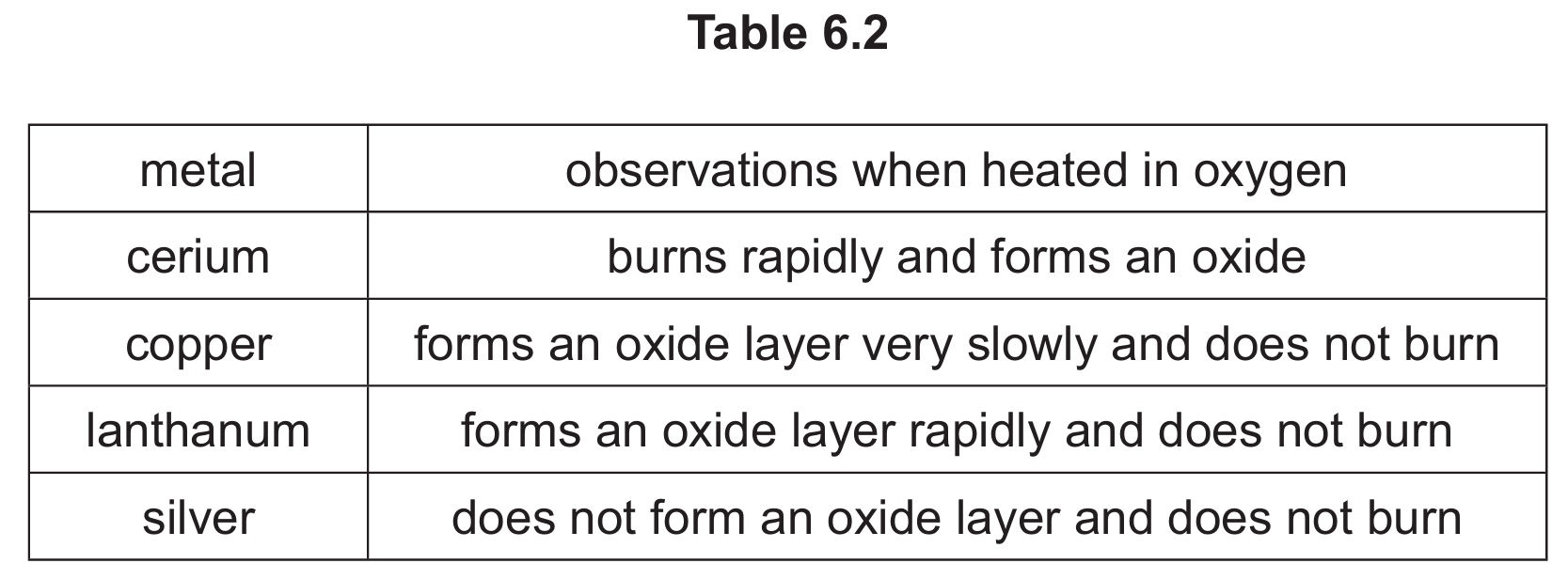
The correct order from least reactive to most reactive is: silver → copper → lanthanum → cerium. Silver shows no reaction with oxygen, copper tarnishes very slowly, lanthanum reacts rapidly but does not ignite, while cerium burns rapidly, indicating it is the most reactive metal among the four.
(e)
Copper(II) oxide is reduced because it loses oxygen to form copper metal. In the reaction CuO → Cu, the copper(II) oxide has had oxygen removed from it, which is the classical definition of reduction. The carbon monoxide acts as the reducing agent by gaining this oxygen to become carbon dioxide.
Question 7
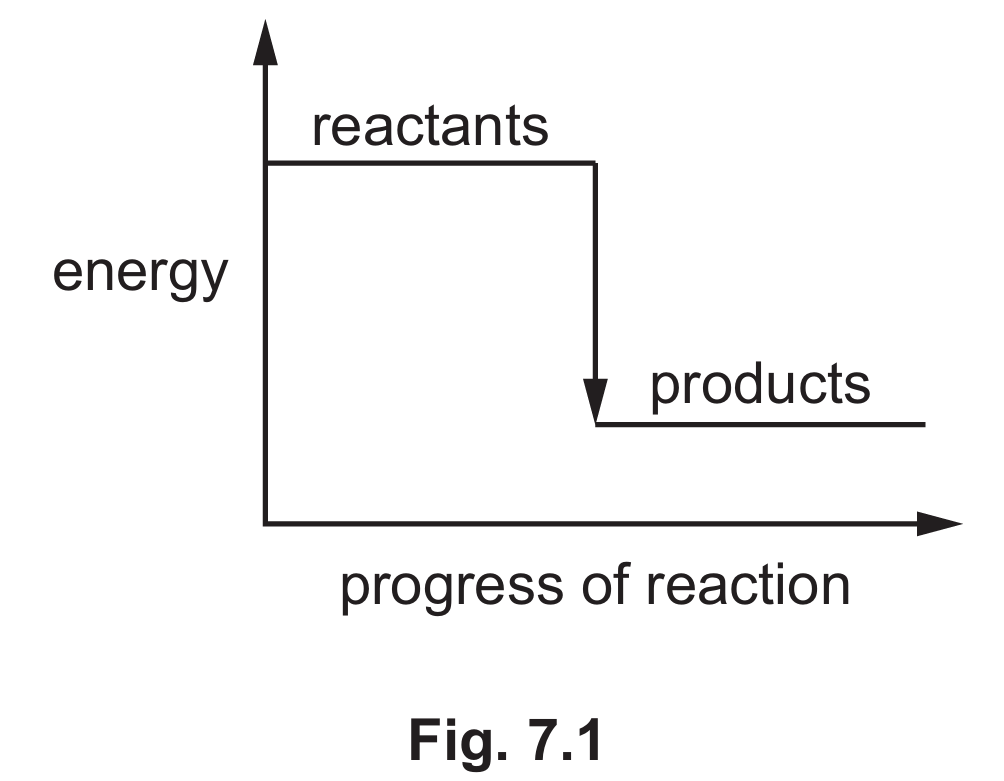
Most-appropriate topic codes (Cambridge IGCSE Chemistry 0620):
• Topic 7.3 — Preparation of salts (Parts (a)(i)-(ii), (b)(i))
• Topic 7.1 — Characteristic properties of acids and bases (Part (b)(ii))
• Topic 5.1 — Exothermic and endothermic reactions (Parts (b)(iii)-(iv))
• Topic 7.1 — The characteristic properties of acids and bases (Part (c))
▶️ Answer/Explanation
(a)(i)
aqueous / dissolved in water
The symbol (aq) indicates that the substance is dissolved in water, forming an aqueous solution where water is the solvent.
(a)(ii)
filtration
Filtration is the correct technique because it separates the insoluble solid (excess zinc oxide) from the liquid solution (zinc sulfate). The residue is the solid, and the filtrate is the solution.
(b)(i)
acid: nitric acid; alkali: sodium hydroxide
Sodium nitrate (NaNO₃) is a salt derived from nitric acid (HNO₃) and sodium hydroxide (NaOH). The reaction is a standard neutralisation: acid + alkali → salt + water.
(b)(ii)
\[ \text{H}^+ + \text{OH}^- \rightarrow \text{H}_2\text{O} \]
This is the ionic equation for neutralisation. Hydrogen ions from the acid react with hydroxide ions from the alkali to form water molecules.
(b)(iii)
release of thermal energy / heat energy to the surroundings
An exothermic reaction is a chemical reaction that transfers energy (usually heat) to its surroundings, causing the temperature of the surroundings to increase.
(b)(iv)
The energy of the products is lower than the energy of the reactants.
In the diagram, the products are on a lower energy level than the reactants. The difference in height (ΔH) is negative, which is the characteristic of an exothermic reaction.
(c)
pH2: red / pink; pH12: yellow
Methyl orange is a pH indicator. In strongly acidic conditions (pH 2) it appears red/pink, and in alkaline conditions (pH 12) it appears yellow. It changes color between pH 3.1 and 4.4.
Question 8
The three concentrations of acid are:
- 0.5 mol/dm3
- 1.0 mol/dm3
- 2.0 mol/dm3
All other conditions stay the same.
Table 8.1 shows the time taken for each reaction to finish.

Most-appropriate topic codes (Cambridge IGCSE Chemistry 0620):
• Topic 6.2 — Rate of reaction (Parts (a)(i)-(iii))
• Topic 4.1 — Electrolysis (Parts (b)(i)-(ii))
• Topic 1.1 — Solids, liquids and gases (Part (c))
▶️ Answer/Explanation
(a)(i)
The concentrations match the times: 1.0 mol/dm³ (32 s), 0.5 mol/dm³ (64 s), 2.0 mol/dm³ (16 s). Higher concentration increases particle collisions per unit volume, speeding up the reaction and reducing the time taken.
(a)(ii)
At a lower temperature, the time taken increases (gets longer). Lower temperature reduces the kinetic energy of particles, leading to fewer collisions exceeding the activation energy, thus a slower rate.
(a)(iii)
Using powdered calcium carbonate decreases the time taken (shorter time). Powdering increases the surface area of the solid, allowing more frequent collisions between acid particles and the solid reactant.
(b)(i)
Positive electrode (anode): Chlorine (Cl₂). Negative electrode (cathode): Calcium (Ca). During electrolysis of molten CaCl₂, Ca²⁺ ions are reduced at the cathode, and Cl⁻ ions are oxidized at the anode.
(b)(ii)
Graphite. Graphite is an inert electrode because it conducts electricity well and does not react with the molten electrolyte or the products (calcium and chlorine).
(c)
Motion: The particles move rapidly in random, straight lines, changing direction upon collisions. Separation: The particles are very far apart relative to their size, with large empty spaces between them, characteristic of the gaseous state.