
Question 1
The formulae of the molecules A to I are shown in Table 1.1.
Table 1.1
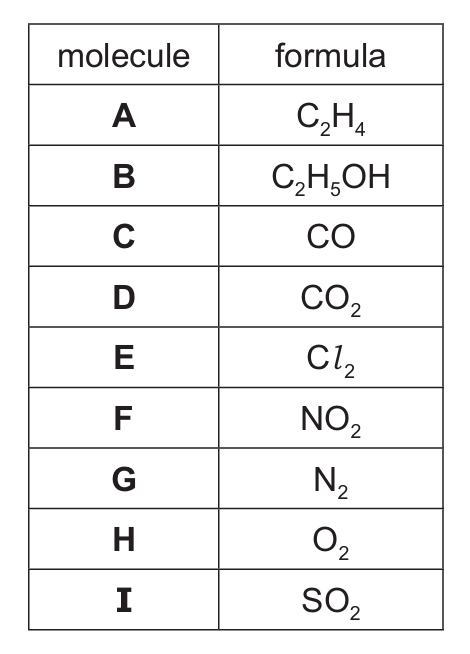
Answer the following questions about the molecules, A to I. Each letter may be used once, more than once or not at all.
State which of the molecules A to I:
(a) is an element with a triple bond
(b) is a product of photosynthesis
(c) is used as a fuel
(d) turns limewater milky
(e) undergoes a substitution reaction with alkanes
(f) is a colourless liquid at r.t.p.
(g) is unsaturated
(h) is 21% of clean, dry air
(i) is a reactant in the Haber process.
Most-appropriate topic codes (Cambridge IGCSE Chemistry 0620):
• Topic 2.5 — Simple molecules and covalent bonds (Part (a))
• Topic 10.3 — Air quality and climate / photosynthesis (Part (b))
• Topic 11.6 — Alcohols (Part (c))
• Topic 12.5 — Identification of ions and gases (Part (d))
• Topic 11.4 — Alkanes (substitution) (Part (e))
• Topic 11.6 — Alcohols (physical properties) (Part (f))
• Topic 11.5 — Alkenes (Part (g))
• Topic 10.3 — Air quality and climate (Part (h))
• Topic 6.3 — Reversible reactions and equilibrium / Haber process (Part (i))
▶️ Answer/Explanation
(a) G (N₂)
Nitrogen gas (N₂) consists of two nitrogen atoms joined by a triple covalent bond, fulfilling the definition of an element with a triple bond.
(b) D (CO₂)
During photosynthesis, plants convert carbon dioxide (CO₂) and water into glucose and oxygen, making CO₂ a key product of the process.
(c) B (C₂H₅OH)
Ethanol (C₂H₅OH) is highly combustible and widely used as a biofuel, for example in mixtures with gasoline or as a spirit burner fuel.
(d) D (CO₂)
Carbon dioxide reacts with calcium hydroxide (limewater) to form an insoluble white precipitate of calcium carbonate, which gives the characteristic milky appearance.
(e) E (Cl₂)
Chlorine gas (Cl₂) reacts with alkanes under ultraviolet light in a photochemical substitution reaction, where a chlorine atom replaces a hydrogen atom.
(f) B (C₂H₅OH)
At room temperature and pressure (r.t.p.), ethanol is a volatile, clear, colourless liquid, unlike the other molecules which are either gases or solids.
(g) A (C₂H₄)
Ethene (C₂H₄) contains a carbon-carbon double bond, classifying it as an unsaturated hydrocarbon, which can be tested using bromine water.
(h) H (O₂)
Clean, dry air is composed of approximately 78% nitrogen and 21% oxygen, making oxygen the second most abundant component and the correct answer.
(i) G (N₂)
The Haber process synthesizes ammonia (NH₃) from its elements, requiring a direct reaction between nitrogen (N₂) and hydrogen (H₂) under high pressure and temperature.
Question 2
Aluminium is manufactured by the electrolysis of aluminium oxide.
(a) State the name of the main ore of aluminium.
(b) Name the substance mixed with aluminium oxide to reduce the operating temperature of the process.
(c) Explain why the molten mixture in (b) conducts electricity.
(d) Table 2.1 contains some information about the processes which take place at the anode and the cathode.
Table 2.1

(i) Complete Table 2.1:
– Write the number of electrons needed to balance the ionic half-equation for the reaction at the anode.
– Write the ionic half-equation for the reaction at the cathode.
(ii) State why the process at the anode is an oxidation.
(iii) Oxygen is formed at the anode.
Explain why the main gas given off at the anode is carbon dioxide and not oxygen.
(e) State why aluminium is used in food containers.
(f) Aluminium reacts with fluorine to form the ionic compound aluminium fluoride.
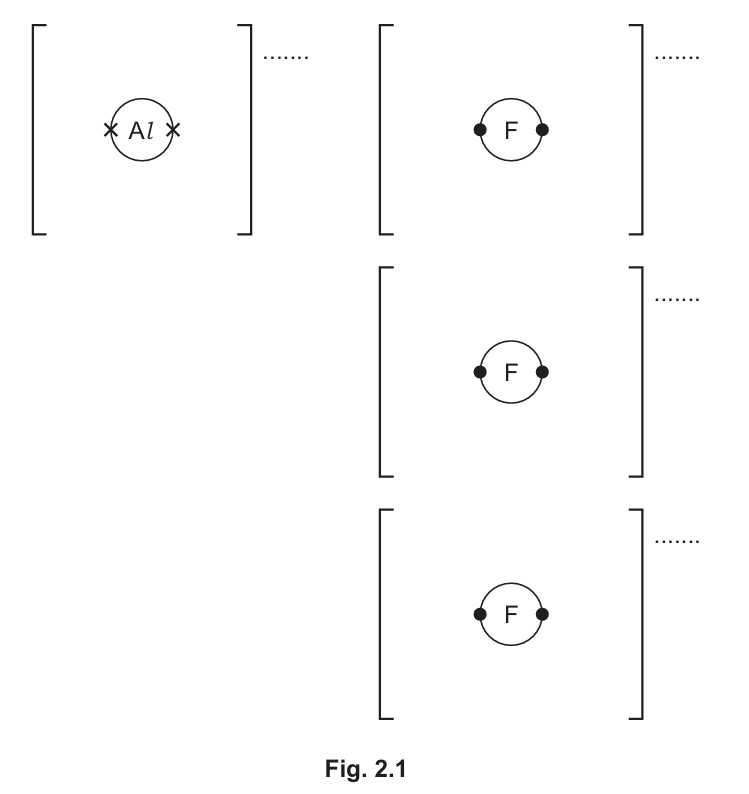
Complete the dot-and-cross diagram in Fig. 2.1 of the ions in aluminium fluoride.
Give the charges on the ions.
Most-appropriate topic codes (Cambridge IGCSE Chemistry 0620):
• Topic 9.6 — Extraction of metals (Parts (a), (b), (e))
• Topic 4.1 — Electrolysis (Parts (c), (d)(i), (d)(ii), (d)(iii))
• Topic 2.4 — Ions and ionic bonds (Part (f))
▶️ Answer/Explanation
(a) Bauxite.
Bauxite is the primary ore containing aluminium oxide (Al₂O₃) from which aluminium is economically extracted after purification.
(b) Cryolite (sodium hexafluoroaluminate, Na₃AlF₆).
Cryolite is added to lower the melting point of the aluminium oxide mixture to about 950°C, saving energy.
(c) The molten mixture contains mobile ions (Al³⁺ and O²⁻) which are free to move and carry charge.
In the molten state, the ionic lattice breaks down, allowing ions to act as charge carriers for electrolysis.
(d)(i) Anode: 4 electrons; Cathode half-equation: Al³⁺ + 3e⁻ → Al.
At the anode, 2O²⁻ → O₂ + 4e⁻ requires 4 electrons; at the cathode each Al³⁺ gains 3 electrons to form neutral aluminium.
(d)(ii) The process at the anode is oxidation because oxide ions lose electrons (O²⁻ → O₂ + 4e⁻).
Loss of electrons is the defining characteristic of an oxidation reaction.
(d)(iii) The anodes are made of carbon/graphite, and the hot oxygen produced reacts with carbon to form CO₂.
Reaction: C(s) + O₂(g) → CO₂(g); this consumes the anodes and releases carbon dioxide instead of pure oxygen.
(e) Aluminium is resistant to corrosion due to its protective oxide layer.
This passive layer prevents further reaction with food or air, making it safe and durable for food containers.
(f) Diagram: Al³⁺ ion (with no outer electrons, charge 3+) and three F⁻ ions each with a full octet (charge 1−).
Aluminium loses its three valence electrons to three fluorine atoms; each fluoride gains one electron to achieve a neon structure.
Question 3
Sulfur forms two chlorides, P and Q. Chloride P has the formula \( S_2Cl_2 \). Chloride Q has the formula \( SCl_2 \).
(a) Both chlorides are covalently bonded and have low melting points.
Suggest, in terms of attraction between particles, why these chlorides have low melting points.
(b) Chloride P, \( S_2Cl_2 \), forms when sulfur reacts with chlorine.
Write the symbol equation for this reaction.
(c) Complete the dot-and-cross diagram in Fig. 3.1 of a molecule of chloride Q, \( SCl_2 \).
Show outer electrons only.

(d) Chloride P is converted to chloride Q by reaction with chlorine in a closed system. The reversible reaction reaches an equilibrium.
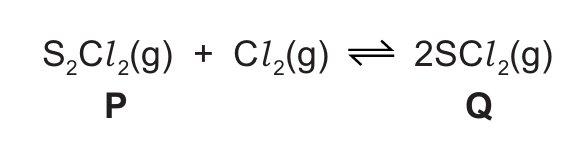
The forward reaction is exothermic.
Suggest two changes to the conditions which will result in a decrease in the concentration of chloride Q at equilibrium.
(e) The rate of the forward reaction in (d) is determined by collision theory.
The rate of reaction depends upon two factors:
- the frequency of collisions between particles
- the proportion of collisions which have energy greater than or equal to the activation energy.
(i) Define the term activation energy.
(ii) Give the symbol for activation energy.
(iii) Complete Table 3.1 to show the effect, if any, when the conditions are changed.
Use only the words increases, decreases or no change.

(f) The reaction of chloride P with chlorine is a redox reaction.
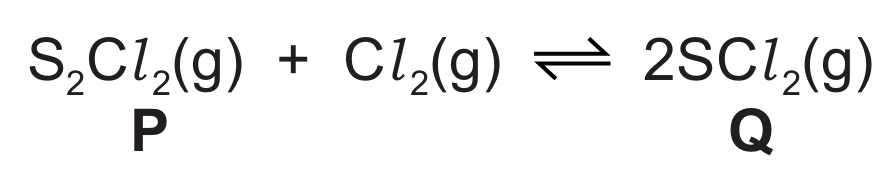
The oxidation number of Cl in chloride P and chloride Q is -1.
Use oxidation numbers to explain why:
- sulfur is oxidised in the forward reaction
- chlorine is oxidised in the reverse reaction.
Most-appropriate topic codes (Cambridge IGCSE Chemistry 0620):
• Topic 2.5 — Simple molecules and covalent bonds (Parts (a), (c))
• Topic 6.3 — Reversible reactions and equilibrium (Part (d))
• Topic 6.2 — Rate of reaction / Collision theory (Parts (e)(i), (e)(ii), (e)(iii))
• Topic 6.4 — Redox (Part (f))
• Topic 3.1 — Formulae and equations (Part (b))
▶️ Answer/Explanation
(a) Topic 2.5 These chlorides are simple molecular substances. The intermolecular forces (weak van der Waals forces) between the molecules are weak, requiring little energy to overcome, hence they have low melting points.
(b) Topic 3.1 \( 2S + Cl_2 \rightarrow S_2Cl_2 \)
(c) Topic 2.5 The diagram must show: Central S atom with 6 outer electrons, two Cl atoms each with 7 outer electrons. Sulfur forms two single bonds (sharing 1 dot and 1 cross with each Cl). The remaining 4 electrons on Sulfur are shown as 2 lone pairs. Each Chlorine shows 3 lone pairs (6 electrons) after bonding.
(d) Topic 6.3 1. Increase the temperature (favors endothermic reverse reaction, decreasing Q). 2. Decrease the concentration of Chlorine (\(Cl_2\)) (shifts equilibrium left, decreasing Q).
(e)(i) Topic 6.2 Activation energy is the minimum energy that colliding particles must possess for a chemical reaction to occur.
(e)(ii) Topic 6.2 \( E_a \)
(e)(iii) Topic 6.2
Increasing \([Cl_2]\): Frequency = increases, Proportion = no change.
Increasing Temperature: Frequency = increases, Proportion = increases.
Adding Catalyst: Frequency = no change, Proportion = increases.
(f) Topic 6.4 Forward: In \(S_2Cl_2\) S is +1, in \(SCl_2\) S is +2 (increase = oxidation). Reverse: In \(SCl_2\) Cl is -1, in \(Cl_2\) Cl is 0 (increase = oxidation).
Question 4
Silver bromide, AgBr, is made when aqueous silver ethanoate, CH3COOAg, is added to aqueous sodium bromide, NaBr.
The equation for the reaction is shown in equation 1.
equation 1
CH3COOAg + NaBr → CH3COONa + AgBr
The method includes the following steps.
step 1 Add 200.0 cm3 of 0.0500 mol/dm3 CH3COOAg to a beaker. This volume contains 0.0100 mol of Ag+ ions.
step 2 Add 50.0 cm3 of aqueous NaBr. This volume contains 0.0100 mol of Br– ions. A precipitate forms.
step 3 Filter the mixture.
step 4 Dry the solid residue until all the water is removed.
step 5 Record the mass of the dry residue.
(a) Complete the ionic equation for the reaction by adding the missing state symbols.
\[ \text{Ag}^+(……) + \text{Br}^-(……) \rightarrow \text{AgBr}(……) \]
(b) Name a different aqueous silver salt which could be used in step 1.
(c) Use the information in step 2 to calculate the concentration of aqueous NaBr.
(d) State the colour of the precipitate which forms in step 2.
(e) Use the information in step 1, step 2 and equation 1 to determine the number of moles of AgBr formed. Use this value to calculate the mass of AgBr formed.
(f) Name the salt dissolved in the filtrate in step 3.
(g) The recorded mass of the dry residue in step 5 is greater than the mass calculated in (e) because a step is missing from the procedure.
(i) Suggest the missing step.
(ii) Name the substance responsible for the greater mass of the dry residue.
(h) Barium sulfate can be made by the same method but with different aqueous solutions.
(i) Suggest two aqueous solutions which can be added together to make barium sulfate.
(ii) Write the balanced symbol equation for this reaction.
Most-appropriate topic codes (Cambridge IGCSE Chemistry 0620):
• Topic 7.3 — Preparation of salts (Parts (a) to (h))
▶️ Answer/Explanation
(a) \[ \text{Ag}^+(aq) + \text{Br}^-(aq) \rightarrow \text{AgBr}(s) \]
Silver ions and bromide ions are in aqueous solution before the reaction, and they combine to form an insoluble solid precipitate of silver bromide.
(b) Silver nitrate (AgNO₃)
Silver nitrate is another common soluble silver salt that dissociates in water to provide Ag⁺ ions, making it suitable for preparing silver halides.
(c) 0.200 mol/dm³
Concentration = moles ÷ volume (in dm³). Volume = 50.0/1000 = 0.05 dm³. Concentration = 0.0100 / 0.05 = 0.200 mol/dm³.
(d) Cream (or pale yellow)
Silver bromide is well-known for its characteristic cream-colored precipitate, which distinguishes it from white silver chloride and yellow silver iodide.
(e) number of moles of AgBr = 0.0100 mol, mass of AgBr = 1.88 g
From the 1:1 mole ratio in the ionic equation, moles of AgBr = 0.0100 mol. Molar mass of AgBr = 108 + 80 = 188 g/mol. Mass = 0.0100 × 188 = 1.88 g.
(f) Sodium ethanoate (CH₃COONa)
The other product of the reaction is sodium ethanoate, which is soluble in water and remains dissolved in the filtrate.
(g)(i) Washing the residue with distilled water
Washing removes soluble impurities (like sodium ethanoate) that remain on the precipitate after filtration.
(g)(ii) Sodium ethanoate (or any soluble salt present)
If the residue is not washed, soluble salts crystallize during drying and add extra mass to the solid residue.
(h)(i) Barium chloride (BaCl₂) and sodium sulfate (Na₂SO₄)
Any soluble barium salt and any soluble sulfate salt can be mixed to produce the insoluble barium sulfate precipitate.
(h)(ii) BaCl₂(aq) + Na₂SO₄(aq) → BaSO₄(s) + 2NaCl(aq)
This is a double displacement reaction where the barium and sulfate ions combine to form the insoluble white precipitate of barium sulfate.
Question 5
Alkenes are manufactured by cracking larger alkane molecules.
(a) State the source of the large alkane molecules used in cracking.
(b) State two conditions needed for cracking large alkane molecules.
(c) When one molecule of dodecane, \( C_{12}H_{26} \), is cracked, three molecules of but-1-ene and one other product are formed.
(i) Use molecular formulae to complete the symbol equation for this reaction.
\( C_{12}H_{26} \rightarrow \) ………………………………… + …………………………………
(ii) Suggest the type of chemical reaction which happens during cracking.
(d) Propene will undergo polymerisation.
(i) Suggest the name of the polymer formed from propene.
(ii) Draw part of this polymer molecule to show three repeat units.
(iii) State the type of polymerisation propene undergoes.
Most-appropriate topic codes (Cambridge IGCSE Chemistry 0620):
• Topic 11.3 — Fuels and petroleum (Parts (a), (c))
• Topic 11.5 — Alkenes (Parts (b), (c)(ii), (d))
• Topic 11.8 — Polymers (Parts (d)(i), (d)(ii), (d)(iii))
▶️ Answer/Explanation
(a) Petroleum (or crude oil).
Petroleum is the primary source of large alkane molecules (long-chain hydrocarbons) which are separated by fractional distillation before being cracked into smaller, more useful molecules like alkenes.
(b) Any two from: high temperature (e.g., 400-700°C), a catalyst (e.g., silica, alumina, or zeolites), or high pressure.
Cracking is an endothermic process requiring high temperatures to break strong carbon-carbon bonds, while a catalyst provides an alternative reaction pathway with a lower activation energy, making the process economically viable.
(c)(i) \( C_{12}H_{26} \rightarrow 3C_4H_8 + H_2 \)
To balance the equation: three molecules of but-1-ene (3 × C₄H₈) account for 12 carbons and 24 hydrogens. The original dodecane has 26 hydrogens, so the remaining 2 hydrogens form one molecule of hydrogen gas (H₂).
(c)(ii) Thermal decomposition (or catalytic cracking).
Cracking involves breaking down large hydrocarbon molecules into smaller ones using heat, which fits the definition of thermal decomposition. When a catalyst is used, it is specifically called catalytic cracking.
(d)(i) Poly(propene) (or polypropylene).
The polymer is named by adding the prefix ‘poly-‘ to the name of the monomer (propene), following IUPAC nomenclature for addition polymers.
(d)(ii) The structure showing three repeat units of poly(propene) is:
\(-[\text{CH}_2-\text{CH}(\text{CH}_3)]-[\text{CH}_2-\text{CH}(\text{CH}_3)]-[\text{CH}_2-\text{CH}(\text{CH}_3)]-\)
In the diagram, the carbon backbone is drawn with single bonds, and a methyl group (CH₃) is attached to every other carbon atom, representing the repeat unit derived from propene. The brackets indicate the repeating nature of the polymer chain.
(d)(iii) Addition polymerisation.
Propene contains a carbon-carbon double bond (C=C). During addition polymerisation, this double bond ‘opens up’ allowing monomers to join together in a long chain without the loss of any small molecules (unlike condensation polymerisation).
Question 6
Polyamides and polyesters are polymers.
Polyamides can occur naturally or can be manufactured.
(a) Part of the structure of a polyamide is shown in Fig. 6.1.

(i) On Fig. 6.1, draw a circle around one amide linkage.
(ii) Complete Fig. 6.2 to show the structures of the two monomers needed to make the polymer in Fig. 6.1.
Show all of the atoms and all of the bonds in the functional groups.

(iii) Name the other product formed in this polymerisation.
(iv) State the term given to natural polyamides.
(v) Name the type of monomers which are used to make natural polyamides.
(vi) One of the monomers which forms part of a natural polyamide has three carbon atoms.
Complete Fig. 6.3 to show the displayed formula of this monomer.

(b) PET is a polyester.
(i) Name the two types of monomer molecules needed to make polyesters.
(ii) Draw part of the structure of PET which shows two repeat units.
Show all of the atoms and all of the bonds in the linkages.
Most-appropriate topic codes (Cambridge IGCSE Chemistry 0620):
• Topic 11.8 — Polymers (Parts (a)(i)-(vi), (b)(i)-(ii))
▶️ Answer/Explanation
(a)(i) The amide linkage is the -CO-NH- group. On Fig. 6.1, a circle should be drawn around any complete -CO-NH- unit (e.g., the bond between the carbonyl carbon and the nitrogen).
(a)(ii) The two monomers are a dicarboxylic acid (HOOC-CH₂-COOH) and a diamine (H₂N-CH₂-CH₂-NH₂). Both must show all atoms and bonds, especially the -COOH and -NH₂ functional groups.
(a)(iii) The other product formed is water (H₂O). This is a condensation polymerisation where a small molecule is eliminated each time a new bond forms.
(a)(iv) Natural polyamides are called proteins. They are essential biological macromolecules found in all living organisms.
(a)(v) The monomers used to make natural polyamides are amino acids. Each amino acid contains both a basic amino group and an acidic carboxyl group.
(a)(vi) The monomer with three carbon atoms is the amino acid 2-aminopropanoic acid (alanine). Its displayed formula shows a central carbon bonded to H, CH₃, NH₂, and COOH.
(b)(i) The two types of monomers needed to make polyesters are dicarboxylic acids (with two -COOH groups) and diols (with two -OH groups).
(b)(ii) PET (polyethylene terephthalate) is made from benzene-1,4-dicarboxylic acid and ethane-1,2-diol. The structure of two repeat units shows the repeating [-O-CH₂-CH₂-O-CO-C₆H₄-CO-] pattern, with the ester linkage (-COO-) clearly drawn, all atoms and bonds shown, and continuation bonds at both ends.