
Question 1
A list of substances is shown:
bauxite, carbon dioxide, cryolite, ethane, ethanol, ethene, graphite, helium, hematite, hydrogen, silicon(IV) oxide, sodium chloride
Answer the following questions using only the substances from the list. Each substance may be used once, more than once or not at all.
State which substance:
(a) is manufactured by fermentation
(b) is monatomic
(c) is a reactant in photosynthesis
(d) is a solvent in the extraction of aluminium
(e) is an ore of iron
(f) is manufactured from methane
(g) is a compound with a giant covalent structure
(h) is used as a lubricant
(i) is tested for with limewater
Most-appropriate topic codes (Cambridge IGCSE Chemistry 0620):
• Topic 11.6 — Alcohols (Part a)
• Topic 8.5 — Noble gases (Part b)
• Topic 10.3 — Air quality and climate (Part c)
• Topic 9.6 — Extraction of metals (Part d)
• Topic 9.6 — Extraction of metals (Part e)
• Topic 11.3 — Fuels (Part f)
• Topic 2.6 — Giant covalent structures (Part g)
• Topic 2.6 — Giant covalent structures (Part h)
• Topic 12.5 — Identification of ions and gases (Part i)
▶️ Answer/Explanation
(a) ethanol
Ethanol is produced by the fermentation of glucose (sugar) in the absence of oxygen, using enzymes found in yeast, making it the key alcohol manufactured this way.
(b) helium
Helium is a noble gas with a full outer shell of electrons, making it chemically inert and causing it to exist as single, separate atoms (monatomic).
(c) carbon dioxide
Carbon dioxide is absorbed by plants from the atmosphere and, together with water, is converted into glucose and oxygen during photosynthesis.
(d) cryolite
Cryolite is used to lower the melting point of aluminium oxide (bauxite), acting as a solvent to make the electrolysis process more energy-efficient.
(e) hematite
Hematite is a naturally occurring mineral consisting mainly of iron(III) oxide (Fe₂O₃), which is the primary ore used for extracting iron in a blast furnace.
(f) hydrogen
Hydrogen is often produced industrially by steam reforming of methane (natural gas) at high temperatures, yielding hydrogen gas and carbon monoxide.
(g) silicon(IV) oxide
Silicon(IV) oxide (SiO₂) forms a giant covalent lattice where each silicon atom is bonded to four oxygen atoms, resulting in a very hard, high-melting-point solid.
(h) graphite
Graphite has a layered structure with weak forces between layers, allowing them to slide over each other, which makes it an ideal solid lubricant.
(i) carbon dioxide
Carbon dioxide turns limewater (calcium hydroxide solution) milky or cloudy due to the formation of insoluble white calcium carbonate precipitate.
Topic codes: 11.6, 8.5, 10.3, 9.6, 2.6, 12.5
Question 2
This question is about electrolysis.
(a) State the meaning of the term electrolysis.
(b) Table 2.1 gives some information about the electrolysis of two electrolytes using graphite electrodes.
Table 2.1
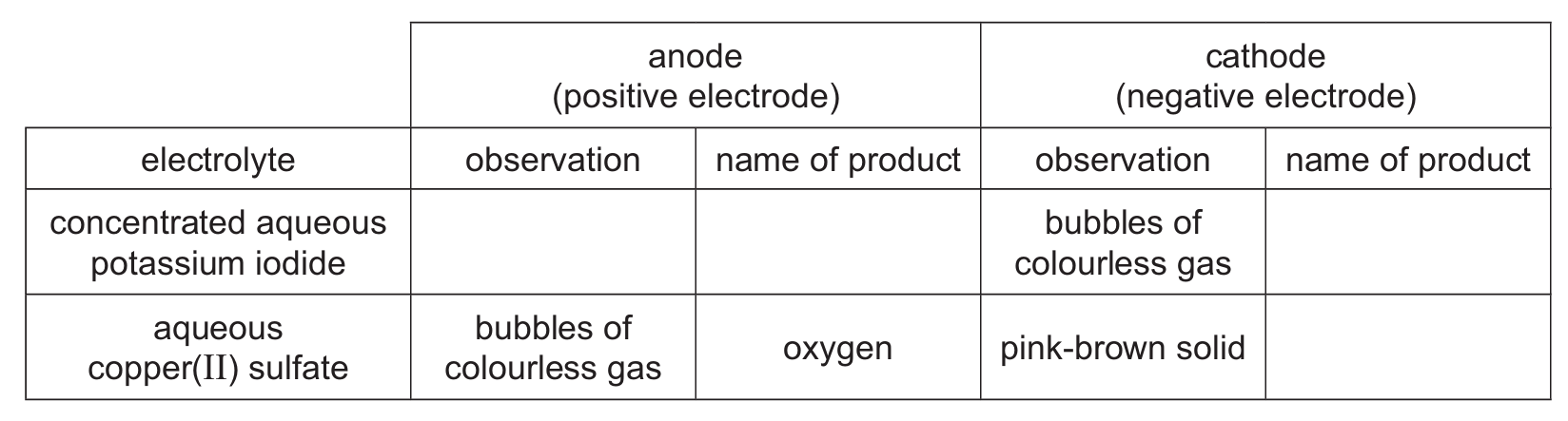
(i) Complete Table 2.1.
(ii) Oxygen is produced at the anode by the electrolysis of aqueous copper(II) sulfate. Write the ionic half-equation for this reaction.
(c) Aqueous copper(II) sulfate is electrolysed using copper electrodes instead of graphite electrodes.
(i) Explain why the mass of the anode decreases during this electrolysis.
(ii) Name the product formed at the cathode.
(iii) State what change, if any, is observed in the appearance of the aqueous copper(II) sulfate.
Most-appropriate topic codes (Cambridge IGCSE Chemistry 0620):
• Topic 4.1 — Electrolysis (Parts (a), (b)(i), (b)(ii), (c)(i), (c)(ii), (c)(iii))
▶️ Answer/Explanation
(a) Electrolysis is the decomposition of an ionic compound, when molten or in aqueous solution, by the passage of an electric current.
(b)(i) Completed Table 2.1:
– For concentrated aqueous potassium iodide: Anode product is iodine (brown solution/black solid); Cathode product is hydrogen (colourless gas bubbles).
– For aqueous copper(II) sulfate: Cathode product is copper (pink-brown solid).
(b)(ii) The ionic half-equation for oxygen formation at the anode is:
\(4\mathrm{OH}^{-}(\mathrm{aq}) \rightarrow 2\mathrm{H_2O}(\mathrm{l}) + \mathrm{O_2}(\mathrm{g}) + 4\mathrm{e}^{-}\).
(c)(i) The mass of the anode decreases because copper atoms from the anode lose electrons to form soluble copper(II) ions (\(\mathrm{Cu}^{2+}\)), which enter the solution, causing the anode to dissolve.
(c)(ii) The product formed at the cathode is copper.
(c)(iii) There is no change in the appearance of the aqueous copper(II) sulfate.
Detailed Explanation: In electrolysis with inert electrodes, ions are discharged based on reactivity. With a copper anode, the copper atoms themselves oxidise, plating out at the cathode, so the solution concentration and colour remain constant.
Question 3
This question is about compounds of tin.
(a) Tin(IV) oxide has the formula SnO₂. The relative formula mass, \( M_r \) of SnO₂ is 151. Calculate the percentage by mass of tin in SnO₂.
(b) SnO₂ is an amphoteric oxide. SnO₂ reacts with aqueous sodium hydroxide, NaOH, to form a sodium salt and water only. The sodium salt contains a negative ion with the formula SnO₃²⁻.
(i) State the meaning of the term amphoteric.
(ii) Write the symbol equation for the reaction between SnO₂ and NaOH.
(c) Tin is a metal that forms both covalent and ionic compounds. Suggest why this is unusual for a metal.
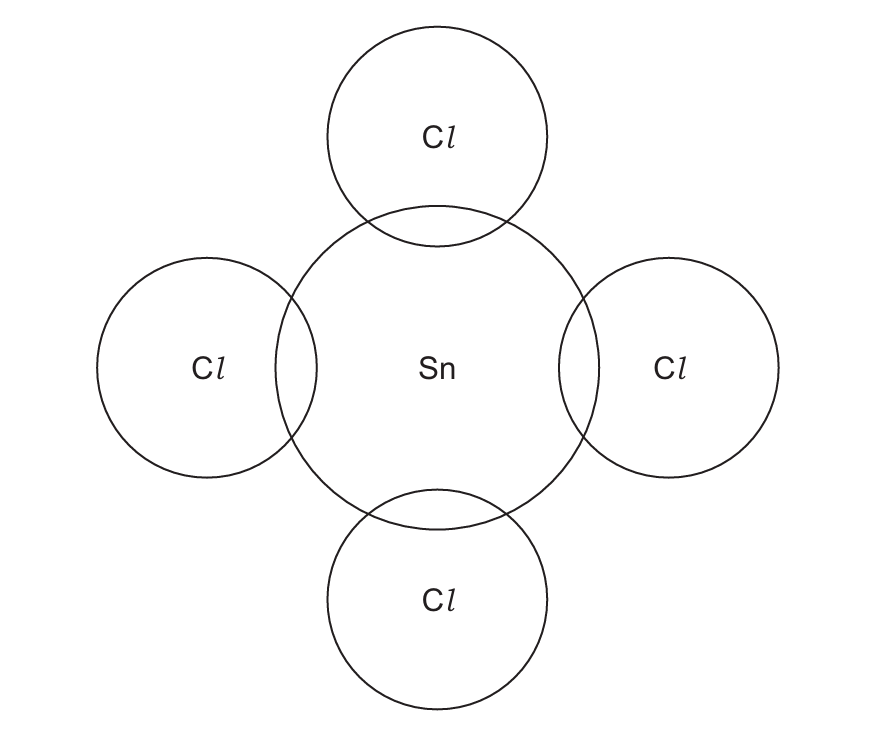
(d) (i) Tin(IV) chloride, SnCl₄ is covalently bonded. A tin atom has four electrons in its outer shell. Complete the dot-and-cross diagram in Fig. 3.1 for a molecule of SnCl₄. Show the outer shell electrons only.
(ii) Tin(II) oxide, SnO, is ionically bonded. The melting points of SnCl₄ and SnO are shown in Table 3.1.
Table 3.1
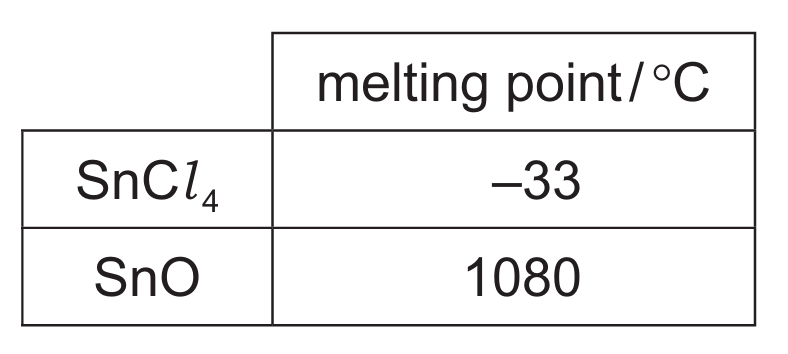
Explain, in terms of structure and bonding, why SnCl₄ has a much lower melting point than SnO.
(e) Part of the reactivity series is shown.
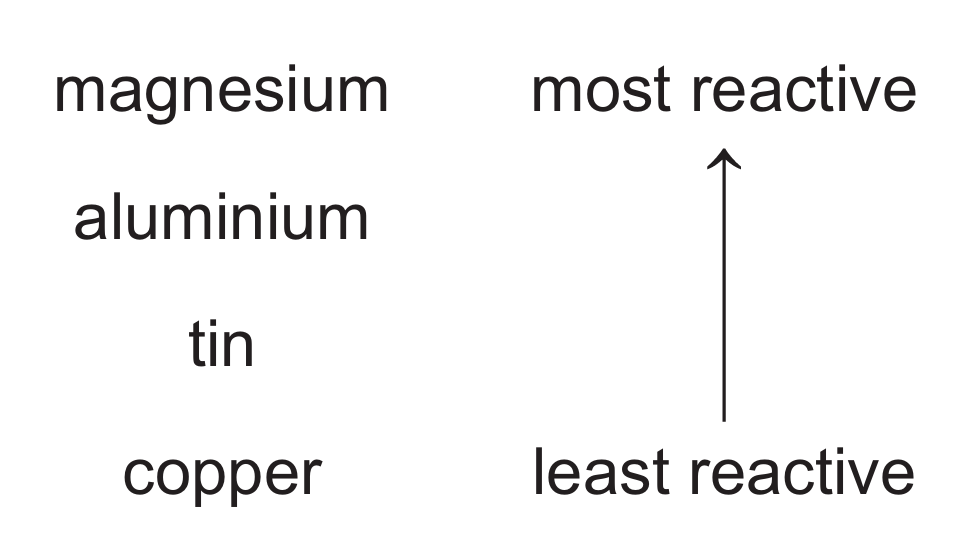
(i) When aluminium foil is added to aqueous tin(II) sulfate, a reaction does not occur even though aluminium is above tin in the reactivity series. Explain why a reaction does not occur.
(ii) An aqueous solution of tin(II) sulfate contains Sn²⁺ ions. Two experiments are carried out.
Experiment 1 Copper is added to aqueous tin(II) sulfate.
Experiment 2 Magnesium is added to aqueous tin(II) sulfate.
Write an ionic equation for any reaction that occurs in each experiment. If no reaction occurs, write ‘no reaction’.
(f) Hydrated tin(II) nitrate, Sn(NO₃)₂•20H₂O, decomposes when it is heated.
(i) State what is meant by the term hydrated.
(ii) Complete the equation for the decomposition of Sn(NO₃)₂•20H₂O.
2Sn(NO₃)₂•20H₂O → ……SnO + ……NO₂ + O₂ + ……H₂O
Most-appropriate topic codes (Cambridge IGCSE Chemistry 0620):
• Topic 3.2 — Relative masses of atoms and molecules (Part (a))
• Topic 7.2 — Oxides (Parts (b)(i), (b)(ii))
• Topic 2.4/2.5 — Ions and ionic bonds / Simple molecules and covalent bonds (Parts (c), (d)(i))
• Topic 2.4 — Ions and ionic bonds (Part (d)(ii))
• Topic 9.4 — Reactivity series (Parts (e)(i), (e)(ii))
• Topic 7.3 — Preparation of salts (Parts (f)(i), (f)(ii))
▶️ Answer/Explanation
(a) 78.8%
Detailed solution: The relative atomic mass of tin (Sn) is 119. The percentage by mass is calculated as (Ar of Sn / Mr of SnO₂) × 100 = (119 / 151) × 100 = 78.8%.
(b)(i) An amphoteric oxide is an oxide that reacts with both acids and bases to produce a salt and water.
Detailed solution: This means it shows both acidic behaviour (reacting with bases) and basic behaviour (reacting with acids), which is a property of elements like aluminium, zinc, and tin.
(b)(ii) \( \text{SnO}_2 + 2\text{NaOH} \rightarrow \text{Na}_2\text{SnO}_3 + \text{H}_2\text{O} \)
Detailed solution: Since the sodium salt contains SnO₃²⁻, two Na⁺ ions are needed to balance the charge, forming Na₂SnO₃. The remaining atoms balance to give one water molecule.
(c) Metals typically only form ionic compounds by losing electrons, not covalent bonds.
Detailed solution: Covalent bonding involves sharing electrons between non-metals. Tin is unusual because its outer electrons are held strongly enough to be shared (covalent) but can still be lost to form ions (ionic), similar to some metalloids.
(d)(i) The dot-and-cross diagram should show a central Sn atom with four single covalent bonds to four Cl atoms. Each Cl atom must have three lone pairs of electrons around it. Sn has no lone pairs.
Detailed solution: Sn has 4 outer electrons, each shared with one Cl (7 outer electrons each). After sharing, Sn achieves an octet, and each Cl has a complete outer shell (8 electrons).
(d)(ii) SnCl₄ is a simple molecular substance with weak intermolecular forces, while SnO is a giant ionic lattice with strong electrostatic forces.
Detailed solution: Little energy is needed to overcome weak forces between SnCl₄ molecules, so its melting point is low. A lot of energy is needed to break strong ionic bonds in the SnO lattice, so its melting point is high.
(e)(i) Aluminium has a protective, unreactive layer of aluminium oxide on its surface.
Detailed solution: This oxide layer prevents the aluminium metal underneath from coming into contact with the tin(II) sulfate solution, so no displacement reaction can occur despite aluminium being more reactive.
(e)(ii) Experiment 1: no reaction
Experiment 2: \( \text{Mg} + \text{Sn}^{2+} \rightarrow \text{Mg}^{2+} + \text{Sn} \)
Detailed solution: Copper is below tin, so it cannot displace tin. Magnesium is above tin, so it displaces tin ions to form magnesium ions and solid tin.
(f)(i) A hydrated substance contains water molecules chemically bonded within its crystal structure (water of crystallisation).
Detailed solution: This is different from being ‘wet’. The water is part of the crystal lattice, shown by a dot in the formula (e.g., CuSO₄·5H₂O).
(f)(ii) \( 2\text{Sn(NO}_3\text{)}_2•20\text{H}_2\text{O} \rightarrow 2\text{SnO} + 4\text{NO}_2 + \text{O}_2 + 40\text{H}_2\text{O} \)
Detailed solution: Balancing: 2 Sn on both sides. 4 nitrate groups produce 4 NO₂. The remaining oxygen forms O₂. The 40 water molecules come from the 20 H₂O per formula unit × 2.
Question 4
This question is about sulfuric acid, \( H_2SO_4 \).
(a) Dilute sulfuric acid and aqueous sodium hydroxide can be used to prepare sodium sulfate crystals using a method that involves titration.
The apparatus for titration is shown in Fig. 4.1.

Thymolphthalein is used as an indicator for this titration.
(i) State the colour change of thymolphthalein at the end-point of this titration.
(ii) Suggest why universal indicator is not used for this titration.
(b) 25.0 cm³ of aqueous sodium hydroxide, NaOH, of concentration 0.100 mol/dm³ is neutralised by 20.0 cm³ of dilute sulfuric acid, \( H_2SO_4 \).
The equation for the reaction is shown.
\[2NaOH + H_2SO_4 \rightarrow Na_2SO_4 + 2H_2O\]
Calculate the concentration of \( H_2SO_4 \) using the following steps.
– Calculate the number of moles of NaOH used.
– Determine the number of moles of \( H_2SO_4 \) that react with the NaOH.
– Calculate the concentration of \( H_2SO_4 \).
(c) A student is provided with an aqueous solution of sodium sulfate.
Describe how to prepare a pure sample of sodium sulfate crystals from this solution.
(d) Potassium hydrogen sulfate, \( KHSO_4 \), can be prepared by a reaction between aqueous potassium hydroxide and dilute sulfuric acid. Water is the only other product.
Write a symbol equation for this reaction.
(e) Potassium hydrogen sulfate, \( KHSO_4 \), dissolves in water to form solution X.
Solution X contains \( K^+ \), \( H^+ \) and \( SO_4^{2-} \) ions.
(i) Name the type of solution that contains \( H^+ \) ions.
(ii) State the observations when the following tests are done.
- A flame test is carried out on X.
- Solid copper(II) carbonate is added to X.
- Aqueous barium nitrate acidified with dilute nitric acid is added to X.
(f) 0.325 g of Zn is added to dilute sulfuric acid which contains 0.0100 moles of \( H_2SO_4 \).
The equation for this reaction is shown.
\[Zn + H_2SO_4 \rightarrow ZnSO_4 + H_2\]
(i) Determine whether Zn or \( H_2SO_4 \) is the limiting reactant.
Explain your answer.
(ii) In another experiment, 48.0 cm³ of hydrogen gas, \( H_2 \), is produced. The experiment is carried out at room temperature and pressure, r.t.p.
Calculate the number of molecules in 48.0 cm³ of \( H_2 \) gas measured at r.t.p.
The value of the Avogadro constant is \( 6.02 \times 10^{23} \).
Most-appropriate topic codes (Cambridge IGCSE Chemistry 0620):
• Topic 7.3 — Preparation of salts (Parts (a), (c), (d))
• Topic 3.3 — The mole and the Avogadro constant (Parts (b), (f)(ii))
• Topic 12.5 — Identification of ions and gases (Parts (e)(i), (e)(ii))
• Topic 6.4 — Redox / limiting reactants (Part (f)(i))
▶️ Answer/Explanation
(a)(i) The colour change is from blue to colourless. Thymolphthalein is blue in alkaline conditions and colourless in acidic conditions, so at the end-point (neutral to slightly acidic) the blue colour disappears sharply.
(a)(ii) Universal indicator is not used because it shows a gradual range of colours over a wide pH scale, which makes it very difficult to determine the exact equivalence point of the titration accurately.
(b) Moles of NaOH = (0.100 mol/dm³) × (25.0/1000 dm³) = 0.00250 mol.
Moles of H₂SO₄ = 0.00250 mol ÷ 2 = 0.00125 mol (2:1 ratio).
Concentration of H₂SO₄ = 0.00125 mol ÷ (20.0/1000 dm³) = 0.0625 mol/dm³.
(c) Warm the solution gently to concentrate it, then leave it to cool slowly so that crystals form. Filter off the crystals using vacuum filtration, wash them with a little cold distilled water, and dry them between sheets of filter paper.
(d) KOH(aq) + H₂SO₄(aq) → KHSO₄(aq) + H₂O(l)
(e)(i) Acidic solution (or acid).
(e)(ii) Flame test: Lilac flame (characteristic of potassium ions).
Copper(II) carbonate: Effervescence (bubbles of CO₂), solid dissolves, blue solution formed.
Barium nitrate: White precipitate of barium sulfate (insoluble in acid).
(f)(i) Moles Zn = 0.325 g / 65 g/mol = 0.00500 mol. Reaction requires 1:1 ratio with H₂SO₄. Only 0.00500 mol H₂SO₄ is needed, but 0.0100 mol is present. Zn runs out first, so Zn is the limiting reactant.
(f)(ii) Moles H₂ = 48.0 cm³ / 24000 cm³/mol = 0.00200 mol.
Number of molecules = 0.00200 mol × (6.02 × 10²³) = 1.20 × 10²¹ molecules.
Question 5
This question is about rate of reaction and equilibrium.
A student investigates the rate of decomposition of aqueous hydrogen peroxide, \( H_2O_2 \), using manganese(IV) oxide as a catalyst.
The equation for the reaction is shown.
\( 2H_2O_2(aq) \rightarrow 2H_2O(l) + O_2(g) \)
The student uses the apparatus shown in Fig. 5.1.
Fig. 5.1
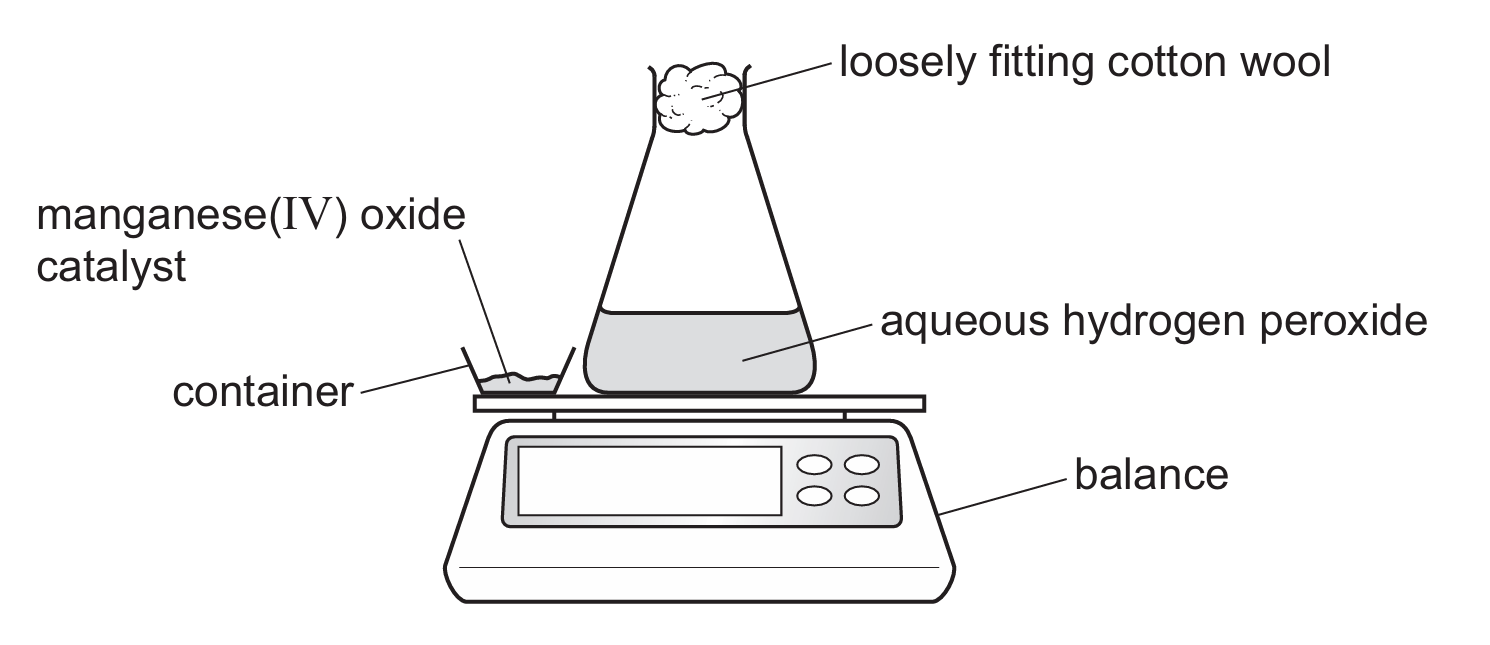
The student:
- adds the catalyst to the aqueous hydrogen peroxide
- replaces the container on the balance
- starts a stop-watch
- records the mass at regular time intervals.
(a) Table 5.1 shows the mass recorded at regular time intervals.
Table 5.1
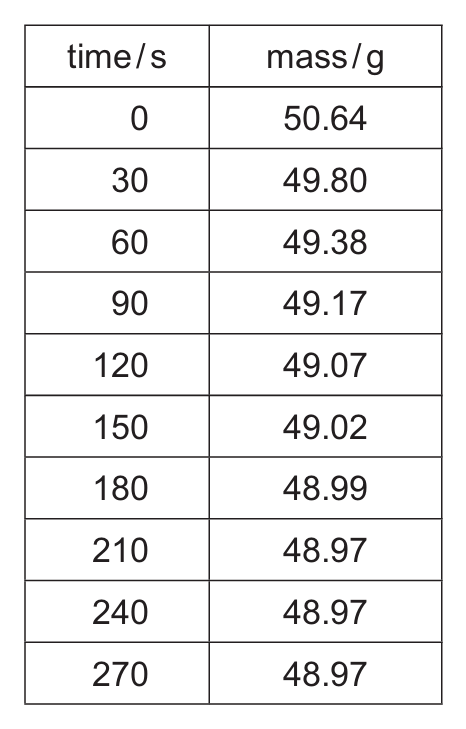
(i) Suggest why the mass decreases as time increases.
(ii) After a certain time the reaction stops. Explain why the reaction stops.
(iii) Suggest why it is not possible to use the results in Table 5.1 to determine the exact time when the reaction stops.
(b) Fig. 5.2 shows a graph of the mass against time.
Fig. 5.2
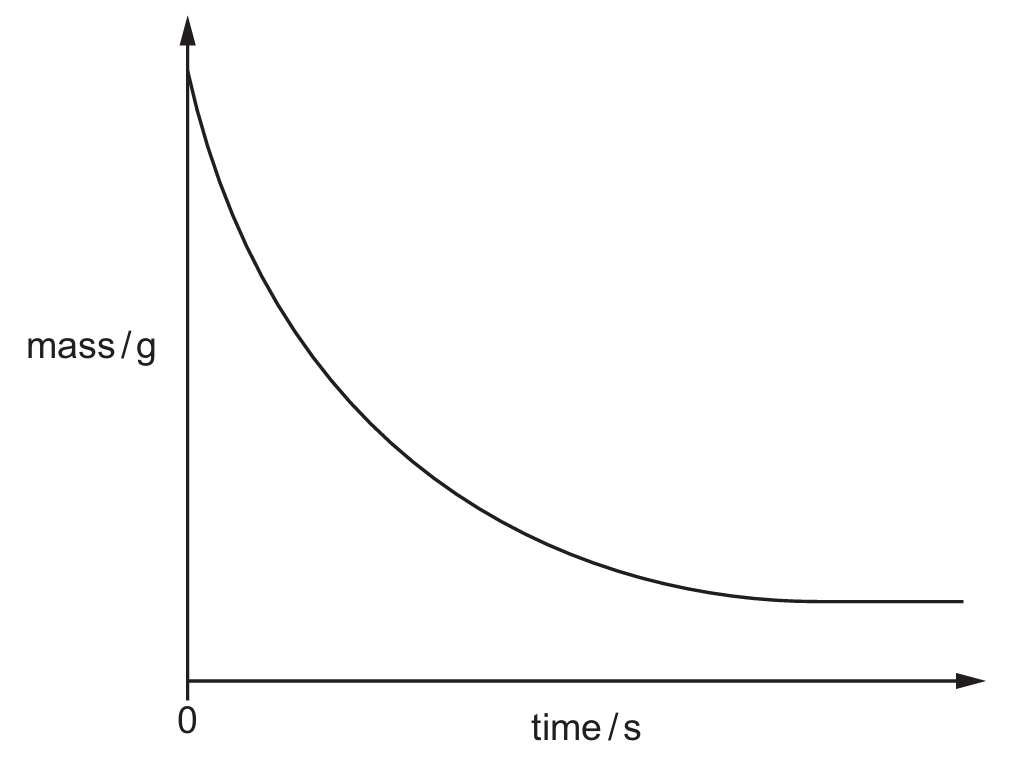
The experiment is repeated at a higher temperature. All other conditions remain the same.
(i) Explain, in terms of collision theory, why the rate of reaction is higher at a higher temperature.
(ii) On Fig. 5.2, sketch the line expected when the experiment is repeated at a higher temperature.
(c) Manganese(IV) oxide is the catalyst in this reaction.
(i) Explain the meaning of (IV) in manganese(IV) oxide.
(ii) State how the mass of the catalyst has changed, if at all, at the end of the experiment.
(d) Nitrogen monoxide gas, \( NO \), and oxygen gas, \( O_2 \), react to produce nitrogen dioxide gas, \( NO_2 \), at room temperature.
The reaction can reach equilibrium. The equation is shown.
\( 2NO(g) + O_2(g) \rightleftharpoons 2NO_2(g) \) \( \Delta H = -113 \, \text{kJ/mol} \)
NO(g) and \( O_2(g) \) are passed into a beaker as shown in Fig. 5.3.
Fig. 5.3
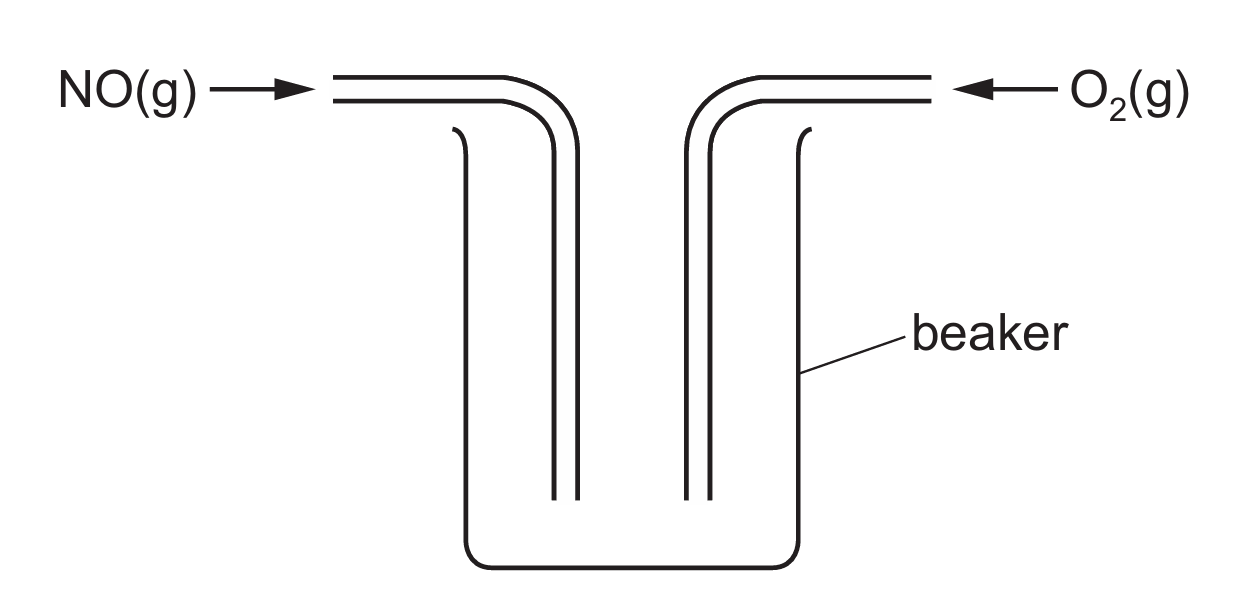
(i) Explain why the method shown in Fig. 5.3 will not allow the reaction to reach equilibrium.
(ii) The apparatus is changed and equilibrium is reached. The temperature of the equilibrium system is then increased and the position of equilibrium shifts to the left. Explain why the position of equilibrium shifts to the left.
(iii) The pressure of the equilibrium system is then increased. State the direction, if any, in which the position of equilibrium shifts. Explain your answer.
Most-appropriate topic codes (Cambridge IGCSE Chemistry 0620):
• Topic 6.2 — Rate of reaction (Parts (a), (b), (c))
• Topic 6.3 — Reversible reactions and equilibrium (Parts (d)(i), (d)(ii), (d)(iii))
• Topic 6.4 — Redox / Oxidation numbers (Part (c)(i))
▶️ Answer/Explanation
(a)(i) The mass decreases because oxygen gas (O₂) is produced and escapes from the reaction flask.
The decomposition of hydrogen peroxide releases oxygen. Since the cotton wool allows gas to escape but not liquid, the total mass of the system drops as the gas leaves.
(a)(ii) The reaction stops because all of the hydrogen peroxide (reactant) has been completely used up.
The reaction cannot proceed without the reactant hydrogen peroxide. Once it is fully decomposed into water and oxygen, no further change in mass occurs.
(a)(iii) The time intervals between mass readings (30 seconds) are too large to pinpoint the exact second the mass became constant.
Table 5.1 shows the mass is constant between 210 and 270 seconds, but the exact finishing time within this range cannot be determined from the data.
(b)(i) At a higher temperature, particles have greater kinetic energy, leading to more frequent collisions and a higher proportion of collisions exceeding the activation energy.
Collision theory states that increasing temperature increases both the frequency of collisions and the energy of particles, resulting in more successful collisions per unit time and thus a faster rate.
(b)(ii) The sketch should show a steeper initial downward slope starting from the same mass, reaching the same final mass at an earlier time.
The higher temperature increases the rate of reaction, so mass decreases faster. The total mass loss (oxygen produced) is the same, but the reaction completes sooner.
(c)(i) The (IV) in manganese(IV) oxide indicates that manganese has an oxidation number of +4 in this compound.
Roman numerals in transition metal compound names represent the oxidation state of the metal. Since oxygen is -2, Mn must be +4 in MnO₂ to balance the charges.
(c)(ii) The mass of the catalyst does not change; it remains the same at the end of the experiment.
A catalyst speeds up a reaction without being consumed in the overall chemical process. It is chemically unchanged and retains its original mass.
(d)(i) The method will not allow equilibrium because the beaker is an open system, allowing gases to enter and escape freely.
Equilibrium can only be established in a closed system where no reactants or products can leave. Here, NO and O₂ are continuously added and can escape, preventing a reversible balance.
(d)(ii) The equilibrium shifts to the left because the forward reaction is exothermic (ΔH is negative).
According to Le Chatelier’s principle, increasing temperature favors the endothermic direction to absorb heat. Since the forward reaction releases heat, the reverse (left) reaction is endothermic and is favored.
(d)(iii) The position of equilibrium shifts to the right (towards NO₂).
Increasing pressure favors the side with fewer gas molecules. The left has 3 gas molecules (2NO + 1O₂) and the right has 2 gas molecules (2NO₂), so the system shifts right to reduce pressure.
Question 6
This question is about hydrocarbons.
(a) State the meaning of the term hydrocarbon.
(b) Propene, C₃H₆, can be made from long-chain alkanes such as dodecane. Dodecane contains 12 carbon atoms.
(i) Deduce the molecular formula of dodecane.
(ii) Name the type of reaction that occurs when long-chain alkanes are converted into shorter chain alkenes.
(c) Propene is an unsaturated hydrocarbon. Propene reacts with bromine.
(i) State the meaning of the term unsaturated.
(ii) Write the molecular formula of the product formed when propene reacts with bromine.
(d) A styrene molecule is represented as shown in Fig. 6.1.
Fig. 6.1
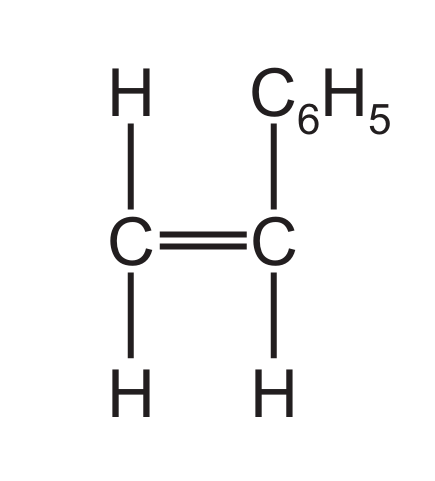
(i) The molecular formula of styrene is C₈H₈. Determine the empirical formula of styrene.
(ii) Styrene can be polymerised into poly(styrene). State the type of polymerisation that occurs when styrene is converted into poly(styrene).
(iii) Draw the structure of one repeat unit of poly(styrene). Include all of the atoms and all of the bonds. The C₈H₅ group should be represented as C₈H₅.
Most-appropriate topic codes (Cambridge IGCSE Chemistry 0620):
• Topic 11.3 — Fuels (Part (a))
• Topic 11.4 — Alkanes (Part (b)(i))
• Topic 11.5 — Alkenes (Parts (b)(ii), (c)(i), (c)(ii))
• Topic 3.3 — Stoichiometry (Part (d)(i))
• Topic 11.8 — Polymers (Parts (d)(ii), (d)(iii))
▶️ Answer/Explanation
(a) A hydrocarbon is a compound containing only carbon and hydrogen atoms.
This is the basic definition of organic molecules derived from crude oil, excluding any other elements like oxygen or nitrogen.
(b)(i) C₁₂H₂₆
Alkanes follow the general formula CₙH₂ₙ₊₂. Substituting n=12 gives C₁₂H₂₆.
(b)(ii) Cracking
Cracking is the process where long-chain alkanes are broken down under high temperature and a catalyst to form shorter-chain alkenes (like propene) and alkanes.
(c)(i) Unsaturated means containing at least one carbon-carbon double bond (C=C).
Unlike saturated alkanes, unsaturated alkenes can undergo addition reactions because the double bond can open up to accommodate new atoms.
(c)(ii) C₃H₆Br₂
Propene reacts with bromine in an addition reaction. The double bond breaks, and a bromine atom attaches to each of the two carbon atoms, forming 1,2-dibromopropane.
(d)(i) CH
The empirical formula is the simplest whole number ratio. C₈H₈ simplifies to CH (divide both subscripts by 8).
(d)(ii) Addition polymerisation
Styrene contains a C=C double bond. In addition polymerisation, these double bonds open up to link monomers together without losing any small molecules.
(d)(iii) Structure of the repeat unit:
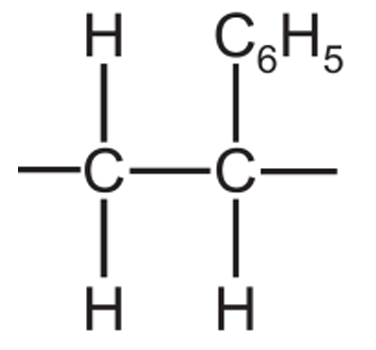
The repeat unit shows a two-carbon backbone (from the opened double bond). Each carbon has a hydrogen atom, and one carbon carries the C₈H₅ (phenyl) group. The extended bonds indicate continuation of the polymer chain.