
Question 1
Fig. 1.1 shows two strips of staples.

(a) The width of one strip is 56mm. There are 40 staples in the strip. Calculate the average width of one staple.
(b) A student wants to find the volume of one strip of 40 staples. The student has a measuring cylinder and a beaker of water as shown in Fig. 1.2.
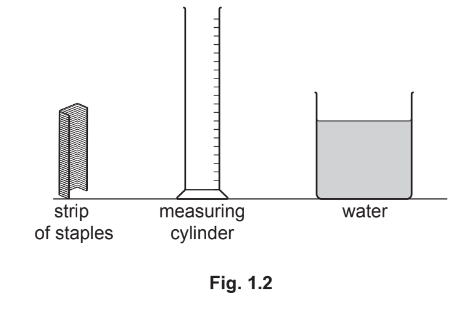
Describe how the student can determine the volume of one strip of staples by using the equipment shown in Fig. 1.2.
(c) The staples are made from a block of metal.
The mass of the block is \(296 \mathrm{~g}\). The volume of the block is \(33.2 \mathrm{~cm}^3\).
Calculate the density of the metal. Include the unit.
Most-appropriate topic codes (Cambridge IGCSE Physics 0625):
• Topic $1.1$ — Physical quantities and measurement techniques (Part $\mathrm{(a)}$, $\mathrm{(b)}$)
• Topic $1.4$ — Density (Part $\mathrm{(c)}$)
▶️ Answer/Explanation
Ans:
(a) (average thickness =) \(1.4(\mathrm{~mm})\)
(average thickness \(=\) ) \(56 \div 40\)
Detailed Solution: The average width is found by dividing the total width of the strip by the number of staples; \(56 \text{ mm} \div 40 = 1.4 \text{ mm}\).
(b) any three from:
measuring cylinder (partially) filled with water
(initial) volume measured/noted
strip submerged in water owtte
(new/2nd) volume (of strip and water) measured
volume of strip \(=\) difference in volumes
Detailed Solution: Record the initial water volume, fully submerge the staple strip, record the new volume, and subtract to find the strip’s volume.
(c) \((\rho=) 8.92\)
\((\rho=) 296 \div 33.2\)
(density \(=\) ) mass \(\div\) volume \(\mathrm{OR}(\rho=) \mathrm{m} / \mathrm{V}\) in any form
\(\mathrm{g} / \mathrm{cm}^3\)
Detailed Solution: Density is mass per unit volume; \(\rho = \frac{296 \text{ g}}{33.2 \text{ cm}^3} \approx 8.92 \text{ g/cm}^3\) using the formula \(\rho = \frac{m}{V}\).
Question 2
(a) A student has a spring of length 14.0cm. She stretches the spring by adding different loads to the spring.
She measures the length of the spring for each load. She plots a graph of the results.
Fig. 2.1 shows the graph of her results.
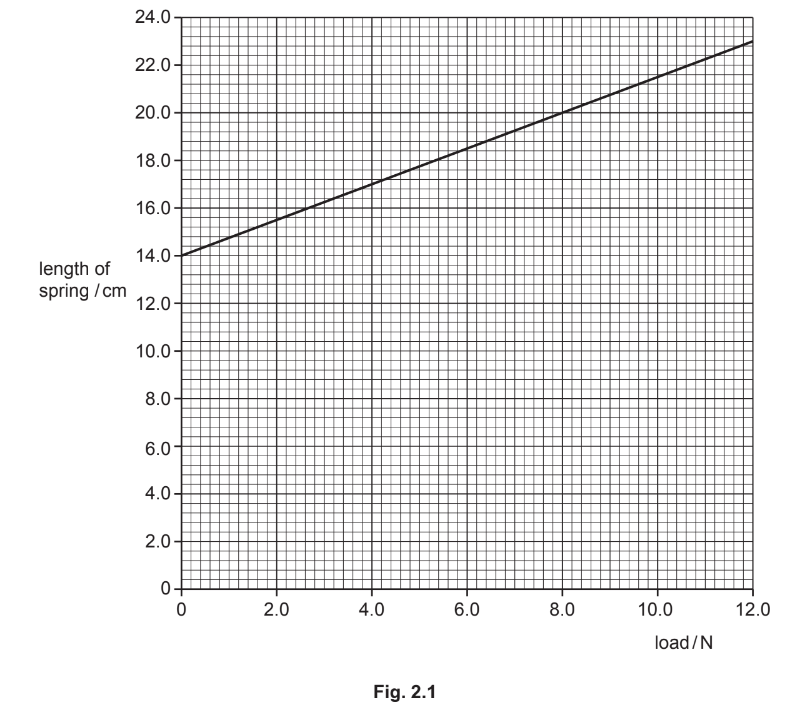
(i) Use the graph to determine the length of the spring when the student adds a load of 8.0N to the spring.
(ii) Use the graph to determine the load added to the spring when the extension of the spring is 7.0cm.
(b) Complete the sentence about effects of forces. Choose a word from the box.

A load stretching a spring is an example of a force changing the size and the ……………………. of an object.
(c) A clamp stand used in the experiment has a weight of 8.6N.
Calculate the mass of the clamp stand.
Most-appropriate topic codes (Cambridge IGCSE Physics 0625):
• Topic 1.5.1 — Effects of forces (Parts (a)(i), (a)(ii), (b))
• Topic 1.3 — Mass and weight (Part (c))
▶️ Answer/Explanation
Ans:
(a)(i) (length of spring with 8.0 N load =) 20 (cm)
The graph shows a direct relationship between load and spring length. Locate 8.0 N on the horizontal axis, move vertically up to intersect the plotted line, then read horizontally across to the vertical axis to find the corresponding length, which is 20 cm.
(a)(ii) (load for length of 21 cm =) 9.3 (N)
(extension of 7 cm = length of) 21 cm
Extension is calculated as total length minus original length ($14.0\text{ cm}$). For an extension of $7.0\text{ cm}$, the length is $14.0 + 7.0 = 21.0\text{ cm}$. Locating $21.0\text{ cm}$ on the graph corresponds to a load of approximately $9.3\text{ N}$ on the horizontal axis.
(b) shape
Forces can produce changes in the size and shape of an object. Stretching a spring alters both its length (size) and its physical form, which is described as a change in shape.
(c) \(\begin{aligned} & (\mathrm{m}=) 0.88(\mathrm{~kg}) \\ & (\mathrm{m}=) 8.6 \div 9.8 \\ & \mathrm{~W}=\mathrm{mg} \text { OR }(\mathrm{m}=) \mathrm{W} \div \mathrm{g}\end{aligned}\)
Weight is the gravitational force on a mass, given by $W = mg$. Rearranging for mass gives $m = \frac{W}{g}$. Using $g = 9.8\text{ m/s}^2$, the calculation is $m = \frac{8.6}{9.8} = 0.88\text{ kg}$ (to two significant figures).
Question 3
Fig. 3.1 shows the distance-time graph for a cyclist.
The journey has two sections, PQ and QR.
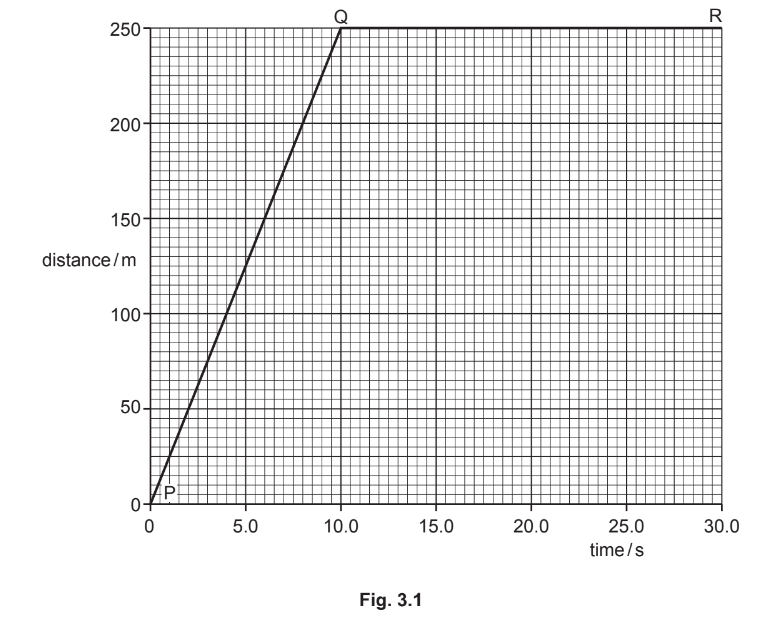
(a) (i) Calculate the speed of the cyclist in section PQ.
(ii) Describe the motion of the cyclist in section QR on the graph. ……………..
(b) Fig. 3.2 shows a bicycle fitted with wide tyres and a bicycle fitted with narrow tyres. The two bicycles have the same weight.
People use bicycles fitted with wide tyres to ride over soft ground.
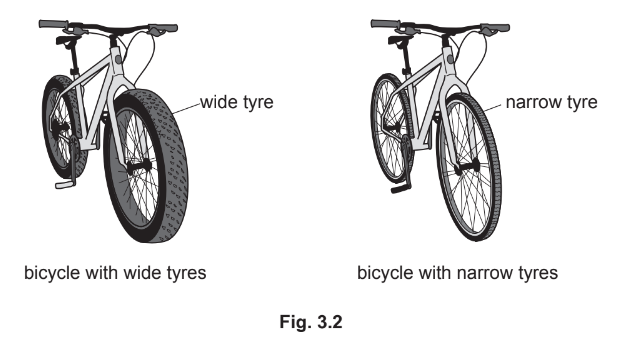
Explain why people use bicycles fitted with wide tyres to ride over soft ground. Use your ideas about pressure.
Most-appropriate topic codes (Cambridge IGCSE Physics 0625):
• Topic 1.2 — Motion (Parts (a)(i), (a)(ii))
• Topic 1.8 — Pressure (Part (b))
▶️ Answer/Explanation
Ans:
(a)(i) (speed =) 25 (m / s)
(speed =) 250 ÷ 10
(speed =) gradient of d-t graph OR d ÷ t in any form
Detailed Solution: Speed is the gradient of a distance-time graph. For section PQ, distance increases from 0 m to 250 m in 10 s. Speed = Δd / Δt = 250 m / 10 s = 25 m/s.
(a)(ii) (QR –) at rest or stationary
Detailed Solution: In section QR, the distance remains constant at 250 m as time increases, indicating a horizontal line on the graph with zero gradient, so the cyclist is stationary.
(b) any two from
(wide tyres have) large (contact) area
(so) less pressure (on ground)
so less likely to sink (into soft ground)
Detailed Solution: Pressure P = F / A. Wide tyres increase the contact area A, reducing the pressure exerted on soft ground for the same force (weight), preventing sinking.
Question 4
Fig. 4.1 shows some gas, at room temperature, in a cylinder with a piston that can move. The gas cannot escape from the cylinder.
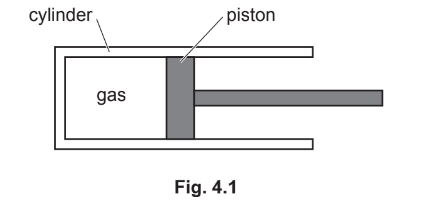
(a) (i) Describe the movement of the gas particles.
(ii) Describe how the gas particles exert a pressure on the walls of the cylinder and piston.
(b) The piston in Fig. 4.1 moves to the left.
The volume of the gas decreases. The temperature of the gas does not change.
State and explain any change in the pressure of the gas when the piston moves to the left.
Most-appropriate topic codes (Cambridge IGCSE Physics 0625):
• Topic 2.1.2 — Particle model (Parts (a)(i), (a)(ii))
• Topic 2.1.3 — Gases and the absolute scale of temperature (Part (b))
▶️ Answer/Explanation
(a)(i)
Any two from:
high speed
moving freely
random (motion) OR (moving in) any / all directions
Gas particles at room temperature possess significant kinetic energy, allowing them to move rapidly and independently of one another unless they collide. Their motion is haphazard with no preferred path, and they continuously change direction upon colliding with other particles or the container walls.
(a)(ii)
collisions (of particles with walls of cylinder OR surface)
The force exerted by gas particles on a surface arises from their countless impacts with that surface. Each collision imparts a tiny impulse, and the cumulative effect of innumerable impacts per second across the entire internal area manifests as a steady pressure.
(b)
Any three from:
pressure increases
(because) molecules are closer together / more densely packed OR area of cylinder decreases (so there are) more collisions per unit area (with walls of cylinder)
pressure \(=\) force \(\div\) area
When the piston moves left, the same number of gas particles is confined within a smaller volume. This higher concentration of particles leads to a greater frequency of collisions against the internal walls per unit time and per unit surface area, which directly corresponds to an increase in pressure according to the kinetic particle model.
Question 5
This question is about work, energy stores and energy transfers.
(a) Fig. 5.1 shows a child pulling a toy trolley across the floor.
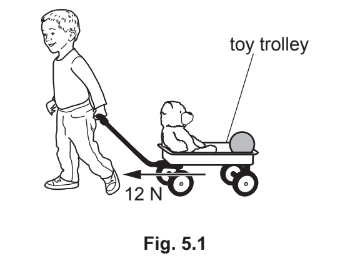
The child pulls the toy trolley with a horizontal force of \(12 \mathrm{~N}\). The distance moved by the trolley is \(5.0 \mathrm{~m}\).
Calculate the mechanical work done on the toy trolley by the \(12 \mathrm{~N}\) force.
(b) Fig. 5.2 shows a candle burning.
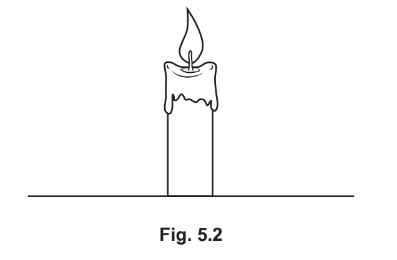
Describe the energy transfers taking place as the candle burns.
Your answer should refer to energy stores as well as transfers between energy stores.
Most-appropriate topic codes (Cambridge IGCSE Physics 0625):
• Topic 1.7.2 — Work (Part (a))
• Topic 1.7.1 — Energy (Part (b))
▶️ Answer/Explanation
Ans:
(a) (work done =) \(60(\mathrm{~J})\)
(work done =) \(12 \times 5(.0)\)
(work done \(=\) ) force \(\times\) distance in any form
Detailed solution: Mechanical work done is calculated using \(W = Fd = 12 \times 5.0 = 60 \mathrm{~J}\), representing the energy transferred by the force.
(b) chemical store (in candle) decreases
energy is transferred by radiation / light / em / IR waves
thermal store of surroundings has increased owtte
Detailed solution: Chemical energy stored in the wax decreases, transferring to the surroundings via heating by radiation (light and infrared) and increasing the thermal store of the air and nearby objects.
Question 6
Fig. 6.1 shows how the displacement of a transverse wave varies with time.
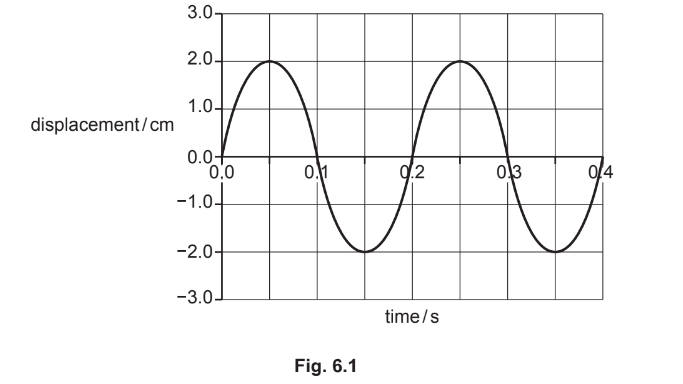
(a) (i) Determine the amplitude of the wave in Fig. 6.1.
(ii) Determine the frequency of the wave in Fig. 6.1.
(b) Describe the motion of particles in a transverse water wave.
(c) A wave has a frequency of 400Hz and a wavelength of 0.90m.
Calculate the velocity of the wave.
Most-appropriate topic codes (Cambridge IGCSE Physics 0625):
• Topic 3.1 — General properties of waves (Parts (a)(i), (a)(ii), (b), (c))
▶️ Answer/Explanation
Ans:
(a)(i) $2.0 \text{ cm}$
Detailed Solution:
The amplitude is defined as the maximum displacement of a point on a wave away from its undisturbed (rest) position. Looking at the y-axis of Fig. 6.1, the peak of the wave reaches: $$\text{Amplitude} = 2.0 \text{ cm}$$
(a)(ii) $5.0 \text{ Hz}$
Detailed Solution:
First, we find the period ($T$), which is the time taken for one complete oscillation. From the graph, one full wave cycle is completed at $0.2 \text{ s}$. $$T = 0.2 \text{ s}$$ The frequency ($f$) is the reciprocal of the period: $$f = \frac{1}{T} = \frac{1}{0.2 \text{ s}} = 5.0 \text{ Hz}$$
(b) Particles vibrate or oscillate perpendicular (at right angles) to the direction of energy travel.
Detailed Solution:
In a transverse wave, the individual particles of the medium move up and down. Specifically, the direction of particle vibration is perpendicular ($90^\circ$) to the direction in which the wave (energy) is traveling.
(c) $360 \text{ m/s}$
Detailed Solution:
To calculate the wave velocity ($v$), we use the wave equation: $$v = f \times \lambda$$ Given: $f = 400 \text{ Hz}$ and $\lambda = 0.90 \text{ m}$ $$v = 400 \text{ Hz} \times 0.90 \text{ m}$$ $$v = 360 \text{ m/s}$$
Question 7
(a) A student places a book in front of a plane mirror.
State three characteristics of the image of the book formed by the plane mirror.
(b) Visible light is one region of the electromagnetic spectrum. Another region is ultraviolet radiation.
(i) Give one use of ultraviolet radiation.
(ii) Give one possible harmful effect of excessive exposure to ultraviolet radiation.
Most-appropriate topic codes (Cambridge IGCSE Physics 0625):
• Topic 3.2.1 — Reflection of light (Part (a))
• Topic 3.3 — Electromagnetic spectrum (Parts (b)(i) and (b)(ii))
▶️ Answer/Explanation
(a)
same size (as object / book)
same distance from mirror (as book / object)
virtual
Detailed Solution: A plane mirror forms an image that is laterally inverted, virtual, and the same size as the object. The image distance behind the mirror equals the object distance in front of it.
(b)(i)
(use:) security marking OR detecting fake bank notes OR sterilising water
Detailed Solution: Ultraviolet radiation is used in applications like sterilising water by killing bacteria, detecting forged banknotes via fluorescence, and security marking.
(b)(ii)
(harmful effect:) damage to surface cells / skin OR eyes OR damage to cells / genes / DNA OR skin cancer
Detailed Solution: Excessive UV exposure damages DNA in skin cells, leading to premature aging, sunburn, eye damage like cataracts, and increased risk of skin cancer.
Question 8
(a) A student uses a dry cloth to rub a plastic rod.
State how the plastic rod gains a positive charge from friction between the cloth and the rod. \([2]\)
(b) Three balls, P, Q and R, are electrically charged. The balls are suspended by threads of insulating material. Fig. 8.1 shows the arrangement.
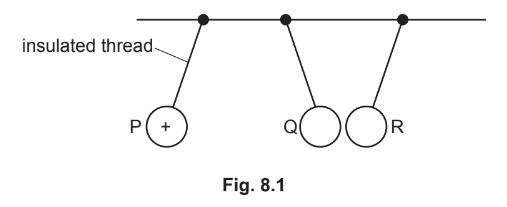
The charge on ball \(P\) is positive.
State the charge on ball \(Q\) and the charge on ball \(\mathrm{R}\).
(c) The student connects ball \(\mathrm{P}\) to earth with a copper wire. Charges from the earth flow in the copper wire to ball \(P\).
State the name of the electrically charged particles moving in the copper wire.
Most-appropriate topic codes (Cambridge IGCSE Physics 0625):
• Topic 4.2.1 — Electric charge (Part (a), (b))
• Topic 4.2.2 — Electric current (Part (c))
▶️ Answer/Explanation
Ans:
(a) negative charges OR electrons
move from rod OR move to cloth
Detailed solution: Friction causes negatively charged electrons to be transferred from the surface of the plastic rod to the dry cloth. This loss of electrons leaves the rod with a net positive charge.
(b) (ball Q is) positive
(ball R is) negative
Detailed solution: Ball P (positive) and Q repel, so Q must have the same charge (positive). Ball Q (positive) and R attract, so R must have the opposite charge (negative).
(c) (free) electrons
Detailed solution: In a metallic conductor like copper, electric current consists of a flow of delocalised (free) electrons moving through the lattice of positive ions.
Question 9
Fig. 9.1 shows an electric kettle.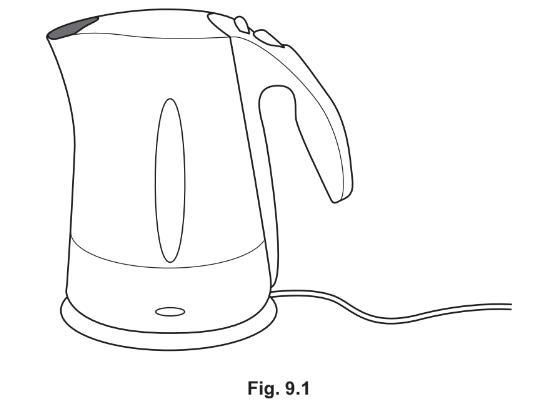
(a) (i) The power input of the kettle is \(1.5 \mathrm{~kW}\). The potential difference of the mains electrical supply for the kettle is \(220 \mathrm{~V}\).
Calculate the current in the kettle when it is switched on.
(ii) The 1.5kW kettle is used for a total of 4.0 hours. The cost of 1.0kWh of electrical energy is 14 pennies (p).
Calculate the cost of the energy used by the kettle in 4.0 hours.
(b) Fig. 9.2 shows an overloaded extension lead.
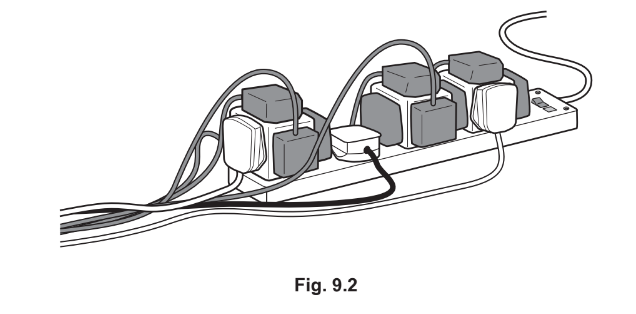
Explain the danger of connecting too many plugs to an extension lead.
Most-appropriate topic codes (Cambridge IGCSE Physics 0625):
• Topic 4.2.5 — Electrical energy and electrical power (Parts (a)(i), (a)(ii))
• Topic 4.4 — Electrical safety (Part (b))
▶️ Answer/Explanation
(a)(i)
\((I=) 6.8(\mathrm{A})\)
\((I=) 1500 \div 220\)
\(P=I \times V\) OR \((I=) P \div V\)
\(1.5 \mathrm{~kW}=1500 \mathrm{~W}\)
Electrical power is the rate of energy transfer. The relationship between power, current, and potential difference is \(P = IV\). Converting \(1.5 \mathrm{~kW}\) to \(1500 \mathrm{~W}\) and substituting \(V = 220 \mathrm{~V}\) gives \(I = \frac{1500}{220} \approx 6.8 \mathrm{~A}\).
(a)(ii)
\((\text{cost of energy} =) 84(\mathrm{p})\)
\((\text{cost of energy} =) 1.5 \times 4(.0) \times 14\)
\((\text{cost of energy} =)\) power \(\times\) time \(\times\) cost of \(1 \mathrm{kWh}\)
OR
number of \(\mathrm{kWh} \times\) cost of \(1 \mathrm{kWh}\)
The energy consumed is \(\text{power} \times \text{time} = 1.5 \mathrm{~kW} \times 4.0 \mathrm{~h} = 6.0 \mathrm{~kWh}\). Multiplying by the unit cost gives \(6.0 \times 14 = 84\) pennies.
(b)
large current (in extension lead / socket)
(can cause) overheating / fire
Connecting too many appliances draws a large total current through the extension lead. The resulting Joule heating (\(P = I^2R\)) in the wires can exceed safe limits, melting insulation and causing a fire hazard.
Question 10
(a) Fig. 10.1 shows two coils of wire \(P\) and \(Q\), each in a circuit. The ends of the coils are close but not touching.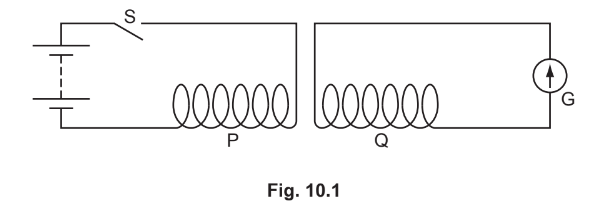
Now, switch \(\mathrm{S}\) is closed. The pointer in the sensitive ammeter \(\mathrm{G}\) deflects and then returns to its zero position.
Explain why the pointer in sensitive ammeter \(\mathrm{G}\) deflects.
(b) Describe the construction of a step-up transformer. You may draw a labelled diagram as part of your answer.
Most-appropriate topic codes (Cambridge IGCSE Physics 0625):
• Topic 4.5.1 — Electromagnetic induction (Part (a))
• Topic 4.5.6 — The transformer (Part (b))
▶️ Answer/Explanation
(a)
For the correct answer:
any three from:
(when switch S closed) current in coil P
coil P has (changing) magnetic field
magnetic field (from P) links with / cuts coil Q
e.m.f. / voltage / current induced / produced / generated in coil Q
When switch S is closed, a current begins to flow in coil P, creating a magnetic field around it. As this current is switched on, the magnetic field grows and changes, causing its field lines to cut across the turns of the adjacent coil Q. According to the principle of electromagnetic induction, this changing magnetic flux linkage induces an electromotive force (e.m.f.) in coil Q, which drives a momentary current and causes the ammeter pointer to deflect.
(b)
For the correct answer:
two coils (of copper wire)
(wrapped around / linked by soft) iron core
more turns on secondary coil OR less turns on primary coil
A step-up transformer consists of two separate coils of insulated copper wire, known as the primary and secondary coils, which are wound around a common laminated soft-iron core. The core provides a pathway for the magnetic flux and links the two coils. In a step-up transformer, the secondary coil has a greater number of turns than the primary coil, which results in a higher output voltage across the secondary circuit.
Question 11
Americium-241 is a radioactive nuclide. The nuclide notation for a nucleus of americium-241 is
241
\({ }_{95} \mathrm{Am}\)
(a) Determine the number of:
protons in one nucleus of americium-241,
neutrons in one nucleus of americium-241.
(b) Americium-241 has a half-life of 430 years.
A radioactive source contains \(12 \mathrm{mg}\) of americium-241.
Calculate the mass of americium-241 that remains in the source after 860 years.
Most-appropriate topic codes (Cambridge IGCSE Physics 0625):
• Topic 5.1.2 — The nucleus (Part (a))
• Topic 5.2.4 — Half-life (Part (b))
▶️ Answer/Explanation
Ans:
(a)95
Detailed solution:
The proton number (atomic number) \(Z\) is the subscript 95. Number of neutrons \(= A – Z = 241 – 95 = 146\).
(b)146
(amount remaining =) \(3(.0)(\mathrm{mg})\)
(amount remaining =) \(12 \times 1 / 2 \times 1 / 2\) OR \(12 \times 1 / 4\)
860 years is 2 half-lives
Detailed solution:
Number of half-lives elapsed \(= \frac{860}{430} = 2\). After 2 half-lives, remaining mass \(= 12 \times \left(\frac{1}{2}\right)^2 = 3 \text{ mg}\).
Question 12
(a) State, in order, the names of the three planets closest to the Sun.
Closest to the Sun
Furthest from the Sun
(b) Define a light-year.
(c) Jupiter is \(780000000000 \mathrm{~m}\left(7.8 \times 10^{11} \mathrm{~m}\right)\) from the Sun.
The speed of light is \(300000000 \mathrm{~m} / \mathrm{s}\left(3.0 \times 10^8 \mathrm{~m} / \mathrm{s}\right)\).
Calculate the time for light to travel from the Sun to Jupiter.
Most-appropriate topic codes (Cambridge IGCSE Physics 0625):
• Topic 6.1.2 — The Solar System (Parts (a), (c))
• Topic 6.2.2 — Stars (Part (b))
▶️ Answer/Explanation
Ans:
(closest to Sun) Mercury
Venus
(furthest from Sun) Earth
Detailed solution: According to the order of planets in the Solar System, the three planets closest to the Sun are Mercury, Venus, and Earth, in that sequence.
(b) distance travelled by light (in the vacuum of space) in one year
Detailed solution: A light-year is an astronomical unit of distance, defined as the total distance that a photon of light travels through the vacuum of space in one Julian year (365.25 days).
(c) $
2.6 \times 10^3(\mathrm{~s}) \text { OR } 2600(\mathrm{~s})
$
time \(=\) distance \(\div\) speed OR \(7.8 \times 10^{11} \div 3.0 \times 10^8\)
OR \(780000000000 \div 300000000\)
Detailed solution: Using the equation $time = \frac{distance}{speed}$, substitute the given values: $t = \frac{7.8 \times 10^{11} \text{ m}}{3.0 \times 10^8 \text{ m/s}}$. Dividing the coefficients and subtracting the exponents yields $2.6 \times 10^3 \text{ s}$.