
Question 1
A river current acts at right angles to the direction the boat points. The river current has a speed of 2.5 m/s.
By drawing a scale diagram or by calculation, determine the speed and direction of the boat relative to the river bank.
State the names of one other scalar quantity and one other vector quantity.
Most-appropriate topic codes (Cambridge IGCSE Physics 0625):
• Topic 1.1 — Physical quantities and measurement techniques (Parts $\mathrm{(a)}$, $\mathrm{(b)}$)
▶️ Answer/Explanation
(a)
For the correct answer: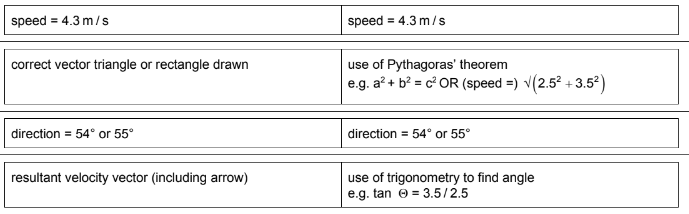
To find the resultant velocity, we add the two perpendicular velocity vectors using Pythagoras’ theorem. The resultant speed is the magnitude of the new vector: $v=\sqrt{3.5^2+2.5^2}=\sqrt{12.25+6.25}=\sqrt{18.5}\approx 4.3\text{ m/s}$. The direction relative to the river bank can be found using trigonometry: $\tan(\theta)=\frac{3.5}{2.5}=1.4$, which gives $\theta=\tan^{-1}(1.4)\approx 54^{\circ}$. Alternatively, an accurate scale drawing can be used to construct a vector triangle and directly measure the resultant vector’s length and angle.
(b)
For the correct answer:
a scalar quantity
distance, time, mass, energy, temperature
a vector quantity
force, weight, acceleration, momentum, electric field strength, gravitational field strength
A scalar quantity is defined as having only magnitude (size) and no specific direction, meaning it can be fully described by a numerical value and a unit (e.g., mass or energy). In contrast, a vector quantity possesses both magnitude and a specific direction in space. This distinction is crucial because vector quantities like force or momentum must be added geometrically, whereas scalars can be added purely arithmetically.
Question 2
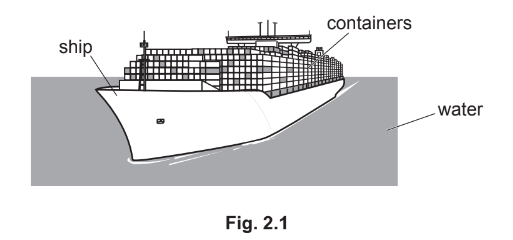
The density of steel is 7800 kg/m³ and the density of water is 1000 kg/m³.
Explain why the ship floats in the water.
State and explain the effect on the stability of the ship of loading the containers in this way.
Calculate the energy transferred to the gravitational potential energy stored in the container.
Most-appropriate topic codes (Cambridge IGCSE Physics 0625):
• Topic 1.4 — Density (Part (a))
• Topic 1.5.3 — Centre of gravity (Part (b))
• Topic 1.7.1 — Energy (Part (c))
▶️ Answer/Explanation
(a)
For the correct answer:
ship is not solid steel / there are air spaces in ship
(average) density of ship is less than the density of the water
Although the ship is constructed from steel, which is denser than water, it is not a solid block. The hull encloses large spaces filled with air, which has a very low density. This internal air significantly reduces the mass-to-volume ratio of the vessel. Consequently, the overall average density of the entire ship is less than the density of water (1000 kg/m³). Because its average density is lower, the upward buoyant force from the displaced water can fully support its weight, allowing it to float.
(b)
For the correct answer:
the centre of gravity is lower and (so) the ship is more stable
Loading the heaviest containers at the bottom of the ship shifts its overall centre of gravity downwards, closer to the base. An object with a lower centre of gravity is inherently more stable because it requires a much larger angle of tilt to move the centre of gravity outside its base of support. This deliberate weight distribution reduces the turning effect (moment) that could cause the vessel to capsize in high winds or rough seas, ensuring it remains upright during transport.
(c)
For the correct answer:
1.4 × 10⁷ J OR 14 MJ OR 14000 kJ
The energy transferred to the gravitational potential energy store can be calculated using the equation $\Delta E_p = mg\Delta h$. In this scenario, the mass $m$ is 30000 kg, the acceleration of free fall $g$ is approximately 9.8 m/s², and the change in vertical height $\Delta h$ is 48 m. Substituting these specific values into the formula yields $\Delta E_p = 30000 \times 9.8 \times 48$. This evaluates to 14112000 J. Expressed to an appropriate number of significant figures, this is 1.4 × 10⁷ J or 14 MJ.
Question 3
(i) Define the unit kWh.
(ii) Calculate the energy produced by the wind turbine operating at maximum power for 4.0 h. Give your answer in kWh.
State two energy resources that are not due to radiation from the Sun.
Most-appropriate topic codes (Cambridge IGCSE Physics 0625):
• Topic 1.7.1 — Energy (Part (a))
• Topic 4.2.5 — Electrical energy and electrical power (Parts (b)(i), (b)(ii))
• Topic 1.7.3 — Energy resources (Part (c))
▶️ Answer/Explanation
(a)
For the correct answer:
energy cannot be created or destroyed
energy can be transferred / transformed (between energy stores)
The principle of conservation of energy states that the total energy of an isolated system remains constant. Energy cannot be created or destroyed; it can only be transferred from one store to another or transformed into different forms. For example, in a falling object, gravitational potential energy is converted into kinetic energy, but the total amount of energy remains exactly the same.
(b)(i)
For the correct answer:
energy transferred in one hour at a rate of transfer of 1 kW
A kilowatt-hour (kWh) is a unit of electrical energy, not power. It is defined as the total amount of energy transferred or consumed by an appliance operating with a power of 1 kW (which is 1000 W) continuously for exactly one hour. This is equivalent to $3.6 \times 10^6$ J of energy.
(b)(ii)
For the correct answer:
7200 kWh
$E = P \times t$ OR $1800 \times 4.0$ OR $1.8 \times 4.0$ OR $7.2 \times 10^n$
To find the energy in kWh, the power must be in kilowatts (kW) and the time in hours (h). First, convert the maximum output power from megawatts to kilowatts: 1.8 MW = 1800 kW. Using the formula for energy $E = P \times t$, multiply the power by the time: $E = 1800 \times 4.0$. This results in a total energy of 7200 kWh.
(c)
For the correct answer (any two from):
• geothermal
• nuclear
• tidal
Most energy resources on Earth derive their initial energy from the Sun’s radiation (such as fossil fuels, wind, solar, and hydroelectric). However, geothermal energy originates from radioactive decay and residual heat within the Earth’s core. Nuclear energy is derived from unstable atomic nuclei like uranium. Tidal energy is generated by the gravitational pull of the Moon and the Sun on Earth’s oceans.
Question 4
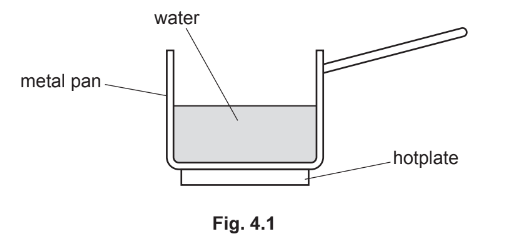
(a) Thermal energy is transferred through the metal pan by conduction.
State and explain the two ways that thermal energy is conducted in a metal.
Explain, in terms of forces and distances between particles, why the gas occupies a much greater volume than it does as a liquid.
The initial temperature of the milk is $20.0^\circ\text{C}$. The boiling point of milk is $95.0^\circ\text{C}$.
The milk starts to boil when $60700\text{ J}$ of thermal energy has been transferred to it. The density of milk is $1.03\text{ g/cm}^3$.
Calculate the value of the specific heat capacity of milk. Give your answer to 3 significant figures.
Most-appropriate topic codes (Cambridge IGCSE Physics 0625):
• Topic $2.3.1$ — Conduction (Part $\mathrm{(a)}$)
• Topic $2.1.2$ — Particle model (Part $\mathrm{(b)(i)}$)
• Topic $2.2.3$ — Melting, boiling and evaporation (Part $\mathrm{(b)(ii)}$)
• Topic $2.2.2$ — Specific heat capacity (Part $\mathrm{(c)}$)
▶️ Answer/Explanation
(a)
For the correct answer:
Free (delocalised) electrons move through the metal OR lattice vibrations transfer energy
In metals, thermal energy is conducted primarily through the movement of free (delocalised) electrons. When heated, these electrons gain kinetic energy and move rapidly through the lattice, colliding with distant particles and transferring energy. Additionally, the positive ions making up the metal lattice vibrate more vigorously when heated, passing on thermal energy to their immediate neighbouring ions through direct collisions.
(b)(i)
For the correct answer:
Attractive forces are much weaker in gases AND particles are much further apart in gases
In a liquid state, particles are held relatively close together by intermolecular attractive forces. When the liquid boils and becomes a gas, the particles gain enough kinetic energy to overcome these attractive forces almost completely. Consequently, the particles spread out and move freely, leading to a much greater distance between them and causing the gas to occupy a significantly larger volume than the liquid.
(b)(ii)
For the correct answer:
Boiling occurs at a fixed temperature AND boiling takes place throughout the liquid
Boiling is a bulk process that happens throughout the entire volume of the liquid (visible as bubbles forming within), whereas evaporation is a surface phenomenon occurring only at the liquid-air interface. Furthermore, boiling occurs strictly at a specific, fixed temperature (the boiling point) for a given pressure, while evaporation can take place at any temperature between the melting and boiling points.
(c)
For the correct answer:
$3.93\text{ J}/(\text{g }^\circ\text{C})$ OR $3930\text{ J}/(\text{kg }^\circ\text{C})$
First, calculate the mass of the milk using the density equation $m = \rho V$. Substituting the values: $m = 1.03\text{ g/cm}^3 \times 200\text{ cm}^3 = 206\text{ g}$. Next, calculate the change in temperature: $\Delta \theta = 95.0^\circ\text{C} – 20.0^\circ\text{C} = 75.0^\circ\text{C}$. Finally, use the specific heat capacity formula $c = \frac{\Delta E}{m \Delta \theta}$. Plugging in the variables gives $c = \frac{60700\text{ J}}{206\text{ g} \times 75.0^\circ\text{C}} = 3.9288…\text{ J}/(\text{g }^\circ\text{C})$. Rounded to three significant figures, the final answer is $3.93\text{ J}/(\text{g }^\circ\text{C})$.
Question 5
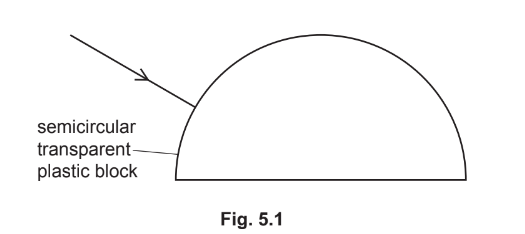
(i) Calculate the critical angle for the plastic.
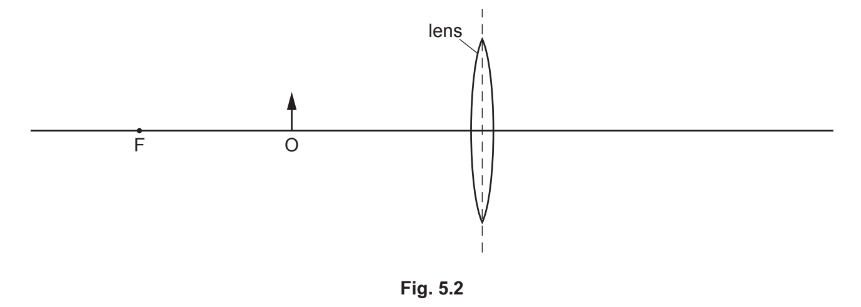
(i) Determine the focal length of the lens.
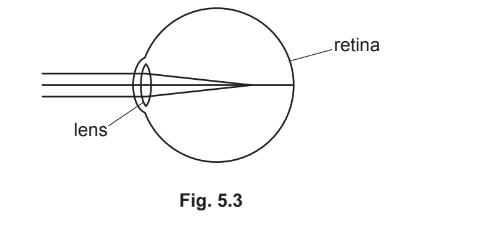
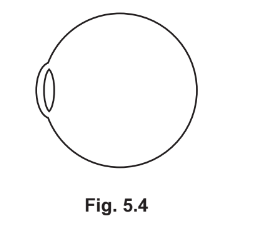
Most-appropriate topic codes (Cambridge IGCSE Physics 0625):
• Topic 3.2.2 — Refraction of light (Parts a)
• Topic 3.2.3 — Thin lenses (Parts b, c)
▶️ Answer/Explanation
(a)(i)
For the correct answer:
$42^{\circ}$
The refractive index $n$ is related to the critical angle $c$ by the equation $n=\frac{1}{\sin c}$. Rearranging this gives $c=\sin^{-1}\left(\frac{1}{n}\right)$. Substituting the given refractive index $n=1.5$, we get $c=\sin^{-1}\left(\frac{1}{1.5}\right)=41.8^{\circ}$, which correctly rounds up to $42^{\circ}$.
(a)(ii)
For the correct answer:
Ray continues straight along the radius of the semicircle within the plastic.
Ray reflected inside the plastic on the straight edge, with angle of reflection = angle of incidence AND emerges from the block along the normal.
Since the initial ray is incident normally (at an angle of $90^{\circ}$ to the surface boundary) on the curved face, it travels straight into the block without refracting. Inside the block, it hits the flat edge at an angle of $45^{\circ}$. Because $45^{\circ}$ is greater than the critical angle of $42^{\circ}$, total internal reflection occurs. The ray reflects at $45^{\circ}$ and then emerges normally from the bottom curved surface without bending.
(b)(i)
For the correct answer:
$7.2\text{ cm}$
The focal length is defined as the distance from the optical centre of the lens to its principal focus $F$. By measuring this horizontal distance directly on the provided full-scale diagram using a ruler, it is found to be exactly $7.2\text{ cm}$.
(b)(ii)
For the correct answer:
Two correct rays extended backwards to intersect to the left of the object and line from the principal axis to the top of the image labelled $I$.
To locate the virtual image, draw a ray from the top of the object $O$ passing perfectly straight through the optical centre of the lens. Draw a second ray parallel to the principal axis, which then refracts downwards through the focal point $F$ on the right side. Extending both of these diverging rays backward until they intersect clearly locates the top of the upright, magnified virtual image $I$ on the same side as the object.
(c)
For the correct answer:
Diverging lens drawn in front of the eye lens.
Rays meeting correctly on the retina.
Short-sightedness (myopia) occurs when light rays from distant objects converge too strongly and focus in front of the retina. To correct this, a diverging (concave) lens must be placed in front of the eye. This external lens spreads the incoming parallel rays outwards slightly before they enter the eye, which perfectly compensates for the over-convergence and allows the eye’s natural lens to focus the light directly onto the retina.
Question 6
Explain what is meant by compression and rarefaction.
State the reason for this…………………………………..
The sound of the thunder is heard 9.0s after the lightning is seen. The speed of sound in air is 340m/ s. Calculate the distance from the thunderstorm to the observer.
Calculate the charge that flows.
Most-appropriate topic codes (Cambridge IGCSE Physics 0625):
• Topic 3.4 — Sound (Parts (a), (b), (c))
• Topic 4.2.2 — Electric current (Part (d))
▶️ Answer/Explanation
(a)
For the correct answer:
(region where) particles are close(r) together (than normal) OR (region where) there is a great(er) pressure (than normal)
(region where) particles are further / far apart (than normal) OR (region where) there is a low(er) pressure (than normal)
In a longitudinal sound wave, particles oscillate parallel to the direction of wave travel. A compression is a region where the particles of the medium are pushed closely together, resulting in a higher pressure than normal. Conversely, a rarefaction is a region where the particles are spread further apart, leading to a lower pressure than the surrounding medium. This alternating pattern of pressure propagates the sound energy.
(b)
For the correct answer:
light does not need a medium to travel through OR sound needs a medium to travel through (and there is no medium between Sun and Earth)
Sound waves are mechanical waves, meaning they require a material medium (like a solid, liquid, or gas) to transmit their energy. Because space is predominantly a vacuum, sound cannot travel from the Sun to the Earth. Light, however, is an electromagnetic wave, which does not require a medium and can freely travel through the vacuum of space.
(c)
For the correct answer:
3100 m OR 3.1 km
\(\begin{aligned} & v=s / t \text { OR }(s=) v t \text { OR } 340 \times 9\end{aligned}\)
To calculate the distance to the thunderstorm, we use the distance equation $s = vt$, where $v$ is the speed of sound and $t$ is the time delay. We assume the light from the lightning arrives almost instantaneously due to its immense speed. Substituting the given values gives $s = 340 \times 9.0 = 3060$ m. Rounding to two significant figures to match the precision of the given values yields 3100 m or 3.1 km.
(d)
For the correct answer:
\(\begin{aligned}& 1400 \mathrm{C} \\ & I=Q / t \text { OR }(Q=) I t \text { OR } 3.0 \times 10^4 \times 48 \times 10^{-3} \\ & (t=) 48 \times 10^{-3} \text { OR }(t=) 4.8 \times 10^{-2} \text { OR }(t=) 0.048 \text { SEEN }\end{aligned}\)
Electric current is defined as the rate of flow of electrical charge, expressed by the equation $I = \frac{Q}{t}$. To find the total charge $Q$, we rearrange the formula to $Q = It$. First, the time must be converted from milliseconds to standard SI units (seconds): 48 ms is 0.048 s. Multiplying the current by this time, we get $Q = 3.0 \times 10^4 \times 0.048$, which gives 1440 C (or 1400 C when appropriately rounded to two significant figures).
Question 7
Calculate the work done by the battery when it moves a charge of 30C around a complete circuit.
(i) Draw a circuit diagram of these components connected in series.
Most-appropriate topic codes (Cambridge IGCSE Physics 0625):
• Topic 4.2.3 — Electromotive force and potential difference (Parts $\mathrm{(a)[cite_start]}$, $\mathrm{(b)(i)}$, $\mathrm{(b)(ii)}$)
• Topic 4.3.1 — Circuit diagrams and circuit components (Part $\mathrm{(c)(i)[cite_start]}$)
• Topic 4.3.3 — Action and use of circuit components (Part $\mathrm{(c)(ii)[cite_start]}$)
▶️ Answer/Explanation
(a)
For the correct answer:
work done in passing charge through / across a component OR work done per unit charge
Potential difference (p.d.) is defined as the work done by a unit charge passing through a component. It measures the electrical energy transferred to other forms (like heat or light) per coulomb of charge flowing between two points in a circuit. The mathematical representation is $V = \frac{W}{Q}$, where $W$ is the work done and $Q$ is the charge.
(b)(i)
For the correct answer:
$E = \frac{W}{Q}$
Electromotive force (e.m.f.) represents the total electrical work done by a source in moving a unit charge completely around a circuit. The defining equation mathematically represents this as the energy transferred per unit charge, denoted as $E = \frac{W}{Q}$.
(b)(ii)
For the correct answer:
270 J
Using the electromotive force equation $E = \frac{W}{Q}$, you can rearrange the formula to solve for the work done, giving $W = E \times Q$. By substituting the given values, W = 9.0 V × 30 C, which equals 270 J. This represents the total energy supplied by the battery to move the charge around the circuit.
(c)(i)
For the correct answer: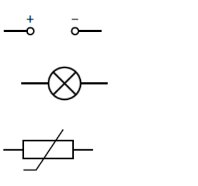
three components in a complete series circuit
A series circuit connects components end-to-end so that there is only a single path for the current to flow. The diagram must accurately feature the standard electrical symbols : a d.c. power supply, a lamp, and a thermistor connected in a continuous, unbroken loop.
(c)(ii)
For the correct answer:
resistance (of thermistor) decreases (when temperature increases)
resistance of circuit decreases OR greater current (in lamp so brightness of lamp increases) OR greater p.d. across lamp (so brightness of lamp increases)
When the temperature of a thermistor increases, its electrical resistance decreases. Because the thermistor is connected in series with the lamp, the total overall resistance of the circuit drops. According to Ohm’s law ($I = \frac{V}{R}$), a lower total resistance with a constant voltage results in a greater current flowing through the entire circuit, which consequently increases the brightness of the lamp.
Question 8
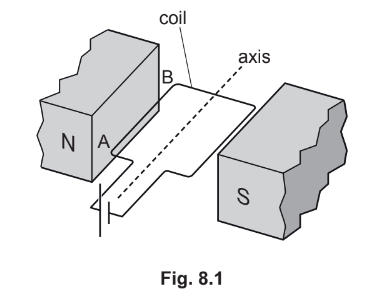
(a) Determine the direction of movement of the side AB relative to the plane of the coil.
Explain the effects of the split-ring commutator and the brushes on the action of the motor.
Most-appropriate topic codes (Cambridge IGCSE Physics 0625):
• Topic $4.5.5$ — The d.c. motor
▶️ Answer/Explanation
(a)
For the correct answer:
downwards / into the page / anti-clockwise
Using Fleming’s Left-Hand Rule, align your first finger with the magnetic field $B$ from the North to the South pole (left to right). Point your second finger in the direction of conventional current $I$, which flows from the positive terminal to the negative terminal (from A to B). Your thumb will point downwards, indicating the force $F$ on side AB pushes it into the page.
(b)
For the correct answer:
current, (magnetic) field, motion at right angles to each other
magnetic field from left to right / N to S AND current is from A to B / positive to negative
The direction is determined using Fleming’s Left-Hand Rule, which dictates that the force vector is perpendicular to both the current and magnetic field vectors. When you hold the thumb, index finger, and middle finger of the left hand mutually perpendicular to represent force, magnetic field, and current respectively, the resulting downward force can be deduced directly from the visual inputs.
(c)
For the correct answer:
(at vertical) the coil stops OR (at vertical) the coil overshoots and comes back OR the coil vibrates (about the vertical)
Reason: (as the coil approaches vertical) the turning effect decreases OR (at vertical) the turning effect is zero OR (past vertical) the turning effect reverses / changes direction
As the coil rotates toward the vertical position, the perpendicular distance $d$ between the line of action of the magnetic force $F$ and the pivot decreases. Since the moment is given by $M = F \times d$, this turning effect decreases to zero at the exact vertical. Without a mechanism to reverse the current, any over-rotation causes opposing forces that make the coil eventually stop.
(d)
For the correct answer:
reverses the current
With any two from: (brushes) ensure current is maintained / coil rotates continuously (in the same direction) / without wires getting tangled / every half turn (when the coil is vertical)
The split-ring commutator rotates with the coil and serves to reverse the direction of the current $I$ within the coil every half turn. Meanwhile, the stationary brushes maintain continuous sliding electrical contact with the commutator. This periodic current reversal ensures that the resulting torque remains unidirectional, enabling the motor to rotate continuously.
Question 9
Use nuclide notation to write down the nuclide equation for this reaction.
Most-appropriate topic codes (Cambridge IGCSE Physics 0625):
• Topic $5.1.2$ — The nucleus (Parts $\mathrm{(a)(i)}$, $\mathrm{(a)(ii)}$, $\mathrm{(b)}$)
▶️ Answer/Explanation
(a)(i)
For the correct answer:
large unstable nucleus OR neutrons hit nucleus OR neutrons are released (from nucleus); (large) nucleus splits (into smaller nuclei); (large) release of energy
Nuclear fission is the process where a large, unstable nucleus, such as Uranium-235, absorbs a neutron and subsequently splits into two smaller, lighter daughter nuclei. This fragmentation process is accompanied by the emission of several neutrons and the release of a significant amount of kinetic energy and gamma radiation.
(a)(ii)
For the correct answer:
advantage – Continuous supply of energy OR not affected by weather; disadvantage – danger of radiation leak OR radioactive waste
Nuclear power provides a reliable, continuous “base load” of electricity that does not depend on environmental factors like wind speed, unlike wind turbines which are intermittent. However, nuclear stations produce high-level radioactive waste that requires secure, long-term storage for thousands of years and carries the risk of catastrophic radiation leaks if the reactor core is damaged.
(b)
For the correct answer:
${ }_1^2 \mathrm{H}+{ }_1^2 \mathrm{H} \rightarrow{ }_2^3 \mathrm{He}+{ }_0^1 \mathrm{n}$
Nuclear fusion involves the joining of light nuclei to form a heavier nucleus, releasing energy in the process. For the fusion of two deuterium nuclei (${ }_1^2 \mathrm{H}$), the total mass number on the left is $2+2=4$ and the total atomic number is $1+1=2$; therefore, the products must be Helium-3 (${ }_2^3 \mathrm{He}$) and a single neutron (${ }_0^1 \mathrm{n}$) to conserve both nucleon and proton numbers.
Question 10
Calculate the average orbital speed of Mars in km/s.
(i) Explain what is meant by redshift.
(ii) State the quantity that the redshift of a galaxy is used to calculate.
Most-appropriate topic codes (Cambridge IGCSE Physics 0625):
• Topic 6.1.1 & 6.1.2 — The Earth and the Solar System (Parts (a), (b))
• Topic 6.2.2 & 6.2.3 — Stars and the Universe (Part (c))
▶️ Answer/Explanation
(a)
For the correct answer:
24 km/s
To calculate the orbital speed, first determine the total time T in seconds: T=690×24×60×60=59,616,000 s. Then, use the orbital speed formula v= T 2πr , where r=2.28×10 8 km. Substituting these values gives v= 59,616,000 2×π×2.28×10 8 ≈24.03 km/s, which rounds to 24 km/s.
(b)
For the correct answer:
elliptical / ellipse
According to the laws of planetary motion, the orbits of planets around the Sun are not perfect circles but are slightly flattened circles known as ellipses. In these elliptical orbits, the Sun is located at one of the two focal points (foci) rather than at the exact geometric center of the path.
(c)(i)
For the correct answer:
wavelength (of light from distant galaxies) increases; occurs when galaxies are moving away (from Earth)
Redshift refers to the phenomenon where the observed wavelength of electromagnetic radiation from an object increases (shifts toward the red end of the spectrum). This occurs due to the Doppler effect when a light source, such as a distant galaxy, is receding or moving away from the observer on Earth.
(c)(ii)
For the correct answer:
speed / velocity (that galaxy is moving away from Earth)
The degree of redshift in the light from a galaxy is directly proportional to the speed at which that galaxy is receding from us. By measuring the change in wavelength, astronomers can calculate the recession velocity v, which is essential for determining the rate of the Universe’s expansion via the Hubble constant.