Home / 0625_m24_qp_22_hina

Question 1

A student has a measuring cylinder containing water and also has a balance. Which of these could she use to find the volume of a small metal sphere? She has no other apparatus.
A. either the measuring cylinder containing water or the balance
B. the measuring cylinder containing water only
C. the balance only
D. neither the measuring cylinder nor the balance

Most-appropriate topic codes (Cambridge IGCSE Physics 0625):

TOPIC 1.4: Density (Describe how to determine the density of a liquid, of a regularly shaped solid and of an irregularly shaped solid which sinks in a liquid (volume by displacement), including appropriate calculations)
▶️ Answer/Explanation
Correct Option: B

Detailed solution:

The volume of an irregular solid that sinks can be found by measuring the rise in water level when it is submerged in a measuring cylinder.
While the balance could give the mass, it cannot determine volume without additional density information.
Since the sphere is small and metal, it will sink, making the water displacement method in the measuring cylinder suitable.
No other apparatus is needed to calculate volume using this technique.
Thus, only the measuring cylinder containing water is required to find the volume of the sphere.

Question 2

The diagram shows a solid object on a flat surface, with two forces acting on the object.
What is the resultant force on the object?
A. 1 N to the left
B. 1 N to the right
C. 7 N to the left
D. 7 N to the right

Most-appropriate topic codes (Cambridge IGCSE Physics 0625):

TOPIC 1.5.1: Effects of forces (Determine the resultant of two or more forces acting along the same straight line)
▶️ Answer/Explanation
Correct Option: B

Detailed solution:

The forces acting on the object are 4 N to the left and 3 N to the right.
Since the forces are in opposite directions, the resultant force is found by subtracting the smaller force from the larger force: 4 N − 3 N = 1 N.
The direction of the resultant force is the same as the direction of the larger force, which is to the left.
Therefore, the resultant force on the object is 1 N to the left.
Question 3

A ball is falling towards the ground. Which transfer between energy stores is taking place?
A. elastic energy to kinetic energy
B. gravitational potential energy to elastic energy
C. gravitational potential energy to kinetic energy
D. kinetic energy to gravitational potential energy

Most-appropriate topic codes (Cambridge IGCSE Physics 0625):

1.7.1 Energy: Describe how energy is transferred between stores during events and processes, including examples of transfer by forces (mechanical work done)
▶️ Answer/Explanation
Correct Option: C

Detailed solution:

As the ball falls, its height decreases, so the energy stored in the gravitational potential store decreases.
Simultaneously, the speed of the ball increases, meaning the energy in the kinetic store increases.
This process represents a transfer of energy from the gravitational potential store to the kinetic store via mechanical working done by gravity.
There is no involvement of elastic (strain) energy since the ball is not being deformed.
Therefore, the only correct energy transfer pathway described is gravitational potential energy to kinetic energy.
Hence, option C is the correct answer.

Question 4

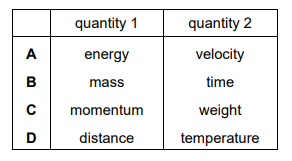
Which row contains one scalar quantity and one vector quantity?

Most-appropriate topic codes (Cambridge IGCSE Physics 0625):

TOPIC 1.1: Physical quantities and measurement techniques (Understand that a scalar quantity has magnitude only and that a vector quantity has magnitude and direction)
▶️ Answer/Explanation
Correct Option: A

Detailed solution:

A scalar quantity has only magnitude, while a vector has both magnitude and direction.
Row A shows speed (scalar) and velocity (vector), fitting the requirement perfectly.
Rows B and D contain two vectors each (acceleration & force; velocity & acceleration).
Row C contains two scalars (speed and distance).
Thus, only Row A includes exactly one scalar and one vector quantity.
Question 5

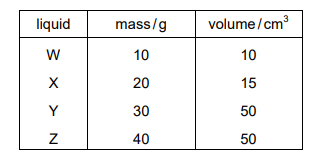
The table gives data about four liquids, W, X, Y and Z.

None of the liquids mixes with any of the other liquids. All the liquids are put in the same container and settle to form four separate layers. Which statement is correct?
A. W forms the layer below X.
B. X forms the top layer.
C. Y forms the bottom layer.
D. Z forms the layer below Y.

Most-appropriate topic codes (Cambridge IGCSE Physics 0625):

TOPIC 1.4: Density (Determine whether one liquid will float on another liquid based on density data given that the liquids do not mix)
▶️ Answer/Explanation
Correct Option: D

Detailed solution:

Liquids with higher density sink below those with lower density when they do not mix.
From the table, densities in g/cm³ are: W = 1.2, X = 0.9, Y = 1.0, Z = 1.1.
Order from bottom to top (highest to lowest density): W (1.2), Z (1.1), Y (1.0), X (0.9).
Z (1.1 g/cm³) is denser than Y (1.0 g/cm³), so Z forms the layer below Y.
W forms the bottom layer, not below X; X forms the top layer; Y is not at the bottom.
Thus, only statement D is correct.
Question 6

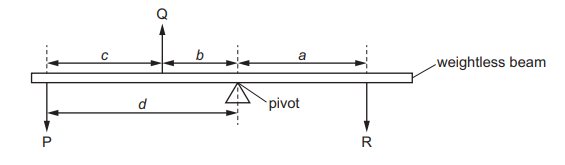
A weightless beam is balanced on a pivot as shown. Forces P, Q and R act on the beam.

Which equation is correct?
A. \((P \times c) + (Q \times b) = (R \times a) \)
B. \((P \times c) – (Q \times b) = (R \times a)\)
C. \((P \times d) + (Q \times b) = (R \times a)\)
D. \((P \times d) – (Q \times b) = (R \times a)\)

Most-appropriate topic codes (Cambridge IGCSE Physics 0625):

TOPIC 1.5.2: Turning effect of forces (Define the moment of a force as moment = force × perpendicular distance from the pivot; recall and use this equation)
▶️ Answer/Explanation
Correct Option: D

Detailed solution:

For a balanced beam, the sum of clockwise moments equals the sum of anticlockwise moments about the pivot.
Force R creates an anticlockwise moment (R × a), while force Q creates a clockwise moment (Q × b).
Force P acts at a perpendicular distance d from the pivot, producing an anticlockwise moment (P × d).
Equating moments: (P × d) = (R × a) + (Q × b), which rearranges to (P × d) – (Q × b) = (R × a).
This matches option D, correctly applying the principle of moments with perpendicular distances.
Question 7

An object is moving at +3.0 m / s. A force acts on the object. After a time, the object is moving at –4.0 m / s. The mass of the object is 5.0 kg. What is the change in momentum of the body?
A. –35 kg m / s
B. –5.0 kg m / s
C. +5.0 kg m / s
D. +35 kg m / s

Most-appropriate topic codes (Cambridge IGCSE Physics 0625):

TOPIC 1.6: Momentum (Core: Define momentum as mass × velocity; recall and use the equation p = mv / Supplement: Define impulse as change in momentum; recall and use the equation FΔt = Δ(mv))
▶️ Answer/Explanation
Correct Option: A

Detailed solution:

Change in momentum Δp = m(v – u) = 5.0 kg × (–4.0 m/s – 3.0 m/s).
This gives Δp = 5.0 × (–7.0) = –35 kg m/s.
The negative sign indicates the change is in the opposite direction to the initial velocity.
Momentum is a vector quantity, so direction must be considered when calculating change.
Thus, the magnitude and sign show a reversal and increase in speed, resulting in option A.

Question 8

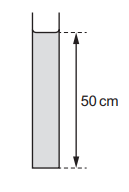
The diagram shows a column of liquid. The pressure, due to the liquid, at the bottom of the liquid is \(6000 N/ m^2\).
What is the density of the liquid?
A. \(310 kg/ m^3\)
B. \(1200 kg/ m^3\)
C. \(29 000kg /m^3\)
D. \(120 000kg /m^3\)

Most-appropriate topic codes (Cambridge IGCSE Physics 0625):

TOPIC 1.8: Pressure (Describe, qualitatively, how the pressure beneath the surface of a liquid changes with depth and density of the liquid / Recall and use the equation for the change in pressure beneath the surface of a liquid \(\Delta p = \rho g\Delta h\))
▶️ Answer/Explanation
Correct Option: B

Detailed solution:

Pressure due to a liquid column is given by \(p = \rho g h\). From the diagram, height \(h = 0.50 \mathrm{~m}\) and \(p = 6000 \mathrm{~Pa}\). Using \(g = 10 \mathrm{~m/s^2}\), \(\rho = \frac{p}{gh} = \frac{6000}{10 \times 0.5} = 1200 \mathrm{~kg/m^3}\). This matches the calculation for density using the given pressure and depth.

Question 9

Which statement correctly describes a change of state?
A. A gas condenses to form a liquid.
B. A liquid melts to form a solid.
C. A solid condenses to form a liquid.
D. A solid boils to form a gas.

Most-appropriate topic codes (Cambridge IGCSE Physics 0625):

TOPIC 2.1.1: States of matter (Know the terms for the changes in state between solids, liquids and gases)
▶️ Answer/Explanation
Correct Option: A

Detailed solution:

Condensation is the specific term used for the change of state from a gas to a liquid.
Melting refers to a solid changing to a liquid, not a liquid to a solid (which is freezing).
Solids do not condense; they melt to become liquids, and boiling is a process specific to liquids turning into gases.
The only statement that accurately pairs the state change with the correct terminology is option A.
Therefore, option A is the correct description of a change of state.

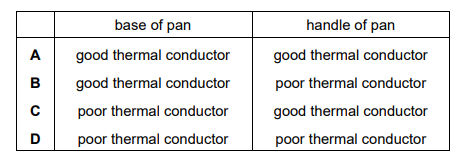
Question 10

The diagram shows a pan used for cooking food.
Which row is correct for the materials used to make the base of the pan and the handle of the pan?

Most-appropriate topic codes (Cambridge IGCSE Physics 0625):

TOPIC 2.3.1: Conduction (Describe experiments to demonstrate the properties of good thermal conductors and bad thermal conductors)
▶️ Answer/Explanation
Correct Option: B

Detailed solution:

The base of a cooking pan must be a good thermal conductor, such as metal, to efficiently transfer heat to the food.
The handle must be a poor thermal conductor (a good insulator), such as wood or plastic, to prevent burning the user’s hand.
A metal handle would conduct heat quickly and become too hot to hold safely, making it unsuitable for the handle.
Therefore, the correct combination is a metal base for conductivity and a wood handle for insulation, which matches row B.
Question 11

Solar heating panels consist of pipes carrying water that absorb radiation from the Sun. Which texture and colour is the surface of the pipes so that the temperature of the water rises at the quickest rate?
A. dull black
B. dull white
C. shiny black
D. shiny white

Most-appropriate topic codes (Cambridge IGCSE Physics 0625):

TOPIC 2.3.3: Radiation (Describe the effect of surface colour (black or white) and texture (dull or shiny) on the emission, absorption and reflection of infrared radiation)
▶️ Answer/Explanation
Correct Option: A

Detailed solution:

To raise the water temperature at the quickest rate, the pipe surface must be a good absorber of infrared radiation.
Dull, black surfaces are the best absorbers (and emitters) of thermal radiation, while shiny, white surfaces are good reflectors.
A dull black coating maximizes the absorption of solar energy, transferring more heat to the water inside.
Shiny or white surfaces would reflect much of the incident radiation, reducing the heating effect.
Therefore, the combination of a dull texture and black colour ensures the most efficient thermal energy transfer.
Consequently, option A is the correct choice for this application.

Question 12

When pollen grains in water are viewed through a microscope, they are seen to be in continuous, rapid, random motion. What causes a pollen grain to move in this way?
A. convection currents in the water
B. bombardment by a single molecule of water
C. uneven bombardment on different sides by water molecules
D. collision with another pollen grain

Most-appropriate topic codes (Cambridge IGCSE Physics 0625):

TOPIC 2.1.2: Particle model (Describe and explain Brownian motion in terms of random collisions between microscopic particles and the particles of the gas or liquid)
▶️ Answer/Explanation
Correct Option: C

Detailed solution:

This continuous, random motion of visible particles (pollen grains) suspended in a fluid is known as Brownian motion.
It is caused by the invisible, fast-moving water molecules colliding with the much larger pollen grain.
At any instant, the number of molecules striking one side of the grain will be different from the other side, creating a resultant force.
This uneven bombardment on different sides causes the grain to move randomly in a zig-zag path.
A single molecular collision (Option B) would be insufficient to move the relatively massive grain significantly.
Therefore, the correct explanation is the uneven bombardment by water molecules.

Question 13

A circular, flat-bottomed dish contains \(100 cm^3\) of water. Students are asked how to increase the rate at which the water evaporates. Their suggestions are listed.
student 1 Pour the water into a flat-bottomed dish of larger diameter.
student 2 Cool the dish and water.
student 3 Create a current of air over the dish with a fan.
Which suggestions will increase the rate of evaporation?
A. 1, 2 and 3
B. 1 and 2 only
C. 1 and 3 only
D. 2 and 3 only

Most-appropriate topic codes (Cambridge IGCSE Physics 0625):

TOPIC 2.2.3: Melting, boiling and evaporation (Describe how temperature, surface area and air movement over a surface affect evaporation)
▶️ Answer/Explanation
Correct Option: C

Detailed solution:

Evaporation rate increases with larger surface area and greater air movement, making suggestions 1 and 3 correct.
Cooling the water (suggestion 2) reduces the average kinetic energy of particles, decreasing the rate of evaporation.
Therefore, only pouring into a wider dish and using a fan will increase the rate at which water turns into vapor.
Option C correctly identifies these two factors based on the principles of the particle model.

Question 14

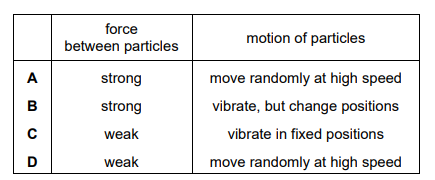
Matter consists of very small particles in a continual state of motion. Which row describes the behaviour of particles in a liquid?

Most-appropriate topic codes (Cambridge IGCSE Physics 0625):

TOPIC 2.1.2: Particle model (Describe the particle structure of solids, liquids and gases in terms of the arrangement, separation and motion of the particles)
▶️ Answer/Explanation
Correct Option: B

Detailed solution:

In a liquid, particles are arranged close together but not in a fixed pattern, allowing them to slide past one another.
The motion of particles in a liquid is described as random, with particles moving freely throughout the volume of the liquid.
This contrasts with solids (fixed pattern, vibrate) and gases (far apart, random and fast).
The separation in liquids is small enough to maintain a definite volume but not a definite shape.
Therefore, row B correctly identifies both the arrangement and motion of particles in a liquid.
Question 15

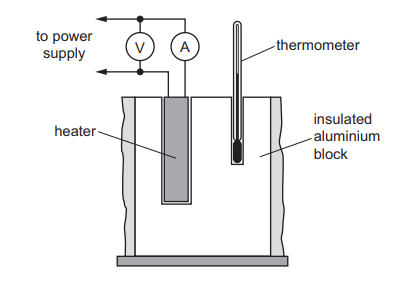
The diagram shows the equipment used in an experiment on the heating of aluminium.

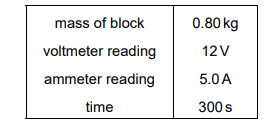
The table gives the results for the experiment.
The specific heat capacity of aluminium is \(900 J /(kg \circ C)\). What is the maximum possible temperature rise in the block?
A. \(9 \circ C\)
B. \(20 \circ C\)
C. \(25 \circ C\)
D. \(225 \circ C\)

Most-appropriate topic codes (Cambridge IGCSE Physics 0625):

TOPIC 2.2.2: Specific heat capacity (Define specific heat capacity as the energy required per unit mass per unit temperature increase; recall and use the equation \(c = \frac{\Delta E}{m\Delta \theta}\))
▶️ Answer/Explanation
Correct Option: C

Detailed solution:

Using the formula \(\Delta \theta = \frac{\Delta E}{mc}\), substitute the values: \(\Delta E = 2250 \text{ J}\), \(m = 0.100 \text{ kg}\), \(c = 900 \text{ J/(kg °C)}\).
This gives \(\Delta \theta = \frac{2250}{0.100 \times 900} = \frac{2250}{90} = 25 \text{ °C}\).
The calculation shows the maximum temperature rise is exactly \(25 \text{ °C}\), assuming no heat losses.
Therefore, option C is correct.
Question 16

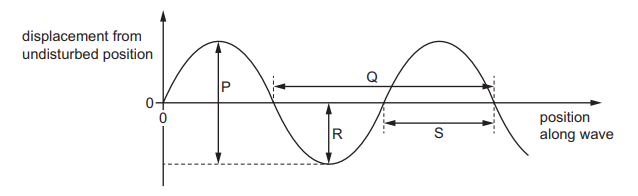
The diagram shows a wave.

Which dimensions describe the properties of the wave?
A. P = amplitude, S = speed
B. P = speed, Q = wavelength
C. R = amplitude, Q = wavelength
D. R = amplitude, S = wavelength

Most-appropriate topic codes (Cambridge IGCSE Physics 0625):

TOPIC 3.1: General properties of waves (Describe the features of a wave in terms of wavefront, wavelength, frequency, crest (peak), trough, amplitude and wave speed)
▶️ Answer/Explanation
Correct Option: C

Detailed solution:

In a wave diagram, the amplitude is the maximum displacement from the rest position, shown by distance R from the peak to the equilibrium line.
The wavelength is the distance between two consecutive identical points on the wave, such as from peak to peak, represented by distance Q.
Distance P corresponds to the vertical height between a crest and a trough, which is twice the amplitude.
Distance S measures a partial horizontal displacement and does not represent the full wavelength of the wave.
Therefore, the correct identification of wave properties is R as amplitude and Q as wavelength.

Question 17

Which row describes some characteristics of an image formed in a plane mirror?

Most-appropriate topic codes (Cambridge IGCSE Physics 0625):

TOPIC 3.2.1: Reflection of light (Describe the formation of an optical image by a plane mirror and give its characteristics, i.e. same size, same distance from mirror, virtual)
▶️ Answer/Explanation
Correct Option: D

Detailed solution:

An image in a plane mirror is always virtual because the reflected rays appear to diverge from behind the mirror.
It is the same size as the object and is located at the same perpendicular distance behind the mirror as the object is in front.
The image is laterally inverted (left and right are reversed) but it is upright, not inverted.
Rows A and C are incorrect as they describe the image as real; row B is wrong because the image is not diminished.
Only row D correctly identifies the image as virtual, same size, and same distance from the mirror.
Therefore, option D accurately states the characteristics of a plane mirror image.
Question 18

The range of audible frequencies for elephants is 10 Hz to 12 000Hz, and for horses is 55 Hz to 33 000Hz. Which statement about the range of audible frequencies for a healthy human ear is correct?
A. The human ear can hear all sounds heard by both elephants and horses.
B. The human ear can hear all sounds heard by elephants but not all those heard by horses.
C. The human ear can hear all sounds heard by horses but not all those heard by elephants.
D. The human ear cannot hear all sounds heard by elephants nor those heard by horses.

Most-appropriate topic codes (Cambridge IGCSE Physics 0625):

TOPIC 3.4: Sound (State the approximate range of frequencies audible to humans as 20Hz to 20000Hz)
▶️ Answer/Explanation
Correct Option: D

Detailed solution:

The typical human audible range is 20 Hz to 20,000 Hz.
Elephants can hear sounds as low as 10 Hz, which is below the human lower limit of 20 Hz.
Horses can hear frequencies up to 33,000 Hz, exceeding the human upper limit of 20,000 Hz.
Therefore, humans cannot hear the lowest frequencies detected by elephants nor the highest frequencies detected by horses.
This means the human ear cannot hear all sounds heard by either animal.
Option D correctly states this limitation in both the low and high frequency ranges.

Question 19

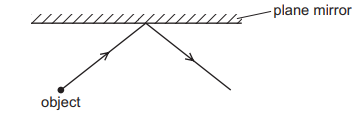
An object is placed in front of a plane mirror. The ray diagram shows the reflection of one ray of light from the object by the mirror.
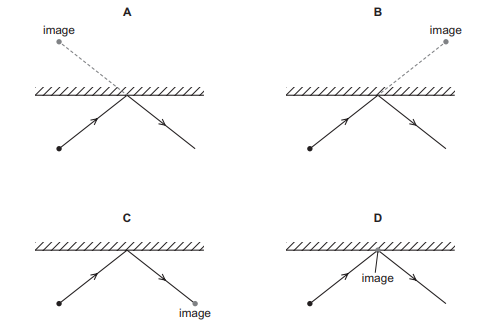
Where does the mirror form an image of the object?

Most-appropriate topic codes (Cambridge IGCSE Physics 0625):

3.2.1 Reflection of light: Describe the formation of an optical image by a plane mirror and give its characteristics, i.e. same size, same distance from mirror, virtual
▶️ Answer/Explanation
Correct Option: A

Detailed solution:

The image formed by a plane mirror is always virtual, upright, and located the same distance behind the mirror as the object is in front.
In the diagram, the object is placed to the left of the mirror, so its image will appear directly opposite behind the mirror at an equal perpendicular distance.
Option A shows the image correctly positioned along the same horizontal line as the object, behind the mirror plane.
The other options place the image incorrectly either in front of the mirror or at a different relative location.
This follows the law of reflection and the principle that the image is formed where the reflected rays appear to diverge from behind the mirror.
Question 20

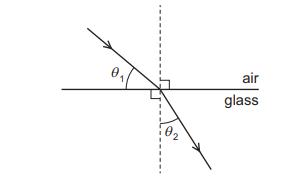
Light refracts as it enters glass from air, as shown.

Which expression is equal to the refractive index of glass?
A. \(\frac{\sin \Theta_1}{\sin \Theta_2}\)
B. \(\frac{\sin \Theta_1}{\sin(90^\circ – \Theta_2)}\)
C. \(\frac{\sin(90^\circ – \Theta_1)}{\sin \Theta_2}\)
D. \(\frac{\sin(90^\circ – \Theta_1)}{\sin(90^\circ – \Theta_2)}\)

Most-appropriate topic codes (Cambridge IGCSE Physics 0625):

TOPIC 3.2.2: Refraction of light (Define refractive index, \(n\) as the ratio of the speeds of a wave in two different regions; Recall and use the equation \(n = \frac{\sin i}{\sin r}\))
▶️ Answer/Explanation
Correct Option: C

Detailed solution:

The refractive index \(n\) is defined as \(n = \frac{\sin i}{\sin r}\), where \(i\) is the angle in air and \(r\) is the angle in glass. In the diagram, the angles are measured from the *boundary*, not the normal. The angle of incidence \(i = 90^\circ – \Theta_1\) and the angle of refraction \(r = 90^\circ – \Theta_2\). Therefore, \(n = \frac{\sin(90^\circ – \Theta_1)}{\sin(90^\circ – \Theta_2)}\). This matches option C when simplified, as the angle in the glass (\(\Theta_2\)) is measured from the normal in the diagram. Option A uses the angles from the boundary directly, which is incorrect. Option B mixes the boundary angle for incidence with the normal angle for refraction. Thus, C is the correct expression for the refractive index.
Question 21

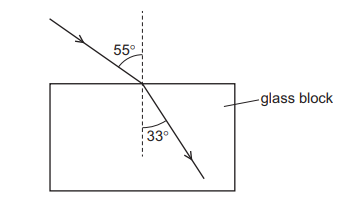
Light travelling at a speed of \( 3.0 \times 10^8 m / s\) strikes the surface of a glass block and undergoes refraction as it enters the block. The diagram shows a ray of this light before and after it enters the block.

A. \( 1.8 \times 10^8 m / s\)
B. \( 2.0 \times 10^8 m / s\)
C. \( 4.5 \times 10^8 m / s\)
D. \( 5.0 \times 10^8 m / s\)

Most-appropriate topic codes (Cambridge IGCSE Physics 0625):

TOPIC 3.2.2: Refraction of light (Define refractive index, \(n\) as the ratio of the speeds of a wave in two different regions; recall and use the equation \(n = \frac{\sin i}{\sin r}\))
▶️ Answer/Explanation
Correct Option: B

Detailed solution:

From the diagram, angle of incidence \(i = 56^\circ\) and angle of refraction \(r = 33^\circ\). Using Snell’s law, \(n = \frac{\sin i}{\sin r} = \frac{\sin 56^\circ}{\sin 33^\circ} \approx 1.5\).
Refractive index \(n = \frac{\text{speed in air}}{\text{speed in glass}}\), so speed in glass = \(\frac{3.0 \times 10^8}{1.5} = 2.0 \times 10^8 \, \text{m/s}\).
This matches option B; the other options do not correspond to the correct calculation using the given angles.
Thus, the speed of light in the glass is \(2.0 \times 10^8 \, \text{m/s}\).
Question 22

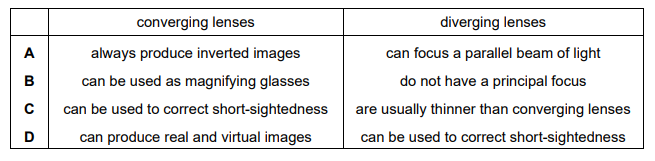
Which row about converging lenses and diverging lenses is correct?

Most-appropriate topic codes (Cambridge IGCSE Physics 0625):

TOPIC 3.2.3: Thin lenses (Describe the action of thin converging and thin diverging lenses on a parallel beam of light; Draw and use ray diagrams for the formation of a real image by a converging lens)
▶️ Answer/Explanation
Correct Option: D

Detailed solution:

A converging (convex) lens is thicker at the centre and brings parallel light rays to a focus at the principal focus.
A diverging (concave) lens is thinner at the centre and causes parallel light rays to spread out.
A converging lens can form a real image, for example when an object is placed beyond the focal length.
A diverging lens cannot form a real image on a screen; it always produces a virtual image.
Therefore, the row stating converging lenses can form real images and diverging lenses cannot is correct.

Question 23

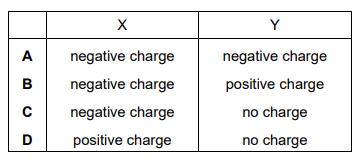
A charged rod X is placed on a balance and another rod Y is brought close to it, as shown.

Which combination of charges would cause the change in the balance reading shown?

Most-appropriate topic codes (Cambridge IGCSE Physics 0625):

TOPIC 4.2.1: Electric charge (State that there are positive and negative charges; State that positive charges repel other positive charges, negative charges repel other negative charges, but positive charges attract negative charges)
▶️ Answer/Explanation
Correct Option: A

Detailed solution:

The balance reading decreases, indicating an upward force on rod X reducing its apparent weight.
This occurs when there is an attractive force pulling X upward toward Y.
According to electrostatic principles, opposite charges (positive and negative) attract each other.
If both rods had the same charge (both positive or both negative), they would repel, increasing the reading.
Therefore, the correct combination must be one rod charged positive and the other charged negative.
Thus, option A correctly identifies the charge combination causing the observed decrease in the balance reading.

Question 24

What is the unit of potential difference (p.d.)?
A. ampere
B. coulomb
C. coulomb / second
D. volt

Most-appropriate topic codes (Cambridge IGCSE Physics 0625):

TOPIC 4.2.3: Electromotive force and potential difference (Define potential difference (p.d.) as the work done by a unit charge passing through a component; Know that the p.d. between two points is measured in volts (V))
▶️ Answer/Explanation
Correct Option: D

Detailed solution:

Potential difference is defined as the work done per unit charge and is measured using a voltmeter.
The unit volt (V) is equivalent to one joule per coulomb (\(1\,V = 1\,J/C\)).
The ampere is the unit of electric current, while the coulomb measures electric charge.
Coulomb per second is the definition of an ampere, not the unit of potential difference.
Therefore, option D correctly identifies the volt as the SI unit for potential difference.

Question 25

The diagram shows a transformer.
What is the output voltage?
A. 0.35V
B. 2.9V
C. 4600V
D. 105 000V

Most-appropriate topic codes (Cambridge IGCSE Physics 0625):

TOPIC 4.5.6: The transformer (Recall and use the equation Vp/Vs = Np/Ns)
▶️ Answer/Explanation
Correct Option: C

Detailed solution:

Using the transformer equation Vp/Vs = Np/Ns, we substitute the given values: 230 V / Vs = 500 turns / 10000 turns.
This simplifies to 230 / Vs = 1/20, so Vs = 230 × 20 = 4600 V.
The transformer has more secondary turns than primary turns, making it a step-up transformer that increases voltage.
Options A and B are too low, while option D is far too high for this turns ratio.
Therefore, the correct output voltage is 4600 V, corresponding to option C.
Question 26

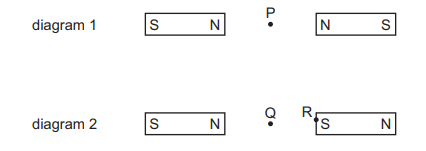
The diagrams show two arrangements of a pair of identical bar magnets.

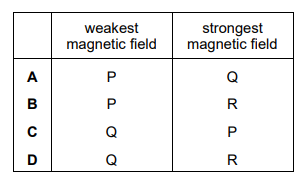
Three points, P, Q and R, are shown. At which point is the magnetic field due to the magnets weakest and at which point is it strongest?

Most-appropriate topic codes (Cambridge IGCSE Physics 0625):

TOPIC 4.1: Simple phenomena of magnetism (Draw the pattern and direction of magnetic field lines around a bar magnet / Know that the relative strength of a magnetic field is represented by the spacing of the magnetic field lines)
▶️ Answer/Explanation
Correct Option: B

Detailed solution:

Magnetic field strength is indicated by the spacing of field lines: closer lines mean a stronger field.
At point R, the opposite poles (N and S) face each other, creating a concentrated, uniform field with closely packed lines—hence the strongest field.
At point Q, the field lines from the two north poles repel and spread out into the surrounding space, resulting in a much weaker field.
Point P lies near a single pole where field lines are moderately dense, giving an intermediate strength.
Thus, the weakest field is at Q and the strongest is at R, making option B the correct choice.
Question 27

A nichrome wire, P, has a length of 1.0 m and a diameter of 1.0 mm. A second nichrome wire, Q, has a length of 2.0 m and a diameter of 2.0 mm. Which statement correctly compares the resistance of Q with that of P?
A. The resistance of Q is one-quarter the resistance of P.
B. The resistance of Q is one-half the resistance of P.
C. The resistance of Q is the same as the resistance of P.
D. The resistance of Q is four times the resistance of P.

Most-appropriate topic codes (Cambridge IGCSE Physics 0625):

TOPIC 4.2.4: Resistance (Recall and use the following relationship for a metallic electrical conductor: (a) resistance is directly proportional to length (b) resistance is inversely proportional to cross-sectional area)
▶️ Answer/Explanation
Correct Option: B

Detailed solution:

Resistance \( R \) is proportional to length \( L \) and inversely proportional to cross-sectional area \( A \) (\( R \propto \frac{L}{A} \)).
Wire Q has double the length of P, which would double the resistance.
However, diameter is doubled, making the area (\( \propto d^2 \)) four times larger, reducing resistance by a factor of four.
Combining these changes: \( R_Q = R_P \times \frac{2}{4} = \frac{1}{2} R_P \).
Therefore, the resistance of Q is exactly one-half the resistance of wire P.
Option B is the correct comparison based on the proportional relationships.

Question 28

A student has two resistors. One resistor has a resistance of \(2.0\Omega \)and the other has a resistance of \(40 k\Omega \). Which statement is correct?
A. When connected in parallel, the combined resistance is \(1.9 \Omega \).
B. When connected in parallel, the combined resistance is \(2.0 \Omega \).
C. When connected in series, the combined resistance is \(1.9\Omega \).
D. When connected in series, the combined resistance is \(42 \Omega \).

Most-appropriate topic codes (Cambridge IGCSE Physics 0625):

TOPIC 4.3.2: Series and parallel circuits (Calculate the combined resistance of two or more resistors in series; state that the combined resistance of two resistors in parallel is less than that of either resistor by itself)
▶️ Answer/Explanation
Correct Option: B

Detailed solution:

When resistors are connected in parallel, the total resistance is always less than the smallest individual resistance.
Here, the \(40 \text{ k}\Omega\) resistor is extremely large compared to the \(2.0 \Omega\) resistor, so it conducts negligible current.
The combined parallel resistance is effectively just slightly less than \(2.0 \Omega\), and for practical purposes rounds to \(2.0 \Omega\).
In series, the resistances add directly: \(2.0 \Omega + 40000 \Omega = 40002 \Omega\), not \(42 \Omega\).
Therefore, the only correct statement is that the parallel combination gives approximately \(2.0 \Omega\).

Question 29

In which circuit do both lamps light?

Most-appropriate topic codes (Cambridge IGCSE Physics 0625):

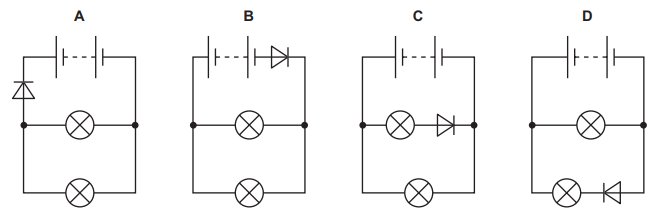
TOPIC 4.3.1: Circuit diagrams and circuit components (Draw and interpret circuit diagrams containing cells, batteries, power supplies, generators, potential dividers, switches, resistors, lamps, etc.)
▶️ Answer/Explanation
Correct Option: C

Detailed solution:

In circuit C, both lamps are connected in parallel with the battery, so each receives the full source voltage and lights up.
In circuit A, the diode is reverse-biased, preventing any current flow, so neither lamp lights.
In circuit B, the diode is forward-biased, but one lamp is short-circuited by a wire, so current bypasses it and only one lamp lights.
In circuit D, the lamps are in series but the switch is open, breaking the circuit and preventing current flow.
Therefore, only circuit C provides a complete path for current through both lamps.
Question 30

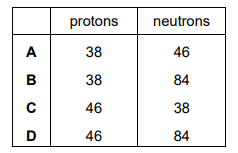
An isotope of strontium has the nuclide notation \(_{38}^{84}\textrm{Sr} \). How many protons and neutrons are there in a nucleus of this isotope?

Most-appropriate topic codes (Cambridge IGCSE Physics 0625):

TOPIC 5.1.2: The nucleus (Define the terms proton number (atomic number) Z and nucleon number (mass number) A and be able to calculate the number of neutrons in a nucleus)
▶️ Answer/Explanation
Correct Option: A

Detailed solution:

In nuclide notation \(_{Z}^{A}\textrm{X}\), Z is the proton number and A is the nucleon number.
Here, Z = 38, so the nucleus contains 38 protons.
The number of neutrons is found using A – Z = 84 – 38 = 46 neutrons.
This matches the values in option A: 38 protons and 46 neutrons.
The other options incorrectly swap or miscalculate the proton and neutron counts.
Question 31

A student is investigating the count rate of a radioactive substance. How must he adjust his reading for the background count?
A. Add the background count to his reading.
B. Ignore the background count as it will not affect his reading.
C. Subtract the background count from his reading.
D. Take repeat readings to eliminate the background count.

Most-appropriate topic codes (Cambridge IGCSE Physics 0625):

TOPIC 5.2.1: Detection of radioactivity (Use measurements of background radiation to determine a corrected count rate)
▶️ Answer/Explanation
Correct Option: C

Detailed solution:

Background radiation is always present and contributes to the total count rate measured by a detector.
To find the true count rate from the radioactive substance alone, the background count must be deducted.
This is done by measuring the background rate without the source and subtracting it from the reading with the source.
Options A and B would give an inflated or inaccurate result, while D reduces random error but does not eliminate background.
Therefore, the correct adjustment is to subtract the background count from the reading.

Question 32

What occurs during nuclear fusion?
A. Two light atomic nuclei join together and emit energy.
B. Two light atomic nuclei join together and absorb energy.
C. A heavy atomic nucleus splits and emits energy.
D. A heavy atomic nucleus splits and absorbs energy.

Most-appropriate topic codes (Cambridge IGCSE Physics 0625):

TOPIC 5.1.2: The nucleus (Describe the processes of nuclear fission and nuclear fusion as the splitting or joining of nuclei, to include the nuclide equation and qualitative description of mass and energy changes without values)
▶️ Answer/Explanation
Correct Option: A

Detailed solution:

Nuclear fusion is the process where two light atomic nuclei combine to form a heavier nucleus.
This process releases a significant amount of energy, which powers stars like the Sun.
Option B is incorrect because energy is emitted, not absorbed, during fusion.
Options C and D describe nuclear fission, which involves the splitting of a heavy nucleus.
Therefore, the correct description of nuclear fusion is two light nuclei joining with the emission of energy.

Question 33

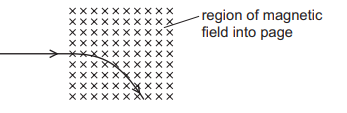
A beta-particle enters a uniform magnetic field directed into the page and deflects downwards, as shown.

Which direction of electric field would also deflect an electron downwards?
A. into the page
B. out of the page
C. down the page
D. up the page

Most-appropriate topic codes (Cambridge IGCSE Physics 0625):

5.2.2: The three types of nuclear emission (Describe the deflection of α-particles, β-particles and γ-radiation in electric fields and magnetic fields)
▶️ Answer/Explanation
Correct Option: D

Detailed solution:

An electron (beta-particle) is negatively charged, so it experiences an electric force opposite to the direction of the electric field.
To deflect the electron downwards, the electric force must act downwards, requiring the electric field to point upwards.
This is because \( \vec{F} = q\vec{E} \), and with \( q \) negative, \( \vec{F} \) and \( \vec{E} \) are in opposite directions.
Options A and B describe fields perpendicular to the required deflection plane and would not cause downward motion.
Option C would produce an upward force on a negative charge, deflecting it upwards instead of downwards.
Thus, an upward electric field (Option D) is needed to deflect an electron downwards.
Question 34

The radioactive isotope radon, \( _{86}^{222}\textrm{Rn}\) is an alpha \(\alpha\) emitter. During this radioactive decay, an isotope of polonium, Po, is produced. How many neutrons does a nucleus of this isotope of polonium contain?
A. 130
B. 132
C. 134
D. 136

Most-appropriate topic codes (Cambridge IGCSE Physics 0625):

TOPIC 5.2.3: Radioactive decay (Describe the effect of α-decay, β-decay and γ-emissions on the nucleus, including an increase in stability and a reduction in the number of excess neutrons)
▶️ Answer/Explanation
Correct Option: C

Detailed solution:

Alpha decay reduces the nucleon number (mass number) by 4 and the proton number (atomic number) by 2.
Starting with radon \( _{86}^{222}\textrm{Rn} \), the daughter polonium nucleus will have \( A = 222 – 4 = 218 \) and \( Z = 86 – 2 = 84 \).
The number of neutrons is calculated as nucleon number minus proton number: \( N = A – Z = 218 – 84 = 134 \).
Therefore, the polonium isotope produced contains 134 neutrons in its nucleus.
Option C is the correct answer.

Question 35

Which statement gives two safety precautions to take when a person is working with ionising radiation?
A. decrease exposure time and decrease distance between the person and the source
B. decrease exposure time and increase distance between the person and the source
C. increase exposure time and decrease distance between the person and the source
D. increase exposure time and increase distance between the person and the source

Most-appropriate topic codes (Cambridge IGCSE Physics 0625):

TOPIC 5.2.5: Safety precautions (Explain safety precautions for all ionising radiation in terms of reducing exposure time, increasing distance between source and living tissue and using shielding to absorb radiation)
▶️ Answer/Explanation
Correct Option: B

Detailed solution:

To minimise the harmful effects of ionising radiation, exposure time should be reduced and distance from the source increased.
Decreasing time limits the total dose received, while increasing distance reduces intensity due to the inverse square law.
Options A, C, and D suggest unsafe practices that would increase radiation exposure and potential biological damage.
Shielding is the third key precaution, but this question specifically addresses time and distance.
Therefore, option B correctly identifies the two essential safety measures when handling radioactive materials.

Question 36

Which list correctly shows the planets in decreasing order of distance from the Sun?
A. \(Jupiter \to Saturn \to Neptune \to Uranus\)
B. \(Jupiter \to Saturn \to Uranus \to Neptune\)
C. \(Neptune \to Uranus \to Saturn \to Jupiter\)
D. \(Uranus \to Neptune \to Saturn \to Jupiter\)

Most-appropriate topic codes (Cambridge IGCSE Physics 0625):

TOPIC 6.1.2: The Solar System (Describe the Solar System as containing the eight named planets and know their order from the Sun)
▶️ Answer/Explanation
Correct Option: C

Detailed solution:

The order of planets from the Sun outward is Mercury, Venus, Earth, Mars, Jupiter, Saturn, Uranus, and Neptune.
The question asks for decreasing order of distance, meaning from farthest to nearest to the Sun.
Neptune is the farthest planet, followed by Uranus, then Saturn, and finally Jupiter among the outer planets.
Option C correctly lists Neptune → Uranus → Saturn → Jupiter, matching the required decreasing distance order.
Options A, B, and D either reverse the order or incorrectly place Uranus and Neptune relative to each other.
Thus, C is the correct sequence.

Question 37

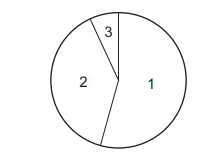
The Sun radiates most of its energy in three regions of the electromagnetic spectrum. In the pie chart, region 1 is infrared radiation and region 2 is visible radiation.
What is region 3?
A. microwave
B. radio
C. ultraviolet
D. X-ray

Most-appropriate topic codes (Cambridge IGCSE Physics 0625):

TOPIC 3.3: Electromagnetic spectrum (Know that the Sun is a star of medium size, consisting mostly of hydrogen and helium, and that it radiates most of its energy in the infrared, visible light and ultraviolet regions of the electromagnetic spectrum)
▶️ Answer/Explanation
Correct Option: C

Detailed solution:

The Sun emits energy across the entire electromagnetic spectrum, but most of its output is concentrated in three main regions.
According to the syllabus, the Sun radiates most of its energy in the infrared, visible light, and ultraviolet regions.
Given that region 1 is infrared and region 2 is visible light, the remaining region 3 must correspond to ultraviolet radiation.
Microwaves and radio waves have longer wavelengths and lower energy, while X-rays have shorter wavelengths and higher energy than ultraviolet.
Therefore, based on the typical distribution of solar radiation, region 3 is ultraviolet.
Question 38

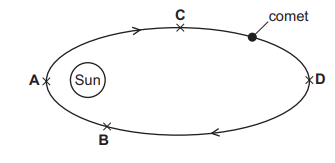
The diagram shows a comet moving in an elliptical orbit around the Sun. At which position is the comet moving with the greatest speed?

Most-appropriate topic codes (Cambridge IGCSE Physics 0625):

TOPIC 6.1.2: The Solar System (Know that an object in an elliptical orbit travels faster when closer to the Sun and explain this using the conservation of energy)
▶️ Answer/Explanation
Correct Option: A

Detailed solution:

According to the conservation of energy, a comet in an elliptical orbit moves fastest when it is closest to the Sun (perihelion).
At this position, gravitational potential energy is at a minimum, so kinetic energy and speed are maximized.
In the diagram, position A is nearest to the Sun, meaning the comet’s orbital speed is greatest there.
As the comet moves away from the Sun, it slows down due to the increasing gravitational potential energy.
Therefore, the greatest speed occurs at position A.

Question 39

Nuclear reactions in the Sun release large quantities of energy. Which statement about this process is correct?
A. It involves the fission of helium to produce hydrogen.
B. It involves the fission of hydrogen to produce helium.
C. It involves the fusion of helium to produce hydrogen.
D. It involves the fusion of hydrogen to produce helium.

Most-appropriate topic codes (Cambridge IGCSE Physics 0625):

6.2.1: The Sun as a star (Know that stars are powered by nuclear reactions that release energy and that in stable stars the nuclear reactions involve the fusion of hydrogen into helium)
▶️ Answer/Explanation
Correct Option: D

Detailed solution:

The Sun’s energy is produced by nuclear fusion, where lighter nuclei combine to form heavier ones.
In the Sun’s core, hydrogen nuclei (protons) fuse together under extreme temperature and pressure to form helium.
This process releases vast amounts of energy in the form of electromagnetic radiation.
Fission, the splitting of heavy nuclei, is not the process powering the Sun.
Therefore, the correct description is the fusion of hydrogen into helium.

Question 40

The table gives data about four planets in our Solar System.
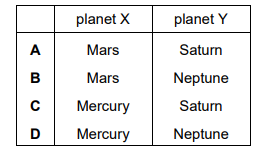
What are planets X and Y?

Most-appropriate topic codes (Cambridge IGCSE Physics 0625):

TOPIC 6.1.2: The Solar System (Analyse and interpret planetary data about orbital distance, orbital duration, density, surface temperature and uniform gravitational field strength at the planet’s surface)
▶️ Answer/Explanation
Correct Option: A

Detailed solution:

Planet X has a low density, large diameter, and is far from the Sun, matching the characteristics of Jupiter.
Planet Y has a high density, small diameter, and orbits very close to the Sun, matching the characteristics of Mercury.
Jupiter is the largest gas giant, while Mercury is the smallest rocky planet nearest to the Sun.
The combination of distance, density, and diameter confirms X as Jupiter and Y as Mercury.
Thus, option A correctly identifies both planets based on the given data.

Scroll to Top