
Question 1
(a) Fig. 1.1. is a speed–time graph for the first 5 minutes of a bus journey.
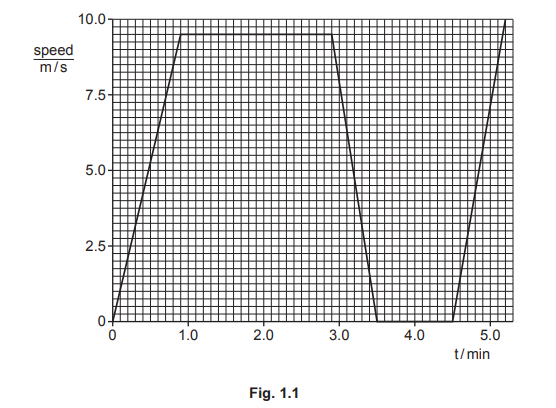
Describe the motion between:
1. t = 0.90min and t = 2.9min ………………………………….
2. t = 2.9min and t = 3.5min ………………………………….
3. t = 3.5min and t = 4.5min ………………………………….
(b) Another bus travels at a speed of 8.9m/ s. The brakes apply a constant force and the bus stops in a distance of 23m. This bus has a mass of 18000kg.
(i) Calculate the kinetic energy of the bus before the brakes are applied.
(ii) Calculate the force applied to stop the bus.
Most-appropriate topic codes (Cambridge IGCSE Physics 0625):
• Topic 1.2 — Motion (Part (a))
• Topic 1.7.1 — Energy (Part (b)(i))
• Topic 1.5.1 — Effects of forces (Part (b)(ii))
▶️ Answer/Explanation
Correct Answer: 1. constant speed, 2. constant / uniform deceleration, 3. stationary
Detailed solution: The speed–time graph shows a horizontal line from 0.90–2.9 min indicating constant speed. The downward sloping straight line from 2.9–3.5 min indicates uniform deceleration. The line at zero speed from 3.5–4.5 min shows the bus is stationary.
Correct Answer: $7.1 \times 10^5$ J OR 710 000 J OR 710 kJ
Detailed solution: Kinetic energy is calculated using $E_k = \frac{1}{2}mv^2$. Substituting the values gives $\frac{1}{2} \times 18000 \times (8.9)^2 = 712890$ J, which rounds to $7.1 \times 10^5$ J or 710 kJ to two significant figures.
Correct Answer: 31 000 N OR 31 kN
Detailed solution: The work done by the braking force equals the initial kinetic energy. Using $W = Fd$, rearranging gives $F = \frac{W}{d} = \frac{710000}{23} \approx 30870$ N, which rounds to 31000 N or 31 kN.
Question 2
(a) Define impulse.
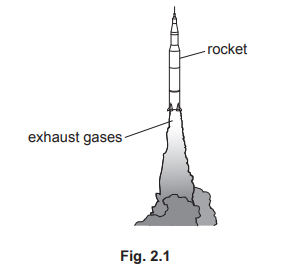
(i) Show that the force exerted on the rocket by the exhaust gases is $3900\text{ kN}$. State the equation you use.
(ii) Calculate the maximum mass that this force can lift from the ground. Ignore air resistance.
Most-appropriate topic codes (Cambridge IGCSE Physics 0625):
• Topic 1.6 — Momentum (Part (a) and Part (b)(i))
• Topic 1.5.1 — Effects of forces (Part (b)(ii))
▶️ Answer/Explanation
Correct Answer: Impulse $=$ force $\times$ time (for which the force acts)
Detailed solution: Impulse is defined as the product of the resultant force acting on an object and the time duration for which the force is applied. It is a vector quantity that equals the change in momentum of the object.
Correct Answer: $F = \frac{\Delta (mv)}{\Delta t}$ OR $F = \frac{\Delta p}{\Delta t}$; Calculation yields $3.92 \times 10^6\text{ N} \approx 3900\text{ kN}$
Detailed solution: The force exerted equals the rate of change of momentum of the exhaust gases. Using $F = \frac{\Delta (mv)}{\Delta t}$, substitute the given mass flow rate ($2800\text{ kg/s}$) and velocity ($1400\text{ m/s}$) to get $F = 2800 \times 1400 = 3,920,000\text{ N}$, which is approximately $3900\text{ kN}$.
Correct Answer: $4.0 \times 10^5\text{ kg}$ (or $400,000\text{ kg}$)
Detailed solution: At maximum lift capacity, the upward thrust force equals the total weight of the rocket ($F = mg$). Rearranging for mass gives $m = \frac{F}{g} = \frac{3.9 \times 10^6\text{ N}}{9.8\text{ m/s}^2} \approx 4.0 \times 10^5\text{ kg}$, representing the maximum mass the force can support against gravity.
Question 3
Most-appropriate topic codes (Cambridge IGCSE Physics 0625):
• Topic 1.8 — Pressure (Part (a)(i))
• Topic 2.1.2 — Particle model (Part (a)(ii))
• Topic 2.1.3 — Gases and the absolute scale of temperature (Part (b))
▶️ Answer/Explanation
Correct Answer: $2.0 \times 10^5\text{ Pa}$ OR $200000\text{ Pa}$ OR $200\text{ kPa}$
Detailed solution: Pressure is defined as force per unit area, $P = F/A$. The total force is the weight $F = 13000\text{ N}$ distributed over four tyres, so total contact area $A = 4 \times 0.016 = 0.064\text{ m}^2$. Therefore, $P = 13000 / 0.064 = 203125\text{ Pa}$, which is $2.0 \times 10^5\text{ Pa}$ to two significant figures.
Correct Answer: Any four from the points listed below.
Detailed solution: As the car travels, friction between the road and tyres causes the temperature of the air inside the tyre to increase. The air particles gain kinetic energy and move faster, colliding with the tyre walls more frequently and with greater force. Since the tyre’s internal surface area remains essentially constant, the increased force per unit area results in a higher air pressure.
Correct Answer: $34$
Detailed solution: At constant temperature, Boyle’s law applies ($pV = \text{constant}$). The total volume $V_2$ the released gas occupies at atmospheric pressure is found using $p_1 V_1 = p_2 V_2$. This gives $(2.0 \times 10^6) \times 0.026 = (1.0 \times 10^5) \times V_2$, so $V_2 = 0.52\text{ m}^3$. Dividing this total available volume by the volume per balloon ($0.015\text{ m}^3$) yields $0.52 / 0.015 = 34.6$, meaning a maximum of $34$ complete balloons can be filled.
Question 4
(a) Define specific heat capacity.
Most-appropriate topic codes (Cambridge IGCSE Physics 0625):
• Topic 2.2.2 — Specific heat capacity (Part (a))
• Topic 1.4 — Density (Part (b)(i))
• Topic 2.2.2 — Specific heat capacity (Part (b)(ii))
• Topic 1.7.4 — Power (Part (b)(iii))
▶️ Answer/Explanation
Correct Answer: Energy transferred per unit mass per unit temperature change.
Detailed solution: Specific heat capacity quantifies the amount of thermal energy required to raise the temperature of a $1\text{ kg}$ mass of a substance by exactly $1^{\circ}\text{C}$ (or $1\text{ K}$). It is an intrinsic material property measured in $\text{J}/(\text{kg}^{\circ}\text{C})$.
Correct Answer: $2.2\text{ kg}$
Detailed solution: Mass is calculated from density using the formula $m = \rho V$. Substituting the given values: $m = 910\text{ kg/m}^3 \times 0.0024\text{ m}^3 = 2.184\text{ kg}$. This value rounds appropriately to $2.2\text{ kg}$ based on the significant figures provided in the volume data.
Correct Answer: $7.0 \times 10^5\text{ J}$
Detailed solution: The thermal energy required is found using $\Delta E = mc\Delta\theta$. The temperature change is $\Delta\theta = 180 – 20 = 160^{\circ}\text{C}$. Calculation: $\Delta E = 2.184 \times 2000 \times 160 = 698880\text{ J}$. This is $7.0 \times 10^5\text{ J}$ when expressed to two significant figures.
Correct Answer: $1700\text{ W}$
Detailed solution: Power is the rate of energy transfer, given by $P = E / t$. The time in seconds is $t = 7.0 \times 60 = 420\text{ s}$. Using the energy value: $P = 700000 / 420 \approx 1666.7\text{ W}$. Rounded to two significant figures, the power is $1700\text{ W}$.
Questions 5
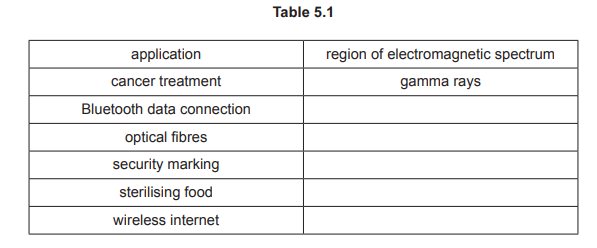
(a) (i) Table 5.1 shows applications of regions of the electromagnetic spectrum.
Complete the second column of the table with the region of the electromagnetic spectrum used for each application. Choose from the regions in this list:
gamma rays infrared microwaves radio waves ultraviolet
Each region may be used once, more than once or not at all.
Most-appropriate topic codes (Cambridge IGCSE Physics 0625):
• Topic 3.3 — Electromagnetic spectrum (Part (a))
• Topic 3.1 — General properties of waves (Part (b))
▶️ Answer/Explanation
Correct Answer: 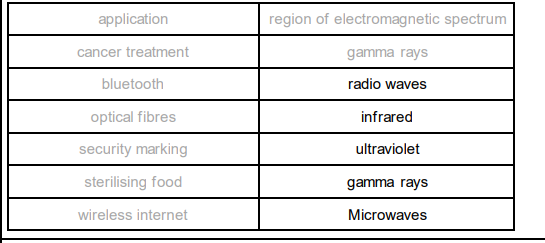
Detailed solution: Satellite communication uses microwaves which can penetrate the atmosphere. Remote controllers for televisions operate using infrared radiation. Sterilizing medical equipment requires the high penetrating power and ionizing ability of gamma rays to kill bacteria.
Correct Answer: \(3.0 \times 10^8\) (m / s) OR 300 000 000 (m / s)
Detailed solution: All electromagnetic waves, including radio waves, are transverse waves that travel at the same speed in a vacuum (and approximately the same speed in air). This constant value is \(3.0 \times 10^8\text{ m/s}\).
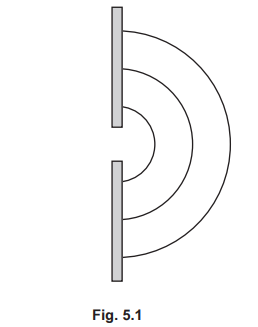
Correct Answer: three crests parallel to the barrier same wavelength as wave after the gap
Detailed solution: Before reaching the gap, the wavefronts of a plane wave are straight, parallel lines. The spacing between these three successive crests must be equal to the wavelength shown in the diffracted wave after passing through the gap.
Correct Answer: central part of crest (parallel to the (gap in the) barrier) is straight
crests have curved ends
Detailed solution: When a plane wave passes through a wide gap (much larger than the wavelength), diffraction is minimal. The majority of the wavefront remains straight and parallel to the barrier, with only slight curving observed near the very edges of the wave.
Question 6
Fig. 6.1 shows a full‑scale diagram of an object O and its image I produced by a converging lens. The lens and its position on the principal axis are not shown.
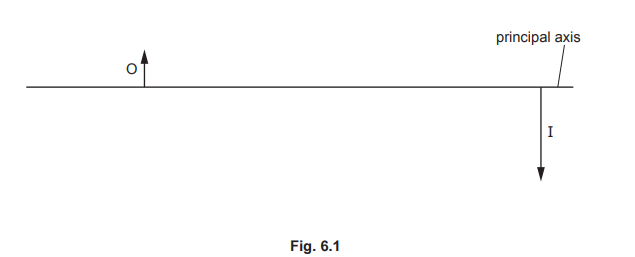
• a single ray to locate the position of the centre of the converging lens
• a line to represent the position of the lens and label the line L.
Most-appropriate topic codes (Cambridge IGCSE Physics 0625):
• Topic 3.2.3 — Thin lenses (Part (a))
• Topic 3.2.3 — Thin lenses (Part (b))
• Topic 3.2.3 — Thin lenses (Part (c))
▶️ Answer/Explanation
Correct Answer: ray from top of object to tip of image AND line labelled L drawn perpendicular to principal axis at its intersection with previous ray
Detailed solution: A ray from the top of the object O that passes undeviated through the centre of the lens will travel in a straight line to the tip of the image I. The point where this ray crosses the principal axis marks the optical centre of the lens. The lens position L is drawn as a vertical line perpendicular to the principal axis through this intersection point.
Correct Answer: ray from top of O parallel to principal axis to lens AND ray from lens to tip of I OR ray from tip of I parallel to principal axis to lens AND ray from lens to top of O; 2.1 cm
Detailed solution: To find the focal point, draw a ray from the top of O parallel to the principal axis to the lens line L, then continue it as a straight line through the tip of I. The point where this ray meets the principal axis is the principal focus. The focal length is the distance from the lens line L to this focus, which measures approximately $2.1\text{ cm}$ on the diagram.
Correct Answer: virtual AND upright
Detailed solution: In the original diagram, the object is beyond the focal point, producing a real and inverted image. Moving the object $2.0\text{ cm}$ closer places it inside the focal length. For an object placed between a converging lens and its focal point, the image formed is virtual (cannot be projected on a screen) and upright (same orientation as the object).
Question 7
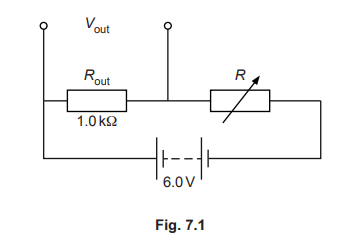
(a) Draw the circuit symbol for a potential divider.
Most-appropriate topic codes (Cambridge IGCSE Physics 0625):
• Topic 4.3.3 — Action and use of circuit components (Part (a))
• Topic 4.2.2 — Electric current (Part (b)(ii))
▶️ Answer/Explanation
Correct Answer: 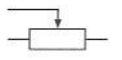
Detailed solution: A potential divider consists of two resistors in series across a voltage supply, with the output taken across one resistor. The symbol is drawn as a fixed resistor with a sliding contact arrow.
Correct Answer: 1.5 V
Detailed solution: The two resistors are in series with a $6.0\text{ V}$ supply. Using the potential divider formula $V_{out} = V_{in} \times \frac{R_2}{R_1 + R_2}$, with $R_1 = 3.0\text{ k}\Omega$ and $R_2 = 1.0\text{ k}\Omega$, $V_{out} = 6.0 \times \frac{1.0}{3.0 + 1.0} = 1.5\text{ V}$.
Correct Answer: 0.51 C
Detailed solution: Electric current is the rate of flow of charge. Using $I = \frac{Q}{t}$, the charge $Q = I \times t = (1.7 \times 10^{-3}\text{ A}) \times 300\text{ s} = 0.51\text{ C}$.
Question 8
(a) Fig. 8.1 shows a wire carrying a large current.
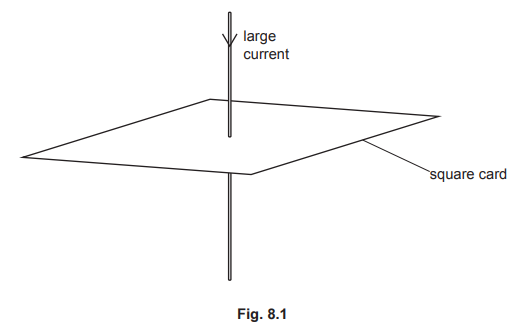
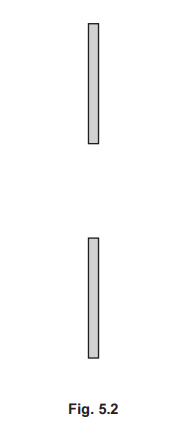
(i) Fig. 8.2 shows the square card viewed from above.
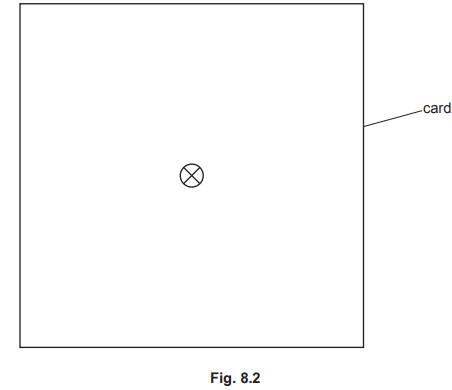
On Fig. 8.2, draw three magnetic field lines that indicate the direction of the magnetic field and how its strength varies with distance from the wire.
(ii) The current in the wire increases and the direction of the current is reversed. State how these changes affect the magnetic field.
(b) Electricity is transmitted at high voltage. Explain why a high voltage increases the efficiency of transmission even with thinner wires.
Most-appropriate topic codes (Cambridge IGCSE Physics 0625):
• Topic 4.5.3 — Magnetic effect of a current (Part (a))
• Topic 4.5.6 — The transformer (Part (b))
▶️ Answer/Explanation
Correct Answer: three concentric circles centred on X, with increasing spacing between successive circles, and arrows pointing clockwise.
Detailed solution: A current-carrying straight wire produces a circular magnetic field around it. The concentric circles show the field lines, with increasing separation between them indicating that the field strength decreases with distance from the wire. Using the right-hand grip rule with current directed downwards, the magnetic field direction is clockwise when viewed from above.
Correct Answer: strength of magnetic field increases; its direction reverses.
Detailed solution: The magnetic field strength around a wire is directly proportional to the current flowing through it, so an increase in current results in a stronger field. Reversing the direction of the current reverses the direction of the magnetic field lines according to the right-hand grip rule.
Correct Answer: High voltage reduces current for the same power, reducing $I^2R$ power loss, allowing thinner (higher resistance) wires without major efficiency loss.
Detailed solution: Power loss in transmission cables is given by $P = I^2R$. Transmitting at a higher voltage allows the same power to be delivered with a lower current. Since power loss depends on the square of the current, reducing the current significantly decreases energy wasted as heat, even if thinner wires with higher resistance are used.
Question 9
(a) An experiment directs alpha particles at a very thin sheet of gold foil.
(i) Most of the alpha particles pass through the thin foil in a straight line. State the conclusion about atoms from this observation.
(ii) Some of the alpha particles are deflected through angles less than 90° and a few are deflected through 180°. State and explain two conclusions about the nuclei of atoms from this observation.
(i) State the change in the nucleus which occurs when a β‑particle is emitted.
(ii) The initial mass of this isotope of strontium in the source is 25µg. Calculate the mass of the strontium isotope that decays in 87 years.
Most-appropriate topic codes (Cambridge IGCSE Physics 0625):
• Topic 5.1.1 — The atom (Part (a))
• Topic 5.2.3 — Radioactive decay (Part (b)(i))
• Topic 5.2.4 — Half-life (Part (b)(ii))
▶️ Answer/Explanation
Correct Answer: Most of the atom is empty space.
Detailed solution: Since the vast majority of the positively charged alpha particles pass straight through the gold foil without any deflection, they must be traveling through regions of the atom that contain very little mass or charge to interact with, confirming that atoms consist mostly of empty space.
Correct Answer: 1. The nucleus is very small. 2. The nucleus is positively charged.
Detailed solution: The very few large deflections indicate that alpha particles only occasionally encounter a dense, concentrated center (small nucleus). The repulsion causing deflection proves the nucleus is positively charged, as like charges (alpha particles and nucleus) repel.
Correct Answer: A neutron changes into a proton.
Detailed solution: In beta-minus decay, an unstable nucleus contains an excess of neutrons. To achieve stability, a neutron is converted into a proton, and this process results in the emission of a high-energy electron (β⁻ particle) and an antineutrino.
Correct Answer: $22 \mu\text{g}$
Detailed solution: The time of 87 years divided by the half-life of 29 years equals exactly 3 half-lives. After 3 half-lives, the remaining undecayed fraction is $(1/2)^3 = 1/8$. The remaining mass is $25/8 = 3.125\mu\text{g}$. The decayed mass is therefore $25 – 3.125 \approx 22\mu\text{g}$.
Question 10
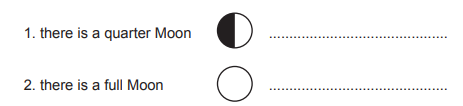
(a) Fig. 10.1 represents different positions A–H of the Moon as it rotates around the Earth.
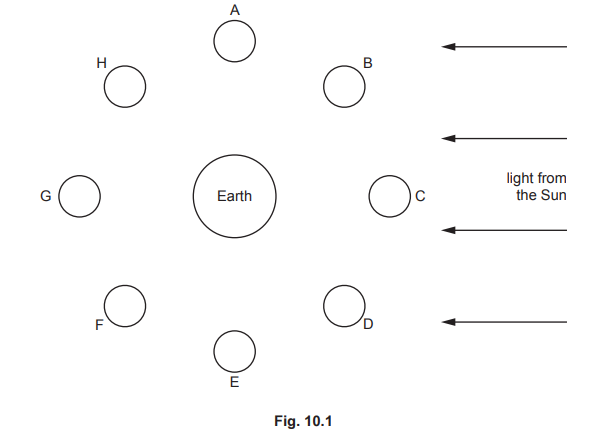
(i) State a position of the Moon where an observer on Earth sees:
(ii) State the approximate time taken for the Moon to orbit the Earth.
(b) The average distance of the Earth from the Sun is \(1.5 × 10^8 \text{ km}\).
(i) Calculate the average orbital speed of the Earth in km/h.
(ii) The speed of light in a vacuum is \(3.0 × 10^8 \text{ m/s}\). Calculate the time taken for light from the Sun to reach the Earth.
Most-appropriate topic codes (Cambridge IGCSE Physics 0625):
• Topic 6.1.1 — The Earth (Part (a))
• Topic 6.1.1 — The Earth (Part (b)(i))
• Topic 3.3 — Electromagnetic spectrum (Part (b)(ii))
▶️ Answer/Explanation
Correct Answer: position A and / or E ; position G
Detailed solution: Position A or E shows the Moon in alignment with the Earth and Sun, producing a New Moon phase where the illuminated half faces away from Earth. Position G represents a Full Moon, with the Moon on the opposite side of Earth so its fully illuminated face is visible to an observer.
Correct Answer: 1 month
Detailed solution: The Moon completes one full revolution around the Earth in approximately 27.3 days, but due to the Earth’s simultaneous motion around the Sun, the lunar phase cycle (synodic month) is about 29.5 days, commonly approximated as one month.
Correct Answer: 110 000 (km / h)
Detailed solution: Orbital speed \(v = \frac{2\pi r}{T}\). Using \(r = 1.5 \times 10^8\text{ km}\) and \(T = 365 \times 24\text{ h}\), the calculation yields \(v = \frac{2\pi \times 1.5 \times 10^8}{8760} \approx 1.1 \times 10^5\text{ km/h}\).
Correct Answer: 500 s
Detailed solution: Using \(t = \frac{s}{v}\), convert distance to metres: \(1.5 \times 10^{11}\text{ m}\). Then \(t = \frac{1.5 \times 10^{11}}{3.0 \times 10^8} = 500\text{ s}\), which is the approximate light travel time from the Sun to Earth.
Question 11
(a) State the condition required for a protostar to become a stable star.
Most-appropriate topic codes (Cambridge IGCSE Physics 0625):
• Topic 6.2.2 — Stars (Part (a))
• Topic 6.2.3 — The Universe (Part (b))
▶️ Answer/Explanation
Correct Answer: inward force / force of gravitational attraction, is balanced by an outward force / force due to fusion reactions
Detailed solution: A protostar becomes a stable main sequence star when the inward gravitational force pulling material together is exactly balanced by the outward radiation pressure generated by nuclear fusion reactions occurring in its core.
Correct Answer: ratio of the speed at which the galaxy is moving away from the Earth/observer to its distance (from the Earth/observer)
ratio of speed (of a galaxy) to distance (away from observer)
Detailed solution: The Hubble constant ($H_0$) quantifies the rate of expansion of the universe, defined as the constant of proportionality between the recessional velocity of a distant galaxy and its distance from Earth.
Correct Answer: (age of universe =) d / v = \(1 / H_0\) OR age (of universe) = \(1 / H_0\)
Detailed solution: Assuming a constant rate of expansion since the Big Bang, the time elapsed is the reciprocal of the Hubble constant. The equation is derived directly from the relationship $v = H_0 d$ and the basic kinematic equation $t = d/v$.
Correct Answer: \(4.5 \times 10^{17}\) (s)
Detailed solution: Using the equation $t = 1 / H_0$, the calculation is $t = 1 / (2.2 \times 10^{-18})$. Performing this division yields approximately $4.545 \times 10^{17}$ seconds, which rounds to the given answer of $4.5 \times 10^{17}$ seconds.