Home / 0625_m25_qp_22

Question 1

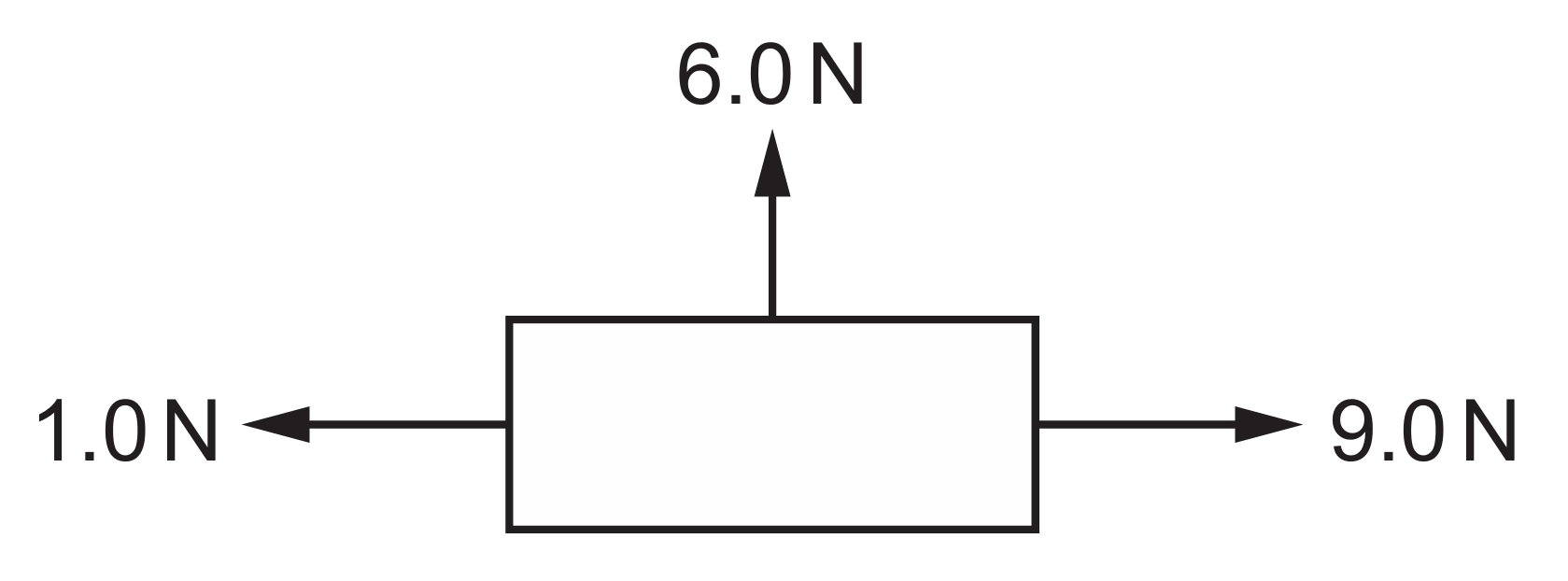
The diagram shows three forces acting on an object.
What is the magnitude of the resultant force acting on the object?
A. 2.0 N
B. 10 N
C. 14 N
D. 16 N

Most-appropriate topic codes (Cambridge IGCSE Physics 0625):

TOPIC 1.1: Physical quantities and measurement techniques (Determine, by calculation or graphically, the resultant of two vectors at right angles)
▶️ Answer/Explanation
Correct Option: B

Detailed solution:

To find the magnitude of the resultant force, first determine the net horizontal component \(F_{x}\).
\(F_{x} = 9.0 N – 1.0 N = 8.0 N\) directed to the right.
The vertical force component \(F_{y}\) is given as 6.0 N upwards.
Since the horizontal and vertical forces act at right angles \(90^{\circ}\), use Pythagoras’ theorem to find the total resultant force \(F\).
\(F = \sqrt{F_x^2 + F_y^2} = \sqrt{(8.0)^2 + (6.0)^2}\)
\(F = \sqrt{64 + 36} = \sqrt{100} = 10 N\).
The magnitude of the resultant force is 10 N, corresponding to option B.
Question 2

Which row defines speed and velocity?
A. speed: distance travelled in a given direction | velocity: speed per unit time
B. speed: distance travelled per unit time | velocity: speed in a given direction
C. speed: distance travelled in a given direction | velocity: speed in a given direction
D. speed: distance travelled per unit time | velocity: speed per unit time

Most-appropriate topic codes (Cambridge IGCSE Physics 0625):

TOPIC 1.2: Motion (Define speed as distance travelled per unit time)
▶️ Answer/Explanation
Correct Option: B

Detailed solution:

Speed is a scalar quantity, meaning it has only magnitude and no specific direction.
It is defined as the total distance travelled per unit time, mathematically represented as $v = \frac{s}{t}$.
Velocity is a vector quantity, which means it requires both a magnitude and a specific direction to be fully defined.
Therefore, velocity is defined as an object’s speed in a given direction.
Comparing these fundamental definitions with the given options, Row B is the only correct match.
Row B accurately states speed is the distance travelled per unit time, and velocity is speed in a given direction.

Question 3

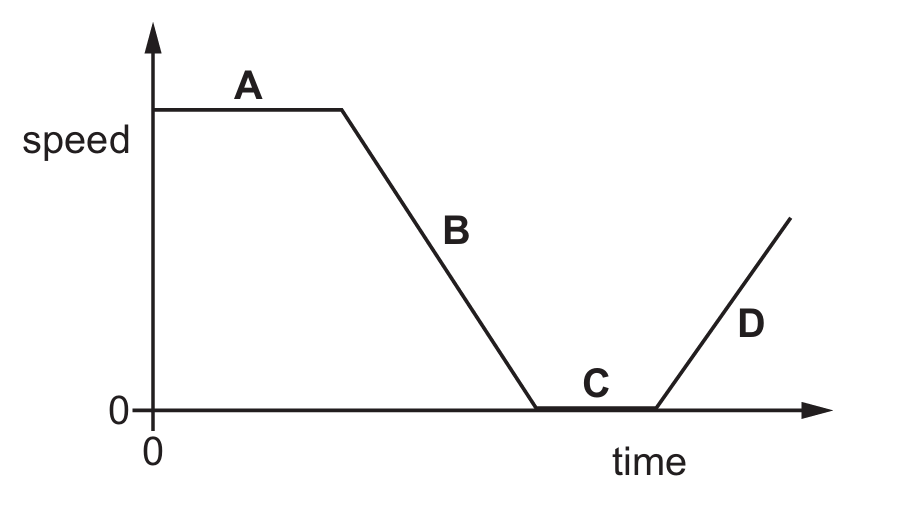
The graph shows the journey of a motorcyclist.
Which section of the graph shows the time when the motorcyclist is stationary at some traffic lights?

Most-appropriate topic codes (Cambridge IGCSE Physics 0625):

TOPIC 1.2: Motion (Determine, qualitatively, from the shape of a speed-time graph when an object is at rest)
▶️ Answer/Explanation
Correct Option: C

Detailed solution:

The given figure represents a speed-time graph of a motorcyclist’s journey.
When the motorcyclist is stationary at traffic lights, their speed must be exactly $0$.
On a speed-time graph, a speed of $0$ is represented by a horizontal line that lies entirely on the time axis.
Analyzing the graph, section A shows constant positive speed, and section B represents deceleration.
Section C represents a period where the speed is strictly equal to $0$.
Therefore, section C represents the time when the motorcyclist is entirely stationary.
Question 4

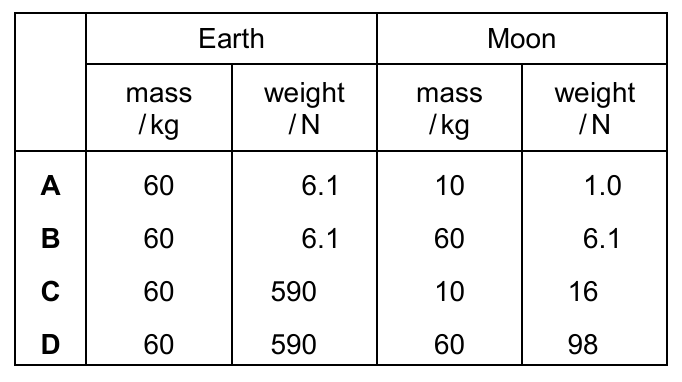
The acceleration of free fall on the Moon has one sixth of its value on the Earth. On the Earth, an astronaut’s mass is measured as 60 kg.

Which row gives the mass and weight of the astronaut on the Earth and on the Moon?

Most-appropriate topic codes (Cambridge IGCSE Physics 0625):

TOPIC 1.3: Mass and weight
▶️ Answer/Explanation
Correct Option: D

Detailed solution:

Mass is an intrinsic property representing the amount of matter in an object, meaning it remains constant regardless of location.
Thus, the astronaut’s mass is 60 kg on both the Earth and the Moon.
Weight is the gravitational force acting on an object, calculated using the equation $W = mg$, where $g$ is the acceleration of free fall.
Using the Earth’s acceleration of free fall (approximately 9.8 m/s²), the Earth weight is calculated as $W = 60 \times 9.8 = 588$ N, which rounds to 590 N to match the given significant figures.
Since the Moon’s acceleration of free fall is one-sixth of the Earth’s, the weight on the Moon is $\frac{588}{6} = 98$ N.
Therefore, Row D correctly identifies a constant mass of 60 kg alongside weights of 590 N and 98 N.
Question 5

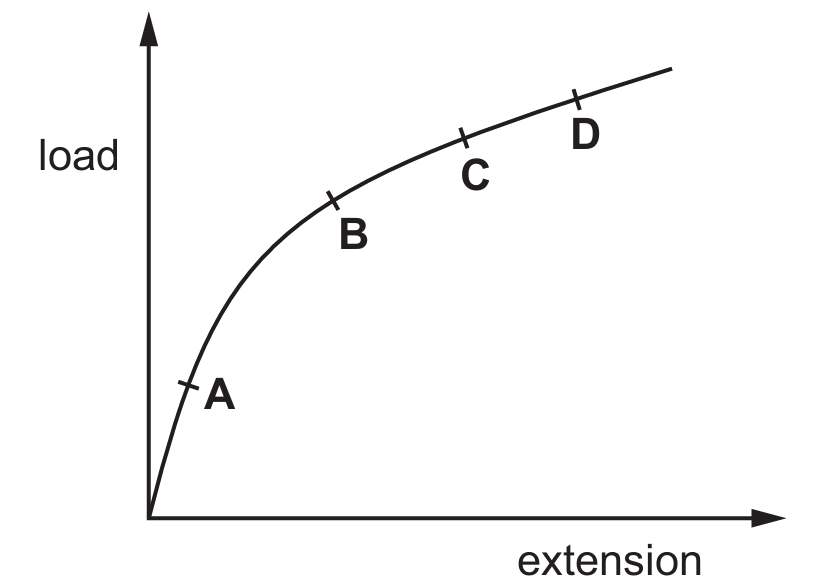
The load–extension graph for a material is shown.

Which point indicates the limit of proportionality?

Most-appropriate topic codes (Cambridge IGCSE Physics 0625):

TOPIC 1.5.1: Effects of forces (Define and use the term ‘limit of proportionality’ for a load-extension graph and identify this point on the graph)
▶️ Answer/Explanation
Correct Option: A

Detailed solution:

According to Hooke’s Law, the extension of a material is directly proportional to the applied load up to a specific limit.
On a load-extension graph, this region of direct proportionality is visually represented by a straight line starting from the origin.
The limit of proportionality is defined as the exact point where this linear relationship ends and the graph begins to curve.
Observing the provided graph, the line remains perfectly straight from the origin until it reaches point $A$.
Beyond point $A$, the gradient of the curve clearly decreases, indicating that extension is no longer directly proportional to the load.
Therefore, point $A$ correctly indicates the limit of proportionality for this material.
Question 6

An object of mass 4.0 kg is moving with a velocity of 3.0 m/s in a straight line.

What is the momentum of the object?

A. 0.75 kg m/s
B. 1.3 kg m/s
C. 12 kg m/s
D. 24 kg m/s

Most-appropriate topic codes (Cambridge IGCSE Physics 0625):

TOPIC 1.6: Momentum (Define momentum as mass x velocity; recall and use the equation $p = mv$)
▶️ Answer/Explanation
Correct Option: C

Detailed solution:

The momentum of an object is defined as the product of its mass and its velocity.
The formula for calculating momentum is $p = mv$, where $m$ is the mass and $v$ is the velocity.
From the question, we are given the mass $m = 4.0$ kg and the velocity $v = 3.0$ m/s.
Substituting these values into our formula gives $p = 4.0 \times 3.0$.
Calculating the product yields $p = 12$ kg m/s.
Therefore, the correct momentum is 12 kg m/s, which matches option C.

Question 7

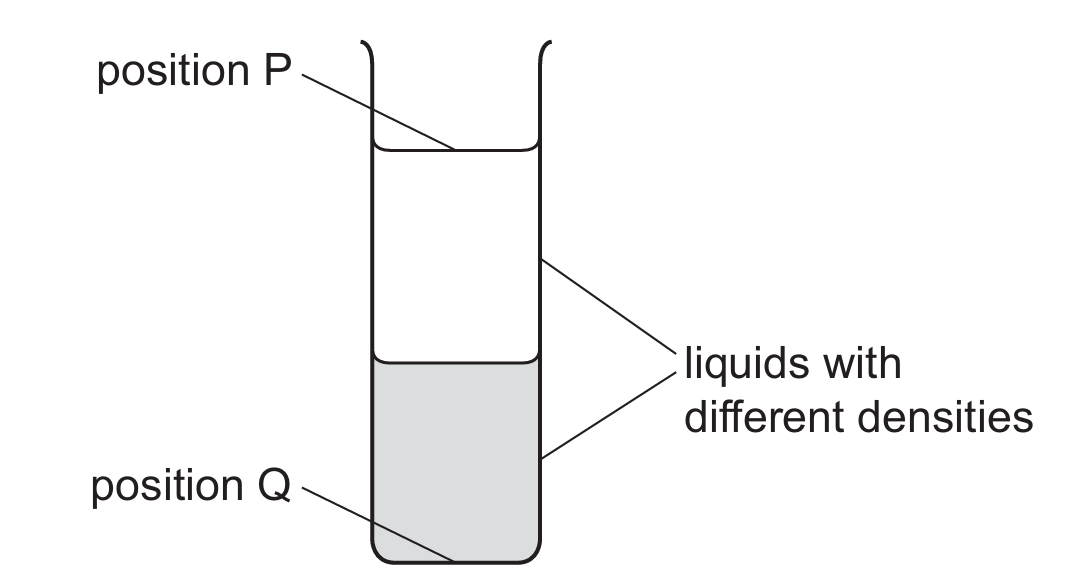
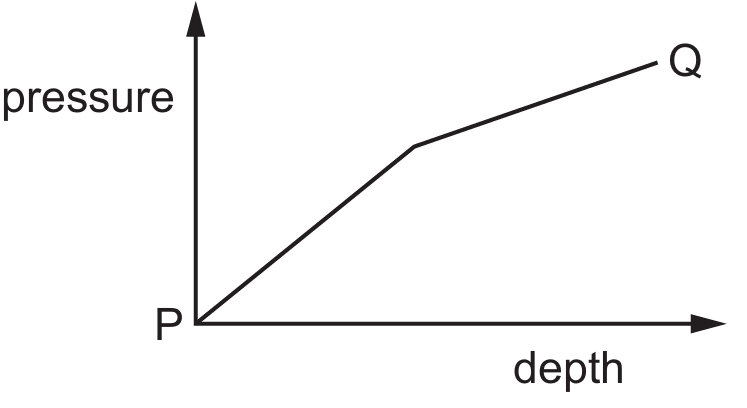
A tall cylinder is partly filled with two liquids, which do not mix. The two liquids have different densities. A student measures the pressure due to the liquids at different depths.
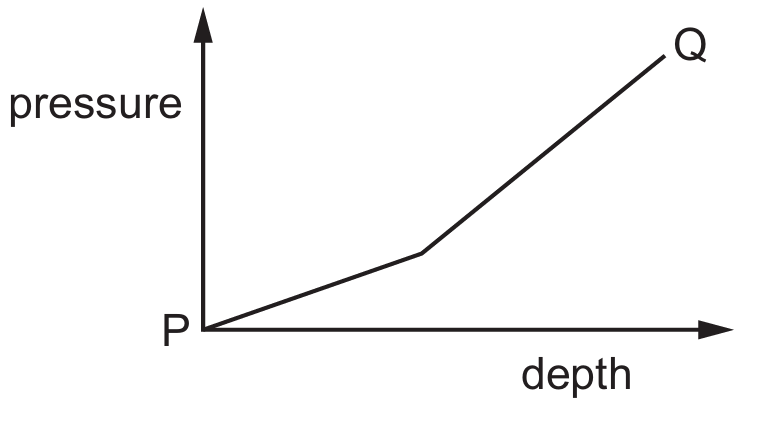
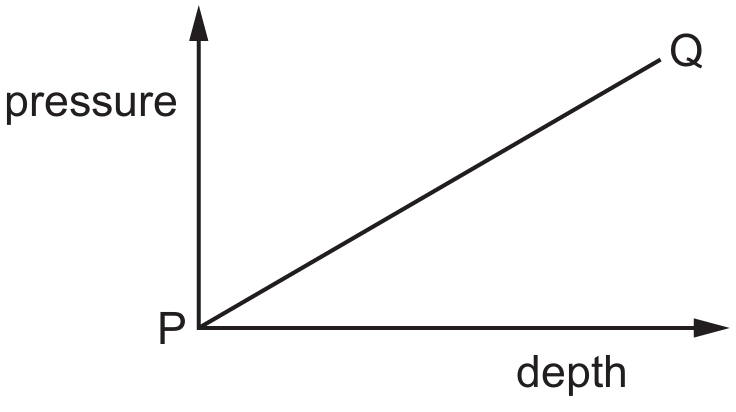
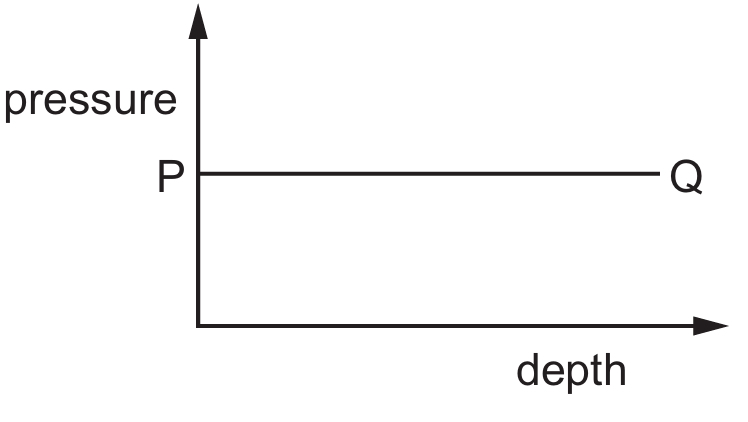
Which graph shows how the liquid pressure varies between positions P and Q?
A.
B.
C.
D.

Most-appropriate topic codes (Cambridge IGCSE Physics 0625):

TOPIC 1.8: Pressure (Describe how the pressure beneath the surface of a liquid changes with depth and density of the liquid)
▶️ Answer/Explanation
Correct Option: B

Detailed solution:

The pressure due to a liquid at a given depth is calculated using the equation $p = \rho g h$.
Since pressure is plotted on the y-axis and depth on the x-axis, the gradient (slope) of the graph is equal to $\frac{\Delta p}{\Delta h} = \rho g$.
This implies that the slope of the graph is directly proportional to the density $\rho$ of the liquid.
Because the two liquids do not mix and form distinct layers, the denser liquid must settle at the bottom.
Therefore, the slope of the pressure-depth graph must be steeper for the bottom liquid compared to the top liquid.
Graph B correctly shows the pressure starting at $0$ at position P, increasing steadily, and then adopting a steeper positive slope in the denser bottom liquid.
Question 8

A tennis ball with momentum 2.3 kg m/s is struck by a tennis racket.

The racket causes the direction of motion of the ball to reverse.

The racket exerts an average force of 1500 N during the impact with the ball. The racket and ball are in contact with each other for a time of 0.0024 s.

What is the magnitude of the momentum of the ball as it leaves the tennis racket?

A. 1.3 kg m/s
B. 3.6 kg m/s
C. 5.9 kg m/s
D. 8.6 kg m/s

Most-appropriate topic codes (Cambridge IGCSE Physics 0625):

TOPIC 1.6: Momentum (Define impulse as force x time for which force acts; recall and use the equation $\text{impulse} = F\Delta t = \Delta(mv)$)
▶️ Answer/Explanation
Correct Option: A

Detailed solution:

First, we need to calculate the impulse exerted by the racket on the ball, which is equal to the change in momentum.
The formula for impulse is $I = F \Delta t$.
Since the force reverses the ball’s direction, we consider the force negative relative to the initial momentum: $F = -1500$ N.
The impulse is therefore $-1500 \times 0.0024 = -3.6$ kg m/s.
We know that the change in momentum is $\Delta p = p_{f} – p_{i}$, which means $-3.6 = p_{f} – 2.3$.
Solving for the final momentum $p_{f}$, we get $p_{f} = -3.6 + 2.3 = -1.3$ kg m/s.
The magnitude of the final momentum is the absolute value, $|-1.3|$, which is 1.3 kg m/s, matching option A.

Question 9

A car is travelling at a speed of $8.0\text{ m/s}$.

The kinetic energy stored in the car is $32\,000\text{ J}$.

What is the kinetic energy stored in the car when its speed increases to $16\text{ m/s}$?

A. $16\,000\text{ J}$
B. $32\,000\text{ J}$
C. $64\,000\text{ J}$
D. $130\,000\text{ J}$

Most-appropriate topic codes (Cambridge IGCSE Physics 0625):

TOPIC 1.7.1: Energy (Recall and use the equation for kinetic energy $E_{k}=\frac{1}{2}mv^{2}$)
▶️ Answer/Explanation
Correct Option: D

Detailed solution:

The kinetic energy of an object is given by the formula $E_{k} = \frac{1}{2}mv^{2}$.
Since the mass $m$ of the car remains constant, the kinetic energy is directly proportional to the square of its speed ($E_{k} \propto v^{2}$).
The initial speed is $v_{1} = 8.0\text{ m/s}$ and the final speed is $v_{2} = 16\text{ m/s}$, meaning the speed has exactly doubled (increased by a factor of $2$).
Because the speed increases by a factor of $2$, the kinetic energy increases by a factor of $2^{2} = 4$.
The new kinetic energy is $4 \times 32\,000\text{ J} = 128\,000\text{ J}$.
Rounding this value to two significant figures, consistent with the given initial speed of $8.0\text{ m/s}$, yields $130\,000\text{ J}$.

Question 10

The Sun is not the primary source of energy for which resource?
A. oil
B. tidal
C. wind
D. wave

Most-appropriate topic codes (Cambridge IGCSE Physics 0625):

TOPIC 1.7.3: Energy resources (Know that radiation from the Sun is the main source of energy for all our energy resources except geothermal, nuclear and tidal)
▶️ Answer/Explanation
Correct Option: B

Detailed solution:

Radiation from the Sun is the primary source of energy for most of our energy resources.
Oil is a fossil fuel containing chemical energy derived from ancient organisms that depended on sunlight to grow.
Wind is driven by the uneven heating of the Earth’s atmosphere by the Sun, and wind in turn drives surface waves.
However, tidal energy is an exception; it is generated primarily by the gravitational pull of the Moon on the Earth’s oceans.
Other key exceptions that do not rely on the Sun’s radiation include geothermal and nuclear energy.
Therefore, tidal energy is the correct resource for which the Sun is not the primary source.

Question 11

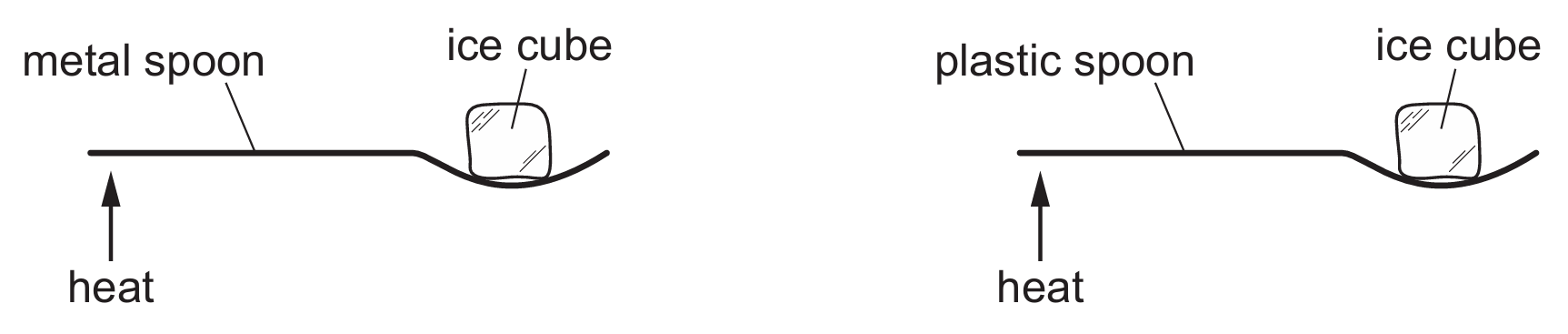
An experiment is done to compare the rate of conduction of thermal energy in metal and plastic spoons.
An ice cube is placed on one end of each spoon and the other end is heated gently.

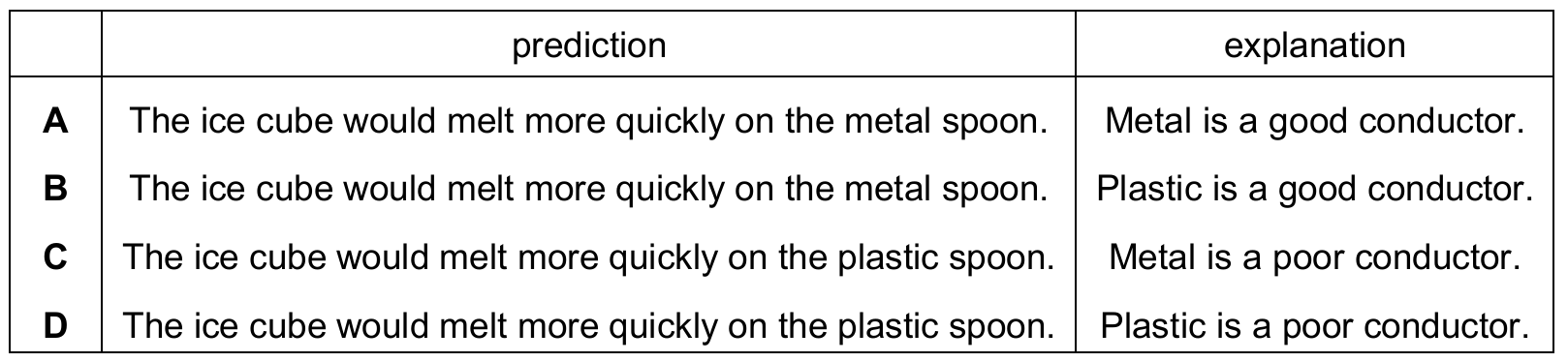
Which row has the correct prediction and correct explanation?

Most-appropriate topic codes (Cambridge IGCSE Physics 0625):

TOPIC 2.3.1: Conduction (Describe experiments to demonstrate the properties of good thermal conductors and bad thermal conductors)
▶️ Answer/Explanation
Correct Option: A

Detailed solution:

Metals are excellent conductors of thermal energy, whereas plastics are poor conductors (often acting as thermal insulators).
When heat is applied to one end of the metal spoon, thermal energy is rapidly transferred along its length to the ice cube.
This rapid transfer of energy causes the ice cube on the metal spoon to absorb heat and melt more quickly than the one on the plastic spoon.
The plastic spoon restricts the flow of thermal energy, meaning much less heat reaches its ice cube in the same amount of time.
Therefore, the correct prediction is that the ice cube melts more quickly on the metal spoon.
The correct explanation for this is simply that metal is a good thermal conductor, perfectly matching row A.
Question 12

Four students determine the efficiency of four different electrical devices. The teacher knows that one student has made a mistake in the calculation.

Which value for efficiency is not correct?

A. 12%
B. 36%
C. 78%
D. 102%

Most-appropriate topic codes (Cambridge IGCSE Physics 0625):

TOPIC 1.7.3: Energy resources (Understand, qualitatively, the concept of efficiency of energy transfer)
▶️ Answer/Explanation
Correct Option: D

Detailed solution:

Efficiency is the ratio of useful energy output to the total energy input, mathematically defined as $Efficiency = \frac{Useful\ Energy\ Output}{Total\ Energy\ Input} \times 100\%$.
According to the fundamental principle of conservation of energy, energy cannot be created, meaning an electrical device can never output more energy than it initially takes in.
Therefore, the absolute theoretical maximum efficiency of any machine or electrical system is exactly 100%.
In reality, practical efficiency is always less than 100% due to energy being dissipated to the surroundings, usually as thermal energy.
A calculated efficiency of 102% implies that the device is generating more energy than it consumes, which is physically impossible and indicates a calculation error.

Question 13

A sample of gas is sealed inside a container of fixed volume.

The temperature of the gas is increased.

Which statement explains why the pressure of the gas increases?
A. The gas particles collide with the walls of the container more frequently.
B. The mass of the gas particles increases.
C. The number of gas particles in the container increases.
D. The time between collisions of the gas particles increases.

Most-appropriate topic codes (Cambridge IGCSE Physics 0625):

TOPIC 2.1.3: Gases and the absolute scale of temperature (Describe qualitatively, in terms of particles, the effect on the pressure of a fixed mass of gas of a change of temperature at constant volume)
▶️ Answer/Explanation
Correct Option: A

Detailed solution:

When the temperature of a gas increases, the average kinetic energy and speed of its particles also increase.
Because the container is sealed and has a fixed volume, the number of particles and their mass remain constant, making options B and C incorrect.
As the particles travel faster, they cover the distance between the container walls in less time, meaning the time between collisions decreases, ruling out option D.
The higher speed causes the gas particles to strike the walls of the container more frequently and with a greater force.
Since pressure is the force exerted per unit area ($p=\frac{F}{A}$), these more frequent and forceful collisions result in an overall increase in gas pressure.
Therefore, statement A is the only correct explanation for the increase in pressure.

Question 14

A student does an experiment to determine the specific heat capacity of a metal block. She records the following measurements.
energy supplied = $12\text{ kJ}$
initial temperature = $20~^{\circ}\text{C}$
final temperature = $45~^{\circ}\text{C}$
mass of metal block = $600\text{ g}$
What is the specific heat capacity of the metal block?
A. $8.0 \times 10^{-4}\text{ J}/(\text{kg}~^{\circ}\text{C})$
B. $0.80\text{ J}/(\text{kg}~^{\circ}\text{C})$
C. $180\text{ J}/(\text{kg}~^{\circ}\text{C})$
D. $800\text{ J}/(\text{kg}~^{\circ}\text{C})$

Most-appropriate topic codes (Cambridge IGCSE Physics 0625):

TOPIC 2.2.2: Specific heat capacity (Recall and use the equation $c = \frac{\Delta E}{m\Delta\theta}$)
▶️ Answer/Explanation
Correct Option: D

Detailed solution:

To find the specific heat capacity, we use the formula $c = \frac{\Delta E}{m \Delta \theta}$.
First, convert the energy supplied from kilojoules to joules: $\Delta E = 12\text{ kJ} = 12000\text{ J}$.
Next, convert the mass from grams to kilograms to match the units in the options: $m = 600\text{ g} = 0.6\text{ kg}$.
Calculate the change in temperature: $\Delta \theta = 45~^{\circ}\text{C} – 20~^{\circ}\text{C} = 25~^{\circ}\text{C}$.
Substitute these values into the specific heat capacity formula: $c = \frac{12000}{0.6 \times 25}$.
Solving the denominator gives $0.6 \times 25 = 15$.
Finally, dividing the energy by this product gives $c = \frac{12000}{15} = 800\text{ J}/(\text{kg}~^{\circ}\text{C})$, which matches option D.

Question 15

A metal block is left overnight in a cool, shady room. In the morning, the metal block is moved into warm surroundings.

Which statement about the metal block is correct in the morning?
A. The internal energy of the metal block increases.
B. The temperature of the metal block decreases.
C. Convection transfers energy throughout the metal block.
D. The metal contracts slightly.

Most-appropriate topic codes (Cambridge IGCSE Physics 0625):

TOPIC 2.2.2: Specific heat capacity (Know that a rise in the temperature of an object increases its internal energy)
▶️ Answer/Explanation
Correct Option: A

Detailed solution:

When the metal block is moved from a cool room to warm surroundings, thermal energy transfers from the warmer environment to the cooler block.
As the block absorbs this thermal energy, the average kinetic energy of its particles increases, which directly means its internal energy increases.
Consequently, the temperature of the block will increase, not decrease, causing the metal to expand rather than contract.
Furthermore, thermal energy is transferred throughout the solid metal block via conduction, whereas convection primarily occurs in fluids (liquids and gases).
Therefore, the only correct statement is that the internal energy of the metal block increases.

Question 16

A fixed mass of gas is contained within a sealed syringe at a pressure of 100 kPa. The plunger is slowly moved until the pressure is 80 kPa. The final volume of the gas is 50 cm³. The temperature of the gas does not change.

What is the volume of the gas before the plunger is moved?
A. 0.25 cm³
B. 40 cm³
C. 63 cm³
D. 160 cm³

Most-appropriate topic codes (Cambridge IGCSE Physics 0625):

TOPIC 2.1.3: Gases and the absolute scale of temperature (Recall and use the equation $pV = \text{constant}$)
▶️ Answer/Explanation
Correct Option: B

Detailed solution:

For a fixed mass of gas at a constant temperature, pressure is inversely proportional to volume.
This relationship is expressed by the equation $p_1 V_1 = p_2 V_2$.
We are given the initial pressure $p_1 = 100\text{ kPa}$, final pressure $p_2 = 80\text{ kPa}$, and final volume $V_2 = 50\text{ cm}^3$.
We need to find the initial volume, $V_1$.
Rearranging the formula gives $V_1 = \frac{p_2 V_2}{p_1}$.
Substituting the known values: $V_1 = \frac{80 \times 50}{100}$.
Calculating the result yields $V_1 = 40\text{ cm}^3$, which matches option B.

Question 17

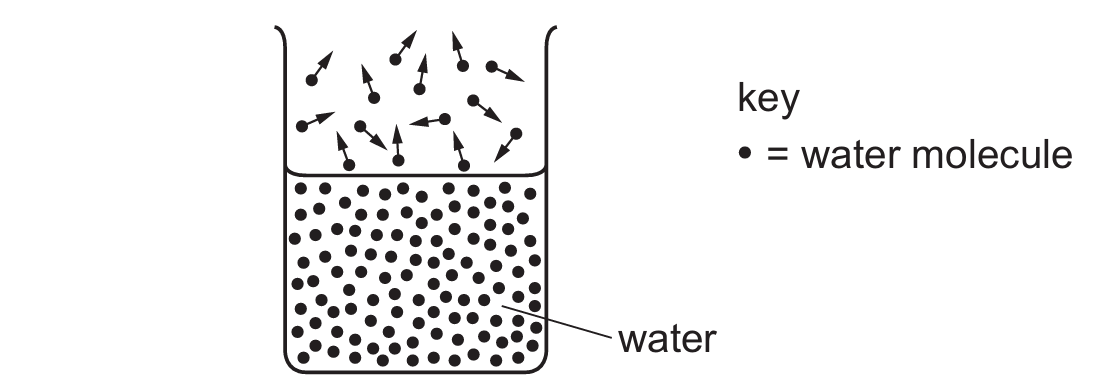
The diagram shows the more energetic water molecules escaping from the surface of liquid water.

What is this process called?

A. Brownian motion
B. condensation
C. evaporation
D. conduction

Most-appropriate topic codes (Cambridge IGCSE Physics 0625):

TOPIC 2.2.3: Melting, boiling and evaporation (Describe evaporation in terms of the escape of more-energetic particles from the surface of a liquid)
▶️ Answer/Explanation
Correct Option: C

Detailed solution:

The diagram clearly illustrates molecules leaving the surface of a liquid state and entering the gaseous state.
In thermal physics, this specific surface-level phase change is defined as evaporation.
During this process, only the most energetic molecules possess sufficient kinetic energy to break free from the intermolecular forces binding the liquid.
Unlike boiling, which occurs throughout the entire volume of the liquid at a specific temperature, evaporation is strictly a surface phenomenon that can happen at any temperature.
Option A is incorrect because Brownian motion refers to the random, erratic movement of suspended microscopic particles.
Option B is the reverse phase change (gas to liquid), and Option D relates to the transfer of thermal energy through a material.
Therefore, the correct term for these escaping water molecules is evaporation.
Question 18

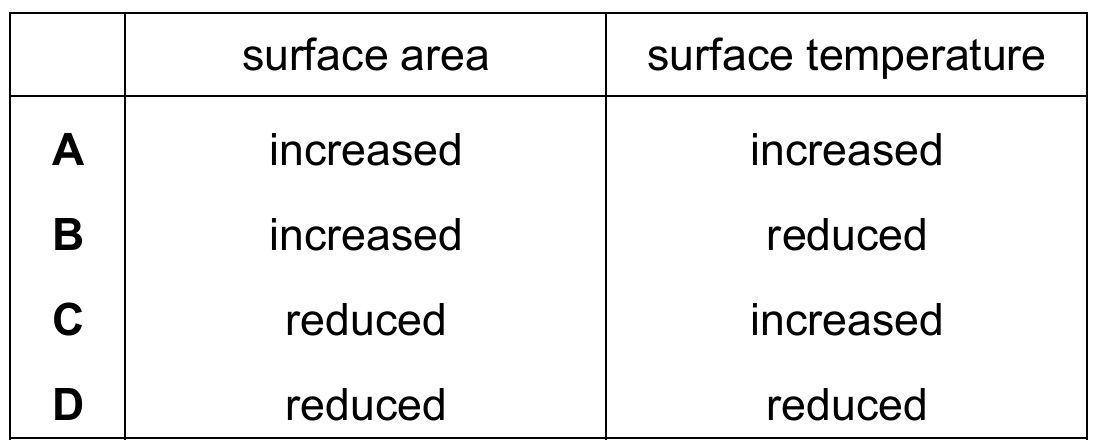
A hot object emits thermal radiation.

Which row describes two changes that both reduce the rate of emission of radiation?

Most-appropriate topic codes (Cambridge IGCSE Physics 0625):

TOPIC 2.3.3: Radiation (Describe how the rate of emission of radiation depends on the surface temperature and surface area of an object)
▶️ Answer/Explanation
Correct Option: D

Detailed solution:

The rate at which a hot object emits thermal radiation depends heavily on its physical characteristics.
A larger exposed surface area provides more space for infrared waves to escape, so to reduce the emission rate, the surface area must be reduced.
Furthermore, the rate of emission is heavily dependent on the object’s surface temperature; hotter objects emit radiation at a much faster rate.
Therefore, lowering the surface temperature will correspondingly decrease the rate of thermal emission.
Combining these two principles, both the surface area and the surface temperature must be reduced to minimize radiation loss.
This aligns perfectly with the conditions described in option D.
Question 19

The frequency of a wave is doubled. The speed of the wave does not change.

What happens to the wavelength of the wave?

A. It becomes four times as large.
B. It does not change.
C. It doubles.
D. It halves.

Most-appropriate topic codes (Cambridge IGCSE Physics 0625):

TOPIC 3.1: General properties of waves (Recall and use the equation for wave speed $v=f\lambda$)
▶️ Answer/Explanation
Correct Option: D

Detailed solution:

The relationship between wave speed ($v$), frequency ($f$), and wavelength ($\lambda$) is given by the wave equation $v = f\lambda$.
By rearranging this formula to solve for wavelength, we get $\lambda = \frac{v}{f}$.
The question states that the wave speed ($v$) remains constant, but the frequency ($f$) is doubled to $2f$.
Substituting these values into the rearranged equation yields the new wavelength: $\lambda_{new} = \frac{v}{2f}$.
This demonstrates that the new wavelength is exactly one-half of the original wavelength ($\lambda_{new} = \frac{1}{2}\lambda$).
Therefore, when the frequency is doubled and the speed is unchanged, the wavelength halves.

Question 20

Which statement about ultrasound is correct?
A. It has a higher frequency than audible sound and it is a longitudinal wave.
B. It has a higher frequency than audible sound and it is a transverse wave.
C. It has a lower frequency than audible sound and it is a longitudinal wave.
D. It has a lower frequency than audible sound and it is a transverse wave.

Most-appropriate topic codes (Cambridge IGCSE Physics 0625):

TOPIC 3.4: Sound (Define ultrasound as sound with a frequency higher than $20\text{ kHz}$ | Describe the longitudinal nature of sound waves)
▶️ Answer/Explanation
Correct Option: A

Detailed solution:

Ultrasound is defined as a sound wave with a frequency greater than the upper limit of human hearing, which is $20000\text{ Hz}$ (or $20\text{ kHz}$).
Therefore, ultrasound intrinsically has a higher frequency than audible sound.
Furthermore, like all sound waves travelling through a medium, ultrasound propagates via compressions and rarefactions.
This means the particles of the medium vibrate parallel to the direction of the wave’s energy transfer.
Hence, ultrasound is classified as a longitudinal wave, not a transverse wave.
Combining these principles confirms that ultrasound has a higher frequency than audible sound and is a longitudinal wave, making option A the correct choice.

Question 21

Which statement about the image produced by a plane mirror is not correct?
A. The image is real.
B. The image is upright.
C. The image is the same size as the object.
D. The distance from the image to the mirror is the same as the distance from the object to the mirror.

Most-appropriate topic codes (Cambridge IGCSE Physics 0625):

TOPIC 3.2.1: Reflection of light (Describe the formation of an optical image by a plane mirror and give its characteristics)
▶️ Answer/Explanation
Correct Option: A

Detailed solution:

When an object is placed in front of a plane mirror, the reflected light rays diverge and appear to originate from a point behind the mirror.
Because the light rays do not actually meet or pass through this point, the image cannot be projected onto a screen, making it a virtual image.
Therefore, the statement that the image is real is exactly what is not correct.
The other options describe the true characteristics of an optical image formed by a plane mirror.
The image formed is always upright and laterally inverted.
It is also exactly the same size as the original object.
Additionally, the image distance $d_{i}$ behind the mirror is precisely equal to the object distance $d_{o}$ in front of the mirror.

Question 22

A ray of light is incident on a boundary between air and water.

Under which conditions is the ray of light totally internally reflected?

A. The ray, initially in the air, is incident on the air–water boundary at any angle of incidence.
B. The ray, initially in the air, is incident on the air–water boundary at an angle of incidence greater than the critical angle.
C. The ray, initially in the water, is incident on the water–air boundary at any angle of incidence.
D. The ray, initially in the water, is incident on the water–air boundary at an angle of incidence greater than the critical angle.

Most-appropriate topic codes (Cambridge IGCSE Physics 0625):

TOPIC 3.2.2: Refraction of light (Describe internal reflection and total internal reflection)
▶️ Answer/Explanation
Correct Option: D

Detailed solution:

Total internal reflection occurs only when two specific conditions are strictly satisfied.
First, the light ray must be travelling from an optically denser medium to an optically less dense medium.
In this scenario, it must travel from water (higher refractive index) to air (lower refractive index), eliminating options A and B.
Second, the angle of incidence, $i$, at the boundary must be strictly greater than the critical angle, $c$, of the denser medium ($i>c$).
Option C is incorrect because it implies total internal reflection can happen at any angle, which ignores the critical angle condition.
Option D correctly pairs both requirements: the ray must initially be in the water, and the angle of incidence must be greater than the critical angle.

Question 23

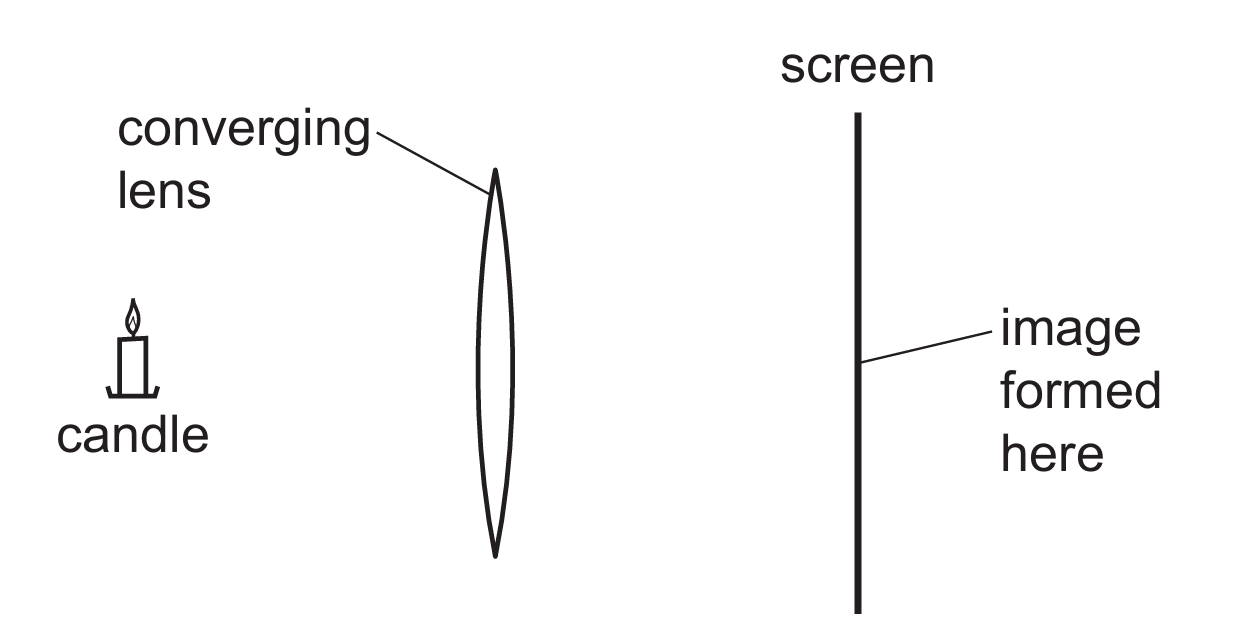
A converging lens is used to make an image on a screen.

Which type of image is formed on the screen?

A. real and inverted
B. real and upright
C. virtual and inverted
D. virtual and upright

Most-appropriate topic codes (Cambridge IGCSE Physics 0625):

TOPIC 3.2.3: Thin lenses
▶️ Answer/Explanation
Correct Option: A

Detailed solution:

An image that can be successfully projected and captured on a screen is, by definition, a real image.
This occurs because light rays originating from the object actually converge at the position of the screen.
For a single thin converging lens, any real image produced is always inverted (upside-down) relative to the original object.
In contrast, a virtual image is formed when diverging rays are extrapolated backwards; it is upright but cannot form a visible projection on a screen.
Therefore, since the image of the candle is formed on a screen, it must necessarily be real and inverted.
Question 24

A negatively charged rod is brought near to a metal sphere. A positive charge develops on the surface of the metal sphere closest to the negatively charged rod.

Why is this?
A. Electrons in the sphere are attracted by the negatively charged rod.
B. Electrons in the sphere are repelled by the negatively charged rod.
C. Positive charges in the sphere are attracted by the negatively charged rod.
D. Positive charges in the sphere are repelled by the negatively charged rod.

Most-appropriate topic codes (Cambridge IGCSE Physics 0625):

TOPIC 4.2.1: Electric charge (State that positive charges repel other positive charges, negative charges repel other negative charges, but positive charges attract negative charges / Explain that charging of solids involves only a transfer of negative charge (electrons))
▶️ Answer/Explanation
Correct Option: B

Detailed solution:

In a solid metal sphere, only the negative charges (free electrons) are mobile, while the positive charges (protons) remain fixed within the atomic lattice.
When the negatively charged rod is brought near the sphere, it exerts an electrostatic force on the particles.
According to the fundamental laws of electrostatics, like charges repel each other.
Therefore, the negatively charged rod repels the negatively charged free electrons within the metal.
These electrons are pushed away towards the far side of the sphere, leaving a deficiency of electrons on the near side.
Consequently, a net positive charge develops on the surface of the sphere closest to the negatively charged rod.

Question 25

The electromotive force (e.m.f.) of a cell is defined in terms of which quantities?
A. the energy transferred by the cell in moving charge around the circuit
B. the energy transferred by the cell in moving voltage around the circuit
C. the power transferred by the cell in moving charge around the circuit
D. the power transferred by the cell in moving voltage around the circuit

Most-appropriate topic codes (Cambridge IGCSE Physics 0625):

TOPIC 4.2.3: Electromotive force and potential difference (Define electromotive force (e.m.f.) as the electrical work done by a source in moving a unit charge around a complete circuit)
▶️ Answer/Explanation
Correct Option: A

Detailed solution:

Electromotive force (e.m.f.) is formally defined as the electrical work done by a source in moving a unit charge around a complete circuit.
In physics, work done is directly equivalent to the energy transferred by the electrical source.
This relationship can be expressed mathematically as $E = \frac{W}{Q}$, where $E$ represents the e.m.f., $W$ is the energy transferred, and $Q$ is the charge.
Voltage is a measure of potential difference across components, not a physical entity that can be “moved” through a circuit.
Similarly, power is the rate of energy transfer over time, not the total energy itself.
Therefore, e.m.f. strictly relates the energy transferred to the charge being moved, making option A the correct definition.

Question 26

A resistor of resistance $R$ is connected to a battery of electromotive force (e.m.f.) $V$.
There is a current $I$ in the resistor.
Power $P$ is dissipated by the resistor.
In time $t$, the energy transferred is $E$.
Which expression is correct?
A. $E = IVt$
B. $E = PIt$
C. $P = VIR$
D. $P = \frac{V}{R}$

Most-appropriate topic codes (Cambridge IGCSE Physics 0625):

TOPIC 4.2.5: Electrical energy and electrical power (Recall and use the equation $E = IVt$)
▶️ Answer/Explanation
Correct Option: A

Detailed solution:

Electrical power $P$ is defined as the rate at which energy is transferred, given by the formula $P = IV$.
Energy transferred $E$ is the product of power and time, expressed as $E = P \times t$.
By substituting the expression for power into the energy equation, we derive $E = (IV) \times t$, which simplifies to $E = IVt$.
Option B is incorrect because multiplying power by current and time does not yield energy.
Option C is incorrect as it misstates Ohm’s law ($V = IR$) by equating power to $VIR$.
Option D is incorrect because the correct relationship for power in terms of $V$ and $R$ is $P = \frac{V^2}{R}$.
Therefore, expression A is the only mathematically and physically correct formula provided.

Question 27

A copper wire of length $80\text{ cm}$ and cross-sectional area $0.20\text{ mm}^2$ has resistance $R$.
Which length of copper wire of cross-sectional area $0.40\text{ mm}^2$ has resistance $R$?
A. $10\text{ cm}$
B. $20\text{ cm}$
C. $40\text{ cm}$
D. $160\text{ cm}$

Most-appropriate topic codes (Cambridge IGCSE Physics 0625):

TOPIC 4.2.4: Resistance (Relationship of the resistance of a metallic wire to its length and cross-sectional area)
▶️ Answer/Explanation
Correct Option: D

Detailed solution:

The resistance $R$ of a conductor is given by $R = \rho \frac{L}{A}$, where $L$ is length and $A$ is area.
For the first wire: $R \propto \frac{80}{0.20} = 400$.
For the second wire to have the same resistance $R$, the ratio $\frac{L_2}{A_2}$ must also equal $400$.
Given $A_2 = 0.40\text{ mm}^2$, we set up the equation: $\frac{L_2}{0.40} = 400$.
Solving for $L_2$, we get $L_2 = 400 \times 0.40 = 160\text{ cm}$.
Since the area doubled, the length must also double to maintain the same resistance.

Question 28

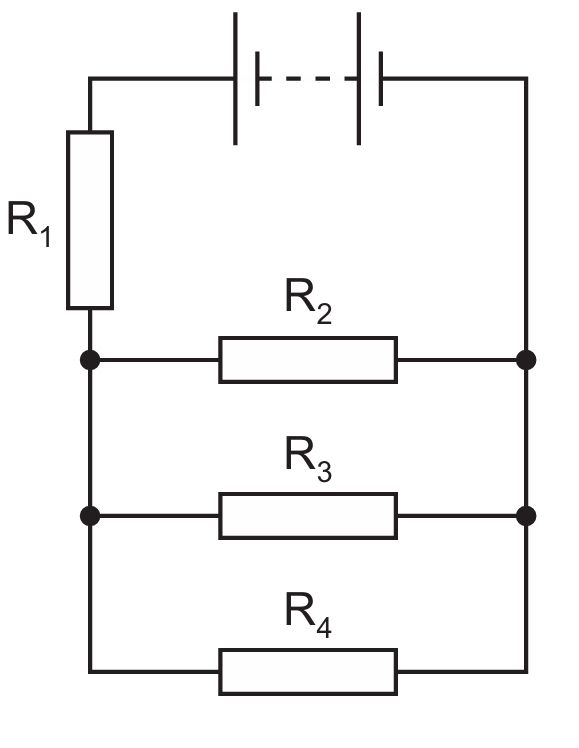
Four identical resistors are connected to a battery as shown. Each resistor has a value of $120\Omega$.
Resistor $R_{4}$ is removed. Which effect does removing this resistor have on the effective resistance of the circuit?
A. The effective resistance does not change.
B. The effective resistance decreases by $20\Omega$.
C. The effective resistance increases by $20\Omega$.
D. The effective resistance decreases by $120\Omega$.

Most-appropriate topic codes (Cambridge IGCSE Physics 0625):

TOPIC 4.3.2: Series and parallel circuits (Calculate the combined resistance of two or more resistors in series/parallel)
▶️ Answer/Explanation
Correct Option: C

Detailed solution:

Initially, $R_{2}, R_{3},$ and $R_{4}$ are in parallel. Their combined resistance is $R_{p1} = \frac{120\Omega}{3} = 40\Omega$. The total initial resistance is $R_{total1} = R_{1} + R_{p1} = 120\Omega + 40\Omega = 160\Omega$.
When $R_{4}$ is removed, only $R_{2}$ and $R_{3}$ remain in parallel. Their new combined resistance is $R_{p2} = \frac{120\Omega}{2} = 60\Omega$.
The new total resistance is $R_{total2} = R_{1} + R_{p2} = 120\Omega + 60\Omega = 180\Omega$.
The change in effective resistance is $180\Omega – 160\Omega = 20\Omega$.
Since $180\Omega > 160\Omega$, the effective resistance increases by $20\Omega$.
Question 29

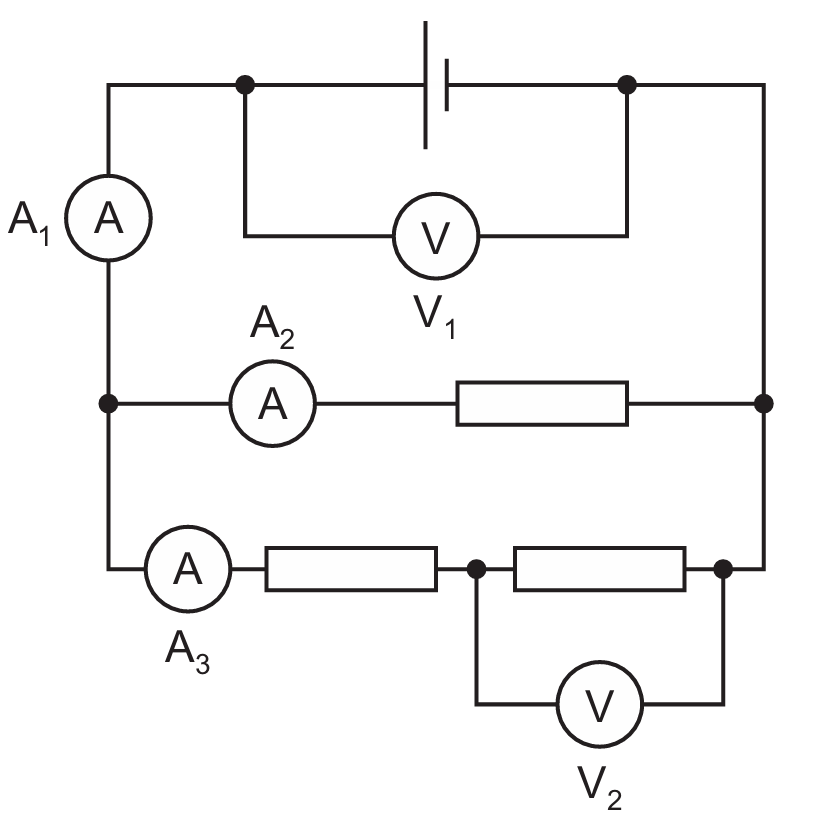
The resistors in the circuit shown are identical.
The reading on voltmeter $V_{2}$ is $1.5\text{ V}$.
The reading on ammeter $A_{2}$ is $0.50\text{ A}$.
The reading on ammeter $A_{3}$ is $0.25\text{ A}$.
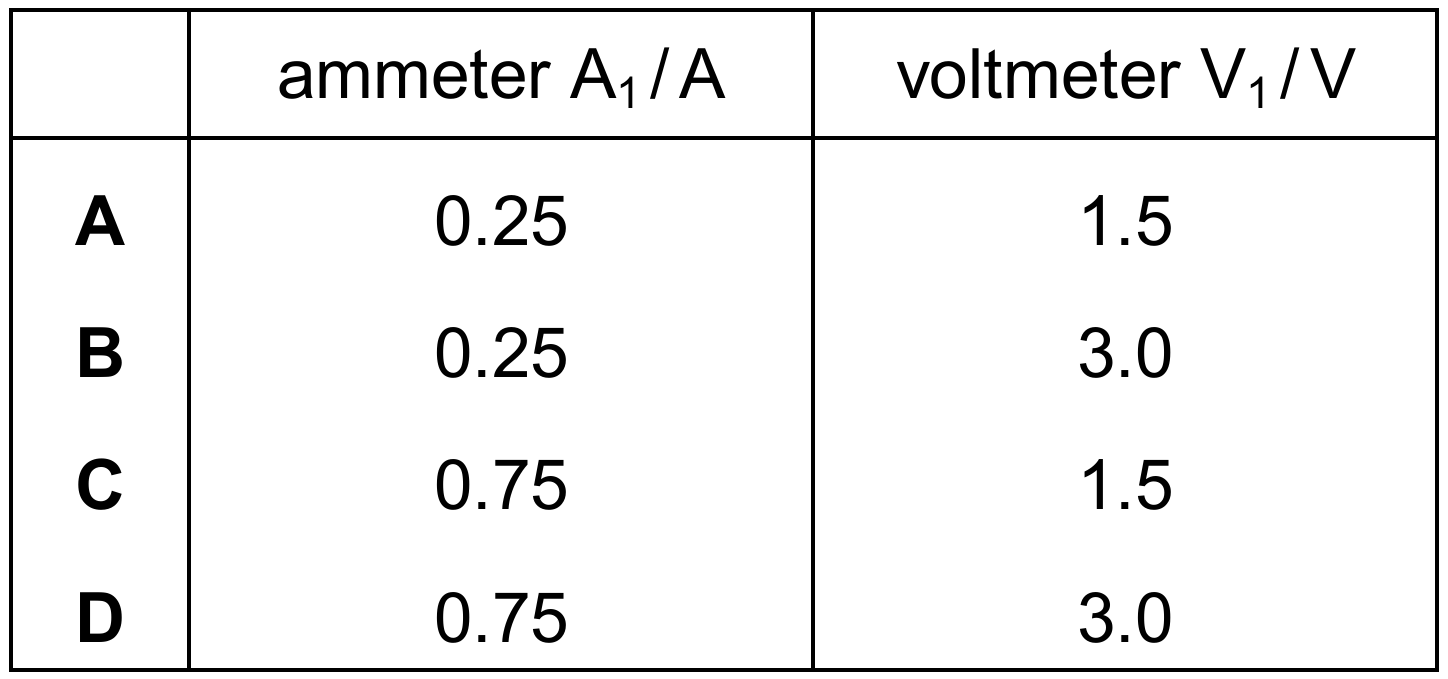
What are the readings on ammeter $A_{1}$ and voltmeter $V_{1}$?

Most-appropriate topic codes (Cambridge IGCSE Physics 0625):

TOPIC 4.3.2: Series and parallel circuits (Current and p.d. rules)
TOPIC 4.2.4: Resistance ($R = \frac{V}{I}$)
▶️ Answer/Explanation
Correct Option: D

Detailed solution:

Ammeter $A_{1}$ measures the total current, which is the sum of currents in the parallel branches: $I_{1} = A_{2} + A_{3} = 0.50\text{ A} + 0.25\text{ A} = 0.75\text{ A}$.
Since resistors are identical, each has resistance $R = \frac{V_{2}}{A_{3}} = \frac{1.5\text{ V}}{0.25\text{ A}} = 6\text{ }\Omega$.
The bottom branch has two resistors in series, so its total potential difference is $V_{\text{bottom}} = A_{3} \times (R + R) = 0.25\text{ A} \times 12\text{ }\Omega = 3.0\text{ V}$.
Voltmeter $V_{1}$ is connected across the battery, measuring the same p.d. as the parallel branches, thus $V_{1} = 3.0\text{ V}$.
Matching these results, $A_{1} = 0.75\text{ A}$ and $V_{1} = 3.0\text{ V}$ corresponds to Option D.
Question 30

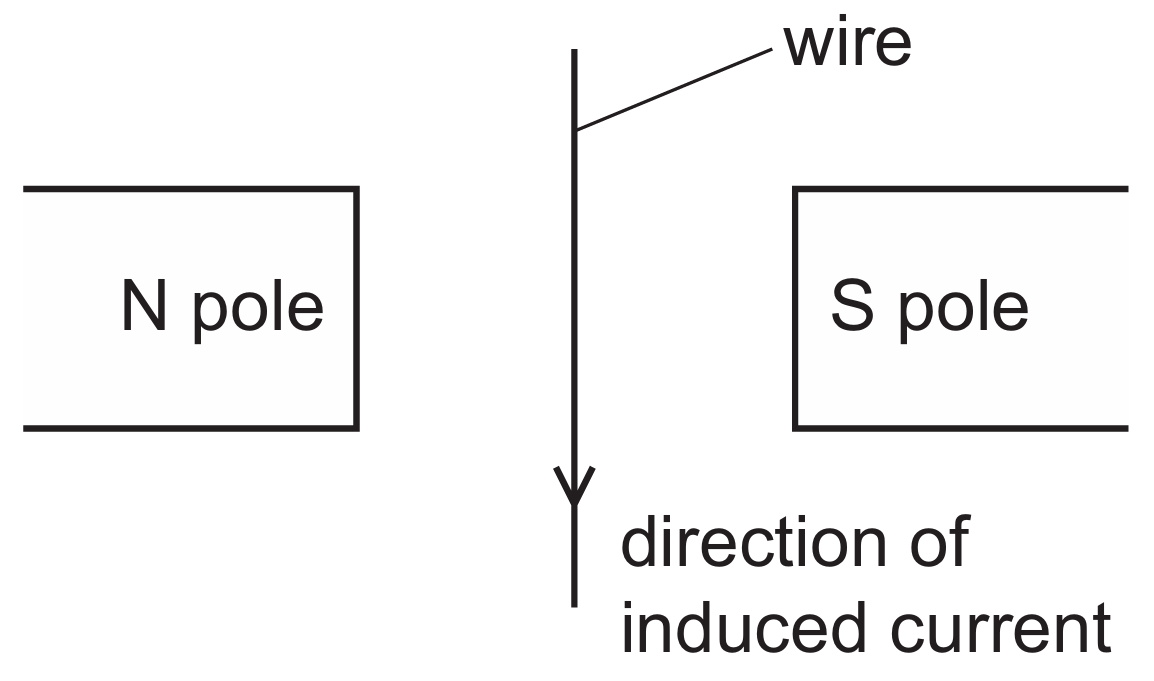
A wire is moved in the region between the poles of a magnet.
A current is induced in the wire as shown in the diagram.
In which direction is the wire moved?
A. horizontally from the N pole to the S pole
B. horizontally from the S pole to the N pole
C. perpendicularly into the plane of the paper
D. perpendicularly out of the plane of the paper

Most-appropriate topic codes (Cambridge IGCSE Physics 0625):

TOPIC 4.5.1: Electromagnetic induction (State and use the relative directions of force, field and induced current)
▶️ Answer/Explanation
Correct Option: C

Detailed solution:

To determine the motion, use Fleming’s Right-Hand Rule for induced current. The magnetic field lines $B$ point from the North pole to the South pole (left to right). The induced current $I$ is shown flowing downwards along the wire. Aligning your right hand, the index finger points right (field) and the middle finger points down (current). Your thumb will then point perpendicularly into the plane of the paper, representing the direction of motion. Therefore, the wire must be moved into the page to induce the specified current direction.
Question 31

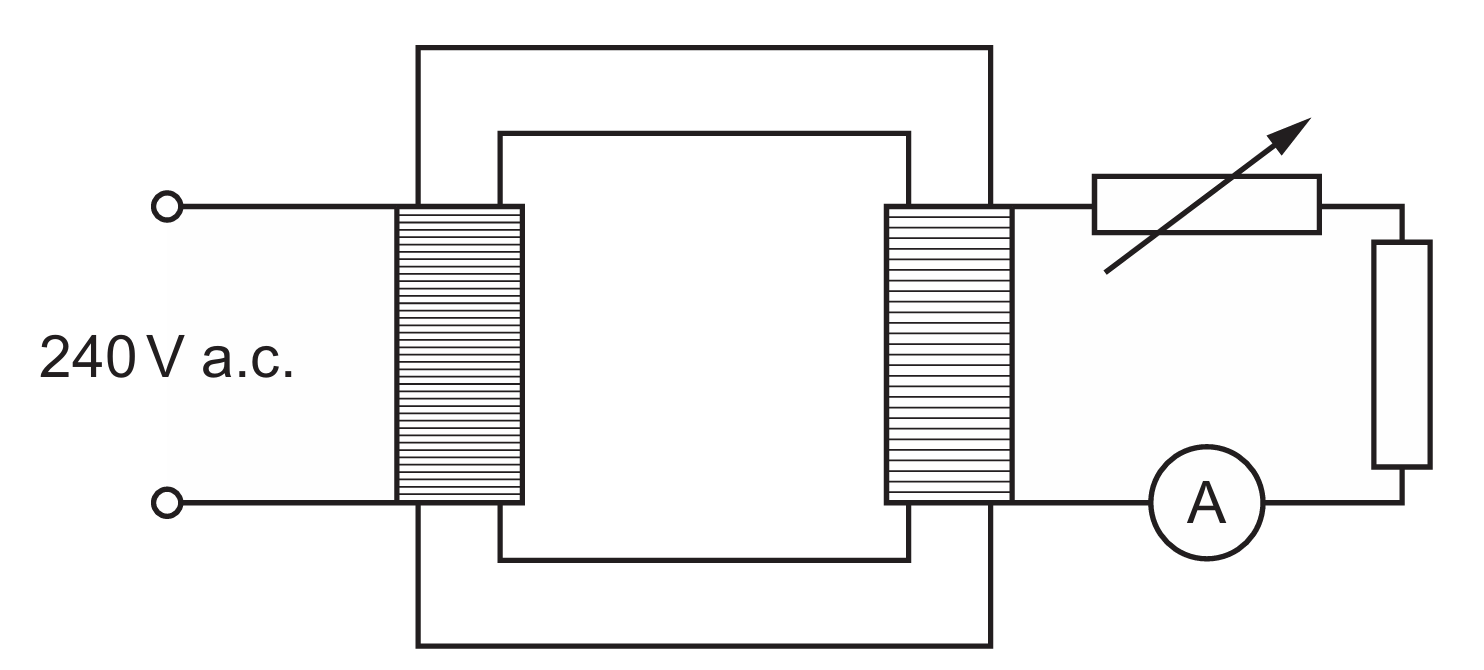
A fixed resistor is connected to the secondary coil of a step-down transformer. The transformer is 100% efficient.
The variable resistor is adjusted so that the current in the fixed resistor decreases by $0.25$ A.
What is the change to the current in the primary circuit?
A. It decreases by $0.25$ A.
B. It decreases by less than $0.25$ A.
C. It decreases by more than $0.25$ A.
D. There is no change.

Most-appropriate topic codes (Cambridge IGCSE Physics 0625):

TOPIC 4.5.6: The transformer (Recall and use the equation for 100% efficiency $I_p V_p = I_s V_s$)
▶️ Answer/Explanation
Correct Option: B

Detailed solution:

For a $100\%$ efficient transformer, the power input equals power output: $V_p I_p = V_s I_s$.
In a step-down transformer, the secondary voltage $V_s$ is lower than the primary voltage $V_p$ ($V_s < V_p$).
Rearranging the power equation gives the current relationship: $I_p = (\frac{V_s}{V_p}) I_s$.
Since $\frac{V_s}{V_p} < 1$, any change in secondary current $\Delta I_s$ results in a smaller change in primary current $\Delta I_p$.
Mathematically, $\Delta I_p = (\frac{V_s}{V_p}) \times 0.25$ A.
Therefore, the current in the primary circuit decreases by less than $0.25$ A.
Question 32

An electrical device changes the voltage of an electrical supply from $240\text{ V a.c.}$ to $20\text{ V a.c.}$
What is this device?
A. a generator
B. a relay
C. a transformer
D. a voltmeter

Most-appropriate topic codes (Cambridge IGCSE Physics 0625):

TOPIC 4.5.6: The transformer (Describe the construction of a simple transformer… as used for voltage transformations)
▶️ Answer/Explanation
Correct Option: C

Detailed solution:

A transformer is a device used to increase or decrease the voltage of an alternating current ($\text{a.c.}$) supply.
In this case, the voltage is reduced from $V_{p} = 240\text{ V}$ to $V_{s} = 20\text{ V}$, which identifies it specifically as a step-down transformer.
This process relies on electromagnetic induction between a primary and secondary coil linked by a soft-iron core.
Other options are incorrect: a generator produces electricity from mechanical energy, a relay is an electromagnetic switch, and a voltmeter measures potential difference without changing it.
Since the device specifically performs a voltage transformation on an $\text{a.c.}$ supply, option C is the correct answer.

Question 33

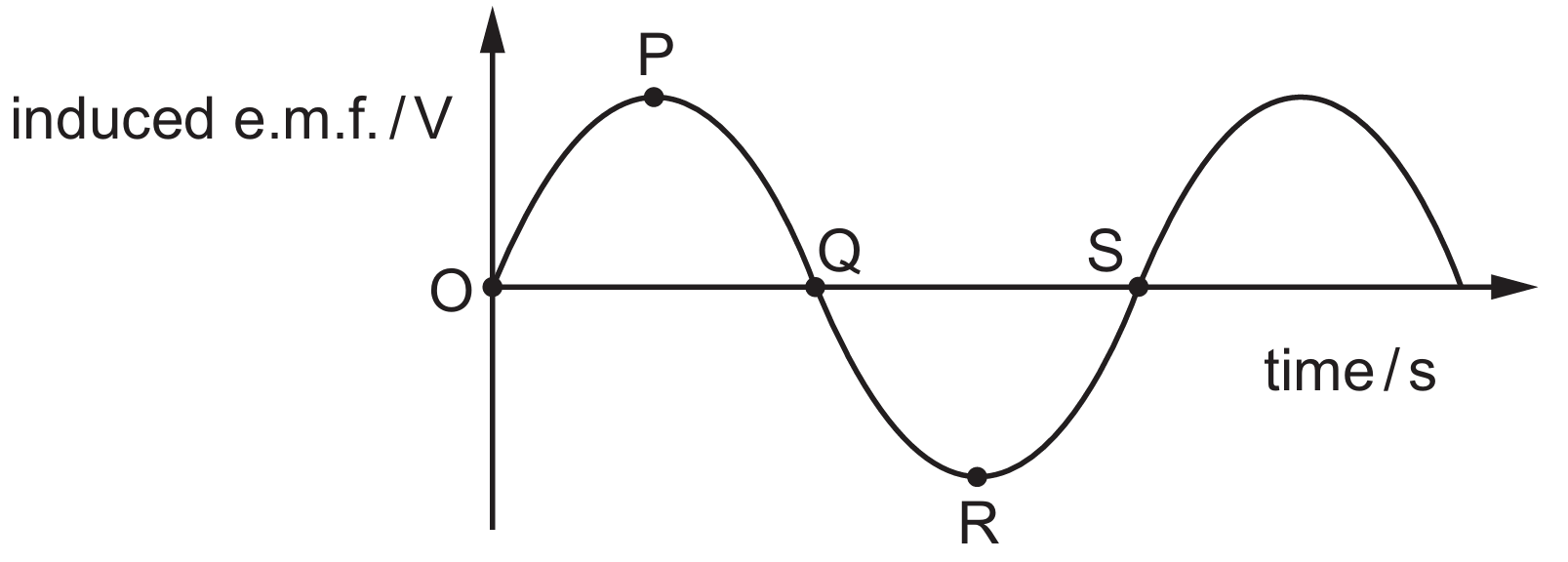
An a.c. generator is set up so that its coil of wire is perpendicular to the magnetic field. The coil of wire is rotated slowly to produce an alternating electromotive force (e.m.f.). A graph of the induced e.m.f. against time is plotted as the coil rotates.
Which section of the graph represents a rotation of three-quarters of a turn?
A. OP
B. OQ
C. OR
D. OS

Most-appropriate topic codes (Cambridge IGCSE Physics 0625):

TOPIC 4.5.3: Magnetic effect of current (Sketch and interpret graphs of e.m.f. against time)
▶️ Answer/Explanation
Correct Option: C

Detailed solution:

One full rotation ($360^\circ$) of the generator coil corresponds to one complete cycle of the sine wave on the e.m.f. graph, ending at point $S$.
A three-quarters rotation represents $\frac{3}{4} \times 360^\circ = 270^\circ$ of the cycle.
In the given graph, point $P$ is at $\frac{1}{4}$ turn ($90^\circ$), point $Q$ is at $\frac{1}{2}$ turn ($180^\circ$), and point $R$ is at $\frac{3}{4}$ turn ($270^\circ$).
Since the section starts from the origin $O$, the section representing three-quarters of a turn is $OR$.
This matches the minimum point of the induced e.m.f. before it returns to zero at the full rotation mark $S$.
Question 34

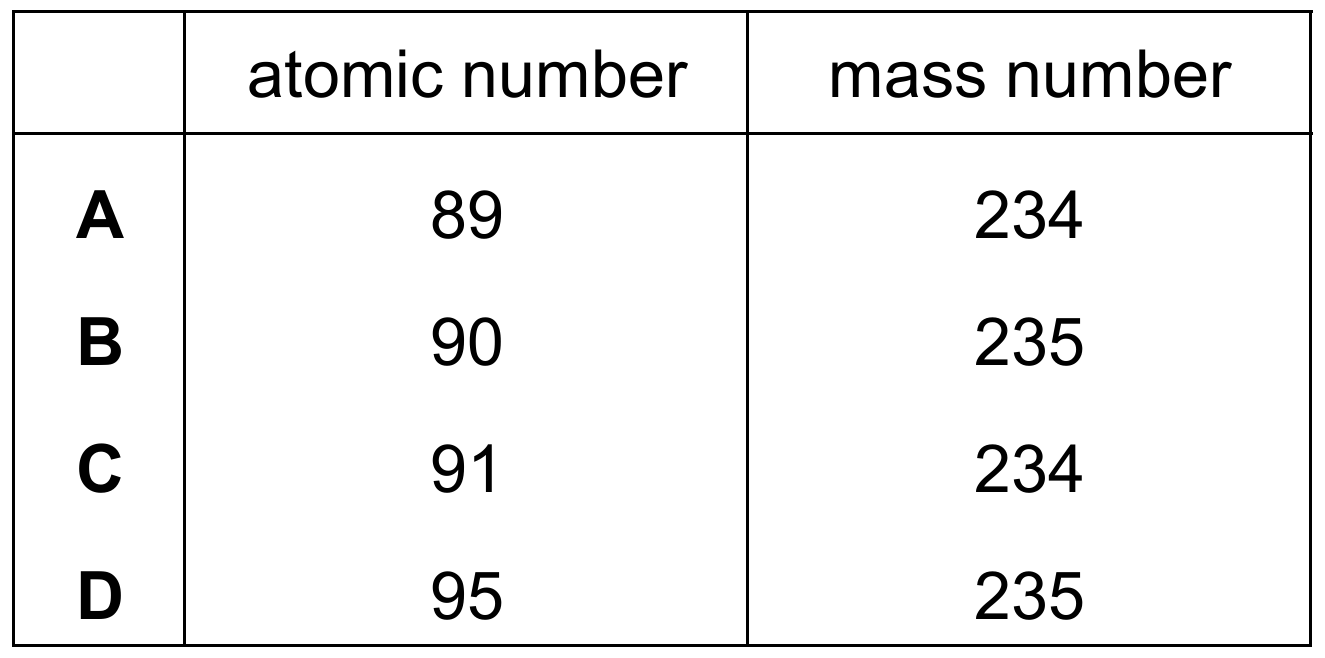
A uranium nucleus $_{92}^{238}\text{U}$ decays to form thorium by emitting an $\alpha$-particle. Thorium decays to protactinium by emitting a $\beta$-particle.

Which row gives the atomic number and mass number of this isotope of protactinium?

Most-appropriate topic codes (Cambridge IGCSE Physics 0625):

TOPIC 5.2.3: Radioactive decay (Describe the effect of $\alpha$-decay and $\beta$-decay on the nucleus)
▶️ Answer/Explanation
Correct Option: C

Detailed solution:

In $\alpha$-decay, the nucleus loses $2$ protons and $2$ neutrons, so the mass number $A$ decreases by $4$ and the atomic number $Z$ decreases by $2$: $_{92}^{238}\text{U} \rightarrow _{90}^{234}\text{Th} + _{2}^{4}\alpha$.
In $\beta$-decay, a neutron changes into a proton and an electron, so the mass number $A$ remains unchanged while the atomic number $Z$ increases by $1$: $_{90}^{234}\text{Th} \rightarrow _{91}^{234}\text{Pa} + _{-1}^{0}\beta$.
Following these two steps, the resulting protactinium isotope has a mass number of $234$ and an atomic number of $91$.
This sequence matches the values provided in Row C.
Question 35

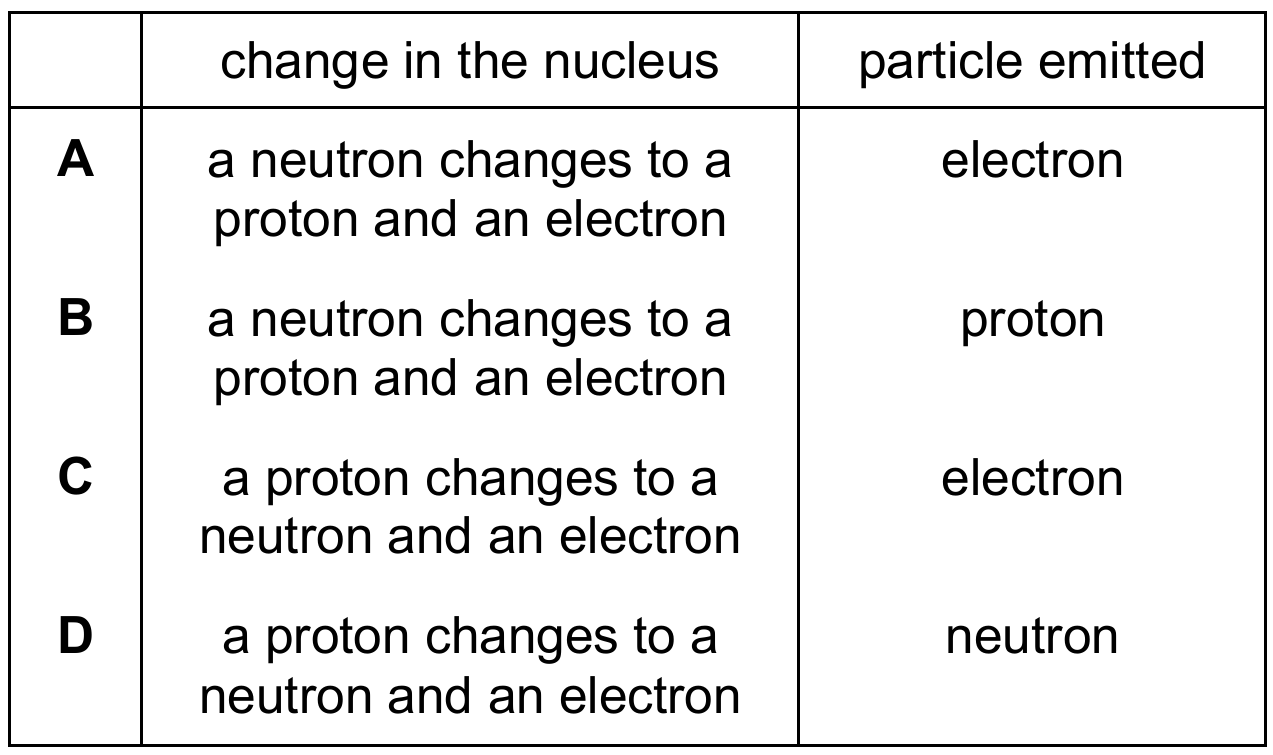
Which row shows what happens when a nucleus decays by emitting a β-particle?

Most-appropriate topic codes (Cambridge IGCSE Physics 0625):

TOPIC 5.2.3: Radioactive decay (The following change in the nucleus occurs during β-emission: neutron→proton+electron)
▶️ Answer/Explanation
Correct Option: A

Detailed solution:

In β-decay (specifically β − emission), an unstable nucleus becomes more stable by transforming a neutron into a proton.
This nuclear process is expressed by the equation: n→p+e − .
The resulting proton remains inside the nucleus, increasing the atomic number by 1.
The electron created in this process is ejected from the nucleus at high speed as a β-particle.
Therefore, the change involves a neutron becoming a proton and an electron, with an electron being the emitted particle.
This corresponds exactly to the description provided in Row A.
Question 36

Which precaution does not always reduce a scientist’s exposure when working with sources of ionising radiation?
A. ensuring the scientist only works with sources of radiation that have long half-life
B. increasing the distance between the scientist and the source of radiation
C. limiting the time for which the scientist handles the source of radiation
D. placing a lead shield between the scientist and the source of radiation

Most-appropriate topic codes (Cambridge IGCSE Physics 0625):

TOPIC 5.2.5: Safety precautions (Explain safety precautions in terms of reducing exposure time, increasing distance, and using shielding)
▶️ Answer/Explanation
Correct Option: A

Detailed solution:

The core principles of radiation protection are time, distance, and shielding.
Increasing distance (Option B) and using lead shielding (Option D) physically block or attenuate the radiation flux.
Limiting handling time (Option C) directly reduces the total dose absorbed by the scientist.
However, a long half-life (Option A) simply means the source stays radioactive for a longer duration.
It does not determine the immediate activity or the intensity of the radiation being emitted.
Therefore, choosing a source with a long half-life does not inherently reduce exposure and is the correct answer.

Question 37

A detector is placed near a radioactive isotope and records a count rate of $700$ counts/min. The half-life of the isotope is $8$ min. The average background count rate is $60$ counts/min. What is the count rate measured by the detector after $16$ min?
A. $100$ counts/min
B. $160$ counts/min
C. $175$ counts/min
D. $220$ counts/min

Most-appropriate topic codes (Cambridge IGCSE Physics 0625):

TOPIC 5.2.4: Half-life (Calculate half-life from data from which background radiation has not been subtracted)
▶️ Answer/Explanation
Correct Option: D

Detailed solution:

First, subtract the background radiation to find the initial corrected count rate: $700 – 60 = 640$ counts/min.
The time elapsed is $16$ min, which is exactly two half-lives ($n = \frac{16}{8} = 2$).
After two half-lives, the corrected count rate is halved twice: $640 \rightarrow 320 \rightarrow 160$ counts/min.
The detector measures the sum of the source’s radiation and the constant background radiation.
Final measured count rate = $160$ (source) + $60$ (background) = $220$ counts/min.
Therefore, the reading on the detector after $16$ min is $220$ counts/min, matching option D.

Question 38

The nucleus of an isotope of nitrogen, $N$, absorbs a neutron. It then decays into an isotope of carbon, $C$, and emits $x$.

$$\text{ }^{1}_{0}n + \text{ }^{14}_{7}N \rightarrow \text{ }^{14}_{6}C + x$$
What is $x$?
A. $\alpha$-particle
B. $\beta$-particle
C. $\gamma$-radiation
D. proton

Most-appropriate topic codes (Cambridge IGCSE Physics 0625):

TOPIC 5.1.2: The nucleus (Use the nuclide notation $\text{ }^{A}_{Z}X$)
TOPIC 5.2.3: Radioactive decay (Use decay equations, using nuclide notation)
▶️ Answer/Explanation
Correct Option: D

Detailed solution:

In any nuclear reaction, the total nucleon number ($A$) and the total proton number ($Z$) must be conserved.
For the reactant side: total $A = 1 + 14 = 15$, and total $Z = 0 + 7 = 7$.
For the product side, the carbon isotope has $A = 14$ and $Z = 6$.
Let $x$ be represented as $\text{ }^{A}_{Z}x$. To balance the equation: $15 = 14 + A$ and $7 = 6 + Z$.
This gives $A = 1$ and $Z = 1$. The particle with a mass of $1$ and a charge of $+1$ is a hydrogen nucleus or a proton.
Thus, $x$ is a proton, which matches Option D.

Question 39

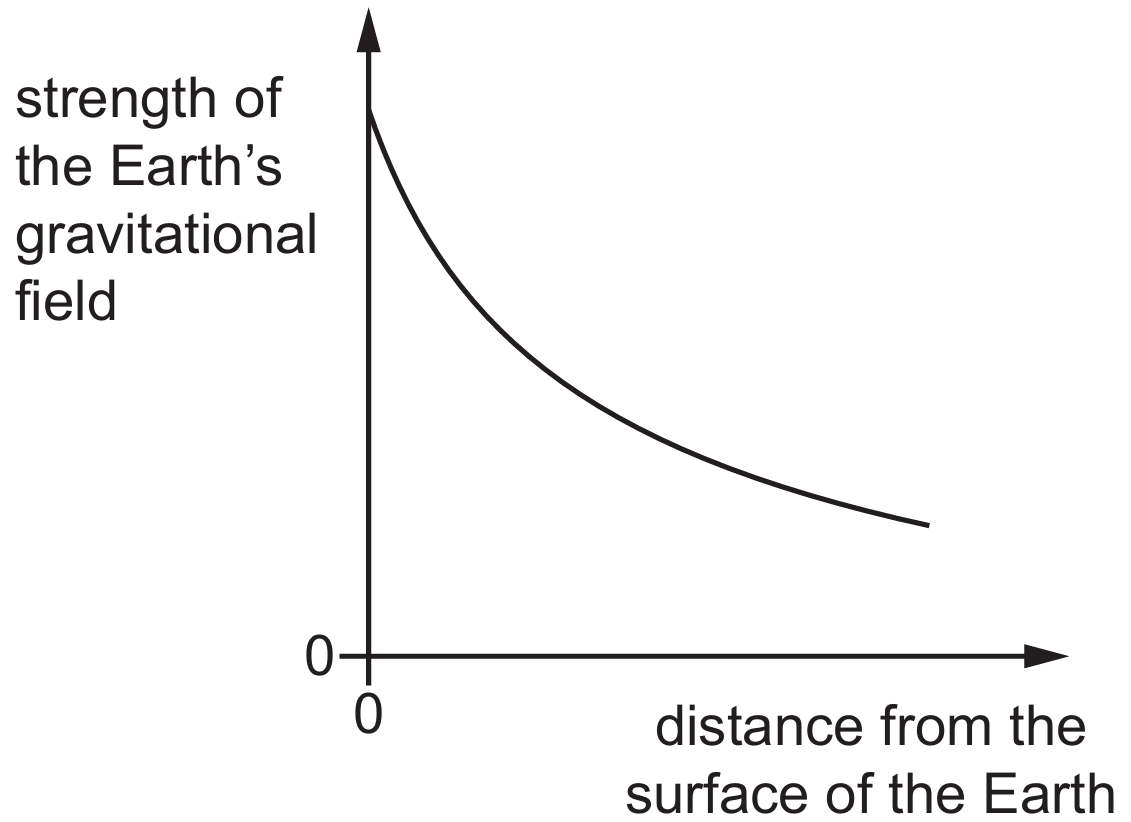
The graph shows how the strength of the Earth’s gravitational field varies as the distance from the Earth’s surface increases.
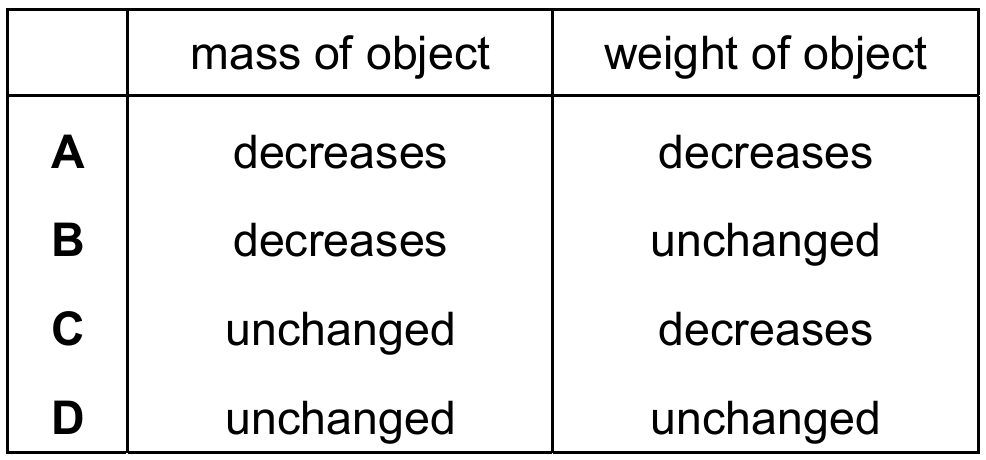
Which row describes the effect that this has on the mass and on the weight of an object as it moves further away from the Earth’s surface?

Most-appropriate topic codes (Cambridge IGCSE Physics 0625):

TOPIC 1.3: Mass and weight (State that mass is a measure of matter; define weight as a gravitational force)
TOPIC 6.1.2: The Solar System (Gravitational field strength decreases as distance increases)
▶️ Answer/Explanation
Correct Option: C

Detailed solution:

Mass is the quantity of matter in an object and remains constant regardless of its position in a gravitational field.
Weight is the gravitational force acting on an object, calculated using the equation $W = m \times g$.
As the distance from the Earth increases, the gravitational field strength $g$ decreases, as shown in the provided graph.
Since $W \propto g$ for a constant mass, a decrease in $g$ results in a corresponding decrease in the object’s weight.
Therefore, the mass remains unchanged while the weight decreases.
This matches the description provided in Row C.
Question 40

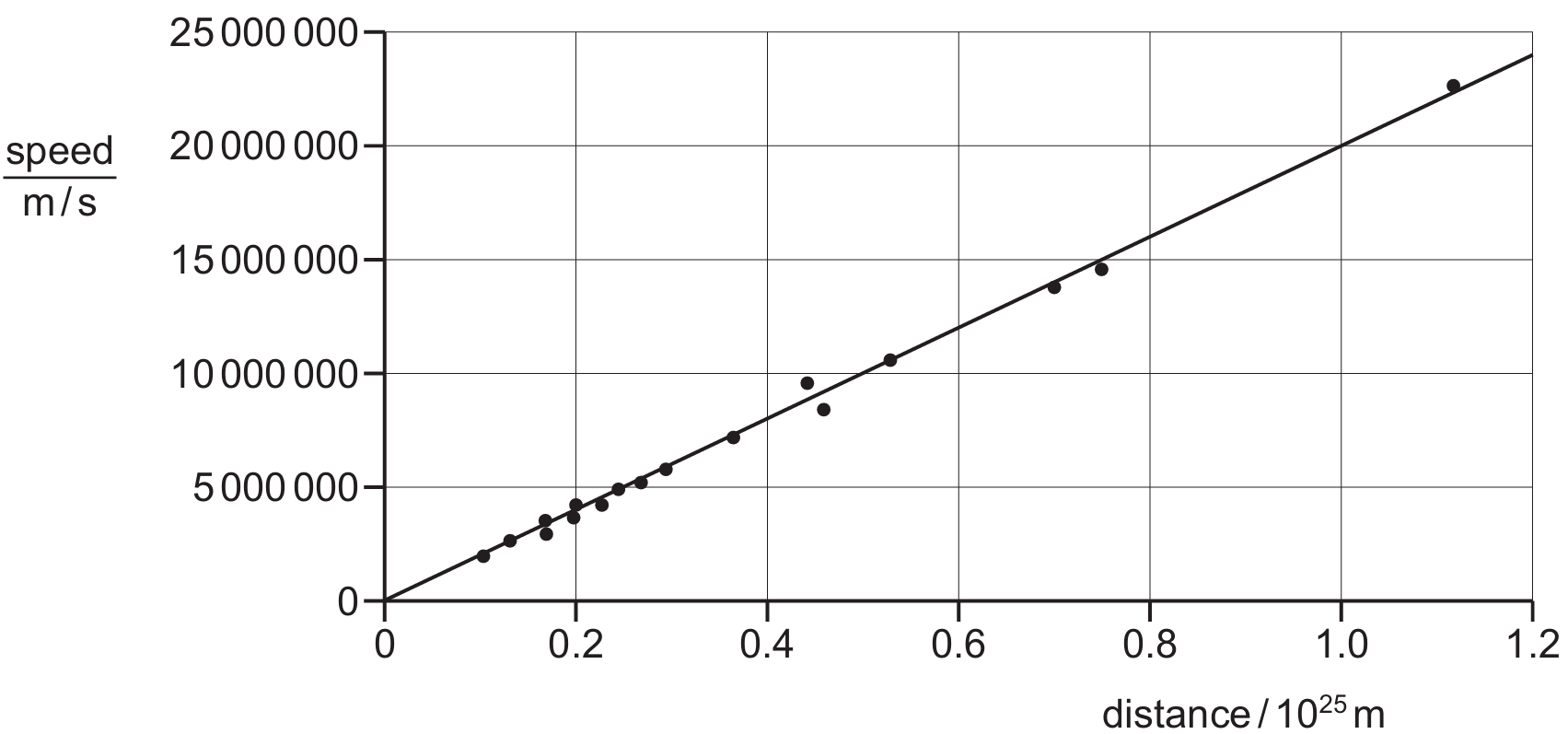
A student plots a graph of the speed of different galaxies moving away from the Earth against their distance from the Earth.
Using the best straight line shown on the graph, what is the value of the Hubble constant $H_0$?
A. $2.0 \times 10^{-18} \text{ s}^{-1}$
B. $2.2 \times 10^{-18} \text{ s}^{-1}$
C. $4.5 \times 10^{17} \text{ s}$
D. $5.0 \times 10^{17} \text{ s}$

Most-appropriate topic codes (Cambridge IGCSE Physics 0625):

TOPIC 6.2.3: The Universe (Define the Hubble constant $H_0$ as the ratio of the speed at which the galaxy is moving away from the Earth to its distance from the Earth)
▶️ Answer/Explanation
Correct Option: A

Detailed solution:

The Hubble constant $H_0$ is defined by the equation $H_0 = \frac{v}{d}$, which corresponds to the gradient of the speed-distance graph.
Selecting a point on the best-fit line, such as $d = 1.0 \times 10^{25} \text{ m}$ and $v = 20,000,000 \text{ m/s} = 2.0 \times 10^7 \text{ m/s}$.
Substituting these values into the formula: $H_0 = \frac{2.0 \times 10^7 \text{ m/s}}{1.0 \times 10^{25} \text{ m}}$.
This calculation yields $H_0 = 2.0 \times 10^{-18} \text{ s}^{-1}$.
Note that the units for the Hubble constant are $\text{s}^{-1}$ because the meters cancel out in the ratio of speed to distance.
Therefore, Option A is the correct value based on the gradient of the provided graph.

Scroll to Top