
Question 1
Most-appropriate topic codes (Cambridge IGCSE Physics 0625):
• Topic $1.2$ — Motion (Parts $\mathrm{(a)}$, $\mathrm{(b)}$, $\mathrm{(c)}$)
• Topic $1.5.1$ — Effects of forces (Part $\mathrm{(d)}$)
• Topic $1.3$ — Mass and weight (Part $\mathrm{(d)}$)
▶️ Answer/Explanation
(a)
For the correct answer:
$3.55\text{ m/s}$
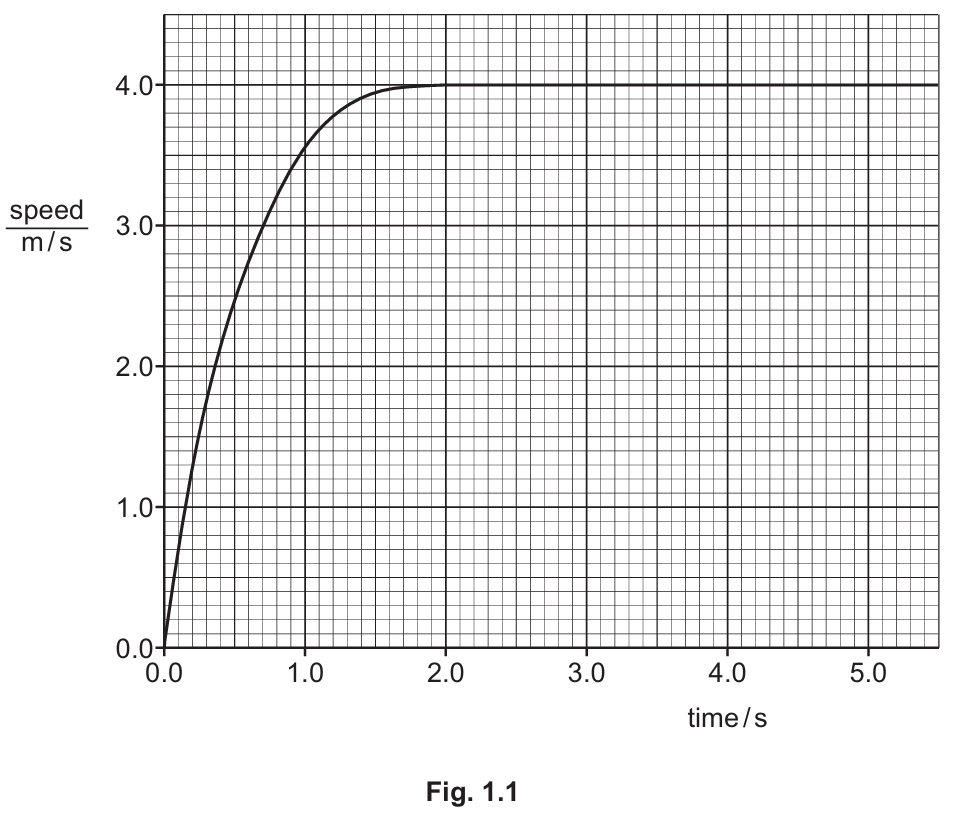
To find the speed at a specific time, locate $t = 1.0\text{ s}$ on the horizontal axis. Move vertically upwards to intersect the plotted curve, then move horizontally to read the corresponding value on the vertical axis. The point lies exactly midway between the grid lines for $3.5\text{ m/s}$ and $3.6\text{ m/s}$, which corresponds to a value of $3.55\text{ m/s}$.
(b)
For the correct answer:
Constant speed OR steady speed OR zero acceleration
Between $t = 2.0\text{ s}$ and $t = 5.0\text{ s}$, the graph is a perfectly horizontal straight line. A horizontal line on a speed-time graph indicates that the speed is not changing as time passes. Therefore, the ball has zero acceleration and is moving at a steady, constant terminal velocity.
(c)
For the correct answer:
$12\text{ m}$
The distance travelled is equal to the area under the speed-time graph for the given time interval. From $t = 2.0\text{ s}$ to $t = 5.0\text{ s}$, the shape under the line is a rectangle with a width (base) of $3.0\text{ s}$ and a height of $4.0\text{ m/s}$. Using the geometric formula for the area of a rectangle ($\text{base} \times \text{height}$), the distance is calculated as $3.0 \times 4.0 = 12\text{ m}$.
(d)
For the correct answer:
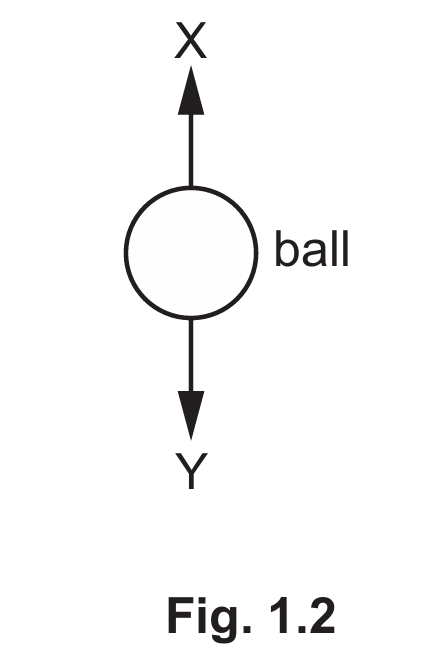
Upward force $X$ is air resistance (or friction/drag). Downward force $Y$ is weight (or gravity).
As the ball falls through the atmosphere, it collides with air molecules, creating a resistive upward force known as air resistance or drag (Force $X$). Simultaneously, the gravitational field of the Earth exerts a downward pull on the mass of the ball, which is defined as its weight (Force $Y$).
Question 2
Most-appropriate topic codes (Cambridge IGCSE Physics 0625):
• Topic $1.4$ — Density (Parts $\mathrm{(a)}$, $\mathrm{(b)}$)
▶️ Answer/Explanation
(a)
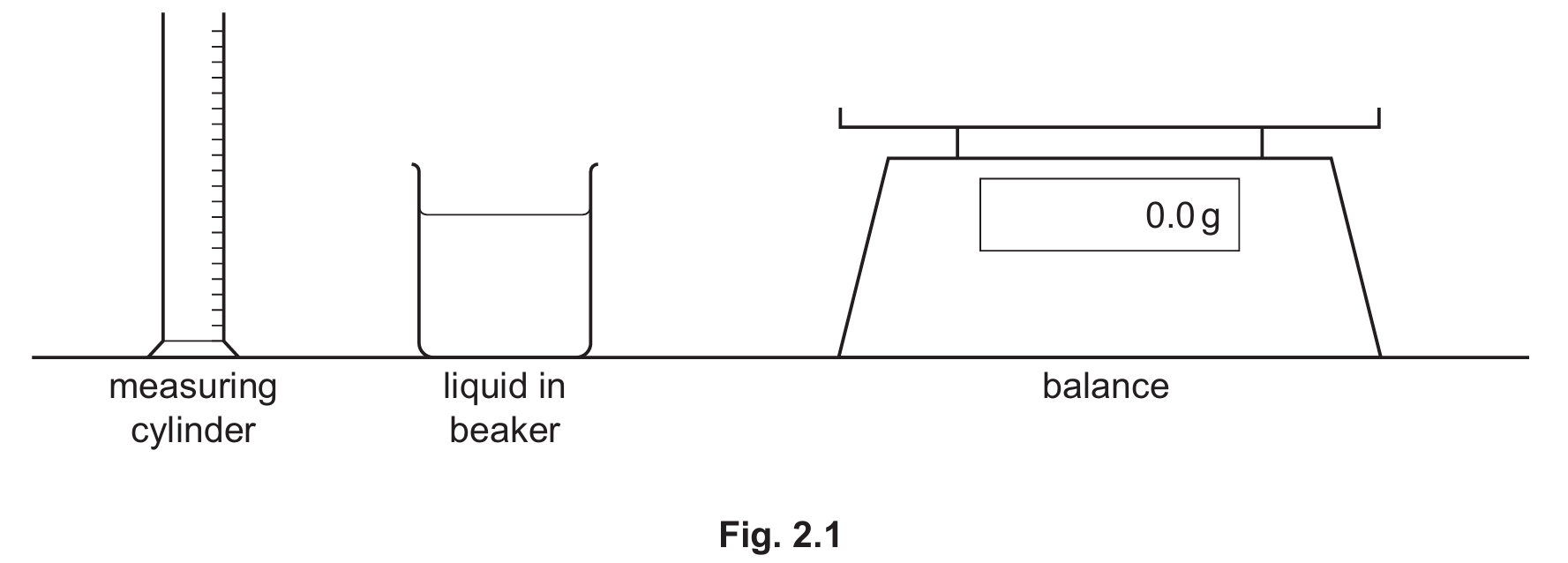
To find the density, the student must measure both the mass and the volume of the liquid. The measuring cylinder is used to directly measure the liquid’s volume $V$. To determine the mass $m$, the student uses the balance to measure the mass of the empty beaker, and then measures the combined mass of the beaker containing the liquid. Subtracting the empty beaker’s mass from the combined mass yields the mass of the liquid. Finally, the student calculates the density using the formula $\rho=\frac{m}{V}$.
(b)
For the correct calculated value: $96\text{ g}$
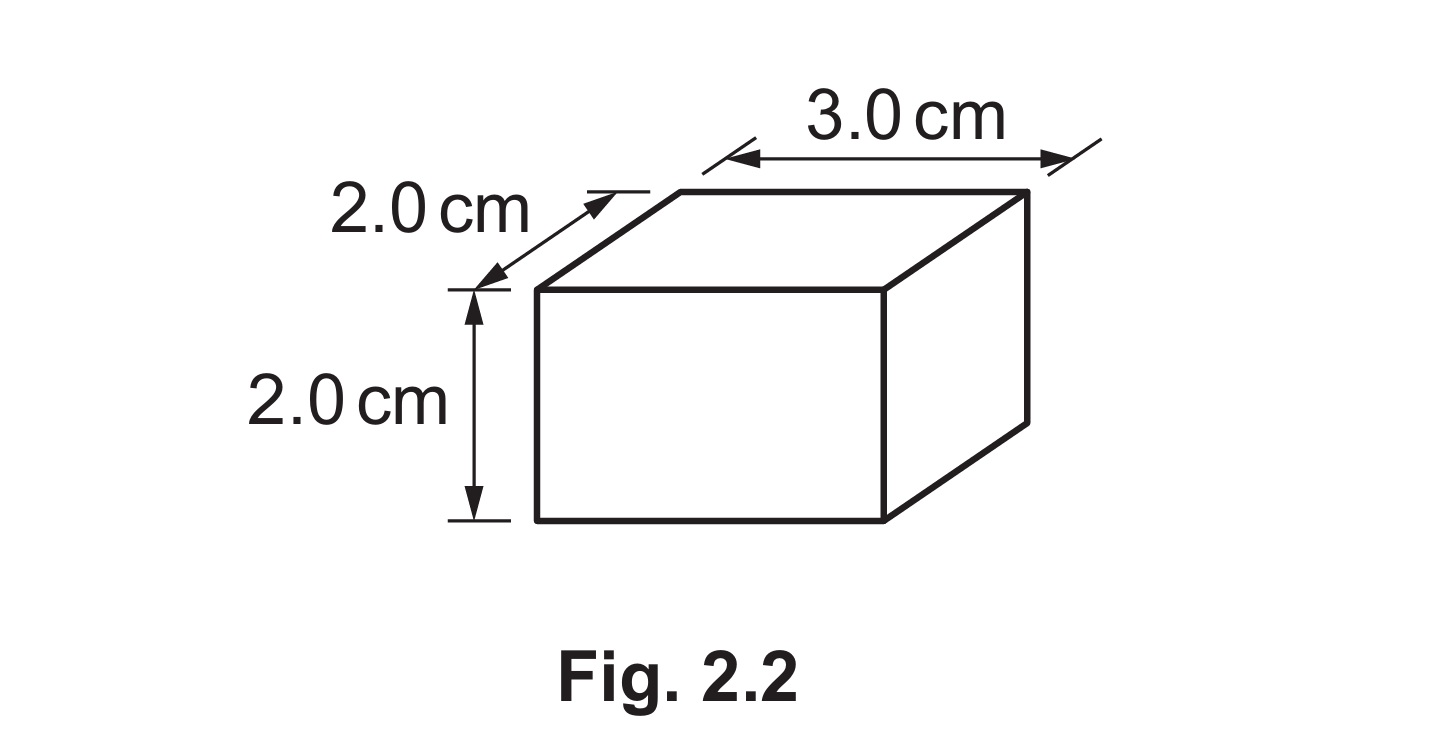
The mass of the block can be found by rearranging the density formula to $m=\rho\times V$. First, calculate the volume of the rectangular block by multiplying its dimensions: $V=2.0\text{ cm}\times 2.0\text{ cm}\times 3.0\text{ cm}=12.0\text{ cm}^{3}$. Given the density $\rho=8.0\text{ g/cm}^{3}$, substitute these values into the rearranged formula to get the final mass: $m=8.0\text{ g/cm}^{3}\times 12.0\text{ cm}^{3}=96\text{ g}$.
Question 3
Most-appropriate topic codes (Cambridge IGCSE Physics 0625):
• Topic $1.5.3$ — Centre of gravity (Part $\mathrm{(a)}$)
• Topic $1.8$ — Pressure (Part $\mathrm{(b)}$)
• Topic $1.5.2$ — Turning effect of forces (Part $\mathrm{(c)}$)
▶️ Answer/Explanation
(a)
For the correct answer:
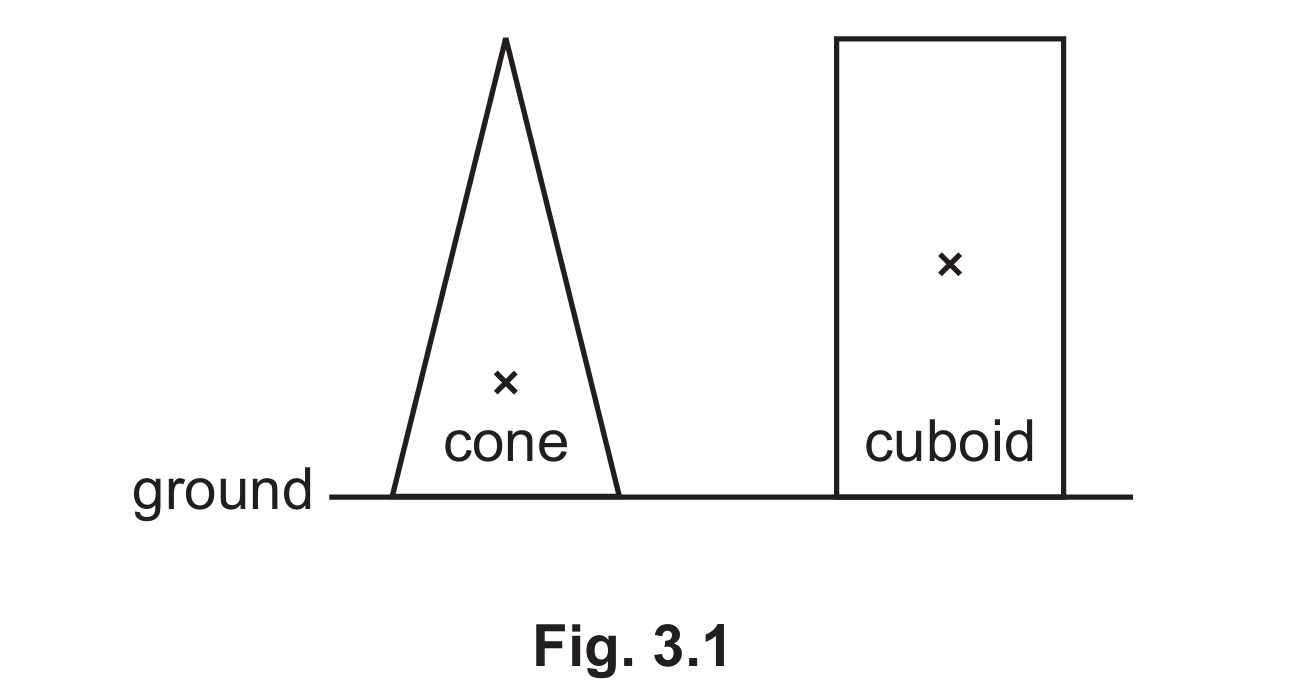
The solid cone has a lower centre of gravity.
The stability of an object depends on the position of its centre of gravity relative to its base. As seen in Fig. $3.1$, the symbol $\times$ for the cone is positioned closer to the ground compared to the cuboid. A lower centre of gravity means the object must be tilted to a larger angle before the vertical line through its centre of gravity falls outside its base, making it more stable.
(b)
For the correct answer:
$1.5\text{ N/cm}^{2}$
Pressure is defined as the normal force applied per unit area. To calculate the pressure exerted by the solid cuboid, we use the formula $P = \frac{F}{A}$. Substituting the given values, where the force $F = 48\text{ N}$ and the area $A = 32\text{ cm}^{2}$, we get $P = \frac{48}{32}$. This simplifies to a pressure of $1.5\text{ N/cm}^{2}$.
(c)
For the correct answer:
$270\text{ N cm}$
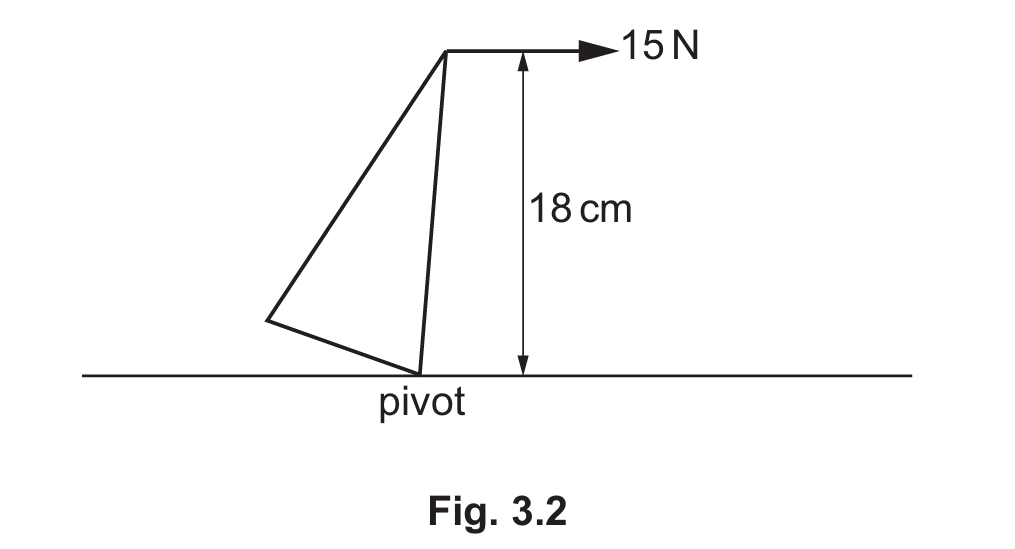
The moment of a force is a measure of its turning effect around a pivot point. It is calculated using the formula $M = F \times d$, where $F$ is the applied force and $d$ is the perpendicular distance from the pivot to the line of action of the force. Given $F = 15\text{ N}$ and the perpendicular distance $d = 18\text{ cm}$, substituting these values yields $M = 15 \times 18$. The calculated moment is $270\text{ N cm}$.
Question 4
Most-appropriate topic codes (Cambridge IGCSE Physics 0625):
• Topic $1.7.3$ — Energy resources
▶️ Answer/Explanation
(a)
For the correct answer (any $4$ valid points):
• Burning fuel produces thermal energy.
• This thermal energy is used to heat water to produce steam.
• The steam turns or spins a turbine.
• The turbine then turns a generator.
The process of generating electricity from biofuels involves a sequence of energy transfers. Initially, the biofuel is burned, which converts its stored chemical energy into thermal energy. This thermal energy is transferred to water within a boiler, causing it to boil and produce high-pressure steam. The kinetic energy of the moving steam is then directed to push against the blades of a turbine, causing it to rotate. Finally, the spinning turbine drives an electrical generator, which converts the kinetic energy into electrical power via electromagnetic induction.
(b)
For the correct advantage (any $1$ valid point):
• It is a renewable form of energy.
• Less contribution to global warming.
• Less atmospheric pollution.
• Can be grown in many countries, reducing dependence on foreign fossil fuels.
For the correct disadvantage (any $1$ valid point):
• Loss of land for food production.
• Not enough biofuel to meet demand.
• Use of fertilisers and large amounts of water for irrigation.
• Problems with monoculture.
Biofuels are considered a renewable energy resource because the crops used to produce them can be replenished relatively quickly, unlike fossil fuels which take millions of years to form. Additionally, they are often considered carbon-neutral since the plants absorb carbon dioxide during their growth phase, mitigating global warming impacts. However, a major disadvantage is that cultivating these crops requires vast amounts of agricultural land. This can lead to deforestation or compete directly with food production, potentially causing food shortages and raising global food prices.
Question 5
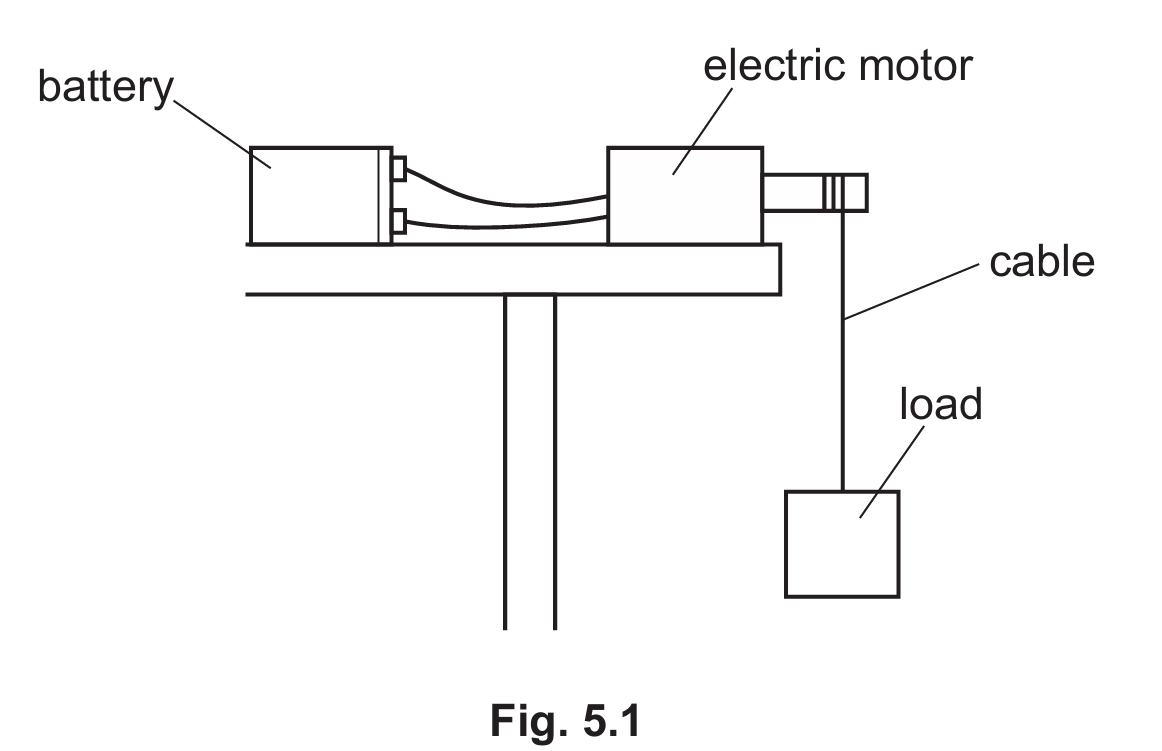
(a) After lifting the load, the motor is switched off. Fig. 5.2 represents the transfer of energy from the battery to the load in Fig. 5.1.
In Fig. 5.2, add the names of the energy stores.

(b) The weight of the load is $8.0\text{ N}$. The motor lifts the load through a vertical distance of $0.60\text{ m}$.
Calculate the work done on the load.
(c) The current in the motor is $0.40\text{ A}$. The potential difference across the motor is $6.0\text{ V}$.
Calculate the power of the electric motor.
Most-appropriate topic codes (Cambridge IGCSE Physics 0625):
• Topic $1.7.1$ — Energy (Part $\mathrm{(a)}$)
• Topic $1.7.2$ — Work (Part $\mathrm{(b)}$)
• Topic $4.2.5$ — Electrical energy and electrical power (Part $\mathrm{(c)}$)
▶️ Answer/Explanation
(a)
For the correct answers:
chemical (energy)
gravitational potential (energy)
A battery stores energy in the form of chemical energy, which is then transferred electrically to the motor to do work. As the motor lifts the load vertically upwards against the downward force of gravity, the kinetic energy is transferred into the gravitational potential energy store of the load.
(b)
For the correct answer:
$4.8\text{ J}$
The work done on an object is calculated using the formula $W = Fd$, where $F$ is the applied force and $d$ is the distance moved in the direction of the force. Here, the force is equal to the load’s weight ($8.0\text{ N}$) and the vertical distance is $0.60\text{ m}$. Substituting these values yields $W = 8.0\text{ N} \times 0.60\text{ m} = 4.8\text{ J}$.
(c)
For the correct answer:
$2.4\text{ W}$
The electrical power of the motor can be determined using the equation $P = IV$, where $I$ is the current and $V$ is the potential difference across the motor. By substituting the given values of $I = 0.40\text{ A}$ and $V = 6.0\text{ V}$, we calculate the power as $P = 0.40\text{ A} \times 6.0\text{ V} = 2.4\text{ W}$.
Question 6
(d) The water is heated until it is boiling. The air pressure in the room is standard atmospheric pressure.
State the temperature at which the water boils.
Most-appropriate topic codes (Cambridge IGCSE Physics 0625):
• Topic $2.1.2$ — Particle model (Part $\mathrm{(a)}$)
• Topic $2.3.1$ — Conduction (Part $\mathrm{(b)}$)
• Topic $2.3.2$ — Convection (Part $\mathrm{(c)}$)
• Topic $2.2.3$ — Melting, boiling and evaporation (Part $\mathrm{(d)}$)
▶️ Answer/Explanation
(a)
For the correct answer:
Any $3$ from: in a random arrangement; close together OR slightly further apart than in solids; move freely OR slide over each other; collide (with each other); moving randomly.
In the liquid state, particles do not have a fixed, regular structure, meaning they are arranged randomly. The separation between the particles is very small, allowing them to remain close together while still having enough space to move. Due to their thermal energy, these particles are in constant random motion, meaning they freely slide over one another and frequently collide with each other.
(b)
For the correct answer:
conduction
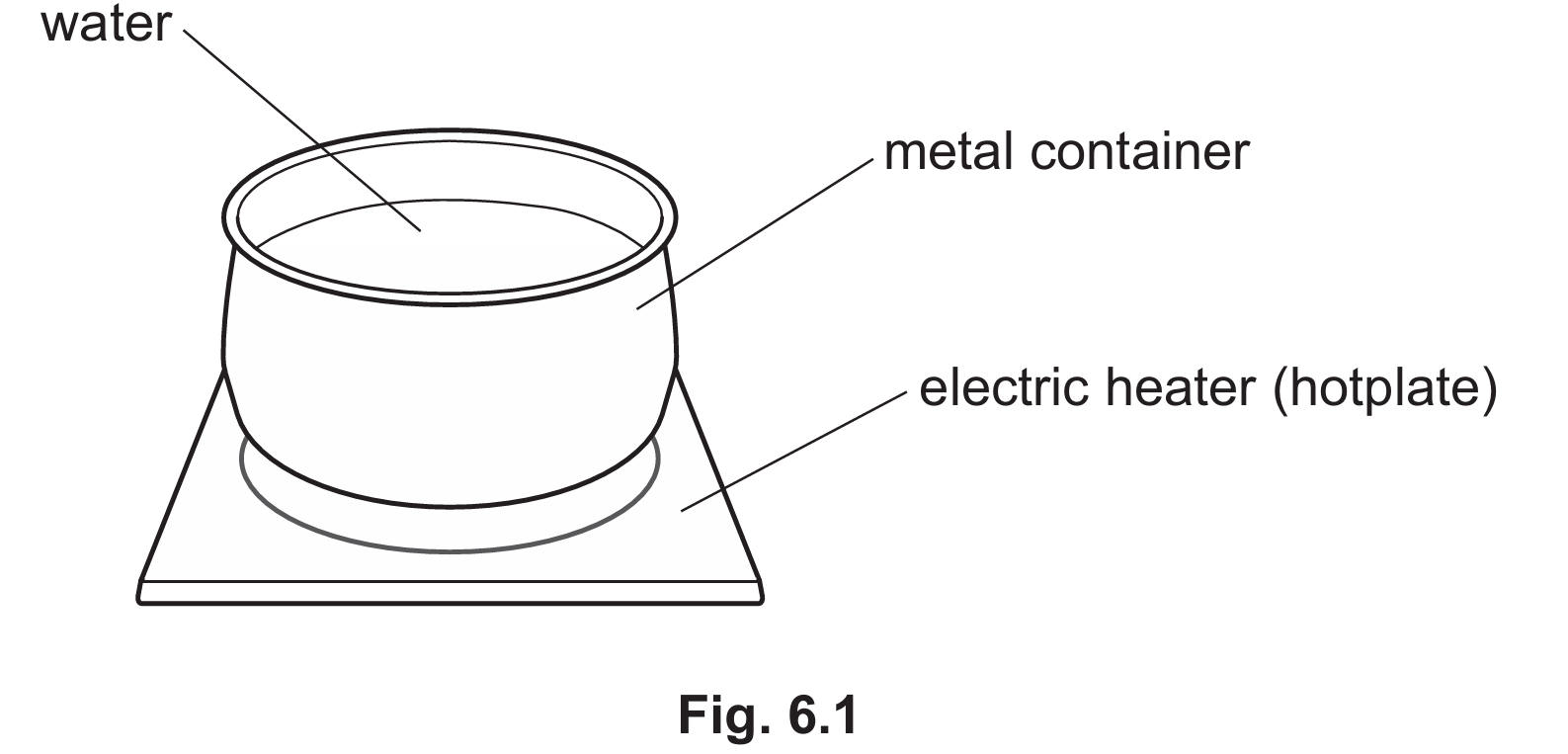
Thermal energy is transferred through solid materials, such as the metal container, primarily by the process of conduction. When the metal is heated by the hotplate, its atomic lattice vibrates more vigorously, transferring energy to neighboring atoms. Additionally, metals contain free (delocalised) electrons that quickly transfer kinetic energy throughout the structure, making them excellent thermal conductors.
(c)
For the correct answer:
Any $3$ from: convection; idea that water at bottom of pan is warmed / temp of water at bottom increases; warm water is less dense; less dense / warm water rises OR more dense/colder water sinks.
Thermal energy spreads through fluids like water via convection. When the water at the bottom of the container is heated, its particles gain kinetic energy, move faster, and spread further apart. This thermal expansion causes the heated water to become less dense than the cooler water above it. Consequently, the warmer, less dense water rises to the surface, displacing the cooler, denser water, which then sinks to the bottom to be heated, forming a continuous convection current.
(d)
For the correct answer:
$100~^{\circ}\text{C}$
Pure water undergoes a change of state from liquid to gas at a specific thermal point called its boiling point. During this phase change, the thermal energy supplied goes into breaking the intermolecular bonds rather than raising the temperature. Under standard atmospheric pressure, this boiling temperature is a constant physical property of water and occurs at exactly $100~^{\circ}\text{C}$.
Question 7
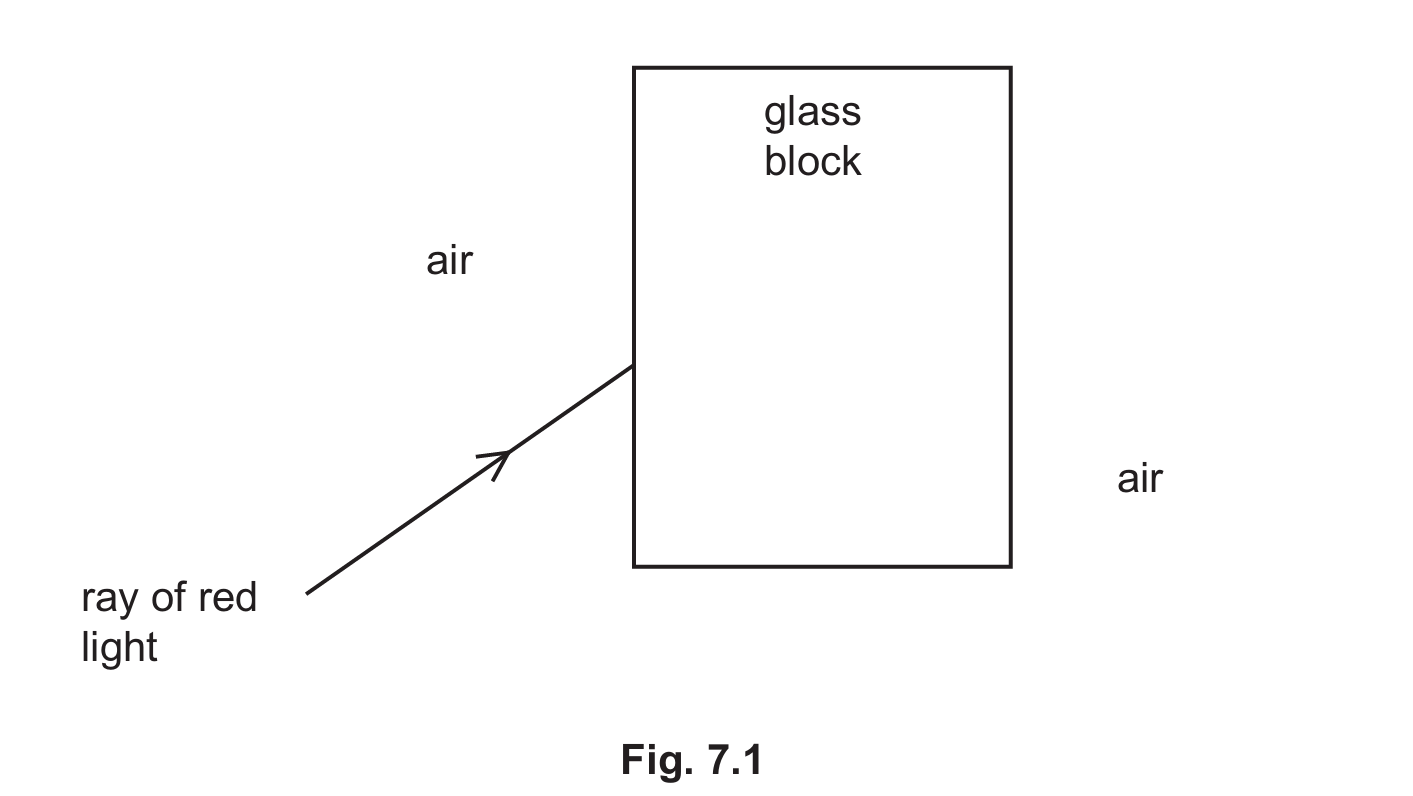
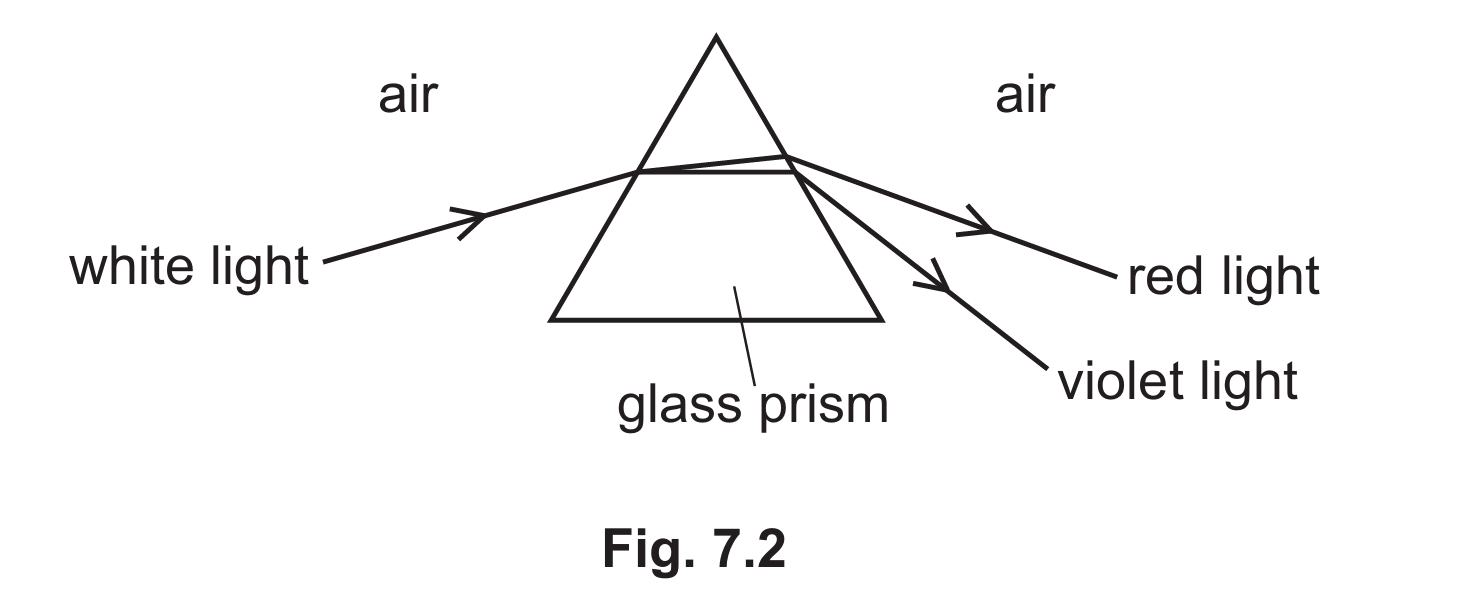

Most-appropriate topic codes (Cambridge IGCSE Physics 0625):
• Topic $3.2.2$ — Refraction of light (Part $\mathrm{(a)}$)
• Topic $3.2.4$ — Dispersion of light (Part $\mathrm{(b)}$)
• Topic $3.3$ — Electromagnetic spectrum (Part $\mathrm{(c)}$)
▶️ Answer/Explanation
(a)
For the correct answer:
Ray refracted toward normal as it enters glass (by eye)
Ray refracted away from normal on leaving glass (by eye) OR emergent ray parallel with incident ray (by eye)
When the red light enters the denser glass block from the air, its speed decreases, causing it to refract towards the normal. When it exits the glass block back into the less dense air, its speed increases, refracting it away from the normal. Because the opposite sides of the rectangular glass block are parallel, the emergent ray is parallel to the original incident ray, just displaced laterally.
(b)
For the correct answer:
orange
yellow
green
blue
indigo
White light consists of a continuous spectrum of seven traditional colours. The order of these colours from longest wavelength (least refracted) to shortest wavelength (most refracted) is red, orange, yellow, green, blue, indigo, and violet. Therefore, the missing colours between red and violet, in exact order, are orange, yellow, green, blue, and indigo.
(c)(i)
For the correct answer:
ultraviolet (rays / light)
The electromagnetic spectrum is ordered by increasing frequency and decreasing wavelength. Following visible light and before X-rays, the correct region is ultraviolet radiation. Thus, the unlabelled box represents ultraviolet light.
(c)(ii)
For the correct answer:
detecting / treating cancer OR sterilising food / medical equipment OR (medical) imaging OR detecting leaks in (underground) pipes
Gamma rays have very high energy and are highly penetrating. They are commonly used in medical applications, such as radiotherapy to target and destroy cancer cells. They are also widely used to sterilize medical equipment and food by safely killing harmful bacteria and pathogens.
(c)(iii)
For the correct answer:
mutation or damage to cells / organs / DNA OR cancer
Due to their extremely high frequency and energy, gamma rays are highly ionizing. Excessive exposure to gamma radiation can penetrate deep into human tissue, causing severe damage to living cells and DNA mutations. This damage significantly increases the risk of developing cancer and other radiation-induced illnesses.
Question 8
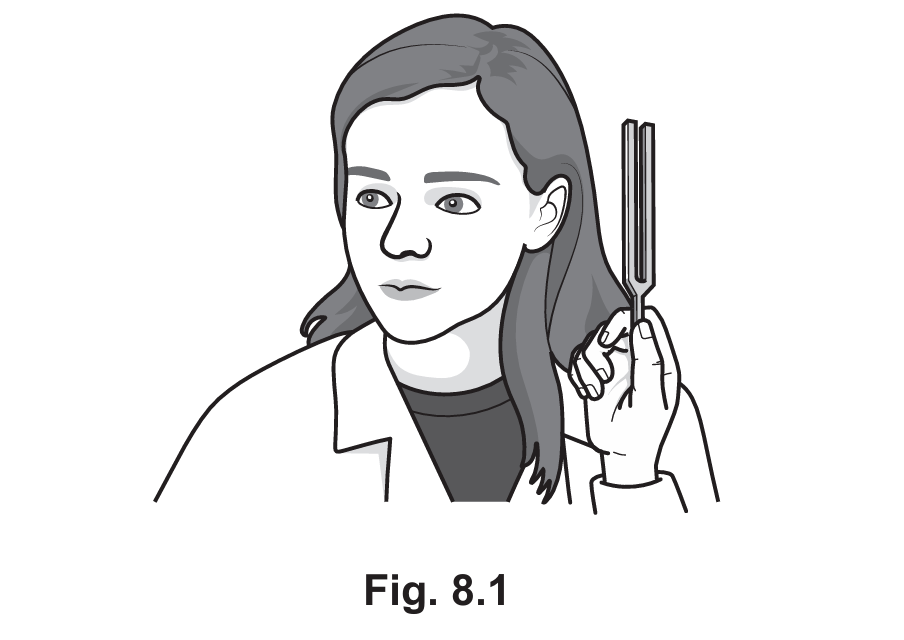
from …………………………………………….. to ……………………………………………..
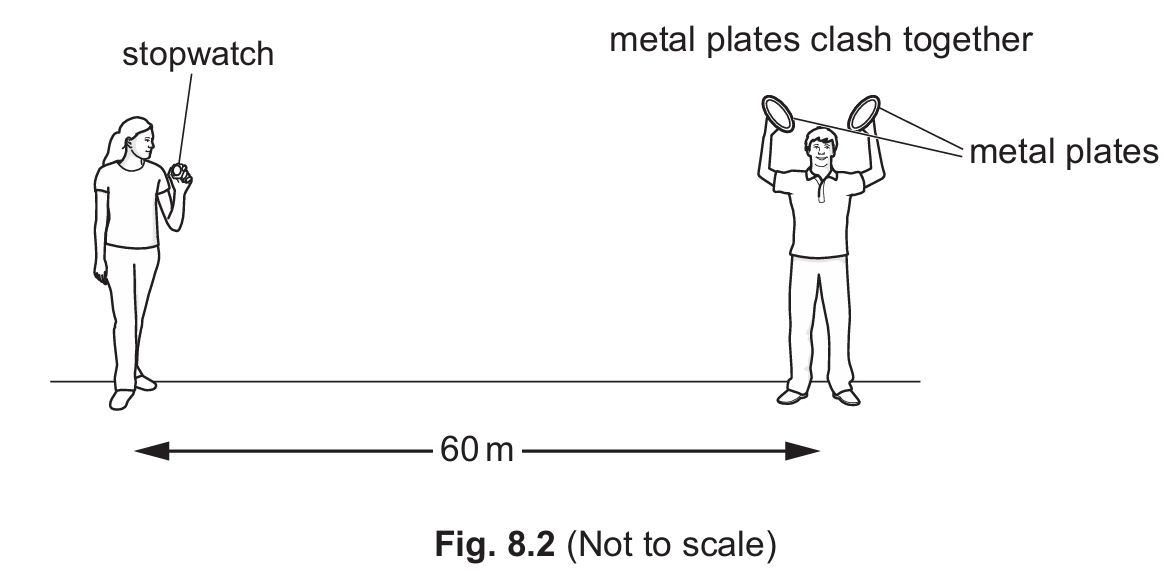
Explain why the students’ value is different.
Most-appropriate topic codes (Cambridge IGCSE Physics 0625):
• Topic $3.4$ — Sound (Parts $\mathrm{(a)}$, $\mathrm{(b)}$, $\mathrm{(c)}$)
▶️ Answer/Explanation
(a)
For the correct answer:
vibrations OR oscillations
When the tuning fork is forcibly struck against the wooden block, its metallic prongs are excited into rapid, periodic mechanical vibrations. These back-and-forth oscillations push and pull on the adjacent air molecules. This continuous displacement creates alternating regions of high pressure (compressions) and low pressure (rarefactions) that propagate outwards as a longitudinal sound wave, which is eventually detected by the student’s ear.
(b)
For the correct answer:
$20$ to $20000$
hertz OR Hz
The human auditory system is sensitive to a specific physiological band of frequencies. The normal range of hearing for a healthy human spans from a lower limit of approximately $20\text{ Hz}$ to an upper limit of around $20000\text{ Hz}$ (or $20\text{ kHz}$). Sound frequencies lying below this interval are termed infrasound, while frequencies exceeding the $20000\text{ Hz}$ threshold are classified as ultrasound.
(c)
For the correct answer:
reaction time OR distance / time interval is too small
The accepted speed of sound in air is approximately $330\text{ m/s}$, meaning the sound will cover the $60\text{ m}$ distance in roughly $0.18\text{ s}$. However, a typical human visual and auditory reaction time ranges between $0.2\text{ s}$ and $0.3\text{ s}$. Because the measured time interval is so extremely short, the manual delay in starting and stopping the stopwatch introduces a massive percentage error, skewing the final calculated speed significantly away from the true value.
Question 9
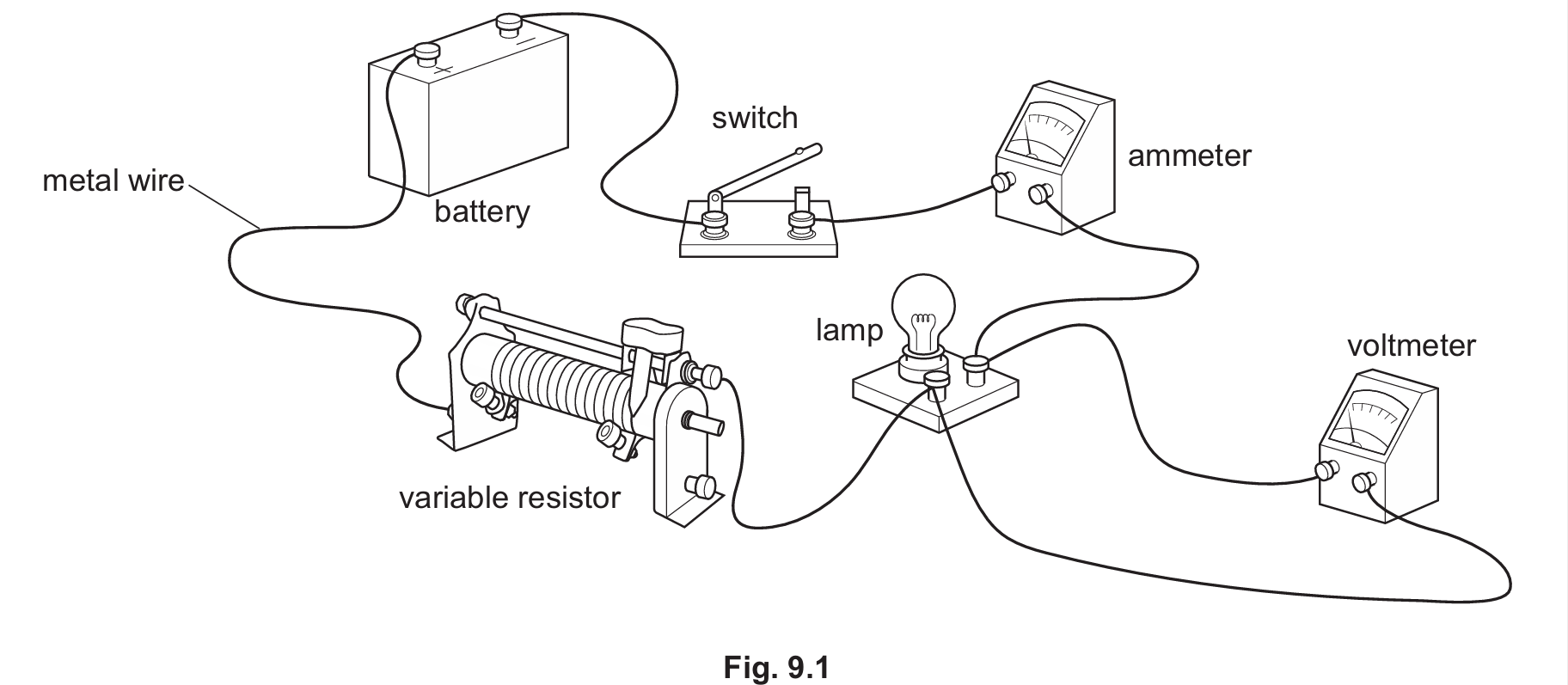
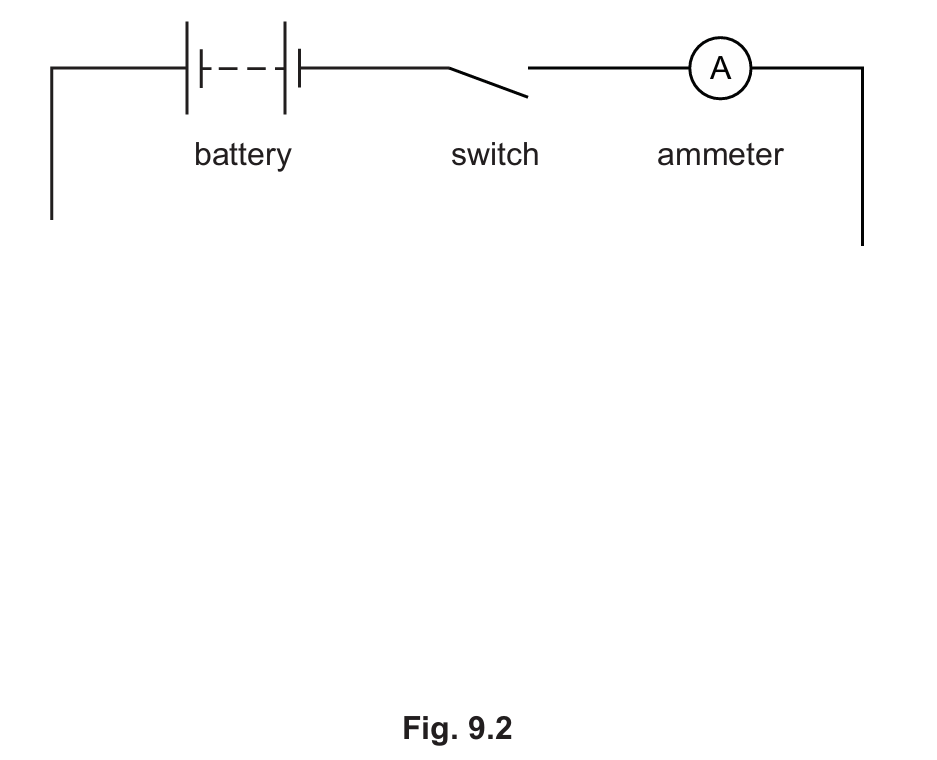
(b) The potential difference (p.d.) across the lamp is $11\text{ V}$ and the current in the lamp is $0.44\text{ A}$.
Calculate the resistance of the lamp.
(c) The student moves the sliding contact from position A to position B, as shown in Fig. 9.3.
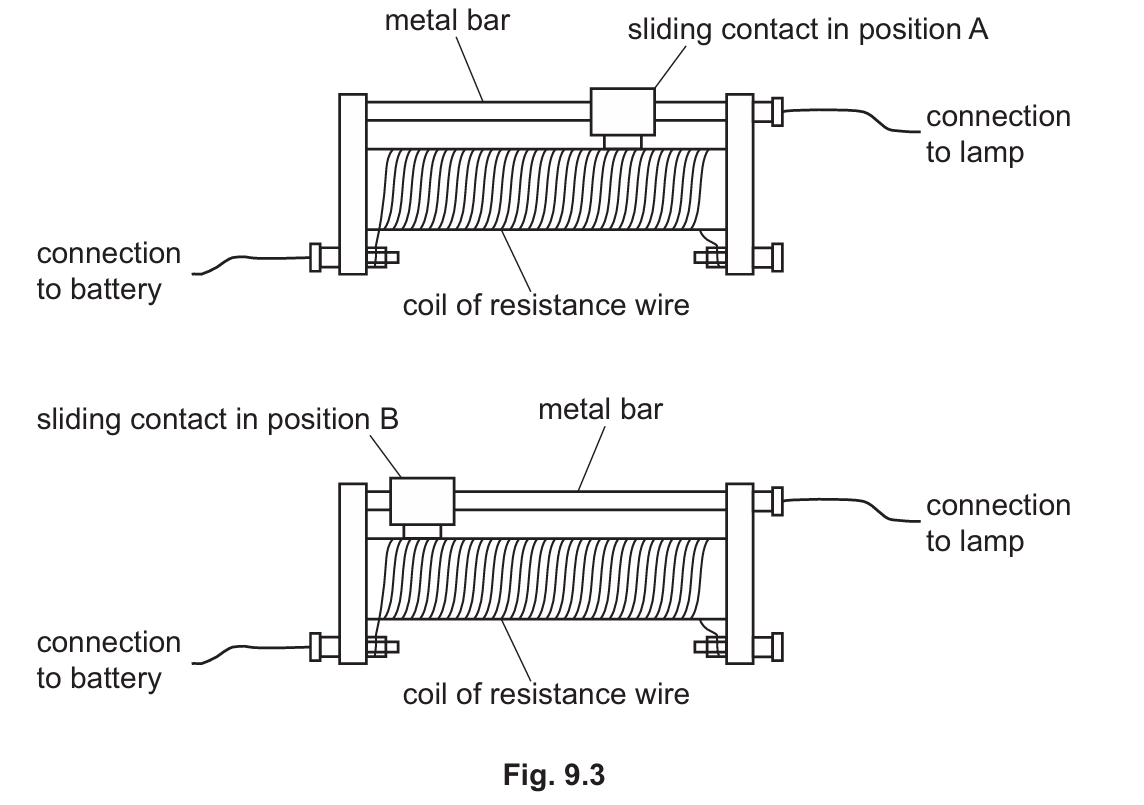
State and explain any effect on the current in the circuit when the sliding contact is moved from position A to position B.
Most-appropriate topic codes (Cambridge IGCSE Physics 0625):
• Topic $4.3.1$ — Circuit diagrams and circuit components (Part $\mathrm{(a)}$)
• Topic $4.2.4$ — Resistance (Parts $\mathrm{(b)}$, $\mathrm{(c)}$)
▶️ Answer/Explanation
(a)
For the correct answer:
Correct symbols drawn for the voltmeter, lamp, and variable resistor. The lamp and variable resistor must be connected in series, and the voltmeter must be connected in parallel with the lamp.
To accurately represent the physical circuit in a standard schematic, you must use internationally recognized symbols. The ammeter, lamp, and variable resistor all lie on the main circuit loop, meaning they are in series with the battery and switch. The voltmeter is connected across the lamp, meaning it must be drawn in parallel to measure the potential difference specific to the lamp.
(b)
For the correct answer:
$25\ \Omega$
The resistance of an electrical component can be found using the rearranged form of the resistance equation, $R = \frac{V}{I}$. By substituting the given potential difference $V = 11\text{ V}$ and the current $I = 0.44\text{ A}$ into the equation, we get $R = \frac{11}{0.44}$. Calculating this division yields a final resistance of $25\ \Omega$.
(c)
For the correct answer:
The current increases because the resistance of the variable resistor decreases (there is less resistance wire in the circuit for the current to move through).
Moving the sliding contact from position A to position B reduces the physical length of the coiled resistance wire that the current must pass through. Since the resistance of a metallic wire is directly proportional to its length ($R \propto l$), a shorter path results in a lower total resistance for the circuit. According to the relationship $I = \frac{V}{R}$, with the battery’s voltage remaining constant, a decrease in the circuit’s total resistance leads to a proportional increase in the current.
Question 10
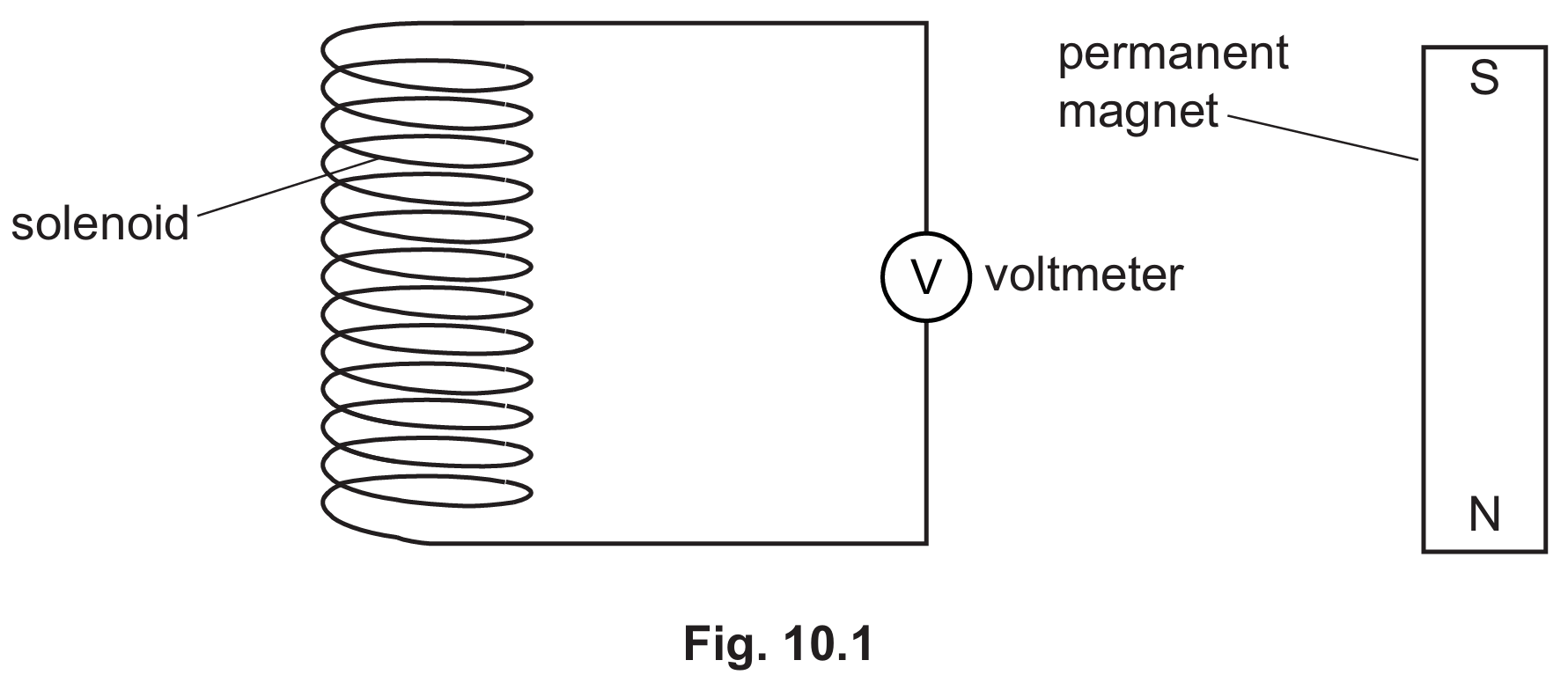
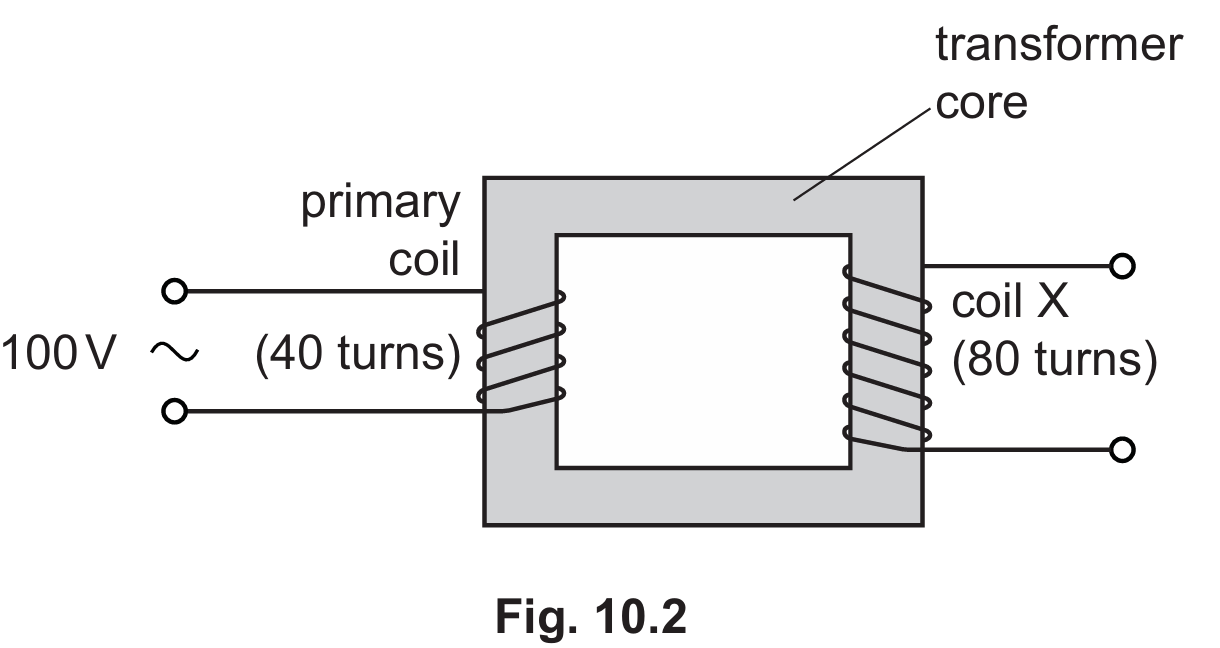
Most-appropriate topic codes (Cambridge IGCSE Physics 0625):
• Topic 4.5.1 — Electromagnetic induction (Parts (a), (b))
• Topic 4.5.6 — The transformer (Part (c))
▶️ Answer/Explanation
(a)
For the correct answer:
Move the magnet into or out of the solenoid (or relative to the coil).
To demonstrate electromagnetic induction, there must be relative motion between the conductor and the magnetic field. By moving the permanent magnet into or out of the solenoid, the magnetic field lines cut across the wire turns. This changing magnetic flux linkage induces an electromotive force (e.m.f.), which is then detected by the deflection on the voltmeter.
(b)
For the correct answer (any two):
Use a stronger magnet; increase the number of turns on the coil; increase the speed of movement of the magnet.
According to Faraday’s law of induction, the magnitude of the induced e.m.f. is directly proportional to the rate of change of magnetic flux linkage. Moving the magnet faster increases the rate at which field lines are cut. Using a stronger magnet increases the magnetic flux density, and adding more turns to the solenoid increases the total flux linkage.
(c)(i)
For the correct answer:
(Soft) iron
The transformer core needs to be easily magnetized and demagnetized to rapidly transfer the changing magnetic field from the primary coil to the secondary coil. Soft iron is the standard magnetic material used because it increases the efficiency of this transfer while minimizing energy losses.
(c)(ii)
For the correct answer:
Secondary (coil)
In a transformer, the coil connected to the alternating input voltage is called the primary coil. Coil X is situated on the output side where the new alternating voltage is induced, making it the secondary coil.
(c)(iii)
For the correct answer:
Step-up (transformer)
A transformer’s voltage ratio is determined by its turns ratio, described by the equation $\frac{V_s}{V_p} = \frac{N_s}{N_p}$. The primary coil has 40 turns ($N_p = 40$) and the secondary coil X has 80 turns ($N_s = 80$). Since the number of turns on the secondary coil is greater ($N_s > N_p$), the output voltage will be higher than the input voltage, which is the definition of a step-up transformer.
Question 11
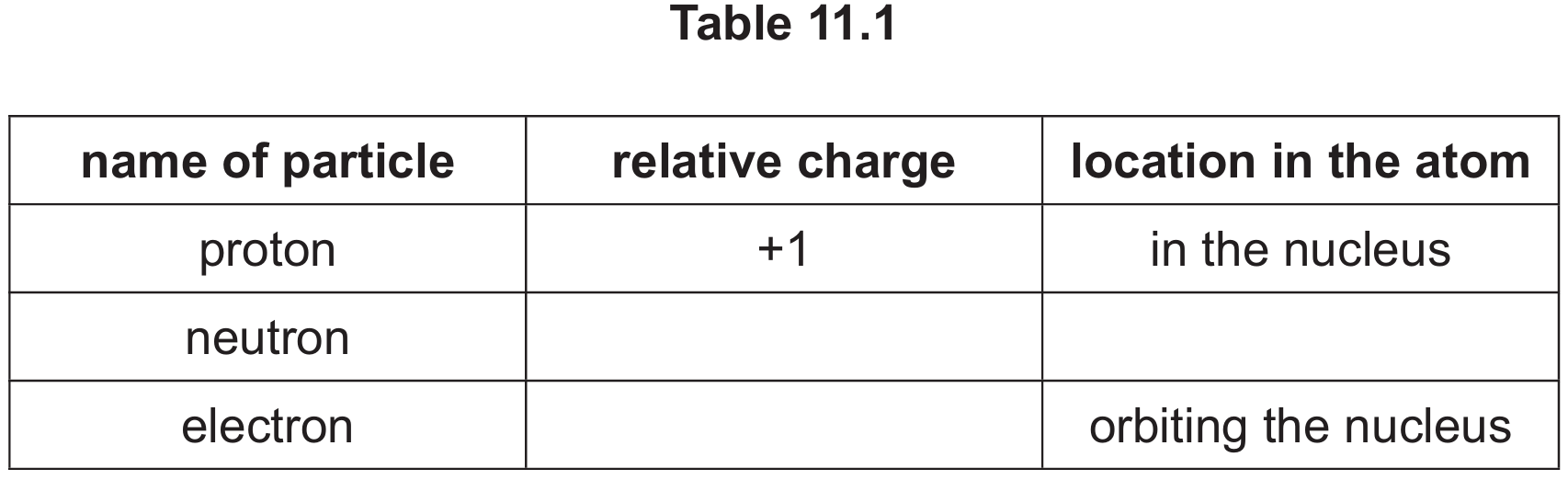
Most-appropriate topic codes (Cambridge IGCSE Physics 0625):
• Topic $5.1.1$ — The atom (Part $\mathrm{(a)}$)
• Topic $5.1.2$ — The nucleus (Part $\mathrm{(a)}$)
• Topic $5.2.2$ — The three types of nuclear emission (Parts $\mathrm{(b)}$, $\mathrm{(c)}$)
▶️ Answer/Explanation
(a)
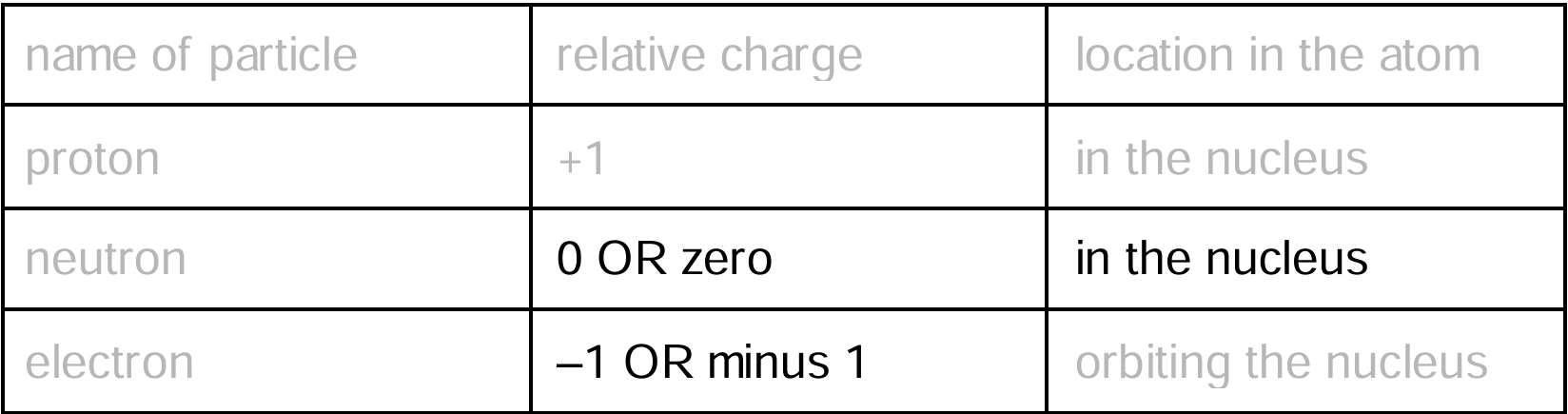
Explanation: The structure of an atom consists of a central nucleus containing protons and neutrons, with electrons orbiting this central region. Protons have a relative charge of $+1$, neutrons are neutral with a relative charge of $0$, and electrons have a relative charge of $-1$. Therefore, the neutron’s charge is $0$, it is located in the nucleus, and the orbiting electron’s charge is $-1$.
(b)
For the correct answer:
$+2$ (OR plus two)
Explanation: An alpha particle is equivalent to a helium nucleus, meaning it is entirely composed of $2$ protons and $2$ neutrons. Since protons each carry a relative charge of $+1$ and neutrons carry $0$ charge, the total relative electrical charge of the alpha particle is simply the sum of its protons, giving $+2$.
(c)
For the correct answer (any two of the following):
Gamma (rays) are the most / more penetrating.
Alpha (particles) are the least / less penetrating.
Beta (particles) are between alpha and gamma in penetrating ability.
Explanation: Gamma rays are highly energetic electromagnetic waves with no mass or charge, which allows them to pass through materials most effectively, making them the most penetrating. Alpha particles are relatively massive and carry a $+2$ charge, meaning they interact heavily with matter and are stopped easily, making them the least penetrating. Beta particles are high-speed electrons with a $-1$ charge, placing their penetrating capability midway between alpha particles and gamma rays.
Question 12
(c) The distance of the Earth from the Sun is $1.48 \times 10^{11}$ m. The speed of light is $3.0 \times 10^8$ m/s.
Calculate the time it takes light from the Sun to reach the Earth.
Most-appropriate topic codes (Cambridge IGCSE Physics 0625):
• Topic 6.1.2 — The Solar System (Parts (a), (c))
• Topic 6.1.1 — The Earth (Part (b))
▶️ Answer/Explanation
(a)
For the correct answer:
Gravitational attraction (or gravity)
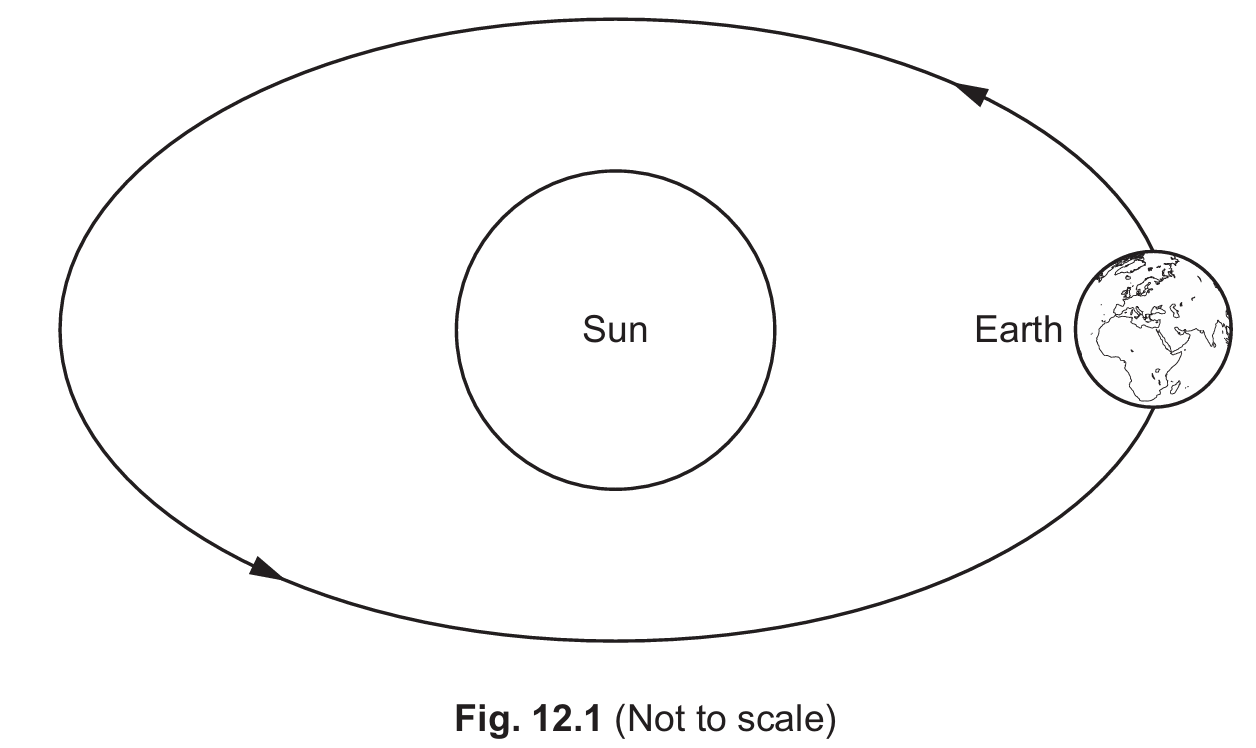
The Sun possesses an enormous mass, which creates a very strong gravitational field. According to Newton’s law of universal gravitation, this field exerts an attractive pull on the Earth. This gravitational force continuously pulls the Earth toward the Sun, acting as the centripetal force necessary to maintain its elliptical orbit rather than drifting off in a straight line.
(b)
For the correct answer:
The Earth’s axis is tilted (relative to its orbital plane) OR the idea that in part of the orbit, the North or South pole points towards/away from the Sun.
The Earth rotates on an axis that is tilted at approximately 23.5° relative to its orbital plane. As the Earth revolves around the Sun over a year, this constant axial tilt causes different hemispheres to receive varying intensities of direct sunlight. When a hemisphere is angled toward the Sun, it experiences warmer temperatures and longer days (summer), and when it is angled away, it experiences winter.
(c)
For the correct calculated value:
490 s
To find the time taken, we use the standard motion equation relating speed, distance, and time: $v = \frac{d}{t}$. Rearranging this formula to solve for time gives us $t = \frac{d}{v}$. By substituting the provided distance ($d = 1.48 \times 10^{11}$ m) and the speed of light ($v = 3.0 \times 10^8$ m/s), we calculate $t = \frac{1.48 \times 10^{11}}{3.0 \times 10^8} = 493.33$ s. Depending on significant figures, this accurately rounds to 490 s.