
Question 1
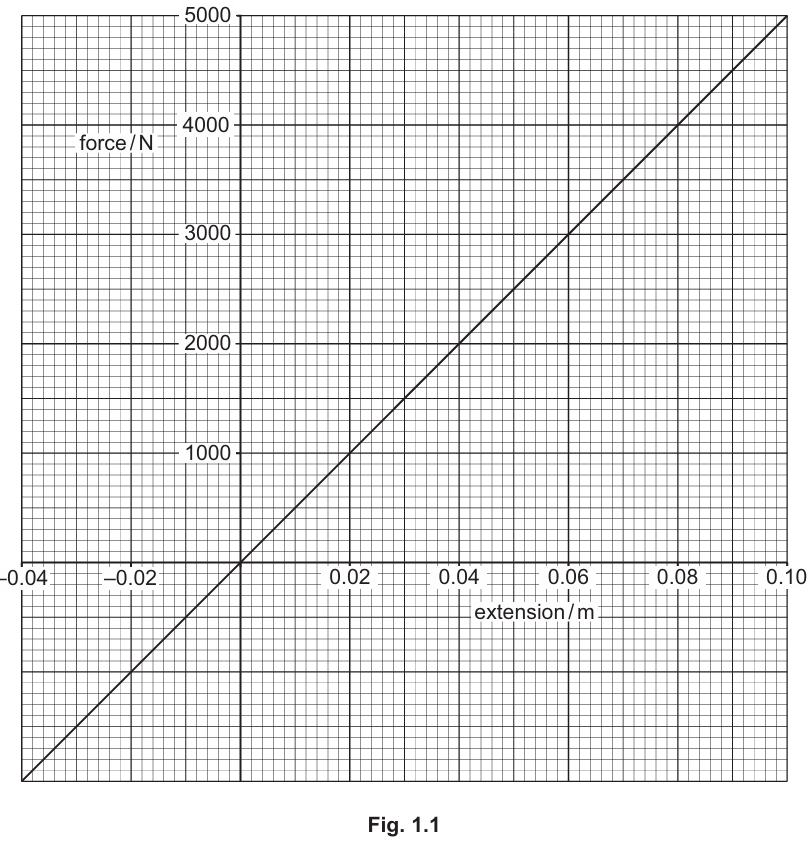
Most-appropriate topic codes (Cambridge IGCSE Physics 0625):
• Topic $1.5.1$ — Effects of forces (Parts $\mathrm{(a)}$, $\mathrm{(b)}$, $\mathrm{(c)}$)
• Topic $1.1$ — Physical quantities and measurement techniques (Part $\mathrm{(d)}$)
▶️ Answer/Explanation
(a)
For the correct answer:
$50000\text{ N/m}$ OR $5.0 \times 10^4\text{ N/m}$
The spring constant $k$ can be determined from the gradient of the straight-line section of the force-extension graph. Using Hooke’s law formula $k = \frac{F}{x}$, we can select a clear coordinate from the line, such as $(0.10\text{ m}, 5000\text{ N})$. Substituting these values yields $k = \frac{5000\text{ N}}{0.10\text{ m}} = 50000\text{ N/m}$.
(b)
For the correct answer:
The graph is a straight line through the origin (the gradient is constant).
The limit of proportionality is the point beyond which extension is no longer directly proportional to force. Since the graph remains a straight line up to $5000\text{ N}$, the limit of proportionality has not yet been reached at $4500\text{ N}$.
(c)
For the correct calculated value:
$-1250\text{ N}$ (or indication of opposite direction)
Using $F = kx$, we substitute $k = 50000\text{ N/m}$ and $x = -0.025\text{ m}$. This gives $F = 50000 \times (-0.025) = -1250\text{ N}$.
(d)
For the correct answer:
Force is a vector quantity. It has both magnitude and direction.
Vector quantities possess both magnitude and direction. Force requires a size and a specific direction of action to be completely defined.
Question 2
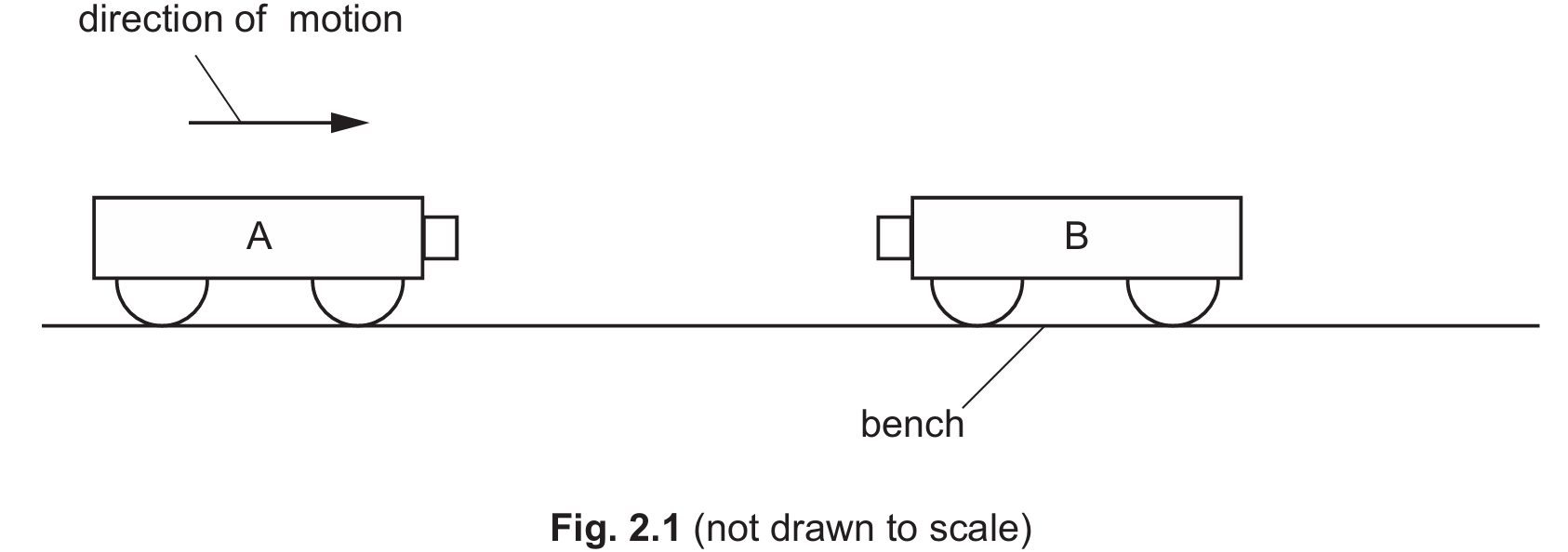
Most-appropriate topic codes (Cambridge IGCSE Physics 0625):
• Topic $1.6$ — Momentum: Conservation of Momentum (Part $\mathrm{(b)}$)
• Topic $1.6$ — Momentum: Resultant force as $F = \frac{\Delta p}{\Delta t}$ (Part $\mathrm{(c)(i)}$)
• Topic $1.6$ — Momentum: Impulse as $F\Delta t = \Delta(mv)$ (Part $\mathrm{(c)(ii)}$)
▶️ Answer/Explanation
(a)
For the correct answer:
$0\text{ kg m/s}$.
Momentum is mass $\times$ velocity ($p = mv$). Since trolley B is stationary, its velocity is $0\text{ m/s}$, making its momentum zero.
(b)
For the correct calculated value:
Total momentum before = Total momentum after
$m_A u_A + m_B u_B = (m_A + m_B)v$
$(0.75 \times 0.44) + 0 = (0.75 + m_B) \times 0.18$
$0.33 = 0.135 + 0.18m_B$
$0.195 = 0.18m_B$
$m_B = 1.083… \text{ kg}$
Therefore, the mass of trolley B is $\boxed{1.1\text{ kg}}$ (to 2 s.f.).
(c)(i)
For the correct calculated value:
$F = \frac{\Delta p}{\Delta t}$
The change in momentum $\Delta p$ is the total momentum of the system ($0.33\text{ kg m/s}$) brought to zero.
$F = \frac{0.33}{2.6} = 0.1269… \text{ N}$
Therefore, the force $F$ is $\boxed{0.13\text{ N}}$.
(c)(ii)
For the correct explanation:
The time taken increases.
Since the change in momentum required to stop the trolleys is the same, and impulse is defined as $F\Delta t = \Delta p$, force and time are inversely proportional. A smaller force $F$ requires a larger time $\Delta t$ to achieve the same change in momentum.
Question 3
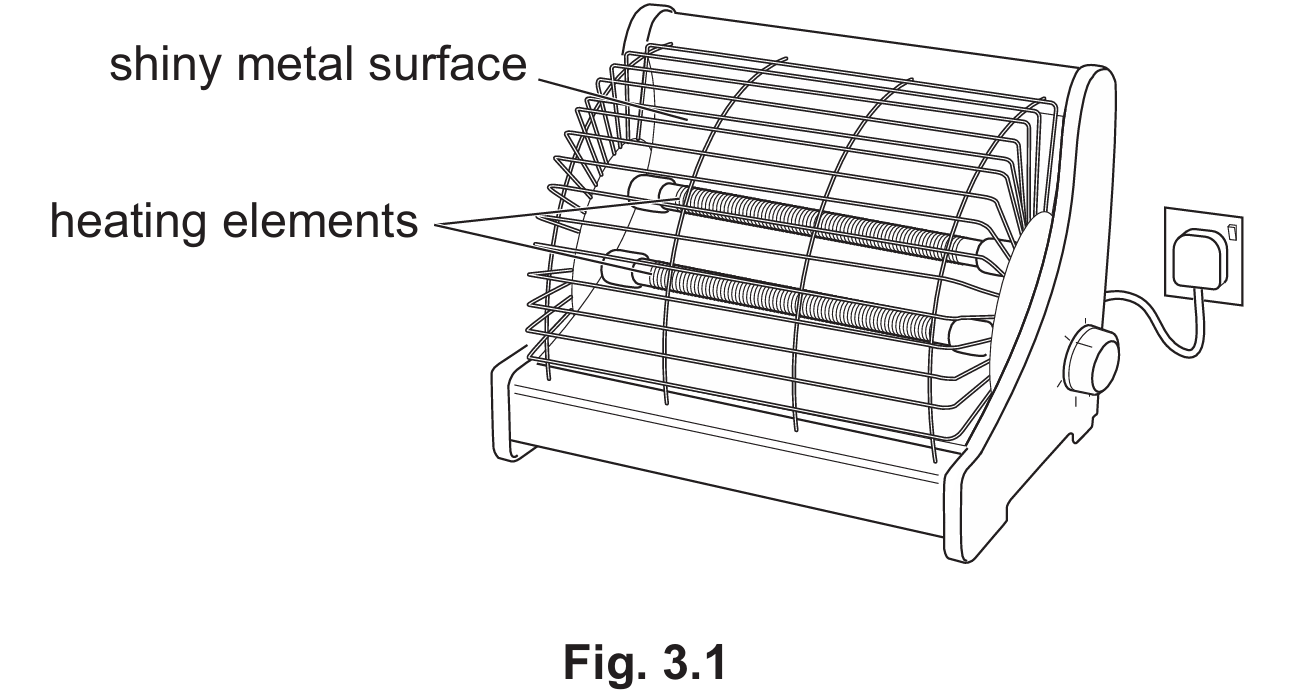
Most-appropriate topic codes (Cambridge IGCSE Physics 0625):
• Topic ( 4.4 ) — Electrical safety (Part ($\mathrm{(c)}$))
• Topic ( 4.2.4 ) — Resistance (Part ($\mathrm{(d)(i)}$))
• Topic ( 4.2.5 ) — Electrical energy and electrical power (Part ($\mathrm{(d)(ii)}$))
• Topic ( 1.7.3 ) — Energy resources (Part ($\mathrm{(d)(iii)}$))
▶️ Answer/Explanation
Correct Answer: infrared
Detailed solution: Thermal energy is transferred by electromagnetic radiation primarily in the infrared region. All objects emit infrared radiation, and a heating element specifically uses this part of the electromagnetic spectrum to radiate heat into the surrounding environment.
Correct Answer: A shiny surface is a good reflector of radiation.
Detailed solution: Shiny metal surfaces are excellent reflectors and very poor absorbers of infrared radiation. By placing a shiny surface behind the heating elements, the infrared radiation emitted backwards is reflected forward. This prevents the heater’s casing from unnecessarily absorbing the heat and ensures maximum thermal energy is directed outward into the room.
Correct Answer: It prevents electric shock if the live wire touches the metal casing.
Detailed solution: If a fault occurs and the live wire comes into contact with the metal outer casing, the casing would become live. The earth wire provides a low-resistance path for the current to flow safely to the ground rather than passing through a person touching the heater, thereby preventing a severe electric shock.
Correct Answer: $2.6\text{ A}$
Detailed solution: We use the rearranged resistance formula $I = \frac{V}{R}$ to find the current. Since the components are connected in parallel, the full mains voltage of $230\text{ V}$ acts across each individual element. Substituting the given values, we get $I = \frac{230\text{ V}}{89\,\Omega}$, which yields $2.584\text{ A}$. This rounds up to $2.6\text{ A}$ for one heating element.
Correct Answer: $P = IV$ (or $P = \frac{V^{2}}{R}$), producing $\approx 1189\text{ W}$ which is approx $1200\text{ W}$
Detailed solution: The electrical power for one element can be calculated using $P = \frac{V^{2}}{R} = \frac{(230\text{ V})^{2}}{89\,\Omega} \approx 594.4\text{ W}$. Because there are two identical heating elements operating in parallel, the total power is double this amount: $2 \times 594.4\text{ W} = 1188.8\text{ W}$. Alternatively, using the total current $I_{\text{total}} = 2 \times 2.584\text{ A} = 5.168\text{ A}$, the formula $P = IV$ gives $230\text{ V} \times 5.168\text{ A} \approx 1189\text{ W}$. Both methods show the power is approximately $1200\text{ W}$.
Correct Answer: $68000\text{ J}$ (or $68\text{ kJ}$)
Detailed solution: First, we find the total electrical energy input over $t = 60\text{ s}$ using the formula $E = Pt$. Using the nominal power of $1200\text{ W}$ provided in the previous part, the total energy input is $1200\text{ W} \times 60\text{ s} = 72000\text{ J}$. Because the heater is only $95\%$ efficient, the useful thermal energy output is $0.95 \times 72000\text{ J} = 68400\text{ J}$. To present the final answer to strictly two significant figures, this correctly rounds down to $68000\text{ J}$.
Question 4
Most-appropriate topic codes (Cambridge IGCSE Physics 0625):
• Topic $1.1$ — Physical quantities and measurement techniques (Part $\mathrm{(a)(ii)}$)
• Topic $1.5.1$ — Effects of forces (Parts $\mathrm{(b)(i)}$, $\mathrm{(b)(ii)}$)
▶️ Answer/Explanation
Correct Answer: Rate of change in velocity OR change in velocity per unit time.
Detailed solution: Acceleration is a vector quantity that describes how quickly an object’s velocity is changing over time. It is mathematically defined as the change in velocity divided by the time taken for that change to occur, typically represented by the equation $a = \frac{\Delta v}{\Delta t}$.
Correct Answer: $200000\text{ m}$ divided by $3600\text{ s}$ is seen.
Detailed solution: To convert the maximum speed from $200\text{ km/h}$ to $\text{m/s}$, both the distance and time must be converted into standard SI units. First, convert $200\text{ km}$ into meters by multiplying by $1000$, which gives $200000\text{ m}$. Next, convert $1\text{ hour}$ into seconds by multiplying $60\text{ minutes}$ by $60\text{ seconds}$, which yields $3600\text{ s}$. Dividing the distance by the time ($\frac{200000}{3600}$) gives $55.55\text{ m/s}$, which rounds to approximately $56\text{ m/s}$.
Correct Answer: $80\text{ s}$ OR $79\text{ s}$.
Detailed solution: The time required to reach the maximum speed can be found by rearranging the acceleration formula, $a = \frac{\Delta v}{t}$, to solve for time: $t = \frac{\Delta v}{a}$. Since the train starts from rest, the change in velocity $\Delta v$ is simply its maximum speed, $56\text{ m/s}$. Substituting the values into the rearranged equation gives $t = \frac{56}{0.70}$, resulting in exactly $80\text{ s}$ (or $79.4\text{ s}$ if using the more precise unrounded value of $55.6\text{ m/s}$).
Correct Answer: $310000\text{ N}$ OR $3.1 \times 10^5\text{ N}$.
Detailed solution: According to Newton’s second law of motion, the resultant force acting on an object is equal to its mass multiplied by its acceleration, given by the equation $F = ma$. Using the provided mass $m = 440000\text{ kg}$ and acceleration $a = 0.70\text{ m/s}^2$, we substitute these into the formula to get $F = 440000 \times 0.70$. This calculation yields $308000\text{ N}$, which is expressed as $310000\text{ N}$ or $3.1 \times 10^5\text{ N}$ when given to two significant figures.
Correct Answer: Statement: Reduces acceleration OR lowers maximum velocity. Explanation: Resultant/net force decreases.
Detailed solution: The train’s forward motion is caused by the driving force of its engines. A headwind introduces an opposing drag force that acts against the direction of the train’s motion. As a result, the overall resultant (or net) force acting on the train is reduced. Since $F = ma$, a smaller net force for a constant mass directly leads to a reduced acceleration, meaning the train will accelerate less quickly and may reach a lower maximum velocity.
Question 5
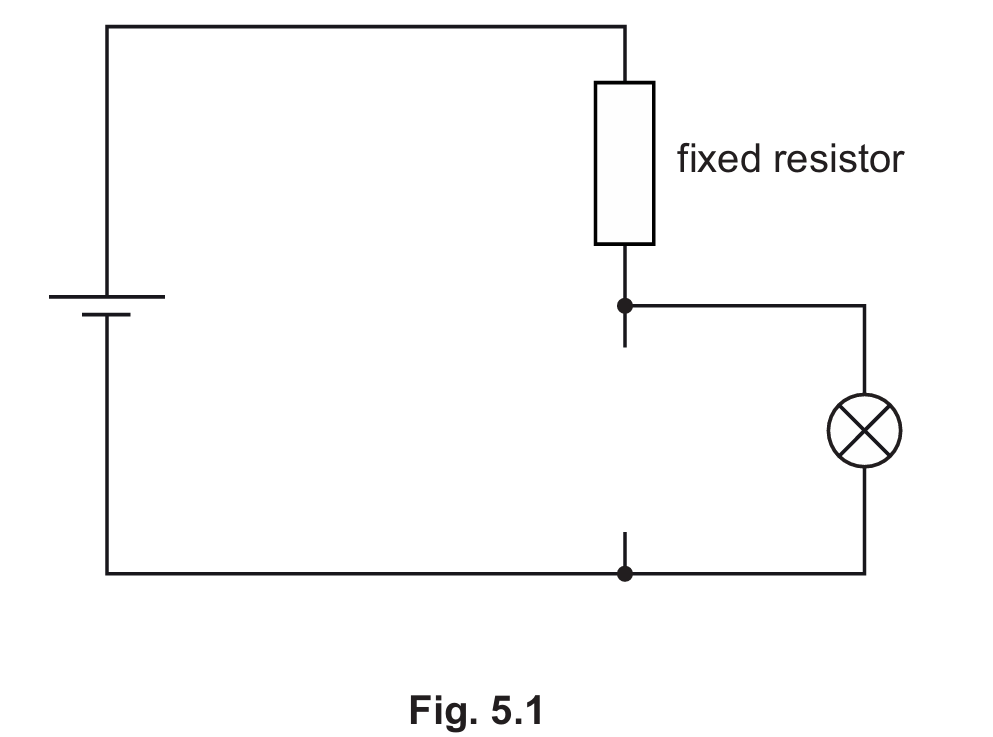
Most-appropriate topic codes (Cambridge IGCSE Physics 0625):
• Topic ( 4.3 .3 ) — Action and use of circuit components (Part ( $\mathrm{(b)(ii)} $))
• Topic ( 4.3 .2 ) — Series and parallel circuits (Part ( $\mathrm{(b)(ii)}$ ))
▶️ Answer/Explanation
Correct Answer: Axes are correctly labelled (resistance on the y-axis, light intensity on the x-axis) and the graph shows a straight line or smooth curve with a negative gradient.
Detailed solution: Based on the problem description, the resistance is low when light intensity is high, and high when light intensity is low. This indicates an inverse relationship between the two variables. Plotting resistance ( R ) on the y-axis against light intensity on the x-axis yields a line or curve with a negative gradient, visually demonstrating that resistance decreases as light intensity increases.
Correct Answer: The standard symbol for an LDR (a rectangle with two arrows pointing diagonally downwards towards it) is drawn in the gap.
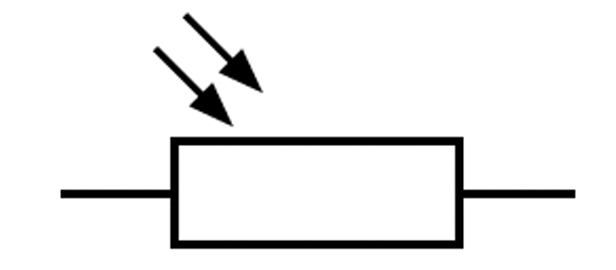
Detailed solution: To complete the circuit diagram accurately, the standard electronic symbol for a Light-Dependent Resistor must be drawn between the open terminals. This symbol is constructed by drawing a standard resistor rectangle and adding two parallel arrows pointing towards the rectangle, representing incoming light rays hitting the component.
Correct Answer: In the dark, the LDR’s resistance is high, meaning it takes a larger proportion of the e.m.f. Because the lamp is in parallel with the LDR, the p.d. across the lamp is also high, turning it on.
Detailed solution: The circuit acts as a potential divider where the total electromotive force (e.m.f.) is constant and shared between the fixed resistor and the parallel LDR-lamp combination. In the dark, the LDR’s resistance ( R_{\text{LDR}} ) increases significantly, meaning the potential difference across it, ( V_{\text{LDR}} ), becomes a much larger fraction of the total e.m.f. Since the lamp is connected in parallel with the LDR, the p.d. across the lamp ( V_{\text{LAMP}} ) is equal to ( V_{\text{LDR}} ). This high ( V_{\text{LAMP}} ) provides sufficient energy to turn the lamp on, whereas in bright light, the low ( R_{\text{LDR}} ) drops the voltage, keeping the lamp off.
Question 6
Most-appropriate topic codes (Cambridge IGCSE Physics 0625):
• Topic ( 3.2.3 ) — Thin lenses: Image Characteristics (Real, Inverted, Enlarged) (Part ( $\mathrm{(a)(iv)}$ ))
• Topic ( 3.2.3 ) — Thin lenses: Virtual Image Formation (Part ( $\mathrm{(b)}$ ))
▶️ Answer/Explanation
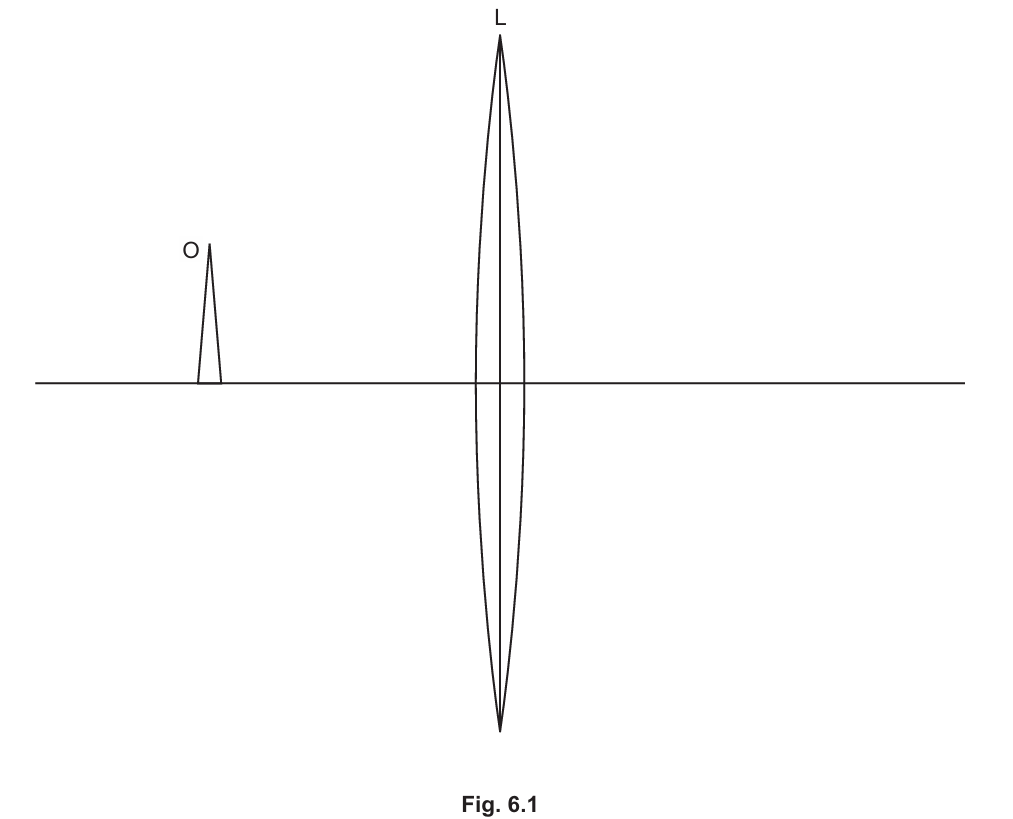
Correct Answer: The horizontal axis should be labelled with a P.
Detailed solution: The principal axis is defined as the imaginary, straight line that passes directly through the optical centre of a lens, remaining perpendicular to its surfaces. In the given ray diagram, this physical property corresponds perfectly to the solid horizontal line extending across the page.
Correct Answer: Place an X on the horizontal axis exactly 3.0 cm to the left OR right of the centre of L.
Detailed solution: A focal point lies directly on the principal axis at a set distance from the optical centre, known as the focal length. The problem explicitly states that the diagram is drawn to full scale and the focal length is 3.0 cm. Therefore, you must use a physical ruler to measure exactly 3.0 cm along the principal axis from the centre of the lens.
Correct Answer: Draw one ray straight through the centre of the lens. Draw another ray parallel to the principal axis, then refracting through the focal point. Extend both until they intersect.
Detailed solution: To precisely locate the image’s tip, standard principal rays must be drawn from the top of the object O. The first ray passes undeflected through the optical centre. A second ray travels parallel to the principal axis and refracts to pass through the focal point on the opposite side.
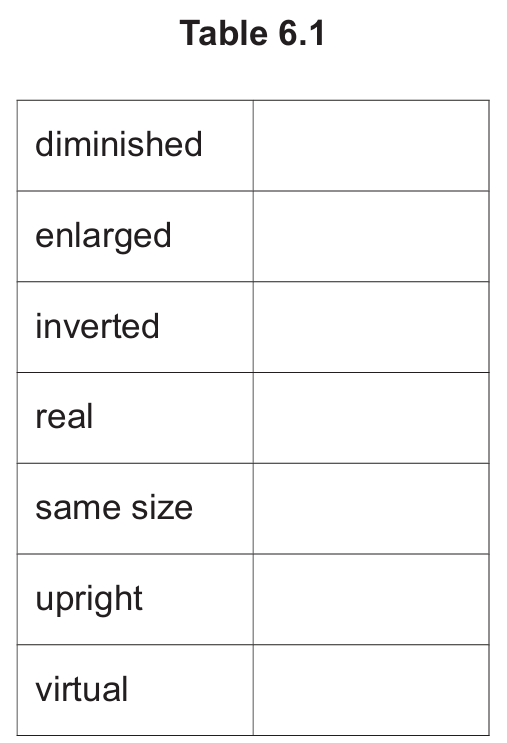
Correct Answer: Place a tick next to: enlarged, inverted, and real.
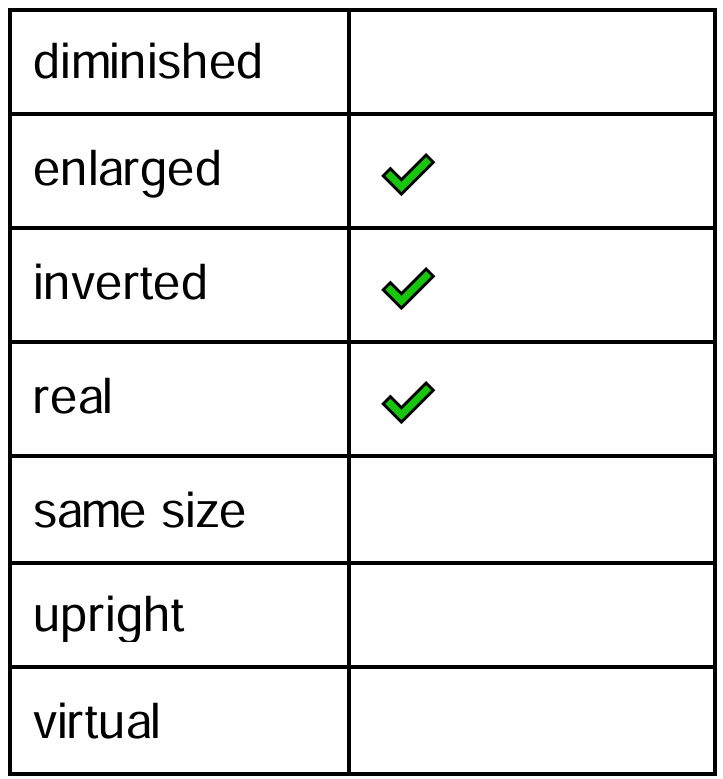
Detailed solution: Because the object distance (5.0 cm) is between one and two focal lengths (3.0 cm and 6.0 cm), the lens focuses the light on the opposite side, producing a real image. The geometric intersection falls below the principal axis and spans a greater height, meaning the image is both inverted and enlarged.
Correct Answer: The new image will be virtual and upright.
Detailed solution: When the object distance is less than the focal length of 3.0 cm, the refracted rays diverge. To an observer, these rays appear to originate from a point behind the object, creating a virtual image. This setup acts as a magnifying glass, yielding an image that is upright.
Question 7
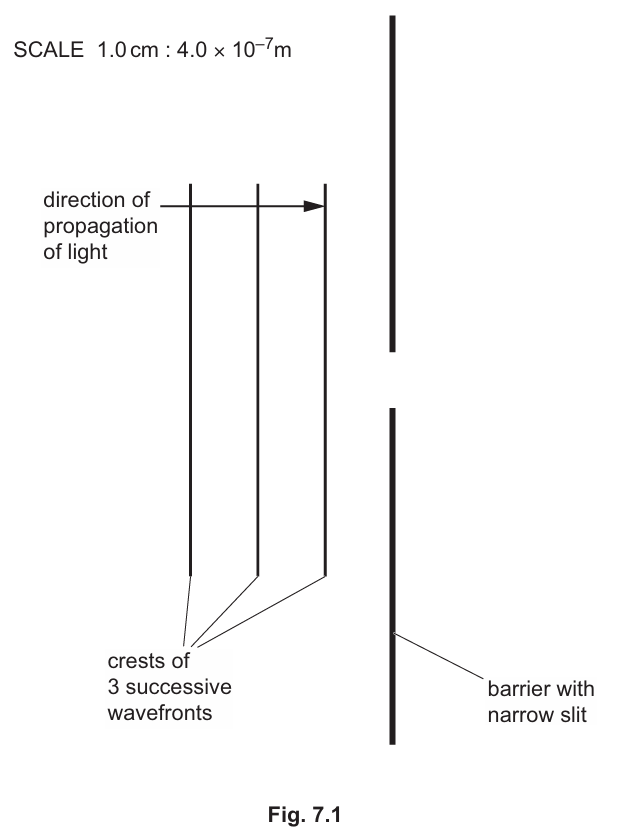
Most-appropriate topic codes (Cambridge IGCSE Physics 0625):
• Topic $3.1$ — General properties of waves (Wave equation $v = f\lambda$) (Parts $\mathrm{(a)(ii)}$, $\mathrm{(b)(i)}$)
• Topic $1.2$ — Motion (Speed $v = \frac{s}{t}$) (Part $\mathrm{(b)(ii)}$)
▶️ Answer/Explanation
Correct Answer: Diffraction
Detailed solution: When waves pass through a narrow slit or gap that is similar in size to their wavelength, they spread out into the region beyond the barrier. This spreading of waves is an observable phenomenon known as diffraction.
Correct Answer: $4.8 \times 10^{-7}$ m (or 480 nm)
Detailed solution: Measure the distance between two successive wavefronts on the diagram to find the scale wavelength, which is exactly 1.2 cm. Using the provided scale where 1.0 cm represents $4.0 \times 10^{-7}$ m, calculate the actual wavelength by multiplying the measured distance by the scale factor: $1.2 \times (4.0 \times 10^{-7})$. This gives a final wavelength of $4.8 \times 10^{-7}$ m.
Correct Answer: Three semi-circular wavefronts drawn centred on the gap, with the wavelength unchanged.
Detailed solution: As the plane wavefronts pass through the narrow gap, they diffract and spread out into a circular pattern. The drawn wavefronts must be semi-circular arcs centred perfectly on the middle of the slit. The radial distance between each successive semi-circle must remain identical to the original incident wavelength.
Correct Answer: $v = f\lambda$, followed by $\lambda = \frac{330}{380} = 0.87$ m.
Detailed solution: The fundamental relationship between wave speed, frequency, and wavelength is given by the wave equation $v = f\lambda$. Rearranging this formula to solve for wavelength gives $\lambda = \frac{v}{f}$. Substituting the given speed of sound (330 m/s) and frequency (380 Hz) yields $\lambda = \frac{330}{380}$, which equates to 0.868 m, correctly rounding to 0.87 m.
Correct Answer: 7.6 s
Detailed solution: The time taken for the sound wave to travel can be found using the constant speed equation $v = \frac{s}{t}$, which rearranges to $t = \frac{s}{v}$. First, convert the given distance into standard SI units: 2.5 km = 2500 m. Dividing this total distance by the speed of sound (330 m/s) yields $t = \frac{2500}{330}$, which calculates to 7.57 s and rounds to 7.6 s.
Question 8
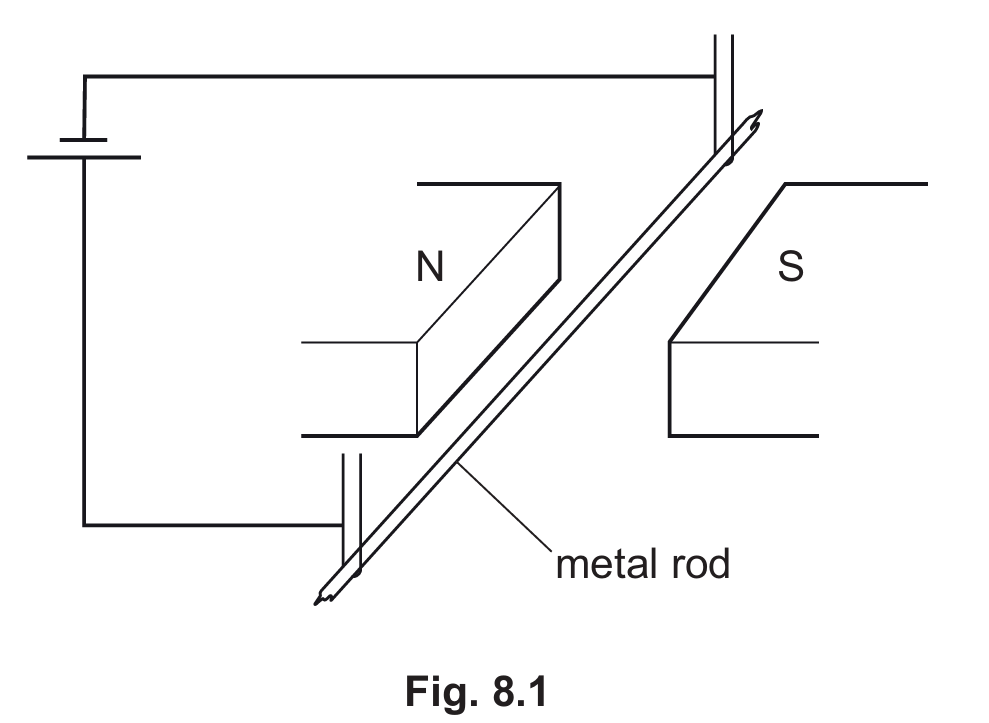
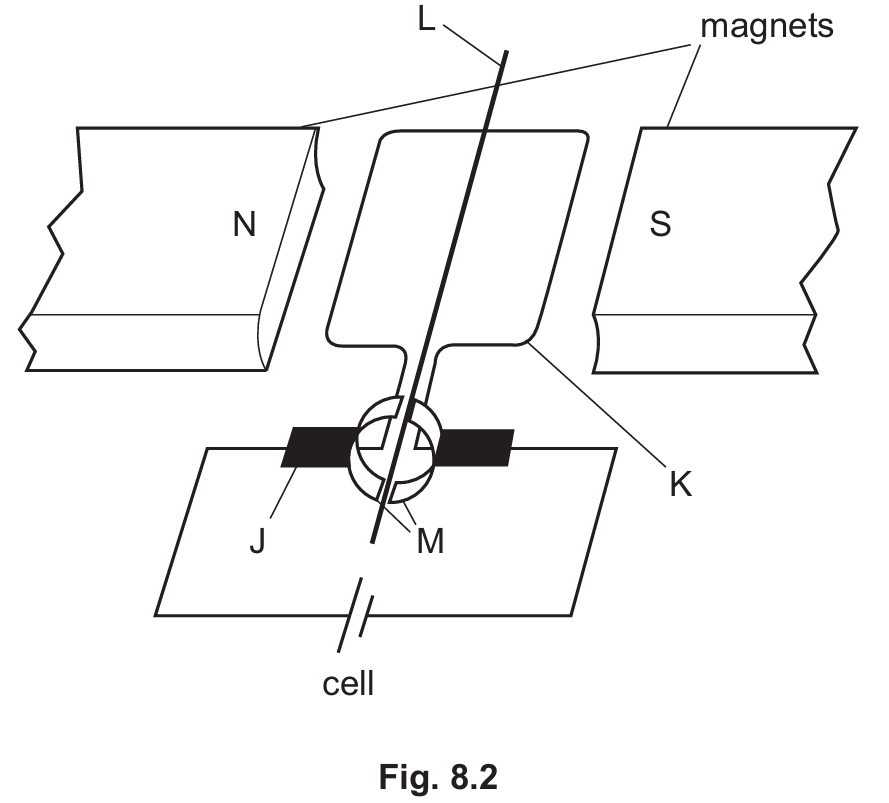
Most-appropriate topic codes (Cambridge IGCSE Physics 0625):
• Topic ( 4.5.5 ) — The d.c. motor (Part ( $\mathrm{(c)} $))
▶️ Answer/Explanation
(a)
For the correct answer:
Downwards.
By applying Fleming’s Left-Hand Rule: the magnetic field ( B ) points from North to South (left to right), and conventional current ( I ) flows into the plane of the paper. This results in a downward force.
(b)
For the correct answer:
The direction of the force reverses (upwards).
Reversing the cell connections reverses the current direction. According to Fleming’s Left-Hand Rule, if the field remains the same but the current is reversed, the force direction must also reverse.
(c)
For the correct descriptions:
• J (brushes): Maintain electrical contact between the external circuit and the rotating commutator.
• K (coil): Provides a path for current to flow, experiencing a magnetic torque that causes rotation.
• L (axle): The shaft that supports the coil and allows it to rotate about a fixed axis.
• M (commutator): Reverses the direction of the current in the coil every half-turn to ensure continuous rotation in one direction.
Question 9
Most-appropriate topic codes (Cambridge IGCSE Physics 0625):
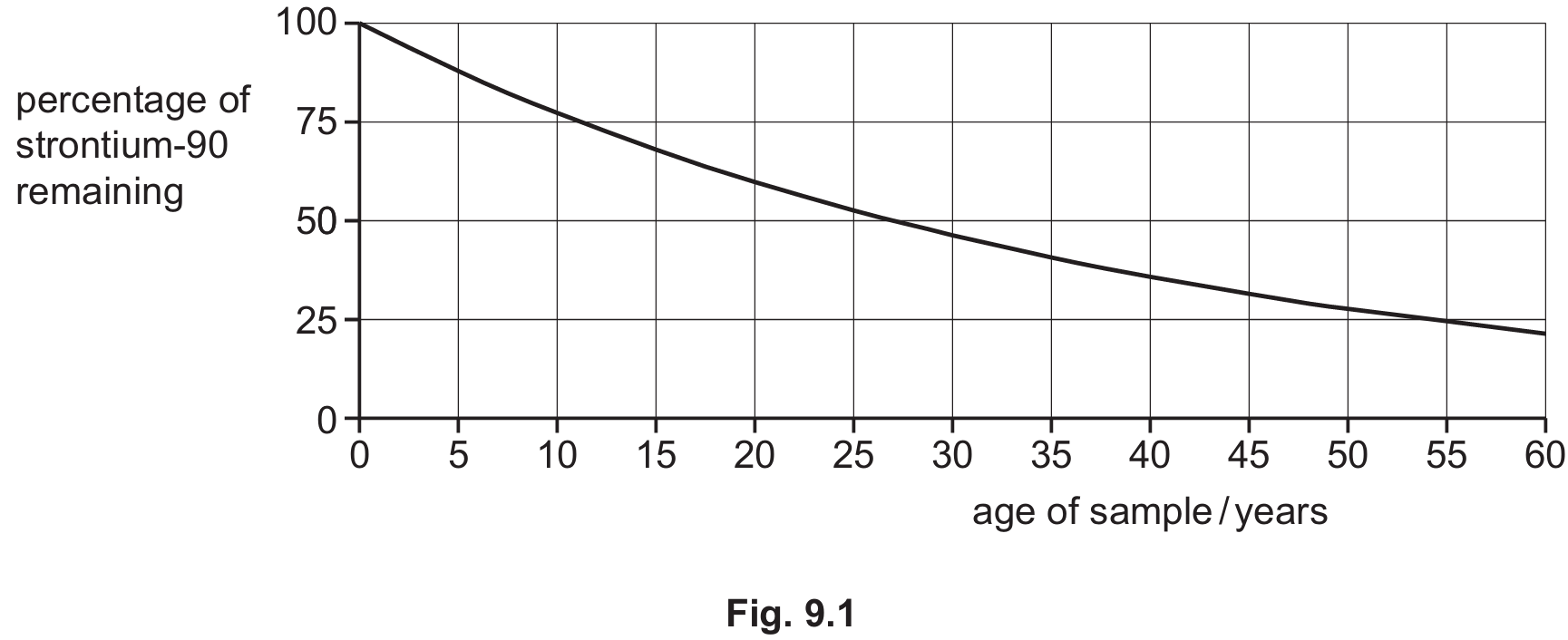
• Topic ( 5.2.4 ) — Half-life (Parts ( $\mathrm{(b)(i)}$ ), ( $\mathrm{(b)(ii)}$ ))
▶️ Answer/Explanation
Correct Answer: Isotopes are forms of an element with the same number of protons but a different number of neutrons in the nucleus.
Detailed solution: Elements are fundamentally defined by their atomic number, which represents the number of protons inside the nucleus. However, atoms of the exact same element can naturally occur with varying numbers of neutrons. Because they possess the identical number of protons (and thus electrons in a neutral state), isotopes exhibit identical chemical properties, but their differing neutron counts give them different mass numbers and nuclear stabilities.
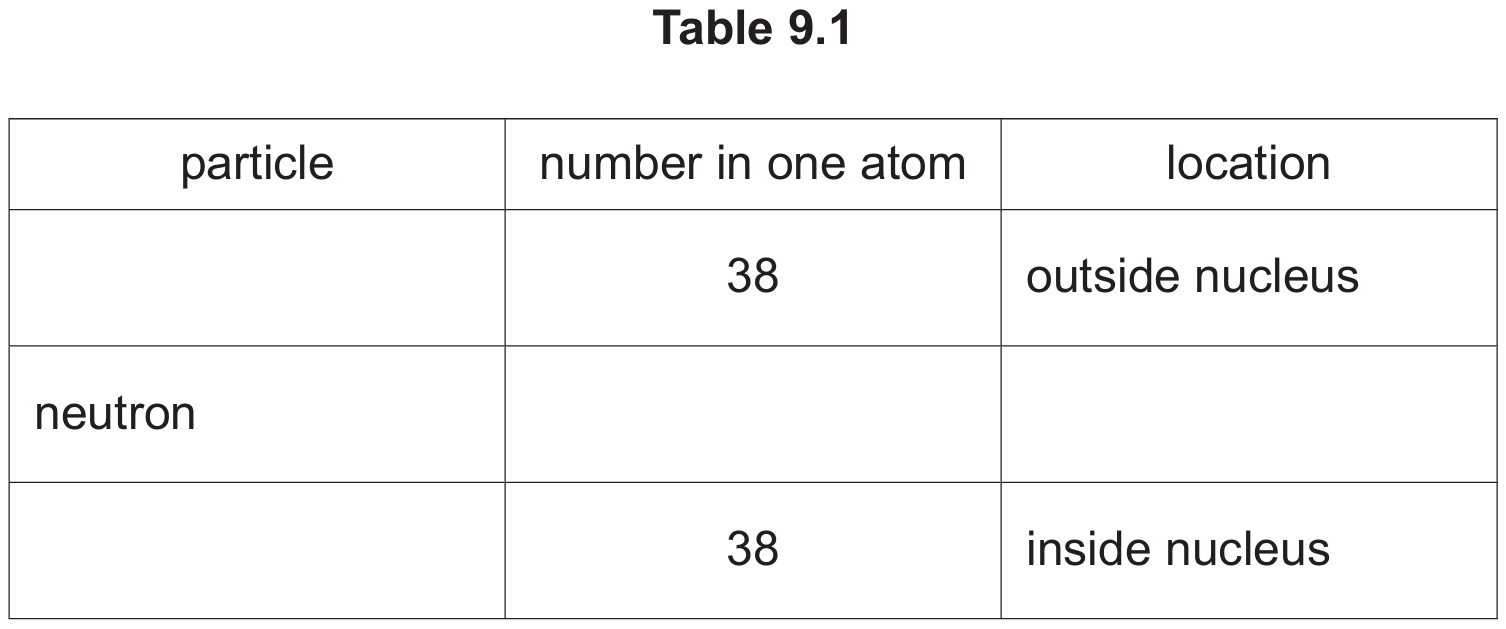
Correct Answer: Electron: $38$, outside nucleus; Neutron: $52$, inside nucleus; Proton: $38$, inside nucleus.
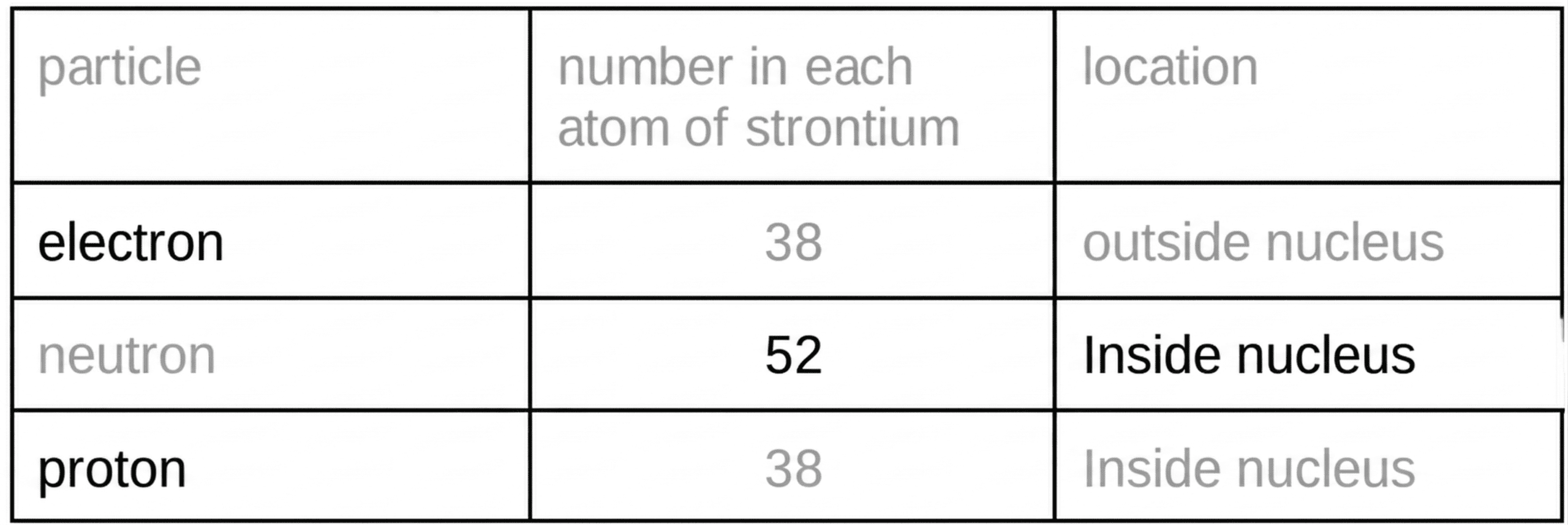
Detailed solution: The nuclide notation $^{90}_{38}\text{Sr}$ provides the mass number $A = 90$ and the atomic number $Z = 38$. The atomic number directly dictates there are $38$ protons inside the nucleus, and to remain neutral, there must be an equal number of electrons ($38$) orbiting outside the nucleus. The number of neutrons is found by subtracting the atomic number from the mass number ($90 – 38 = 52$), and these reside inside the nucleus alongside the protons.
Correct Answer: Beta ($\beta$) particles can penetrate the $0.75\text{ mm}$ metal sheet, and the number of particles detected varies with the thickness of the metal.
Detailed solution: To effectively measure thickness, the emitted radiation must be capable of partially passing through the material so a detector can measure the transmitted intensity. Beta particles are ideal for millimeter-thick metal sheets because their penetration is partially absorbed; if the sheet gets thicker, fewer beta particles reach the detector. Alpha particles would be entirely stopped by the metal, while gamma rays would pass right through largely unattenuated, making both unsuitable for this specific thickness.
Correct Answer: After $15\text{ years}$, the percentage of the source remaining is around $63\% – 70\%$, meaning the activity (count rate) becomes too low to accurately detect small differences in thickness.
Detailed solution: By reading the provided decay curve at an age of $15\text{ years}$, the percentage of strontium-90 remaining drops to roughly $68\%$ (a loss of about $32\%$). As the radioactive isotope decays over time, the rate of emitted beta particles decreases significantly. If the baseline count rate falls too much or gets too close to the background radiation level, the detector will struggle to accurately discern the subtle fluctuations in count rate needed to precisely monitor the metal sheet’s thickness.
Question 10
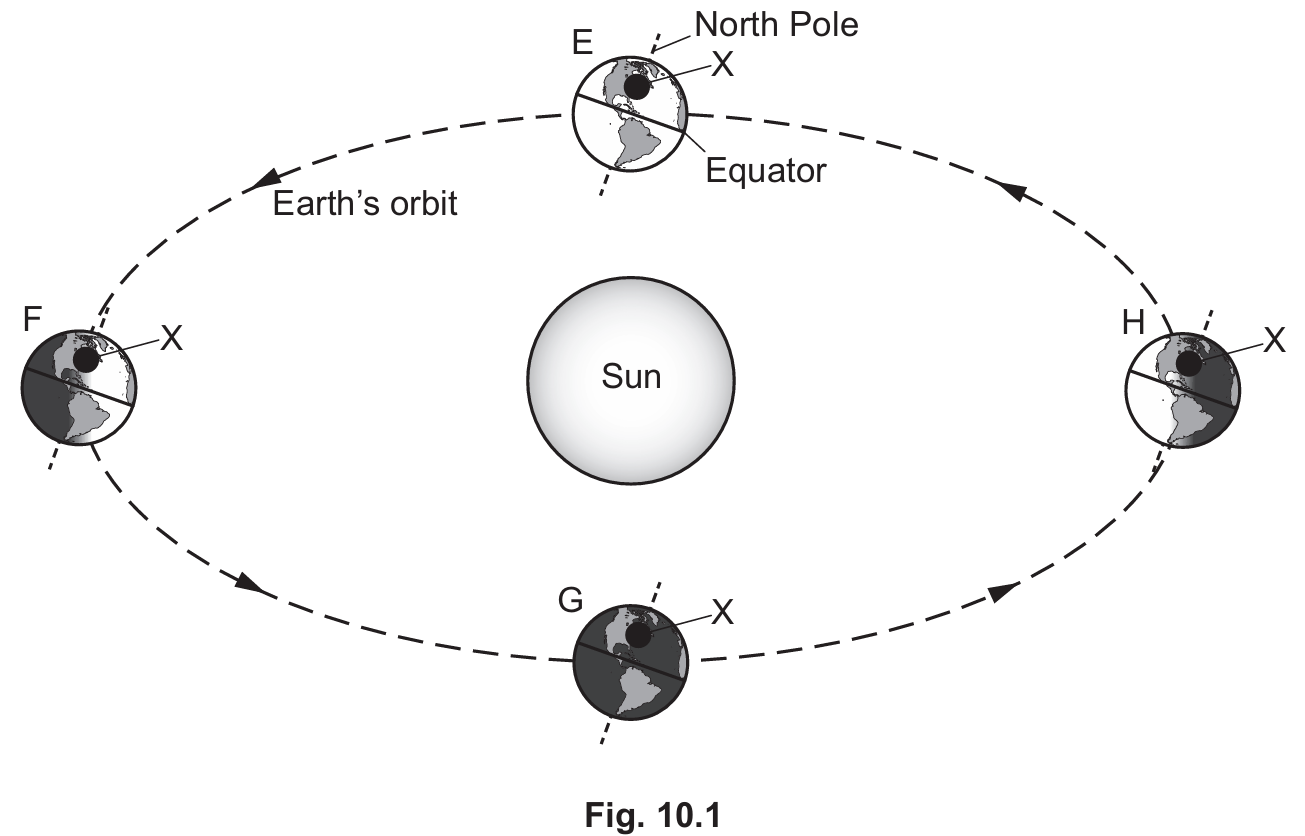
(b) Fig. 10.1 shows four positions E, F, G and H of the Earth in its orbit of the Sun.
(ii) Identify the position of the Earth when it is winter at X.
Most-appropriate topic codes (Cambridge IGCSE Physics 0625):
• Topic $6.1.1$ — The Earth [Orbital Speed] (Part $\mathrm{(c)}$)
• Topic $6.1.2$ — The Solar System (Part $\mathrm{(d)}$)
▶️ Answer/Explanation
(a)
For the correct answer:
$91$ days
It takes the Earth approximately $365$ days to complete one full orbit around the Sun. The movement from F to G represents one-quarter ($\frac{1}{4}$) of the orbit: $\frac{365}{4} \approx 91$ days.
(b)
For the correct answer:
(i) F
(ii) H
Position X is in the Northern Hemisphere. At F, the Northern Hemisphere is tilted towards the Sun (Summer). At H, it is tilted away (Winter).
(c)
For the correct calculated value:
$T = 365 \times 24 \times 60 \times 60 = 31,536,000\text{ s}$
Using $v = \frac{2\pi r}{T}$:
$r = \frac{vT}{2\pi} = \frac{(3.0 \times 10^4) \times 31,536,000}{2\pi}$
$r \approx 1.5 \times 10^{11}\text{ m}$
(d)
For the correct answer:
Moons (or comets, asteroids, minor planets, natural satellites).
The Solar System contains various naturally occurring objects including natural satellites (moons), asteroids, and comets that orbit the Sun or planets.