
Question 1
Most-appropriate topic codes (Cambridge IGCSE Physics 0625):
• Topic $1.1$ — Physical quantities and measurement techniques (Parts $\mathrm{(a)(i)}$, $\mathrm{(a)(ii)}$, $\mathrm{(a)(iii)}$, $\mathrm{(b)}$)
▶️ Answer/Explanation
(a)(i)
For the correct answer:
$0.30\text{ cm}^3$
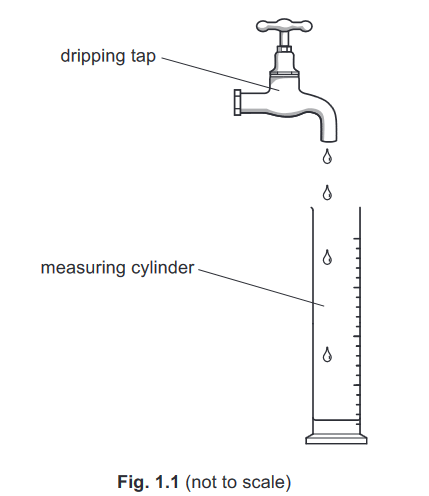
To find the average volume of a single drop of water, we must divide the total volume of water collected by the total number of drops. The total volume given is $60\text{ cm}^3$ and the number of drops is $200$. Using the formula $V_{\text{avg}} = \frac{V_{\text{total}}}{N}$, we calculate $V_{\text{avg}} = \frac{60}{200}$. This yields exactly $0.3\text{ cm}^3$ per drop.
(a)(ii)
For the correct answer:
$226.5\text{ s}$
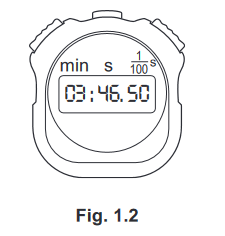
The stop-watch displays the total elapsed time in a minutes and seconds format, shown clearly as $03:46.5$. To convert this reading entirely into seconds, we first convert the minutes by multiplying by $60$, since there are $60\text{ seconds}$ in a minute. We calculate $3 \times 60 = 180\text{ s}$. Finally, we add the remaining $46.5\text{ seconds}$ to get a total of $180 + 46.5 = 226.5\text{ s}$.
(a)(iii)
For the correct answer:
$1.1\text{ s}$
To determine the average time interval between drops, we divide the total time taken by the number of drop intervals. Since $200$ drops were produced over the entire period, we divide the total time of $226.5\text{ s}$ by $200$. Calculating $\frac{226.5}{200}$ gives an interval of $1.1325\text{ s}$. Rounding this value to two significant figures provides a practical answer of $1.1\text{ s}$.
(b)
For the correct answer:
$84\text{ cm}^3$
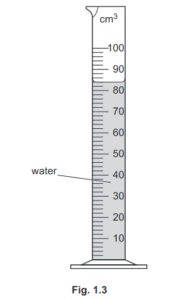
When reading the volume from a measuring cylinder, you must carefully read the value corresponding to the bottom of the meniscus at eye level to avoid parallax error. The main scale markings are in increments of $10\text{ cm}^3$, and there are five subdivisions between $80$ and $90$, making each small graduation equal to $2\text{ cm}^3$. The meniscus rests precisely on the second line above $80$, which calculates to $80 + (2 \times 2) = 84\text{ cm}^3$.
Question 2
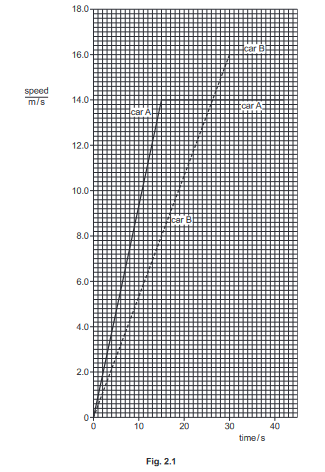
Fig. 2.1 shows the speed–time graphs for two cars, A and B.
Most-appropriate topic codes (Cambridge IGCSE Physics 0625):
• Topic 1.2 — Motion (Parts (a)(i), (a)(ii), (b)(i), (b)(ii))
▶️ Answer/Explanation
(a)(i)
For the correct answer:
$9.3\text{ (m/s)}$
Any indication on graph or in working of vertical line from $10.0\text{ s}$
Detailed Solution: To find the speed of car A at $t = 10\text{ s}$, locate the $10\text{ s}$ mark on the x-axis (time). Trace a vertical line upwards until it intersects the graph for car A. From that point of intersection, draw a horizontal line straight across to the y-axis (speed). Reading the scale carefully gives a value of $9.3\text{ m/s}$.
(a)(ii)
For the correct answer:
(car) A (has greater acceleration)
(speed-time graph/line) has greater gradient OR is steeper
Detailed Solution: On a speed-time graph, the acceleration of an object is represented by the gradient (or slope) of the line ($a = \frac{\Delta v}{\Delta t}$). When visually comparing the two lines during the first $10\text{ s}$, the line for car A is noticeably steeper than the line for car B. This steeper gradient mathematically confirms that car A has a greater acceleration over that time interval.
(b)(i)
For the correct answer:
speed (of car) is steady OR speed is constant
(at) $16\text{ m/s}$
Detailed Solution: After the $30\text{ s}$ mark, the graph for car B levels out into a completely horizontal straight line. In a speed-time graph, a horizontal line signifies that the speed is not changing as time passes. By tracing this flat section back to the y-axis, we can conclude the car is moving at a constant, steady speed of $16\text{ m/s}$.
(b)(ii)
For the correct answer:
$240\text{ (m)}$
$\text{distance } = \frac{1}{2} \times 16 \times 30$
$\text{distance travelled } = \text{area under graph OR } (d =) \text{ speed} \times \text{time OR } \frac{1}{2} \times b \times h$
Detailed Solution: The distance travelled by an object is geometrically equivalent to the total area under its speed-time graph. For car B, the shape mapped out between $t = 0\text{ s}$ and $t = 30\text{ s}$ is a right-angled triangle. We calculate this area using the mathematical formula $\text{Area} = \frac{1}{2} \times \text{base} \times \text{height}$. Substituting the graph values yields $d = \frac{1}{2} \times 30 \times 16 = 240\text{ m}$.
Question 3
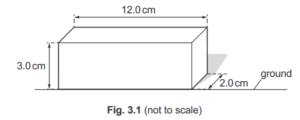
Calculate the weight of the metal block.
Calculate the pressure of this block on the ground.
Most-appropriate topic codes (Cambridge IGCSE Physics 0625):
• Topic 1.1 — Physical quantities and measurement techniques (Part (a)(i))
• Topic 1.3 — Mass and weight (Part (a)(ii))
• Topic 1.8 — Pressure (Part (b))
▶️ Answer/Explanation
(a)(i)
For the correct answer:
24 cm2
The area of the rectangular metal block in contact with the ground is determined by multiplying its length by its width. By observing the dimensions given in Fig. 3.1, the base has a length of 12 cm and a width of 2.0 cm. Applying the standard mathematical formula for the area of a rectangle ($A = l \times w$), we get $A = 12 \times 2.0 = 24\text{ cm}^2$.
(a)(ii)
For the correct answer:
8.4 N
Weight is the gravitational force acting on an object with mass. It is calculated using the equation $W = mg$, where $m$ is the mass and $g$ is the acceleration of free fall (or gravitational field strength). Using the provided mass of 0.84 kg and an acceleration of free fall value of 10 for $g$ (as per the specific marking scheme provided), the calculation becomes $W = 0.84 \times 10 = 8.4\text{ N}$.
(b)
For the correct answer:
6.0 N / cm2
Pressure is defined as the force applied per unit area. It can be logically calculated using the equation $p = \frac{F}{A}$, where $F$ is the force (the downward weight of the block) and $A$ is the contact area. Given the weight of 24 N and an area of 4.0 cm2, substituting these values into the formula yields $p = \frac{24}{4.0} = 6.0\text{ N/cm}^2$.
Question 4
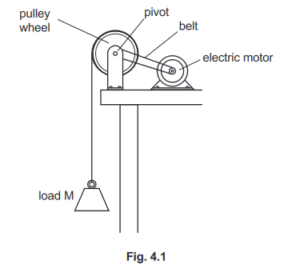
Fig. 4.1 shows an electric motor and pulley wheel being used to raise a load M. The electric motor
uses a belt to turn the pulley wheel.
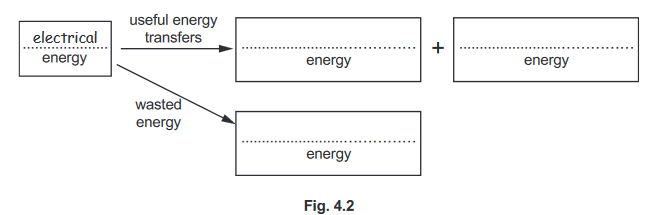
Write on Fig. 4.2 to complete the label in each box. The first label is done for you.
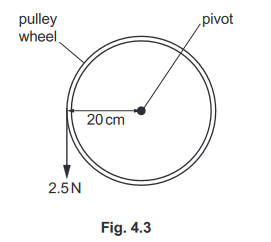
Calculate the moment of the weight of load M about the pivot.
Most-appropriate topic codes (Cambridge IGCSE Physics 0625):
• Topic 1.7.1 — Energy (Part (a))
• Topic 1.5.2 — Turning effect of forces (Part (b))
▶️ Answer/Explanation
(a)
For the correct answers:
Useful energy transfers: Kinetic (energy) AND Gravitational potential (energy) [in either order]
Wasted energy transfer: Thermal (energy)
The electric motor uses electrical energy to perform mechanical work. The useful energy transfers are to kinetic energy, as the motor causes the load and pulley to move, and to gravitational potential energy, as the load is actively being raised against gravity. Because the motor and its moving parts experience friction and electrical resistance, a portion of the input electrical energy is wasted and dissipates into the surrounding environment as thermal energy.
(b)
For the correct answer:
50 N cm
The turning effect of a force is measured by its moment. To calculate it, we use the equation $Moment = F \times d$, where $F$ is the applied force and $d$ is the perpendicular distance from the pivot. Substituting the provided values gives a calculation of $2.5 \times 20 = 50$. Since the force is given in newtons (N) and the distance in centimetres (cm), the final calculated moment is 50 N cm.
Question 5
Most-appropriate topic codes (Cambridge IGCSE Physics 0625):
• Topic 1.7.3 — Energy resources (Parts (a), (b), (c))
▶️ Answer/Explanation
(a)
For the correct answer (any three):
• (moving) air has kinetic energy OR wind has kinetic energy
• (moving) air / wind turns turbine/blades
• turbine turns generator
• (rotating) generator produces/generates electricity
Detailed Solution: The wind possesses kinetic energy due to the constant motion of the air. As the wind blows against the turbine blades, this kinetic energy is physically transferred, causing the blades to rotate. These rotating blades are connected to a central shaft that spins a generator. Through the principles of electromagnetic induction, this mechanical energy is successfully converted into usable electrical energy.
(b)
For the correct answer (any two):
• (wind is) renewable (energy source)
• no greenhouse gases / CO2 produced (during operation)
• no SO2 OR acidic gases produced (during operation) OR no nitrous oxides produced
Detailed Solution: Wind is a completely renewable energy resource, meaning it will naturally replenish and never run out, unlike finite fossil fuels such as coal. Furthermore, the daily operation of wind turbines does not produce any harmful greenhouse gases (like CO2) or acidic gases (like SO2), which significantly mitigates global climate change and prevents the formation of acid rain.
(c)
For the correct answer (any two):
• large(r) area of land needed OR dilute energy source
• intermittent/inconsistent/unreliable supply OR cannot work if wind too strong/weak
• (possible) harm to (migrating) birds
• difficult to maintain (particularly if off-shore)
Detailed Solution: Wind is inherently an intermittent and unreliable energy source because turbines can only generate electricity when wind speeds fall within a very specific operational range. Additionally, wind farms require a substantially larger geographical land area to generate the equivalent amount of electricity as a concentrated coal power station, and their spinning blades can present a hazard to local wildlife such as migrating birds.
Question 6
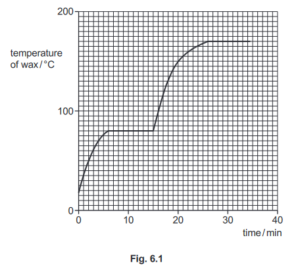
Most-appropriate topic codes (Cambridge IGCSE Physics 0625):
• Topic $2.3.1$ — Conduction (Part $\mathrm{(a)(i)}$)
• Topic $2.2.3$ — Melting, boiling and evaporation (Part $\mathrm{(a)(ii)}$)
• Topic $2.1.2$ — Particle model (Part $\mathrm{(b)}$)
▶️ Answer/Explanation
(a)(i)
For the correct answer:
Conduction
Conduction is the process by which thermal energy is transmitted through a solid material, such as copper. In metallic conductors, this thermal transfer occurs primarily through the vibration of atoms in the lattice and the rapid movement of free (delocalised) electrons.
(a)(ii) 1.
For the correct answer:
$80^{\circ}\text{C}$
The melting point is indicated by the first horizontal section of the heating curve, where the temperature remains constant as the solid state turns into a liquid. By tracing this first temperature plateau directly across to the y-axis, the value is exactly $80^{\circ}\text{C}$.
(a)(ii) 2.
For the correct answer:
$170^{\circ}\text{C}$
The boiling point corresponds to the second horizontal section of the given graph, where the liquid turns into a gas at a constant temperature. Tracing this second, higher plateau directly across to the y-axis gives a value of $170^{\circ}\text{C}$.
(a)(ii) 3.
For the correct answer:
$26\text{ minutes}$
The wax begins to boil at the exact moment the temperature first reaches the boiling point of $170^{\circ}\text{C}$ and levels off. Tracing the very beginning of this second horizontal plateau downwards to the time on the x-axis shows that this occurs at $26\text{ minutes}$.
(b)
For the correct answer:
Solid: particles are fixed in place/position, have regular spacing/pattern, are vibrating, and are close together.
Gas: particles are moving randomly at high speed, colliding with each other/walls, randomly arranged, and relatively far apart.
In a solid state, molecules are arranged in a regular, closely packed pattern and can only vibrate about their fixed positions. In contrast, when the wax is a gas, the molecules are separated by large distances and move randomly at high speeds, frequently colliding.
Question 7
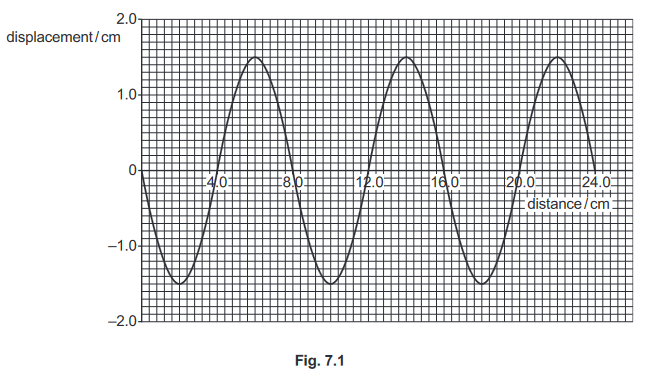
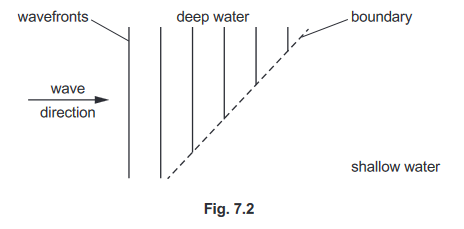
Most-appropriate topic codes (Cambridge IGCSE Physics 0625):
• Topic $3.1$ — General properties of waves (Parts $\mathrm{(a)(i)}$, $\mathrm{(a)(ii)}$, $\mathrm{(b)(i)}$, $\mathrm{(b)(ii)}$)
• Topic $3.3$ — Electromagnetic spectrum (Parts $\mathrm{(c)(i)}$, $\mathrm{(c)(ii)}$)
▶️ Answer/Explanation
(a)(i)
For the correct answer:
$8.0\text{ cm}$
Wavelength is the horizontal distance between two consecutive identical points on a wave, such as from crest to crest. In Fig. $7.1$, the first visible crest is at $4.0\text{ cm}$ and the next crest is at $12.0\text{ cm}$. The difference gives the wavelength: $\lambda = 12.0\text{ cm} – 4.0\text{ cm} = 8.0\text{ cm}$.
(a)(ii)
For the correct answer:
$1.5\text{ cm}$
Amplitude is defined as the maximum displacement of the wave from its rest or equilibrium position. The graph shows the equilibrium axis is at $0\text{ cm}$, and the peak of the crest reaches exactly $1.5\text{ cm}$ on the vertical displacement scale. Therefore, the amplitude is $1.5\text{ cm}$.
(b)(i)
For the correct answer:
Wavefronts drawn at a different angle bending towards the left, with a smaller wavelength.
As the waves travel from deep to shallow water, their speed decreases causing them to change direction (refract). Because the wave equation is $v = f\lambda$ and frequency $f$ remains constant, a decrease in speed $v$ results directly in a proportionally smaller wavelength $\lambda$.
(b)(ii)
For the correct answer:
Refraction
Refraction is the scientific term for the change in direction and speed of a wave as it crosses a boundary between two different media, such as moving from deep water into shallow water.
(c)(i)
For the correct answer (any one):
Ultraviolet OR X-rays OR gamma rays.
The electromagnetic spectrum consists of various waves ordered by frequency and wavelength. Waves with a higher frequency and a correspondingly shorter wavelength than visible light include ultraviolet (UV) radiation, X-rays, and gamma rays.
(c)(ii)
For the correct answer (based on selected wave):
Ultraviolet: security marking, sterilising water. X-rays: medical scanning, security scanners. Gamma rays: sterilising food/medical equipment, cancer detection and treatment.
Electromagnetic waves have specific practical applications based on their energy levels and penetrating abilities. For instance, X-rays are highly penetrating and can pass through soft tissue to produce medical scans of bones, while UV light is effective at destroying microorganisms to sterilise water.
Question 8
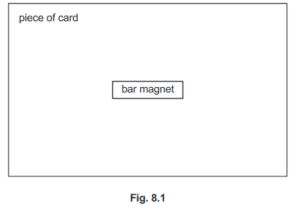
You may draw on Fig. $8.1$ if it helps to explain your answer.
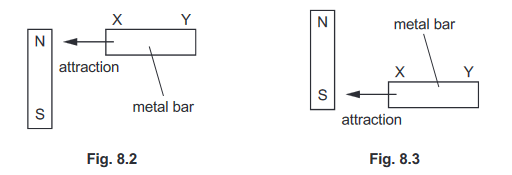
Most-appropriate topic codes (Cambridge IGCSE Physics 0625):
• Topic $4.1$ — Simple phenomena of magnetism (Parts $\mathrm{(a)}$, $\mathrm{(b)}$)
▶️ Answer/Explanation
(a)
For the correct answer:
Place a plotting compass near the magnet and mark the position of its North-seeking arrow. Move the compass so its tail aligns with the mark, and mark the new tip position. Repeat this step until the path reaches the opposite pole, then draw a smooth curve connecting the points. Repeat this entire process starting from various different positions around the pole to reveal the complete magnetic field pattern.
(b)
For the correct answer:
The results reveal that the metal bar XY is made of an unmagnetised magnetic material, such as soft iron. We can deduce it is a magnetic material because it experiences a force of attraction towards the permanent magnet. Furthermore, it must be unmagnetised because end X is attracted to both the North pole (Fig. $8.2$) and the South pole (Fig. $8.3$); a permanent magnet would have repelled one of the poles.
Question 9
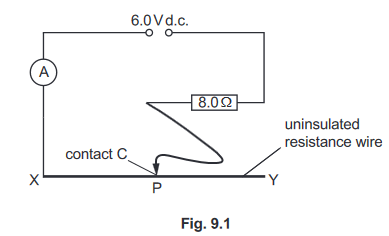
State and explain the effect on the ammeter reading when they move the contact C from Y to X.
Calculate the total resistance of the resistance wire between X and P and the fixed resistor.
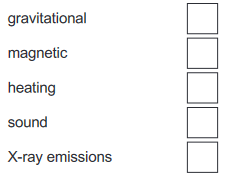
Place a tick ($\checkmark$) in the boxes next to these two effects.
Most-appropriate topic codes (Cambridge IGCSE Physics 0625):
• Topic 4.2.4 — Resistance (Parts (a), (b))
• Topic 4.3.2 — Series and parallel circuits (Part (c))
• Topic 4.5.3 — Magnetic effect of a current (Part (d))
▶️ Answer/Explanation
(a)
For the correct answer:
Current/reading increases because circuit resistance decreases.
Moving contact C from Y to X decreases the length of the resistance wire included in the active circuit. Since the resistance of a wire is directly proportional to its length ($R \propto L$), the total resistance of the circuit decreases. According to Ohm’s law ($I = \frac{V}{R}$), a decrease in the overall resistance results in a proportionally higher electric current, assuming the supply voltage remains constant. Therefore, the ammeter reading steadily increases.
(b)
For the correct answer:
$0.75\text{ A}$
When contact C is positioned exactly at X, the resistance wire XY is completely bypassed, meaning its effective resistance in the circuit is zero. The only component resisting the flow of current is the fixed resistor, which has a value of $8.0\text{ }\Omega$. Using the equation $I = \frac{V}{R}$, where $V = 6.0\text{ V}$ and $R = 8.0\text{ }\Omega$, we calculate the current as $I = \frac{6.0}{8.0}$. This yields an ammeter reading of $0.75\text{ A}$.
(c)
For the correct answer:
$28\text{ }\Omega$
The contact C is placed at point P, which introduces a section of the resistance wire into the circuit. The resistance of the wire segment between X and P is given as $20\text{ }\Omega$. Because this segment is connected in series with the fixed $8.0\text{ }\Omega$ resistor, their resistances simply add together. Using the formula for calculating total resistance in series circuits ($R = R_{1} + R_{2}$), the total resistance is evaluated as $20\text{ }\Omega + 8.0\text{ }\Omega = 28\text{ }\Omega$.
(d)
For the correct answer:
Ticks in the ‘heating’ and ‘magnetic’ boxes.
As electric current flows through the uninsulated resistance wire and the fixed resistor, electrical energy is transferred to the thermal store of the components, producing a heating effect. Additionally, any wire carrying an electric current generates a magnetic field around it, representing the magnetic effect of a current. The circuit does not involve liquids or chemical reactions (like electrolysis), and current does not create gravitational fields.
Question 10
(a) A microwave oven has a metal case and is connected to a 240 V electricity supply.
The microwave oven is fitted with a 13 A fuse and an earth wire is connected to the metal case of the microwave oven. A fault occurs and the live wire of the microwave oven touches the metal case.
Explain how the fuse and an earthed metal case protect the appliance and the user.
(b) The electric circuit for the microwave oven includes a transformer.
The voltage to the primary coil of the transformer $V_p$ is 240 V.
The number of turns on the primary coil $N_p$ is 70.
The number of turns on the secondary coil $N_s$ is 560.
Calculate the secondary voltage $V_s$ for the transformer.
Most-appropriate topic codes (Cambridge IGCSE Physics 0625):
• Topic 4.4 — Electrical safety (Part a)
• Topic 4.5.6 — The transformer (Part b)
▶️ Answer/Explanation
(a)
When the live wire touches the metal case, the earth wire maintains the case at zero volts (earth potential), ensuring the user is not electrocuted upon touching it. This creates a low-resistance path, causing a very large current to flow through the earth wire and the fuse. The sudden surge in current exceeds the 13 A limit, causing the fuse to melt and break the circuit. This completely isolates the microwave from the electricity supply, preventing further damage, overheating, or potential electrical fires.
(b)
For the correct answer: 1920 V
To find the secondary voltage, we use the transformer equation: $\frac{V_p}{V_s} = \frac{N_p}{N_s}$. Rearranging the formula to solve for $V_s$, we get $V_s = V_p \times \frac{N_s}{N_p}$. Substituting the given values yields $V_s = 240 \times \frac{560}{70}$. Since $\frac{560}{70} = 8$, the secondary voltage is $240 \times 8 = 1920$ V. This demonstrates a step-up transformer where the voltage is increased proportionally to the number of turns.
Question 11
A teacher determines the types of emission from a radioactive source. He uses different materials to absorb the emissions. Fig. 11.1 shows the equipment.
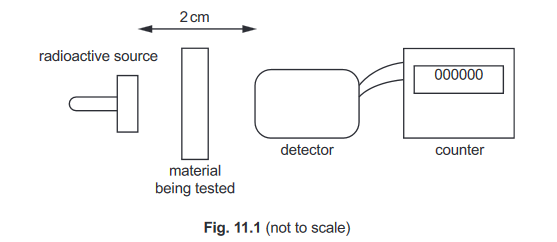
The teacher places a material between the radioactive source and the detector. The counter shows the count rate for the emission that reaches the detector. The teacher records the count rate. He repeats the experiment for different materials.
Table 11.1 shows the results.
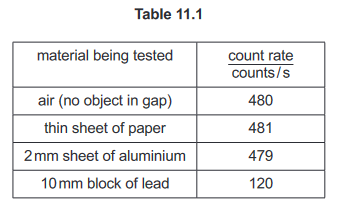
Use information from Table 11.1 to give a reason for your answer.
Use information from Table 11.1 to give a reason for your answer.
Most-appropriate topic codes (Cambridge IGCSE Physics 0625):
• Topic $5.2.2$ — The three types of nuclear emission (Parts $\mathrm{(a)}$, $\mathrm{(b)}$)
▶️ Answer/Explanation
(a)
For the correct answer:
No $\alpha$ (alpha) particles are emitted.
The source does not emit $\alpha$-particles[cite: 875]. Alpha particles have very low penetrating power and are completely absorbed by a single, thin sheet of paper[cite: 877]. According to the experimental data in Table 11.1, the recorded count rate remains exactly the same at $480$ counts/min when paper is introduced as an absorber compared to when there is no absorber (air). If $\alpha$-particles were present in the radioactive emission, the count rate would have noticeably decreased when the paper was placed between the source and the detector. Therefore, the lack of any drop in the count rate confirms the absolute absence of alpha radiation in this experiment.
(b)
For the correct answer:
Yes, $\gamma$ (gamma) rays are emitted.
The source does emit $\gamma$-rays[cite: 875]. Gamma radiation is highly penetrating and can easily pass through paper and $2\text{ mm}$ of aluminium, but it is significantly absorbed by dense materials like lead[cite: 877]. The data shows that after the $2\text{ mm}$ aluminium sheet absorbs the $\beta$-particles (dropping the count from $480$ to $20$), adding $10\text{ mm}$ of lead further decreases the count rate down to $12$ counts/min. This further reduction directly indicates that the lead is absorbing high-energy radiation that successfully passed through the aluminium barrier, which is a defining characteristic of $\gamma$-rays.