
Question 1
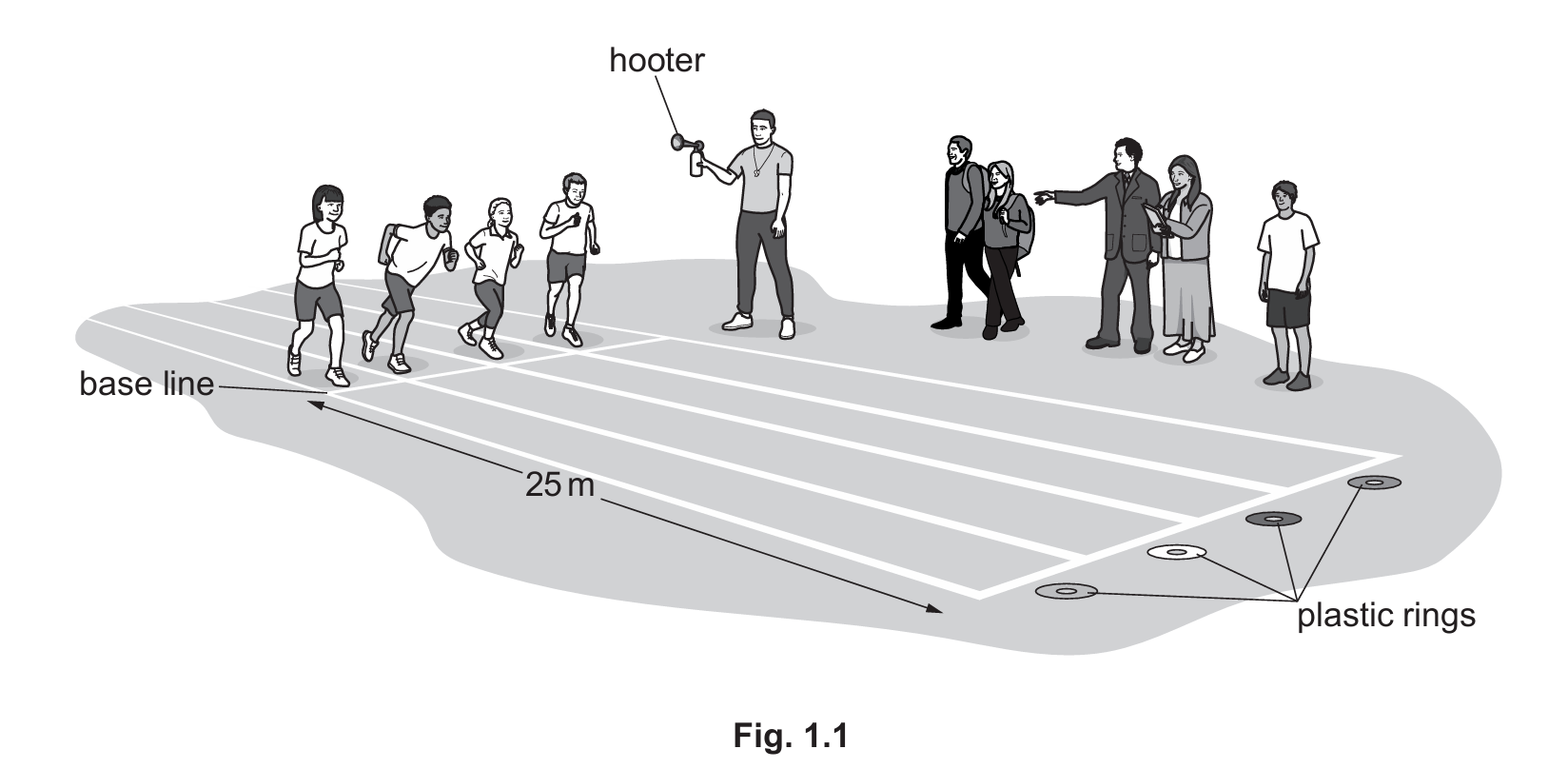
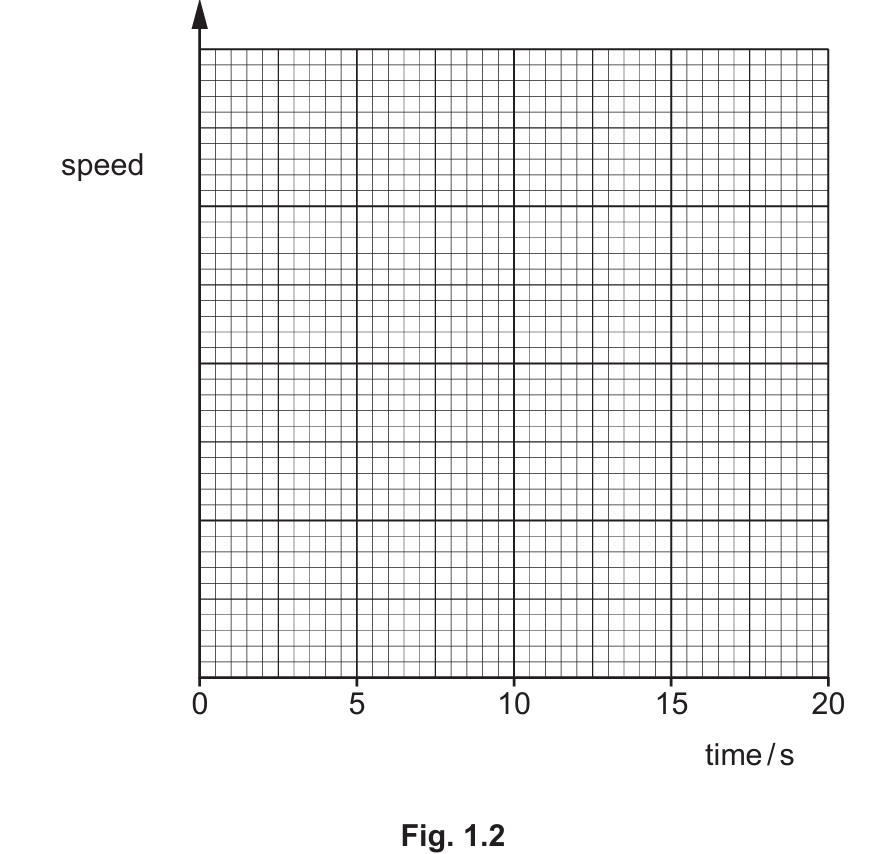
The child picks up the ring at time $= 9.0\text{ s}$.
The child finishes the race at time $= 17.0\text{ s}$.
The highest speed occurs as the child finishes the race.
Most-appropriate topic codes (Cambridge IGCSE Physics 0625):
• Topic $1.1$ — Physical quantities and measurement techniques (Part $\mathrm{(a)(i)}$)
• Topic $1.2$ — Motion (Parts $\mathrm{(a)(ii)}$, $\mathrm{(b)}$, $\mathrm{(c)}$)
▶️ Answer/Explanation
(a)(i)
For the correct answer:
Metre rule / measuring tape.
When measuring relatively long distances like $25\text{ m}$ on a school field or track, a standard laboratory ruler just won’t cut it. A teacher would logically use a long measuring tape, trundle wheel, or a $50\text{ m}$ surveyor’s tape because these tools are specifically designed to handle large-scale measurements efficiently and accurately without having to repeatedly move a shorter device.
(a)(ii)
For the correct answer:
$50\text{ m}$
The race explicitly requires the children to run a straight distance of $25\text{ m}$ to reach the plastic rings, and then run the exact same path back to the starting base line. Therefore, you simply add the two segments together: $25\text{ m} + 25\text{ m} = 50\text{ m}$. It’s a round trip, so the total distance covered is double the one-way distance.
(b)
For the correct answer:
Graph starts at origin $(0,0)$.
Speed $= 0$ at $9.0\text{ s}$.
Highest speed at $17\text{ s}$.
To sketch the graph correctly, we need to think about the child’s physical movement. The child starts from rest, meaning the line begins at $(0,0)$. At $9.0\text{ s}$, the child has to stop to pick up the ring, so the speed must dip back down to $0\text{ m/s}$ at that exact timestamp. Finally, the problem tells us the highest speed is reached right at the finish line, so the graph should peak at the $17.0\text{ s}$ mark, showing an upward trend from the $9.0\text{ s}$ stop.
(c)(i)
For the correct answer:
$260\text{ s}$
Time conversions are straightforward if you remember there are $60$ seconds in every minute. So, for $4$ minutes, you multiply $4$ by $60$ to get $240$ seconds. Then, simply add the remaining $20$ seconds to find the total time: $240 + 20 = 260\text{ s}$. This gives us the standard unit needed for speed calculations.
(c)(ii)
For the correct answer:
$1.9\text{ m/s}$ (or $1.92\text{ m/s}$)
The formula for average speed is the total distance divided by the total time taken ($v = \frac{s}{t}$). We have a total distance of $500\text{ m}$ and we just figured out the time is $260\text{ s}$. Plugging these values into the equation gives $\frac{500}{260}$, which calculates to approximately $1.923\text{ m/s}$. Rounding this to a sensible two significant figures, we get $1.9\text{ m/s}$, which is a very realistic running speed for a child.
Question 2
Most-appropriate topic codes (Cambridge IGCSE Physics 0625):
• Topic $1.7.1$ — Energy (Parts $\mathrm{(a)}$, $\mathrm{(b)}$)
• Topic $1.7.4$ — Power (Part $\mathrm{(b)(iii)}$)
• Topic $1.4$ — Density (Part $\mathrm{(c)}$)
▶️ Answer/Explanation
(a)(i)
For the correct answer:
electrical; kinetic / (gravitational) potential.
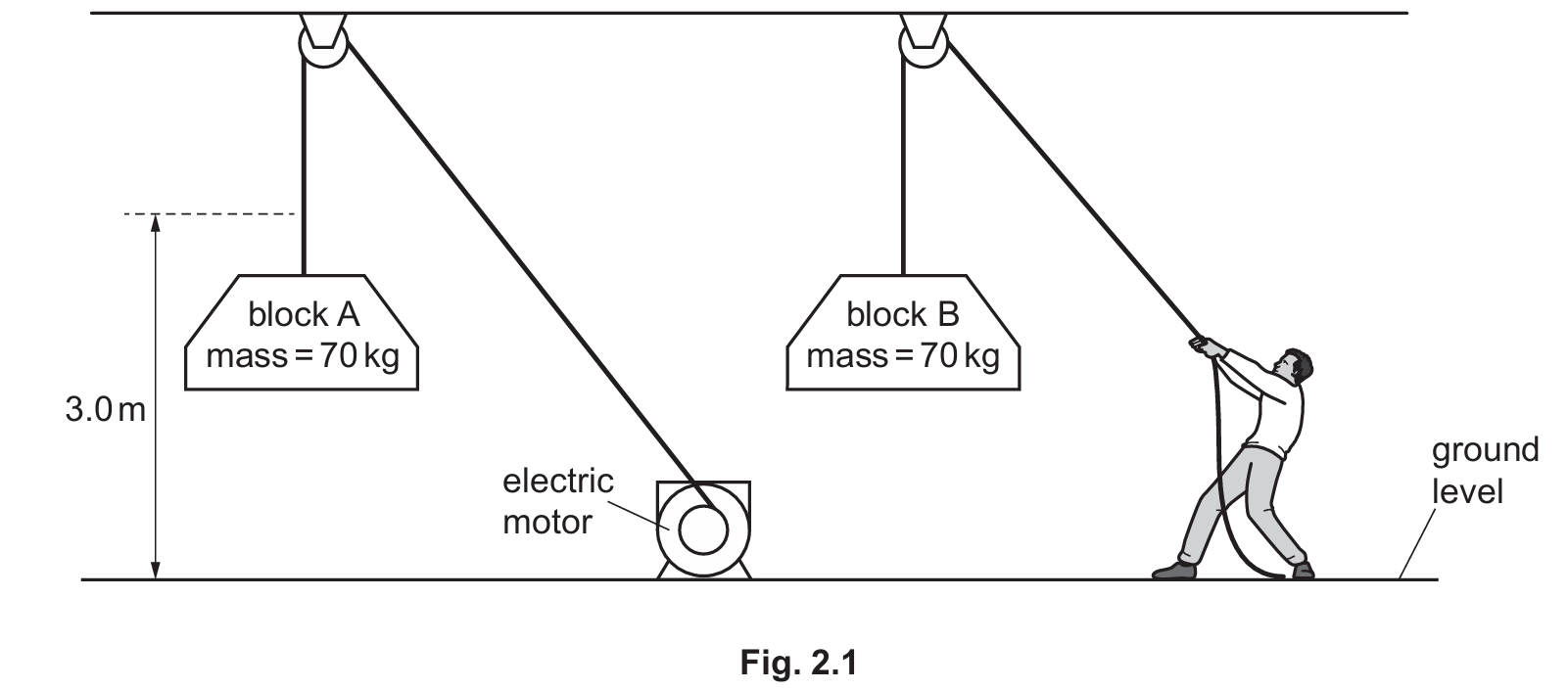
An electric motor’s entire purpose is to take electrical energy from a power source and convert it into useful motion. When the motor starts pulling the block, the electrical energy is transferred into the kinetic energy of the moving parts and the load, eventually becoming gravitational potential energy as the block rises higher off the ground.
(a)(ii)
For the correct answer:
(gravitational) potential
Whenever an object is lifted upwards against the force of Earth’s gravity, work is being done on it. This work is stored within the object as gravitational potential energy. Since both block A and block B are moving from the ground to a height of $3.0\text{ m}$, they are both gaining this specific type of stored energy.
(b)(i)
For the correct answer:
Same / equal.
The amount of gravitational potential energy an object gains depends only on its mass, the gravitational field strength, and the height it is lifted ($\Delta E_p = mg\Delta h$). Because block A and block B are identical ($70\text{ kg}$ each) and are lifted to the exact same height ($3.0\text{ m}$), the energy they gain is mathematically identical, regardless of whether a motor or a person did the lifting.
(b)(ii)
For the correct answer:
Energy is wasted / dissipated as thermal energy/heat due to friction in the motor/pulleys.
In the real world, no machine is $100\%$ efficient. When the electric motor runs, parts rub against each other creating friction, and electrical resistance in the wires generates heat. This means a portion of the electrical energy input is inevitably lost to the surroundings as thermal energy or sound, so the useful energy transferred to the block is always less than the total energy put in.
(b)(iii)
For the correct answer:
weight / force / mass AND height / distance moved AND time.
Power is the rate at which work is done or energy is transferred ($P = \frac{W}{t}$). To find the work done, the engineer first needs to know the force applied (the weight of the block, derived from its mass) and the distance it was moved (the height). Finally, to calculate the rate, they absolutely must measure the time it took to lift the block.
(c)
For the correct answer:
$7900\text{ kg/m}^3$
Density tells us how tightly packed the matter in an object is, calculated by dividing its mass by its volume ($\rho = \frac{m}{V}$). We take the given mass of the block, $70\text{ kg}$, and divide it by the given volume, $0.0089\text{ m}^3$. Doing the math ($70 / 0.0089$) gives approximately $7865\text{ kg/m}^3$, which rounds nicely to $7900\text{ kg/m}^3$, a typical value for dense metals like iron or steel.
Question 3
Most-appropriate topic codes (Cambridge IGCSE Physics 0625):
• Topic $1.8$ — Pressure (Parts $\mathrm{(a)}$, $\mathrm{(b)(ii)}$)
• Topic $1.3$ — Mass and weight (Part $\mathrm{(b)(i)}$)
▶️ Answer/Explanation
(a)
For the correct answer:
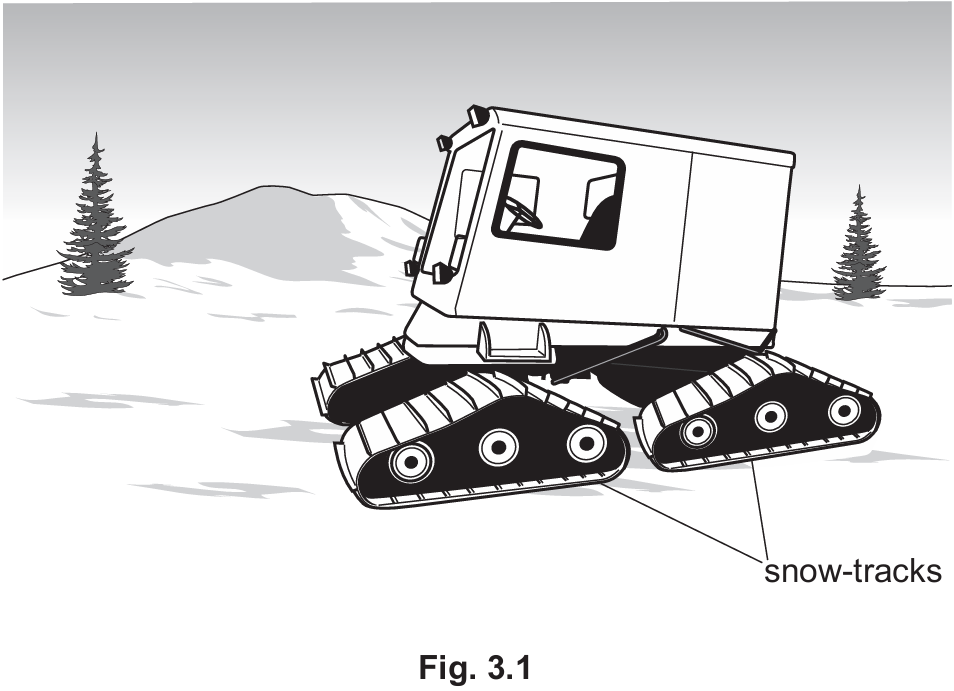
Larger area, lower pressure on the ground, so it does not sink in.
Snow is soft and easily compacted. If a vehicle used standard wheels, the entire weight would be concentrated on a very small contact area, creating immense pressure that would cause the wheels to sink deep into the snow. Snow-tracks spread that same weight out over a much larger surface area, significantly reducing the pressure ($p = \frac{F}{A}$) and allowing the heavy vehicle to glide over the snow without getting stuck.
(b)(i)
For the correct answer:
$400\text{ kg}$
Mass and weight are fundamentally linked by gravity. Weight is a force, calculated as mass multiplied by the acceleration of free fall ($W = mg$). On Earth, we use $g = 10\text{ m/s}^2$. To find the mass, we rearrange the formula to $m = \frac{W}{g}$. Dividing the given weight of $4000\text{ N}$ by $10\text{ m/s}^2$ directly yields a mass of $400\text{ kg}$.
(b)(ii)
For the correct answer:
Pressure $= 500$
Unit $= \text{N/m}^2$ or $\text{Pa}$
First, we need to find the force exerted by a single track. The total weight is $4000\text{ N}$, and since each of the four tracks supports a quarter of this, one track bears $1000\text{ N}$ of force. Pressure is force divided by area ($p = \frac{F}{A}$). Taking the $1000\text{ N}$ force and dividing it by the track’s area of $2.0\text{ m}^2$ gives $500$. The standard unit for pressure is Pascals ($\text{Pa}$) or Newtons per square metre ($\text{N/m}^2$).
Question 4
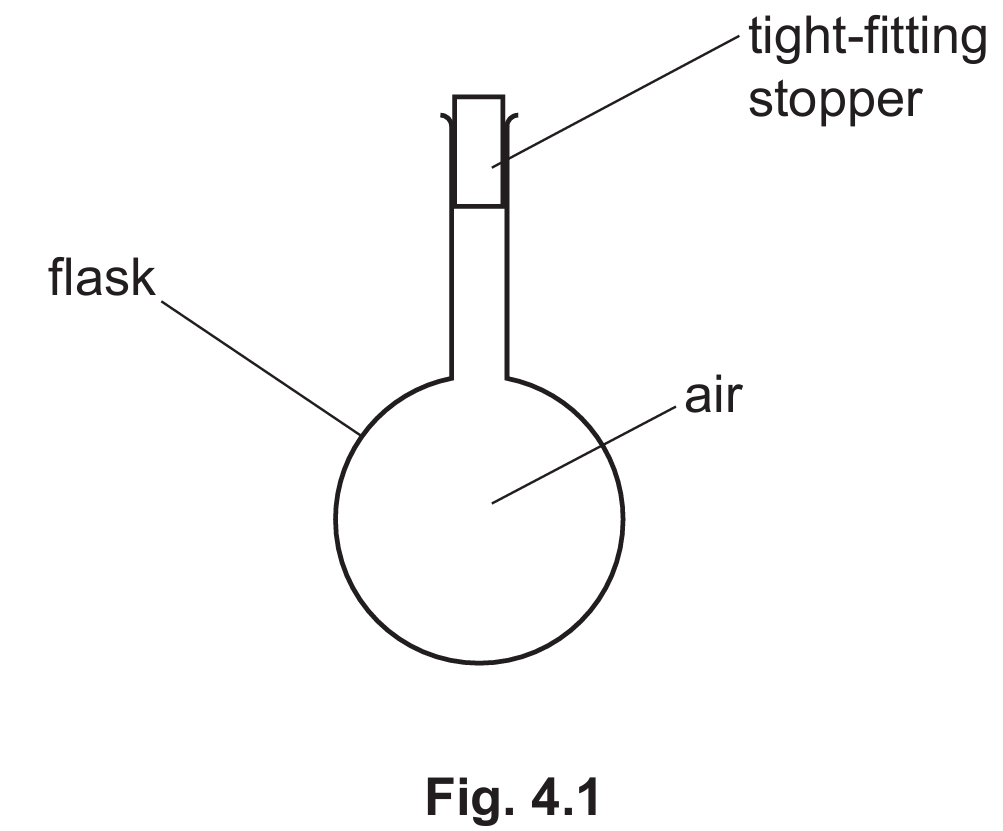
Most-appropriate topic codes (Cambridge IGCSE Physics 0625):
• Topic $2.2.1$ — Thermal expansion of solids, liquids and gases (Part $\mathrm{(a)}$)
• Topic $2.1.2$ — Particle model (Part $\mathrm{(b)}$)
▶️ Answer/Explanation
(a)
For the correct answer:
Situation (e.g., fitting a steel tyre onto a train wheel).
Explanation (e.g., heating expands the tyre so it fits over the wheel, and cooling contracts it for a tight fit).
Thermal expansion is used brilliantly in engineering and everyday life. A classic example is the bimetallic strip found in older thermostats or fire alarms. It consists of two different metals fused together. Because they expand at different rates when heated, the strip bends as the temperature rises, which can mechanically open or close an electrical circuit to trigger an alarm or switch off a heater.
(b)(i)
For the correct answer:
Decreases.
Pressure in a sealed container is directly related to temperature when the volume is kept constant. As the flask is placed in the refrigerator and cools down, the thermal energy of the trapped air is removed. Consequently, the overall pressure of the air inside the rigid glass flask will naturally decrease.
(b)(ii)
For the correct answer:
Molecules slow down / have less kinetic energy.
They hit the wall/flask less often.
They hit the wall/flask with less force.
When we cool the gas, we are essentially draining kinetic energy away from its molecules. Because they have less energy, these air molecules travel at slower speeds around the flask. Slower molecules means they won’t crash into the inner glass walls as frequently, and when they do collide, the impact force is much weaker. Since pressure is just the total force of these collisions spread over an area, less frequent and weaker collisions mean a noticeable drop in pressure.
Question 5
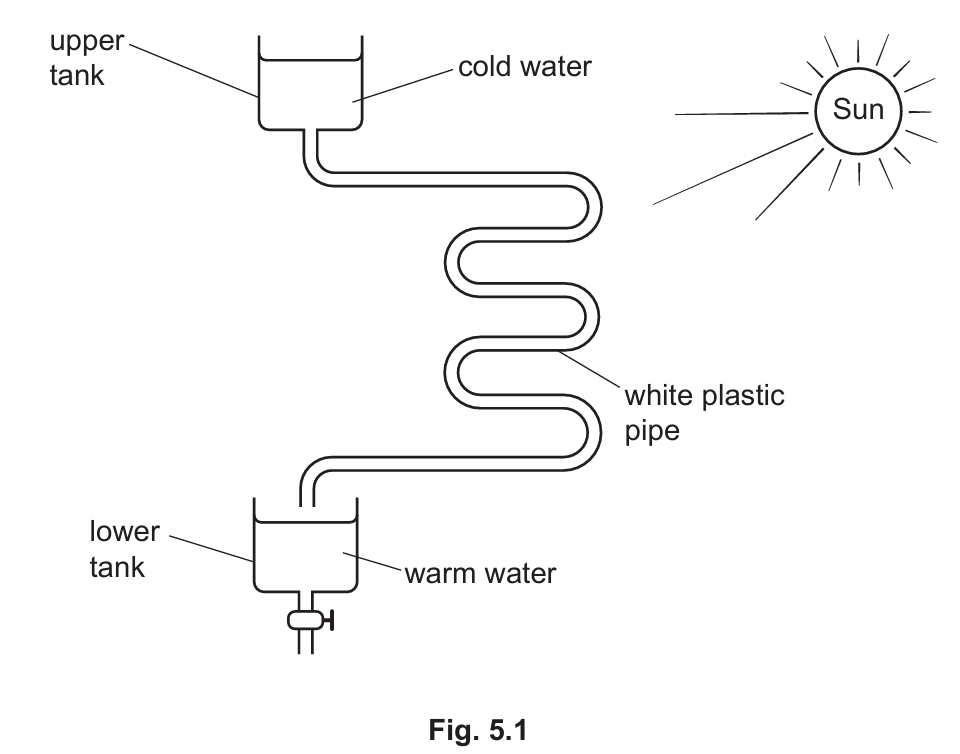
Most-appropriate topic codes (Cambridge IGCSE Physics 0625):
• Topic $2.2.1$ — Thermal properties and temperature (Part $\mathrm{(a)}$)
• Topic $2.3.1$ — Conduction (Parts $\mathrm{(b)}$, $\mathrm{(c)}$)
▶️ Answer/Explanation
(a)
For the correct answer:
Thermometer
To obtain an accurate, quantifiable measurement of how hot or cold a substance is, scientists and engineers rely on a thermometer. Whether it’s a traditional liquid-in-glass model or a modern digital sensor, it’s the standard tool designed specifically to gauge temperature changes in the water tanks.
(b)(i)
For the correct answer:
Radiation
The Sun is millions of kilometers away, separated from Earth by the vast vacuum of space. Because there are no particles in a vacuum to conduct or convect heat, the Sun’s thermal energy can only reach the plastic pipe via electromagnetic waves, specifically infrared radiation.
(b)(ii)
For the correct answer:
Conduction
Once the outside of the solid plastic pipe gets hot from the Sun, that heat needs to travel through the physical wall of the pipe to reach the water inside. Heat transfer through a solid material, where vibrating particles pass energy to their immediate neighbors without the material itself flowing, is known as conduction.
(c)
For the correct answer:
Improvement 1: Paint the pipe black (or a dull, dark colour).
Explanation 1: Black surfaces are much better absorbers of infrared radiation than white ones.
Improvement 2: Use a metal pipe instead of plastic (or make the pipe longer/thinner).
Explanation 2: Metal is a much better thermal conductor than plastic, allowing heat to pass through to the water more efficiently.
If the engineer wants the system to be more efficient, they have to optimize both how heat is captured and how it is transferred. White plastic is a poor choice because white reflects thermal radiation and plastic acts as an insulator. By painting the pipe a dull black, it will absorb significantly more of the Sun’s radiant heat. Additionally, swapping the plastic for a metal like copper will drastically speed up conduction, allowing the captured heat to move rapidly through the pipe wall and into the flowing water.
Question 6
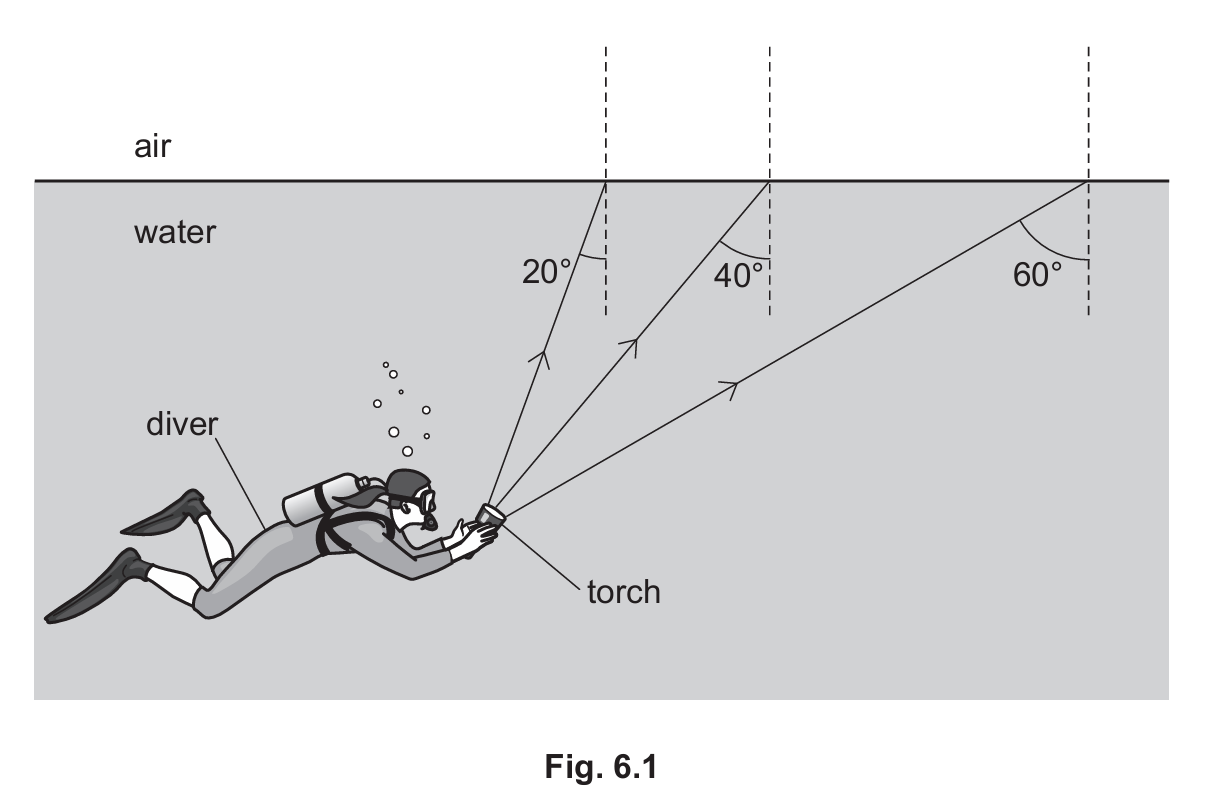
Most-appropriate topic codes (Cambridge IGCSE Physics 0625):
• Topic $3.2.2$ — Refraction of light (Parts $\mathrm{(a)}$, $\mathrm{(b)}$)
▶️ Answer/Explanation
(a)
For the correct answer:
Normal
In ray diagrams describing optics, any dashed line drawn perpendicular to the boundary between two different optical media (in this case, water and air) is designated as the normal line. It serves as a geometric reference point from which angles of incidence, reflection, and refraction are consistently measured.
(b)(i)
For the correct answer:
The angle of incidence that results in an angle of refraction of $90^{\circ}$ OR the angle of incidence above which total internal reflection occurs.
The critical angle is a specific threshold. When a light ray attempts to cross from a denser medium to a less dense one, it bends away from the normal. As the incident angle increases, the refracted angle approaches $90^{\circ}$ along the boundary. The precise incident angle that causes this grazing refraction is the critical angle.
(b)(ii)
For the correct answer:
Ray at $20^{\circ}$: Refracts away from the normal into the air.
Ray at $40^{\circ}$: Refracts further away from the normal into the air.
Ray at $60^{\circ}$: Undergoes total internal reflection, reflecting back into the water at $60^{\circ}$.
Since the critical angle is given as $48^{\circ}$, any ray striking the boundary at an angle less than $48^{\circ}$ will refract out into the air, bending away from the normal. This happens for the $20^{\circ}$ and $40^{\circ}$ rays. However, the $60^{\circ}$ ray exceeds the critical angle, so it cannot escape the water. It undergoes total internal reflection, bouncing back downwards following the law of reflection (angle of incidence equals angle of reflection).
Question 7
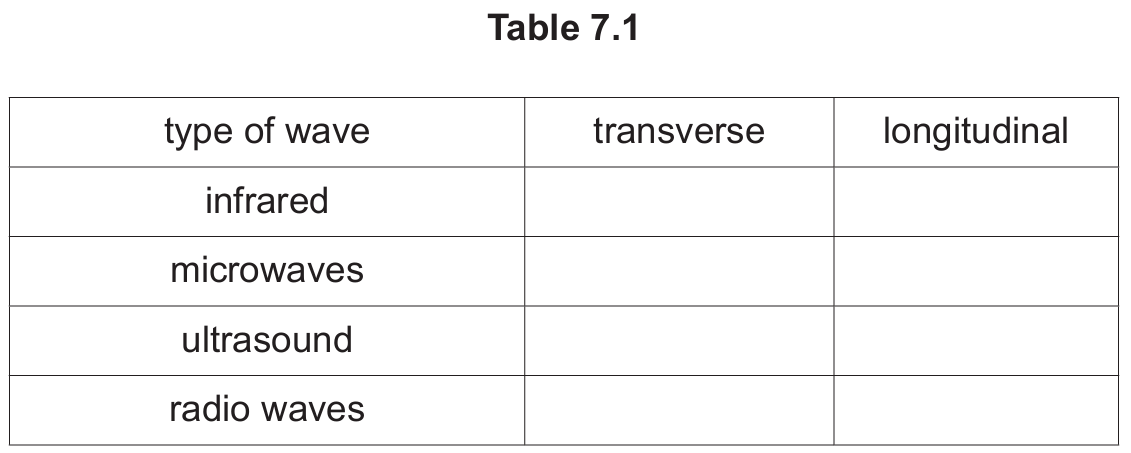
(c) Indicate whether the types of wave in Table $7.1$ are transverse or longitudinal.
Show your answer for each type of wave by placing a tick in one column.
Complete all the rows in Table $7.1$.
Most-appropriate topic codes (Cambridge IGCSE Physics 0625):
• Topic $3.3$ — Electromagnetic spectrum (Parts $\mathrm{(a)}$, $\mathrm{(b)}$, $\mathrm{(c)}$)
• Topic $3.4$ — Sound (Parts $\mathrm{(a)(iv)}$, $\mathrm{(c)}$)
• Topic $3.1$ — General properties of waves (Part $\mathrm{(c)}$)
▶️ Answer/Explanation
(a)(i)
For the correct answer:
Infrared, microwaves, and radio waves.
The electromagnetic spectrum consists of waves created by oscillating electric and magnetic fields. Out of the given list, infrared, microwaves, and radio waves fall into this category. Ultrasound, on the other hand, is a mechanical wave (sound) that requires a physical medium to propagate.
(a)(ii)
For the correct answer:
Radio waves
Within the electromagnetic spectrum, radio waves occupy the far end characterized by the lowest frequencies and the longest wavelengths. Their wavelengths can range from a millimeter to hundreds of kilometers, making them significantly longer than infrared or microwaves.
(a)(iii)
For the correct answer:
Any two from: infrared, microwaves, radio waves.
Because electromagnetic waves do not rely on vibrating particles to travel, they can effortlessly pass through the empty vacuum of space. Any of the three electromagnetic options from the list are perfectly valid answers here. Mechanical sound waves like ultrasound would be trapped, unable to travel without particles.
(a)(iv)
For the correct answer:
Ultrasound
In medical imaging, high-frequency sound waves—ultrasound—are directed into the body. These safe, non-ionizing mechanical waves reflect off tissue boundaries (like an unborn baby) and are captured to build a detailed visual map, contrasting sharply with the harmful nature of X-rays.
(b)
For the correct answer (any two):
Optical fibres, thermal imaging, remote controls, intruder alarms, electrical grills.
Infrared radiation is incredibly versatile. It is the invisible signal linking your TV remote to the television sensor. It’s also the heat signature picked up by thermal cameras and motion-detecting intruder alarms. Furthermore, short-wavelength infrared is widely used to transmit massive amounts of data through optical fibre networks.
(c)
For the correct answer: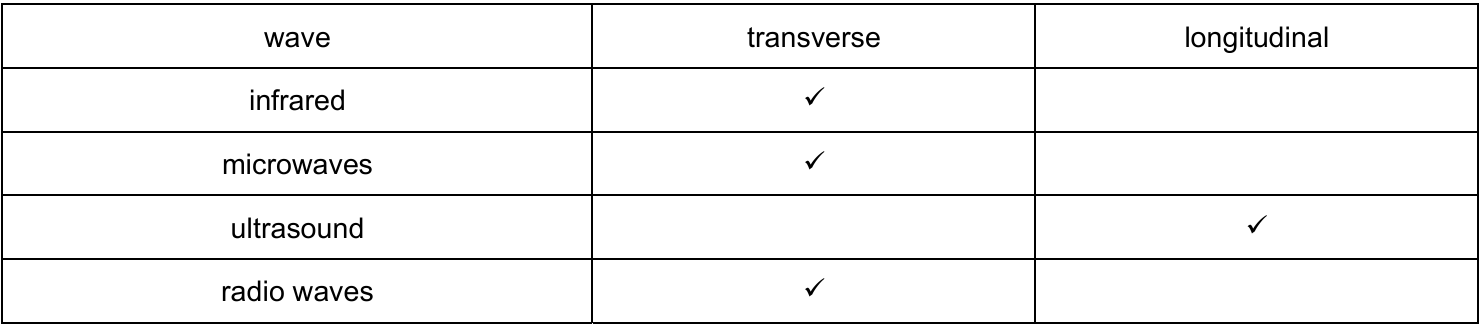
All electromagnetic waves, without exception, are transverse—their oscillating fields move perpendicular to the direction of travel. Thus, infrared, microwaves, and radio waves get ticked under the transverse column. Ultrasound is a sound wave, which propagates through a series of compressions and rarefactions parallel to the wave’s path, making it strictly longitudinal.
Question 8
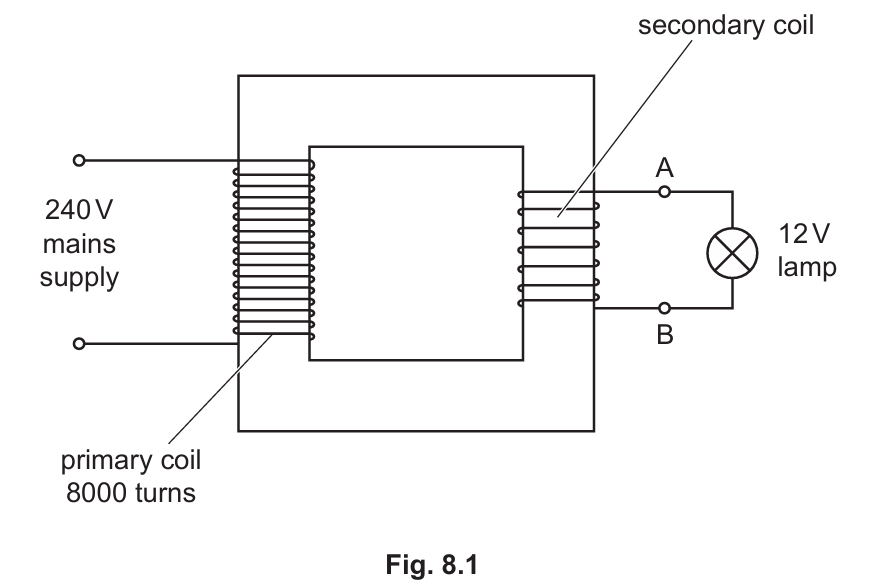
Most-appropriate topic codes (Cambridge IGCSE Physics 0625):
• Topic $4.5.6$ — The transformer (Parts $\mathrm{(a)}$)
• Topic $4.3.2$ — Series and parallel circuits (Part $\mathrm{(b)}$)
▶️ Answer/Explanation
(a)(i)
For the correct answer:
$400$ turns
We can solve this using the transformer equation: $\frac{V_p}{V_s} = \frac{N_p}{N_s}$. We know the primary voltage ($V_p$) is $240\text{ V}$, the secondary voltage ($V_s$) is $12\text{ V}$, and the primary turns ($N_p$) are $8000$. Rearranging to solve for secondary turns ($N_s$ gives us $N_s = N_p \times (\frac{V_s}{V_p})$. Plugging in the numbers: $8000 \times (\frac{12}{240})$ equals exactly $400$ turns.
(a)(ii)
For the correct answer:
Step-down transformer
Because the output voltage ($12\text{ V}$) is significantly lower than the input mains voltage ($240\text{ V}$), the primary function of this device is to “step down” the electrical potential. It accomplishes this through electromagnetic induction between its distinct coils.
(a)(iii)
For the correct answer:
Copper
To maximize efficiency, the coils inside a transformer must have the lowest possible electrical resistance. Copper is universally used because it is an outstanding electrical conductor, minimizing power lost as heat while the alternating current flows through the many turns of wire.
(b)
For the correct answer:
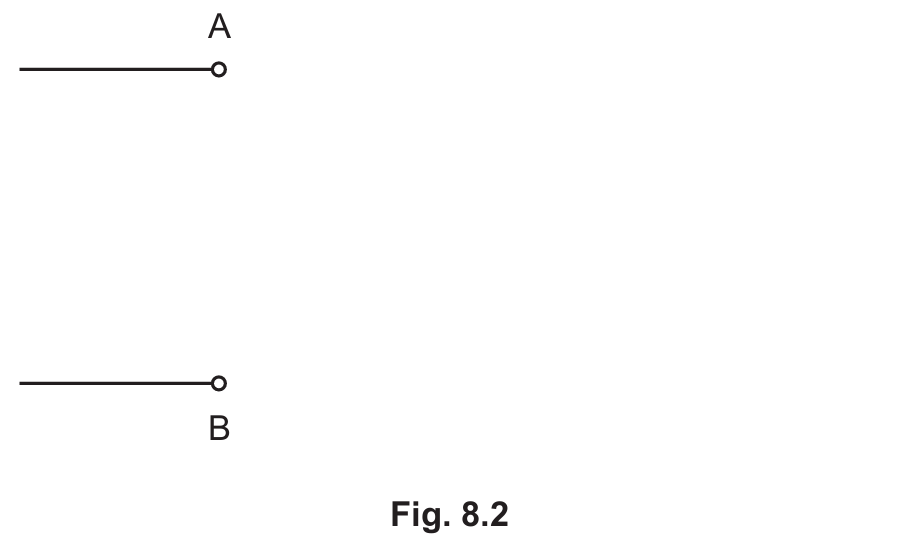
Diagram showing the motor connected in parallel across A and B, and the two lamps connected in series with each other, forming a separate parallel branch across A and B.
The power source across A and B provides $12\text{ V}$. For the $12\text{ V}$ motor to operate properly, it must be connected directly across A and B in parallel so it receives the full voltage. The lamps, however, require $6.0\text{ V}$ each. By wiring the two $6.0\text{ V}$ lamps in series with each other, they will naturally split the $12\text{ V}$ parallel branch voltage evenly, resulting in exactly $6.0\text{ V}$ across each lamp, ensuring everything functions safely.
Question 9
Most-appropriate topic codes (Cambridge IGCSE Physics 0625):
• Topic $4.2.3$ — Electromotive force and potential difference (Part $\mathrm{(a)}$)
• Topic $4.2.2$ — Electric current (Parts $\mathrm{(b)}$, $\mathrm{(c)}$)
• Topic $4.3.2$ — Series and parallel circuits (Part $\mathrm{(c)}$)
▶️ Answer/Explanation
(a)
For the correct answer:
Potential difference / voltage / electromotive force (e.m.f.).
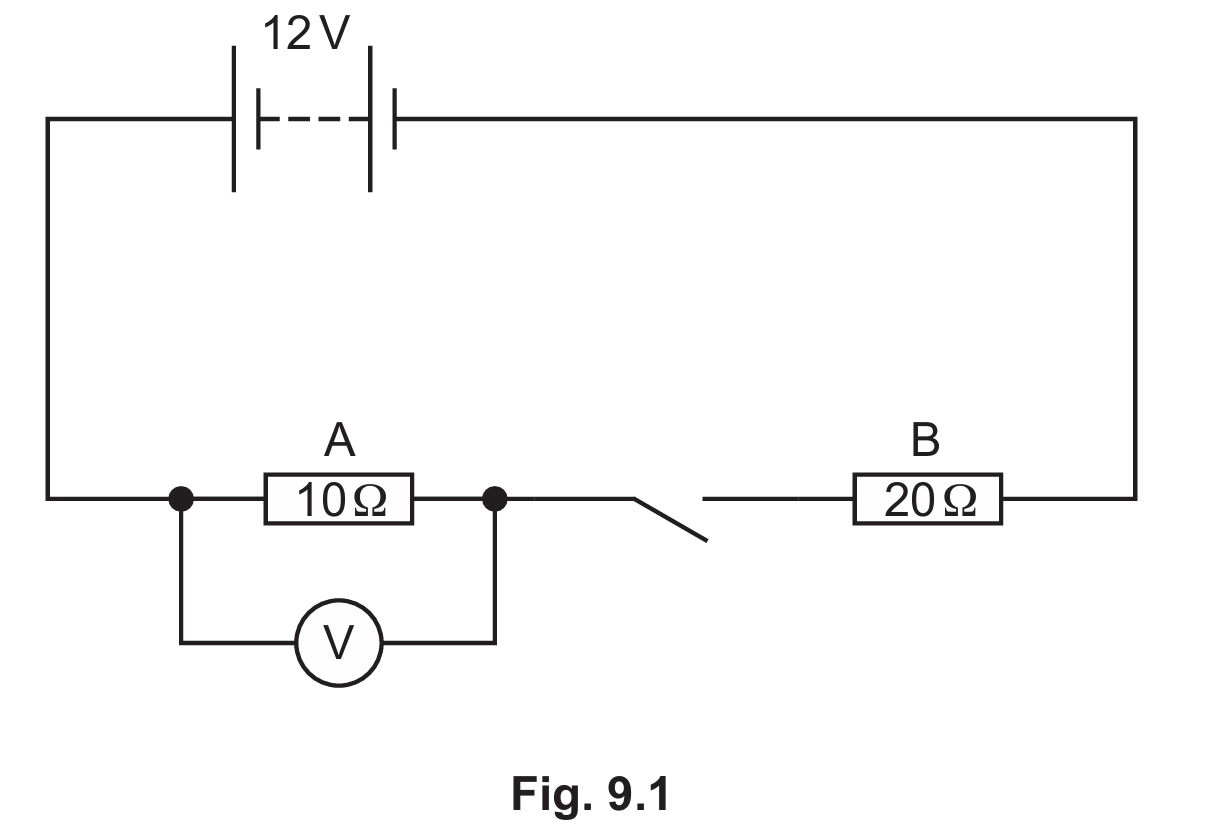
A voltmeter is wired in parallel across a specific component to measure the electrical work done per unit of charge passing through that segment. This quantity is technically defined as potential difference, though the terms voltage and e.m.f. are commonly accepted depending on exactly what is being measured.
(b)(i)
For the correct answer:
Electrons
Metals are exceptional conductors because they possess a “sea” of delocalised subatomic particles that are free to move. When a circuit is closed and a potential difference is applied, it is these tiny, negatively charged electrons that drift through the solid metal lattice to form the electric current.
(b)(ii)
For the correct answer:
Ammeter
To measure the actual rate of flow of charge (the current) moving through a wire, an ammeter is placed directly in the path of the circuit (in series). This allows it to accurately count the coulombs of charge passing a point per second, displaying the result in Amperes.
(c)(i)
For the correct answer:
$0.4\text{ A}$
We can find the current using Ohm’s Law ($I = \frac{V}{R}$). We are told the voltmeter reading across the $10\Omega$ resistor is $4.0\text{ V}$. Dividing the voltage ($4.0\text{ V}$) by the resistance ($10\Omega$) gives a calculated current of $0.4$ Amperes.
(c)(ii)
For the correct answer:
$0.4\text{ A}$
In a simple series circuit, there are no branches for the current to split down. The exact same flow of electrons must travel sequentially through every single component. Because we calculated the current through the first resistor as $0.4\text{ A}$, the current traveling through the subsequent $20\Omega$ resistor must identically be $0.4\text{ A}$.
(c)(iii)
For the correct answer:
No effect/change.
The total resistance of the circuit remains the same ($30\Omega$).
Initially, the total series resistance is $10\Omega + 20\Omega$, which equals $30\Omega$. If we replace both components with $15\Omega$ resistors, the new total series resistance is $15\Omega + 15\Omega$, which still equals exactly $30\Omega$. Because the battery voltage ($12\text{ V}$) is unchanged and the overall resistance opposing the current is unchanged, the total current flowing out of the battery will not be affected at all.
Question 10
Most-appropriate topic codes (Cambridge IGCSE Physics 0625):
• Topic $5.2.2$ — The three types of nuclear emission (Part $\mathrm{(a)}$)
• Topic $5.1.2$ — The nucleus (Parts $\mathrm{(b)}$, $\mathrm{(c)}$)
▶️ Answer/Explanation
(a)
For the correct answer:
Alpha ($\alpha$), Beta ($\beta$), Gamma ($\gamma$).
When an unstable atomic nucleus decays to become more stable, it randomly releases energy or particles. The three fundamental types of ionising radiation emitted during this natural nuclear process are alpha particles, beta particles, and high-energy gamma rays.
(b)(i)
For the correct answer:
$35$
In standard nuclide notation (${}_{Z}^{A}\text{X}$), the top number ($A$) represents the total nucleon number. This is the combined sum of protons and neutrons residing tightly within the nucleus. For this specific chlorine isotope, the top number is clearly written as $35$.
(b)(ii)
For the correct answer:
$17$
The bottom number ($Z$) in nuclide notation indicates the proton number, also known as the atomic number. This specific integer defines the elemental identity of the atom. Here, the number $17$ confirms that the atom is indeed chlorine.
(b)(iii)
For the correct answer:
$18$
Since the nucleon number ($35$) is the sum of protons and neutrons, and the proton number is $17$, you find the number of neutrons by simple subtraction. Subtracting the $17$ protons from the total $35$ nucleons leaves exactly $18$ neutrons in the nucleus.
(c)
For the correct answer:
electrons
Protons carry a positive electrical charge, while electrons carry a negative charge. For an entire atom to be electrically neutral, these opposing charges must perfectly balance out. Therefore, every neutral atom must possess an equal number of positive protons in the nucleus and negative electrons orbiting around it.