
Question 1
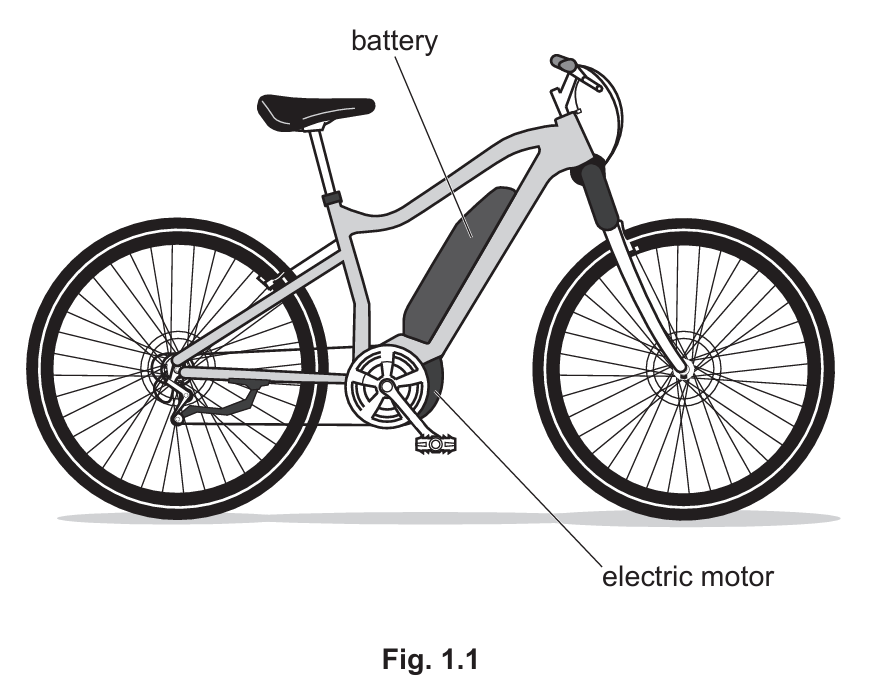
Most-appropriate topic codes (Cambridge IGCSE Physics 0625):
• Topic 1.7.4 — Power (Parts (a)(i), (b))
• Topic 1.7.1 — Energy (Part (a)(ii))
• Topic 1.7.3 — Energy resources (Part (c))
▶️ Answer/Explanation
(a)(i)
For the correct answer:
\(2.2 \times 10^{6}\,\mathrm{J}\) OR \(2\,200\,000\,\mathrm{J}\)
Energy is the product of power and time: \(E = Pt\). The time of 60 minutes needs to be converted into seconds first, giving \(60 \times 60 = 3600\,\mathrm{s}\). Then multiply the power by this time: \(600 \times 3600 = 2\,160\,000\,\mathrm{J}\), which is \(2.2 \times 10^{6}\,\mathrm{J}\) to two significant figures. This is the total energy the battery stores when fully charged.
(a)(ii)
For the correct answer:
Chemical (energy)
A battery does not store energy in a mechanical or electrical form directly. Inside the battery, energy is held as chemical potential energy, ready to be converted into electrical energy when the circuit is complete.
(b)
For the correct answer:
\(8600\,\mathrm{s}\) OR \(140\,\min\) OR \(2.4\,\mathrm{h}\) OR \(2\,\mathrm{h}\,24\,\min\)
OR \(8800\,\mathrm{s}\) OR \(147\,\min\) OR \(2\,\mathrm{h}\,27\,\min\)
Rearrange the power equation to make time the subject: \(t = \frac{E}{P}\). Using the energy calculated in part (a)(i), \(2.2 \times 10^{6}\,\mathrm{J}\), and dividing by the motor’s power of \(250\,\mathrm{W}\) gives \(8800\,\mathrm{s}\). Converting this to hours and minutes shows the battery can power the bicycle for about 2 hours and 27 minutes.
(c)
For any two correct benefits:
• Less noise / no noise
• Less / no air (gaseous) pollution (from the bicycle) / does not produce acid rain
• (The bicycle) uses no / less fossil fuel
• Does not contribute to greenhouse effect / does not release \(\mathrm{CO}_{2}\)
Compared to a small motorcycle with a petrol engine, an electric bicycle runs almost silently, cutting down noise pollution. It also produces zero exhaust emissions at the point of use, so it does not release carbon dioxide, nitrogen oxides, or other pollutants that harm air quality and contribute to climate change.
Question 2
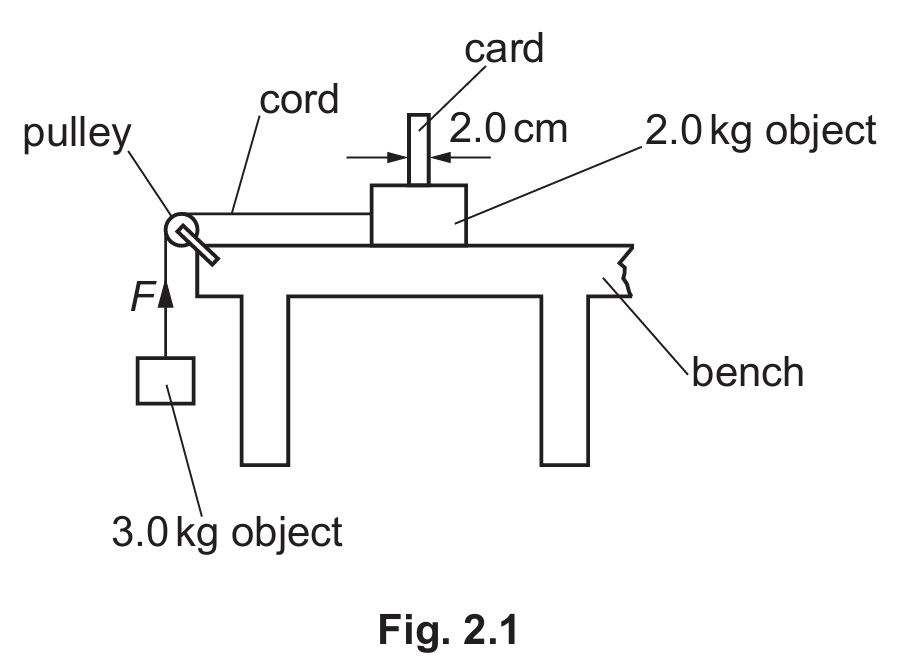
Most-appropriate topic codes (Cambridge IGCSE Physics 0625):
• Topic 1.5.1 — Effects of forces (Parts (a), (b), (c)(i))
• Topic 1.2 — Motion (Parts (c)(i), (c)(ii))
▶️ Answer/Explanation
(a)
For the correct answer:
\(8.0\,\mathrm{N}\)
Newton’s second law states \(F = ma\). We know the mass of the object on the bench is \(2.0\,\mathrm{kg}\) and it accelerates at \(4.0\,\mathrm{m}/\mathrm{s}^{2}\). Substituting directly into the formula gives \(2.0 \times 4.0 = 8.0\,\mathrm{N}\). This resultant force is what causes the object to speed up along the bench.
(b)
For the correct answer:
\(18\,\mathrm{N}\)
First, calculate the weight of the \(3.0\,\mathrm{kg}\) object: \(W = mg = 3.0 \times 10 = 30\,\mathrm{N}\). Next, find the resultant force needed to accelerate this object downwards: \(F_{\text{res}} = ma = 3.0 \times 4.0 = 12\,\mathrm{N}\). The cord pulls upwards with a tension \(F\), so the net downward force is the weight minus this tension: \(30 – F = 12\). Rearranging gives \(F = 30 – 12 = 18\,\mathrm{N}\).
(c)(i)
For the correct demonstration:
\(\Delta v = a \Delta t = 4.0 \times 0.80 = 3.2\,\mathrm{m}/\mathrm{s}\)
Acceleration is defined as the change in velocity per unit time: \(a = \frac{\Delta v}{\Delta t}\). Since the objects begin at rest, the initial velocity is zero. Multiplying the constant acceleration of \(4.0\,\mathrm{m}/\mathrm{s}^{2}\) by the time interval of \(0.80\,\mathrm{s}\) directly yields a final speed of \(3.2\,\mathrm{m}/\mathrm{s}\).
(c)(ii)
For the correct answer:
\(0.0063\,\mathrm{s}\) OR \(6.3 \times 10^{-3}\,\mathrm{s}\)
Speed equals distance divided by time, so rearrange to get time equals distance over speed: \(t = \frac{d}{v}\). The card width of \(2.0\,\mathrm{cm}\) must be converted to metres: \(0.020\,\mathrm{m}\). Using the speed from part (c)(i), \(t = \frac{0.020}{3.2} = 0.00625\,\mathrm{s}\). Rounded to two significant figures, this is \(6.3 \times 10^{-3}\,\mathrm{s}\), the brief moment the light beam is interrupted.
Question 3
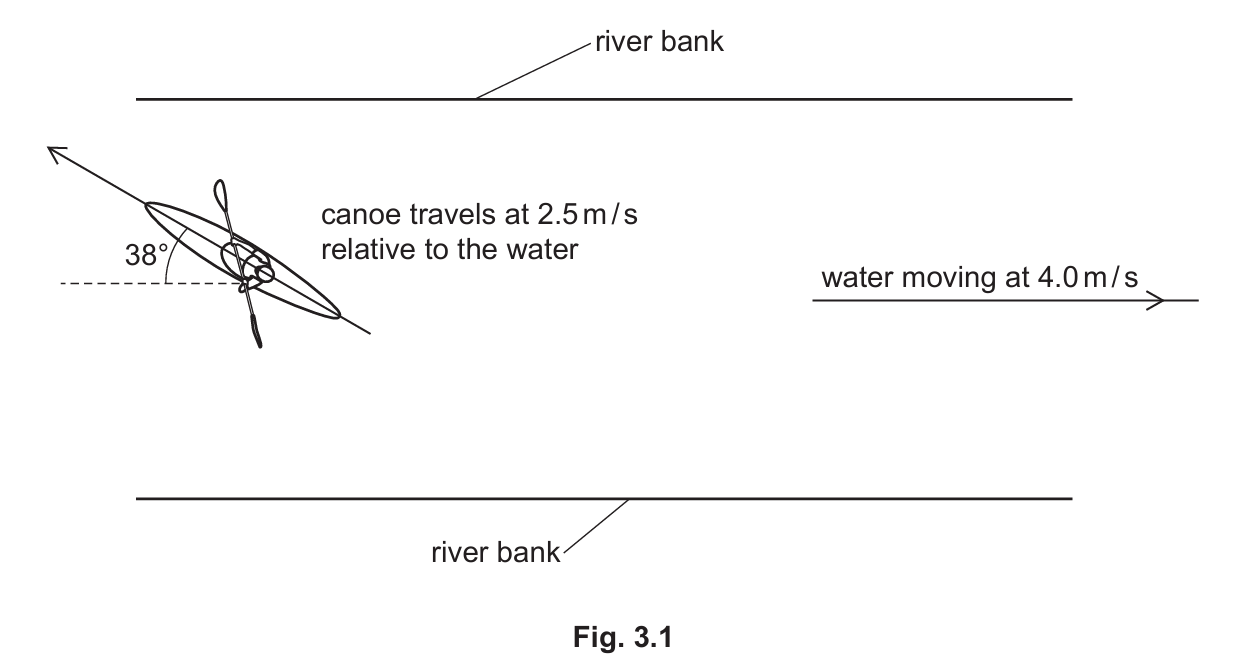
Most-appropriate topic codes (Cambridge IGCSE Physics 0625):
• Topic 1.1 — Physical quantities and measurement techniques (Part (a))
• Topic 1.7.1 — Energy (Part (b))
▶️ Answer/Explanation
(a)
For the correct answer range:
Magnitude: \(2.3 – 2.8\,\mathrm{m}/\mathrm{s}\)
Direction: \(35^{\circ} – 40^{\circ}\) downstream
(Scale stated, e.g. \(1\,\mathrm{cm}:1\,\mathrm{m}/\mathrm{s}\))
To find the canoe’s actual path over the ground, we must add the velocity of the river and the canoe’s velocity relative to the water as vectors. A scale diagram is drawn: first a horizontal arrow for the river’s \(4.0\,\mathrm{m}/\mathrm{s}\) flow, then from its tip a second arrow of length representing \(2.5\,\mathrm{m}/\mathrm{s}\) at a \(38^{\circ}\) angle to the bank. The diagonal from the starting point to the tip of the second arrow represents the resultant velocity. Its measured length and angle give the magnitude and the precise direction downstream that the canoe actually travels.
(b)
For the correct answer:
\(200\,\mathrm{J}\)
Kinetic energy is calculated using \(E_{\mathrm{k}} = \frac{1}{2}mv^{2}\). Substituting the canoeist’s mass of \(65\,\mathrm{kg}\) and her speed of \(2.5\,\mathrm{m}/\mathrm{s}\): \(\frac{1}{2} \times 65 \times (2.5)^{2} = \frac{1}{2} \times 65 \times 6.25 = 203.125\,\mathrm{J}\). Expressed to two significant figures, this becomes \(200\,\mathrm{J}\).
Question 4
Most-appropriate topic codes (Cambridge IGCSE Physics 0625):
• Topic 2.2.2 — Specific heat capacity (Parts (b), (c))
• Topic 2.2.1 — Thermal expansion of solids, liquids and gases (Part (a))
▶️ Answer/Explanation
(a)
For the correct statements and explanations:
Statement 1: Bore of constant (cross-sectional) area.
Explanation 1: So the liquid thread moves by the same length for the same increase in volume/expansion of the liquid.
Statement 2: (Liquid has) constant thermal expansion.
Explanation 2: So the liquid moves the same distance for each degree Celsius temperature rise.
For a thermometer’s scale to be marked in evenly spaced divisions, two physical conditions must hold. Firstly, the narrow tube, or bore, must have exactly the same diameter along its length. If it narrowed, the same volume of expanding liquid would surge further than expected, making the spacing uneven. Secondly, the liquid itself must expand uniformly; its volume increase per degree must be the same at all temperatures, otherwise equal temperature steps would produce unequal movements of the thread.
(b)
For the correct explanation:
The heat capacity (of the hot junction) is small, so it only needs/uses a small amount of (thermal) energy (to raise its temperature).
A thermocouple measures temperature via a tiny junction where two metals meet. To respond rapidly, this junction must have a very low heat capacity. This means it takes only a minuscule amount of heat energy from the surroundings to change its own temperature, allowing it to reach thermal equilibrium almost instantly without drawing significant heat away from the object being measured.
(c)
For the correct answer:
\(36\,\mathrm{J}\)
First, determine the change in temperature: \(\Delta \theta = 345 – 20 = 325^{\circ}\mathrm{C}\). The energy required is the product of the heat capacity and this temperature change: \(E = C\Delta\theta = 0.11 \times 325 = 35.75\,\mathrm{J}\). Rounded to reflect the precision of the given data, this is \(36\,\mathrm{J}\).
Question 5
Most-appropriate topic codes (Cambridge IGCSE Physics 0625):
• Topic 3.4 — Sound (Parts (a)(i), (a)(ii))
• Topic 3.3 — Electromagnetic spectrum (Part (b))
▶️ Answer/Explanation
(a)(i)
For the correct answer:
Ultrasound. (Explanation:) (Sound frequency is) above the audible range / above \(20\,000\,\mathrm{Hz}\) / above \(20\,\mathrm{kHz}\).
The human ear can typically detect sound waves in the range of \(20\,\mathrm{Hz}\) to \(20\,000\,\mathrm{Hz}\). A frequency of \(1.5\,\mathrm{MHz}\) is \(1\,500\,000\,\mathrm{Hz}\), far surpassing this upper limit. Any sound with a frequency higher than \(20\,\mathrm{kHz}\) is classified as ultrasound, and these high-frequency waves are widely used for medical imaging because they can be focused and produce echoes from internal structures.
(a)(ii)
For the correct answer:
\(8.7 \times 10^{-4}\,\mathrm{m}\)
All waves obey the wave equation: \(v = f\lambda\). Rearranging for wavelength gives \(\lambda = \frac{v}{f}\). We must work in consistent SI units: the speed is \(1.3\,\mathrm{km/s} = 1300\,\mathrm{m/s}\), and the frequency is \(1.5\,\mathrm{MHz} = 1.5 \times 10^{6}\,\mathrm{Hz}\). Dividing gives \(\frac{1300}{1.5 \times 10^{6}} = 8.67 \times 10^{-4}\,\mathrm{m}\). This extremely small wavelength allows ultrasound to resolve fine details within soft tissue.
(b)
For a correct use with explanatory detail:
X-rays are used for detecting broken bones. X-rays can pass through soft tissue but are absorbed by bone, so an image captured on a detector clearly shows the outline and any fractures within the bone.
Medical X-ray imaging exploits the differential absorption of X-rays by different body tissues. Dense materials such as bone contain calcium, which absorbs X-rays strongly, casting a white shadow on the image. The surrounding muscle and skin are much less absorbent, allowing the X-rays to pass through and darken the film. This contrast reveals the internal bone structure clearly, enabling doctors to diagnose fractures, dislocations, and other skeletal conditions.
Question 6
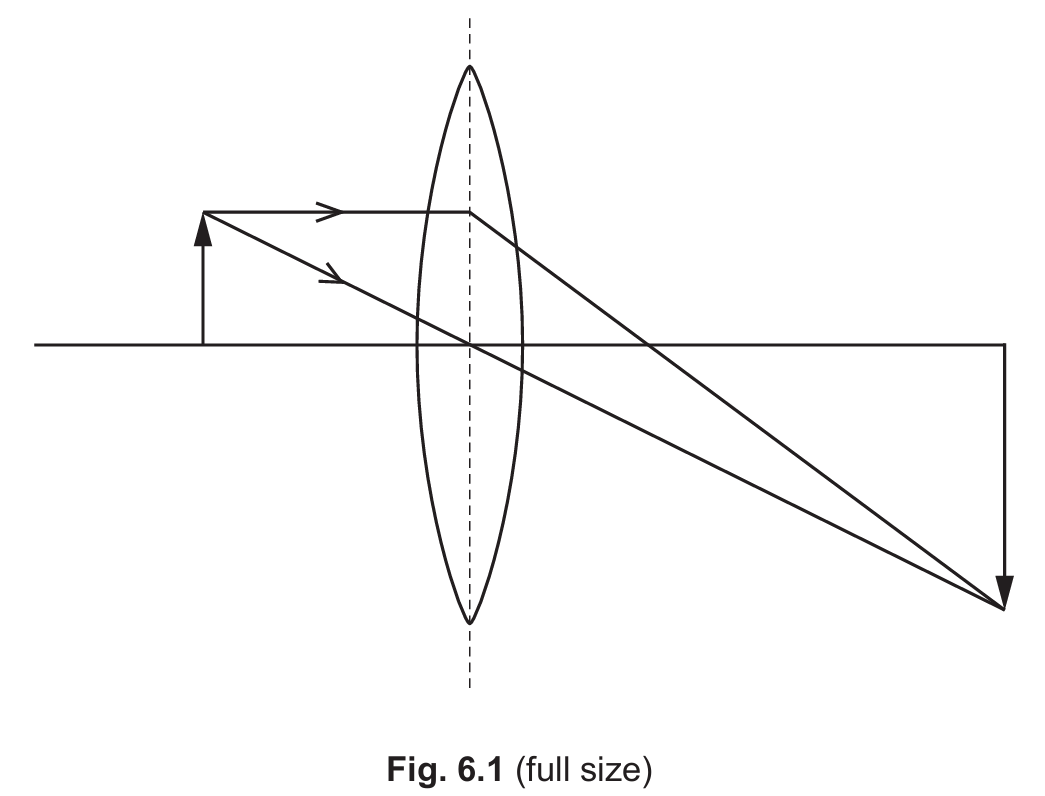
Most-appropriate topic codes (Cambridge IGCSE Physics 0625):
• Topic 3.2.3 — Thin lenses (Parts (a), (b), (c))
▶️ Answer/Explanation
(a)
For the correct answer:
\(1.9 – 2.1\,\mathrm{cm}\)
The focal length is the distance from the centre of the lens to the principal focus, which is the point where rays that were parallel to the principal axis converge after passing through the lens. On the full-size diagram, measuring this distance directly with a ruler gives a value very close to \(2.0\,\mathrm{cm}\).
(b)
For the three correct descriptors circled:
enlarged, inverted, real
Examining the ray diagram carefully, the image appears on the opposite side of the lens relative to the object and is upside-down, meaning it is inverted. Since the light rays actually cross and meet at the image location, the image is real and can be projected onto a screen. Compared to the object drawn, the image is noticeably larger, making it enlarged.
(c)
For a correct feature:
Not an intersection of (real) rays / cannot be formed/projected on a screen / light rays do not pass through the image / light rays do not meet / light rays do not converge.
A virtual image is formed where light rays only appear to come from when projected backwards. For instance, when you look into a flat mirror, your brain traces the diverging reflected rays back to a point behind the glass – yet no light actually travels to or converges at that spot.
Question 7
Most-appropriate topic codes (Cambridge IGCSE Physics 0625):
• Topic 4.1 — Simple phenomena of magnetism (Part (a))
• Topic 4.5.4 — Force on a current-carrying conductor (Parts (b), (c))
▶️ Answer/Explanation
(a)
For the correct answer:
pole A: N (North)
pole B: S (South)
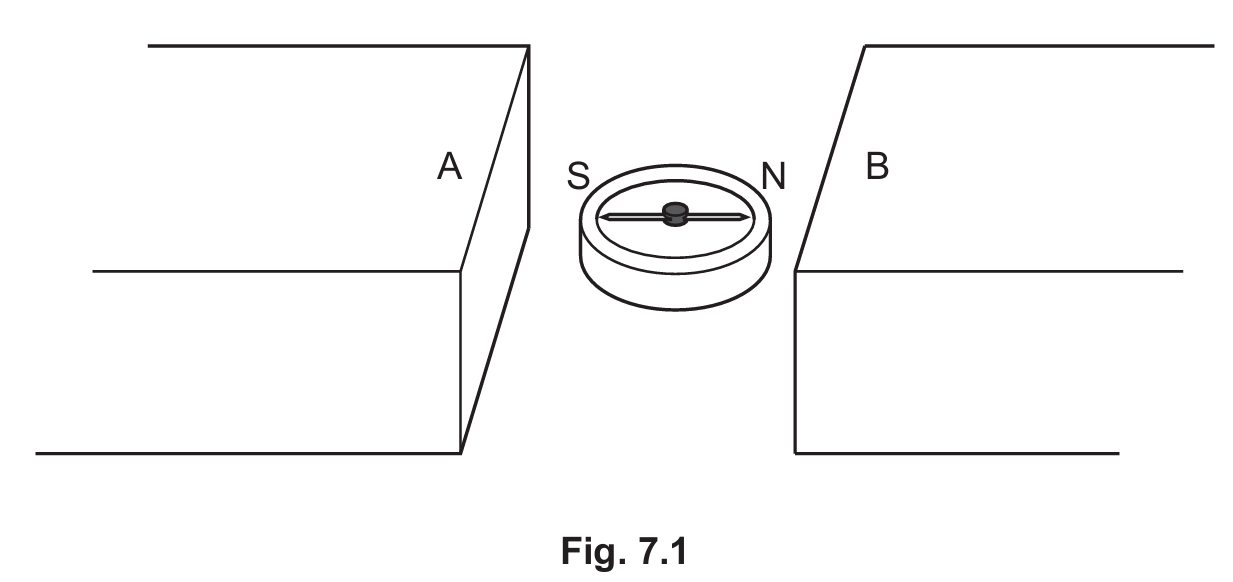
The north-seeking end of a compass needle points along the direction of the magnetic field, which by convention runs from the north pole to the south pole of a magnet. In the diagram, the compass arrow points towards pole B, indicating that the field lines travel from A to B. Therefore, pole A must be the north pole and pole B the south pole.
(b)
For the correct arrow direction:
Arrow drawn vertically upwards.
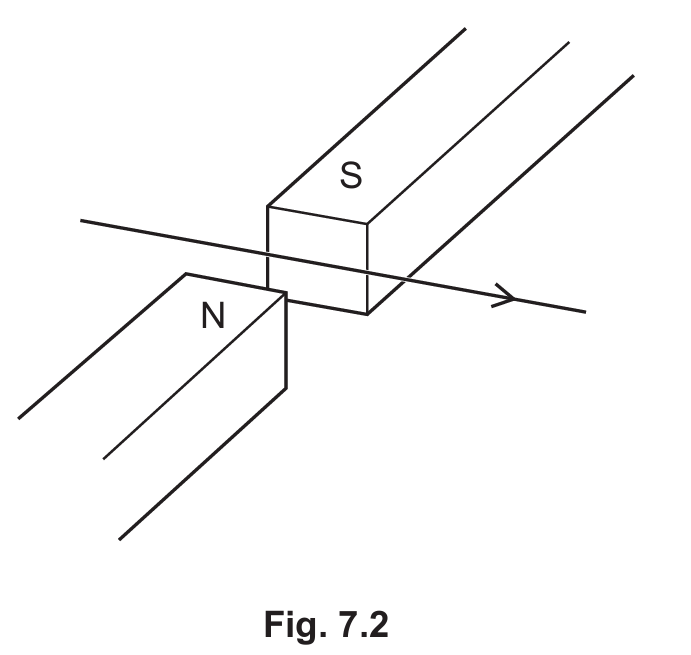
We use Fleming’s left-hand rule for the motor effect. Point the First finger in the direction of the Field (from N to S, giving left to right). Point the seCond finger in the direction of the Current (as shown by the arrow on the wire). Your ThuMb then pushes out, pointing the direction of the force (thrust). In this configuration, the thumb points vertically upwards, indicating the wire is pushed upwards out of the magnet’s gap.
(c)
For the correct arrow direction:
Arrow drawn vertically downwards.
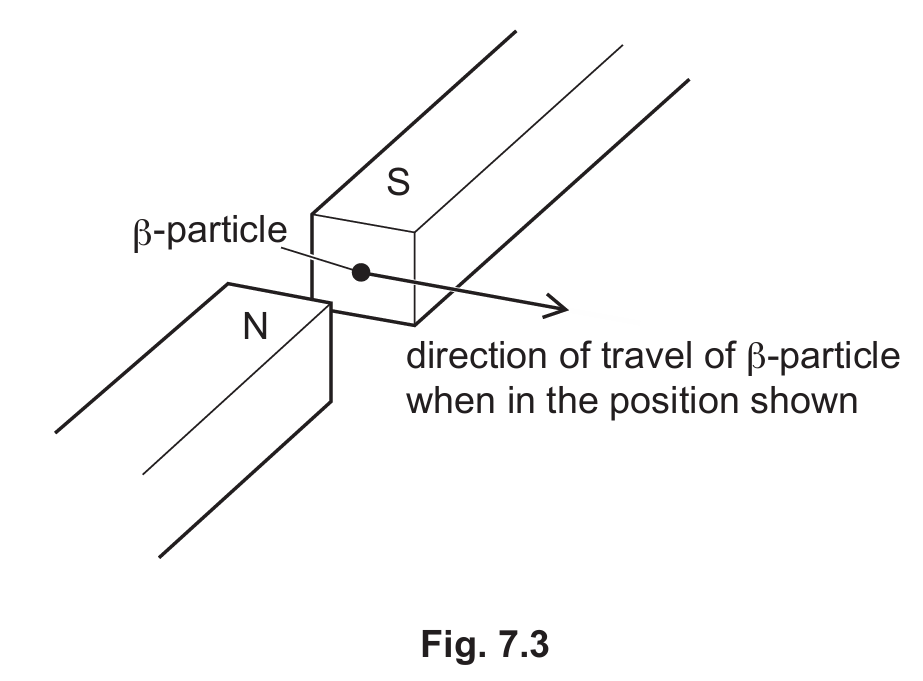
A \(\beta\)-particle is a high-speed electron, carrying a negative charge. The direction of conventional current is opposite to the flow of electrons. Since the particle moves in a specific direction, we imagine conventional current flowing the opposite way. Applying Fleming’s left-hand rule for this “conventional current” direction gives a force upwards, but the negative charge of the beta particle means the actual magnetic force reverses, and the particle is deflected downwards.
Question 8
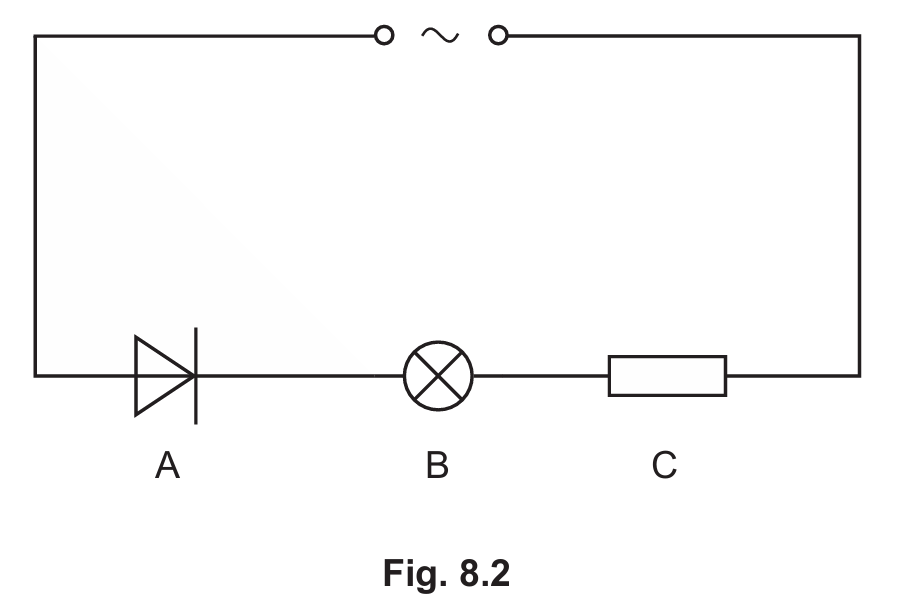
2. mark, with an arrow labelled I, the direction of the conventional current in component C.
Most-appropriate topic codes (Cambridge IGCSE Physics 0625):
• Topic 4.2.2 — Electric current (Parts (a), (b)(i), (b)(ii), (c))
• Topic 4.2.5 — Electrical energy and electrical power (Part (d))
▶️ Answer/Explanation
(a)
For the correct answer:
\(0.017\,\mathrm{s}\) OR \(1.7 \times 10^{-2}\,\mathrm{s}\)
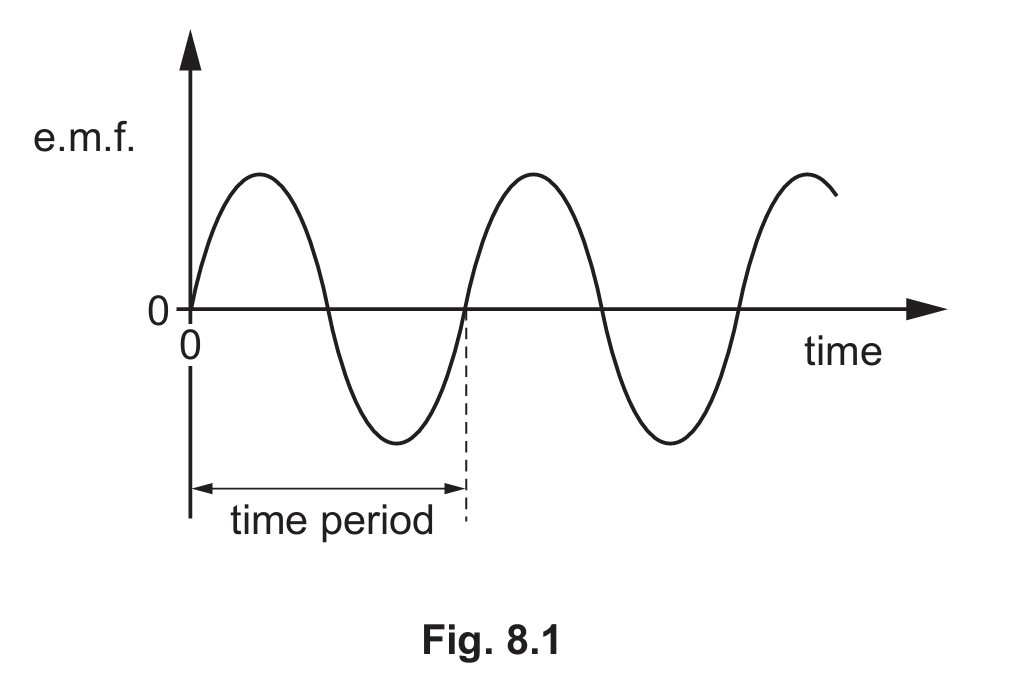
The time period \(T\) and frequency \(f\) of any wave are inversely related: \(T = \frac{1}{f}\). The power supply operates at a frequency of \(60\,\mathrm{Hz}\), meaning 60 complete cycles occur every second. Therefore, the duration of a single cycle is \(\frac{1}{60} = 0.01666…\,\mathrm{s}\), which rounds to \(0.017\,\mathrm{s}\).
(b)(i)
For the correct answer:
Diode
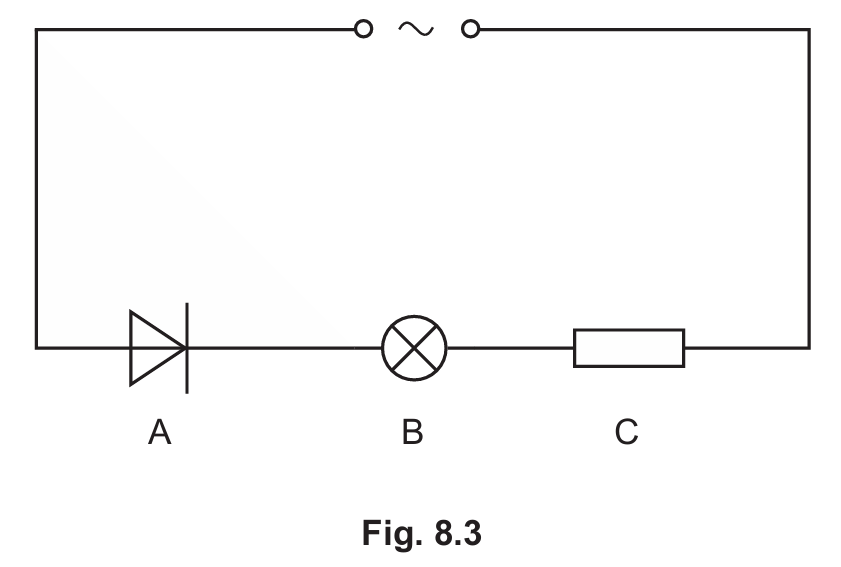
The component labelled A has a specific circuit symbol of a triangle pointing towards a vertical line. This symbol represents a diode, a semiconductor device that allows current to flow in only one direction — effectively acting as a one-way electrical valve.
(b)(ii)
For the correct answer:
\(1.4\,\mathrm{A}\)
Electric current is defined as the rate of flow of charge: \(I = \frac{Q}{t}\). First, find the total charge \(Q\) passing through in one time period by multiplying the number of electrons by the elementary charge: \(Q = 1.5 \times 10^{17} \times 1.6 \times 10^{-19} = 0.024\,\mathrm{C}\). Dividing this charge by the time period from part (a) gives the average current: \(\frac{0.024}{0.017} \approx 1.41\,\mathrm{A}\).
(c)
For the correct diagram markings:
Arrow labelled E: clockwise direction (around the circuit).
Arrow labelled I: anticlockwise direction (around the circuit).
Electrons carry a negative charge and are repelled by the negative terminal of the supply, physically drifting around the circuit from negative to positive. By contrast, conventional current was historically defined as the flow of positive charge, so it is always drawn in the direction from the positive terminal, around the circuit, to the negative terminal — exactly opposite to the electron movement.
(d)
For the correct answer:
\(4.2\,\mathrm{W}\)
The power delivered by any electrical source is the product of its electromotive force and the current it supplies: \(P = IV\). With the d.c. supply providing an e.m.f. of \(12\,\mathrm{V}\) and a current of \(0.35\,\mathrm{A}\) flowing, the power is simply \(12 \times 0.35 = 4.2\,\mathrm{W}\).
Question 9
Most-appropriate topic codes (Cambridge IGCSE Physics 0625):
• Topic 4.2.4 — Resistance (Parts (a)(i), (a)(ii), (a)(iii))
• Topic 4.3.2 — Series and parallel circuits (Part (b))
▶️ Answer/Explanation
(a)(i)
For the correct answer:
\(0\,\mathrm{A}\)
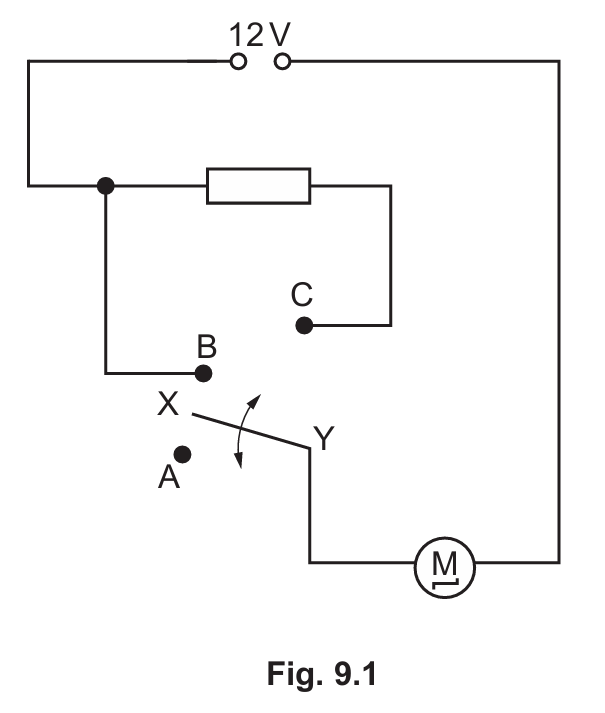
When the switch is connected to point A, the circuit path from the power supply to the motor is not complete. There is a gap, so no current can flow through the motor — the reading would be precisely zero amperes.
(a)(ii)
For the correct answer:
\(6.0\,\mathrm{A}\)
Connecting X to point B places the motor alone directly across the \(12\,\mathrm{V}\) supply. Using Ohm’s law, \(I = \frac{V}{R}\), we insert the voltage and the motor’s resistance: \(I = \frac{12}{2.0} = 6.0\,\mathrm{A}\). This is a relatively large current, as the motor has a low resistance.
(a)(iii)
For the correct answer:
\(2.4\,\mathrm{A}\)
When X connects to point C, the motor and the \(3.0\,\Omega\) resistor are in series across the \(12\,\mathrm{V}\) supply. The total circuit resistance becomes \(R_{\text{total}} = 2.0 + 3.0 = 5.0\,\Omega\). Applying Ohm’s law again: \(I = \frac{12}{5.0} = 2.4\,\mathrm{A}\). The added series resistance has reduced the current flowing through both the motor and the resistor.
(b)
For the correct answer:
\(1.2\,\Omega\)
For two resistors in parallel, the reciprocal of the combined resistance is the sum of the reciprocals of the individual resistances: \(\frac{1}{R_{\text{p}}} = \frac{1}{R_{1}} + \frac{1}{R_{2}}\). Substituting the values: \(\frac{1}{R_{\text{p}}} = \frac{1}{2.0} + \frac{1}{3.0} = \frac{3}{6} + \frac{2}{6} = \frac{5}{6}\). Taking the reciprocal gives \(R_{\text{p}} = \frac{6}{5} = 1.2\,\Omega\). The combined parallel resistance is always less than any of the individual resistances.
Question 10
▶️ Answer/Explanation
(a)
For the correctly completed truth table:
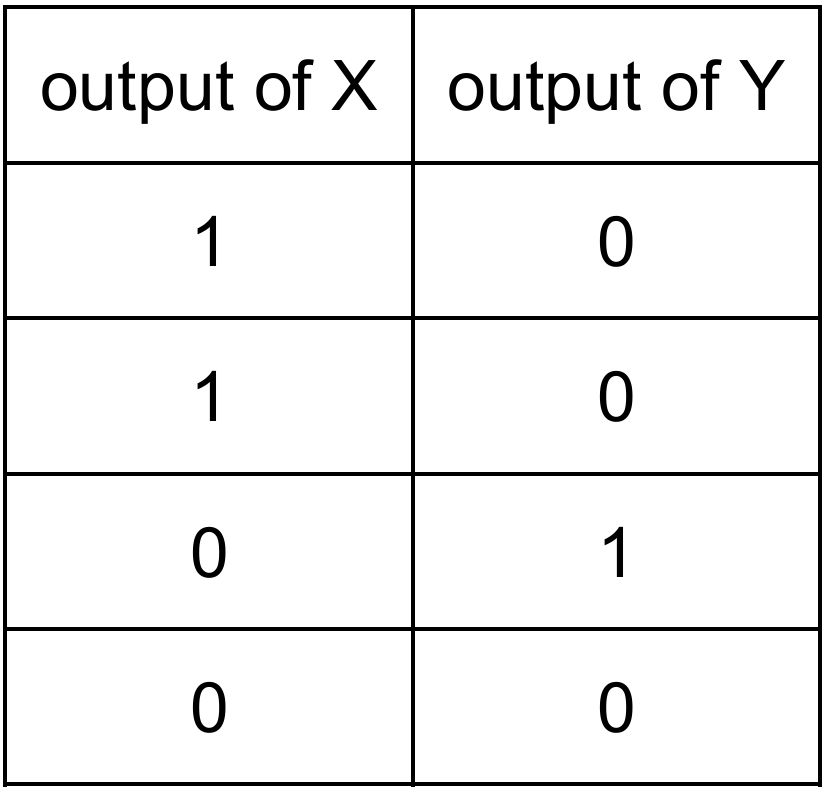
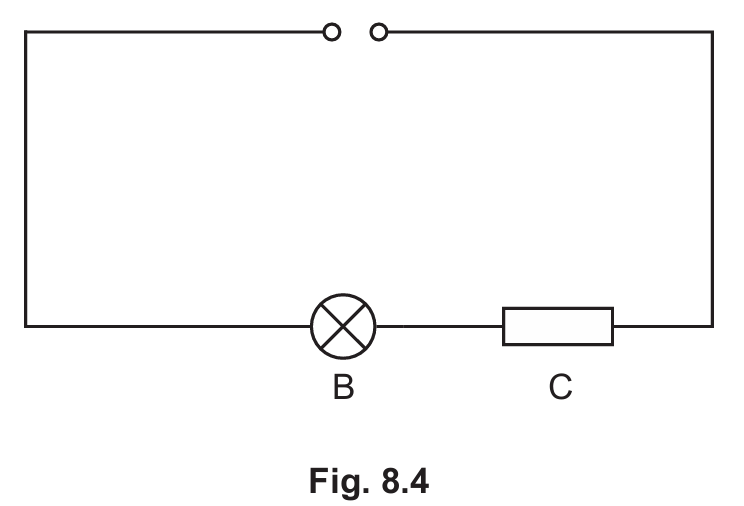
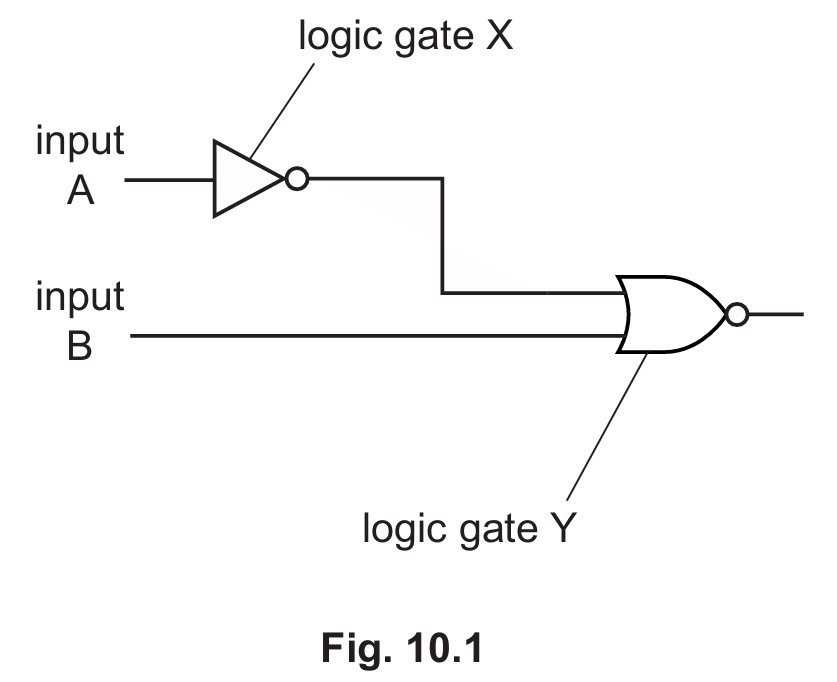
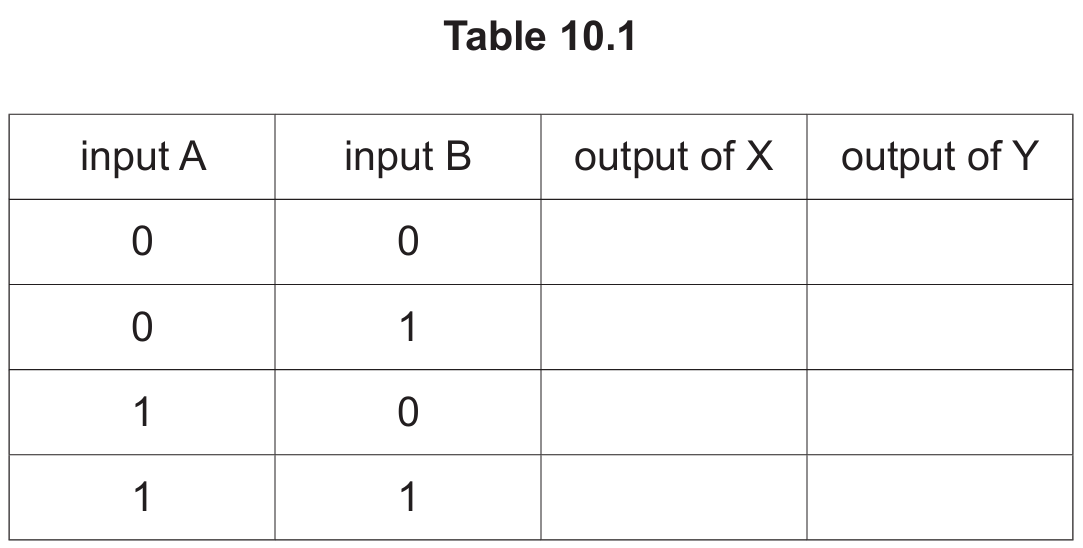
Gate X is a NAND gate, which outputs a logic 1 unless both inputs are 1. So for the input pairs (0,0), (0,1), and (1,0), X gives 1; only (1,1) gives X=0. Gate Y then processes the output of X together with input B through a NOR gate, which outputs 1 only when both its inputs are 0. Tracing each row yields the completed truth table. The buzzer sounds only on the third row.
(b)
For the correct condition:
High humidity AND dark(ness).
From the truth table, the output of Y is logic 1 only when input A is 1 and input B is 0. According to the sensor definitions, A=1 signals high humidity, and B=0 signals darkness. Therefore, the circuit is designed so that the buzzer alerts exactly when it is both humid and dark.
(c)
For the correct component and explanation:
Component: Relay.
Explanation: The low voltage output (of the NOR gate/gate Y) / small current (in the relay coil) is insufficient to power the buzzer directly. The relay uses this small signal to switch a separate circuit, providing a larger current / larger voltage to operate the buzzer.
Digital logic circuits operate at very low power levels — their output cannot drive something like a buzzer, which demands higher current. A relay acts as an electromagnetic switch: the tiny current from the logic gate energises a coil, which physically closes a pair of heavy-duty contacts. These contacts connect the buzzer to its own power supply, allowing it to sound loudly without damaging the delicate logic circuit.
Question 11
Most-appropriate topic codes (Cambridge IGCSE Physics 0625):
• Topic 5.1.1 — The atom (Parts (a)(i), (a)(ii))
• Topic 5.1.2 — The nucleus (Part (b))
▶️ Answer/Explanation
(a)(i)
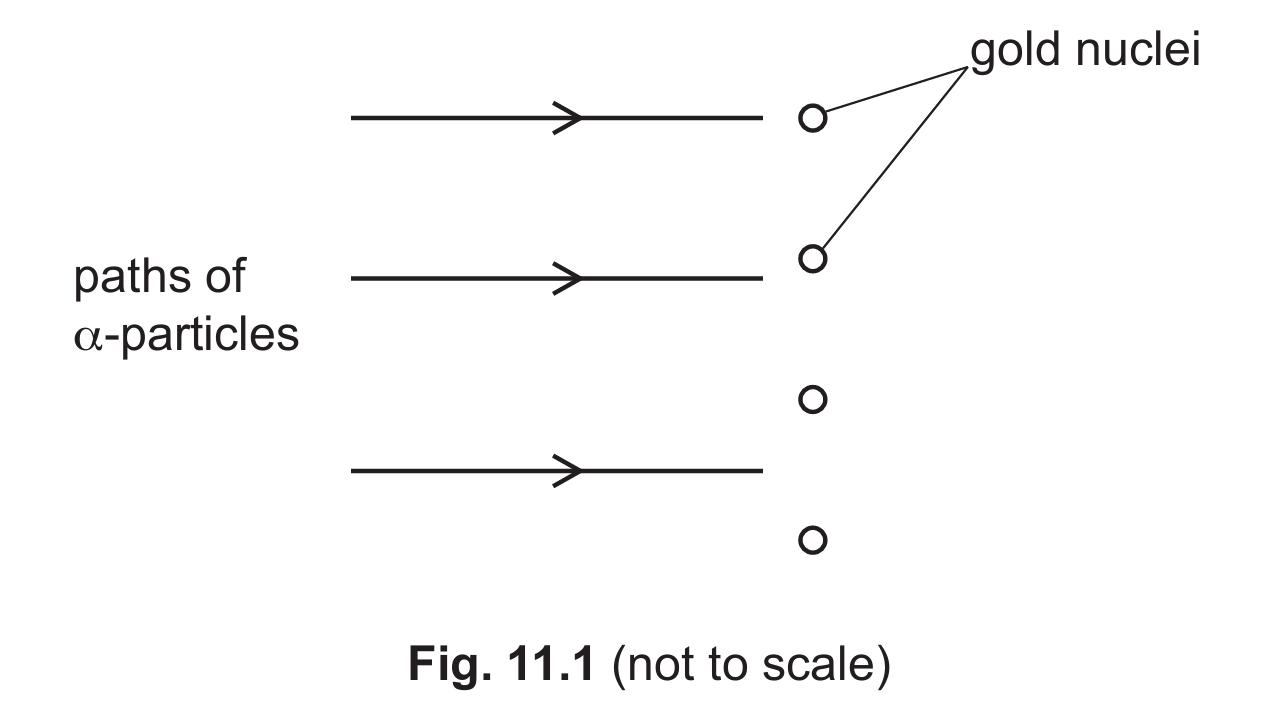
For the correct completed paths:
Top particle: travels straight to the left (undeflected).
Middle particle: deflected downwards, continuing to travel to the right.
Bottom particle: travels straight on (undeflected).
The classic Rutherford scattering experiment shows that most alpha particles pass through the gold foil with little or no deflection, implying that the atom is mostly empty space. The top and bottom particles are far from any nucleus and continue straight. The middle particle, however, passes very close to a positively charged gold nucleus. The strong electrostatic repulsion between the two positive charges causes the alpha particle’s path to curve sharply away — downwards in this case. This deflection pattern provided the crucial evidence for the nuclear model of the atom.
(a)(ii)
For the correct answer:
Plus / positive / \(+\)
An alpha particle consists of two protons and two neutrons bound together; it is essentially a helium nucleus. Since it contains two protons and no electrons, its net charge is \(+2e\), making it a positively charged particle.
(b)
For the correct numbers:
number of electrons = 79
number of neutrons = 119
number of protons = 79
In the nuclide notation \(\frac{198}{79}\mathrm{Au}\), the lower number (79) is the atomic number \(Z\), which tells us there are 79 protons in the nucleus. A neutral atom must have exactly the same number of electrons as protons to balance the charge, so there are 79 electrons. The upper number (198) is the mass number \(A\), representing the total number of protons and neutrons. Subtracting the protons from the mass number: \(198 – 79 = 119\), gives the number of neutrons in the nucleus.