Home / 0625_s24_qp_13_hina

Question 1

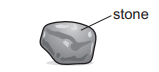
A student wishes to find the volume of a small, irregularly shaped stone.
A ruler and a measuring cylinder containing some water are available. Which apparatus is needed?
A. neither the ruler nor the measuring cylinder
B. the measuring cylinder only
C. the ruler and the measuring cylinder
D. the ruler only

Most-appropriate topic codes (Cambridge IGCSE Physics 0625):

TOPIC 1.1: Physical quantities and measurement techniques (Describe the use of rulers and measuring cylinders to find a length or a volume)
▶️ Answer/Explanation
Correct Option: B

Detailed solution:

To find the volume of an irregularly shaped object like a stone, we cannot use a ruler because there are no regular dimensions (like length or width) to measure and calculate mathematically.
The standard method for this is the displacement method, which requires a measuring cylinder partially filled with a liquid.
First, you record the initial volume of the water in the cylinder, then carefully submerge the stone and record the new, higher volume.
The difference between these two readings represents the volume of the stone.
Since a ruler is useless for non-geometric shapes, only the measuring cylinder is required for this specific task.
Question 2

A car travels along a road at a constant speed. What correctly describes the speed–time graph of the car?
A. a horizontal line
B. a vertical line
C. a diagonal line upwards
D. a curved line with increasing gradient

Most-appropriate topic codes (Cambridge IGCSE Physics 0625):

TOPIC 1.2: Motion (Sketch, plot and interpret distance–time and speed–time graphs; Determine, qualitatively, from given data or the shape of a speed–time graph when an object is moving with constant speed)
▶️ Answer/Explanation
Correct Option: A

Detailed solution:

In a speed–time graph, the vertical axis represents the speed of the object while the horizontal axis represents the time elapsed.
If a car is moving at a constant speed, its velocity does not change as time increases.
On a graph, this means the y-value remains the same regardless of the x-value, resulting in a straight horizontal line.
A diagonal line would imply a changing speed (acceleration), and a vertical line is physically impossible as it would mean time has stopped.
Therefore, a horizontal line with a gradient of 0 is the only correct representation of constant motion on this type of plot.

Question 3

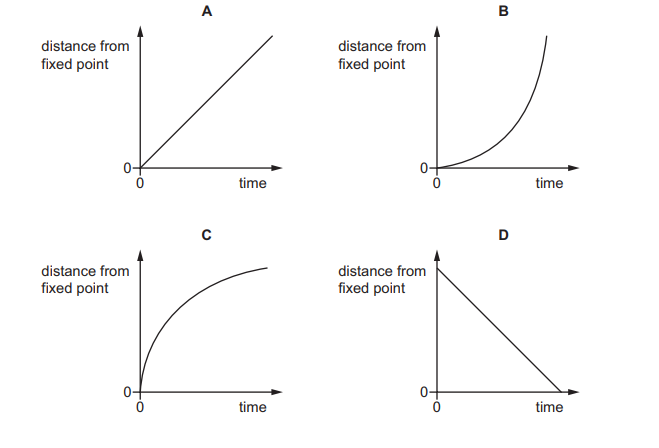
Four objects are moving along a straight line. The distance of each object from a fixed point on the line is plotted against time. Which object is decelerating?

Most-appropriate topic codes (Cambridge IGCSE Physics 0625):

TOPIC 1.2: Motion (Determine, qualitatively, from given data or the shape of a distance–time graph or speed–time graph when an object is decelerating)
▶️ Answer/Explanation
Correct Option: C

Detailed solution:

In a distance-time graph, the gradient (slope) of the curve represents the speed of the object.
If an object is moving at a constant speed, the graph is a straight diagonal line, while a horizontal line indicates the object is stationary.
Deceleration means the speed is decreasing over time, which corresponds to the gradient of the graph becoming flatter (less steep) as time passes.
Looking at graph C, the curve starts with a steep slope and gradually levels off, indicating that the object is covering less distance per unit of time.
Therefore, graph C represents an object that is slowing down, or decelerating, until it eventually comes to a stop.
Question 4

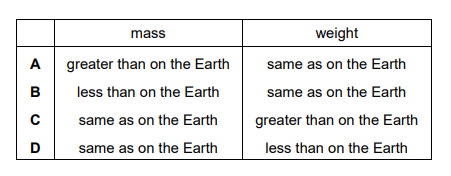
An object is taken from the Earth to the Moon. The acceleration of free fall is $9.8$ $m/s^2$ on the Earth and is $1.6$ $m/s^2$ on the Moon. Which row describes the mass and the weight of the object on the Moon compared to on the Earth?

Most-appropriate topic codes (Cambridge IGCSE Physics 0625):

TOPIC 1.3: Mass and weight (State that mass is a measure of the quantity of matter in an object at rest relative to the observer; state that weight is a gravitational force on an object that has mass; define gravitational field strength as force per unit mass; recall and use the equation $g = \frac{W}{m}$)
▶️ Answer/Explanation
Correct Option: D

Detailed solution:

The mass of an object is a measure of the amount of matter it contains and remains constant regardless of its location in the universe; therefore, the mass on the Moon is the same as on Earth.
Weight, however, is the gravitational force acting on that mass and is calculated using the formula $W = m \times g$.
Since the acceleration of free fall $g$ on the Moon ($1.6$ $m/s^2$) is significantly less than on Earth ($9.8$ $m/s^2$), the gravitational pull is weaker.
This means that while the object’s physical substance doesn’t change, the force pulling it down decreases.
Consequently, the weight of the object on the Moon is less than its weight on Earth, making row D the correct description.
Question 5

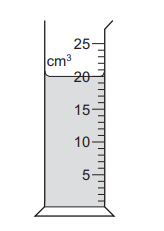
The diagram shows some liquid in a measuring cylinder. The mass of the liquid is $16 \text{ g}$.
What is the density of the liquid?
A. $0.80 \text{ g/cm}^3$
B. $1.3 \text{ g/cm}^3$
C. $36 \text{ g/cm}^3$
D. $320 \text{ g/cm}^3$

Most-appropriate topic codes (Cambridge IGCSE Physics 0625):

TOPIC 1.4: Density (Define density as mass per unit volume; recall and use the equation $\rho = \frac{m}{V}$)
▶️ Answer/Explanation
Correct Option: A

Detailed solution:

To find the density, we first need to determine the volume of the liquid from the measuring cylinder.
By looking closely at the meniscus in the diagram, we can see that the liquid level is at $20 \text{ cm}^3$.
The problem states that the mass of the liquid is $16 \text{ g}$.
Using the density formula, we calculate $\text{density} = \frac{\text{mass}}{\text{volume}}$, which gives us $\frac{16 \text{ g}}{20 \text{ cm}^3}$.
Performing the division, $16 \div 20$ equals $0.80$.
Therefore, the density of the liquid is $0.80 \text{ g/cm}^3$, which matches Option A.
Question 6

A single force acts upon an object and the volume of the object does not change. Which statement is correct?
A. The density of the object changes.
B. The velocity of the object changes.
C. The mass of the object changes.
D. The weight of the object changes.

Most-appropriate topic codes (Cambridge IGCSE Physics 0625):

TOPIC 1.5.1: Effects of forces (State that a resultant force may change the velocity of an object by changing its direction of motion or its speed)
▶️ Answer/Explanation
Correct Option: B

Detailed solution:

When a single resultant force acts on an object, it must cause an acceleration according to Newton’s second law, $F = ma$.
Since there is an acceleration, the velocity of the object must change over time.
The mass of an object is an intrinsic property and does not change just because a force is applied.
Because the mass and volume are constant, the density ($\rho = m/V$) also remains unchanged.
Similarly, weight depends on mass and the gravitational field strength, so it would not be affected by a single applied force.
Therefore, the only correct observation is that the object’s motion or velocity will be altered.

Question 7

Four electric motors do the same quantity of work when they lift a weight of $10\text{ N}$ through the same distance. The times taken by each motor to lift the weight are shown. What is the time taken by the motor which produces the most power?
A. $1.5\text{ s}$
B. $6.0\text{ s}$
C. $15\text{ s}$
D. $60\text{ s}$

Most-appropriate topic codes (Cambridge IGCSE Physics 0625):

TOPIC 1.7.4: Power (Define power as work done per unit time; recall and use the equation $P = \frac{W}{t}$)
▶️ Answer/Explanation
Correct Option: A

Detailed solution:

To solve this, we need to look at the relationship between power, work, and time using the formula $P = \frac{W}{t}$.
The question states that all four motors perform the same quantity of work ($W$) since they lift the same weight through the same distance.
Because the work done is constant, the power produced is inversely proportional to the time taken; this means the shorter the time, the higher the power.
Comparing the given options, $1.5\text{ s}$ is the smallest value for time among the choices provided.
Therefore, the motor that completes the work in $1.5\text{ s}$ is the one that produces the most power, making Option A the correct answer.

Question 8

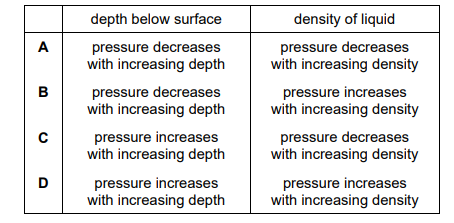
Which row describes how the pressure beneath the surface of a liquid depends on the depth below the surface and on the density of the liquid?

Most-appropriate topic codes (Cambridge IGCSE Physics 0625):

TOPIC 1.8: Pressure (Describe, qualitatively, how the pressure beneath the surface of a liquid changes with depth and density of the liquid)
▶️ Answer/Explanation
Correct Option: D

Detailed solution:

In physics, the pressure exerted by a column of liquid is determined by the formula $P = h \rho g$, where $h$ is the depth, $\rho$ is the density, and $g$ is the gravitational field strength.
Looking at this relationship, we can see that as the depth below the surface increases, the weight of the liquid pressing down above that point increases, leading to higher pressure.
Similarly, if the density of the liquid is higher, the mass per unit volume is greater, which also results in an increase in pressure at any given depth.
Therefore, pressure increases with both increasing depth and increasing density.
By checking the table, Row D correctly identifies that pressure increases in both of these scenarios, making it the correct choice.
Question 9

In which process does a gas turn into a liquid?
A. boiling
B. condensing
C. freezing
D. melting

Most-appropriate topic codes (Cambridge IGCSE Physics 0625):

TOPIC 2.2.3: Melting, boiling and evaporation (Describe condensation and solidification in terms of particles)
▶️ Answer/Explanation
Correct Option: B

Detailed solution:

The transition of a substance from a gaseous state to a liquid state is known as condensation.
This process occurs when the gas particles lose kinetic energy, usually due to cooling, and come closer together to form a liquid phase.
In contrast, boiling is the reverse process (liquid to gas), while freezing refers to a liquid becoming a solid.
Melting describes the change from a solid to a liquid state.
Therefore, when specifically looking for the change from gas to liquid, condensation is the correct scientific term.
This makes Option B the right choice for this phase change.

Question 10

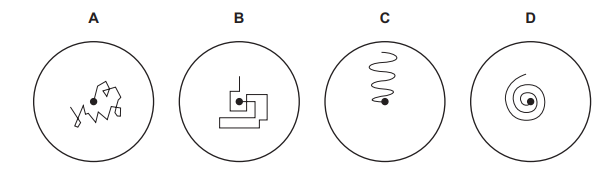
A pollen grain in a beaker of still water is viewed through a microscope. Which diagram shows the most likely movement of the pollen grain?

Most-appropriate topic codes (Cambridge IGCSE Physics 0625):

TOPIC 2.1.2: Particle model (Know that the random motion of microscopic particles in a suspension is evidence for the kinetic particle model of matter)
▶️ Answer/Explanation
Correct Option: A

Detailed solution:

When we observe pollen grains in water, they exhibit what is known as Brownian motion.
This phenomenon occurs because the tiny water molecules are in constant, rapid, and random motion, colliding with the much larger pollen grain from all sides.
Because these collisions are uneven and haphazard, the pollen grain is pushed in various directions, resulting in a jagged and unpredictable path.
Diagram A perfectly represents this random walk, showing the sharp changes in direction that characterize microscopic particles in suspension.
Options B, C, and D suggest smooth or circular patterns, which would imply organized forces that do not exist in a still beaker of water.
Therefore, the completely irregular zig-zag path in A is the only movement that aligns with the kinetic particle model.
Question 11

What is the relationship between temperatures in kelvin ($T$) and temperatures in degrees Celsius ($\theta$)?
A. $\theta = T + 273$
B. $\theta = T – 273$
C. $\theta = T + 373$
D. $\theta = T – 373$

Most-appropriate topic codes (Cambridge IGCSE Physics 0625):

TOPIC 2.1.3: Gases and the absolute scale of temperature (Convert temperatures between kelvin and degrees Celsius; recall and use the equation $T (\text{in K}) = \theta (\text{in } ^\circ\text{C}) + 273$)
▶️ Answer/Explanation
Correct Option: B

Detailed solution:

To convert from the Celsius scale to the Kelvin scale, we use the standard relation $T = \theta + 273$, where $T$ is the temperature in Kelvin and $\theta$ is the temperature in degrees Celsius.
This formula is based on the fact that absolute zero ($0\text{ K}$) is equivalent to $-273^\circ\text{C}$.
If we want to find the expression for $\theta$ in terms of $T$, we simply need to rearrange the equation by subtracting $273$ from both sides.
Subtracting $273$ gives us $\theta = T – 273$.
Comparing this result to the given choices, we can see that it matches perfectly with Option B.
Therefore, to get the Celsius temperature from a Kelvin value, you just subtract $273$ from the Kelvin temperature.

Question 12

In a famous experiment, a scientist showed that, when water in an insulated tub is stirred, its temperature increases. What can be concluded from this experiment?
A. Temperature is a store of energy.
B. The water absorbs heat from the surroundings.
C. Work done by stirring increases the internal energy of the water.
D. Energy is not conserved.

Most-appropriate topic codes (Cambridge IGCSE Physics 0625):

TOPIC 1.7.1: Energy (State that energy may be stored as kinetic, gravitational potential, chemical, elastic (strain), nuclear, electrostatic and internal (thermal))
▶️ Answer/Explanation
Correct Option: C

Detailed solution:

When the water is stirred in an insulated tub, mechanical work is being performed on the liquid by the person or device doing the stirring.
Because the tub is insulated, no heat can enter from the surroundings, meaning the temperature rise isn’t due to external heating.
Instead, the mechanical energy from stirring is transferred to the water molecules, increasing their kinetic energy and thus the total internal energy.
A rise in temperature is a direct indicator that the internal energy of the substance has increased.
Therefore, we can conclude that the work done during stirring is converted into internal energy, which is exactly what Option C describes.

Question 13

Solids expand when heated and contract when cooled. In which example is there a useful application of expansion and not an unwanted effect?
A. bridges
B. railway lines
C. telephone cables
D. thermostats

Most-appropriate topic codes (Cambridge IGCSE Physics 0625):

TOPIC 2.2.1: Thermal expansion of solids, liquids and gases (Describe some of the everyday applications and consequences of thermal expansion)
▶️ Answer/Explanation
Correct Option: D

Detailed solution:

Thermal expansion can be either a problem to overcome or a property to be utilized in engineering.
In bridges, railway lines, and telephone cables, expansion is generally an unwanted effect that requires gaps or slack to prevent buckling or snapping during temperature changes.
However, in a thermostat, we specifically use a bimetallic strip made of two different metals that expand at different rates when heated.
This unequal expansion causes the strip to bend, which mechanically opens or closes an electric circuit to regulate temperature.
Therefore, the thermostat is a classic example where thermal expansion is a deliberate and useful application rather than a nuisance.

Question 14

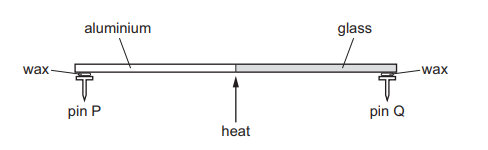
A rod is made half of aluminium and half of glass. A pin is attached to each end of the rod by wax. The rod is heated at the centre. A pin falls off when the wax melts.
Which statement is correct?
A. Pin P falls off first because aluminium is a better thermal conductor than glass.
B. Pin P falls off first because aluminium is a worse thermal conductor than glass.
C. Pin Q falls off first because glass is a better thermal conductor than aluminium.
D. Pin Q falls off first because glass is a worse thermal conductor than aluminium.

Most-appropriate topic codes (Cambridge IGCSE Physics 0625):

TOPIC 2.3.1: Conduction (Describe experiments to demonstrate the properties of good thermal conductors and bad thermal conductors (thermal insulators))
▶️ Answer/Explanation
Correct Option: A

Detailed solution:

When the rod is heated at the center, thermal energy is transferred outward toward both ends via conduction.
Aluminium is a metal, which means it contains a high density of free electrons that transfer heat energy very rapidly throughout the material.
In contrast, glass is an insulator (a poor thermal conductor) because it lacks these free-moving electrons and relies on slower lattice vibrations.
Because aluminium conducts heat much more efficiently than glass, the wax at end P will reach its melting point much faster than the wax at end Q.
Consequently, Pin P will fall off first, making Option A the correct description of the experiment’s outcome.
Question 15

In countries where it is usually hot, houses are often painted white. What is the reason for this?
A. White surfaces are good reflectors of infrared radiation.
B. White surfaces are good conductors of infrared radiation.
C. White surfaces are good absorbers of infrared radiation.
D. White surfaces are good emitters of infrared radiation.

Most-appropriate topic codes (Cambridge IGCSE Physics 0625):

TOPIC 2.3.3: Radiation (Describe the effect of surface colour (black or white) and texture (dull or shiny) on the emission, absorption and reflection of infrared radiation)
▶️ Answer/Explanation
Correct Option: A

Detailed solution:

When sunlight hits a surface, it carries energy in the form of infrared radiation, which we feel as heat.
The color and texture of a surface significantly determine how much of that radiation is kept or bounced away.
White and light-colored surfaces are excellent reflectors and very poor absorbers of infrared radiation.
By painting houses white in hot climates, the majority of the thermal radiation from the sun is reflected back into the atmosphere rather than being absorbed into the walls.
This keeps the interior of the building much cooler than if it were painted a dark color like black, which is a good absorber.
Therefore, Option A is the correct explanation for this common architectural practice.

Question 16

What is the name of the distance from one crest in a transverse wave to the next crest?
A. amplitude
B. period
C. wavefront
D. wavelength

Most-appropriate topic codes (Cambridge IGCSE Physics 0625):

TOPIC 3.1: General properties of waves (Describe the features of a wave in terms of wavefront, wavelength, frequency, crest (peak), trough, amplitude and wave speed)
▶️ Answer/Explanation
Correct Option: D

Detailed solution:

To solve this, we need to look at the basic anatomy of a transverse wave.
The term wavelength refers to the spatial length of one complete wave cycle, which is measured as the distance between two consecutive identical points.
Specifically, measuring from the peak of one wave (the crest) to the very next peak gives us this value, typically denoted by the Greek letter $\lambda$.
Other options like amplitude refer to the height of the wave, while the period is a measure of time, not distance.
Therefore, the distance between successive crests is defined exactly as the wavelength.
This makes Option D the correct physical description for the distance described.

Question 17

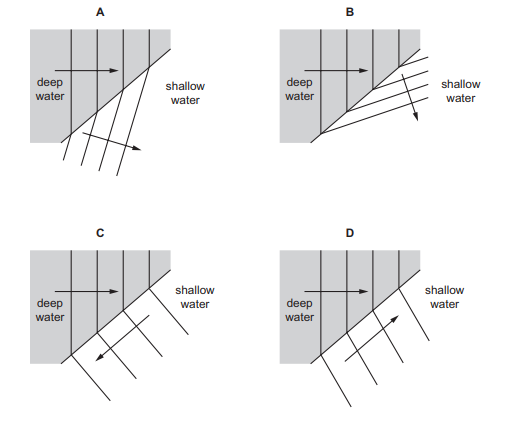
Waves on the surface of water travel from deep water to shallow water. Which diagram shows the correct path of the waves in the shallow water?

Most-appropriate topic codes (Cambridge IGCSE Physics 0625):

TOPIC 3.1: General properties of waves (Describe how waves can undergo refraction due to a change of speed)
▶️ Answer/Explanation
Correct Option: A

Detailed solution:

When water waves transition from deep water to shallow water, their speed decreases because the wave interaction with the seabed becomes more significant.
According to the wave equation $v = f\lambda$, since the frequency $f$ remains constant when a wave changes medium, a decrease in speed $v$ results in a shorter wavelength $\lambda$.
Refraction occurs when the waves hit the boundary at an angle; the side of the wave hitting the shallow water first slows down, causing the wavefronts to bend.
In the shallow region, the wavefronts should be closer together to represent the decreased wavelength and should bend toward the normal.
Looking at the diagrams, Option A correctly depicts both the change in direction and the decrease in the distance between successive wavefronts.
This behavior is consistent with the physical principles of wave refraction in different depths of water.
Question 18

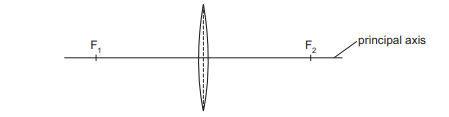
The diagram shows a thin converging lens with principal focuses at $F_1$ and $F_2$.
A small light source is placed at $F_1$. A beam of light from the source passes through the lens. Which statement correctly describes the beam of light emerging from the lens?
A. The beam converges to $F_2$.
B. The beam converges to a point to the right of $F_2$.
C. The beam diverges from a point to the left of $F_1$.
D. The beam travels parallel to the principal axis.

Most-appropriate topic codes (Cambridge IGCSE Physics 0625):

TOPIC 3.2.3: Thin lenses (Define and use the terms focal length, principal axis and principal focus (focal point))
▶️ Answer/Explanation
Correct Option: D

Detailed solution:

This question explores the principle of reversibility of light in a thin converging lens.
We know that light rays traveling parallel to the principal axis will refract through the lens and pass through the principal focus on the opposite side.
Conversely, if a light source is placed exactly at the principal focus ($F_1$), the diverging rays hitting the lens will be refracted so that they emerge perfectly parallel to the principal axis.
This happens because the lens “bends” the spreading rays just enough to straighten them out into a cylindrical beam.
Therefore, the light does not converge to a specific point or continue to diverge, but rather forms a parallel beam, making Option D the correct choice.

Question 19

A student reads the following relationship in his physics book.
$i = r$
What is the student reading about?
A. diffraction due to a gap
B. dispersion of light by a prism
C. reflection in a plane mirror
D. refraction as light enters glass

Most-appropriate topic codes (Cambridge IGCSE Physics 0625):

TOPIC 3.2.1: Reflection of light (State that for reflection, the angle of incidence is equal to the angle of reflection; recall and use this relationship)
▶️ Answer/Explanation
Correct Option: C

Detailed solution:

The equation $i = r$ represents the Law of Reflection, where the angle of incidence is exactly equal to the angle of reflection.
In this context, both angles are measured relative to the normal line, which is perpendicular to the surface of the mirror at the point of impact.
For other phenomena like refraction, the relationship between these angles is governed by Snell’s Law, meaning $i$ is not equal to $r$.
In dispersion and diffraction, the behavior of light is described by wave speed changes or spreading effects rather than a simple equality of angles.
Therefore, the student is specifically looking at the behavior of light when it bounces off a smooth surface like a plane mirror.
This makes Option C the only correct choice based on basic optical laws.

Question 20

The table shows information about different colours of light.
Using the data, what is the frequency of orange light?
A. $4.0 \times 10^{14} \text{ Hz}$
B. $5.0 \times 10^{14} \text{ Hz}$
C. $6.0 \times 10^{14} \text{ Hz}$
D. $7.0 \times 10^{14} \text{ Hz}$

Most-appropriate topic codes (Cambridge IGCSE Physics 0625):

TOPIC 3.1: General properties of waves (Recall and use the equation for wave speed $v = f \lambda$)
▶️ Answer/Explanation
Correct Option: B

Detailed solution:

To find the frequency of orange light, we can use the wave equation $v = f \lambda$, where $v$ is the speed of light, $f$ is the frequency, and $\lambda$ is the wavelength.
In a vacuum or air, all electromagnetic waves travel at a constant speed of approximately $v = 3.0 \times 10^8 \text{ m/s}$.
By looking at the table, orange light is listed with a wavelength of $600 \text{ nm}$, which is $600 \times 10^{-9} \text{ m}$ or $6.0 \times 10^{-7} \text{ m}$.
Rearranging the formula to solve for frequency gives us $f = \frac{v}{\lambda}$.
Plugging in the values, we get $f = \frac{3.0 \times 10^8}{6.0 \times 10^{-7}}$, which simplifies to $0.5 \times 10^{15} \text{ Hz}$.
In standard scientific notation, this equals $5.0 \times 10^{14} \text{ Hz}$, matching option B.
Question 21

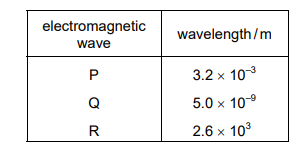
The table gives the wavelengths of three electromagnetic waves.
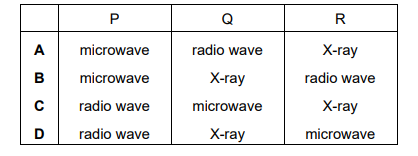
Which row correctly identifies P, Q and R?

Most-appropriate topic codes (Cambridge IGCSE Physics 0625):

TOPIC 3.3: Electromagnetic spectrum (Know the main regions of the electromagnetic spectrum in order of frequency and in order of wavelength)
▶️ Answer/Explanation
Correct Option: B

Detailed solution:

To solve this, we need to compare the given wavelengths to the known regions of the electromagnetic spectrum.
Wave P has a wavelength of $1.0 \times 10^{-11} \text{ m}$, which is extremely short and characteristic of high-energy Gamma rays.
Wave Q is $1.0 \times 10^{-5} \text{ m}$ ($10 \text{ \mu m}$), which falls into the Infrared region just beyond the visible light spectrum.
Wave R has a much longer wavelength of $1.0 \times 10^{2} \text{ m}$ ($100 \text{ meters}$), which is typical for Radio waves used in broadcasting.
By matching these specific values to their respective categories, we can see that Row B correctly identifies all three waves.
Understanding the scale of the EM spectrum from shortest (Gamma) to longest (Radio) is key to identifying these regions.
Question 22

A healthy human ear is able to hear a range of frequencies. What is this approximate range?
A. $10$ Hz to $1000$ Hz
B. $20$ Hz to $2000$ Hz
C. $20$ Hz to $20,000$ Hz
D. $200$ Hz to $200,000$ Hz

Most-appropriate topic codes (Cambridge IGCSE Physics 0625):

TOPIC 3.4: Sound (State the approximate range of frequencies audible to humans as $20$Hz to $20,000$Hz)
▶️ Answer/Explanation
Correct Option: C

Detailed solution:

The range of frequencies that a healthy human ear can detect is known as the audible range.
For humans, the lower limit of hearing is typically around $20$ Hz, which represents very deep, low-pitched bass sounds.
The upper limit for a healthy young person is approximately $20,000$ Hz (or $20$ kHz), where sounds are extremely high-pitched.
Frequencies below this range are called infrasound, while those above are known as ultrasound.
Since the standard accepted value for human hearing covers these three orders of magnitude, Option C is the correct answer.

Question 23

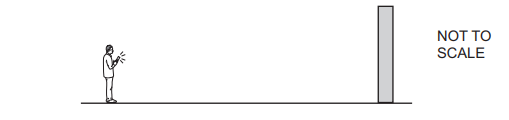
A student hits two wooden blocks together in front of a wall and calculates the speed of sound to be $340 \text{ m/s}$. The time between the student hitting the blocks and hearing the echo is $0.59 \text{ s}$.
What is the distance between the student and the wall?
A. $100 \text{ m}$
B. $200 \text{ m}$
C. $290 \text{ m}$
D. $570 \text{ m}$

Most-appropriate topic codes (Cambridge IGCSE Physics 0625):

TOPIC 3.4: Sound (Describe an echo as the reflection of sound waves)
▶️ Answer/Explanation
Correct Option: A

Detailed solution:

To find the distance to the wall, we first need to determine the total distance traveled by the sound wave.
Since the sound travels from the student to the wall and back again (an echo), the total distance is $2d$, where $d$ is the distance to the wall.
Using the formula $\text{speed} = \frac{\text{distance}}{\text{time}}$, the total distance covered in $0.59 \text{ s}$ at a speed of $340 \text{ m/s}$ is $340 \times 0.59 = 200.6 \text{ m}$.
Because this represents the “round trip,” we must divide this value by $2$ to find the one-way distance to the wall.
Calculation: $d = \frac{200.6}{2} = 100.3 \text{ m}$, which rounds to approximately $100 \text{ m}$.
Therefore, Option A is the correct choice based on the physics of echo reflection.
Question 24

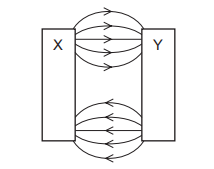
The diagram shows part of the magnetic field between two bar magnets.
Which statement about the ends of the magnets is correct?
A. X and Y are both N poles.
B. X and Y are both S poles.
C. X is an N pole and Y is an S pole.
D. X is an S pole and Y is an N pole.

Most-appropriate topic codes (Cambridge IGCSE Physics 0625):

TOPIC 4.1: Simple phenomena of magnetism (Draw the pattern and direction of magnetic field lines around a bar magnet)
▶️ Answer/Explanation
Correct Option: C

Detailed solution:

To solve this, we need to look closely at the arrows on the magnetic field lines, as they indicate the direction of the field.
By convention, magnetic field lines always point away from a North pole and toward a South pole.
In the diagram, we can clearly see the arrows emerging from the end labeled $X$, which identifies it as a North (N) pole.
Similarly, the arrows are pointing directly into the end labeled $Y$, which identifies it as a South (S) pole.
Since the field lines travel from $X$ to $Y$, these two poles are attracted to each other.
Therefore, $X$ must be an N pole and $Y$ must be an S pole, making Option C the correct choice.
Question 25

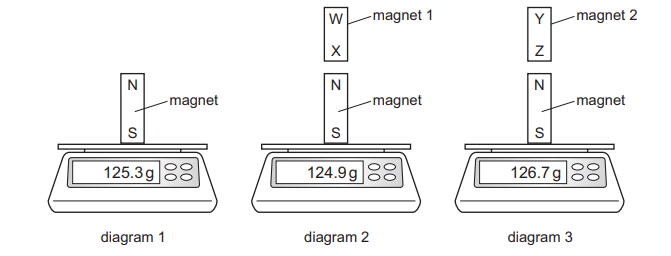
Diagrams 1, 2 and 3 show an experiment to compare two magnets 1 and 2.
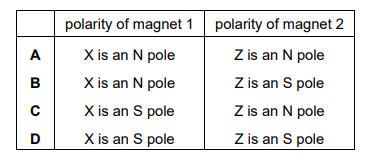
Which row explains the readings on the balances?

Most-appropriate topic codes (Cambridge IGCSE Physics 0625):

TOPIC 4.1: Simple phenomena of magnetism (Describe the forces between magnetic poles and between magnets and magnetic materials, including the use of the terms north pole (N pole), south pole (S pole), attraction and repulsion, magnetised and unmagnetised)
▶️ Answer/Explanation
Correct Option: C

Detailed solution:

In Diagram 1, we see the weight of the steel block alone is $100$ g. In Diagram 2, when Magnet 1 is placed above the block, the reading increases to $120$ g, which means Magnet 1 is attracting the steel block with a force equivalent to $20$ g ($120 – 100$).
In Diagram 3, Magnet 2 is used, and the reading is $125$ g, indicating it exerts a stronger attractive force equivalent to $25$ g ($125 – 100$).
Since Magnet 2 creates a larger change in the balance reading than Magnet 1, Magnet 2 is clearly the stronger magnet.
Furthermore, the increase in weight on the balance occurs because the magnet pulls the steel block upward, and by Newton’s third law, the block pulls the magnet downward, or more accurately, the magnetic attraction creates an internal tension that results in an increased downward force exerted by the apparatus on the scale.
Therefore, Magnet 2 is stronger, and the readings increase because of the magnetic attraction between the magnets and the steel, making row C the correct choice.
Question 26

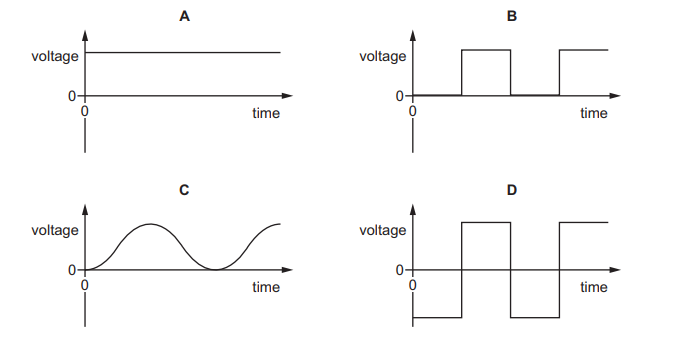
Which graph of voltage against time shows an a.c. voltage?

Most-appropriate topic codes (Cambridge IGCSE Physics 0625):

TOPIC 4.2.2: Electric current (Know the difference between direct current (d.c.) and alternating current (a.c.))
▶️ Answer/Explanation
Correct Option: D

Detailed solution:

Alternating current (a.c.) is characterized by a voltage that continuously changes its magnitude and periodically reverses its direction.
In a voltage-time graph, this means the line must cross the horizontal axis (where $V = 0$) to move between positive and negative values.
Graphs A, B, and C all show voltages that remain on one side of the axis, meaning the current always flows in a single direction, which is characteristic of direct current (d.c.).
Graph D shows a periodic wave that oscillates between positive and negative peaks, indicating the polarity is reversing over time.
Therefore, Graph D is the only one representing an alternating current supply.

Question 27

There is a current $I$ in a resistor for a time $t$. The potential difference (p.d) across the resistor is $V$. What does the product $IVt$ represent?
A. the charge flowing through the resistor
B. the energy transferred by the resistor
C. the power dissipated by the resistor
D. the resistance of the resistor

Most-appropriate topic codes (Cambridge IGCSE Physics 0625):

TOPIC 4.2.5: Electrical energy and electrical power (Recall and use the equation $E = IVt$)
▶️ Answer/Explanation
Correct Option: B

Detailed solution:

To understand what the product $IVt$ represents, we can break down the electrical definitions step by step.
The product of current and time ($I \times t$) gives us the total charge $Q$ that has flowed through the resistor.
When this charge $Q$ moves through a potential difference $V$, the work done or energy transferred is calculated as $W = V \times Q$.
By substituting $Q = It$ into the energy equation, we arrive at the expression $E = VIt$, which represents the total electrical energy transferred.
While $IV$ alone would represent the power (rate of energy transfer), multiplying by time $t$ gives us the total energy quantity.
Therefore, the product $IVt$ specifically identifies the energy transferred by the resistor over that time period.

Question 28

A student designs a circuit to turn on a fan when the temperature increases. Which component does the student need to use in her circuit?

Most-appropriate topic codes (Cambridge IGCSE Physics 0625):

TOPIC 4.3.1: Circuit diagrams and circuit components (Draw and interpret circuit diagrams containing… thermistors (NTC only)… and know how these components behave in the circuit)
▶️ Answer/Explanation
Correct Option: D

Detailed solution:

To create a circuit that responds specifically to temperature changes, we need a component whose electrical properties change with heat.
A thermistor is a temperature-dependent resistor; specifically, an NTC (Negative Temperature Coefficient) thermistor’s resistance decreases as the temperature increases.
Looking at the symbols provided: A is a fuse, B is a variable resistor (rheostat), C is a light-dependent resistor (LDR), and D is a thermistor.
By using the thermistor (Option D), the circuit can “sense” the rise in temperature and allow more current to flow to trigger the fan.
Therefore, component D is the essential choice for any heat-activated electronic design.
Question 29

Four statements about safety when designing electrical products are listed.
  1. If the outer casing is a conductor, it should be earthed.
  2. If the outer casing is a conductor, it should not be earthed.
  3. If the outer casing is an insulator, it should be earthed.
  4. If the outer casing is an insulator, it should not be earthed.
Which statements are correct?
A. 1 and 3
B. 1 and 4
C. 2 and 3
D. 2 and 4

Most-appropriate topic codes (Cambridge IGCSE Physics 0625):

TOPIC 4.3.3: Explain why the outer casing of an electrical appliance is earthed, if the case is made of metal, and why it is not earthed, if the case is made of an insulating material (double insulation)
▶️ Answer/Explanation
Correct Option: B

Detailed solution:

When an electrical appliance has a metal outer casing (a conductor), it must be earthed so that if a fault occurs and a live wire touches the casing, the current flows safely to the ground rather than through a person.
This makes statement 1 correct and statement 2 incorrect.
Conversely, if the outer casing is made of an insulator, such as plastic, it is known as “double insulation.”
Because insulators do not conduct electricity, there is no risk of the casing becoming live, so an earth wire is not required for safety.
Therefore, statement 4 is correct and statement 3 is incorrect, making the combination of 1 and 4 the right choice.

Question 30

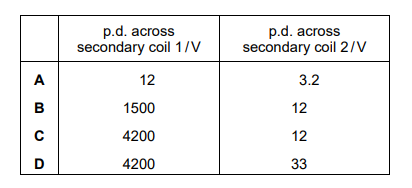
A transformer has $400$ turns on the primary coil connected to the $240\text{V}$ mains supply. There are two secondary coils to serve different parts of a television. Secondary coil 1 has $2500$ turns and secondary coil 2 has $20$ turns. Which row is correct?

Most-appropriate topic codes (Cambridge IGCSE Physics 0625):

TOPIC 4.5.6: Transformers (Describe the construction of a simple transformer and use the equation $\frac{V_p}{V_s} = \frac{N_p}{N_s}$)
▶️ Answer/Explanation
Correct Option: B

Detailed solution:

To find the output voltage for each coil, we use the transformer equation: $\frac{V_p}{V_s} = \frac{N_p}{N_s}$, where $V$ is voltage and $N$ is the number of turns.
For secondary coil 1, we rearrange the formula to $V_{s1} = \frac{V_p \cdot N_{s1}}{N_p}$, giving us $\frac{240 \cdot 2500}{400} = 1500\text{V}$.
For secondary coil 2, using the same logic, we calculate $V_{s2} = \frac{240 \cdot 20}{400} = 12\text{V}$.
Comparing these results to the provided table, we can see that coil 1 acts as a step-up transformer and coil 2 acts as a step-down transformer.
Therefore, the values $1500\text{V}$ and $12\text{V}$ align perfectly with the data in row B.
Question 31

A class is designing a d.c. motor. To achieve a greater turning effect, three suggestions are made.
  1. Have a larger current in the coil of the motor.
  2. Have a stronger magnet in the motor.
  3. Put a larger number of turns on the coil.
Which suggestions will help to increase the turning effect?
A. 1, 2 and 3
B. 1 and 2 only
C. 1 and 3 only
D. 2 and 3 only

Most-appropriate topic codes (Cambridge IGCSE Physics 0625):

TOPIC 4.5.5: The d.c. motor (Know that a current-carrying coil in a magnetic field may experience a turning effect and that the turning effect is increased by increasing: (a) the number of turns on the coil (b) the current (c) the strength of the magnetic field)
▶️ Answer/Explanation
Correct Option: A

Detailed solution:

To increase the turning effect (or torque) of a d.c. motor, we need to increase the magnetic force acting on the sides of the coil.
The force on a wire is proportional to the magnetic field strength, the current, and the number of turns in the coil.
Increasing the current provides more charge flow, which directly boosts the motor’s strength, while a stronger magnet provides a more intense magnetic field for the current to interact with.
Additionally, having more turns on the coil means the magnetic force acts on more segments of wire simultaneously, effectively multiplying the total torque.
Since all three suggestions—increasing current, using a stronger magnet, and adding more turns—contribute to a higher turning effect, option A is the correct choice.

Question 32

Which statement about the structure of an atom is correct?
A. It contains positively charged particles only.
B. It contains negatively charged particles only.
C. It contains no charged particles.
D. It contains positively charged particles and negatively charged particles.

Most-appropriate topic codes (Cambridge IGCSE Physics 0625):

TOPIC 5.1.1: The atom (Describe the structure of an atom in terms of a positively charged nucleus and negatively charged electrons in orbit around the nucleus)
▶️ Answer/Explanation
Correct Option: D

Detailed solution:

An atom is composed of a central, positively charged nucleus surrounded by electrons that move in orbits.
The nucleus contains protons, which carry a positive charge ($+1$), and usually neutrons, which are electrically neutral ($0$).
In the space surrounding the nucleus, we find electrons that carry a negative charge ($-1$).
In a neutral atom, the total number of positive charges in the nucleus equals the total number of negative charges from the electrons.
Therefore, an atom is not made of just one type of charge; it essentially contains both positively and negatively charged particles, making Option D the correct description of its structure.

Question 33

A nuclide of strontium is represented by $_{38}^{90}\textrm{Sr}$.
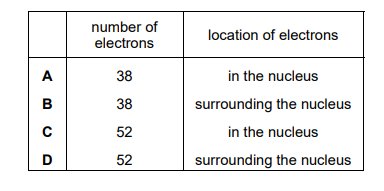
Which row gives the number and location of the electrons in an atom of $_{38}^{90}\textrm{Sr}$?

Most-appropriate topic codes (Cambridge IGCSE Physics 0625):

TOPIC 5.1.1: The atom (Describe the structure of an atom in terms of a positively charged nucleus and negatively charged electrons in orbit around the nucleus)
▶️ Answer/Explanation
Correct Option: B

Detailed solution:

In the standard nuclide notation $_Z^A\textrm{X}$, the bottom number ($Z$) represents the proton number or atomic number.
For a neutral atom of strontium, the number of electrons is always equal to the number of protons to ensure the charges balance out, which in this case is $38$.
Regarding the structure of the atom, we know that protons and neutrons are tightly packed within the central nucleus.
The electrons, however, are found orbiting this nucleus in specific energy levels or shells.
Therefore, a strontium atom contains $38$ electrons located in orbits around the nucleus, matching the description in row B.
This fundamental arrangement defines the basic electronic structure of any neutral atom.
Question 34

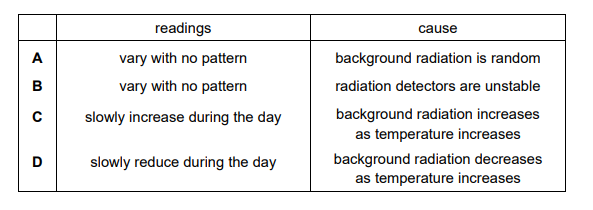
A radiation detector in a laboratory is measuring background radiation. Which row describes the readings and the cause?

Most-appropriate topic codes (Cambridge IGCSE Physics 0625):

TOPIC 5.2.1: Detection of radioactivity (Know what is meant by background radiation; Know the sources that make a significant contribution to background radiation including: (a) radon gas (in the air) (b) rocks and buildings (c) food and drink (d) cosmic rays)
▶️ Answer/Explanation
Correct Option: A

Detailed solution:

Background radiation refers to the low-level ionizing radiation that is constantly present in our environment from both natural and artificial sources.
The radioactive decay process responsible for this radiation is random in nature, meaning the readings on a detector will fluctuate and vary slightly over time rather than remaining constant.
Common sources of this radiation include cosmic rays from space and radioactive rocks in the Earth’s crust, such as those containing uranium or thorium.
Since there is no specific “single” laboratory source mentioned, the detector is picking up these ubiquitous natural emissions.
Therefore, the readings must be described as varying, and the cause is attributed to cosmic rays and rocks, making Option A the correct choice.
Question 35

The nuclei of the atoms in a substance are changing randomly and emitting radiation. What is happening to the substance?
A. It is undergoing electromagnetic induction.
B. It is undergoing magnetisation.
C. It is undergoing solidification.
D. It is undergoing radioactive decay.

Most-appropriate topic codes (Cambridge IGCSE Physics 0625):

TOPIC 5.2.2: The three types of nuclear emission (Describe the emission of radiation from a nucleus as spontaneous and random in direction)
▶️ Answer/Explanation
Correct Option: D

Detailed solution:

Radioactive decay is the process by which an unstable atomic nucleus loses energy by emitting radiation.
This process occurs completely at random, meaning we cannot predict exactly when a specific nucleus will decay.
The emission often involves $\alpha$-particles, $\beta$-particles, or $\gamma$-rays as the nucleus tries to reach a more stable state.
Options A, B, and C refer to physical or magnetic processes that do not involve changes to the atomic nucleus itself.
Therefore, a substance whose nuclei are changing and emitting radiation is by definition undergoing radioactive decay, matching Option D.

Question 36

What is the safest way to store a radioactive source?
A. in a lead-lined box in a metal cabinet
B. on a shelf away from other radioactive materials
C. in a glass bottle containing oil
D. in a fume cupboard

Most-appropriate topic codes (Cambridge IGCSE Physics 0625):

TOPIC 5.2.5: Safety precautions (Describe how radioactive materials are moved, used and stored in a safe way)
▶️ Answer/Explanation
Correct Option: A

Detailed solution:

Radioactive materials emit ionizing radiation such as alpha, beta, and gamma rays, which can be harmful to living tissue.
To minimize exposure, these sources must be shielded by materials with high density and high atomic numbers, such as lead, which effectively absorbs most radiations.
Storing the source in a lead-lined box ensures that the radiation is contained within the container rather than escaping into the environment.
Furthermore, placing that box inside a locked metal cabinet provides an extra layer of distance and security, preventing unauthorized access.
Other options like glass bottles or fume cupboards do not provide sufficient density to block penetrating gamma rays, making Option A the correct safety protocol.

Question 37

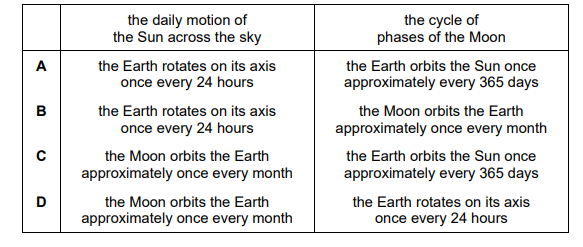
Which row explains the apparent daily motion of the Sun across the sky and the cycle of phases of the Moon?

Most-appropriate topic codes (Cambridge IGCSE Physics 0625):

TOPIC 6.1.1: The Earth (Know that the Earth is a planet that rotates on its axis, which is tilted, once in approximately 24 hours, and use this to explain observations of the apparent daily motion of the Sun and the periodic cycle of day and night; Know that it takes approximately one month for the Moon to orbit the Earth and use this to explain the periodic nature of the Moon’s cycle of phases)
▶️ Answer/Explanation
Correct Option: B

Detailed solution:

To understand the apparent daily motion of the Sun, we must look at the Earth’s behavior; the Sun appears to move across the sky because the Earth rotates on its own axis once every $24$ hours.
This rotation creates the illusion of the Sun rising and setting, even though the Sun is relatively stationary compared to Earth’s spin.
Regarding the phases of the Moon, these are caused by the Moon’s orbit around the Earth, which takes approximately $27.3$ days.
As the Moon moves around our planet, different portions of its illuminated half become visible to us from Earth.
Combining these two facts, the Sun’s daily motion is due to Earth’s rotation and the Moon’s phases are due to the Moon’s orbit, making Option B the correct choice.

Question 38

The nearest star to the Sun is $4$ light-years away. A spaceship travels at $0.1\%$ of the speed of light. What is the total time taken for a journey from the Sun to the star and back again?
A. 400 years
B. 800 years
C. 4000 years
D. 8000 years

Most-appropriate topic codes (Cambridge IGCSE Physics 0625):

TOPIC 6.2.2: Stars (State that astronomical distances can be measured in light-years, where one light-year is the distance travelled in space by light in one year)
▶️ Answer/Explanation
Correct Option: D

Detailed solution:

To solve this, we first look at the distance for a one-way trip, which is $4$ light-years. Since the return journey is also required, the total distance traveled is $4 \times 2 = 8$ light-years.
A light-year is the distance light travels in one year, so at $100\%$ the speed of light, the trip would take $8$ years.
However, the spaceship is only traveling at $0.1\%$ of the speed of light, which can be written as a fraction: $\frac{0.1}{100} = 0.001$.
To find the time, we use the relationship $time = \frac{distance}{speed}$, giving us $\frac{8 \text{ light-years}}{0.001 \times c}$.
This calculation results in $8 \div 0.001 = 8000$ years for the round trip.
Therefore, Option D is the correct duration for the entire journey.

Question 39

In which regions of the electromagnetic spectrum does the Sun radiate most of its energy?
A. microwave to infrared
B. ultraviolet to X-ray
C. infrared to ultraviolet
D. radio to infrared

Most-appropriate topic codes (Cambridge IGCSE Physics 0625):

TOPIC 6.2.1: Know that the Sun is a star of medium size, consisting mostly of hydrogen and helium, and that it radiates most of its energy in the infrared, visible light and ultraviolet regions of the electromagnetic spectrum
▶️ Answer/Explanation
Correct Option: C

Detailed solution:

The Sun behaves much like a black body radiator, emitting a broad range of wavelengths across the electromagnetic spectrum.
The peak of the Sun’s energy output occurs in the visible light region, which is what we see during the day.
However, a massive portion of its energy is also radiated in the wavelengths immediately surrounding visible light: the infrared (heat) and ultraviolet (UV) regions.
While the Sun does emit radio waves and X-rays, the total power in those bands is negligible compared to the “middle” of the spectrum.
Therefore, the vast majority of solar radiation is concentrated from the infrared through to the ultraviolet range, making Option C the correct choice.

Question 40

What is the approximate diameter of the Milky Way?
A. $100,000$ kilometres
B. $1,000,000$ kilometres
C. $100,000$ light-years
D. $1,000,000$ light-years

Most-appropriate topic codes (Cambridge IGCSE Physics 0625):

TOPIC 6.2.3: The Universe (Know that the Milky Way is one of many billions of galaxies making up the Universe and that the diameter of the Milky Way is approximately $100,000$ light-years)
▶️ Answer/Explanation
Correct Option: C

Detailed solution:

To answer this, we need to consider the vast scale of our galaxy, the Milky Way.
While a hundred thousand kilometres might sound like a large distance on Earth, it is extremely small in astronomical terms—even the Sun is much larger than that.
Galaxies are composed of billions of stars spread across massive distances, so we use “light-years” as the standard unit of measurement.
A light-year is the distance light travels in one year, which is roughly $9.5 \times 10^{12}$ km.
Scientific observations and data confirm that the diameter of the Milky Way’s disk is approximately $100,000$ light-years.
Therefore, Option C is the correct value commonly taught in physics and astronomy curricula.

Scroll to Top