
Question 1
Most-appropriate topic codes (Cambridge IGCSE Physics 0625):
• Topic $1.2$ — Motion (Parts $\mathrm{(a)}$, $\mathrm{(b)}$, $\mathrm{(c)}$)
▶️ Answer/Explanation
(a)
For the correct answer:
(constant) acceleration OR accelerating OR increasing speed
Detailed solution:
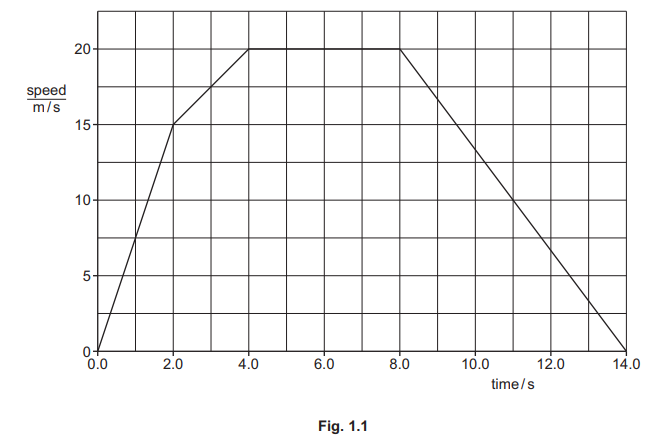
Between $0$ and $2.0\text{ s}$ the graph shows a straight line sloping upwards, meaning the speed increases at a constant rate. This indicates uniform acceleration.
(b)
For the correct answer:
zero
Detailed solution:
Between $4.0\text{ s}$ and $8.0\text{ s}$ the graph is a horizontal line, showing the speed is constant. Acceleration is the gradient of a speed–time graph; a horizontal line has zero gradient, so acceleration is zero.
(c)
For the correct answer:
$60\text{ (m)}$
$ \frac{1}{2} \times 6 \times 20$
distance = area under (speed–time) graph OR $ \frac{1}{2} \times b\times h$
Detailed solution:
Distance travelled equals the area under the speed–time graph. From $8.0\text{ s}$ to $14.0\text{ s}$ the graph forms a triangle with base $6\text{ s}$ and height $20\text{ m/s}$. Using the area of a triangle formula: $\frac{1}{2} \times 6 \times 20 = 60\text{ m}$.
Question 2
Most-appropriate topic codes (Cambridge IGCSE Physics 0625):
• Topic 1.4 — Density (Parts (a), (b))
▶️ Answer/Explanation
(a)
Any three from:
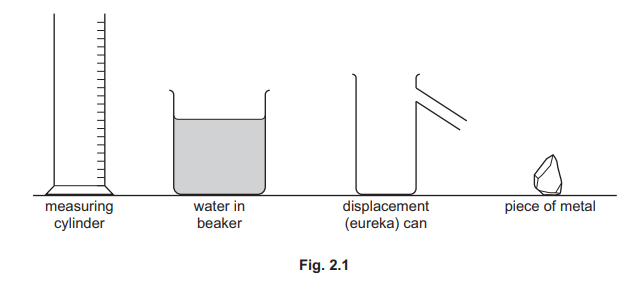
• measuring cylinder (part) filled with water
• volume of water measured or recorded/noted/read
• metal submerged / placed in water owtte
• new volume read / noted / measured / recorded
• volume of metal = difference in volumes
Detailed solution: Pour water into the measuring cylinder and record the initial volume \(V_1\). Carefully submerge the metal piece completely in the water, ensuring no air bubbles are trapped, and record the new volume \(V_2\). The volume of the metal is calculated as the difference \(V_{\text{metal}} = V_2 – V_1\), using the principle of liquid displacement for an irregularly shaped solid.
(b)
\((\rho =)\) 6
\((\rho =)\) \(192 \div 30\)
(density =) mass ÷ volume OR \((\rho =) m / V\) in any form
\(g / cm^3\)
Detailed solution: Density is defined as mass per unit volume, given by \(\rho = \frac{m}{V}\). Substituting the given values, \(\rho = \frac{192\text{ g}}{30\text{ cm}^3} = 6.4\text{ g/cm}^3\), which requires stating the correct numerical value with the appropriate derived unit for density.
Question 3
Most-appropriate topic codes (Cambridge IGCSE Physics 0625):
• Topic 1.5.3 — Centre of gravity (Part (a))
• Topic 1.3 — Mass and weight (Part (b))
• Topic 1.5.2 — Turning effect of forces (Parts (c)(i), (c)(ii))
▶️ Answer/Explanation
(a)
For the correct answer:
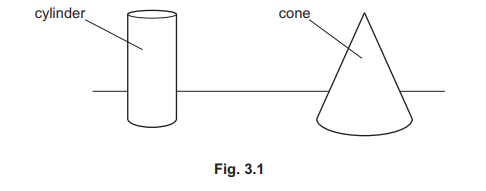
cone
For the explanation:
(because it has) lower centre of mass/gravity
The stability of an object is determined by the position of its centre of gravity. A cone has a wider base and its mass is distributed lower down compared to a cylinder of the same material and height, resulting in a lower centre of gravity. An object with a lower centre of gravity requires a greater angle of tilt before its line of action of weight falls outside its base, making it more stable.
(b)
For the correct answer:
(weight =) 2.5 (N)
Weight is the gravitational force acting on an object’s mass and is calculated using the equation $W = mg$, where $g$ is the gravitational field strength ($9.8\text{ m/s}^2$ or approximately $10\text{ m/s}^2$ on Earth). Substituting the given mass: $W = 0.25\text{ kg} \times 10\text{ N/kg}$ (or $9.8\text{ N/kg}$) $= 2.5\text{ N}$ (or $2.45\text{ N}$).
(c)(i)
For the correct answer:
(moment =) 66 (Ncm)
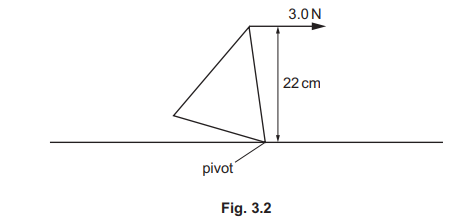
The moment of a force is the measure of its turning effect and is calculated by multiplying the force by the perpendicular distance from the pivot. In Fig. 3.2, the horizontal force of $3.0\text{ N}$ acts at a perpendicular distance of $22\text{ cm}$ from the pivot. Therefore, the moment $= 3.0\text{ N} \times 22\text{ cm} = 66\text{ Ncm}$.
(c)(ii)
For the correct answer:
(moment of weight =) answer to (c)(i) OR 66 (Ncm)
According to the principle of moments, for an object in equilibrium (as the cone is balancing on one edge), the sum of the clockwise moments about the pivot must equal the sum of the anticlockwise moments. The $3.0\text{ N}$ force creates a clockwise moment. The weight of the cone, acting downwards through its centre of gravity, creates an equal and opposite anticlockwise moment to maintain the balance.
Question 4
Fig. 4.1 shows a flow diagram for the energy transferred in a television.
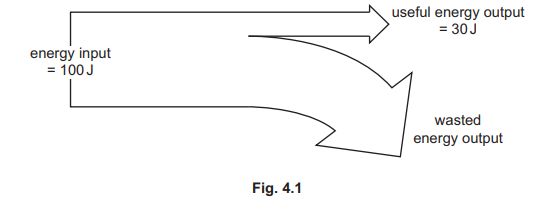
(a) (i) State two ways in which useful energy is transferred from the television.
(ii) Determine the value of the wasted energy output from the television.
(b) Fig. 4.2 represents a hydroelectric power station.
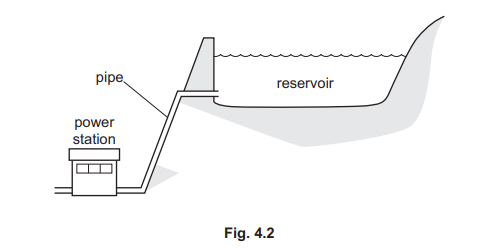
(i) Describe how a hydroelectric power station generates electrical power.
(ii) Apart from cost, state one advantage and one disadvantage of generating electrical power using a hydroelectric power station compared to a coal-fired power station.
Most-appropriate topic codes (Cambridge IGCSE Physics 0625):
• Topic 1.7.1 — Energy (Parts (a)(i), (a)(ii))
• Topic 1.7.3 — Energy resources (Parts (b)(i), (b)(ii))
▶️ Answer/Explanation
(a)(i)
light
sound
(a)(ii)
(100 – 30 =) 70 (J)
(b)(i)
any three from:
water (behind dam) has gravitational OR potential energy
water flows down / moves in / goes through pipe OR through (HEP) station OR through turbine
water turns / moves / rotates / spins turbine
(turbine) turns / moves / rotates / spins generator
(b)(ii)
any one advantage from:
renewable form of energy
no greenhouse gases OR no \(CO_2\)
no atmospheric / air pollution
short start-up time owtte
any one disadvantage from:
(large area of) land flooded
relocation of population
damage to (land / valley) habitats OR migration of fish (upriver) interrupted owtte
vulnerable to drought
idea of limited suitable sites
reduced water supply downstream owtte
Detailed solution:
The television transfers 100 J of electrical energy input into 30 J of useful light and sound energy. By the principle of conservation of energy (Topic 1.7.1), the remaining energy is wasted as thermal energy (heat). The wasted energy is calculated as total input minus useful output: 100 J – 30 J = 70 J. In a hydroelectric power station (Topic 1.7.3), water stored behind a dam possesses gravitational potential energy which is converted to kinetic energy as it flows down through a turbine, causing it to rotate. The turbine is connected to a generator, which converts this kinetic energy into electrical energy.
Question 5
Most-appropriate topic codes (Cambridge IGCSE Physics 0625):
• Topic 2.1.2 — Particle model (Parts (a), (b)(i), (b)(ii))
• Topic 1.8 — Pressure (Part (c))
▶️ Answer/Explanation
(a)
For the correct answer:
(particles are) fixed in position / in lattice OR regular / fixed arrangement / pattern
can only vibrate / no translational KE
close / closer (than in liquids or gases)
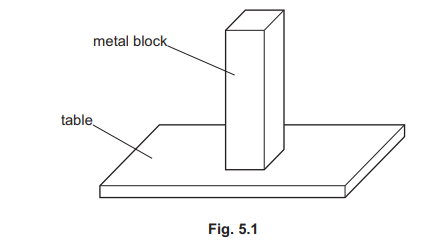
In a solid metal block, the particles are arranged in a regular, repeating pattern known as a lattice. They are held closely together by strong forces of attraction, which restricts their movement to small vibrations about their fixed positions; they possess no translational kinetic energy.
(b)(i)
For the correct answer:
(particles move) closer (as temperature decreases)
particles vibrate slower / less OR have smaller vibrations
As the temperature of the metal block decreases, the average kinetic energy of its particles reduces. This causes the particles to vibrate with less speed and amplitude, and their average separation distance decreases slightly as the block undergoes thermal contraction.
(b)(ii)
For the correct answer:
(at absolute zero particles have) least / smallest vibrations
Absolute zero ($-273^{\circ}\text{C}$ or $0\text{ K}$) is the lowest possible theoretical temperature. At this limit, particles within the metal block would possess the minimum possible kinetic energy and would exhibit only their least, or smallest, vibrations.
(c)
For the correct answer:
(P =) \(0.62 (\text{N} / \text{cm}^2)\)
(P =) 26 ÷ 42
(P =) F ÷ A
Pressure is defined as the force acting per unit area. Using the formula $P = \frac{F}{A}$, substitute the weight of the block for the force ($F = 26\text{ N}$) and the given contact area ($A = 42\text{ cm}^2$). The calculation yields $P = \frac{26}{42} = 0.619\text{ N/cm}^2$, which rounds to $0.62\text{ N/cm}^2$.
Question 6
A student studies different types of wave.
(a) She studies waves on the surface of water in a ripple tank. The frequency of the waves is 4.0Hz. The wavelength of the waves is 5.0cm. Calculate the speed of the waves.
(b) The student puts a block into the ripple tank, as shown in Fig. 6.1. The block sinks. The waves travel towards the block and then over the block.
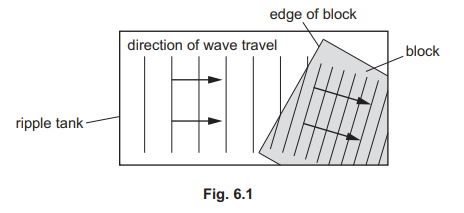
State and explain what happens to the waves as they travel over the edge of the block.
(c) The chart in Fig. 6.2 shows the main regions of the electromagnetic spectrum. 
(i) State the name of one region in Fig. 6.2 that has longer wavelengths than visible light.
(ii) Describe one use of ultraviolet radiation.
(iii) Compare the speed of radio waves with the speed of gamma rays as they both travel through a vacuum
Most-appropriate topic codes (Cambridge IGCSE Physics 0625):
• Topic 3.1 — General properties of waves (Part (a), (b))
• Topic 3.3 — Electromagnetic spectrum (Part (c)(i), (c)(ii), (c)(iii))
▶️ Answer/Explanation
Ans
(a) (v =) 20 (cm / s)
(v =) \(4(.0)\times 5(.0) \)
(v =) \(f \times \lambda \)
Detailed Solution:
Wave speed is calculated using \(v = f \lambda\). Substituting \(f = 4.0\ \mathrm{Hz}\) and \(\lambda = 5.0\ \mathrm{cm}\) gives \(v = 4.0 \times 5.0 = 20\ \mathrm{cm/s}\). This applies the core wave equation from Topic 3.1.
(b) any three from:
refraction
direction of waves / wavefronts changes
(due to) change in speed
wavelength changes
as depth of water changes
Detailed Solution:
As waves move into shallower water over the block, their speed decreases. This causes refraction: the wavelength shortens and the wavefronts change direction unless approaching along the normal. This demonstrates wave behavior from Topic 3.1.
(c)(i) radio waves OR microwaves OR infrared
Detailed Solution:
In the electromagnetic spectrum, regions with longer wavelengths than visible light are radio waves, microwaves, and infrared. Any of these is a correct response under Topic 3.3.
(ii) security marking OR detecting forged bank notes OR sterilising food / water
Detailed Solution:
Ultraviolet radiation is used to reveal security markings on banknotes or to sterilize surfaces and water by killing microorganisms. This is a practical application listed in Topic 3.3.
(iii) (both have) same speed owtte
Detailed Solution:
All electromagnetic waves travel at the same speed in a vacuum, \(3.0 \times 10^8\ \mathrm{m/s}\). Therefore, radio waves and gamma rays have identical speeds as per Topic 3.3.
Question 7
A battery, a lamp L, a fixed resistor R and a switch S are connected as shown in Fig. 7.1.
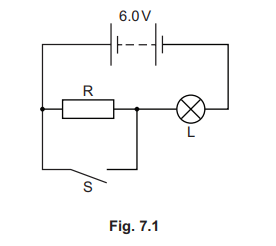
(a) The potential difference (p.d.) across lamp L is 4.8V and the current in lamp L is 0.40A. Calculate the resistance of lamp L.
(b) State and explain how closing switch S affects the brightness of lamp L.
Most-appropriate topic codes (Cambridge IGCSE Physics 0625):
• Topic 4.2.4 — Resistance (Part (a))
• Topic 4.3.2 — Series and parallel circuits (Part (b))
▶️ Answer/Explanation
(a)
12 \( \Omega \)
Resistance is calculated using the equation \( R = \frac{V}{I} \). Substituting the given values: \( R = \frac{4.8\text{ V}}{0.40\text{ A}} = 12\ \Omega \).
(b)
Lamp L becomes brighter (brightness increases).
Closing switch S places resistor R in parallel with the wire, significantly reducing the total resistance of that branch. This decreases the overall circuit resistance, increasing the total current from the battery and the potential difference across lamp L, thus causing a higher current through the lamp.
Question 8
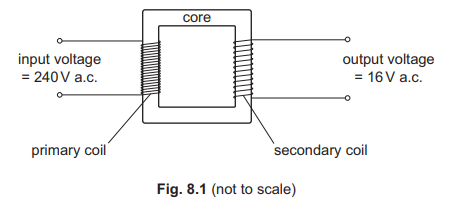
Most-appropriate topic codes (Cambridge IGCSE Physics 0625):
• Topic 4.2.5 — Electrical energy and electrical power (Part (a))
• Topic 4.5.6 — The transformer (Parts (b)(i), (b)(ii))
▶️ Answer/Explanation
(a)
For the correct answer:
30 000 (J)
(E =) \(1.8\times 1200\times 14\) OR \(2160\times 14\)
(E =) \(1.8\times 20\times 14\) OR \(36\times 14\)
(E =)\(I\times t \times V\) OR E =\(P\times t\) AND \(P = I\times V\)
Electrical energy transferred is calculated using \(E = IVt\). Convert time to seconds: \(20\text{ min} = 20 \times 60 = 1200\text{ s}\). Substitute values: \(E = 1.8\text{ A} \times 14\text{ V} \times 1200\text{ s} = 30\,240\text{ J}\), which rounds to \(30\,000\text{ J}\).
(b)(i)
For the correct answer:
(soft) iron
A transformer core is made of soft iron because it is easily magnetised and demagnetised, allowing efficient transfer of the changing magnetic field between the primary and secondary coils with minimal energy loss.
(b)(ii)
For the correct answer:
320 (turns)
\(16 / 240 =N_s / 4800\) OR \(240 / 16 = 4800 / N_s\) OR \(N_s = 4800\times {16 / 240}\)
\((V_s / V_p) = (N_s / N_p)\) in any form
Using the transformer equation \(\frac{V_s}{V_p} = \frac{N_s}{N_p}\). From Fig. 8.1, \(V_p = 240\text{ V}\) and \(V_s = 16\text{ V}\). Substitute: \(\frac{16}{240} = \frac{N_s}{4800}\). Rearranging: \(N_s = \frac{16}{240} \times 4800 = 320\) turns.
Questions 9
(a) Fig. 9.1 shows an electricity cable that has a fault.
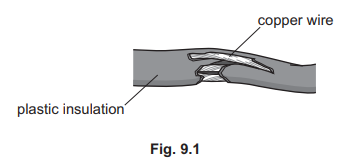
The cable is used for supplying electricity at a high voltage. State the fault and describe the hazard shown in Fig. 9.1.
(b) Fig. 9.2 shows a piece of cable used in a mains circuit. 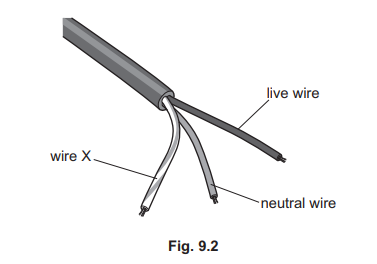
(i) State the name of wire X in Fig. 9.2.
(ii) An electrical appliance is connected in the mains circuit. One of the wires in the cable is connected to the switch for the appliance. State and explain which wire is connected to the switch.
Most-appropriate topic codes (Cambridge IGCSE Physics 0625):
• Topic 4.4 — Electrical safety (Parts (a), (b)(i), (b)(ii))
▶️ Answer/Explanation
(a)
fault: insulation damaged owtte
hazard: electrocution OR electric shock
Detailed solution: The cable’s outer insulating layer is visibly broken, exposing the inner conductor. Damaged insulation removes the protective barrier, creating a severe risk of electric shock or electrocution if a person touches the live conductor.
(b)(i)
earth (wire)
Detailed solution: In standard mains wiring, the earth wire has yellow/green insulation. The diagram shows wire X with this distinctive colour pattern, identifying it as the earth wire for safety protection.
(b)(ii)
(switch is connected in) live (wire)
(so appliance is) disconnected from main / supply OR disconnected from high voltage (when switch is open / off)
Detailed solution: The switch must be placed in the live wire. This ensures that when the switch is off, the appliance is completely isolated from the high voltage mains supply, preventing current flow and making it safe to touch.
Question 10
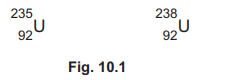
(a) U-235 and U-238 are isotopes of uranium. Fig. 10.1 shows the nuclide notation for U-235 and for U-238.
(i) Compare the number of protons in one nucleus of U-235 with the number of protons in one nucleus of U-238.
(ii) Compare the number of neutrons in one nucleus of U-235 with the number of neutrons in one nucleus of U-238.
(b) A sample contains another isotope of uranium. The half-life of this isotope is 24 minutes. Calculate the time taken for the mass of this isotope in the sample to decay from 16.0mg to 4.0mg.
Most-appropriate topic codes (Cambridge IGCSE Physics 0625):
• Topic 5.1.2 — The nucleus (Parts (a)(i), (a)(ii))
• Topic 5.2.4 — Half-life (Part (b))
▶️ Answer/Explanation
Ans
(a)(i) both have 92 (protons) OR same (number of protons)
(ii) U-235 has (3) fewer neutrons OR U-238 has (3) more neutrons OR U-235 has 143 and U-238 has 146 neutrons
(b) \((2\times 24 =)\) 48 (minutes)
(change in mass takes place over / decay takes) 2 half-lives
\(16\to 8(.0)\to 4(.0)\) OR \(16\times ½\times ½ (= 4(.0))\)
Detailed Solution: (a)(i) Isotopes have the same proton number, so both U-235 and U-238 contain 92 protons. (a)(ii) The neutron number is A – Z, giving 143 for U-235 and 146 for U-238. (b) The mass halves each half-life: 16.0 mg → 8.0 mg (24 min) → 4.0 mg (48 min).
Question 11
Most-appropriate topic codes (Cambridge IGCSE Physics 0625):
• Topic 6.1.2 — The Solar System (Parts (a)(i), (a)(ii), (a)(iii))
• Topic 6.2.2 — Stars (Part (b))
▶️ Answer/Explanation
(a)(i)
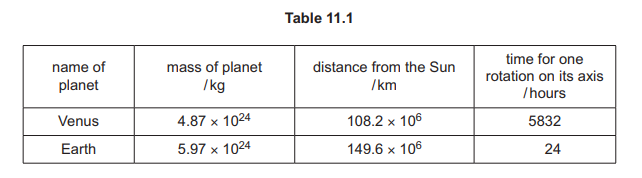
Earth has greater mass ORA
Gravitational field strength at a planet’s surface depends on its mass and radius. Since Earth and Venus are similar in size, the planet with the greater mass (Earth) exerts a stronger gravitational pull on objects at its surface.
(a)(ii)
243 (Earth days)
5832 ÷ 24
idea that one rotation on its axis equals one day
One day on a planet is the time it takes to complete one full rotation on its axis. Venus takes 5832 hours to rotate once. To convert this time into Earth days, divide the total hours by the number of hours in one Earth day (24).
(a)(iii)
360 (s)
\(108.2\times 10^9 ÷ 3.0\times 10^8\)
speed = distance ÷ time OR (t =) s ÷ v
conversion 1 km = 1000 m
The time taken for light to travel from the Sun to Venus is calculated using the formula time = distance / speed. The distance must first be converted from kilometers to meters by multiplying by 1000. This distance is then divided by the speed of light in a vacuum.
(b)
distance
travelled (in space) by light in one year owtte
A light-year is a unit of astronomical distance, not time. It is defined as the total distance that a beam of light, moving at a constant speed in the vacuum of space, can travel in the duration of one Earth year.