
Question 1
A long tube contains oil. A small ball is held at rest at the surface of the oil. At time t = 0, the ball is released and begins to fall vertically through the oil. Fig. 1.1 shows the ball falling through the oil.
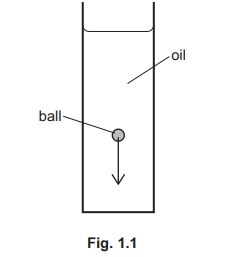
As the ball begins to fall through the oil, it accelerates.
(a) Define acceleration.
(b) The mass of the ball is 0.0075kg. Calculate the resultant force acting on the ball when it is accelerating downwards at 2.8 \(m/s^2\) .
(c) As the ball falls, its speed v is recorded. Fig. 1.2 is the speed–time graph for the falling ball.
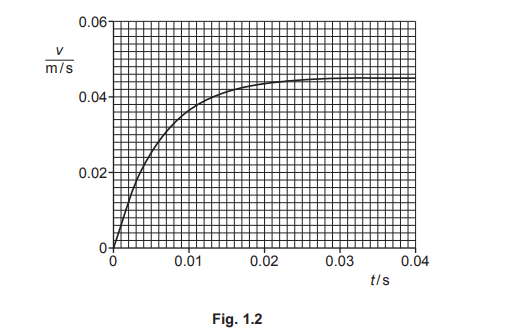
(i) Describe what happens to the acceleration between t = 0 and t = 0.040s. Explain why this happens.
(ii) By drawing a tangent on Fig. 1.2, determine a value for the acceleration of the ball at t = 0.010s.
Most-appropriate topic codes (Cambridge IGCSE Physics 0625):
• Topic 1.2 — Motion (Parts (a), (c))
• Topic 1.5.1 — Effects of forces (Part (b))
▶️ Answer/Explanation
Correct Answer: (acceleration is) rate of change in velocity OR change in velocity per unit time OR (a =)∆v / ∆t
Detailed solution: Acceleration is a vector quantity defined as the rate at which an object’s velocity changes with time. It is calculated by dividing the change in velocity (∆v) by the time interval (∆t) during which this change occurs.
Correct Answer: 0.021N
Detailed solution: According to Newton’s second law (F = ma), the resultant force is the product of mass and acceleration. Substituting the given values, F = 0.0075 kg × 2.8 m/s² yields a resultant force of 0.021 N acting downwards.
Correct Answer: any four from: (acceleration) decreases (acceleration decreases) to zero (at approximately 0.03 s) resistive force increases / resistance increases (as speed / velocity increases) resultant force (downwards) decreases (until) terminal velocity / constant speed (is reached) (when) resistive force = weight OR resultant force is zero OR forces are balanced
Detailed solution: The acceleration decreases because the resistive force from the oil increases with speed. This reduces the resultant downward force. Eventually the resistive force equals the ball’s weight, the resultant force becomes zero, and the ball reaches a constant terminal velocity.
Correct Answer: tangent drawn at t = 0.010 s \(1.2m / s^2\) ⩽ acceleration⩽ \(1.8m / s^2\) (a =) gradient of tangent OR (a =) {∆y / ∆x}
Detailed solution: The instantaneous acceleration is the gradient of the tangent to the curve at t = 0.010 s. Constructing a large triangle on the tangent line and calculating ∆v / ∆t gives an acceleration value within the accepted range of 1.2 m/s² to 1.8 m/s².
Question 2
Fig. 2.1 shows two identical trolleys, P and Q, held at rest on a frictionless horizontal surface. A load is fixed to trolley P.
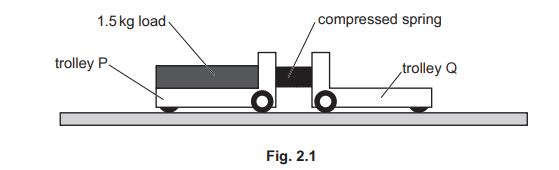
There is a compressed spring between trolley P and trolley Q. The trolleys are released. As the spring expands, it pushes the trolleys apart. Trolley Q moves to the right at a constant speed of 0.36m/s. The mass of each trolley is 1.2kg. The mass of the load on trolley P is 1.5kg. The spring has negligible mass.
(a) Calculate:
(i) the speed at which trolley P moves to the left
(ii) the kinetic energy of trolley Q when it moves at 0.36m/ s.
(b) State the energy transfer that takes place as the spring expands.
Most-appropriate topic codes (Cambridge IGCSE Physics 0625):
• Topic 1.6 — Momentum (Part (a)(i))
• Topic 1.7.1 — Energy (Part (a)(ii) and (b))
▶️ Answer/Explanation
Correct Answer: 0.16 m/s
Detailed solution: Using conservation of momentum, total initial momentum is zero. The total mass of P is $1.2\text{ kg} + 1.5\text{ kg} = 2.7\text{ kg}$. Equating magnitudes: $m_P v_P = m_Q v_Q$, so $2.7 \times v_P = 1.2 \times 0.36$. Solving gives $v_P = 0.432 / 2.7 = 0.16\text{ m/s}$.
Correct Answer: 0.078 J
Detailed solution: Kinetic energy is calculated using $E_k = \frac{1}{2}mv^2$. For trolley Q, mass $m = 1.2\text{ kg}$ and speed $v = 0.36\text{ m/s}$. Substituting values gives $E_k = 0.5 \times 1.2 \times (0.36)^2 = 0.6 \times 0.1296 = 0.07776\text{ J}$, which rounds to $0.078\text{ J}$.
Correct Answer: from elastic (energy store) to kinetic (energy store)
Detailed solution: Before release, energy is stored as elastic potential energy in the compressed spring. As the spring expands, this stored energy is transferred to the trolleys, increasing their kinetic energy as they move apart.
Question 3
Fig. 3.1 shows a small block of ice floating in a beaker of warm water.
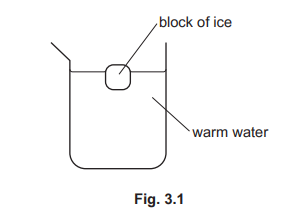
(i) State the name of the thermal process that transfers energy from the water to the ice.
(ii) Initially, there is 0.34kg of water in the beaker. The specific heat capacity of water is 4200J/(kg°C). Calculate the energy transferred from this water as its temperature decreases from 28°C to 10°C.
(iii) The temperature of the water near the ice decreases first. Explain how convection causes the temperature of all the water in the beaker to decrease.
(iv) State what happens to the internal energy of the water as the temperature of the water decreases. Describe the change in terms of the energy of the particles.
Most-appropriate topic codes (Cambridge IGCSE Physics 0625):
• Topic 2.1.1 — States of matter (Part (a))
• Topic 2.3.1 — Conduction (Part (b)(i))
• Topic 2.2.2 — Specific heat capacity (Part (b)(ii))
• Topic 2.3.2 — Convection (Part (b)(iii))
• Topic 2.2.2 — Specific heat capacity (Part (b)(iv))
▶️ Answer/Explanation
Correct Answer: (they / particles in ice) vibrate (about a fixed position) OR particles in water move throughout the liquid
Detailed solution: In a solid like ice, particles are held in a fixed lattice structure by strong intermolecular forces, so their motion is restricted to vibration about a fixed position. In a liquid like water, particles have more kinetic energy, allowing them to overcome some of these forces and move freely throughout the volume of the liquid.
Correct Answer: conduction
Detailed solution: Conduction is the transfer of thermal energy through a substance or between substances in direct contact via particle collisions. The ice and the warm water are in direct physical contact, so energy transfers from the higher-energy water particles to the lower-energy ice particles across the boundary.
Correct Answer: $2.6 \times 10^4\text{ J}$
Detailed solution: The energy transferred is calculated using $\Delta E = mc\Delta\theta$. The mass $m = 0.34\text{ kg}$, specific heat capacity $c = 4200\text{ J}/(\text{kg}^\circ\text{C})$, and temperature change $\Delta\theta = 28^\circ\text{C} – 10^\circ\text{C} = 18^\circ\text{C}$. The calculation is $0.34 \times 4200 \times 18 = 25704\text{ J}$, which is $2.6 \times 10^4\text{ J}$ to two significant figures.
Correct Answer: density (of water next to the ice) increases cold(er) water sinks warm(er) water replaces cold water OR warm(er) water rises OR making a convection current
Detailed solution: As water near the ice cools, its particles lose kinetic energy and move closer together, causing its density to increase. This denser, colder water sinks to the bottom of the beaker. Warmer, less dense water from below is displaced and rises to the top, creating a convection current that circulates and cools all the water.
Correct Answer: internal energy decreases AND (average) kinetic energy (of particles) decreases
Detailed solution: The internal energy of a substance is the sum of the kinetic and potential energies of its constituent particles. When the temperature of the water falls, it indicates that the average kinetic energy of the water particles has decreased, resulting in a net decrease in the total internal energy of the water.
Question 4
The lens in a magnifying glass is a converging lens.
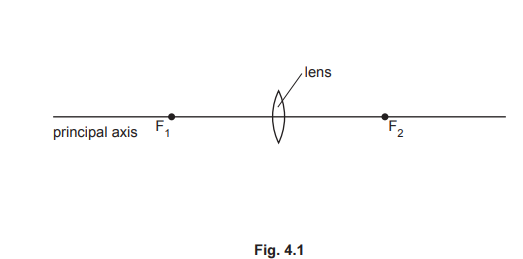
(a) Fig. 4.1 shows the lens of the magnifying glass, its two focal points, \(F_1\) and \(F_2\) , and its principal axis.
(i) State what is meant by ‘focal point’.
(ii) A student using the magnifying glass sees a magnified image of an object. On Fig. 4.1, mark:
• a point X on the principal axis for a possible position of the object
• a point E for a possible position of the student’s eye.
(iii) Underline two words in the list that describe the image produced in (a)(ii).
inverted real upright virtual
(b) The refractive index of the glass used to make the lens is 1.5.
(i) The speed of light in air is \(3.0 × 10^8\) m/s. Calculate the speed of light in the glass.
(ii) State what happens to the wavelength of light as it passes into the lens.
(c) Converging lenses are used in spectacles (glasses) to correct one problem with vision. State the name of the problem and explain how a converging lens is used to correct it. You may draw a diagram.
Most-appropriate topic codes (Cambridge IGCSE Physics 0625):
• Topic 3.2.3 — Thin lenses (Part (a))
• Topic 3.2.2 — Refraction of light (Part (b))
• Topic 3.2.3 — Thin lenses (Part (c))
▶️ Answer/Explanation
Correct Answer: (point on principal axis) where rays of light parallel (to the principal axis, incident on converging lens) meet / converge after passing through lens / refraction.
Detailed solution: The focal point is a specific location on the principal axis. When incoming rays of light travel parallel to the principal axis and strike a converging lens, the lens refracts these rays so that they all intersect precisely at this single focal point.
Correct Answer: X marked between one of the focal points and the lens AND E marked on other side of lens.
Detailed solution: To produce a magnified virtual image with a magnifying glass, the object (X) must be placed at a distance less than the focal length, i.e., between the focal point $F_1$ and the lens. The observer’s eye (E) should be positioned on the opposite side of the lens to view the virtual image formed on the same side as the object.
Correct Answer: virtual AND upright.
Detailed solution: When an object is placed inside the focal length of a converging lens (acting as a magnifying glass), the rays diverge after refraction. The image is formed where these rays appear to originate from behind the object, resulting in an image that is virtual (cannot be projected on a screen) and upright (same orientation as the object).
Correct Answer: \(2.0\times 10^8\) m/s.
Detailed solution: The refractive index $n$ is the ratio of the speed of light in a vacuum (or air) $c$ to the speed in the medium $v$. Using the formula $v = \frac{c}{n}$, we substitute the given values: $v = \frac{3.0 \times 10^8\text{ m/s}}{1.5} = 2.0 \times 10^8\text{ m/s}$.
Correct Answer: (wavelength) decreases.
Detailed solution: As light travels from air into a denser medium like glass, its speed decreases. Since the frequency of light remains constant during this transition, the relationship $v = f\lambda$ dictates that a decrease in speed $v$ must correspond to a proportional decrease in wavelength $\lambda$.
Correct Answer: long-sightedness; it moves the image towards the lens / back of the eye / retina OR reduces / shortens focal length of (combined lens); (converging lens) focuses image on back of eye / retina.
Detailed solution: Long-sightedness (hyperopia) occurs when the eye’s lens system is too weak or the eyeball is too short, causing images of nearby objects to focus behind the retina. A converging lens in spectacles adds additional convergence, shortening the overall focal length of the eye’s optical system and ensuring the image is formed exactly on the retina.
Question 5
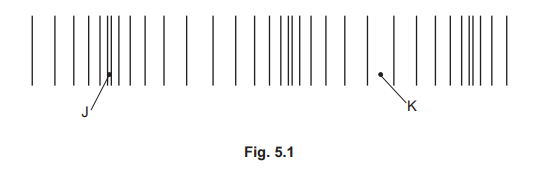
(a) Describe how a longitudinal wave differs from a transverse wave.
Most-appropriate topic codes (Cambridge IGCSE Physics 0625):
• Topic 3.1 — General properties of waves (Part (a))
• Topic 3.1 — General properties of waves (Part (b))
▶️ Answer/Explanation
Correct Answer: any two from:
(longitudinal) vibration / oscillation in wave parallel to propagation direction / direction of travel
transverse wave vibrates / oscillates perpendicular to propagation direction / direction of travel
(longitudinal) consists of compressions and rarefactions
transverse wave consists of crests / peaks and troughs
(longitudinal) needs a medium (to travel)
Detailed solution: In a longitudinal wave, the particles of the medium vibrate back and forth along the same line as the direction of energy transfer. In contrast, a transverse wave involves particle vibration at a right angle ($90^{\circ}$) to the direction the wave travels. Additionally, longitudinal waves feature regions of compression and rarefaction, whereas transverse waves exhibit crests and troughs.
Correct Answer: P-wave AND it is longitudinal
Detailed solution: The diagram shows particle displacement parallel to the direction of wave travel (indicated by the horizontal axis and the back-and-forth arrows), which is the defining characteristic of a longitudinal wave. Seismic P-waves (primary waves) are longitudinal, whereas S-waves (secondary waves) are transverse and cannot be represented by this parallel oscillation.
Correct Answer: \( 1.8\times 10^4\)m OR 18km
\(1.5\lambda\) OR \(1.5\times 1.2\times 10^4\) OR \(1.8\times 10^4\)
Detailed solution: The distance between two points on a wave is a fraction of the wavelength ($\lambda$). Examining the diagram, point J is at a compression peak and point K is at the next rarefaction trough, which represents $1.5$ complete wave cycles ($1.5\lambda$). Multiplying the wavelength by $1.5$ gives $1.5 \times 1.2 \times 10^4\text{ m} = 1.8 \times 10^4\text{ m}$.
Correct Answer: v = f\(\lambda\) OR v=\(\lambda\) / t OR (t =)\(\lambda\) / v OR f = 4600 /\( 1.2 \times 10^4\)
OR (t / 5 =) \(1.2\times 10^4\) / 4600 OR (t =) \(6(.0)\times 10^4\) / 4600
13s
t = 1 / f OR (time for one wave = ) 2.6 (s)
Detailed solution: The time for 5 complete wavelengths to pass is the total time taken. First, find the time period $T$ for one wavelength using the wave equation $v = \lambda / T$, which gives $T = \lambda / v = (1.2 \times 10^4) / 4600 \approx 2.61\text{ s}$. The total time for 5 oscillations is $5 \times T = 5 \times 2.61 \approx 13.0\text{ s}$.
Question 6
Fig. 6.1 shows an isolated metal sphere suspended by an insulating thread from the ceiling.
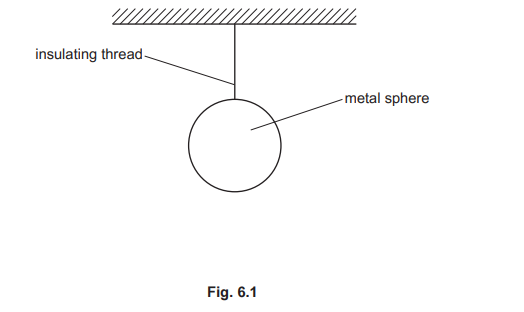
The sphere is negatively charged.
(a) The charge on the sphere produces an electric field in the surroundings.
(i) State what is meant by ‘electric field’.
(ii) Draw on Fig. 6.1 to show the pattern and direction of the electric field produced by the charge on the sphere. Draw at least four lines.
(b) The magnitude of the charge on the sphere is \(3.5 × 10^{–10}\)C. An earthed metal wire is touched against the surface of the sphere and the sphere is discharged.
(i) State what happens in the wire as the sphere is discharged.
(ii) It takes a time of 0.14ns for the sphere to discharge completely. Calculate the average current in the earthed wire as the sphere discharges.
Most-appropriate topic codes (Cambridge IGCSE Physics 0625):
• Topic 4.2.1 — Electric charge (Part (a))
• Topic 4.2.2 — Electric current (Part (b))
▶️ Answer/Explanation
Correct Answer: (region) where (an electric) charge experiences a force OR (region) where a force acts on a (an electric) charge
Detailed solution: An electric field is defined as a region of space surrounding an electric charge in which another electric charge will experience an electrostatic force. The direction of the field is defined as the direction of the force on a small positive test charge.
Correct Answer: at least four straight radial lines AND evenly spaced (by eye) surrounding sphere; four lines touching sphere AND no lines inside sphere; at least one arrowhead towards sphere AND no incorrect arrowheads
Detailed solution: The electric field around an isolated charged sphere is radial. Since the sphere is negatively charged, the field lines point inwards towards the center of the sphere, indicating the direction of force on a positive test charge.
Correct Answer: electrons move (through the wire) from the sphere OR electrons move (through the wire) to(wards) the Earth electrons move (in the wire)
Detailed solution: The sphere has an excess of electrons (negative charge). When an earthed wire is touched to it, the electrons repel each other and flow through the conducting wire to the ground (Earth) to neutralize the sphere.
Correct Answer: 2.5 A
I = Q / t OR (I =) Q / t OR \(3.5\times 10^{–10}\) / \(1.4\times 10^{–10}\)
\(2.5\times 10^N\)
Detailed solution: Average current is the rate of flow of charge. Using \(I = \frac{Q}{t}\), substitute \(Q = 3.5 \times 10^{-10}\text{ C}\) and \(t = 0.14\text{ ns} = 1.4 \times 10^{-10}\text{ s}\). Calculation: \(I = \frac{3.5 \times 10^{-10}}{1.4 \times 10^{-10}} = 2.5\text{ A}\).
Question 7
The electromotive force (e.m.f.) of a battery is 7.5V.
(a) Define the term electromotive force.
(b) The battery is connected in series with a variable resistor and a 30Ω resistor. The battery is made using 1.5V cells.
(i) Draw a circuit diagram that shows all the 1.5V cells connected to produce an e.m.f. of 7.5V, the variable resistor and the 30Ω resistor.
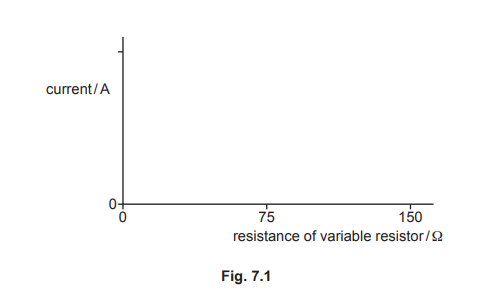
(ii) The resistance of the variable resistor can be varied from 0Ω to a maximum resistance of 150Ω. Using the axes in Fig. 7.1, draw a graph to show how the current in the circuit varies with the resistance of the variable resistor as it increases from 0Ω to 150Ω. Determine and label the value of the maximum current on the y-axis.
Most-appropriate topic codes (Cambridge IGCSE Physics 0625):
• Topic 4.2.3 — Electromotive force and potential difference (Part (a))
• Topic 4.3.1 — Circuit diagrams and circuit components (Part (b)(i))
• Topic 4.3.2 — Series and parallel circuits (Part (b)(ii))
▶️ Answer/Explanation
Correct Answer: (electrical) work done moving a unit charge around a (complete) circuit
Detailed solution: Electromotive force (e.m.f.) represents the energy supplied by a source, such as a battery, to drive a unit electric charge through a complete circuit. It is defined as the electrical work done per unit charge and is measured in volts (Joules per Coulomb).
Correct Answer: Five cells in series, connected in series with a variable resistor and a fixed resistor.
Detailed solution: To achieve a total e.m.f. of 7.5V using 1.5V cells, five cells must be connected in series ($5 \times 1.5 = 7.5$V). The circuit diagram must show the correct symbols for these cells connected end-to-end, followed by the symbol for a variable resistor and a fixed resistor, all linked in a single closed loop.
Correct Answer: Curve decreasing from 0.25A at $0\Omega$, approaching but not touching the x-axis at $150\Omega$.
Detailed solution: The maximum current occurs when the variable resistor is $0\Omega$, giving $I = V/R_{\text{total}} = 7.5 / 30 = 0.25$A. As the variable resistance increases from 0 to $150\Omega$, the total resistance increases, causing the current to decrease along a curve with a negative gradient that gets shallower, asymptotically approaching zero without crossing the axis.
Question 8
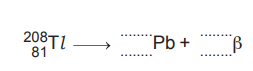
The isotope thallium-208 \((_{81}^{208}\textrm{Tl})\) is radioactive. It decays by β-decay.
(a) Thallium-208 decays to an isotope of lead (Pb).
(i) Complete the equation for this decay
(ii) The β-emission of thallium-208 is accompanied by γ-emission from the nucleus. Explain why this γ-emission does not affect the numbers in the equation in (a)(i).
(iii) Suggest one reason why a nucleus of thallium-208 is unstable.
(b) A sample of thallium-208 is placed in a thick lead container. Fig. 8.1 shows a narrow beam of β-particles and γ-radiation emerging from a small hole in one side of the container.
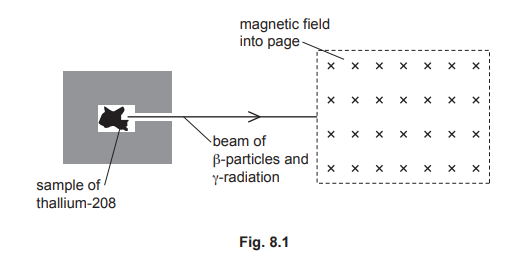
The narrow beam enters a region where there is a magnetic field that is directed into the page.
On Fig. 8.1:
• draw a line labelled β to indicate the path of the β-particles in the magnetic field
• draw a line labelled γ to indicate the path of the γ-radiation in the magnetic field.
Most-appropriate topic codes (Cambridge IGCSE Physics 0625):
• Topic 5.2.2 — The three types of nuclear emission (Part (a)(i), (a)(ii), (b))
• Topic 5.2.3 — Radioactive decay (Part (a)(iii))
▶️ Answer/Explanation
Correct Answer: \(_{-1}^{0}\rm{\beta}\) , \(_{82}^{208}\textrm{Pb}\)
Detailed solution: In beta-minus decay, a neutron converts to a proton, emitting an electron \(_{-1}^{0}\rm{\beta}\). The nucleon number (208) remains constant, while the proton number increases by 1, changing thallium (\(Z=81\)) into lead (\(Z=82\)).
Correct Answer: γ-emission consists of waves/rays OR γ-emission has no mass/charge.
Detailed solution: Gamma radiation is electromagnetic energy released from an excited nucleus. It has zero rest mass and zero electric charge, so its emission does not alter the number of protons or neutrons in the nucleus, leaving atomic and mass numbers unchanged.
Correct Answer: (It contains) too many / excess of neutrons OR (nucleus is) too heavy.
Detailed solution: A nucleus becomes unstable when the ratio of neutrons to protons is too high. Thallium-208 is neutron-rich compared to stable isotopes of similar mass, causing it to undergo beta decay to restore stability.
Correct Answer: smooth curve (downwards) labelled β; horizontal straight line labelled γ.
Detailed solution: β-particles are negatively charged and deflected by a magnetic field according to Fleming’s left-hand rule, curving downwards. γ-radiation has no charge and is unaffected by the field, continuing in a straight horizontal path.
Question 9
The Sun is one of many billions of stars in the Milky Way. The Sun emits a very large quantity of energy as electromagnetic radiation.
(a) State the three regions of the electromagnetic spectrum in which the Sun emits the most energy.
(b) Electromagnetic radiation from the Sun travels at a speed of \(3.0 × 10^8\text{ m/s}\). The radiation takes \(500\text{ s}\) to reach the Earth. Calculate the distance from the Sun to the Earth.
(c) Approximately 4.6 billion years ago, the Sun formed from an interstellar cloud of gas and became a stable star.
(i) Describe and explain what happens as an interstellar cloud of gas forms a protostar.
(ii) Describe and explain what happens as a protostar becomes a stable star.
Most-appropriate topic codes (Cambridge IGCSE Physics 0625):
• Topic 3.3 — Electromagnetic spectrum (Part (a), Part (b))
• Topic 6.2.2 — Stars (Part (c))
▶️ Answer/Explanation
Correct Answer: ultraviolet AND visible light AND infrared only
Detailed solution: The Sun is a medium-sized star that radiates energy across the entire electromagnetic spectrum, but its peak energy output is concentrated in three main regions: ultraviolet, visible light, and infrared. Any inclusion of other regions (like X-rays or radio waves) in this specific list would be considered an incorrect addition.
Correct Answer: \(1.5 \times 10^{11}\text{ m}\)
Detailed solution: Distance is calculated by rearranging the speed equation \(v = s/t\) to \(s = v \times t\). Substituting the given values: speed \(v = 3.0 \times 10^8\text{ m/s}\) and time \(t = 500\text{ s}\). Multiplying these gives \(3.0 \times 10^8 \times 500 = 1.5 \times 10^{11}\text{ m}\), which is the distance from the Sun to Earth.
Correct Answer: The cloud/nebula collapses due to (internal) gravitational attraction, and the (internal) temperature increases.
Detailed solution: A protostar forms when an interstellar cloud of gas and dust (nebula) begins to collapse under its own internal gravitational attraction. As the material is pulled inward, gravitational potential energy is converted to kinetic energy, causing the density and the internal temperature of the collapsing core to rise significantly.
Correct Answer: Nuclear fusion / nuclear reactions occur; the inward gravitational force is balanced by an outward force due to the high temperature.
Detailed solution: A protostar becomes a stable star when the core temperature and pressure become high enough to initiate nuclear fusion (converting hydrogen to helium). The star reaches stability when the inward force of gravitational attraction is exactly balanced by the outward force created by the immense pressure from the high internal temperature generated by these nuclear reactions.