Home / 0625_s25_qp_11

Question 1

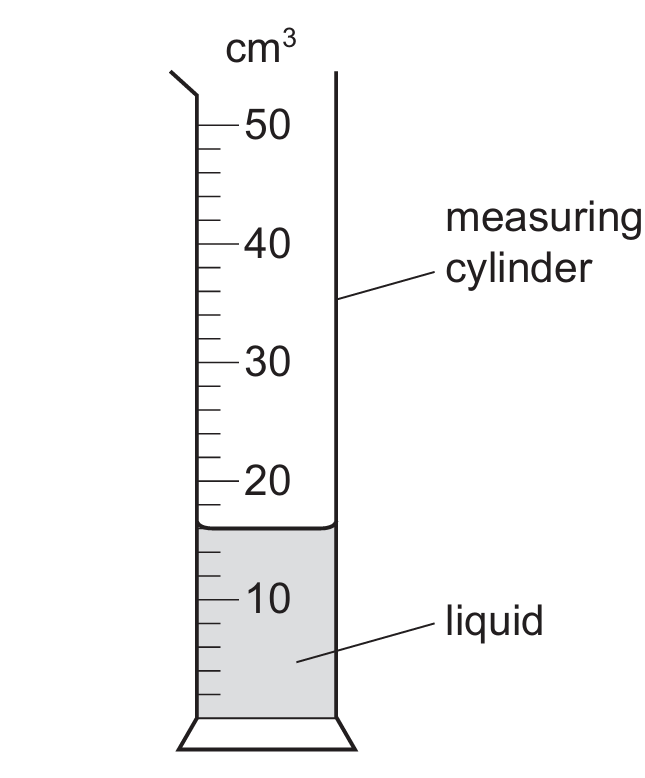
The diagram shows a measuring cylinder containing liquid.
What is the volume of liquid in the measuring cylinder?
A. $13.0\text{ cm}^3$
B. $13.5\text{ cm}^3$
C. $16.0\text{ cm}^3$
D. $17.0\text{ cm}^3$

Most-appropriate topic codes (Cambridge IGCSE Physics 0625):

TOPIC 1.1: Physical quantities and measurement techniques (Describe the use of measuring cylinders to find a volume)
▶️ Answer/Explanation
Correct Option: C

Detailed solution:

First, determine the scale increment: there are $5$ divisions between $10$ and $20$, so each small mark represents $2\text{ cm}^3$.
The level of the liquid (the bottom of the meniscus) is three small divisions above the $10\text{ cm}^3$ mark.
Calculating the total volume: $10\text{ cm}^3 + (3 \times 2\text{ cm}^3) = 16\text{ cm}^3$.
Since the scale allows for such precision, the reading is exactly $16.0\text{ cm}^3$.
This matches Option C.
Question 2

Which statement about the speed and velocity of an object is correct?
A. The speed and velocity of an object are always greater than zero.
B. The speed of an object is always greater than its velocity.
C. The velocity of an object is equal to its speed in a given direction.
D. Speed can be measured in $m/s$ but velocity can only be measured in $km/h$.

Most-appropriate topic codes (Cambridge IGCSE Physics 0625):

TOPIC 1.2: Motion (Define speed as distance travelled per unit time; define velocity as speed in a given direction)
TOPIC 1.1: Physical quantities (Scalar vs Vector quantities)
▶️ Answer/Explanation
Correct Option: C

Detailed solution:

Speed is a scalar quantity defined as distance per unit time ($v = \frac{s}{t}$), having only magnitude.
Velocity is a vector quantity, defined as speed in a specified direction.
Option A is incorrect because both can be $0$ when an object is at rest.
Option B is incorrect as the magnitude of velocity can equal speed in straight-line motion.
Option D is incorrect because both quantities share the same $SI$ unit of $m/s$.
Option C correctly identifies that velocity is simply speed with the addition of direction.

Question 3

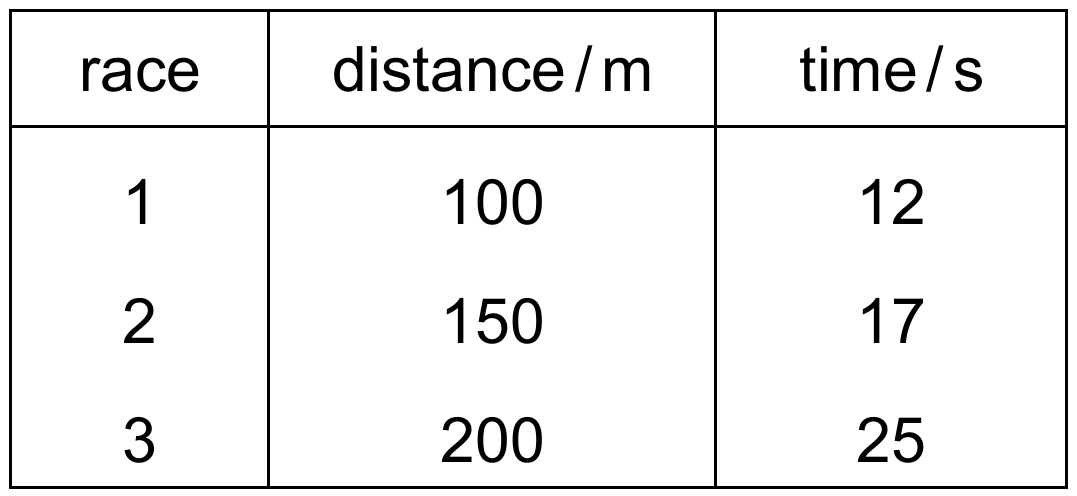
The table shows a student’s times in three races.

What is the order of the student’s average speeds in each race, from lowest to highest?

A. $1 \rightarrow 2 \rightarrow 3$
B. $1 \rightarrow 3 \rightarrow 2$
C. $2 \rightarrow 1 \rightarrow 3$
D. $3 \rightarrow 1 \rightarrow 2$

Most-appropriate topic codes (Cambridge IGCSE Physics 0625):

TOPIC 1.2: Motion (Recall and use the equation $\text{average speed} = \frac{\text{total distance}}{\text{total time}}$)
▶️ Answer/Explanation
Correct Option: D

Detailed solution:

To find the order, we calculate the average speed for each race using $v = \frac{s}{t}$:
Race 1: $v_{1} = \frac{100\text{ m}}{12\text{ s}} \approx 8.33\text{ m/s}$
Race 2: $v_{2} = \frac{150\text{ m}}{17\text{ s}} \approx 8.82\text{ m/s}$
Race 3: $v_{3} = \frac{200\text{ m}}{25\text{ s}} = 8.00\text{ m/s}$
Comparing these values: $8.00\text{ m/s} < 8.33\text{ m/s} < 8.82\text{ m/s}$.
The order from lowest to highest speed is Race 3, then Race 1, then Race 2.
This corresponds to the sequence $3 \rightarrow 1 \rightarrow 2$.
Question 4

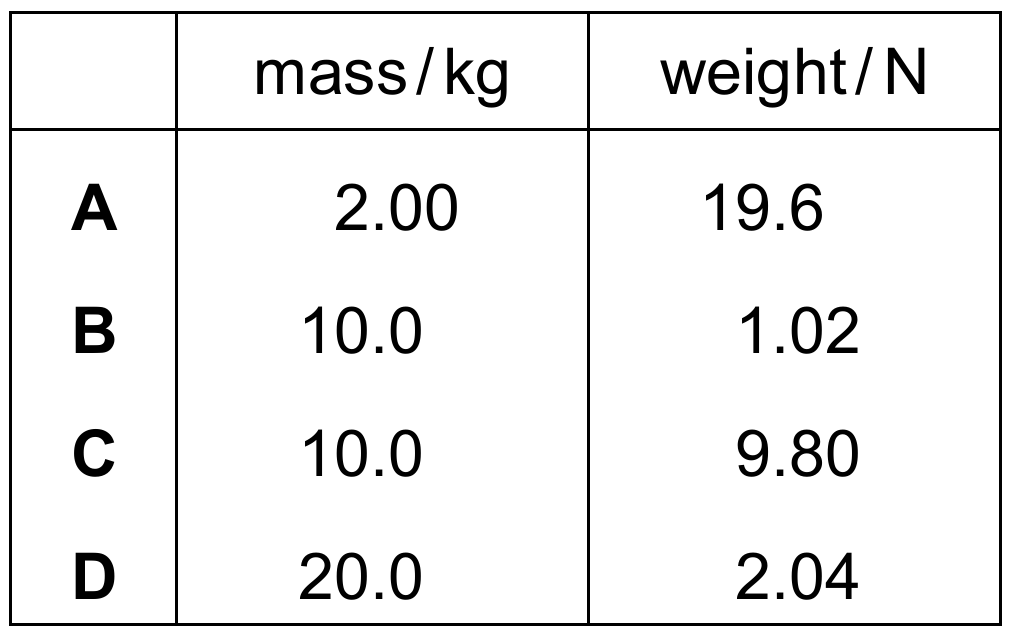
Which row gives the correct weight for the mass shown when it is at the Earth’s surface?

Most-appropriate topic codes (Cambridge IGCSE Physics 0625):

TOPIC 1.3: Mass and weight (Recall and use the equation g= m W ​ )
▶️ Answer/Explanation
Correct Option: A

Detailed solution:

The weight of an object is calculated using the formula W=m×g, where m is the mass in kg and g is the acceleration of free fall.
According to the syllabus, the value of g near the surface of the Earth is approximately 9.8 m/s 2 .
For Row A, the weight is 2.00 kg×9.8 m/s 2 =19.6 N, which matches the table.
In Row C, the weight should be 10.0×9.8=98.0 N, making the given 9.80 N incorrect.
Rows B and D incorrectly divide the mass by g rather than multiplying, resulting in values near 1.02 and 2.04.
Therefore, Row A provides the only mathematically correct relationship between mass and weight.
Question 5

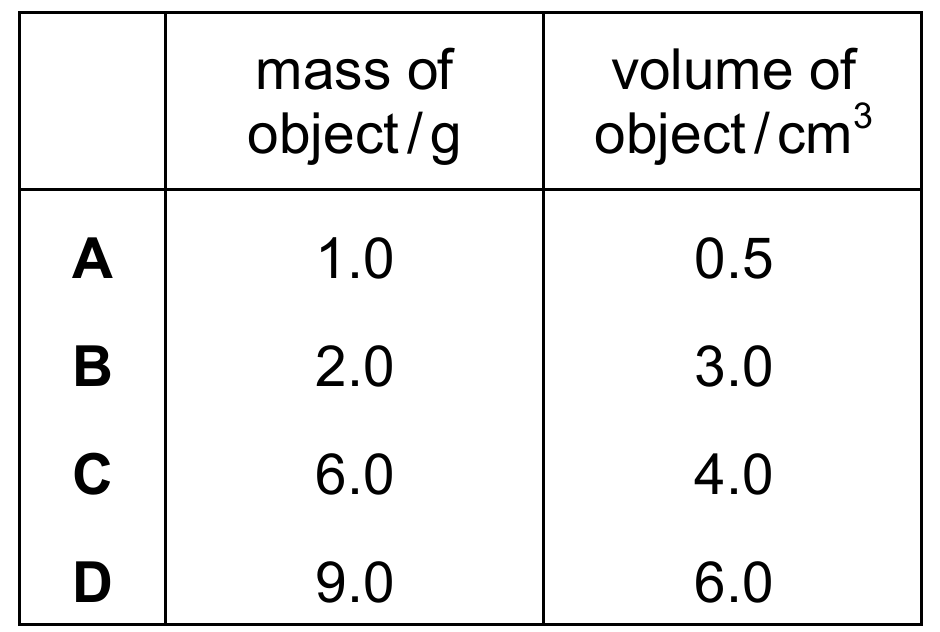
The masses and volumes of four objects are shown.
Which object floats in a liquid of density $1.4\text{ g/cm}^{3}$?

Most-appropriate topic codes (Cambridge IGCSE Physics 0625):

TOPIC 1.4: Density (Determine whether an object floats based on density data)
▶️ Answer/Explanation
Correct Option: B

Detailed solution:

An object floats if its density is less than the density of the liquid ($1.4\text{ g/cm}^{3}$).
Density is calculated using $\rho = \frac{m}{V}$.
$\rho_{A} = \frac{1.0}{0.5} = 2.0\text{ g/cm}^{3}$ (Sinks)
$\rho_{B} = \frac{2.0}{3.0} \approx 0.67\text{ g/cm}^{3}$ (Floats)
$\rho_{C} = \frac{6.0}{4.0} = 1.5\text{ g/cm}^{3}$ (Sinks)
$\rho_{D} = \frac{9.0}{6.0} = 1.5\text{ g/cm}^{3}$ (Sinks)
Only object B has a density lower than $1.4\text{ g/cm}^{3}$, so it is the only one that floats.
Question 6

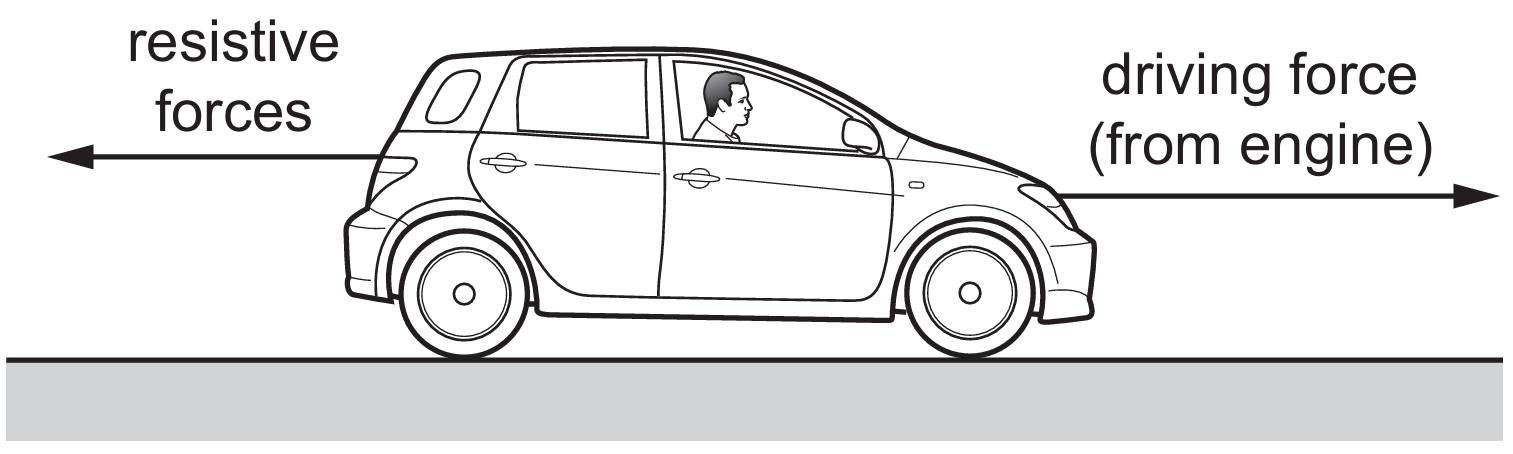
A car is driven from rest on a long straight road. The car engine exerts a constant driving force.
The diagram shows the horizontal forces acting on the car. The resistive forces are proportional to the speed of the car.
Why does the car eventually reach a maximum speed?
A. The resistive forces decrease to make the acceleration of the car negative.
B. The resistive forces decrease to make the acceleration of the car zero.
C. The resistive forces increase to make the acceleration of the car negative.
D. The resistive forces increase to make the acceleration of the car zero.

Most-appropriate topic codes (Cambridge IGCSE Physics 0625):

TOPIC 1.5.1: Effects of forces (Resultant force and changes in velocity/speed)
TOPIC 1.2: Motion (Terminal velocity and resistive forces)
▶️ Answer/Explanation
Correct Option: D

Detailed solution:

The car starts from rest and accelerates due to a constant driving force. As speed increases, the resistive forces (drag and friction) also increase because they are proportional to speed. According to $F_{resultant} = F_{driving} – F_{resistive}$, the net force decreases as the resistive force grows. Eventually, the resistive force increases until it equals the driving force, resulting in $F_{resultant} = 0$. At this point, the acceleration $a = \frac{F}{m}$ becomes $0$, and the car reaches a constant maximum speed (terminal velocity).
Question 7

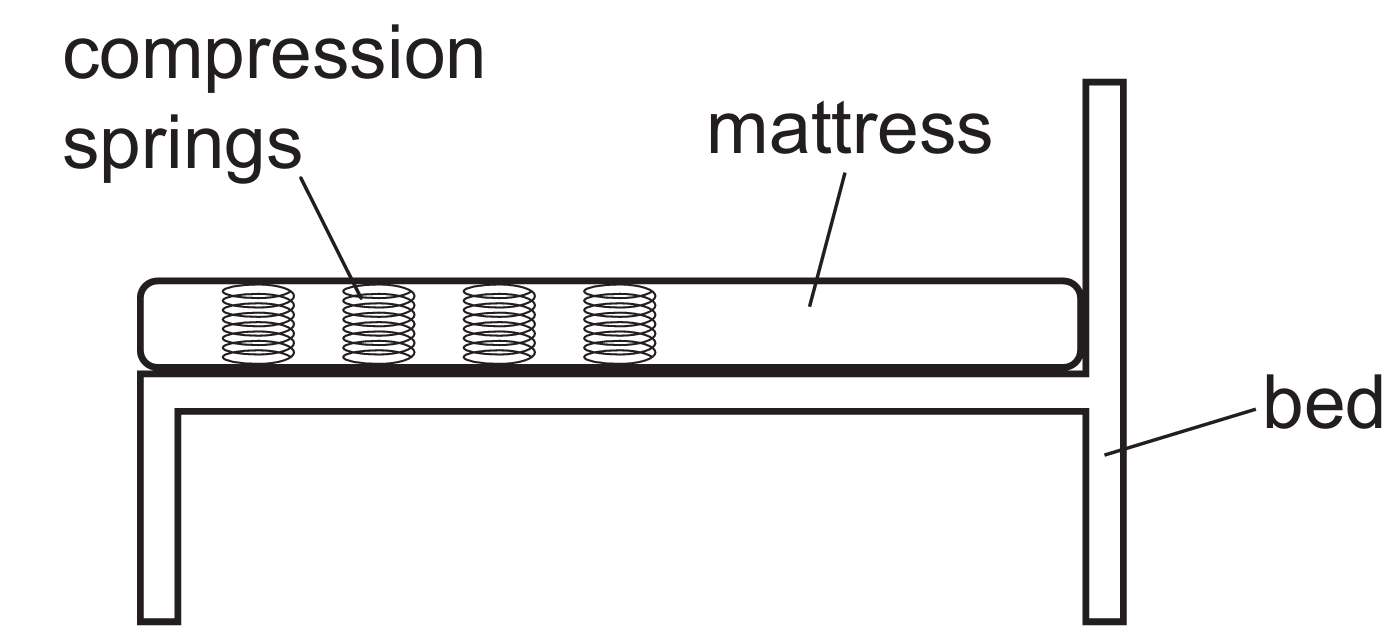
A mattress placed on a bed contains many compression springs.
Which energy store of the mattress increases when a person lies on the bed?
A. gravitational potential
B. chemical
C. elastic
D. kinetic

Most-appropriate topic codes (Cambridge IGCSE Physics 0625):

TOPIC 1.7.1: Energy (State that energy may be stored as kinetic, gravitational potential, chemical, elastic (strain)…)
TOPIC 1.5.1: Effects of forces (Forces may produce changes in the size and shape of an object)
▶️ Answer/Explanation
Correct Option: C

Detailed solution:

When a person lies on the bed, their weight exerts a force $F$ that compresses the springs in the mattress.
This compression causes a change in the shape of the springs, resulting in work being done to deform them.
The energy transferred by this work is stored as elastic (strain) energy within the material of the springs.
According to the syllabus, the energy in an elastic store is calculated using $E_{e} = \frac{1}{2}kx^{2}$, where $x$ is the compression.
As the compression $x$ increases from zero, the elastic energy store of the mattress must increase.
Other stores like chemical or kinetic do not increase as the mattress remains stationary and no chemical reaction occurs.
Question 8

Which energy resource does not contain a store of chemical energy?
A. biofuel
B. coal
C. nuclear fuel
D. oil

Most-appropriate topic codes (Cambridge IGCSE Physics 0625):

TOPIC 1.7.1: Energy (State that energy may be stored as kinetic, gravitational potential, chemical, nuclear…)
TOPIC 1.7.3: Energy resources (Describe how useful energy may be obtained from fossil fuels, biofuels, nuclear fuel…)
▶️ Answer/Explanation
Correct Option: C

Detailed solution:

Chemical energy is energy stored in the bonds of chemical compounds, which is released during a chemical reaction (like combustion).
Biofuel, coal, and oil are all forms of fuel that release energy through burning, meaning they are stores of chemical energy.
Nuclear fuel, such as uranium, does not release energy through chemical bonds but through nuclear fission or fusion.
In these processes, energy is released from the nucleus of the atom, which is defined as a store of nuclear energy.
Therefore, nuclear fuel is the only resource listed that does not contain a store of chemical energy.
Option C is the correct choice as it identifies nuclear fuel as a non-chemical energy store.

Question 9

A person carries 20 tiles from the ground to the roof of a house. Each tile has a mass of 1.2 kg. The roof of the house is 15 m above the ground.
How much work does the person do against gravity on the tiles in carrying them to the roof?
A. 37 J
B. 180 J
C. 360 J
D. 3500 J

Most-appropriate topic codes (Cambridge IGCSE Physics 0625):

TOPIC 1.7.1: Energy (Recall and use the equation ΔE p ​ =mgΔh)
TOPIC 1.7.2: Work (Understand that mechanical work done is equal to the energy transferred)
▶️ Answer/Explanation
Correct Option: D

Detailed solution:

The work done against gravity is equal to the gain in gravitational potential energy, calculated as W=ΔE p ​ =mgh.
The total mass m is the number of tiles multiplied by the mass of one tile: 20×1.2 kg=24 kg.
Using the standard value for acceleration of free fall g=9.8 m/s 2 (as per the 0625 syllabus) and height h=15 m.
Substituting the values: W=24 kg×9.8 m/s 2 ×15 m=3528 J.
Rounding to two significant figures to match the provided options gives 3500 J.
Thus, the work done by the person on the tiles is approximately 3500 J, which corresponds to Option D.

Question 10

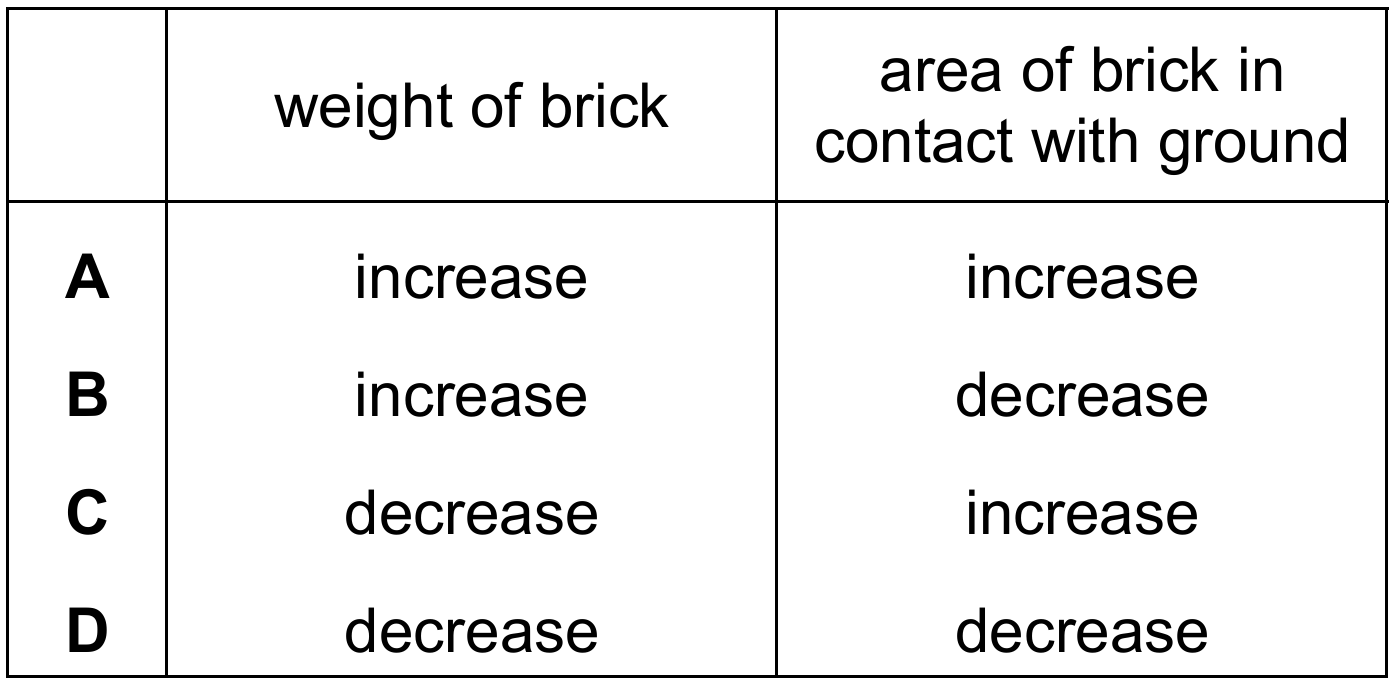
Which pair of changes, applied at the same time, always increases the pressure that a brick exerts on the ground?

Most-appropriate topic codes (Cambridge IGCSE Physics 0625):

TOPIC 1.8: Pressure (Define pressure as force per unit area; recall and use the equation p= A F ​ )
▶️ Answer/Explanation
Correct Option: B

Detailed solution:

Pressure is defined as the force exerted per unit area, expressed by the formula p= A F ​ .
In this context, the force F is equal to the weight W of the brick.
To increase the pressure p, one must either increase the numerator (weight) or decrease the denominator (contact area).
An increase in weight results in a greater force being applied downward onto the surface.
A decrease in the contact area concentrates that force over a smaller region, further raising the pressure.
Therefore, the combination of increasing the weight and decreasing the area (Option B) will always result in a higher pressure.
Question 11

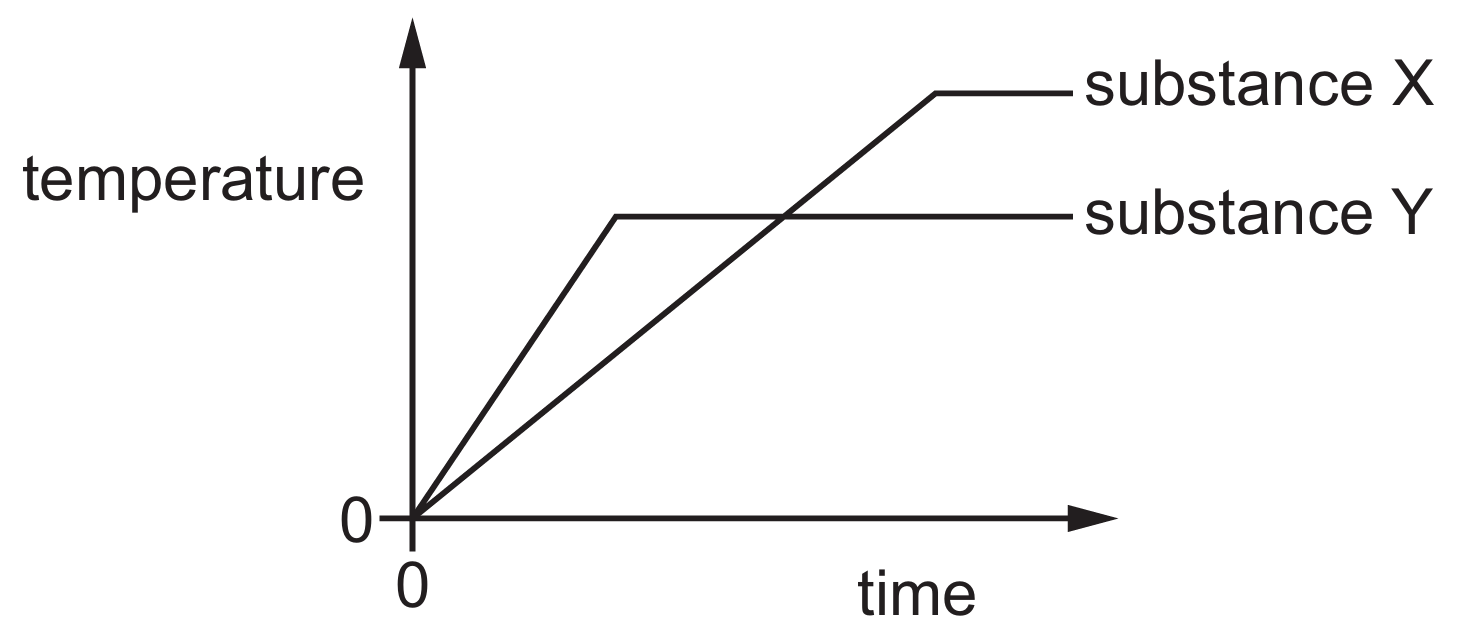
Two different pure substances, X and Y, are heated. Both substance X and substance Y are initially in the solid state.
The graph shows how the temperature of each substance changes with time.
What does the graph tell us about the substances?
A. Substance X has a lower boiling point than substance Y.
B. Substance X has a lower melting point than substance Y.
C. Substance Y has a lower boiling point than substance X.
D. Substance Y has a lower melting point than substance X.

Most-appropriate topic codes (Cambridge IGCSE Physics 0625):

TOPIC 2.2.3: Melting, boiling and evaporation (Describe melting and boiling in terms of energy input without a change in temperature)
▶️ Answer/Explanation
Correct Option: D

Detailed solution:

The substances start as solids; the first horizontal section on a heating curve represents the melting point where the temperature remains constant during the phase change.
By observing the vertical axis (temperature), the plateau for substance Y occurs at a lower position than the plateau for substance X.
This indicates that the temperature at which substance Y melts, T m(Y) ​ , is less than the melting temperature of substance X, T m(X) ​ .
Since the graph only shows the transition from solid to liquid, we cannot determine boiling points from this data.
Therefore, the graph confirms that substance Y has a lower melting point than substance X.
Option D correctly identifies this relationship based on the provided temperature-time coordinates.
Question 12

A liquid substance changes into a gas.
Which property of the substance remains the same?
A. ability to flow
B. compressibility
C. shape
D. volume

Most-appropriate topic codes (Cambridge IGCSE Physics 0625):

TOPIC 2.1.1: States of matter (Properties of solids, liquids and gases)
▶️ Answer/Explanation
Correct Option: A

Detailed solution:

Both liquids and gases are classified as fluids because their particles can move past one another, giving them the ability to flow.
When a liquid turns into a gas, the particles move much further apart, causing the volume to increase significantly.
Gases are highly compressible due to the large spaces between particles, whereas liquids are virtually incompressible.
While both take the shape of their container, a gas expands to fill the entire available space unlike a liquid.
Therefore, the only property that remains fundamentally the same for both states in this context is their ability to flow.

Question 13

At room temperature, iron is difficult to compress.
At the same temperature, oxygen is much easier to compress.
Which comparison of the particles in iron and the particles in oxygen explains this?
A. The iron particles are closer together.
B. The iron particles have a greater mass.
C. The iron particles can be magnetised.
D. The iron particles have less average kinetic energy.

Most-appropriate topic codes (Cambridge IGCSE Physics 0625):

TOPIC 2.1.2: Particle model (Describe the particle structure of solids, liquids and gases in terms of the arrangement, separation and motion of the particles)
▶️ Answer/Explanation
Correct Option: A

Detailed solution:

Iron is a solid, meaning its particles are packed in a regular lattice with very small gaps between them. Conversely, oxygen is a gas where the separation between particles is much larger than the particle size itself. Compression requires reducing the empty space between particles; since iron particles are already extremely close together, there is negligible room for further reduction. In oxygen, the large intermolecular distances allow for significant compression under pressure. While mass and magnetism are properties of iron, they do not explain compressibility. Furthermore, at the same temperature, both substances have the same average kinetic energy, as defined by the relation $E_{k} \propto T$.

Question 14

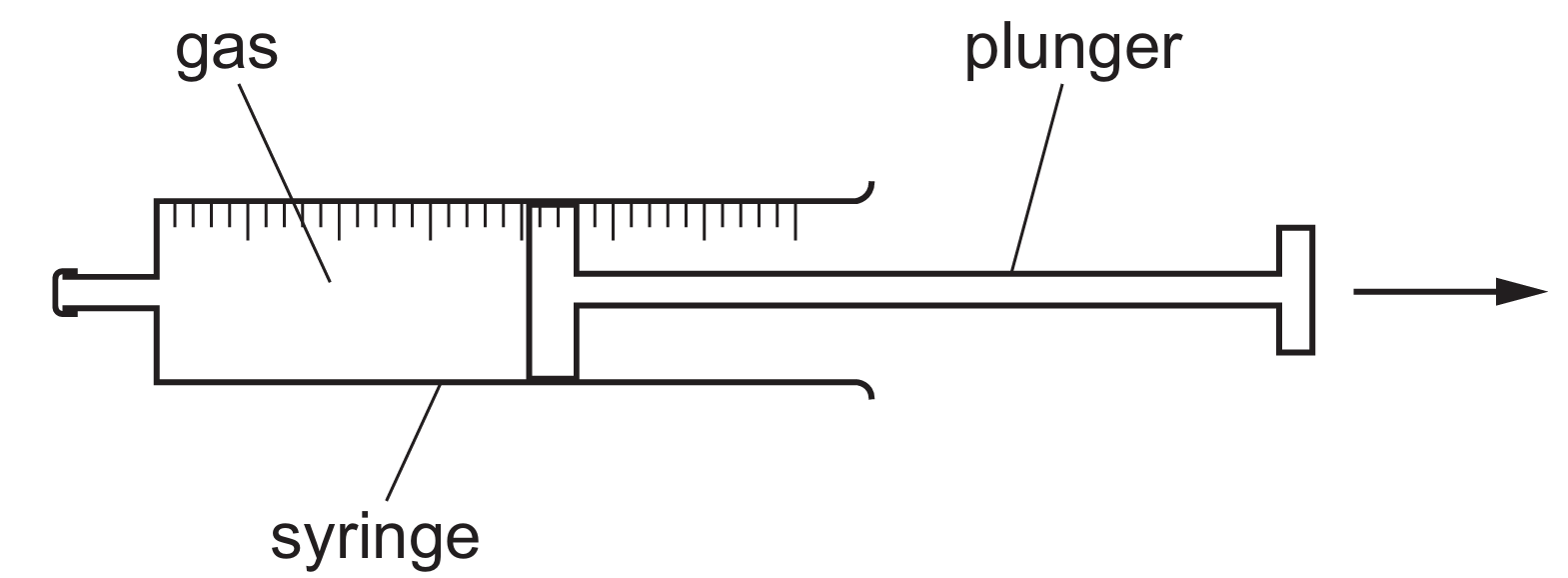
A teacher has a gas in a sealed syringe with a movable plunger.
The teacher slowly moves the plunger out of the syringe. The temperature of the gas remains constant.
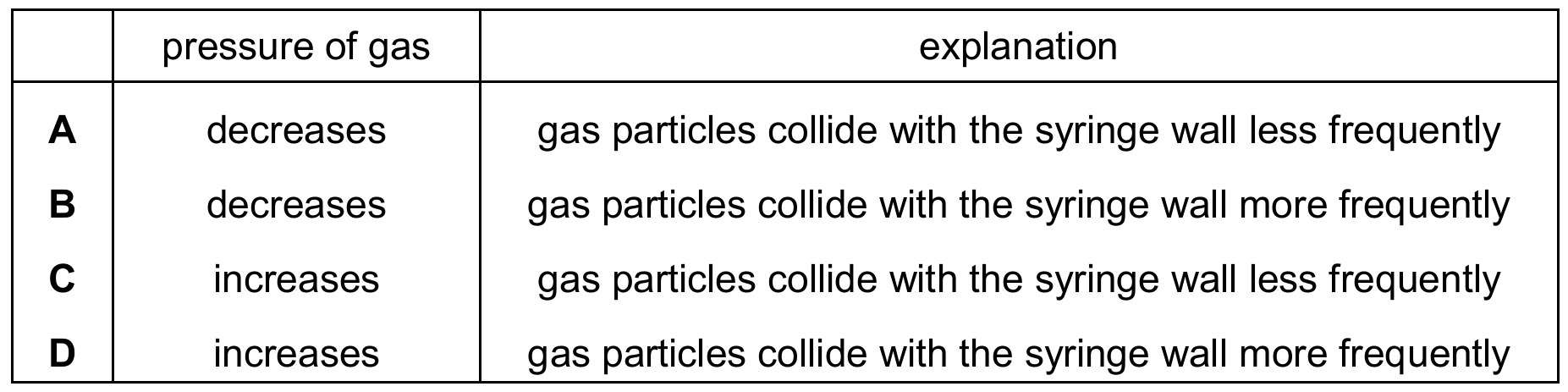
Which row explains what happens to the pressure of the gas in the syringe?

Most-appropriate topic codes (Cambridge IGCSE Physics 0625):

TOPIC 2.1.2: Particle model (Describe pressure and changes in pressure of a gas)
TOPIC 2.1.3: Gases and the absolute scale of temperature (Effect of change of volume at constant temperature)
▶️ Answer/Explanation
Correct Option: A

Detailed solution:

When the plunger is moved out, the volume $V$ of the gas increases while the temperature $T$ remains constant.
According to Boyle’s Law, $pV = \text{constant}$, so an increase in volume leads to a decrease in pressure $p$.
In terms of the kinetic particle model, the gas particles are now spread out over a larger space.
As a result, the particles hit the walls of the syringe less often, meaning the frequency of collisions decreases.
Since pressure is defined as the force per unit area, fewer collisions per second result in a lower pressure.
Therefore, Row A correctly identifies that the pressure decreases because particles collide with the walls less frequently.
Question 15

Evaporation occurs from the surface of a pool of water. Which statement describes this change of state?
A. Electrons move from the liquid and become a gas.
B. Molecules that move from the liquid have the same energy as the molecules that stay in the liquid.
C. The more-energetic molecules escape the liquid.
D. The more-energetic molecules remain in the liquid.

Most-appropriate topic codes (Cambridge IGCSE Physics 0625):

TOPIC 2.2.3: Melting, boiling and evaporation (Describe evaporation in terms of the escape of more-energetic particles from the surface of a liquid)
▶️ Answer/Explanation
Correct Option: C

Detailed solution:

Evaporation is the process where a liquid changes into a gas at temperatures below the boiling point. In a liquid, molecules move at various speeds, meaning they have different amounts of kinetic energy $E_{k}$. Molecules at the surface with higher-than-average energy can overcome the attractive forces of neighboring molecules. Consequently, these more-energetic molecules escape the liquid phase to become a gas. As a result, the average $E_{k}$ of the remaining molecules decreases, leading to the cooling of the liquid. Option C correctly identifies that it is the more-energetic molecules that leave the surface.

Question 16

Students test four rods of different materials, $W$, $X$, $Y$ and $Z$, to compare how well the materials conduct thermal energy.
The rods are the same size and shape.
The students use wax to stick a pin to one end of the first rod. The wax melts when it is warm. The other end of the rod is heated and the time taken for the pin to fall is recorded.
The experiment is repeated for each rod.
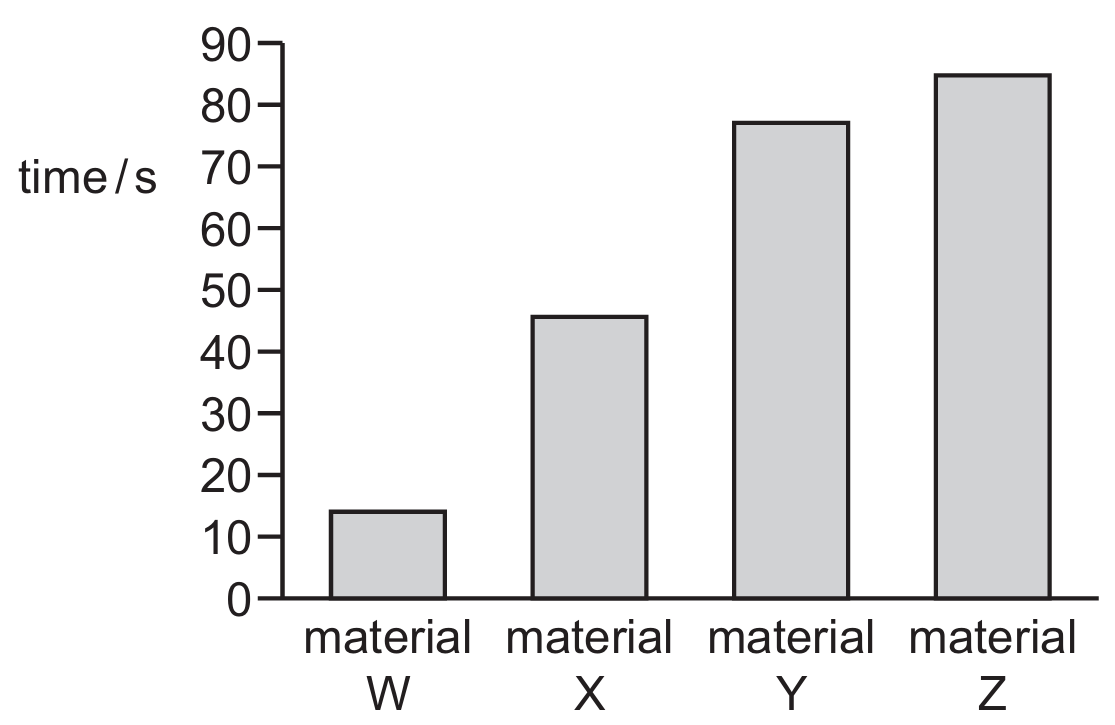
The students plot a chart of the time taken for each pin to fall.

Which statement is correct?

A. $X$ is a better thermal conductor than $Y$.
B. $Y$ is a better thermal conductor than $W$.
C. $Z$ is a better thermal conductor than $W$.
D. $Z$ is a better thermal conductor than $X$.

Most-appropriate topic codes (Cambridge IGCSE Physics 0625):

TOPIC 2.3.1: Conduction (Describe experiments to demonstrate the properties of good thermal conductors and bad thermal conductors)
▶️ Answer/Explanation
Correct Option: A

Detailed solution:

Thermal conduction is the process where energy is transferred through a material. A better thermal conductor transfers energy faster, meaning the wax will reach its melting point in a shorter amount of time ($t$).
According to the bar chart, the times recorded are: $t_W \approx 14\text{ s}$, $t_X \approx 45\text{ s}$, $t_Y \approx 77\text{ s}$, and $t_Z \approx 85\text{ s}$.
Since $t_X < t_Y$, material $X$ conducts heat to the pin faster than material $Y$ does.
Therefore, $X$ is a better thermal conductor than $Y$, making statement A correct.
Statements B, C, and D are incorrect because they suggest materials with higher time values ($Y$ and $Z$) are better conductors than those with lower time values ($W$ and $X$).
Question 17

A student has four metal containers filled with the same volume of water at a temperature of 80 °C.
The metal containers are put in a room at a temperature of 20 °C.
The metal containers are identical except for the texture and colour of their surfaces.
Which surface will emit energy at the greatest rate?
A. dull black
B. shiny black
C. dull white
D. shiny white

Most-appropriate topic codes (Cambridge IGCSE Physics 0625):

TOPIC 2.3.3: Radiation (Effect of surface colour and texture on emission)
▶️ Answer/Explanation
Correct Option: A

Detailed solution:

Thermal energy transfer via radiation depends heavily on the surface characteristics of an object.
Darker colours are better emitters than lighter colours; thus, black surfaces emit more than white ones.
Texture also plays a role: dull or matt surfaces are more efficient at emitting infrared radiation than shiny, reflective surfaces.
Since the containers are at 80 °C and the room is at 20 °C, they will lose energy to the surroundings.
A dull black surface is the most effective configuration for both absorbing and emitting thermal radiation.
Consequently, the container with the dull black surface will emit energy at the greatest rate.

Question 18

A water wave has a speed of 2.0 m/s.
4.0 complete waves pass a point every 10 seconds.
What is the wavelength of the wave?
A. 0.50 m
B. 0.80 m
C. 5.0 m
D. 8.0 m

Most-appropriate topic codes (Cambridge IGCSE Physics 0625):

TOPIC 3.1: General properties of waves (Recall and use the equation for wave speed v=fλ)
▶️ Answer/Explanation
Correct Option: C

Detailed solution:

First, calculate the frequency f, which is the number of waves passing a point per second: f= 10 s 4.0 waves ​ =0.40 Hz.
The relationship between wave speed v, frequency f, and wavelength λ is given by the wave equation: v=fλ.
Rearrange the formula to solve for wavelength: λ= f v ​ .
Substitute the given speed v=2.0 m/s and the calculated frequency into the equation: λ= 0.40 2.0 ​ .
This results in a wavelength of λ=5.0 m.
Therefore, the correct wavelength of the water wave is 5.0 m, matching option C.

Question 19

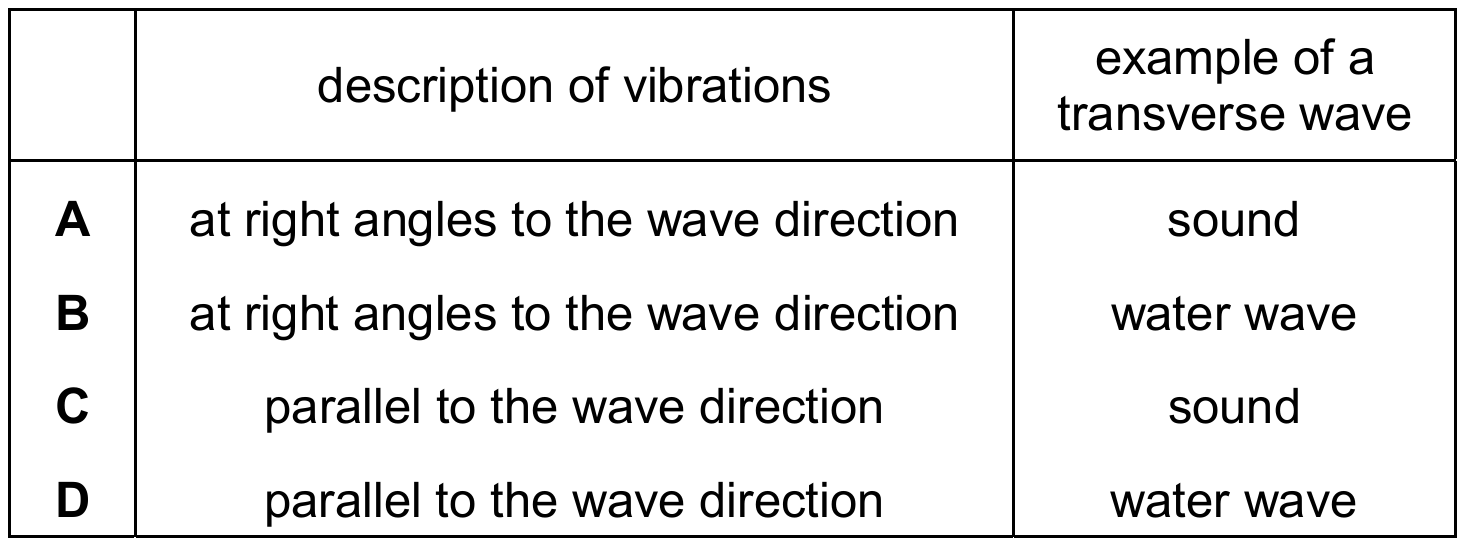
Which row correctly describes the vibrations of a transverse wave and also gives a correct example of a transverse wave?

Most-appropriate topic codes (Cambridge IGCSE Physics 0625):

TOPIC 3.1: General properties of waves (Know that for a transverse wave, the direction of vibration is at right angles to the direction of propagation)
▶️ Answer/Explanation
Correct Option: B

Detailed solution:

A transverse wave is defined by vibrations occurring at $90^{\circ}$ (right angles) to the direction of energy transfer.
Common examples of transverse waves include electromagnetic radiation and water waves.
In contrast, sound waves are longitudinal, meaning their vibrations are parallel to the wave direction.
Row A is incorrect because sound is longitudinal; Rows C and D are incorrect because transverse vibrations are not parallel.
Therefore, Row B correctly identifies both the perpendicular nature of the vibrations and a valid example.
This aligns with the syllabus requirement to model water waves as transverse motions.
Question 20

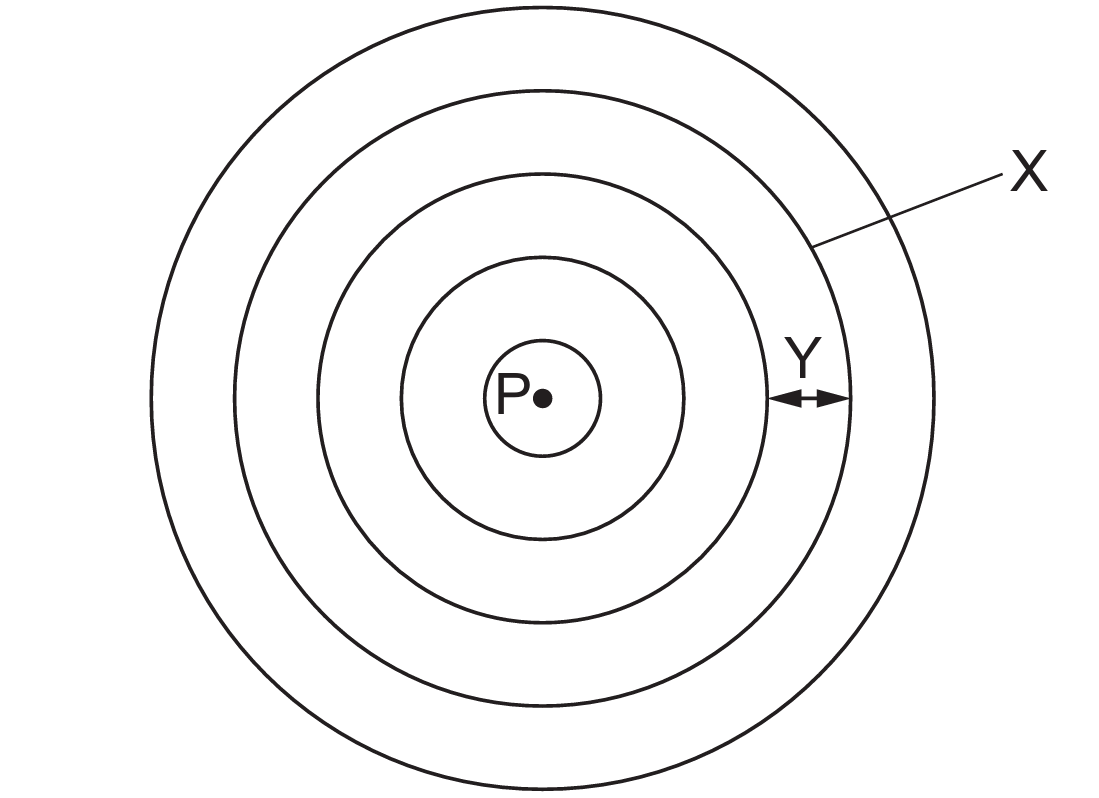
The diagram shows a view from above of waves on the surface of a pond after the water has been disturbed at point $P$.
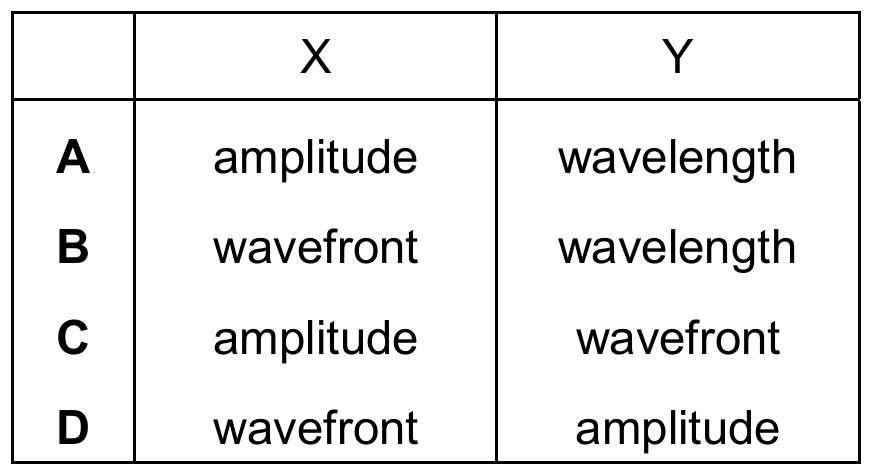
What are the correct labels for $X$ and $Y$?

Most-appropriate topic codes (Cambridge IGCSE Physics 0625):

TOPIC 3.1: General properties of waves (Describe the features of a wave in terms of wavefront and wavelength)
▶️ Answer/Explanation
Correct Option: B

Detailed solution:

Label $X$ points to a line representing a surface of constant phase, such as a crest, which is defined as a wavefront.
Label $Y$ indicates the shortest distance between two consecutive wavefronts (two successive crests), which defines the wavelength $\lambda$.
In this “view from above,” amplitude cannot be seen as it represents the vertical displacement from the rest position.
Therefore, $X$ is a wavefront and $Y$ is the wavelength, making Row B the correct choice.

Question 21

The diagram shows the image of a clock as seen by a person standing in front of a plane mirror.
What is the actual time?
A. $4:15$
B. $4:45$
C. $7:15$
D. $7:45$

Most-appropriate topic codes (Cambridge IGCSE Physics 0625):

TOPIC 3.2.1: Reflection of light (Characteristics of an optical image formed by a plane mirror)
▶️ Answer/Explanation
Correct Option: C

Detailed solution:

Images in a plane mirror undergo lateral inversion, meaning the left and right sides are interchanged.
In the reflected image, the minute hand points to $9$ (representing $45$ minutes) and the hour hand is between $4$ and $5$.
Applying lateral inversion, the minute hand at $9$ reflects to the $3$ position, which represents $15$ minutes.
The hour hand, appearing past the $4$ mark in the mirror, reflects to a position just past the $7$ mark.
Therefore, the actual time shown on the physical clock is $7:15$.
This confirms that Option C is the correct choice based on the laws of reflection.
Question 22

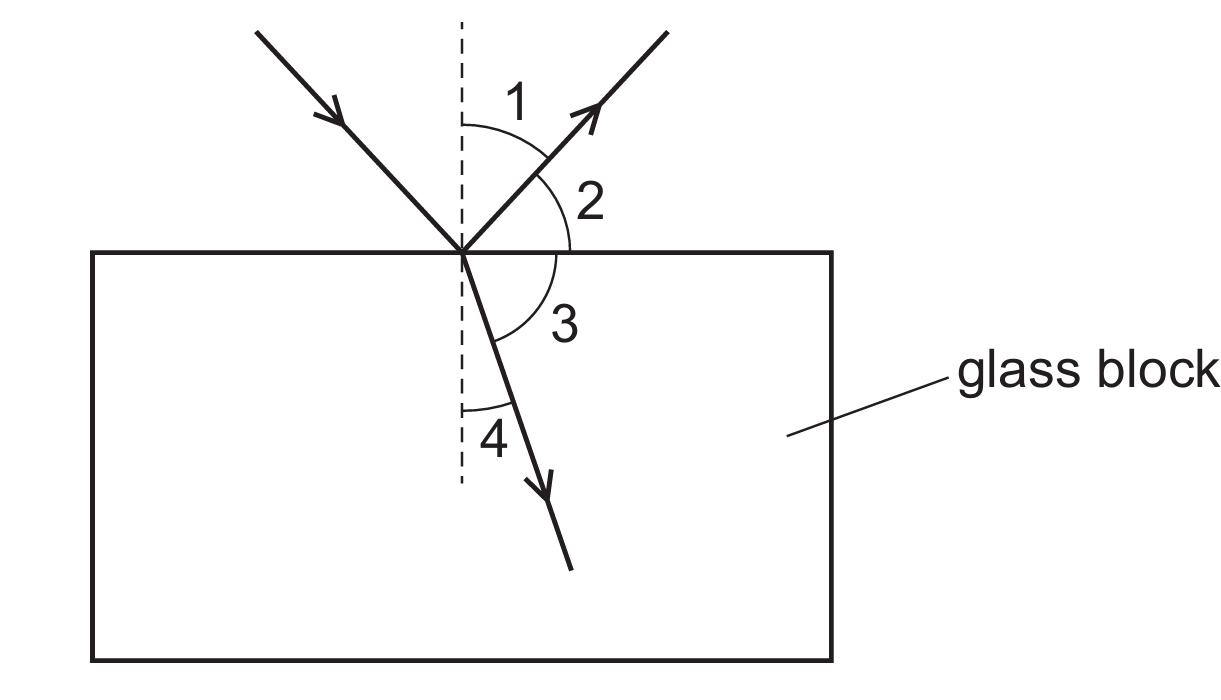
The diagram shows a ray of light incident on the surface of a glass block.
The ray of light is partially reflected back into the air and partially refracted into the glass block.
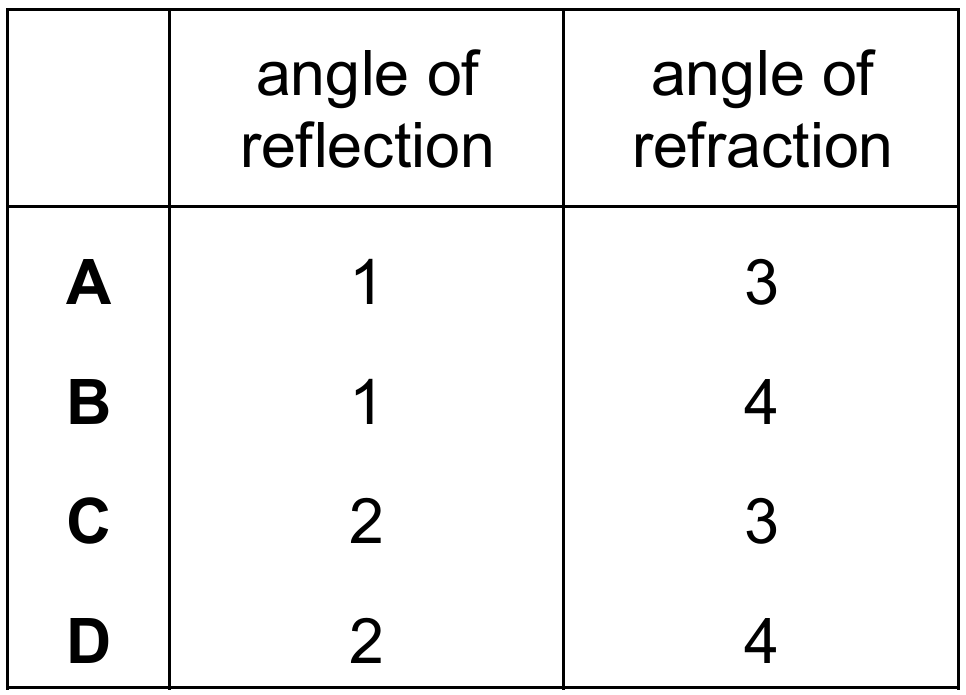
Which row correctly identifies the angle of reflection and the angle of refraction?

Most-appropriate topic codes (Cambridge IGCSE Physics 0625):

TOPIC 3.2.1: Reflection of light (Define and use the terms normal, angle of incidence and angle of reflection)
TOPIC 3.2.2: Refraction of light (Define and use the terms normal, angle of incidence and angle of refraction)
▶️ Answer/Explanation
Correct Option: B

Detailed solution:

All angles in optics are measured between the light ray and the normal, which is the dashed line perpendicular to the surface.
The angle of reflection is the angle between the reflected ray and the normal in the first medium; in the diagram, this is identified as angle $1$.
The angle of refraction is the angle between the refracted ray and the normal in the second medium; in the diagram, this is identified as angle $4$.
Angles $2$ and $3$ are incorrect because they are measured from the ray to the glass surface (the interface) rather than the normal.
According to the law of reflection, the angle of incidence equals the angle of reflection ($i = r$).
Therefore, the correct row identifying the required angles is B.
Question 23

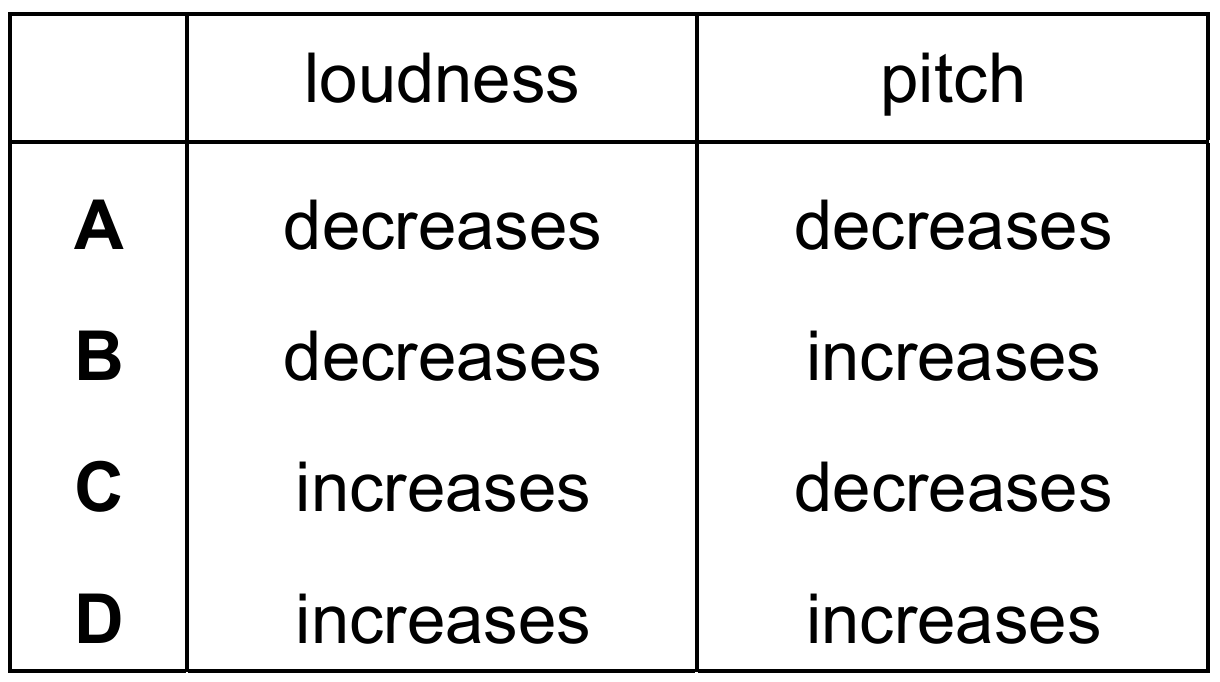
The amplitude and the frequency of a sound wave both increase.
What happens to the loudness and what happens to the pitch of the sound?

Most-appropriate topic codes (Cambridge IGCSE Physics 0625):

TOPIC 3.4: Sound (Describe how changes in amplitude and frequency affect the loudness and pitch of sound waves)
▶️ Answer/Explanation
Correct Option: D

Detailed solution:

The loudness of a sound wave is directly related to its amplitude; as the amplitude increases, the sound becomes louder.
The pitch of a sound is determined by its frequency, where a higher frequency $f$ results in a higher-pitched sound.
Since the question states both the amplitude and frequency increase, both the loudness and the pitch must increase accordingly.
This relationship is consistent with the wave property where energy is proportional to $Amplitude^{2}$ and perceived tone depends on $f$.
Therefore, Row D correctly identifies that both characteristics will increase.
Question 24

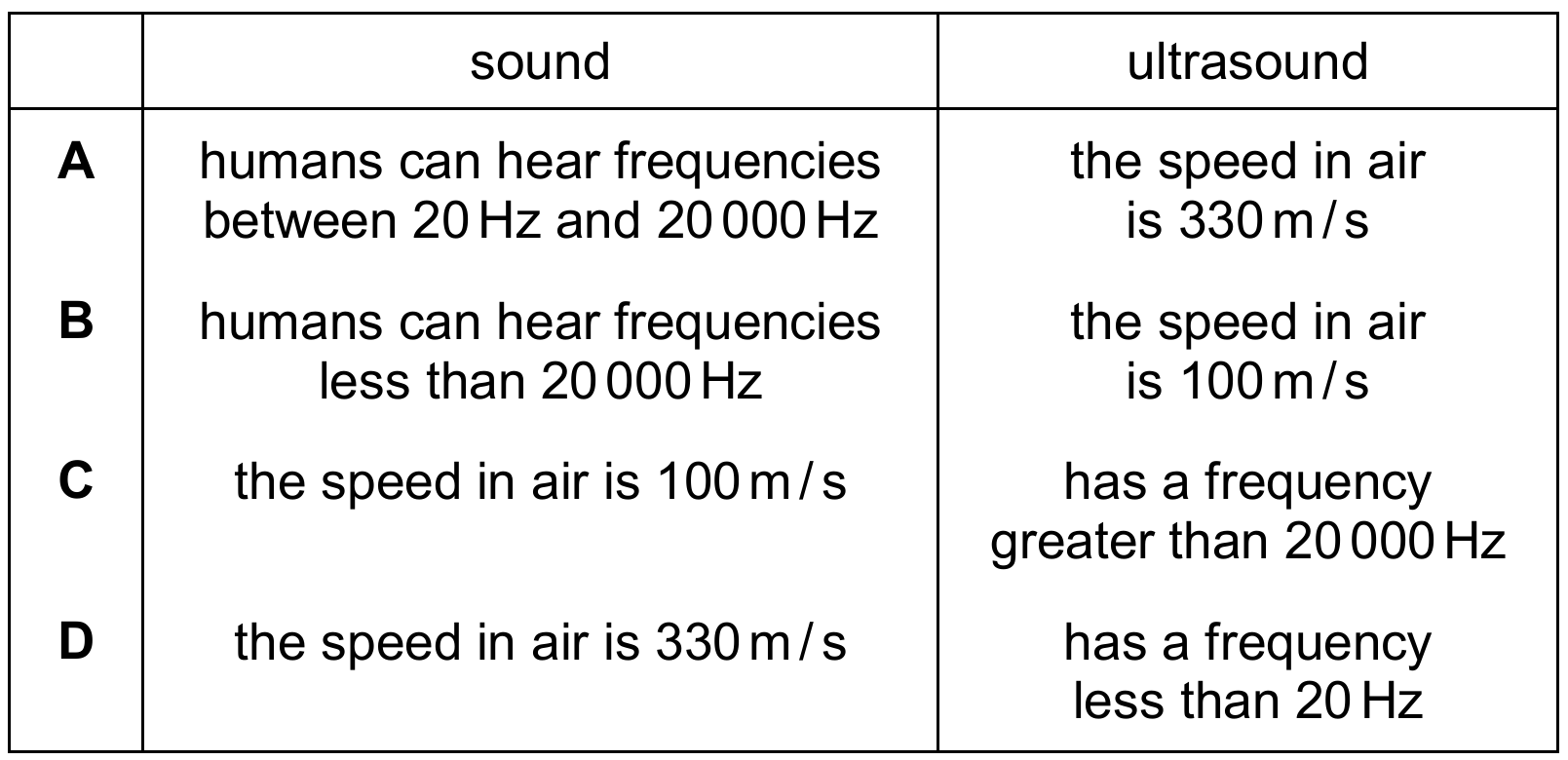
Which statements about sound and ultrasound are correct?

Most-appropriate topic codes (Cambridge IGCSE Physics 0625):

TOPIC 3.4: Sound (Audible range and speed of sound)
▶️ Answer/Explanation
Correct Option: A

Detailed solution:

The human range of audible frequencies is approximately $20\text{ Hz}$ to $20000\text{ Hz}$.
Ultrasound is defined as sound with a frequency higher than $20\text{ kHz}$ ($20000\text{ Hz}$).
Both audible sound and ultrasound are longitudinal waves that travel at the same speed in a given medium.
In air, this speed is approximately $330\text{ m/s}$ to $350\text{ m/s}$.
Option A is correct because it accurately identifies the human hearing range and the correct speed of the wave in air.
Other options are incorrect as they provide the wrong speed ($100\text{ m/s}$) or misdefine the frequency limits of ultrasound.
Question 25

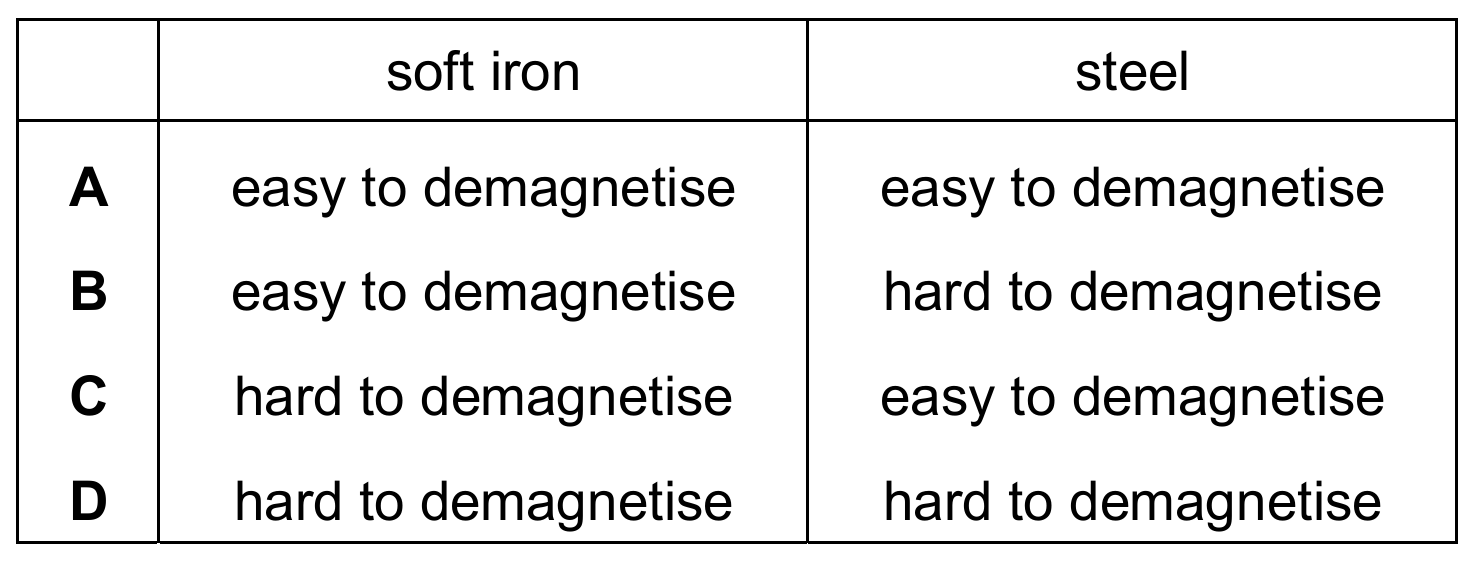
Which row describes the magnetic properties of soft iron and steel?

Most-appropriate topic codes (Cambridge IGCSE Physics 0625):

TOPIC 4.1: Simple phenomena of magnetism (State the differences between the properties of temporary magnets made of soft iron and permanent magnets made of steel)
▶️ Answer/Explanation
Correct Option: B

Detailed solution:

Magnetic materials are classified by how easily they can be magnetised or demagnetised.
Soft iron is a “soft” magnetic material; it is easy to magnetise but loses its magnetism quickly, making it easy to demagnetise.
Steel is a “hard” magnetic material; it is more difficult to magnetise, but once magnetised, it retains it, making it hard to demagnetise.
This makes soft iron ideal for temporary magnets (like electromagnets) and steel ideal for permanent magnets.
Therefore, Row B correctly identifies these distinct physical properties for both materials.
Question 26

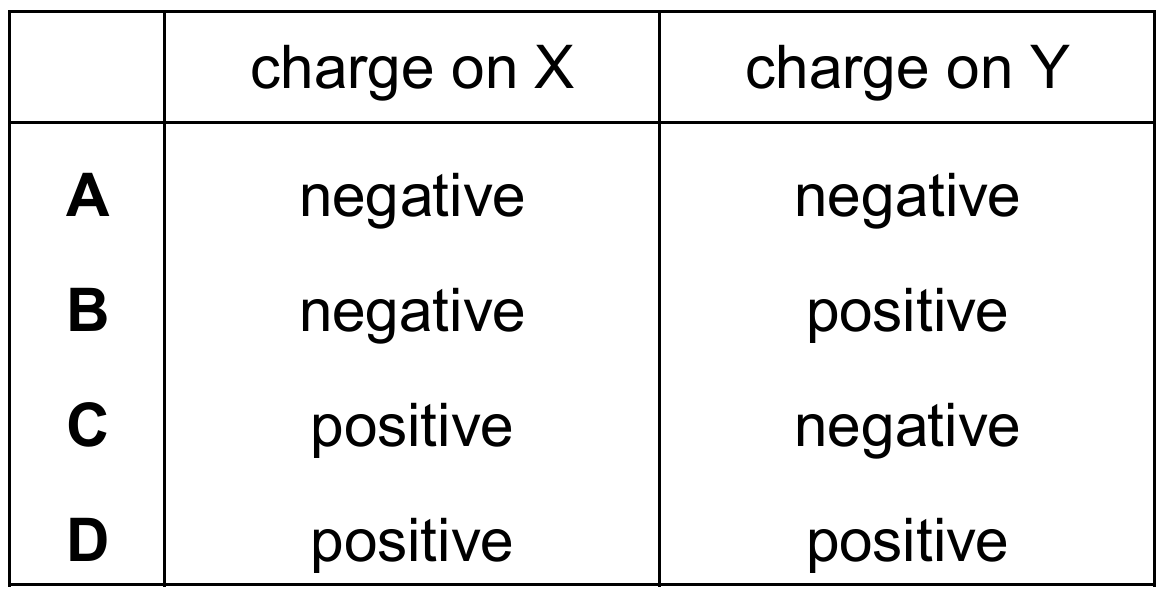
Two charged rods, X and Y, are brought, in turn, near to a negatively charged rod.
X is attracted by the negatively charged rod, and Y is repelled.
What are the charges on X and Y?

Most-appropriate topic codes (Cambridge IGCSE Physics 0625):

TOPIC 4.2.1: Electric charge (Positive charges attract negative charges; negative charges repel other negative charges)
▶️ Answer/Explanation
Correct Option: C

Detailed solution:

Electrostatic theory states that opposite charges attract while like charges repel.
Rod X is attracted to a negative rod, meaning X must possess an opposite (positive) charge.
Rod Y is repelled by the negative rod, meaning Y must possess a like (negative) charge.
Therefore, the charge on X is positive and the charge on Y is negative.
This corresponds exactly to the configuration presented in Row C.
Question 27

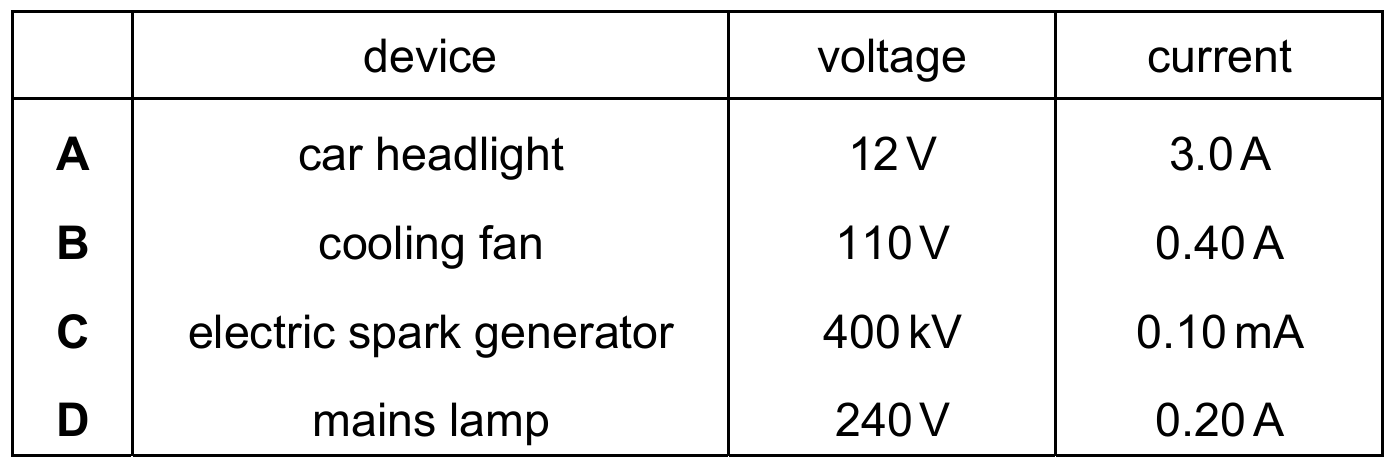
The table gives data for four different electrical devices.
Which device develops the greatest power?

Most-appropriate topic codes (Cambridge IGCSE Physics 0625):

TOPIC 4.2.5: Electrical energy and electrical power (Recall and use the equation $P = IV$)
▶️ Answer/Explanation
Correct Option: D

Detailed solution:

Electrical power $P$ is calculated using the formula $P = IV$.
For A: $P = 12\text{ V} \times 3.0\text{ A} = 36\text{ W}$.
For B: $P = 110\text{ V} \times 0.40\text{ A} = 44\text{ W}$.
For C: $P = (400 \times 10^{3}\text{ V}) \times (0.10 \times 10^{-3}\text{ A}) = 40\text{ W}$.
For D: $P = 240\text{ V} \times 0.20\text{ A} = 48\text{ W}$.
Comparing the results, the mains lamp (Option D) develops the greatest power at $48\text{ W}$.
Question 28

A mains-operated radio is a double-insulated appliance.
Which statement is correct?
A. The radio does not need a neutral connection.
B. The radio must be earthed.
C. The radio circuit is safe without a fuse or trip switch.
D. The outer casing of the radio cannot become live.

Most-appropriate topic codes (Cambridge IGCSE Physics 0625):

TOPIC 4.4: Electrical safety (Explain why the outer casing of an electrical appliance must be either non-conducting (double-insulated) or earthed)
▶️ Answer/Explanation
Correct Option: D

Detailed solution:

Double insulation means the appliance has two layers of insulation between the live internal parts and the user.
The outer casing is made of a non-conducting material (insulator), such as plastic, rather than metal.
Because the casing is an insulator, it cannot conduct electricity even if an internal fault occurs.
Consequently, the outer casing cannot become live, making an earth wire connection unnecessary.
A neutral wire is still required to complete the circuit, and a fuse is still needed to protect against $I^{2}R$ heating or excess current.
Thus, statement D is the only correct description of the safety benefit provided by double insulation.

Question 29

Which statement describes a magnetic field?
A. It is a region where all objects experience a force.
B. It is a region where all electric charges experience a force.
C. It is a region where all magnetic poles experience a force.
D. It is a region where all metals experience a force.

Most-appropriate topic codes (Cambridge IGCSE Physics 0625):

TOPIC 4.1: Simple phenomena of magnetism (Describe a magnetic field as a region in which a magnetic pole experiences a force)
▶️ Answer/Explanation
Correct Option: C

Detailed solution:

A magnetic field is a vector field that describes the magnetic influence on moving electric charges and magnetic materials.
By definition, it is a region of space surrounding a magnet or a current-carrying conductor where a magnetic pole will experience a force $F$.
While it affects magnetic materials like iron, it does not exert a force on all metals (e.g., aluminum or copper) or all general objects.
Electric charges only experience a magnetic force when they are in motion relative to the field, whereas magnetic poles are always affected.
Therefore, the most precise description is that it is a region where magnetic poles experience a force.
This aligns perfectly with Option C.

Question 30

A plastic rod is charged by friction. The plastic rod becomes positively charged.
Which particles are transferred in this process?
A. atoms
B. electrons
C. protons
D. neutrons

Most-appropriate topic codes (Cambridge IGCSE Physics 0625):

TOPIC 4.2.1: Electric charge (Explain that charging of solids by friction involves only a transfer of negative charge (electrons))
▶️ Answer/Explanation
Correct Option: B

Detailed solution:

Charging by friction occurs when two insulators are rubbed together, causing a transfer of surface particles.
In solids, protons and neutrons are bound tightly within the nucleus and cannot move between objects.
Only electrons, which carry a negative charge of approximately $-1.6 \times 10^{-19} \text{ C}$, are mobile enough to be transferred.
When the plastic rod becomes positively charged, it means it has lost some of its negative electrons to the rubbing material.
This creates an imbalance where the number of positive protons exceeds the remaining negative electrons.
Therefore, the only particles transferred during this charging process are electrons.

Question 31

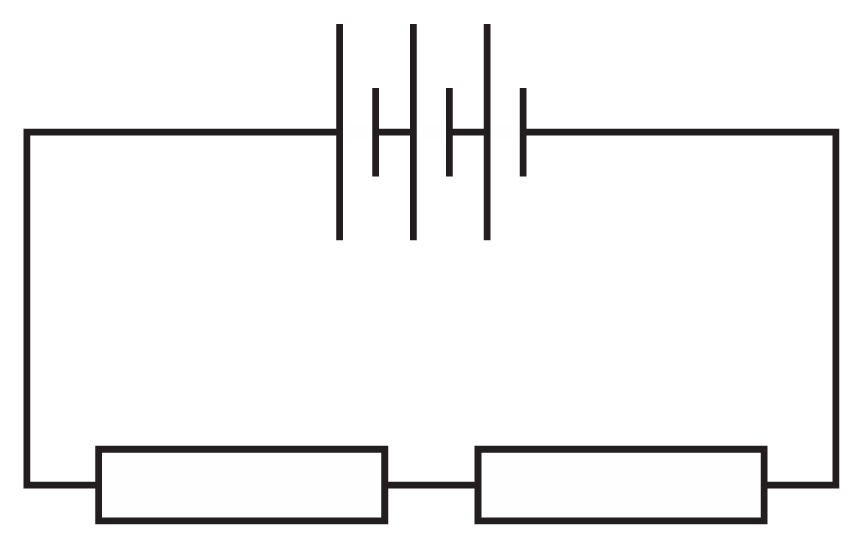
A teacher makes a circuit using three $1.5\text{V}$ cells and two $20\Omega$ resistors connected in series.
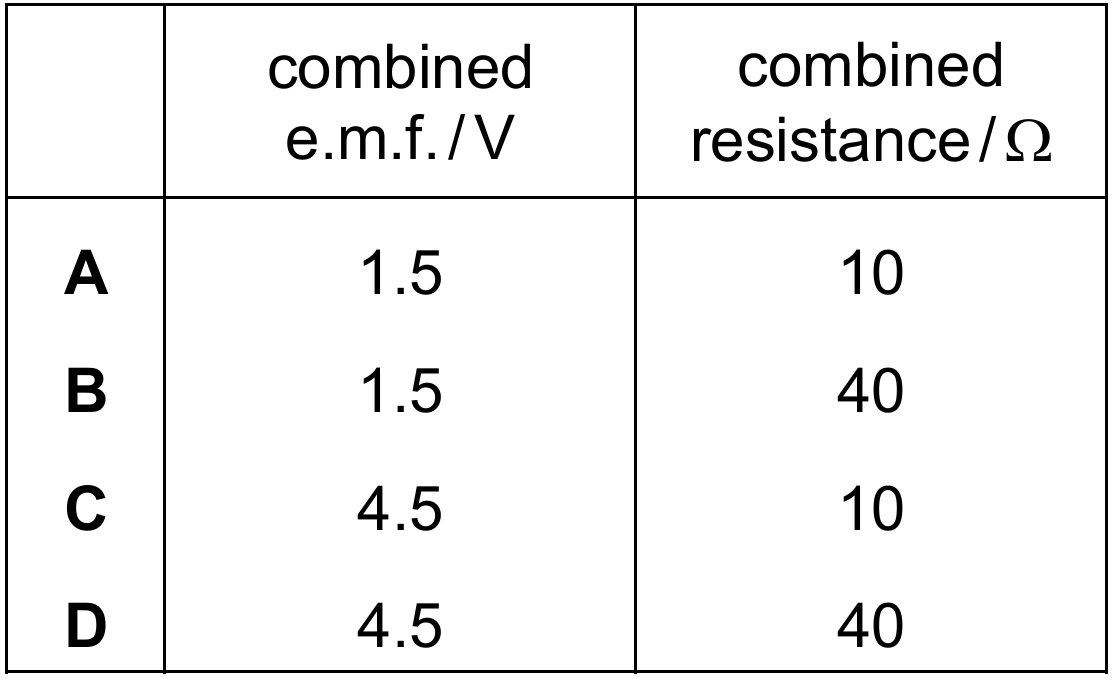
Which row gives the combined electromotive force (e.m.f.) of the cells and the combined resistance of the resistors?

Most-appropriate topic codes (Cambridge IGCSE Physics 0625):

TOPIC 4.3.2: Series and parallel circuits (Calculate combined e.m.f. and resistance in series)
▶️ Answer/Explanation
Correct Option: D

Detailed solution:

The total e.m.f. of cells connected in series is the sum of their individual values: $E_{total} = 1.5\text{V} + 1.5\text{V} + 1.5\text{V} = 4.5\text{V}$.
For resistors in a series circuit, the combined resistance is the sum of the individual resistances: $R_{total} = R_{1} + R_{2}$.
Substituting the given values, the total resistance is $R_{total} = 20\Omega + 20\Omega = 40\Omega$.
Comparing these results to the table, Row D correctly identifies both values.
Therefore, the combined e.m.f. is $4.5\text{V}$ and the combined resistance is $40\Omega$.
Question 32

A student investigates the turning effect on a current-carrying coil placed in a magnetic field.
The student changes the current in the coil and the number of turns on the coil.
Which two changes together must increase the turning effect?
A. decreasing the current and decreasing the number of turns
B. decreasing the current and increasing the number of turns
C. increasing the current and decreasing the number of turns
D. increasing the current and increasing the number of turns

Most-appropriate topic codes (Cambridge IGCSE Physics 0625):

TOPIC 4.5.5: The d.c. motor (Turning effect is increased by increasing: the number of turns on the coil, the current, and the strength of the magnetic field)
▶️ Answer/Explanation
Correct Option: D

Detailed solution:

The turning effect (torque) on a coil in a magnetic field is directly proportional to the current I and the number of turns N.
Mathematically, the turning effect can be expressed by the relationship τ∝B⋅I⋅A⋅N, where B is the magnetic field strength and A is the area.
To ensure an increase in the turning effect, both variables I and N should be changed in a way that maximizes their product.
Increasing the current I provides more force per unit length of the wire according to F=BIl.
Increasing the number of turns N adds more lengths of wire, thereby multiplying the total force acting on the sides of the coil.
Therefore, only option D, which suggests increasing both the current and the number of turns, guaranteed an increase in the turning effect.

Question 33

There is a current of $3.0\text{ A}$ in a conductor.
The current is changed to $6.0\text{ A}$ in the opposite direction.
Which effect does this have on the magnetic field around the conductor?
A. It decreases and it acts in the opposite direction.
B. It decreases and it acts in the same direction.
C. It increases and it acts in the opposite direction.
D. It increases and it acts in the same direction.

Most-appropriate topic codes (Cambridge IGCSE Physics 0625):

TOPIC 4.5.3: Magnetic effect of a current (Describe the effect on the magnetic field around straight wires of changing the magnitude and direction of the current)
▶️ Answer/Explanation
Correct Option: C

Detailed solution:

The strength of a magnetic field around a conductor is directly proportional to the magnitude of the electric current ($B \propto I$).
Since the current increases from $3.0\text{ A}$ to $6.0\text{ A}$, the magnitude of the magnetic field strength increases.
The direction of the magnetic field is determined by the direction of the current, as shown by the Right-Hand Grip Rule.
By reversing the current direction, the circular magnetic field lines will now act in the opposite direction.
Therefore, the field both increases in strength and reverses its direction, making option C the correct choice.

Question 34

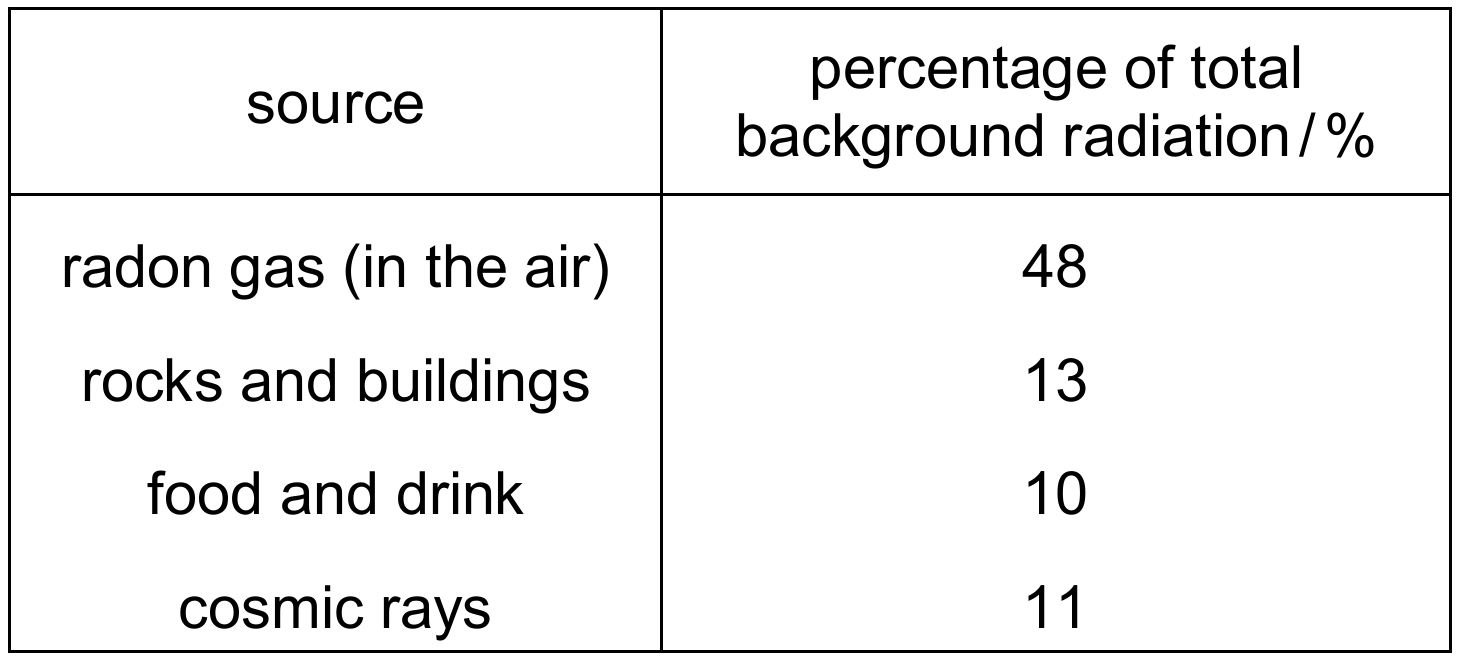
The table shows the contribution to background radiation from the four most common sources.

Which percentage of background radiation comes from all other sources?

A. $14\%$
B. $18\%$
C. $21\%$
D. $82\%$

Most-appropriate topic codes (Cambridge IGCSE Physics 0625):

TOPIC 5.2.1: Detection of radioactivity (Know the sources that make a significant contribution to background radiation)
▶️ Answer/Explanation
Correct Option: B

Detailed solution:

The total percentage of background radiation from all possible sources must equal $100\%$.
First, calculate the sum of the percentages for the four specific sources provided in the table:
$Total_{known} = 48\% + 13\% + 10\% + 11\% = 82\%$.
To find the percentage contributed by “all other sources,” subtract this known sum from the total:
$Percentage_{other} = 100\% – 82\% = 18\%$.
This calculation identifies that $18\%$ of the background radiation originates from sources not listed in the table.
Therefore, Option B is the correct answer.
Question 35

The unstable nucleus of an element undergoes radioactive decay. The proton number remains unchanged.

Which description of this radioactive decay event is correct?

A. The nucleus emits an α-particle.
B. The nucleus emits a β-particle.
C. The nucleus emits γ-radiation.
D. The nucleus emits an α-particle, a β-particle and γ-radiation together.

Most-appropriate topic codes (Cambridge IGCSE Physics 0625):

TOPIC 5.2.3: Radioactive decay (Describe the effect of α-decay, β-decay and γ-emissions on the nucleus)
▶️ Answer/Explanation
Correct Option: C

Detailed solution:

Radioactive decay involves the emission of radiation from an unstable nucleus to increase stability. In α-decay, the proton number decreases by 2. In β-decay, a neutron changes into a proton, increasing the proton number by 1. However, γ-radiation consists of high-energy electromagnetic waves rather than particles. Because it carries no charge and has no mass, the emission of a γ-ray does not change the proton number (Z) or the nucleon number (A) of the nucleus. Therefore, since the proton number remains unchanged, the event must be the emission of γ-radiation.

Question 36

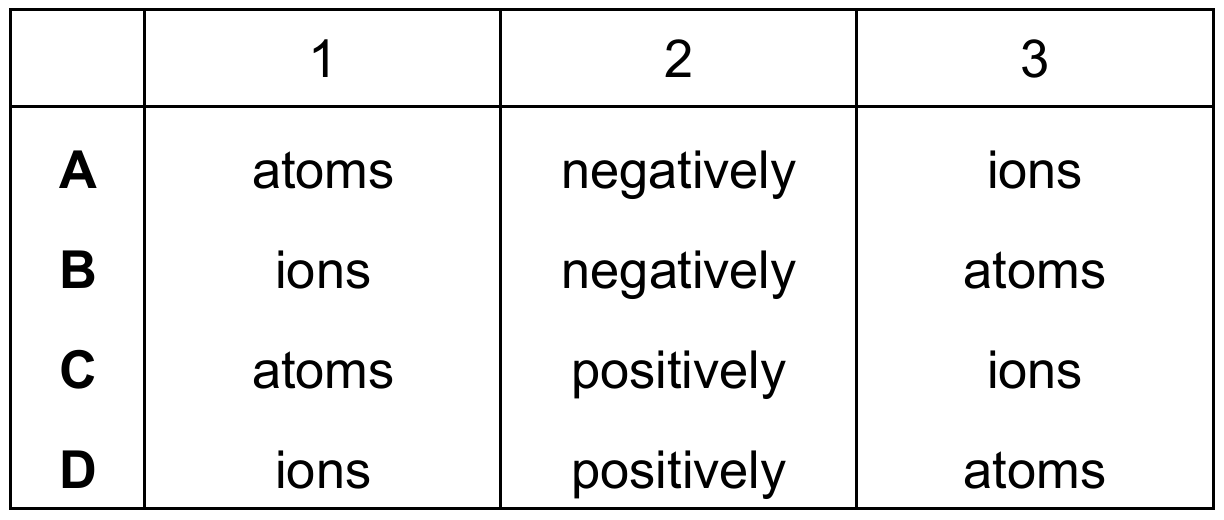
When they lose electrons, ……1…… form ……2…… charged ……3…… .
Which words correctly complete the sentence?

Most-appropriate topic codes (Cambridge IGCSE Physics 0625):

TOPIC 5.1.1: The atom (Know how atoms may form positive ions by losing electrons)
▶️ Answer/Explanation
Correct Option: C

Detailed solution:

An atom is initially neutral because the number of protons ($+1$ charge each) equals the number of electrons ($-1$ charge each).
When atoms lose electrons, they lose negative charge, resulting in a net positive charge since protons now outnumber electrons.
The resulting particle is a positively charged ion (specifically a cation).
Conversely, gaining electrons would create a negatively charged ion.
Therefore, the sentence is correctly completed as: “When they lose electrons, atoms form positively charged ions.”
This corresponds exactly to the sequence provided in Row C.
Question 37

An isotope of krypton has an atomic number of $36$ and a mass number of $78$.
What is the number of protons in a krypton nucleus?
A. $36$
B. $42$
C. $78$
D. $114$

Most-appropriate topic codes (Cambridge IGCSE Physics 0625):

TOPIC 5.1.2: The nucleus (Define the terms proton number $Z$ and nucleon number $A$)
▶️ Answer/Explanation
Correct Option: A

Detailed solution:

The atomic number, often represented by the symbol $Z$, is defined as the number of protons found in the nucleus of an atom.
In this question, the isotope of krypton is explicitly stated to have an atomic number of $36$.
The mass number (or nucleon number, $A = 78$) represents the total sum of protons and neutrons, but does not change the identity or proton count of the element.
Since the atomic number is $36$, the number of protons must also be $36$.
This matches Option A.

Question 38

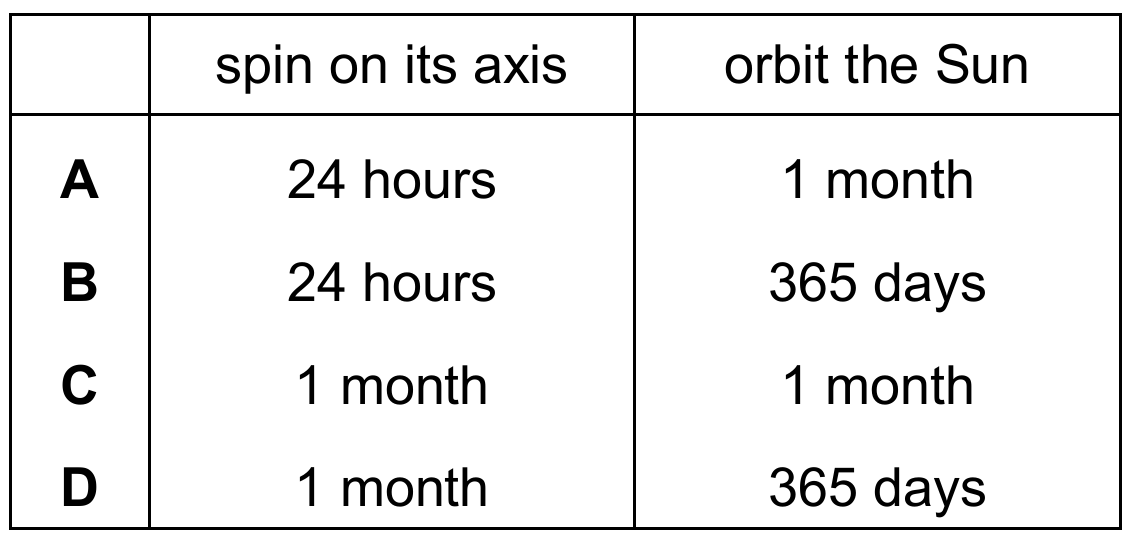
What is the time taken for the Earth to spin once on its axis and the time taken for the Earth to orbit the Sun?

Most-appropriate topic codes (Cambridge IGCSE Physics 0625):

TOPIC 6.1.1: The Earth (Rotation and Orbit)
▶️ Answer/Explanation
Correct Option: B

Detailed solution:

The Earth rotates on its tilted axis, completing one full rotation in approximately $24$ hours, which creates the cycle of day and night.
Simultaneously, the Earth travels in an elliptical path around the Sun, completing one full revolution or orbit in approximately $365$ days (one year).
The Moon, by contrast, takes approximately $1$ month to complete its orbit around the Earth.
Therefore, the correct time intervals for the Earth’s motions are $24$ hours for axial spin and $365$ days for solar orbit.
Matching these facts to the table, Row B provides the accurate duration for both astronomical events.

Question 39

Electromagnetic radiation from distant galaxies is redshifted when observed from the Earth. This is evidence that supports the Big Bang Theory. Which statement is correct?
A. Light from galaxies that are moving towards the Earth is redshifted.
B. Redshift is an increase in the wavelength of electromagnetic radiation.
C. The Big Bang Theory says that the Solar System is expanding out into the Universe.
D. The Big Bang Theory says that, billions of years ago, the Universe expanded to its current size in a few seconds.

Most-appropriate topic codes (Cambridge IGCSE Physics 0625):

TOPIC 6.2.3: The Universe (Describe redshift as an increase in the observed wavelength)
▶️ Answer/Explanation
Correct Option: B

Detailed solution:

Redshift occurs when the light from an object receding from the observer is stretched.
This stretching results in an increase in the observed wavelength $\lambda$ of the electromagnetic radiation.
Option A is incorrect because light from galaxies moving towards Earth would be blueshifted (decreased $\lambda$).
Option C is incorrect as the Big Bang Theory describes the expansion of the Universe itself, not just the Solar System.
Option D is factually incorrect regarding the timeline and rate of expansion to the current size.
Therefore, statement B is the only scientifically accurate definition of redshift provided.

Question 40

Which statement about the Milky Way is correct?
A. It is a galaxy made up of billions of stars.
B. It is a group of galaxies in our Solar System.
C. It is all the stars that we can see in the night sky.
D. It is the path taken by a comet when it gets close to the Sun.

Most-appropriate topic codes (Cambridge IGCSE Physics 0625):

TOPIC 6.2.2: Stars (The Sun is a star in the galaxy known as the Milky Way)
TOPIC 6.2.3: The Universe (The Milky Way is one of many billions of galaxies)
▶️ Answer/Explanation
Correct Option: A

Detailed solution:

The Milky Way is classified as a galaxy, which is a massive system consisting of gas, dust, and billions of stars.
Our Solar System is merely a small part of the Milky Way, not the other way around as suggested in option B.
While we see many stars from the Milky Way in the night sky, we cannot see all of its billions of stars with the naked eye.
A comet’s path is a local orbital trajectory within the Solar System and is unrelated to the definition of a galaxy.
The diameter of the Milky Way is approximately $100000$ light-years, and it contains our Sun as one of its many stars.
Therefore, statement A is the only scientifically accurate description of the Milky Way’s nature.

Scroll to Top