Home / 0625_s25_qp_22

Question 1

Which instrument is most suitable to determine the volume of a small irregularly shaped stone?
A. 30 cm ruler
B. digital timer
C. measuring cylinder
D. tape measure

Most-appropriate topic codes (Cambridge IGCSE Physics 0625):

TOPIC 1.1: Physical quantities and measurement techniques (Describe the use of rulers and measuring cylinders to find a length or a volume)
TOPIC 1.4: Density (Describe how to determine the density of… an irregularly shaped solid… volume by displacement)
▶️ Answer/Explanation
Correct Option: C

Detailed solution:

To find the volume of an irregularly shaped object, we use the displacement method.
Instruments like a $30\text{ cm}$ ruler or tape measure are used for linear dimensions, which only work for regular shapes.
A digital timer measures time intervals and is irrelevant for volume determination.
A measuring cylinder allows us to measure the volume of liquid displaced when the stone is submerged.
The increase in the liquid level represents the volume of the stone, expressed as $V = V_{final} – V_{initial}$.
Therefore, the measuring cylinder is the only suitable instrument for this task.

Question 2

A steel ball is dropped from the top floor of a building. Air resistance can be ignored. Which statement describes the motion of the ball?
A. The ball falls with constant acceleration.
B. The ball falls with constant speed.
C. The ball falls with decreasing speed.
D. The ball falls with increasing acceleration.

Most-appropriate topic codes (Cambridge IGCSE Physics 0625):

TOPIC 1.2: Motion (State that the acceleration of free fall $g$ for an object near to the surface of the Earth is approximately constant)
▶️ Answer/Explanation
Correct Option: A

Detailed solution:

When an object falls near the Earth’s surface and air resistance is ignored, it is in a state of free fall.
The only force acting on the ball is its weight, resulting in a constant acceleration due to gravity, $g \approx 9.8 \text{ m/s}^2$.
Since the acceleration is constant and in the direction of motion, the speed of the ball increases at a steady rate.
Option B and C are incorrect because the speed is changing, not remaining constant or decreasing.
Option D is incorrect because the gravitational field strength is uniform, so the acceleration does not increase.
Thus, the ball falls with a constant acceleration, making option A the correct description.

Question 3

The diagram shows a velocity–time graph for an object which is accelerating.
What is the acceleration of the object?
A. 0.40 m/s 2
B. 2.5 m/s 2
C. 3.0 m/s 2
D. 100 m/s 2

Most-appropriate topic codes (Cambridge IGCSE Physics 0625):

TOPIC 1.2: Motion (Calculate acceleration from the gradient of a speed-time graph)
▶️ Answer/Explanation
Correct Option: B

Detailed solution:

Acceleration a is defined as the change in velocity Δv per unit time Δt, which corresponds to the gradient of a velocity-time graph.
From the graph, the initial velocity u at t=0 s is 20 m/s, and the final velocity v at t=40 s is 120 m/s.
The change in velocity is Δv=120 m/s−20 m/s=100 m/s, and the time interval is Δt=40 s−0 s=40 s.
Using the formula a= Δt Δv ​ , we calculate the acceleration as a= 40 100 ​ =2.5 m/s 2 .
This matches the value provided in Option B.

Question 4

Diagram 1 shows a piece of flexible material that contains many pockets of air. Diagram 2 shows the same piece of flexible material after it has been compressed so that its volume decreases.
What happens to the mass and to the weight of the flexible material when it is compressed?

Most-appropriate topic codes (Cambridge IGCSE Physics 0625):

TOPIC 1.3: Mass and weight (State that mass is a measure of the quantity of matter; weight is a gravitational force)
▶️ Answer/Explanation
Correct Option: D

Detailed solution:

Mass is defined as the measure of the quantity of matter in an object. Compression only changes the volume $V$ and density $\rho$ by pushing particles closer together, but the total amount of matter remains constant, so mass does not change.
Weight is the gravitational force acting on a mass, calculated using $W = mg$. Since the mass $m$ is constant and the gravitational field strength $g$ remains unchanged, the weight also stays the same.
Therefore, both mass and weight experience no change during the compression of the flexible material.
This corresponds to the values provided in Row D.

Question 5

A student determines the density of copper.
She has a rectangular block of copper.
Which other apparatus does she need?

Most-appropriate topic codes (Cambridge IGCSE Physics 0625):

TOPIC 1.4: Density (Describe how to determine the density of a regularly shaped solid)
TOPIC 1.1: Physical quantities and measurement techniques (Use of rulers and balances)
▶️ Answer/Explanation
Correct Option: C

Detailed solution:

Density is defined by the equation $\rho = \frac{m}{V}$, where $m$ is mass and $V$ is volume.
To find the mass ($m$), the student must use a balance to weigh the copper block.
For a rectangular block, volume is calculated using $V = l \times w \times h$.
A ruler is required to measure these linear dimensions (length, width, and height).
Since the block is solid and its volume is determined geometrically, a stop-watch and thermometer are not needed.
Therefore, the student only needs a balance and a ruler to determine the density.
Question 6

A $0.15\text{ kg}$ mass is suspended from a vertical spring.
The mass is pulled downwards until the spring has extended by $12\text{ cm}$ from its unstretched length.
The spring constant of the spring is $30\text{ N/m}$.
What is the magnitude of the initial acceleration of the mass when it is released?
A. $14\text{ m/s}^{2}$
B. $24\text{ m/s}^{2}$
C. $28\text{ m/s}^{2}$
D. $34\text{ m/s}^{2}$

Most-appropriate topic codes (Cambridge IGCSE Physics 0625):

TOPIC 1.3: Mass and weight ($W = mg$)
TOPIC 1.5.1: Effects of forces ($F = kx$ and $F = ma$)
▶️ Answer/Explanation
Correct Option: A

Detailed solution:

The upward restoring force of the spring is $F_{s} = kx = 30\text{ N/m} \times 0.12\text{ m} = 3.6\text{ N}$.
The downward weight of the mass is $W = mg = 0.15\text{ kg} \times 9.8\text{ m/s}^{2} = 1.47\text{ N}$.
The resultant upward force upon release is $F_{res} = F_{s} – W = 3.6\text{ N} – 1.47\text{ N} = 2.13\text{ N}$.
Using Newton’s Second Law, the acceleration is $a = \frac{F_{res}}{m} = \frac{2.13\text{ N}}{0.15\text{ kg}} = 14.2\text{ m/s}^{2}$.
Rounding to two significant figures as per the options, the magnitude is $14\text{ m/s}^{2}$.

Question 7

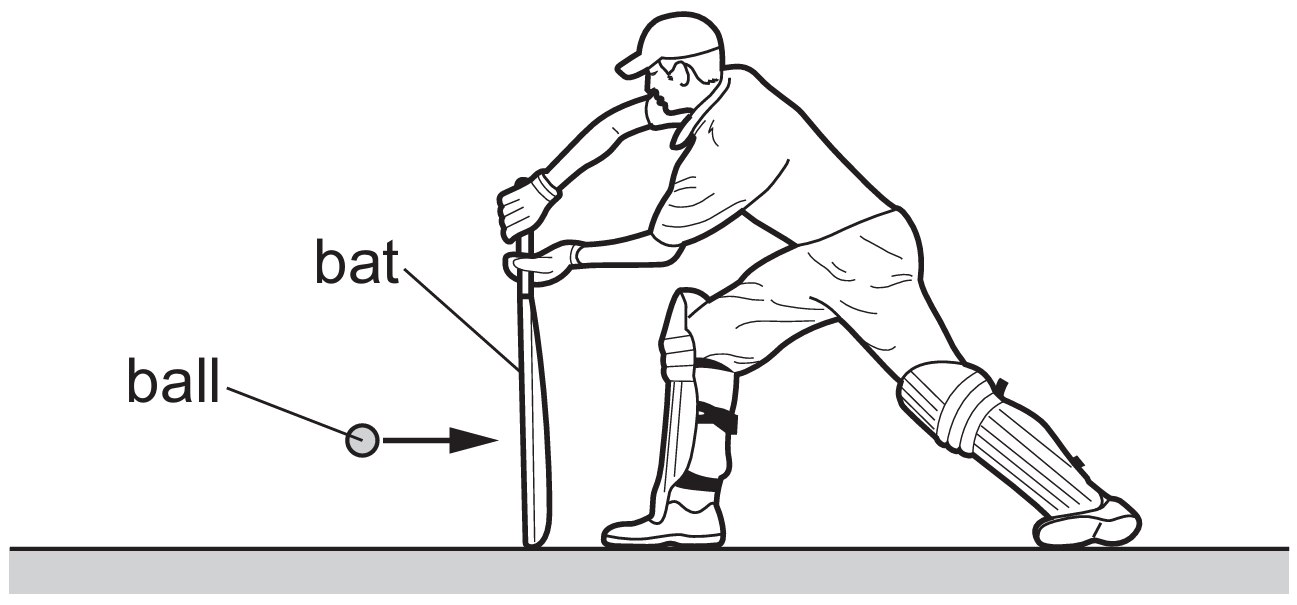
A cricket ball of mass $0.15 \text{ kg}$ is moving at a speed of $30 \text{ m/s}$.
A batsman holds a bat stationary as the ball hits the bat and bounces back at the same speed in the opposite direction.
The ball is in contact with the bat for $1.0 \times 10^{-3} \text{ s}$.
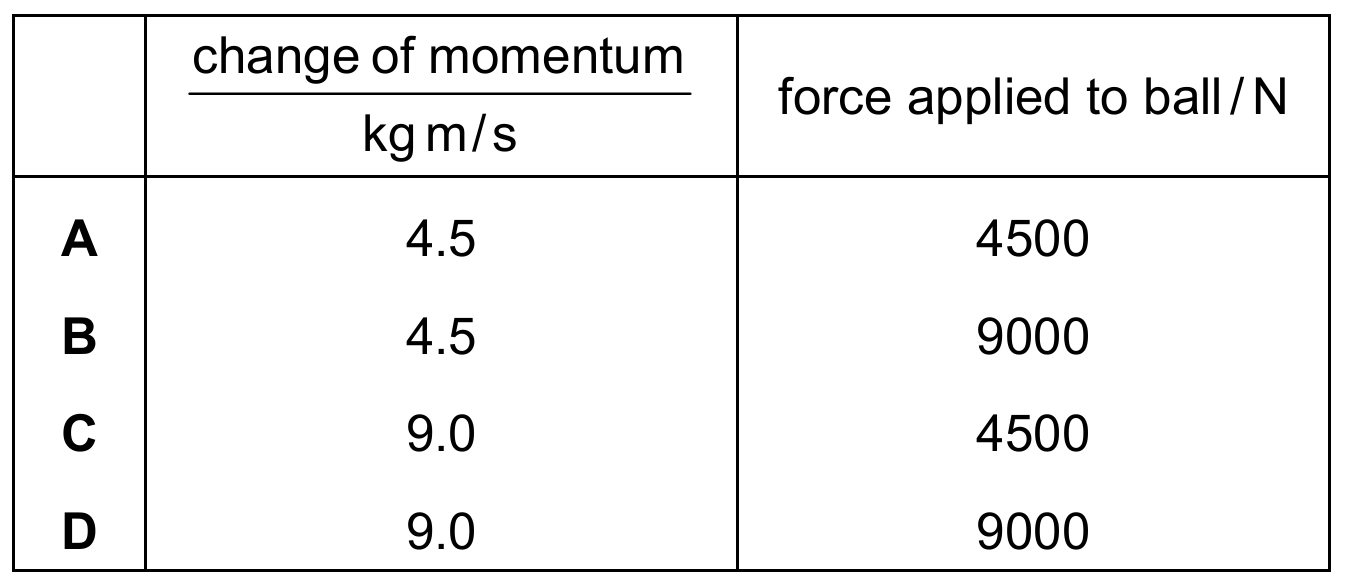
Which row shows the change in momentum of the ball and the magnitude of the force applied to the ball?

Most-appropriate topic codes (Cambridge IGCSE Physics 0625):

TOPIC 1.6: Momentum (Define momentum as $p=mv$ and impulse as $F\Delta t = \Delta(mv)$)
▶️ Answer/Explanation
Correct Option: D

Detailed solution:

Initial momentum is $p_{i} = mv = 0.15 \text{ kg} \times 30 \text{ m/s} = 4.5 \text{ kg m/s}$.
Since it bounces back at the same speed, final momentum is $p_{f} = m(-v) = -4.5 \text{ kg m/s}$.
Change in momentum is $\Delta p = p_{f} – p_{i} = -4.5 – 4.5 = -9.0 \text{ kg m/s}$, so the magnitude is $9.0 \text{ kg m/s}$.
Force is defined as the rate of change of momentum: $F = \frac{\Delta p}{\Delta t}$.
Substituting the values, $F = \frac{9.0 \text{ kg m/s}}{1.0 \times 10^{-3} \text{ s}} = 9000 \text{ N}$.
Thus, Row D is the correct choice as it matches both calculated values.

Question 8

A stone is thrown vertically upwards at a speed of $5.0$ m/s.
All of the energy initially in the kinetic store of the stone is transferred to its gravitational potential store when the stone reaches its maximum height.
Which equation gives the maximum height $h$ reached by the stone?
A. $h = \frac{9.8}{2 \times 5.0^{2}}$
B. $h = \frac{5.0^{2} \times 2}{9.8}$
C. $h = \frac{5.0^{2}}{2 \times 9.8}$
D. $h = \frac{2 \times 9.8}{5.0^{2}}$

Most-appropriate topic codes (Cambridge IGCSE Physics 0625):

TOPIC 1.7.1: Energy (Conservation of energy; Kinetic and Gravitational Potential Energy equations)
TOPIC 1.2: Motion (Acceleration of free fall $g \approx 9.8$ m/s$^{2}$)
▶️ Answer/Explanation
Correct Option: C

Detailed solution:

By the principle of conservation of energy, the initial kinetic energy $E_{k}$ equals the final gravitational potential energy $\Delta E_{p}$ at maximum height.
Using the formulas $E_{k} = \frac{1}{2}mv^{2}$ and $\Delta E_{p} = mgh$, we set them equal: $\frac{1}{2}mv^{2} = mgh$.
The mass $m$ cancels out from both sides, leaving $\frac{1}{2}v^{2} = gh$.
Rearranging for height gives $h = \frac{v^{2}}{2g}$.
Substituting the given initial speed $v = 5.0$ m/s and the constant $g = 9.8$ m/s$^{2}$, the expression becomes $h = \frac{5.0^{2}}{2 \times 9.8}$.
This matches the expression shown in option C.

Question 9

Three energy resources are listed:
  1. geothermal
  2. wind
  3. nuclear fuel
Which resources get their energy from the Sun?
A. $1$, $2$ and $3$
B. $1$ and $2$ only
C. $1$ only
D. $2$ only

Most-appropriate topic codes (Cambridge IGCSE Physics 0625):

TOPIC 1.7.3: Energy resources (Know that radiation from the Sun is the main source of energy for all our energy resources except geothermal, nuclear and tidal)
▶️ Answer/Explanation
Correct Option: D

Detailed solution:

The Sun is the primary source of energy for most Earth resources, but there are specific exceptions.
Wind energy is driven by the Sun, as solar radiation causes uneven heating of the atmosphere, creating pressure differences.
Geothermal energy originates from radioactive decay and residual heat within the Earth’s core, not the Sun.
Nuclear fuel (such as Uranium) is derived from elements present during the Earth’s formation and is not a solar product.
According to the syllabus, only geothermal, nuclear, and tidal resources do not depend on the Sun.
Therefore, out of the three listed, only wind ($2$) obtains its energy from solar radiation, making D the correct choice.

Question 10

A sample of a substance has a shape that is determined by its container. What are the possible states of this sample?
A. gas, liquid and solid
B. gas and liquid only
C. gas and solid only
D. solid and liquid only

Most-appropriate topic codes (Cambridge IGCSE Physics 0625):

TOPIC 2.1.1: States of matter (Know the distinguishing properties of solids, liquids and gases)
▶️ Answer/Explanation
Correct Option: B

Detailed solution:

The state of a substance is determined by the arrangement and mobility of its particles. Solids have a fixed shape because their particles are held in a rigid lattice. In contrast, liquids and gases are fluids; they do not have a fixed shape and instead flow to take the shape of the part of the container they occupy. A liquid has a fixed volume but conforms to the container’s base, while a gas expands to fill the entire volume of its container. Since solids maintain their own shape regardless of the container, the only possible states for the sample described are gas and liquid. Thus, Option B is correct.

Question 11

A stationary smoke particle is hit by a fast-moving nitrogen molecule.
Which row describes the motion of the smoke particle and of the nitrogen molecule after the collision?

Most-appropriate topic codes (Cambridge IGCSE Physics 0625):

TOPIC 2.1.2: Particle model (Brownian motion in terms of random collisions)
▶️ Answer/Explanation
Correct Option: A

Detailed solution:

This scenario illustrates Brownian motion, where microscopic smoke particles are moved by collisions with light, fast-moving molecules.
When a fast-moving nitrogen molecule ($m_{n}$) hits a much larger smoke particle ($M_{s}$), a transfer of momentum occurs.
The nitrogen molecule has high kinetic energy and, due to its small mass relative to the smoke particle, it rebounds upon impact.
The smoke particle, though much larger, receives an impulse that causes it to move from its stationary position.
According to the principle of conservation of momentum, the total momentum before collision ($m_{n}v$) must equal the total momentum after.
Since the smoke particle moves and the nitrogen molecule rebounds to conserve energy and momentum, Row A is the correct description.

Question 12

A bubble of gas rises from the bottom of a lake to the top.
The table shows readings of the gas pressure inside the bubble and the volume of the bubble.
The temperature of the water in the lake is constant.
The values in three rows of the table are correct and one row is not correct.
Which row is not correct?

Most-appropriate topic codes (Cambridge IGCSE Physics 0625):

TOPIC 2.1.3: Gases and the absolute scale of temperature (Recall and use the equation $pV = \text{constant}$)
▶️ Answer/Explanation
Correct Option: C

Detailed solution:

Since the temperature is constant, we apply Boyle’s Law: $pV = \text{constant}$.
For Row A: $360 \times 2.4 = 864$.
For Row B: $270 \times 3.2 = 864$.
For Row D: $120 \times 7.2 = 864$.
The constant value for the correct rows is $864\text{ kPa cm}^3$.
For Row C: $160 \times 4.6 = 736$, which does not equal $864$.
Therefore, Row C is the incorrect row.
Question 13

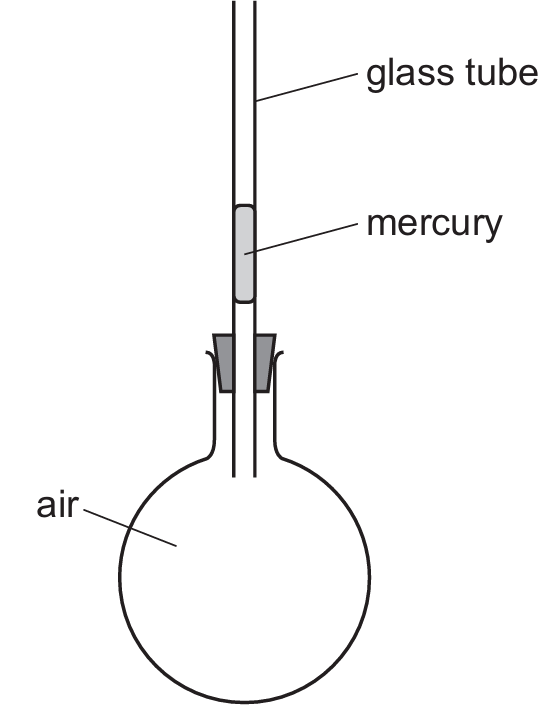
The diagram shows a glass flask sealed with a small volume of mercury in a glass tube. When the flask is gently warmed, the mercury rises up the tube.
What is the main cause of the movement of the mercury?
A. expansion of air in the flask
B. expansion of the glass flask
C. expansion of the glass tube
D. expansion of the mercury

Most-appropriate topic codes (Cambridge IGCSE Physics 0625):

TOPIC 2.2.1: Thermal expansion of solids, liquids and gases (Describe, qualitatively, the thermal expansion of solids, liquids and gases)
▶️ Answer/Explanation
Correct Option: A

Detailed solution:

When the flask is warmed, the thermal energy is transferred to the air trapped inside. This increase in temperature causes the air molecules to move faster and push further apart, leading to significant thermal expansion. Gases expand much more than solids or liquids for the same increase in temperature. As the volume of the air increases, it exerts pressure on the mercury thread, forcing it to rise up the glass tube. While the glass and mercury also expand, their expansion is negligible compared to the air. Thus, the expansion of air is the primary cause of the mercury’s movement.
Question 14

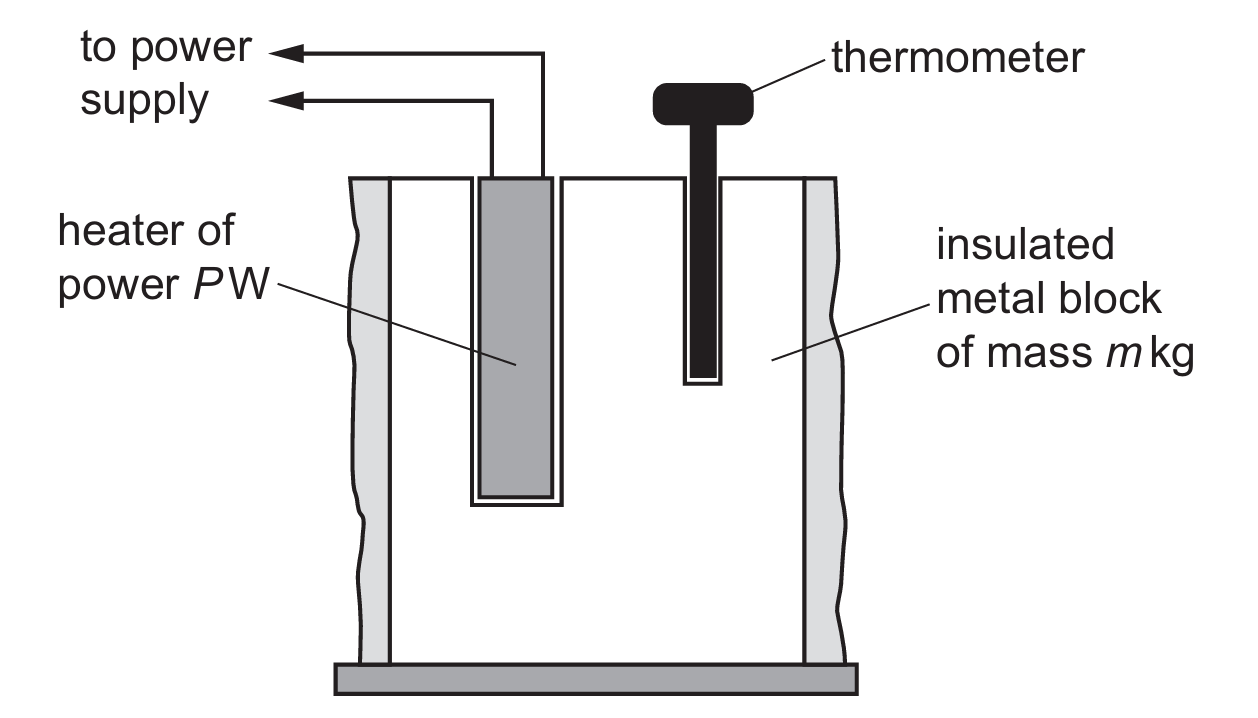
The diagram shows the equipment used in an experiment to determine the specific heat capacity of a metal.
In the experiment, a heater is switched on for $t$ s and the increase in temperature $\Delta \theta$ of a block of the metal is measured in °C.
Which equation gives the specific heat capacity of the metal?
A. $c = \frac{P}{tm\Delta \theta}$
B. $c = \frac{Pt}{m\Delta \theta}$
C. $c = \frac{tm\Delta \theta}{P}$
D. $c = \frac{m\Delta \theta}{Pt}$

Most-appropriate topic codes (Cambridge IGCSE Physics 0625):

TOPIC 2.2.2: Specific heat capacity (Recall and use the equation $c = \frac{\Delta E}{m\Delta \theta}$)
TOPIC 1.7.4: Power (Recall and use the equation $P = \frac{\Delta E}{t}$)
▶️ Answer/Explanation
Correct Option: B

Detailed solution:

The energy transferred by the heater is given by $\Delta E = P \times t$, where $P$ is power and $t$ is time.
Specific heat capacity $c$ is defined by the thermal energy equation $\Delta E = mc\Delta \theta$.
By substituting the expression for energy, we get $Pt = mc\Delta \theta$.
Rearranging this formula to make $c$ the subject gives $c = \frac{Pt}{m\Delta \theta}$.
This matches the expression provided in Option B.

Question 15

The diagram shows four rods. Each rod is made of a different metal.
Wax is used to attach small metal balls at the rod ends $P$, $Q$, $R$ and $S$.
Each rod is the same size. They are heated uniformly by a Bunsen burner at point $X$.
As the rods warm up, the wax melts and the balls fall off.
Why does the ball on the silver rod fall first?
A. Silver is the best conductor of heat.
B. Silver is the worst conductor of heat.
C. Silver is the best radiator of heat.
D. Silver is the worst radiator of heat.

Most-appropriate topic codes (Cambridge IGCSE Physics 0625):

TOPIC 2.3.1: Conduction (Properties of good and bad thermal conductors)
▶️ Answer/Explanation
Correct Option: A

Detailed solution:

Thermal conduction is the process where heat energy is transferred through a solid material from a region of higher temperature to a region of lower temperature.
In this experiment, heat travels from the central point $X$ toward the ends $P$, $Q$, $R$, and $S$ via the metal lattice and free electrons.
The ball on the silver rod falls first because the wax holding it reaches its melting point before the wax on the other rods.
This indicates that heat is transferred most rapidly through silver compared to brass, copper, or iron.
Therefore, silver must have the highest thermal conductivity among the metals shown, making it the best conductor of heat.
Radiation is not the primary mechanism here as the heat is traveling through the medium of the rod itself.

Question 16

Three solid copper spheres, X, Y and Z, are heated to the same temperature. 
Which row gives the order for the rate of emission of radiation?

Most-appropriate topic codes (Cambridge IGCSE Physics 0625):

TOPIC 2.3.3: Radiation (Describe the effect of surface colour and surface area on the rate of emission)
▶️ Answer/Explanation
Correct Option: B

Detailed solution:

The rate of infrared emission depends on surface temperature, surface area, and surface colour. All spheres are at the same temperature.
Surface area is proportional to the square of the diameter ($A \propto d^{2}$); thus, X and Z (diameter $2d$) have 4 times the area of Y (diameter $d$).
Black surfaces are better emitters than white surfaces. Comparing X and Z, X (black) emits more than Z (white) despite having equal area.
Comparing Z and Y, both are white, but Z has a larger surface area, so it emits at a higher rate than Y.
The resulting order from highest to lowest rate of emission is X, then Z, then Y.
This corresponds to Option B.

Question 17

Which wave will diffract the most when passing through a gap that is $0.85$ m wide?

Most-appropriate topic codes (Cambridge IGCSE Physics 0625):

TOPIC 3.1: General properties of waves (Describe how wavelength and gap size affects diffraction through a gap)
▶️ Answer/Explanation
Correct Option: C

Detailed solution:

Diffraction is most significant when the wavelength $\lambda$ of a wave is approximately equal to the width of the gap.
Wavelength is calculated using the wave equation: $\lambda = \frac{v}{f}$, where $v$ is speed and $f$ is frequency.
For Option C, $\lambda = \frac{350\text{ m/s}}{280\text{ Hz}} = 1.25$ m. For Option A, $\lambda \approx 1.07$ m; B, $\lambda = 0.75$ m; D, $\lambda = 0.875$ m.
While Option D is numerically closest to the $0.85$ m gap, maximum diffraction occurs when the wavelength is large enough to be comparable to or slightly larger than the gap.
Option C provides the longest wavelength ($1.25$ m) among the choices, leading to the greatest spreading of the wavefront.
Therefore, the combination of high speed and low frequency in Row C results in the most pronounced diffraction.

Question 18

Which arrow on the graph shows the amplitude of the wave?

Most-appropriate topic codes (Cambridge IGCSE Physics 0625):

TOPIC 3.1: General properties of waves (Describe the features of a wave in terms of amplitude)
▶️ Answer/Explanation
Correct Option: B

Detailed solution:

The amplitude of a wave is defined as the maximum displacement of a point on the wave from its undisturbed (rest) position.
In the given displacement-distance graph, the horizontal axis represents the equilibrium position where displacement is $0$.
Arrow B correctly measures the vertical distance from this equilibrium line to the crest of the wave.
In contrast, arrow A represents the peak-to-trough height, which is equivalent to $2 \times \text{amplitude}$.
Arrow C shows a half-wavelength, while arrow D represents one full wavelength $\lambda$, measured between two adjacent troughs.
Therefore, only arrow B accurately represents the amplitude of the wave.

Question 19

Which row describes a seismic S-wave?

Most-appropriate topic codes (Cambridge IGCSE Physics 0625):

TOPIC 3.1: General properties of waves (Understand that seismic S-waves can be modelled as transverse)
▶️ Answer/Explanation
Correct Option: D

Detailed solution:

Seismic S-waves (secondary waves) are classified as transverse waves. By definition, a transverse wave is one where the direction of vibration of the particles is at an angle of $90^{\circ}$ (perpendicular) to the direction of energy propagation. Conversely, longitudinal waves, such as P-waves, vibrate parallel to the direction of travel. Therefore, for an S-wave, the vibration must be perpendicular to the movement of the wavefront. This makes Row D the only scientifically accurate description.

Question 20

The image of an object is formed by a plane mirror.
Which row gives the correct properties of the image?

Most-appropriate topic codes (Cambridge IGCSE Physics 0625):

TOPIC 3.2.1: Reflection of light (Describe the formation of an optical image by a plane mirror and give its characteristics)
▶️ Answer/Explanation
Correct Option: D

Detailed solution:

An image in a plane mirror is always virtual because the light rays do not actually meet but only appear to diverge from a point behind the mirror.
One of the fundamental laws of reflection in plane mirrors is that the image distance is equal to the object distance, meaning the image is at the same distance from the mirror as the object.
Additionally, the image is upright and the same size as the object, though it is laterally inverted.
Row D correctly identifies both properties: the image is virtual and located at the same distance from the mirror as the object.
Options A and B are incorrect as the image is not real; Option C is incorrect as the distance is not closer.

Question 21

A ray of light, travelling in air, is incident on an air–glass boundary.
The angles between the incident ray, the refracted ray and the boundary are shown.
Which equation is used to calculate the refractive index $n$ of the glass?
A. $n = \frac{\sin 40^\circ}{\sin 26^\circ}$
B. $n = \frac{\sin 40^\circ}{\sin 64^\circ}$
C. $n = \frac{\sin 50^\circ}{\sin 26^\circ}$
D. $n = \frac{\sin 50^\circ}{\sin 64^\circ}$

Most-appropriate topic codes (Cambridge IGCSE Physics 0625):

TOPIC 3.2.2: Refraction of light (Recall and use the equation $n = \frac{\sin i}{\sin r}$)
▶️ Answer/Explanation
Correct Option: A

Detailed solution:

To find the refractive index $n$, we use Snell’s Law: $n = \frac{\sin i}{\sin r}$, where $i$ and $r$ are measured from the normal.
The angle of incidence $i$ is the angle between the incident ray and the normal: $i = 90^\circ – 50^\circ = 40^\circ$.
The angle of refraction $r$ is the angle between the refracted ray and the normal: $r = 90^\circ – 64^\circ = 26^\circ$.
Substituting these values into the equation gives $n = \frac{\sin 40^\circ}{\sin 26^\circ}$.
The diagram provides angles relative to the boundary, which must be subtracted from $90^\circ$ to find the correct angles for the formula.
Thus, option A is the correct mathematical representation for the refractive index.
Question 22

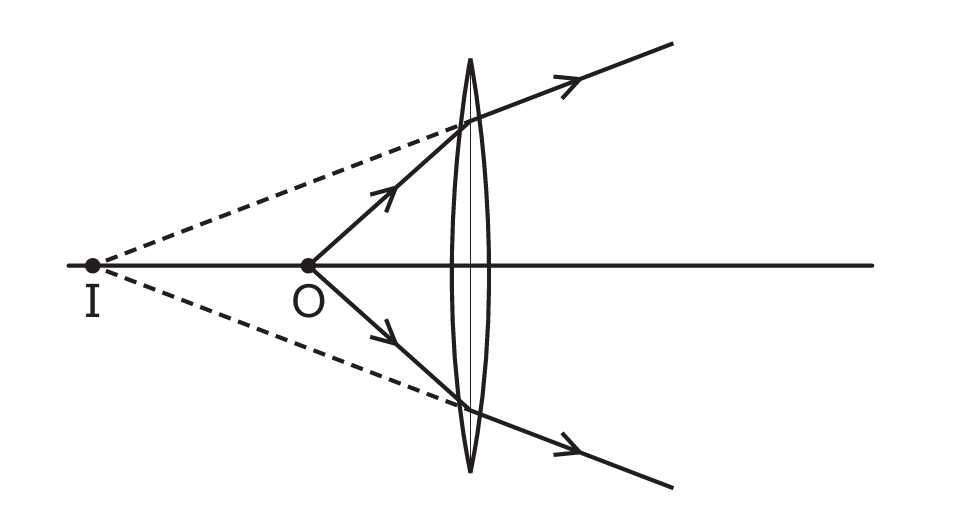
A small object $O$ is placed near a converging lens, as shown. The lens forms an image $I$.
Which statement is correct?
A. The image $I$ is diminished.
B. The image $I$ is inverted.
C. The image $I$ is real.
D. The object $O$ is closer to the lens than its principal focus.

Most-appropriate topic codes (Cambridge IGCSE Physics 0625):

TOPIC 3.2.3: Thin lenses (Draw and use ray diagrams for the formation of a virtual image by a converging lens)
▶️ Answer/Explanation
Correct Option: D

Detailed solution:

The ray diagram shows light rays from object $O$ diverging after passing through the lens. Since the rays do not meet on the opposite side, they are extrapolated backwards (dashed lines) to form a virtual image $I$. This specific configuration—where a converging lens produces an upright, enlarged, and virtual image—only occurs when the object $O$ is placed between the lens and its principal focus $F$. Thus, the object distance $u$ is less than the focal length $f$. Consequently, the image is not real, inverted, or diminished, making statement D the only correct choice.
Question 23

What is the approximate speed of light in air?
A. 300 m/s
B. 300 km/s
C. 3.0×10 8 m/s
D. 3.0×10 8 km/s

Most-appropriate topic codes (Cambridge IGCSE Physics 0625):

TOPIC 3.3: Electromagnetic spectrum (Know that the speed of electromagnetic waves in a vacuum is 3.0×10 8 m/s and is approximately the same in air)
▶️ Answer/Explanation
Correct Option: C

Detailed solution:

Light is an electromagnetic wave, and all waves in the electromagnetic spectrum travel at a constant high speed in a vacuum.
According to the syllabus, this speed is exactly 3.0×10 8 m/s.
While light slows down slightly when passing through transparent media, the speed in air is considered approximately equal to its speed in a vacuum.
Option A (300 m/s) is incorrect as it approximates the speed of sound in air, not light.
Option B and D use incorrect units or magnitudes that do not align with the standard physical constant.
Therefore, the correct approximate value is 3.0×10 8 m/s, which corresponds to Option C.

Question 24

A ship sends an ultrasound pulse to the seabed to measure the depth of the sea. The speed of ultrasound waves in sea water is $1500 \text{ m/s}$. The pulse takes $4.6$ seconds to travel to the seabed and back to the ship. What is the depth of the sea?
A. $330 \text{ m}$
B. $650 \text{ m}$
C. $3500 \text{ m}$
D. $6900 \text{ m}$

Most-appropriate topic codes (Cambridge IGCSE Physics 0625):

TOPIC 3.4: Sound (Describe the uses of ultrasound in sonar including calculation of depth or distance from time and wave speed)
▶️ Answer/Explanation
Correct Option: C

Detailed solution:

The ultrasound pulse performs a round trip, meaning the total distance travelled is twice the depth ($2d$).
The total distance is calculated using the formula $\text{distance} = \text{speed} \times \text{time}$.
Substituting the given values: $2d = 1500 \text{ m/s} \times 4.6 \text{ s} = 6900 \text{ m}$.
To find the actual depth of the sea, we divide the total distance by $2$: $d = \frac{6900 \text{ m}}{2} = 3450 \text{ m}$.
Rounding to two significant figures as per the options provided gives $3500 \text{ m}$.
Thus, the depth of the sea is $3500 \text{ m}$.

Question 25

A dolphin has a range of audible frequencies of $150 \text{ Hz}–150 \text{ kHz}$.

Which range of frequencies can be heard both by humans with good hearing and by dolphins?
A. $20 \text{ Hz}–150 \text{ Hz}$
B. $20 \text{ Hz}–150 \text{ kHz}$
C. $20 \text{ kHz}–150 \text{ kHz}$
D. $150 \text{ Hz}–20 \text{ kHz}$

Most-appropriate topic codes (Cambridge IGCSE Physics 0625):

TOPIC 3.4: Sound (State the approximate range of frequencies audible to humans as $20 \text{ Hz}$ to $20000 \text{ Hz}$)
▶️ Answer/Explanation
Correct Option: D

Detailed solution:

The human range of hearing is $20 \text{ Hz}$ to $20 \text{ kHz}$ ($20000 \text{ Hz}$).
The dolphin’s range is given as $150 \text{ Hz}$ to $150 \text{ kHz}$.
To find the overlapping range, we identify the highest minimum frequency and the lowest maximum frequency.
The overlap starts at $150 \text{ Hz}$ (since humans hear from $20 \text{ Hz}$ but dolphins start at $150 \text{ Hz}$).
The overlap ends at $20 \text{ kHz}$ (since dolphins hear up to $150 \text{ kHz}$ but humans stop at $20 \text{ kHz}$).
Thus, the common range is $150 \text{ Hz}–20 \text{ kHz}$, which corresponds to Option D.

Question 26

A positively charged balloon is placed against a wall. The charge makes the balloon stick to the wall. Which statement explains this?
A. Positive charges on the balloon attract electrons in the wall.
B. Positive charges on the balloon attract protons in the wall.
C. Positive charges on the balloon repel electrons in the wall.
D. Positive charges on the balloon repel protons in the wall.

Most-appropriate topic codes (Cambridge IGCSE Physics 0625):

TOPIC 4.2.1: Electric charge (Positive charges attract negative charges)
▶️ Answer/Explanation
Correct Option: A

Detailed solution:

When a positively charged balloon is brought near a neutral wall, it induces a charge on the surface of the wall.
According to the fundamental law of electrostatics, opposite charges attract while like charges repel.
The positive charge on the balloon exerts an attractive force on the negatively charged electrons within the atoms of the wall.
This attraction pulls the electrons closer to the surface of the wall, creating a local negative charge layer.
The electrostatic force of attraction between the positive balloon and these negative electrons is strong enough to make the balloon stick.
Therefore, the statement that positive charges on the balloon attract electrons in the wall correctly explains the observation.

Question 27

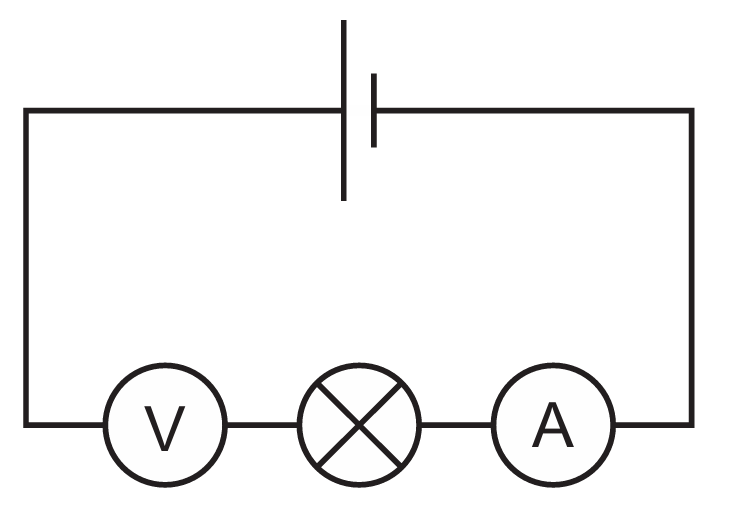
A student is trying to determine the resistance of a lamp. He sets up the incorrect circuit shown.
Which change would allow him to take the measurements needed to calculate the resistance of the lamp?
A. Disconnect the ammeter and move it to the left of the lamp.
B. Swap the positions of the ammeter and the voltmeter in the circuit.
C. Disconnect the ammeter and connect it in parallel with the lamp.
D. Disconnect the voltmeter and connect it in parallel with the lamp.

Most-appropriate topic codes (Cambridge IGCSE Physics 0625):

TOPIC 4.2.4: Resistance (Describe an experiment to determine resistance using a voltmeter and an ammeter)
TOPIC 4.3.1: Circuit diagrams and circuit components
▶️ Answer/Explanation
Correct Option: D

Detailed solution:

To calculate resistance using $R = \frac{V}{I}$, we must measure the potential difference ($V$) across the lamp and the current ($I$) through it. In the diagram, the voltmeter is incorrectly connected in series, which prevents current flow due to its high resistance. An ammeter must be connected in series to measure the current passing through the component. A voltmeter must be connected in parallel to measure the potential difference across the component. By moving the voltmeter from a series connection to a parallel connection with the lamp, the circuit is corrected. This allows the ammeter to record the current and the voltmeter to record the voltage required for the calculation.

Question 28

A metallic wire X has a resistance.
What is the difference in resistance for a wire of the same material as X that is:
• shorter than X but the same diameter
• the same length as X but with a smaller diameter?

Most-appropriate topic codes (Cambridge IGCSE Physics 0625):

TOPIC 4.2.4: Resistance (Relationship of the resistance of a metallic wire to its length and cross-sectional area)
▶️ Answer/Explanation
Correct Option: C

Detailed solution:

Resistance $R$ is directly proportional to length $L$ ($R \propto L$), so a shorter wire has a smaller resistance.
Resistance is inversely proportional to cross-sectional area $A$ ($R \propto \frac{1}{A}$); since area depends on diameter $d$ as $A = \frac{\pi d^{2}}{4}$, resistance is inversely proportional to the square of the diameter ($R \propto \frac{1}{d^{2}}$).
Therefore, a wire with a smaller diameter has a greater resistance.
Matching these relationships to the table, Row C correctly identifies the resistance as smaller for the shorter wire and greater for the thinner wire.
Question 29

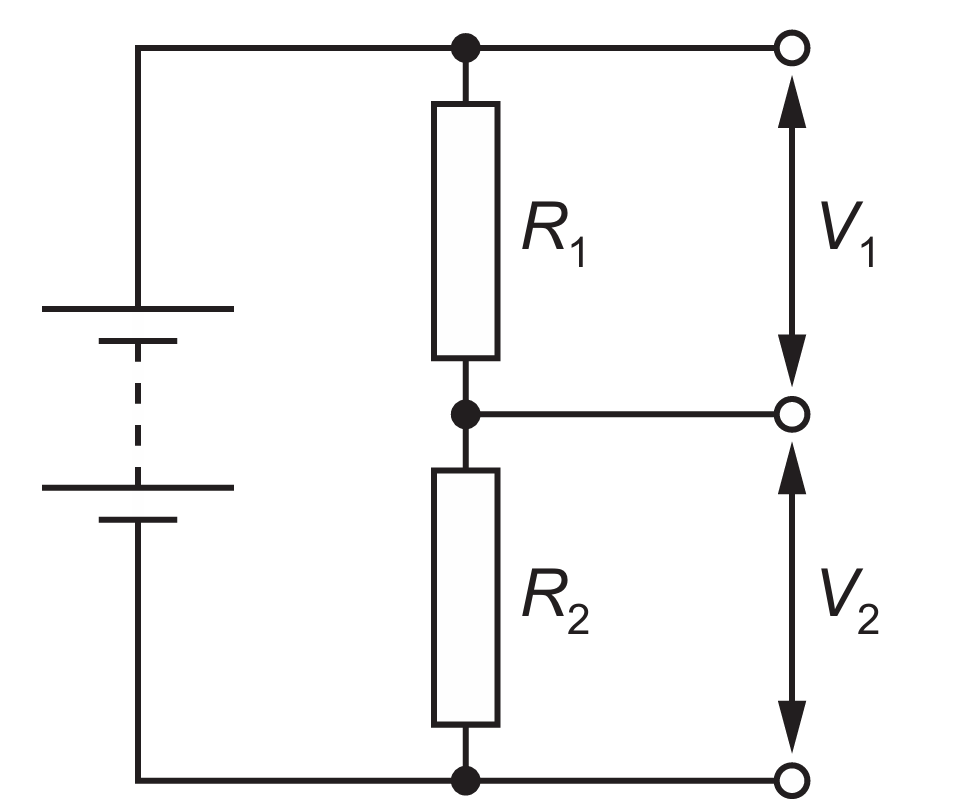
The diagram shows the circuit for a potential divider.
Which equation is used to calculate $V_1$?
A. $V_1 = \frac{R_1}{V_2 \times (R_1 + R_2)}$
B. $V_1 = \frac{V_2 \times R_1}{R_2}$
C. $V_1 = \frac{V_2 \times R_1}{R_1 + R_2}$
D. $V_1 = \frac{R_1}{V_2 \times R_2}$

Most-appropriate topic codes (Cambridge IGCSE Physics 0625):

TOPIC 4.3.3: Action and use of circuit components (Recall and use the equation for two resistors used as a potential divider $\frac{R_1}{R_2} = \frac{V_1}{V_2}$)
▶️ Answer/Explanation
Correct Option: B

Detailed solution:

In a series circuit acting as a potential divider, the current $I$ flowing through both resistors $R_1$ and $R_2$ is identical.
According to Ohm’s Law ($V = IR$), the potential difference across each resistor is proportional to its resistance.
This relationship is expressed by the ratio $\frac{V_1}{R_1} = \frac{V_2}{R_2}$, as both sides represent the constant current $I$.
To solve for $V_1$, we rearrange the equation by multiplying both sides by $R_1$.
This yields the final expression: $V_1 = \frac{V_2 \times R_1}{R_2}$.
Thus, option B is the correct mathematical representation for calculating $V_1$ based on the given circuit parameters.

Question 30

Which electrical device is used to convert a.c. to d.c.?
A. diode
B. relay
C. thermistor
D. transformer

Most-appropriate topic codes (Cambridge IGCSE Physics 0625):

TOPIC 4.3.1: Circuit diagrams and circuit components (behave in the circuit)
TOPIC 4.2.4: Resistance (Supplement: current-voltage graphs for a diode)
▶️ Answer/Explanation
Correct Option: A

Detailed solution:

Alternating current ($a.c.$) periodically reverses direction, while direct current ($d.c.$) flows in only one direction.
A diode is a component that allows current to flow through it in only one direction, possessing very high resistance in the opposite direction.
When $a.c.$ is passed through a diode, the “half-cycles” moving in the reverse direction are blocked, effectively converting it to $d.c.$ through a process called rectification.
In contrast, a relay is an electromagnetic switch, a thermistor’s resistance changes with temperature, and a transformer changes the magnitude of $a.c.$ voltage but does not convert it to $d.c$.
Therefore, the diode is the specific device used for this conversion.

Question 31

A cell is connected to a parallel combination of a $2.0~\Omega$ resistor and a $4.0~\Omega$ resistor. The current in the $4.0~\Omega$ resistor is $1.0~A$.
What is the current in the cell?
A. $1.0~A$
B. $1.5~A$
C. $2.0~A$
D. $3.0~A$

Most-appropriate topic codes (Cambridge IGCSE Physics 0625):

TOPIC 4.3.2: Series and parallel circuits (Current in parallel branches and p.d. across parallel resistances)
TOPIC 4.2.4: Resistance (Recall and use the equation $R = \frac{V}{I}$)
▶️ Answer/Explanation
Correct Option: D

Detailed solution:

In a parallel circuit, the potential difference ($V$) across each branch is the same. For the $4.0~\Omega$ resistor, $V = I \times R = 1.0~A \times 4.0~\Omega = 4.0~V$.
Using this voltage for the $2.0~\Omega$ resistor, the current is $I_{2} = \frac{V}{R} = \frac{4.0~V}{2.0~\Omega} = 2.0~A$.
The total current in the cell is the sum of the currents in the parallel branches: $I_{total} = 1.0~A + 2.0~A = 3.0~A$.
This follows the principle that the sum of currents entering a junction equals the sum of currents leaving it.
Therefore, the correct current provided by the cell is $3.0~A$, matching option D.

Question 32

When there is an electric current in a long straight wire, a magnetic field is created around the wire. Which diagram shows the correct pattern and direction of magnetic field lines around a long straight wire carrying current into the page?
A.
B.
C.
D.

Most-appropriate topic codes (Cambridge IGCSE Physics 0625):

TOPIC 4.5.3: Magnetic effect of a current (Describe the pattern and direction of the magnetic field due to currents in straight wires)
▶️ Answer/Explanation
Correct Option: B

Detailed solution:

Using the Right-Hand Grip Rule, pointing the thumb “into the page” (representing current $I$) causes the fingers to curl in a clockwise direction, identifying the field lines. The magnetic field strength $B$ is inversely proportional to the distance $r$ from the wire ($B \propto \frac{1}{r}$), meaning the field weakens as you move away. Visually, this weakening is represented by the spacing between the concentric circular field lines increasing as the radius increases. Diagram B correctly shows both the clockwise direction and the increasing spacing of the field lines, whereas D incorrectly shows uniform spacing. Therefore, option B is the only representation that satisfies both the directional and strength characteristics of the field.

Question 33

The primary voltage supplied to a transformer is $3.0\text{ V}$. The secondary voltage is $5.0\text{ V}$ and the secondary current is $2.0\text{ A}$. The transformer is $100\%$ efficient.

What is the primary current in the transformer?
A. $1.2\text{ A}$
B. $2.0\text{ A}$
C. $3.3\text{ A}$
D. $7.5\text{ A}$

Most-appropriate topic codes (Cambridge IGCSE Physics 0625):

TOPIC 4.5.6: The transformer (Recall and use the equation for $100\%$ efficiency in a transformer $I_p V_p = I_s V_s$)
▶️ Answer/Explanation
Correct Option: C

Detailed solution:

For a $100\%$ efficient transformer, the input power equals the output power, expressed by the equation $I_p V_p = I_s V_s$.
Given: primary voltage $V_p = 3.0\text{ V}$, secondary voltage $V_s = 5.0\text{ V}$, and secondary current $I_s = 2.0\text{ A}$.
Rearranging the formula to solve for the primary current: $I_p = \frac{I_s V_s}{V_p}$.
Substituting the values: $I_p = \frac{2.0 \times 5.0}{3.0} = \frac{10}{3.0}$.
This calculation yields $I_p \approx 3.33\text{ A}$, which corresponds to option C.
Thus, the primary current required to maintain the power balance is $3.3\text{ A}$.

Question 34

When a thin gold foil is bombarded with alpha particles, some alpha particles are deflected through large angles. Which statement explains this deflection?
A. Most of the atom consists of empty space.
B. All of the positive charge and most of the mass of the gold atom are concentrated in a small volume.
C. Positive charge in the gold atom is spread evenly throughout the atom.
D. All of the negative charge is concentrated at its centre.

Most-appropriate topic codes (Cambridge IGCSE Physics 0625):

TOPIC 5.1.1: The atom (Describe how the scattering of alpha ($\alpha$) particles supports the nuclear model)
▶️ Answer/Explanation
Correct Option: B

Detailed solution:

The large-angle deflection of alpha particles ($\alpha$) occurs due to the electrostatic repulsion between the positively charged alpha particle and the nucleus. For such a significant change in momentum to occur, the positive charge and nearly all the atomic mass must be concentrated in a very small, dense region called the nucleus. Option A explains why most particles pass straight through, but not the deflection itself. Option C describes the “Plum Pudding” model, which was disproved by this experiment as it could not account for large deflections. Option D is incorrect because the center (nucleus) is positively charged, while negative electrons orbit the periphery. Thus, the concentration of mass and positive charge in a small volume (the nucleus) is the only valid explanation for the observed scattering.

Question 35

A detector near a radioactive source shows a reading of $2000$ counts / minute. How is the corrected count rate determined?
A. by moving the detector closer to the source
B. by placing an absorber between the detector and the source
C. by repeating and averaging the measurements
D. by taking away the background radiation count rate

Most-appropriate topic codes (Cambridge IGCSE Physics 0625):

TOPIC 5.2.1: Detection of radioactivity (Use measurements of background radiation to determine a corrected count rate)
▶️ Answer/Explanation
Correct Option: D

Detailed solution:

The total reading shown by a detector includes both the radiation from the source and the ever-present background radiation.
Background radiation comes from natural sources such as cosmic rays and radioactive rocks.
To find the radiation specifically emitted by the source, we must subtract the background count from the total measured count.
The mathematical relationship is: $\text{corrected count rate} = \text{measured count rate} – \text{background count rate}$.
Therefore, taking away the background radiation count rate provides the accurate value for the source alone.
This process ensures that the data reflects only the activity of the radioactive sample being studied.

Question 36

Which statement about alpha, beta and gamma radiation is not correct?
A. Alpha particles are deflected most in an electric field.
B. Beta particles are deflected most in a magnetic field.
C. Gamma radiation is not deflected by a magnetic field.
D. Gamma radiation is least ionising.

Most-appropriate topic codes (Cambridge IGCSE Physics 0625):

TOPIC 5.2.2: The three types of nuclear emission (Nature, relative ionising effects, and penetrating abilities)
▶️ Answer/Explanation
Correct Option: A

Detailed solution:

Alpha ($\alpha$) particles have a large mass (approx. $4\text{ u}$) and a charge of $+2e$, while beta ($\beta$) particles are much lighter electrons with a charge of $-1e$.
Because $\beta$ particles have significantly less mass than $\alpha$ particles, they experience a much greater acceleration and deflection in both electric and magnetic fields.
Gamma ($\gamma$) radiation consists of high-energy electromagnetic waves with no charge or mass, so it is not deflected by these fields (making statement C correct).
Furthermore, $\gamma$ radiation is the most penetrating but least ionising (making statement D correct).
Since $\beta$ particles are deflected more easily than the heavier $\alpha$ particles, statement A is false and is therefore the correct choice for this “not correct” question.

Question 37

A sample of a radioactive material has a half-life of 20 minutes. Which statement is correct?
A. After 30 minutes, less than half of the material has decayed.
B. After 40 minutes, all of the radioactive material has decayed.
C. After 60 minutes, an eighth of the radioactive material remains.
D. After 120 minutes, a sixth of the radioactive material remains.

Most-appropriate topic codes (Cambridge IGCSE Physics 0625):

TOPIC 5.2.4: Half-life (Define and use the half-life of a particular isotope in simple calculations)
▶️ Answer/Explanation
Correct Option: C

Detailed solution:

The half-life is 20 minutes, meaning the material reduces by half every 20 minutes.
After 60 minutes, the number of half-lives elapsed is n= 20 60 ​ =3.
The fraction of material remaining is calculated as ( 2 1 ​ ) n , which is ( 2 1 ​ ) 3 = 8 1 ​ .
Option A is wrong because after 30 minutes (more than one half-life), more than half has decayed.
Option B is wrong because radioactivity is a random process; material never fully reaches zero.
Option D is wrong because after 120 minutes (n=6), the remaining fraction is ( 2 1 ​ ) 6 = 64 1 ​ .
Thus, statement C is the only mathematically correct conclusion.

Question 38

Which statement is correct?
A. The Earth orbits the Sun once in approximately 24 hours.
B. The Earth orbits the Moon once in approximately 1 week.
C. The Moon orbits the Earth once in approximately 1 month.
D. The Sun orbits the Earth once in approximately 365 days.

Most-appropriate topic codes (Cambridge IGCSE Physics 0625):

TOPIC 6.1.1: The Earth (Periodic nature of the Moon’s cycle of phases)
▶️ Answer/Explanation
Correct Option: C

Detailed solution:

The Earth rotates on its axis every $24$ hours, but it takes approximately $365$ days to complete one orbit around the Sun.
The Moon is a natural satellite that orbits the Earth, completing one full cycle in approximately $1$ month ($27.3$ to $29.5$ days).
Option A is incorrect as $24$ hours refers to Earth’s rotation, not its orbit.
Option B is incorrect because the Moon orbits the Earth, not vice versa.
Option D is incorrect because the Earth orbits the Sun, which is the central body of our Solar System.
Therefore, statement C is the only scientifically accurate description of these celestial movements.

Question 39

Stars are powered by nuclear reactions that release energy. Which statement describes the nuclear reaction in stable stars?
A. Nuclear fission converts helium into hydrogen.
B. Nuclear fission converts hydrogen into helium.
C. Nuclear fusion converts helium into hydrogen.
D. Nuclear fusion converts hydrogen into helium.

Most-appropriate topic codes (Cambridge IGCSE Physics 0625):

TOPIC 6.2.1: The Sun as a star
TOPIC 5.1.2: The nucleus (Nuclear fission and fusion)
▶️ Answer/Explanation
Correct Option: D

Detailed solution:

Stable stars, such as the Sun, are primarily composed of hydrogen and helium. The energy source for these stars is nuclear fusion, a process where light nuclei join to form a heavier nucleus. In the core of a stable star, high temperatures and pressures allow hydrogen nuclei to fuse together. This reaction specifically converts hydrogen into helium and releases a vast amount of energy in the form of electromagnetic radiation. Unlike fission, which involves splitting heavy nuclei, fusion powers the lifecycle of stars during their stable main-sequence phase.

Question 40

A galaxy is moving away from the Earth at a velocity of $3000\text{ km/s}$.
What is the distance between the Earth and the galaxy?
A. $7.3 \times 10^{-25}\text{ m}$
B. $7.3 \times 10^{-22}\text{ m}$
C. $1.4 \times 10^{21}\text{ m}$
D. $1.4 \times 10^{24}\text{ m}$

Most-appropriate topic codes (Cambridge IGCSE Physics 0625):

TOPIC 6.2.3: The Universe (Hubble constant $H_{0} = \frac{v}{d}$)
▶️ Answer/Explanation
Correct Option: D

Detailed solution:

To find the distance $d$, we use the Hubble’s Law equation: $H_{0} = \frac{v}{d}$, which rearranges to $d = \frac{v}{H_{0}}$.
First, convert the velocity to SI units: $v = 3000\text{ km/s} = 3.0 \times 10^{6}\text{ m/s}$.
Using the Hubble constant provided in the syllabus, $H_{0} = 2.2 \times 10^{-18}\text{ s}^{-1}$.
Substitute the values: $d = \frac{3.0 \times 10^{6}}{2.2 \times 10^{-18}}$.
This calculation yields $d \approx 1.36 \times 10^{24}\text{ m}$.
Rounding to two significant figures, we get $1.4 \times 10^{24}\text{ m}$, which matches option D.

Scroll to Top