
Question 1
(a) Circle the vector quantities in the list.
acceleration mass speed time velocity
Suggest one change to the motion of the train that leads to this longer journey time.
Most-appropriate topic codes (Cambridge IGCSE Physics 0625):
• Topic $1.1$ — Physical quantities and measurement techniques (Part $\mathrm{(a)}$)
• Topic $1.2$ — Motion (Part $\mathrm{(b)}$)
▶️ Answer/Explanation
Correct Answer: acceleration AND velocity
Detailed solution: Vector quantities are physical quantities that have both magnitude (size) and a specific direction. Among the given options, both acceleration and velocity describe motion with a particular direction. In contrast, mass, speed, and time only possess magnitude without any directional component, which classifies them as scalar quantities.
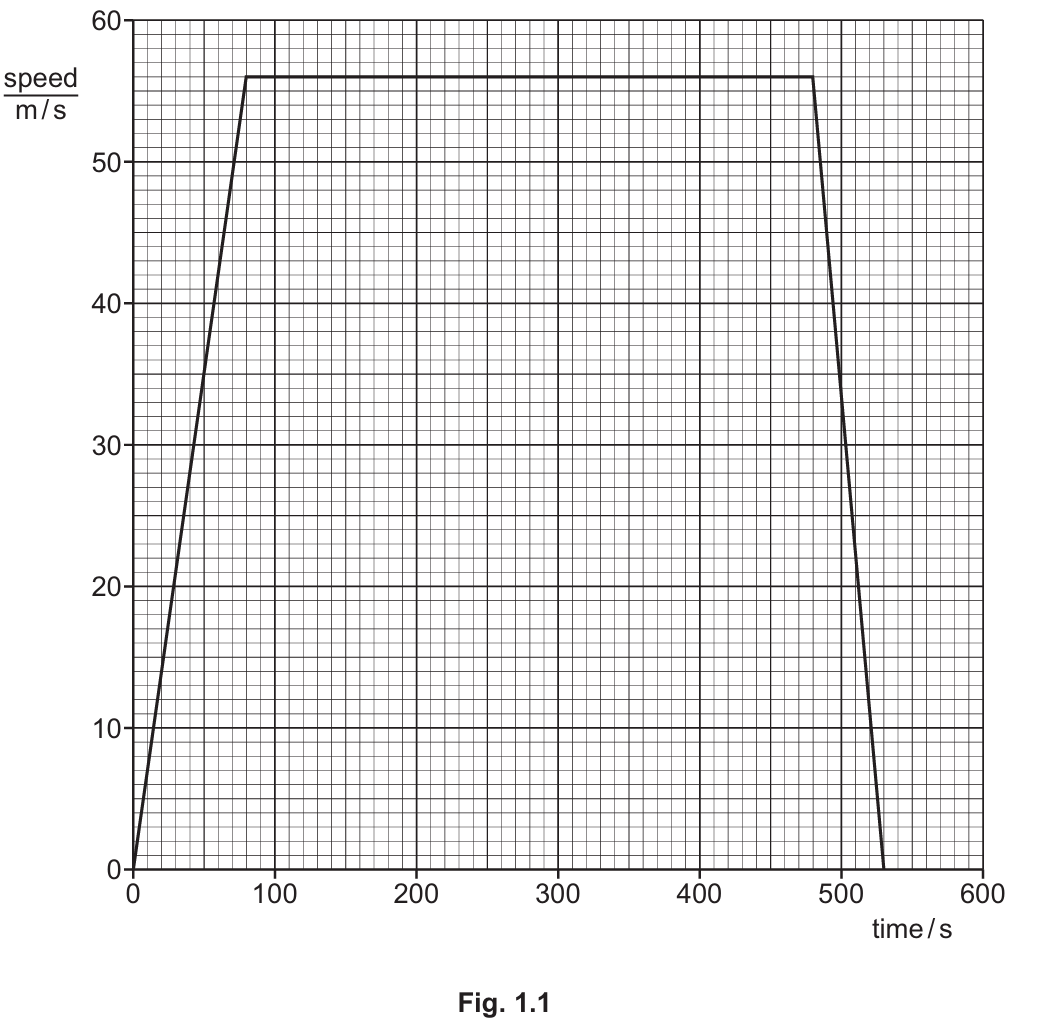
Correct Answer: $56\text{ m/s}$
Detailed solution: On a speed-time graph, the speed of the object is represented on the vertical $y$-axis. The maximum speed achieved by the train corresponds to the highest flat section reached on the graph. Observing the plot, this top horizontal section aligns perfectly with $56$ on the vertical axis, giving a maximum speed of $56\text{ m/s}$.
Correct Answer: The train accelerates at a constant rate, then travels at a constant speed, and finally decelerates at a constant rate.
Detailed solution: The motion is divided into three distinct phases. First, the straight line with a positive gradient from $0\text{ s}$ to $80\text{ s}$ shows that the train undergoes constant acceleration. The horizontal line segment from $80\text{ s}$ to $480\text{ s}$ indicates that the train is moving at a steady, constant speed. Finally, the straight line with a negative gradient from $480\text{ s}$ to $530\text{ s}$ represents constant deceleration until it stops.
Correct Answer: $26000\text{ m}$ (or $26\text{ km}$)
Detailed solution: The total distance travelled equals the area under the speed-time graph. The area can be calculated as a single trapezium using the formula $\text{Area} = \frac{1}{2}(a+b)h$. The parallel sides are the base width $b = 530\text{ s}$ and the top flat section $a = (480 – 80) = 400\text{ s}$. The height $h$ is $56\text{ m/s}$. The calculation is $\frac{1}{2} \times (400 + 530) \times 56 = 26040\text{ m}$, which is generally rounded to $26000\text{ m}$ for two significant figures.
Correct Answer: Lower maximum constant speed (or lower acceleration, or lower deceleration).
Detailed solution: The distance between station A and station B is a fixed value. If the train takes a longer overall time ($650\text{ s}$) to cover this same distance, its average speed must be lower. This reduction in average speed could be caused by reaching a lower maximum speed during the middle of the journey, having a slower rate of acceleration initially, or a lower rate of deceleration at the end.
Question 2
Most-appropriate topic codes (Cambridge IGCSE Physics 0625):
• Topic $1.5.1$ — Effects of forces (Parts $\mathrm{(a)(i)}$, $\mathrm{(a)(ii)}$)
• Topic $1.5.2$ — Turning effect of forces (Part $\mathrm{(b)}$)
▶️ Answer/Explanation
(a)(i)
For the correct answer:
Direction of motion changes; speed (or magnitude of velocity) changes.
According to Newton’s laws of motion, a resultant force acting on a moving object causes it to accelerate. This acceleration can manifest as a change in the magnitude of the velocity, meaning the object’s speed increases or decreases. Alternatively, the resultant force can act at an angle to the motion, causing a change in the object’s direction.
(a)(ii)
For the correct answer:
Change its size or shape (deformation).
When a force is applied to a stationary object and it does not cause the object to move, it can exert mechanical stress on the material. This leads to deformation, where the physical dimensions of the object are altered (such as compression or stretching).
(b)
For the correct procedure:
Place the ruler on the pivot to balance it, add masses on both sides until balanced again. Calculate moment as $F \times d$ and show clockwise moments equal anticlockwise moments.
First, place the uniform metre ruler on the pivot at its center of mass ($50\text{ cm}$ mark) so it balances horizontally. Suspend a known mass on one side and another mass on the opposite side, adjusting its position until the ruler is in equilibrium. Calculate the turning effect for each side using $\text{Moment} = F \times d$. Demonstrate that the sum of clockwise moments equals the sum of anticlockwise moments, proving there is zero resultant moment.
Question 3
Most-appropriate topic codes (Cambridge IGCSE Physics 0625):
• Topic $1.7.1$ — Energy (Parts $\mathrm{(a)}$, $\mathrm{(b)(i)}$)
• Topic $1.6$ — Momentum (Part $\mathrm{(b)(ii)}$)
▶️ Answer/Explanation
(a)
For the correct answer:
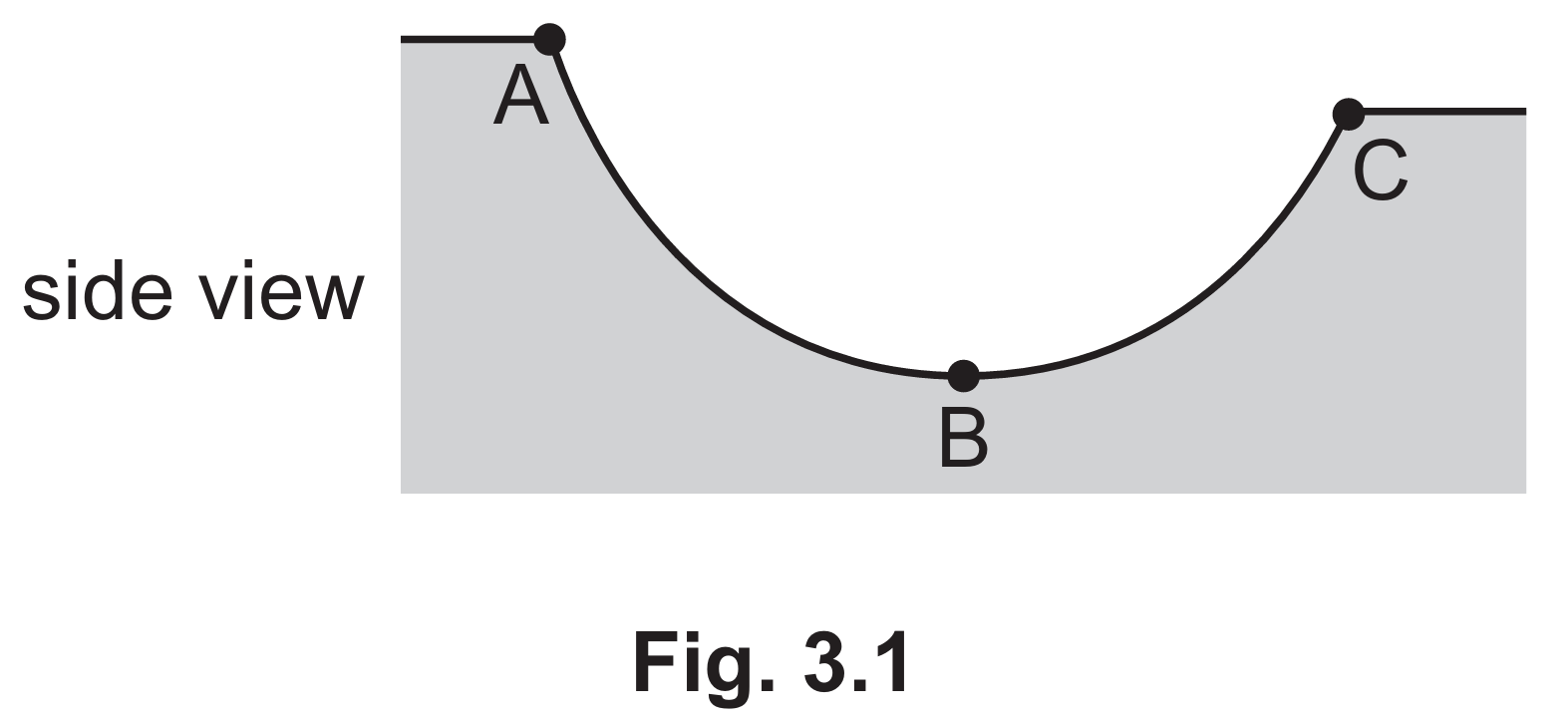
Gravitational potential energy transfers to kinetic energy, then back to gravitational potential energy. Some energy is also transferred to the thermal store.
At point A, the skateboarder has maximum gravitational potential energy. As she descends to B, this is transferred into kinetic energy. Moving from B to C, kinetic energy is transferred back into gravitational potential energy. Friction results in energy being dissipated as heat.
(b) (i)
For the correct calculated value:
$1800\text{ J}$ (to 2 s.f.)
Work done equals the change in gravitational potential energy: $W = mg\Delta h$.
$W = 65\text{ kg} \times 9.8\text{ m/s}^2 \times 2.8\text{ m} = 1783.6\text{ J}$.
Rounding to two significant figures gives $1800\text{ J}$.
(b) (ii)
For the correct answer:
$F = \frac{\Delta p}{\Delta t}$
Where $F$ is the resultant force, $\Delta p$ is the change in momentum, and $\Delta t$ is the time taken for the change to occur.
Question 4
Most-appropriate topic codes (Cambridge IGCSE Physics 0625):
• Topic $2.3.2$ — Convection (Parts $\mathrm{(a)(i)}$, $\mathrm{(a)(ii)}$)
• Topic $4.2.5$ — Electrical energy and electrical power (Part $\mathrm{(b)(i)}$)
• Topic $4.4$ — Electrical safety (Part $\mathrm{(b)(ii)}$)
▶️ Answer/Explanation
(a)(i)
Correct Answer: Convection.
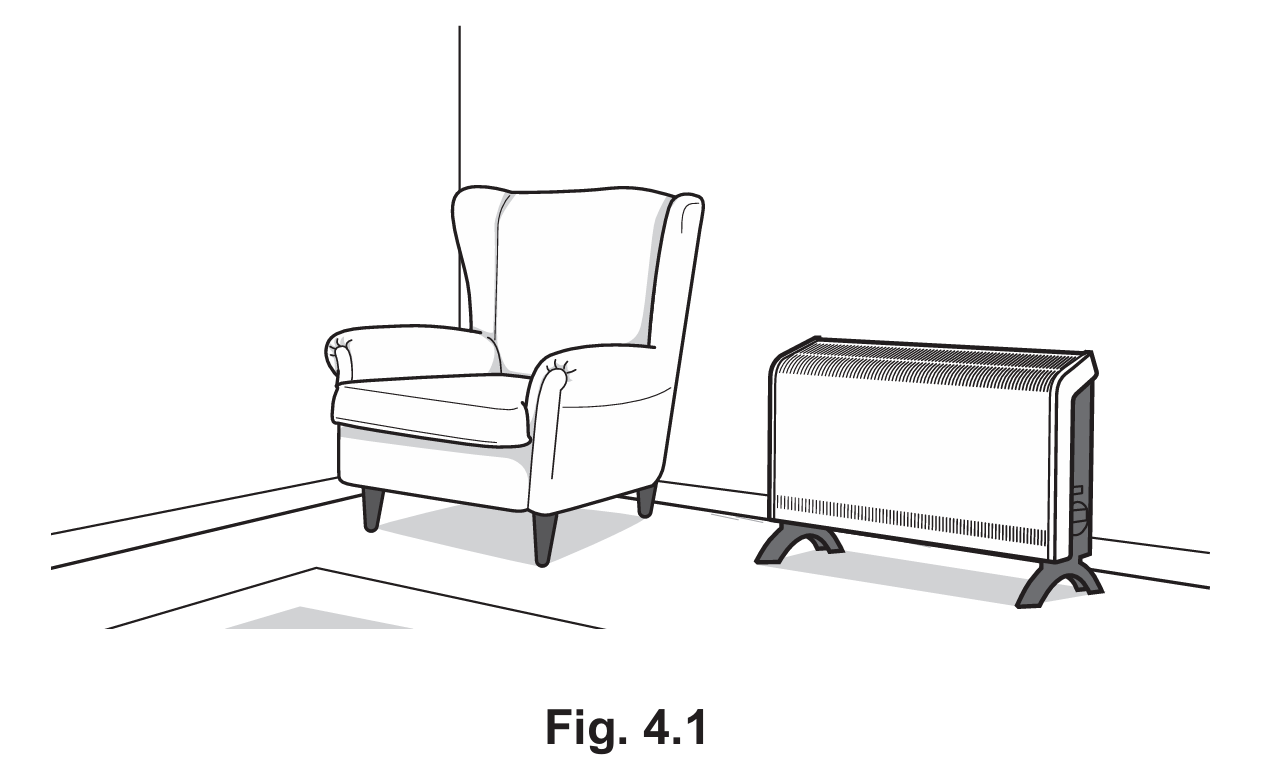
The primary mechanism for thermal energy transfer in fluids, such as the air in a room, is convection involving the macroscopic movement of the fluid.
(a)(ii)
Correct Answer: Warm air expands and becomes less dense, causing it to rise. Cooler, denser air falls to replace it, creating a convection current.
When the heater warms the air, molecules spread apart, reducing density. This air rises while cooler, denser air sinks to be heated, forming a continuous circulation.
(b)(i)
Correct Answer: $I = 8.7\text{ A}$
Using $P = IV$, first convert power: $P = 2.0\text{ kW} = 2000\text{ W}$.
$I = \frac{P}{V} = \frac{2000}{230} \approx 8.696\text{ A}$, which rounds to $8.7\text{ A}$.
(b)(ii)
Correct Answer: $10\text{ A}$ fuse. The fuse rating must be slightly higher than the normal operating current.
The fuse must exceed $8.7\text{ A}$ to prevent melting during normal operation, but be low enough to protect the circuit. $10\text{ A}$ is the most appropriate choice.
Question 5
Most-appropriate topic codes (Cambridge IGCSE Physics 0625):
• Topic $3.2.2$ — Refraction of light (Parts $\mathrm{(a)}$, $\mathrm{(b)(i)}$, $\mathrm{(b)(ii)}$)
• Topic $3.2.4$ — Dispersion of light (Part $\mathrm{(c)(i)}$)
• Topic $3.1$ — General properties of waves (Part $\mathrm{(c)(ii)}$)
• Topic $3.3$ — Electromagnetic spectrum (Part $\mathrm{(c)(ii)}$)
▶️ Answer/Explanation
(a)
Correct Answer: The ratio of the speed of light in air (or vacuum) to the speed of light in the soap film.
Detailed solution: The refractive index ($n$) is a dimensionless measure that describes how fast light travels through a material. It is formally defined as the ratio of the speed of light in a vacuum ($c$) to the speed of light in the specified medium ($v$).
(b)(i)
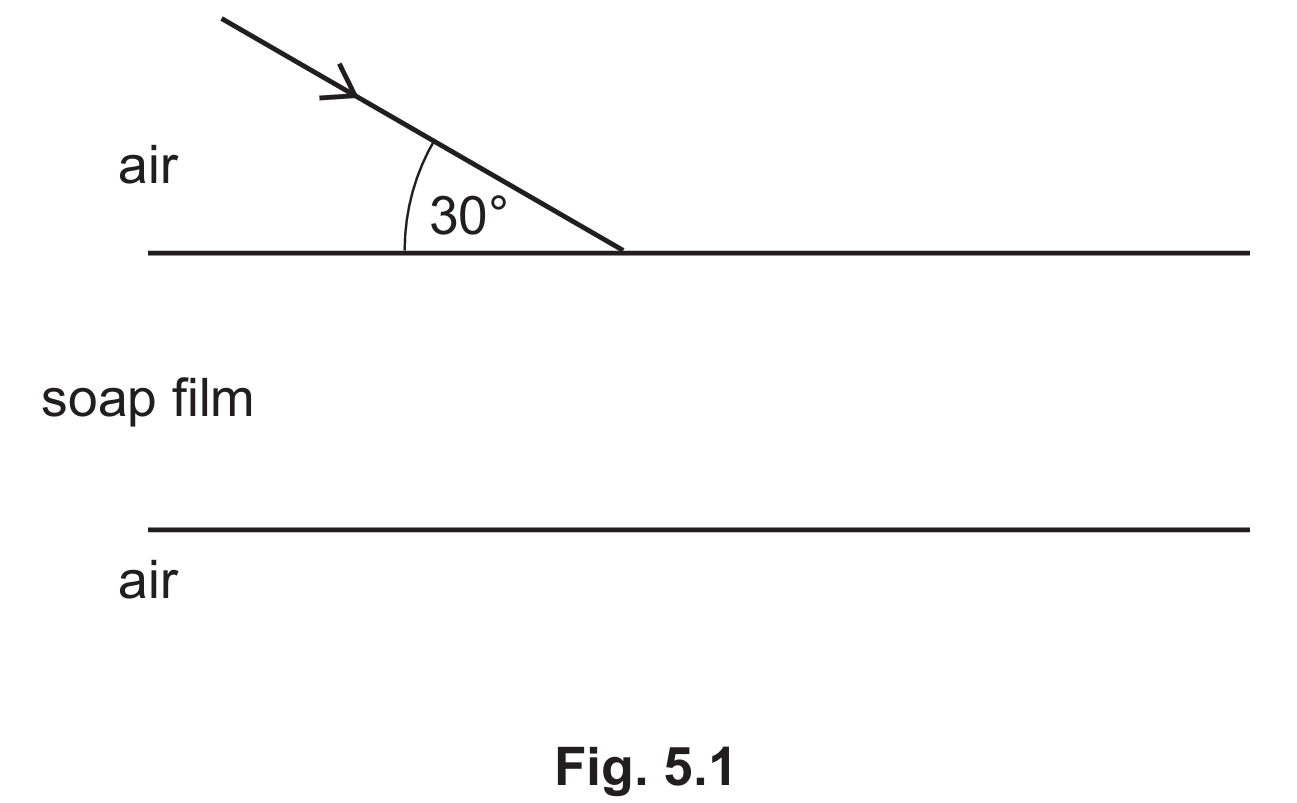
Correct Answer: $i = 60^{\circ}$, $1.28 = \frac{\sin 60^{\circ}}{\sin r}$, $r = 42.6^{\circ} \approx 43^{\circ}$
Detailed solution: First, find the angle of incidence ($i$), measured from the normal: $i = 90^{\circ} – 30^{\circ} = 60^{\circ}$. Applying Snell’s Law, $n = \frac{\sin i}{\sin r}$, we rearrange to $\sin r = \frac{\sin 60^{\circ}}{1.28} \approx 0.676$. Thus, $r \approx 42.6^{\circ}$, which rounds to $43^{\circ}$.
(b)(ii)
Correct Answer: A normal drawn at the incidence point; a refracted ray drawn bending towards the normal with the angle $r$ labeled.
Detailed solution: Draw a dashed normal line perpendicular to the surface. Draw the refracted ray inside the film bending toward the normal at the calculated angle.
(c)(i)
Correct Answer: Light of a single frequency.
Detailed solution: Monochromatic refers to electromagnetic waves consisting of exactly one single frequency (or wavelength), resulting in a single pure color.
(c)(ii)
Correct Answer: $4.4 \times 10^{14}\text{ Hz}$
Detailed solution: Using $v = f\lambda$ where $v = 3.0 \times 10^8\text{ m/s}$ and $\lambda = 680 \times 10^{-9}\text{ m}$: $f = \frac{3.0 \times 10^8}{680 \times 10^{-9}} \approx 4.41 \times 10^{14}\text{ Hz}$.
Question 6
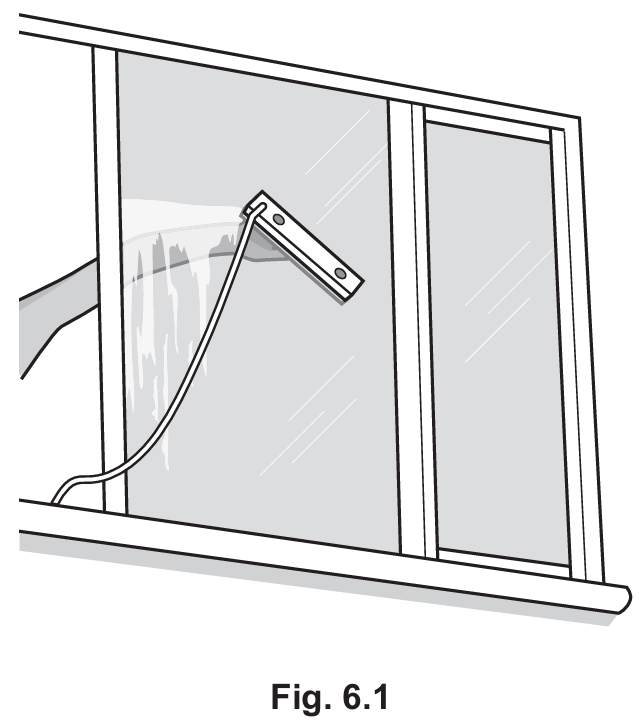
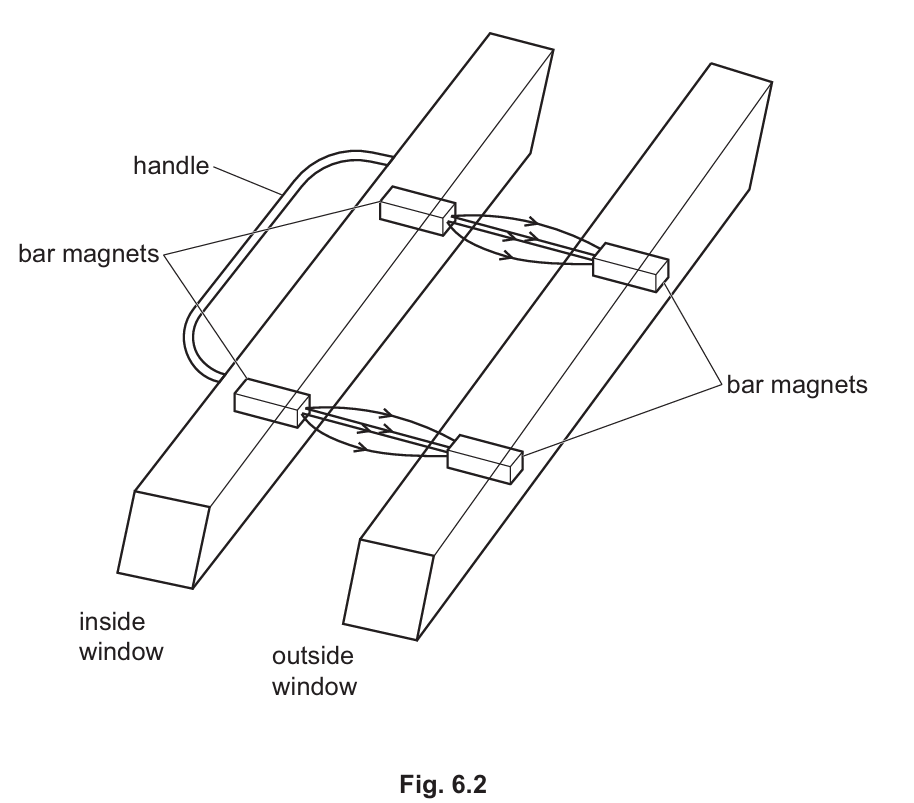
Most-appropriate topic codes (Cambridge IGCSE Physics 0625):
• Topic $4.1$ — Simple phenomena of magnetism (Parts $\mathrm{(a)}$, $\mathrm{(b)}$, $\mathrm{(c)}$, $\mathrm{(d)}$)
▶️ Answer/Explanation
(a)
Magnetic materials are attracted to magnets (or experience a force in a magnetic field), while non-magnetic materials are not.
Magnetic materials, such as iron, cobalt, and nickel, will experience a magnetic force when placed in a magnetic field. In contrast, non-magnetic materials like glass, plastic, or wood do not interact with magnetic fields.
(b)
Steel. It is a hard magnetic material and forms a permanent magnet.
The window cleaner requires permanent magnets to function continuously. Steel is a hard magnetic material, meaning it retains its magnetism for a long time. Soft magnetic materials, like soft iron, lose their magnetism easily and are unsuitable.
(c)
N and S poles correctly labelled (magnetic field lines travel from North to South).
By standard convention, magnetic field lines always emerge from the North pole (N) and enter into the South pole (S). Observing the direction of the arrowheads on the field lines allows for the identification of the poles.
(d)
The closer together the magnetic field lines are, the stronger the magnetic field.
The relative strength of a magnetic field is represented by the density of its lines. In regions where field lines are closer together, the field is stronger; where they are spread further apart, the field is weaker.
Question 7
Most-appropriate topic codes (Cambridge IGCSE Physics 0625):
• Topic $4.2.4$ — Resistance (Part $\mathrm{(a)}$)
• Topic $4.2.5$ — Electrical energy and electrical power (Parts $\mathrm{(b)(i)}$, $\mathrm{(b)(ii)}$)
• Topic $4.3.2$ — Series and parallel circuits (Part $\mathrm{(b)(iii)}$)
▶️ Answer/Explanation
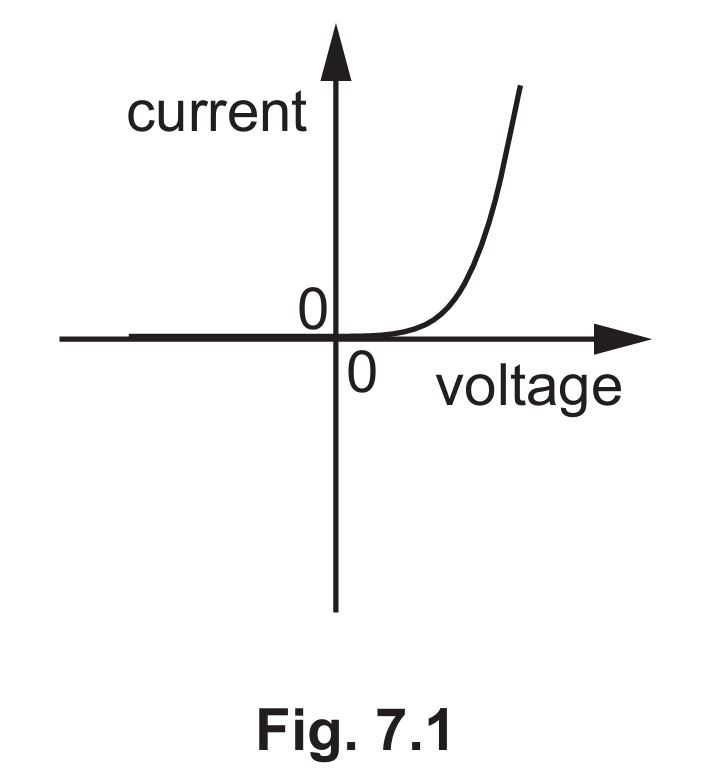
Correct Answer: (i) Diode.
(ii) [Circuit symbol of a diode: a triangle pointing to a vertical line].
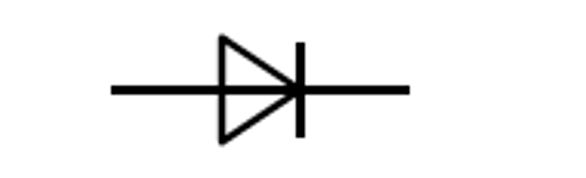
Detailed solution: The component is a diode because the graph shows that current only flows when the voltage is applied in one specific direction (forward bias). In the opposite direction (reverse bias), the current remains at zero, indicating an extremely high resistance. This non-linear, one-way conduction characteristic is the defining property of a semiconductor diode. The symbol consists of an arrow indicating the allowed direction of conventional current flow.
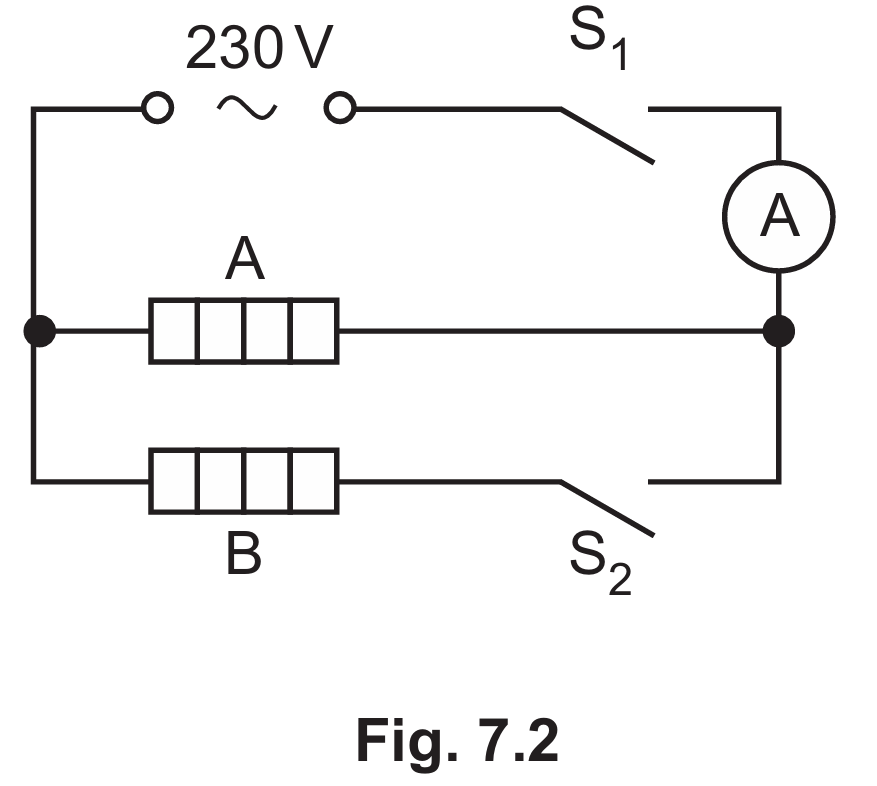
Correct Answer: $59\text{ }\Omega$
Detailed solution: When $S_1$ is closed and $S_2$ is open, only heater A is in the completed circuit. Using Ohm’s Law, $R = \frac{V}{I}$, where $V = 230\text{ V}$ and $I = 3.9\text{ A}$. Substituting these values gives $R = \frac{230}{3.9} = 58.97\text{ }\Omega$. Rounding to two significant figures, as provided in the marking scheme, we get a resistance of $59\text{ }\Omega$.
Correct Answer: $2.7 \times 10^5\text{ J}$ (or $270,000\text{ J}$)
Detailed solution: Energy transferred is calculated using the formula $E = IVt$. First, convert the time from minutes to seconds: $t = 5.0 \times 60 = 300\text{ s}$. Using the mains voltage $V = 230\text{ V}$ and current $I = 3.9\text{ A}$, the calculation becomes $E = 3.9 \times 230 \times 300$. This results in $269,100\text{ J}$, which is expressed as $2.7 \times 10^5\text{ J}$ when rounded to appropriate significant figures.
Correct Answer: $7.8\text{ A}$
Detailed solution: Heaters A and B are identical and connected in parallel, meaning they both experience the same potential difference of $230\text{ V}$. Since the heaters are identical, heater B will also draw a current of $3.9\text{ A}$ when its switch $S_2$ is closed. According to Kirchhoff’s Current Law ($I_{total} = I_1 + I_2$), the total current measured by the ammeter is the sum of the currents in each branch: $3.9\text{ A} + 3.9\text{ A} = 7.8\text{ A}$.
Question 8
Most-appropriate topic codes (Cambridge IGCSE Physics 0625):
• Topic 4.5.2 — The a.c. generator (Parts (a), (b))
• Topic 4.5.6 — The transformer (Part (c))
▶️ Answer/Explanation
Part (a)
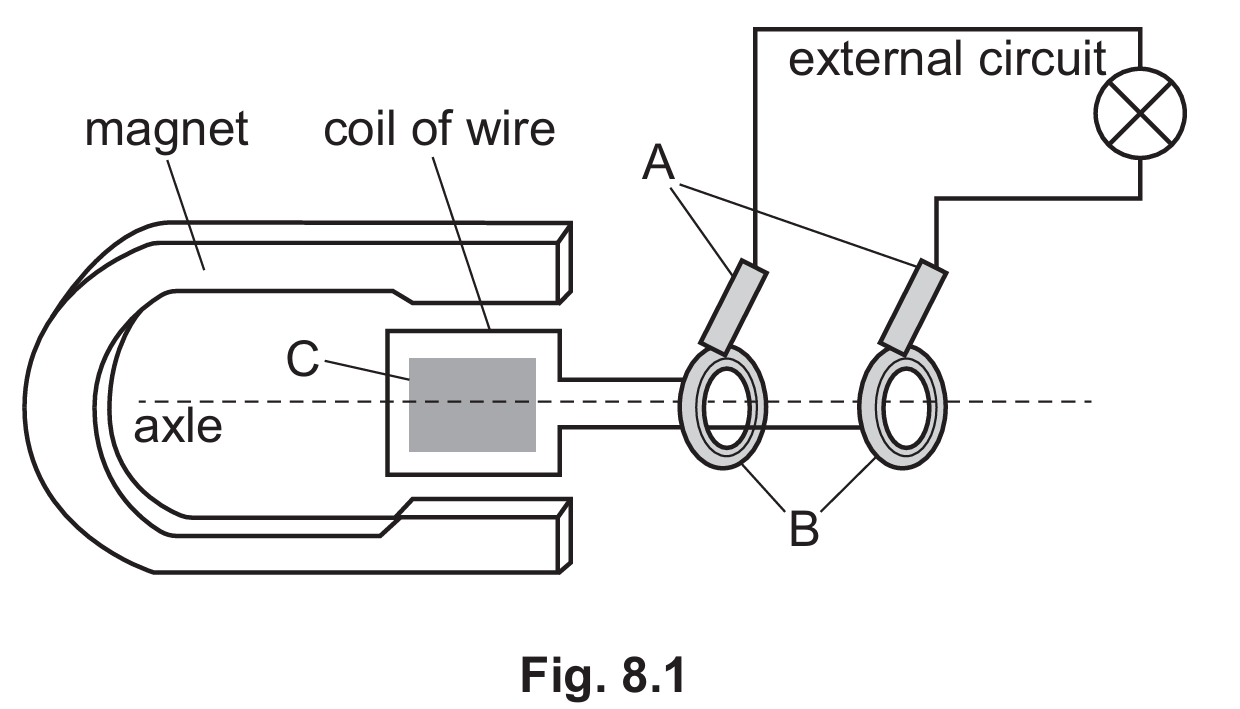
Correct Answer: (i) A: Brushes (Carbon brushes), B: Slip rings (ii) Strengthens the magnetic field.
In an a.c. generator, the slip rings (B) are connected to the rotating coil to provide a continuous electrical path. The brushes (A) press against these rings to transfer the induced current to the external circuit. Component C, the soft iron core, increases the magnetic flux linkage by concentrating the magnetic field lines through the coil.
Part (b)
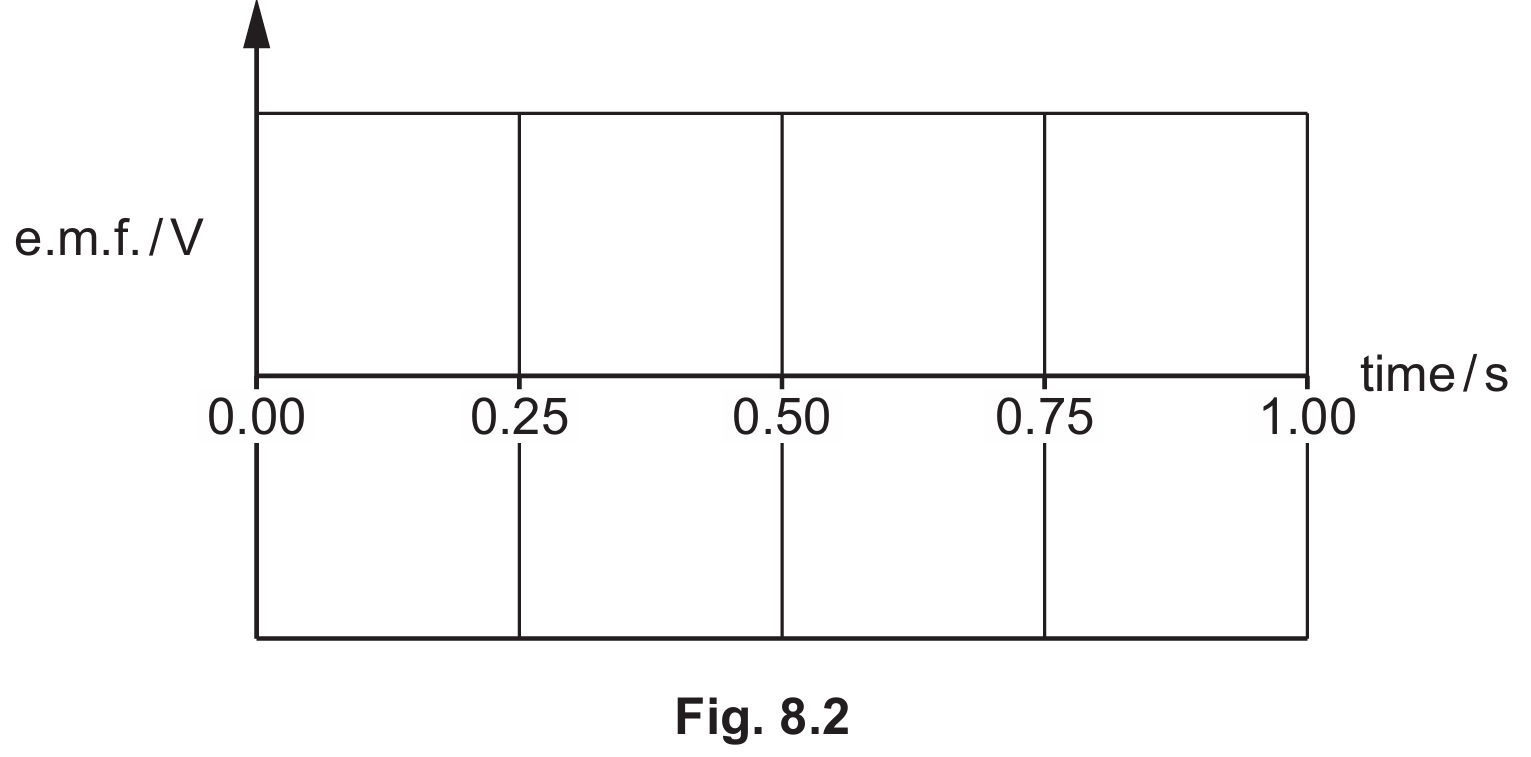
Correct Answer: Sinusoidal wave starting at maximum (or zero depending on orientation) with a period of 0.5 s.
Since the frequency is 2 rev/s (2 Hz), the period T= f 1 = 2 1 =0.5 s. The graph should show two full sine waves within the 1.0 s interval. As the coil rotates, the rate of cutting magnetic flux changes sinusoidally, producing an alternating voltage.
Part (c)(i)
Correct Answer: Reduces power loss in cables and allows for thinner wires.
Transmitting at high voltage (V) reduces the current (I) for the same power (P=IV). According to P loss =I 2 R, lowering the current drastically reduces energy wasted as heat in the transmission lines, allowing for more efficient long-distance delivery.
Part (c)(ii)
Correct Answer: 5400 turns
Using the transformer turns ratio equation V s V p = N s N p , we rearrange to find N s = V p N p ×V s . Substituting the given values: N s = 25000 450×300000 =450×12=5400.
Question 9
(ii) Complete the nuclide equation for the decay of strontium-90 to yttrium:
$_{38}^{90}\text{Sr} \longrightarrow \dots \dots \text{Y} + \dots \dots \beta$
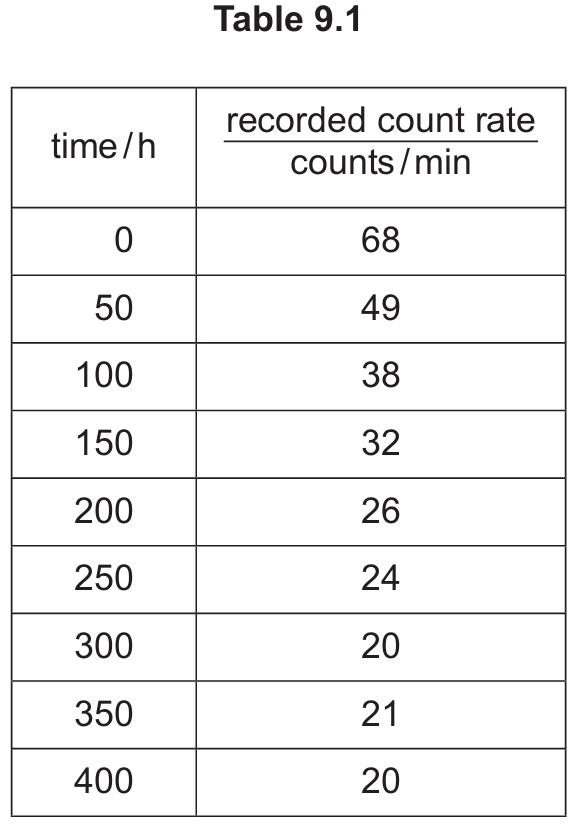
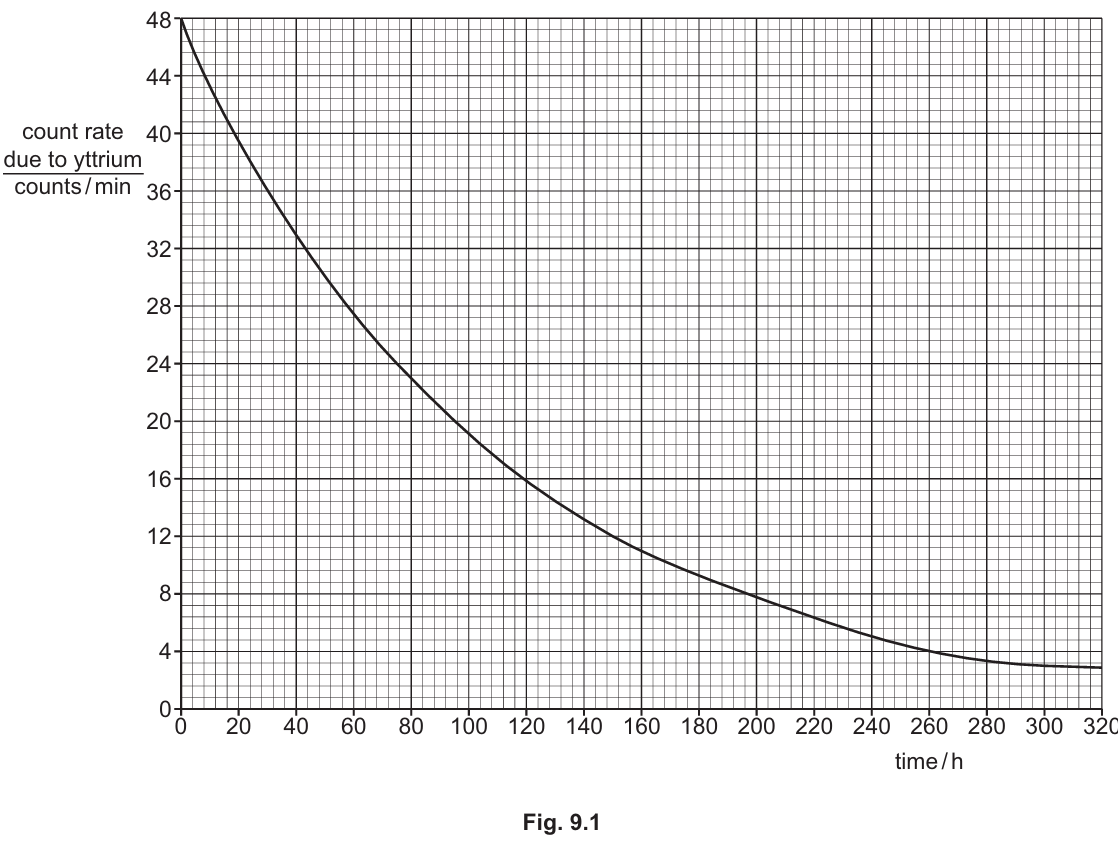
(ii) Explain the difference between the count rate in Table 9.1 and the count rate due to yttrium plotted on the graph in Fig. 9.1.
Most-appropriate topic codes (Cambridge IGCSE Physics 0625):
• Topic $5.1.2$ — The nucleus (Part $\mathrm{a(i)}$)
• Topic $5.2.3$ — Radioactive decay (Part $\mathrm{a(ii)}$)
• Topic $5.2.5$ — Safety precautions (Part $\mathrm{a(iii)}$)
• Topic $5.2.4$ — Half-life (Part $\mathrm{b(i)}$)
• Topic $5.2.1$ — Detection of radioactivity (Part $\mathrm{b(ii)}$)
▶️ Answer/Explanation
(a)(i)
Suggestion: The stable isotope has fewer neutrons.
Explanation: Isotopes of the same element must have the same number of protons ($38$ for Strontium) but different numbers of neutrons. Radioactive isotopes like $_{38}^{90}\text{Sr}$ often have an excess of neutrons, making the nucleus unstable. A stable version would typically have a lower neutron-to-proton ratio.
(a)(ii)
$_{38}^{90}\text{Sr} \longrightarrow _{39}^{90}\text{Y} + _{-1}^{0}\beta$
In beta decay, a neutron changes into a proton and an electron. The nucleon number ($A$) remains $90$, while the proton number ($Z$) increases by $1$ to $39$.
(a)(iii)
Beta particles are ionizing radiation that can remove electrons from atoms in living cells. This can lead to DNA mutations or cell death. Limiting exposure reduces the total dose and the risk of cancer.
(b)(i)
Correct Answer: $72\text{ h}$ to $76\text{ h}$
Initial count rate at $t = 0$ is $48\text{ counts/min}$. Half of this is $24\text{ counts/min}$. From the graph, the time taken to reach $24\text{ counts/min}$ is approximately $74\text{ h}$.
(b)(ii)
Table 9.1 shows the raw count rate (sample + background). The graph shows the corrected count rate, where background radiation (approx. $20\text{ counts/min}$) has been subtracted.
Question 10
(i) Define gravitational field strength.
(ii) State one factor which causes the difference between the gravitational field strength at the surface of Jupiter and the gravitational field strength at the surface of the Earth.
Most-appropriate topic codes (Cambridge IGCSE Physics 0625):
• Topic $6.1.2$ — The Solar System (Parts $\mathrm{(a)}$, $\mathrm{(b)(ii)}$, $\mathrm{(c)}$)
• Topic $1.3$ — Mass and weight (Part $\mathrm{(b)(i)}$)
▶️ Answer/Explanation
(a)
For the correct answer:
Jupiter is gaseous, Earth is rocky.
Based on the structure of our Solar System, the four inner planets (including Earth) are relatively small and composed primarily of rock and metal. In contrast, the four outer planets (including Jupiter) are massive and are composed mostly of gases like hydrogen and helium.
(b)(i)
For the correct answer:
Gravitational force per unit mass.
Gravitational field strength, $g$, is defined as the gravitational force exerted on an object per unit of its mass ($g = \frac{W}{m}$).
(b)(ii)
For the correct answer:
The mass of the planet.
The gravitational field strength at the surface of a planet depends on its mass. Jupiter is much more massive than Earth, leading to a stronger gravitational field.
(c)
For the correct answer:
Jupiter’s orbital speed is slower because it is further from the Sun.
As distance from the Sun increases, the Sun’s gravitational field strength weakens. Therefore, planets further out like Jupiter travel at slower orbital speeds to maintain their orbit compared to Earth.