
Question 1
Most-appropriate topic codes (Cambridge IGCSE Physics 0625):
• Topic $1.2$ — Motion (Parts $\mathrm{(a)}$, $\mathrm{(b)}$, $\mathrm{(c)}$)
• Mathematical Requirements — Graphs (Part $\mathrm{(c)(ii)}$)
▶️ Answer/Explanation
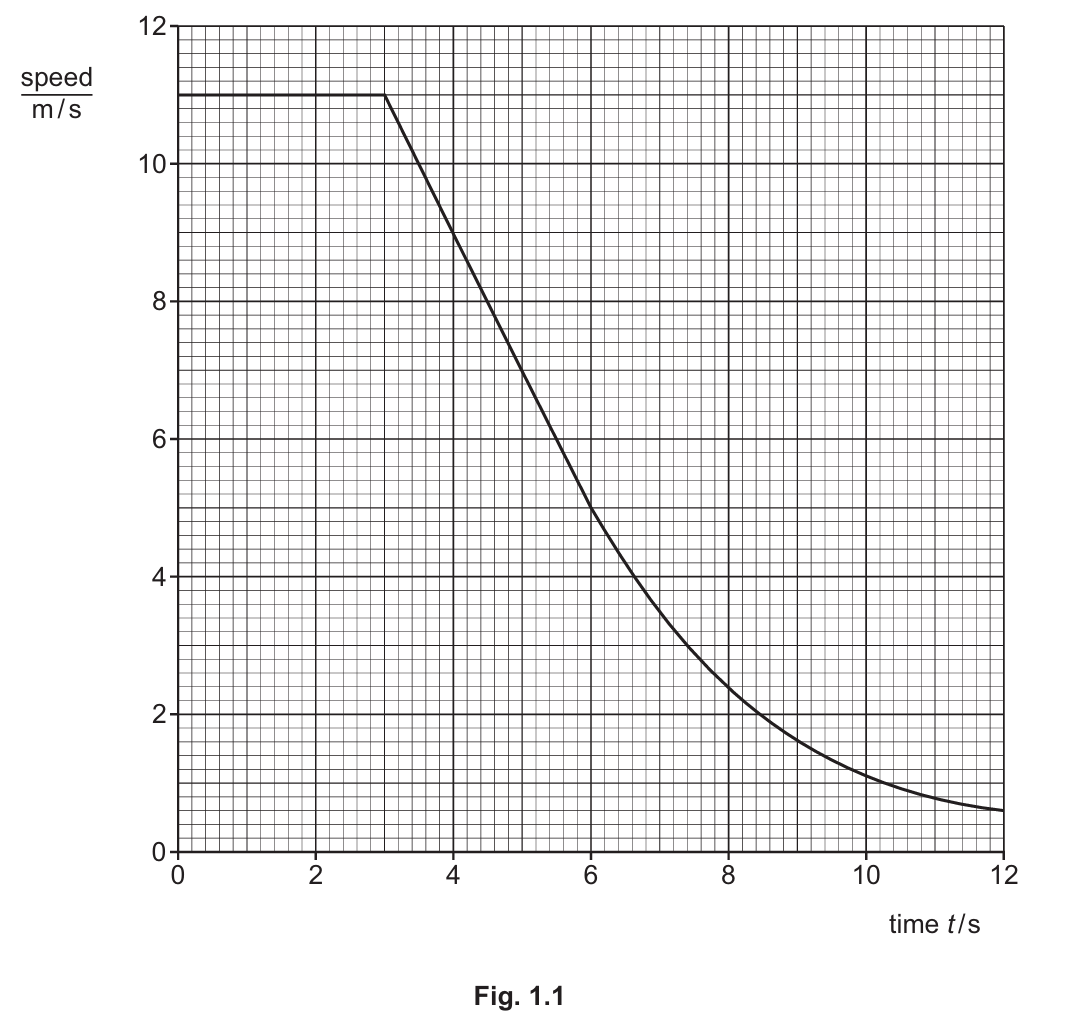
Part (a)
For the correct answer:
Constant speed (or uniform speed)
On a speed–time graph, a horizontal line indicates that the speed is not changing as time progresses. Between $t = 0$ and $t = 3.0\text{ s}$, the graph is a flat horizontal line at $v = 11\text{ m/s}$. This represents steady motion where the acceleration is zero.
Part (b)
For the correct answer:
$33\text{ m}$
The distance travelled is equal to the area under the speed–time graph. For the first $3.0\text{ s}$, this area is a rectangle with a height of $11\text{ m/s}$ and a width of $3.0\text{ s}$. Calculating the area: $\text{distance} = \text{speed} \times \text{time} = 11\text{ m/s} \times 3.0\text{ s} = 33\text{ m}$.
Part (c)(i)
For the correct answer:
Negative acceleration (or rate of decrease of velocity)
Deceleration is defined as the rate at which an object slows down. Mathematically, it is the change in velocity per unit time when the final velocity is less than the initial velocity. It can be expressed as a negative acceleration value.
Part (c)(ii)
For the correct answer:
$0.50\text{–}0.70\text{ m/s}^2$
To find the deceleration at a specific point on a curve, draw a straight tangent line touching the curve at $t = 9.0\text{ s}$. The gradient (slope) of this tangent represents the acceleration. Choose two points $(t_1, v_1)$ and $(t_2, v_2)$ on the tangent to calculate $\text{gradient} = \frac{v_2 – v_1}{t_2 – t_1}$. The magnitude of this negative gradient gives the deceleration.
Question 2
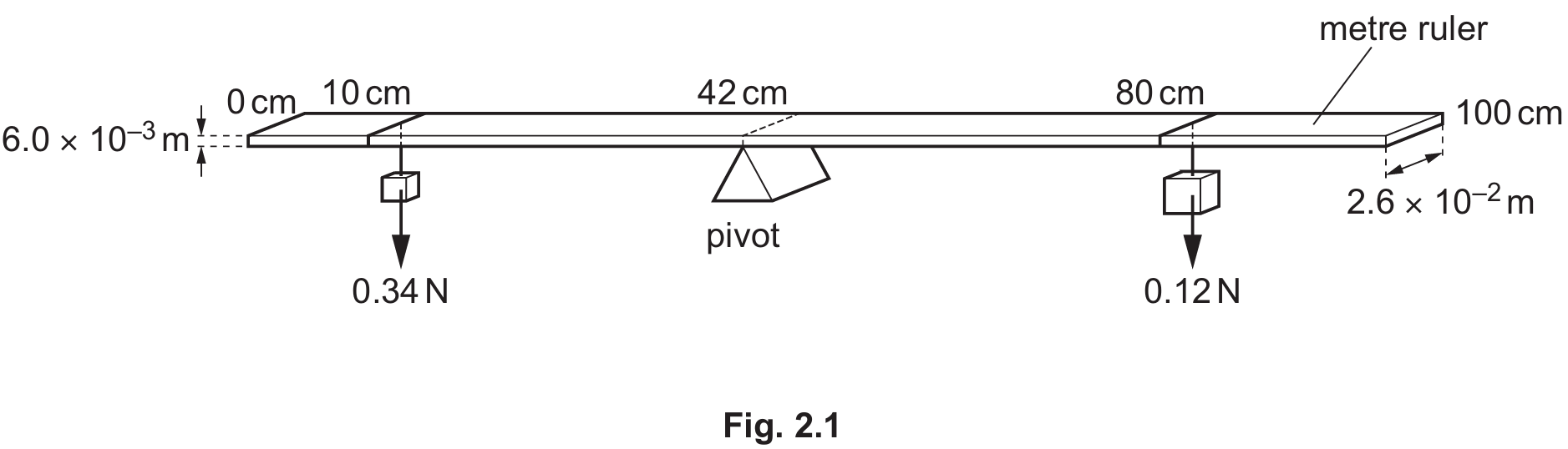
(ii) Calculate the density of the wood of the metre ruler.
Most-appropriate topic codes (Cambridge IGCSE Physics 0625):
• Topic $1.5.2$ — Turning effect of forces (Parts $\mathrm{(a)}$, $\mathrm{(c)(i)}$)
• Topic $1.5.3$ — Centre of gravity (Part $\mathrm{(b)}$)
• Topic $1.4$ — Density (Part $\mathrm{(c)(ii)}$)
▶️ Answer/Explanation
(a)
The product of the force and the perpendicular distance from the pivot.
In physics, the moment of a force is a measure of its turning effect. It is quantitatively defined as the force multiplied by the perpendicular distance between the line of action of the force and the point of rotation (the pivot).
(b)
Mark “X” at the $50\text{ cm}$ mark on the ruler.
The question states that the metre ruler is “uniform.” For a uniform object, the centre of gravity is located at its geometric centre. Since a metre ruler is $100\text{ cm}$ long, its midpoint is exactly at the $50\text{ cm}$ mark.
(c) (i)
Using the Principle of Moments: $\text{Sum of Clockwise Moments} = \text{Sum of Anticlockwise Moments}$.
The $0.34\text{ N}$ force is $32\text{ cm}$ from pivot. The $0.12\text{ N}$ weight is $38\text{ cm}$ from pivot. The ruler’s weight $W$ acts at $50\text{ cm}$ ($8\text{ cm}$ from pivot).
$(W \times 8) + (0.12 \times 38) = (0.34 \times 32) \implies 8W + 4.56 = 10.88 \implies W = 0.79\text{ N}$.
$m = \frac{W}{g} = \frac{0.79}{9.8} \approx 0.081\text{ kg}$.
(c) (ii)
$520\text{ kg/m}^3$
Volume $V = 1.0 \times (2.6 \times 10^{-2}) \times (6.0 \times 10^{-3}) = 1.56 \times 10^{-4}\text{ m}^3$.
$\rho = \frac{m}{V} = \frac{0.081}{1.56 \times 10^{-4}} \approx 520\text{ kg/m}^3$.
Question 3
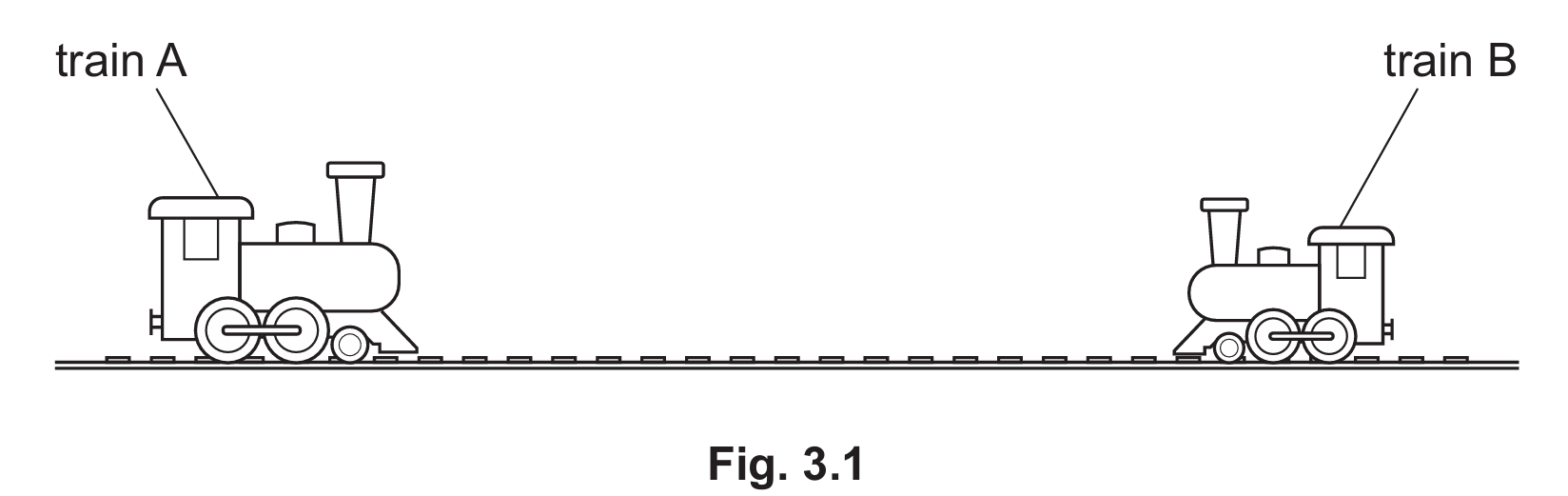
- the velocity of train A is $0.34\text{ m/s}$ to the right
- the velocity of train B is $0.12\text{ m/s}$ to the left
Most-appropriate topic codes (Cambridge IGCSE Physics 0625):
• Topic $1.6$ — Momentum (Parts $\mathrm{(a)}$, $\mathrm{(b)}$, $\mathrm{(c)}$)
▶️ Answer/Explanation
(a)
For the correct answer:
$\text{mass} \times \text{velocity}$
Momentum is a vector quantity defined as the product of an object’s mass and its velocity. In mathematical terms, it is expressed by the equation $p = mv$. It represents the “quantity of motion” an object possesses.
(b)
For the correct answer:
$0.19\text{ m/s}$ to the right
Using the conservation of momentum, total initial momentum = $(0.45 \times 0.34) + (0.21 \times -0.12) = 0.153 – 0.0252 = 0.1278\text{ kg m/s}$. Final mass = $0.45 + 0.21 = 0.66\text{ kg}$. $0.1278 = 0.66 \times v \implies v \approx 0.19\text{ m/s}$.
(c)
For the correct calculated value:
$-0.12\text{ N}$
Resultant force is the rate of change of momentum: $F = \frac{\Delta p}{\Delta t}$. Here, $\Delta p = 0 – 0.26 = -0.26\text{ kg m/s}$. Thus, $F = \frac{-0.26}{2.1} \approx -0.12\text{ N}$.
Question 4
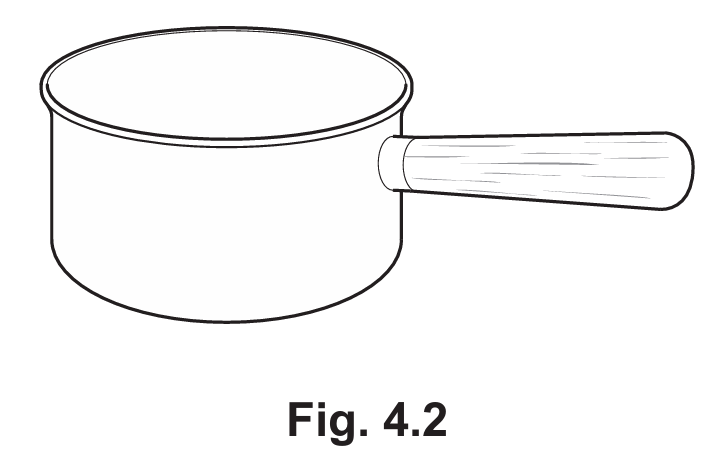
Most-appropriate topic codes (Cambridge IGCSE Physics 0625):
• Topic $2.3.3$ — Radiation (Parts $\mathrm{(a)(i)}$, $\mathrm{(a)(ii)}$)
• Topic $2.3.2$ — Convection (Part $\mathrm{(a)(iii)}$)
• Topic $2.3.1$ — Conduction (Part $\mathrm{(b)}$)
▶️ Answer/Explanation
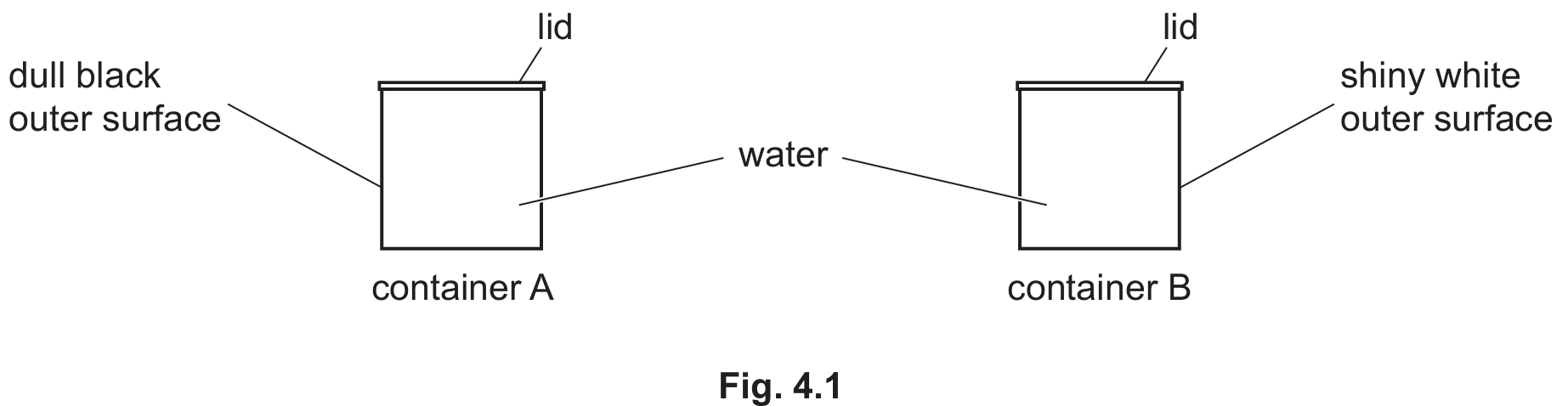
Correct Answer: Container A (Dull black surface)
Detailed solution: Dull black surfaces are much better emitters of infrared radiation compared to shiny white surfaces. Since container A is dull black, it loses thermal energy to the surroundings via radiation at a significantly higher rate. This results in a faster drop in temperature for the water inside, leading to a larger temperature change over the first $5$ minutes.
Correct Answer: Rate of energy loss equals rate of energy gain.
Detailed solution: An object reaches a constant temperature when it is in thermal equilibrium with its surroundings. In this state, the rate at which the container transfers thermal energy away to the environment is exactly equal to the rate at which it receives/absorbs energy from the environment. Because the net energy transfer is zero, the internal energy and temperature remain stable.
Correct Answer: Convection (or Evaporation)
Detailed solution: Removing the lids allows the air directly above the hot water surface to be heated, become less dense, and rise, creating a convection current that carries heat away. Additionally, evaporation can occur more freely, where the most energetic water molecules escape the surface, further increasing the rate of cooling through mass and energy transfer.
Correct Answer: Presence of free (delocalised) electrons in metal.
Detailed solution: Metals are excellent thermal conductors because they contain a “sea” of free or delocalised electrons that can move rapidly through the material. These electrons gain kinetic energy at the hot end and collide with distant ions, transferring energy much faster than the process in wood. Wood is an insulator and can only transfer energy slowly through relatively inefficient atomic lattice vibrations.
Question 5
(i) State the name of the region of the electromagnetic spectrum used by Bluetooth.
(ii) State the speed of electromagnetic waves in air.
(iii) The frequency of a Bluetooth network is $2.48\text{ GHz}$. Calculate the wavelength of the waves used in the Bluetooth network.
Most-appropriate topic codes (Cambridge IGCSE Physics 0625):
• Topic $3.4$ — Sound (Part $\mathrm{(a)}$)
• Topic $3.3$ — Electromagnetic spectrum (Parts $\mathrm{(b)(i)}$, $\mathrm{(b)(ii)}$)
• Topic $3.1$ — General properties of waves (Part $\mathrm{(b)(iii)}$)
▶️ Answer/Explanation
Correct Answer: Speed = $\frac{2 \times \text{distance}}{\text{time}}$ (using the echo method)
Detailed solution: Using the echo method, a person stands a measured distance $d$ (e.g., $100\text{ m}$) from a large flat wall, measured using a trundle wheel. The person makes a sharp sound (clapping blocks) and starts a stopwatch, stopping it when the echo is heard. Since the sound travels to the wall and back, the total distance is $2d$. The speed $v$ is then calculated using the formula $v = \frac{2d}{t}$. Repeating the process improves accuracy.
Correct Answer: Radio waves
Detailed solution: Bluetooth technology relies on short-range wireless communication. According to the electromagnetic spectrum classifications in the syllabus, Bluetooth operates within the radio wave region. These waves are capable of passing through obstacles like walls, though the signal strength may be reduced. This makes them ideal for connecting localized devices like phones and headphones.
Correct Answer: $3.0 \times 10^8\text{ m/s}$
Detailed solution: All electromagnetic waves, regardless of their frequency or wavelength, travel at the same constant speed in a vacuum. This speed is approximately $3.0 \times 10^8\text{ m/s}$. For the purposes of the IGCSE Physics syllabus, the speed of these waves in air is considered to be effectively the same as their speed in a vacuum.
Correct Answer: $0.12\text{ m}$
Detailed solution: To find the wavelength $\lambda$, use the wave equation $v = f\lambda$, rearranged as $\lambda = \frac{v}{f}$. Given the frequency $f = 2.48\text{ GHz} = 2.48 \times 10^9\text{ Hz}$ and speed $v = 3.0 \times 10^8\text{ m/s}$, the calculation becomes $\lambda = \frac{3.0 \times 10^8}{2.48 \times 10^9}$. This results in a wavelength of approximately $0.1209\text{ m}$, which rounds to $0.12\text{ m}$ to two significant figures.
Question 6


Most-appropriate topic codes (Cambridge IGCSE Physics 0625):
• Topic $3.2.3$ — Thin lenses (Parts $\mathrm{(a)(i)}$, $\mathrm{(a)(ii)}$, $\mathrm{(a)(iii)}$)
• Topic $3.2.3$ — Thin lenses (Parts $\mathrm{(b)(i)}$, $\mathrm{(b)(ii)}$)
▶️ Answer/Explanation
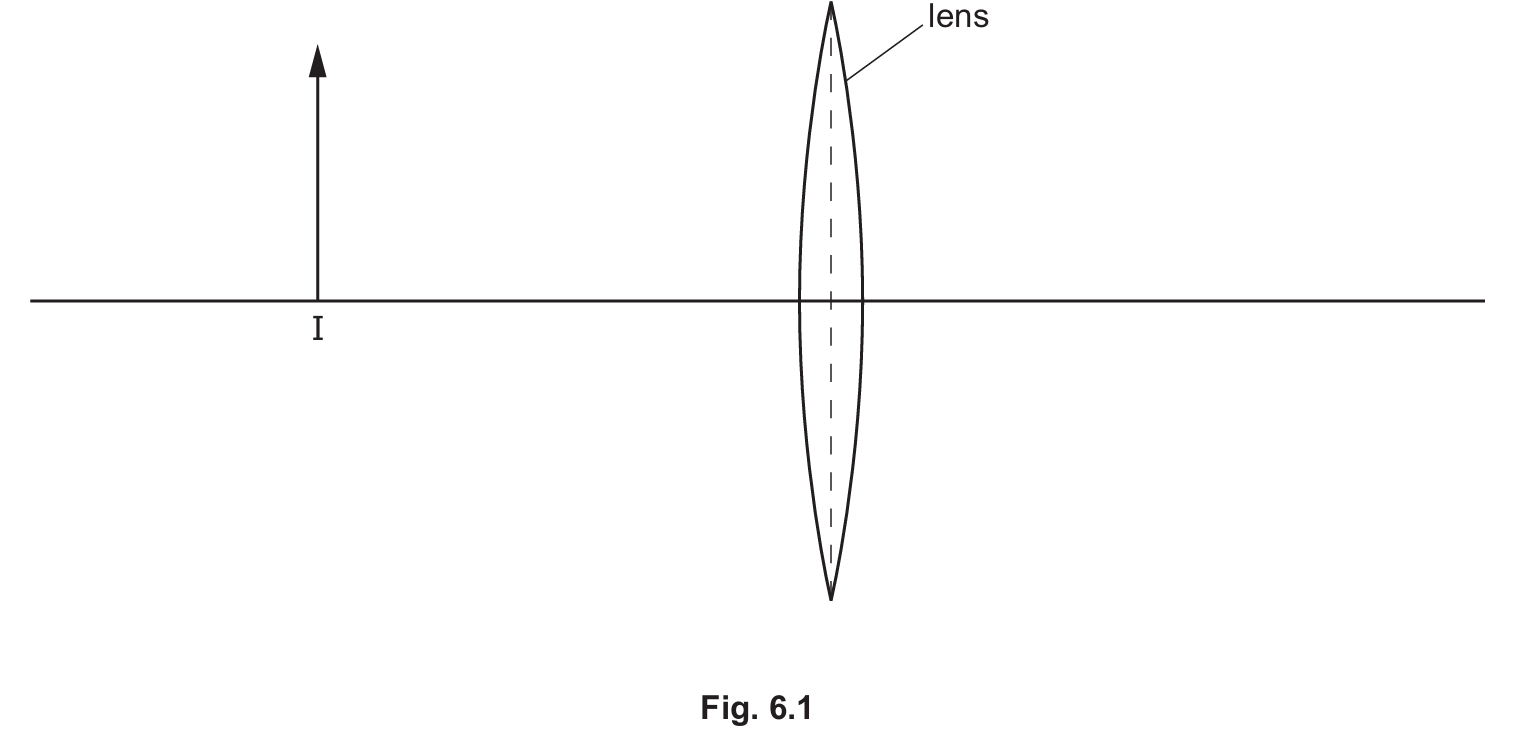
Correct Answer: Mark two points $F$ on the principal axis, both $3.0\text{ cm}$ from the optical centre of the lens.
Detailed solution: The principal focus ($F$) is defined by the focal length. Since the lens is symmetrical, there is a focal point on both the left and right sides. You must use a ruler to measure exactly $3.0\text{ cm}$ from the vertical centreline of the lens along the horizontal principal axis in both directions and mark these points with the letter $F$.
Correct Answer: Object $O$ drawn at the intersection of rays to the right of the lens (Method 1) or left (Method 2).
Detailed solution: To locate the object from the image $I$, trace rays backward. One ray passes from the top of $I$ straight through the centre of the lens (undeviated). A second ray travels from the top of $I$ parallel to the principal axis until the lens, then refracts through the focal point $F$. The intersection of these rays identifies the top of the object $O$. Since the image shown is upright and on the same side as the object, it is a virtual image formed by a magnifying glass arrangement.
Correct Answer: Real (or Inverted, or Same Size).
Detailed solution: The focal length is $f = 3.0\text{ cm}$. Moving the object to $6\text{ cm}$ places it at exactly $2f$. For a converging lens, when the object is at $2f$, the image formed is real, inverted, and the same size as the object, located at $2f$ on the opposite side of the lens. Any of these three characteristics is a valid answer.
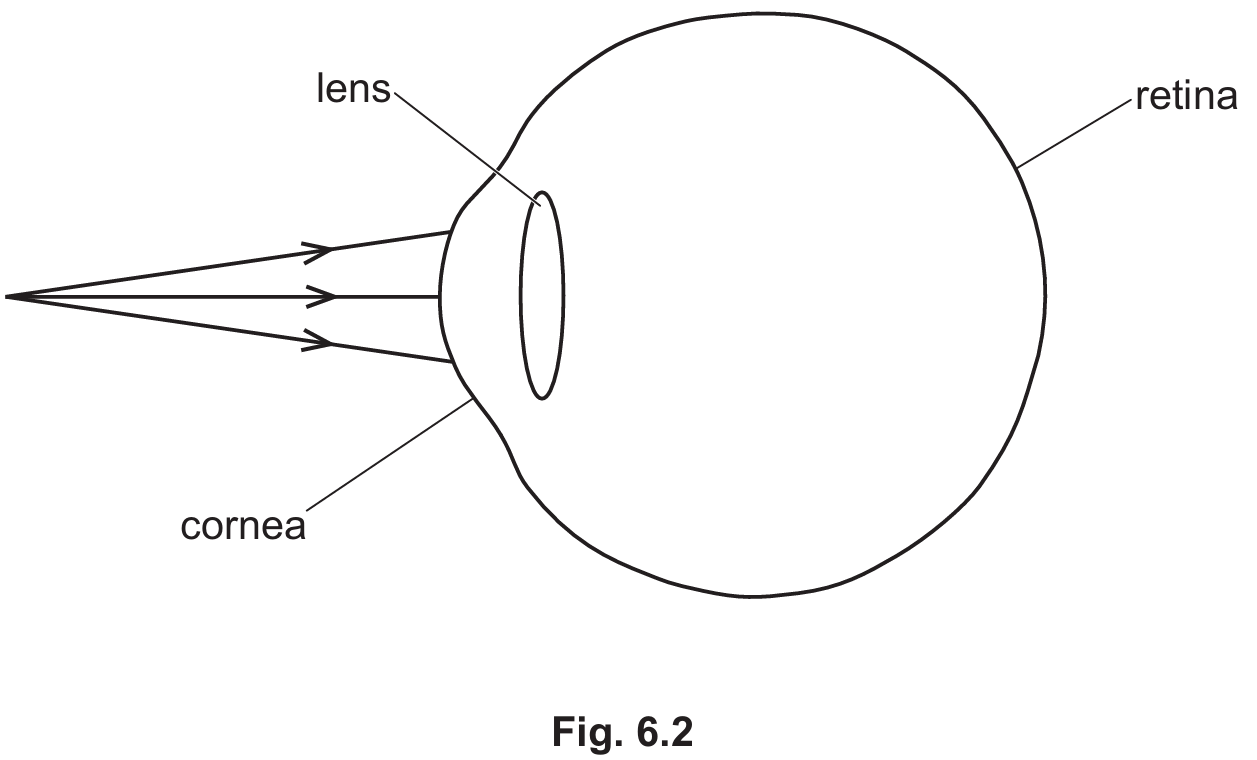
Correct Answer: Rays meeting (converging) at a point behind the retina.
Detailed solution: Long-sightedness (hyperopia) occurs when the eye’s lens is too weak or the eyeball is too short. In this condition, the light rays from a near object are not bent sufficiently by the cornea and lens, causing them to reach the retina before they have finished converging. On the diagram, continue the rays from the lens until they meet at a point located to the right of the retina wall.
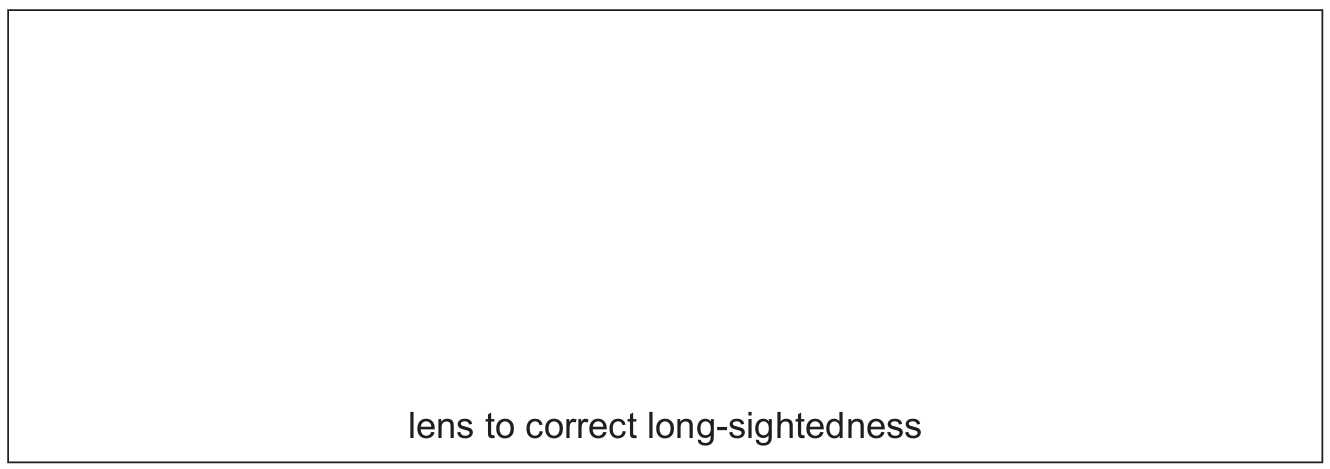
Correct Answer: A converging (convex) lens.
Detailed solution: To correct long-sightedness, an additional converging lens is placed in front of the eye. This lens provides extra refractive power to help “pre-bend” the light rays so that they converge sooner, allowing them to focus exactly on the retina. The lens should be drawn with a biconvex shape (thicker in the middle than at the edges).
Question 7
(i) Explain why.
(ii) The negatively charged plastic rod is suspended by an insulating thread. Another negatively charged plastic rod is brought close to the suspended rod. State what happens to the suspended plastic rod.
(ii) A small lamp illuminates an electric oven. The lamp has an output power of $25\text{ W}$ and operates for $220\text{ hours}$ in one year. The p.d. across the lamp is $230\text{ V}$.
1. Calculate the energy transferred by the lamp in one year. Give your answer in $\text{kWh}$.
2. Calculate the current in the lamp.
Most-appropriate topic codes (Cambridge IGCSE Physics 0625):
• Topic $4.2.1$ — Electric charge (Parts $\mathrm{(a)}$, $\mathrm{(b)}$)
• Topic $4.2.5$ — Electrical energy and electrical power (Part $\mathrm{(c)}$)
▶️ Answer/Explanation
Correct Answer: A region where an electric charge experiences a force.
Detailed solution: An electric field is a physical concept used to describe the influence exerted by a charged object into the space around it. Any other charged particle placed within this region will be subject to an electrostatic force.
Correct Answer: (i) Electrons move from the cloth to the plastic rod due to friction. (ii) It moves away/repels.
Detailed solution: In part (i), rubbing causes friction which provides energy for electrons to be transferred; the rod becomes negative by gaining electrons. In part (ii), like charges repel.
Correct Answer: The energy transferred in one hour at a rate of $1\text{ kW}$.
Detailed solution: The kilowatt-hour is a unit of energy representing the work done by a $1\text{ kW}$ device operating for one hour.
Correct Answer: 1. $5.5\text{ kWh}$ 2. $0.11\text{ A}$
Detailed solution: 1. $E = P \times t = 0.025\text{ kW} \times 220\text{ h} = 5.5\text{ kWh}$. 2. $I = \frac{P}{V} = \frac{25}{230} \approx 0.11\text{ A}$.
Question 8
Most-appropriate topic codes (Cambridge IGCSE Physics 0625):
• Topic $4.5.1$ / $4.5.2$ — Electromagnetic induction and the a.c. generator (Part $\mathrm{(a)}$)
• Topic $4.2.4$ / $4.3 .2$ — Resistance and Series and parallel circuits (Part $\mathrm{(b)}$)
▶️ Answer/Explanation
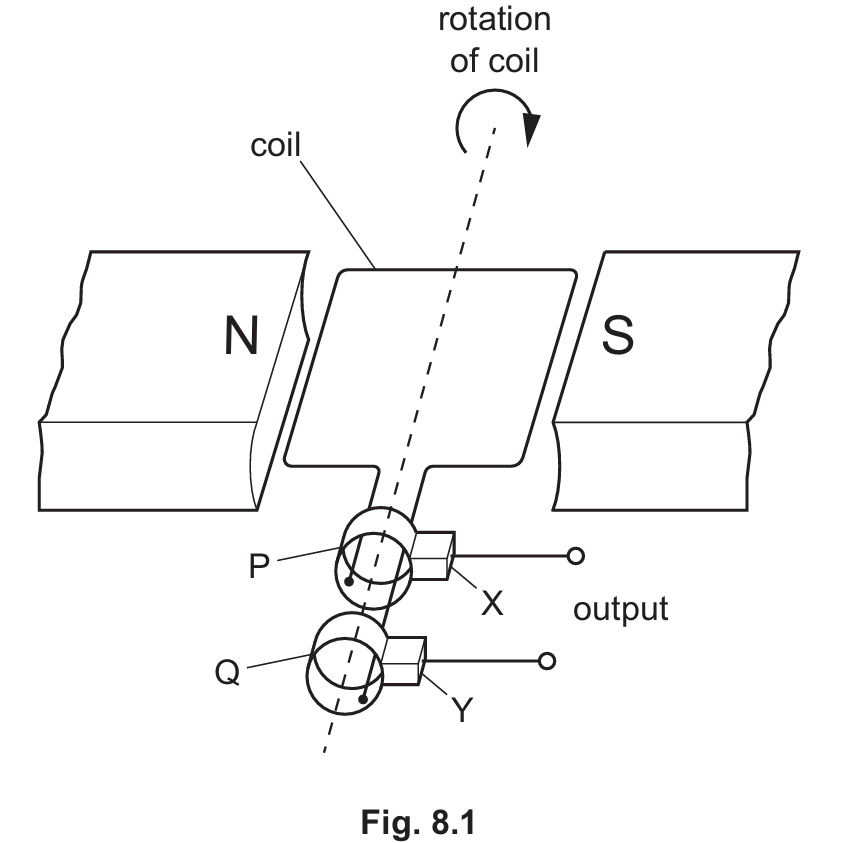
(i) P and Q: slip rings; X and Y: brushes
(ii) Detailed solution: An electromotive force (e.m.f.) is induced only when there is a change in the magnetic flux linkage. When the coil turns, its sides cut through the magnetic field lines between the North and South poles. This relative motion between the conductor and the magnetic field is essential to drive the flow of electrons; if the coil is stationary, no field lines are cut, and the e.m.f. is zero.
(iii) Detailed solution: To increase the induced e.m.f., one can increase the strength of the magnetic field (using stronger magnets), increase the speed of rotation of the coil (cutting lines faster), or increase the number of turns of wire in the coil. Each of these changes increases the rate at which magnetic flux is cut by the conductor.
Correct Answer: $1.2\text{ A}$
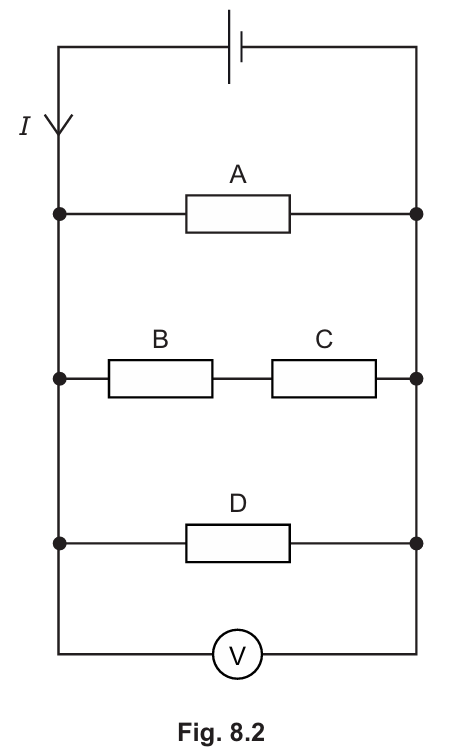
Detailed solution: Resistors B and C are in series, and since they are identical, the total resistance of that branch is twice that of the branch containing only resistor A ($R_{BC} = 2R$). Because the branches are in parallel, they share the same potential difference. Since $V = IR$, doubling the resistance in a branch with the same voltage results in the current being halved: $\frac{2.4\text{ A}}{2} = 1.2\text{ A}$.
Correct Answer: $6.0\text{ A}$
Detailed solution: The total current $I$ is the sum of the currents in the three parallel branches. The top branch (A) has $2.4\text{ A}$. The middle branch (B and C) has $1.2\text{ A}$. The bottom branch (D) is identical to branch A and thus also has $2.4\text{ A}$. Summing these gives $I = 2.4 + 1.2 + 2.4 = 6.0\text{ A}$.
Correct Answer: $2.1\text{ }\Omega$
Detailed solution: The resistance $R$ is calculated using Ohm’s Law, $R = \frac{V}{I}$. The voltmeter is connected in parallel across the resistors, so the potential difference across resistor A is $5.0\text{ V}$. Using the given current for resistor A ($2.4\text{ A}$), the resistance is $R_A = \frac{5.0}{2.4}$, which equals approximately $2.083\text{ }\Omega$, rounded to $2.1\text{ }\Omega$ for significant figures.
Question 9
(ii) State one source that makes a significant contribution to background radiation.
(b) Radioactive isotopes are used in some medical treatments. Radium-223 ($_{88}^{223}\text{Ra}$) is an isotope of radium. Radium-223 decays by the emission of alpha ($\alpha$) particles to an isotope of radon ($\text{Rn}$).
(i) Complete the nuclide equation for this decay.
$_{88}^{223}\text{Ra} \longrightarrow \dots\dots\dots\dots \text{Rn} + \dots\dots\dots\dots \alpha$
(ii) Radium-223 is injected into the body to treat a specific organ. Explain why the source must be inside the body.
(i) Explain why a source of gamma radiation is used.
(ii) Explain why a source with a short half-life must be used.
Most-appropriate topic codes (Cambridge IGCSE Physics 0625):
• Topic $5.2.1$ — Detection of radioactivity (Part $\mathrm{(a)}$)
• Topic $5.2.3$ — Radioactive decay (Part $\mathrm{(b)(i)}$)
• Topic $5.2.2$ — The three types of nuclear emission (Parts $\mathrm{(b)(ii)}$, $\mathrm{(c)(i)}$)
• Topic $5.2.4$ — Half-life (Part $\mathrm{(c)(ii)}$)
▶️ Answer/Explanation
Correct Answer: (i) Radiation present in the environment (ii) Radon gas / Cosmic rays / Rocks
Detailed solution: Background radiation refers to the low-level ionising radiation that is constantly present in the natural environment around us. Significant natural sources include radon gas seeping from the ground, cosmic rays from outer space, and naturally occurring radioactive isotopes in rocks, buildings, and even the food we consume.
Correct Answer: (i) $_{86}^{219}\text{Rn} + _{2}^{4}\alpha$ (ii) Alpha particles have low penetration.
Detailed solution: In $\alpha$-decay, the nucleus loses $2$ protons and $2$ neutrons; thus the nucleon number $A$ decreases by $4$ ($223 – 4 = 219$) and the proton number $Z$ decreases by $2$ ($88 – 2 = 86$). Because $\alpha$-particles are highly ionising but have a very short range (blocked by skin or a few cm of air), the source must be placed inside the body to ensure the radiation reaches and treats the targeted cancerous organ directly.
Correct Answer: (i) Gamma can penetrate the body (ii) To minimize radiation damage over time.
Detailed solution: Gamma ($\gamma$) radiation is used for medical imaging because it is highly penetrating and can easily pass through body tissues to be detected by external sensors. A short half-life, such as $6\text{ hours}$, is essential because it ensures the radioactive material decays rapidly, meaning the patient is only exposed to ionising radiation for a limited duration before the activity reaches negligible levels.
Question 10
Most-appropriate topic codes (Cambridge IGCSE Physics 0625):
• Topic $6.1.2$ — The Solar System (Part $\mathrm{a(i)}$)
• Topic $2.1 .3$ — Gases and the absolute scale of temperature (Part $\mathrm{a(ii)}$)
• Topic $1.3$ — Mass and weight (Part $\mathrm{a(iii)}$)
• Topic $6.2 .2$ — Stars (Part $\mathrm{b(i)}$)
• Topic $6.2 .3$ — The Universe (Part $\mathrm{b(ii)}$)
▶️ Answer/Explanation
(a)(i)
Correct Answer: Planet B
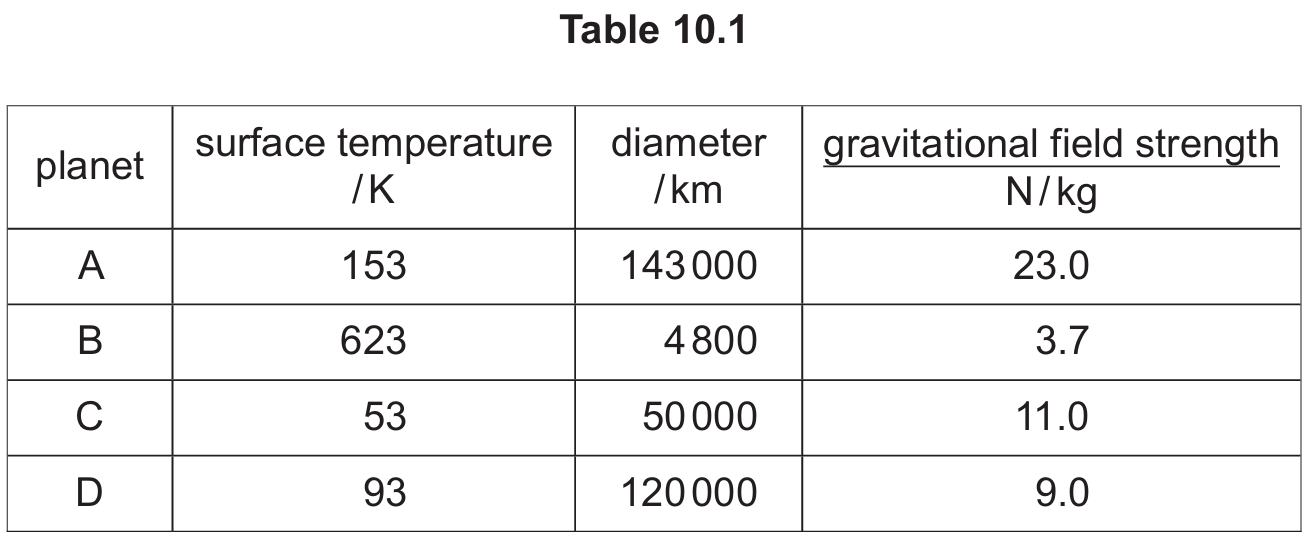
Planet B is the closest to the Sun because it has the highest surface temperature ($623\text{ K}$). Planets closer to the Sun receive more intense radiation, leading to higher surface temperatures.
(a)(ii)
Correct Answer: $-180^\circ\text{C}$
Using the conversion $\theta = T – 273$:
$93 – 273 = -180^\circ\text{C}$.
(a)(iii)
Correct Answer: Planet A
Time taken to fall is inversely related to acceleration due to gravity ($g$). Planet A has the highest gravitational field strength ($23.0\text{ N/kg}$), providing the greatest acceleration and thus the shortest fall time.
(b)(i)
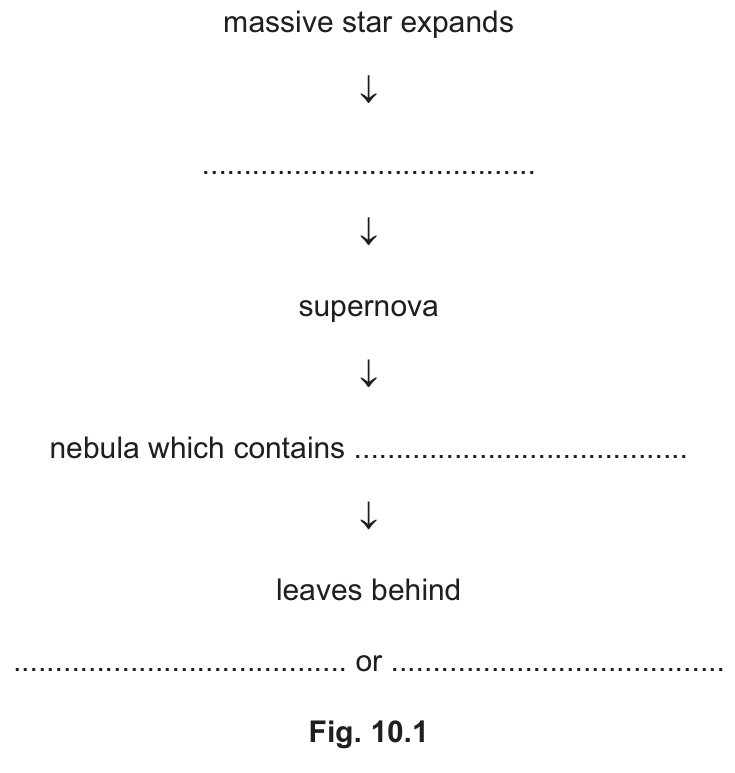
Correct Answer: Red supergiant; (new) heavier elements; neutron star OR black hole.
A massive star forms a red supergiant, explodes as a supernova creating heavier elements, and leaves a neutron star or black hole.
(b)(ii)
Correct Answer: Distance (from Earth) to the galaxy.
By comparing peak luminosity (intrinsic brightness) to apparent brightness, the distance $d$ to the galaxy can be calculated.