

▶️ Answer/Explanation
Detailed solution:
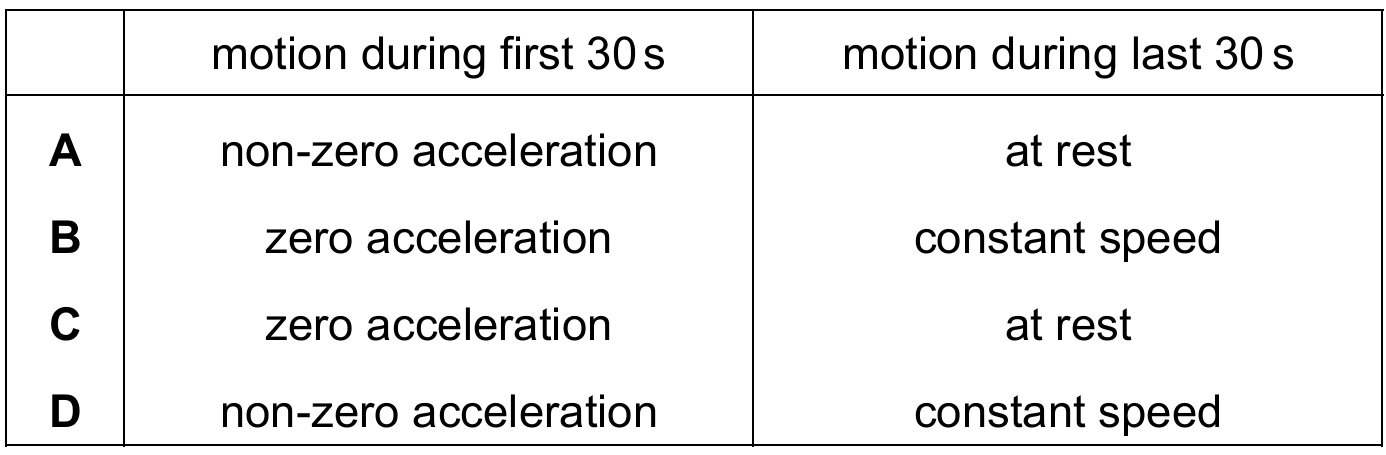
Let’s look at the speedometer readings over time. In the first 30 seconds, the car’s speed increases steadily from 0 to 4, then 8, and finally 12 m/s. Because the speed is changing, the car is definitely experiencing a non-zero acceleration (specifically, $a = \Delta v / \Delta t$). Now, for the last 30 seconds (from 30 s to 60 s), the speedometer stays stuck right at 12 m/s the whole time. Since the speed isn’t changing at all, the car is moving at a constant speed, which also means its acceleration has dropped to zero. So, it accelerates first, then cruises at a steady pace.

▶️ Answer/Explanation
Detailed solution:
To find the density of any material, we need to know how much mass is packed into a given volume. The standard formula for density is mass divided by volume ($\rho = m/V$). Here, we are given a rectangular block with side lengths $p$, $q$, and $r$. The volume of a solid rectangular block is simply the product of its three dimensions, which is calculated as $V = p \times q \times r$. By plugging this into our density formula, we get the expression mass $m$ divided by the volume $(p \times q \times r)$. This points us directly to option B.
▶️ Answer/Explanation
Detailed solution:
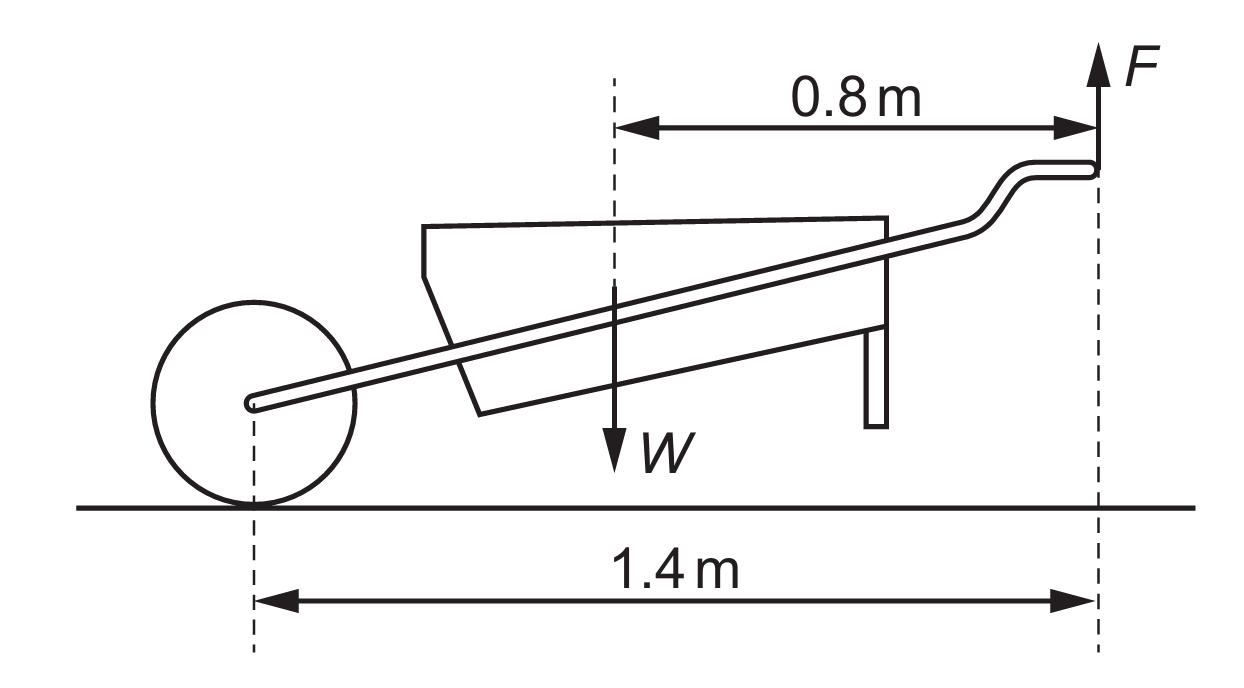
To find the force needed to lift the handles, we use the principle of moments, taking the wheel’s axle as our pivot point. The wheelbarrow is in equilibrium, so the clockwise moment must equal the anticlockwise moment. The downward force is the weight $W$ (140 N), and its distance from the pivot is calculated by subtracting 0.8 m from the total length of 1.4 m, giving $0.6$ m. The upward force $F$ is applied at a full distance of $1.4$ m from the pivot. Setting up the equation, we get $F \times 1.4 = 140 \times 0.6$. Solving for $F$ gives $84 / 1.4$, which equals exactly 60 N.
▶️ Answer/Explanation
Detailed solution:
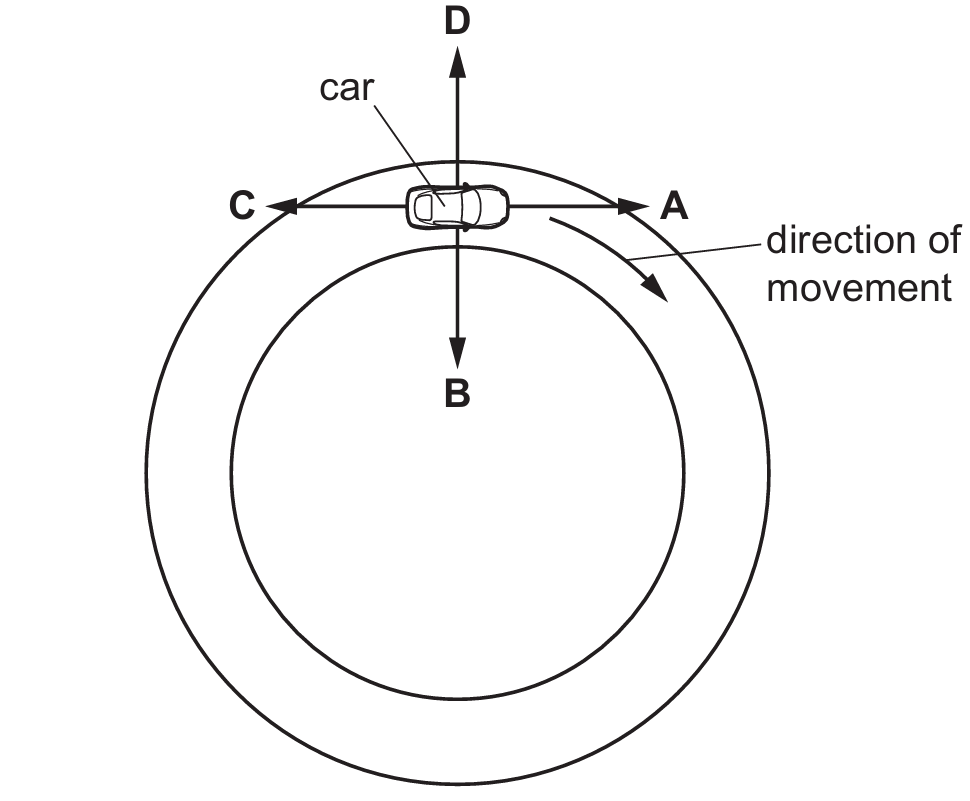
When an object travels in a circle at a constant speed, it is continuously changing its direction. Because its velocity (which includes both speed and direction) is constantly changing, it must be accelerating, meaning there is a resultant force acting on it. For stable circular motion, this resultant force is called the centripetal force. The centripetal force always acts perpendicularly to the direction of motion, pulling the object directly inward toward the center of the circle. Therefore, the resultant force points straight to the center of the track.

▶️ Answer/Explanation
Detailed solution:
We can solve this by looking at the change in momentum of the water as it accelerates through the nozzle. Force is defined mathematically as the rate of change of momentum ($F = \Delta p / \Delta t$). Every second, 15 kg of water is speeding up from 1 m/s to 6 m/s, representing a velocity change of 5 m/s. The change in momentum per second is simply the mass per second multiplied by this change in velocity ($15 \times 5$). Calculating this gives us 75 N of force. By Newton’s third law, the water exerts an equal and opposite force of 75 N right back on the hose.
▶️ Answer/Explanation
Detailed solution:
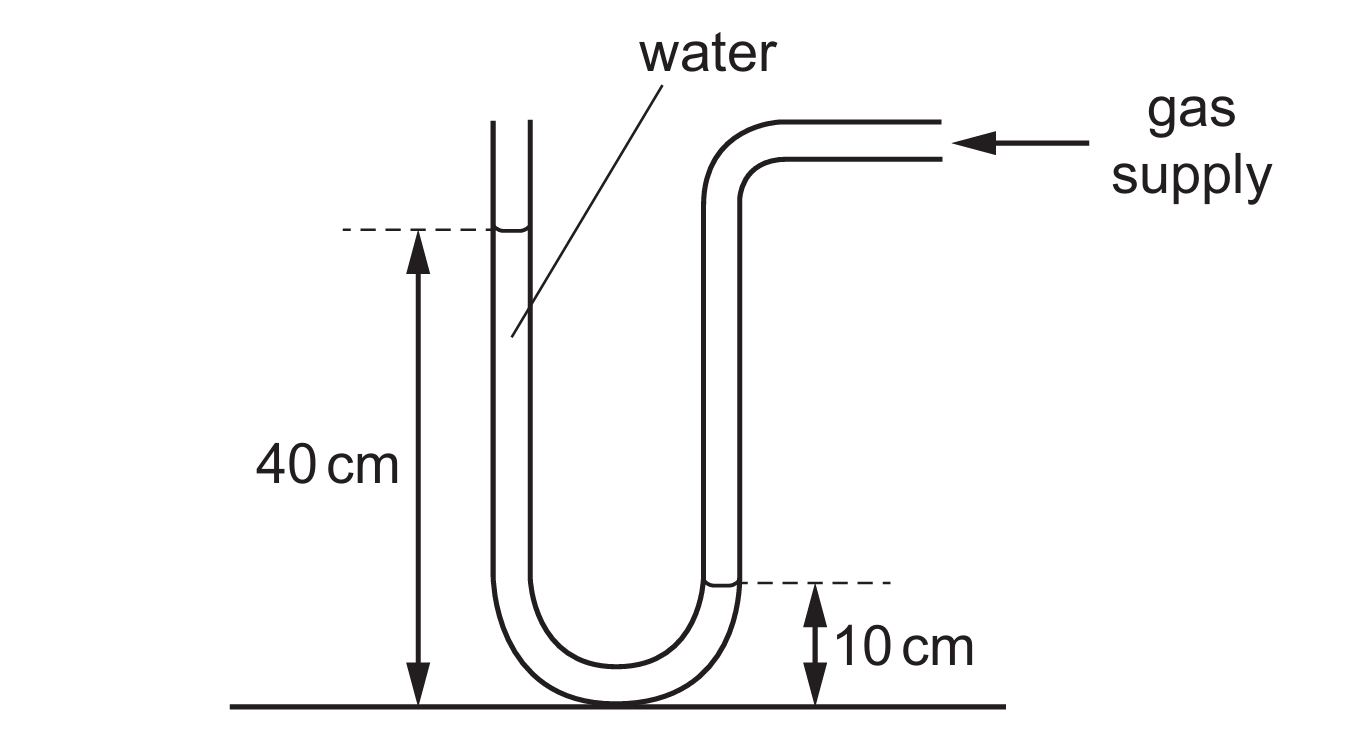
A manometer measures the pressure difference between a gas and the outside atmosphere by observing the height difference in a liquid column. First, we need to find the exact difference in water levels between the two arms. The left side is at $40\text{ cm}$ and the right side is at $10\text{ cm}$, so the difference $\Delta h$ is $30\text{ cm}$, which we must convert to $0.3\text{ m}$ for standard units. To calculate the pressure difference, we apply the fluid pressure formula $\Delta p = \rho g \Delta h$. Plugging in our values: density $\rho = 1000\text{ kg/m}^3$, gravity $g = 10\text{ m/s}^2$, and $\Delta h = 0.3\text{ m}$. Multiplying these together gives $1000 \times 10 \times 0.3 = 3000\text{ Pa}$. Since the gas pushes the water down, its pressure is exactly $3000\text{ Pa}$ higher than atmospheric pressure.

▶️ Answer/Explanation
Detailed solution:
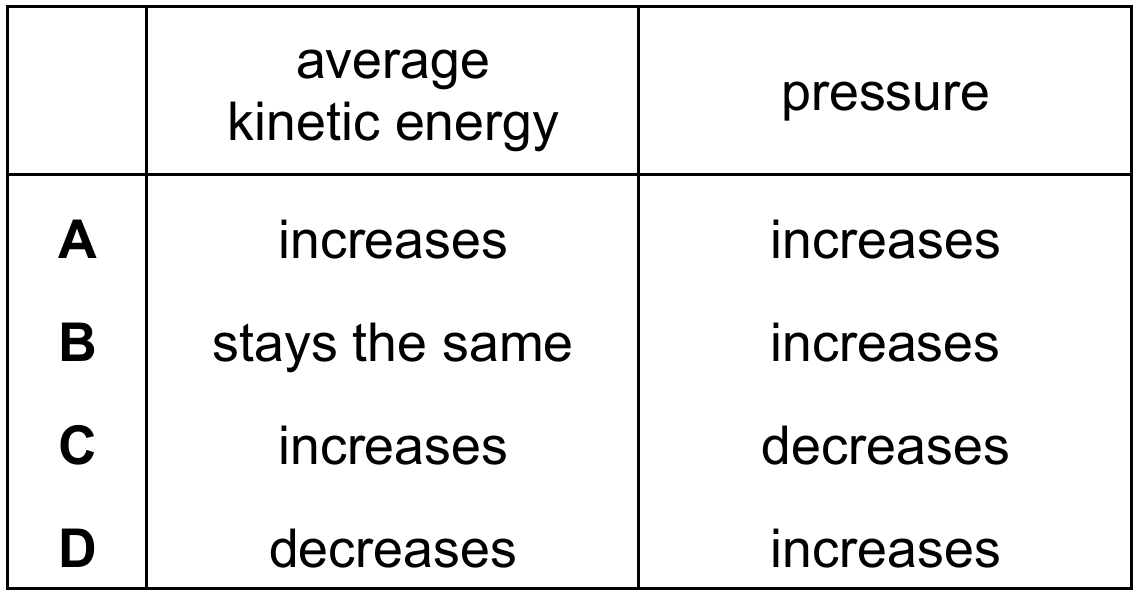
Temperature is essentially a direct measure of the average kinetic energy of the particles making up a substance. When you heat up the trapped gas, you are transferring thermal energy into it, which inherently means the molecules’ average kinetic energy increases and they begin to zip around much faster. Because the container’s volume is fixed and isn’t expanding to give them more room, these faster-moving molecules will collide with the walls of the container much more frequently and with significantly greater force. The culmination of all these harder, more frequent microscopic collisions results in a higher overall pressure on the container walls. Therefore, both the kinetic energy and the pressure see a noticeable increase.
▶️ Answer/Explanation
Detailed solution:
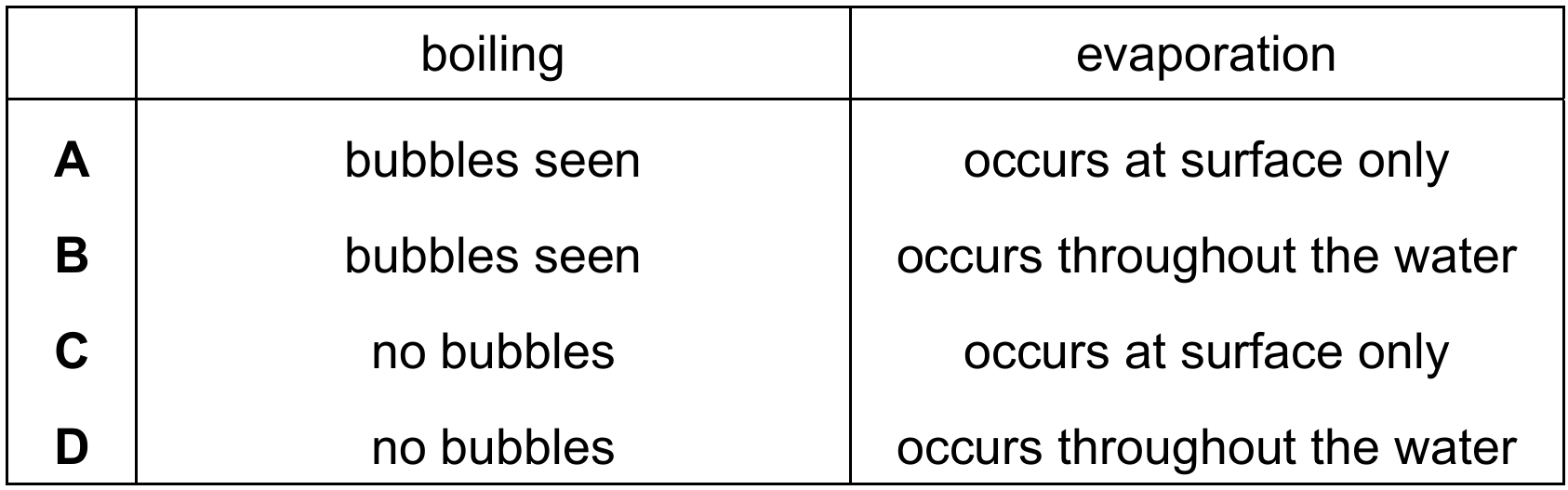
Boiling and evaporation are two distinct processes by which a liquid turns into a gas, even though the end result is similar. Boiling is a rapid, active process that happens at a specific temperature (the boiling point); it occurs throughout the entire volume of the liquid, which is why you see large bubbles of vapor forming deep inside and rising to the surface. Evaporation, on the other hand, is a much quieter, slower process that happens at any temperature. It strictly occurs only at the surface of the liquid, where the most energetic particles manage to overcome attractive forces and escape into the air without any bubbles being formed. Hence, boiling involves visible bubbles, while evaporation happens exclusively at the surface.

▶️ Answer/Explanation
Detailed solution:
The sensitivity of a thermometer refers to its ability to register a noticeably large change in the length of the liquid thread for even a tiny change in temperature. When the liquid inside the bulb gets heated, it expands by a very specific volume. If you force this expanding volume of liquid up into a narrower capillary tube, it has no choice but to travel much further along the tube to accommodate the same volume increase. This increased travel distance makes the scale markings wider and easier to read, thereby increasing the instrument’s sensitivity. Changing the thickness of the glass (like making it thinner) improves responsiveness—how quickly it reacts—but does not change sensitivity.

▶️ Answer/Explanation
Detailed solution:
To find the temperature, we need to determine what fraction of the full scale the liquid has reached. Based on standard diagrams of this type, the measurements are typically taken from the same reference point (like the end of the bulb). If the $0^\circ\text{C}$ mark is at $8\text{ mm}$, and the $100^\circ\text{C}$ mark is at $88\text{ mm}$, then the total distance representing the $100^\circ\text{C}$ range is $88\text{ mm} – 8\text{ mm} = 80\text{ mm}$. The liquid level itself is at a distance of $64\text{ mm}$ past the $0^\circ\text{C}$ mark (or $72\text{ mm}$ from the bulb, making the expansion length $72 – 8 = 64\text{ mm}$). Since it’s a uniform capillary tube, the temperature scales linearly with length. The temperature is simply the ratio of the liquid’s expansion to the full scale expansion multiplied by 100. That gives us $(64 / 80) \times 100^\circ\text{C} = 80^\circ\text{C}$.
▶️ Answer/Explanation
Detailed solution:
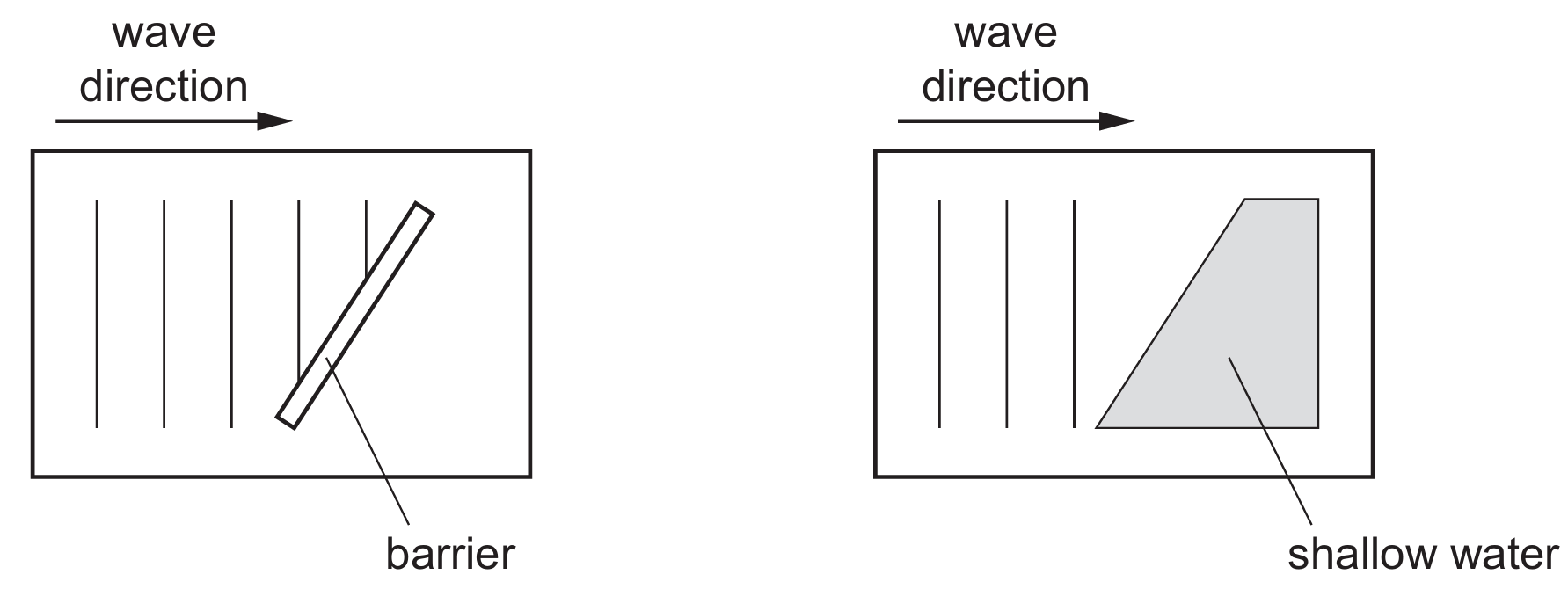
Let’s evaluate the student’s claims one by one. Statement 1 is entirely correct: when waves reflect off a barrier, their direction changes according to the law of reflection, but because they remain in the exact same depth of water (the same medium), their speed and consequently their wavelength do not change at all. Statement 2, however, is flawed. When waves cross into shallower water at an angle, they definitely slow down, causing the wavelength to decrease (bunch up). Because they hit the boundary at an angle, this change in speed also causes the waves to bend, meaning their direction of travel changes. Since statement 2 wrongly claims the direction remains the same, only statement 1 is correct.
▶️ Answer/Explanation
Detailed solution:
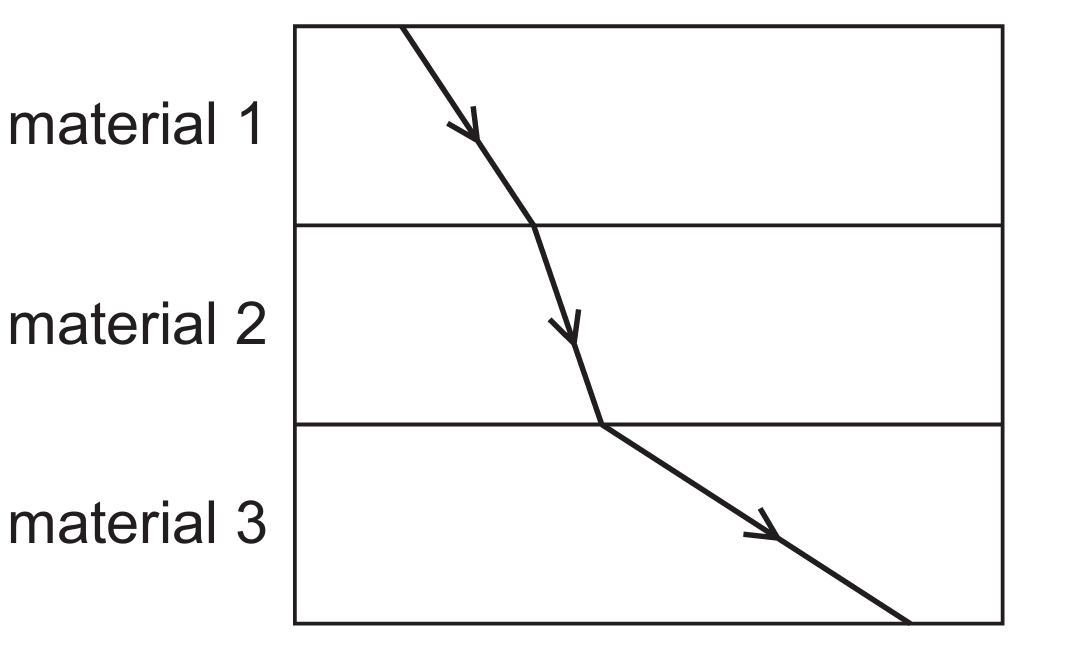
When light travels from one transparent material into another, its speed changes, causing it to refract. The golden rule is: if it bends towards the normal line, it has slowed down; if it bends away from the normal, it has sped up. Observing the diagram, when the light goes from material 1 to material 2, it bends distinctly towards the normal. This tells us it travels slower in 2 than it does in 1 ($v_2 < v_1$). Then, moving from 2 into 3, it bends drastically away from the normal, meaning it has sped up considerably. The angle of the ray in material 3 is even wider than it was initially in material 1, indicating the light travels the absolute fastest in material 3. Therefore, ordering the speeds from slowest to fastest gives us 2, then 1, then 3.
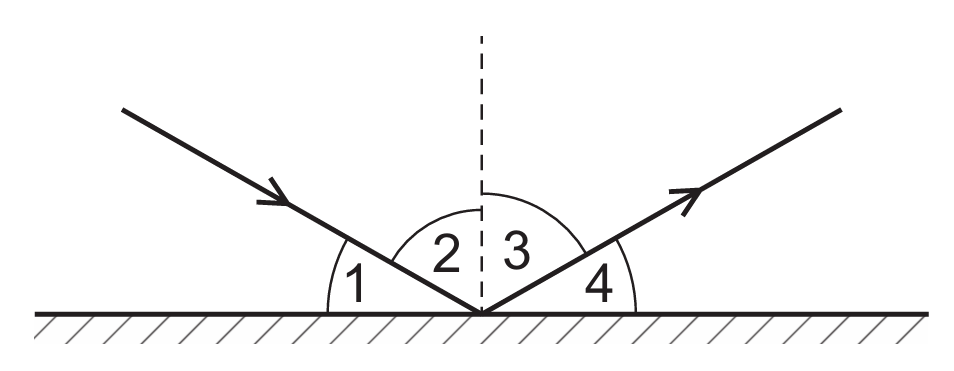
▶️ Answer/Explanation
Detailed solution:
When dealing with light rays, all standard angles are measured relative to the normal, which is the imaginary dashed line drawn perfectly perpendicular (at 90 degrees) to the surface of the mirror. The angle of incidence is defined as the angle exactly between the incoming (incident) ray and the normal. In the described diagram, this is angle 2. Similarly, the angle of reflection is measured directly between the outgoing (reflected) ray and the normal, which corresponds to angle 3. Angles 1 and 4 are merely the glancing angles with the mirror surface, not the standard incident or reflected angles.
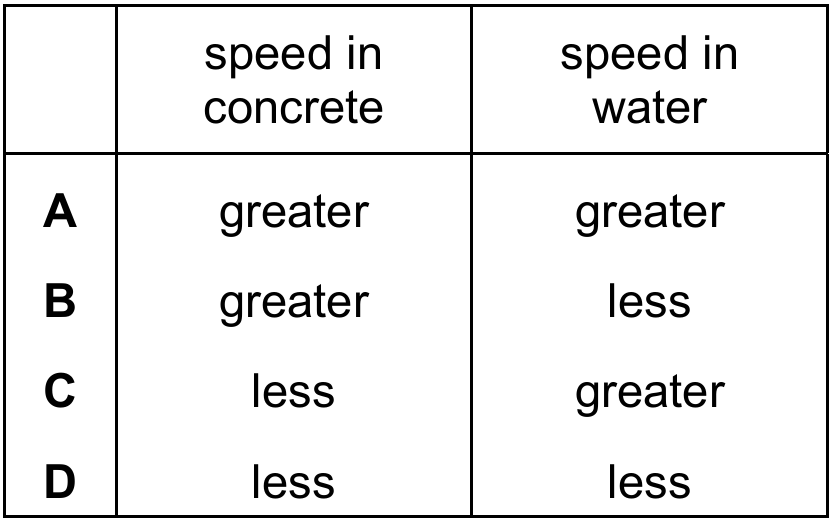
▶️ Answer/Explanation
Detailed solution:
Sound waves are mechanical vibrations that propagate by transferring energy from one particle to an adjacent particle. Because particles in a liquid (like water) are packed much closer together than the widely spread particles in a gas (like air), water transmits these sound vibrations much faster. When we look at a solid (like concrete), the particles are packed incredibly tightly and held by strong bonds, making the energy transfer even more rapid. Therefore, the speed of sound is highest in solids, slower in liquids, and slowest in gases, meaning the speed in both concrete and water is significantly greater than 330 m/s.
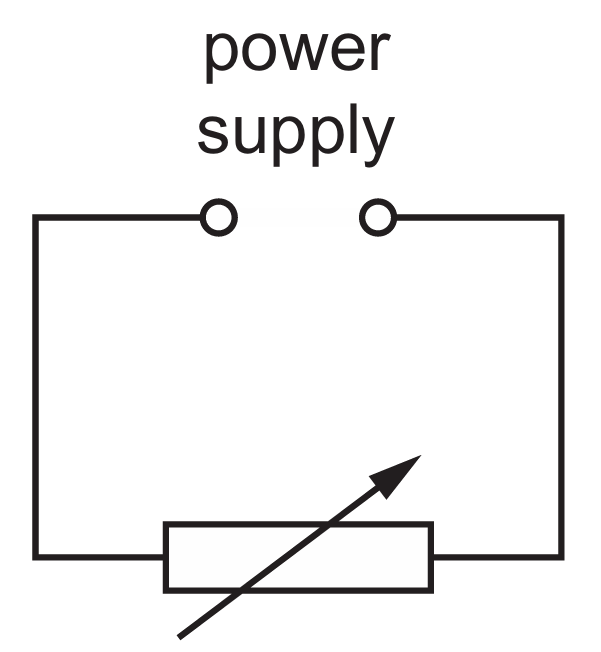

▶️ Answer/Explanation
Detailed solution:
We can solve this swiftly using Ohm’s Law, which states that current is equal to the potential difference divided by the resistance ($I = V/R$). Let’s calculate the exact current for each row. For the first row, $I_1 = 3.6 / 12 = 0.3\text{ A}$. For the second row, $I_2 = 1.2 / 12 = 0.1\text{ A}$. For the third row, $I_3 = 3.6 / 6 = 0.6\text{ A}$. Now we simply need to rank these calculated values. Comparing them directly, 0.1 A is the smallest, 0.3 A is in the middle, and 0.6 A is the largest. Therefore, the correct sequential order from smallest to largest is $I_2$, then $I_1$, and finally $I_3$.
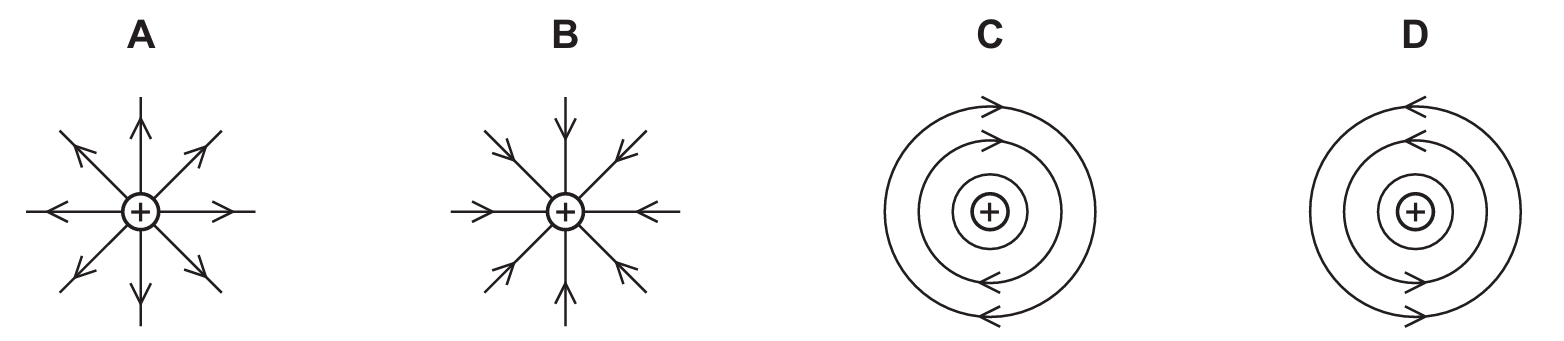
▶️ Answer/Explanation
Detailed solution:
An electric field represents the area where an electric charge exerts a force on other charges. By standard scientific convention, the direction of any electric field line is defined by the direction of the force it would exert on a small, imaginary positive “test” charge. If you bring a positive test charge close to a central positive point charge, the two like charges will repel each other strongly. Because the test charge is pushed straight away, the electric field lines around a positive charge must be drawn as straight lines radiating perfectly outward from the center.

▶️ Answer/Explanation
Detailed solution:
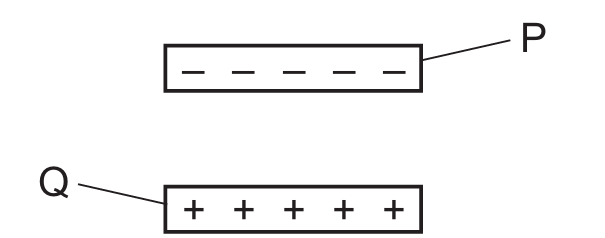
One of the foundational rules of electrostatics is that opposite charges attract each other, while like charges repel. In this scenario, rod P has a negative charge and rod Q has a positive charge, making them opposites. This means there is a mutual attractive force pulling them together. Since rod P is physically located above rod Q, the attraction pulls rod P straight downwards toward Q. Conversely, because rod Q is located below rod P, the attractive force pulls rod Q straight upwards toward P. They pull towards each other, confirming the downward and upward force directions respectively.

▶️ Answer/Explanation
Detailed solution:
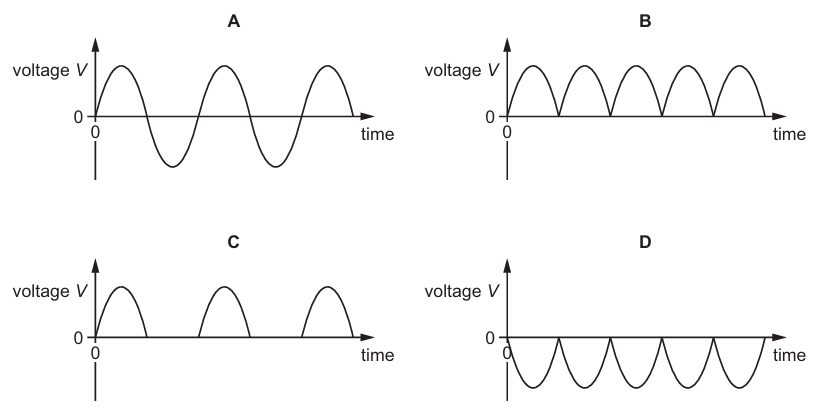
An alternating current (a.c.) power supply naturally produces a voltage that continuously swings back and forth, represented mathematically as a full sine wave oscillating above and below zero. However, this circuit includes a diode in series. A diode is a specialized electrical component designed to allow current to flow in only one specific direction, while completely blocking current from flowing backwards. Therefore, during the half-cycle when the a.c. pushes in the diode’s forward direction, voltage drops across the resistor (creating a positive hump). During the reverse half-cycle, the diode acts like an open switch, blocking the current, meaning zero voltage falls across the resistor. This creates a “half-wave rectified” graph: positive peaks separated by flat lines at zero.

▶️ Answer/Explanation
Detailed solution:
The resistance of any metallic wire is fundamentally governed by its physical dimensions. Specifically, resistance is directly proportional to the length of the wire (a longer wire means electrons have to squeeze through more obstacles) and inversely proportional to its cross-sectional area (a thicker wire gives electrons more room to flow easily). To maximize resistance, you need the wire to be as long and as thin as possible. Looking at our options, the longest length available is 17 cm, and the thinnest diameter available is 0.8 mm. Combining these two properties gives us the wire with the absolute largest resistance.
▶️ Answer/Explanation
Detailed solution:
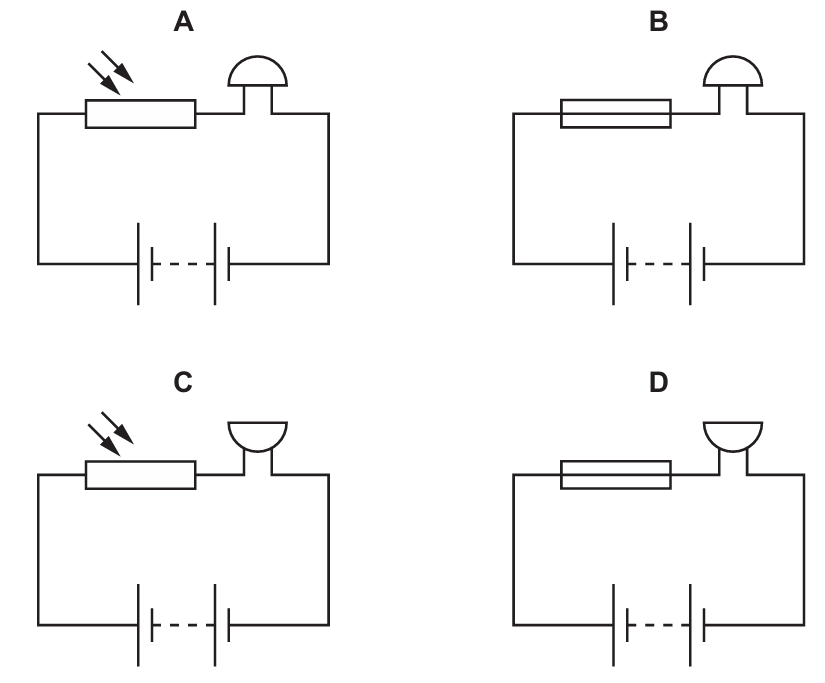
To answer this, we need to carefully match standard electrical symbols to the required components. A “battery” is represented by two or more cells in series (long and short parallel lines). A “fuse” is specifically drawn as a rectangle with the connecting wire running completely straight through its center. A “buzzer” is universally depicted as a semi-circle with two small legs acting as its connection points. Looking at the options provided, only diagram D correctly combines all three of these specific, standardized symbols in one complete series circuit.

▶️ Answer/Explanation
Detailed solution:
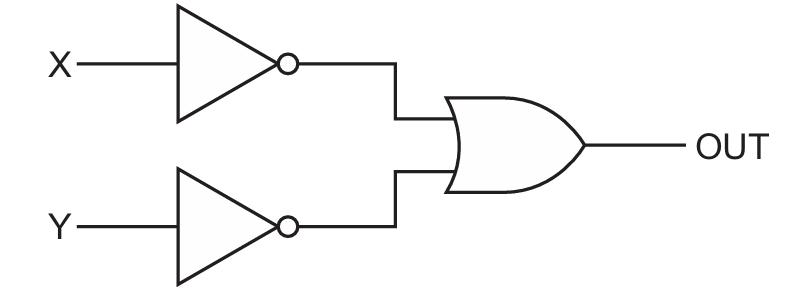
We can solve this logic puzzle by constructing a quick truth table. The network performs the operation (NOT X) OR (NOT Y). If X=1 and Y=1, the NOT gates flip them to 0 and 0. The OR gate sees 0 OR 0, which outputs 0. If X=0 and Y=1, we get 1 OR 0, which outputs 1. If X=1 and Y=0, we get 0 OR 1, outputting 1. If X=0 and Y=0, we get 1 OR 1, outputting 1. The final output is 1 for all cases except when both inputs are 1. This exact behavior perfectly matches a NAND gate (NOT AND). The symbol for a NAND gate is an AND gate with a tiny inversion circle on the output, which is Option D.


▶️ Answer/Explanation
Detailed solution:
A transformer relies entirely on electromagnetic induction to transfer power. For the primary coil to generate a magnetic field and carry electricity efficiently, it must be made of an excellent electrical conductor; copper is the standard choice because plastic is an insulator and won’t work. For the core, its sole job is to efficiently link the magnetic field from the primary to the secondary coil. It needs to magnetize and demagnetize incredibly easily as the alternating current constantly flips. Soft iron is the perfect magnetic material for this because it is easily magnetized and demagnetized, whereas steel is a hard magnetic material and retains its magnetism, making it terribly inefficient for a transformer core.
▶️ Answer/Explanation
Detailed solution:
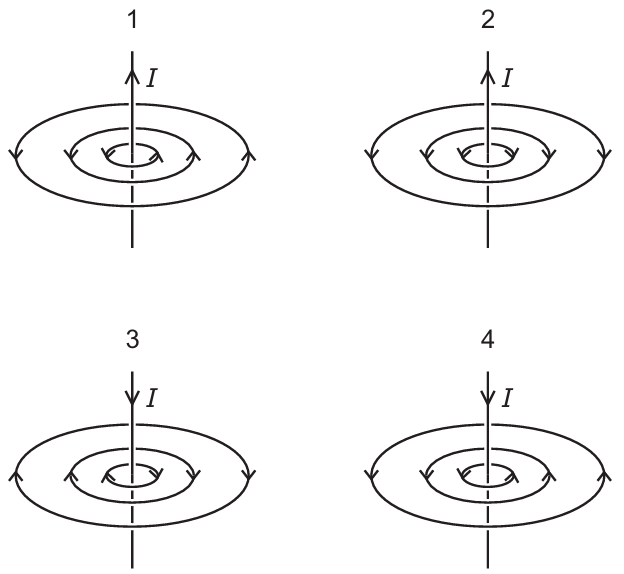
To determine the direction of the magnetic field around a straight current-carrying wire, we use the Right-Hand Grip Rule. Imagine gripping the wire with your right hand so that your thumb points in the direction of the conventional current. Your fingers will naturally curl around the wire in the exact direction of the magnetic field lines. In Diagram 1, pointing your thumb up makes your fingers curl anticlockwise, so it’s correct. Diagram 2 is wrong. In Diagram 3, pointing your thumb downwards makes your fingers curl clockwise, so it is also correct. Diagram 4 is wrong. Therefore, diagrams 1 and 3 correctly map the magnetic fields.

▶️ Answer/Explanation
Detailed solution:
This question references the famous Geiger-Marsden experiment, also heavily known as Rutherford’s gold foil experiment. In this historic setup, a beam of heavy, positively charged alpha-particles ($\alpha$-particles) was fired at a tremendously thin sheet of gold foil. The astonishing observation was that while most alpha particles sailed straight through uninterrupted, a tiny fraction were deflected at massive angles, and some even bounced straight back. Rutherford deduced that this scattering could only happen if almost all of the atom’s mass and positive charge were intensely concentrated in an incredibly small, dense center. Thus, the experiment used alpha-particles and definitively concluded that atoms have a very small, dense nucleus.

▶️ Answer/Explanation
Detailed solution:
The half-life of a radioactive isotope is strictly defined as the exact amount of time it takes for the measured count rate to fall to half of its initial value. By looking at the graph, we can trace the starting point at $t = 0\text{ s}$, where the count rate is at 60 counts/s. Half of 60 is exactly 30. If we trace a horizontal line across from 30 on the y-axis over to the curve, and then drop down to the x-axis, we hit exactly $t = 2.0\text{ s}$. To double-check our work, dropping from 30 to half its value (15) takes another 2.0 seconds (reaching $t = 4.0\text{ s}$). Thus, the half-life is definitively 2.0 seconds.