Question 1
Most-appropriate topic codes (Cambridge IGCSE Physics 0625):
▶️ Answer/Explanation
Detailed solution:
Timing a single swing introduces a large human reaction time error relative to the very short period.
By measuring the time for 100 swings, this error is distributed across many oscillations, significantly reducing its impact on the calculated period.
This method directly applies the syllabus technique of measuring multiples to determine a more accurate average for a small time interval.
Options A and D still leave a single period measurement susceptible to start/stop error, while Option C introduces a larger relative error by halving an already short interval.
Therefore, measuring multiple oscillations provides the greatest improvement in accuracy.
Question 2
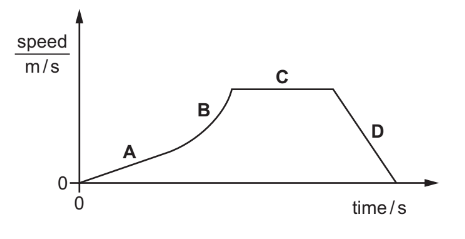
Which section of the graph represents a period when the car is decelerating?

Most-appropriate topic codes (Cambridge IGCSE Physics 0625):
▶️ Answer/Explanation
Detailed solution:
Deceleration means the speed of the car is decreasing over time.
On a speed-time graph, this is shown by a line sloping downwards from left to right (negative gradient).
Looking at the graph, Section D is the only section where the speed value drops as time progresses.
Sections A and C show increasing speed (acceleration), and Section B shows constant speed.
Therefore, Section D correctly represents the period of deceleration.
Question 3
Most-appropriate topic codes (Cambridge IGCSE Physics 0625):
▶️ Answer/Explanation
Detailed solution:
Weight is related to mass by the equation \(W = mg\), where \(g\) is the gravitational field strength.
Rearranging gives mass \(m = \frac{W}{g} = \frac{19 \mathrm{~N}}{3.8 \mathrm{~m/s^2}}\).
Calculating this yields \(m = 5.0 \mathrm{~kg}\).
This matches Option C.
Question 4

Most-appropriate topic codes (Cambridge IGCSE Physics 0625):
▶️ Answer/Explanation
Detailed solution:
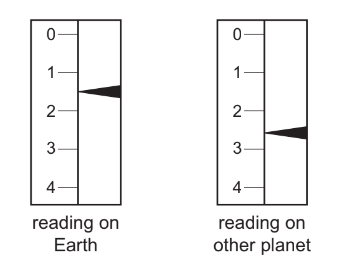
Mass is the quantity of matter in an object and remains constant regardless of location.
Weight is the gravitational force on the object, given by $W = mg$, so it changes with the gravitational field strength $g$.
The spring balance measures weight, so a higher reading on the other planet indicates a greater weight.
This is possible only if the other planet has a stronger gravitational field than Earth.
Therefore, the weight increases while the mass stays the same, making Option D correct.
Question 5
She determines the density of the cooking oil.
Which apparatus does she need?

Most-appropriate topic codes (Cambridge IGCSE Physics 0625):
▶️ Answer/Explanation
Detailed solution:
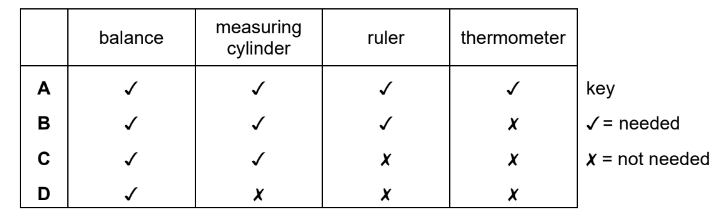
To find the density of a liquid, mass must be measured using a balance and volume using a measuring cylinder.
The ruler is not needed for a liquid, and the stopwatch is used for timing events, not density.
Option C includes both the balance and measuring cylinder, the only apparatus required.
Using the density formula $\rho = \frac{m}{V}$, the mass and volume obtained give the density.
Therefore, the correct apparatus set is shown in Option C.
Question 6
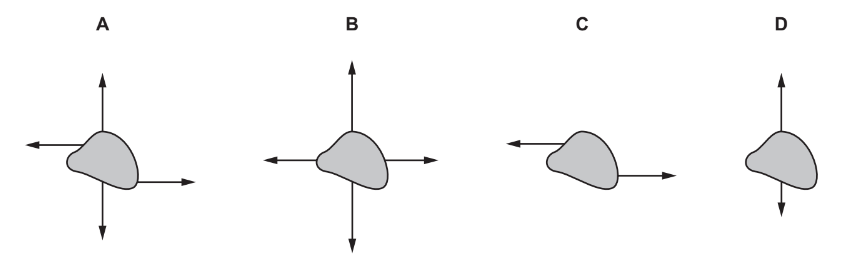
The length of each arrow indicates the magnitude of the force.
Which object is in equilibrium?

Most-appropriate topic codes (Cambridge IGCSE Physics 0625):
▶️ Answer/Explanation
Detailed solution:
An object is in equilibrium when there is no resultant force and no resultant moment acting on it.
In option B, the two horizontal forces are equal in length and opposite in direction, cancelling each other out, and the vertical forces also cancel.
In the other options, the opposing forces are not equal, resulting in a net force that would cause acceleration.
Therefore, only object B satisfies the condition for equilibrium as stated in the syllabus.
Question 7
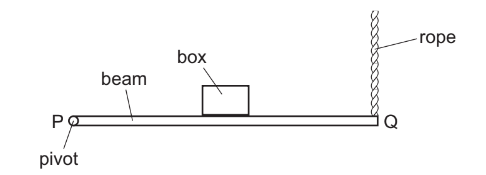
A box has been placed on the beam.

Most-appropriate topic codes (Cambridge IGCSE Physics 0625):
▶️ Answer/Explanation
Detailed solution:
Taking moments about the pivot P, the clockwise moment (box weight × distance) must equal the anticlockwise moment (tension × distance PQ).
Reducing the mass of the box decreases its weight, directly reducing the clockwise moment.
Moving the box towards P decreases the perpendicular distance from the pivot, further reducing this moment.
Both changes lower the required opposing moment, therefore the tension in the rope at Q must decrease.
This matches Option A.
Question 8
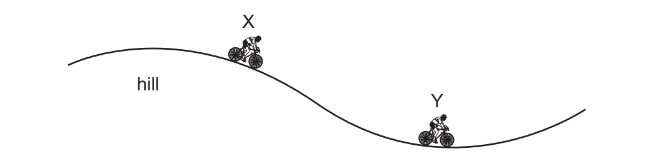
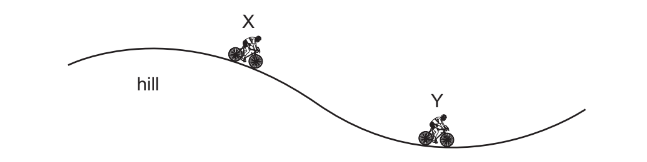
The cyclist applies his brakes and the cycle stops at point Y.

Most-appropriate topic codes (Cambridge IGCSE Physics 0625):
▶️ Answer/Explanation
Detailed solution:
At point X, the cyclist has gravitational potential energy due to his height.
As he moves down the hill, this energy is transferred into kinetic energy (movement).
When the brakes are applied, friction converts the kinetic energy into internal (thermal) energy, causing the cycle to stop at Y.
Therefore, the sequence is gravitational potential → kinetic → internal (thermal).
Question 9
Most-appropriate topic codes (Cambridge IGCSE Physics 0625):
▶️ Answer/Explanation
Detailed solution:
Non-renewable energy resources exist in finite amounts and cannot be replenished at the rate of consumption.
Geothermal, solar, and wind energy are all renewable because they are naturally replenished on a human timescale.
Natural gas is a fossil fuel formed over millions of years and is therefore a non-renewable resource.
Consequently, among the given choices, only natural gas is classified as non-renewable.
Question 10
What is the power of the pump?
Most-appropriate topic codes (Cambridge IGCSE Physics 0625):
▶️ Answer/Explanation
Detailed solution:
Power is the rate of doing work: $P = \frac{W}{t}$.
Convert time to seconds: $t = 7 \times 60 = 420\text{ s}$.
Substitute the values: $P = \frac{460000\text{ J}}{420\text{ s}} \approx 1095\text{ W}$.
Convert to kilowatts: $1095\text{ W} = 1.1\text{ kW}$.
This matches Option A.
Question 11
Most-appropriate topic codes (Cambridge IGCSE Physics 0625):
▶️ Answer/Explanation
Detailed solution:
Pressure in a liquid is caused by the force exerted by the molecules of the liquid due to their weight. As the diver descends, the column of water directly above them becomes taller, meaning there is a greater total weight of water pressing down per unit area. Density and gravitational field strength are assumed constant in this context. Therefore, the pressure increases solely because the weight of the water above increases.
Question 12
Most-appropriate topic codes (Cambridge IGCSE Physics 0625):
▶️ Answer/Explanation
Detailed solution:
Gases are easily compressed because the particles are widely spaced with large distances between them.
Applying pressure simply pushes these particles closer together, significantly reducing the volume of the gas.
In contrast, liquids and solids have particles that are already close together, making them difficult to compress.
The volume of the individual particles themselves does not change.
This corresponds directly to the particle model described in the syllabus.
Question 13
What is the melting point of mercury in kelvin?
Most-appropriate topic codes (Cambridge IGCSE Physics 0625):
▶️ Answer/Explanation
Detailed solution:
To convert a temperature from degrees Celsius to kelvin, add 273 to the Celsius temperature.
Calculation: \( T(\mathrm{K}) = \theta (\mathrm{^\circ C}) + 273 = -39 + 273 = 234 \mathrm{~K} \).
This is because the kelvin scale is an absolute scale where \(0 \mathrm{~K}\) is absolute zero, equivalent to \(-273^{\circ} \mathrm{C}\).
Therefore, the melting point of mercury is \(234 \mathrm{~K}\).
This matches Option C.
Question 14

Most-appropriate topic codes (Cambridge IGCSE Physics 0625):
▶️ Answer/Explanation
Detailed solution:
When heated, the bimetallic strip bends into a curve with metal P on the outside of the curve.
This indicates that metal P has become longer than metal Q at the same temperature increase.
Therefore, metal P has a greater thermal expansion, expanding more than metal Q.
Since the strip bends towards the side that expands less (metal Q), option C is the correct statement.
Question 15

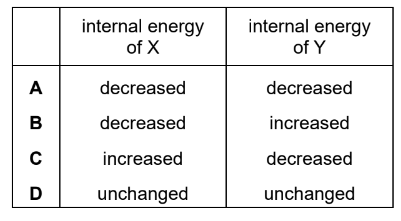
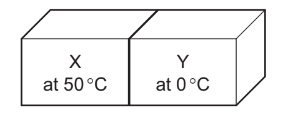
What has happened to the internal energy of each block?

Most-appropriate topic codes (Cambridge IGCSE Physics 0625):
▶️ Answer/Explanation
Detailed solution:
Block X cools from \(50^{\circ}\mathrm{C}\) to \(25^{\circ}\mathrm{C}\), so its particles lose kinetic energy and its internal energy decreases.
Block Y warms from \(0^{\circ}\mathrm{C}\) to \(25^{\circ}\mathrm{C}\), so its particles gain kinetic energy and its internal energy increases.
Energy is transferred thermally from the hotter block to the colder block until thermal equilibrium is reached.
Therefore, the internal energy of X decreases and the internal energy of Y increases.
This matches Option B.
Question 16


Most-appropriate topic codes (Cambridge IGCSE Physics 0625):
▶️ Answer/Explanation
Detailed solution:
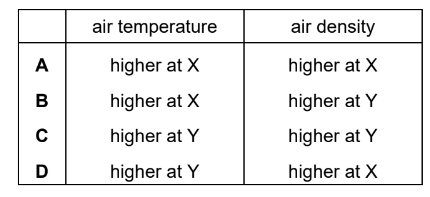
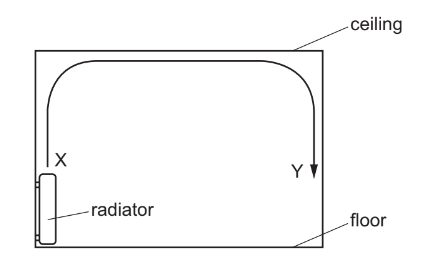
Air heated by the radiator at X expands, becomes less dense, and rises to the ceiling.
As the air cools near the window at Y, it contracts, becomes more dense, and sinks towards the floor.
Therefore, the temperature at X is higher than at Y, and the density at X is lower than at Y.
This correctly matches the conditions described in row B.
Question 17
Which statements about waves are correct?
- Only longitudinal waves can undergo diffraction.
- All waves can undergo refraction.
- All waves can undergo reflection.
Most-appropriate topic codes (Cambridge IGCSE Physics 0625):
▶️ Answer/Explanation
Detailed solution:
Statement 1 is incorrect: both transverse and longitudinal waves undergo diffraction.
Statement 2 is correct: all waves change speed and direction when entering a new medium.
Statement 3 is correct: all waves bounce off surfaces according to the law of reflection.
Therefore, only statements 2 and 3 are correct.
This matches Option D.
Question 18
Most-appropriate topic codes (Cambridge IGCSE Physics 0625):
▶️ Answer/Explanation
Detailed solution:
Amplitude is the maximum displacement from the rest position, measured in metres. Wavelength is the distance between two consecutive identical points (e.g., crest to crest), also measured in metres. Frequency is measured in Hertz (Hz), and wave speed is measured in metres per second (m/s). Therefore, only amplitude and wavelength both have the SI unit of metres.
Question 19

Most-appropriate topic codes (Cambridge IGCSE Physics 0625):
▶️ Answer/Explanation
Detailed solution:
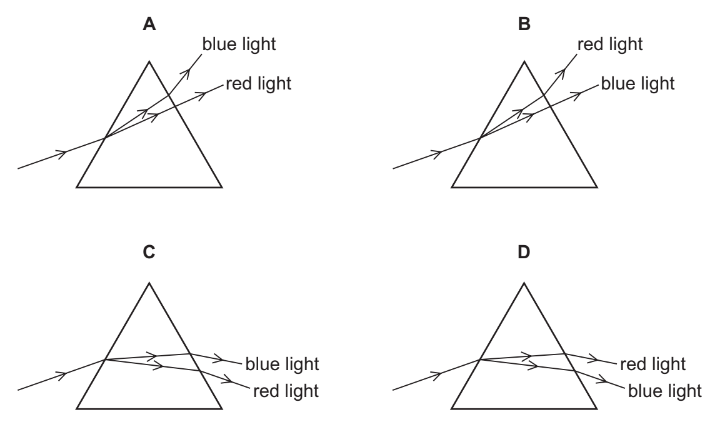
When white light enters a glass prism, it refracts and disperses into its constituent colours.
Violet light has the highest frequency and is refracted the most; red light has the lowest frequency and is refracted the least.
Diagram D correctly shows the incident white light entering, the spectrum spreading inside the prism with violet deviating more than red, and the colours continuing to separate upon exiting.
The order of colours (red to violet) and the direction of deviation must match this physical principle.
Question 20


Most-appropriate topic codes (Cambridge IGCSE Physics 0625):
▶️ Answer/Explanation
Detailed solution:
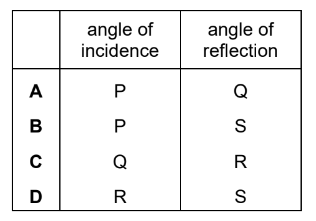
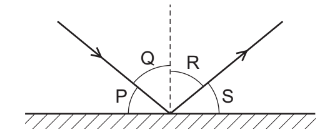
The angle of incidence is the angle between the incident ray and the normal (the line perpendicular to the mirror surface).
The angle of reflection is the angle between the reflected ray and the normal.
According to the law of reflection, the angle of incidence is always equal to the angle of reflection.
In the diagram, the normal is represented by the dashed line; the angle on either side of it is $35^\circ$.
Therefore, both the angle of incidence and the angle of reflection are $35^\circ$, which corresponds to Row C.
Question 21
Which statement about the real image is always correct?
Most-appropriate topic codes (Cambridge IGCSE Physics 0625):
▶️ Answer/Explanation
Detailed solution:
For a converging lens, a real image is formed when rays of light physically converge on the opposite side of the lens from the object.
Real images are always inverted and can be magnified, diminished, or the same size depending on the object distance.
Unlike virtual images (which are upright and on the same side), real images always appear inverted and on the opposite side.
Therefore, the only statement that is always correct for any real image is that it is on the opposite side of the lens to the object.
This matches Option B.
Question 22
Most-appropriate topic codes (Cambridge IGCSE Physics 0625):
▶️ Answer/Explanation
Detailed solution:
All types of electromagnetic waves (radio, microwaves, visible light, X-rays, etc.) travel at approximately $3.0 \times 10^8\text{ m/s}$ in a vacuum.
When these waves enter a medium like air, glass, or water, they slow down and different frequencies may travel at slightly different speeds, causing dispersion.
Therefore, a vacuum is the only location where all electromagnetic waves travel at exactly the same speed.
This matches Option B.
Question 23
Most-appropriate topic codes (Cambridge IGCSE Physics 0625):
▶️ Answer/Explanation
Detailed solution:
The human audible range is approximately \(20 \mathrm{~Hz}\) to \(20 \mathrm{~kHz}\).
Dogs can hear up to \(45 \mathrm{~kHz}\), which is well above the upper limit of human hearing.
Therefore, sounds between \(20 \mathrm{~kHz}\) and \(45 \mathrm{~kHz}\) are audible to dogs but silent to humans.
This makes statement D correct, as these are high-frequency sounds beyond human perception.
Question 24

Most-appropriate topic codes (Cambridge IGCSE Physics 0625):
▶️ Answer/Explanation
Detailed solution:
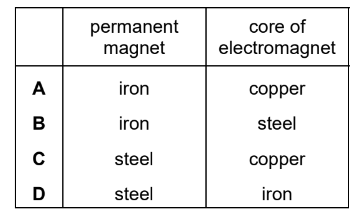
Permanent magnets require a material that retains its magnetism, such as hard magnetic steel.
The core of an electromagnet must be easily magnetized and demagnetized, making soft iron the ideal choice.
Therefore, steel is used for the permanent magnet and soft iron is used for the electromagnet core.
This combination of materials corresponds to Row D in the table.
Question 25
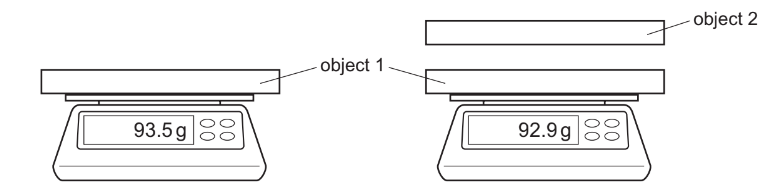
Object 2, which is also charged, is brought close to object 1 and the reading on the balance changes as shown.

Most-appropriate topic codes (Cambridge IGCSE Physics 0625):
▶️ Answer/Explanation
Detailed solution:
The decreased reading indicates an upward electrostatic attraction, so Object 2 must be positive. To increase this attraction, Object 2 needs a larger positive charge and/or Object 1 needs a larger negative charge. Transferring electrons (negative charge) from Object 2 to Object 1 makes Object 2 more positive and Object 1 more negative, strengthening the attraction and further decreasing the balance reading. This matches Option D.
Question 26
Which statement about a voltmeter is correct?
A. It has a scale which is marked in amperes (A).
B. It must be connected in series in a circuit.
C. It measures potential difference (p.d.).
D. It must have three terminals.
Most-appropriate topic codes (Cambridge IGCSE Physics 0625):
▶️ Answer/Explanation
Detailed solution:
A voltmeter is an instrument used to measure the potential difference (p.d.) between two points in a circuit.
It is marked in volts (V), not amperes (A), and must be connected in parallel, not series.
While some voltmeters may have multiple terminals, it is not a mandatory requirement for all voltmeters.
Therefore, the only universally correct statement is that it measures potential difference.
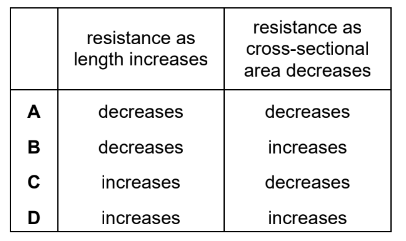
Question 27
- as its length increases
- as its cross-sectional area decreases?

Most-appropriate topic codes (Cambridge IGCSE Physics 0625):
▶️ Answer/Explanation
Detailed solution:
For a metallic wire at constant temperature, resistance is directly proportional to its length, so increasing length increases resistance.
Resistance is also inversely proportional to its cross-sectional area, so decreasing the area also increases resistance.
Therefore, both changes described result in an increase in the overall resistance of the wire.
This corresponds to Option A in the table provided.
Question 28

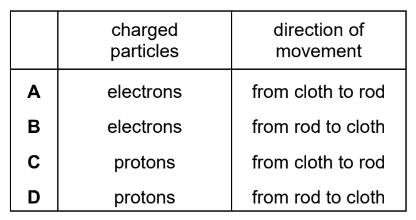
Most-appropriate topic codes (Cambridge IGCSE Physics 0625):
▶️ Answer/Explanation
Detailed solution:
When a plastic rod is rubbed with a cloth, electrons (which are negatively charged) are transferred from the rod to the cloth.
The loss of electrons leaves the rod with an overall positive charge.
This aligns with the principle that only negative charge (electrons) moves during charging by friction.
Therefore, the charged particles are electrons, and they move from the rod to the cloth.
This matches Option B in the table.
Question 29
Most-appropriate topic codes (Cambridge IGCSE Physics 0625):
▶️ Answer/Explanation
Detailed solution:
For two identical resistors \(R\) in parallel, the combined resistance is given by \(R_{\text{total}} = \frac{R}{n}\), where \(n\) is the number of resistors.
Here, \(R = 2.0 \, \Omega\) and \(n = 2\), so \(R_{\text{total}} = \frac{2.0}{2} = 1.0 \, \Omega\).
The combined resistance in a parallel circuit is always less than the smallest individual resistance.
Since \(1.0 \, \Omega\) is less than \(2.0 \, \Omega\), the correct choice is Option A.
Question 30
The current in the heater is \(10 \mathrm{~A}\).
The cable attached to the heater is rated at \(15 \mathrm{~A}\).
The fuses available are rated at \(1.0 \mathrm{~A}, 3.0 \mathrm{~A}, 5.0 \mathrm{~A}\) and \(13 \mathrm{~A}\).
Which fuse should be used?
Most-appropriate topic codes (Cambridge IGCSE Physics 0625):
▶️ Answer/Explanation
Detailed solution:
The fuse rating must be slightly higher than the normal operating current of \(10\text{ A}\) to prevent unnecessary blowing.
It must also be lower than the cable’s maximum rating of \(15\text{ A}\) to ensure the cable is protected from overheating.
From the available options, the \(13\text{ A}\) fuse is the only one that satisfies both of these safety conditions.
A lower rating (e.g., \(5\text{ A}\)) would blow immediately under normal use.
Therefore, the \(13\text{ A}\) fuse is the correct and safe choice.
Question 31

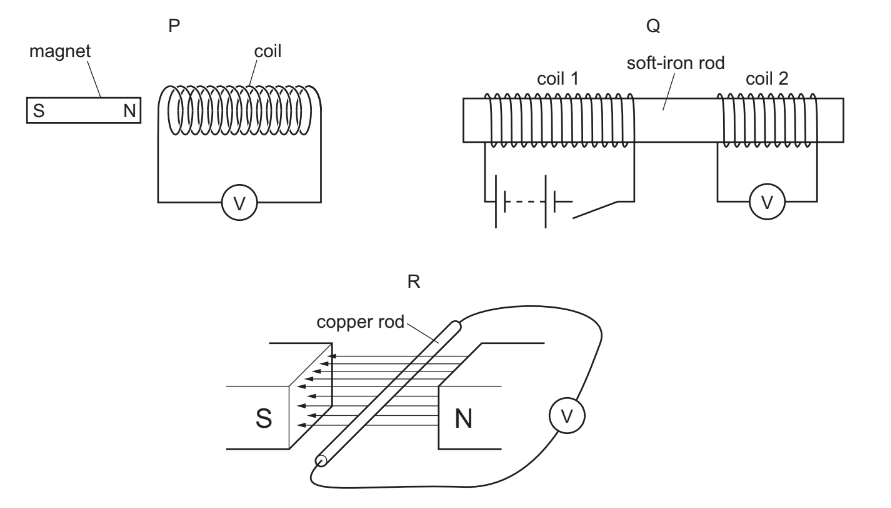
In demonstration \(Q\), the switch is closed.
In demonstration R, the copper rod is moved vertically upwards.
Most-appropriate topic codes (Cambridge IGCSE Physics 0625):
▶️ Answer/Explanation
Detailed solution:
Electromagnetic induction occurs when there is relative motion between a conductor and a magnetic field or a changing magnetic field linking a circuit.
In P, moving the magnet changes the field linking the coil, inducing an e.m.f.
In Q, closing the switch changes the current in the left coil, creating a changing magnetic field that links the right coil.
In R, moving the rod vertically upwards in the magnetic field cuts field lines, inducing an e.m.f. across the rod.
Question 32

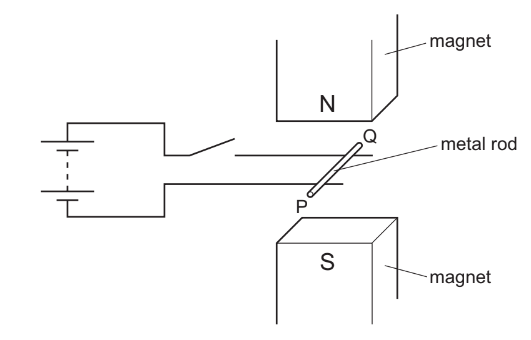
What could be changed so that the rod moves to the left?
Most-appropriate topic codes (Cambridge IGCSE Physics 0625):
▶️ Answer/Explanation
Detailed solution:
The direction of the force on a current-carrying conductor in a magnetic field can be determined using Fleming’s left-hand rule.
Reversing the battery terminals reverses the direction of the current through the rod.
If the direction of the magnetic field remains unchanged, reversing the current will reverse the direction of the force, causing the rod to move to the left.
Opening the switch stops the current and the force; exchanging both the current and magnetic field directions results in no change to the force direction.
Turning the rod around does not change the direction of current relative to the magnetic field.
Question 33
A transformer in a computer is used to transform the mains voltage of \(240 \mathrm{~V}\) to \(12 \mathrm{~V}\).
The number of turns on the secondary coil is 2000 .
Which statement about the transformer is correct?
A. It is a step-down transformer and has 100 turns on its primary coil.
B. It is a step-down transformer and has 40000 turns on its primary coil.
C. It is a step-up transformer and has 100 turns on its primary coil.
D. It is a step-up transformer and has 40000 turns on its primary coil.
Most-appropriate topic codes (Cambridge IGCSE Physics 0625):
▶️ Answer/Explanation
Detailed solution:
The transformer steps \(240 \mathrm{~V}\) down to \(12 \mathrm{~V}\), so it is a step-down transformer.
Using \( \frac{V_{\mathrm{p}}}{V_{\mathrm{s}}} = \frac{N_{\mathrm{p}}}{N_{\mathrm{s}}} \), we have \( \frac{240}{12} = \frac{N_{\mathrm{p}}}{2000} \).
Solving gives \(N_{\mathrm{p}} = 20 \times 2000 = 40000\) turns.
Therefore, the primary coil has 40000 turns, matching option B.
Question 34
Atom \(Q\) has 6 electrons, 6 protons and 7 neutrons.
Which statement is correct?
Most-appropriate topic codes (Cambridge IGCSE Physics 0625):
▶️ Answer/Explanation
Detailed solution:
Nucleon number (mass number) is the total number of protons and neutrons in the nucleus.
For atom \(Q\), there are 6 protons and 7 neutrons, so the nucleon number is \(6 + 7 = 13\).
Atom \(P\) has an atomic number of 6 (equal to the number of protons), not 12.
Atoms \(P\) and \(Q\) are isotopes of the same element because they have the same number of protons.
Therefore, only statement C is correct.
Question 35
\(\alpha\)-particles, \(\beta\)-particles and \(\gamma\)-rays are emitted by radioactive nuclei when they decay.
Which emissions can be deflected by an electric field?
Most-appropriate topic codes (Cambridge IGCSE Physics 0625):
▶️ Answer/Explanation
Detailed solution:
\(\alpha\)-particles have a positive charge \((+2)\) and \(\beta\)-particles have a negative charge \((-1)\), so both experience a force in an electric field.
\(\gamma\)-rays are electromagnetic waves with no charge and therefore travel in a straight line without deflection.
As a result, only \(\alpha\) and \(\beta\) emissions are deflected by the electric field.
This matches Option B.
Question 36

Most-appropriate topic codes (Cambridge IGCSE Physics 0625):
▶️ Answer/Explanation
Detailed solution:
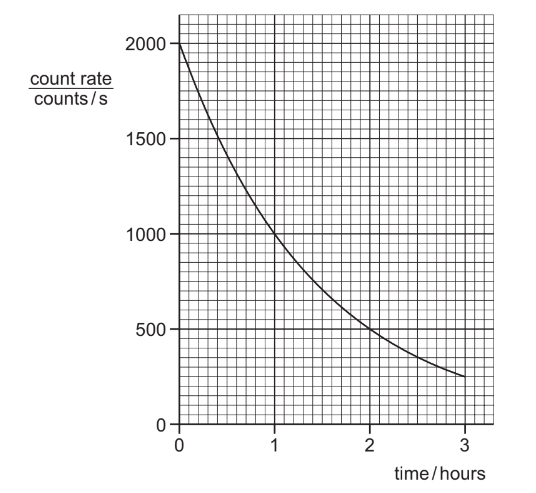
Locate the initial count rate on the graph, which is $100$ counts/minute at time $t = 0$.
Find the time taken for the count rate to decrease by half, from $100$ counts/minute to $50$ counts/minute.
From the graph, the curve passes through $50$ counts/minute at exactly $t = 1.0$ hour.
Therefore, the half-life of the radioactive source is $1.0$ hour.
This matches Option B.
Question 37
A scientist carries out an experiment using a sealed source which emits \(\beta\)-particles. The range of the \(\beta\)-particles in the air is about \(30 \mathrm{~cm}\).
Which precaution is the most effective to protect the scientist from the radiation?
Most-appropriate topic codes (Cambridge IGCSE Physics 0625):
▶️ Answer/Explanation
Detailed solution:
The \(\beta\)-particles travel only about \(30 \mathrm{~cm}\) in air, so increasing the distance beyond this range prevents them from reaching the scientist.
Using long tongs keeps the source far enough away from the body to avoid exposure.
Reducing time and increasing distance are key safety principles; shielding is less critical here since air provides sufficient attenuation over \(30 \mathrm{~cm}\).
Temperature, ventilation, and hand washing do not effectively protect against direct external radiation from a sealed source.
Therefore, handling the source with long tongs is the most effective precaution.
Question 38
Most-appropriate topic codes (Cambridge IGCSE Physics 0625):
▶️ Answer/Explanation
Detailed solution:
Recall the correct sequence of the eight planets in order from the Sun: Mercury, Venus, Earth, Mars, Jupiter, Saturn, Uranus, and Neptune.
By identifying the positions of Mars and Saturn in this sequence, the planet located directly between them is Jupiter.
The other options are incorrect because Earth and Mercury are located before Mars, while Neptune is located after Saturn.
This confirms that Option B is the correct answer.
Question 39
Most-appropriate topic codes (Cambridge IGCSE Physics 0625):
▶️ Answer/Explanation
Detailed solution:
The Sun is classified as a medium-sized (main sequence) star, not a dwarf or giant.
It is composed primarily of hydrogen (about 74%) and helium (about 24%), with trace amounts of other elements.
Nuclear fusion in the Sun’s core converts hydrogen into helium, releasing vast amounts of energy.
Options A, B, and D incorrectly state the star’s size classification and/or its primary elemental composition.
This matches the syllabus statement for Topic 6.2.1.
Question 40
Most-appropriate topic codes (Cambridge IGCSE Physics 0625):
▶️ Answer/Explanation
Detailed solution:
A light-year is defined as the distance travelled by light in a vacuum during one year.
It is a unit of astronomical distance used to measure the vast spaces between stars and galaxies.
Since it quantifies how far light travels over a specific time, it measures distance, not time, speed, or angle.
Therefore, Option B is the correct choice.