Question 1
Which is a vector quantity?
Most-appropriate topic codes (Cambridge IGCSE Physics 0625):
▶️ Answer/Explanation
Detailed solution:
Vector quantities have both magnitude and direction, whereas scalar quantities have only magnitude. Density, mass, and pressure are all scalar quantities.
Weight is a gravitational force that acts downwards towards the center of the Earth, giving it both magnitude and direction.
Therefore, weight is the only vector quantity listed among the options.
This matches Option D.
Question 2
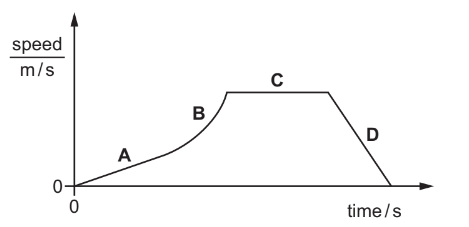
Which section of the graph represents a period when the car is decelerating?

Most-appropriate topic codes (Cambridge IGCSE Physics 0625):
▶️ Answer/Explanation
Detailed solution:
Deceleration means a decrease in speed over time, shown by a downward slope on a speed-time graph.
In section D, the graph line slopes downwards, indicating the car is slowing down.
Sections A and C show constant speed (horizontal line), while section B shows acceleration (upward slope).
Therefore, only section D correctly represents a period of deceleration.
Question 3

Most-appropriate topic codes (Cambridge IGCSE Physics 0625):
▶️ Answer/Explanation
Detailed solution:
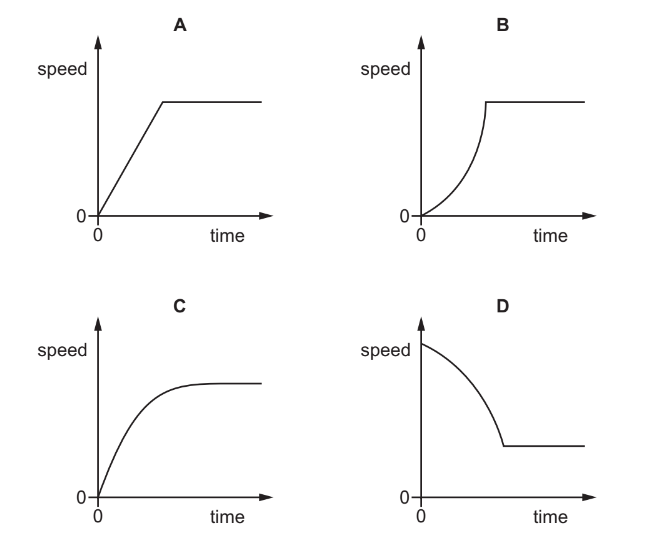
The object starts from rest, so its speed increases from zero.
As it accelerates, air resistance increases, reducing the net force and thus the acceleration.
The graph shows the gradient (acceleration) decreasing until the speed becomes constant.
Terminal velocity is reached when the speed curve flattens into a horizontal line.
Only graph C correctly shows this gradual decrease in acceleration followed by a constant maximum speed.
Question 4


Most-appropriate topic codes (Cambridge IGCSE Physics 0625):
▶️ Answer/Explanation
Detailed solution:
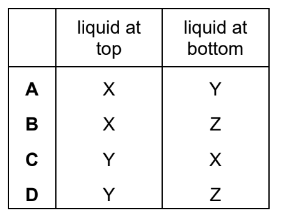
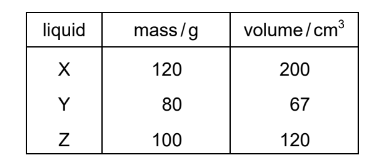
Calculate density ($\rho = m/V$) for each liquid: X = $100/86 \approx 1.16\text{ g/cm}^3$, Y = $115/101 \approx 1.14\text{ g/cm}^3$, Z = $109/100 = 1.09\text{ g/cm}^3$.
The liquid with the lowest density (Z) floats to the top, and the liquid with the highest density (X) sinks to the bottom.
Comparing the densities, the order from top to bottom is Z, Y, then X.
This matches the arrangement shown in Option A.
Question 5
Most-appropriate topic codes (Cambridge IGCSE Physics 0625):
▶️ Answer/Explanation
Detailed solution:
According to Newton’s first law, a resultant force causes a change in velocity (speed or direction).
Options A, C, and D describe objects moving with constant speed in a straight line, meaning zero resultant force.
In Option B, the aircraft is moving in a circular path, so its direction is constantly changing.
This change in direction means the velocity is changing, requiring a centripetal resultant force acting on the aircraft.
Question 6
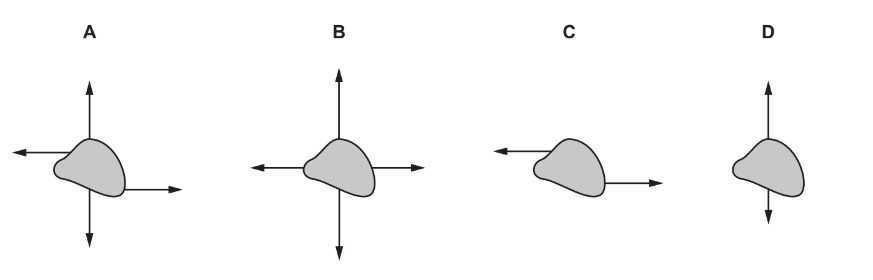
The length of each arrow indicates the magnitude of the force.
Which object is in equilibrium?

Most-appropriate topic codes (Cambridge IGCSE Physics 0625):
▶️ Answer/Explanation
Detailed solution:
An object is in equilibrium when there is no resultant force acting on it.
In option B, the two horizontal forces are equal in magnitude and opposite in direction, canceling each other out.
The vertical forces are also equal in magnitude and opposite in direction, resulting in a net force of zero.
In all other options, the opposing forces are not balanced, leading to a resultant force.
Therefore, only object B satisfies the condition for equilibrium.
Question 7
The mass of each sphere is \(0.15 \mathrm{~kg}\).
Sphere \(X\) is travelling at a velocity of \(2.0 \mathrm{~m} / \mathrm{s}\) before the collision and produces an impulse of \(0.21 \mathrm{Ns}\) on sphere \(\mathrm{Y}\).
Most-appropriate topic codes (Cambridge IGCSE Physics 0625):
▶️ Answer/Explanation
Detailed solution:
The impulse on \(Y\) is equal and opposite to the impulse on \(X\): impulse on \(X = -0.21\text{ N s}\).
Using impulse = change in momentum: \(-0.21 = (0.15 \times v) – (0.15 \times 2.0)\).
Solving gives \(v = 0.60\text{ m/s}\) in the same direction as \(Y\) (positive value).
Therefore, sphere \(X\) continues forward with a reduced speed.
This matches Option B.
Question 8
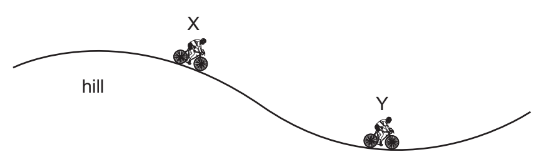
The cyclist applies his brakes and the cycle stops at point \(\mathrm{Y}\).

Most-appropriate topic codes (Cambridge IGCSE Physics 0625):
▶️ Answer/Explanation
Detailed solution:
At point \(X\), the cyclist has gravitational potential energy due to his height.
As he moves down the hill, this energy is transferred to kinetic energy, increasing his speed.
When the brakes are applied, friction converts the kinetic energy into internal (thermal) energy, heating the brake pads and rims.
Therefore, the sequence of energy transfers is gravitational potential \(\rightarrow\) kinetic \(\rightarrow\) internal (thermal).
This sequence is described in Option A.
Question 9

Most-appropriate topic codes (Cambridge IGCSE Physics 0625):
▶️ Answer/Explanation
Detailed solution:
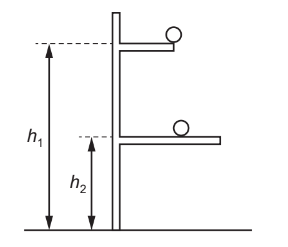
The change in gravitational potential energy depends on the vertical height lost by the object.
The formula for gravitational potential energy change is \(\Delta E_{\mathrm{p}} = mg\Delta h\), where \(\Delta h\) is the change in height.
Here, the object falls from height \(h_1\) to height \(h_2\), so the change in height is \(h_1 – h_2\).
Substituting this into the formula gives the energy lost as \(mg(h_1 – h_2)\).
This corresponds to Option D.
Question 10
What is the power of the pump?
Most-appropriate topic codes (Cambridge IGCSE Physics 0625):
▶️ Answer/Explanation
Detailed solution:
Convert time to seconds: \(t = 7 \times 60 = 420 \mathrm{~s}\).
Use the power equation: \(P = \frac{W}{t} = \frac{460000}{420} \approx 1095 \mathrm{~W}\).
Convert watts to kilowatts by dividing by 1000: \(P \approx 1.1 \mathrm{~kW}\).
This value matches option A.
Question 11
The water in a swimming pool exerts a pressure at the bottom of the pool.
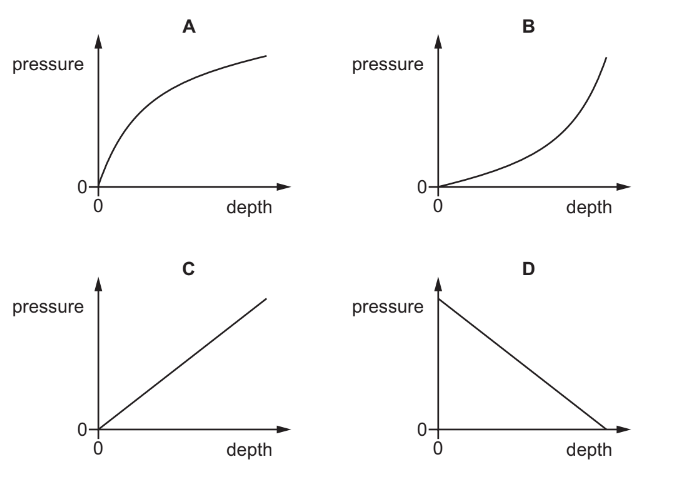
Which graph shows the relationship between the pressure exerted by the water and the depth of water in the pool?
(Assume the density of water is constant.)

Most-appropriate topic codes (Cambridge IGCSE Physics 0625):
▶️ Answer/Explanation
Detailed solution:
The pressure due to a liquid is given by the equation $p = \rho g h$, where $\rho$ and $g$ are constant for this scenario.
This shows that pressure ($p$) is directly proportional to the depth ($h$).
A directly proportional relationship is represented graphically by a straight line passing through the origin.
As the depth increases, the pressure increases linearly from zero at the surface.
Therefore, the correct representation of this relationship is a straight line through the origin, which matches graph C.
Question 12
Most-appropriate topic codes (Cambridge IGCSE Physics 0625):
▶️ Answer/Explanation
Detailed solution:
In the kinetic particle model, gas particles have large spaces between them relative to their size.
This means they are not tightly packed like in solids or liquids.
When pressure is applied, these particles can be pushed closer together, significantly reducing the volume.
The individual volume of the particles themselves does not change; it is the empty space that is reduced.
Therefore, option A correctly explains why gases are easily compressible.
Question 13

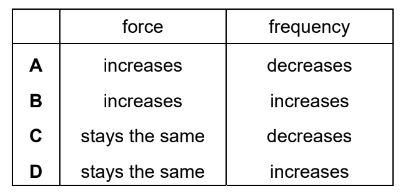
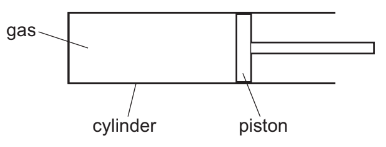
How is the force of each collision of a gas particle with the piston affected and how does the
frequency of collisions between the gas particles and the piston change?

Most-appropriate topic codes (Cambridge IGCSE Physics 0625):
▶️ Answer/Explanation
Detailed solution:
Heating the gas increases the average kinetic energy and speed of the particles, so the force of each collision with the piston increases.
However, to maintain constant pressure during expansion, the piston moves outward, increasing the volume and surface area.
This results in particles having to travel further between collisions with the walls, so the frequency of collisions decreases.
Therefore, the force of each collision increases while the frequency of collisions decreases, matching the description in Option A.
Question 14
On a warm day, a carton of fresh milk is covered with a wet cloth.
Why does this help to reduce the temperature of the milk?
A. Some water evaporates from the cloth so the remaining water becomes cooler.
B. The water has a very high specific heat capacity.
C. The water insulates the milk from the warm air around it.
D. Water is always colder than the air around it.
Most-appropriate topic codes (Cambridge IGCSE Physics 0625):
▶️ Answer/Explanation
Detailed solution:
Evaporation involves the escape of the most energetic molecules from the surface of the water.
When these high-energy particles leave, the average kinetic energy of the remaining particles decreases.
This reduction in average kinetic energy corresponds to a lower temperature in the water left behind.
Consequently, the cooled water and cloth absorb thermal energy from the milk carton, keeping it cool.
This process aligns with the principles outlined in Topic 2.2.3 regarding evaporation causing cooling.
Question 15
A chef heats some water in a pan on a hotplate.
The temperature of the water rises by \(10^{\circ} \mathrm{C}\) in time \(t\).
She then puts the same volume of oil in an identical pan on the same hotplate.
The specific heat capacity of water is 2.5 times that of oil and water is 1.1 times denser than oil.
What is the time for the temperature of the oil to rise by \(10^{\circ} \mathrm{C}\) ?
Most-appropriate topic codes (Cambridge IGCSE Physics 0625):
▶️ Answer/Explanation
Detailed solution:
Energy supplied by hotplate is constant, so \(P = \frac{m c \Delta \theta}{t}\) is constant. For equal volumes, \(m_{\text{w}} = 1.1 m_{\text{o}}\). Given \(c_{\text{w}} = 2.5 c_{\text{o}}\), \(t_{\text{o}} = t \times \frac{m_{\text{o}} c_{\text{o}}}{m_{\text{w}} c_{\text{w}}} = t \times \frac{1}{1.1 \times 2.5} \approx 0.36t\).
This matches Option A.
Question 16


Most-appropriate topic codes (Cambridge IGCSE Physics 0625):
▶️ Answer/Explanation
Detailed solution:
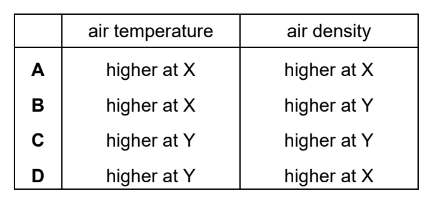
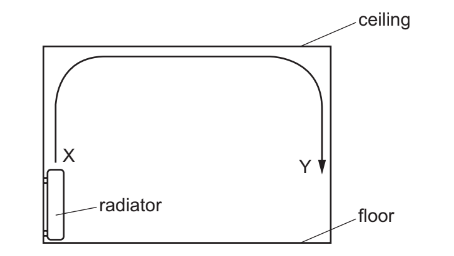
At X, the air is heated by the radiator, so it is warmer and less dense, causing it to rise.
As it travels to Y, the air cools down, becomes cooler and more dense, and starts to sink.
Therefore, the temperature at X is warm and at Y is cool, while the density at X is low and at Y is high.
This corresponds to the conditions described in row B of the table.
Question 17

Most-appropriate topic codes (Cambridge IGCSE Physics 0625):
▶️ Answer/Explanation
Detailed solution:
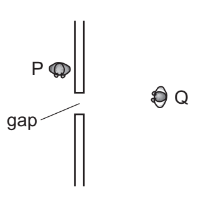
Diffraction is the spreading of waves around obstacles or through gaps, and the effect is most noticeable when the wavelength is comparable to the size of the gap.
Sound waves have wavelengths (typically a few centimeters to meters) that are similar in size to the gap in the wall, causing them to diffract significantly.
Visible light, however, has extremely short wavelengths (around \(5 \times 10^{-7}\text{ m}\)), so it diffracts very little through such a gap, meaning man P cannot see man Q.
This principle explains why P can hear Q but not see him.
Question 18
Most-appropriate topic codes (Cambridge IGCSE Physics 0625):
▶️ Answer/Explanation
Detailed solution:
Amplitude is the maximum displacement from the rest position and is measured in metres (m).
Wavelength is the distance between two consecutive crests or troughs and is also measured in metres (m).
Frequency is measured in hertz (Hz), and wave speed is measured in metres per second (m/s).
Therefore, only amplitude and wavelength share the same SI unit of metres.
This matches Option B.
Question 19

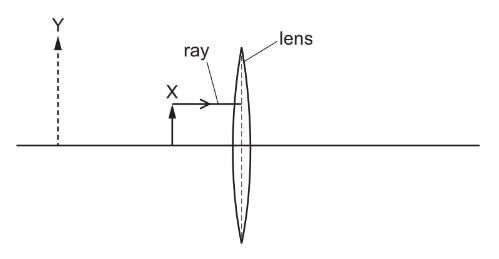
Which arrow shows the direction of this ray as it leaves the lens?

Most-appropriate topic codes (Cambridge IGCSE Physics 0625):
▶️ Answer/Explanation
Detailed solution:
The ray shown is parallel to the principal axis before reaching the lens.
After passing through a converging lens, a ray parallel to the principal axis is refracted through the principal focus on the opposite side.
In the diagram, arrow A correctly shows the ray bending downwards toward the principal focus.
This is consistent with the standard ray diagram rules for a converging lens.
Therefore, the correct arrow indicating the ray’s direction after leaving the lens is A.
Question 20


Most-appropriate topic codes (Cambridge IGCSE Physics 0625):
▶️ Answer/Explanation
Detailed solution:
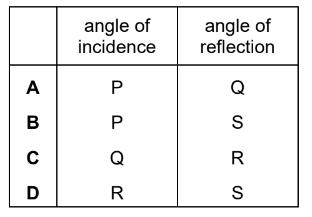
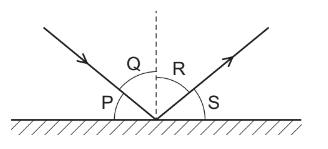
The angle of incidence is measured between the incident ray and the normal (the perpendicular line to the mirror surface).
The law of reflection states that the angle of incidence equals the angle of reflection.
From the diagram, both of these angles are $50^\circ$ as they are measured relative to the normal, not the mirror surface.
Option C correctly identifies both angles as $50^\circ$.
Question 21
A thin converging lens is used to produce a real image of an object.
Which statement about the real image is always correct?
Most-appropriate topic codes (Cambridge IGCSE Physics 0625):
▶️ Answer/Explanation
Detailed solution:
A real image is formed when light rays physically converge at a point, meaning the image can be projected on a screen.
For a single converging lens, a real image is always inverted (not upright) and forms on the opposite side of the lens relative to the object.
The image distance and size depend on the object distance, so it is not always nearer or the same size.
Therefore, the only statement that is always correct is that the image is on the opposite side of the lens to the object.
Question 22
What is the wavelength of these radio waves?
Most-appropriate topic codes (Cambridge IGCSE Physics 0625):
▶️ Answer/Explanation
Detailed solution:
Use the wave equation \(v = f\lambda\), where the speed of electromagnetic waves \(v = 3.0 \times 10^8 \mathrm{~m/s}\).
Convert frequency to hertz: \(f = 200 \mathrm{kHz} = 200 \times 10^3 \mathrm{Hz} = 2.0 \times 10^5 \mathrm{Hz}\).
Rearranging for wavelength: \(\lambda = \frac{v}{f} = \frac{3.0 \times 10^8}{2.0 \times 10^5} = 1.5 \times 10^3 \mathrm{~m}\).
This calculation matches Option C.
Question 23
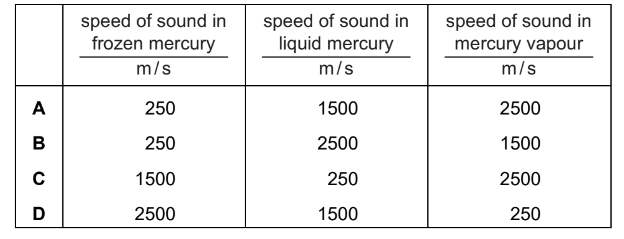
Which row gives a possible set of values of the speeds of sound through mercury?

Most-appropriate topic codes (Cambridge IGCSE Physics 0625):
▶️ Answer/Explanation
Detailed solution:
Sound travels fastest in solids due to closely packed particles transmitting vibrations efficiently.
It travels slower in liquids and slowest in gases due to increasing particle separation.
Therefore, the speed must be highest in solid mercury, intermediate in liquid, and lowest in gas.
Only row D shows values (3300 m/s > 1500 m/s > 350 m/s) consistent with this general rule.
This confirms Option D as the only physically correct set of values.
Question 24

Most-appropriate topic codes (Cambridge IGCSE Physics 0625):
▶️ Answer/Explanation
Detailed solution:
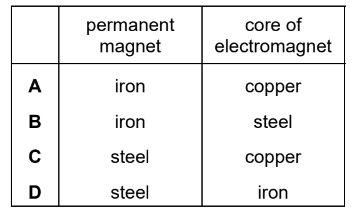
Permanent magnets are typically made of **steel** because it retains its magnetism (high coercivity).
Electromagnet cores are made of **soft iron** because it is easily magnetized and demagnetized when the current is switched off.
Row D correctly identifies steel for the permanent magnet and iron for the electromagnet core.
This matches the material properties described in the syllabus for magnetic materials.
Question 25
Which statement describes the direction of an electric field at a point?
A. the direction of the force on a negative charge
B. the direction of the force on an \(\mathrm{N}\) pole
C. the direction of the force on a positive charge
D. the direction of the force on an \(S\) pole
Most-appropriate topic codes (Cambridge IGCSE Physics 0625):
▶️ Answer/Explanation
Detailed solution:
An electric field is a region where a charge experiences a force.
By definition, the direction of the electric field at any point is the direction of the force that would act on a positive test charge placed at that point.
Therefore, the force on a positive charge aligns with the field, while a negative charge would experience a force in the opposite direction.
Options B and D refer to magnetic poles, which are irrelevant for defining an electric field.
This matches Option C.
Question 26
Most-appropriate topic codes (Cambridge IGCSE Physics 0625):
▶️ Answer/Explanation
Detailed solution:
A voltmeter is an instrument specifically designed to measure potential difference (p.d.) between two points in a circuit.
Option A is incorrect as the scale is marked in volts (V), not amperes.
Option B is incorrect because a voltmeter must always be connected in parallel, not series.
Option D is incorrect as a voltmeter typically requires only two terminals for connection.
This matches Option C.
Question 27
A second wire of the same material has twice the length and twice the cross-sectional area.
What is the resistance of the second wire?
Most-appropriate topic codes (Cambridge IGCSE Physics 0625):
▶️ Answer/Explanation
Detailed solution:
Resistance is directly proportional to length and inversely proportional to cross-sectional area (\(R \propto \frac{L}{A}\)).
Doubling the length doubles resistance (\( \times 2 \)), while doubling the area halves it (\( \times \frac{1}{2} \)).
The combined effect is \(8.0 \Omega \times \frac{2}{2} = 8.0 \Omega\).
Therefore, the resistance of the second wire remains unchanged at \(8.0 \Omega\).
This matches Option B.
Question 28

Most-appropriate topic codes (Cambridge IGCSE Physics 0625):
▶️ Answer/Explanation
Detailed solution:
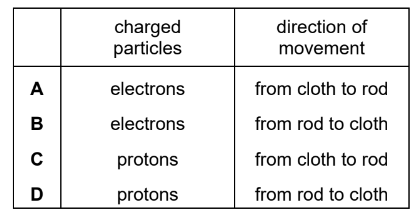
When a plastic rod is rubbed with a cloth, electrons (negative charges) are transferred.
The rod becomes positively charged because it loses electrons to the cloth.
Therefore, the charged particles moving are electrons, and their direction of movement is from the rod to the cloth.
This matches row B in the table provided.
Question 29


Most-appropriate topic codes (Cambridge IGCSE Physics 0625):
▶️ Answer/Explanation
Detailed solution:
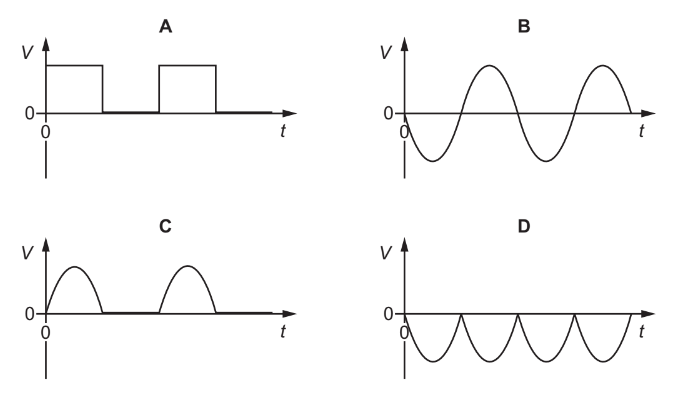
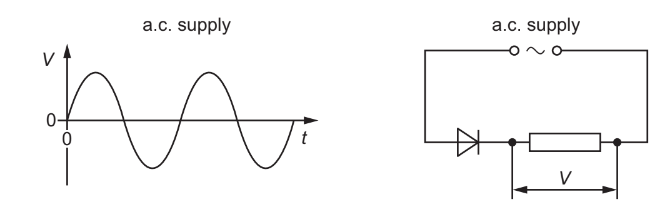
A diode allows current to flow in only one direction, so it blocks the negative half-cycles of the a.c. input.
During the positive half-cycle, the diode conducts, and a p.d. appears across the resistor.
During the negative half-cycle, the diode does not conduct, so the p.d. across the resistor is zero.
This results in a waveform with only positive pulses, which corresponds to graph C.
Question 30


Most-appropriate topic codes (Cambridge IGCSE Physics 0625):
▶️ Answer/Explanation
Detailed solution:
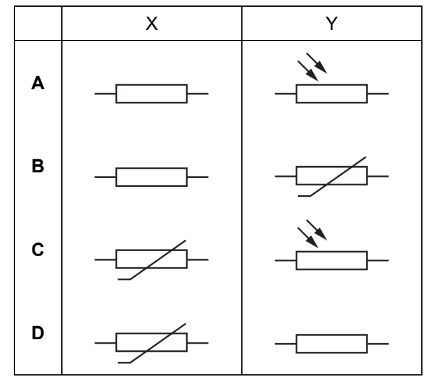
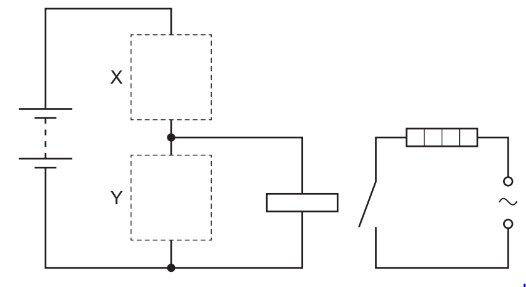
Component X must sense the temperature drop, so a thermistor is needed; its resistance changes with temperature.
Component Y is part of the switching circuit that turns the heater on, so a relay coil is needed; it uses a small current to activate a switch.
When the temperature falls, the thermistor’s resistance increases, reducing the current through the relay coil, causing the relay switch to close the heater circuit.
This matches the combination of thermistor at X and relay at Y in Option B.
Question 31
Most-appropriate topic codes (Cambridge IGCSE Physics 0625):
▶️ Answer/Explanation
Detailed solution:
To reverse the magnetic field direction from east to west, the current direction must be reversed.
To produce a stronger magnetic field, the magnitude of the current must be increased.
Option D satisfies both conditions: a larger current increases field strength, and reversing the current flips the field direction.
Turning the solenoid by $180^{\circ}$ changes its orientation but not the internal field direction relative to the solenoid.
Question 32
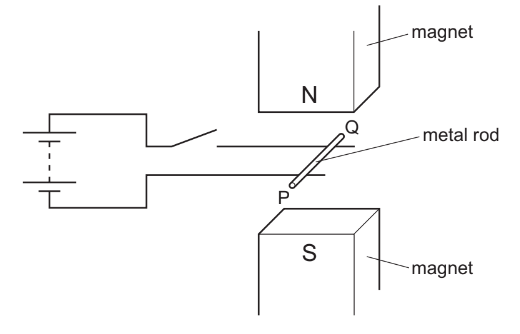
A metal rod PQ rests on two horizontal metal wires that are attached to a battery. The rod lies between the poles of a magnet.

When the switch is closed, the rod moves to the right.
What could be changed so that the rod moves to the left?
A. Open the switch.
B. Reverse the battery terminals and exchange the poles of the magnet.
C. Reverse the battery terminals but without exchanging the poles of the magnet.
D. Turn the metal rod around ( \(P\) and \(Q\) exchanged).
Most-appropriate topic codes (Cambridge IGCSE Physics 0625):
▶️ Answer/Explanation
Detailed solution:
The direction of the force on a current-carrying conductor in a magnetic field depends on both the direction of the current and the direction of the magnetic field.
Reversing only the battery terminals reverses the current direction, which reverses the force direction, causing the rod to move left.
Exchanging the magnet poles as well (Option B) would reverse the field twice, resulting in no net change in direction.
Therefore, reversing the battery terminals alone correctly achieves the desired leftward motion.
Question 33
A transformer in a computer is used to transform the mains voltage of \(240 \mathrm{~V}\) to \(12 \mathrm{~V}\).
The number of turns on the secondary coil is 2000 .
Which statement about the transformer is correct?
A. It is a step-down transformer and has 100 turns on its primary coil.
B. It is a step-down transformer and has 40000 turns on its primary coil.
C. It is a step-up transformer and has 100 turns on its primary coil.
D. It is a step-up transformer and has 40000 turns on its primary coil.
Most-appropriate topic codes (Cambridge IGCSE Physics 0625):
▶️ Answer/Explanation
Detailed solution:
The transformer steps the voltage down from $240\text{ V}$ to $12\text{ V}$, so it is a step-down transformer.
Using the transformer equation $\frac{V_{\mathrm{p}}}{V_{\mathrm{s}}} = \frac{N_{\mathrm{p}}}{N_{\mathrm{s}}}$, substitute the values: $\frac{240}{12} = \frac{N_{\mathrm{p}}}{2000}$.
This simplifies to $20 = \frac{N_{\mathrm{p}}}{2000}$, giving $N_{\mathrm{p}} = 20 \times 2000 = 40000$ turns.
Therefore, the transformer is step-down and has $40000$ turns on the primary coil.
This matches Option B.
Question 34
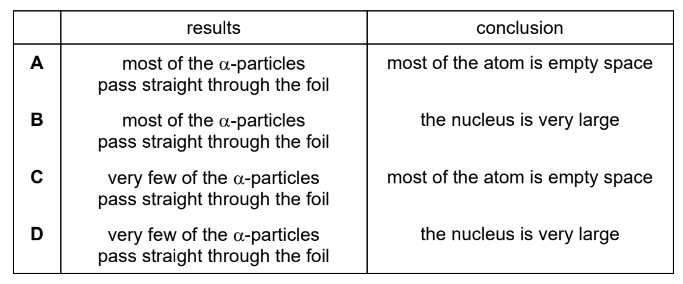
Which row describes results from the experiment and a conclusion that the results lead to?

Most-appropriate topic codes (Cambridge IGCSE Physics 0625):
▶️ Answer/Explanation
Detailed solution:
Most \(\alpha\)-particles pass straight through the foil with no deflection, showing that the atom consists of mostly empty space.
A very small fraction of particles are deflected through very large angles, sometimes bouncing back.
This indicates they encountered a very small, dense, and positively charged nucleus at the center of the atom.
Therefore, the conclusion is that the mass of the atom is concentrated in a tiny nucleus.
This corresponds directly to the description in Row A.
Question 35
Which emissions can be deflected by an electric field?
Most-appropriate topic codes (Cambridge IGCSE Physics 0625):
▶️ Answer/Explanation
Detailed solution:
An electric field exerts a force only on charged particles. \(\alpha\)-particles are positively charged and \(\beta\)-particles are negatively charged, so both are deflected by an electric field.
\(\gamma\)-rays are electromagnetic waves with no electric charge, therefore they are not deflected by an electric field.
Hence, only \(\alpha\)-particles and \(\beta\)-particles can be deflected by an electric field.
This corresponds to option B.
Question 36

Most-appropriate topic codes (Cambridge IGCSE Physics 0625):
▶️ Answer/Explanation
Detailed solution:
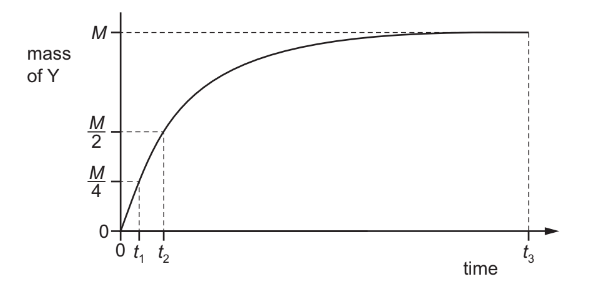
The mass of \(Y\) increases as \(X\) decays; when the mass of \(Y\) reaches half its final maximum value, one half-life has elapsed.
The graph shows the maximum mass of \(Y\) is reached at \(t_3\), and half of this mass corresponds to the time \(t_2\).
Thus, the half-life of \(X\) is simply the time \(t_2\) itself, not a time interval.
This matches the definition of half-life when interpreting a product growth curve.
Therefore, option C is correct.
Question 37
Most-appropriate topic codes (Cambridge IGCSE Physics 0625):
▶️ Answer/Explanation
Detailed solution:
Nuclear fission occurs when a heavy, unstable nucleus (like uranium-235) absorbs a neutron, becoming highly unstable and splitting into smaller nuclei.
Protons are repelled by the positive nucleus and alpha or beta particles are generally emitted, not absorbed, to initiate fission.
This absorption of a neutron releases energy and more neutrons, leading to a chain reaction.
Hence, a neutron is the correct particle absorbed by the nucleus.
Question 38
Which statement explains why?
Most-appropriate topic codes (Cambridge IGCSE Physics 0625):
▶️ Answer/Explanation
Detailed solution:
The seasons are caused by the tilt of the Earth’s axis relative to its orbital plane.
In June, the Northern Hemisphere is tilted towards the Sun, receiving more direct sunlight and longer days.
This results in warmer temperatures and the summer season, regardless of the Earth’s distance from the Sun.
Therefore, the tilt of the axis is the correct explanation for summer in June.
Question 39
Which statement about the Sun is correct?
A. The Sun is a dwarf star consisting mostly of hydrogen and oxygen.
B. The Sun is a giant star consisting mostly of helium and carbon dioxide.
C. The Sun is a medium-sized star consisting mostly of hydrogen and helium
D. The Sun is a medium-sized star consisting mostly of nitrogen and oxygen.
Most-appropriate topic codes (Cambridge IGCSE Physics 0625):
▶️ Answer/Explanation
Detailed solution:
The syllabus states that the Sun is a star of medium size, consisting mostly of hydrogen and helium.
It radiates most of its energy in the infrared, visible, and ultraviolet regions of the electromagnetic spectrum.
Option C correctly identifies both the relative size of the Sun and its primary elemental composition.
Options A, B, and D are incorrect because they misstate the size, composition, or both.
Therefore, the correct answer is C.
Question 40
Which star will eventually explode as a supernova?

Most-appropriate topic codes (Cambridge IGCSE Physics 0625):
▶️ Answer/Explanation
Detailed solution:
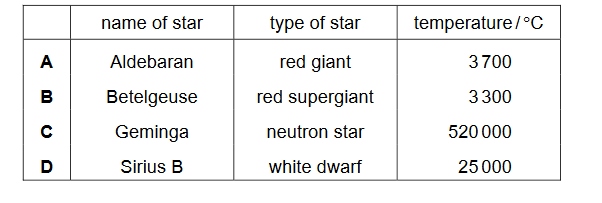
A supernova explosion occurs at the end of the life cycle of a massive star (much more massive than the Sun).
Star B has a mass of $10.0$ solar masses, which is significantly greater than the Sun’s mass, classifying it as a high-mass star.
According to stellar evolution, high-mass stars expand into red supergiants and ultimately end their lives in a supernova explosion.
Stars A, C, and D have masses less than or equal to $1.5$ solar masses and will end their lives as white dwarfs or planetary nebulae, not as supernovae.
Therefore, Star B is the correct answer.