
Question 1
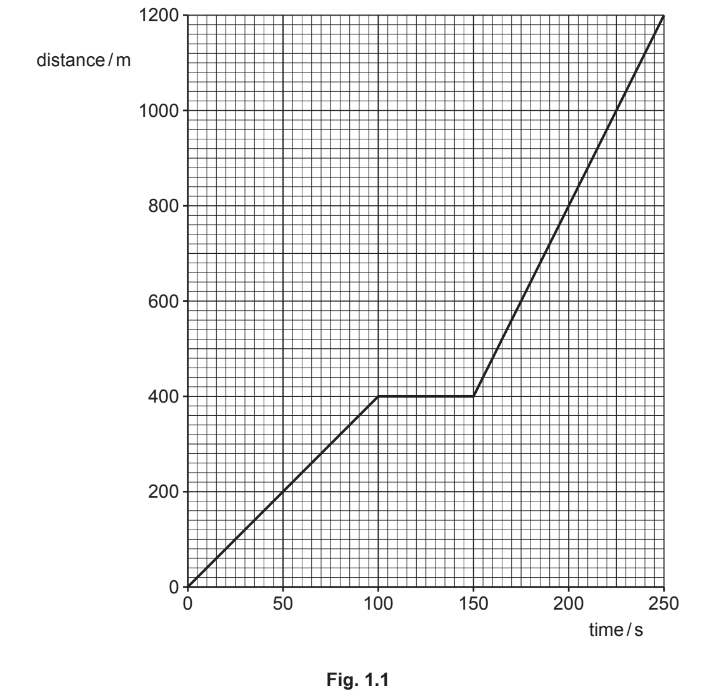
(a) (i) Determine the distance travelled by the cyclist between $\text{time} = 0$ and $\text{time} = 100\text{ s}$.
(ii) Calculate the speed of the cyclist between $\text{time} = 0$ and $\text{time} = 100\text{ s}$.
(iii) Describe the motion of the cyclist between $\text{time} = 100\text{ s}$ and $\text{time} = 250\text{ s}$.
(b) Fig. 1.2 shows the cyclist riding along a long straight road.
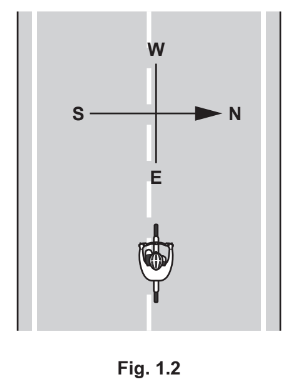
The speed of the cyclist is $15\text{ m/s}$. Determine the velocity of the cyclist.
Most-appropriate topic codes (Cambridge IGCSE Physics 0625):
• Topic $1.2$ — Motion (Parts $\mathrm{(a)(i)}$, $\mathrm{(a)(ii)}$, $\mathrm{(a)(iii)}$, $\mathrm{(b)}$)
▶️ Answer/Explanation
(a)(i)
For the correct answer:
$400\text{ m}$
To find the distance at a specific time from a distance-time graph, locate the time $100\text{ s}$ on the horizontal axis and read the corresponding value on the vertical axis. At $t = 100\text{ s}$, the line reaches the $400\text{ m}$ mark, representing the total distance covered from the start.
(a)(ii)
For the correct answer:
$4\text{ m/s}$
The speed is the gradient of the distance-time graph, calculated as $\text{gradient} = \frac{\text{rise}}{\text{run}}$. Using the points $(0,0)$ and $(100, 400)$, the speed is $v = \frac{400\text{ m} – 0\text{ m}}{100\text{ s} – 0\text{ s}} = 4\text{ m/s}$. A straight line through the origin indicates a constant speed of $4\text{ m/s}$ throughout this interval.
(a)(iii)
For the correct answer:
Stationary between $100$–$150\text{ s}$, then constant speed between $150$–$250\text{ s}$.
From $100$ to $150\text{ s}$, the horizontal line indicates a gradient of zero, meaning the cyclist is at rest or stationary. From $150$ to $250\text{ s}$, the distance increases linearly again, represented by a straight diagonal line, which signifies that the cyclist is moving at a new constant, steady speed.
(b)
For the correct answer:
$15\text{ m/s}$ due west
Velocity is a vector quantity that defines both speed and direction. Since the speed is given as $15\text{ m/s}$ and the compass rose in Fig. 1.2 indicates the cyclist is travelling toward the left, the velocity must be stated as $15\text{ m/s}$ in the direction of west.
Question 2
Most-appropriate topic codes (Cambridge IGCSE Physics 0625):
• Topic $1.4$ — Density (Part $\mathrm{(a)}$)
• Topic $1.5.1$ — Effects of forces (Part $\mathrm{(b)}$)
• Topic $1.5.2$ — Turning effect of forces (Part $\mathrm{(c)}$)
▶️ Answer/Explanation
(a)
For the correct answer:
$7.7 \text{ g/cm}^3$
Density is defined as mass per unit volume ($\rho = m/V$). By substituting the given values, $400 \text{ g} \div 52 \text{ cm}^3 \approx 7.69 \text{ g/cm}^3$, which rounds to $7.7 \text{ g/cm}^3$. The unit must be consistently derived from the mass in grams and volume in cubic centimeters.
(b)
For the correct answer:
Name: Friction / Air resistance / Drag; Size: $3.9 \text{ N}$
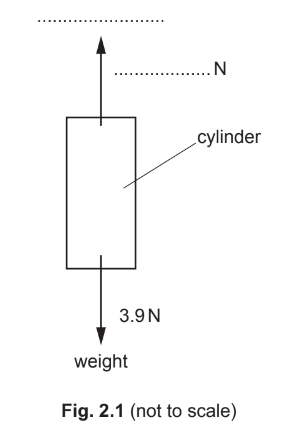
When an object falls at a constant speed (terminal velocity), the resultant force acting on it is zero, meaning the upward and downward forces are balanced. The downward force is the weight ($3.9 \text{ N}$), so the upward force, known as air resistance or drag, must also have a magnitude of $3.9 \text{ N}$ to counteract the weight exactly.
(c)
For the correct answer:
$2.3 \text{ N}$
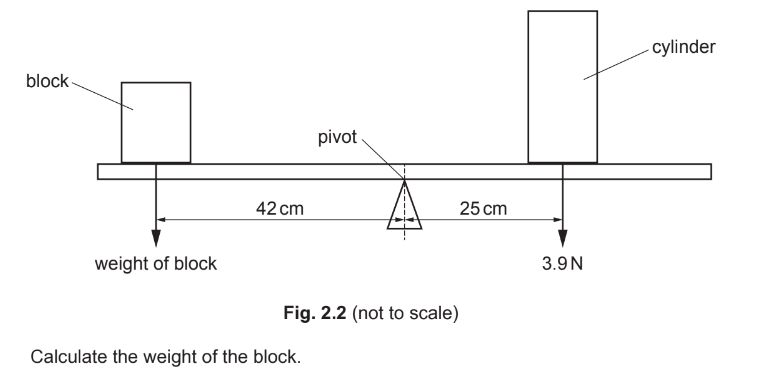
Using the principle of moments, the clockwise moment must equal the anticlockwise moment for the beam to be balanced. The moment of the cylinder is $3.9 \text{ N} \times 25 \text{ cm} = 97.5 \text{ N cm}$. Setting this equal to the block’s moment ($W \times 42 \text{ cm}$), we find the weight of the block by calculating $97.5 \div 42 \approx 2.3 \text{ N}$.
Question 3
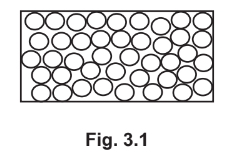
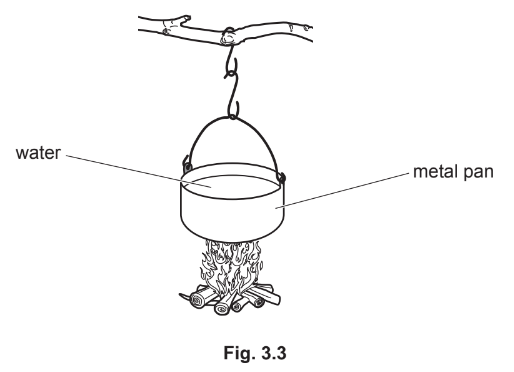
Most-appropriate topic codes (Cambridge IGCSE Physics 0625):
• Topic 2.1.1 — States of matter (Parts (a), (b))
• Topic 2.3.1 — Conduction (Parts (c)(i), (c)(ii))
• Topic 2.2 — Thermal properties and temperature (Part (c)(iii))
▶️ Answer/Explanation
(a)
For the correct answer:
At least 4 circles widely separated and randomly arranged.
In a gas, particles are far apart with large gaps between them, typically much greater than the diameter of the particles themselves. The arrangement must be completely random to show there is no regular structure.
(b)
For the correct answer:
Regular arrangement, fixed positions, vibrating, and closely packed.
In a solid, particles are arranged in a highly organized, regular lattice structure and are packed very tightly together with negligible separation. Because of strong intermolecular forces, they cannot move from place to place but instead vibrate about fixed positions.
(c)(i)
For the correct answer:
Conduction
Thermal conduction is the process where heat energy is transferred through a solid material, like the metal pan, via the vibration of particles and the movement of free electrons. Metals are particularly good conductors because their delocalized electrons transfer kinetic energy rapidly throughout the structure.
(c)(ii)
For the correct answer:
Water at the bottom heats up, expands, becomes less dense, and rises, creating a circulation current.
When water at the base of the pan is heated, the particles gain kinetic energy and move further apart, causing that region of liquid to become less dense than the cooler water above. This less dense water rises, while cooler, denser water sinks to take its place, forming a convection current that distributes heat.
(c)(iii)
For the correct answer:
100 °C
At standard atmospheric pressure, the boiling point of pure water is defined as 100 degrees Celsius. This is a fixed thermal property where the energy input is used to overcome molecular bonds to change the state from liquid to gas without a further increase in temperature.
Question 4
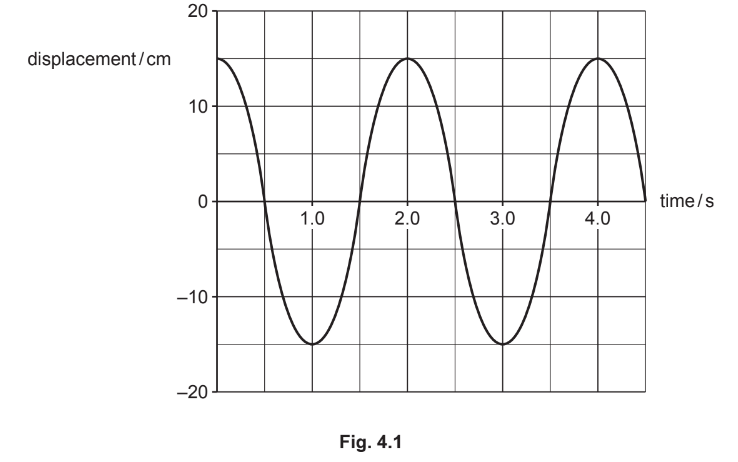
Most-appropriate topic codes (Cambridge IGCSE Physics 0625):
• Topic $3.1$ — General properties of waves (Parts $\mathrm{(a)}$, $\mathrm{(b)}$, $\mathrm{(c)}$)
▶️ Answer/Explanation
(a)(i)
For the correct answer: $15\text{ cm}$
Amplitude is the maximum displacement from the equilibrium position to a peak or trough; in Fig. 4.1, the vertical distance from the center line ($0\text{ cm}$) to the crest is $15\text{ cm}$.
(a)(ii)
For the correct answer: $0.5\text{ Hz}$
The graph shows one complete wave cycle occurring every $2.0\text{ s}$ (the period $T$); frequency $f$ is calculated using the reciprocal of the period ($f = 1/T$), resulting in $1/2.0 = 0.5\text{ Hz}$.
(b)
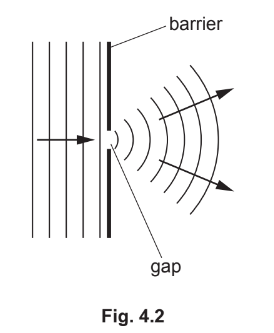
For the correct answer: diffraction
Diffraction occurs when waves spread out as they pass through a gap or around an edge; Fig. 4.2 illustrates this by showing the straight wavefronts becoming curved after passing through the narrow opening.
(c)(i)
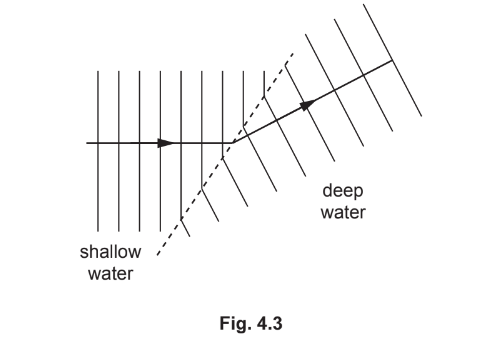
For the correct answer: refraction
Refraction is the change in direction of a wave as it crosses a boundary between two different media (or depths) due to a change in speed, as evidenced by the bending wavefronts in Fig. 4.3.
(c)(ii)
For the correct answer: wavelength OR speed (velocity)
As waves transition from shallow to deep water, their speed increases and their wavelength increases (waves spread further apart) while the frequency remains constant as it is determined by the source.
Question 5
Most-appropriate topic codes (Cambridge IGCSE Physics 0625):
• Topic $3.3$ — Electromagnetic spectrum (Parts $\mathrm{(a)}$, $\mathrm{(b)}$, $\mathrm{(c)}$)
▶️ Answer/Explanation
(a)
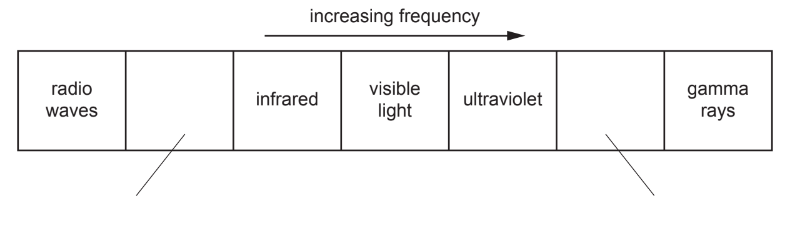
For the correct answer:
Microwaves; X-rays
The electromagnetic spectrum is arranged by frequency; microwaves follow radio waves as they have higher frequencies, while X-rays are positioned after ultraviolet radiation but before gamma rays.
(b)
For the correct answer:
Infrared: Remote controllers; Ultraviolet: Sterilising water
Infrared radiation is commonly used in short-range communications like television remotes and thermal imaging, whereas ultraviolet radiation is effective for security marking and killing bacteria to sterilise food or water supplies.
(c)
For the correct answer:
Infrared: Skin burns; Ultraviolet: Skin cancer / Eye damage
Overexposure to infrared radiation leads to significant internal heating that causes skin burns, while ultraviolet radiation carries enough energy to damage surface cells and DNA, potentially resulting in skin cancer or cataracts.
Question 6
Most-appropriate topic codes (Cambridge IGCSE Physics 0625):
• Topic 1.7.3 — Energy resources (Part (a))
• Topic 4.2.5 — Electrical energy and electrical power (Part (b))
• Topic 4.5.6 — The transformer (Part (c))
▶️ Answer/Explanation
(a)
For the correct answer:
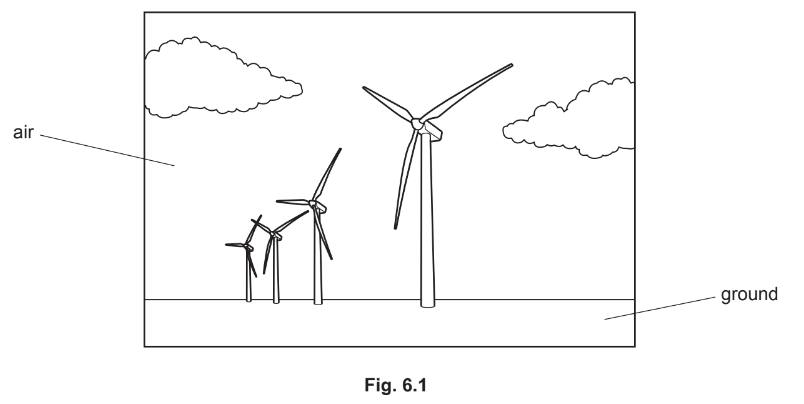
Kinetic energy of wind rotates turbine blades which turn the generator.
As wind moves across the turbine blades, its kinetic energy is transferred to the blades, causing them to rotate. This rotational motion is used to spin a shaft connected to an internal generator. Inside the generator, the mechanical energy is converted into electrical energy through electromagnetic induction as coils rotate within a magnetic field.
(b)
For the correct answer:
1200 V (or 1.2 kV)
First, convert power from kilowatts to watts: P=624 kW=624,000 W. Using the electrical power formula P=IV, rearrange to solve for voltage: V=P/I. Substituting the values gives V=624,000 W/520 A=1200 V. This ensures the units are consistent for a standard potential difference calculation.
(c)
For the correct answer:
Reduces power loss and allows for thinner, cheaper cables.
Transmitting power at high voltages significantly reduces the current flowing through the transmission lines. Since power loss in cables is proportional to the square of the current (P=I 2 R), a lower current results in much higher efficiency. Additionally, lower current requirements allow for thinner, lighter cables, reducing the overall cost of infrastructure.
Question 7
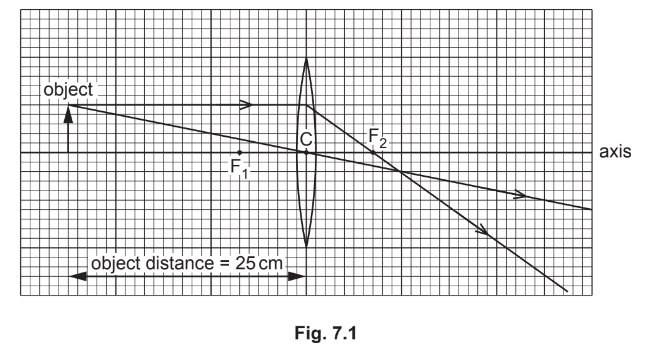
F 1 and F 2 are the focal points of the lens and C is the centre of the converging lens.
Most-appropriate topic codes (Cambridge IGCSE Physics 0625):
• Topic 3.2.3 — Thin lenses (Parts (a), (b), (c))
▶️ Answer/Explanation
(a)
For the correct answer:
3.0 cm (allow 2.9 to 3.1)
The focal length is the distance from the optical centre of the lens (C) to the principal focus (F 1 or F 2 ). On the provided grid, count the number of squares between C and either F point. Since each square represents 1.0 cm and there are 3 squares between the centre and the focal point, the focal length is calculated as 3×1.0 cm=3.0 cm.
(b)
For the correct answer:
An arrow drawn perpendicularly from the principal axis to the intersection of the two refracted rays.
To locate the image, trace the path of the rays after they pass through the lens. The first ray travels parallel to the axis and passes through F 2 , while the second ray passes through the centre C undeviated. The point where these two rays intersect marks the tip of the image. An arrow should be drawn from the principal axis down to this intersection point to represent the inverted image.
(c)
For the correct answer:
Real, inverted, and diminished (smaller than the object).
The image is “real” because it is formed by the actual intersection of light rays and can be projected onto a screen. It is “inverted” as it points in the opposite vertical direction to the object. Finally, by comparing the height of the image (approximately 1.5 squares) to the original object height (2 squares), we can observe that the image is “diminished” or smaller than the object.
Question 8
Most-appropriate topic codes (Cambridge IGCSE Physics 0625):
• Topic 4.1 — Simple phenomena of magnetism (Part (a))
• Topic 4.5 — Electromagnetic effects (Part (b))
▶️ Answer/Explanation
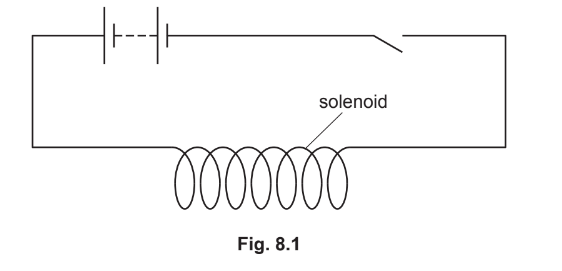
(a)
For the correct answer:
Use a plotting compass or iron filings to map the field lines; the compass needle points in the direction of the magnetic field at various positions.
Place a plotting compass near the solenoid and mark the direction of the needle’s North pole. Move the compass to the next mark and repeat the process to trace complete field lines, which will form a pattern similar to a bar magnet. Alternatively, sprinkle iron filings on a card around the solenoid and tap gently to reveal the field pattern, then use a compass to determine the specific North-to-South direction.
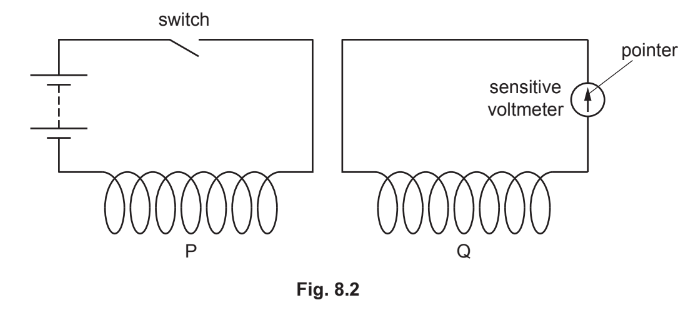
(b)
For the correct answer:
The voltmeter pointer deflects momentarily and then returns to zero; closing the switch creates a changing magnetic field in P that induces an e.m.f. in Q.
When the switch is closed, the current in solenoid P increases from zero, creating a rapidly growing magnetic field that spreads out and cuts through the coils of solenoid Q. This changing magnetic flux linkage induces an electromotive force (e.m.f.) across solenoid Q, causing a temporary reading on the sensitive voltmeter. Once the current in P becomes steady, the magnetic field is no longer changing, so the induction stops and the voltmeter pointer returns to the zero position.
Question 9
Most-appropriate topic codes (Cambridge IGCSE Physics 0625):
• Topic 4.3.2 — Series and parallel circuits (Part (a)(i))
• Topic 4.2.3 — Electromotive force and potential difference (Part (a)(ii))
• Topic 4.3.1 — Circuit diagrams and circuit components (Part (a)(iii))
• Topic 4.2.5 — Electrical energy and electrical power (Part (b))
▶️ Answer/Explanation
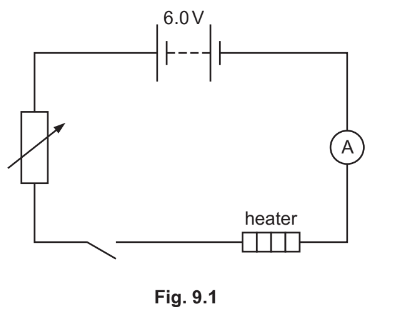
(a)(i)
For the correct answer:
To change or control the current in the circuit or heater.
A variable resistor allows the user to manually adjust the resistance within a circuit. By increasing the resistance, the total current flowing through the heater decreases, and by decreasing it, the current increases, thereby providing a method to control the electrical output of the component.
(a)(ii)
For the correct answer:
4 cells
When cells are connected in series to form a battery, their individual electromotive forces (e.m.f.) are summed. To find the number of 1.5 V cells required to produce a total of 6.0 V, divide the total required voltage by the voltage per cell: 6.0 V/1.5 V=4 cells.
(a)(iii)
For the correct answer:
Voltmeter symbol (V in a circle) connected in parallel with the heater.
To measure the potential difference across a specific component like a heater, a voltmeter must be used. It is always connected in parallel (across the component) so that it experiences the same p.d. as the component without significantly affecting the current in the main branch.
(b)
For the correct answer:
256 J (rounded to 260 J)
The electrical energy transferred (E) is calculated using the formula E=IVt, where I is current, V is potential difference, and t is time. Substituting the given values: E=1.6 A×4.0 V×40 s=256 J. This represents the total work done by the electrical source on the heater.
Question 10
The chemical symbol for actinium is Ac.
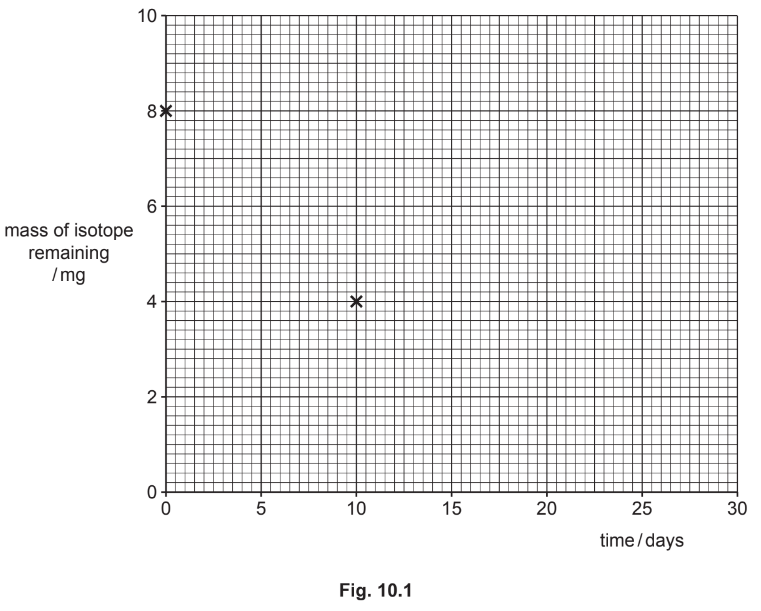
Most-appropriate topic codes (Cambridge IGCSE Physics 0625):
• Topic 5.1.2 — The nucleus (Parts (a)(i))
• Topic 5.1.1 — The atom (Parts (a)(ii))
• Topic 5.2.4 — Half-life (Parts (b))
▶️ Answer/Explanation
(a)(i)
For the correct answer:
89 225 Ac
Nuclide notation is written as Z A X, where A is the nucleon number and Z is the proton number. The nucleon number is calculated by adding the protons and neutrons (89+136=225). The proton number for Actinium is given as 89, which is placed at the bottom left of the chemical symbol.
(a)(ii)
For the correct answer:
89
In a neutral atom, the total positive charge of the nucleus must be balanced by an equal negative charge from the electrons. Since the nucleus contains 89 positively charged protons, there must be exactly 89 negatively charged electrons orbiting it to ensure the atom has no net charge.
(b)
For the correct answer:
Points plotted at (20,2.0) and (30,1.0) with a smooth decay curve.
Half-life is the time required for the mass of a radioactive sample to decrease by half. After two half-lives (20 days), the mass drops from 4.0 mg to 2.0 mg; after three half-lives (30 days), it drops to 1.0 mg. These points are plotted on the graph and connected with a smooth, decreasing curve that levels off toward the x-axis.
Question 11
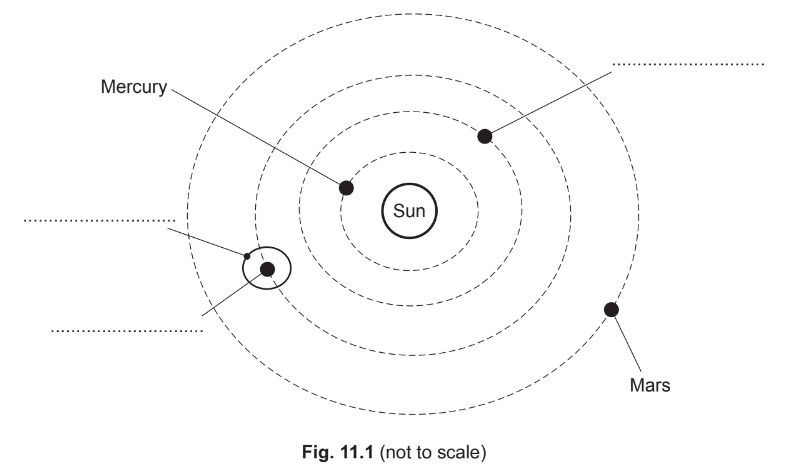
The Sun consists mostly of the elements ………………………… and ………………………… .
Most of the Sun’s energy is radiated in the infrared, ………………………….. and …………………………….. regions of the electromagnetic spectrum.
Most-appropriate topic codes (Cambridge IGCSE Physics 0625):
• Topic 6.1.1 & 6.1.2 — The Earth and the Solar System (Part (a))
• Topic 6.2.3 — The Universe (Parts (b), (c))
▶️ Answer/Explanation
(a)
For the correct answer: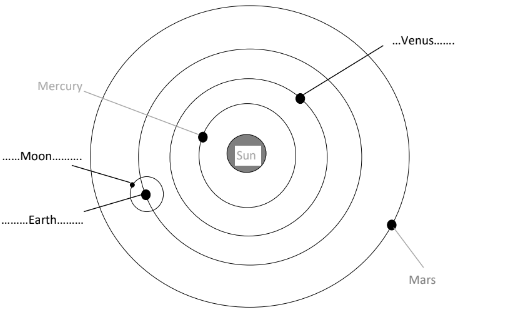
In the Solar System, planets are categorized by their distance from the Sun. The first label identifies the asteroid belt, a region of rocky debris between Mars and Jupiter. The second label indicates the four inner, rocky planets (Mercury, Venus, Earth, Mars), and the third label identifies the four outer, gaseous giants (Jupiter, Saturn, Uranus, Neptune) which formed further from the Sun.
(b)
For the correct answer:
Hydrogen and Helium; visible (light) and Ultraviolet
The Sun is a medium-sized star composed primarily of hydrogen and helium gas. It generates immense energy through nuclear fusion, primarily radiating this energy across specific regions of the electromagnetic spectrum. While it emits across various frequencies, the majority of its output is concentrated in the infrared, visible light, and ultraviolet regions.
(c)
For the correct answer:
100 000 (light-years)
The Milky Way is a vast spiral galaxy containing billions of stars, including our Sun. To describe such immense scales, astronomers use light-years (the distance light travels in one year). The approximate diameter of the Milky Way galaxy is estimated to be 100,000 light-years, reflecting its status as just one of many billions of galaxies in the observable Universe.