
Question 1
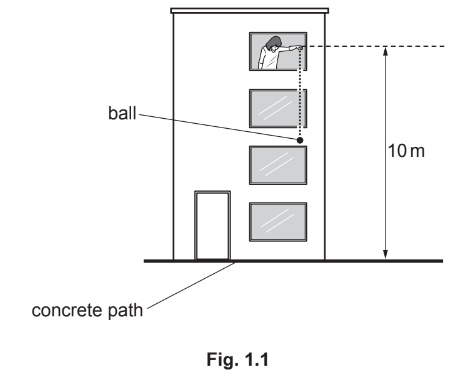
Most-appropriate topic codes (Cambridge IGCSE Physics 0625):
• Topic 1.7.1 — Energy (Parts (a), (b)(i))
• Topic 1.6 — Momentum (Parts (b)(ii), (b)(iii))
▶️ Answer/Explanation
(a)
For the correct answer: 20 J
The gravitational potential energy (ΔE p ) is calculated using the formula ΔE p =mgh. By substituting the mass m=0.20 kg, gravitational field strength g=9.8 m/s 2 (or 10 m/s 2 ), and height h=10 m, we get 0.20×9.8×10=19.6 J, which rounds to 20 J.
(b)(i)
For the correct answer: 14.4 J (rounded to 14 J)
Kinetic energy (E k ) is given by the equation E k = 2 1 mv 2 . Using the mass of 0.20 kg and the speed immediately after the bounce v=12 m/s, the calculation is E k =0.5×0.20×12 2 =14.4 J.
(b)(ii)
For the correct answer: 5.2 kg m/s (shown)
Momentum is a vector quantity, so direction matters. Taking upward as positive, the change in momentum is Δp=m(v−u)=0.20×(12−(−14))=0.20×26=5.2 kg m/s. This considers the initial velocity as −14 m/s (downward) and the final as +12 m/s (upward).
(b)(iii)
For the correct answer: 21 N (or 20.8 N)
The average resultant force F is defined as the rate of change of momentum, expressed by the formula F= Δt Δp . Substituting the change in momentum from the previous part (Δp=5.2 kg m/s) and the contact time (Δt=0.25 s), we find F= 0.25 5.2 =20.8 N.
Question 2
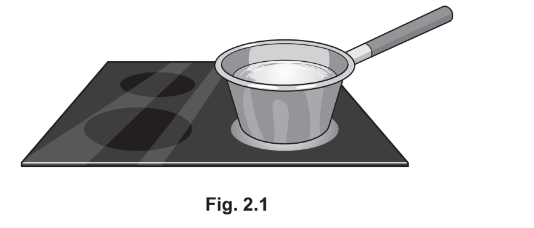
(a) Thermal energy is conducted through all solids by lattice vibrations. Describe one other way in which thermal energy is conducted through the copper.
Most-appropriate topic codes (Cambridge IGCSE Physics 0625):
• Topic 2.3.1 — Conduction (Part (a))
• Topic 2.3.3 — Radiation (Part (b))
• Topic 2.3.2 — Convection (Part (c))
▶️ Answer/Explanation
(a)
In metals like copper, thermal conduction also occurs via free (delocalised) electrons. These electrons gain kinetic energy from the hotplate and move rapidly throughout the metal lattice. They collide with distant, cooler ions, transferring energy much faster than simple lattice vibrations alone.
(b)
Shiny or polished surfaces are very poor emitters of infrared radiation compared to dull, black surfaces. By keeping the pan shiny, the rate of thermal energy transfer to the surroundings via radiation is significantly reduced. This helps the pan retain heat more effectively, ensuring more energy is used to heat the water.
(c)
The main method is convection. As water at the base heats up, it expands, becomes less dense, and rises, while cooler, denser water sinks to take its place, creating a convection current.
Question 3
$F=$
$\text{mass} =$
Most-appropriate topic codes (Cambridge IGCSE Physics 0625):
• Topic $2.1.2$ — Particle model (Part $\mathrm{(a)}$)
• Topic $1.8$ — Pressure (Parts $\mathrm{(b)(i)}$, $\mathrm{(b)(ii)}$)
• Topic $1.3$ — Mass and weight (Part $\mathrm{(b)(iii)}$)
▶️ Answer/Explanation
(a)
In a liquid, particles are packed very closely together and are often touching, leaving very little empty space between them. When a compressive force is applied, the large repulsive forces between the electron clouds of adjacent particles strongly resist any further reduction in separation. This lack of significant “gaps” makes liquids virtually incompressible compared to gases.
(b)(i)
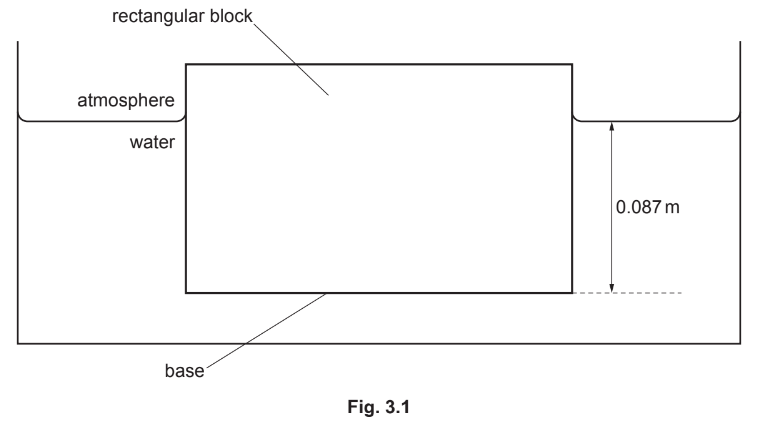
To find the pressure at a depth, use the formula $p = \rho gh$. Substituting the given values: $p = 1000 \text{ kg/m}^3 \times 9.8 \text{ m/s}^2 \times 0.087 \text{ m} = 852.6 \text{ Pa}$. This value is approximately $850 \text{ Pa}$ as required.
(b)(ii)
The force exerted by the water is calculated by rearranging the pressure formula $p = \frac{F}{A}$ to $F = p \times A$. Using the approximate pressure: $F = 850 \text{ Pa} \times 0.014 \text{ m}^2 = 11.9 \text{ N}$, which rounds to $12 \text{ N}$.
(b)(iii)
Weight is defined by the equation $W = mg$, so mass is $m = \frac{W}{g}$. Since the upward force $F$ equals the weight, the mass is $m = \frac{11.9 \text{ N}}{9.8 \text{ m/s}^2} \approx 1.2 \text{ kg}$.
Question 4
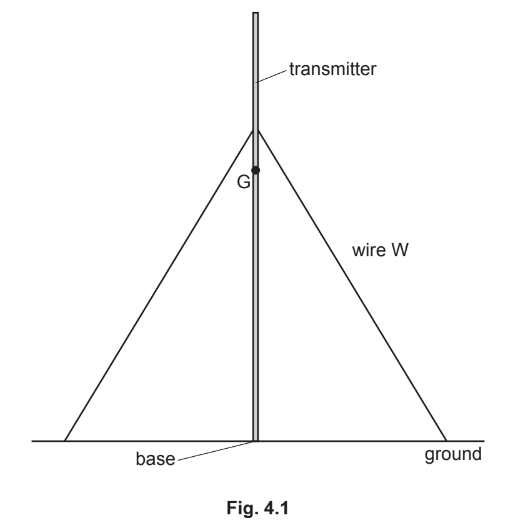
(i) State what is meant by centre of gravity.
(ii) Explain why the radio transmitter without the wires is a very unstable structure.
(i) On Fig. 4.1, mark an arrow to show the force T exerted by wire W on the transmitter.
(ii) The force T produces a moment on the transmitter about its base. Describe how the moment produced by T is calculated and indicate on Fig. 4.1 what is meant by any other terms in the description.
Most-appropriate topic codes (Cambridge IGCSE Physics 0625):
• Topic 1.5.3 — Centre of gravity (Parts (a)(i), (a)(ii))
• Topic 1.5.2 — Turning effect of forces (Parts (b)(i), (b)(ii))
▶️ Answer/Explanation
(a)(i)
For the correct answer:
The point where the weight of an object acts.
The centre of gravity is defined as the single point through which the entire weight of a body acts, regardless of its orientation. For a symmetrical object like a cylinder, it is located at the geometric centre, serving as the balance point where gravitational forces are concentrated.
(a)(ii)
For the correct answer:
A small tilt causes the centre of gravity to fall outside the narrow base.
Stability is determined by the position of the centre of gravity relative to the base. Because the transmitter is tall and thin, its centre of gravity is high and its base is narrow; any slight rotation causes the vertical line of action of its weight to fall outside the base area, creating a toppling moment.
(b)(i)
For the correct answer:
Arrow marked along wire W pointing towards the ground.
Tension is a pulling force that acts along the length of a wire. Since wire W is anchored to the ground and prevents the transmitter from falling, the force T exerted by the wire on the transmitter must pull away from the attachment point on the cylinder, directed straight down the wire toward the ground.
(b)(ii)
For the correct answer:
Moment=F×d, where d is the perpendicular distance.
The moment of a force is calculated using the equation Moment=F×d. In this case, F represents the tension T, and d is the perpendicular distance from the pivot (the base) to the line of action of the force. On Fig 4.1, one should draw a line extending from T and a perpendicular line reaching the base to represent d.
Question 5
Most-appropriate topic codes (Cambridge IGCSE Physics 0625):
• Topic 1.7.3 — Energy resources (Parts (a), (b), (c))
▶️ Answer/Explanation
(a)
In a hydroelectric dam, water stored at a height possesses gravitational potential energy (ΔE p =mgΔh). When released, this energy is transferred into kinetic energy as the falling water drives a turbine. The mechanical work from the rotating turbine then spins a generator, converting the kinetic energy into electrical energy for the grid.
(b)
A significant advantage of hydroelectric power is that it is a renewable energy resource, meaning it will not run out and produces no greenhouse gas emissions during operation. However, a major disadvantage is the high initial cost and environmental impact, as flooding large areas to create reservoirs can destroy local habitats and displace communities.
(c)
While most energy resources on Earth originate from solar radiation, geothermal energy and nuclear power do not. Geothermal energy is derived from the internal thermal energy of the Earth (radioactive decay in the core), while nuclear power relies on the energy released during the fission of uranium or plutonium isotopes.
Question 6
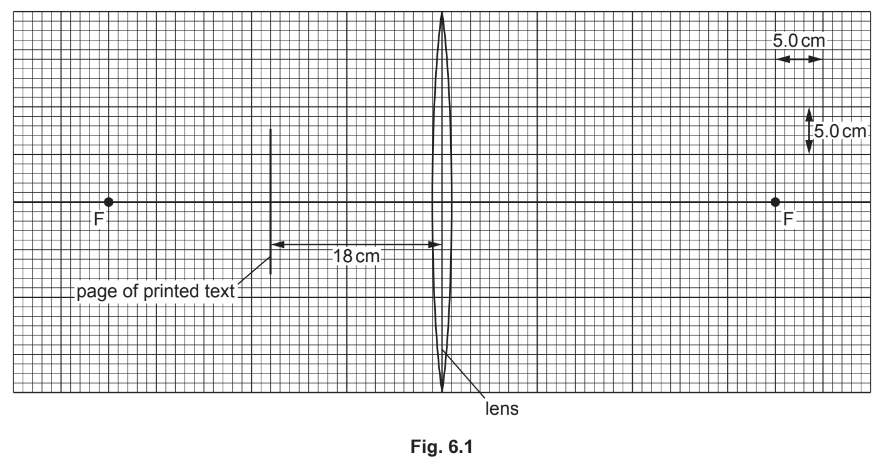
(i) By drawing on Fig. 6.1, locate the image of the page produced by the lens and label it I.
(ii) Using Fig. 6.1, determine the actual distance of image I from the lens.
Most-appropriate topic codes (Cambridge IGCSE Physics 0625):
• Topic 3.2.3 — Thin lenses (Parts (a), (b), (c))
▶️ Answer/Explanation
(a)(i)
To locate the image, draw a ray parallel to the principal axis that refracts through the far principal focus F. Draw a second ray passing straight through the optical center of the lens. Since the object is within the focal length (u < f), the rays diverge; extrapolate them backwards until they intersect on the same side as the object to find image I.
(a)(ii)
For the correct answer:
35.5 cm to 38.5 cm
Measure the distance from the center of the lens to the image I on the scale diagram (approx. 7.1 to 7.7 cm). Apply the scale factor: Actual distance=diagram distance×5.0. Alternatively, using the lens formula f 1 = u 1 + v 1 , where u=−18 cm and f=+35 cm, the calculated image distance v is approximately −37 cm.
(b)
For the correct answer:
virtual
The image is virtual because the light rays do not actually meet at the image position but only appear to diverge from it. Consequently, a virtual image cannot be projected onto a screen. This occurs whenever the object is placed between the lens and its principal focus, resulting in an upright, magnified, and virtual image.
(c)
For the correct answer:
Converging lenses focus images onto the retina.
Long-sightedness (hypermetropia) occurs when the eye’s lens is too weak or the eyeball is too short, causing images of near objects to focus behind the retina. A converging lens provides additional refractive power, bending the incoming light rays earlier. This adjustment reduces the effective focal length of the eye’s optical system, ensuring that the light converges to a sharp point directly on the retina.
Question 7
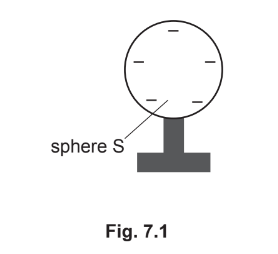
(i) State what is meant by an electric field.
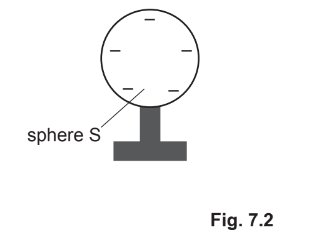
(ii) On Fig. 7.1, draw the pattern of the electric field surrounding sphere $\mathrm{S}$ and indicate its direction.
Most-appropriate topic codes (Cambridge IGCSE Physics 0625):
• Topic $4.2.1$ — Electric charge (Parts $\mathrm{(a)}$, $\mathrm{(b)(i)}$, $\mathrm{(b)(ii)}$, $\mathrm{(c)}$)
▶️ Answer/Explanation
(a)
For the correct answer:
electrons move from cloth to rod; (plastic) rod gains electrons
When two insulators are rubbed together, friction causes the transfer of negatively charged electrons from one material to the other. In this case, electrons are transferred from the woollen cloth to the plastic rod. Because electrons carry a negative charge, the accumulation of extra electrons on the rod results in a net negative charge, leaving the cloth with an equal positive charge.
(b)(i)
For the correct answer:
(region) where an (electric) charge experiences a force
An electric field is defined as a region of space around a charged object where any other charged particle will experience a non-contact force. The strength and direction of this field determine the magnitude and direction of the electrostatic force $F$ exerted on a test charge $q$, represented by the relationship $E = \frac{F}{q}$.
(b)(ii)
For the correct answer:
At least three radial field lines distributed evenly around outside of $\mathrm{S}$ AND touching $\mathrm{S}$ AND not inside $\mathrm{S}$; arrow on (at least one) field line pointing towards $\mathrm{S}$
The electric field around a charged conducting sphere is radial, meaning the lines of force are perpendicular to the surface and spread out in all directions. Since the sphere is negatively charged, the field lines must point inwards toward the center of the sphere, as the field direction is defined as the direction of force on a positive test charge.
(c)
For the correct answer:
arrow through $Z$ and away from (centre of) sphere
Electrostatic force follows the law of conservation of charge where like charges repel each other. Since both the sphere $\mathrm{S}$ and the particle $Z$ carry a negative charge, they experience a repulsive force. Therefore, the arrow representing the force on $Z$ must be drawn pointing directly away from the center of sphere $\mathrm{S}$ along the radial line connecting them.
Question 8
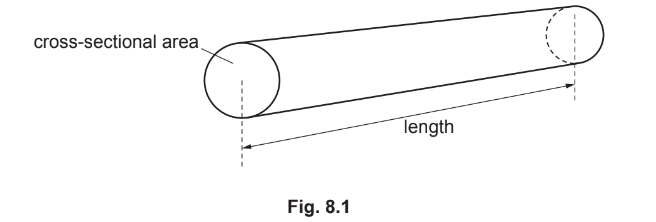
The cylinder is connected into a circuit. Fig. 8.2 shows that the circuit also includes a battery of electromotive force (e.m.f.) 9.0 V and a resistor P.
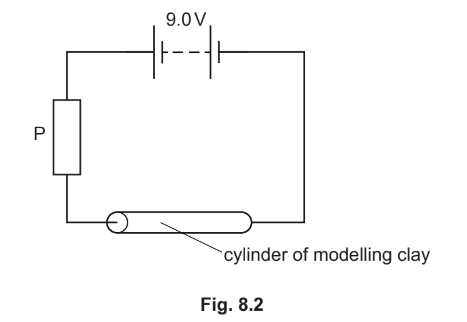
The resistance of P is 4.0 Ω. The current in P is 1.5 A.
Most-appropriate topic codes (Cambridge IGCSE Physics 0625):
• Topic 4.2.2 — Electric current (Part (a)(i))
• Topic 4.2.4 — Resistance (Parts (a)(ii), (b))
▶️ Answer/Explanation
(a)(i)
For the correct answer:
900 C
Electric current I is defined as the rate of flow of charge Q over time t. Using the formula Q=I×t, we substitute the given values: X=1.5 A×600 s=900 C.
(a)(ii)
For the correct answer:
2.0 Ω
First, find total resistance R total using Ohm’s Law: R total = I V = 1.5 A 9.0 V =6.0 Ω. Since resistor P and the cylinder are in series, the cylinder’s resistance is R cyl =R total −R P =6.0 Ω−4.0 Ω=2.0 Ω.
(b)
For the correct answer:
1200 s
Resistance R is proportional to length L and inversely proportional to area A (R∝ A L ). Doubling L and halving A increases the cylinder’s resistance fourfold to 8.0 Ω, making the new total resistance 12.0 Ω. The new current is I new = 12.0 Ω 9.0 V =0.75 A, and the time required for charge X to flow is t= I new Q = 0.75 A 900 C =1200 s.
Question 9
Many household smoke alarms contain a sample of the radioactive isotope americium-241 (Am).
(a) Americium-241 is the isotope of the element americium that has the nucleon number (mass number) 241 .
(i) State how the composition of a nucleus of americium-241 differs from that of a nucleus of americium-242.
(ii) An atom of a different element has a nucleon number of 241 .
State two differences between the composition of a nucleus of this atom and a nucleus of americium-241.
(b) Americium-241 decays to an isotope of neptunium ( (\mathrm{Np}) ) by alpha-particle ( (\alpha)-particle) emission.
(i) Complete the equation for this decay.
<br />{ }_{\ldots . .}{ }^{241} \mathrm{Am} \longrightarrow{ }_{93} \mathrm{~Np}+{ }^{\ldots . . . .} \alpha<br />
(ii) One reason for using an isotope that emits (\alpha)-particles in a smoke detector is that (\alpha)-particles are more strongly ionising than beta-particles ( (\beta)-particles).
Explain why (\alpha)-particles are more strongly ionising than (\beta)-particles.
(iii) The isotope of neptunium produced by americium-241 is also radioactive.
The decay of this isotope of neptunium produces an isotope of protactinium which decays by (\beta)-emission. (\beta)-particles are more penetrating than (\alpha)-particles.
The half-life of neptunium is longer than two million years.
Using this information, explain the advantage of this long half-life for the use and safe disposal of a household smoke alarm.
Most-appropriate topic codes (Cambridge IGCSE Physics 0625):
• Topic 5.1.2 — The nucleus (Parts (a)(i), (a)(ii))
• Topic 5.2.2 — The three types of nuclear emission (Parts (b)(i), (b)(ii))
• Topic 5.2.4 — Half-life (Part (b)(iii))
▶️ Answer/Explanation
(a)(i)
Americium-241 has one fewer neutron than americium-242. Since both are isotopes of the same element, they possess the same proton number (Z), but the nucleon number (A) indicates the total sum of protons and neutrons; therefore, a difference of 1 in A represents a difference of 1 neutron.
(a)(ii)
The nuclei will have a different number of protons and a different number of neutrons. Because the atoms belong to different elements, their proton numbers must be distinct, and since their total nucleon numbers are the same (A=241), the number of neutrons (N=A−Z) must also differ to maintain that sum.
(b)(i)
95 241 Am→ 93 237 Np+ 2 4 α
In alpha decay, the nucleus emits an α-particle ( 2 4 α), decreasing the proton number by 2 (95−2=93) and the nucleon number by 4 (241−4=237). The periodic table identifies element 95 as Americium.
(b)(ii)
Alpha particles possess a greater positive charge (+2e) and significantly more mass/kinetic energy compared to beta particles. This higher charge density and slower velocity increase the probability of interacting with and removing electrons from nearby atoms, making them more strongly ionising.
(b)(iii)
A long half-life ensures that the activity (A) of the source remains low and relatively constant over many years, meaning fewer emissions per second. This results in a negligible health hazard during use and allows for safer, cheaper disposal as the radiation levels do not pose a high risk to humans or the environment.
Question 10
(i) Describe how the observed light is different from when it was emitted.
(ii) State the quantity that astronomers use to determine the speed at which the galaxy is moving away.
(i) Calculate the distance from the Earth of a galaxy that is moving away at a speed of $1.3 \times 10^7\text{ m/s}$.
(ii) Calculate an estimate for the age of the Universe. Give your answer in years.
Most-appropriate topic codes (Cambridge IGCSE Physics 0625):
• Topic $6.2.1$ — The Sun as a star (Part $\mathrm{(a)}$)
• Topic $6.2.3$ — The Universe (Parts $\mathrm{(b)(i)}$, $\mathrm{(b)(ii)}$, $\mathrm{(c)(i)}$, $\mathrm{(c)(ii)}$)
▶️ Answer/Explanation
(a)
For the correct answer:
Hydrogen nuclei fuse to become helium nuclei.
Stars are powered by nuclear fusion reactions occurring in their high-pressure cores. In a stable star, hydrogen nuclei collide and fuse together to form helium nuclei, a process that releases vast amounts of energy. This internal energy release provides the outward pressure necessary to balance the inward force of gravity.
(b)(i)
For the correct answer:
The observed wavelength is longer (redshift).
When a galaxy moves away from Earth, the light it emits is stretched as it travels through expanding space. This results in the observed light having a longer wavelength than when it was originally emitted, a phenomenon known as redshift. Consequently, the spectral lines are shifted toward the red end of the electromagnetic spectrum.
(b)(ii)
For the correct answer:
Change in wavelength (redshift).
Astronomers measure the specific change in wavelength ($\Delta \lambda$) of known spectral lines from the distant galaxy. By comparing the observed wavelength to the laboratory wavelength, they can calculate the recession speed of the galaxy, as the degree of redshift is directly proportional to how fast the galaxy is moving away.
(c)(i)
For the correct answer:
$5.9 \times 10^{24}\text{ m}$
To find the distance, use the Hubble Law equation $v = H_0 d$, rearranged to $d = \frac{v}{H_0}$. Substituting the given values: $d = \frac{1.3 \times 10^7\text{ m/s}}{2.2 \times 10^{-18}\text{ s}^{-1}}$. This calculation yields a distance of approximately $5.9 \times 10^{24}\text{ metres}$, representing the vast scale of the observable Universe.
(c)(ii)
For the correct answer:
$1.4 \times 10^{10}\text{ years}$
The age of the Universe can be estimated using the reciprocal of the Hubble constant, $T = \frac{1}{H_0}$. First, calculate the age in seconds: $T = \frac{1}{2.2 \times 10^{-18}} \approx 4.54 \times 10^{17}\text{ s}$. To convert this to years, divide by the number of seconds in a year ($365.25 \times 24 \times 3600$), resulting in an estimate of $1.4 \times 10^{10}\text{ years}$.