
▶️ Answer/Explanation
Detailed solution:
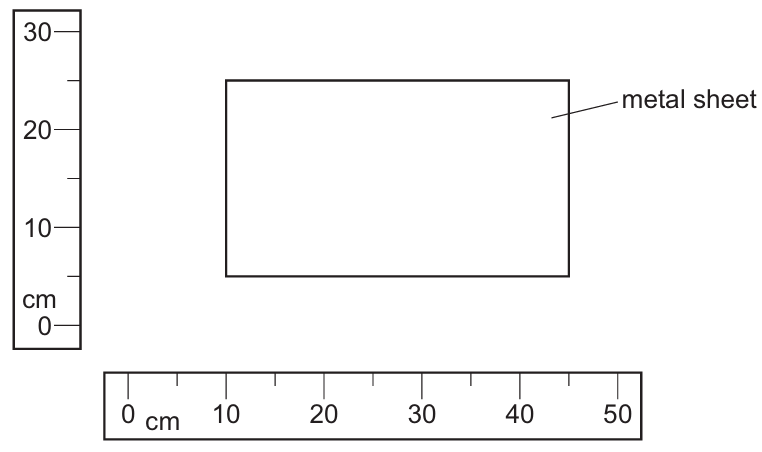
To determine the area of the rectangular metal sheet, we first need to find its length and width by reading the two rulers.
The horizontal ruler measures the length. The edges of the sheet align with the $10\text{ cm}$ and $45\text{ cm}$ marks, giving a length of $45\text{ cm} – 10\text{ cm} = 35\text{ cm}$.
The vertical ruler measures the width. The edges of the sheet align with the $10\text{ cm}$ and $30\text{ cm}$ marks, giving a width of $30\text{ cm} – 10\text{ cm} = 20\text{ cm}$.
The area of a rectangle is calculated by multiplying its length by its width.
Therefore, the total area is $35\text{ cm} \times 20\text{ cm} = 700\text{ cm}^2$, which exactly matches Option A.

▶️ Answer/Explanation
Detailed solution:
To find the acceleration from a speed-time graph, we need to look at the gradient or slope of the line.
The formula for acceleration is $a = \frac{\Delta v}{\Delta t}$, which corresponds directly to the steepness of the graph.
A steeper upward line indicates a greater change in speed over a given time, meaning a larger acceleration.
When we compare the different sections visually, section B clearly has the steepest positive slope.
Section A is less steep, C has zero slope (constant speed), and D shows deceleration (negative slope).
Therefore, the largest acceleration occurs in section B, making it the correct choice.
▶️ Answer/Explanation
Detailed solution:
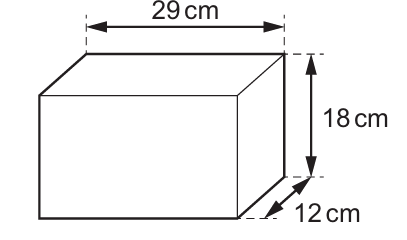
First, we need to determine the total volume of the concrete building block using the dimensions provided in the diagram.
The volume of a rectangular block is found by multiplying its length, width, and height ($V = l \times w \times h$).
Next, we use the standard formula for density, which is defined as mass per unit volume ($\rho = \frac{m}{V}$).
We are given the total mass of the block as $15000\text{ g}$.
By dividing this mass by the calculated volume from the diagram, we can easily find the density of the material.
The final calculation yields a density of $2.4\text{ g/cm}^3$, making Option B the correct choice.
▶️ Answer/Explanation
Detailed solution:
The stability of an object generally depends on two main factors: the width of its base and the height of its centre of gravity.
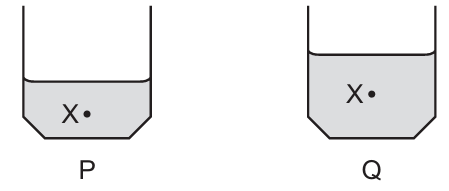
Since containers $P$ and $Q$ are completely identical in shape, they share the exact same base area.
For an object to be more stable and resist toppling over easily, its centre of gravity needs to be as low as possible.
Based on the position $X$ marked in the given scenario, container $P$ has a lower centre of gravity than container $Q$.
Therefore, container $P$ is more stable directly because of this lower centre of gravity, making Option A the correct choice.
▶️ Answer/Explanation
Detailed solution:
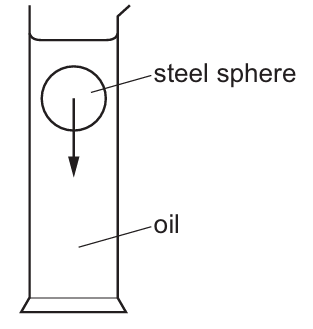
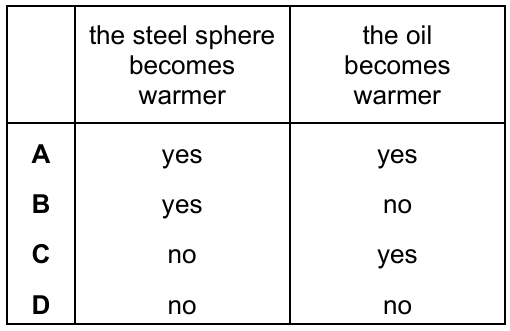
When the steel sphere falls through the viscous oil, it experiences friction (drag) as it moves against the fluid layers.
This friction causes some of the sphere’s kinetic and gravitational potential energy to be converted into thermal energy.
As a result, the internal energy of the steel sphere increases, leading to a rise in its temperature.
Similarly, the work done against the viscous forces of the oil increases the internal energy of the oil as well.
Therefore, both the steel sphere and the oil gain internal energy during the process.
This leads us to the conclusion that row A is the correct answer.

▶️ Answer/Explanation
Detailed solution:
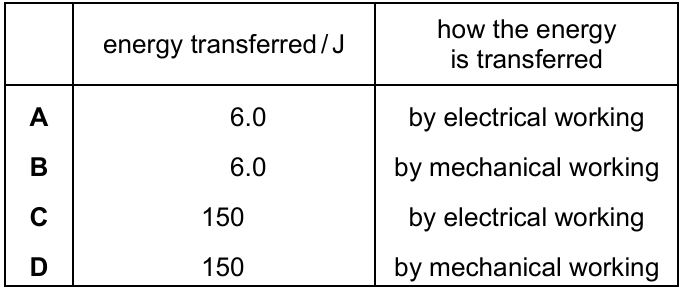
To find the energy transferred, we use the formula for work done: $W = F \times d$, where $F$ is the force and $d$ is the distance moved in the direction of the force.
Plugging in the given values, we get $30\text{ N} \times 5.0\text{ m} = 150\text{ J}$.
Since friction is the force acting against the motion, the energy is transferred mechanically as work is being done by the force.
The energy initially in the kinetic store of the object is transferred to the thermal store of the surroundings due to friction.
Looking at the table provided, the energy transferred is $150\text{ J}$ and the method of transfer is “mechanically”.
This corresponds correctly with Option D.
▶️ Answer/Explanation
Detailed solution:
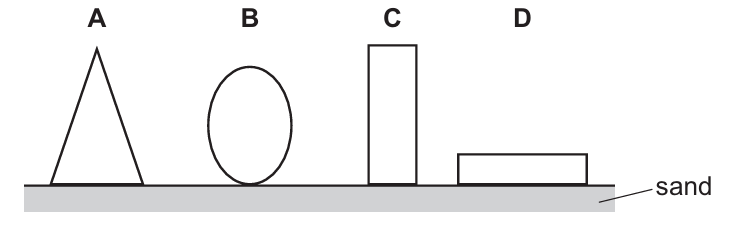
The likelihood of a sculpture sinking into the sand depends on the amount of pressure it exerts on the surface.
Pressure is defined as force per unit area, represented mathematically by the equation $P = \frac{F}{A}$.
Since all the sculptures share an equal weight, they exert the exact same downward force ($F$) onto the sand.
To minimize the pressure and thus be least likely to sink, a sculpture must distribute this constant force over the largest possible base area ($A$).
Sculpture D has the widest circular base, which yields the lowest pressure, making it the correct choice.
▶️ Answer/Explanation
Detailed solution:
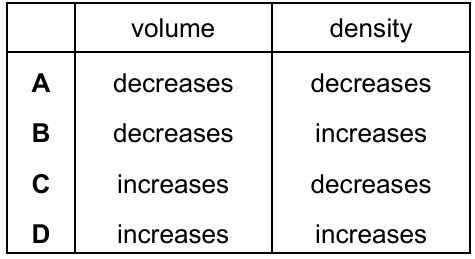
When liquid water turns into steam, the molecules gain energy and move much further apart, which causes the volume of the substance to increase significantly.
Since the mass remains constant as stated in the question, we look at the relationship $\text{density} = \frac{\text{mass}}{\text{volume}}$.
Because the volume increases while the mass stays the same, the density must decrease because the same amount of matter is now spread over a larger space.
In the given table, Row C correctly identifies that the volume increases and the density decreases during this phase change.
Therefore, Option C is the correct choice to describe the transition from water to steam.

▶️ Answer/Explanation
Detailed solution:
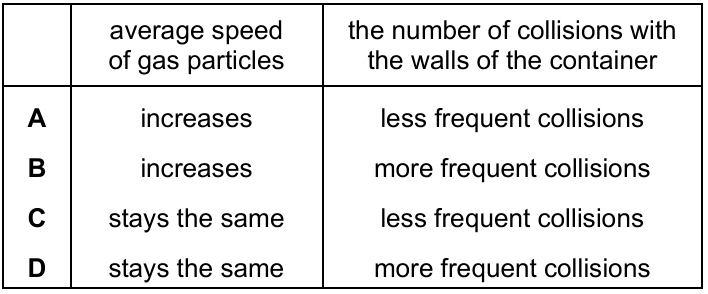
When the temperature of a gas in a sealed container is increased, the thermal energy is converted into kinetic energy.
This causes the average speed of the gas particles to increase, meaning they move much faster within the space.
Because the particles are moving faster within the same fixed volume of the container, they will travel between the walls in less time.
Consequently, they will strike the container walls more frequently.
Therefore, both the average speed of the particles and the number of collisions with the walls of the container will increase.
This corresponds to the conditions described in Option B.
▶️ Answer/Explanation
Detailed solution:
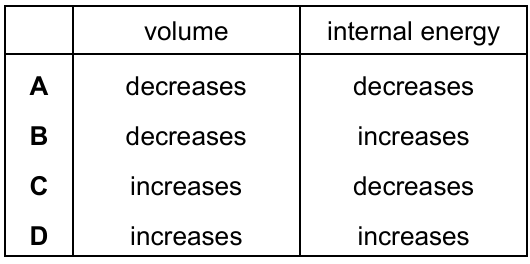
When a metal object is heated, the atoms gain kinetic energy and vibrate more vigorously, causing them to push slightly further apart. This microscopic behavior leads to thermal expansion, resulting in an increase in the overall volume of the object.
Simultaneously, heating increases the internal energy of the metal, which is the sum of the random kinetic and potential energies of its particles.
Since both the temperature and the average separation of the atoms increase, the internal energy must increase as well.
Looking at the provided table, the row where both volume and internal energy are described as increasing is row D.
Therefore, the correct observation for the heated object is represented by Option D.
▶️ Answer/Explanation
Detailed solution:
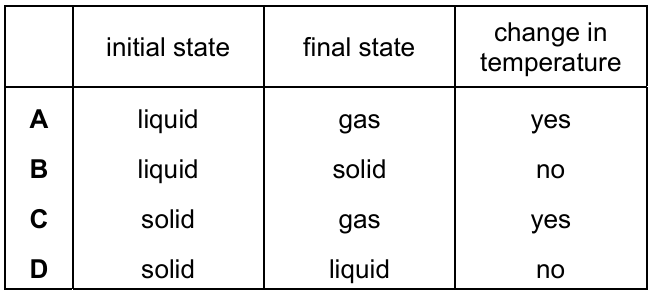
Melting is the physical process where a substance transitions from a solid state to a liquid state due to the absorption of thermal energy.
In the solid state, molecules or atoms are closely packed together in a regular lattice structure and can only vibrate around fixed positions.
As the substance melts, the added energy overcomes the strong intermolecular forces holding the rigid lattice together.
Consequently, in the resulting liquid state, the particles gain more kinetic energy and break free from their fixed positions.
This allows the particles to move more freely and slide past one another, while still remaining relatively close together.
Therefore, the row describing a change from vibrating in fixed positions to moving past one another correctly identifies melting, corresponding to Option D.
▶️ Answer/Explanation
Detailed solution:
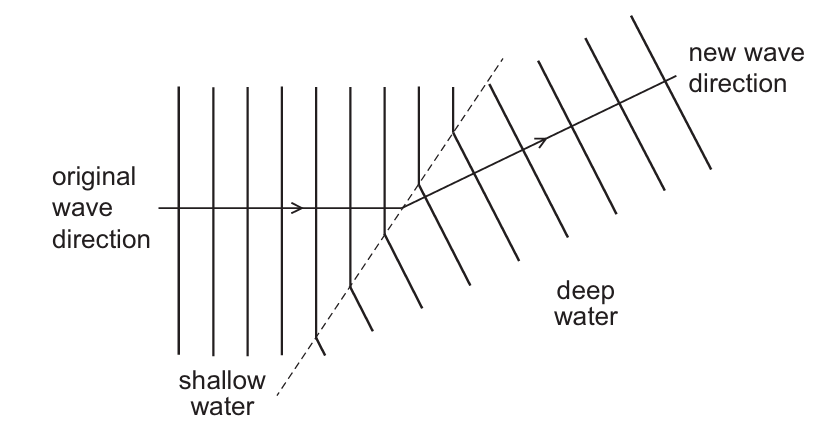
When water waves travel from a region of shallow water into deeper water, their wave speed naturally increases.
This abrupt change in speed across the boundary between the two depths causes the wavefronts to change their direction of propagation.
The phenomenon of a wave bending as it passes from one medium or condition to another is a fundamental wave property.
While diffraction involves spreading around obstacles and reflection is bouncing back, this bending due to a change in wave speed is exclusively known as refraction.
Therefore, the effect depicted in the diagram is refraction, which perfectly aligns with Option D.

▶️ Answer/Explanation
Detailed solution:
In a typical ray diagram for a plane mirror, solid lines are used to represent the actual paths of physical light, while dashed lines represent virtual extensions of these rays.
Looking at the given image, line $Z$ is the incident ray travelling from the real object to the surface of the mirror.
Similarly, line $Y$ is the reflected ray bouncing off the mirror and travelling towards the observer’s eye, meaning both $Y$ and $Z$ exist in real space.
Line $X$, however, is drawn behind the opaque mirror using a dashed line to locate where the virtual image appears to be; it does not represent a real light ray because light cannot pass through the mirror.
Consequently, only lines $Y$ and $Z$ represent actual light rays, making Option D the correct choice.
▶️ Answer/Explanation
Detailed solution:
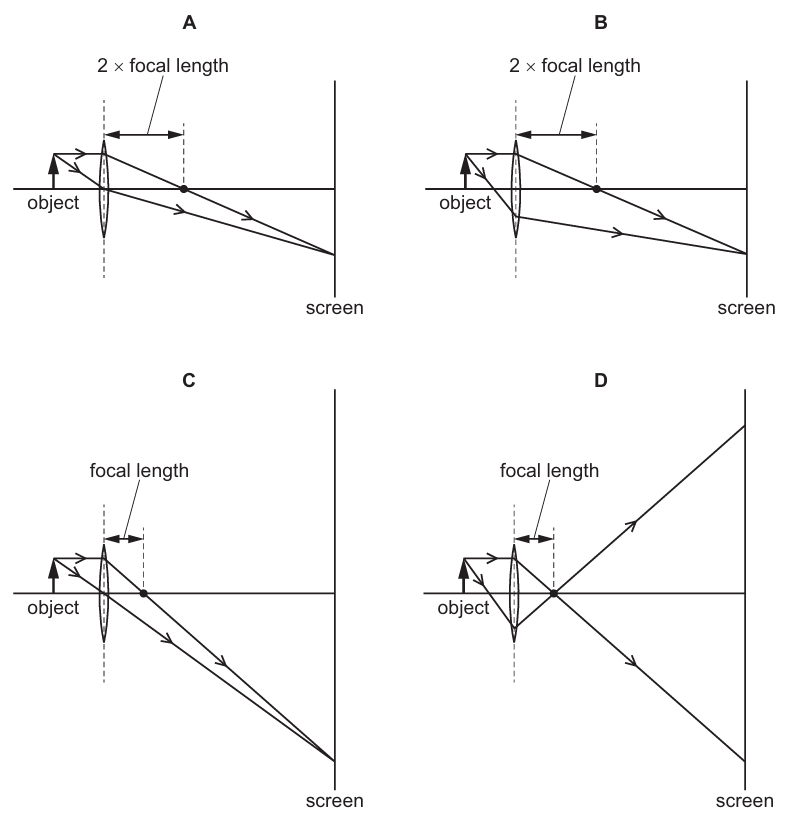
To form a real image on a screen using a converging lens, light rays from the object must pass through the lens and converge at a single point on the screen.
We need to follow the standard rules of ray diagrams: a ray parallel to the principal axis passes through the principal focus, and a ray passing through the center of the lens continues undeviated.
In diagram C, we can see that the rays originating from the top of the object accurately converge at a specific point on the screen after passing through the lens.
The other diagrams show rays that either do not converge properly or fail to follow the basic laws of refraction for a convex lens.
Therefore, diagram C is the only one that correctly illustrates the formation of a focused image on the screen.
▶️ Answer/Explanation
Detailed solution:
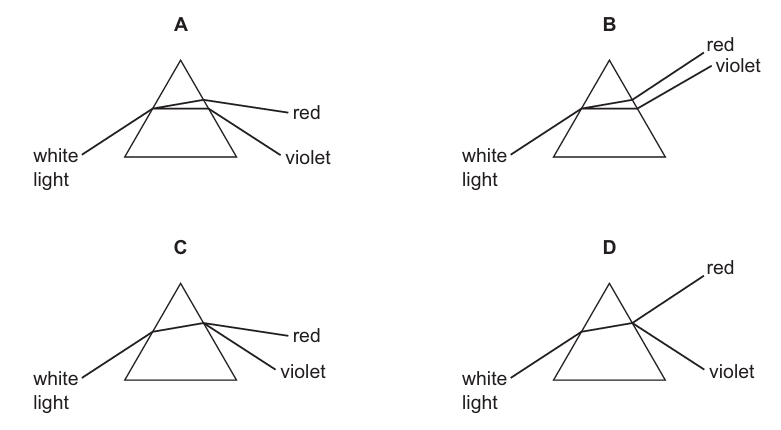
When white light passes through a glass prism, it undergoes a process called dispersion, splitting into its constituent colors.
Because different colors of light have different wavelengths, they travel at slightly different speeds inside the glass and refract (bend) by different amounts.
Red light has the longest wavelength in the visible spectrum and bends the least.
Violet light has the shortest wavelength and bends the most.
Diagram A correctly illustrates this phenomenon, showing the red light bending less than the violet light as it exits the prism.
▶️ Answer/Explanation
Detailed solution:
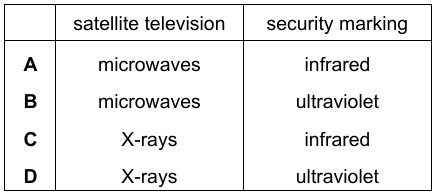
To solve this, we need to recall the specific applications for different parts of the electromagnetic spectrum. Satellite television requires waves that can pass through the Earth’s atmosphere without being reflected, which is a characteristic of microwaves. Security marking, often used on banknotes or IDs, involves materials that glow when exposed to ultraviolet (UV) radiation. Looking at the table provided in the image, microwaves are listed for satellite television and ultraviolet is listed for security marking in the second row. By matching these properties to the options, we can see that row B correctly identifies both uses. Therefore, the correct option is B.
▶️ Answer/Explanation
Detailed solution:
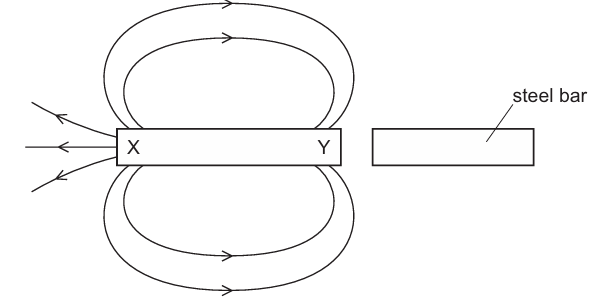
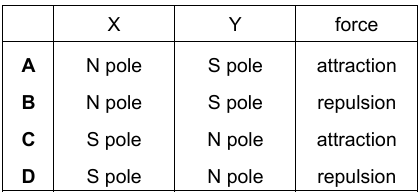
To identify the poles, we look at the direction of the magnetic field lines. Since magnetic field lines always point away from the North pole and toward the South pole, the end where lines emerge ($X$) is the North pole and the end where they enter ($Y$) is the South pole.
Next, we consider the interaction with the steel bar. Steel is a ferromagnetic material, which means it becomes an induced magnet when placed in a magnetic field.
The magnetic field from the bar magnet causes the domains in the steel bar to align, creating an opposite pole on the nearest side of the steel.
This induced magnetism always results in a force of attraction between the permanent magnet and the unmagnetized magnetic material.
Therefore, $X$ is North, $Y$ is South, and the bars will attract, which corresponds to Option A.
▶️ Answer/Explanation
Detailed solution:
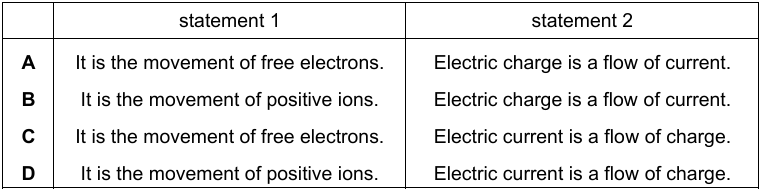
In a metallic conductor, the structure consists of a lattice of positive ions surrounded by a “sea” of delocalized electrons.
When an electric potential difference is applied, it is these free electrons that move through the lattice to create a current.
The positive ions remain fixed in their lattice positions and do not move to conduct electricity.
By convention, the direction of conventional current is from positive to negative, but the actual flow of electrons is from negative to positive.
Therefore, the particles that move are electrons and their direction of flow is towards the positive terminal, which corresponds to row C.
▶️ Answer/Explanation
Detailed solution:
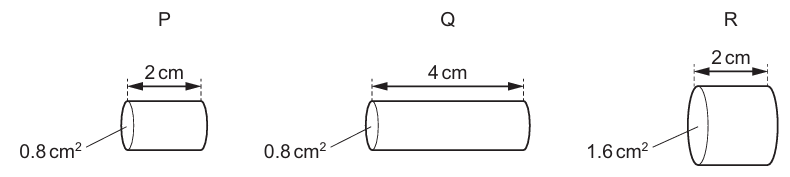
Resistance is determined by the formula $R = \rho \frac{L}{A}$, where $\rho$ is the resistivity, $L$ is length, and $A$ is cross-sectional area. Since all wires are the same metal, $\rho$ is constant, so we compare the ratio $L/A$.For wire P, the ratio is $L/A$. For wire Q, which is longer and thinner, the ratio is $2L / (0.5A) = 4(L/A)$, meaning it has the highest resistance.For wire R, which is short and thick, the ratio is $0.5L / 2A = 0.25(L/A)$, giving it the lowest resistance.Ordering these from lowest to highest gives us R ($0.25$), then P ($1$), then Q ($4$).Therefore, the correct sequence is R → P → Q, which matches Option C.
▶️ Answer/Explanation
Detailed solution:
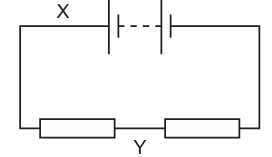
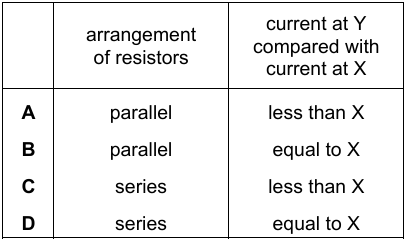
Looking at the circuit, we can see that the two identical resistors are connected in parallel with each other. According to Kirchhoff’s first law, the total current leaving the battery splits into the two parallel branches.
Since the resistors are identical, the resistance in each branch is equal, meaning the current will split equally between them.
Point $X$ is located on the main wire before the split, so it measures the total current, while point $Y$ is in one of the parallel branches.
Therefore, the current at $X$ must be twice the current at $Y$ ($I_X = 2 \times I_Y$).
Checking the table, only row D satisfies this relationship with $I_X = 4.0\text{ A}$ and $I_Y = 2.0\text{ A}$.
▶️ Answer/Explanation
Detailed solution:
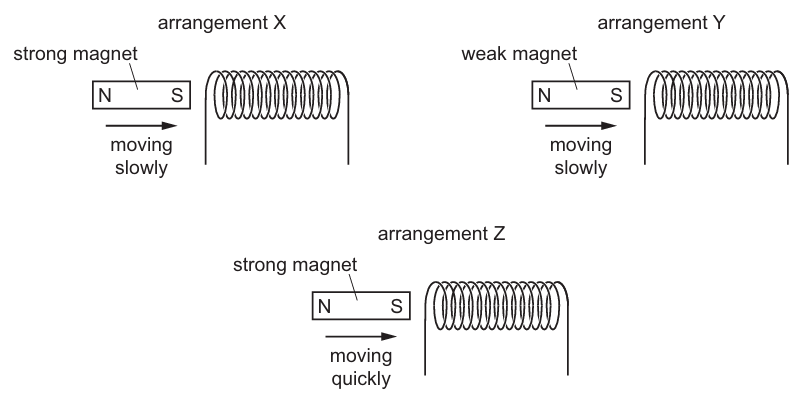
The magnitude of the induced electromotive force (e.m.f.) is determined by the rate at which the magnetic flux linkage changes through the coil.
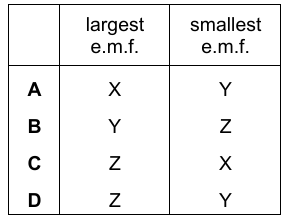
To induce the largest e.m.f., we need the highest rate of change, which is achieved by using the strong magnet moving at a high speed ($v = 4\text{ m/s}$), corresponding to arrangement $1$.
Conversely, the smallest e.m.f. is induced when the change in flux is slowest, which occurs with the weak magnet moving at the lowest speed ($v = 1\text{ m/s}$), as seen in arrangement $4$.
By comparing the arrangements, $1$ provides the maximum change per second while $4$ provides the minimum.
Therefore, the largest e.m.f. is in arrangement $1$ and the smallest is in arrangement $4$, which matches Option D.
▶️ Answer/Explanation
Detailed solution:
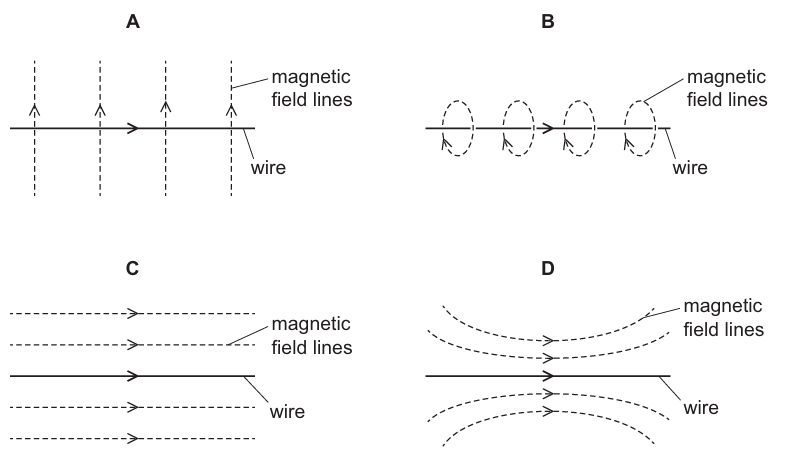
To determine the direction of the magnetic field around a straight wire, we use the Right-Hand Grip Rule.
Imagine gripping the wire with your right hand so that your thumb points in the direction of the conventional current flow.
Your fingers will then naturally curl in the direction of the magnetic field lines, which form concentric circles around the wire.
In diagram B, the current is moving upward; placing your thumb upward causes your fingers to curl counter-clockwise when viewed from above.
The arrows in diagram B correctly represent this circular field pattern, whereas other diagrams show incorrect field shapes or directions.
Therefore, diagram B is the correct representation of the magnetic field.
▶️ Answer/Explanation
Detailed solution:
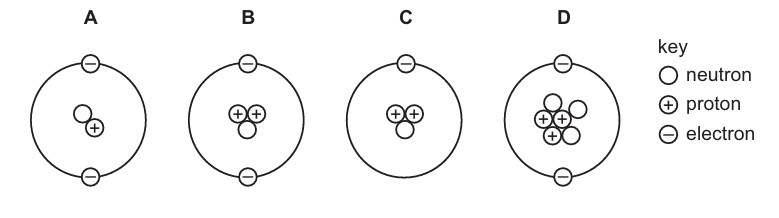
For an atom to be neutral, the total positive charge in the nucleus must be exactly balanced by the total negative charge of the orbiting electrons.
In the nucleus, protons carry a charge of $+1$ and neutrons carry a charge of $0$. Electrons orbiting the nucleus carry a charge of $-1$.
By checking the diagrams, we look for the one where the number of protons equals the number of electrons.
In diagram B, there are $2$ protons and $2$ electrons, meaning the net charge is $(+2) + (-2) = 0$.
Therefore, diagram B correctly represents the structure of a neutral atom.
▶️ Answer/Explanation
Detailed solution:
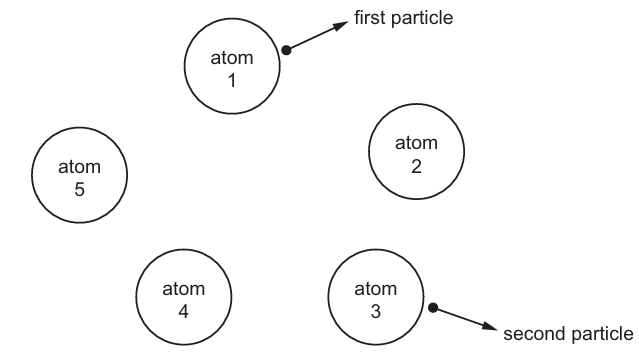
Radioactive decay is a completely random and spontaneous process at the atomic level.
While we can predict the behavior of a large number of atoms using half-life, we cannot predict when an individual nucleus will decay.
The fact that Atom $1$ and Atom $3$ have already decayed does not provide any information about the sequence of the remaining atoms.
Each remaining nucleus has the same probability of decaying next, regardless of its position or the history of previous decays.
Therefore, it is impossible to tell which specific atom will be the next to emit an $\alpha$-particle.
This leads us to Option D.
▶️ Answer/Explanation
Detailed solution:
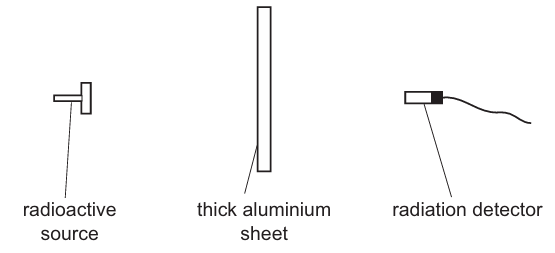
To identify the radiation, we look at the penetrating power of each type relative to the thick aluminium sheet.
$\alpha$-particles are stopped by a thin sheet of paper, so they definitely cannot pass through thick aluminium.
$\beta$-particles are typically stopped by a few millimeters of aluminium, meaning they would be blocked by a thick sheet.
$\gamma$-radiation is highly penetrating and can pass through several centimeters of aluminium or even lead.
Since the detector is still showing a reading above background levels, the radiation must have passed through the sheet.
Therefore, the source must be emitting $\gamma$-radiation, which corresponds to Option C.
▶️ Answer/Explanation
Detailed solution:
To solve this, we need to classify both the Sun and the Milky Way based on astronomical definitions.
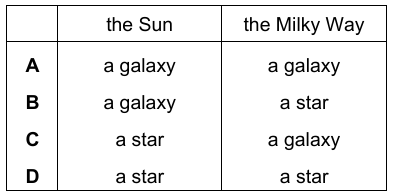
The Sun is a medium-sized star located at the center of our solar system, so it is correctly identified as a star.
The Milky Way is the vast collection of billions of stars, gas, and dust that contains our solar system, which defines it as a galaxy.
Looking at the table, Row $C$ correctly identifies the Sun as a star and the Milky Way as a galaxy.
Other options incorrectly classify the Milky Way as a solar system or the Sun as a galaxy.
Therefore, Option $C$ is the only accurate description.