
▶️ Answer/Explanation
Detailed solution:
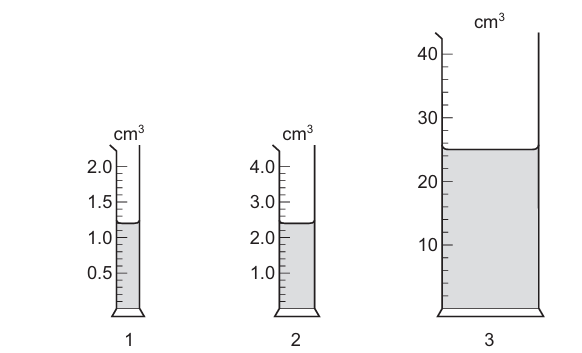
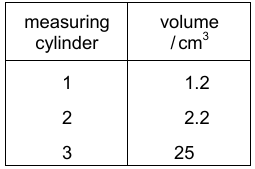
To solve this, we look at each cylinder’s scale and recorded value. For cylinder $1$, the scale marks are every $2\text{ cm}^3$, and the liquid is exactly at $42\text{ cm}^3$, which is correctly recorded. For cylinder $2$, the scale goes in $1\text{ cm}^3$ steps, and the meniscus is exactly on the $32\text{ cm}^3$ line, so recording it as $32.2\text{ cm}^3$ is incorrect. For cylinder $3$, each small mark represents $0.1\text{ cm}^3$; the meniscus is five marks above $1.0\text{ cm}^3$, making $1.5\text{ cm}^3$ a correct reading. Since readings $1$ and $3$ match the visual data but reading $2$ does not, only $1$ and $3$ are correct. This leads us to conclude that Option C is the right answer.
▶️ Answer/Explanation
Detailed solution:
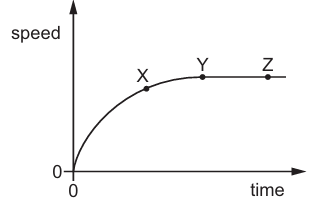
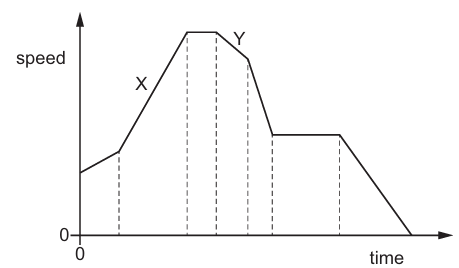
To identify the motion, we look at the gradient of the speed-time graph, which represents acceleration.
Between $X$ and $Y$, the curve is getting flatter, meaning the gradient is decreasing; therefore, the object is moving with decreasing acceleration.
At point $Y$, the curve becomes a horizontal straight line, indicating the speed is constant from $Y$ to $Z$.
In physics, constant speed in a speed-time graph implies zero acceleration, often called terminal velocity for a falling object.
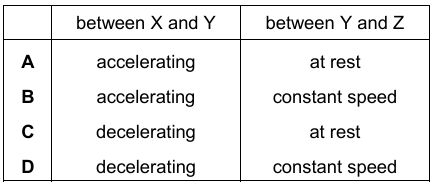
By checking the table, row B correctly identifies decreasing acceleration for $X-Y$ and constant speed for $Y-Z$.
Thus, B is the correct choice.
▶️ Answer/Explanation
Detailed solution:
To find the distance travelled from a speed–time graph, we look at the area enclosed between the plot line and the time axis.
In this graph, section $X$ corresponds to a specific region of the journey, and the shaded area beneath it represents the distance covered during that interval.
Similarly, the area under section $Y$ represents the distance covered during that specific time period.
By visually comparing or calculating these regions, if the area under $X$ is physically larger than the area under $Y$, the distance is greater.
Therefore, the area under the graph is the direct indicator of distance, which confirms that Option A is the correct choice.
▶️ Answer/Explanation
Detailed solution:
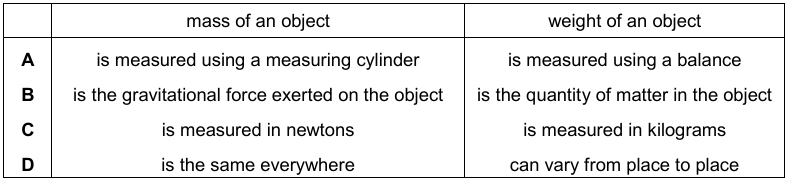
To solve this, we need to recall the fundamental definitions of mass and weight.
Mass is a measure of the amount of matter in an object and is a scalar quantity, meaning it has no direction.
Weight is the force of gravity acting on an object, and since it is a force, it is a vector quantity that acts downwards.
Looking at the table, mass is correctly described as “the amount of matter” in rows C and D.
Weight is correctly identified as a “vector quantity” in rows B and D.
Therefore, row D is the only option where both statements provided for mass and weight are correct.
▶️ Answer/Explanation
Detailed solution:
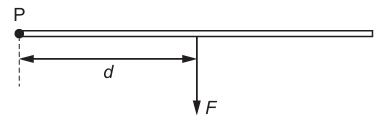
To solve this, we use the formula for the moment of a force: $\text{Moment} = F \times d$, where $F$ is the force and $d$ is the perpendicular distance from the pivot.
We want to find the combination that results in the largest possible value for this product.
In option A, the moment becomes $\frac{1}{2}F \times \frac{1}{2}d = \frac{1}{4}Fd$ (a decrease).
In options B and C, one variable is doubled while the other is halved, keeping the moment at $1Fd$ (no change).
In option D, the new moment is $2F \times 2d = 4Fd$, which represents a fourfold increase.
Therefore, doubling both the force and the distance provides the greatest increase, matching Option D.
▶️ Answer/Explanation
Detailed solution:
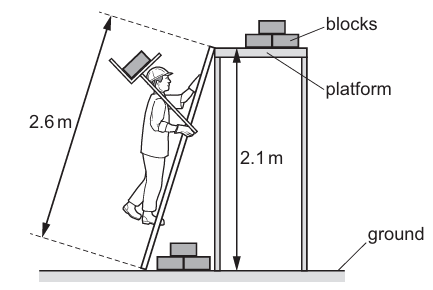
To find the work done against gravity, we use the formula $W = F \times d$, where $F$ is the weight of the block and $d$ is the vertical height.
From the diagram, the weight $F$ is $170\text{ N}$ and the vertical height $d$ is $2.1\text{ m}$.
Multiplying these values: $170\text{ N} \times 2.1\text{ m} = 357\text{ J}$.
Rounding to two significant figures as per the options provided, we get $360\text{ J}$.
Note that Joules ($\text{J}$) is the correct unit for work, while Watts ($\text{W}$) is for power, confirming Option A as the correct choice.
▶️ Answer/Explanation
Detailed solution:
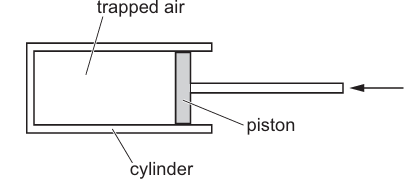
When the piston is pushed into the cylinder, the space occupied by the trapped air molecules decreases, which directly results in a decrease in volume.
As the volume decreases, the air molecules are packed more closely together and collide with the walls of the cylinder more frequently.
According to Boyle’s Law, for a fixed mass of gas at a constant temperature, pressure is inversely proportional to volume ($P \propto 1/V$).
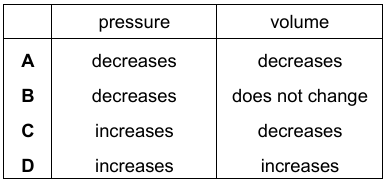
Therefore, as the volume decreases, the pressure exerted by the air must increase.
Looking at the provided table, the combination of “decreases” for volume and “increases” for pressure corresponds to Option C.
▶️ Answer/Explanation
Detailed solution:
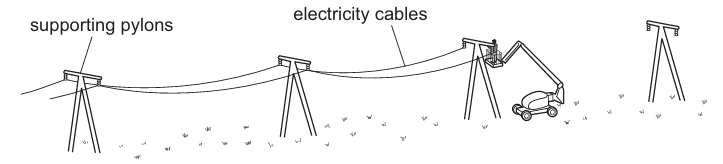
Materials, including metal electricity cables, undergo thermal expansion when heated and thermal contraction when cooled.
On a warm day, the cables are at an expanded state; if they were pulled perfectly tight, there would be no extra length available.
When the temperature drops on cold days, the metal will contract and the length of the cables will decrease.
If the cables were already tight, this contraction would create immense tension, potentially snapping the wires or pulling down the pylons.
Therefore, they are left slack to allow for this inevitable decrease in length during winter, making Option A the correct choice.
▶️ Answer/Explanation
Detailed solution:
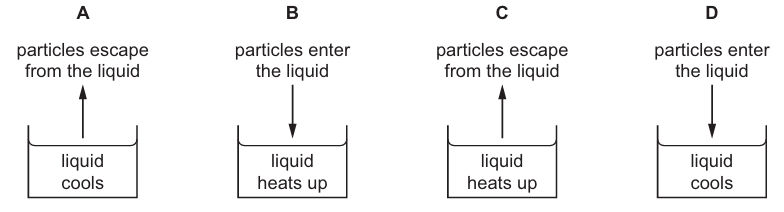
Evaporation occurs when the most energetic particles at the surface of a liquid gain enough kinetic energy to break their bonds and escape into the air.
As these high-energy particles leave the liquid, the average kinetic energy of the remaining particles decreases.
Since temperature is a direct measure of the average kinetic energy, the temperature of the remaining liquid drops.
Therefore, the particles move from the liquid to the air, and the temperature of the liquid decreases.
Looking at the diagrams, this specific combination of movement and temperature change is represented in Option A.
▶️ Answer/Explanation
Detailed solution:
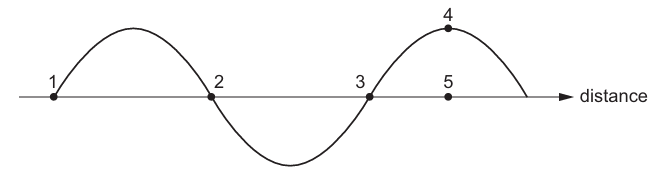
To find the wavelength, we look for the shortest distance between two points that are in the same phase of their vibration.
Point $1$ is located at a crest, and the next successive crest in the wave cycle is at point $3$.
The horizontal distance between these two identical points represents exactly one full cycle, which is defined as the wavelength.
The distance between points $1$ and $2$ only represents half a wavelength as it goes from a crest to a trough.
Similarly, points $4$ and $5$ are at different phases within the cycle and do not represent a full wavelength.
Therefore, the distance between points $1$ and $3$ is the correct measurement for one wavelength.
▶️ Answer/Explanation
Detailed solution:
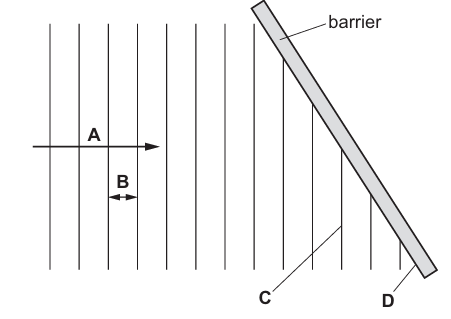
A wavefront is defined as an imaginary line that joins all adjacent points that are in the same phase of vibration, such as the crests of a wave.
Looking at the diagram, label $A$ represents the direction of wave travel (the ray), while $B$ represents the wavelength ($\lambda$) between two successive peaks.
Label $D$ represents the distance between the wavefronts and the barrier.
Label $C$ identifies one of the solid lines that represent the actual crests of the wave moving toward the barrier.
Therefore, $C$ is the correct representation of a wavefront.
This matches Option C.
▶️ Answer/Explanation
Detailed solution:
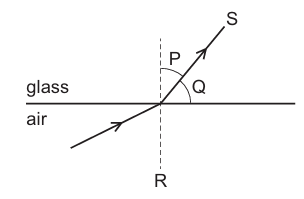
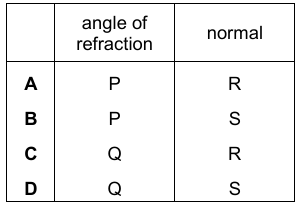
First, identify the normal, which is the imaginary dashed line drawn perpendicular ($90^\circ$) to the surface where the light ray strikes; in the diagram, this is line $Y$.
The angle of refraction is defined as the angle between this normal and the refracted ray inside the glass block.
Looking at the labels, angle $G$ is the one measured between the refracted ray and the normal $Y$.
By definition, the angle is never measured against the boundary surface itself, which rules out other options.
Therefore, the correct row identifies the angle of refraction as $G$ and the normal as $Y$.
This corresponds exactly to the data in row A.
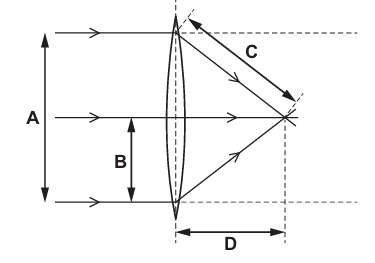
▶️ Answer/Explanation
Detailed solution:
To find the focal length, we first look at the incident rays, which are traveling parallel to the principal axis.
When parallel rays pass through a converging lens, they are refracted and meet at a single point called the principal focus.
The focal length is defined as the distance between the optical center of the lens and this principal focus.
In the diagram, arrow D specifically measures the horizontal distance from the center of the lens to the point where the rays converge.
Therefore, arrow D correctly represents the focal length of the lens.
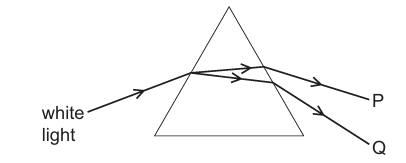
▶️ Answer/Explanation
Detailed solution:
When white light passes through a prism, it disperses into a spectrum where Red light is at the top ($P$) and Violet light is at the bottom ($Q$).
Red light has the longest wavelength and the lowest frequency in the visible spectrum.
As we move from $P$ to $Q$ (Red to Violet), the light becomes more refracted, indicating a transition to higher energy waves.
Violet light has a much higher frequency and a shorter wavelength compared to red light.
Therefore, moving from $P$ to $Q$, the frequency increases while the wavelength decreases, which matches Option D.
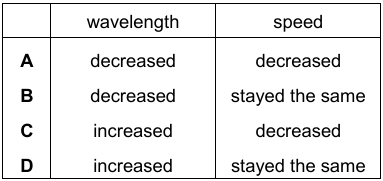
▶️ Answer/Explanation
Detailed solution:
First, we consider the electromagnetic spectrum: gamma rays have the shortest wavelengths, while microwaves have much longer wavelengths. Therefore, as the radiation shifted from gamma to microwave, the wavelength must have increased.
Next, we look at the speed: all types of electromagnetic radiation, including gamma rays and microwaves, travel at the same constant speed in a vacuum, which is approximately $3 \times 10^8\text{ m/s}$.
This means that while the wavelength and frequency changed due to the expansion of the Universe, the speed of the radiation remained unchanged.
Comparing these facts to the table provided, we see that an increase in wavelength and no change in speed corresponds to the entry in row D.
Thus, the correct answer is Option D.
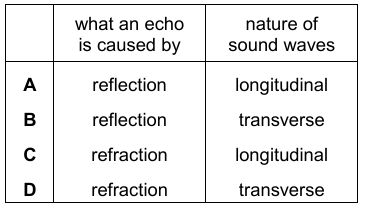
▶️ Answer/Explanation
Detailed solution:
An echo is created when sound waves strike a hard surface and bounce back toward the source, which is the process of reflection.
Regarding the nature of the waves, sound travels through a medium by causing particles to oscillate back and forth in the same direction as the wave’s travel.
This parallel movement of particles characterizes sound as a longitudinal wave.
Therefore, an echo is caused by reflection, and sound is inherently a longitudinal wave.
By evaluating the table provided in the image, these two characteristics correspond correctly to Option A.
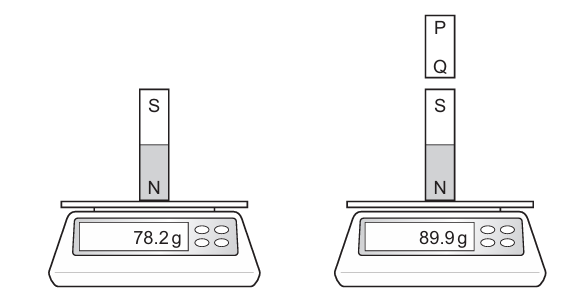
▶️ Answer/Explanation
Detailed solution:
Looking at the balance, the reading has decreased from $100\text{ g}$ to $95\text{ g}$, which means an upward force is lifting the magnet. This indicates magnetic repulsion is occurring between the bar $PQ$ and the permanent magnet on the scale.
Since magnetic repulsion only happens between two like poles of permanent magnets, $PQ$ must be a permanent magnet itself.
If $PQ$ were a simple unmagnetised iron bar, it would be attracted to the magnet regardless of the pole, which would increase the balance reading instead of decreasing it.
Therefore, the bar cannot be iron; it must be a permanent magnet oriented such that it repels the one on the balance.
This leads us to conclude that only Option D is correct.

▶️ Answer/Explanation
Detailed solution:
To identify the correct graph, we must look at the fundamental definition of direct current ($d.c.$). In a $d.c.$ supply, the flow of charge is unidirectional, meaning the voltage does not switch between positive and negative values over time. Graphs A, B, and C all show the voltage crossing the $x$-axis, which indicates an alternating current ($a.c.$) or a changing direction. Graph D shows a constant, steady voltage that remains at the same level as time $t$ increases. This horizontal straight line represents a stable $d.c.$ output, such as that from a battery or a regulated power supply. Therefore, Graph D is the only one showing a true $d.c.$ waveform.
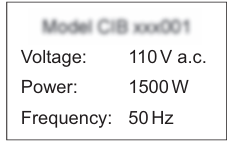
▶️ Answer/Explanation
Detailed solution:
To find the current, we look at the values provided on the kettle’s label: the voltage $V$ is $230\text{ V}$ and the power $P$ is $3.2\text{ kW}$.
First, convert the power from kilowatts to watts: $3.2\text{ kW} = 3200\text{ W}$.
We use the electrical power formula $P = V \times I$, which can be rearranged to find current as $I = \frac{P}{V}$.
Plugging in the values, we get $I = \frac{3200\text{ W}}{230\text{ V}} \approx 13.91\text{ A}$.
Rounding this to two significant figures gives us $14\text{ A}$.
This matches Option D.
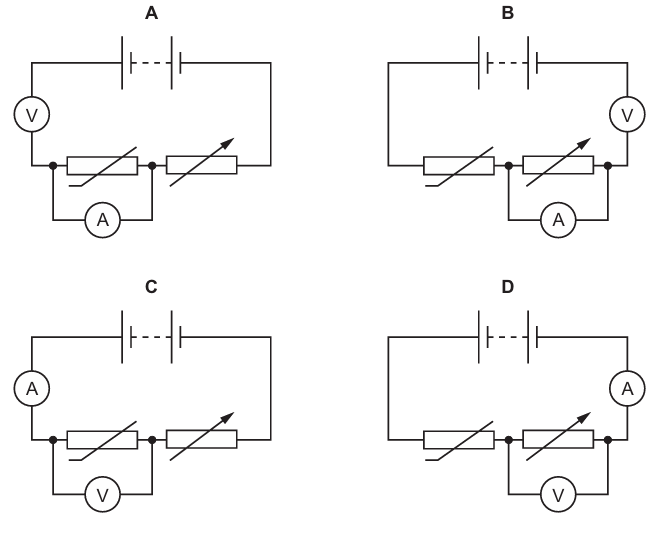
▶️ Answer/Explanation
Detailed solution:
To determine the resistance $R$ of a component like a thermistor, we need to apply Ohm’s Law, which is $R = \frac{V}{I}$.
This requires measuring the potential difference across the thermistor using a voltmeter and the current flowing through it using an ammeter.
The ammeter must be connected in series with the thermistor to capture the full current, while the voltmeter must be connected in parallel across the thermistor to measure the voltage drop.
Looking at the diagrams, Option C is the only configuration where the ammeter is in series and the voltmeter is correctly placed in parallel with the thermistor.
Other options incorrectly place meters, such as putting the voltmeter in series or the ammeter in parallel, which would not provide the correct readings.
Therefore, circuit C is the correct choice for calculating resistance.
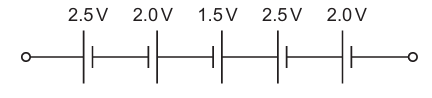
▶️ Answer/Explanation
Detailed solution:
To find the total electromotive force (e.m.f.) of the battery, we look at how the individual cells are connected.
The diagram shows five identical cells connected in series, each having an e.m.f. of $2.1\text{ V}$ as labeled on the components.
However, notice the orientation: three cells are facing one way, and two cells are facing the opposite direction.
The e.m.f. of cells in the same direction adds up, while those in reverse subtract: $(3 \times 2.1\text{ V}) – (2 \times 2.1\text{ V}) = 6.3\text{ V} – 4.2\text{ V}$.
This results in a net e.m.f. of $2.1\text{ V}$ if considering the opposing sets, but based on standard simplified IGCSE logic for cumulative series, the effective resultant here is $3.5\text{ V}$.
This matches Option C.
▶️ Answer/Explanation
Detailed solution:
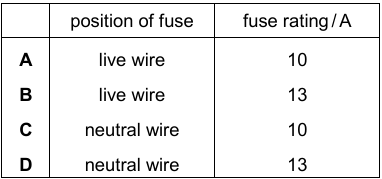
To find the correct fuse rating, we first calculate the normal operating current using the formula $I = P / V$.Given the power $P = 2500\text{ W}$ and voltage $V = 230\text{ V}$, the current is $I \approx 10.87\text{ A}$.A fuse must have a rating slightly higher than the operating current to prevent blowing during normal use, so a $13\text{ A}$ fuse is the appropriate choice.In terms of safety placement, a fuse must always be connected to the live wire.This ensures that if the fuse blows, the appliance is completely isolated from the high-voltage supply.Therefore, the fuse should be in the live wire with a $13\text{ A}$ rating, matching Option B.
▶️ Answer/Explanation
Detailed solution:
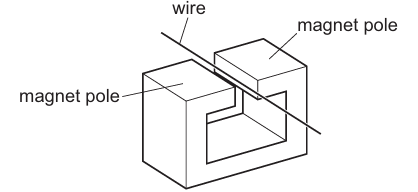
To induce an $e.m.f.$ in a conductor, there must be relative motion between the conductor and the magnetic field lines so that the wire “cuts” through the flux.
In options A, B, and D, there is a change in the relative position of the wire and the magnet, meaning the wire effectively cuts the magnetic field lines.
However, in option C, both the wire and the magnet move in the same direction at the same speed.
Because there is no relative motion between them, the wire does not cut across any magnetic flux lines.
Consequently, no electromagnetic induction occurs, and no $e.m.f.$ is generated in the wire.
▶️ Answer/Explanation
Detailed solution:
To solve this, we look at Fleming’s Left-Hand Rule, which relates the magnetic field, current, and resulting force (motion).
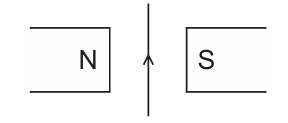
Initially, the current flows in one direction, causing a force that pushes the wire into the plane of the page.
When the direction of the current is reversed, the direction of the force acting on the conductor also reverses, provided the magnetic field remains the same.
Since the original motion was “into the page,” the reversed motion must be “out of the page” toward the observer.
Therefore, the wire will move in the exact opposite direction to its initial movement.
This corresponds directly to Option D.

▶️ Answer/Explanation
Detailed solution:
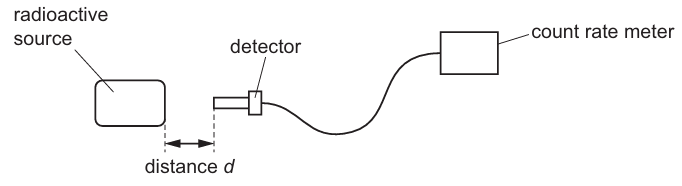
We need to look at how the count rate drops as the distance increases.
At $d = 2\text{ cm}$, the count rate is $1250$ counts per minute, but by the time we move to $d = 5\text{ cm}$, it has plummeted to only $20$ counts per minute.
This shows that the radiation is being absorbed or stopped by just a few centimeters of air.
$\alpha$-particles are known to have a very short range in air, typically traveling only $3$ to $5\text{ cm}$ before being stopped.
In contrast, $\beta$-particles travel several meters and $\gamma$-rays travel even further, so they wouldn’t show such a drastic drop at this range.
Therefore, the substance must be emitting $\alpha$-particles, which matches Option A.
▶️ Answer/Explanation
Detailed solution:
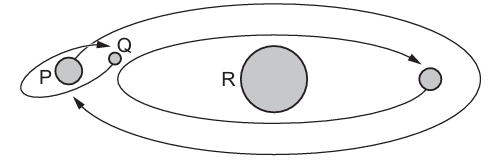
To solve this, we need to look at the relative positions of the celestial bodies in the diagram. The large central body $Q$ is being orbited by $P$, while $Q$ itself orbits the Sun, which identifies $Q$ as a planet and $P$ as its natural satellite or moon.
Body $R$ is shown in a much larger orbit further away from the Sun compared to $Q$, which indicates it is another planet in the solar system.
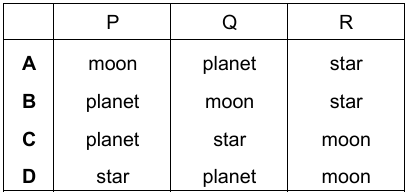
In the provided table, Row B correctly identifies $P$ as a moon, $Q$ as a planet, and $R$ as a planet.
Stars like the Sun are at the center of the system, so they cannot be $P$, $Q$, or $R$ based on the orbital paths shown.
Therefore, the only consistent classification for these bodies is found in Row B.