Home / 0625_w24_qp_13

Question 1

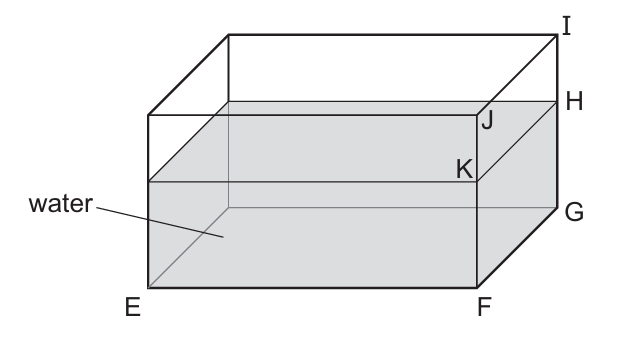
A student uses a ruler to find the volume of water in a tank.She measures the lengths $EF$ and $FG$.
What other length does she need to measure?
A. $FJ$
B. $FK$
C. $HI$
D. $IJ$

Most-appropriate topic codes (Cambridge IGCSE Physics 0625):

TOPIC 1.4: Density (Measurement of volume of a regular solid)
▶️ Answer/Explanation
Correct Option: B

Detailed solution:

To calculate the volume of a rectangular body of water, we need three dimensions: length, width, and the depth of the water itself.The student has already measured $EF$ (representing the width) and $FG$ (representing the length) of the tank.To find the volume of the water, she specifically needs the vertical height of the liquid column.Looking at the diagram, the line segment $FK$ represents the depth from the surface of the water to the bottom of the tank.Measuring $FJ$ or other external container heights would be incorrect as they do not represent the actual space occupied by the water.Therefore, $FK$ is the required third dimension to complete the calculation: $\text{Volume} = EF \times FG \times FK$.
Question 2

Which statement is correct?
A. speed = distance travelled $\times$ time taken
B. speed = velocity in a given direction
C. velocity = $\frac{\text{time taken}}{\text{distance travelled}}$
D. velocity = speed in a given direction

Most-appropriate topic codes (Cambridge IGCSE Physics 0625):

TOPIC 1.2: Motion
▶️ Answer/Explanation
Correct Option: D

Detailed solution:

To find the correct statement, we need to distinguish between scalar and vector quantities in kinematics.Speed is a scalar quantity defined as distance divided by time, making option A and C mathematically incorrect.Velocity is a vector quantity, which means it consists of both a magnitude (speed) and a specific direction.Option B is incorrect because speed is only the magnitude and does not include direction.Therefore, velocity is accurately described as speed in a given direction, which aligns with the definition of a vector.This confirms that Option D is the correct statement.

Question 3

A stone falls freely from the top of a cliff. Air resistance may be ignored.
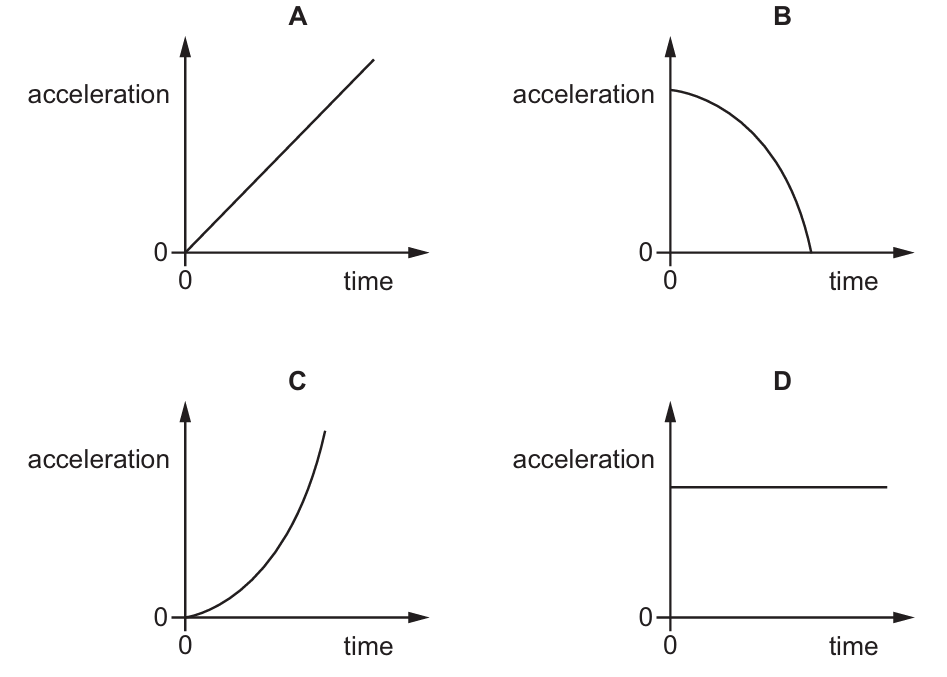
Which graph shows how the acceleration of the stone varies with time as it falls?

Most-appropriate topic codes (Cambridge IGCSE Physics 0625):

TOPIC 1.2: Motion
▶️ Answer/Explanation
Correct Option: D

Detailed solution:

When an object falls freely near the Earth’s surface and air resistance is ignored, it is only under the influence of gravity.In this “free fall” state, the object experiences a constant acceleration known as the acceleration due to gravity, which is approximately $9.8\text{ m/s}^2$ or $10\text{ m/s}^2$.Since the question states that air resistance is ignored, this acceleration remains uniform and does not change as the stone falls over time.Looking at the graphs, a constant acceleration over time is represented by a horizontal straight line.Therefore, Graph D correctly depicts the acceleration remaining at a fixed non-zero value, matching the physics of free fall.
Question 4

Which statement about weight is correct?
A. It is a measure of the quantity of matter in an object.
B. It is the gravitational force on an object that has mass.
C. It is equivalent to the acceleration of free fall.
D. It is the gravitational force per unit mass.

Most-appropriate topic codes (Cambridge IGCSE Physics 0625):

TOPIC 1.3: Mass and Weight
▶️ Answer/Explanation
Correct Option: B

Detailed solution:

To identify the correct statement, we must distinguish between mass and weight. Mass is the measure of the quantity of matter in an object, which rules out Option A. Weight, on the other hand, is specifically defined as the force of gravity acting on an object with mass. This is represented by the formula $W = m \times g$, where $W$ is weight and $g$ is the gravitational field strength. Option C is incorrect as it describes acceleration, and Option D actually defines gravitational field strength ($g$), not weight itself. Therefore, the statement that weight is the gravitational force on an object is correct, matching Option B.

Question 5

A student uses the equation $\rho = \frac{m}{V}$.
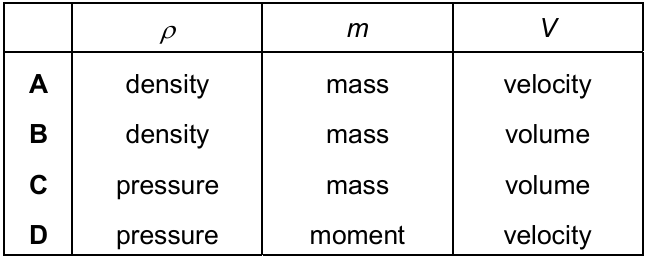
Which row shows the correct meaning of these symbols?

Most-appropriate topic codes (Cambridge IGCSE Physics 0625):

TOPIC 1.4: Density
▶️ Answer/Explanation
Correct Option: B

Detailed solution:

To solve this, we need to identify the standard variables used in the density formula $\rho = \frac{m}{V}$.
The Greek letter $\rho$ (rho) specifically represents density, which is defined as mass per unit volume.
The symbol $m$ represents the mass of the object, while $V$ represents the volume it occupies.
Looking at the table, Row B correctly identifies $\rho$ as density, $m$ as mass, and $V$ as volume.
Other options misidentify the variables, such as swapping mass and volume or using weight incorrectly.
Therefore, Row B is the only logically correct choice for this physical equation.
Question 6

What is the point at which the weight of an object appears to act?
A. the centre of gravity of the object
B. the density of the object
C. the moment of a force about a point
D. the pressure on the object due to its depth

Most-appropriate topic codes:

TOPIC 1.5.3: Centre of gravity
▶️ Answer/Explanation
Correct Option: A

Detailed solution:

To solve this, we need to recall the fundamental definition used in physics for mass distribution. The weight of an object is actually distributed throughout its entire volume because gravity acts on every single particle.
However, for the sake of simplifying calculations and understanding mechanics, we represent this entire gravitational pull as a single force.
This single force is considered to act through a unique point called the centre of gravity.
While density refers to mass per unit volume and moments refer to turning effects, only the centre of gravity describes the point of action for weight.
Therefore, the correct definition is provided in Option A.

Question 7

A spring is stretched by adding loads to it.
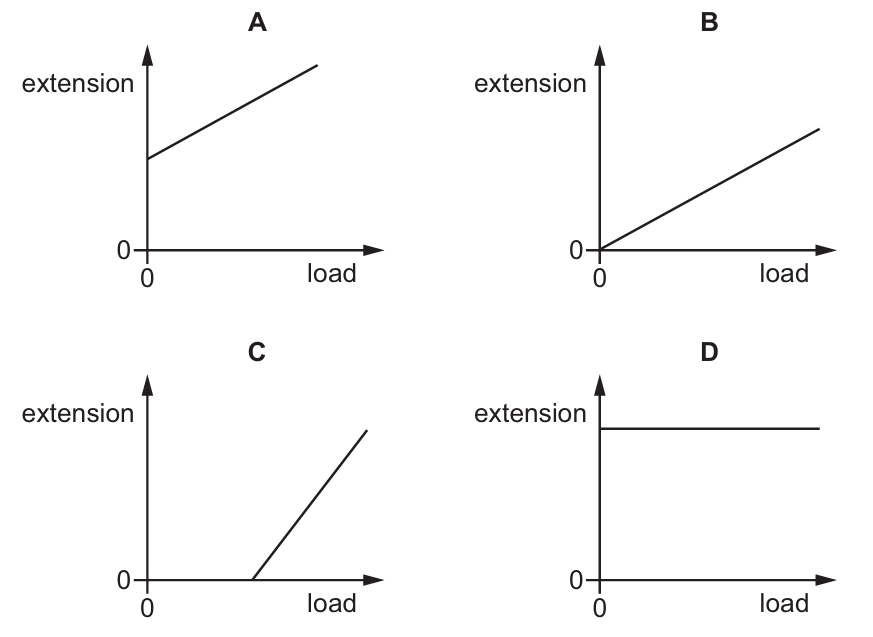
Which diagram shows the extension–load graph for the spring?

Most-appropriate topic codes (Cambridge IGCSE Physics 0625):

TOPIC 1.5.1: Effects of forces (State Hooke’s Law and recall the expression $F = k \Delta x$)
▶️ Answer/Explanation
Correct Option: B

Detailed solution:

According to Hooke’s Law, the extension of a spring is directly proportional to the load applied, provided the limit of proportionality is not exceeded. This relationship is expressed by the formula $F = k \cdot x$, which represents a linear relationship. On a graph of extension against load, this should appear as a straight line starting from the origin $(0,0)$. Graph B correctly displays this constant gradient, showing that as the load increases, the extension increases at a steady, predictable rate. Therefore, Option B is the only diagram that accurately represents the behavior of a standard spring within its elastic limit.
Question 8

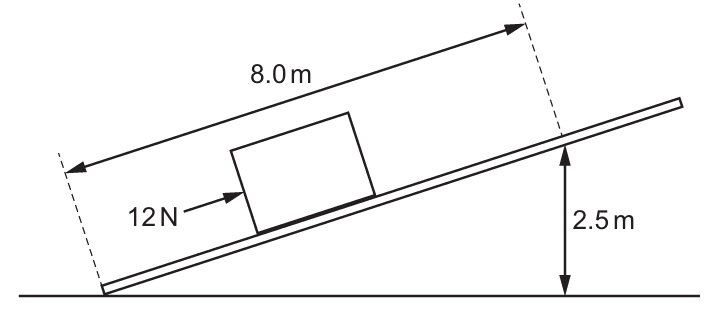
The diagram shows a force of $12\text{ N}$ being used to push a box up a slope. The box is moved $8.0\text{ m}$ along the slope. This lifts the box through a vertical height of $2.5\text{ m}$.
How much work is done pushing the box from the bottom to the top of the slope?
A. $1.5\text{ J}$
B. $4.8\text{ J}$
C. $30\text{ J}$
D. $96\text{ J}$

Most-appropriate topic codes:

TOPIC 1.7.2: Work
▶️ Answer/Explanation
Correct Option: D

Detailed solution:

To find the work done, we use the formula $W = F \times d$, where $F$ is the force applied and $d$ is the distance moved in the direction of the force.
In this case, the force being applied is $12\text{ N}$ and it is directed along the slope.
The distance moved specifically in the direction of that force is the length of the slope, which is $8.0\text{ m}$.
Multiplying these values together: $12\text{ N} \times 8.0\text{ m} = 96\text{ J}$.
Note that the vertical height of $2.5\text{ m}$ is not used here because we are calculating the work done by the pushing force, not the change in gravitational potential energy.
Therefore, the total work done is $96\text{ J}$, which corresponds to Option D.
Question 9

Which energy resource is non-renewable?
A. biofuel
B. energy from the Sun
C. nuclear fuel
D. water behind a dam

Most-appropriate topic codes:

TOPIC 1.7.3: Energy resources
▶️ Answer/Explanation
Correct Option: C

Detailed solution:

To identify a non-renewable resource, we look for energy sources that are finite and cannot be replenished within a human timescale.
Biofuel, solar energy, and hydroelectric power (water behind a dam) are all renewable because they are naturally replenished by biological or planetary processes.
Nuclear fuel, such as Uranium, exists in a limited supply within the Earth’s crust and does not regenerate once consumed in a reactor.
While it provides a vast amount of energy per unit of mass, it is classified as non-renewable because the source is finite.
Therefore, nuclear fuel is the only option listed that will eventually run out.
This confirms that Option C is the correct answer.

Question 10

What is the relationship between the power of a motor, the force exerted by the motor, the distance moved by the force and the time taken?
A. $\text{power} = \frac{\text{distance moved} \times \text{time taken}}{\text{force}}$
B. $\text{power} = \text{force} \times \text{distance moved} \times \text{time taken}$
C. $\text{power} = \frac{\text{force} \times \text{time taken}}{\text{distance moved}}$
D. $\text{power} = \frac{\text{force} \times \text{distance moved}}{\text{time taken}}$

Most-appropriate topic codes:

TOPIC 1.7.4: Power
▶️ Answer/Explanation
Correct Option: D

Detailed solution:

To find the correct relationship, we start with the basic definition of power as the rate at which work is done, or $\text{power} = \frac{\text{work done}}{\text{time taken}}$.
Recall that work done is defined as the product of the force applied and the distance moved in the direction of that force, expressed as $\text{work} = \text{force} \times \text{distance moved}$.
By substituting the formula for work into the power equation, we get $\text{power} = \frac{\text{force} \times \text{distance moved}}{\text{time taken}}$.
This shows that power is directly proportional to both force and distance, but inversely proportional to the time it takes to complete the task.
Therefore, the expression in Option D correctly represents this physical relationship.

Question 11

How is pressure defined?
A. area per unit force
B. force per unit area
C. mass per unit area
D. mass per unit volume

Most-appropriate topic codes (Cambridge IGCSE Physics 0625):

TOPIC 1.8: Pressure
▶️ Answer/Explanation
Correct Option: B

Detailed solution:

Pressure is a physical quantity that describes how a force is distributed over a specific surface area.
By definition, pressure $P$ is calculated using the formula $P = \frac{F}{A}$, where $F$ represents the normal force and $A$ is the area.
This relationship shows that pressure is the amount of force acting per unit of area.
Option A is incorrect because it flips the relationship, while options C and D involve mass, which relates to density or loading rather than the definition of pressure.
Therefore, the correct definition is force per unit area, which corresponds to Option B.

Question 12

A fixed mass of gas is trapped in a cylinder with a piston. The volume of the gas is slowly reduced at constant temperature without any particles of gas escaping.
Which statement is correct?
A. The force exerted by the gas on the piston will decrease because the particles move more quickly.
B. The force exerted by the gas on the piston will decrease because the particles move more slowly.
C. The force exerted by the gas on the piston will increase because the particles are hitting the piston harder.
D. The force exerted by the gas on the piston will increase because the particles are hitting the piston more frequently.

Most-appropriate topic codes:

TOPIC 2.1.3: Gases and the absolute scale of temperature
▶️ Answer/Explanation
Correct Option: D

Detailed solution:

When the volume of a gas is reduced at a constant temperature, the average kinetic energy of the particles remains the same, meaning their speed does not change.
However, because the same number of particles is now packed into a smaller space, the number of particles per unit volume increases.
This leads to a higher frequency of collisions between the gas particles and the walls of the cylinder, including the piston.
Since pressure is defined as the force exerted per unit area, and the frequency of impacts has increased, the total force on the piston increases.
Therefore, the force increases specifically because the particles hit the piston more frequently, making Option D the correct statement.

Question 13

The air temperature rises from $10^\circ\text{C}$ to $40^\circ\text{C}$.
What is the change in temperature, expressed in kelvin?
A. $30\text{ K}$
B. $50\text{ K}$
C. $243\text{ K}$
D. $303\text{ K}$

Most-appropriate topic codes (Cambridge IGCSE Physics 0625):

TOPIC 2.2.2: Specific heat capacity
▶️ Answer/Explanation
Correct Option: A

Detailed solution:

To find the change in temperature, we first calculate the difference in degrees Celsius: $40^\circ\text{C} – 10^\circ\text{C} = 30^\circ\text{C}$.
It is a fundamental rule in physics that a change of $1$ degree Celsius is exactly equal to a change of $1$ kelvin.
Even if you convert both temperatures to kelvin first ($10^\circ\text{C} = 283\text{ K}$ and $40^\circ\text{C} = 313\text{ K}$), the difference remains the same.
Subtracting these values gives: $313\text{ K} – 283\text{ K} = 30\text{ K}$.
Therefore, the change in temperature expressed in kelvin is $30\text{ K}$, which matches Option A.

Question 14

Which effect is not due to thermal expansion?
A. convection currents in air
B. expansion of a bubble rising through a fizzy drink
C. expansion of a liquid in a thermometer
D. lengthening of overhead power lines in the summer

Most-appropriate topic codes (Cambridge IGCSE Physics 0625):

TOPIC 2.2.1: Thermal expansion of solids, liquids and gases
▶️ Answer/Explanation
Correct Option: B

Detailed solution:

Thermal expansion occurs when the particles of a substance move further apart due to an increase in temperature.
Convection currents (Option A) rely on the expansion of air to change its density, while thermometers (Option C) and power lines (Option D) rely on the direct expansion of liquids and solids.
However, a bubble rising in a fizzy drink (Option B) expands primarily because the hydrostatic pressure decreases as it moves toward the surface.
According to Boyle’s law, as the external pressure on the gas bubble drops, its volume must increase.
Therefore, this specific expansion is a result of pressure changes rather than a change in temperature.
This identifies Option B as the correct choice.

Question 15

On a hot summer day, the level of the water in a pond falls.
Which statement explains this?
A. The least energetic water particles escape from the surface and do not return.
B. The least energetic water particles escape from the surface and then return.
C. The most energetic water particles escape from the surface and do not return.
D. The most energetic water particles escape from the surface and then return.

Most-appropriate topic codes:

TOPIC 2.2.3: Melting, boiling and evaporation
▶️ Answer/Explanation
Correct Option: C

Detailed solution:

When the water level in a pond falls on a hot day, it is due to the process of evaporation occurring at the surface.
In any liquid, particles have a range of kinetic energies; those with the highest energy are moving fast enough to overcome the attractive forces of neighboring molecules.
These “most energetic” particles break away from the liquid surface and enter the gaseous state as water vapor.
Once they escape into the atmosphere, they are carried away by air currents and do not return to the pond.
This loss of high-energy particles reduces the total number of molecules in the pond, causing the water level to drop.
Therefore, statement C is the correct physical explanation for this observation.

Question 16

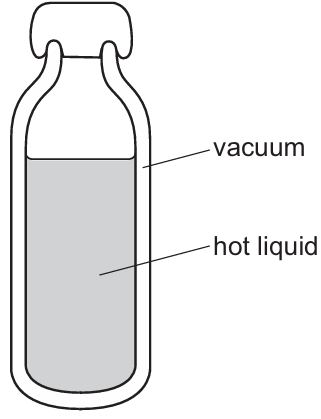
The diagram shows a vacuum flask used to keep liquid hot.
How does thermal energy pass through the vacuum?
A. conduction and convection only
B. conduction only
C. convection only
D. radiation only

Most-appropriate topic codes:

TOPIC 2.3.3: Radiation
▶️ Answer/Explanation
Correct Option: D

Detailed solution:

To solve this, we need to consider how heat travels through different media.
Conduction requires physical contact between particles to transfer energy, and convection relies on the movement of fluids like liquids or gases.
A vacuum is a space that contains no particles, meaning neither conduction nor convection can occur through it.
Radiation, however, consists of electromagnetic waves (infrared) which do not require a medium and can travel freely through empty space.
Therefore, thermal energy can only pass across the vacuum gap in the flask via radiation.
This identifies Option D as the correct answer.
Question 17

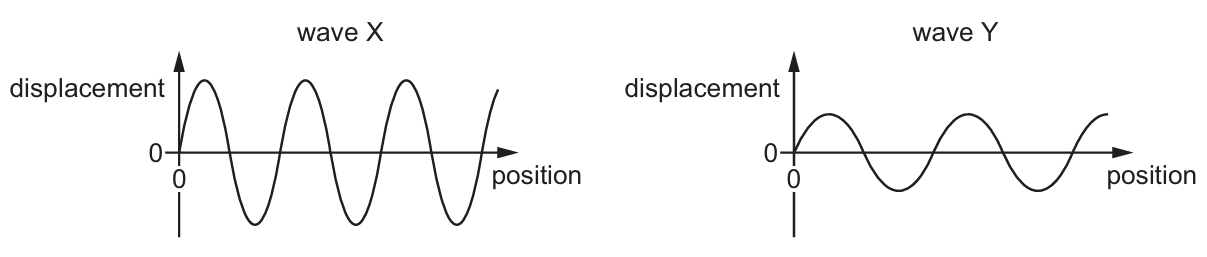
The diagrams show two transverse waves $X$ and $Y$ and are to the same scale.
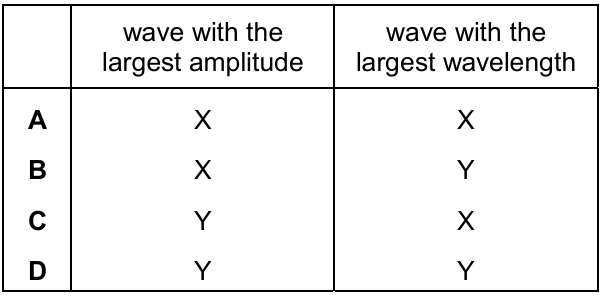
Which row is correct?

Most-appropriate topic codes (Cambridge IGCSE Physics 0625):

TOPIC 3.1: General properties of waves
▶️ Answer/Explanation
Correct Option: B

Detailed solution:

To solve this, we compare the physical dimensions of wave $X$ and wave $Y$ using the same scale. First, look at the amplitude (the height from the equilibrium to the peak): wave $X$ is clearly taller than wave $Y$, so $X$ has a larger amplitude than $Y$. Next, we check the wavelength (the horizontal distance for one full cycle): wave $X$ completes one full cycle in the same distance that wave $Y$ also completes one full cycle, meaning their wavelengths are equal. Comparing this to the table, we need the row where amplitude is “larger for $X$ than for $Y$” and wavelength is “the same for both waves”. This corresponds perfectly to row B.
Question 18

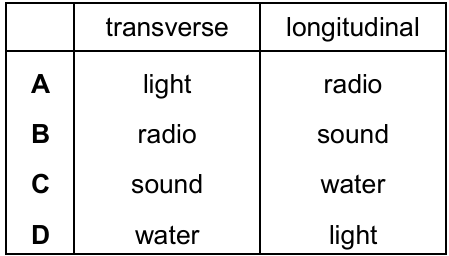
Which row shows an example of a transverse wave and an example of a longitudinal wave?

Most-appropriate topic codes (Cambridge IGCSE Physics 0625):

TOPIC 3.1: General properties of waves
▶️ Answer/Explanation
Correct Option: B

Detailed solution:

To solve this, we need to classify different types of waves based on their particle vibration.
Transverse waves have oscillations perpendicular to the direction of energy transfer; light and all electromagnetic waves fall into this category.
Longitudinal waves have oscillations parallel to the direction of energy transfer, with sound being the most common example.
Looking at the table, radio waves are part of the electromagnetic spectrum and are therefore transverse.
Sound waves travel through compressions and rarefactions, making them longitudinal.
This matches the configuration shown in Row B.
Question 19

A ray of light is reflected from a plane mirror. Which angle is the angle of reflection?
A. the angle between the incident ray and the normal
B. the angle between the incident ray and the reflected ray
C. the angle between the reflected ray and the normal
D. the angle between the reflected ray and the surface

Most-appropriate topic codes:

TOPIC 3.2.1: Reflection of light
▶️ Answer/Explanation
Correct Option: C

Detailed solution:

In optics, when we talk about angles of incidence or reflection, we always measure them relative to the “normal” line.
The normal is an imaginary line drawn perpendicular ($90^{\circ}$) to the surface of the mirror at the point of impact.
By definition, the angle of incidence is the angle between the incoming ray and this normal.
Similarly, the angle of reflection is specifically the angle between the reflected ray and the normal.
While the angle to the surface (Option D) exists, it is not the standard way we define the angle of reflection in physics.
Therefore, the correct description is found in Option C.

Question 20

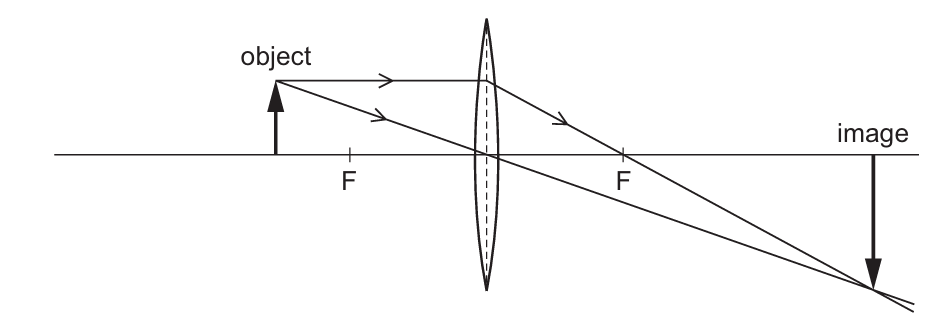
A thin converging lens forms an image.
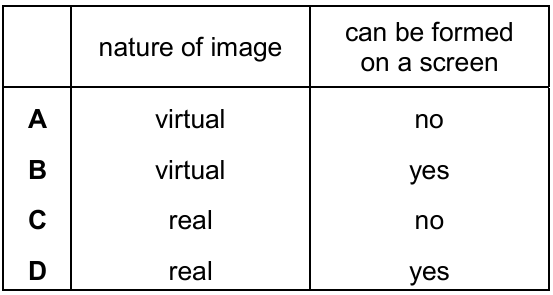
What is the nature of this image and can it be formed on a screen?

Most-appropriate topic codes (Cambridge IGCSE Physics 0625):

TOPIC 3.2.3: Thin lenses
▶️ Answer/Explanation
Correct Option: D

Detailed solution:

By observing the ray diagram, we can see that the object is placed between the optical center and the principal focus $F$.
In this specific configuration, the light rays diverge after passing through the lens, so they appear to meet behind the object.
Because the rays do not actually intersect but only appear to do so, the image formed is a virtual image.
Since virtual images cannot be projected onto a surface, the image cannot be formed on a screen.
Additionally, the image is upright and magnified, which is characteristic of a magnifying glass setup.
This confirms that the nature is virtual and it cannot be formed on a screen, matching Option D.
Question 21

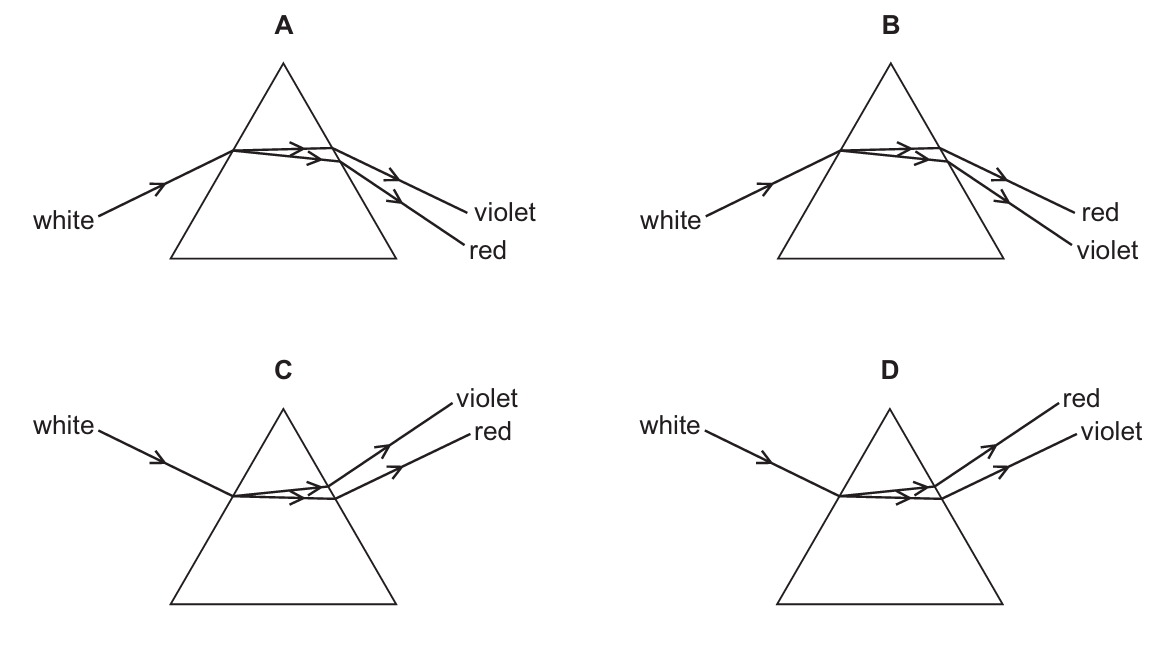
Which diagram shows the dispersion of white light by a prism?

Most-appropriate topic codes:

TOPIC 3.2.4: Dispersion of light
▶️ Answer/Explanation
Correct Option: B

Detailed solution:

When white light enters a triangular glass prism, it undergoes dispersion, which is the splitting of light into its constituent colors.
This happens because different colors of light travel at different speeds in glass, causing them to refract by different amounts.
In diagram B, the light correctly bends toward the normal upon entering and away from the normal upon exiting, spreading into a spectrum.
Red light is refracted the least and appears at the top, while violet light is refracted the most and appears at the bottom.
Diagrams A, C, and D are incorrect because they either show no splitting inside the prism or show the light bending in ways that defy the laws of refraction.
Question 22

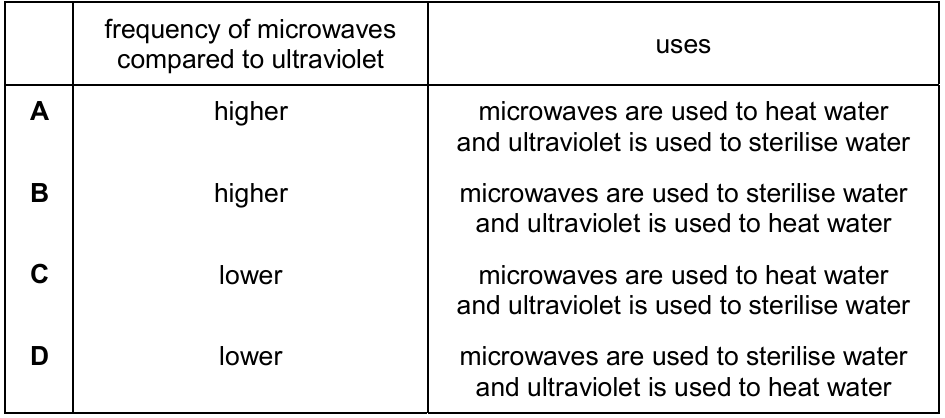
Which row correctly compares microwaves and ultraviolet?

Most-appropriate topic codes (Cambridge IGCSE Physics 0625):

TOPIC 3.3: Electromagnetic spectrum
▶️ Answer/Explanation
Correct Option: C

Detailed solution:

To solve this, we need to recall the order of the electromagnetic spectrum: Radio, Microwave, Infrared, Visible, Ultraviolet, X-ray, and Gamma rays.
As we move from microwaves toward ultraviolet, the frequency increases, which means microwaves have a lower frequency than ultraviolet light.
Conversely, since wave speed $v$ is constant in a vacuum and $v = f \lambda$, a lower frequency means a longer wavelength; thus, microwaves have a longer wavelength.
Checking the options, Row C correctly identifies that microwaves have a lower frequency and a longer wavelength than ultraviolet.
Therefore, Option C is the only logically consistent comparison between these two types of radiation.
Question 23

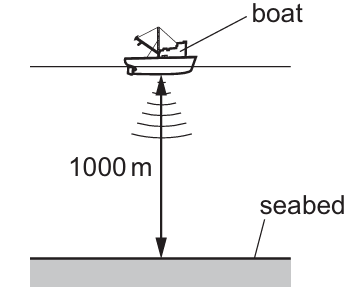
A pulse of sound is produced at the bottom of a boat. The sound travels through the water and is reflected from the seabed. The reflected sound reaches the boat $1.3\text{ s}$ after the sound was produced. The seabed is $1000\text{ m}$ below the boat.
Using this information, what is the speed of sound in the water?
A. $770\text{ m/s}$
B. $1300\text{ m/s}$
C. $1500\text{ m/s}$
D. $2600\text{ m/s}$

Most-appropriate topic codes:

TOPIC 3.4: Sound
▶️ Answer/Explanation
Correct Option: C

Detailed solution:

To find the speed, we first need to realize that the sound travels to the seabed and back, which is twice the depth of the water. The total distance traveled by the pulse is $2 \times 1000\text{ m} = 2000\text{ m}$. The total time taken for this round trip is given as $1.3\text{ s}$. Using the formula $\text{speed} = \frac{\text{distance}}{\text{time}}$, we calculate $\frac{2000\text{ m}}{1.3\text{ s}}$. This gives a value of approximately $1538\text{ m/s}$, which rounds to $1500\text{ m/s}$ in the context of the given options. Therefore, Option C is the most accurate choice.
Question 24

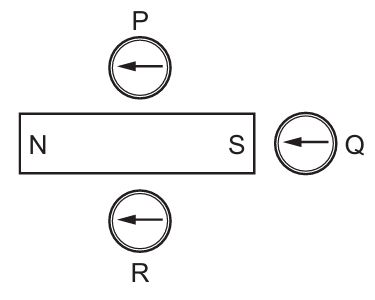
The diagram shows three small compasses near to a bar magnet.
Which compasses show the direction of the magnetic field due to the bar magnet?
A. P and Q
B. P only
C. Q and R
D. Q only

Most-appropriate topic codes (Cambridge IGCSE Physics 0625):

TOPIC 4.1: Simple phenomena of magnetism
▶️ Answer/Explanation
Correct Option: D

Detailed solution:

Magnetic field lines are directed away from the North pole ($N$) and toward the South pole ($S$) of a magnet. A compass needle always points in the direction of the magnetic field at its location, with the North end of the needle pointing toward the $S$ pole of the magnet.
Looking at compass $P$, it is pointing toward the $N$ pole, which is incorrect as like poles repel.
Compass $R$ is pointing away from the $S$ pole, which is also incorrect as it should be attracted toward it.
Only compass $Q$ is correctly aligned, pointing toward the South pole of the bar magnet.
Therefore, only compass $Q$ shows the correct direction, matching Option D.
Question 25

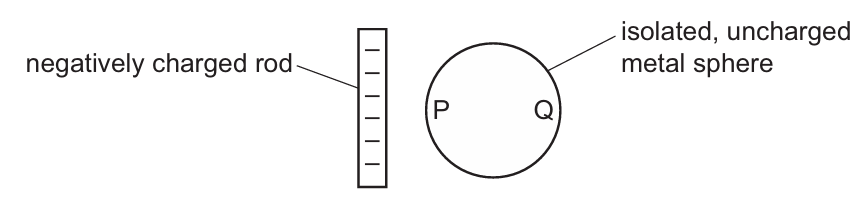
A negatively charged rod is brought close to an isolated, uncharged metal sphere.
What are the charges on sides $P$ and $Q$ of the sphere?
A. $P$ and $Q$ are both negatively charged.
B. $P$ and $Q$ are both positively charged.
C. $P$ is negatively charged and $Q$ is positively charged.
D. $P$ is positively charged and $Q$ is negatively charged.

Most-appropriate topic codes (Cambridge IGCSE Physics 0625):

TOPIC 4.2.1: Electric charge (Describe experiments to show electrostatic charging by induction)
▶️ Answer/Explanation
Correct Option: D

Detailed solution:

When the negatively charged rod is brought near the metal sphere, it exerts an electrostatic force on the free electrons within the metal.
Since like charges repel, the electrons in the sphere are pushed away from the rod toward the far side, which is side $Q$.
This accumulation of electrons makes side $Q$ negatively charged, while the lack of electrons on the near side, $P$, leaves it with a net positive charge.
This process is known as electrostatic induction, where the total charge of the isolated sphere remains neutral, but becomes redistributed.
Therefore, $P$ is positively charged and $Q$ is negatively charged, which corresponds to Option D.
Question 26

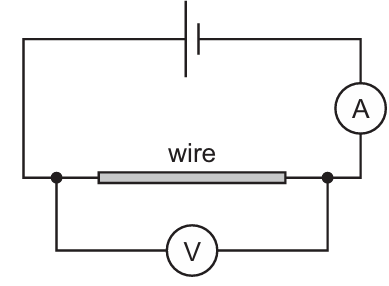
The diagram shows a simple circuit.
The ammeter reading is $2.0\text{ A}$ and the voltmeter reading is $6.0\text{ V}$.What is the resistance of the wire?
A. $0.33\ \Omega$
B. $3.0\ \Omega$
C. $8.0\ \Omega$
D. $12\ \Omega$

Most-appropriate topic codes (Cambridge IGCSE Physics 0625):

TOPIC 4.2.4: Resistance
▶️ Answer/Explanation
Correct Option: B

Detailed solution:

To find the resistance of the wire, we use Ohm’s Law, which relates voltage, current, and resistance.The formula is $V = I \times R$, which can be rearranged to solve for resistance as $R = \frac{V}{I}$.From the question, the potential difference (voltage) is $V = 6.0\text{ V}$ and the current is $I = 2.0\text{ A}$.Substituting these values into the formula gives $R = \frac{6.0\text{ V}}{2.0\text{ A}} = 3.0\ \Omega$.Therefore, the resistance of the wire is $3.0\ \Omega$, which corresponds to Option B.
Question 27

A lamp is rated $240\text{ V}$, $0.40\text{ A}$. The lamp operates at normal brightness for $1.0\text{ min}$.
How much energy does the lamp transfer?
A. $60\text{ J}$
B. $96\text{ J}$
C. $600\text{ J}$
D. $5800\text{ J}$

Most-appropriate topic codes (Cambridge IGCSE Physics 0625):

TOPIC 4.2.5: Electrical energy and electrical power
▶️ Answer/Explanation
Correct Option: D

Detailed solution:

To find the total energy transferred, we use the electrical energy formula $E = V \cdot I \cdot t$, where $V$ is voltage, $I$ is current, and $t$ is time.First, we must convert the time from minutes to seconds: $1.0\text{ min} = 60\text{ s}$.Now, substitute the given values into the equation: $E = 240\text{ V} \times 0.40\text{ A} \times 60\text{ s}$.Multiplying these together, $240 \times 0.40 = 96$, and then $96 \times 60 = 5760$.Rounding to two significant figures as per the input values, we get $5800\text{ J}$.This result corresponds to Option D.

Question 28

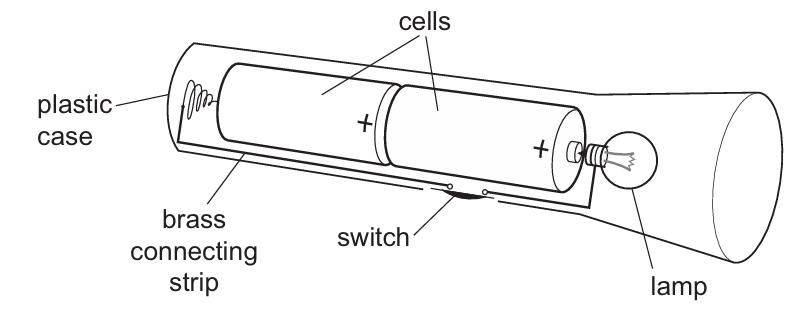
The diagram shows a torch containing two cells, a switch and a lamp.
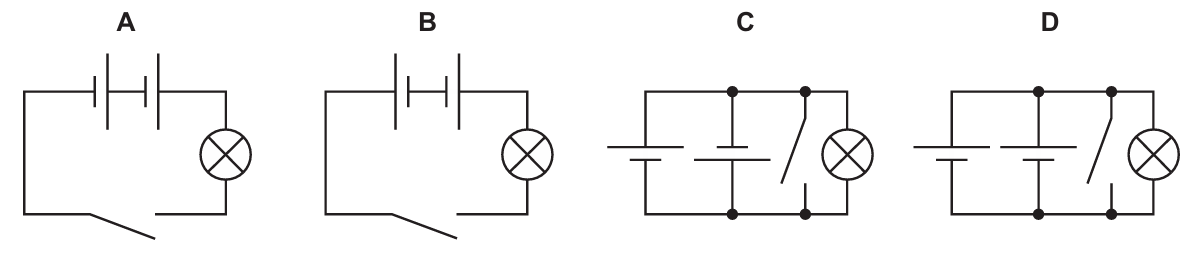
Which circuit diagram is correct for the torch?

Most-appropriate topic codes (Cambridge IGCSE Physics 0625):

TOPIC 4.3.1: Circuit diagrams and circuit components
▶️ Answer/Explanation
Correct Option: A

Detailed solution:

By looking at the torch diagram, we can see that it contains two cells connected in series, a single switch, and one lamp. In a series circuit, all components are connected in a single loop so that the same current flows through each. Diagram A correctly shows two cell symbols, a switch symbol, and a lamp symbol all connected in a single series loop. Diagram B is incorrect because it shows the cells and lamp in parallel branches, which doesn’t match the torch’s physical layout. Diagrams C and D are incorrect because they use the wrong symbols or include extra components not found in the original torch. Therefore, Diagram A is the only representation that accurately reflects the physical construction of the torch.

Question 29

Which symbol represents a device that contains a current-carrying coil in a magnetic field?

Most-appropriate topic codes:

TOPIC 4.5.3: Magnetic effect of a current
▶️ Answer/Explanation
Correct Option: B

Detailed solution:

To identify the correct symbol, we need to look for a device that uses electromagnetic induction or the motor effect.
Symbol A represents a resistor, which simply limits current flow, while Symbol C is a bell and Symbol D is a fuse.
Symbol B represents a loudspeaker (or a generic transducer), which functions using a coil of wire placed within a magnetic field.
When current passes through this coil, it experiences a force that moves the cone to create sound waves.
Therefore, Symbol B is the only one that fundamentally contains a current-carrying coil designed to interact with a magnetic field.
This confirms that Option B is the correct choice.
Question 30

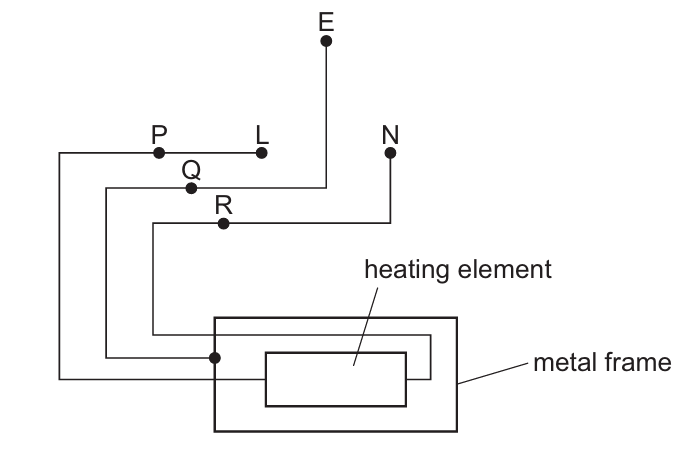
The diagram shows a three-core cable connecting a three-pin socket to an electric fire with a metal frame.
The earth, live and neutral connections of the socket are labelled $E$, $L$ and $N$ respectively.
A switch is connected into the circuit.
Where is a switch connected?
A. at either of $P$ or $R$
B. at $P$ only
C. at $Q$ only
D. at $R$ only

Most-appropriate topic codes (Cambridge IGCSE Physics 0625):

TOPIC 4.4: Electrical safety (Explain why switches and fuses are connected in the live wire)
▶️ Answer/Explanation
Correct Option: B

Detailed solution:

To ensure maximum safety in an electrical circuit, the switch must always be placed in the live wire ($L$).
In the diagram, wire $P$ is connected to the live terminal, wire $Q$ is the earth connection for the metal frame, and wire $R$ is the neutral wire.
When the switch is placed at position $P$ and turned off, it disconnects the appliance from the high-voltage supply.
If the switch were placed in the neutral wire ($R$), the internal components of the electric fire would remain “live” even when the switch is off, posing a risk of electric shock.
Therefore, the switch must be connected at $P$ only.
This corresponds to Option B.
Question 31

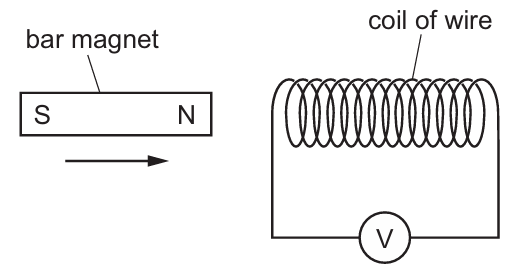
A student investigates electromagnetic induction. She moves the N pole of a magnet quickly towards a coil of wire. There is a reading on the sensitive voltmeter.
What can she do to get a greater reading on the sensitive voltmeter?
A. Hold the bar magnet stationary inside the coil.
B. Move the bar magnet slowly away from the coil.
C. Use a coil of wire with fewer turns on it.
D. Use a stronger bar magnet.

Most-appropriate topic codes (Cambridge IGCSE Physics 0625):

TOPIC 4.5.1: Electromagnetic induction (State the factors affecting the magnitude of an induced e.m.f.)
▶️ Answer/Explanation
Correct Option: D

Detailed solution:

To increase the reading on the voltmeter, we need to increase the induced electromotive force ($e.m.f.$). According to Faraday’s Law, the induced $e.m.f.$ is directly proportional to the rate at which the magnetic flux linkage changes.
Using a stronger bar magnet increases the magnetic field strength, which causes a greater change in flux when the magnet moves.
Moving the magnet slowly (Option B) or using fewer turns (Option C) would actually decrease the induced voltage.
Holding the magnet stationary (Option A) results in zero induced $e.m.f.$ because there is no change in magnetic flux.
Therefore, increasing the magnetic field strength with a stronger magnet is the only way to get a higher reading.
This matches Option D.
Question 32

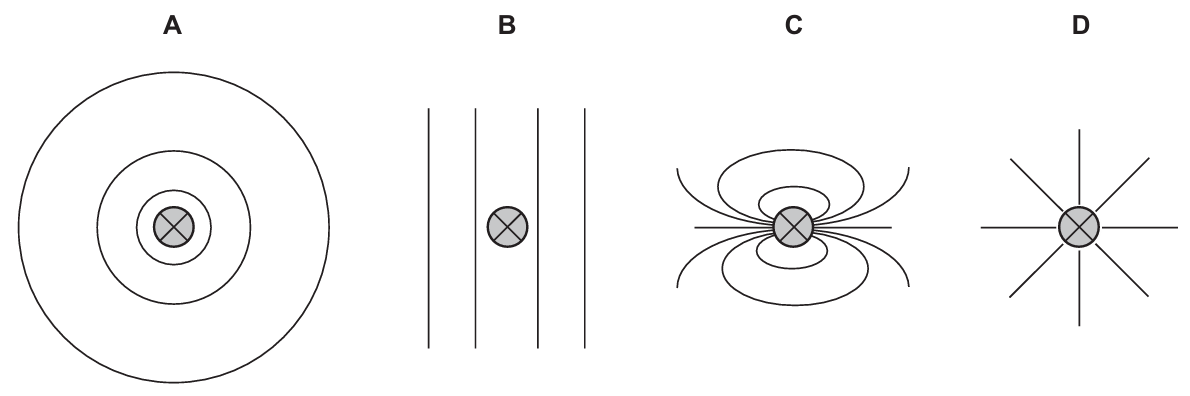
The direction of the current in a straight wire $X$ is into the paper.
Which diagram shows the shape of the magnetic field pattern around the wire?

Most-appropriate topic codes:

TOPIC 4.5.3: Magnetic effect of a current
▶️ Answer/Explanation
Correct Option: A

Detailed solution:

To find the direction of the magnetic field around a straight wire, we use the Right-Hand Grip Rule.Point your right thumb in the direction of the current; since the current is “into the paper” (represented by the $X$), your thumb should point away from you.Your fingers will naturally curl in a clockwise direction, which indicates the direction of the magnetic field lines.The field lines for a straight wire are always concentric circles that become further apart as the distance from the wire increases.Looking at the diagrams, Option A correctly shows clockwise circular field lines centered on the wire.Therefore, diagram A is the correct representation of the magnetic field pattern.
Question 33

What does a step-up transformer increase?
A. current
B. energy
C. power
D. voltage

Most-appropriate topic codes:

TOPIC 4.5.6: The transformer
▶️ Answer/Explanation
Correct Option: D

Detailed solution:

A transformer works on the principle of electromagnetic induction to change the alternating relative levels of electricity.
By definition, a step-up transformer has more turns in the secondary coil than in the primary coil, which acts to increase the potential difference.
According to the transformer equation $\frac{V_p}{V_s} = \frac{N_p}{N_s}$, if $N_s > N_p$, then the output voltage $V_s$ will be greater than the input voltage $V_p$.
It is important to note that while voltage increases, the current actually decreases to satisfy the law of conservation of energy.
Since the device specifically “steps up” the electrical potential, the correct answer is voltage.

Question 34

When measuring the emissions from a radioactive rock brought into the laboratory, a teacher mentions that background radiation must be taken into account.
What is this background radiation?
A. ionising radiation in the laboratory when the radioactive rock is not present
B. ionising radiation from the radioactive rock brought into the laboratory
C. infrared radiation from the Sun
D. infrared radiation from warm objects in the laboratory

Most-appropriate topic codes (Cambridge IGCSE Physics 0625):

TOPIC 5.2.1: Detection of radioactivity
▶️ Answer/Explanation
Correct Option: A

Detailed solution:

Background radiation refers to the constant level of ionizing radiation present in our environment at all times.
This radiation comes from various natural sources such as cosmic rays from space and radioactive materials in the ground or air (like radon gas).
Crucially, this radiation exists independently of any specific source we choose to measure in the lab, such as the radioactive rock mentioned.
Options C and D are incorrect because background radiation involves ionizing radiation, not just heat or infrared waves.
Therefore, when the rock is removed, the remaining radiation detected by the counter is the background radiation, matching Option A.

Question 35

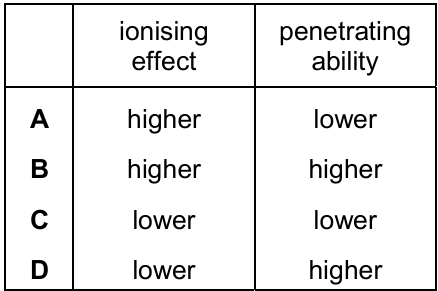
How do the ionising effect and the penetrating ability of $\alpha$-particles compare with those of $\beta$-particles and $\gamma$-rays?

Most-appropriate topic codes:

TOPIC 5.2.3: Radioactive decay
▶️ Answer/Explanation
Correct Option: A

Detailed solution:

To solve this, we need to compare the physical properties of the three types of radiation. Alpha ($\alpha$) particles are relatively large and carry a $+2$ charge, which makes them highly likely to strike and ionize atoms they pass, giving them the strongest ionizing effect. However, because they interact so frequently, they lose energy quickly and have the least penetrating ability, usually stopped by a sheet of paper.
In contrast, beta ($\beta$) particles are smaller and faster with a moderate ionizing effect, while gamma ($\gamma$) rays are electromagnetic waves with no charge, making them the least ionizing but the most penetrating.
Looking at the table, alpha particles are correctly identified as having the “strongest” ionizing effect and being the “least” penetrating.
This corresponds to the characteristics listed in row A.
Question 36

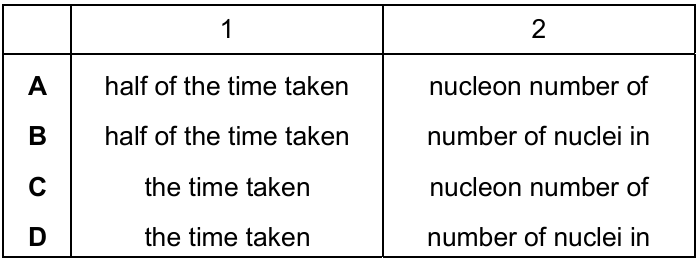
Half-life is ……1…… for the ……2…… a sample of a radioactive isotope to halve.
Which words correctly complete gaps 1 and 2?

Most-appropriate topic codes (Cambridge IGCSE Physics 0625):

TOPIC 5.2.4: Half-life
▶️ Answer/Explanation
Correct Option: D

Detailed solution:

By definition, half-life is a measure of the time taken for a radioactive process to occur, so gap $1$ must be “the time”.
Specifically, it refers to the time needed for the activity or the number of undecayed nuclei in a sample to decrease by half.
Looking at the provided table, Option D correctly identifies gap $1$ as “the time” and gap $2$ as “the activity of”.
This matches the scientific principle that as a sample decays, its rate of emission (activity) reduces predictably over time.
Therefore, the full sentence reads: “Half-life is the time for the activity of a sample of a radioactive isotope to halve.”
This confirms that Option D is the correct choice.
Question 37

Radioactive materials must be handled in a safe way.
What is not a safety procedure?
A. storing radioactive materials in cardboard boxes
B. monitoring exposure time to radioactive materials
C. using tongs to pick up the radioactive source
D. wearing protective clothing

Most-appropriate topic codes (Cambridge IGCSE Physics 0625):

TOPIC 5.2.5: Safety precautions
▶️ Answer/Explanation
Correct Option: A

Detailed solution:

When handling radioactive sources, the goal is to minimize exposure to harmful ionizing radiation.
Standard safety protocols include maximizing distance using tongs (Option C), minimizing time (Option B), and using shielding like protective clothing (Option D).
Cardboard boxes provide virtually no shielding against highly penetrating radiation like gamma rays or high-energy beta particles.
Radioactive materials should instead be stored in thick lead-lined containers to properly absorb radiation.
Therefore, storing them in cardboard boxes is unsafe and is not a recognized safety procedure.
This leads us to Option A as the correct answer.

Question 38

The Solar System contains eight major planets.
What is the correct order of three of the major planets, starting with the planet furthest from the Sun?
A. Mercury $\rightarrow$ Venus $\rightarrow$ Earth
B. Neptune $\rightarrow$ Jupiter $\rightarrow$ Saturn
C. Neptune $\rightarrow$ Mars $\rightarrow$ Earth
D. Jupiter $\rightarrow$ Saturn $\rightarrow$ Uranus

Most-appropriate topic codes (Cambridge IGCSE Physics 0625):

TOPIC 6.1.2: The Solar System
▶️ Answer/Explanation
Correct Option: C

Detailed solution:

To solve this, we first list the eight planets in order of increasing distance from the Sun: Mercury, Venus, Earth, Mars, Jupiter, Saturn, Uranus, and Neptune.
The question specifically asks for the order starting from the planet furthest from the Sun, so we must look at the sequence in reverse: Neptune $\rightarrow$ Uranus $\rightarrow$ Saturn $\rightarrow$ Jupiter $\rightarrow$ Mars $\rightarrow$ Earth $\rightarrow$ Venus $\rightarrow$ Mercury.
Looking at the options, Option A is in order of increasing distance, and Options B and D skip planets in the wrong direction.
Option C follows the sequence Neptune $\rightarrow$ Mars $\rightarrow$ Earth, which correctly identifies three planets moving inward toward the Sun.
Therefore, Option C is the only logically consistent choice based on a decreasing distance from the Sun.

Question 39

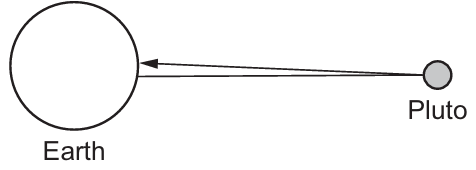
The diagram shows a radio signal from the Earth being reflected by Pluto and returning to the Earth. The distance between the Earth and Pluto is $0.00050$ light-years.
What is the time taken for the radio signal to return to the Earth after being sent?
A. $2000$ years
B. $1000$ years
C. $0.0010$ years
D. $0.00050$ years

Most-appropriate topic codes:

TOPIC 6.2.3: The Universe
▶️ Answer/Explanation
Correct Option: C

Detailed solution:

By definition, a light-year is the distance light (or radio signals) travels in exactly one year.The question states the distance from Earth to Pluto is $0.00050$ light-years, meaning it takes $0.00050$ years for the signal to reach Pluto.Since the signal must travel to Pluto and then reflect back to Earth, the total distance covered is doubled.We calculate the total time by multiplying the one-way travel time by two: $0.00050 \times 2 = 0.0010$ years.Therefore, the return trip takes a total of $0.0010$ years, which corresponds to Option C.
Question 40

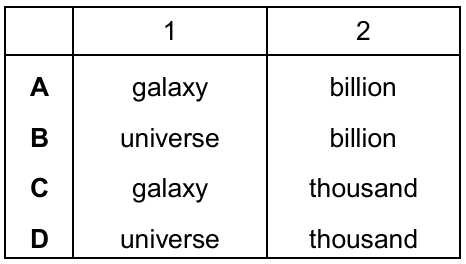
The Milky Way is a ……1…… made up of about a hundred ……2…… stars.
Which words correctly complete gaps 1 and 2?

Most-appropriate topic codes:

TOPIC 6.2.2: Stars
▶️ Answer/Explanation
Correct Option: A

Detailed solution:

To answer this, we need to identify the nature and scale of the Milky Way.
First, the Milky Way is categorized as a galaxy, which is a massive system of stars, gas, and dust held together by gravity.
Regarding the quantity of stars, our galaxy is estimated to contain roughly $100$ to $400$ billion stars.
Therefore, gap $1$ should be “galaxy” and gap $2$ should be “billion” to correctly describe its composition.
Looking at the provided image options, this combination corresponds to Option A.
This fits the standard scientific model of our position in the universe.

Scroll to Top