Home / 0625_w24_qp_21

Question 1

A student uses a metre ruler to measure the length of a sheet of paper.
Which measurement is shown to the nearest millimetre?
A. 0.2932 m
B. 0.293 m
C. 0.29 m
D. 0.3 m

Most-appropriate topic codes (Cambridge IGCSE Physics 0625):

TOPIC 1.1: Physical quantities and measurement techniques (Describe the use of rulers and measuring cylinders to find a length or a volume)
▶️ Answer/Explanation
Correct Option: B

Detailed solution:

A metre ruler is typically graduated in millimetres (mm), which is its smallest division.
One millimetre is equal to 0.001 metres (10⁻³ m).
Therefore, a measurement taken to the nearest millimetre must be recorded to three decimal places when expressed in metres.
Option B (0.293 m) shows three decimal places, representing 293 mm.
Options C and D are less precise, while option A suggests a level of precision (0.1 mm) that a standard ruler cannot provide.

Question 2

A rocket travels with an average speed of 6 km/s for 2 minutes.
What is the distance travelled by the rocket?
A. 12 km
B. 50 km
C. 720 km
D. 12000 km

Most-appropriate topic codes (Cambridge IGCSE Physics 0625):

TOPIC 1.2: Motion (Recall and use the equation average speed = total distance travelled / total time taken)
▶️ Answer/Explanation
Correct Option: C

Detailed solution:

Distance travelled is found using the equation: distance = average speed × time taken.
Convert time to seconds: 2 min = 120 s.
Distance = 6 km/s × 120 s = 720 km.
This matches option C directly.
Options A and B arise from omitting the seconds conversion; D results from treating time as hours instead of minutes.
Thus, the correct answer is C.

Question 3

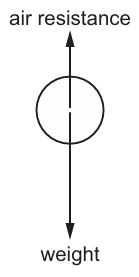
The diagram shows the vertical forces acting on a ball as it falls vertically through the air. The ball does not reach terminal velocity.
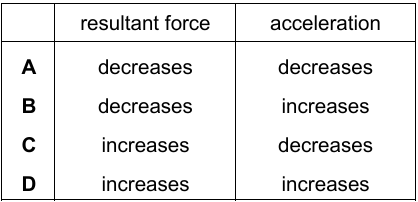
Which row describes what happens to the resultant force on the ball and what happens to the acceleration of the ball as it falls through the air?

Most-appropriate topic codes (Cambridge IGCSE Physics 0625):

TOPIC 1.5.1: Effects of forces (State that a resultant force may change the velocity of an object by changing its direction of motion or its speed; Describe, qualitatively, motion with air resistance including terminal velocity)
▶️ Answer/Explanation
Correct Option: A

Detailed solution:

As the ball falls, air resistance (drag) increases with speed, so the net downward force (weight – drag) decreases.

Since resultant force decreases but is still downward, acceleration (a = F/m) also decreases but remains downward.

The ball speeds up, but at a decreasing rate, until terminal velocity would be reached.

Thus, both resultant force and acceleration decrease.
Question 4

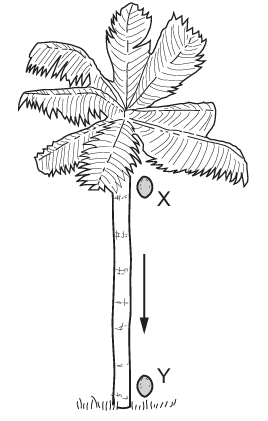
A coconut falls from a palm tree. At X, it has just started falling. Y is the point just before it hits the ground.
What is the acceleration of the coconut at X? (Air resistance can be ignored.)
A. zero
B. less than that at Y
C. the same as that at Y
D. more than that at Y

Most-appropriate topic codes (Cambridge IGCSE Physics 0625):

TOPIC 1.2: Motion (State that the acceleration of free fall \(g\) for an object near to the surface of the Earth is approximately constant and is approximately \(9.8m/s^2\))
▶️ Answer/Explanation
Correct Option: C

Detailed solution:

Ignoring air resistance, the coconut is in free fall under gravity. Its acceleration is the constant acceleration of free fall \(g \approx 9.8 \, m/s^2\) at all points during the fall, including at X and Y. Thus, the acceleration is the same at both points.
Question 5

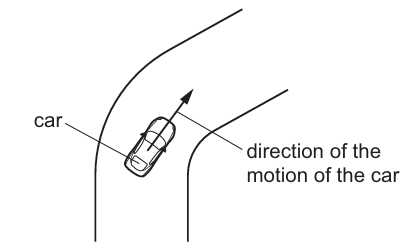
A car is driven round a bend in the road at a constant speed.
What is the direction of the resultant force on the car when it is going round the bend?
A. parallel to the motion and in the same direction as the motion
B. parallel to the motion and in the opposite direction to the motion
C. perpendicular to the motion and towards the inside of the bend
D. perpendicular to the motion and towards the outside of the bend

Most-appropriate topic codes (Cambridge IGCSE Physics 0625):

TOPIC 1.5.1: Effects of forces (Describe, qualitatively, motion in a circular path due to a force perpendicular to the motion)
▶️ Answer/Explanation
Correct Option: C

Detailed solution:

When a car moves at constant speed around a bend, its velocity direction changes, so it accelerates toward the centre.

This centripetal acceleration requires a resultant force perpendicular to motion, directed inward.

Question 6

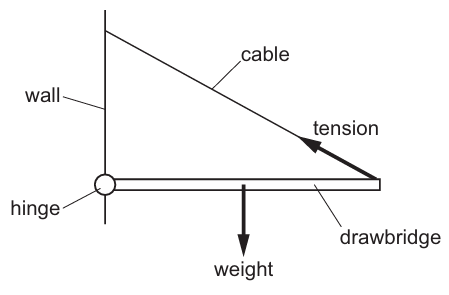
The diagram shows a drawbridge that is attached to a wall by a hinge at one end and a cable at the other.
The weight of the drawbridge and the tension in the cable are represented by the labelled arrows in the diagram. There is a third force at the hinge, which is not shown. The drawbridge is in equilibrium.
Which arrow shows a possible direction for the force at the hinge?

Most-appropriate topic codes (Cambridge IGCSE Physics 0625):

TOPIC 1.5.2: Turning effect of forces (Apply the principle of moments to situations with one force each side of the pivot, including balancing of a beam; State that, when there is no resultant force and no resultant moment, an object is in equilibrium)
▶️ Answer/Explanation
Correct Option: D

Detailed solution:

For equilibrium, the net force and net moment must be zero. The hinge force must balance the weight (down) and cable tension (up-left). Summing horizontal forces requires hinge force to have a rightward component; summing vertical forces requires it to have an upward component, matching arrow D.
Question 7

Which equation gives the momentum change of an object?
A. momentum change = \(\frac{force}{area}\)
B. momentum change = force × distance
C. momentum change = force × \(\frac{distance}{time}\)
D. momentum change = force × time

Most-appropriate topic codes (Cambridge IGCSE Physics 0625):

TOPIC 1.6: Momentum (Define impulse as force × time for which force acts; recall and use the equation impulse = FΔt = Δ(mv))
▶️ Answer/Explanation
Correct Option: D

Detailed solution:

Impulse equals change in momentum, and impulse is defined as force multiplied by the time interval over which it acts.
Force/area gives pressure, not momentum change. Force × distance gives work done, not momentum change. Force × (distance/time) is force × speed, which is power.
Therefore, the correct relationship is momentum change = force × time.

Question 8

Which statement about the use of nuclear fuel as an energy resource is correct?
A. It obtains its energy from the Sun.
B. It has no environmental impact.
C. Nuclear power stations do not need turbines.
D. The energy is released by nuclear fission.

Most-appropriate topic codes (Cambridge IGCSE Physics 0625):

TOPIC 5.1.2: The nucleus (Describe the processes of nuclear fission and nuclear fusion as the splitting or joining of nuclei)
▶️ Answer/Explanation
Correct Option: D

Detailed solution:

Nuclear fuel releases energy through nuclear fission, where heavy nuclei split into smaller nuclei. It does not originate from the Sun (unlike solar or wind). Nuclear waste has significant environmental impact. Power stations use turbines to generate electricity from heat produced by fission. Thus, option D is correct.

Question 9

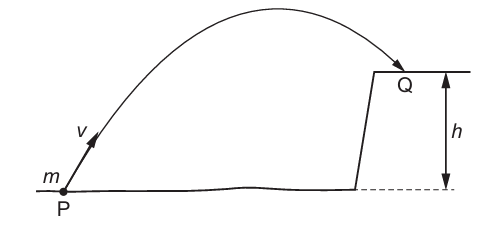
The diagram shows an object of mass m being projected with speed v from a point P to a point Q on top of a cliff height h.
The object does work W against air resistance as it travels from P to Q.
A. \(\frac{1}{2}mv^{2}\) + mgh + W
B. \(\frac{1}{2}mv^{2}\) + mgh – W
C. \(\frac{1}{2}mv^{2}\) – mgh + W
D. \(\frac{1}{2}mv^{2}\) – mgh – W

Most-appropriate topic codes (Cambridge IGCSE Physics 0625):

TOPIC 1.7.1: Energy (Recall and use the equation for kinetic energy \(E_k = \frac{1}{2}mv^2\) and for change in gravitational potential energy \(\Delta E_p = mg\Delta h\); know the principle of conservation of energy and apply to complex examples involving multiple stages)
▶️ Answer/Explanation
Correct Option: D

Detailed solution:

Initial kinetic energy = \(\frac{1}{2}mv^2\).
At Q, gain in GPE = mgh and work done against air resistance = W.
By energy conservation, final KE = initial KE – gain in GPE – work done against resistance = \(\frac{1}{2}mv^2 – mgh – W\).
Question 10

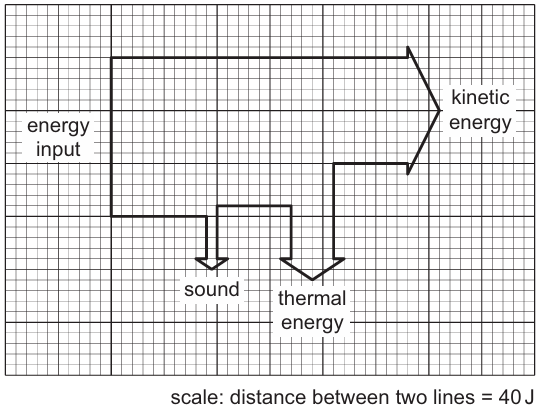
The diagram shows a Sankey diagram for an electric drill.
What is the total wasted energy shown by the diagram?
A. 120 J
B. 200 J
C. 360 J
D. 560 J

Most-appropriate topic codes (Cambridge IGCSE Physics 0625):

TOPIC 1.7.1: Energy (Know the principle of the conservation of energy and apply this principle to complex examples involving multiple stages, including the interpretation of Sankey diagrams)
▶️ Answer/Explanation
Correct Option: B

Detailed solution:

Total input energy = 560 J.
Useful energy output (light + sound + kinetic) = 120 J + 120 J + 120 J = 360 J.
Wasted energy = total input − useful output = 560 J − 360 J = 200 J.
Question 11

An elephant of weight 45000 N stands with all four feet on the floor.
The average pressure on the floor due to the elephant foot in contact with it is 34000 Pa.
What is the area of each foot of the elephant?
A. 0.19 \(m^{2}\)
B. 0.33 \(m^{2}\)
C. 0.76 \(m^{2}\)
D. 1.3 \(m^{2}\)

Most-appropriate topic codes (Cambridge IGCSE Physics 0625):

TOPIC 1.8: Pressure (Define pressure as force per unit area; recall and use the equation \(p = \frac{F}{A}\))
▶️ Answer/Explanation
Correct Option: B

Detailed solution:

Pressure is defined as force per unit area, \(p = \frac{F}{A}\). The total weight is 45000 N, supported by four feet.
The force on one foot is \(F = \frac{45000}{4} = 11250\text{ N}\). Using \(A = \frac{F}{p}\), the area is \(A = \frac{11250}{34000} \approx 0.33\text{ m}^2\).
This calculation applies the direct relationship between pressure, force, and area for a single foot.
Thus, the area of each foot is approximately 0.33 m², matching option B.

Question 12

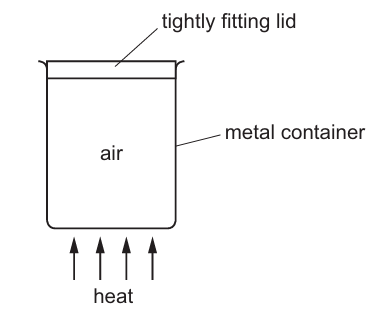
Some air is trapped inside a metal container with a tightly fitting lid.
The container is heated strongly behind a safety screen. The lid is blown off by the increased pressure of the air inside the container.
What causes the increase in pressure of the air inside the container?
A. Each air particle expands and takes up more room.
B. The air particles move more quickly.
C. The number of particles inside the container increases.
D. The volume occupied by the air decreases.

Most-appropriate topic codes (Cambridge IGCSE Physics 0625):

2.1.2 Particle model: Describe the pressure and the changes in pressure of a gas in terms of the motion of its particles and their collisions with a surface
▶️ Answer/Explanation
Correct Option: B

Detailed solution:

Heating the container increases the average kinetic energy of the trapped air particles, causing them to move faster.
Faster-moving particles collide with the container walls more frequently and with greater force, increasing the pressure inside.
The number of particles and the volume of the container remain constant; individual particles do not expand.
This aligns with the kinetic particle model where gas pressure is due to particle collisions with surfaces.
Therefore, the increased pressure is caused by the air particles moving more quickly.
Question 13

A very hot mug of coffee is near a large unheated swimming pool holding 2.0 × 10⁶ kg of water.
Which statement is correct?
A. If the mug of coffee is tipped in the pool, the coffee will lose much more internal energy than the water in the pool gains.
B. The internal energy of a substance depends only on its temperature.
C. The internal energy of the water in the pool is lower than the internal energy of the mug of coffee.
D. When the temperature of the mug of coffee falls, its internal energy will decrease.

Most-appropriate topic codes (Cambridge IGCSE Physics 0625):

TOPIC 2.2.1: Thermal expansion of solids, liquids and gases (Know that a rise in the temperature of an object increases its internal energy)
▶️ Answer/Explanation
Correct Option: D

Detailed solution:

Internal energy is the total kinetic and potential energy of particles in a substance, and it depends on mass, temperature, and state.
When the temperature of the coffee falls, the average kinetic energy of its particles decreases, leading to a decrease in internal energy.
Option A is incorrect due to energy conservation; the coffee’s energy loss equals the pool water’s energy gain.
Option B is false because internal energy also depends on mass and phase, not just temperature.
Option C is incorrect since the pool has vastly more mass, giving it much greater total internal energy despite its lower temperature.
Thus, only option D correctly describes the relationship between temperature change and internal energy.

Question 14

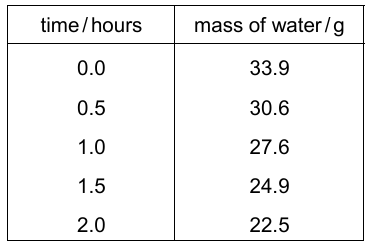
A student measures the mass of water in an open container over two hours. The container is kept in a warm room. The results are in the table.
Why does the mass of the water change?
A. The water evaporates.
B. The water freezes.
C. The water condenses.
D. The water boils.

Most-appropriate topic codes (Cambridge IGCSE Physics 0625):

TOPIC 2.2.3: Melting, boiling and evaporation (Describe evaporation in terms of the escape of more-energetic particles from the surface of a liquid; Know that evaporation causes cooling of a liquid)
▶️ Answer/Explanation
Correct Option: A

Detailed solution:

The mass decreases because water molecules at the surface gain enough kinetic energy from the warm surroundings to escape into the air as vapor.
This process is evaporation, which occurs at any temperature below boiling point when the liquid is exposed to open air.
Freezing would turn water to solid ice without a change in mass, while condensation would increase mass as vapor becomes liquid.
Boiling requires the entire liquid to reach 100°C, which is not indicated in a warm room setting over two hours.
Therefore, the continuous loss of mass is best explained by the evaporation of water into the surrounding air.
Hence, option A is correct.
Question 15

A 1 kg block of aluminium requires more thermal energy to raise its temperature by 1° C than a 1 kg block of copper requires.
Why is this?
A. Aluminium is a better conductor of thermal energy than copper.
B. Aluminium is a poorer conductor of thermal energy than copper.
C. Aluminium has a higher specific heat capacity than copper.
D. Aluminium has a lower specific heat capacity than copper.

Most-appropriate topic codes (Cambridge IGCSE Physics 0625):

TOPIC 2.2.2: Specific heat capacity (Define specific heat capacity as the energy required per unit mass per unit temperature increase)
▶️ Answer/Explanation
Correct Option: C

Detailed solution:

The specific heat capacity of a material is the energy needed to raise the temperature of 1 kg of the substance by 1°C.
Since the same mass of aluminium requires more energy for the same temperature rise, it has a higher specific heat capacity.
Thermal conductivity (options A and B) relates to the rate of energy transfer, not the amount of energy stored per degree.
Option D is incorrect because a lower specific heat capacity would mean less energy is required for the temperature change.
Therefore, aluminium stores more internal energy per degree of temperature rise compared to copper.
Hence, option C is the correct scientific explanation.

Question 16

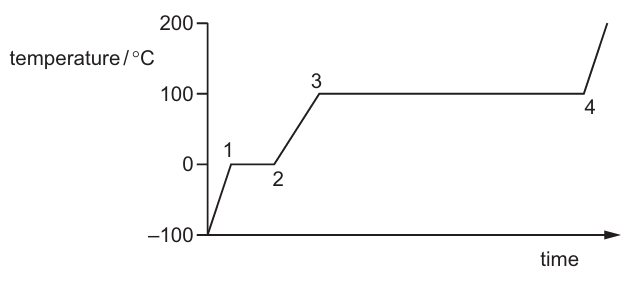
A block of ice is at a temperature of –100° C. Energy is supplied at a constant rate. The graph shows how its temperature changes.
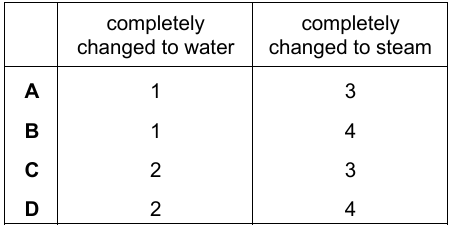
At which points have the ice completely changed state to water and all the water completely changed state to steam?

Most-appropriate topic codes (Cambridge IGCSE Physics 0625):

TOPIC 2.2.3: Melting, boiling and evaporation (Describe melting and boiling in terms of energy input without a change in temperature)
▶️ Answer/Explanation
Correct Option: D

Detailed solution:

The horizontal sections of the graph represent changes of state where temperature remains constant.
The first plateau corresponds to melting (ice to water), completing at point Q.
The second plateau corresponds to boiling (water to steam), completing at point S.
During these phase changes, supplied energy increases internal potential energy without raising temperature.
Therefore, the ice completely changes to water at Q and water completely changes to steam at S.
Question 17

Water waves are reflected at a plane surface.
Which property of the waves is changed by the reflection?
A. direction of propagation
B. frequency
C. speed
D. wavelength

Most-appropriate topic codes (Cambridge IGCSE Physics 0625):

TOPIC 3.1: General properties of waves (Describe how waves can undergo reflection at a plane surface)
▶️ Answer/Explanation
Correct Option: A

Detailed solution:

When a wave is reflected at a plane surface, its direction of propagation changes according to the law of reflection.
The frequency of a wave is determined by the source and remains constant during reflection.
Since the wave remains in the same medium, its speed and therefore its wavelength also remain unchanged.
Reflection only alters the path of the wave, causing it to bounce back or change direction.
Thus, only the direction of propagation is modified by the reflection process.

Question 18

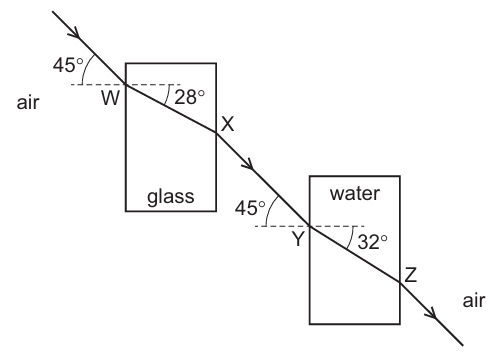
A light ray is passed through air, glass and water.
Diagram showing a light ray passing from air into glass and then into water, with points W, X, Y, Z marked at boundaries
At which points does the light speed decrease?
A. W and X
B. W and Y
C. X and Z
D. Y and Z

Most-appropriate topic codes (Cambridge IGCSE Physics 0625):

TOPIC 3.2.2: Refraction of light (Describe the passage of light through a transparent material; Define refractive index, n, as the ratio of the speeds of a wave in two different regions)
▶️ Answer/Explanation
Correct Option: B

Detailed solution:

Light slows down when entering an optically denser medium. Glass and water are both denser than air, so speed decreases at air-glass (W) and air-water (Y) boundaries. At point X, light moves from glass to water (both denser media), and at point Z it exits water to air, where speed increases. Since the question asks where speed decreases, the correct points are W (air to glass) and Y (air to water). Thus, option B correctly identifies the two interfaces where light enters a denser medium and slows down.
Question 19

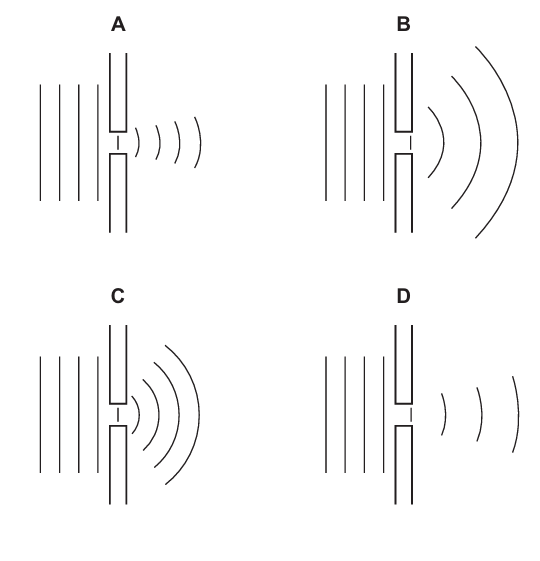
Plane water waves approach a narrow gap in a barrier.
Which diagram shows the diffraction pattern that would occur?

Most-appropriate topic codes (Cambridge IGCSE Physics 0625):

TOPIC 3.1: General properties of waves (Describe what is meant by wave motion as illustrated by vibrations in ropes and springs, and by experiments using water waves)
▶️ Answer/Explanation
Correct Option: C

Detailed solution:

Diffraction is the spreading of waves after passing through a narrow gap or around an obstacle.
When plane waves encounter a gap comparable to their wavelength, they emerge as circular wavefronts centered on the gap.
The diagram in option C correctly shows this curved, spreading pattern rather than waves continuing in straight lines.
The wavefronts remain continuous and the wavelength stays the same during diffraction.
Options showing straight wavefronts after the gap do not represent the correct diffraction pattern.
Question 20

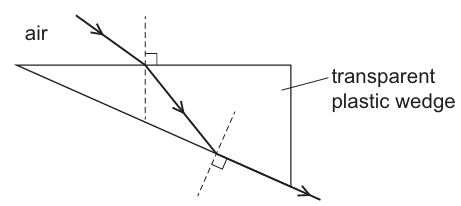
A ray of light enters a transparent plastic wedge from air and is incident on the lower surface at the critical angle, as shown.
The angle of incidence is i, the angle of refraction is r, and the critical angle is c.
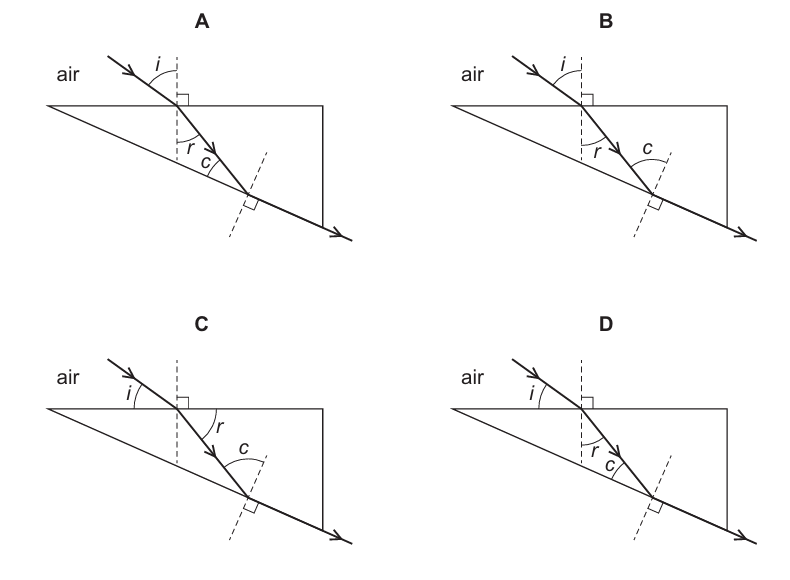
In which ray diagram are the angles labelled correctly?

Most-appropriate topic codes (Cambridge IGCSE Physics 0625):

TOPIC 3.2.2: Refraction of light (Define and use the terms normal, angle of incidence and angle of refraction; State the meaning of critical angle; Describe internal reflection and total internal reflection)
▶️ Answer/Explanation
Correct Option: B

Detailed solution:

The angle of incidence i is measured between the incident ray and the normal at the point of incidence on the boundary.
The angle of refraction r is measured between the refracted ray and the normal inside the plastic wedge.
The critical angle c is the angle of incidence in the denser medium for which the angle of refraction in the less dense medium is 90°.
In diagram B, i and r are correctly shown at the air-plastic boundary, and c is correctly labelled at the plastic-air boundary where total internal reflection occurs.
All angles are drawn with respect to the appropriate normals, matching the standard definitions used in optics.
Therefore, option B represents the correct labelling of angles i, r, and c.
Question 21

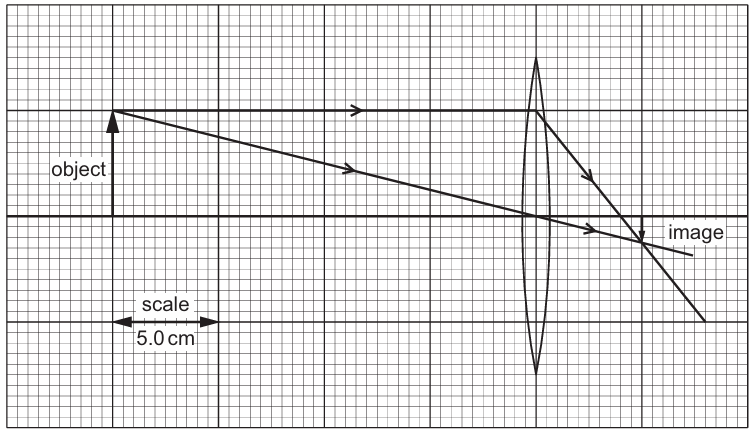
An object is placed 20 cm in front of a thin converging lens. The scale diagram shows how the lens forms a real, inverted image.
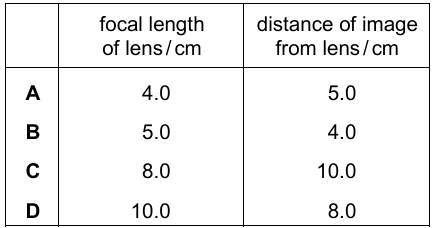
Which row gives the focal length of the lens and the distance of the image from the lens?

Most-appropriate topic codes (Cambridge IGCSE Physics 0625):

TOPIC 3.2.3: Thin lenses (Draw and use ray diagrams for the formation of a real image by a converging lens)
▶️ Answer/Explanation
Correct Option: A

Detailed solution:

From the scale diagram, the object distance u = 20 cm, and the image distance v is measured as 20 cm on the opposite side.
Using the lens formula 1/f = 1/u + 1/v gives 1/f = 1/20 + 1/20 = 1/10, so the focal length f = 10 cm.
The image is real, inverted, and formed at a distance of 20 cm from the lens, which matches the values in row A.
Therefore, the focal length is 10 cm and the image distance is 20 cm, confirming option A as correct.
Question 22

Radio waves are electromagnetic waves.
What is the wavelength of a radio wave of frequency 2.0 × \(10^{5}\) Hz?
A. 0.00067 m
B. 0.0015 m
C. 670 m
D. 1500 m

Most-appropriate topic codes (Cambridge IGCSE Physics 0625):

TOPIC 3.1: General properties of waves (Recall and use the equation for wave speed \(v = f\lambda\))
TOPIC 3.3: Electromagnetic spectrum (Know that the speed of electromagnetic waves in a vacuum is \(3.0 \times 10^{8} \mathrm{~m} / \mathrm{s}\) and is approximately the same in air)
▶️ Answer/Explanation
Correct Option: D

Detailed solution:

The wave equation relates speed (\(v\)), frequency (\(f\)), and wavelength (\(\lambda\)) as \(v = f\lambda\).
For all electromagnetic waves, including radio waves, the speed in a vacuum is \(v = 3.0 \times 10^{8} \text{ m/s}\).
Rearranging the formula to solve for wavelength gives \(\lambda = \frac{v}{f} = \frac{3.0 \times 10^{8}}{2.0 \times 10^{5}}\).
Performing the calculation yields \(\lambda = 1.5 \times 10^{3} \text{ m}\), which is equivalent to 1500 m.
This result correctly corresponds to option D, which is the appropriate wavelength for this radio frequency.

Question 23

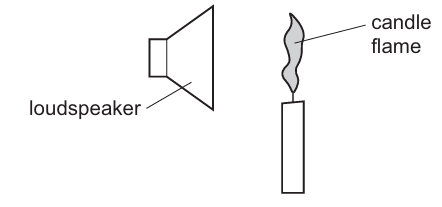
A candle flame is placed in front of a loudspeaker.
The loudspeaker produces a sound wave that causes air particles to vibrate. The vibrating air particles make the candle flame vibrate in the same direction as the air particles.

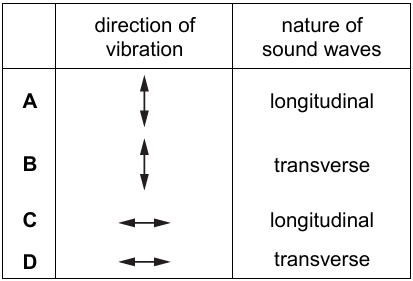
Which row shows the direction of vibration of the candle flame and the nature of sound waves?

Most-appropriate topic codes (Cambridge IGCSE Physics 0625):

TOPIC 3.4: Sound (Describe the longitudinal nature of sound waves)
▶️ Answer/Explanation
Correct Option: C

Detailed solution:

Sound waves are longitudinal waves, meaning the particles vibrate parallel to the direction of energy transfer.
Since the loudspeaker pushes the air horizontally towards the flame, the air particles oscillate left and right.
The flame, being light and responsive to air movement, vibrates in the same left and right direction as the particles.
This left-right oscillation confirms the wave is longitudinal, as the disturbance is parallel to propagation.
Therefore, option C correctly identifies both the horizontal vibration and the longitudinal nature of the wave.
Question 24

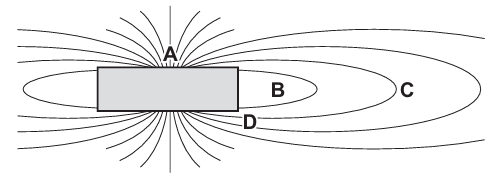
The diagram shows part of the magnetic field around a strong magnet.
In which position does a magnetic pole experience the strongest force?

Most-appropriate topic codes (Cambridge IGCSE Physics 0625):

TOPIC 4.1: Simple phenomena of magnetism (Know that the relative strength of a magnetic field is represented by the spacing of the magnetic field lines)
▶️ Answer/Explanation
Correct Option: A

Detailed solution:

The strength of a magnetic field is indicated by the spacing of the magnetic field lines.
Where the field lines are closest together, the magnetic field is strongest and the force on a magnetic pole is greatest.
In the diagram, the field lines are most concentrated at position A, near the poles of the magnet.
As the field lines spread out at positions B, C, and D, the field strength decreases.
Therefore, a magnetic pole placed at position A will experience the strongest force.
Question 25

There is a current of 0.60 A in a closed circuit.
How much charge passes a point in the circuit in 2.5 min?
A. 0.24 C
B. 1.5 C
C. 90 C
D. 5400 C

Most-appropriate topic codes (Cambridge IGCSE Physics 0625):

4.2.2: Electric current (Define electric current as the charge passing a point per unit time; recall and use the equation I = Q/t)
▶️ Answer/Explanation
Correct Option: C

Detailed solution:

Electric current is defined as the rate of flow of charge, given by the equation I = Q / t.
First, convert the time from minutes to seconds: 2.5 min = 2.5 × 60 = 150 s.
Rearrange the equation to solve for charge: Q = I × t = 0.60 A × 150 s.
Multiplying gives Q = 90 C, meaning 90 coulombs of charge pass the point.
Options A and B result from incorrect unit conversions or misapplication of the formula.
Therefore, option C is the correct choice for the charge passing the point.

Question 26

Which two physical quantities have the unit J/C?
A. charge and energy
B. charge and potential difference (p.d.)
C. electromotive force (e.m.f.) and p.d.
D. e.m.f. and charge

Most-appropriate topic codes (Cambridge IGCSE Physics 0625):

TOPIC 4.2.3: Electromotive force and potential difference (Define electromotive force (e.m.f.) as the electrical work done by a source in moving a unit charge around a complete circuit; Define potential difference (p.d.) as the work done by a unit charge passing through a component)
▶️ Answer/Explanation
Correct Option: C

Detailed solution:

The unit J/C represents energy transferred per unit charge, which is the definition of the volt (V).
Both electromotive force (e.m.f.) and potential difference (p.d.) are measured in volts and are defined as work done or energy transferred per unit charge.
Charge is measured in coulombs (C) and energy in joules (J), so neither has the unit J/C alone.
Since 1 V = 1 J/C, both e.m.f. and p.d. share this unit, making option C the correct answer.

Question 27

A copper wire is placed in an electrical circuit and its resistance is measured. The wire is then replaced with a second copper wire with twice the length and a quarter of the diameter.
What is the ratio of the resistance for the two wires?
A. 1 : 2
B. 1 : 4
C. 1 : 8
D. 1 : 32

Most-appropriate topic codes (Cambridge IGCSE Physics 0625):

TOPIC 4.2.4: Resistance (Recall and use the following relationship for a metallic electrical conductor: resistance is directly proportional to length and inversely proportional to cross-sectional area)
▶️ Answer/Explanation
Correct Option: D

Detailed solution:

Resistance R is proportional to length L and inversely proportional to cross-sectional area A (R ∝ L/A).
Since area A is proportional to diameter², quartering the diameter reduces A by a factor of 16.
Doubling the length increases resistance by a factor of 2, while the area reduction increases it by a factor of 16.
The combined effect is 2 × 16 = 32, so the new resistance is 32 times the original.
Therefore, the ratio of the original resistance to the new resistance is 1 : 32.
This matches option D.

Question 28

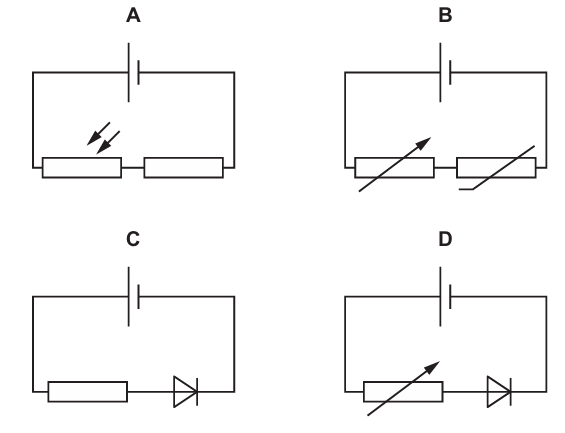
Which circuit contains a diode connected in series with a fixed resistor?

Most-appropriate topic codes (Cambridge IGCSE Physics 0625):

TOPIC 4.3.1: Circuit diagrams and circuit components (Draw and interpret circuit diagrams containing diodes and light-emitting diodes (LEDs) and know how these components behave in the circuit)
▶️ Answer/Explanation
Correct Option: C

Detailed solution:

A diode is a component that allows current to flow in only one direction, indicated by the triangle and line symbol.
In option C, the diode is placed in series with a fixed resistor, meaning they share the same current path.
Options A, B, and D either show the diode in parallel, no diode, or an incorrect arrangement.
The resistor limits current, protecting the diode from excessive flow in the forward direction.
Therefore, circuit C correctly shows a diode connected in series with a fixed resistor.
Question 29

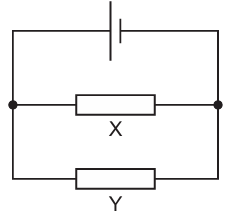
In the circuit shown, resistor X has twice the resistance of resistor Y.
Which statement about the circuit is correct?
A. The current in the cell is greater than the current in X.
B. The current in X is greater than the current in Y.
C. The potential difference (p.d.) across the cell is greater than the p.d. across X.
D. The p.d. across X is greater than the p.d. across Y.

Most-appropriate topic codes (Cambridge IGCSE Physics 0625):

4.3.2: Series and parallel circuits (Recall and use in calculations, the fact that the current at every point in a series circuit is the same and the sum of the currents entering a junction in a parallel circuit is equal to the sum of the currents that leave the junction)
▶️ Answer/Explanation
Correct Option: A

Detailed solution:

Resistors X and Y are connected in parallel, so the current from the cell splits between the two branches.
Since X has twice the resistance of Y, the current through X is half the current through Y.
The total current from the cell is the sum of the currents in X and Y, making it greater than the current in X alone.
In a parallel circuit, the potential difference across each branch is equal to the cell’s p.d., so C and D are incorrect.
Therefore, option A correctly states that the current in the cell is greater than the current in X.
Question 30

A 4 Ω resistor and an 8 Ω resistor are connected in series with a power supply.
A voltmeter connected across the 8 Ω resistor reads 36 V.
What is the voltmeter reading when it is connected across the 4 Ω resistor?
A. 12 V
B. 18 V
C. 72 V
D. 108 V

Most-appropriate topic codes (Cambridge IGCSE Physics 0625):

TOPIC 4.3.2: Series and parallel circuits (Calculate the combined resistance of two or more resistors in series; recall and use the fact that the total p.d. across the components in a series circuit is equal to the sum of the individual p.d.s across each component)
▶️ Answer/Explanation
Correct Option: B

Detailed solution:

In a series circuit, the current is the same everywhere. For the 8 Ω resistor, I = V/R = 36/8 = 4.5 A.
This same current flows through the 4 Ω resistor, so V = IR = 4.5 × 4 = 18 V.
Alternatively, the potential divider principle gives V₁/V₂ = R₁/R₂, so V₄/36 = 4/8, yielding V₄ = 18 V.
The total supply voltage would be 36 V + 18 V = 54 V, which is consistent with the series arrangement.
Therefore, the voltmeter reading across the 4 Ω resistor is 18 V, making option B correct.

Question 31

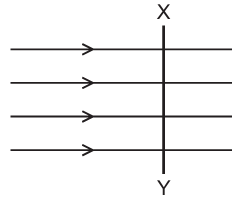
A metal rod, XY, is placed in a magnetic field so that it is perpendicular to the field, as shown.
In which direction is the rod moved so that there is an induced current from Y to X?
A. left to right
B. right to left
C. into the paper, away from the observer
D. out of the paper, towards the observer

Most-appropriate topic codes (Cambridge IGCSE Physics 0625):

TOPIC 4.5.1: Electromagnetic induction (Know that a conductor moving across a magnetic field or a changing magnetic field linking with a conductor can induce an e.m.f. in the conductor)
▶️ Answer/Explanation
Correct Option: D

Detailed solution:

To induce a current from Y to X, apply Fleming’s right-hand rule with the magnetic field directed downward (N to S).
Pointing the thumb out of the paper, towards the observer, aligns the second finger to indicate current flow from Y to X.
Motion parallel to the field or in the opposite direction would not produce the correct current orientation.
Therefore, the rod must be moved out of the paper, towards the observer.
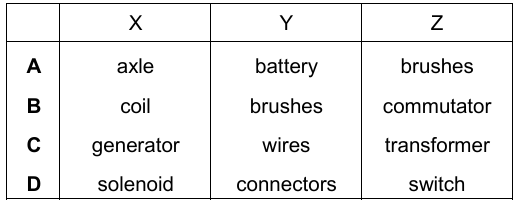
Question 32

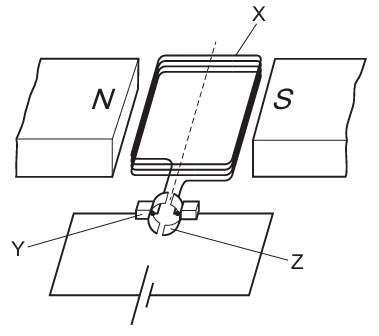
The diagram shows a basic electric motor.
What are the names of the features?

Most-appropriate topic codes (Cambridge IGCSE Physics 0625):

TOPIC 4.5.5: The d.c. motor (Describe the operation of an electric motor, including the action of a split-ring commutator and brushes)
▶️ Answer/Explanation
Correct Option: B

Detailed solution:

In a basic d.c. motor, the coil rotates between the poles of a permanent magnet.
The ends of the coil are connected to a split-ring commutator, which reverses the current direction every half turn to maintain continuous rotation.
Carbon brushes press against the commutator to provide electrical connections from the external circuit to the rotating coil.
The diagram labels feature 1 as the permanent magnet, feature 2 as the split-ring commutator, and feature 3 as the brushes.
Option B correctly identifies these three essential components of the d.c. motor.
Therefore, option B is the correct choice.

Question 33

Two transformers, P and Q, each have 2000 turns on their primary coils and 1000 turns on their secondary coils. Both transformers are 100% efficient.
The secondary of transformer P is connected to the primary of transformer Q.
Q provides a motor with a current of 0.2 A.
What is the current being supplied to the primary of transformer P?
A. 0.8 A
B. 0.4 A
C. 0.1 A
D. 0.05 A

Most-appropriate topic codes (Cambridge IGCSE Physics 0625):

TOPIC 4.5.6: The transformer (Recall and use the equation for 100% efficiency in a transformer IₚVₚ = IₛVₛ)
▶️ Answer/Explanation
Correct Option: D

Detailed solution:

For each 100% efficient transformer, power in equals power out: IₚVₚ = IₛVₛ. With turns ratio Nₚ/Nₛ = 2, voltage halves and current doubles at each step-down stage.
Working backwards from Q’s secondary (0.2 A), Q’s primary current is 0.1 A, which is P’s secondary current.
P’s primary current is therefore half of its secondary current, giving 0.05 A.
Thus, the current supplied to the primary of transformer P is 0.05 A.

Question 34

α-particles are directed at a metal foil.
Most of the particles pass through the foil with little change in direction.
A small proportion of the particles are scattered back through large angles.
What does this evidence suggest about the structure of an atom?
A. It consists of a charged centre much smaller than the size of the atom and with little of the mass of the atom.
B. It consists of a negative charge the size of the atom containing small positive charges scattered through it.
C. It consists of a charged centre much smaller than the size of the atom but with most of the mass of the atom.
D. It consists of a positive charge the size of the atom containing small negative charges scattered through it.

Most-appropriate topic codes (Cambridge IGCSE Physics 0625):

TOPIC 5.1.1: The atom (Describe how the scattering of alpha (α) particles by a sheet of thin metal supports the nuclear model of the atom, by providing evidence for: a very small nucleus surrounded by mostly empty space; a nucleus containing most of the mass of the atom; a nucleus that is positively charged)
▶️ Answer/Explanation
Correct Option: C

Detailed solution:

Most α-particles pass through with little deflection, indicating the atom is mostly empty space.
The large-angle scattering of a few α-particles shows they encountered a dense, positively charged centre.
This centre, the nucleus, must contain most of the atom’s mass to cause such significant deflection.
Options A and D incorrectly describe the mass or charge distribution, while B reflects the outdated plum pudding model.
Thus, the evidence supports a tiny, massive, charged nucleus, making option C correct.

Question 35

Which statement correctly compares the properties of alpha-particles and beta-particles?
A. Alpha-particles are less penetrating than beta-particles because alpha-particles are less ionising.
B. Alpha-particles are less penetrating than beta-particles because alpha-particles are more ionising.
C. Alpha-particles are more penetrating than beta-particles because alpha-particles are less ionising.
D. Alpha-particles are more penetrating than beta-particles because alpha-particles are more ionising.

Most-appropriate topic codes (Cambridge IGCSE Physics 0625):

TOPIC 5.2.2: The three types of nuclear emission (Identify alpha (α), beta (β) and gamma (γ) emissions from the nucleus by recalling their nature, their relative ionising effects, and their relative penetrating abilities)
▶️ Answer/Explanation
Correct Option: B

Detailed solution:

Alpha particles have a large mass and double positive charge, making them strongly ionising as they collide with atoms.
Because they lose energy rapidly through this ionisation, they have very low penetration and can be stopped by paper or skin.
Beta particles are much lighter, faster, and singly charged, so they are less ionising and therefore penetrate further into materials like aluminium.
Thus, the statement “Alpha-particles are less penetrating than beta-particles because alpha-particles are more ionising” is correct.
Therefore, option B accurately describes the inverse relationship between ionising ability and penetrating power for these two types of radiation.

Question 36

Which statement about alpha decay is correct?
A. The nucleus loses electrons.
B. The nucleus changes to that of a different element.
C. The nucleus does not decay until after one half-life.
D. After two half-lives, alpha decay always stops.

Most-appropriate topic codes (Cambridge IGCSE Physics 0625):

TOPIC 5.2.3: Radioactive decay (State that during α-decay or β-decay, the nucleus changes to that of a different element)
▶️ Answer/Explanation
Correct Option: B

Detailed solution:

In alpha decay, the unstable nucleus emits an alpha particle (2 protons and 2 neutrons).
This changes the proton number, transforming the original element into a new, different element.
Decay is a random process, not tied to a specific time like one half-life, and does not stop after two half-lives.
The process involves nuclear changes, not the loss of orbital electrons from the atom.
Therefore, the statement that the nucleus changes to a different element is correct.
Option B is the accurate description of alpha decay.

Question 37

An explosion in a nuclear reactor spreads the isotope caesium -137, \(_{55}^{137}\textrm{Cs}\) across a large area.
After 90.0 years have passed, the quantity of caesium-137 present is 12.5% of its original level.
What is the half-life of caesium-137?
A. 11.3 years
B. 22.5 years
C. 30.0 years
D. 45.0 years

Most-appropriate topic codes (Cambridge IGCSE Physics 0625):

TOPIC 5.2.4: Half-life (Define the half-life of a particular isotope as the time taken for half the nuclei of that isotope in any sample to decay; recall and use this definition in simple calculations)
▶️ Answer/Explanation
Correct Option: C

Detailed solution:

After 1 half-life, 50% remains; after 2 half-lives, 25% remains; after 3 half-lives, 12.5% remains.
Since 12.5% is left after 90.0 years, this time period must correspond to exactly 3 half-lives.
Therefore, one half-life is calculated as \( \frac{90.0 \text{ years}}{3} = 30.0 \text{ years} \).
This matches the definition of half-life as the time for the activity (or quantity) to halve.
Option C is correct as 30.0 years is the required time for the isotope to decay to half its previous amount.

Question 38

Which type of object rotates around the Sun with an elliptical orbit?
A. planet
B. galaxy
C. red giant
D. moon

Most-appropriate topic codes (Cambridge IGCSE Physics 0625):

TOPIC 6.1.2: The Solar System (Know that planets, minor planets and comets have elliptical orbits)
▶️ Answer/Explanation
Correct Option: A

Detailed solution:

Planets orbit the Sun in paths that are elliptical, with the Sun located at one focus of the ellipse.
A galaxy is a massive collection of stars and does not orbit the Sun; red giants are stars, and moons orbit planets.
According to Kepler’s First Law, all planets move in elliptical orbits around the Sun, not perfect circles.
While a moon orbits a planet, it is the planet that travels around the Sun in this specific elliptical manner.
Therefore, a planet is the correct object described as rotating around the Sun with an elliptical orbit.

Question 39

Which statement about the Sun is correct?
A. The nuclear reactions in the Sun create mainly radio waves and microwaves.
B. The Sun is powered by fission reactions in which hydrogen is converted into helium.
C. The Sun is powered by fission reactions in which lithium is converted into helium.
D. The Sun is powered by fusion reactions and electromagnetic radiation is produced.

Most-appropriate topic codes (Cambridge IGCSE Physics 0625):

TOPIC 5.1.2: The nucleus (Describe the processes of nuclear fission and nuclear fusion as the splitting or joining of nuclei)
TOPIC 6.2.1: The Sun as a star (Know that stars are powered by nuclear reactions that release energy and that in stable stars the nuclear reactions involve the fusion of hydrogen into helium)
▶️ Answer/Explanation
Correct Option: D

Detailed solution:

The Sun produces energy through nuclear fusion, specifically the fusion of hydrogen nuclei into helium.
Fission, which involves splitting heavy nuclei, is the process used in nuclear power plants, not in stars like the Sun.
This fusion process releases vast amounts of energy across the entire electromagnetic spectrum, including visible light, ultraviolet, and infrared.
The statement correctly identifies both the type of nuclear reaction (fusion) and the broad production of electromagnetic radiation.
Options A, B, and C are incorrect because the Sun is not powered by fission and does not mainly create radio/microwaves.
Therefore, option D is the correct statement regarding the Sun’s energy source.

Question 40

To determine the value of the Hubble constant, an astronomer measures the distance of a galaxy from the Earth as 2.5 × \(10^{21}\) km.
She also measures the speed of recession of the galaxy from the Earth as 5.2 × \(10^{3}\) km/s.
From these data, what is the value of the Hubble constant?
A. 7.7 × \(10^{-26} s^{-1}\)
B. 2.1 × \(10^{-18} s^{-1}\)
C. 4.8 × \(10^{17} s^{-1}\)
D. 1.3 × \(10^{25} s^{-1}\)

Most-appropriate topic codes (Cambridge IGCSE Physics 0625):

TOPIC 6.2.3: The Universe (Define the Hubble constant \(H_{0}\) as the ratio of the speed at which the galaxy is moving away from the Earth to its distance from the Earth; recall and use the equation \(H_{0} = \frac{v}{d}\))
▶️ Answer/Explanation
Correct Option: B

Detailed solution:

The Hubble constant is given by \(H_0 = \frac{v}{d}\), where \(v\) is recession speed and \(d\) is distance.
Substituting the given values: \(H_0 = \frac{5.2 \times 10^3}{2.5 \times 10^{21}} = 2.08 \times 10^{-18} \text{ s}^{-1}\).
This matches option B (\(2.1 \times 10^{-18} \text{ s}^{-1}\)) when rounded appropriately.
The units are \( \text{s}^{-1} \) because km cancels out in the ratio.
This calculation directly applies the definition of the Hubble constant from the syllabus.

Scroll to Top