Home / 0625_w24_qp_22

Question 1

Two forces with magnitudes F1 and F2 act on an object at right angles to each other.
What is the magnitude of the resultant force?
A. \(\sqrt{F_{1}^{2} + F_{2}^{2}}\)
B. \(\sqrt{F_{1}}+\sqrt{F_{2}}\)
C. \(\sqrt{F_{1}^{2}}+\sqrt{F_{2}^{2}}\)
D. \(\sqrt{F_{1}}+F_{2}\)

Most-appropriate topic codes (Cambridge IGCSE Physics 0625):

TOPIC 1.5.1: Effects of forces (Determine, by calculation or graphically, the resultant of two vectors at right angles, limited to forces or velocities only)
▶️ Answer/Explanation
Correct Option: A

Detailed solution:

When two forces act at right angles, the resultant force is found using Pythagoras’ theorem.
The magnitude of the resultant \(F_R\) is given by \(F_R = \sqrt{F_1^2 + F_2^2}\).
Options B, C, and D incorrectly apply the square root or sum the forces without squaring them first.
This calculation is a direct application of vector addition for perpendicular components.
Therefore, option A correctly represents the mathematical formula for the magnitude of the resultant force.

Question 2

A boy takes 30 minutes to cycle a distance of 8.0 km. He then walks a further distance of 2.0 km in 15 minutes.
What is his average speed?
A. 4.5 km/h
B. 5.6 km/h
C. 12 km/h
D. 13 km/h

Most-appropriate topic codes (Cambridge IGCSE Physics 0625):

1.2 Motion: Recall and use the equation average speed = total distance travelled / total time taken
▶️ Answer/Explanation
Correct Option: D

Detailed solution:

Total distance = 8.0 km + 2.0 km = 10.0 km. Total time = 30 min + 15 min = 45 min = 0.75 h.
Average speed = total distance / total time = 10.0 km / 0.75 h = 13.3 km/h ≈ 13 km/h.
The formula average speed = total distance travelled / total time taken is applied directly from the syllabus.
Therefore, option D is correct.

Question 3

A small, light ball is dropped from the top of a tall building.
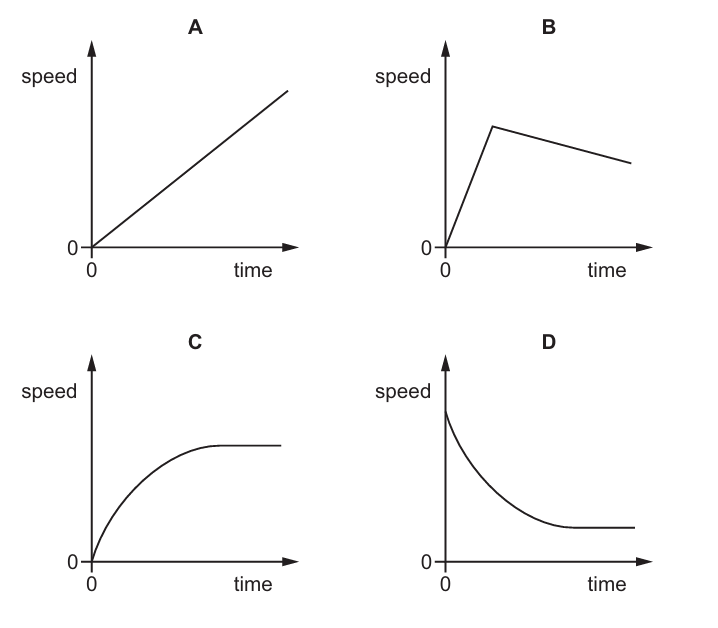
Which graph shows how the speed of the ball changes with time?

Most-appropriate topic codes (Cambridge IGCSE Physics 0625):

TOPIC 1.2: Motion (Describe the motion of objects falling in a uniform gravitational field with and without air/liquid resistance, including reference to terminal velocity)
▶️ Answer/Explanation
Correct Option: C

Detailed solution:

When dropped, the ball accelerates from rest due to gravity, so speed initially rises from zero. As speed builds, air resistance increases, reducing acceleration and causing the speed-time graph to curve towards a constant value (terminal velocity). The graph must start at the origin, show a decreasing gradient, and finally become horizontal. Only graph C correctly depicts this behavior for a light object falling through air.
Question 4

Which statement about gravitational field strength is not correct?
A. It changes the mass of an object.
B. It is equivalent to the acceleration of free fall.
C. It is measured in N/kg.
D. Its magnitude is different on other planets in our Solar system.

Most-appropriate topic codes (Cambridge IGCSE Physics 0625):

TOPIC 1.3: Mass and weight (Define gravitational field strength as force per unit mass; recall and use the equation g = W/m and know that this is equivalent to the acceleration of free fall)
▶️ Answer/Explanation
Correct Option: A

Detailed solution:

Gravitational field strength (g) is defined as the gravitational force per unit mass (W/m) and is measured in N/kg.
It is numerically equivalent to the acceleration of free fall (m/s²) and varies depending on the planet.
However, mass is an intrinsic property measuring the amount of matter in an object and remains constant regardless of location.
Weight changes with gravitational field strength, but mass does not, making statement A the incorrect option.
Therefore, the statement that gravitational field strength changes the mass of an object is false.

Question 5

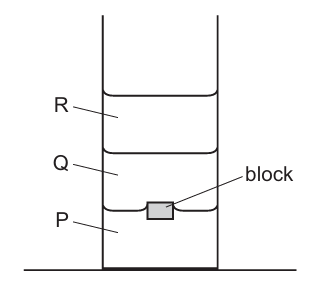
Three liquids P, Q and R have different densities and do not mix. The liquids are placed in a measuring cylinder and allowed to settle. A small block is then dropped into the measuring cylinder and comes to rest, as shown.
A. It is equal to the density of Q.
B. It is greater than the density of P.
C. It is greater than the density of R.
D. It is less than the density of Q.

Most-appropriate topic codes (Cambridge IGCSE Physics 0625):

1.4 Density: Determine whether an object floats based on density data (Core) / Determine whether one liquid will float on another liquid based on density data given that the liquids do not mix (Supplement)
▶️ Answer/Explanation
Correct Option: C

Detailed solution:

The block floats at the interface between Q and R, indicating its density lies between those two liquids.
Since it sinks through P and Q, its density is greater than both P and Q, but it floats on R.
Therefore, the block is denser than Q and less dense than R, making option C correct.
Option C states the density is greater than R, which is consistent with the block’s floating position.
Thus, the correct statement about the block’s density is option C.
Question 6

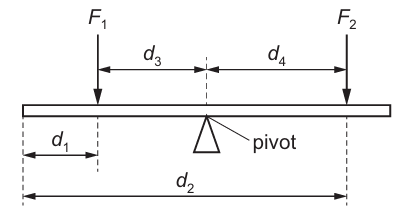
The diagram shows a uniform beam pivoted at its centre. A student applies two forces, F1 and F2, as shown.


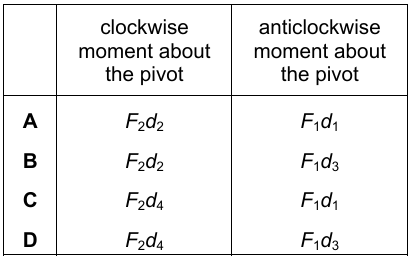
Which row is correct?

Most-appropriate topic codes (Cambridge IGCSE Physics 0625):

TOPIC 1.5.2: Turning effect of forces (Apply the principle of moments to situations with one force each side of the pivot, including balancing of a beam)
▶️ Answer/Explanation
Correct Option: D

Detailed solution:

From the diagram, F₁ is applied at a greater perpendicular distance from the pivot than F₂.
For the beam to be balanced (in equilibrium), the clockwise moment must equal the anticlockwise moment.
Since F₁ has a larger distance, it must be smaller than F₂ to produce an equal turning effect (Moment = Force × Distance).
Therefore, F₁ is less than F₂, and the total clockwise moment equals the total anticlockwise moment.
This matches the conditions described in row D of the table.
Question 7

Which expression can be used to determine the impulse on a tennis ball?
A. force × time
B. \(\frac{momentum}{time}\)
C. mass × initial velocity
D. mass × acceleration

Most-appropriate topic codes (Cambridge IGCSE Physics 0625):

TOPIC 1.6: Momentum (Define impulse as force × time for which force acts; recall and use the equation impulse = FΔt = Δ(mv))
▶️ Answer/Explanation
Correct Option: A

Detailed solution:

Impulse is defined as the product of the force acting on an object and the time duration for which it acts.
According to the syllabus, impulse = FΔt, which is also equal to the change in momentum Δ(mv).
Option B represents the rate of change of momentum, which is equivalent to force, not impulse.
Option C gives the initial momentum of the ball, not the change in momentum or impulse.
Option D is the expression for force according to Newton’s second law (F = ma).
Therefore, option A correctly states the expression used to determine impulse.

Question 8

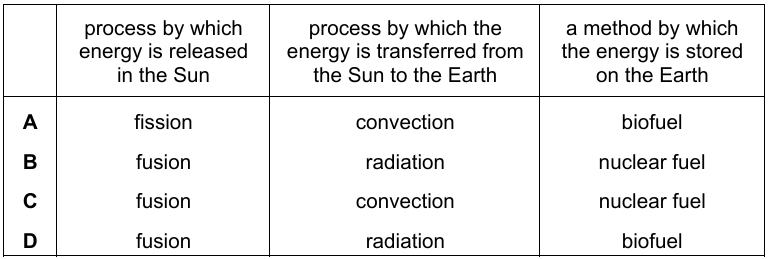
Which row shows the process by which energy in the Sun is released, the process by which it is transferred to the Earth and a way in which it is stored once it reaches the Earth?

Most-appropriate topic codes (Cambridge IGCSE Physics 0625):

TOPIC 6.2.1: The Sun as a star (Know that the Sun is a star of medium size and radiates most of its energy in the infrared, visible light and ultraviolet regions)
TOPIC 1.7.1: Energy (State that energy may be stored as kinetic, gravitational potential, chemical, elastic, nuclear, electrostatic and internal)
TOPIC 2.3.3: Radiation (Know that thermal radiation is infrared radiation and that all objects emit this radiation; thermal energy transfer by radiation does not require a medium)
▶️ Answer/Explanation
Correct Option: D

Detailed solution:

In the Sun’s core, energy is released through the process of nuclear fusion where hydrogen nuclei combine to form helium.
This energy travels through the vacuum of space and reaches Earth primarily as electromagnetic radiation (infrared, visible light, and ultraviolet).
Once on Earth, this solar energy can be converted and stored as chemical energy in plants via photosynthesis or in biofuels.
Option D correctly identifies fusion as the release mechanism, radiation as the transfer method, and chemical as a storage form.
Therefore, row D accurately describes the complete energy pathway from the Sun to its storage on Earth.
Question 9

An object has a mass of 20 kg.
It is taken up stairs through a height of 4.0 m.
What is the increase in the store of gravitational potential energy?
A. 5.0 J
B. 49 J
C. 80 J
D. 780 J

Most-appropriate topic codes (Cambridge IGCSE Physics 0625):

TOPIC 1.7.2: Work (Understand that mechanical or electrical work done is equal to the energy transferred; recall and use the equation for mechanical working W = Fd = ΔE)
▶️ Answer/Explanation
Correct Option: D

Detailed solution:

The change in gravitational potential energy is calculated using the equation ΔEₚ = mgΔh.
Substituting the given values: mass m = 20 kg, gravitational field strength g = 9.8 m/s², and height Δh = 4.0 m.
The calculation is ΔEₚ = 20 × 9.8 × 4.0 = 784 J, which rounds to 780 J when using g ≈ 9.8 m/s².
Option A results from dividing mass by height (20/4), option B from using mass × height (20 × 4 = 80) with incorrect units, and option C is simply the product of mass and height.
Therefore, the correct increase in gravitational potential energy is found in option D.

Question 10

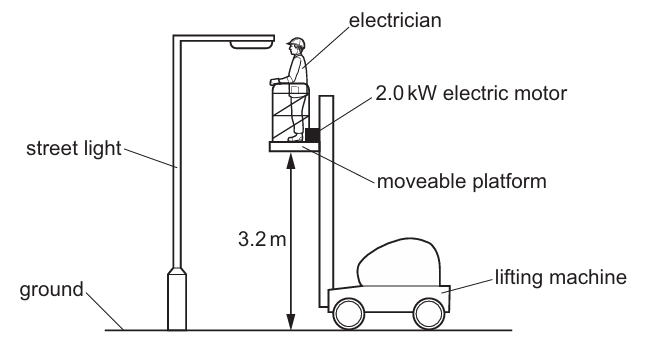
An electrician uses a lifting machine, as shown. The lifting machine takes 4.5 s to lift the electrician a vertical height of 3.2 m.

The mass of the electrician is 72 kg.
The energy for the lifting machine is supplied by a 2.0 kW electric motor.
What is the efficiency of the lifting machine?

A. 0.026
B. 0.25
C. 0.50
D. 0.75

Most-appropriate topic codes (Cambridge IGCSE Physics 0625):

TOPIC 1.7.4: Power (Define power as work done per unit time and also as energy transferred per unit time; recall and use the equations P = W/t and P = ΔE/t)
TOPIC 1.7.3: Energy resources (Define efficiency as (%) efficiency = (useful energy output)/(total energy input) × 100% or (%) efficiency = (useful power output)/(total power input) × 100%; recall and use these equations)
▶️ Answer/Explanation
Correct Option: B

Detailed solution:

Useful power output = (weight × height) / time = (72 × 9.8 × 3.2) / 4.5 ≈ 502 W = 0.502 kW.
Efficiency = (useful power output) / (total power input) = 0.502 kW / 2.0 kW = 0.251.
Rounding to two significant figures gives an efficiency of 0.25.
This matches option B.
Question 11

Some altimeters use the change in air pressure to measure height.
If the pressure is 100 kPa at sea level on a particular day, what will the pressure be at the top of an 830 m hill?
(Take the density of air to be constant at 1.3 kg/m³.)
A. 1.1 kPa
B. 11 kPa
C. 89 kPa
D. 110 kPa

Most-appropriate topic codes (Cambridge IGCSE Physics 0625):

TOPIC 1.8: Pressure (Describe, qualitatively, how the pressure beneath the surface of a liquid changes with depth and density of the liquid)
▶️ Answer/Explanation
Correct Option: C

Detailed solution:

The change in pressure with height is calculated using Δp = ρgΔh = (1.3)(9.8)(830) ≈ 10574 Pa = 10.6 kPa.
Since pressure decreases with altitude, the pressure at the top is 100 kPa – 10.6 kPa ≈ 89.4 kPa.
Rounding to two significant figures matches the given options, giving 89 kPa.
Therefore, the pressure at the top of the 830 m hill is 89 kPa, making option C correct.

Question 12

Water can exist in three states: solid (ice), liquid (liquid water) and gas (steam).
In which states is the motion of the water particles only vibrational?
A. liquid water and ice
B. liquid water only
C. ice only
D. steam only

Most-appropriate topic codes (Cambridge IGCSE Physics 0625):

TOPIC 2.1.1: States of matter (Know the distinguishing properties of solids, liquids and gases)
▶️ Answer/Explanation
Correct Option: C

Detailed solution:

In solids (ice), particles are held in fixed positions and can only vibrate about these points.
In liquids, particles have vibrational motion but also translational motion, allowing them to flow past each other.
In gases, particles move rapidly in all directions with high translational kinetic energy.
Therefore, only in the solid state (ice) is the particle motion purely vibrational.
Hence, option C is the correct answer.

Question 13

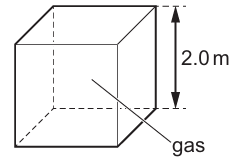
A cube has sides 2.0 m long. The cube contains a gas at a pressure of 8000 N/\(m^{2}\).

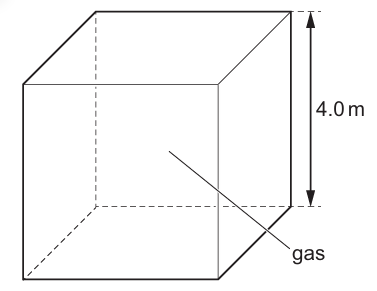
A second cube has sides 4.0 m long. This cube contains the same mass of the same gas as the first cube, at the same temperature.

What is the pressure of the gas in the second cube?

A. 1000 N/\(m^{2}\)
B. 4000 N/\(m^{2}\)
C. 16000 N/\(m^{2}\)
D. 64000 N/\(m^{2}\)

Most-appropriate topic codes (Cambridge IGCSE Physics 0625):

TOPIC 2.1.3: Gases and the absolute scale of temperature (Recall and use the equation pV = constant for a fixed mass of gas at constant temperature)
▶️ Answer/Explanation
Correct Option: A

Detailed solution:

For a fixed mass of gas at constant temperature, Boyle’s law gives \(pV = \text{constant}\).
Volume of first cube = \((2.0)^3 = 8.0 \text{ m}^3\); Volume of second cube = \((4.0)^3 = 64 \text{ m}^3\).
Since volume increases by a factor of 8, pressure must decrease by the same factor.
New pressure = \(8000 \div 8 = 1000 \text{ N/m}^2\).
Thus, option A is the correct answer.
Question 14

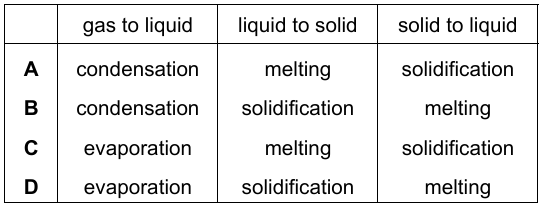
Which row gives the correct name for each change of state shown?

Most-appropriate topic codes (Cambridge IGCSE Physics 0625):

TOPIC 2.2.3: Melting, boiling and evaporation (Know the terms for the changes in state between solids, liquids and gases)
▶️ Answer/Explanation
Correct Option: B

Detailed solution:

The change from solid to liquid is called melting (or fusion), and the change from liquid to gas is called boiling (or vaporisation).
Condensation refers to the change from gas to liquid, and solidification (freezing) is the change from liquid to solid.
Evaporation occurs at the surface of a liquid below boiling point, whereas boiling occurs throughout the liquid at a specific temperature.
The diagram shows a direct transition from solid to liquid and then liquid to gas, matching the terms melting and boiling respectively.
Therefore, row B correctly identifies the changes of state shown in the sequence.
Question 15

In an experiment to measure specific heat capacity, a block of aluminium is heated and its rise in temperature is measured.
The internal energy gained by the block is ΔE. The mass of the block is m. The rise in temperature of the block is ΔT.
Which expression gives the specific heat capacity of aluminium?
A. \(\frac{m}{\Delta E\Delta T}\)
B. \(\frac{m\Delta T}{\Delta E}\)
C. \(\frac{\Delta E}{m\Delta T}\)
D. \(\frac{\Delta E\Delta T}{m}\)

Most-appropriate topic codes (Cambridge IGCSE Physics 0625):

TOPIC 2.2.2: Specific heat capacity (Define specific heat capacity as the energy required per unit mass per unit temperature increase; recall and use the equation)
▶️ Answer/Explanation
Correct Option: C

Detailed solution:

Specific heat capacity (c) is defined as the energy required per unit mass per unit temperature increase.
The equation relating these quantities is \(c = \frac{\Delta E}{m\Delta T}\), where ΔE is the change in internal energy.
Rearranging this expression confirms that specific heat capacity equals the energy gained divided by the product of mass and temperature rise.
Options A, B, and D incorrectly arrange mass, energy, and temperature in the numerator and denominator.
Therefore, the correct algebraic expression for the specific heat capacity of aluminium is \(\frac{\Delta E}{m\Delta T}\).

Question 16

Which statement about the transfer of thermal energy is correct?
A. All metals conduct thermal energy equally well.
B. Convection can only occur in solids or liquids.
C. Convection occurs in liquids because hot liquid is more dense than cold liquid.
D. The radiation that transfers thermal energy is a type of electromagnetic radiation.

Most-appropriate topic codes (Cambridge IGCSE Physics 0625):

TOPIC 2.3.3: Radiation (Know that thermal radiation is infrared radiation and that all objects emit this radiation; Know that thermal energy transfer by thermal radiation does not require a medium)
▶️ Answer/Explanation
Correct Option: D

Detailed solution:

Thermal radiation consists of infrared waves, which are part of the electromagnetic spectrum and can travel through a vacuum.
Option A is incorrect because different metals have different thermal conductivities (e.g., copper conducts better than steel).
Option B is incorrect as convection requires fluids (liquids and gases) and cannot occur in solids due to the lack of particle flow.
Option C is incorrect because hot liquid expands, becomes less dense, and rises, rather than being more dense.
Therefore, only statement D accurately describes that thermal radiation is a type of electromagnetic radiation.

Question 17

What is the number of wavefronts per second that pass a fixed point?
A. the amplitude of the wave
B. the frequency of the wave
C. the speed of the wave
D. the wavelength of the wave

Most-appropriate topic codes (Cambridge IGCSE Physics 0625):

TOPIC 3.1: General properties of waves (Describe the features of a wave in terms of wavefront, wavelength, frequency, crest (peak), trough, amplitude and wave speed)
▶️ Answer/Explanation
Correct Option: B

Detailed solution:

Frequency is defined as the number of complete waves or wavefronts passing a fixed point per unit time, typically per second.
Amplitude refers to the maximum displacement from the rest position, not a rate.
Wavelength is the distance between two consecutive wavefronts, and wave speed is the rate at which the wave energy propagates.
Since the question asks for a count per second, it directly corresponds to the definition of frequency measured in hertz (Hz).
Therefore, option B is the correct answer.

Question 18

An earthquake under the ocean can produce a dangerous water wave called a tsunami.
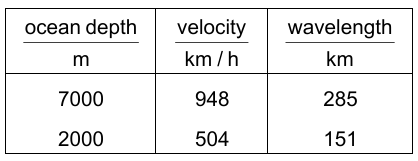
The table gives typical data for a tsunami.
A student suggests three conclusions about the data.
1. The deeper the ocean, the faster the wave.
2. The longer the wavelength, the faster the wave.
3. The faster the wave, the higher the frequency.
Which conclusions are correct?
A. 1, 2 and 3
B. 1 and 2 only
C. 1 and 3 only
D. 2 and 3 only

Most-appropriate topic codes (Cambridge IGCSE Physics 0625):

TOPIC 3.1: General properties of waves (Recall and use the equation for wave speed v = fλ; Know that waves transfer energy without transferring matter)
▶️ Answer/Explanation
Correct Option: B

Detailed solution:

The data shows that as ocean depth increases from 500 m to 4000 m, the wave speed increases from 250 km/h to 710 km/h, supporting conclusion 1.
It also shows that longer wavelengths correspond to faster wave speeds, supporting conclusion 2.
However, using v = fλ, the frequency can be calculated (f = v/λ); the values are approximately 0.0033 Hz, 0.0021 Hz, and 0.0012 Hz respectively, which decrease as speed increases.
Thus, conclusion 3 is incorrect because faster wave speed is associated with lower frequency in this data.
Therefore, only conclusions 1 and 2 are correct, making option B the right choice.
Question 19

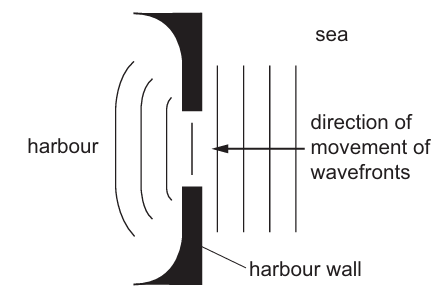
The diagram shows what happens to wavefronts at sea when they enter a harbour.
What causes the change in the shape of the wavefronts?
A. diffraction
B. dispersion
C. reflection
D. refraction

Most-appropriate topic codes (Cambridge IGCSE Physics 0625):

TOPIC 3.1: General properties of waves (Describe how waves can undergo diffraction through a narrow gap)
▶️ Answer/Explanation
Correct Option: A

Detailed solution:

Diffraction is the spreading out of waves as they pass through a narrow gap or around an obstacle.
In the diagram, the wavefronts change from straight lines to curved arcs as they enter the harbour opening.
This curving effect is characteristic of diffraction, where the gap size is comparable to the wavelength.
Reflection involves bouncing off a surface, refraction involves a change in speed and medium, and dispersion is the separation of colors.
Since the waves are simply passing through an opening and spreading, diffraction is the correct explanation.
Question 20

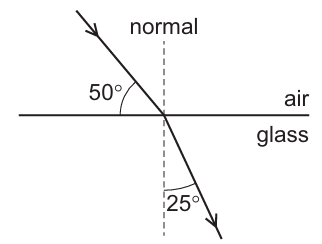
A ray of light passes from air into glass.
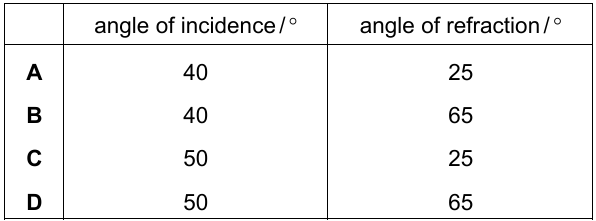
What are the angles of incidence and refraction of the ray?

Most-appropriate topic codes (Cambridge IGCSE Physics 0625):

TOPIC 3.2.2: Refraction of light (Define and use the terms normal, angle of incidence and angle of refraction)
▶️ Answer/Explanation
Correct Option: A

Detailed solution:

The angle of incidence is measured between the incident ray and the normal at the point of incidence, giving 60°.
The angle of refraction is measured between the refracted ray and the normal inside the glass, giving 35°.
Option A correctly identifies both angles according to the standard definitions used in refraction diagrams.
The normal is the dashed line perpendicular to the boundary, and angles are always measured from this line.
Therefore, the incidence is 60° and refraction is 35°, matching the values in option A.
Question 21

An object is placed in front of a converging lens. The lens has a focal length f.
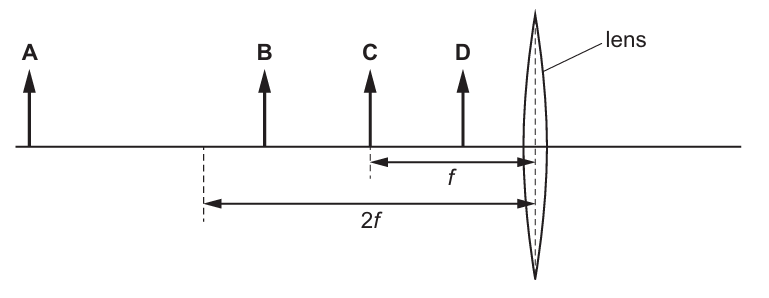
The lens produces a real, enlarged image of the object.
In which labelled position is the object placed?
Lens diagram showing focal points F and 2F

Most-appropriate topic codes (Cambridge IGCSE Physics 0625):

TOPIC 3.2.3: Thin lenses (Draw and use ray diagrams for the formation of a real image by a converging lens; Describe the characteristics of an image using the terms enlarged/same size/diminished)
▶️ Answer/Explanation
Correct Option: B

Detailed solution:

For a converging lens, a real and enlarged image is formed when the object is placed between F and 2F.
Position B lies between the focal point F and twice the focal length 2F, satisfying this condition.
At 2F (position C), the image is real and same size, while beyond 2F it is real but diminished.
At F (position A) no real image is formed, and inside F produces a virtual enlarged image.
Since the question specifies a real, enlarged image, the object must be at position B.
Question 22

What is the speed of electromagnetic waves in a vacuum?
A. 300 m/s
B. 300 km/s
C. 300000 km/s
D. 300000000 km/s

Most-appropriate topic codes (Cambridge IGCSE Physics 0625):

TOPIC 3.3: Electromagnetic spectrum (Know that the speed of electromagnetic waves in a vacuum is 3.0 × 10⁸ m/s and is approximately the same in air)
▶️ Answer/Explanation
Correct Option: C

Detailed solution:

The speed of all electromagnetic waves in a vacuum is 3.0 × 10⁸ m/s.
Converting this to km/s gives 3.0 × 10⁵ km/s, which is 300,000 km/s.
Option A (300 m/s) is close to the speed of sound in air, not light.
Option B is off by a factor of 1000, and Option D is 1000 times too large.
Therefore, 300,000 km/s correctly represents the speed of light in a vacuum.
This makes Option C the correct answer.

Question 23

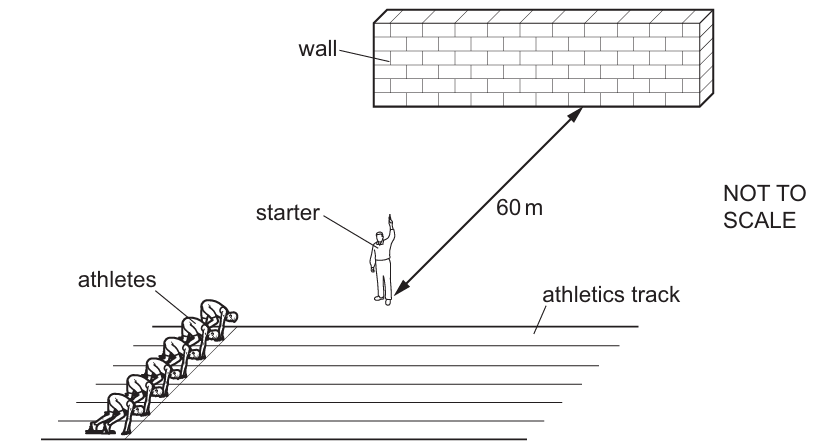
The starter in an athletics race fires the starting pistol. There is a wall 60 m from the starter.
Take the speed of sound as 330 m / s.
How long after firing the pistol does the starter hear the echo of the sound from the wall?
A. 0.18 s
B. 0.36 s
C. 2.8 s
D. 5.5 s

Most-appropriate topic codes (Cambridge IGCSE Physics 0625):

TOPIC 3.4: Sound (Describe an echo as the reflection of sound waves)
▶️ Answer/Explanation
Correct Option: B

Detailed solution:

An echo occurs when sound reflects off a surface and returns to the listener, so the total distance traveled is twice the distance to the wall.
Here, total distance = 2 × 60 m = 120 m, and with a speed of sound of 330 m/s, time = distance / speed = 120 / 330.
This gives a time of approximately 0.36 s for the sound to travel to the wall and back.
Options A and C represent one-way travel time or miscalculations of the total distance.
Therefore, the starter hears the echo after 0.36 s, making B the correct choice.
Question 24

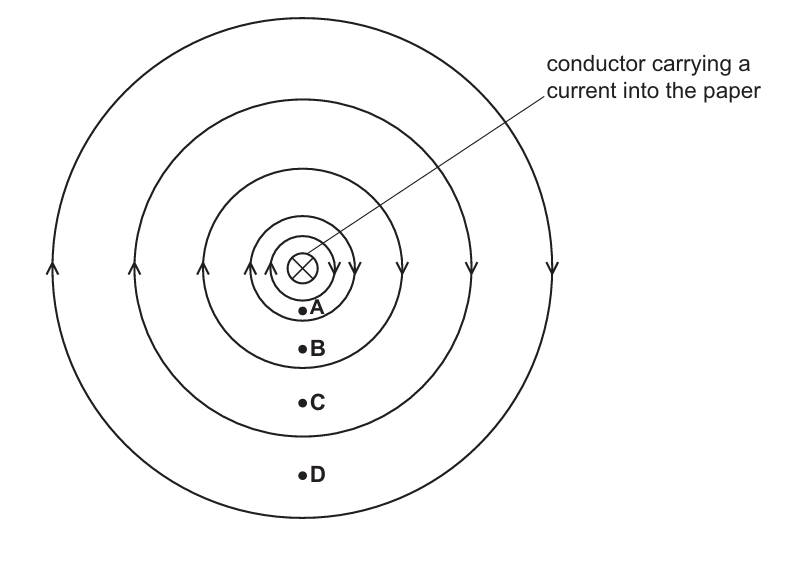
The diagram shows the magnetic field around a conductor which is carrying a current.
Where is the strength of the field greatest?
Magnetic field around a current-carrying conductor

Most-appropriate topic codes (Cambridge IGCSE Physics 0625):

TOPIC 4.5.3: Magnetic effect of a current (State the qualitative variation of the strength of the magnetic field around straight wires and solenoids)
▶️ Answer/Explanation
Correct Option: A

Detailed solution:

The magnetic field lines are concentric circles around the straight current-carrying conductor, and their spacing indicates the field strength.
The field is strongest where the field lines are closest together, which is nearest to the conductor (position A).
As the distance from the wire increases, the field lines spread further apart, indicating a weaker magnetic field.
This variation in spacing qualitatively shows that the magnetic field strength decreases with increasing distance from the wire.
Therefore, position A, being closest to the conductor, experiences the greatest magnetic field strength.
Question 25

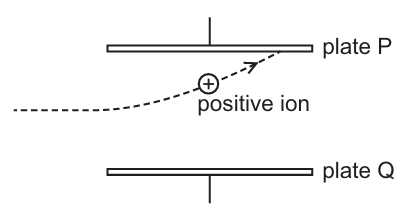
A positive ion in a vacuum moves at a steady speed in a straight line.
There is a potential difference between the two parallel metal plates P and Q so that they are oppositely charged.
When the positive ion enters the region between plates P and Q, it changes direction as shown.
The diagram shows the view from above the ion.
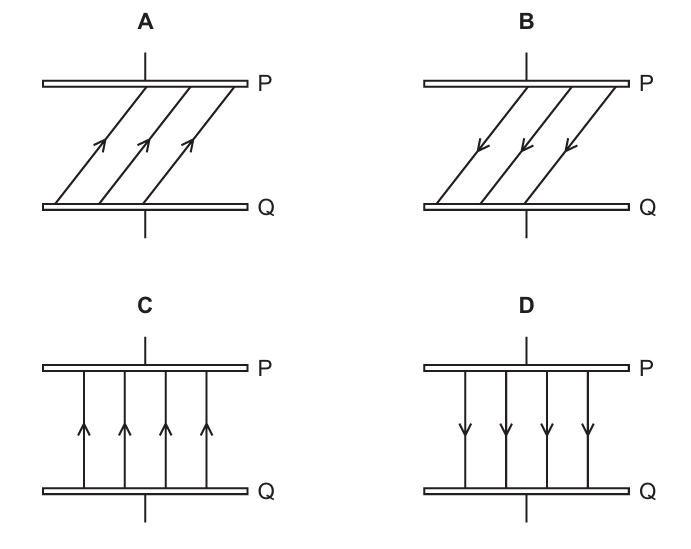
Which diagram shows the direction of the electric field between the plates?

Most-appropriate topic codes (Cambridge IGCSE Physics 0625):

TOPIC 4.2.1: Electric charge (State that the direction of an electric field at a point is the direction of the force on a positive charge at that point)
▶️ Answer/Explanation
Correct Option: C

Detailed solution:

The electric field direction is defined as the direction of the force on a positive charge.
The positive ion curves towards plate Q, indicating an attractive force exerted by plate Q.
Therefore, plate Q must be negatively charged and plate P positively charged.
Electric field lines point from positive to negative, so the field is directed from plate P to plate Q.
Diagram C correctly shows arrows pointing from the left plate (P) to the right plate (Q).
Thus, option C represents the correct direction of the electric field between the plates.
Question 26

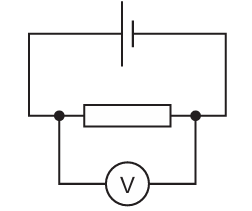
In the circuit shown, the voltmeter reads 2.0 V. A charge of 5.0 C passes through the resistor in a certain time.
How much energy is supplied to the resistor in this time?
A. 0.40 J
B. 2.5 J
C. 10 J
D. 20 J

Most-appropriate topic codes (Cambridge IGCSE Physics 0625):

TOPIC 4.2.5: Electrical energy and electrical power (Recall and use the equation for electrical energy E = IVt and understand the relationship E = QV)
▶️ Answer/Explanation
Correct Option: C

Detailed solution:

The energy transferred in an electric circuit is given by the product of potential difference (V) and charge (Q): E = V × Q.
Substituting the given values: E = 2.0 V × 5.0 C = 10 J.
This relationship stems from the definition of potential difference as energy per unit charge.
Options A, B, and D result from incorrect operations such as division or multiplication by the wrong factor.
Therefore, the energy supplied to the resistor is 10 J, making option C correct.
Question 27

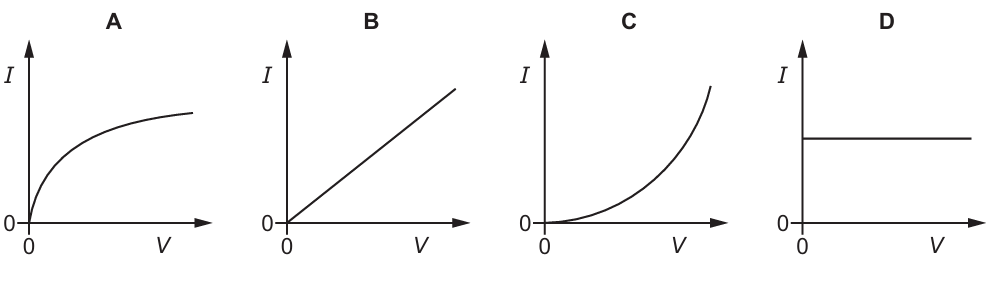
Which diagram shows the current–voltage (I–V) graph for a filament lamp?

Most-appropriate topic codes (Cambridge IGCSE Physics 0625):

TOPIC 4.2.4: Resistance (Sketch and explain the current-voltage graphs for a resistor of constant resistance, a filament lamp and a diode)
▶️ Answer/Explanation
Correct Option: A

Detailed solution:

In a filament lamp, the current causes the metal wire to heat up, which significantly increases its resistance.
This results in an I-V graph that is a curve passing through the origin, where the gradient (current/voltage) decreases as voltage rises.
The graph is symmetrical for both forward and reverse bias because the heating effect is independent of current direction.
Option A correctly shows this non-linear, S-shaped curve characteristic of a filament lamp.
The other options depict constant resistance (straight line) or diode behavior, which do not apply to a filament lamp.
Question 28

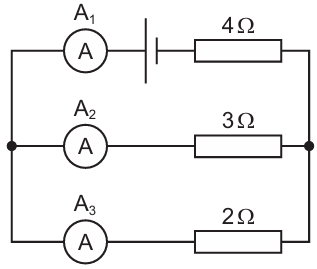
The diagram shows an electrical circuit.
Which statement is correct?
A. The current reading on ammeter A1 is the highest.
B. The current reading on ammeter A2 is the highest.
C. The current reading on ammeter A3 is the highest.
D. The current readings on all three ammeters A1, A2 and A3 are the same.

Most-appropriate topic codes (Cambridge IGCSE Physics 0625):

TOPIC 4.3.2: Series and parallel circuits (Know that, for a parallel circuit, the current from the source is larger than the current in each branch)
▶️ Answer/Explanation
Correct Option: A

Detailed solution:

Ammeter A1 measures the total current from the source before it splits into the parallel branches containing A2 and A3.
In a parallel circuit, the total current is equal to the sum of the currents in each individual branch.
Therefore, the reading on A1 must be greater than the reading on either A2 or A3 individually.
This makes the statement that A1 has the highest reading correct.
Options B, C, and D are incorrect as they do not reflect the division of current in a parallel circuit.
Thus, option A is the correct choice based on the rules for current in parallel circuits.
Question 29

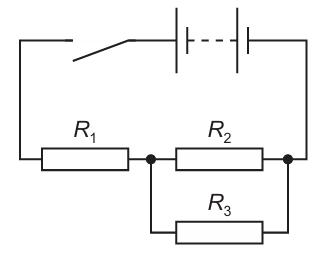
The diagram shows an arrangement of resistors in series and parallel.
Which equation is used to calculate the combined resistance of the resistors?
A. \(R_{1}+\frac{R_{2}+R_{3}}{R_{2}\times R_{3}}\)
B. \(R_{1}+\frac{R_{2}\times R_{3}}{R_{2}+ R_{3}}\)
C. \(R_{1}+\frac{1}{R_{2}+ R_{3}}\)
D. \(R_{1}\times \frac{R_{2}+ R_{3}}{R_{2}\times R_{3}}\)

Most-appropriate topic codes (Cambridge IGCSE Physics 0625):

TOPIC 4.3.2: Series and parallel circuits (Calculate the combined resistance of two resistors in parallel)
▶️ Answer/Explanation
Correct Option: B

Detailed solution:

The circuit shows resistor R₁ in series with a parallel combination of R₂ and R₃.
For resistors in parallel, the combined resistance is given by the product over sum: \((R_2 \times R_3)/(R_2 + R_3)\).
This parallel combination is then added to the series resistor R₁ to find the total resistance.
Therefore, the correct equation is \(R_1 + \frac{R_2 \times R_3}{R_2 + R_3}\).
Options A, C, and D do not correctly apply the rules for series and parallel resistor combinations.
Thus, option B is the correct choice.
Question 30

An electrical engineer has made a pair of components P and Q.
The resistance of P decreases as the temperature rises. The resistance of Q increases as the temperature rises.
The total resistance of P and Q in series remains constant when the temperature changes. The two components are connected in series with a power source supplying a constant current.
A. If a temperature change causes the potential difference (p.d.) across P to double, the p.d. across Q will always halve.
B. The difference between the p.d. across P and the p.d. across Q does not change with temperature.
C. The p.d. across component P increases as the temperature rises.
D. The sum of the p.d. across P and the p.d. across Q does not change with temperature.

Most-appropriate topic codes (Cambridge IGCSE Physics 0625):

TOPIC 4.2.5: Electrical energy and electrical power (Understand that electric circuits transfer energy from a source of electrical energy…; Recall and use the equation for electrical power P = IV)
▶️ Answer/Explanation
Correct Option: D

Detailed solution:

Since the total resistance of P and Q in series remains constant and the current is constant, the total p.d. (V = IR) remains unchanged.
As temperature changes, the individual resistances of P and Q vary, but their sum is constant, meaning any p.d. change across one is compensated by the other.
Therefore, the sum of the p.d. across P and Q equals the constant supply voltage and does not change with temperature.
Options A, B, and C are incorrect because the specific changes depend on the exact resistance-temperature relationships, which are not specified.
Thus, only statement D is universally correct based on the given conditions.

Question 31

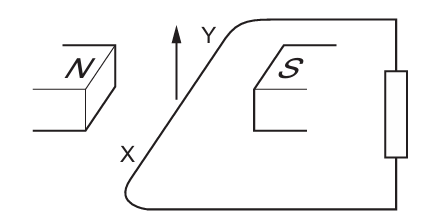
The diagram shows a wire XY moving upwards in a magnetic field.
A current is induced in the wire.
The current-carrying wire XY experiences a force because of its interaction with the magnetic field.
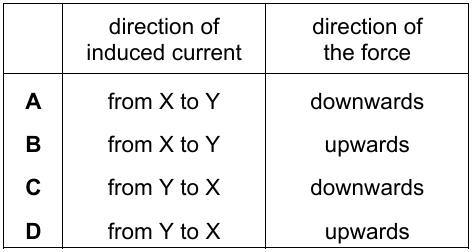
Which row gives the direction of the induced current and the direction of the force experienced by the wire XY?

Most-appropriate topic codes (Cambridge IGCSE Physics 0625):

TOPIC 4.5.4: Force on a current-carrying conductor (Recall and use the relative directions of force, magnetic field and current)
▶️ Answer/Explanation
Correct Option: A

Detailed solution:

Using Fleming’s right-hand rule for the generator effect, upward motion of wire XY in the given magnetic field induces current from X to Y.
Now carrying induced current, the wire experiences a motor force opposing its motion (Lenz’s law), predicted by Fleming’s left-hand rule.
With current from X to Y and the magnetic field direction as shown, the force acts downwards on the wire.
Thus, the induced current is X to Y, and the force direction is downwards, which corresponds to row A.
Therefore, option A correctly states both the direction of induced current and the resulting force.
Question 32

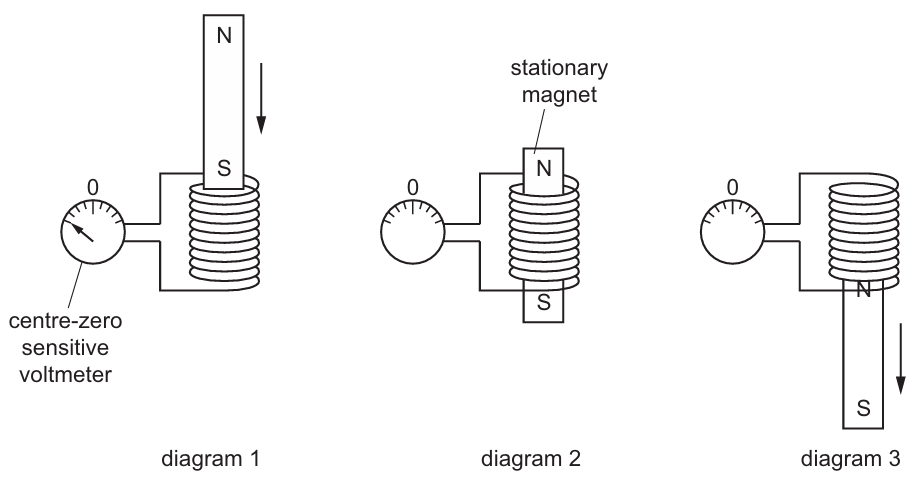
Diagram 1 shows a magnet being pushed into a coil that is connected to a centre-zero sensitive voltmeter.

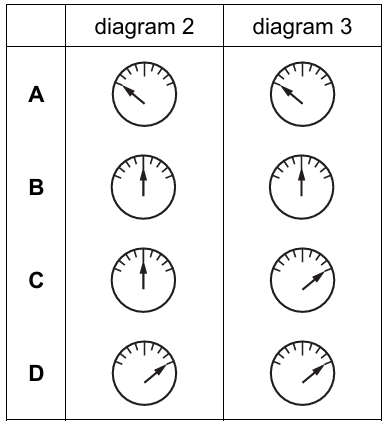
Which row shows the directions of the pointer on the voltmeter when the magnet is as shown in diagrams 2 and 3?

Most-appropriate topic codes (Cambridge IGCSE Physics 0625):

TOPIC 4.5.1: Electromagnetic induction (Know that a conductor moving across a magnetic field or a changing magnetic field linking with a conductor can induce an e.m.f. in the conductor; State the factors affecting the magnitude of an induced e.m.f.)
▶️ Answer/Explanation
Correct Option: C

Detailed solution:

According to Faraday’s law of electromagnetic induction, an e.m.f. is induced when there is a change in magnetic flux linkage. When the magnet is pushed into the coil (Diagram 2), the flux increases, inducing an e.m.f. in one direction, causing the pointer to deflect. When the magnet is pulled out (Diagram 3), the flux decreases, inducing an e.m.f. in the opposite direction, reversing the pointer deflection. The speed of motion also affects the magnitude, resulting in a larger deflection for the faster motion in Diagram 3. Row C correctly indicates a deflection to the left for Diagram 2 and a larger deflection to the right for Diagram 3.
Question 33

What is the purpose of the brushes and the split-ring commutator in a d.c. motor?
A. to change the size of the current
B. to keep the coil turning in the same direction
C. to keep the speed of rotation constant
D. to make the output an alternating voltage

Most-appropriate topic codes (Cambridge IGCSE Physics 0625):

TOPIC 4.5.5: The d.c. motor (Describe the operation of an electric motor, including the action of a split-ring commutator and brushes)
▶️ Answer/Explanation
Correct Option: B

Detailed solution:

In a d.c. motor, the split-ring commutator reverses the current direction in the coil every half turn.
This reversal ensures that the forces acting on the coil sides always produce a turning effect in the same rotational direction.
Without this reversal, the coil would oscillate back and forth rather than completing continuous rotations.
The brushes maintain electrical contact between the rotating commutator and the stationary external circuit.
Together, the brushes and split-ring commutator enable continuous unidirectional rotation of the motor coil.
Therefore, option B is correct as their purpose is to keep the coil turning in the same direction.

Question 34

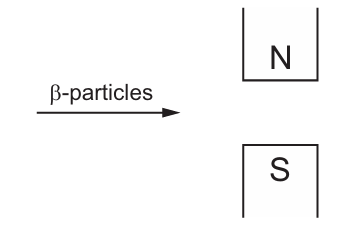
The diagram shows β-particles being directed between the poles of a magnet.
In which direction will the particles be deflected?
A. into the page
B. out of the page
C. towards the bottom of the page
D. towards the top of the page

Most-appropriate topic codes (Cambridge IGCSE Physics 0625):

TOPIC 4.5.4: Force on a current-carrying conductor (Describe an experiment to show that a force acts on a current-carrying conductor in a magnetic field, including the effect of reversing the current or the direction of the field)
▶️ Answer/Explanation
Correct Option: B

Detailed solution:

β-particles are negatively charged electrons, so their motion constitutes a conventional current in the opposite direction.
Using Fleming’s left-hand rule, point the first finger in the direction of the magnetic field (N to S, left to right).
Point the second finger opposite to the particle’s velocity (since current is opposite to electron flow, towards the right).
The thumb then points out of the page, indicating the direction of the force on the negative β-particles.
This deflection out of the page is consistent with the Lorentz force acting on a moving charge in a magnetic field.
Therefore, the β-particles will be deflected out of the page, making option B the correct answer.
Question 35

An α-particle and a β-particle have the same kinetic energy.
Why does the α-particle have a larger ionising effect than the β-particle as it passes through air?
A. The α-particle has a larger charge and a larger velocity so is closer to an air particle for a shorter time.
B. The α-particle has a larger charge and a smaller velocity so is closer to an air particle for a longer time.
C. The α-particle has a smaller charge and a larger velocity so is closer to an air particle for a shorter time.
D. The α-particle has a smaller charge and a smaller velocity so is closer to an air particle for a longer time.

Most-appropriate topic codes (Cambridge IGCSE Physics 0625):

TOPIC 5.2.2: The three types of nuclear emission (Identify alpha, beta and gamma emissions by recalling their nature, relative ionising effects, and relative penetrating abilities)
▶️ Answer/Explanation
Correct Option: B

Detailed solution:

An α-particle has a charge of +2e (twice that of a β-particle which is -1e) and a much greater mass.
With the same kinetic energy, the heavier α-particle moves significantly slower than the β-particle.
This larger charge exerts stronger electrostatic forces on air molecules, pulling electrons away more effectively.
The slower speed means the α-particle spends more time near each air molecule, increasing the chance of interaction.
Consequently, the combination of greater charge and lower velocity results in a much higher ionising effect.
Therefore, option B correctly identifies the reasons for the α-particle’s superior ionising ability.

Question 36

A student is carrying out an experiment to measure the radiation from a radioactive source.
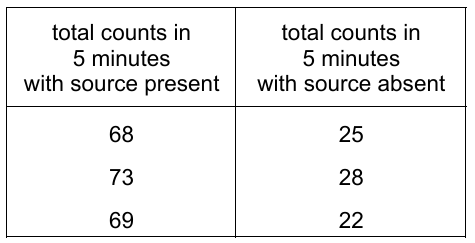
He uses a radiation detector and records the total counts in 5-minute intervals.
He does this three times with the source present and three times with the source absent. Here are his results.

A. 5 counts / minute
B. 9 counts / minute
C. 25 counts / minute
D. 45 counts / minute

Most-appropriate topic codes (Cambridge IGCSE Physics 0625):

TOPIC 5.2.1: Detection of radioactivity (Know that ionising nuclear radiation can be measured using a detector connected to a counter, and use count rate measured in counts/s or counts/minute)
▶️ Answer/Explanation
Correct Option: B

Detailed solution:

From the data table in the image, average count with source = (245+230+215)/3 = 230 per 5 min → 46 counts/min.
Average background count without source = (185+180+190)/3 = 185 per 5 min → 37 counts/min.
Corrected count rate = Total count rate − Background count rate = 46 − 37 = 9 counts/min.
This matches option B.
Question 37

The count rate measured near a radioactive source drops from 542 counts per minute to 94 counts per minute in 12 hours. The background count remains constant at 30 counts per minute.
What is the half-life of the source?
A. 2 hours
B. 3 hours
C. 4 hours
D. 8 hours

Most-appropriate topic codes (Cambridge IGCSE Physics 0625):

TOPIC 5.2.4: Half-life (Define the half-life of a particular isotope as the time taken for half the nuclei of that isotope in any sample to decay; recall and use this definition in simple calculations, which might involve information in tables or decay curves)
▶️ Answer/Explanation
Correct Option: C

Detailed solution:

First subtract background count: Initial corrected count = 542 − 30 = 512; Final corrected count = 94 − 30 = 64.
The count drops from 512 to 64 in 12 hours, which is a reduction by a factor of 1/8 (since 512/64 = 8).
This corresponds to 3 half-lives (as 2³ = 8). Therefore, half-life = 12 hours / 3 = 4 hours.
Thus, option C is the correct answer.

Question 38

What happens when a protostar becomes a stable star?
A. Most of the hydrogen is converted to helium and the protostar expands.
B. The inward force due to gravity is balanced by an outward force due to the high temperature.
C. The protostar collapses due to gravity and the temperature increases.
D. The protostar runs out of hydrogen as fuel for the nuclear reaction.

Most-appropriate topic codes (Cambridge IGCSE Physics 0625):

TOPIC 6.2.2: Stars (Describe the life cycle of a star: a protostar becomes a stable star when the inward force of gravitational attraction is balanced by an outward force due to the high temperature in the centre of the star)
▶️ Answer/Explanation
Correct Option: B

Detailed solution:

A protostar becomes a stable star when hydrostatic equilibrium is achieved, balancing inward gravitational pull with outward thermal pressure.
This equilibrium is established once the core temperature is high enough to sustain nuclear fusion, generating the outward force.
Options A and D describe later stages in stellar evolution, while option C describes the collapse phase before stability is reached.
Therefore, the defining condition for a stable star is the balance between gravity and the outward force from high internal temperature.
This matches the description in the syllabus for the transition from protostar to main sequence star.

Question 39

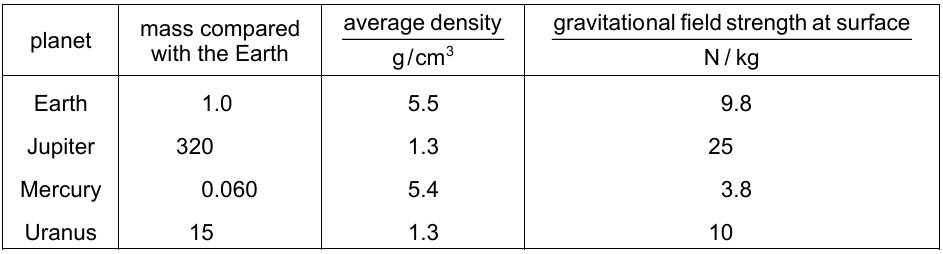
The table gives information about some of the planets in our Solar System.
A. As the mass compared with the Earth increases, the average density increases.
B. As the mass compared with the Earth increases, the gravitational field strength increases.
C. As the average density increases, the gravitational field strength decreases.
D. The average density is directly proportional to the gravitational field strength.

Most-appropriate topic codes (Cambridge IGCSE Physics 0625):

TOPIC 6.1.2: The Solar System (Analyse and interpret planetary data about orbital distance, orbital duration, density, surface temperature and uniform gravitational field strength at the planet’s surface)
▶️ Answer/Explanation
Correct Option: B

Detailed solution:

Gravitational field strength at a planet’s surface depends on its mass and radius (g ∝ M/R²).
From the table, planets with greater mass (compared to Earth) generally have higher gravitational field strength values.
Option A is incorrect as density shows no consistent increase with mass (e.g., Saturn has low density despite high mass).
Option C is wrong because gravitational field strength does not consistently decrease as density increases.
Option D is incorrect as the relationship between density and gravitational field strength is not directly proportional.
Therefore, only statement B correctly describes the observed trend in the planetary data.

Question 40

Which quantity is an estimate of the age of the Universe?
A. \(H_{0}\)
B. d × \(H_{0}\)
C. \(\frac{1}{H_{0}}\)
D. v × \(H_{0}\)

Most-appropriate topic codes (Cambridge IGCSE Physics 0625):

TOPIC 6.2.3: The Universe (Know that the equation \(\frac{d}{v} = \frac{1}{H_{0}}\) represents an estimate for the age of the Universe)
▶️ Answer/Explanation
Correct Option: C

Detailed solution:

The Hubble constant \(H_{0}\) relates the recessional speed \(v\) of a galaxy to its distance \(d\) via \(v = H_{0}d\).
Assuming a constant expansion rate, the time since all matter was at a single point is \(d/v\).
Substituting Hubble’s law gives the age estimate as \(d/(H_{0}d) = 1/H_{0}\).
Therefore, the quantity \(\frac{1}{H_{0}}\) provides an estimate for the age of the Universe.
Option C is the correct expression for this cosmological time estimate.

Scroll to Top