Home / 0625_w24_qp_23

Question 1

Which list contains only vector quantities?
A. acceleration, distance, speed
B. electric field strength, momentum, weight
C. energy, mass, temperature
D. force, time, velocity

Most-appropriate topic codes (Cambridge IGCSE Physics 0625):

TOPIC 1.1: Physical quantities and measurement techniques (Understand that a scalar quantity has magnitude only and that a vector quantity has magnitude and direction)
▶️ Answer/Explanation
Correct Option: B

Detailed solution:

Vector quantities have both magnitude and direction, while scalars have only magnitude.
In option A, distance and speed are scalars, so it is incorrect.
Option C lists energy, mass, and temperature, all of which are scalar quantities.
In option D, time is a scalar, so it does not consist solely of vectors.
Electric field strength, momentum, and weight all possess direction and magnitude, making option B the correct choice.
Therefore, only option B contains exclusively vector quantities.

Question 2

The graph shows how the velocity of an elevator varies with time. The elevator starts from the third floor of a tall building. Point P indicates the start of the elevator’s journey.
When is the elevator on the third floor again?
A. Q to R and S to T
B. Q to R only
C. S to T only
D. The lift does not return to the third floor.

Most-appropriate topic codes (Cambridge IGCSE Physics 0625):

TOPIC 1.2: Motion (Sketch, plot and interpret distance-time and speed-time graphs; Calculate the area under a speed-time graph to determine the distance travelled for motion with constant speed or constant acceleration)
▶️ Answer/Explanation
Correct Option: C

Detailed solution:

To return to the third floor, the total displacement must be zero (area above time axis = area below time axis).
From P to Q, the area is positive (upward displacement); from Q to R, velocity is zero (stopped, still above third floor).
From R to S, the area is negative, cancelling some upward displacement; by S, the lift has returned to the starting point (third floor).
Between S and T, the velocity is zero again, meaning the lift is stationary at the third floor during this interval.
Therefore, the elevator is on the third floor again during the interval S to T only.

Question 3

An object of mass 1.0 kg is at rest on the Earth. An identical object is at rest on a planet with a gravitational field strength of twice that on the Earth.
Which row correctly compares the object on the planet to the object on the Earth?

Most-appropriate topic codes (Cambridge IGCSE Physics 0625):

TOPIC 1.3: Mass and weight (State that mass is a measure of the quantity of matter; Define gravitational field strength as force per unit mass; recall and use the equation g = W/m)
▶️ Answer/Explanation
Correct Option: A

Detailed solution:

Mass is the quantity of matter in an object and does not change with location, so mass on planet = mass on Earth.
Weight is the gravitational force (W = mg). Since the planet’s gravitational field strength (g) is twice that of Earth’s, the weight is doubled.
Therefore, the correct comparison is: mass same, weight greater, which corresponds to row A.

Question 4

An engineer researched the density of different liquids being used as coolants.

None of the liquids mix with water.
Each liquid is poured, in turn, into a container of water. The density of water is 1000 kg / m³.
Which liquids rise to the surface?
A. X only
B. Y and Z
C. Y only
D. Z only

Most-appropriate topic codes (Cambridge IGCSE Physics 0625):

TOPIC 1.4: Density (Determine whether an object floats based on density data / Determine whether one liquid will float on another liquid based on density data given that the liquids do not mix)
▶️ Answer/Explanation
Correct Option: A

Detailed solution:

A liquid floats on water if its density is less than that of water (1000 kg/m³).
From the data, liquid X has a density of 940 kg/m³, which is less than water, so it rises to the surface.
Liquid Y (1250 kg/m³) and liquid Z (1800 kg/m³) have densities greater than water, so they sink.
Since only X has a density lower than water, option A is correct.

Question 5

The diagram shows a car moving along a road.
The force due to the engine is 1500 N and the total drag force is 200 N.

What is the motion of the car?

A. decreasing speed forward
B. increasing speed forward
C. reversing
D. constant speed

Most-appropriate topic codes (Cambridge IGCSE Physics 0625):

TOPIC 1.5.1: Effects of forces (State that a resultant force may change the velocity of an object by changing its direction of motion or its speed)
▶️ Answer/Explanation
Correct Option: B

Detailed solution:

The resultant force is the difference between the forward engine force (1500 N) and the backward drag force (200 N).
This gives a resultant force of 1300 N acting in the forward direction of the car’s motion.
According to the syllabus, a resultant force acting on an object will cause it to accelerate (change its speed).
Since the resultant force is in the same direction as the car’s movement, the speed will increase.
Therefore, the car is increasing speed forward, making option B the correct choice.

Question 6

A pair of cutters is used to cut a rope.
Where should the rope be positioned and at which labelled points should the hands be positioned to produce the greatest cutting force?

Most-appropriate topic codes (Cambridge IGCSE Physics 0625):

TOPIC 1.5.2: Turning effect of forces (Describe the moment of a force as a measure of its turning effect and give everyday examples; Define the moment of a force as moment = force × perpendicular distance from the pivot)
▶️ Answer/Explanation
Correct Option: D

Detailed solution:

To maximize cutting force, the rope should be placed as close to the pivot as possible (position Y) to reduce the distance and increase the force exerted.
The hands should apply effort at the farthest point from the pivot (point Q) to maximize the perpendicular distance.
This arrangement creates the largest possible moment for the same applied effort due to the principle of moments.
Therefore, rope at Y and hands at Q produces the greatest mechanical advantage and cutting force.

Question 7

An object has a mass of 20 kg.
Its velocity changes from 6 m / s to 10 m / s.
Which impulse has acted on the object?
A. 80 N s
B. 120 N s
C. 200 N s
D. 320 N s

Most-appropriate topic codes (Cambridge IGCSE Physics 0625):

TOPIC 1.6: Momentum (Define impulse as force × time for which force acts; recall and use the equation impulse = FΔt = Δ(mv))
▶️ Answer/Explanation
Correct Option: A

Detailed solution:

Impulse is defined as the change in momentum, given by the equation impulse = Δ(mv) = m(v – u).
Substituting the given values: mass m = 20 kg, initial velocity u = 6 m/s, and final velocity v = 10 m/s.
The change in velocity is (10 – 6) = 4 m/s, so the impulse = 20 kg × 4 m/s = 80 kg m/s, which is equivalent to 80 N s.
Therefore, the impulse acting on the object is 80 N s.

Question 8

Useful energy is obtained from different energy resources.
Four examples of energy resources are listed.
  • water waves
  • geothermal
  • wind
  • water behind hydroelectric dams
How many of these energy resources depend on radiation from the Sun?
A. 1
B. 2
C. 3
D. 4

Most-appropriate topic codes (Cambridge IGCSE Physics 0625):

1.7.3: Energy resources (Know that radiation from the Sun is the main source of energy for all our energy resources except geothermal, nuclear and tidal)
▶️ Answer/Explanation
Correct Option: C

Detailed solution:

Water waves, wind, and water behind hydroelectric dams all ultimately derive their energy from the Sun’s radiation.
Solar heating drives the water cycle (evaporation, cloud formation, rain) and creates temperature differences that cause wind.
Geothermal energy, however, comes from heat generated within the Earth’s core and does not depend on the Sun.
Therefore, three of the four listed resources depend on radiation from the Sun, making option C the correct answer.

Question 9

A box of mass 2.0 kg slides down a slope. The gravitational field strength is 9.8 N / kg.
What is the decrease in the gravitational potential energy stored as the box moves from P to Q?
A. 9.8 J
B. 98 J
C. 240 J
D. 250 J

Most-appropriate topic codes (Cambridge IGCSE Physics 0625):

TOPIC 1.7.1: Energy (Recall and use the equation for the change in gravitational potential energy ΔEₚ = mgΔh)
▶️ Answer/Explanation
Correct Option: B

Detailed solution:

The decrease in gravitational potential energy is given by the formula ΔEₚ = mgΔh.
From the diagram, the vertical height Δh between P and Q is 5.0 m.
Substituting the values: m = 2.0 kg, g = 9.8 N/kg, and Δh = 5.0 m, we get ΔEₚ = 2.0 × 9.8 × 5.0 = 98 J.
This calculation shows the energy transferred from the gravitational store to other forms as the box descends.
Options A, C, and D do not match the product of these specific values for mass, field strength, and height.
Therefore, option B is the correct answer.

Question 10

The diagram shows the path of a long-jumper. Point R, where she lands, is on the same horizontal level as point P, from where she takes off. The long-jumper experiences air resistance as she runs and jumps.

Which graph shows how the store of kinetic energy and the store of gravitational potential energy of the long-jumper vary with time between points P and R?

Most-appropriate topic codes (Cambridge IGCSE Physics 0625):

1.7.1 Energy: State that energy may be stored as kinetic, gravitational potential… (Describe how energy is transferred between stores during events and processes)
▶️ Answer/Explanation
Correct Option: B

Detailed solution:

Gravitational potential energy (GPE) peaks at the top of the jump and is zero at take-off and landing.
Kinetic energy (KE) is maximum at P, decreases to a minimum at the peak as speed drops, then increases again towards R.
Due to air resistance, the total mechanical energy decreases, so KE at R is less than at P.
Graph B correctly shows GPE rising and falling symmetrically while KE dips and recovers to a lower value.
The other graphs either show incorrect energy variations or fail to account for energy loss due to air resistance.

Question 11

Four tanks contain water to the depths shown.
At the bottom of which tank is the pressure due to the water greatest?

Most-appropriate topic codes (Cambridge IGCSE Physics 0625):

TOPIC 1.8: Pressure (Describe, qualitatively, how the pressure beneath the surface of a liquid changes with depth and density of the liquid)
▶️ Answer/Explanation
Correct Option: A

Detailed solution:

The pressure exerted by a liquid at the bottom of a tank depends on the vertical depth of the liquid.
Comparing the four diagrams, the water level is highest in tank A, indicating the greatest depth.
Since the liquid is the same (water, so density is constant) and gravity is constant, pressure increases with depth.
The shape or width of the tank does not affect the pressure at the bottom; only the height of the water column matters.
Therefore, the pressure due to the water is greatest at the bottom of tank A.

Question 12

A gas is heated in a sealed container.
The volume of the container does not change.
What happens to the particles of the gas?
A. The average distance between particles increases.
B. The average kinetic energy of the particles increases.
C. The mass of each particle increases.
D. The volume of each particle increases.

Most-appropriate topic codes (Cambridge IGCSE Physics 0625):

TOPIC 2.1.2: Particle model (Describe the relationship between the motion of particles and temperature, including the idea that there is a lowest possible temperature (−273°C), known as absolute zero, where the particles have least kinetic energy)
▶️ Answer/Explanation
Correct Option: B

Detailed solution:

Heating a gas increases the temperature, which corresponds directly to an increase in the average kinetic energy of the particles.
Since the container is sealed and rigid, the volume is constant, meaning the particles cannot move further apart on average.
The mass and individual volume of the gas particles remain unchanged during this physical process.
Therefore, option B correctly identifies the change in the motion of the particles.

Question 13

Air in a sealed syringe is slowly compressed by moving the piston. The temperature of the air stays the same.
Which statement about the air is correct?
A. The pressure of the air decreases because its particles now travel more slowly.
B. The pressure of the air decreases because the area of the syringe walls is now smaller.
C. The pressure of the air increases because its particles now hit the syringe walls more frequently.
D. The pressure of the air increases because its particles now travel more quickly.

Most-appropriate topic codes (Cambridge IGCSE Physics 0625):

TOPIC 2.1.3: Gases and the absolute scale of temperature (Describe qualitatively, in terms of particles, the effect on the pressure of a fixed mass of gas of a change of volume at constant temperature)
▶️ Answer/Explanation
Correct Option: C

Detailed solution:

Since the temperature remains constant, the average speed of the air particles does not change.
Compressing the syringe reduces the volume, meaning the particles have less space to move.
This results in the particles striking the walls of the container more frequently per unit time.
According to the kinetic particle model, this increase in collision frequency causes the pressure to rise.
Therefore, option C is correct because the pressure increases due to more frequent collisions, not faster particles.
Question 14

Which statement about the evaporation of a liquid is correct?
A. The least energetic particles escape from the surface and the temperature of the liquid decreases.
B. The least energetic particles escape from the surface and the temperature of the liquid increases.
C. The most energetic particles escape from the surface and the temperature of the liquid decreases.
D. The most energetic particles escape from the surface and the temperature of the liquid increases.

Most-appropriate topic codes (Cambridge IGCSE Physics 0625):

TOPIC 2.2.3: Melting, boiling and evaporation (Describe evaporation in terms of the escape of more-energetic particles from the surface of a liquid; Know that evaporation causes cooling of a liquid)
▶️ Answer/Explanation
Correct Option: C

Detailed solution:

Evaporation occurs when the most energetic particles at the surface of a liquid overcome attractive forces and escape into the air.
Since the highest kinetic energy particles leave, the average kinetic energy of the remaining particles in the liquid decreases.
A decrease in average kinetic energy corresponds directly to a drop in the temperature of the liquid.
This explains why sweating cools the body; the escaping high-energy water molecules leave behind cooler liquid.
Therefore, the correct description is that the most energetic particles escape, causing the temperature to decrease.
Hence, option C is the correct statement regarding evaporation.

Question 15

A solid is heated causing it to expand.
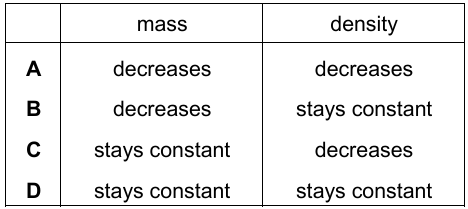
Which effect does this have on its mass and on its density?

Most-appropriate topic codes (Cambridge IGCSE Physics 0625):

TOPIC 2.2.1: Thermal expansion of solids, liquids and gases (Describe, qualitatively, the thermal expansion of solids, liquids and gases at constant pressure)
▶️ Answer/Explanation
Correct Option: C

Detailed solution:

When a solid is heated, its mass remains unchanged because the number of particles does not change.
Thermal expansion causes the solid’s volume to increase while its mass stays constant.
Since density is defined as mass per unit volume (\(\rho = m/V\)), an increase in volume with constant mass results in a decrease in density.
Therefore, the mass stays the same and the density decreases, which corresponds to option C.

Question 16

A glass test-tube containing water is heated at the top. The water at the top boils, but the water at the bottom remains cold.

Which row explains why the water at the bottom of the test-tube remains cold?

Most-appropriate topic codes (Cambridge IGCSE Physics 0625):

TOPIC 2.3.2: Convection (Explain convection in liquids and gases in terms of density changes and describe experiments to illustrate convection)
▶️ Answer/Explanation
Correct Option: D

Detailed solution:

Heating water at the top makes it less dense, so it stays at the top and does not sink.
Convection currents cannot form because the heated, less dense fluid is already above the cooler, denser fluid.
Water is a poor conductor of heat, so thermal energy does not travel downwards effectively to warm the bottom.
Since there is no circulation and minimal conduction, the bottom water remains cold despite boiling at the surface.
Therefore, row D correctly states that water is a poor conductor and convection does not occur.

Question 17

A vertical stick is dipped up and down in water at P.
In two seconds, three wave crests spread out on the surface of the water.
Which statement is correct?
A. Distance X is the amplitude of the waves.
B. Distance Y is the wavelength of the waves.
C. Each circle represents a wavefront.
D. The frequency of the waves is 3 Hz.

Most-appropriate topic codes (Cambridge IGCSE Physics 0625):

TOPIC 3.1: General properties of waves (Describe the features of a wave in terms of wavefront, wavelength, frequency, crest (peak), trough, amplitude and wave speed)
▶️ Answer/Explanation
Correct Option: C

Detailed solution:

The concentric circles shown in the diagram represent lines joining points of the wave that are in phase, known as wavefronts.
Distance X measures from crest to trough, which is twice the amplitude, so A is incorrect.
Distance Y measures between two wavefronts, which is indeed the wavelength, making B a plausible distraction, but C is the universally correct description of the circles.
Frequency is the number of waves per second; 3 crests in 2 seconds gives 1.5 Hz, not 3 Hz, so D is incorrect.
Therefore, the statement that each circle represents a wavefront is the definitively correct answer.

Question 18

Seismic waves from the epicentre of an earthquake take 100 s to reach a point 300 km away.
When they arrive, they cause the ground to vibrate with a frequency of 2.0 Hz.
What is the wavelength of these seismic waves?
A. 0.67 km
B. 1.5 km
C. 3.0 km
D. 6.0 km

Most-appropriate topic codes (Cambridge IGCSE Physics 0625):

TOPIC 3.1: General properties of waves (Recall and use the equation for wave speed v = fλ)
▶️ Answer/Explanation
Correct Option: B

Detailed solution:

First, calculate wave speed: v = distance / time = 300 km / 100 s = 3.0 km/s.
Use the wave equation v = fλ, rearranged to λ = v / f = 3.0 km/s ÷ 2.0 Hz.
This yields a wavelength of 1.5 km, matching option B.

Question 19

Which diagram illustrates diffraction of water waves?

Most-appropriate topic codes (Cambridge IGCSE Physics 0625):

TOPIC 3.1: General properties of waves (Describe how waves can undergo diffraction through a narrow gap)
▶️ Answer/Explanation
Correct Option: A

Detailed solution:

Diffraction is the spreading of waves around an obstacle or through a narrow gap, which is clearly shown in diagram A.
In diagram A, the straight wavefronts bend and spread out into a semicircular pattern after passing through the opening.
Diagram B shows reflection, where waves bounce off a surface, while diagram C illustrates refraction due to a change in depth.
Diagram D also depicts refraction as the waves change direction without the characteristic spreading seen in diffraction.
Therefore, only diagram A correctly illustrates the phenomenon of diffraction of water waves.

Question 20

A single ray of light is reflected by two mirrors.
The diagram shows the ray of light incident on mirror 1.
What is the angle of reflection in mirror 2?
A. 50°
B. 60°
C. 70°
D. 80°

Most-appropriate topic codes (Cambridge IGCSE Physics 0625):

TOPIC 3.2.1: Reflection of light (State that for reflection, the angle of incidence is equal to the angle of reflection; recall and use this relationship)
▶️ Answer/Explanation
Correct Option: C

Detailed solution:

The ray strikes mirror 1 at 50° to the surface, so the angle of incidence is 90° – 50° = 40°.
By the law of reflection, the angle of reflection at mirror 1 is also 40°.
Using geometry of the right-angled triangle formed by the mirrors, the ray strikes mirror 2 at an angle of incidence of 70°.
Applying the law of reflection again, the angle of reflection at mirror 2 is also 70°.
Therefore, option C is the correct answer.

Question 21

Which diagram shows the effect of a converging lens on a parallel beam of light?

Most-appropriate topic codes (Cambridge IGCSE Physics 0625):

TOPIC 3.2.3: Thin lenses (Describe the action of thin converging and thin diverging lenses on a parallel beam of light)
▶️ Answer/Explanation
Correct Option: B

Detailed solution:

A converging (convex) lens brings parallel rays of light together to a single point called the principal focus.
Diagram A shows diverging rays, which is the effect of a concave (diverging) lens on a parallel beam.
Diagram C shows rays passing straight through without bending, which occurs only when passing through the optical center.
Diagram D shows parallel rays remaining parallel after the lens, which is not physically accurate for either type of lens.
Therefore, only diagram B correctly illustrates the converging action of a convex lens on incident parallel light rays.

Question 22

Which three regions of the electromagnetic spectrum are used in the applications listed?
  • sterilising water
  • optical fibres
  • satellite television signals
  • mobile (cell) phones
A. radio, infrared, visible
B. ultraviolet, infrared, microwaves
C. visible, radio, ultraviolet
D. X-rays, visible, infrared

Most-appropriate topic codes (Cambridge IGCSE Physics 0625):

TOPIC 3.3: Electromagnetic spectrum (Describe typical uses of the different regions of the electromagnetic spectrum including ultraviolet, infrared and microwaves)
▶️ Answer/Explanation
Correct Option: B

Detailed solution:

Ultraviolet (UV) radiation is used for sterilising water due to its germicidal properties, effectively killing bacteria and viruses.
Infrared (IR) waves are commonly used in optical fibres for telecommunications because they can carry high rates of data with minimal loss.
Microwaves are used for both satellite television signals and mobile (cell) phone communications as they can penetrate the atmosphere and walls.
Radio waves and visible light are not involved in all three specific applications listed in the question.
Therefore, the correct combination matching the applications is ultraviolet, infrared, and microwaves.

Question 23

A man stands 110 m from a high wall. He makes a short, sharp sound and then hears an echo from the wall. The speed of sound in air is 330 m/s.
How long after making the sound does the man hear the echo?
A. 0.33 s
B. 0.67 s
C. 1.5 s
D. 3.0 s

Most-appropriate topic codes (Cambridge IGCSE Physics 0625):

TOPIC 3.4: Sound (Describe an echo as the reflection of sound waves; Describe a method involving a measurement of distance and time for determining the speed of sound in air)
▶️ Answer/Explanation
Correct Option: B

Detailed solution:

The sound travels from the man to the wall and back, covering a total distance of 2 × 110 m = 220 m.
Using the equation time = distance / speed, the time taken is 220 m / 330 m/s = 0.666… s.
This rounds to 0.67 s, which matches option B.
The calculation requires doubling the one-way distance because an echo involves reflection back to the source.
Options A, C, and D result from either using only the one-way distance or incorrect arithmetic.
Therefore, the echo is heard 0.67 s after the sound is made.

Question 24

The diagram shows the magnetic field of a bar magnet.
How does the strength of the magnetic field vary with position along the dotted path PRQ?
A. It is constant along the path PRQ.
B. It is strong at P and reduces in strength along the path PRQ.
C. It is weak at P and increases in strength along the path PRQ.
D. It is strong at P, decreases to a minimum at R and then increases towards Q.

Most-appropriate topic codes (Cambridge IGCSE Physics 0625):

TOPIC 4.1: Simple phenomena of magnetism (Know that the relative strength of a magnetic field is represented by the spacing of the magnetic field lines)
▶️ Answer/Explanation
Correct Option: D

Detailed solution:

The strength of a magnetic field is indicated by the spacing of the field lines; closer lines mean a stronger field.
At point P (near the pole), the lines are close together, indicating a strong field.
As the path moves towards R (the midpoint between poles), the lines spread out, showing the field weakens to a minimum.
Moving from R to Q (approaching the other pole), the lines converge again, so the field strength increases.
Therefore, the field strength is strong at P, decreases to a minimum at R, and increases towards Q.

Question 25

The diagram shows a charged sphere and the direction of the electric field at point X due to the sphere.

An electron is placed at point Y.
Which diagram shows the direction of the force acting on the electron due to the charged sphere?

Most-appropriate topic codes (Cambridge IGCSE Physics 0625):

TOPIC 4.2.1: Electric charge (State that the direction of an electric field at a point is the direction of the force on a positive charge at that point)
▶️ Answer/Explanation
Correct Option: D

Detailed solution:

The electric field lines point away from the sphere, indicating it has a positive charge.
By convention, the direction of an electric field is the force on a positive test charge.
An electron has a negative charge, so it experiences a force in the opposite direction to the field.
At point Y, the field is directed to the right, therefore the force on the electron is towards the left.
This matches the arrow direction shown in option D, pointing back toward the positive sphere.

Question 26

A battery moves 3.0 C of charge round a complete circuit. The battery transfers 12 J of energy during this process.
What is the electromotive force (e.m.f.) of the cell?
A. 0.25 V
B. 4.0 V
C. 12 V
D. 36 V

Most-appropriate topic codes (Cambridge IGCSE Physics 0625):

TOPIC 4.2.3: Electromotive force and potential difference (Define electromotive force (e.m.f.) as the electrical work done by a source in moving a unit charge around a complete circuit; Recall and use the equation for e.m.f. E = W / Q)
▶️ Answer/Explanation
Correct Option: B

Detailed solution:

Electromotive force (e.m.f.) is defined as the energy transferred per unit charge.
The formula is E = W / Q, where W is the energy transferred in joules and Q is the charge in coulombs.
Substituting the given values, E = 12 J / 3.0 C = 4.0 J/C.
Since 1 J/C is equal to 1 volt (V), the e.m.f. of the cell is 4.0 V.
Therefore, the correct answer is option B.

Question 27

A cylinder of conducting putty has length l, diameter d and resistance R.
The putty is now moulded into a cylinder of diameter 2d that has the same volume.
By which factor does the resistance of the putty cylinder decrease?
A. 2
B. 4
C. 8
D. 16

Most-appropriate topic codes (Cambridge IGCSE Physics 0625):

TOPIC 4.2.4: Resistance (Recall and use the following relationship for a metallic electrical conductor: (b) resistance is inversely proportional to cross-sectional area)
▶️ Answer/Explanation
Correct Option: D

Detailed solution:

Resistance R = ρL/A. Doubling diameter increases cross-sectional area (A ∝ d²) by factor of 4.
Constant volume means Area × Length is constant, so length L decreases by factor of 4.
New resistance R’ = ρ(L/4) / (4A) = (1/16) × (ρL/A) = R/16.
The resistance therefore decreases by a factor of 16, making option D correct.

Question 28

Which statement describes how a diode operates in an electrical circuit?
A. When the temperature increases, its resistance increases.
B. When the current becomes too high, it melts and cuts off the current.
C. It only allows current in one direction.
D. It uses a low-current circuit to switch on a circuit carrying a much larger current.

Most-appropriate topic codes (Cambridge IGCSE Physics 0625):

4.3.3 Action and use of circuit components: Describe the action of a diode in allowing current to flow in one direction only
▶️ Answer/Explanation
Correct Option: C

Detailed solution:

A diode is a semiconductor device that acts as a one-way valve for electric current.
It has very low resistance in forward bias, allowing current to flow, and very high resistance in reverse bias, blocking current.
Option A describes a thermistor, option B describes a fuse, and option D describes a relay.
Therefore, the defining characteristic of a diode is that it only permits current to flow in a single direction.
Hence, option C is the correct answer.

Question 29

A number of identical resistors of resistance 10 Ω are arranged in circuits.
Which arrangement of resistors will give an overall resistance of 25 Ω?

Most-appropriate topic codes (Cambridge IGCSE Physics 0625):

TOPIC 4.3.2: Series and parallel circuits (Calculate the combined resistance of two or more resistors in series and in parallel)
▶️ Answer/Explanation
Correct Option: D

Detailed solution:

For two 10 Ω resistors in parallel, the combined resistance is (10×10)/(10+10) = 5 Ω. Adding this parallel pair in series with two separate 10 Ω resistors gives 10 + 10 + 5 = 25 Ω.
Option A gives 10 Ω in parallel with 10 Ω (5 Ω) and series with 10 Ω = 15 Ω. Option B gives three 10 Ω in parallel = 3.33 Ω. Option C gives two parallel pairs (5 Ω each) in series = 10 Ω.
Only arrangement D provides the correct combination of series and parallel connections to achieve exactly 25 Ω total resistance.

Question 30

The circuit diagram shows a thermistor in a potential divider.
Two voltmeters X and Y are connected in the circuit.

When the temperature of the thermistor increases, its resistance decreases.
As the thermistor becomes warmer, what happens to the reading on each voltmeter?

Most-appropriate topic codes (Cambridge IGCSE Physics 0625):

TOPIC 4.3.3: Action and use of circuit components (Describe the action of a variable potential divider; Recall and use the equation for two resistors used as a potential divider)
▶️ Answer/Explanation
Correct Option: C

Detailed solution:

As temperature increases, the thermistor’s resistance decreases, so its share of the total potential difference drops.
Voltmeter X is across the fixed resistor, which now has a larger proportion of the supply voltage, so its reading increases.
Voltmeter Y is across the thermistor, and since its resistance and p.d. have decreased, the reading on Y decreases.
This behavior follows the potential divider principle, where the voltage is shared in proportion to the resistances.
Hence, the reading on voltmeter X increases, and the reading on voltmeter Y decreases.

Question 31

In an experiment, strong magnetic fields provide a force that keeps charged particles moving with a horizontal circular motion.
Positive particles are accelerated clockwise when viewed from above as shown.

In which direction is the magnetic field?

A. vertically into the page
B. vertically out of the page
C. pointing away from the centre of the circular motion
D. pointing towards the centre of the circular motion

Most-appropriate topic codes (Cambridge IGCSE Physics 0625):

4.5.4: Force on a current-carrying conductor (Recall and use the relative directions of force, magnetic field and current; Determine the direction of the force on beams of charged particles in a magnetic field)
▶️ Answer/Explanation
Correct Option: B

Detailed solution:

Using Fleming’s left-hand rule, the force (centripetal, towards the centre) is given by the thumb, the first finger is the magnetic field, and the second finger is the current (direction of positive particle motion).
For clockwise motion viewed from above, the velocity at the top is directed to the right; pointing the second finger right and thumb towards the centre requires the first finger to point vertically upwards, out of the page.
Thus, the magnetic field must be directed vertically out of the page to produce the observed clockwise circular path for positive particles.
Question 32

When there is a current in a solenoid, a magnetic field is formed around it.
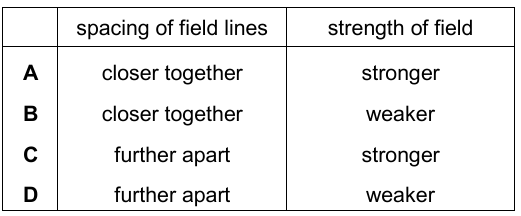
How does the magnetic field change if the current is increased?

Most-appropriate topic codes (Cambridge IGCSE Physics 0625):

TOPIC 4.5.3: Magnetic effect of a current (Describe the effect on the magnetic field around straight wires and solenoids of changing the magnitude and direction of the current)
▶️ Answer/Explanation
Correct Option: A

Detailed solution:

The strength of the magnetic field around a solenoid is directly proportional to the current flowing through it.
Increasing the current increases the magnitude of the magnetic field, which is represented by a greater density of magnetic field lines.
The pattern and direction of the field remain the same, but the field becomes stronger everywhere around the solenoid.
Option A correctly shows the same field pattern with more lines, indicating a stronger field.
Options B and D incorrectly change the direction of the field, while Option C shows no change in field strength.
Therefore, Option A is the correct choice.

Question 33

The diagram shows the structure of a simple transformer.

Which row shows the correct conditions for the efficiency of the transformer to be as high as possible?

Most-appropriate topic codes (Cambridge IGCSE Physics 0625):

TOPIC 4.5.6: The transformer (Describe the construction of a simple transformer with a soft-iron core, as used for voltage transformations)
▶️ Answer/Explanation
Correct Option: A

Detailed solution:

For maximum efficiency, the core should be laminated soft iron to reduce eddy current losses and provide easy magnetization.
The wire should be thick copper to minimize resistive heating from the current flowing through the coils.
Row A correctly identifies laminated soft iron for the core material and thick copper for the wire material.
Other rows propose materials (e.g., steel or thin wire) that would increase energy losses through heat or magnetic hysteresis.
Therefore, option A describes the best construction conditions for a highly efficient transformer.

Question 34

The products of the decay of a nucleus of a radioactive isotope are a nucleus and radiation which is emitted.
What is the nature of the products?
A. a nucleus of an element different from the isotope is formed and both an α-particle and γ-radiation are emitted
B. a nucleus of an element different from the isotope is formed and just γ-radiation is emitted
C. a nucleus of the same element as the isotope is formed and both a β-particle and γ-radiation are emitted
D. a nucleus of the same element as the isotope is formed and just an α-particle is emitted

Most-appropriate topic codes (Cambridge IGCSE Physics 0625):

TOPIC 5.2.3: Radioactive decay (State that during α-decay or β-decay, the nucleus changes to that of a different element)
▶️ Answer/Explanation
Correct Option: A

Detailed solution:

Radioactive decay involves an unstable nucleus emitting particles or energy to become more stable.
During α-decay or β-decay, the proton number changes, resulting in a nucleus of a different element.
Gamma radiation is often emitted alongside alpha or beta particles to release excess energy.
Therefore, the correct description is a new element’s nucleus formed with both α-particle and γ-radiation emitted.
This matches the behavior of isotopes undergoing alpha decay with accompanying gamma emission.

Question 35

An atomic nucleus decays by one or more radioactive decay processes.
What causes the proton number to decrease by 1?
A. α-decay followed by β-decay
B. α-decay only
C. β-decay followed by γ-decay
D. β-decay only

Most-appropriate topic codes (Cambridge IGCSE Physics 0625):

TOPIC 5.2.3: Radioactive decay (Describe the effect of α-decay, β-decay and γ-emissions on the nucleus, including an increase in stability and a reduction in the number of excess neutrons)
▶️ Answer/Explanation
Correct Option: A

Detailed solution:

In α-decay, the proton number decreases by 2 and the nucleon number decreases by 4.
In β-decay, a neutron changes to a proton, so the proton number increases by 1.
γ-decay does not change the proton or nucleon number.
Therefore, an α-decay (proton number decreases by 2) followed by a β-decay (proton number increases by 1) results in a net decrease of 1 in the proton number.
Option A correctly describes this sequence of decays to achieve the required change.

Question 36

Which definition of half-life is not correct?
A. the time it takes for the count rate from a radioactive sample to fall to half its original value
B. the time it takes for half of the unstable nuclei in a radioactive sample to decay
C. the time it takes for the mass of radioactive material in a sample to halve
D. the time it takes for half of the neutrons in a radioactive sample to decay

Most-appropriate topic codes (Cambridge IGCSE Physics 0625):

TOPIC 5.2.4: Half-life (Define the half-life of a particular isotope as the time taken for half the nuclei of that isotope in any sample to decay)
▶️ Answer/Explanation
Correct Option: D

Detailed solution:

Half-life is defined as the time taken for half the unstable nuclei in a sample to decay, which reduces the count rate and mass proportionally.
Options A, B, and C are all valid descriptions of half-life in terms of count rate, nuclei number, or mass of the parent isotope.
Option D is incorrect because half-life refers to the decay of unstable nuclei, not specifically the decay of neutrons alone.
Neutron decay is just one possible process (beta decay), but half-life applies to the overall nuclear transformation of the isotope.
Therefore, the statement in D is not a correct definition of half-life.

Question 37

The diagram shows a system to control the thickness of paper produced by a machine.
The graph shows how the count rate at the detector varies with the thickness of the paper.
The rollers squeeze the paper when the count rate at the detector drops below 12 counts per second and then stop squeezing when the count rate rises above 13 counts per second.
What is the thickness of the paper coming out of the machine?
A. between 0.40 mm and 0.50 mm
B. between 0.50 mm and 0.60 mm
C. between 0.60 mm and 0.70 mm
D. between 0.70 mm and 0.80 mm

Most-appropriate topic codes (Cambridge IGCSE Physics 0625):

TOPIC 5.2.1: Detection of radioactivity (Use count rate measured in counts/s or counts/minute)
▶️ Answer/Explanation
Correct Option: B

Detailed solution:

The control system maintains the count rate between 12 and 13 counts per second.
From the graph, a count rate of 12–13 counts/s corresponds to a paper thickness range of approximately 0.50 mm to 0.60 mm.
Since the rollers adjust the thickness to keep the count rate within this window, the output paper thickness will lie in this range.
Therefore, the thickness of the paper coming out of the machine is between 0.50 mm and 0.60 mm.

Question 38

The table gives the orbital durations of planets in the Solar System.
What is the orbital duration of Mars?
A. 295 days
B. 690 days
C. 7100 days
D. 20600 days

Most-appropriate topic codes (Cambridge IGCSE Physics 0625):

TOPIC 6.1.2: The Solar System (Analyse and interpret planetary data about orbital distance, orbital duration, density, surface temperature and uniform gravitational field strength at the planet’s surface)
▶️ Answer/Explanation
Correct Option: B

Detailed solution:

Mars is the fourth planet from the Sun, located between Earth (365 days) and Jupiter (4300 days).
According to the table, the orbital duration increases with distance from the Sun.
Since Mars is further from the Sun than Earth but closer than Jupiter, its orbital period must be greater than 365 days but significantly less than 4300 days.
690 days (approximately 1.9 Earth years) fits logically within this range based on Kepler’s third law.
Therefore, option B is the correct orbital duration for Mars.

Question 39

Which reaction produces the energy that powers the Sun?
A. fission of hydrogen
B. fission of uranium
C. fusion of hydrogen
D. fusion of uranium

Most-appropriate topic codes (Cambridge IGCSE Physics 0625):

TOPIC 6.2.1: The Sun as a star (Know that stars are powered by nuclear reactions that release energy and that in stable stars the nuclear reactions involve the fusion of hydrogen into helium)
▶️ Answer/Explanation
Correct Option: C

Detailed solution:

The Sun produces energy through the process of nuclear fusion, specifically the fusion of hydrogen nuclei into helium.
Fission involves splitting heavy nuclei, which is not the process occurring in the Sun’s core.
Uranium is not involved in solar reactions; the Sun primarily consists of hydrogen and helium.
In stable stars like the Sun, the inward gravitational force is balanced by the outward pressure from fusion energy.
Thus, the correct answer is the fusion of hydrogen, as described in the nuclear reactions powering the Sun.

Question 40

The diameter of the Milky Way is approximately 100,000 light years.
What is this distance in metres?
A. 9.5 × \( 10^{9}\)m
B. 9.5 × \( 10^{15}\)m
C. 9.5 × \( 10^{17}\)m
D. 9.5 × \( 10^{20}\)m

Most-appropriate topic codes (Cambridge IGCSE Physics 0625):

TOPIC 6.2.3: The Universe (Know that one light-year is equal to \(9.5 \times 10^{15} \mathrm{~m}\))
▶️ Answer/Explanation
Correct Option: D

Detailed solution:

1 light-year is defined as the distance light travels in one year, which is \(9.5 \times 10^{15}\) m.
The diameter of the Milky Way is given as 100,000 light-years.
To convert this to metres, multiply the distance of one light-year by 100,000: \(100,000 \times 9.5 \times 10^{15} \mathrm{m}\).
This calculation yields \(9.5 \times 10^{5} \times 10^{15} = 9.5 \times 10^{20} \mathrm{m}\).
Therefore, option D correctly represents the diameter of the Milky Way in metres.

Scroll to Top