
Question 1
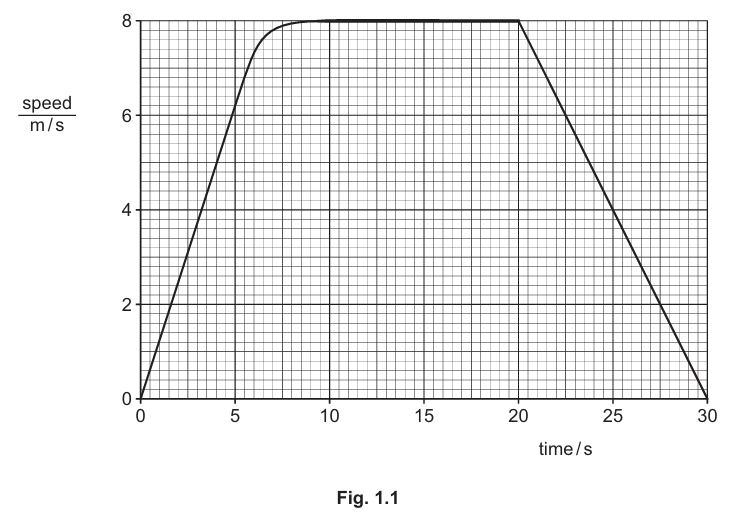
1. from time = 0 to time = 5 s ………………………
2. from time = 10 s to time = 20 s …………………….
3. from time = 20 s to time = 30 s ………………………
Most-appropriate topic codes (Cambridge IGCSE Physics 0625):
• Topic 1.2 — Motion (Parts (a), (b), (c))
▶️ Answer/Explanation
(a)
For the correct answer:
8.0 m / s
At time = 15 s, the graph shows a horizontal line at 8.0 m/s. A horizontal line on a speed–time graph indicates that the speed remains constant over that time interval. Therefore, the speed of the cyclist is read directly from the vertical axis.
(b) 1.
For the correct answer:
accelerating OR acceleration
From time = 0 to 5 s, the line on the graph slopes upwards. An upward slope on a speed–time graph indicates that the speed is increasing with time, which is defined as acceleration.
(b) 2.
For the correct answer:
steady or constant speed
From time = 10 to 20 s, the line is horizontal. This means the speed is not changing; the cyclist is travelling at a steady or constant speed.
(b) 3.
For the correct answer:
decelerating OR deceleration
From time = 20 to 30 s, the line slopes downwards. A downward slope on a speed–time graph represents a decrease in speed over time, which is known as deceleration.
(c)
For the correct answer:
40 m
The distance travelled is the area under the speed–time graph. The section from 20 s to 30 s forms a right-angled triangle with base 10 s and height 8.0 m/s. The area is calculated as \( \frac{1}{2} \times \text{base} \times \text{height} = \frac{1}{2} \times 10 \times 8.0 = 40 \text{ m}\).
Question 2
Calculate the work done by the 40 N force to move the shopping trolley a distance of 50 m.
(ii) The work done on the shopping trolley as it starts moving is transferred into other energy stores.
State two such energy stores.
The total area of contact with the ground is 38 cm².
Calculate the pressure on the ground due to the pushchair and child.
Most-appropriate topic codes (Cambridge IGCSE Physics 0625):
• Topic 1.5.1 — Effects of forces (Part (a))
• Topic 1.7.2 — Work (Part (b)(i))
• Topic 1.7.1 — Energy (Part (b)(ii))
• Topic 1.8 — Pressure (Part (c))
▶️ Answer/Explanation
(a)
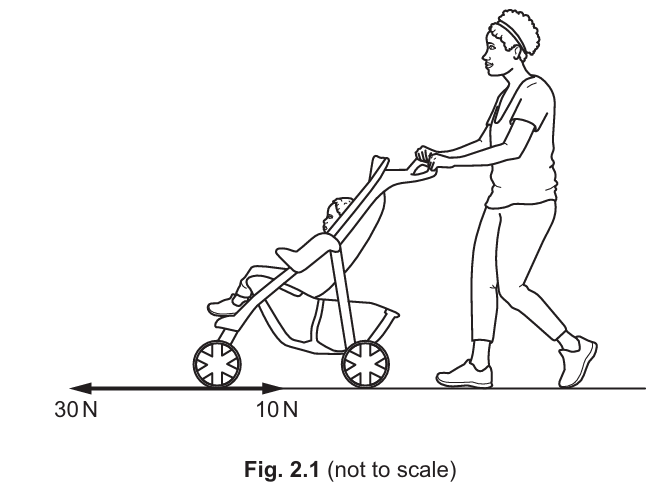
30 – 10 = 20 N
forwards OR in direction of 30 N force
The resultant force is found by subtracting the opposing forces along the same line. Since the 30 N force and 10 N force act in opposite horizontal directions, the net force is 20 N in the direction of the larger force.
(b)(i)
work done = 2000 (J)
work done = 40 × 50
work done = force × distance (moved in direction of force) OR (W) = F × d
Work is the product of the constant force applied and the distance moved in the direction of that force. With a 40 N force acting over 50 m, the work done is 2000 J.
(b)(ii)
internal OR thermal energy (of surroundings / tyres)
kinetic energy
As the trolley is set in motion, the work done is primarily converted into kinetic energy (energy of motion). Additionally, friction between the wheels and ground generates thermal energy, slightly warming the contact surfaces.
(c)
pressure = 6.3 (N/cm²)
pressure = 240 ÷ 38
pressure = force ÷ area OR (p) = F ÷ A
Pressure is defined as the force acting per unit area. The weight of the pushchair (240 N) acts downward on a total contact area of 38 cm², yielding a pressure of approximately 6.3 N/cm².
Question 3
A student determines the density of a metal. Fig. 3.1 shows an irregularly shaped piece of the metal and some equipment.
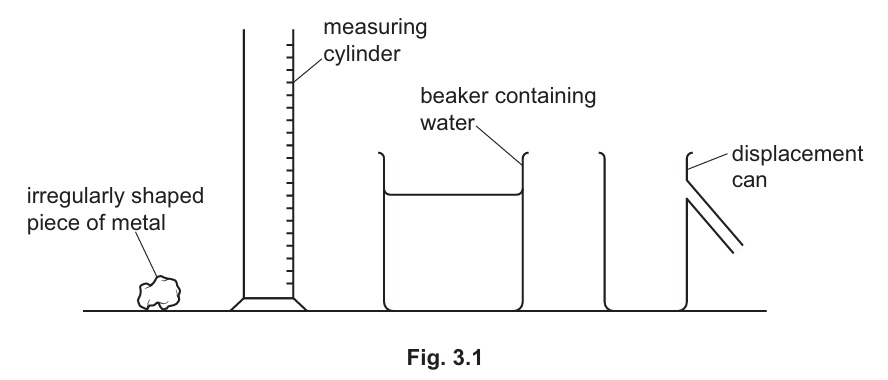
(a) Describe how the student can find the volume of the piece of metal.
In your answer you may refer to some or all of the equipment shown in Fig. 3.1.
(b) The mass of another piece of the metal is 350 g. The volume of this piece of metal is 18 cm³.
Calculate the density of the metal.
Most-appropriate topic codes (Cambridge IGCSE Physics 0625):
• Topic 1.4 — Density (Parts (a), (b))
▶️ Answer/Explanation
(a)
any three from:
• part fill measuring cylinder with water
• measure/note volume (of water)
• submerge metal in measuring cylinder
• determine increase in volume OR measure new volume of water (and metal)
AND
• find the difference in the two volumes OR increase in volume = volume of metal
To find the volume of an irregularly shaped solid, the displacement method is used. The object is submerged in a known volume of water within a measuring cylinder, and the rise in water level directly corresponds to the volume of the solid.
(b)
19 (g/cm³)
350 ÷ 18
density = mass ÷ volume OR ρ = m ÷ V
Density is calculated using the equation ρ = m / V, where m is mass and V is volume. Substituting the given values: ρ = 350 g / 18 cm³ = 19.44 g/cm³. Following significant figure conventions based on the given data (two significant figures for volume), the result is appropriately rounded to 19 g/cm³.
Question 4
(a) Fig. 4.1 shows the energy transfers in a lamp.
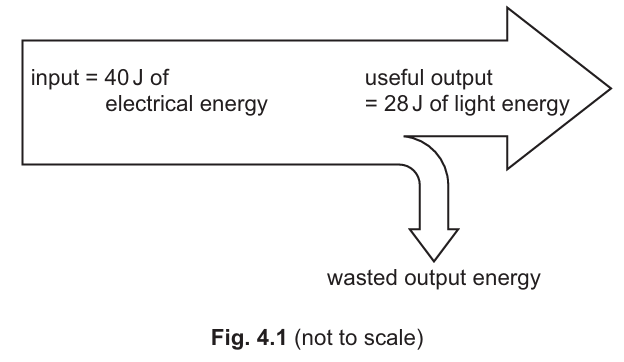
(i) State the value of the wasted output energy.
(ii) The energy that is wasted is transferred to an energy store. State the energy store that is increased by the wasted energy.
(b) A 15 W lamp is switched on for 5.0 minutes.
Calculate the electrical work done in the lamp circuit during this time.
(c) The lamp uses electrical energy that is generated by a wind turbine. Fig. 4.2 shows a wind turbine.
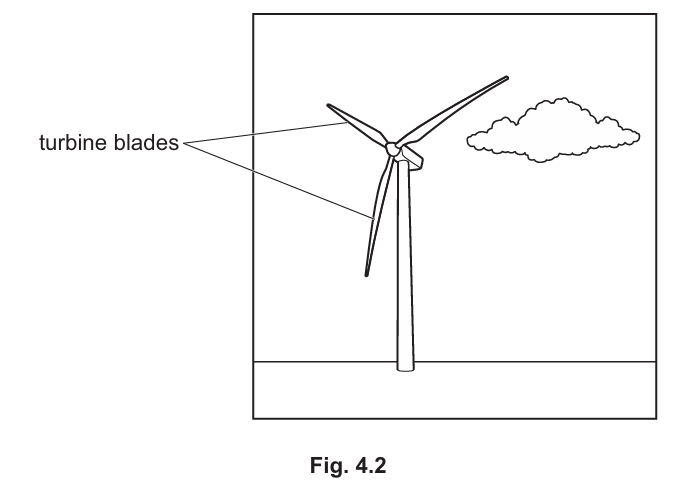
Describe three energy transfers that take place when energy from the Sun causes electrical energy to be generated by the wind turbine.
Most-appropriate topic codes (Cambridge IGCSE Physics 0625):
• Topic 1.7.1 — Energy (Parts (a)(i), (a)(ii))
• Topic 1.7.2 — Work (Part (b))
• Topic 1.7.3 — Energy resources (Part (c))
▶️ Answer/Explanation
4(a) (i) wasted output energy = 12 J
(ii) (form of energy wasted is) internal OR thermal (energy)
4(b) energy = 4500 J
energy = 15 × 300
power = energy ÷ time OR energy = power × time
5.0 minutes = 300 s
4(c) any three from:
• infrared OR e-m waves (from Sun) heat atmosphere
• thermal energy transfers to kinetic energy of wind
• kinetic energy of wind transfers to KE of turbine / blades
• KE of turbine transfers to KE of generator
• generator transfers kinetic energy to electrical energy
Detailed solutions:
(a)(i): Energy is conserved: total input (15 J) = useful output (3 J) + wasted output. Therefore, wasted output energy = 15 J – 3 J = 12 J.
(a)(ii): The wasted energy from a lamp is dissipated as heat, which increases the internal (thermal) energy store of the surroundings.
(b): Electrical work done equals energy transferred. Using \(E = P \times t\), where \(t = 5.0 \times 60 = 300\text{ s}\), \(E = 15\text{ W} \times 300\text{ s} = 4500\text{ J}\).
(c): Solar radiation heats the atmosphere, creating convection currents (thermal to kinetic). This moving air (wind) possesses kinetic energy, which is captured by the turbine blades, causing rotation. The rotating turbine then drives a generator, which converts the mechanical kinetic energy into electrical energy via electromagnetic induction.
Question 5
Fig. 5.1 shows a metal box. The air in the box is at room temperature, 20°C.
Air cannot leave or enter the box.
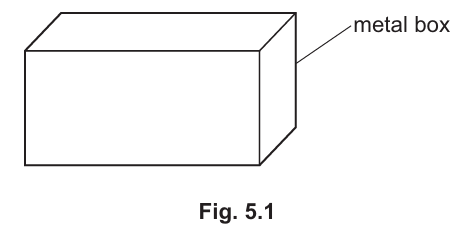
(a) Describe the motion, separation and arrangement of the air particles in the metal box.
(b) A student puts the box in a freezer. The temperature of the air in the box decreases.
Describe the changes in the motion of the air particles in the box when the temperature decreases.
Most-appropriate topic codes (Cambridge IGCSE Physics 0625):
• Topic 2.1.2 — Particle model (Parts (a), (b))
▶️ Answer/Explanation
(a)
For any three of:
• random motion (of particles)
• high speed
• widely separated (compared to particles in liquid or solid)
• random arrangement
• constantly colliding (with each other / walls)
Air is a gas, so its particles are in constant, rapid, and random motion. According to the kinetic particle model, gas particles are spaced far apart relative to their size and have no fixed arrangement, allowing them to move freely and collide frequently with one another and the container walls.
(b)
For any two of:
• speed decreases
• (because) kinetic energy OR (internal) energy decreases
• (and so) collision rate decreases
When the temperature of the air decreases, the average kinetic energy of the air particles is reduced. This results in a lower average particle speed. Consequently, the particles collide with each other and the walls of the box less frequently.
Question 6
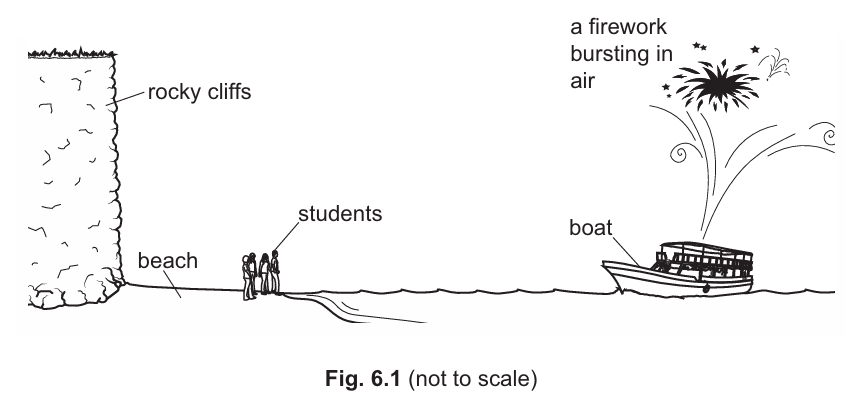
State what causes the second quieter, similar sound.
Calculate the distance from the firework to the students.
Use the speed of sound in air = 340 m/s.
Most-appropriate topic codes (Cambridge IGCSE Physics 0625):
• Topic 3.4 — Sound (Parts (a), (b))
▶️ Answer/Explanation
(a)
For the correct answer:
(sound is) reflected (from cliff) OR echo (from cliff)
The first loud sound travels directly from the firework to the students. The second quieter sound is the echo, which occurs when the sound waves reflect off the rocky cliff and return to the students’ ears with less energy.
(b)
For the correct answer:
d = 442 m
The distance to the firework is found using the wave speed equation $v = \frac{d}{t}$, rearranged to $d = v \times t$. Given the speed of sound $v = 340\text{ m/s}$ and the time taken $t = 1.3\text{ s}$, the calculation is $d = 340 \times 1.3 = 442\text{ m}$.
Question 7
(a) A student demonstrates three different processes that change the direction of water waves in a ripple tank.
Fig. 7.1, Fig. 7.2 and Fig. 7.3 illustrate the three processes.
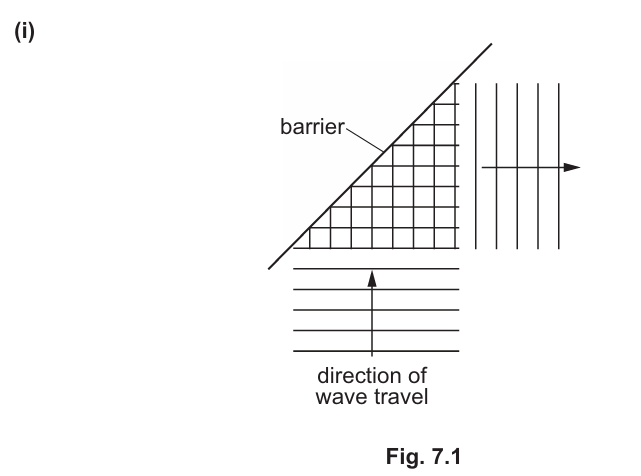
State the name of the process shown in Fig. 7.1.
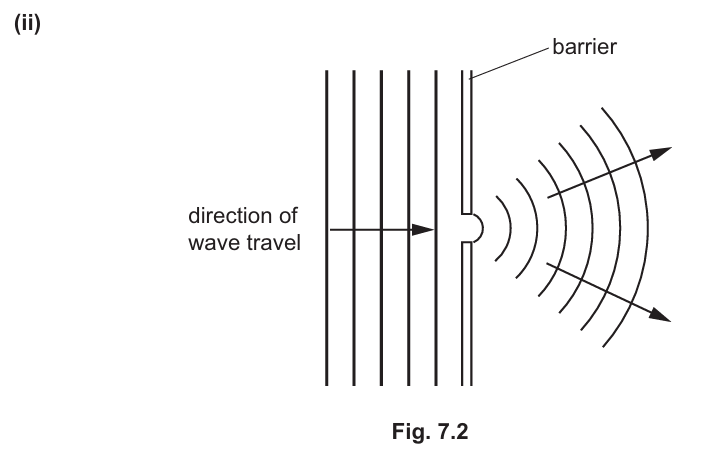
State the name of the process shown in Fig. 7.2.
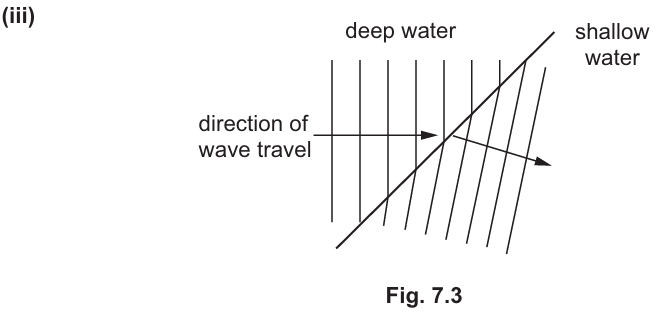
State the name of the process shown in Fig. 7.3.
(iv) Give a reason why the waves in Fig. 7.3 change direction as they move from deep water to shallow water.
(b) Describe the direction of vibration of particles in a transverse wave.
Fig. 7.4 lists examples of waves. Two of the examples are transverse waves.
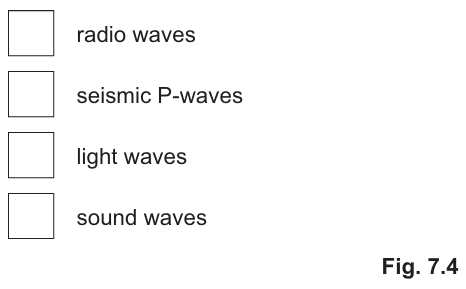
Indicate which of the examples are transverse waves.
Put a tick (✔) in the box next to each example of a transverse wave.
(d) The velocity of a wave is 1500 m/s. The frequency of the wave is 250 Hz.
Calculate the wavelength of the wave.
Most-appropriate topic codes (Cambridge IGCSE Physics 0625):
• Topic 3.1 — General properties of waves (Parts (a), (b), (d))
▶️ Answer/Explanation
7(a) (i) reflection
(ii) diffraction
(iii) refraction
(iv) change in speed
Detailed: Waves undergo refraction at a boundary between deep and shallow water due to a change in wave speed; the part of the wavefront entering shallow water first slows down, causing the wave to change direction.
7(b) (vibrations are) at right angles / perpendicular (to the) direction of propagation of the wave
Detailed: In a transverse wave, the oscillations of the particles are perpendicular (at 90°) to the direction in which the wave energy travels.
7(c) 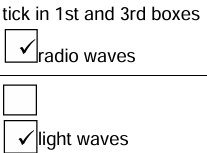
Detailed: Visible light and X-rays are electromagnetic waves, which are transverse in nature. Sound is a longitudinal wave.
7(d) λ = 6.0 m
λ = 1500 ÷ 250
velocity (of wave) OR wave speed = frequency × wavelength OR λ = v ÷ f
Detailed: The wave equation relates velocity ($v$), frequency ($f$), and wavelength ($\lambda$). Rearranging $v = f\lambda$ to solve for wavelength gives $\lambda = \frac{v}{f} = \frac{1500}{250} = 6.0\text{ m}$.
Question 8
(a) Fig. 8.1 shows a ray diagram for a thin converging lens.
The lens forms an image of the object. The object is positioned 30 cm from the centre of the lens.
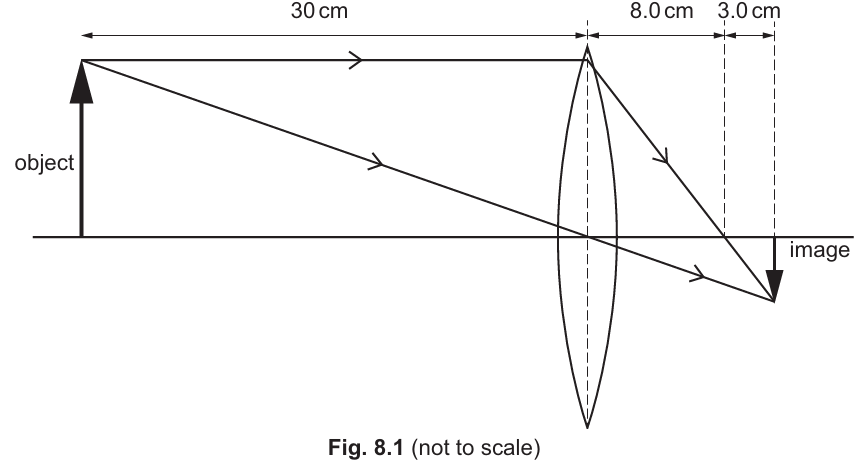
(ii) Determine the focal length of the lens. Use information from Fig. 8.1.
(iii) State two characteristics of the image formed by the lens in Fig. 8.1.

(ii) State one use of ultraviolet radiation.
(iii) State one danger to people from excessive exposure to ultraviolet radiation.
Most-appropriate topic codes (Cambridge IGCSE Physics 0625):
• Topic 3.2.3 — Thin lenses (Parts (a)(i), (a)(ii), (a)(iii))
• Topic 3.3 — Electromagnetic spectrum (Parts (b)(i), (b)(ii), (b)(iii))
▶️ Answer/Explanation
8(a) (i) 0.11 m
The image distance is measured directly from the lens center to the point where the refracted rays converge. Using the scale provided in the diagram, the image forms approximately 11 cm from the lens, which is 0.11 m.
8(a) (ii) 0.08 m
The focal length is the distance from the lens center to the principal focus. Rays parallel to the principal axis converge at the focal point, which is located approximately 8 cm from the lens in the diagram, equivalent to 0.08 m.
8(a) (iii) any two from:
• diminished OR smaller
• inverted OR upside down
• real
Since the object is placed beyond 2F, the image formed by the converging lens is real, inverted, and diminished in size compared to the object.
8(b) (i) X‑rays (box on left)
gamma (rays/radiation) (box on right)
The electromagnetic spectrum in order of decreasing wavelength places X‑rays next to ultraviolet, followed by gamma rays which have the shortest wavelength and highest frequency.
8(b) (ii) security marker OR detecting fake bank notes OR sterilising (medical instruments/water/food)
Ultraviolet radiation causes certain materials to fluoresce visibly, making it useful for security markings and forgery detection; it also has germicidal properties for sterilisation.
8(b) (iii) damage to skin OR (surface) cells OR eyes
Excessive UV exposure damages DNA in skin cells, leading to sunburn, premature aging, and an increased risk of skin cancer and eye cataracts.
Question 9
The student uses the circuit shown in Fig. 9.1.
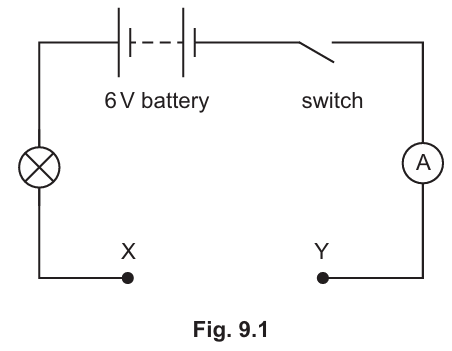
Describe how the student can determine whether tin is an electrical conductor.
Use your ideas about electrons in your answer.
Most-appropriate topic codes (Cambridge IGCSE Physics 0625):
• Topic 4.2.2 — Electric current (Parts (a), (b))
▶️ Answer/Explanation
(a)
For the correct answer:
either: close switch (see if) lamp lights OR reading on ammeter OR lamp lights OR reading on ammeter (so material is (a)) conductor OR lamp lights OR reading on ammeter (so must have electric) current in tin
To determine if tin is an electrical conductor, the student should close the switch to complete the circuit. The tin piece acts as a bridge between points X and Y. If tin conducts electricity, charge will flow, causing the lamp to light up or the ammeter to show a non-zero reading. This observation confirms that tin allows an electric current to pass through it.
(b)
For the correct answer:
mention of free OR de-localised electrons (in the metal) able to move from one atom / ion / particle to another when p.d. OR voltage (applied across the metal / material)
Electrical conduction in a metal is due to the presence of free or de-localised electrons within its structure. These electrons are not bound to any specific atom and can move randomly throughout the metal lattice. When a potential difference (voltage) is applied across the metal, these free electrons drift in a net direction, forming an electric current.
Question 10
In an experiment, a student uses an electrical heater connected to a power supply.
(a) The current in the electrical heater is 2.2 A. The voltage (p.d.) across the heater is 12 V.
Calculate the energy transferred to the heater in 90 s.
(b) The power supply is connected to the electrical mains by a cable that consists of three wires.
State the name for each of the three wires in the cable.
(c) The power supply includes a transformer.
The voltage (\(V_{p}\)) across the primary coil of the transformer is 228 V. The voltage (\(V_{s}\)) across the secondary coil of the transformer is 12 V. The number of turns on the primary coil (\(N_{p}\)) is 760.
Calculate the number of turns (\(N_{s}\)) on the secondary coil.
Most-appropriate topic codes (Cambridge IGCSE Physics 0625):
• Topic 4.2.5 — Electrical energy and electrical power (Part (a))
• Topic 4.4 — Electrical safety (Part (b))
• Topic 4.5.6 — The transformer (Part (c))
▶️ Answer/Explanation
(a)
For the correct answer:
energy = 2400 J
The electrical energy transferred is found using the equation \(E = VIt\). Substituting the given values, \(E = 12\text{ V} \times 2.2\text{ A} \times 90\text{ s} = 2376\text{ J}\), which rounds appropriately to 2400 J given the data precision.
(b)
For the correct answer:
live (or line), neutral, earth (or ground)
A standard three-core mains cable for electrical appliances contains three wires with distinct functions: the live (or line) wire carries the alternating current to the appliance, the neutral wire completes the circuit back to the supply, and the earth (or ground) wire provides a safe path for current in the event of a fault.
(c)
For the correct answer:
40
The transformer turns ratio equation is \(\frac{N_s}{N_p} = \frac{V_s}{V_p}\). Substituting the known values, \(N_s = 760 \times \frac{12\text{ V}}{228\text{ V}} = 760 \times \frac{1}{19} = 40\). Therefore, the secondary coil has 40 turns.
Question 11
Fig. 11.1 represents the planets in the Solar System.
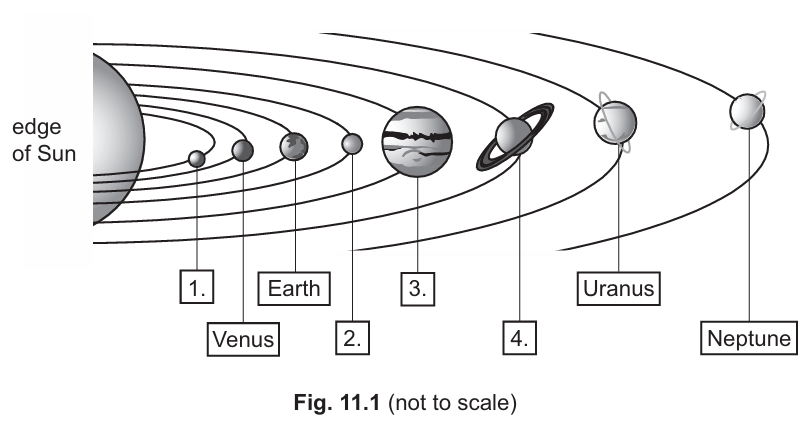
(a) In Fig. 11.1, there are four labels without the name of the planet.
For each label, state the name of the planet.
(b) Describe how the planets in the Solar System were formed.
Use your ideas about the accretion model. You may draw a diagram as part of your answer.
Most-appropriate topic codes (Cambridge IGCSE Physics 0625):
• Topic 6.1.2 — The Solar System (Parts (a), (b))
▶️ Answer/Explanation
(a)
1. Mercury
2. Mars
3. Jupiter
4. Saturn
(b)
any four from:
• (particles of) dust OR gas
• (gas / dust / rocks) orbiting Sun / protostar / star
• (idea of forming) a disc of material
• material (in the disc) colliding
• (and) smaller objects join to make larger objects owtte
• (accretion / combining due to) force of gravity
• (small) rocky planets formed near the Sun
• (large) gaseous planets formed furthest from Sun
Detailed Solution: The accretion model explains that the Solar System formed from a rotating cloud of interstellar gas and dust. Gravity pulled material into a central protostar (Sun) with a surrounding disc. Within this disc, particles collided and stuck together (accretion), building larger bodies. Closer to the Sun, higher temperatures meant only rocky materials could condense, forming small terrestrial planets. Farther out, ices and gases accumulated, forming the large gaseous planets.