
Question 1
A spring is suspended from a clamp. Fig. 1.1 shows a pointer attached to the lower end of the spring.
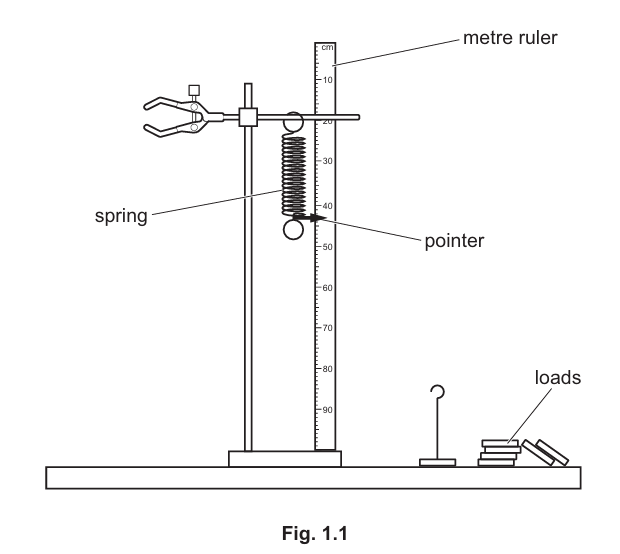
A student suspends loads of different weights from the spring and records the readings on the metre ruler.
Fig. 1.2 is the reading–weight graph that the student obtains.
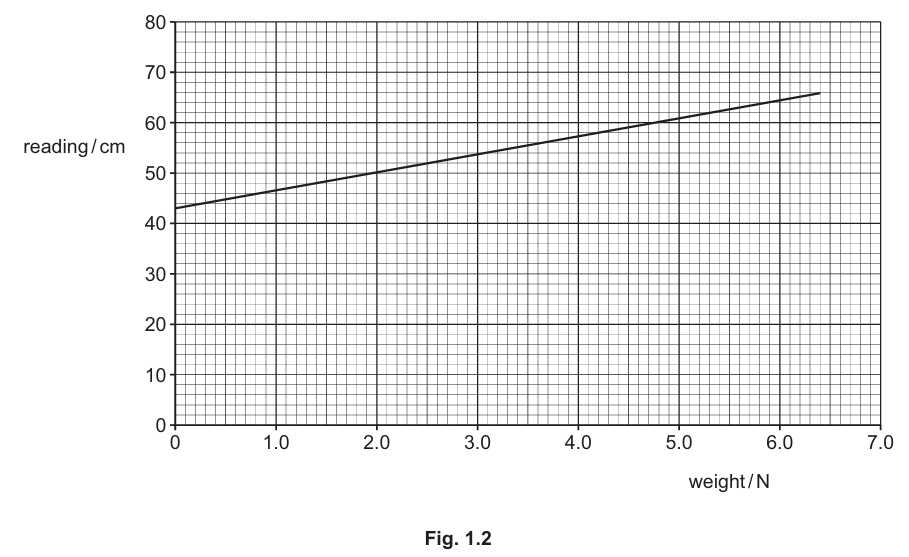
(a) (i) Using Fig. 1.2, determine the reading on the metre ruler when
1. no weight is attached to the spring ……………………….
2. a weight of 5.6 N is attached to the spring …………………………..
(ii) Calculate the extension of the spring when the weight attached is 5.6 N.
(b) Using the values found in (a), calculate the spring constant of the spring.
(c) An object of mass 0.50 kg is attached to the spring.
(i) Calculate the weight of the object.
(ii) The object is pulled downwards until the tension in the spring is 6.5 N.
The object is released.
Calculate the acceleration of the object immediately after it is released.
Most-appropriate topic codes (Cambridge IGCSE Physics 0625):
• Topic 1.5.1 — Effects of forces (Parts (a) and (b))
• Topic 1.3 — Mass and weight (Part (c)(i))
• Topic 1.5.1 — Effects of forces (Part (c)(ii))
▶️ Answer/Explanation
Correct Answer: 43 cm AND 63 cm
Detailed solution: The graph’s y-intercept gives the initial reading with no weight (43 cm). To find the reading at 5.6 N, trace vertically up from 5.6 N on the x-axis to the plotted line, then horizontally to the y-axis, reading a value of 63 cm.
Correct Answer: 20 cm
Detailed solution: Extension is the increase in length from the original position. The extension is calculated by subtracting the initial length from the final length: Extension $= 63\text{ cm} – 43\text{ cm} = 20\text{ cm}$.
Correct Answer: 0.28 N/cm
Detailed solution: The spring constant $k$ relates force to extension ($k = F/x$). Substituting the force applied ($5.6\text{ N}$) and the resulting extension ($20\text{ cm}$) gives $k = 5.6\text{ N} / 20\text{ cm} = 0.28\text{ N/cm}$.
Correct Answer: 4.9 N
Detailed solution: Weight is the gravitational force on a mass, calculated using $W = mg$. Using the given mass $m = 0.50\text{ kg}$ and gravitational field strength $g = 9.8\text{ N/kg}$, the weight is $W = 0.50 \times 9.8 = 4.9\text{ N}$.
Correct Answer: 3.2(0) m/s²
Detailed solution: The resultant upward force is tension minus weight ($6.5 – 4.9 = 1.6\text{ N}$). Using Newton’s second law ($F = ma$), the acceleration is found by $a = F/m = 1.6\text{ N} / 0.50\text{ kg} = 3.2\text{ m/s}^2$.
Question 2
A drag car is a racing car that is powered by a rocket engine.
A drag car accelerates uniformly from rest until it reaches the finishing line. The engine is then switched off and a parachute opens. The car decelerates until it stops.
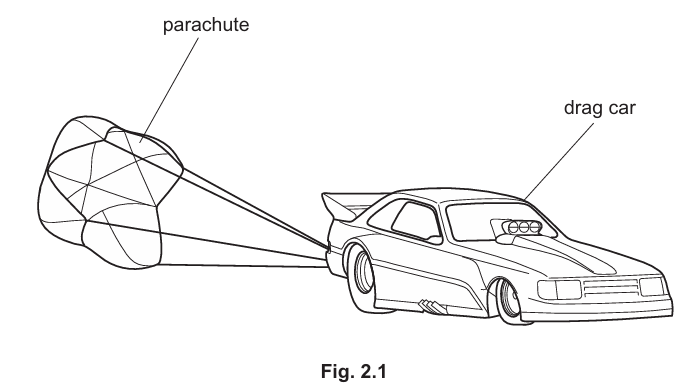
Fig. 2.1 shows a drag car decelerating after a race.
This drag car has a mass of 1400 kg.
Fig. 2.2 is the speed–time graph for the car during a race on a straight horizontal track.
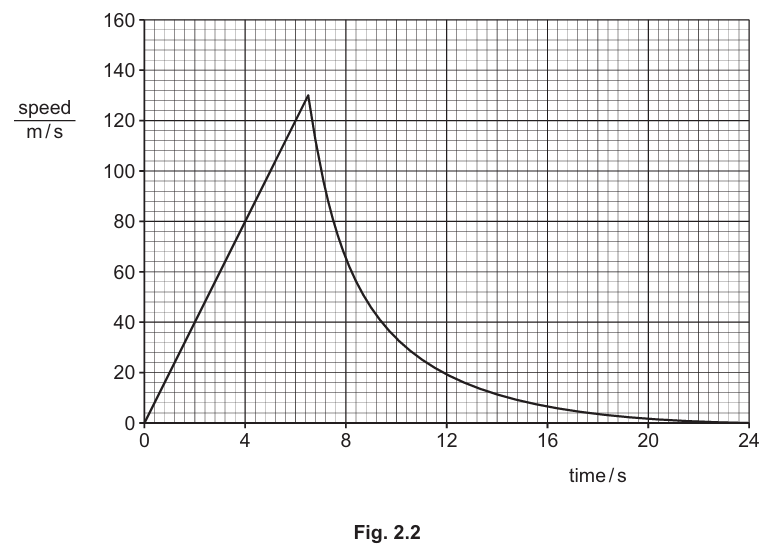
The car reaches its maximum speed of 130 m / s at a time of 6.5 s.
Describe how Fig. 2.2 shows that, after 6.5 s:
(i) the car decelerates
(ii) the deceleration of the car is not constant.
Most-appropriate topic codes (Cambridge IGCSE Physics 0625):
• Topic 1.6 — Momentum (Part (a)(i))
• Topic 1.2 — Motion (Part (a)(ii), (a)(iii), (b)(i), (b)(ii))
• Topic 1.7.1 — Energy (Part (c))
▶️ Answer/Explanation
Correct Answer: $1.8 \times 10^{5}\text{ kg m/s}$ (or $1.8 \times 10^{5}\text{ N s}$)
Detailed solution: Momentum is the product of mass and velocity, given by $p = mv$. The car has a mass of $1400\text{ kg}$ and reaches a maximum velocity of $130\text{ m/s}$. Multiplying these values gives the maximum momentum: $1400 \times 130 = 182,000\text{ kg m/s}$, which is written as $1.8 \times 10^{5}\text{ kg m/s}$ in standard form.
Correct Answer: (scaled) area under the (graph) line
Detailed solution: On a speed-time graph, the area bounded by the graph line and the horizontal time axis represents the total distance travelled by the object. This is a fundamental concept in kinematics for interpreting graphical motion data.
Correct Answer: $420\text{ m}$ (or $422.5\text{ m}$)
Detailed solution: For uniform acceleration from rest, the distance is the area of the triangle under the graph. The formula $\frac{1}{2} \times \text{base} \times \text{height}$ is used. Substituting the base ($6.5\text{ s}$) and the height ($130\text{ m/s}$) gives $\frac{1}{2} \times 6.5 \times 130 = 422.5\text{ m}$, which rounds to $420\text{ m}$ to two significant figures.
Correct Answer: gradient is negative (OR speed decreases)
Detailed solution: Deceleration is defined as a reduction in speed over time. On the speed-time graph, this is visually represented by a downward slope, meaning the gradient of the line is negative after $6.5\text{ s}$.
Correct Answer: gradient is changing (OR line/graph/it is a curve/curved)
Detailed solution: Constant deceleration would be shown by a straight line with a constant negative gradient. Since the graph line after $6.5\text{ s}$ is curved, the steepness of the slope is continuously varying, indicating that the rate of deceleration is changing over time.
Correct Answer: (from) kinetic (energy store) to internal/thermal (energy store as final store)
Detailed solution: As the car slows down, its speed decreases, which reduces its kinetic energy store. This energy is not destroyed but is transferred via mechanical work done by friction (between the parachute/air and brakes) into internal (thermal) energy, causing the surroundings and components to heat up slightly.
Question 3
(a) Define the moment of a force and describe the effect that it measures.
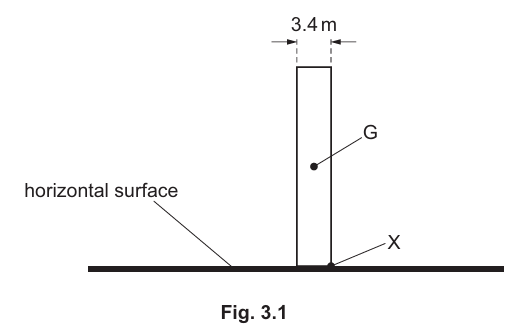
(i) Explain what is meant by centre of gravity.
(ii) The weight of the block is 1.3 × 10⁷ N.
Calculate the moment of the weight of the block about corner X.
State the two different conditions that apply when an object is in equilibrium.
Most-appropriate topic codes (Cambridge IGCSE Physics 0625):
• Topic 1.5.2 — Turning effect of forces (Parts (a) and (c))
• Topic 1.5.3 — Centre of gravity (Part (b))
▶️ Answer/Explanation
Correct Answer: force × perpendicular distance (from pivot). It measures the turning effect of a force.
Detailed solution: The moment of a force quantifies its ability to cause rotation about a pivot. It is calculated by multiplying the magnitude of the force by the perpendicular distance from the line of action of the force to the pivot point. This value directly represents the magnitude of the turning effect produced.
Correct Answer: The point where the entire weight of an object appears to act.
Detailed solution: For any object, the gravitational force acts on every individual particle. However, for calculations involving weight and moments, this distributed force can be treated as a single resultant force acting through a specific point. This theoretical point is defined as the centre of gravity.
Correct Answer: $2.2 \times 10^7\text{ N m}$
Detailed solution: The moment is calculated using $\text{Moment} = \text{Force} \times \text{Perpendicular distance}$. The force is the weight $(1.3 \times 10^7\text{ N})$. Since the block’s centre is uniform, the perpendicular distance from the line of action of the weight to corner X is half the base width, which is $3.4\text{ m} / 2 = 1.7\text{ m}$. Thus, $\text{Moment} = (1.3 \times 10^7) \times 1.7 = 2.21 \times 10^7\text{ N m}$.
Correct Answer: The resultant force is zero, and the resultant moment is zero.
Detailed solution: For an object to be in static equilibrium, two distinct conditions must be simultaneously satisfied. Firstly, the vector sum of all forces acting on it must equal zero, preventing linear acceleration. Secondly, the sum of all clockwise moments about any pivot must equal the sum of all anticlockwise moments, preventing rotational acceleration.
Question 4
(a) Describe an experiment to determine the specific heat capacity of aluminium. You may draw a diagram.
Include in your answer:
- the measurements made
- any equations needed.
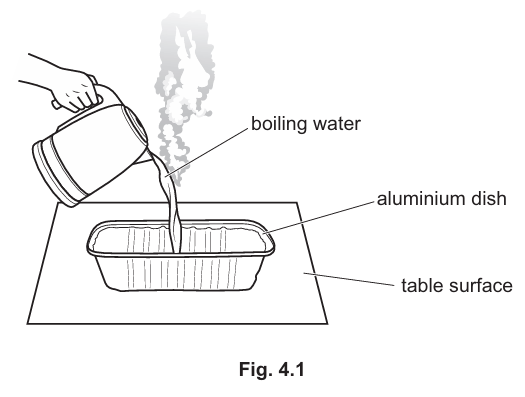
Explain, in terms of the water molecules, what is meant by evaporation.
Most-appropriate topic codes (Cambridge IGCSE Physics 0625):
• Topic 2.2.2 — Specific heat capacity (Part (a))
• Topic 2.2.3 — Melting, boiling and evaporation (Part (b))
▶️ Answer/Explanation
Correct Answer: Method: Heat an aluminium block of known mass using an electrical heater; measure initial and final temperatures, heater power, and heating time. Equation: $c = \frac{Pt}{m\Delta\theta}$ (or $c = \frac{IVt}{m\Delta\theta}$).
Detailed solution: Place an insulated aluminium block with an embedded electrical heater and thermometer. Measure the mass $m$ of the block. Record the initial temperature $\theta_1$, then switch on the heater for a measured time $t$, noting the power $P$ (or current $I$ and voltage $V$). Record the final temperature $\theta_2$ to find $\Delta\theta = \theta_2 – \theta_1$. The specific heat capacity $c$ is calculated using $c = \frac{\text{Energy supplied}}{m\Delta\theta} = \frac{Pt}{m\Delta\theta}$ (or $\frac{IVt}{m\Delta\theta}$).
Correct Answer: Thermal energy transfers from the hotter water to the cooler aluminium dish by conduction until thermal equilibrium is reached and both are at the same temperature.
Detailed solution: Energy naturally flows from a region of higher temperature (boiling water) to a region of lower temperature (room temperature dish). Aluminium is a good thermal conductor, facilitating this transfer. The water cools slightly as the dish warms up; this energy exchange continues until both objects achieve a uniform, identical temperature, at which point there is no net energy transfer.
Correct Answer: The particles gain kinetic energy and vibrate more vigorously, causing the average separation between them to increase.
Detailed solution: When boiling water is added, the temperature of the aluminium increases. This corresponds to an increase in the average kinetic energy of the aluminium atoms. These atoms vibrate with larger amplitudes about their fixed lattice positions, pushing slightly further apart from their neighbours. This increased average separation results in the overall expansion of the dish.
Correct Answer: Evaporation is the escape of the most energetic molecules from the surface of a liquid.
Detailed solution: Within the liquid water, molecules have a range of kinetic energies. Those near the surface with the highest kinetic energy can overcome the attractive forces of neighbouring molecules and break free into the air as vapour. This process occurs at any temperature and results in the remaining liquid having a lower average kinetic energy, hence causing cooling.
Question 5
A loudspeaker produces a sound wave in air. The distance between the centre of a compression and the centre of a neighbouring rarefaction is 0.10 m.
(ii) Explain whether the sound from the loudspeaker is audible to a human with normal hearing.
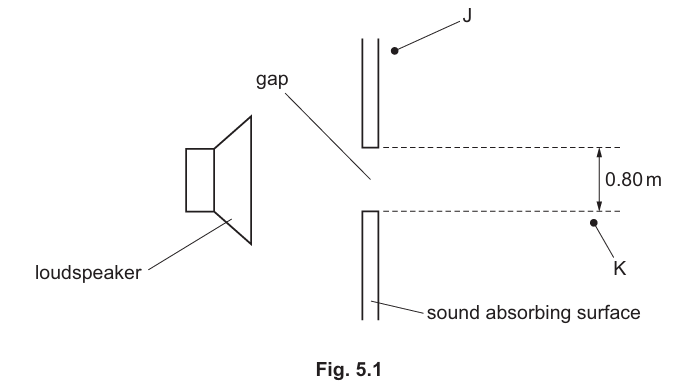
Fig. 5.1 shows the arrangement.
Most-appropriate topic codes (Cambridge IGCSE Physics 0625):
• Topic 3.4 — Sound (Part (a), (b), (c), (d))
▶️ Answer/Explanation
Correct Answer: 0.20 m
Detailed solution: The distance between the center of a compression and the center of a neighboring rarefaction represents exactly half of a full wavelength. Since this half-wavelength distance is given as $0.10\text{ m}$, the full wavelength is calculated by doubling this value: $\lambda = 2 \times 0.10\text{ m} = 0.20\text{ m}$.
Correct Answer: any value in range from $330\text{ m/s}$ to $350\text{ m/s}$
Detailed solution: The speed of sound in air is not a fixed universal constant as it depends on factors like air temperature and pressure. However, under typical room temperature conditions near sea level, the accepted standard range for the speed of sound is between approximately $330\text{ m/s}$ and $350\text{ m/s}$.
Correct Answer: (value from (b)) / 0.20 AND unit Hz
Detailed solution: The frequency of a wave is related to its speed and wavelength by the wave equation $v = f\lambda$. Rearranging this to solve for frequency gives $f = \frac{v}{\lambda}$. The frequency is calculated by dividing the stated value for the speed of sound from part (b) by the wavelength of $0.20\text{ m}$ found in part (a), yielding a value in Hertz (Hz).
Correct Answer: audible/yes OR inaudible/no consistent with value in 5(c)(i) AND explanation referencing $20\text{ Hz} \leqslant$ human hearing $\leqslant 20000\text{ Hz}$
Detailed solution: A typical human ear can detect sound waves with frequencies roughly between $20\text{ Hz}$ and $20000\text{ Hz}$. The calculated frequency in part (c)(i) is compared against this range; if it falls inside the range, the sound is audible, and if it falls outside, it is inaudible to a person with normal hearing.
Correct Answer: point J: Little/no sound heard AND point K: (some) sound heard
Detailed solution: Sound waves spread out or bend around obstacles, a phenomenon called diffraction. The amount of diffraction depends on the relative size of the gap to the wavelength. Here, the gap width ($0.80\text{ m}$) is twice the wavelength ($0.40\text{ m}$), which is relatively large, resulting in only a small amount of diffraction. Therefore, the sound travels mostly straight forward to point K, while very little bends around to reach point J.
Question 6
A potential divider is made by connecting a light-dependent resistor (LDR) and a thermistor in series. Fig. 6.1 shows the potential divider, a voltmeter and a direct current (d.c.) power supply connected into a circuit.
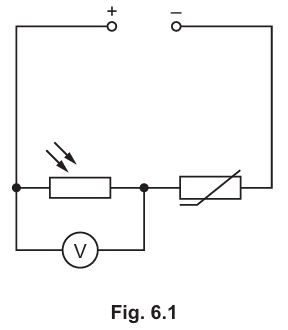
The voltmeter measures the potential difference (p.d.) across the LDR.
Describe how the p.d. across the thermistor can be determined using the reading on the voltmeter.
intensity of incident light on LDR: ………………………………….
temperature of thermistor: ………………………………….
Most-appropriate topic codes (Cambridge IGCSE Physics 0625):
• Topic 4.2.3 — Electromotive force and potential difference (Parts (a) and (b))
• Topic 4.3.3 — Action and use of circuit components (Part (c))
▶️ Answer/Explanation
Correct Answer: work done by a unit charge passing through a component
Detailed solution: Potential difference (p.d.) is defined as the electrical work done per unit charge to move that charge between two points in a circuit. It represents the energy transferred by each coulomb of charge as it passes through a component.
Correct Answer: p.d. = E – reading on voltmeter OR subtract reading on voltmeter from E
Detailed solution: In a series circuit, the sum of the potential differences across the components equals the total e.m.f. of the supply. Since the voltmeter measures the p.d. across the LDR, the p.d. across the thermistor is simply the supply e.m.f. minus the voltmeter reading.
Correct Answer: (intensity of light on LDR) increased AND (temperature of thermistor) decreased
Detailed solution: The resistance of an LDR decreases as the light intensity falling upon it increases. Conversely, a thermistor (typically NTC) experiences an increase in resistance when its surrounding temperature decreases.
Correct Answer: reading on voltmeter / it decreases
Detailed solution: As the resistance of the LDR decreases, it forms a smaller proportion of the total circuit resistance compared to the thermistor. According to the potential divider principle, a smaller share of the constant supply e.m.f. will be dropped across the LDR, resulting in a lower reading on the voltmeter connected across it.
Question 7
A solid bar is inside a copper solenoid. Fig. 7.1 shows that the copper solenoid is connected in series with a battery and a variable resistor.
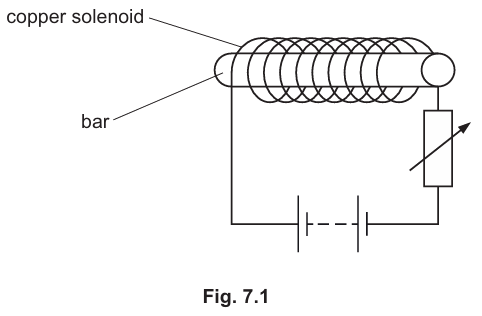
The device shown in Fig. 7.1 is an electromagnet.
(a) Suggest a suitable material for the bar.
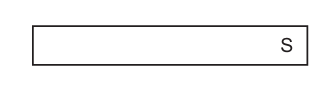
(b) The right-hand end of the bar is the S pole.
(i) Fig. 7.2 shows the bar viewed from above.
On Fig. 7.2, draw at least six field lines to show the pattern and direction of the magnetic
field surrounding the bar.
(ii) The resistance of the variable resistor increases.
Explain what happens to the magnetic field surrounding the bar and state how the pattern of field lines that represents the field changes.
(c) A square coil of many turns is placed close to the bar.
Fig. 7.3 shows the plane of the square coil parallel to the flat circular surface at the right-hand end of the bar.
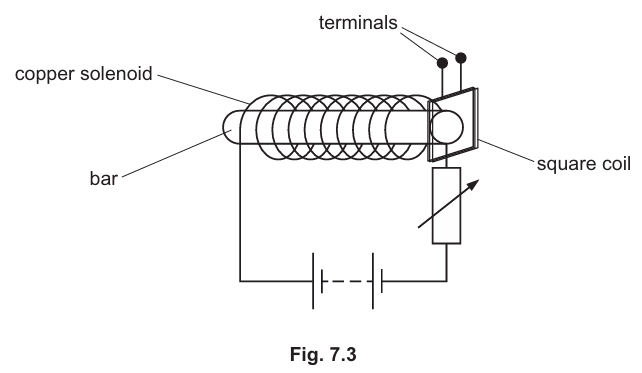
The resistance of the variable resistor is alternately increased and decreased.
Explain what happens in the wires of the square coil.
Most-appropriate topic codes (Cambridge IGCSE Physics 0625):
• Topic 4.5.3 — Magnetic effect of a current (Part (a), (b))
• Topic 4.5.1 — Electromagnetic induction (Part (c))
▶️ Answer/Explanation
Correct Answer: (soft) iron
Detailed solution: An electromagnet requires a core that becomes strongly magnetized when current flows but loses its magnetism when current stops. Soft iron is ideal because it is ferromagnetic and easily magnetized and demagnetized, making the electromagnet’s strength controllable.
Correct Answer: (at least) one complete field line between the poles of the bar (either above or below the bar)
no crossing AND attempt at correct shape AND at least six lines from/to poles
at least one arrowhead towards S pole
Detailed solution: Magnetic field lines emerge from the North pole, curve through the surrounding space, and enter the South pole. The lines must be continuous, must not intersect each other, and arrows should point towards the designated S pole at the right-hand end.
Correct Answer: current (in the coil) decreases
(current decreases so magnetic field) strength decreases
(field strength decreases so) fewer field lines (in same area) OR (field strength decreases so) field lines further apart
Detailed solution: Increasing the variable resistor’s resistance reduces the current in the solenoid. A lower current produces a weaker magnetic field. A weaker field is represented graphically by a lower density of field lines, meaning they will be spaced further apart.
Correct Answer: Any two from:
1. (changing resistance causes) changing current (through solenoid)
2. (changing current causes) changing magnetic field (around solenoid)
3. (square) coil cuts (changing) magnetic field OR coil in changing magnetic field
e.m.f. induced (between terminals)
Detailed solution: Varying the resistance causes the solenoid’s current and its associated magnetic field to constantly change. This changing magnetic field cuts through the nearby square coil. According to Faraday’s law of electromagnetic induction, a changing magnetic flux induces an electromotive force (e.m.f.) in the coil.
Question 8
The nuclide notation for the radioactive isotope carbon-14 is \(_{6}^{14}\textrm{C}\).
neutrons and protons in a neutral atom of carbon-14 and how they are arranged.
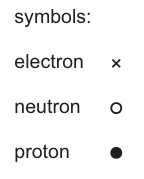
(i) State the name of a particle that is identical to a beta-particle.
(ii) Describe the change that takes place in carbon-14 as a beta-particle is emitted.
A very old object is made of wood. It contains 1.2 × 10¹¹ atoms of carbon-14. When it was manufactured, it contained 9.6 × 10¹¹ atoms of carbon-14.
Determine the time that has passed since it was manufactured.
Most-appropriate topic codes (Cambridge IGCSE Physics 0625):
• Topic 5.1.1 — The atom (Part (a) and (b))
• Topic 5.2.3 — Radioactive decay (Part (c))
• Topic 5.2.4 — Half-life (Part (d))
▶️ Answer/Explanation
Correct Answer: 6 electrons AND 6 protons (i.e. 6 × electron AND 6 × proton)
8 neutrons (i.e. 8 × neutron)
protons and neutrons in nucleus AND electrons orbiting nucleus
Detailed solution: The nuclide notation \(_{6}^{14}\textrm{C}\) indicates the atom has a proton number (atomic number) of 6 and a nucleon number (mass number) of 14. A neutral atom has equal numbers of protons and electrons, so there are 6 of each. The number of neutrons is found by subtracting the proton number from the nucleon number: \(14 – 6 = 8\) neutrons. The protons and neutrons are located in the central nucleus, while the electrons orbit the nucleus in shells.
Correct Answer: (carbon) has one more neutron OR nitrogen has one fewer neutron
(carbon) has one fewer proton / electron OR nitrogen has one more proton / electron
Detailed solution: Carbon-14 has 6 protons and 8 neutrons, while nitrogen-14 has 7 protons and 7 neutrons. Comparing the two, a carbon-14 nucleus contains one more neutron and one fewer proton than a nitrogen-14 nucleus. Since both atoms are neutral, carbon-14 also has one fewer electron than nitrogen-14.
Correct Answer: electron
Detailed solution: A beta-particle is a high-energy, fast-moving electron that is emitted from the nucleus of an atom during beta decay. Therefore, the particle identical to a beta-particle is simply an electron.
Correct Answer: a neutron changes into a proton (and electron)
Detailed solution: During beta decay, a neutron within the nucleus is transformed. This process results in the neutron changing into a proton, which stays in the nucleus, and an electron (the beta-particle), which is ejected from the nucleus at high speed.
Correct Answer: 17,000 years
1.2 × \(10^{11}\)/9.6 × \(10^{11}\) OR \(\frac{1}{8}\) OR one halving seen e.g. 9.6 × \(10^{11}\) ÷ 2
3 (half-lives) OR \(\frac{1}{8}\) × 9.6 × \(10^{11}\) = 1.2 × \(10^{11}\)
Detailed solution: The number of carbon-14 atoms has decreased from \(9.6 \times 10^{11}\) to \(1.2 \times 10^{11}\). The ratio of final to initial atoms is \((1.2 \times 10^{11}) / (9.6 \times 10^{11}) = 1/8\). This fraction represents three half-lives, since \((1/2)^3 = 1/8\). Multiplying the number of half-lives (3) by the half-life of carbon-14 (5700 years) gives the total time passed: \(3 \times 5700 = 17100\) years, which rounds to 17,000 years.
Question 9
The Milky Way is the galaxy in which the Solar System is located.
(a) State what a galaxy is.
Determine this distance in kilometres (km).
(i) State one observation that allows the speed at which a galaxy is moving away to be determined.
(ii) State one different observation that is used to determine the distance to a far galaxy.
(iii) State how the speeds of galaxies and their distances from the Earth are related.
(iv) The best estimate for the Hubble constant \(H_{0}\) is \(2.2 \times 10^{-18}\) per second.
Use this value to calculate an estimate for the age of the Universe.
Most-appropriate topic codes (Cambridge IGCSE Physics 0625):
• Topic 6.2.3 — The Universe (Parts (a), (b), (c))
▶️ Answer/Explanation
Correct Answer: A group/collection of (billions of) stars
Detailed solution: A galaxy is a massive, gravitationally bound system that consists of stars, stellar remnants, interstellar gas, dust, and dark matter. The Milky Way, for instance, contains hundreds of billions of stars along with vast clouds of gas and dust, all orbiting a common centre of mass.
Correct Answer: \(9.5 \times 10^{17}\text{ km}\)
Detailed solution: One light-year is the distance light travels in one year. Using the speed of light \(c = 3.0 \times 10^{8}\text{ m/s}\) and the number of seconds in a year \((365 \times 24 \times 3600)\), we find \(1\text{ ly} \approx 9.5 \times 10^{15}\text{ m}\). Converting to kilometres gives \(9.5 \times 10^{12}\text{ km}\). For a diameter of \(100,000\text{ ly}\), the distance is \(100,000 \times 9.5 \times 10^{12} = 9.5 \times 10^{17}\text{ km}\).
Correct Answer: Increase in wavelength (of light from far galaxy) OR (amount of) redshift
Detailed solution: The speed of a receding galaxy is determined by measuring the redshift of its spectral lines. As a galaxy moves away, the light waves are stretched, shifting the observed wavelength towards the red end of the spectrum, with the degree of shift being proportional to the recession speed.
Correct Answer: Brightness of a supernova
Detailed solution: Distances to far galaxies can be estimated using standard candles like Type Ia supernovae. These supernovae have a known peak absolute brightness, so comparing their known luminosity with their observed apparent brightness allows astronomers to calculate how far away the galaxy must be.
Correct Answer: (Their) speeds are (directly) proportional to distances (from Earth) OR \(H_{0} = v/d\)
Detailed solution: Hubble’s Law describes the linear relationship between a galaxy’s recessional velocity (\(v\)) and its distance (\(d\)) from Earth. This direct proportionality is expressed as \(v = H_{0}d\), meaning that galaxies twice as far away are moving away twice as fast.
Correct Answer: \(4.5 \times 10^{17}\text{ s}\)
Detailed solution: The age of the Universe can be estimated by taking the reciprocal of the Hubble constant, \(\text{Age} = 1/H_{0}\). Using the given value, the calculation is \(1 / (2.2 \times 10^{-18}\text{ s}^{-1}) = 4.545… \times 10^{17}\text{ s}\), which rounds appropriately to \(4.5 \times 10^{17}\text{ s}\).