Question 1

Most-appropriate topic codes (Cambridge IGCSE Physics 0625):
▶️ Answer/Explanation
Detailed solution:
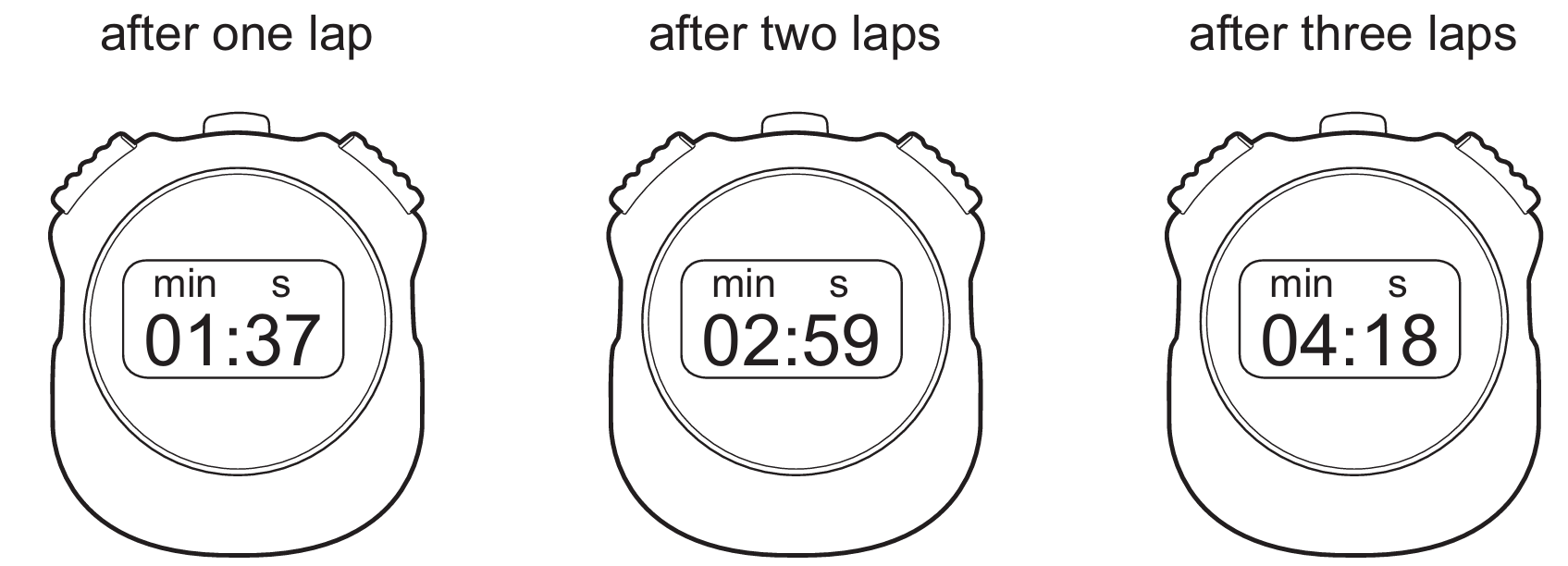
To find the duration of the third lap, subtract the total time after two laps from the total time after three laps.
The reading after two laps is $02:59$ ($2\text{ min }59\text{ s}$) and after three laps is $04:18$ ($4\text{ min }18\text{ s}$).
Convert the times to seconds: $T_{2} = (2 \times 60) + 59 = 179\text{ s}$ and $T_{3} = (4 \times 60) + 18 = 258\text{ s}$.
The time for the third lap is $\Delta t = T_{3} – T_{2} = 258\text{ s} – 179\text{ s} = 79\text{ s}$.
Converting $79\text{ s}$ back to minutes and seconds gives $1\text{ min }19\text{ s}$.
Thus, the athlete took $1\text{ min }19\text{ s}$ to complete the final lap, which corresponds to Option A.
Question 2

Most-appropriate topic codes (Cambridge IGCSE Physics 0625):
▶️ Answer/Explanation
Detailed solution:
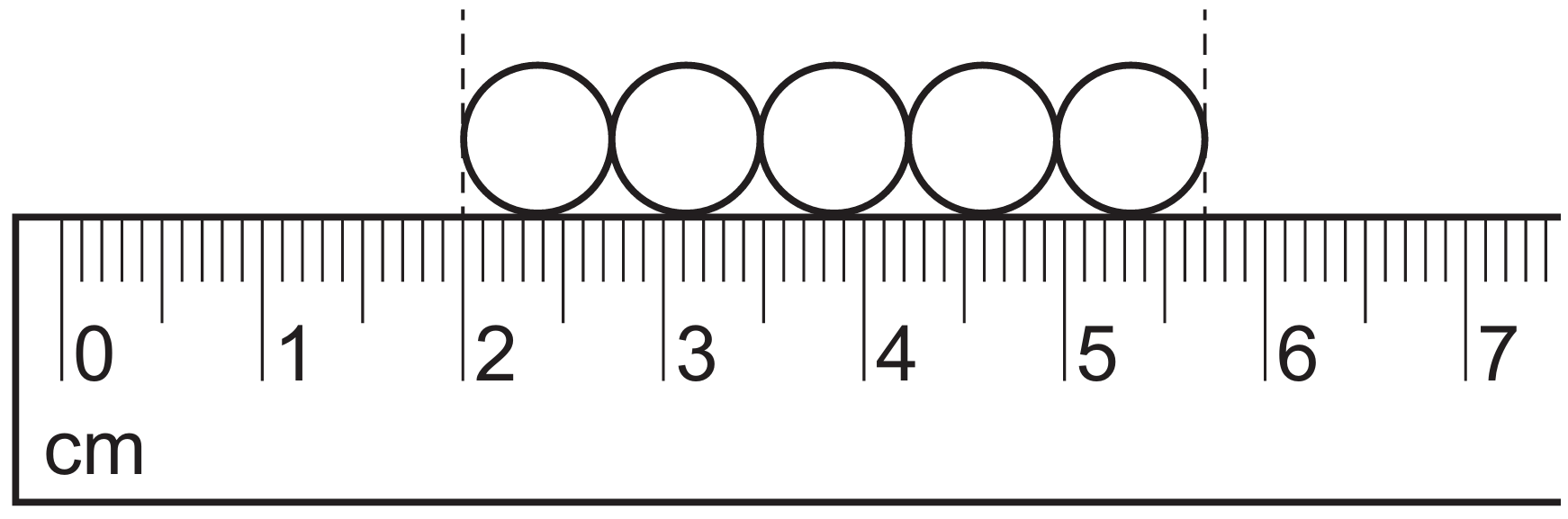
The total length of the $5$ ball-bearings is found by subtracting the initial position from the final position on the ruler.
The start of the first ball-bearing is at $2.0$ cm and the end of the fifth is at $5.7$ cm, giving a total length of $(5.7 – 2.0)$ cm.
To find the average diameter of a single ball-bearing, this total length must be divided by the number of units measured.
Since there are $5$ identical ball-bearings in the row, the calculation is $\frac{(5.7 – 2.0)}{5}$.
This method of measuring multiples improves accuracy when determining small distances like a diameter.
Question 3
Most-appropriate topic codes (Cambridge IGCSE Physics 0625):
▶️ Answer/Explanation
Detailed solution:
Acceleration is defined as the rate of change of velocity per unit time, expressed as $a = \frac{\Delta v}{\Delta t}$.
Since velocity includes both speed and direction, any change in the speed of an object results in acceleration.
Option B describes speed, not acceleration, as it refers to distance per unit time.
Option C is an incorrect physical relationship, and Option D describes weight or gravitational force ($W = mg$).
Therefore, acceleration is directly related to the changing speed (or velocity) of an object over time.
This makes statement A the only scientifically accurate description among the choices provided.
Question 4
Most-appropriate topic codes (Cambridge IGCSE Physics 0625):
▶️ Answer/Explanation
Detailed solution:
Weight is the gravitational force acting on an object and is calculated using the formula $W = m \times g$.
Given the mass $m = 6.0\text{ kg}$ and the gravitational field strength $g = 20\text{ N/kg}$.
Substituting the values: $W = 6.0\text{ kg} \times 20\text{ N/kg}$.
This gives a total weight of $120\text{ N}$.
Therefore, the object exerts a downward force of $120\text{ N}$ on the planet’s surface.
Option D is the correct numerical result of this calculation.
Question 5
Most-appropriate topic codes (Cambridge IGCSE Physics 0625):
▶️ Answer/Explanation
Detailed solution:
In physics, the Greek letter rho ($\rho$) is the standard symbol used to represent density.
Density is defined as the mass per unit volume of a substance, expressed by the formula $\rho = \frac{m}{V}$.
The other options use different symbols: momentum is typically represented by $p$, pressure by $P$ or $p$, and electrical resistance by $R$.
According to the IGCSE syllabus, candidates must recognize $\rho$ specifically for density calculations involving solids and liquids.
Therefore, option A is the only correct identification for this symbol.
Question 6
Which statement about the force exerted by the lift floor on the person’s feet is correct?
Most-appropriate topic codes (Cambridge IGCSE Physics 0625):
▶️ Answer/Explanation
Detailed solution:
The lift is moving at a constant speed, which means its acceleration $a$ is $0\text{ m/s}^{2}$.
According to Newton’s Second Law, the resultant force is $F_{net} = ma$. Since $a = 0$, the net force $F_{net}$ must also be $0\text{ N}$.
The two main forces acting on the person are their weight $W$ (downwards) and the contact force $R$ from the floor (upwards).
For the net force to be zero, these opposing forces must be perfectly balanced: $R – W = 0$.
Therefore, the upward force exerted by the lift floor $R$ is exactly equal to the person’s weight $W$.
Question 7
Most-appropriate topic codes (Cambridge IGCSE Physics 0625):
▶️ Answer/Explanation
Detailed solution:
The moment of a force is a measure of its turning effect about a pivot.
It is defined mathematically as $\text{moment} = \text{force} \times \text{perpendicular distance from the pivot}$.
In the SI system, the unit for force is the Newton ($\text{N}$) and the unit for distance is the metre ($\text{m}$).
By multiplying these two quantities, the resulting unit for the moment is the Newton-metre, expressed as $\text{Nm}$.
Option A represents force, Option B represents gravitational field strength, and Option C is the unit for a spring constant.
Therefore, Option D is the only correct unit for the moment of a force.
Question 8
Most-appropriate topic codes (Cambridge IGCSE Physics 0625):
▶️ Answer/Explanation
Detailed solution:
According to the principle of conservation of energy, the total energy in a system remains constant.
The initial gravitational potential energy ($\Delta E_{p} = 46 \text{ J}$) is transferred as the stone falls.
Part of this energy is used to do work against air resistance ($W = 21 \text{ J}$), which is dissipated as thermal energy.
The remaining energy is converted into the stone’s kinetic energy gain ($\Delta E_{k}$).
Using the equation: $\Delta E_{p} = \Delta E_{k} + W$, we find $\Delta E_{k} = 46 \text{ J} – 21 \text{ J}$.
Therefore, the gain in kinetic energy is $25 \text{ J}$.
Question 9
Most-appropriate topic codes (Cambridge IGCSE Physics 0625):
▶️ Answer/Explanation
Detailed solution:
Work is defined as the process of shifting energy from one store to another through the application of a force.
The relationship between mechanical work and energy is given by the equation $W = Fd = \Delta E$.
In this expression, $W$ represents the work done, which is numerically equal to the amount of energy transferred, $\Delta E$.
While force ($F$) and distance ($d$) are required to perform work, they are not the quantities being “transferred” between systems.
Temperature is a measure of average kinetic energy but is not the quantity transferred by the definition of work.
Therefore, energy is the correct physical quantity that is transferred during the performance of work.
Question 10
Most-appropriate topic codes (Cambridge IGCSE Physics 0625):
▶️ Answer/Explanation
Detailed solution:
Pressure is defined as the force acting per unit area, expressed by the formula $p = \frac{F}{A}$.
In the SI system, the unit for force ($F$) is the Newton ($N$) and the unit for area ($A$) is the square metre ($m^{2}$).
Substituting these units into the formula gives $N/m^{2}$, which is also known as the Pascal ($Pa$).
Option B ($kg/m^{3}$) represents density, while Option C ($Nm$) represents the moment of a force or work done.
Therefore, $N/m^{2}$ is the only correct unit for pressure among the choices provided.
Question 11
How does the mass and volume of the steam produced compare with the mass and volume of the water that is lost through boiling?

Most-appropriate topic codes (Cambridge IGCSE Physics 0625):
▶️ Answer/Explanation
Detailed solution:
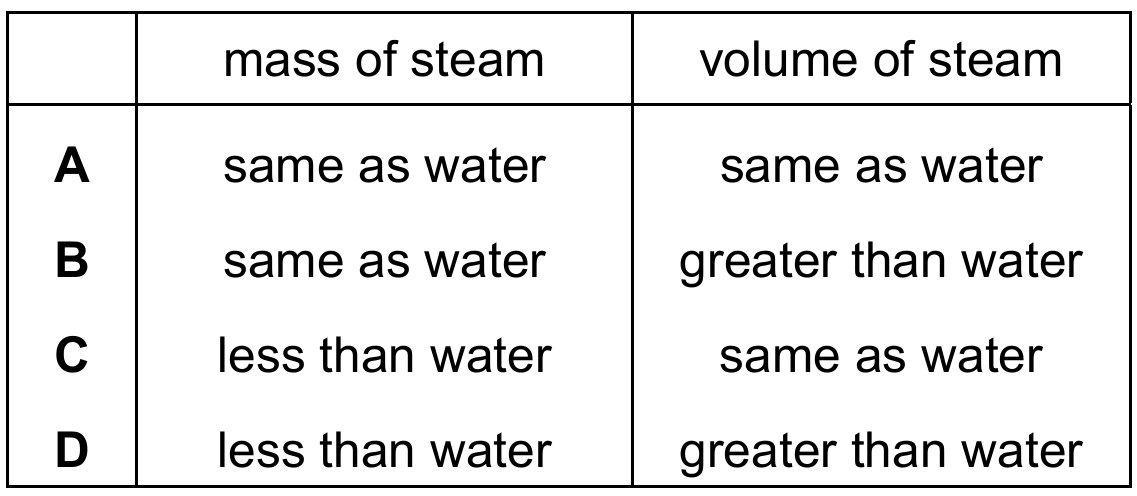
When water boils at 100 °C, it undergoes a phase change from liquid to gas (steam). According to the law of conservation of mass, the mass of the steam produced must be the same as the mass of the water lost. However, in the gaseous state, particles have much larger separation than in the liquid state. This results in a significantly lower density and a greater volume for the same mass of substance. Therefore, the steam occupies more space than the liquid water it came from, making Row B the correct choice.
Question 12

Most-appropriate topic codes (Cambridge IGCSE Physics 0625):
▶️ Answer/Explanation
Detailed solution:
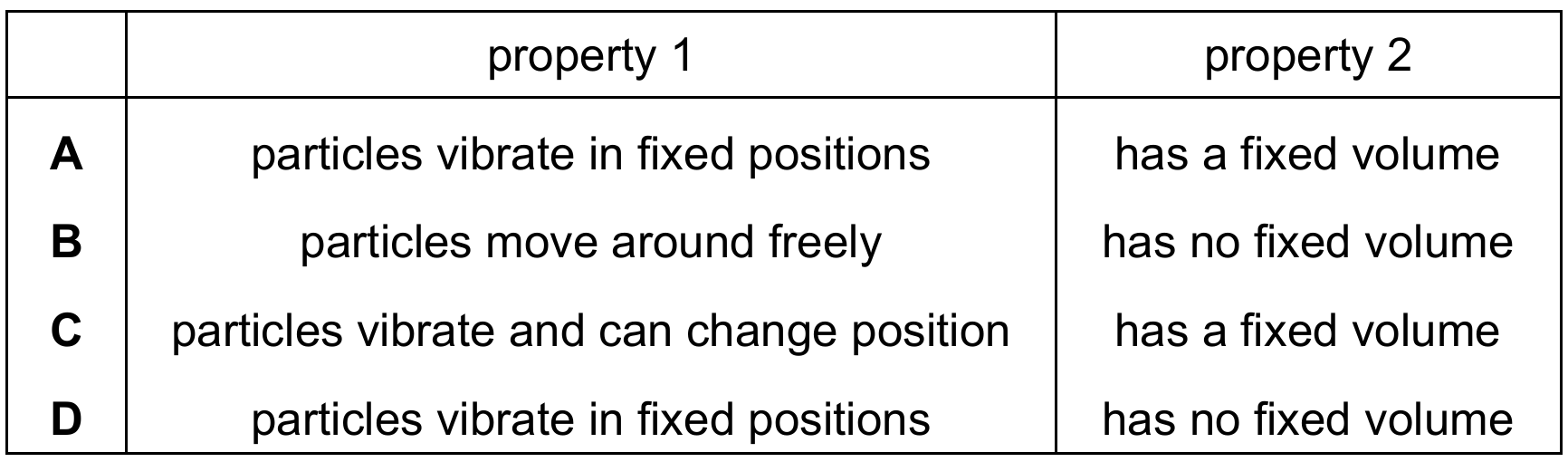
In a solid, particles are packed closely together in a regular lattice arrangement held by strong intermolecular forces.
Because of this rigid structure, the particles cannot move from place to place; they only vibrate in fixed positions.
This lack of particle mobility ensures that a solid maintains a fixed volume and a definite shape under constant conditions.
Option B describes a gas, while Option C describes a liquid where particles can slide past one another.
Option D is contradictory because a fixed particle arrangement prevents a substance from having “no fixed volume”.
Therefore, Row A accurately identifies both the microscopic and macroscopic properties of a solid.
Question 13

Most-appropriate topic codes (Cambridge IGCSE Physics 0625):
▶️ Answer/Explanation
Detailed solution:
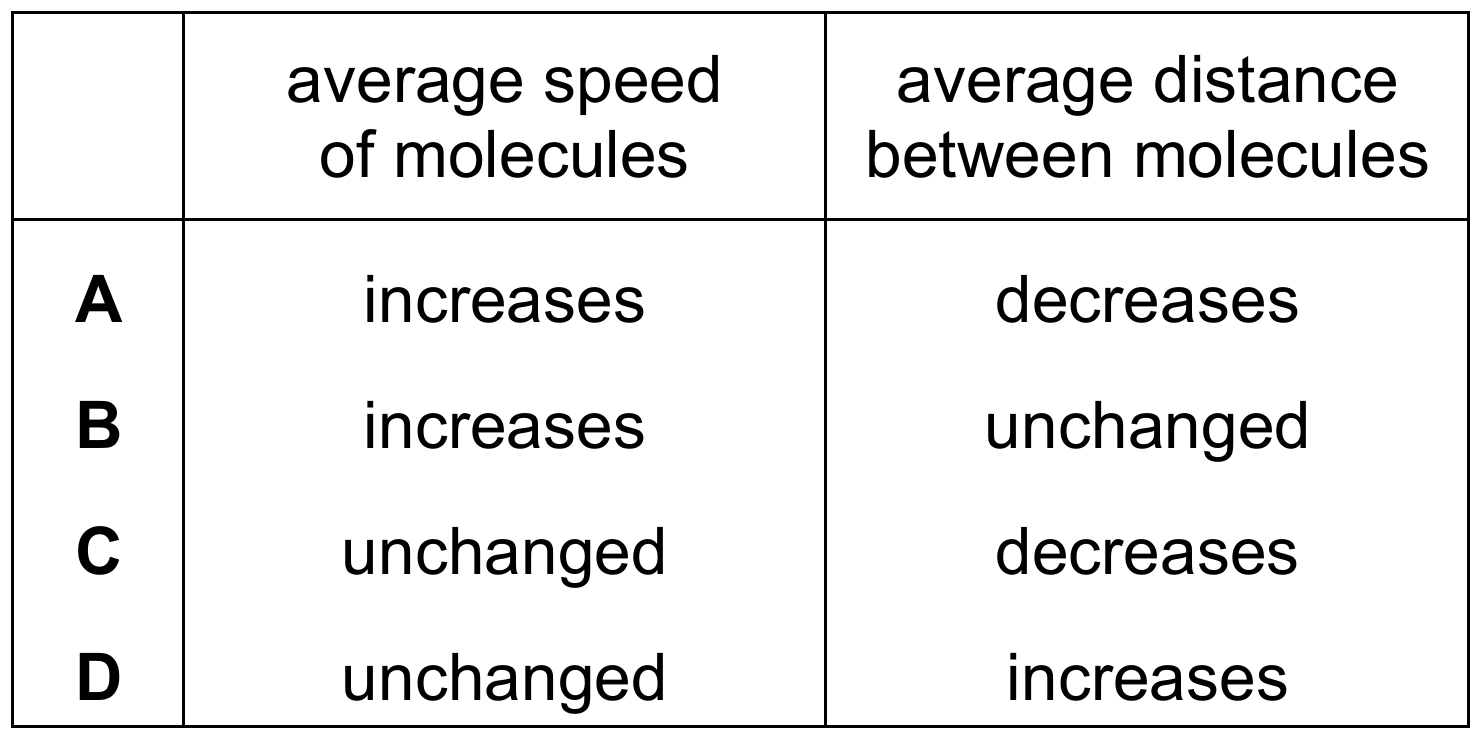
The average speed of gas molecules is directly proportional to the absolute temperature $T$. Since the problem states the temperature stays the same, the average kinetic energy $\frac{1}{2}mv^{2}$ and the average speed remain unchanged.
When the piston is pushed inwards, the volume $V$ of the trapped air reduces. Because the same number of molecules now occupies a smaller space, the molecules are packed more closely together.
Consequently, the average distance between the air molecules must decrease.
This corresponds to the description provided in Row C.
Question 14

Most-appropriate topic codes (Cambridge IGCSE Physics 0625):
▶️ Answer/Explanation
Detailed solution:
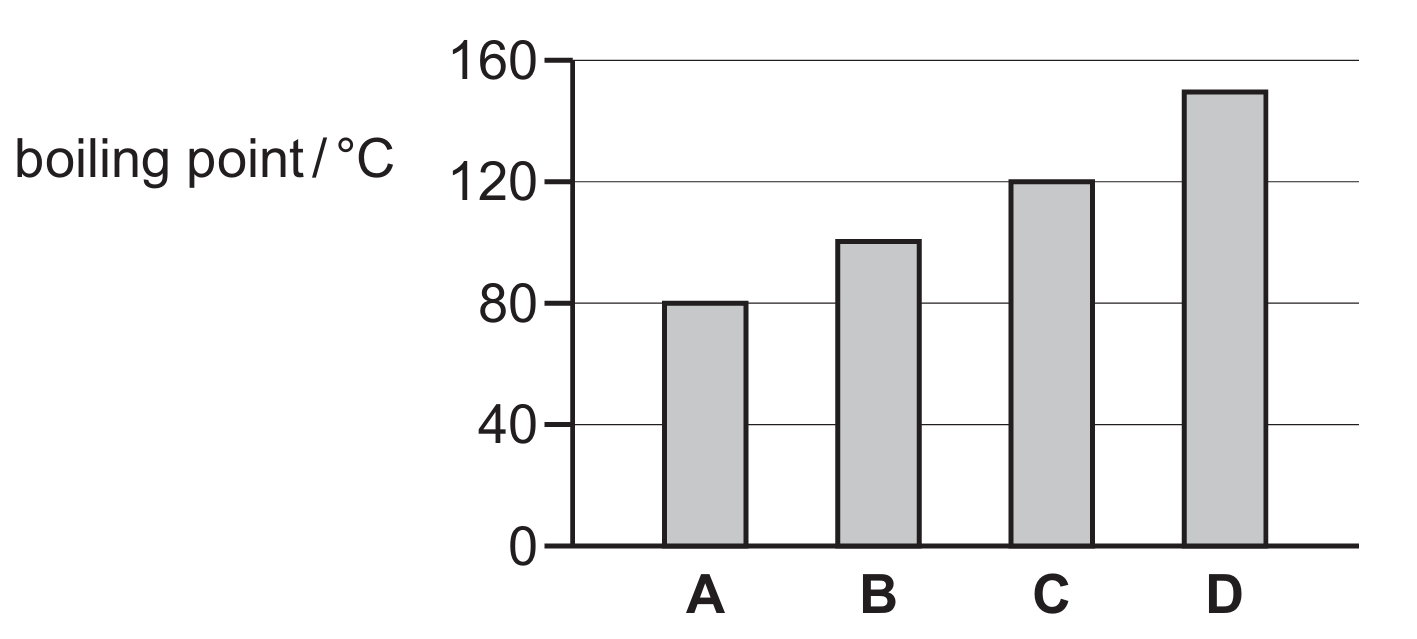
The boiling point of pure water at standard atmospheric pressure is exactly $100^{\circ}C$.
Looking at the provided bar chart, the y-axis represents the boiling point in $^{\circ}C$ with markings at intervals of $40$.
Liquid A shows a boiling point of $80^{\circ}C$, which is below the required value for water.
Liquid B corresponds to the $100^{\circ}C$ mark, as it sits exactly halfway between $80^{\circ}C$ and $120^{\circ}C$.
Liquids C and D have boiling points of $120^{\circ}C$ and approximately $150^{\circ}C$ respectively.
Since only Liquid B aligns with the known physical constant for water, it is the correct choice.
Question 15

Most-appropriate topic codes (Cambridge IGCSE Physics 0625):
▶️ Answer/Explanation
Detailed solution:
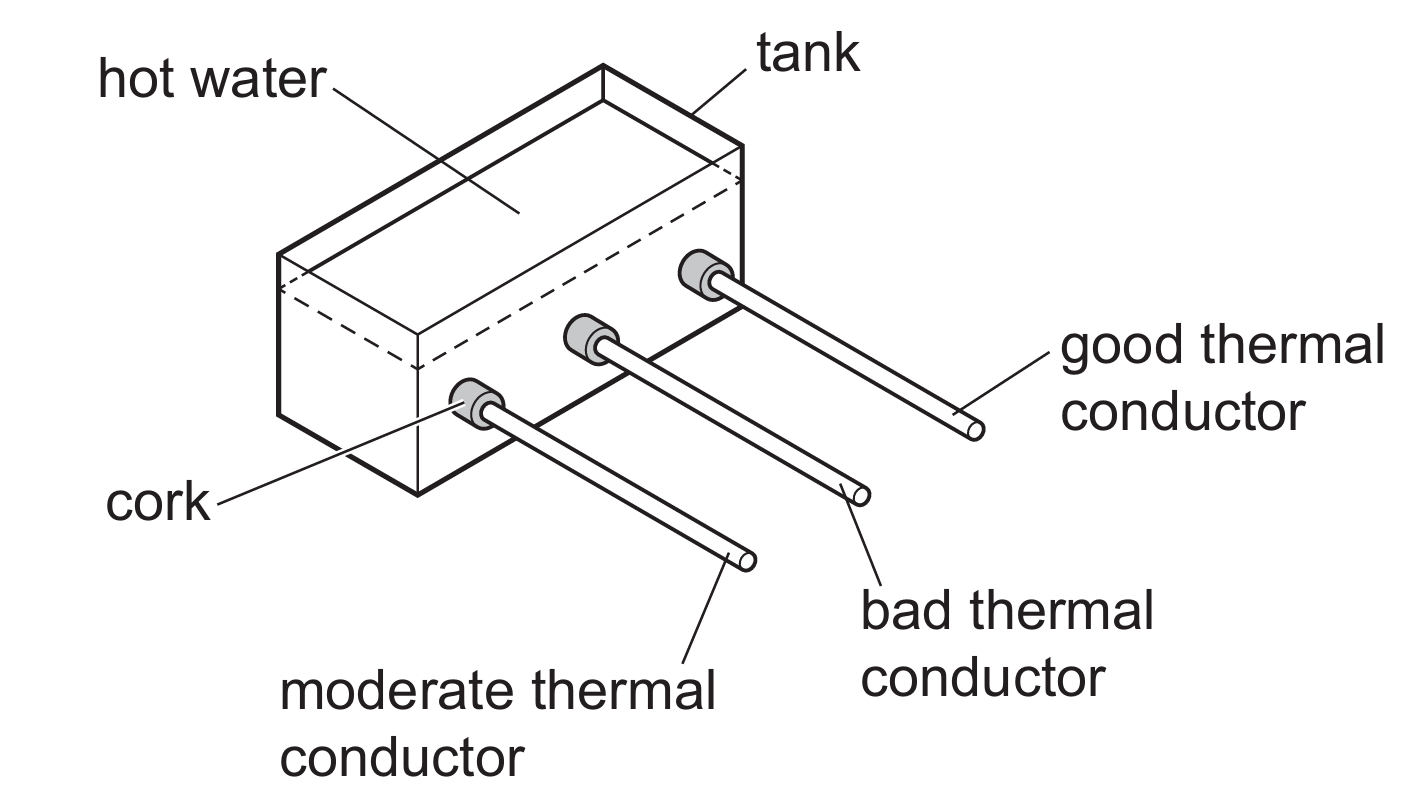
Thermal conduction is the process where thermal energy is transferred through a medium via particle vibrations and electron movement.
A “good thermal conductor” has a high rate of thermal energy transfer, meaning heat travels through it much faster than through other materials.
Since all rods are the same size and submerged in the same hot water, the rod with the highest conductivity will reach the wax’s melting point temperature first.
The “bad thermal conductor” (insulator) resists heat flow, while the “moderate” conductor transfers it at a medium pace.
Therefore, the wax on the good thermal conductor will receive enough energy to melt before the others.
Question 16
Most-appropriate topic codes (Cambridge IGCSE Physics 0625):
▶️ Answer/Explanation
Detailed solution:
When a region of a liquid is heated, its particles move faster and spread further apart, causing the volume to increase.
Since $\text{density} = \frac{m}{V}$, an increase in volume leads to a decrease in density for that portion of the fluid.
This less dense, buoyant liquid rises upward, while cooler, denser liquid sinks to take its place, creating a circulation movement.
This specific process of heat transfer through the bulk movement of molecules in fluids is known as convection.
Options A and D refer to transfer via lattice vibrations/electrons or electromagnetic waves, which do not rely on density-driven fluid motion.
Question 17
Most-appropriate topic codes (Cambridge IGCSE Physics 0625):
▶️ Answer/Explanation
Detailed solution:
The ability of a surface to reflect infrared radiation depends on its color and texture.
Light-colored surfaces, such as white, are better reflectors than dark-colored surfaces like black, which tend to absorb radiation.
Smooth, shiny surfaces reflect significantly more radiation than rough, dull surfaces.
Therefore, a surface that is both shiny and white provides the maximum reflective efficiency.
In contrast, a dull black surface would be the best absorber and the worst reflector.
Consequently, option D is the correct choice as it combines the two best reflective characteristics.
Question 18

Most-appropriate topic codes (Cambridge IGCSE Physics 0625):
▶️ Answer/Explanation
Detailed solution:
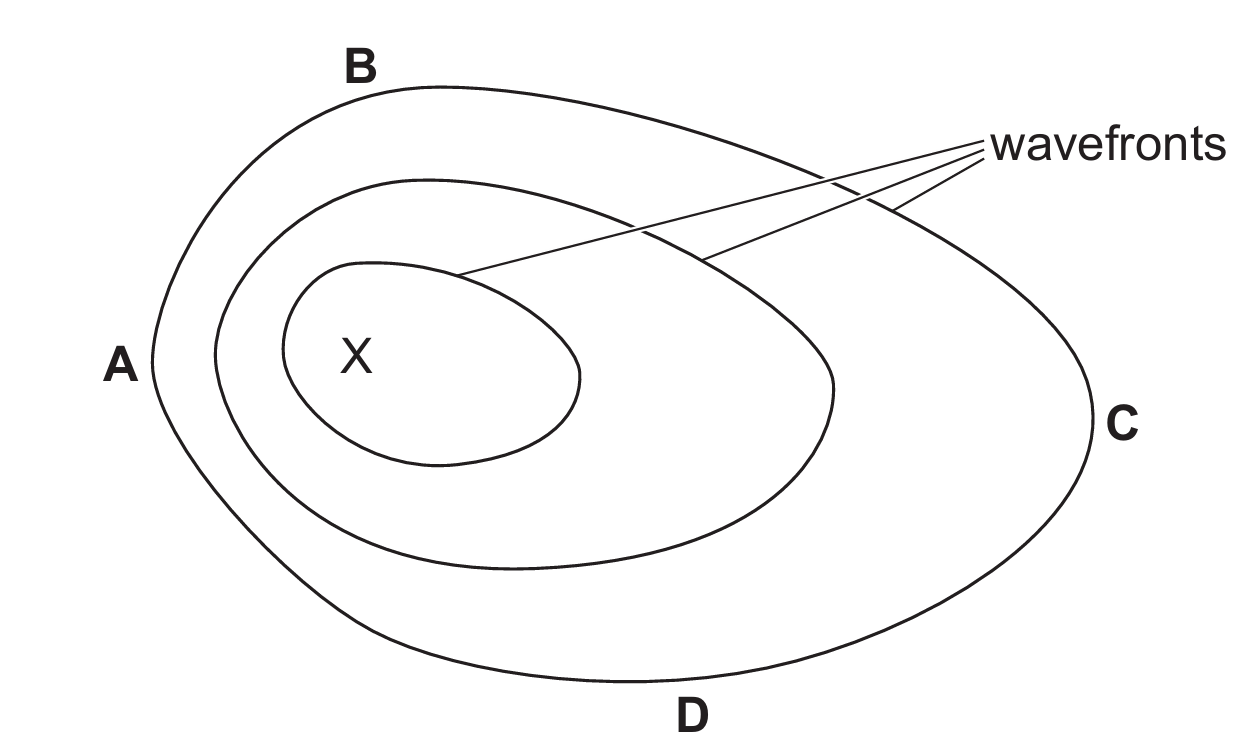
The speed of a wave is defined as the distance a wavefront travels per unit time, $v = \frac{d}{t}$.
According to the question, water waves travel faster in deeper water and slower in shallower water.
In the provided diagram, the wavefronts have moved the greatest distance from the source $X$ toward point $C$ in the same amount of time.
This indicates that the wave speed $v$ is highest in the direction of $C$, implying the water is deepest there.
Conversely, the wavefronts are closest together toward $A$, representing the slowest speed and shallowest region.
Therefore, the region between $X$ and $C$ is likely to be the deepest part of the pool.
Question 19

Most-appropriate topic codes (Cambridge IGCSE Physics 0625):
▶️ Answer/Explanation
Detailed solution:
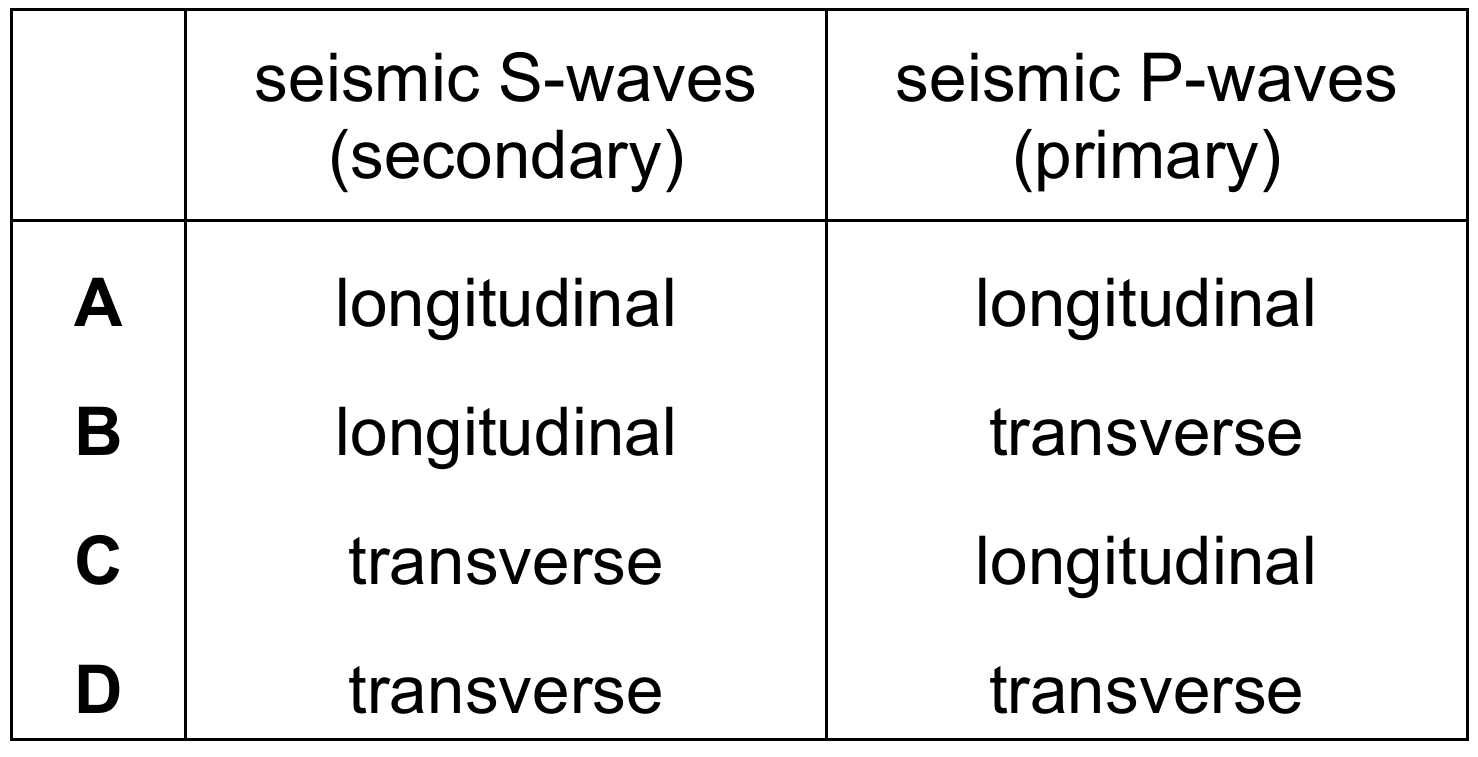
Seismic waves are categorized based on their particle vibration relative to the direction of energy propagation.
Seismic $S$-waves (secondary) are transverse waves, meaning vibrations occur at $90^{\circ}$ to the direction of travel.
Seismic $P$-waves (primary) are longitudinal waves, where vibrations are parallel to the direction of propagation.
According to the syllabus, $S$-waves are modelled as transverse and $P$-waves as longitudinal.
Comparing these classifications to the table, Row $C$ correctly identifies both wave types.
Therefore, Option $C$ is the only row that accurately defines the nature of these seismic waves.
Question 20
Most-appropriate topic codes (Cambridge IGCSE Physics 0625):
▶️ Answer/Explanation
Detailed solution:
According to the law of reflection, the angle of incidence $i$ is equal to the angle of reflection $r$, so $i = r$.
The total angle between the incident ray and the reflected ray is the sum of these two angles: $i + r = 68^{\circ}$.
Substituting $r$ with $i$, we get $i + i = 68^{\circ}$, which simplifies to $2i = 68^{\circ}$.
Dividing by $2$, the angle of incidence is $i = \frac{68^{\circ}}{2} = 34^{\circ}$.
Therefore, the correct angle of incidence relative to the normal is $34^{\circ}$.
Question 21

Most-appropriate topic codes (Cambridge IGCSE Physics 0625):
▶️ Answer/Explanation
Detailed solution:
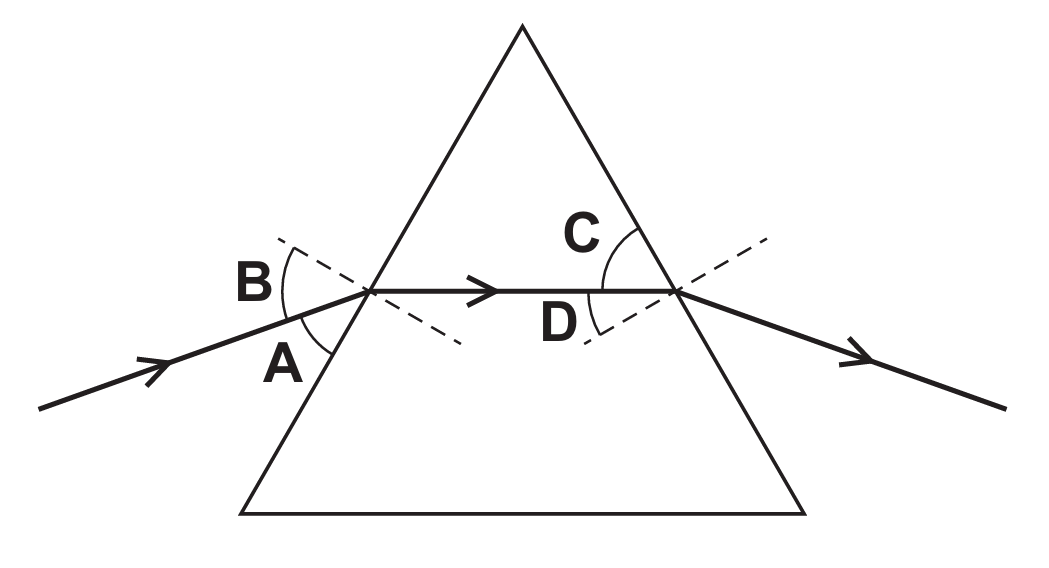
Total internal reflection (TIR) can only occur when light travels from an optically denser medium to a less dense medium.
The critical angle $c$ is defined as the angle of incidence in the denser medium for which the angle of refraction is $90^{\circ}$.
In the provided diagram, the ray moves from the glass prism into the air at the second surface.
The angle of incidence is the angle between the incident ray and the normal inside the denser medium.
Angle $D$ is the angle of incidence at the boundary where the ray is attempting to exit the prism.
When TIR “just occurs,” the angle of incidence $i$ must be exactly equal to the critical angle, so $D = c$.
Angles $A$ and $B$ are at the first surface where light enters the prism, so TIR cannot occur there.
Question 22

Most-appropriate topic codes (Cambridge IGCSE Physics 0625):
▶️ Answer/Explanation
Detailed solution:
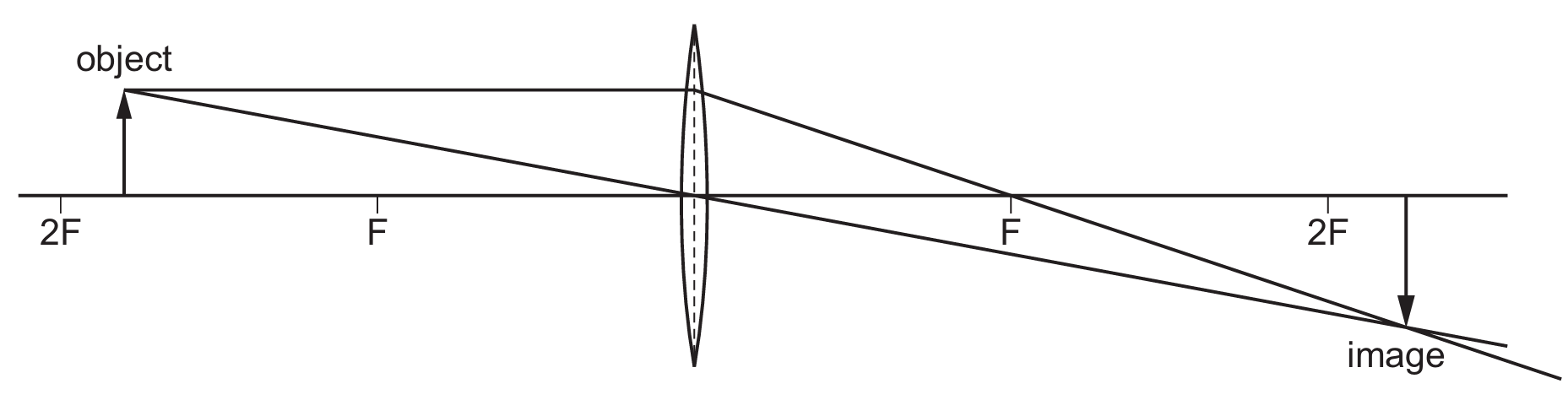
The ray diagram shows the object placed between $F$ and $2F$ from a converging lens. When an object is in this position, the rays converge on the opposite side beyond $2F$ to form a real image. Observing the diagram, the image arrow points downwards, indicating it is inverted. Comparing heights, the image is clearly larger than the object, meaning it is enlarged ($M > 1$). Therefore, the image is both enlarged and inverted, making option A correct.
Question 23
Most-appropriate topic codes (Cambridge IGCSE Physics 0625):
▶️ Answer/Explanation
Detailed solution:
The visible spectrum consists of seven main colours, often remembered by the acronym $ROYGBIV$.
In order of increasing wavelength (from shortest to longest), the sequence is: Violet, Indigo, Blue, Green, Yellow, Orange, and Red.
Conversely, this means Red has the longest wavelength and Violet has the shortest wavelength in the visible range.
Option A follows this sequence correctly: Green is followed by Yellow, then Orange, and finally Red.
Options B, C, and D are incorrect as they do not follow the $V \rightarrow I \rightarrow B \rightarrow G \rightarrow Y \rightarrow O \rightarrow R$ progression for increasing wavelength.
Question 24
Which parts of the electromagnetic spectrum complete the list of applications?
Mobile phones use ……1…… .
Security scanners use ……2…… .
Intruder alarms use ……3…… .

Most-appropriate topic codes (Cambridge IGCSE Physics 0625):
▶️ Answer/Explanation
Detailed solution:
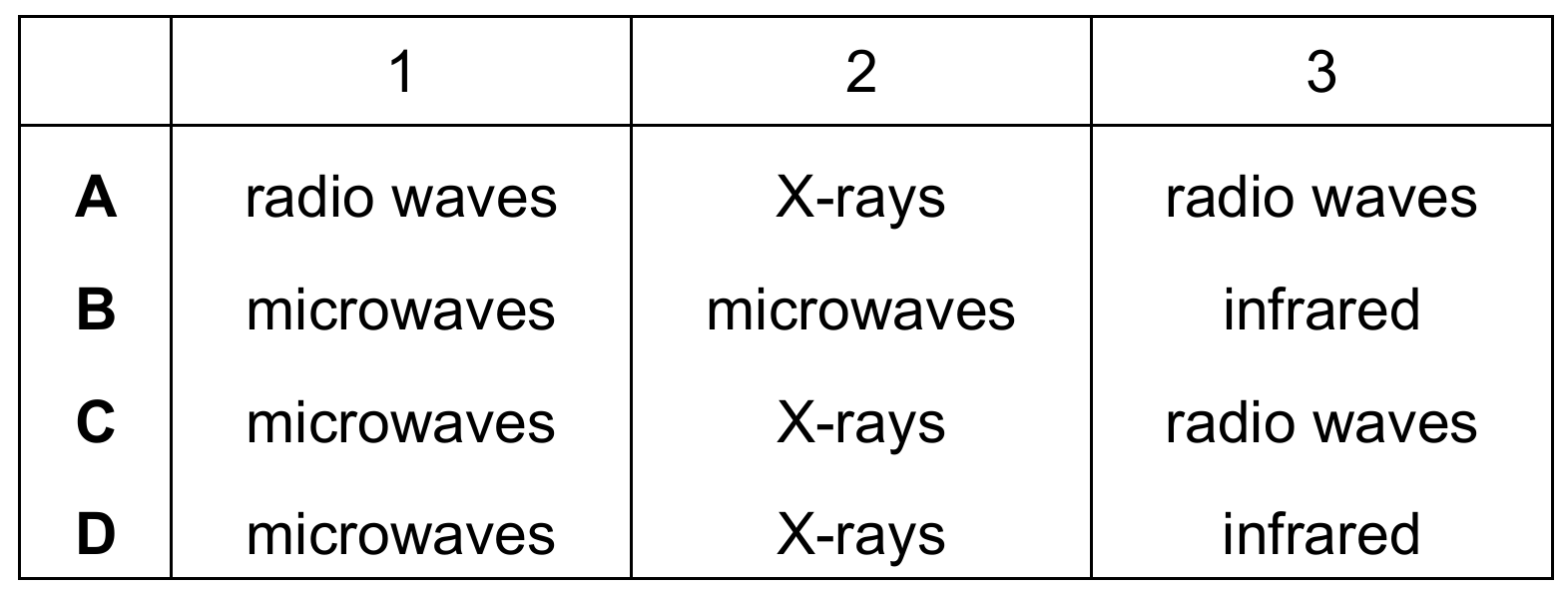
Mobile phones primarily use microwaves for communication because they can penetrate certain obstacles and require only short aerials for transmission.
Security scanners, particularly those used in airports for baggage or medical scanning, utilize $X-rays$ due to their high penetrative ability through solid objects.
Intruder alarms often rely on passive infrared sensors that detect the $infrared$ radiation (thermal energy) emitted by human bodies.
According to the syllabus, microwaves correspond to application $1$, $X-rays$ to application $2$, and infrared to application $3$.
Matching these specific requirements to the provided table, Row D is the only option that correctly identifies all three electromagnetic regions.
Therefore, the correct sequence of waves for the given list is microwaves, $X-rays$, and infrared.
Question 25
Most-appropriate topic codes (Cambridge IGCSE Physics 0625):
▶️ Answer/Explanation
Detailed solution:
Sound waves are longitudinal waves that propagate through the vibration of particles in a medium.
Because sound relies on these particle-to-particle interactions, it requires a physical medium—solid, liquid, or gas—to travel.
In a vacuum, there are no particles present to vibrate and transmit the energy of the sound wave.
Options A, B, and D contain air, carbon dioxide, and water respectively, all of which act as mediums for sound.
Since a vacuum lacks any matter, the sound from the loudspeaker cannot be transmitted to the student’s ears.
Therefore, the student will not hear a sound from the jar containing a vacuum.
Question 26

Most-appropriate topic codes (Cambridge IGCSE Physics 0625):
▶️ Answer/Explanation
Detailed solution:
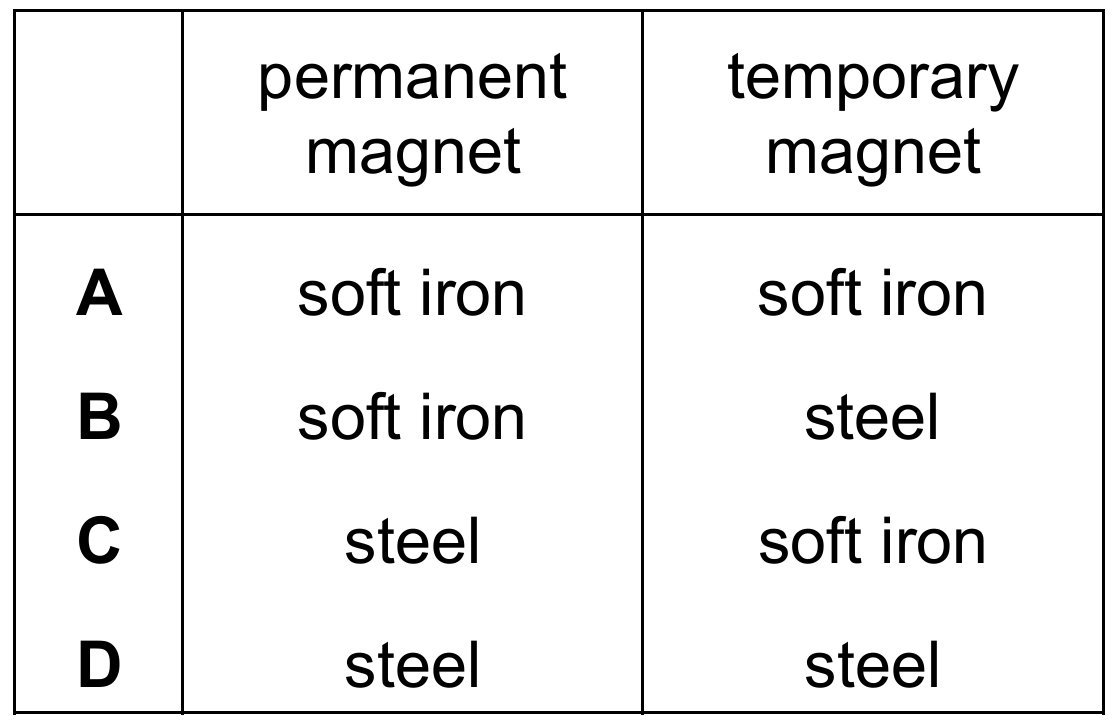
Magnetic materials are classified by how easily they can be magnetized and demagnetized. Steel is a “hard” magnetic material; it is difficult to magnetize but retains its magnetism well, making it ideal for permanent magnets. Soft iron is a “soft” magnetic material; it magnetizes easily but loses its magnetism almost immediately when the external magnetic field is removed. This property makes soft iron the standard choice for temporary magnets, such as the cores of electromagnets. Therefore, Row $C$ correctly identifies that permanent magnets are made of steel and temporary magnets are made of soft iron.
Question 27
Most-appropriate topic codes (Cambridge IGCSE Physics 0625):
▶️ Answer/Explanation
Detailed solution:
When the negatively charged rod is brought near the sphere, it repels the free electrons to the far side of the metal. These electrons carry a negative charge of $-e$.
Upon earthing, these repelled electrons find a path to leave the sphere and move toward the ground.
It is important to note that in solids, only negative charges (electrons) are mobile; the positive protons remain fixed in the lattice.
Consequently, the flow consists of electrons moving from the sphere to the earth, leaving the sphere with a net positive charge.
Options C and D are incorrect because positive charges do not flow in metallic conductors.
Thus, Option A correctly describes the physical process of electrostatic induction and earthing.
Question 28
Most-appropriate topic codes (Cambridge IGCSE Physics 0625):
▶️ Answer/Explanation
Detailed solution:
Direct current ($d.c.$) is defined as an electric current that flows consistently in a single direction through a circuit.
In contrast, alternating current ($a.c.$) involves charges that periodically reverse their direction of flow.
While a cell provides $d.c.$, the definition of the current itself refers to the unidirectional movement of charge carriers.
Option $A$ and $B$ describe behaviors inconsistent with $d.c.$, and option $D$ is a specific case rather than a general definition.
Therefore, statement $C$ correctly identifies the fundamental characteristic of direct current.
Question 29
Which word completes the sentence?
Most-appropriate topic codes (Cambridge IGCSE Physics 0625):
▶️ Answer/Explanation
Detailed solution:
Potential difference ($V$) measures the energy transferred per unit charge as it moves between two points in a circuit.
Mathematically, it is defined by the equation $V = \frac{W}{Q}$, where $W$ is the work done and $Q$ is the charge.
In the context of circuits, this work refers specifically to the electrical work done by the charge passing through a component.
Magnetic, mechanical, and thermal energies are other forms of energy but do not define the unit of p.d.
Therefore, the term “electrical” correctly completes the technical definition of potential difference.
This aligns with the syllabus requirement to define p.d. as the work done by a unit charge.
Question 30
Most-appropriate topic codes (Cambridge IGCSE Physics 0625):
▶️ Answer/Explanation
Detailed solution:
Electrical power $P$ is defined as the rate at which energy is transferred, given by $P = IV$.
Energy transferred $E$ is the product of power and the time $t$ for which the current flows, expressed as $E = P \times t$.
By substituting the expression for power into the energy equation, we derive $E = (IV) \times t$.
Therefore, the total energy transferred by the resistor is $E = IVt$.
This matches option D, while the other options represent incorrect algebraic arrangements of these variables.
Question 31

Most-appropriate topic codes (Cambridge IGCSE Physics 0625):
▶️ Answer/Explanation
Detailed solution:
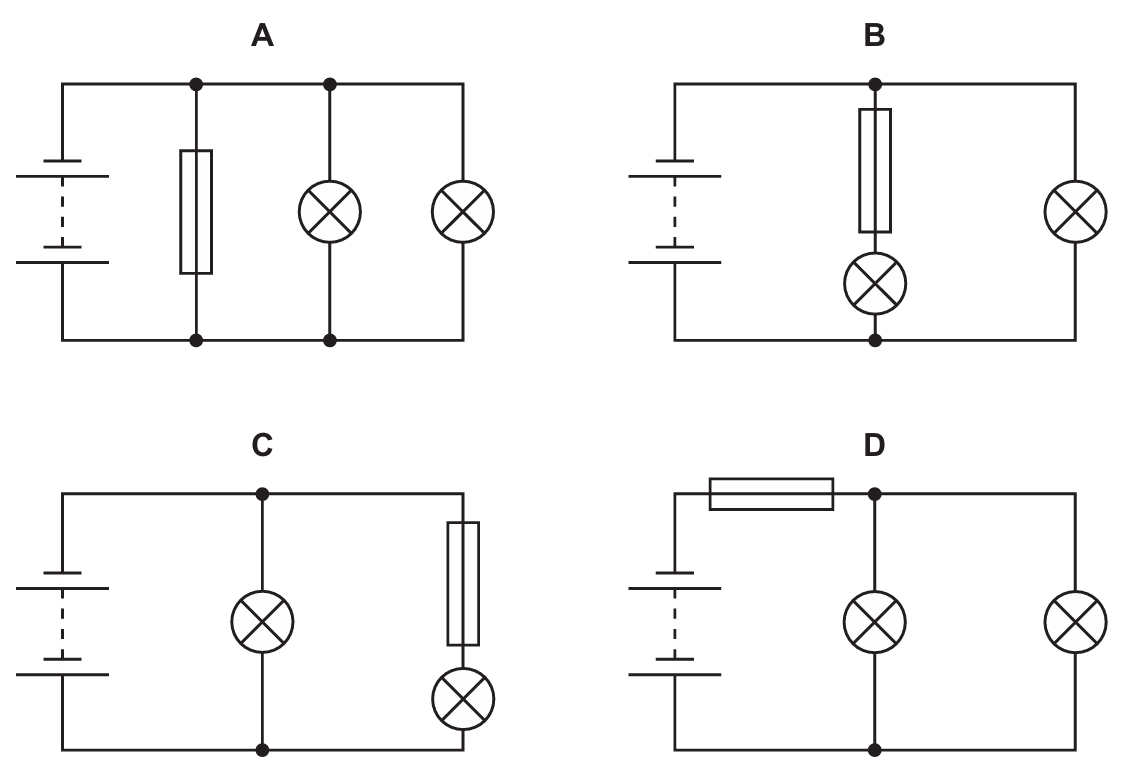
A fuse is a safety device designed to break the circuit by melting when the current exceeds a specific limit. For a fuse to cause all components in a circuit to turn off, it must be placed in the main branch where the total current $I_{total}$ flows. In circuits A, B, and C, the fuse is placed in parallel branches; if it blows, current can still flow through the other available paths to the remaining lamps. In circuit D, the fuse is connected in series with the battery before the parallel junction. If this fuse blows, it creates an open circuit, meaning $I = 0~A$ throughout the entire system, causing both lamps to go out immediately.
Question 32
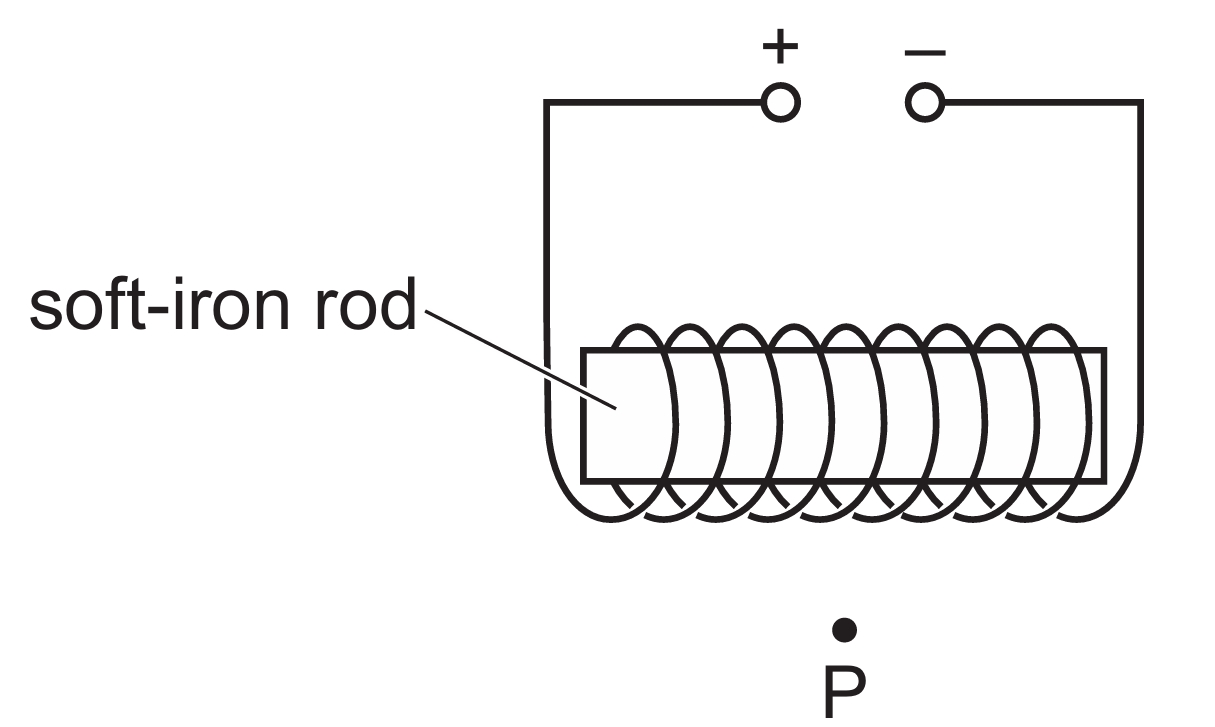
The diagram shows a coil of insulated wire wrapped around a soft-iron rod.
The wire is connected to a d.c. power supply as indicated.
The apparatus is in a region which is totally shielded from the Earth’s magnetic field.

A small compass needle is placed at point P.
In which direction does the N pole of the compass needle point?
Most-appropriate topic codes (Cambridge IGCSE Physics 0625):
▶️ Answer/Explanation
Detailed solution:
Using the right-hand grip rule, current flows from the positive $(+)$ to negative $(-)$ terminal, moving upward across the front of the soft-iron rod. Wrapping your fingers in the direction of the current, your thumb points left, identifying the left end as the North $(N)$ pole and the right end as the South $(S)$ pole. Magnetic field lines emerge from the $N$ pole and return to the $S$ pole outside the solenoid. At point $P$ (located below the solenoid), the field lines travel from left to right as they return to the $S$ pole. Since a compass $N$ pole points in the direction of the local magnetic field, it will point towards the right of the page.
Question 33
Most-appropriate topic codes (Cambridge IGCSE Physics 0625):
▶️ Answer/Explanation
Detailed solution:
An efficient transformer requires high electrical conductivity in the coils and high magnetic permeability in the core.
Copper is used for the coils because it has very low electrical resistance, minimizing energy loss as heat ($P = I^{2}R$).
The core must be made of a soft magnetic material, such as iron, to easily concentrate and link the magnetic flux between the primary and secondary coils.
Copper is non-magnetic and cannot serve as a transformer core, while iron wires would have too much resistance compared to copper.
Thus, the standard construction uses insulated copper wire coils wound around a soft-iron core.
This ensures maximum efficiency during the voltage transformation process described by $\frac{V_{p}}{V_{s}} = \frac{N_{p}}{N_{s}}$.
Question 34
What does the nucleus of one atom of this isotope contain?

Most-appropriate topic codes (Cambridge IGCSE Physics 0625):
▶️ Answer/Explanation
Detailed solution:
In the nuclide notation ${}_{Z}^{A}\text{X}$, the lower number $Z$ represents the proton number (atomic number).
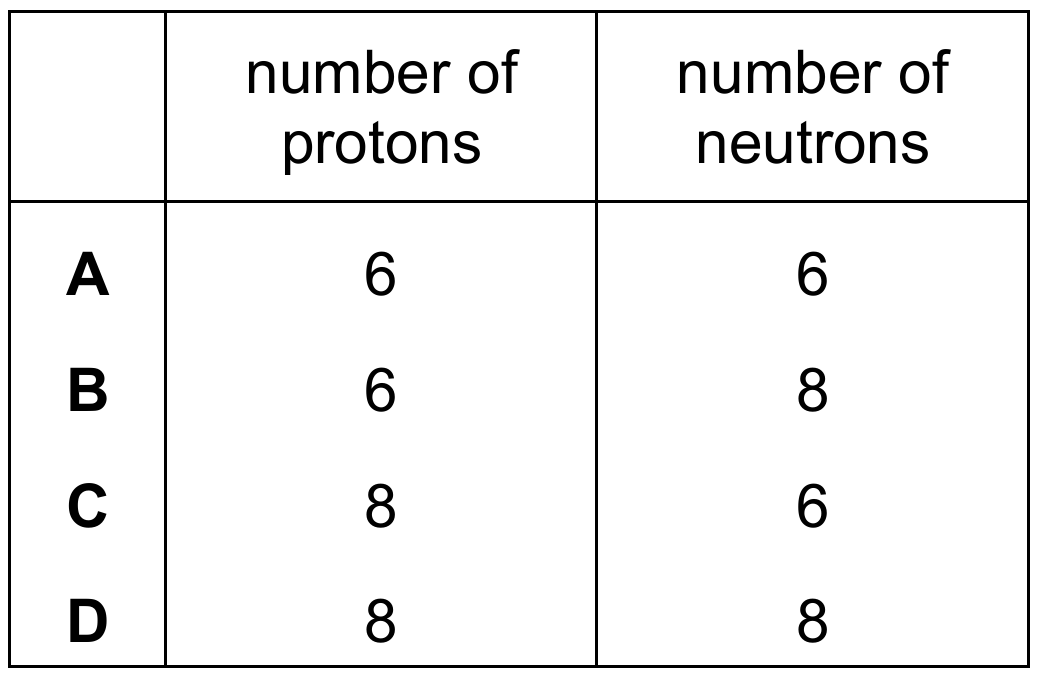
For ${}_{6}^{14}\text{C}$, the number of protons is $Z = 6$.
The upper number $A$ represents the nucleon number (mass number), which is the sum of protons and neutrons ($A = Z + N$).
To find the number of neutrons $N$, we subtract the proton number from the nucleon number: $N = A – Z$.
Calculating for this isotope: $14 – 6 = 8$ neutrons.
Thus, the nucleus contains $6$ protons and $8$ neutrons, matching the values provided in Row B.
Question 35
Most-appropriate topic codes (Cambridge IGCSE Physics 0625):
▶️ Answer/Explanation
Detailed solution:
Background radiation refers to the ionizing radiation present in the environment from natural and artificial sources.
Radon gas is a natural source that emits $\alpha$-particles as it decays in the air.
Space is a major source of cosmic rays, which include high-energy $\gamma$ radiation and other particles entering Earth’s atmosphere.
Infrared radiation and microwaves are part of the electromagnetic spectrum but are non-ionizing and do not constitute nuclear background radiation.
Medical $X$-rays are ionizing but are typically considered artificial exposure rather than constant environmental background.
Therefore, Option A is the only choice containing exclusively nuclear, ionizing background sources.
Question 36
Most-appropriate topic codes (Cambridge IGCSE Physics 0625):
▶️ Answer/Explanation
Detailed solution:
Beta-particles ($\beta^{-}$) are high-speed electrons emitted from the nucleus, not electromagnetic waves like gamma rays or X-rays.
They possess a relative charge of $-1$, making statement D correct, and they are highly ionising, making statement B correct.
During $\beta$-decay, a neutron changes into a proton ($n \to p + e^{-}$), which increases the proton number $Z$ by $1$.
Because the proton number defines the identity of an atom, the strontium-89 changes into a different element, making statement C correct.
Therefore, statement A is the only incorrect claim, as beta radiation consists of particles with mass and charge, not electromagnetic radiation.
Question 37
An isotope of strontium decays by $\beta$ emission. It takes $87$ hours for its activity to fall to $\frac{1}{8}$ of its original value.
What is the half-life of the isotope?
Most-appropriate topic codes (Cambridge IGCSE Physics 0625):
▶️ Answer/Explanation
Detailed solution:
The activity falls to $\frac{1}{8}$ of its original value. Since $(\frac{1}{2})^{3} = \frac{1}{8}$, this represents exactly $3$ half-lives.
The total time taken for this decay is given as $T_{total} = 87$ hours.
To find the duration of one half-life ($t_{1/2}$), we divide the total time by the number of half-lives: $t_{1/2} = \frac{87}{3}$.
Performing the calculation gives $t_{1/2} = 29$ hours.
Therefore, the half-life of the strontium isotope is $29$ hours, which matches option B.
Question 38
Most-appropriate topic codes (Cambridge IGCSE Physics 0625):
▶️ Answer/Explanation
Detailed solution:
The Moon does not produce its own light; it is visible because it reflects light from the Sun.
As the Moon orbits the Earth, its position relative to the Sun and Earth changes constantly.
This orbital motion takes approximately $1$ month to complete a full cycle.
Consequently, the fraction of the Moon’s illuminated half that we can see from Earth varies.
These changing views of the illuminated portion are known as the phases of the Moon.
Therefore, the phases are directly caused by the Moon orbiting the Earth.
Question 39
Most-appropriate topic codes (Cambridge IGCSE Physics 0625):
▶️ Answer/Explanation
Detailed solution:
The Sun emits a broad spectrum of electromagnetic radiation, but the majority of the energy reaching Earth’s surface is concentrated in specific bands.
According to the syllabus, the Sun radiates most of its energy in the infrared, visible light, and ultraviolet regions of the spectrum.
High-energy radiation like $X-rays$ and $gamma$ rays are emitted in much smaller quantities and are largely filtered by the atmosphere.
Conversely, longer wavelengths like $microwaves$ contribute a negligible fraction of the total solar irradiance received.
Therefore, the combination of ultraviolet, visible, and infrared represents the primary regions of received solar radiation.
This matches the information provided in Option C.
Question 40
Light received from distant galaxies is observed to have a longer wavelength than the light originally emitted. This is called redshift.
Which conclusion do astronomers form about distant galaxies from this observation?
Most-appropriate topic codes (Cambridge IGCSE Physics 0625):
▶️ Answer/Explanation
Detailed solution:
Redshift occurs when the observed wavelength λ obs of light is greater than the emitted wavelength λ emit .
This increase in wavelength indicates that the source of light is moving away from the observer.
Astronomers observe that light from nearly all distant galaxies is redshifted, meaning their recession speed v is positive.
Since the redshift increases with distance d, it follows the Hubble Law v=H 0 d.
This universal recession provides strong evidence that the Universe is expanding.
Therefore, the logical conclusion is that galaxies are all moving away from each other.
