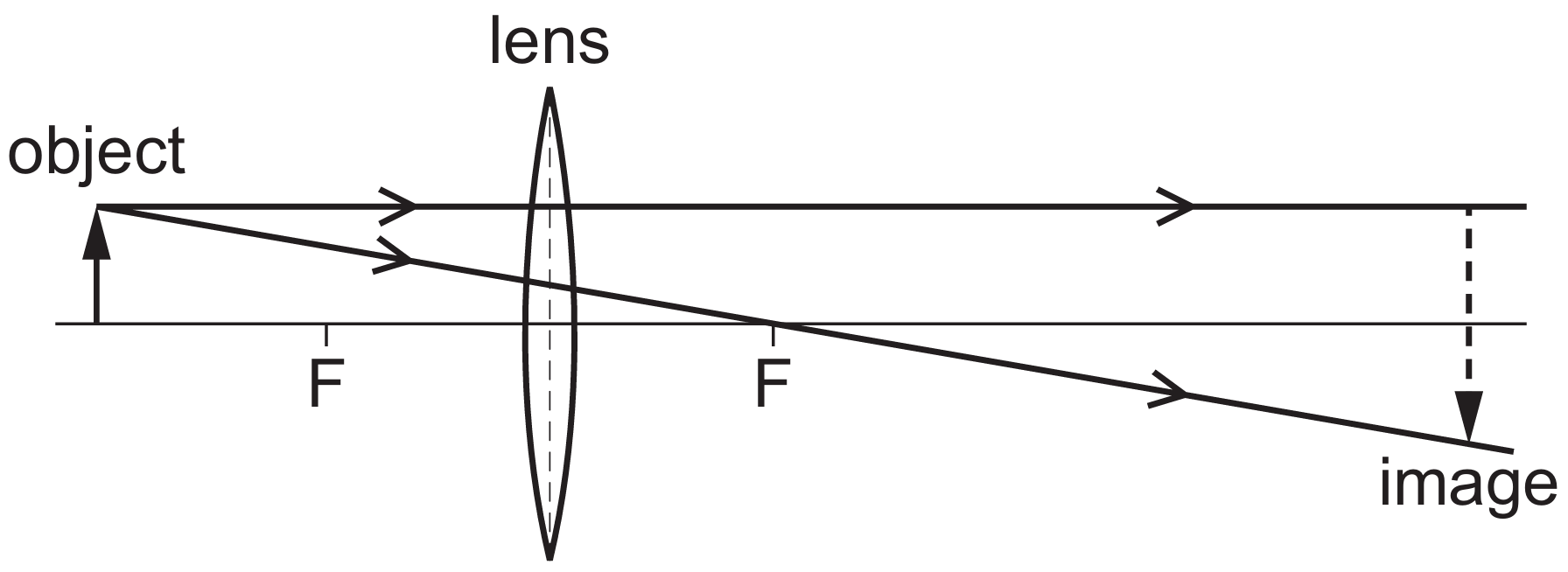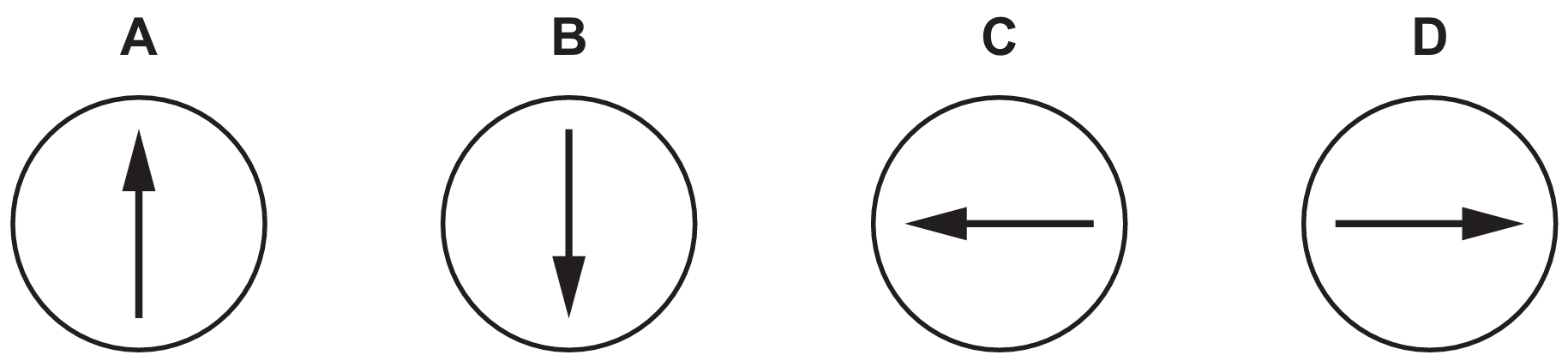
Question 1

Most-appropriate topic codes (Cambridge IGCSE Physics 0625):
▶️ Answer/Explanation
Detailed solution:
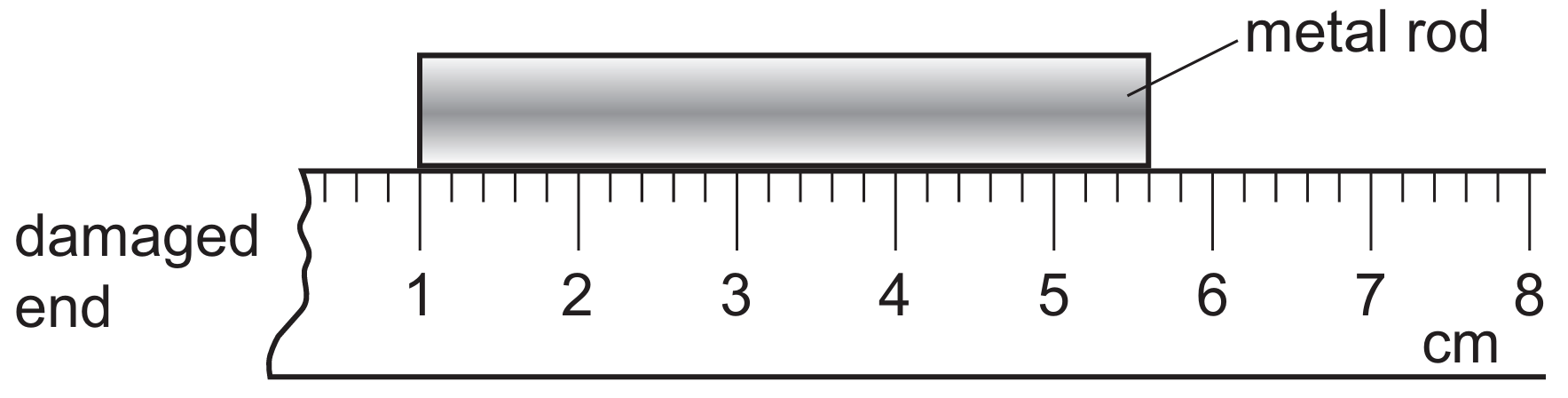
To find the actual length of the rod, subtract the starting position from the final reading on the ruler.
The rod starts at the $1.0\text{ cm}$ mark and ends at the $5.6\text{ cm}$ mark ($5\text{ cm}$ and $6$ small divisions).
$\text{Length} = \text{Final Reading} – \text{Initial Reading} = 5.6\text{ cm} – 1.0\text{ cm} = 4.6\text{ cm}$.
Since $1\text{ cm} = 10\text{ mm}$, the length in millimeters is $4.6 \times 10 = 46\text{ mm}$.
This method correctly accounts for the “zero error” caused by the damaged end of the ruler.
Therefore, the length of the metal rod is $46\text{ mm}$, which corresponds to option B.
Question 2

Most-appropriate topic codes (Cambridge IGCSE Physics 0625):
▶️ Answer/Explanation
Detailed solution:
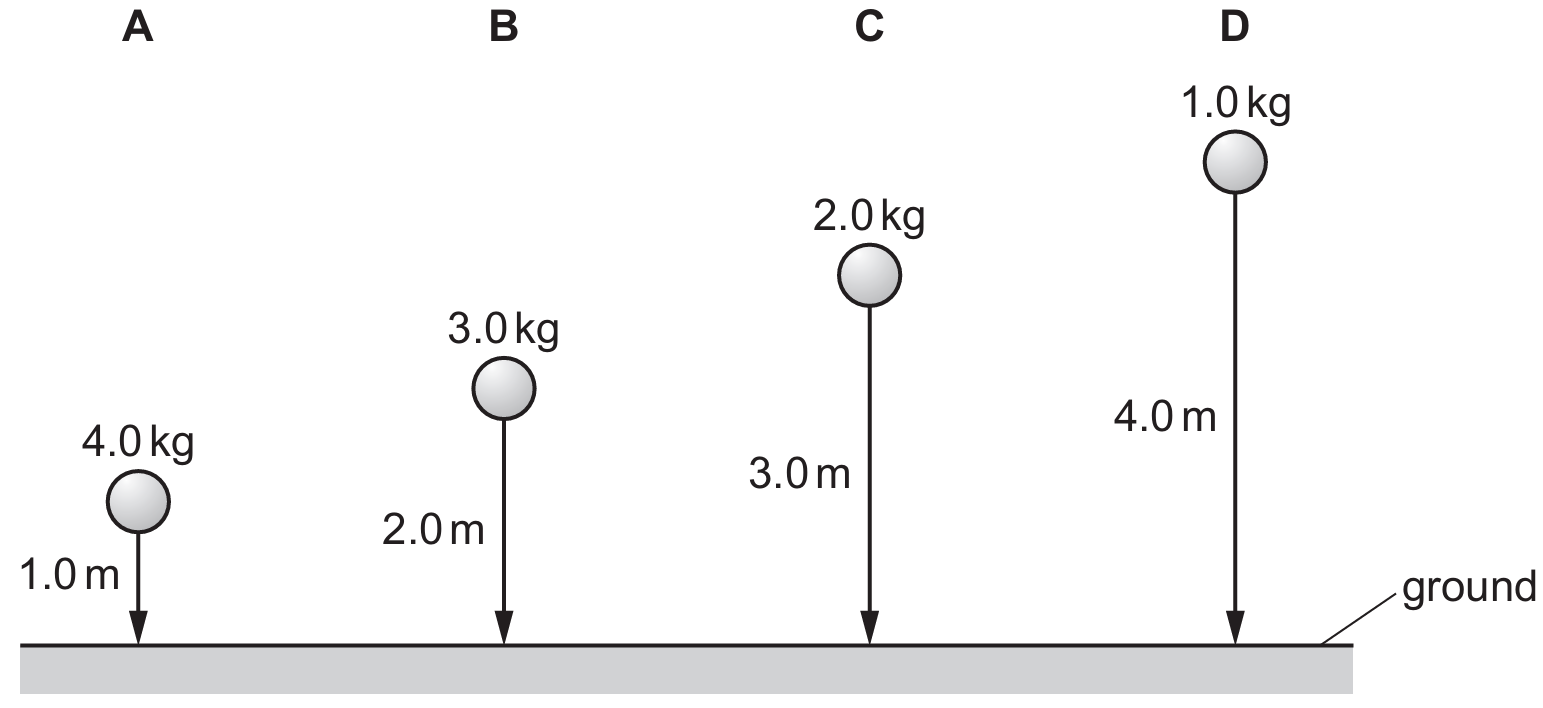
In a vacuum (no air resistance), all objects fall with the same constant acceleration $g \approx 9.8$ $m/s^{2}$, regardless of mass.
The final velocity $v$ upon hitting the ground is determined by $v = \sqrt{2gh}$, meaning higher drop heights result in higher final speeds.
Average speed for an object starting from rest is $v_{avg} = \frac{0 + v}{2}$, which is directly proportional to $\sqrt{h}$.
Since ball D is dropped from the greatest height ($4.0$ m), it will reach the highest final velocity and thus have the greatest average speed.
Mass does not affect the motion parameters in this scenario as $g$ is independent of the object’s mass.
Question 3

Most-appropriate topic codes (Cambridge IGCSE Physics 0625):
▶️ Answer/Explanation
Detailed solution:
Weight is defined as the gravitational force acting on an object that has mass.
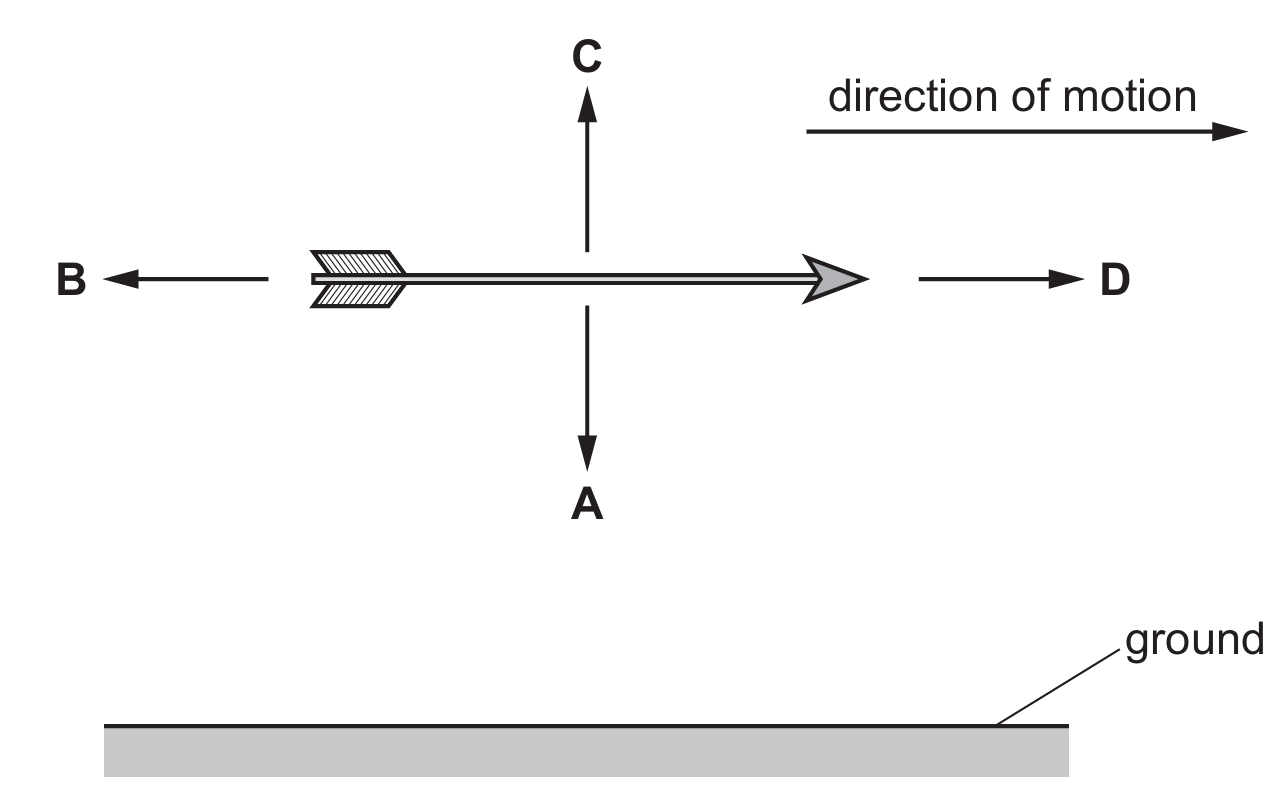
This force is always directed towards the center of the Earth, which is represented as vertically downwards.
The horizontal motion of the arrow at constant speed does not change the direction of the gravitational pull.
In the provided diagram, arrow $A$ points directly toward the ground, representing the vertical downward pull of gravity.
Therefore, the weight of the arrow acts in direction $A$, regardless of its horizontal velocity or direction of motion.
Question 4
Most-appropriate topic codes (Cambridge IGCSE Physics 0625):
▶️ Answer/Explanation
Detailed solution:
Density is defined by the equation $\rho = \frac{m}{V}$, requiring both mass and volume.
While mass is measured using a balance, the volume $V$ of an irregular object cannot be calculated using a ruler.
Instead, the volume is found via the displacement method, where the stone is submerged in a liquid.
A measuring cylinder is essential to observe the change in liquid level, which equals the stone’s volume.
Other tools like a stop-watch (time) or voltmeter (potential difference) are irrelevant to this physical measurement.
Therefore, the measuring cylinder is the only useful piece of equipment listed for this specific task.
Question 5

Most-appropriate topic codes (Cambridge IGCSE Physics 0625):
▶️ Answer/Explanation
Detailed solution:
For a load to be directly proportional to the extension, the relationship must satisfy Hooke’s Law, expressed as $F = kx$.
In this equation, $F$ represents the load, $x$ is the extension, and $k$ is the constant spring constant.
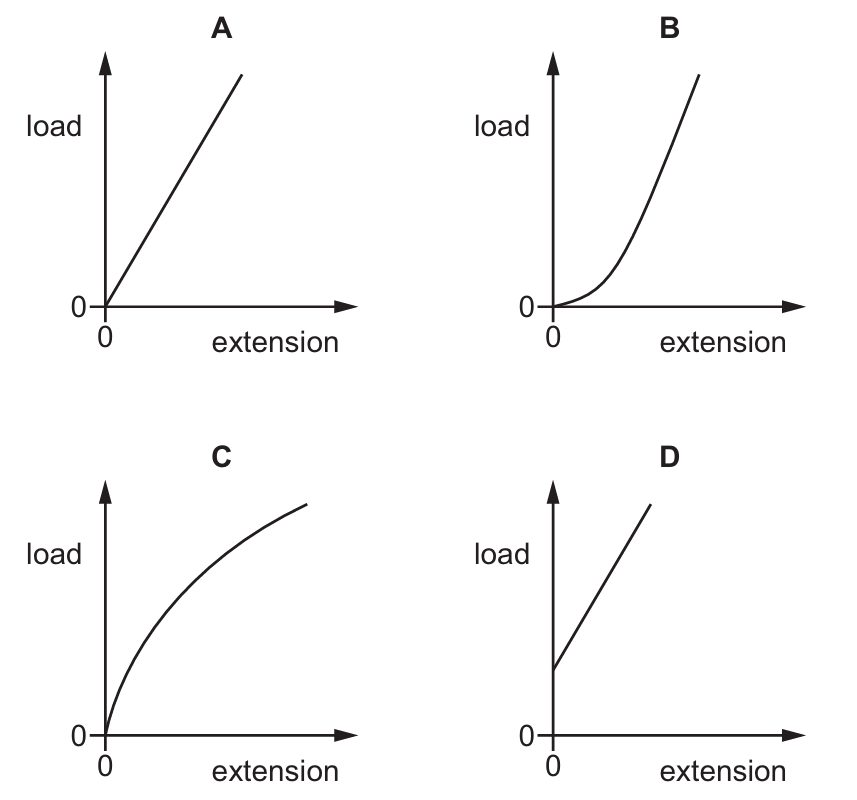
Mathematically, a direct proportion between two variables is always represented by a straight line that passes through the origin $(0,0)$.
Graph A shows a constant gradient starting from zero, confirming that doubling the load results in exactly double the extension.
Graphs B and C are non-linear, meaning the ratio is not constant, while Graph D shows a constant rate but includes an initial load at zero extension.
Therefore, Graph A is the only correct representation of proportionality.
Question 6

Most-appropriate topic codes (Cambridge IGCSE Physics 0625):
▶️ Answer/Explanation
Detailed solution:
The moment of a force is calculated using the formula M=F×d, where d is the perpendicular distance from the pivot to the line of action of the force.
In this scenario, the force F is the weight of the ladder acting downwards from its centre of gravity.
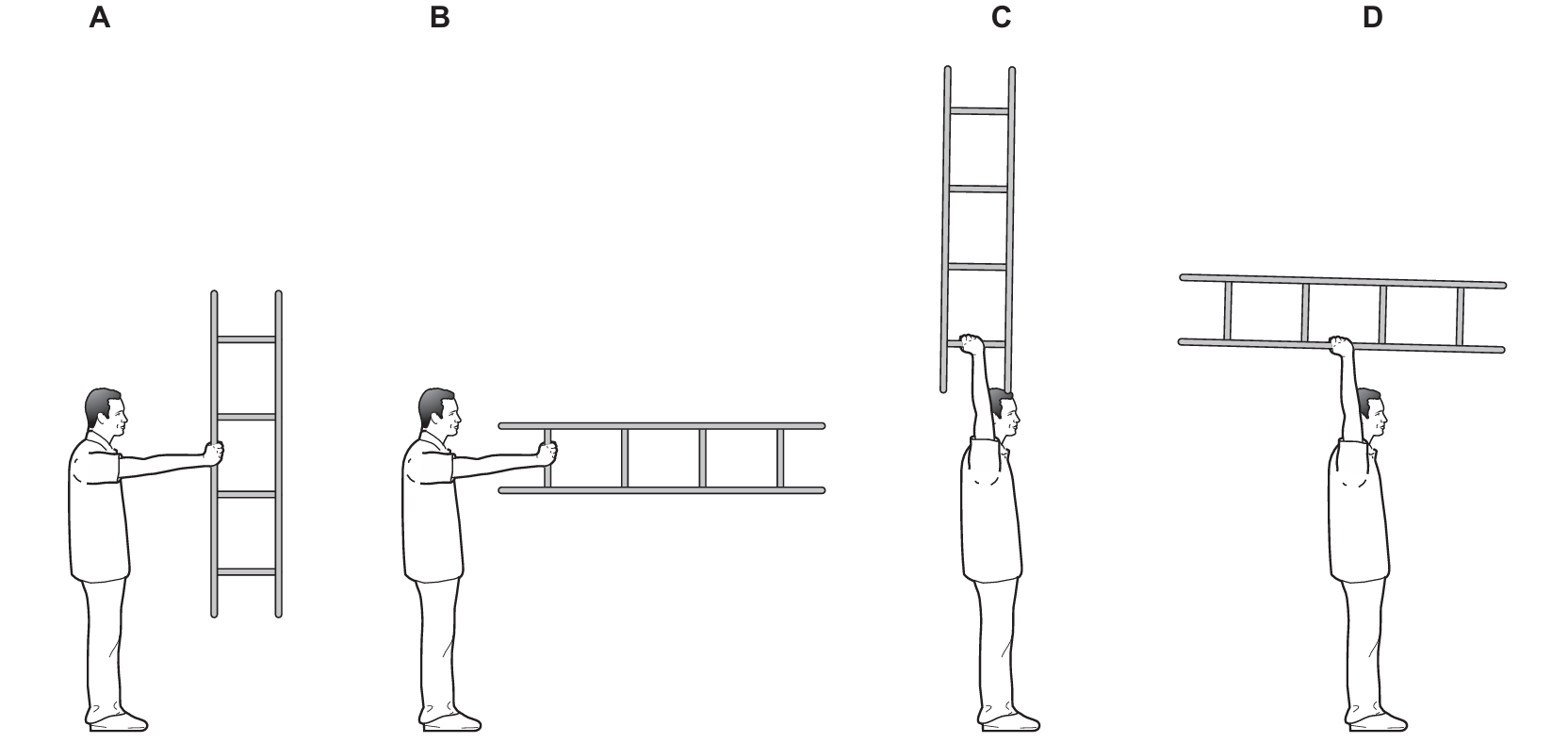
In positions A and C, the centre of gravity is vertically aligned with or very close to the pivot (the shoulder), making d minimal.
In position D, the ladder is held above the head, but the horizontal distance from the shoulder to the ladder’s centre is shorter than in B.
In position B, the ladder is held horizontally at arm’s length, which maximizes the horizontal perpendicular distance d from the shoulder.
Since d is greatest in position B and the weight F remains constant, the resulting moment is greatest in this position.
Question 7
Most-appropriate topic codes (Cambridge IGCSE Physics 0625):
▶️ Answer/Explanation
Detailed solution:
Stability depends on the position of the centre of gravity ($CG$) and the width of the base.
An object is least stable if its $CG$ is high and its base is narrow.
The letter ‘T’ has a heavy top section and a very narrow base point supporting it.
This results in a high $CG$ relative to its contact area with the table.
When knocked, the line of action of its weight easily falls outside the narrow base.
Thus, letter ‘T’ is the most likely to topple compared to ‘A’, ‘M’, or ‘X’.
Question 8
Most-appropriate topic codes (Cambridge IGCSE Physics 0625):
▶️ Answer/Explanation
Detailed solution:
In a free-fall scenario, the force of gravity acts on the object, causing it to move through a distance.
Energy transfer via a force is defined as mechanical work, where W=Fd.
As the object descends, the gravitational force does work to convert ΔE p =mgΔh into E k = 2 1 mv 2 .
Options A, B, and C describe transfers via electricity, radiation, or thermal pathways, which do not drive this motion.
Therefore, the transition from the potential store to the kinetic store is achieved through mechanical work.
This aligns with the principle that mechanical working occurs when a force moves an object.
Question 9
Most-appropriate topic codes (Cambridge IGCSE Physics 0625):
▶️ Answer/Explanation
Detailed solution:
Mechanical work done is defined as the product of the force applied and the distance moved in the direction of the force.
The mathematical formula is expressed as $W = Fd$, where $W$ is work, $F$ is force, and $d$ is distance.
Time is only required for calculating power ($P = \frac{W}{t}$), not for the total work done itself.
Therefore, to find the work done while pushing the mower, the woman only needs to know the force exerted and the distance covered.
This makes Option B the correct choice as it identifies both necessary variables without including irrelevant quantities.
Question 10
Most-appropriate topic codes (Cambridge IGCSE Physics 0625):
▶️ Answer/Explanation
Detailed solution:
Pressure is defined as the force applied per unit area, expressed by the formula $p = \frac{F}{A}$.
According to this relationship, pressure is inversely proportional to the surface area $A$ for a constant force $F$.
By sharpening a knife to a very small surface area at the edge, the pressure exerted becomes significantly higher.
This high pressure allows the knife to cut through materials much more easily with minimal effort.
Options B, C, and D are incorrect as area does not affect the intrinsic density, chemical rusting, or magnetism of the steel.
Question 11
Most-appropriate topic codes (Cambridge IGCSE Physics 0625):
▶️ Answer/Explanation
Detailed solution:
Temperature is a macroscopic measure of the average kinetic energy of the particles in a substance.
When a gas cools, its temperature $\theta$ decreases, which directly corresponds to a reduction in the average kinetic energy $E_{k}$ of its constituent molecules.
The internal energy of an ideal gas is primarily determined by the sum of the kinetic energies of all its particles.
Therefore, a decrease in internal energy during cooling is caused by the particles moving more slowly on average.
Option C and D describe changes that would typically increase energy or occur during expansion, while B is irrelevant to thermal cooling.
Thus, the decrease in internal energy is due to a decrease in the average kinetic energy of the gas particles.
Question 12
What is the temperature of the object in kelvin?
Most-appropriate topic codes (Cambridge IGCSE Physics 0625):
▶️ Answer/Explanation
Detailed solution:
To convert a temperature from the Celsius scale to the Kelvin scale, we use the standard relation: T(in K)=θ(in ∘ C)+273.
Given that the temperature of the object is θ=37 ∘ C, we substitute this value into the conversion formula.
The calculation becomes T=37+273, which equals 310.
Therefore, the temperature in kelvin is 310 K.
This corresponds to option D, which correctly identifies the absolute temperature value.
Note that the kelvin scale starts at absolute zero, which is equivalent to −273 ∘ C.
Question 13

Most-appropriate topic codes (Cambridge IGCSE Physics 0625):
▶️ Answer/Explanation
Detailed solution:
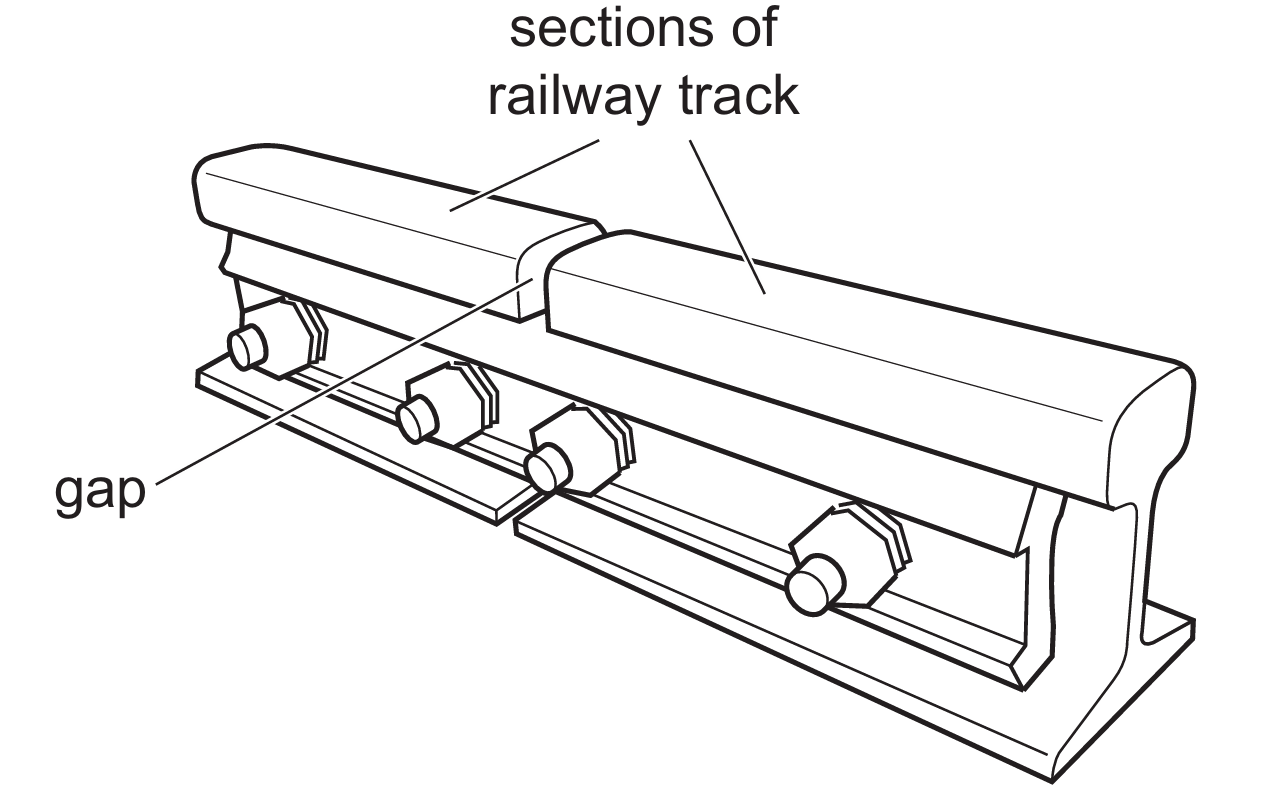
When the temperature increases on warm days, the metal railway tracks undergo thermal expansion.
This occurs because the particles in the solid vibrate more vigorously, increasing their average separation.
The expansion causes the length of each track section to increase by a value $\Delta l$.
Without the gaps, the expanding rails would press against each other, leading to dangerous buckling or deformation.
The gaps provide the necessary space for this increase in volume and length to occur safely.
Therefore, the gaps are specifically required because the tracks expand on warm days.
Question 14
Most-appropriate topic codes (Cambridge IGCSE Physics 0625):
▶️ Answer/Explanation
Detailed solution:
In a liquid, particles are packed closely together with very small gaps between them.
When water boils into steam (a gas), the particles gain enough energy to overcome attractive forces.
The particles in a gas move randomly and are spaced much further apart than in a liquid.
Since the number of particles and the size of individual particles remain constant during a state change,
the massive increase in volume from $1.0 cm^3$ to $1600 cm^3$ is due solely to the increased separation.
Therefore, the average distance between particles in steam is significantly greater than in liquid water.
Question 15
What is the name of this process?
Most-appropriate topic codes (Cambridge IGCSE Physics 0625):
▶️ Answer/Explanation
Detailed solution:
Evaporation occurs when particles at the surface of a liquid gain enough kinetic energy to overcome intermolecular forces.
Unlike boiling, which occurs throughout the liquid at a specific temperature, evaporation happens only at the surface at any temperature.
The “more-energetic” particles have the highest velocities, allowing them to break free into the gaseous phase.
As these high-energy particles escape, the average kinetic energy $E_{k}$ of the remaining particles decreases.
This reduction in average kinetic energy results in a drop in temperature, explaining why evaporation causes cooling.
Therefore, the process described is evaporation, which corresponds to option D.
Question 16


Most-appropriate topic codes (Cambridge IGCSE Physics 0625):
▶️ Answer/Explanation
Detailed solution:
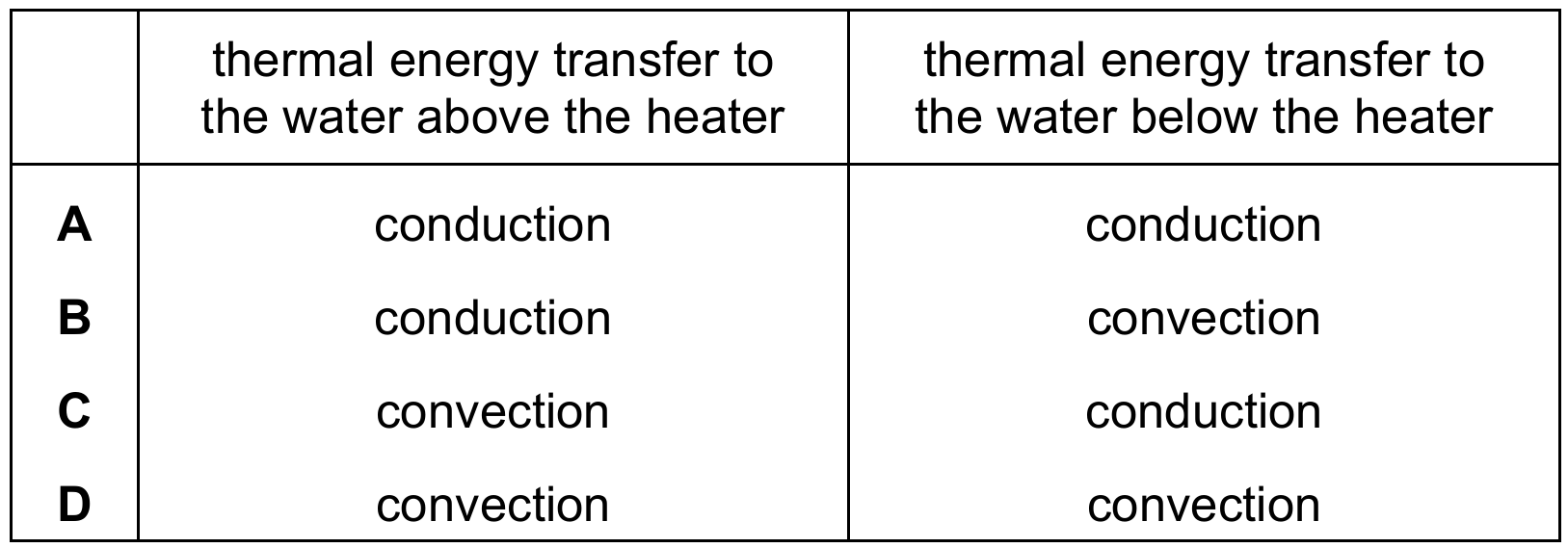
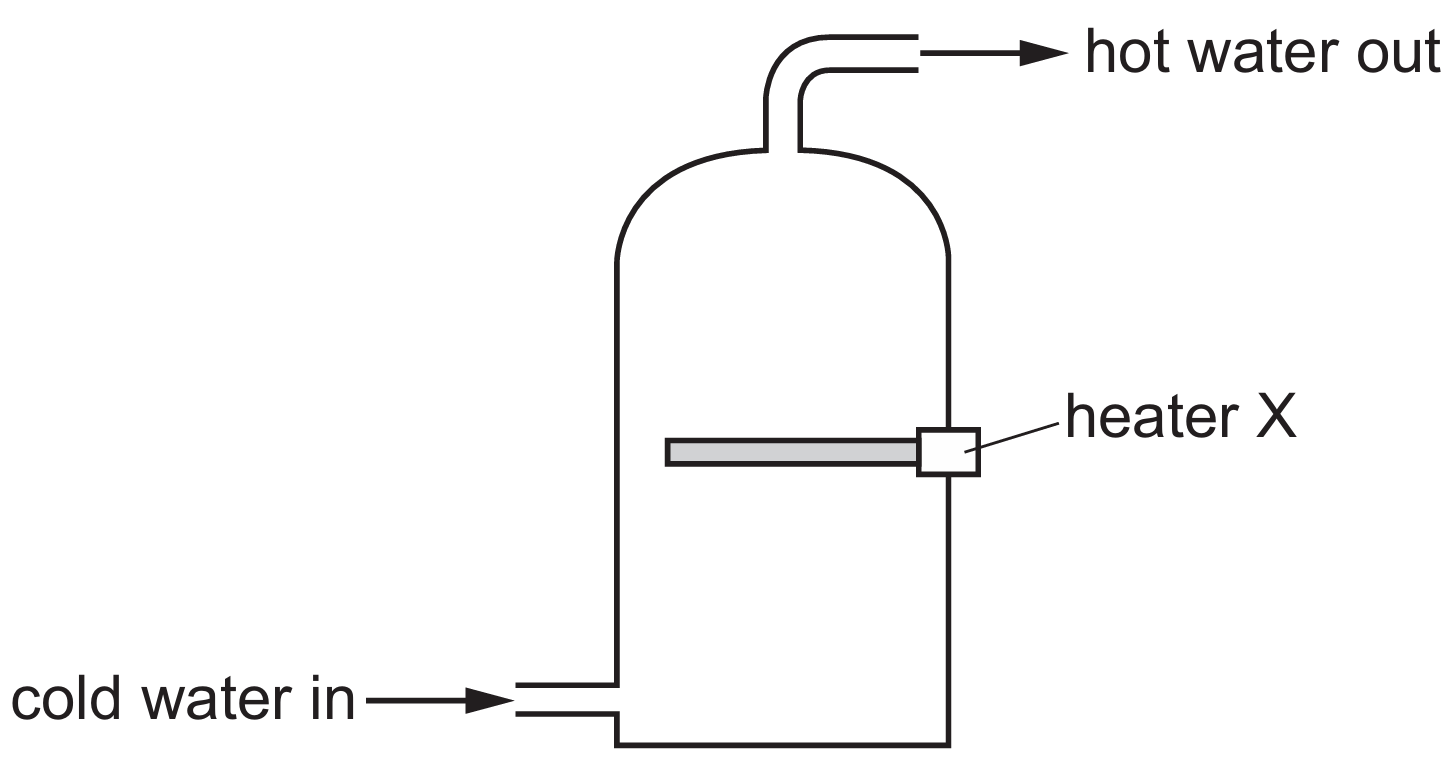
When heater $X$ is on, the water above it is heated, becomes less dense, and rises, creating a convection current that efficiently transfers thermal energy upwards.
However, since hot water rises, convection cannot transfer heat downwards to the water below the heater.
Water is a poor thermal conductor, but conduction remains the only primary method for energy to move toward the bottom of the tank.
Because liquids are bad conductors, the water at the bottom stays cold for much longer than the water at the top.
Thus, the transfer is mainly via convection for the top half and conduction for the bottom half.
This corresponds to Row C.
Question 17
Most-appropriate topic codes (Cambridge IGCSE Physics 0625):
▶️ Answer/Explanation
Detailed solution:
Thermal conduction is the process where heat is transferred through a solid material via atomic vibrations and electron movement. Metals are excellent conductors, while wood is a poor conductor (a thermal insulator). By using wood for the handle, the rate of thermal energy transfer from the hot pan to the user’s hand is significantly lowered. This prevents the handle from reaching high temperatures, ensuring safety during cooking. Since heat travels through the solid material of the handle, the primary mechanism being addressed is conduction rather than convection, which occurs in fluids. Therefore, wood is chosen specifically to reduce thermal energy transfer by conduction.
Question 18

Most-appropriate topic codes (Cambridge IGCSE Physics 0625):
▶️ Answer/Explanation
Detailed solution:
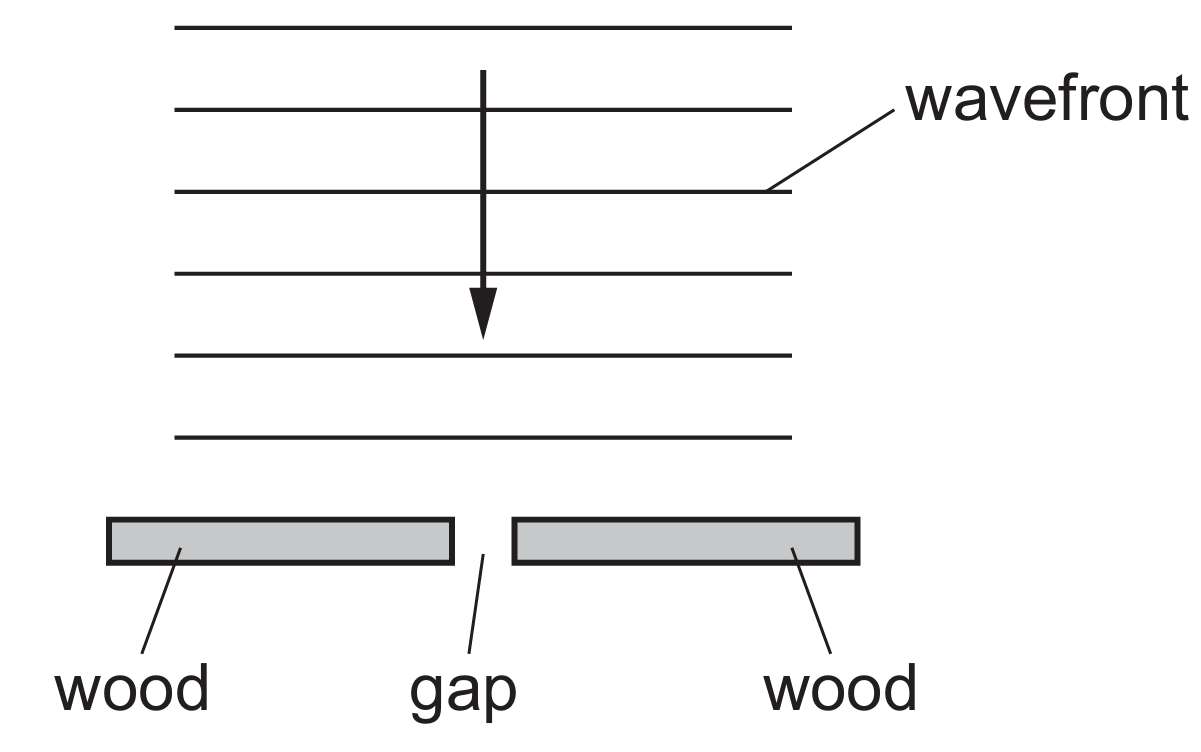
When waves pass through a gap, they undergo diffraction. Significant diffraction occurs when the gap width ($2.0$ cm) is smaller than or similar to the wavelength ($\lambda = 3.0$ cm).
Because the gap is narrower than the wavelength ($2.0$ cm $< 3.0$ cm), the waves emerge as circular/semicircular wavefronts.
Crucially, diffraction only changes the direction and shape of the wavefronts; it does not change the frequency or speed of the waves in constant depth.
Therefore, the wavelength (the distance between wavefronts) remains constant at $3.0$ cm.
This makes Option B the correct choice, as it correctly identifies both the semicircular shape and the unchanged wavelength.
Question 19
Most-appropriate topic codes (Cambridge IGCSE Physics 0625):
▶️ Answer/Explanation
Detailed solution:
Seismic waves are categorized based on their direction of vibration relative to propagation.
P-waves (primary waves) are longitudinal, meaning vibrations are parallel to the wave’s direction.
S-waves (secondary waves) are transverse, meaning vibrations are at $90^{\circ}$ to the wave’s direction.
Since P-waves are longitudinal and S-waves are transverse, statement B is the only correct choice.
Options A, C, and D incorrectly classify the fundamental nature of one or both wave types.
Therefore, only P-waves are longitudinal waves in this comparison.
Question 20


Most-appropriate topic codes (Cambridge IGCSE Physics 0625):
▶️ Answer/Explanation
Detailed solution:
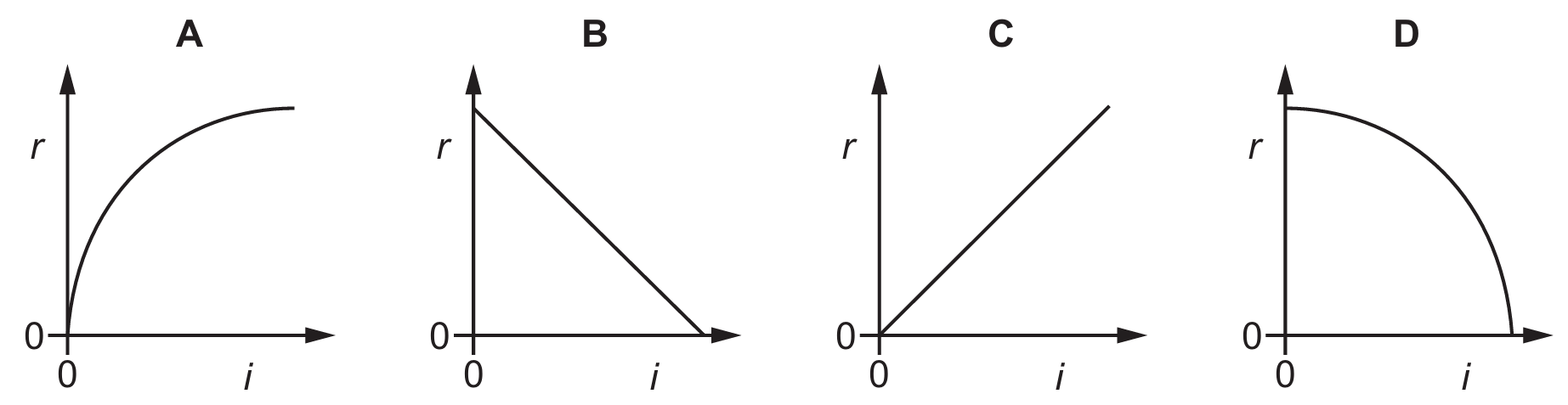
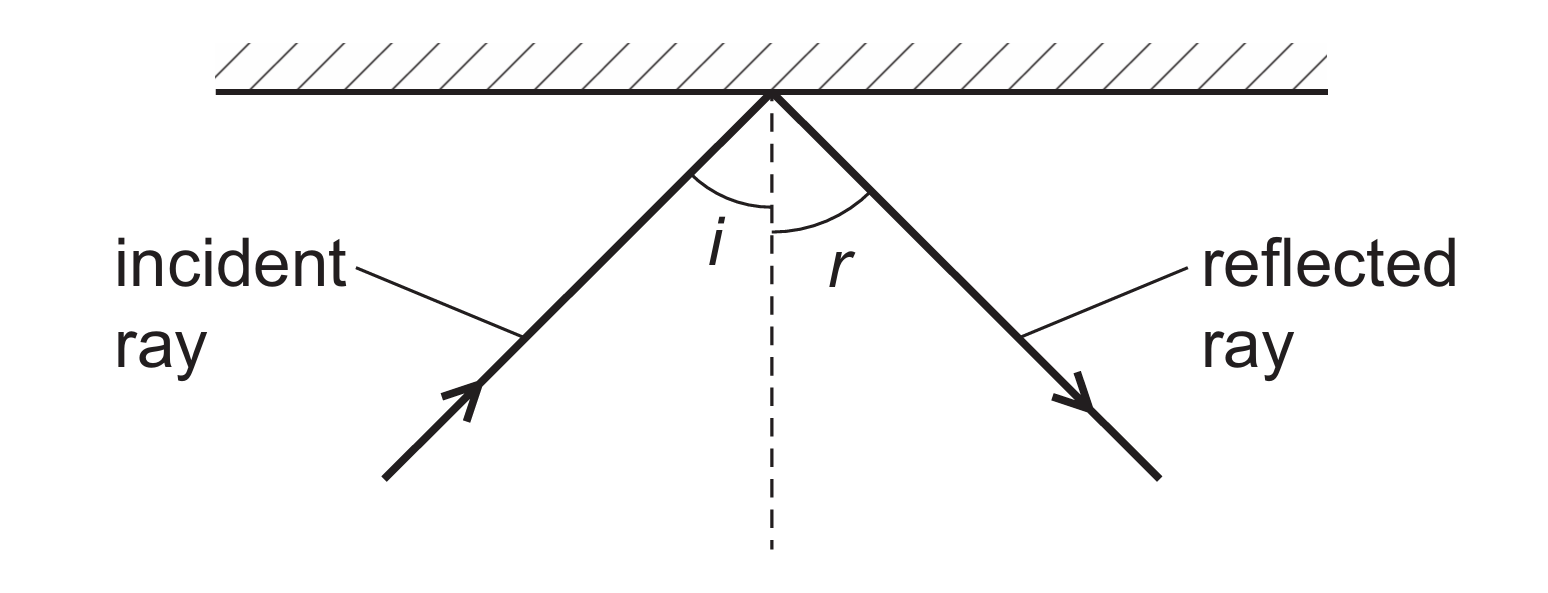
According to the law of reflection for a plane mirror, the angle of incidence i is always equal to the angle of reflection r.
This relationship can be expressed by the linear equation r=i, which follows the form y=mx+c where the gradient m=1 and the intercept c=0.
Since r is directly proportional to i, the resulting graph must be a straight line passing through the origin (0,0).
As the angle of incidence increases, the angle of reflection increases at the exact same rate, maintaining a constant ratio.
Graph C correctly depicts this proportional relationship as a straight line with a constant positive gradient.
Options A, B, and D are incorrect because they represent non-linear or inverse relationships that violate the law of reflection.
Question 21
Which statement is correct?
Most-appropriate topic codes (Cambridge IGCSE Physics 0625):
▶️ Answer/Explanation
Detailed solution:
When light passes from a less dense medium (air) to a more dense medium (glass), it slows down and bends toward the normal.
This means the angle of refraction $r$ is always less than the angle of incidence $i$ ($r < i$).
Option A is incorrect because the angle of incidence is measured from the normal, not the surface.
Option B is incorrect as the angle of incidence can be any value between $0^{\circ}$ and $90^{\circ}$.
Option C is incorrect because refraction occurs normally for any incident angle when entering a denser medium.
Therefore, statement D is the only correct physical description of this interaction.
Question 22


Most-appropriate topic codes (Cambridge IGCSE Physics 0625):
▶️ Answer/Explanation
Detailed solution:
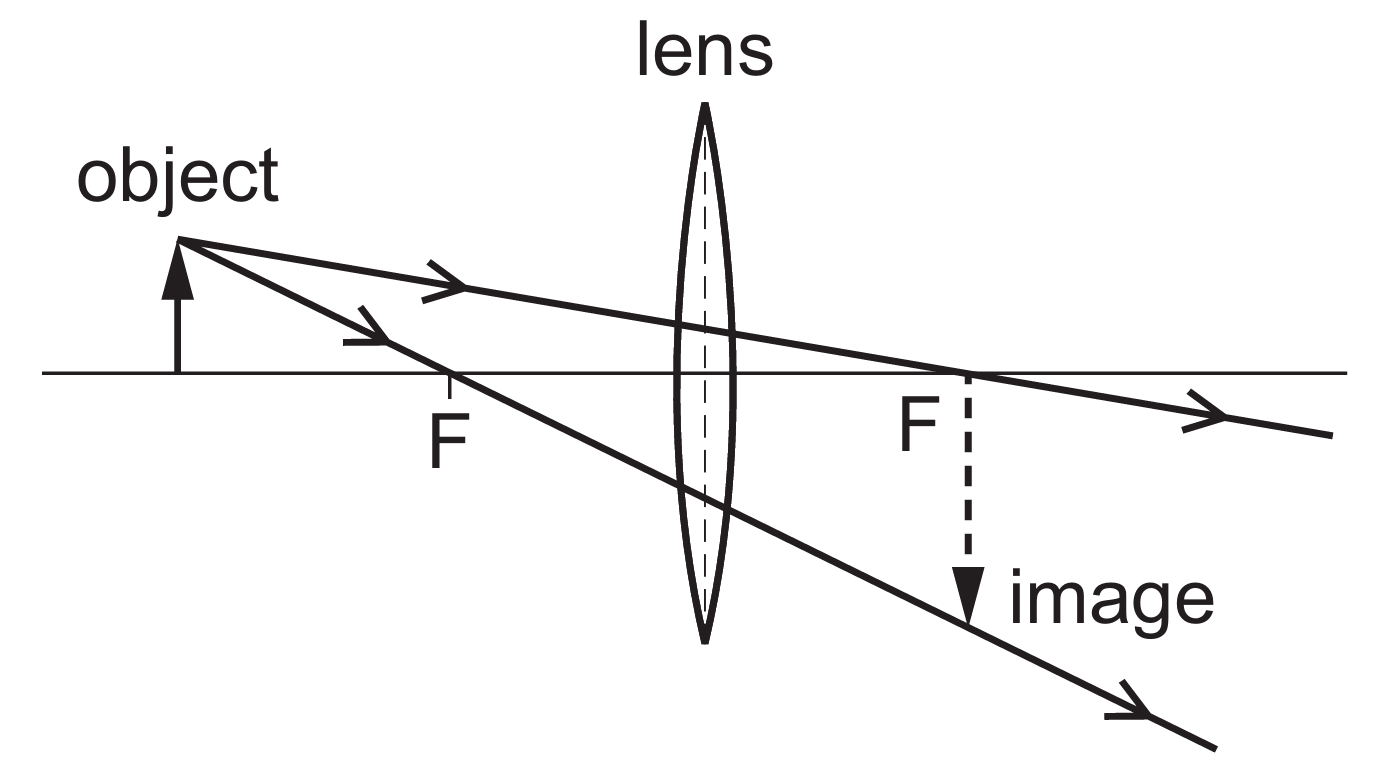
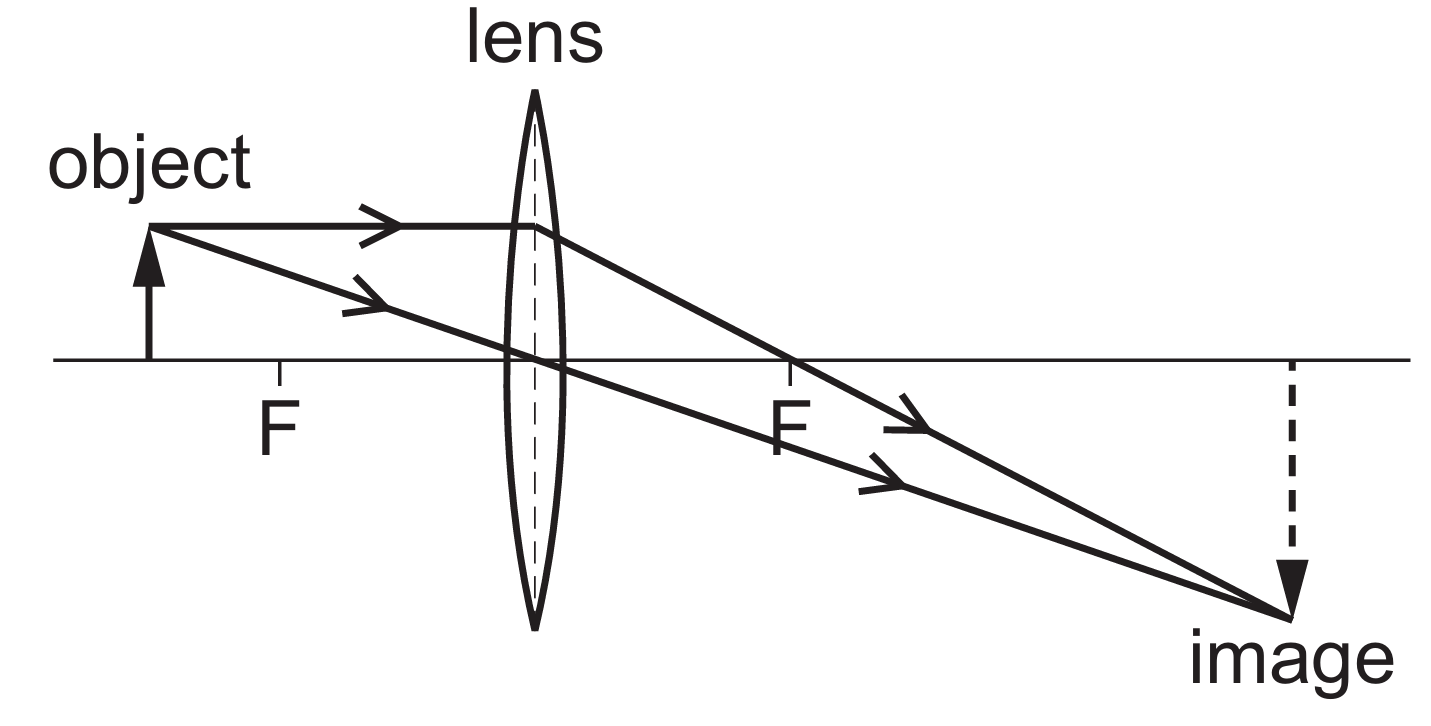
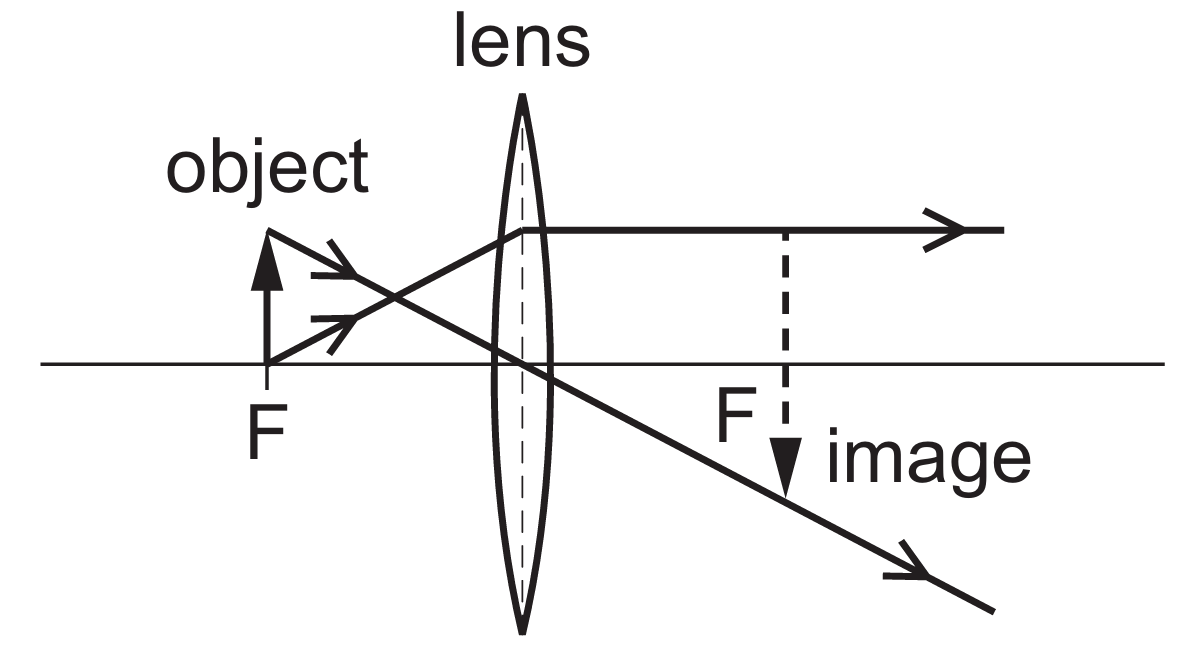
A real image formed by a converging lens must be inverted. Since the image height ($4\text{ cm}$) is greater than the object height ($2\text{ cm}$), the linear magnification $M = \frac{h_i}{h_o} = \frac{4}{2} = 2$ indicates the image is enlarged. This occurs when the object is placed between $F$ and $2F$. In diagram C, the rays correctly follow optical rules: a ray parallel to the principal axis passes through the far principal focus $F$, and a ray through the center of the lens continues undeviated. These rays intersect to form an inverted, enlarged real image beyond $2F$. Other diagrams are incorrect because they show the object at $F$ (which produces no image) or produce diminished images.
Question 23
Most-appropriate topic codes (Cambridge IGCSE Physics 0625):
▶️ Answer/Explanation
Detailed solution:
When white light enters a glass prism, it undergoes refraction at the boundaries. Because different colors of light have different frequencies, they travel at different speeds within the glass. This causes each color to refract by a slightly different angle, a phenomenon known as dispersion. Consequently, the white light splits into its constituent seven colors of the visible spectrum. Diffraction involves the spreading of waves through gaps, while reflection involves light bouncing off surfaces. Thus, the correct term for the splitting of light into a spectrum is dispersion.
Question 24
Most-appropriate topic codes (Cambridge IGCSE Physics 0625):
▶️ Answer/Explanation
Detailed solution:
The typical range of audible frequencies for a healthy human ear is between $20$ Hz and $20\,000$ Hz (or $20$ kHz).
Any sound with a frequency higher than $20\,000$ Hz is classified as ultrasound and is beyond the human limit of hearing.
In this question, the sound wave has a frequency of $25\,000$ Hz, which exceeds the upper limit of $20\,000$ Hz.
The speed of the wave ($340$ m/s) is a standard value for air and does not determine whether the sound is audible.
Therefore, the human cannot hear the sound because the frequency is too high.
Question 25
Most-appropriate topic codes (Cambridge IGCSE Physics 0625):
▶️ Answer/Explanation
Detailed solution:
Loudness is determined by the $amplitude$ of the sound wave; hitting the drum harder transfers more energy, increasing the $amplitude$.
Pitch is determined by the $frequency$ of the vibration; since the pitch remains unchanged, the $frequency$ must remain constant.
Therefore, an increase in loudness without a change in pitch implies that only the $amplitude$ has increased.
Option B and D are incorrect as they suggest a change in $frequency$, which would alter the pitch.
Option C is incorrect because an increased $frequency$ would result in a higher pitch sound.
Thus, statement A is the only accurate description of the change in wave properties.
Question 26

Most-appropriate topic codes (Cambridge IGCSE Physics 0625):
▶️ Answer/Explanation
Detailed solution:
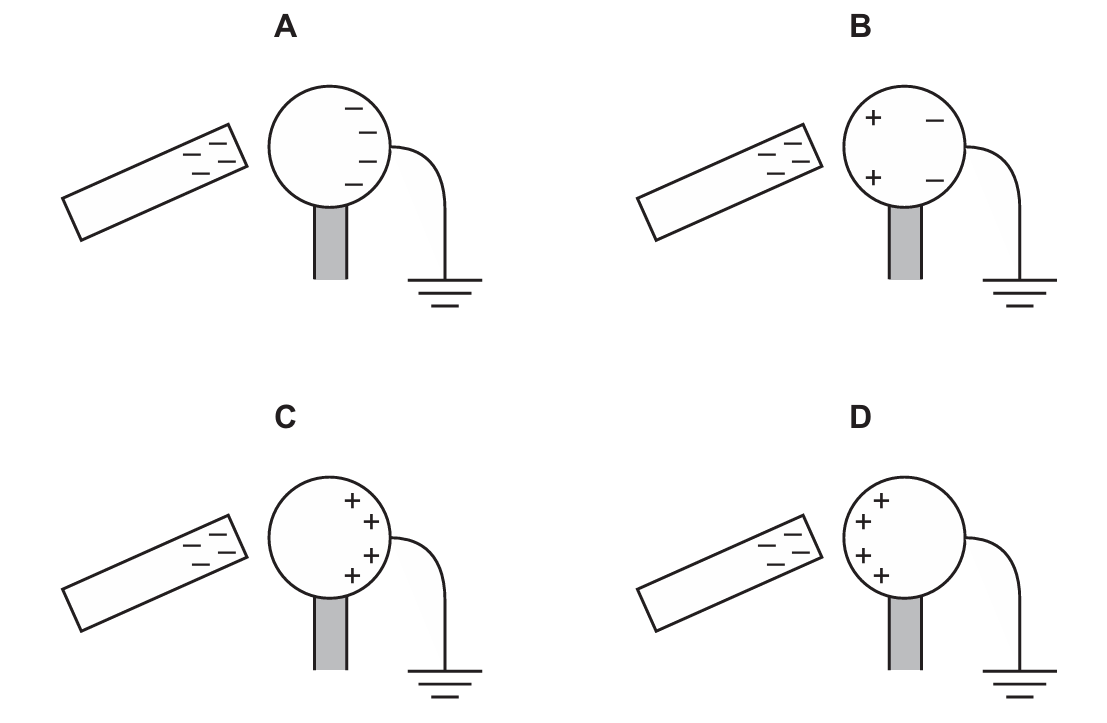
When a negatively charged rod is brought near the metal sphere, it repels the free electrons within the conductor. These electrons move to the far side of the sphere. Since the far side is earthed, the repelled electrons flow away to the Earth, leaving the right side neutral. The near side (left) is left with a deficiency of electrons, resulting in a net positive charge ($+$) being induced there due to attraction to the negative rod. Consequently, the sphere retains only positive charges on the side closest to the rod, as shown in diagram D.
Question 27
A student writes three statements about electric current:
- Electric current is a flow of charge.
- Electric current in a circuit is measured using a voltmeter.
- The direction of an alternating current (a.c.) continually changes.
Which statements are correct?
Most-appropriate topic codes (Cambridge IGCSE Physics 0625):
▶️ Answer/Explanation
Detailed solution:
Statement 1 is correct as electric current is defined as the rate of flow of charge, expressed as $I = \frac{Q}{t}$.
Statement 2 is incorrect because current is measured using an ammeter connected in series, whereas a voltmeter measures potential difference.
Statement 3 is correct because alternating current (a.c.) reverses its direction of flow periodically and continually.
Since statements 1 and 3 are the only accurate descriptions, the correct combination is represented by Option C.
Question 28
Most-appropriate topic codes (Cambridge IGCSE Physics 0625):
▶️ Answer/Explanation
Detailed solution:
Electromotive force ($e.m.f.$) is defined as the electrical work done (energy supplied) by a source in moving a unit charge around a complete circuit.
Mathematically, this relationship is expressed by the equation $E = \frac{W}{Q}$, where $E$ is the $e.m.f.$, $W$ is the energy or work done, and $Q$ is the electrical charge.
While potential difference ($p.d.$) also involves energy per unit charge, $e.m.f.$ specifically refers to the energy provided to the entire circuit by the source.
Since the definition specifically describes the energy required to drive a “physical quantity,” that quantity is the charge ($Q$).
Therefore, option A is the correct definition according to the syllabus requirements.
Question 29
Most-appropriate topic codes (Cambridge IGCSE Physics 0625):
▶️ Answer/Explanation
Detailed solution:
The resistance $R$ of a component is defined as the ratio of the potential difference $V$ across it to the current $I$ flowing through it.
This relationship is expressed by the formula $R = \frac{V}{I}$.
To determine the resistance experimentally, a student must measure the potential difference using a voltmeter and the current using an ammeter.
While physical dimensions like length and area affect resistance, they are not the direct measurements used in this specific formula.
Therefore, potential difference and current are the two essential measurements required.
Option B correctly identifies these two necessary physical quantities.
Question 30
What is the potential difference (p.d.) across the resistor?
Most-appropriate topic codes (Cambridge IGCSE Physics 0625):
▶️ Answer/Explanation
Detailed solution:
The potential difference ($V$) across a resistor can be calculated using Ohm’s Law, which relates resistance ($R$), current ($I$), and voltage ($V$).
The formula is given by: $V = I \times R$.
Given values: Current $I = 2.0\text{ A}$ and Resistance $R = 8.0\text{ }\Omega$.
Substituting the values into the equation: $V = 2.0\text{ A} \times 8.0\text{ }\Omega = 16\text{ V}$.
Therefore, the potential difference across the resistor is $16\text{ V}$, which corresponds to option D.
Question 31
There is a current of $2.0 \text{ A}$ in a resistor for a time of $30 \text{ s}$. The potential difference (p.d.) across the resistor is $12 \text{ V}$.
How much energy is transferred in the resistor?
Most-appropriate topic codes (Cambridge IGCSE Physics 0625):
▶️ Answer/Explanation
Detailed solution:
To calculate the energy transferred in an electrical circuit, we use the formula $E = I \times V \times t$.
From the question, the current $I = 2.0 \text{ A}$, the potential difference $V = 12 \text{ V}$, and the time $t = 30 \text{ s}$.
Substituting these values into the equation: $E = 2.0 \text{ A} \times 12 \text{ V} \times 30 \text{ s}$.
First, calculate the power: $P = I \times V = 2.0 \times 12 = 24 \text{ W}$.
Then, multiply the power by the time: $E = 24 \text{ W} \times 30 \text{ s} = 720 \text{ J}$.
Thus, the total energy transferred in the resistor is $720 \text{ J}$, which corresponds to option D.
Question 32
Most-appropriate topic codes (Cambridge IGCSE Physics 0625):
▶️ Answer/Explanation
Detailed solution:
The question requires identifying a pair where the first component uses a circular symbol and the second uses a rectangular one.
A motor is represented by a circle with the letter $M$ inside, satisfying the first condition.
A thermistor is represented by a rectangle with a diagonal line ending in a horizontal flat section, satisfying the second condition.
In contrast, a cell and battery use parallel lines, a switch uses broken lines, and a heater is a plain rectangle.
Therefore, the pair “motor and thermistor” correctly follows the “circle then rectangle” pattern described.
This matches Option B.
Question 33
Most-appropriate topic codes (Cambridge IGCSE Physics 0625):
▶️ Answer/Explanation
Detailed solution:
Double-insulated appliances are designed with non-conducting outer casings, such as plastic, which prevent the user from touching any live metal parts. Since the casing cannot become live, an earth wire is not required for safety. However, the live wire and neutral wire are still essential to provide a complete circuit for the $P = IV$ power delivery. Additionally, a fuse is still necessary to protect the internal circuitry and cabling from excess current. Therefore, only the earth wire is redundant in this specific setup.
Question 34


Most-appropriate topic codes (Cambridge IGCSE Physics 0625):
▶️ Answer/Explanation
Detailed solution:
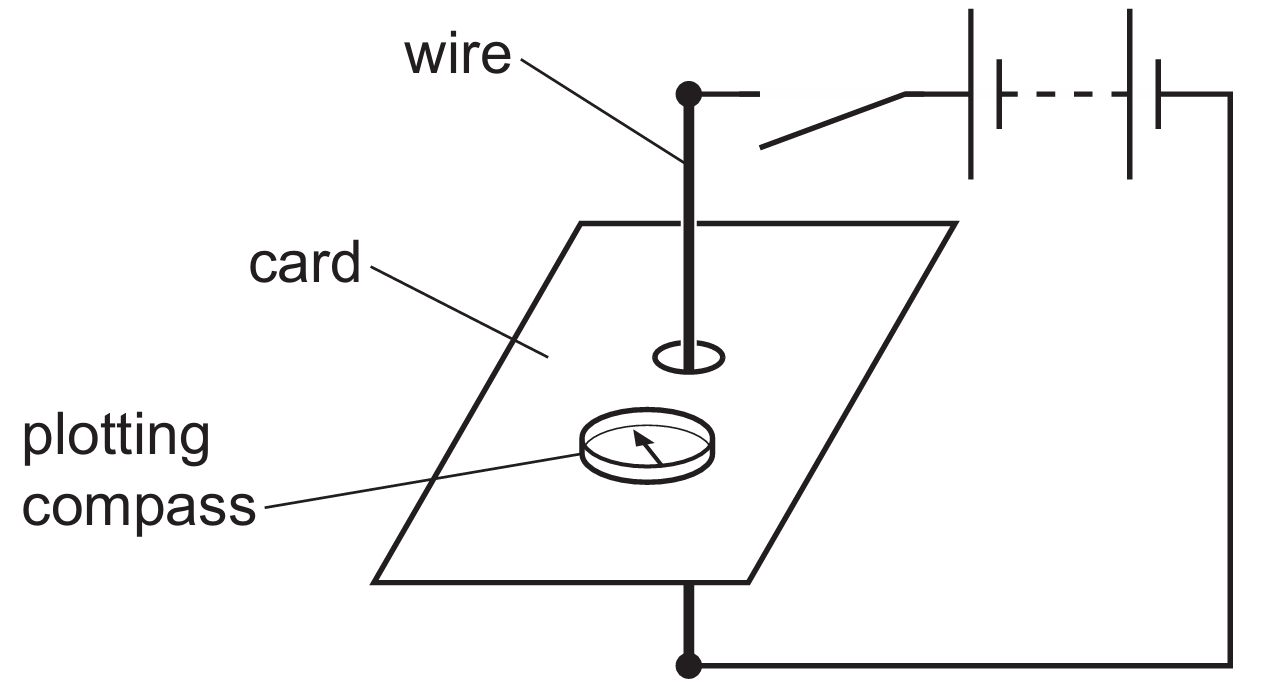
When the switch is closed, current flows from the positive terminal to the negative terminal. In this circuit, conventional current $I$ flows upward through the vertical wire. According to the Right-Hand Grip Rule, if the thumb points in the direction of the current (upward), the curled fingers show the magnetic field $B$ acting in a counter-clockwise direction around the wire. At the position of the plotting compass (located in front of the wire), the magnetic field lines point toward the left. Since the North pole of a compass needle aligns with the local magnetic field direction, the needle will point toward the left, as shown in diagram C.
Question 35
Most-appropriate topic codes (Cambridge IGCSE Physics 0625):
▶️ Answer/Explanation
Detailed solution:
An atom consists of a central nucleus containing protons and neutrons.
Protons carry a relative charge of $+1$, while neutrons have a charge of $0$, making the nucleus positively charged.
Electrons, which carry a relative charge of $-1$, move in orbits around this central nucleus.
Electrostatic attraction between the positive nucleus and negative electrons holds the atom together.
Therefore, the correct structural description is a positively charged nucleus surrounded by negatively charged electrons.
This corresponds exactly to the description provided in Option C.
Question 36
Alpha, beta and gamma emissions are compared.
Alpha radiation is the ……1…… ionising as it has the ……2…… electric charge.
Which words correctly complete the sentence?

Most-appropriate topic codes (Cambridge IGCSE Physics 0625):
▶️ Answer/Explanation
Detailed solution:
Alpha particles ($\alpha$) consist of two protons and two neutrons, giving them a relative charge of $+2$.
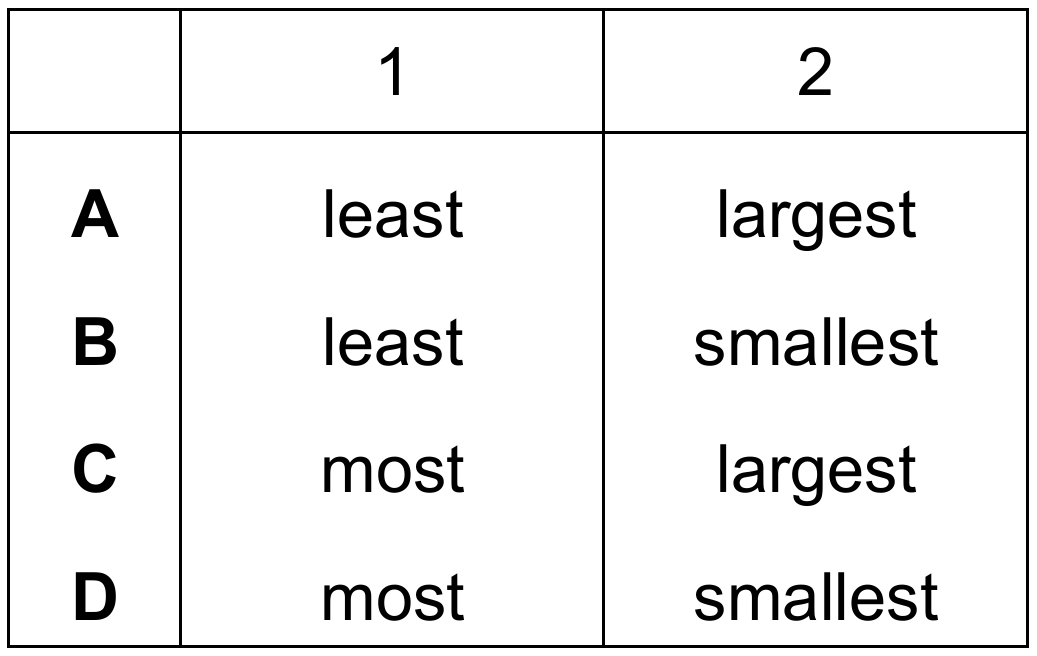
This is the largest electric charge among the three emissions, as beta particles ($\beta$) have a charge of $-1$ and gamma rays ($\gamma$) have $0$ charge.
The high charge and large mass of alpha particles cause them to interact strongly with atoms, making them the most ionising.
Stronger ionisation occurs because the $+2$ charge easily pulls electrons away from nearby atoms during collisions.
Therefore, Row C correctly identifies that alpha radiation is the most ionising due to having the largest electric charge.
Question 37

Most-appropriate topic codes (Cambridge IGCSE Physics 0625):
▶️ Answer/Explanation
Detailed solution:
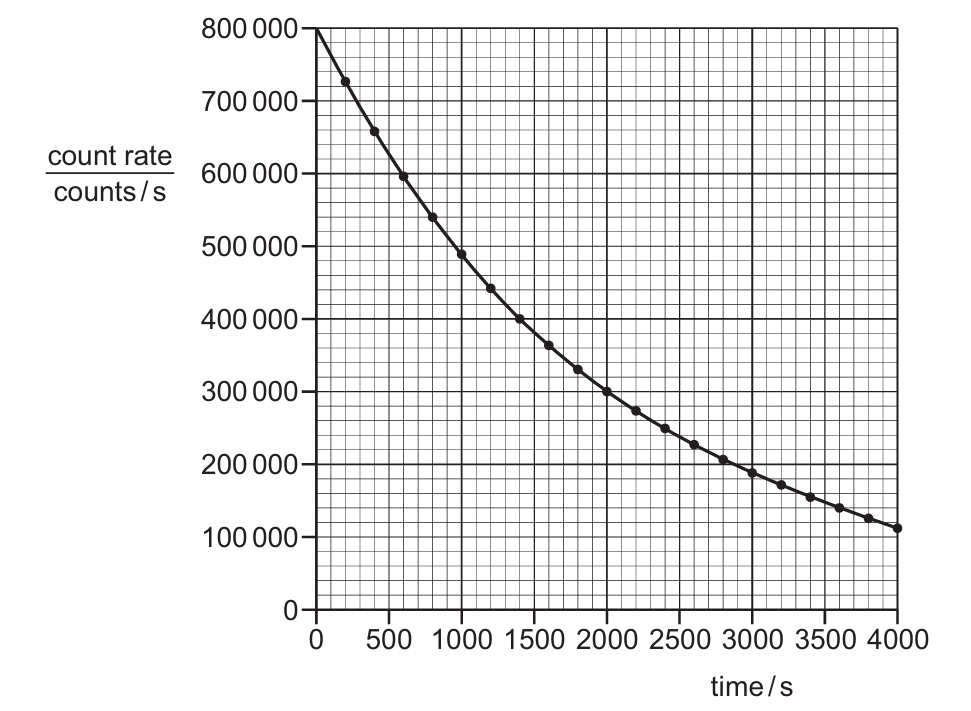
The half-life is the time taken for the activity (count rate) of a radioactive sample to decrease to half of its initial value. From the graph, the initial count rate at $t = 0$ s is $800~000$ counts/s. Half of this initial value is $\frac{800~000}{2} = 400~000$ counts/s. By locating $400~000$ counts/s on the y-axis and moving horizontally to the curve, we drop down to the x-axis to find the corresponding time. The intersection occurs at approximately $1400$ s. Therefore, the approximate half-life is $1400$ s.
Question 38
Most-appropriate topic codes (Cambridge IGCSE Physics 0625):
▶️ Answer/Explanation
Detailed solution:
The Solar System consists of $8$ planets orbiting the Sun. The four inner planets are rocky and small, while the four outer planets are gaseous and large. The correct sequence of the rocky planets starting from the one closest to the Sun is Mercury, followed by Venus, then Earth, and finally Mars. To list them in order of increasing distance, we must follow this specific $1 \rightarrow 2 \rightarrow 3 \rightarrow 4$ arrangement. Option C correctly identifies this progression: Mercury $\rightarrow$ Venus $\rightarrow$ Earth $\rightarrow$ Mars.
Question 39
Most-appropriate topic codes (Cambridge IGCSE Physics 0625):
▶️ Answer/Explanation
Detailed solution:
The Sun is a medium-sized star that emits a broad spectrum of electromagnetic radiation.
According to the syllabus, the Sun radiates the vast majority of its energy within three specific regions: infrared, visible light, and ultraviolet.
Visible light accounts for the peak of the Sun’s emission, while significant energy is also radiated as heat (infrared) and higher-energy photons (ultraviolet).
In contrast, regions like microwaves and radio waves represent a negligible fraction of the Sun’s total energy output.
Since options A, C, and D are the primary regions of solar emission, the Sun radiates the least amount of energy in the microwave region.
Therefore, microwave is the correct answer among the given choices.
Question 40
Most-appropriate topic codes (Cambridge IGCSE Physics 0625):
▶️ Answer/Explanation
Detailed solution:
Redshift occurs when light from an object moving away from the observer is stretched.
In the visible spectrum, red light has the longest wavelength, so a shift toward red signifies an increase in $\lambda$.
Since the speed of light $c$ is constant in a vacuum ($3.0 \times 10^{8} m/s$), the wave equation $c = f\lambda$ applies.
As the wavelength $\lambda$ increases, the frequency $f$ must decrease to keep the speed constant.
Therefore, redshift is explicitly defined by an increase in the observed wavelength of the electromagnetic radiation.
This phenomenon provides critical evidence that distant galaxies are receding and that the Universe is expanding.