Home / 0625_w25_qp_21

Question 1

Which quantity can be measured using a ruler?
A. the distance travelled by a toy train in one second
B. the temperature of a toy train
C. the time taken for a toy train to travel one metre
D. the volume of a toy train

Most-appropriate topic codes (Cambridge IGCSE Physics 0625):

TOPIC 1.1: Physical quantities and measurement techniques (Describe the use of rulers and measuring cylinders to find a length or a volume)
▶️ Answer/Explanation
Correct Option: D

Detailed solution:

A ruler is a primary instrument used to measure the physical dimension of length $l$.
While option A involves distance, it requires a synchronized timer to measure exactly what is covered in $1~s$.
Temperature (B) requires a thermometer, and time (C) requires a stopwatch or digital timer.
Volume $V$ for a regular object is derived from length measurements (e.g., $V = l \times w \times h$).
Since a ruler can measure the dimensions required to calculate the space an object occupies, it is the correct tool.
Therefore, the volume of the toy train is the most appropriate quantity listed that relies on ruler measurements.

Question 2

An athlete runs at a speed of 8 m/s for 10 s, and then at a speed of 6 m/s for 12 s.Which calculation gives the average speed of the athlete in $\text{m/s}$?
A. $\frac{8 + 6}{2}$
B. $\frac{(8 \times 10) + (6 \times 12)}{22}$
C. $\frac{(8 \div 10) + (6 \div 12)}{22}$
D. $\frac{(10 \div 8) + (12 \div 6)}{22}$

Most-appropriate topic codes (Cambridge IGCSE Physics 0625):

TOPIC 1.2: Motion (Recall and use the equation $\text{average speed} = \frac{\text{total distance travelled}}{\text{total time taken}}$)
▶️ Answer/Explanation
Correct Option: B

Detailed solution:

Average speed is defined as the $\frac{\text{total distance travelled}}{\text{total time taken}}$.
First, calculate the distance for each stage using $\text{distance} = \text{speed} \times \text{time}$.
The distance for the first stage is $(8 \times 10)$ and for the second stage is $(6 \times 12)$.
The total distance is the sum of these parts: $(8 \times 10) + (6 \times 12)$.
The total time taken is the sum of both intervals: $10\text{ s} + 12\text{ s} = 22\text{ s}$.
Dividing the total distance by the total time gives the calculation in Option B: $\frac{(8 \times 10) + (6 \times 12)}{22}$.

Question 3

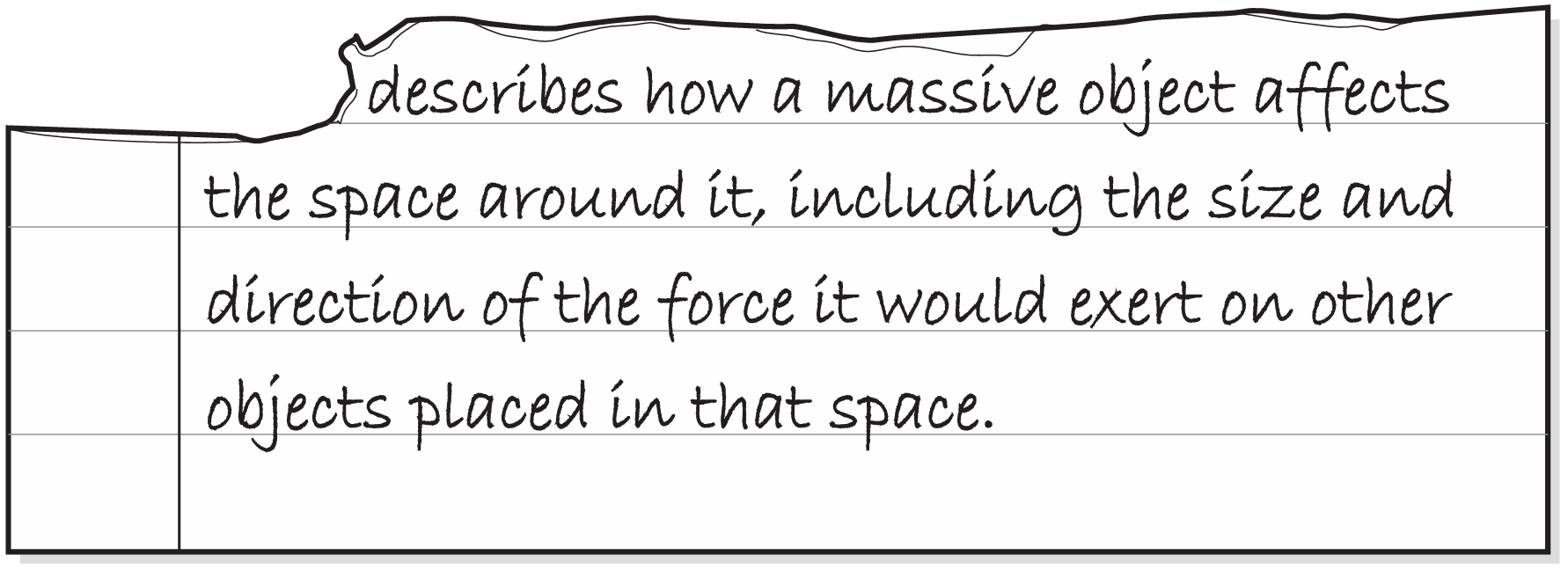
A piece of paper torn out of an exercise book is shown.
What is being described?
A. gravitational charge
B. gravitational field
C. gravitational mass
D. gravitational potential energy

Most-appropriate topic codes (Cambridge IGCSE Physics 0625):

TOPIC 1.3: Mass and weight (Describe, and use the concept of, weight as the effect of a gravitational field on a mass)
▶️ Answer/Explanation
Correct Option: B

Detailed solution:

A field in physics describes a region of space where an object experiences a non-contact force.
A gravitational field is specifically created by any object with mass, affecting the space around it.
The strength of this field, $g$, determines the magnitude of the force ($W$) per unit mass ($m$), expressed as $g = \frac{W}{m}$.
Because the description mentions both the “size and direction of the force,” it identifies a vector field.
Gravitational mass is a property of the object itself, not the space around it, and potential energy is a scalar quantity.
Thus, the definition provided perfectly matches the physical concept of a gravitational field.
Question 4

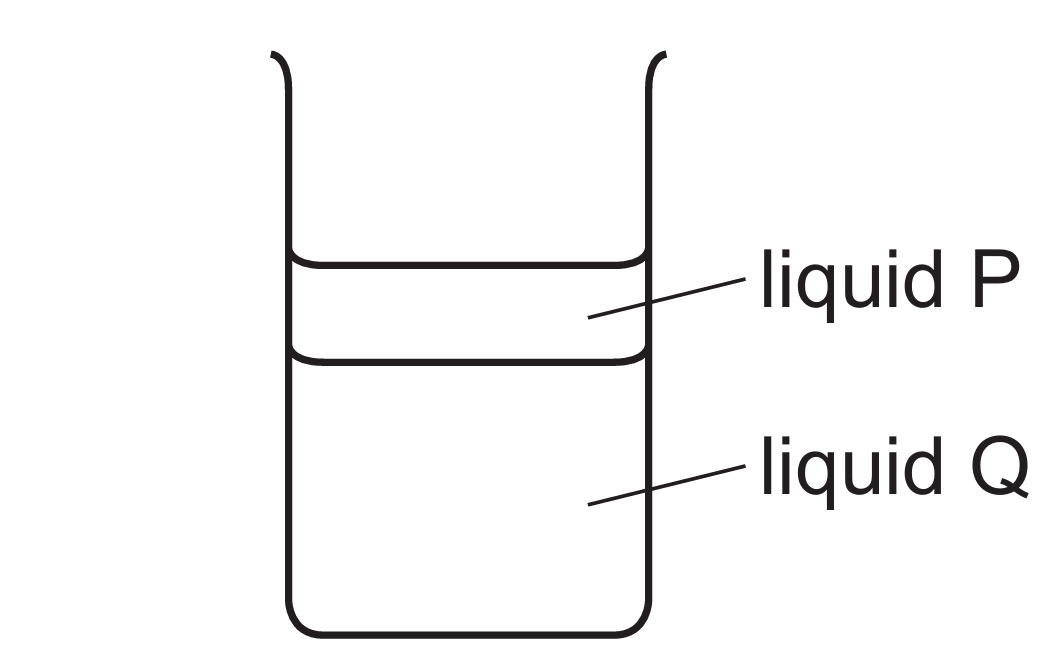
The diagram shows one liquid floating on top of another liquid.
Which statement explains why liquid P floats on top of liquid Q?
A. The mass of liquid Q is greater than the mass of liquid P.
B. The mass of $1\text{ cm}^{3}$ of liquid Q is greater than the mass of $1\text{ cm}^{3}$ of liquid P.
C. The volume of liquid Q is greater than the volume of liquid P.
D. The volume of $1\text{ g}$ of liquid Q is greater than the volume of $1\text{ g}$ of liquid P.

Most-appropriate topic codes (Cambridge IGCSE Physics 0625):

TOPIC 1.4: Density (Determine whether one liquid will float on another liquid based on density data)
▶️ Answer/Explanation
Correct Option: B

Detailed solution:

Floating is determined by density, defined as $\rho = \frac{m}{V}$. For two immiscible liquids, the less dense liquid floats on the more dense one.
Liquid P floats on liquid Q because its density is lower: $\rho_{P} < \rho_{Q}$.
Density represents the mass per unit volume; thus, $1\text{ cm}^{3}$ of liquid Q has more mass than $1\text{ cm}^{3}$ of liquid P.
Option A and C are incorrect because total mass and volume do not determine floating behavior.
Option D is incorrect because a greater volume for the same mass implies a lower density, which describes liquid P, not Q.
Therefore, statement B correctly identifies that liquid Q is denser than liquid P.
Question 5

A spring has a spring constant k.
What is a possible unit for k?
A. metre per newton
B. newton metre
C. newton per metre
D. newton per metre squared

Most-appropriate topic codes (Cambridge IGCSE Physics 0625):

TOPIC 1.5.1: Effects of forces (Define the spring constant as force per unit extension; recall and use the equation k= x F ​ )
▶️ Answer/Explanation
Correct Option: C

Detailed solution:

The spring constant k is defined by Hooke’s Law as the force per unit extension.
Using the formula k= x F ​ , where F represents the force and x represents the extension.
The SI unit for force F is the newton (N) and the unit for extension x is the metre (m).
By substituting these units into the formula, we obtain m N ​ , which is read as newton per metre.
Other variations like N/cm are possible, but among the given options, only C is correct.
Therefore, the unit for the spring constant k is newton per metre.

Question 6

Which statement about the moment of a force is not correct?
A. If an object is balanced about a pivot, the resultant moment on the object must be zero.
B. The moment of a force is a measure of its turning effect.
C. The moment of a force about a point is equal to: force×perpendicular distance from the point.
D. The moment of a force about a point increases when the perpendicular distance of the force from the point decreases.

Most-appropriate topic codes (Cambridge IGCSE Physics 0625):

TOPIC 1.5.2: Turning effect of forces (Define the moment of a force as moment=force×perpendicular distance from the pivot)
▶️ Answer/Explanation
Correct Option: D

Detailed solution:

The moment of a force is defined by the equation M=F×d, where F is the force and d is the perpendicular distance from the pivot.
As shown by this relationship, the moment is directly proportional to the perpendicular distance.
Therefore, if the distance d decreases while the force F remains constant, the resulting moment M must also decrease.
Statement D is incorrect because it falsely claims that the moment increases when the distance decreases.
Statements A, B, and C are all scientifically accurate descriptions of moments and equilibrium as defined in the syllabus.

Question 7

The momentum of a car changes from $10\,000 \text{ kg m/s}$ to $15\,000 \text{ kg m/s}$ in a time of $8.0 \text{ s}$.
What is the resultant force acting on the car?
A. $630 \text{ N}$
B. $3100 \text{ N}$
C. $40\,000 \text{ N}$
D. $200\,000 \text{ N}$

Most-appropriate topic codes (Cambridge IGCSE Physics 0625):

TOPIC 1.6: Momentum (Define resultant force as the change in momentum per unit time; recall and use the equation $F = \frac{\Delta p}{\Delta t}$)
▶️ Answer/Explanation
Correct Option: A

Detailed solution:

The resultant force $F$ acting on an object is defined as the rate of change of momentum.
First, calculate the change in momentum: $\Delta p = 15\,000 \text{ kg m/s} – 10\,000 \text{ kg m/s} = 5\,000 \text{ kg m/s}$.
Using the formula $F = \frac{\Delta p}{\Delta t}$, where $\Delta t = 8.0 \text{ s}$ is the time interval.
Substitute the values: $F = \frac{5\,000}{8.0} = 625 \text{ N}$.
Rounding to two significant figures, as given in the options, we get $630 \text{ N}$.
This matches Option A perfectly.

Question 8

A machine is very efficient. What does this mean?
A. It produces a large amount of power.
B. It uses very little energy.
C. It wastes very little energy.
D. It works very quickly.

Most-appropriate topic codes (Cambridge IGCSE Physics 0625):

TOPIC 1.7.3: Energy resources (Understand, qualitatively, the concept of efficiency of energy transfer)
▶️ Answer/Explanation
Correct Option: C

Detailed solution:

Efficiency is a measure of how much of the total energy input to a system is converted into useful energy output.
The mathematical definition is $Efficiency = \frac{Useful~energy~output}{Total~energy~input} \times 100\%$.
A high efficiency indicates that the gap between total input and useful output is small.
Since $Total~energy~input = Useful~energy~output + Wasted~energy$, a very efficient machine minimizes energy dissipated to the surroundings.
Therefore, saying a machine is very efficient is equivalent to stating that it wastes very little energy.
Options A and D describe high power, while Option B describes low energy consumption, neither of which defines efficiency.

Question 9

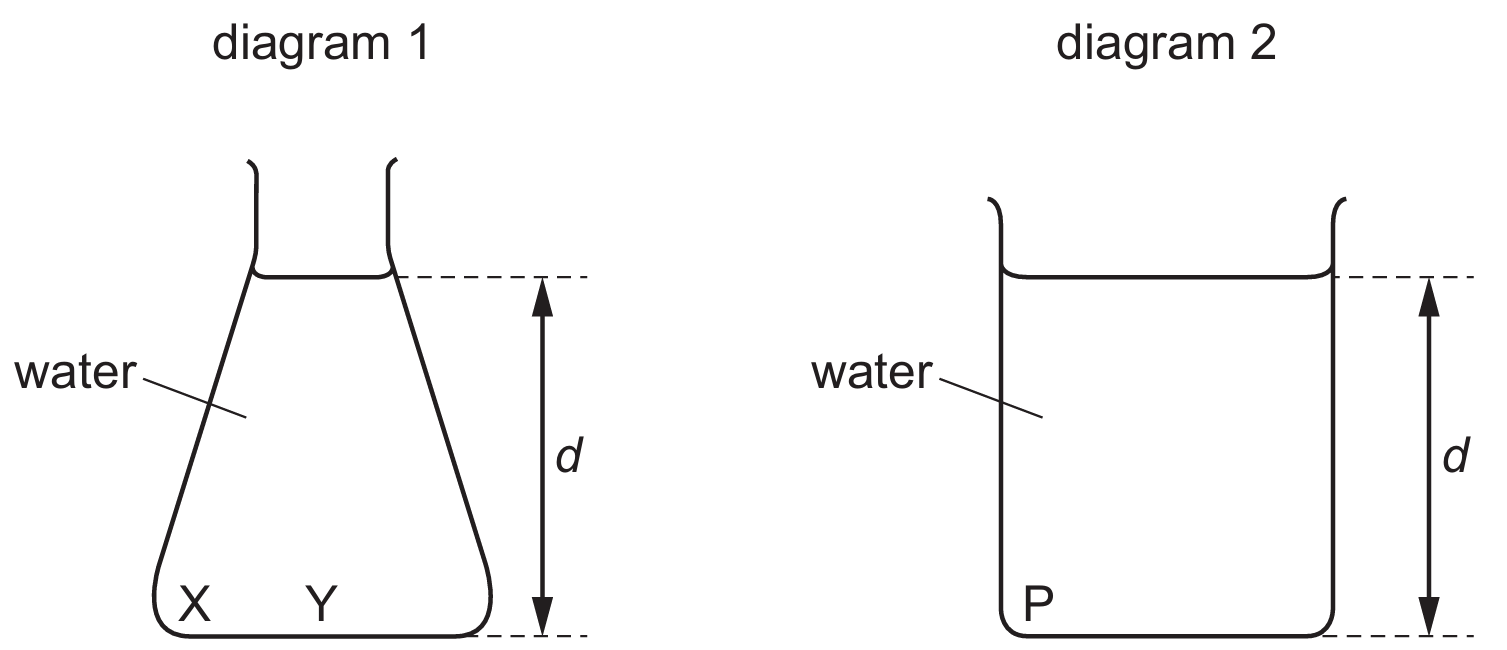
Diagram 1 shows a conical flask containing water.
Diagram 2 shows a beaker with the same base area as the flask and containing water of the same depth $d$.
Which statement is correct?
A. The pressure at P is equal to the pressure at X.
B. The pressure at P is greater than the pressure at Y.
C. The pressure at P is greater than the pressure at X.
D. The pressure at Y is greater than the pressure at X.

Most-appropriate topic codes (Cambridge IGCSE Physics 0625):

TOPIC 1.8: Pressure (Recall and use the equation for the change in pressure beneath the surface of a liquid $\Delta p = \rho g \Delta h$)
▶️ Answer/Explanation
Correct Option: A

Detailed solution:

The pressure at a point in a liquid is determined by the formula $p = \rho g h$, where $\rho$ is the density, $g$ is gravitational field strength, and $h$ is the depth.
Since both containers are filled with water, the density $\rho$ is identical for both.
Points X, Y, and P are all located at the same vertical depth $d$ from the surface of the liquid.
Hydrostatic pressure depends only on the depth and density, not on the shape of the container or the total volume of liquid.
Therefore, the pressure at X, Y, and P must be equal because they share the same depth $d$.
This makes statement A correct, while statements B, C, and D are false as they suggest pressure differences where none exist.
Question 10

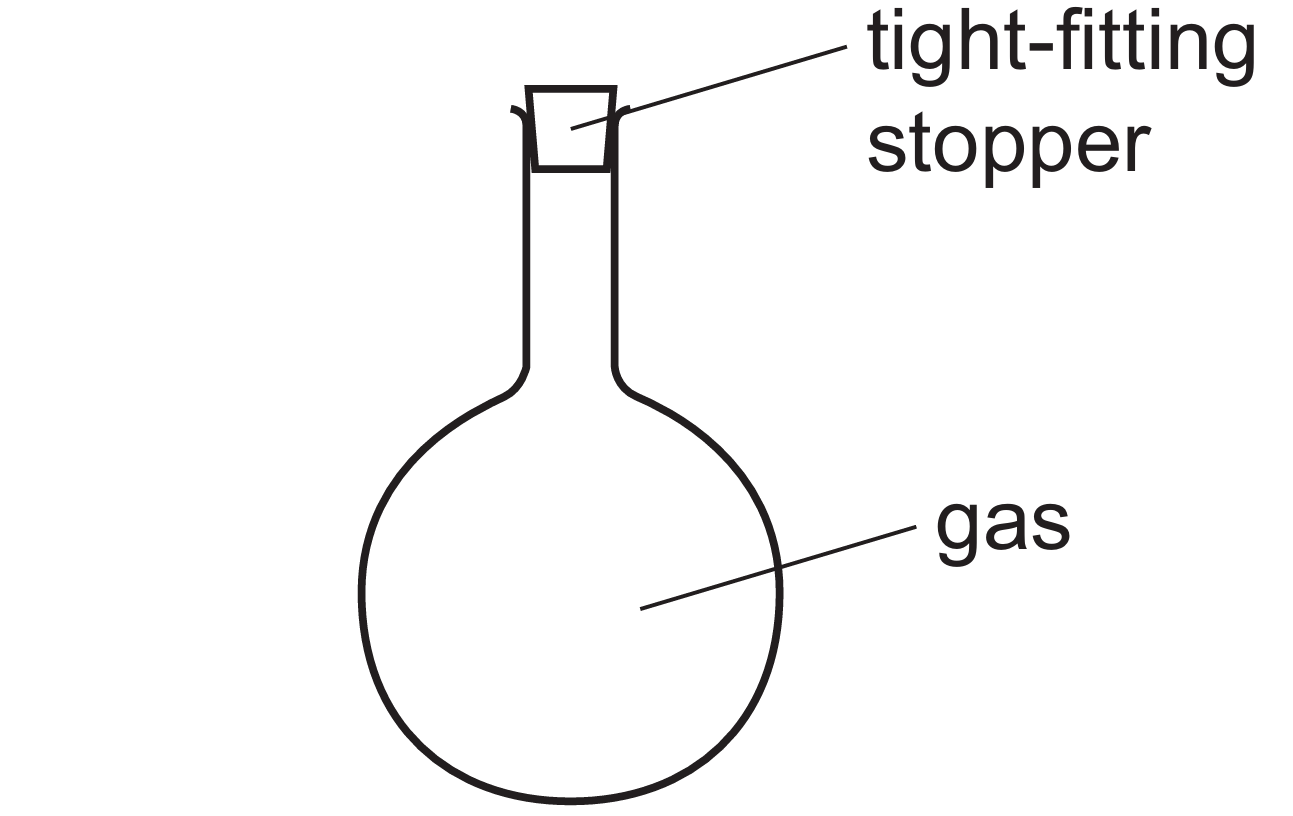
A flask with a tight-fitting stopper contains a gas. The gas and flask are initially at room temperature.
The gas and flask are cooled.
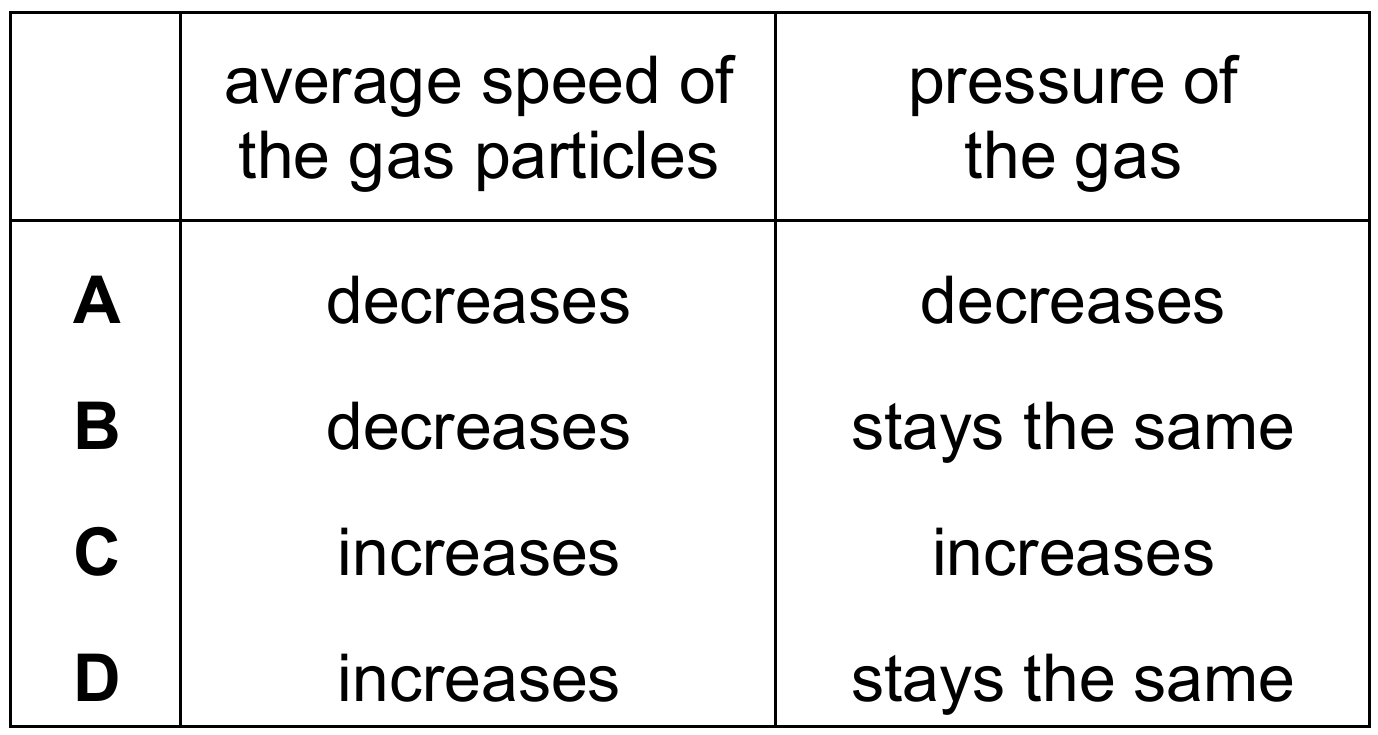
Which row describes the average speed of the gas particles and the pressure of the gas as the temperature decreases?

Most-appropriate topic codes (Cambridge IGCSE Physics 0625):

TOPIC 2.1.2: Particle model (Relationship between motion of particles and temperature)
TOPIC 2.1.3: Gases and the absolute scale of temperature (Effect of temperature on pressure)
▶️ Answer/Explanation
Correct Option: A

Detailed solution:

Temperature is a measure of the average kinetic energy of the particles; thus, as the temperature decreases, the average speed of the gas particles also decreases.
The pressure of a gas is caused by particles colliding with the walls of the container, exerting a force per unit area.
When cooled, the slower-moving particles hit the walls less frequently and with less force, leading to a reduction in pressure.
Since the flask is sealed with a tight-fitting stopper, the volume remains constant while the temperature drops.
According to the kinetic particle model, both the particle velocity and the internal pressure must decrease under these conditions.
Therefore, Row A correctly identifies that both the average speed and the pressure decrease as the temperature falls.
Question 11

Brownian motion is the random movement of microscopic particles in a liquid or gas.
Which statement about Brownian motion is correct?
A. Brownian motion only occurs when the liquid or gas is heated.
B. Much heavier fast-moving particles that cannot be seen collide with the microscopic particles.
C. Much lighter fast-moving particles that cannot be seen collide with the microscopic particles.
D. The microscopic particles move to avoid the fast-moving liquid or gas molecules.

Most-appropriate topic codes (Cambridge IGCSE Physics 0625):

TOPIC 2.1.2: Particle model (Brownian motion in terms of random collisions)
▶️ Answer/Explanation
Correct Option: C

Detailed solution:

Brownian motion provides evidence for the kinetic particle model of matter.
It is the observed random, “zigzag” movement of visible microscopic particles, such as smoke or pollen grains.
This movement is caused by continuous, unequal collisions with much smaller, lighter molecules of the surrounding fluid.
These fluid molecules (atoms or molecules) are too small to be seen even under a microscope but move at high speeds.
Because these molecules are much lighter and faster than the microscopic particles, their impact causes the visible particles to change direction randomly.
Therefore, option C correctly identifies that the collisions involve much lighter, invisible, fast-moving particles.

Question 12

The distance between two electricity pylons is 60 m. The cable that connects the two pylons is 62 m in length.
Why is the cable longer than the distance between the two pylons?
A. to allow for contraction of the cable in cold weather
B. to create a slope in the cable for electrons to flow down
C. to keep the current low and the voltage high
D. to reduce magnetic fields around the cable

Most-appropriate topic codes (Cambridge IGCSE Physics 0625):

TOPIC 2.2.1: Thermal expansion of solids, liquids and gases (Describe some of the everyday applications and consequences of thermal expansion)
▶️ Answer/Explanation
Correct Option: A

Detailed solution:

Most materials, including metal cables, undergo thermal expansion when heated and contraction when cooled.
In cold weather, the kinetic energy of the particles decreases, causing the cable to shorten in length.
If the 62 m cable were stretched tightly across the 60 m gap, contraction could cause it to snap or pull the pylons inward.
The extra 2 m of length provides a “slack” that ensures the cable remains intact even at very low temperatures.
Options B, C, and D are incorrect as they describe electrical or magnetic properties unrelated to the physical length of the wire.

Question 13

A glass beaker contains a mass of $0.20~\text{kg}$ of water at a temperature of $20~^{\circ}\text{C}$.
The specific heat capacity of water is $4200~\text{J}/(\text{kg}~^{\circ}\text{C})$.
A brass block of mass $0.15~\text{kg}$ is at a temperature of $170~^{\circ}\text{C}$.
The block is carefully lowered into the beaker of water.
The final temperature of both the water and brass is $30~^{\circ}\text{C}$.

What is the specific heat capacity of the brass? (Assume no water is lost and no thermal energy is transferred to the beaker or surroundings.)

A. $400~\text{J}/(\text{kg}~^{\circ}\text{C})$
B. $660~\text{J}/(\text{kg}~^{\circ}\text{C})$
C. $1200~\text{J}/(\text{kg}~^{\circ}\text{C})$
D. $5600~\text{J}/(\text{kg}~^{\circ}\text{C})$

Most-appropriate topic codes (Cambridge IGCSE Physics 0625):

TOPIC 2.2.2: Specific heat capacity (Recall and use the equation $c = \frac{\Delta E}{m \Delta \theta}$)
▶️ Answer/Explanation
Correct Option: A

Detailed solution:

The energy gained by the water equals the energy lost by the brass: $m_{w}c_{w}\Delta\theta_{w} = m_{b}c_{b}\Delta\theta_{b}$.
For water: $\Delta E = 0.20~\text{kg} \times 4200~\text{J}/(\text{kg}~^{\circ}\text{C}) \times (30~^{\circ}\text{C} – 20~^{\circ}\text{C}) = 8400~\text{J}$.
For brass: $\Delta\theta_{b} = 170~^{\circ}\text{C} – 30~^{\circ}\text{C} = 140~^{\circ}\text{C}$.
Using the specific heat formula for brass: $c_{b} = \frac{\Delta E}{m_{b}\Delta\theta_{b}}$.
$c_{b} = \frac{8400~\text{J}}{0.15~\text{kg} \times 140~^{\circ}\text{C}} = \frac{8400}{21} = 400~\text{J}/(\text{kg}~^{\circ}\text{C})$.
This matches Option A.

Question 14

Which statement about convection is not correct?
A. It enables water in a pan on a cooker to get evenly heated.
B. It happens in liquids and gases.
C. It occurs because cooler liquids rise above warmer liquids.
D. It occurs because the density of a liquid decreases when it is heated.

Most-appropriate topic codes (Cambridge IGCSE Physics 0625):

TOPIC 2.3.2: Convection (Explain convection in liquids and gases in terms of density changes)
▶️ Answer/Explanation
Correct Option: C

Detailed solution:

Convection is a method of thermal energy transfer that occurs in fluids (liquids and gases).
When a liquid is heated, its particles gain kinetic energy, move further apart, and the volume increases.
According to $\rho = \frac{m}{V}$, the density decreases, causing the warmer, less dense liquid to rise.
Conversely, cooler liquid is denser and sinks to take the place of the rising warm liquid, creating a convection current.
Statement C is incorrect because it is the warmer, less dense liquid that rises, not the cooler liquid.
This process ensures that heat is distributed throughout a substance, such as water in a pan.

Question 15

Iron is a better conductor of thermal energy than rubber.
Which statement explains this?
A. Electrons in iron can move from one part of the iron to another. Electrons in rubber cannot move in this way.
B. Electrons in iron vibrate with more energy than those in rubber.
C. Positive particles in iron can move from one part of the iron to another. Positive particles in rubber cannot move in this way.
D. Positive particles in iron vibrate with more energy than those in rubber.

Most-appropriate topic codes (Cambridge IGCSE Physics 0625):

TOPIC 2.3.1: Conduction (Describe thermal conduction in terms of the movement of free electrons in metallic conductors)
▶️ Answer/Explanation
Correct Option: A

Detailed solution:

Thermal conduction in metals like iron occurs through two main mechanisms: lattice vibrations and the movement of delocalised (free) electrons.
In metallic conductors, these free electrons gain kinetic energy in hotter regions and rapidly transfer it to cooler parts by moving through the structure.
Rubber is an insulator and lacks these free electrons; therefore, it relies solely on much slower atom-to-atom vibrations for energy transfer.
Positive ions in a solid lattice remain in fixed positions and do not move from one part of the material to another, making options C and D incorrect.
Option A correctly identifies that the mobility of electrons is the primary reason for iron’s superior thermal conductivity compared to rubber.

Question 16

Two metal cans are identical, except that one has a shiny silver outer surface and the other has a dull black outer surface. They each have the same mass of hot water at the same temperature sealed inside them. They are both in a vacuum in the darkness of outer space.
How does the temperature of the water in each one change?
A. The temperature of the water does not change.
B. The water in the black can cools more slowly than that in the silver can.
C. The water in the silver can cools more slowly than that in the black can.
D. They both cool down at the same rate.

Most-appropriate topic codes (Cambridge IGCSE Physics 0625):

TOPIC 2.3.3: Radiation (Effect of surface colour and texture on emission of infrared radiation)
▶️ Answer/Explanation
Correct Option: C

Detailed solution:

In the vacuum of space, thermal energy can only be lost through radiation, as conduction and convection require a medium.
The rate of emission of infrared radiation depends heavily on the nature of the object’s surface.
Dull black surfaces are excellent emitters of radiation, while shiny silver surfaces are very poor emitters.
Since the black can radiates energy away much more efficiently, the internal energy and temperature of its water will decrease rapidly.
The silver can reflects most internal radiation back inward and emits very little to the surroundings.
Consequently, the water in the silver can retains its heat longer and cools more slowly than the water in the black can.

Question 17

A ray of light reflects from a plane mirror.
The angle between the incident ray and the surface of the mirror is 35°.
Which statement is correct?
A. The angle of incidence is 35°.
B. The angle of incidence is 55°.
C. The angle of reflection is 70°.
D. The angle of reflection is 110°.

Most-appropriate topic codes (Cambridge IGCSE Physics 0625):

TOPIC 3.2.1: Reflection of light (Define and use the terms normal, angle of incidence and angle of reflection)
▶️ Answer/Explanation
Correct Option: B

Detailed solution:

The normal is an imaginary line perpendicular to the mirror surface, forming a 90° angle.
The angle of incidence i is measured between the incident ray and the normal, not the mirror surface.
Given the angle between the ray and the surface is 35°, the angle of incidence is 90 ∘ −35 ∘ =55 ∘ .
According to the law of reflection, the angle of incidence i is equal to the angle of reflection r.
Therefore, the angle of reflection is also 55 ∘ , making option B the only correct statement.

Question 18

Parallel waves in a ripple tank are diffracted as they pass through a gap in a barrier.
Three changes that can be made to this arrangement are listed:

  1. Decrease the wavelength of the waves.
  2. Increase the amplitude of the waves.
  3. Decrease the size of the gap.

Which changes will cause the shape of the diffracted waves to be less curved?

A. 1, 2 and 3
B. 1 and 3 only
C. 1 only
D. 2 and 3 only

Most-appropriate topic codes (Cambridge IGCSE Physics 0625):

TOPIC 3.1: General properties of waves (Describe how wavelength and gap size affects diffraction through a gap)
▶️ Answer/Explanation
Correct Option: C

Detailed solution:

Diffraction is the spreading of waves as they pass through a gap. The degree of diffraction (curvature) depends on the ratio of the wavelength $\lambda$ to the gap width $w$.
Maximum diffraction occurs when $\lambda \approx w$, resulting in semi-circular, highly curved waves.
To make waves less curved (less diffraction), we must decrease the wavelength relative to the gap size.
1. Decreasing $\lambda$ makes the waves spread less, appearing flatter/less curved.
2. Changing amplitude has no effect on the shape or curvature of the diffracted wavefronts.
3. Decreasing the gap size $w$ actually increases curvature and spreading.
Therefore, only change 1 results in less curved diffracted waves.

Question 19

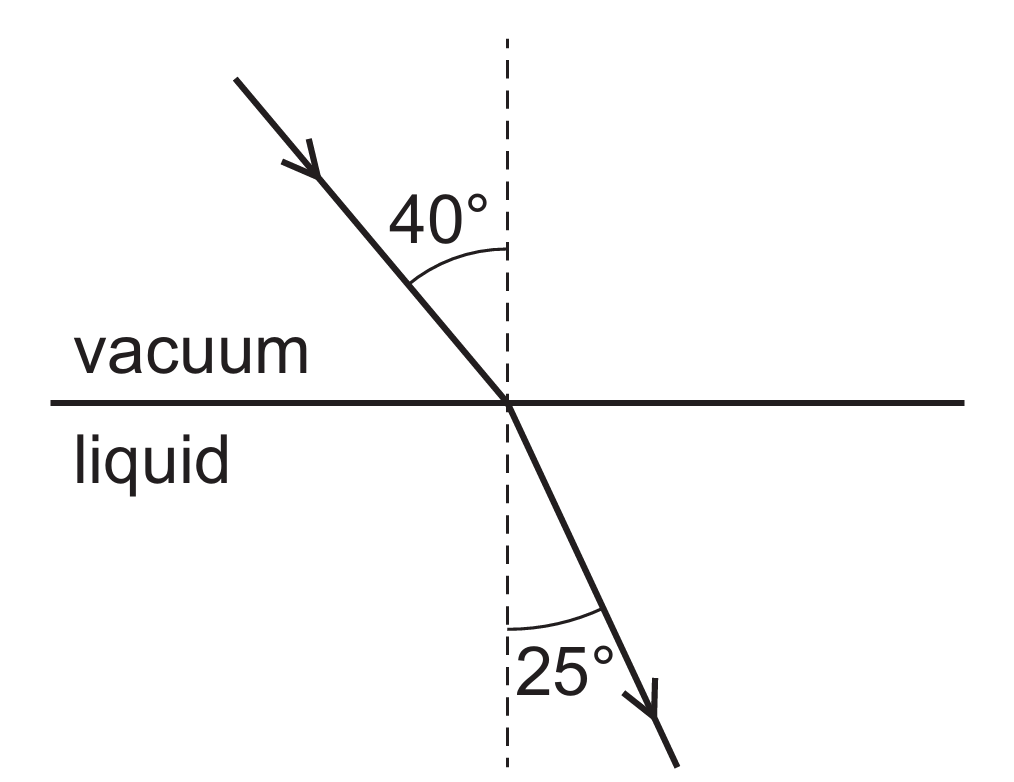
A beam of light passes through a vacuum and then enters a transparent liquid. The diagram shows the path it takes.
The light travels through the vacuum at a speed of $3.0 \times 10^{8}$ m/s.
What is the speed of light in the liquid?
A. $1.9 \times 10^{8}$ m/s
B. $2.0 \times 10^{8}$ m/s
C. $4.6 \times 10^{8}$ m/s
D. $4.8 \times 10^{8}$ m/s

Most-appropriate topic codes (Cambridge IGCSE Physics 0625):

TOPIC 3.2.2: Refraction of light (Define refractive index, $n$, as the ratio of the speeds of a wave in two different regions)
▶️ Answer/Explanation
Correct Option: B

Detailed solution:

First, calculate the refractive index $n$ using Snell’s Law: $n = \frac{\sin i}{\sin r}$, where $i = 40^{\circ}$ and $r = 25^{\circ}$.
This gives $n = \frac{\sin 40^{\circ}}{\sin 25^{\circ}} \approx \frac{0.6428}{0.4226} \approx 1.52$.
The refractive index is also defined by the ratio of speeds: $n = \frac{v_{\text{vacuum}}}{v_{\text{liquid}}}$.
Rearranging for the speed in liquid: $v_{\text{liquid}} = \frac{v_{\text{vacuum}}}{n} = \frac{3.0 \times 10^{8}}{1.52}$.
The resulting speed is approximately $1.97 \times 10^{8}$ m/s, which rounds to $2.0 \times 10^{8}$ m/s.
Thus, option B is the correct choice based on these physical principles.
Question 20

Which statement about a thin converging lens is correct?
A. All rays of light refracted by the lens pass through the principal focus.
B. All rays initially parallel to the principal axis of the lens are refracted through the principal focus.
C. The focal length of the lens is the distance between the image and the principal focus.
D. The focal length of the lens is the distance between the object and the image.

Most-appropriate topic codes (Cambridge IGCSE Physics 0625):

TOPIC 3.2.3: Thin lenses (Describe the action of thin converging lenses on a parallel beam of light)
▶️ Answer/Explanation
Correct Option: B

Detailed solution:

By definition, a converging lens refracts incident rays that are parallel to the principal axis so that they meet at a single point called the principal focus (F).
Statement A is incorrect because rays not parallel to the axis (like those passing through the optical center) do not necessarily pass through the principal focus after refraction.
The focal length (f) is defined as the distance from the optical center of the lens to the principal focus, not the distance to the image or object as suggested in C and D.
Therefore, statement B is the only technically accurate description of the lens’s refractive properties.
This property is fundamental for constructing ray diagrams and determining the focal point of a lens experimentally.

Question 21

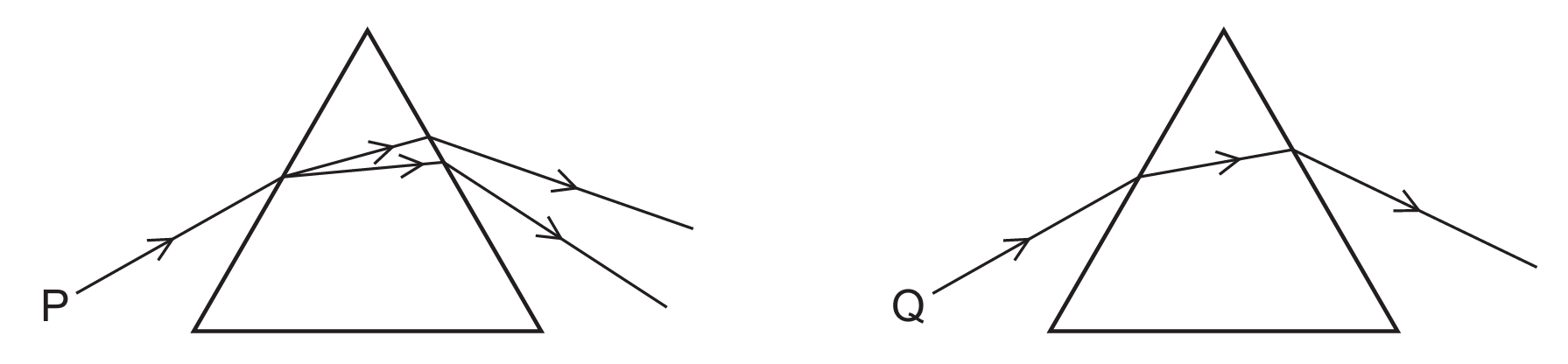
The diagram shows two narrow beams of light, P and then Q, passing through the same prism. Beams P and Q are both incident on the same point on the prism and at the same angle.
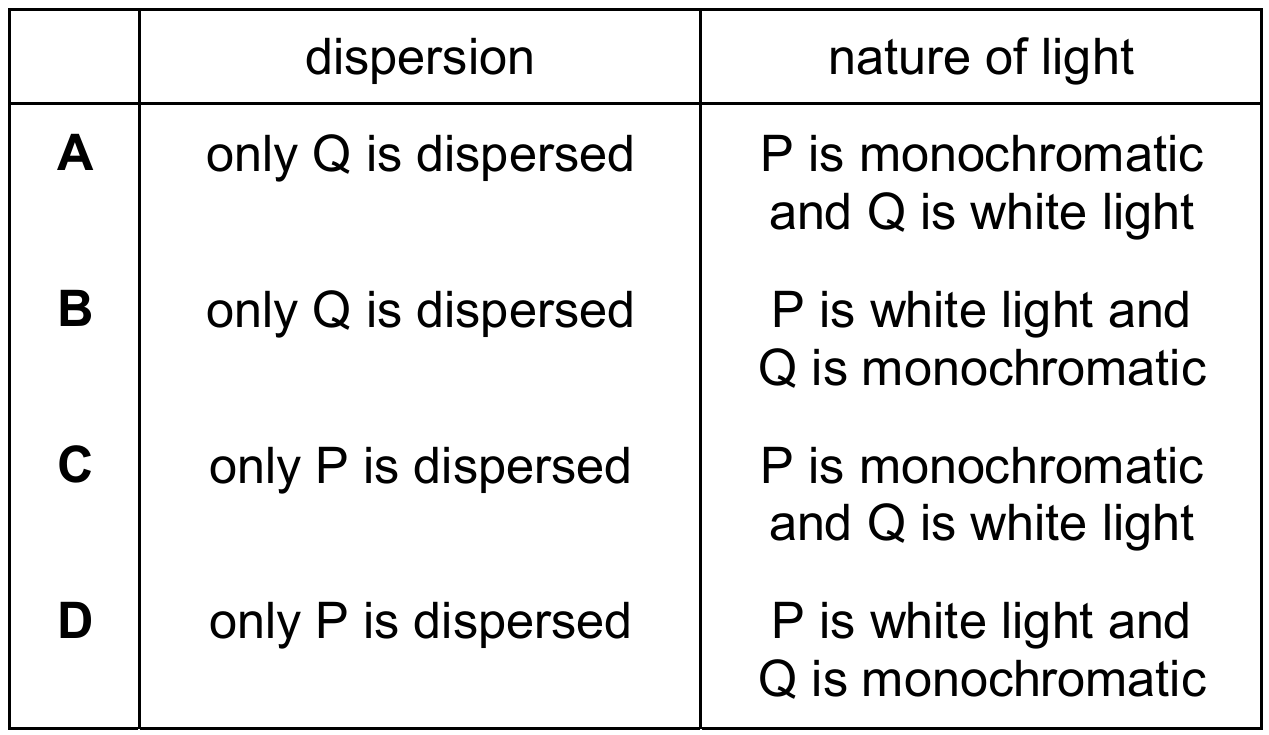
Which row correctly compares beams P and Q?

Most-appropriate topic codes (Cambridge IGCSE Physics 0625):

TOPIC 3.2.4: Dispersion of light (Describe the dispersion of light as illustrated by the refraction of white light by a glass prism)
▶️ Answer/Explanation
Correct Option: D

Detailed solution:

Dispersion occurs when white light separates into its constituent colors because different frequencies refract by different amounts.
In the diagram, beam P splits into multiple rays after entering the prism, indicating it is white light undergoing dispersion.
Beam Q remains as a single ray, meaning it consists of only one frequency and is therefore monochromatic light.
Since only beam P shows a spread of colors, only P is dispersed.
Matching these observations, P must be white light and Q must be monochromatic.
This corresponds exactly to the information provided in Row D.
Question 22

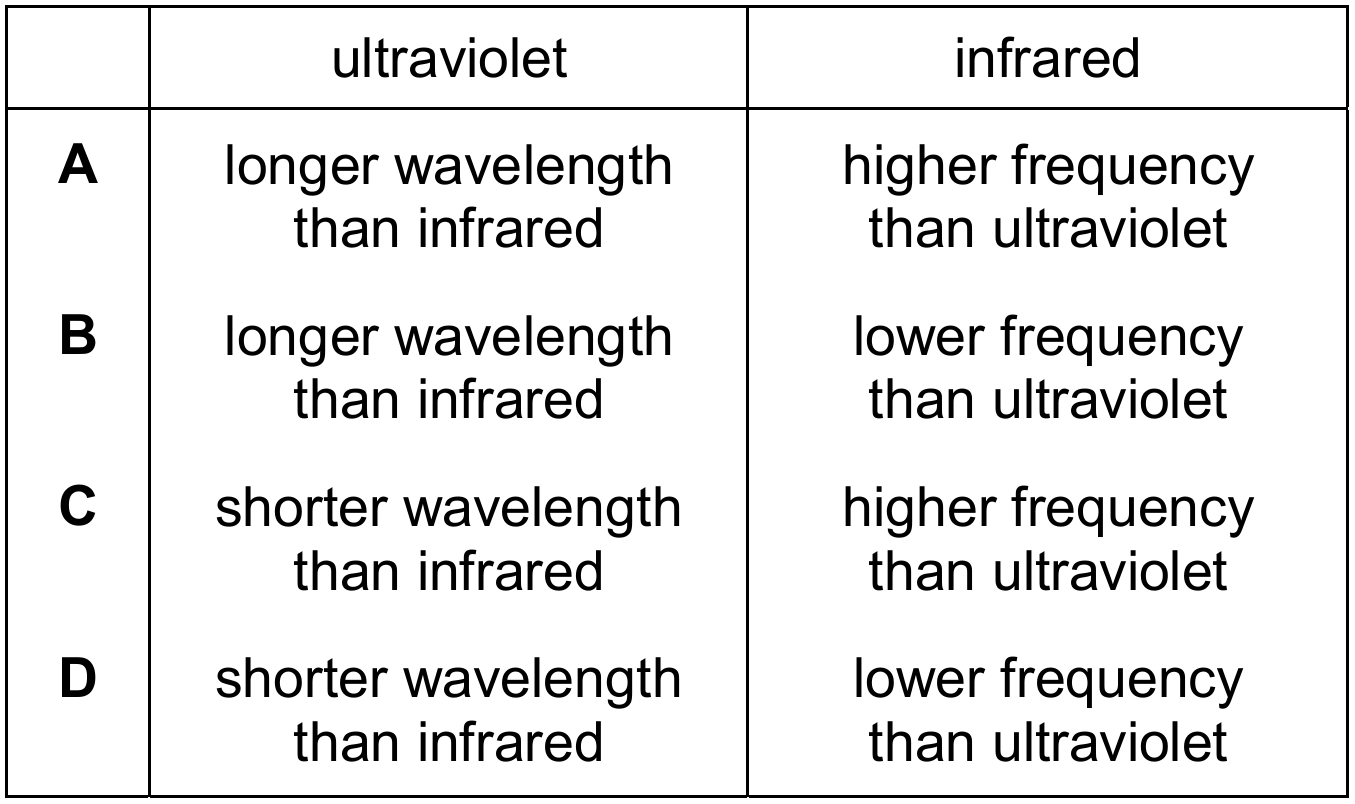
Ultraviolet radiation and infrared radiation are both parts of the electromagnetic spectrum.
However, they differ in wavelength and frequency.
Which row describes how they differ?

Most-appropriate topic codes (Cambridge IGCSE Physics 0625):

TOPIC 3.3: Electromagnetic spectrum (Main regions in order of frequency and wavelength)
▶️ Answer/Explanation
Correct Option: D

Detailed solution:

All electromagnetic waves travel at the same speed in a vacuum, defined by the equation v=fλ.
In the electromagnetic spectrum, ultraviolet (UV) radiation has a higher frequency and thus a shorter wavelength than visible light.
Conversely, infrared (IR) radiation has a lower frequency and a longer wavelength than visible light.
Therefore, ultraviolet radiation possesses a shorter wavelength compared to infrared radiation.
Because frequency and wavelength are inversely proportional, infrared must have a lower frequency than ultraviolet.
This identifies Row D as the correct description of the physical differences between these two regions.
Question 23

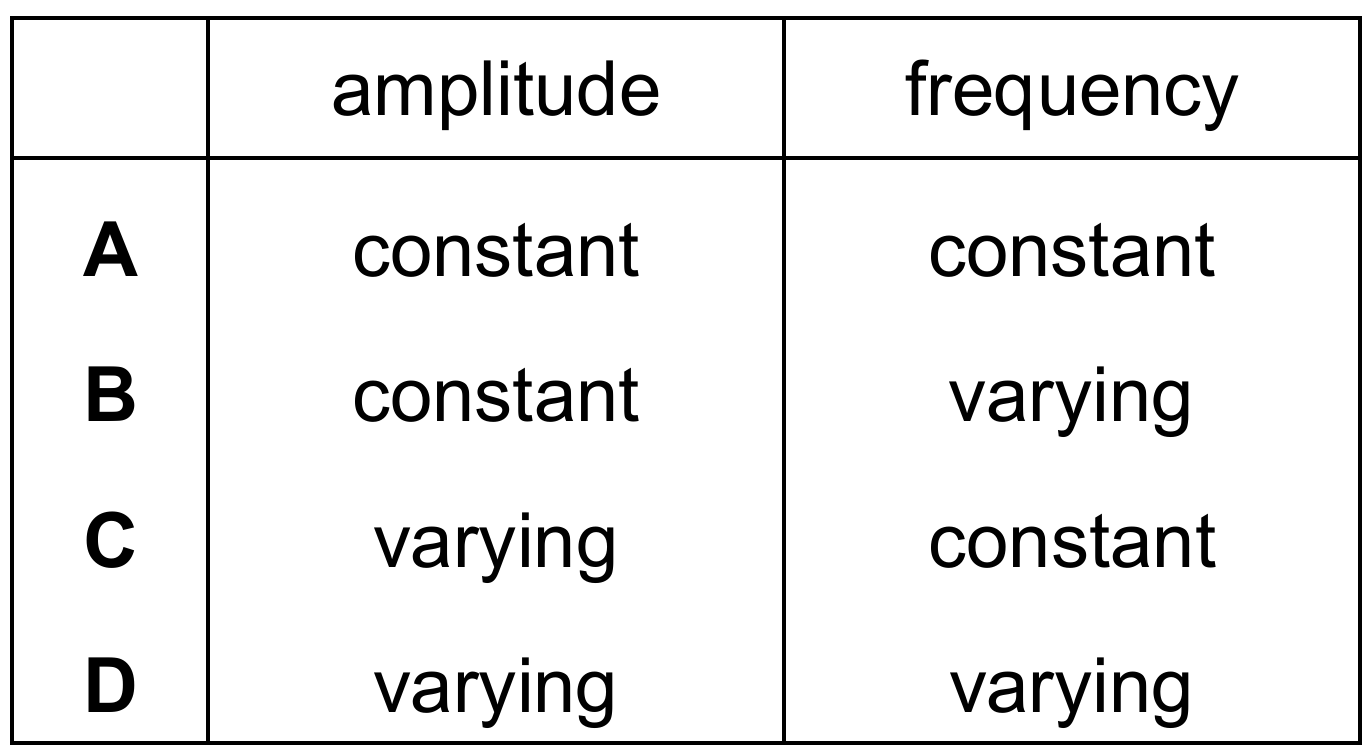
A police car with its siren sounding is stationary in heavy traffic. A pedestrian notices that, although the loudness of the sound produced does not change, the pitch varies.
Which row describes the amplitude and the frequency of the sound?

Most-appropriate topic codes (Cambridge IGCSE Physics 0625):

TOPIC 3.4: Sound (Describe how changes in amplitude and frequency affect the loudness and pitch)
▶️ Answer/Explanation
Correct Option: B

Detailed solution:

The loudness of a sound wave is determined by its $amplitude$; since the loudness does not change, the $amplitude$ remains $constant$.
The pitch of a sound is determined by its $frequency$, where a higher $frequency$ corresponds to a higher pitch.
Because the observer notices the pitch varies, the $frequency$ must be $varying$.
This relationship is a core concept in wave properties where $Loudness \propto Amplitude$ and $Pitch \propto Frequency$.
Therefore, the correct description of the sound characteristics is found in Row B.
Question 24

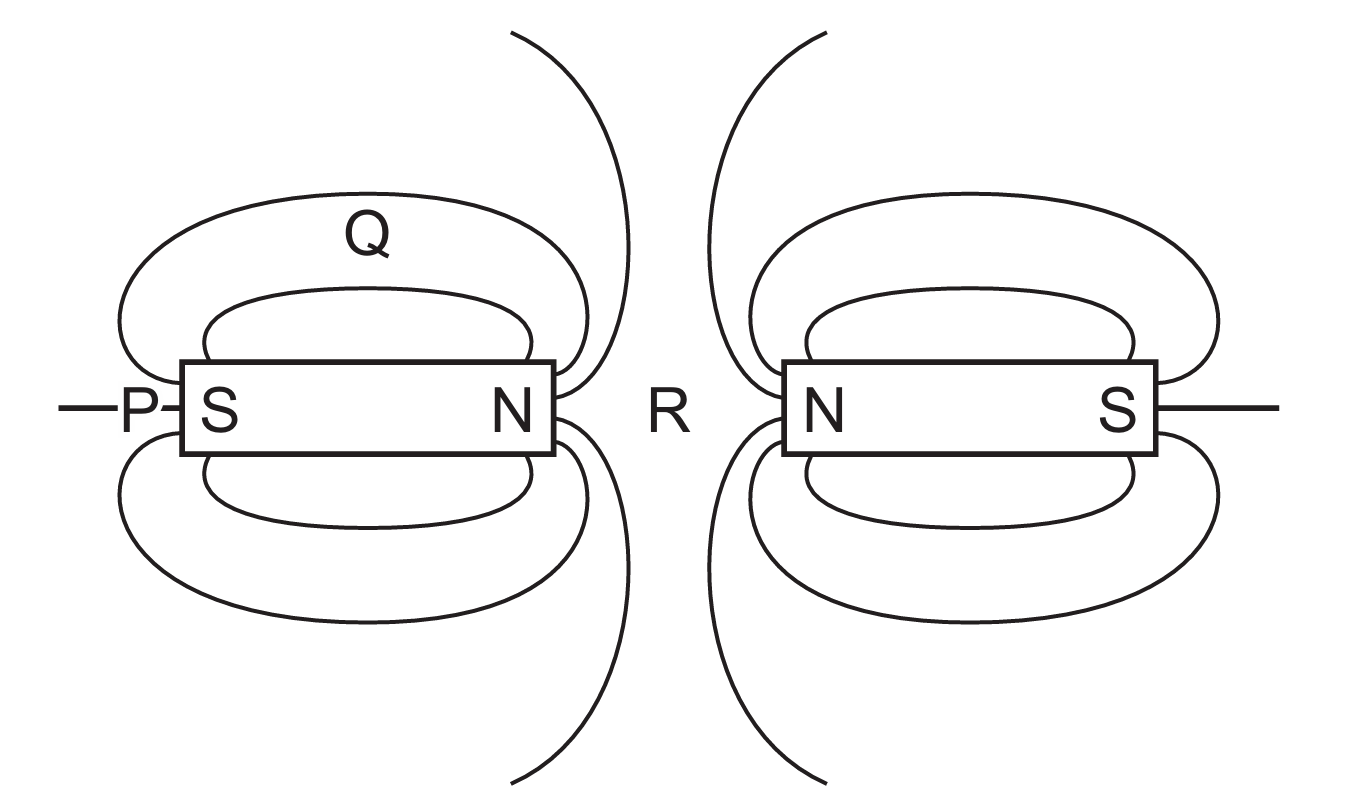
The diagram shows part of the magnetic field around two magnets.
Which list gives the order of magnetic field strengths at the positions $P$, $Q$ and $R$, from weakest to strongest?
A. $P \rightarrow Q \rightarrow R$
B. $P \rightarrow R \rightarrow Q$
C. $Q \rightarrow P \rightarrow R$
D. $R \rightarrow Q \rightarrow P$

Most-appropriate topic codes (Cambridge IGCSE Physics 0625):

TOPIC 4.1: Simple phenomena of magnetism (Relative strength represented by spacing of field lines)
▶️ Answer/Explanation
Correct Option: D

Detailed solution:

The strength of a magnetic field is visually represented by the density or spacing of the magnetic field lines.
At position $R$, there are no field lines shown, indicating a neutral point where the opposing fields cancel out, making it the weakest.
At position $Q$, the lines are present but widely spaced, representing a moderate field strength.
At position $P$, the field lines are most concentrated near the pole of the magnet, indicating the strongest field.
Therefore, the correct order from weakest to strongest is $R \rightarrow Q \rightarrow P$, which corresponds to Option D.
Question 25

A fully charged battery stores a charge of 18 000 C. The battery is charged with a current of 830 mA.
How long does it take to fully charge a completely discharged battery?
A. about 10 minutes
B. about 3.5 hours
C. about 4 hours
D. about 6 hours

Most-appropriate topic codes (Cambridge IGCSE Physics 0625):

TOPIC 4.2.2: Electric current (Recall and use the equation $I = \frac{Q}{t}$)
▶️ Answer/Explanation
Correct Option: D

Detailed solution:

First, convert the current from milliamperes to amperes: $I = 830\text{ mA} = 0.83\text{ A}$.
Using the charge formula $Q = It$, rearrange to solve for time: $t = \frac{Q}{I}$.
Substitute the given values: $t = \frac{18000\text{ C}}{0.83\text{ A}} \approx 21686.7\text{ seconds}$.
To convert seconds into hours, divide by $3600$: $t \approx \frac{21686.7}{3600} \approx 6.02\text{ hours}$.
This value is approximately 6 hours, which matches Option D.

Question 26

What is the definition of electromotive force?
A. the electrical work done by a source in moving a unit charge around a complete circuit
B. the electrical work done by a unit charge passing through a component
C. the mechanical work done by a source in moving a unit charge around a complete circuit
D. the mechanical work done by a unit charge passing through a component

Most-appropriate topic codes (Cambridge IGCSE Physics 0625):

TOPIC 4.2.3: Electromotive force and potential difference (Define electromotive force (e.m.f.) as the electrical work done by a source in moving a unit charge around a complete circuit)
▶️ Answer/Explanation
Correct Option: A

Detailed solution:

Electromotive force ($e.m.f.$) represents the energy supplied by a source, such as a battery or generator, per unit charge.
It is specifically defined as the electrical work done ($W$) by the source to move a unit charge ($Q$) around a complete circuit.
The mathematical relationship is expressed as $E = \frac{W}{Q}$, where $E$ is measured in Volts ($V$).
Option B describes potential difference, which refers to work done across a single component rather than the whole circuit.
Options C and D are incorrect because $e.m.f.$ specifically concerns electrical work rather than mechanical work.
Thus, Option A is the technically accurate definition according to the syllabus standards.

Question 27

A cell passes a current of 2.0 A in a circuit for 30 s. In this time, the cell transfers 120 J of energy.What is the electromotive force (e.m.f.) of the cell?
A. 0.50 V
B. 1.5 V
C. 2.0 V
D. 8.0 V

Most-appropriate topic codes (Cambridge IGCSE Physics 0625):

TOPIC 4.2.3: Electromotive force and potential difference (Recall and use the equation $E = \frac{W}{Q}$)
▶️ Answer/Explanation
Correct Option: C

Detailed solution:

First, calculate the total charge $Q$ moved using the formula $Q = I \times t$.
Given $I = 2.0 \text{ A}$ and $t = 30 \text{ s}$, then $Q = 2.0 \times 30 = 60 \text{ C}$.
Electromotive force ($e.m.f.$) is defined as the work done per unit charge, $E = \frac{W}{Q}$.
Using the energy transferred $W = 120 \text{ J}$ and the calculated charge $Q = 60 \text{ C}$:
$E = \frac{120}{60} = 2.0 \text{ V}$.
Thus, the $e.m.f.$ of the cell is $2.0 \text{ V}$, which corresponds to option C.

Question 28

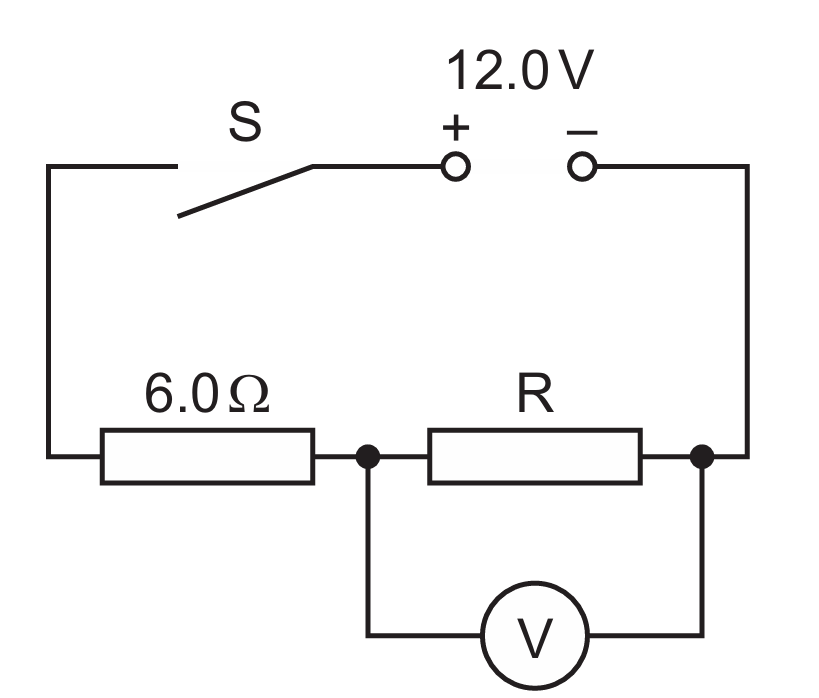
The diagram shows two resistors in series connected to a power supply.
The reading on the voltmeter is 3.0 V when the switch is closed.
What is the resistance of resistor R?
A. 0.67 Ω
B. 1.2 Ω
C. 1.5 Ω
D. 2.0 Ω

Most-appropriate topic codes (Cambridge IGCSE Physics 0625):

TOPIC 4.3.2: Series and parallel circuits (Total p.d. in a series circuit; Potential difference across parallel resistances)
▶️ Answer/Explanation
Correct Option: D

Detailed solution:

In a series circuit, the total voltage V total ​ =12.0 V is shared between resistors. Since the voltage across R is V R ​ =3.0 V, the voltage across the 6.0 Ω resistor is 12.0 V−3.0 V=9.0 V.
Using Ohm’s Law, the current in the circuit is I= R V ​ = 6.0 Ω 9.0 V ​ =1.5 A.
Because current is the same at every point in a series circuit, we find the resistance of R using R= I V R ​ ​ = 1.5 A 3.0 V ​ =2.0 Ω.
Alternatively, using the potential divider ratio R 2 ​ R 1 ​ ​ = V 2 ​ V 1 ​ ​ , we get R 6.0 Ω ​ = 3.0 V 9.0 V ​ , which simplifies to R=2.0 Ω.

Question 29

Lamps can be connected in series or in parallel to a power supply. What is an advantage of connecting the lamps in parallel rather than in series?
A. All of the lamps can be switched on and off using the same switch.
B. Fewer connecting leads are needed to make the circuit.
C. When one lamp stops working, the others may continue to work.
D. Less power is transferred from the supply.

Most-appropriate topic codes (Cambridge IGCSE Physics 0625):

TOPIC 4.3.2: Series and parallel circuits (State the advantages of connecting lamps in parallel in a lighting circuit)
▶️ Answer/Explanation
Correct Option: C

Detailed solution:

In a parallel circuit, each lamp is connected in its own separate branch across the power supply.
This means the total current I total ​ splits between branches, while the potential difference V remains the same for each lamp.
If one lamp fails, it creates an open circuit in that specific branch only, leaving the other branches intact.
Consequently, charge continues to flow through the remaining functional branches, allowing other lamps to stay lit.
In contrast, a series circuit provides only one path; if one component fails, the entire circuit is broken and all lamps turn off.
Therefore, the independence of components is a primary advantage of parallel wiring in practical lighting systems.

Question 30

The lamps on a bicycle are powered by a simple electrical generator.
A permanent magnet rotates around a stationary coil of wire wound on an iron core.
Which statement is correct?
A. The current in the lamps decreases as the speed of rotation increases.
B. The current in the lamps decreases when the magnet is replaced by a stronger magnet.
C. The output electromotive force (e.m.f.) will be higher if the gap between the magnet and the coil is bigger.
D. The output e.m.f. will be higher if there are more turns on the coil.

Most-appropriate topic codes (Cambridge IGCSE Physics 0625):

TOPIC 4.5.1: Electromagnetic induction (State the factors affecting the magnitude of an induced e.m.f.)
▶️ Answer/Explanation
Correct Option: D

Detailed solution:

A generator works on the principle of electromagnetic induction, where a changing magnetic field induces an electromotive force ($e.m.f.$) in a conductor.
According to Faraday’s Law, the magnitude of the induced $e.m.f.$ is directly proportional to the rate of change of magnetic flux linkage.
Increasing the number of turns ($N$) on the stationary coil increases the total flux linkage, thereby resulting in a higher output $e.m.f$.
Options A and B are incorrect because increasing rotation speed or magnet strength actually increases the induced current.
Option C is incorrect because a larger gap weakens the magnetic field strength at the coil, which reduces the induced $e.m.f$.
Therefore, statement D is the only correct physical description of how to increase the generator’s output.

Question 31

A current-carrying coil in the magnetic field between the poles of two magnets experiences a turning effect. Which change would decrease the turning effect?
A. decreasing the distance between the magnets
B. increasing the current in the coil
C. using stronger magnets
D. decreasing the number of turns on the coil

Most-appropriate topic codes (Cambridge IGCSE Physics 0625):

TOPIC 4.5.5: The d.c. motor (Turning effect is increased by increasing: number of turns, current, and strength of the magnetic field)
▶️ Answer/Explanation
Correct Option: D

Detailed solution:

The turning effect (torque) on a coil in a magnetic field is determined by the formula $\tau = B I A N \cos\theta$.
To decrease the turning effect, one must reduce the magnetic field strength ($B$), the current ($I$), or the number of turns ($N$).
Options A and C increase $B$, while option B increases $I$, all of which would increase the turning effect.
Reducing the number of turns ($N$) directly reduces the total force acting on the sides of the coil.
Therefore, decreasing the number of turns on the coil is the only change that results in a smaller turning effect.

Question 32

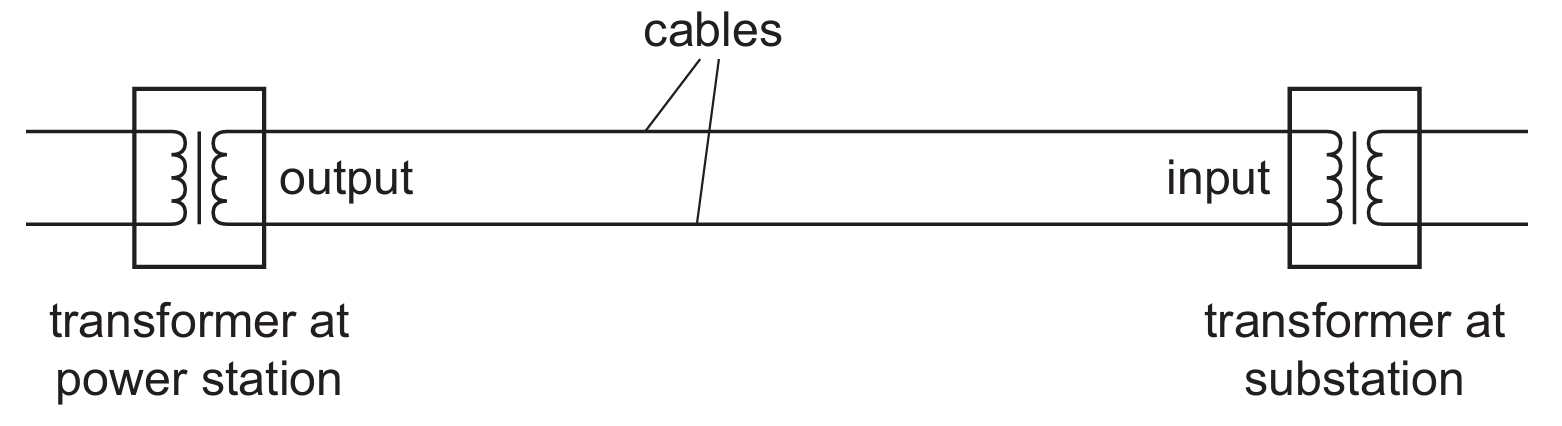
Cables transmit electrical power from the output of the transformer at a power station to the input of another transformer at a substation.
The power at the output of the transformer at the power station is 400 MW.
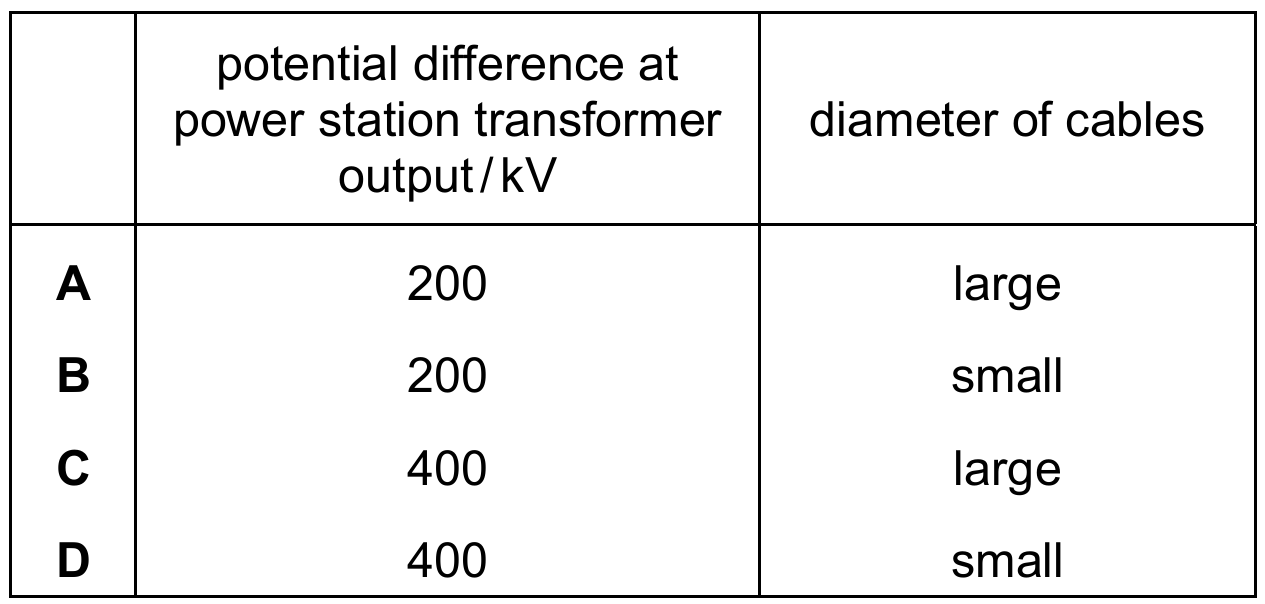
Which situation delivers the most power to the input of the transformer at the substation?

Most-appropriate topic codes (Cambridge IGCSE Physics 0625):

TOPIC 4.5.6: The transformer (High-voltage transmission and $P=I^{2}R$ power losses)
TOPIC 4.2.4: Resistance (Relationship to cross-sectional area)
▶️ Answer/Explanation
Correct Option: C

Detailed solution:

To deliver maximum power, we must minimize power loss ($P_{loss} = I^{2}R$) in the cables. Using a higher potential difference ($V = 400 \text{ kV}$) reduces the current ($I$) since $P = IV$. Lower current significantly reduces $I^{2}R$ losses. Additionally, resistance ($R$) is inversely proportional to cross-sectional area; thus, cables with a large diameter have lower resistance. Combining the highest voltage ($400 \text{ kV}$) and the lowest resistance (large diameter) ensures the least energy is wasted as heat, delivering the most power to the substation.
Question 33

94 239 ​ Pu is an isotope of plutonium.
The nucleus can absorb a neutron and then split to form two other nuclei.
Two nuclei that form are gold, 79 207 ​ Au, and phosphorus, 15 31 ​ P.
In this reaction, neutrons are also produced.
What is the number of neutrons produced when the nucleus splits?
A. 1
B. 2
C. 4
D. 5

Most-appropriate topic codes (Cambridge IGCSE Physics 0625):

TOPIC 5.1.2: The nucleus (Use the nuclide notation and describe nuclear fission)
▶️ Answer/Explanation
Correct Option: B

Detailed solution:

The nuclear fission reaction can be represented by balancing the nucleon numbers (A).
The initial state consists of one plutonium nucleus and one absorbed neutron: 94 239 ​ Pu+ 0 1 ​ n.
The total initial nucleon number is 239+1=240.
The products are gold, phosphorus, and an unknown number (x) of neutrons: 79 207 ​ Au+ 15 31 ​ P+x( 0 1 ​ n).
Setting the sum of nucleons equal: 240=207+31+x(1).
Solving for x: 240=238+x, which gives x=2.
Thus, 2 neutrons are produced during the split, making Option B correct.

Question 34

Three statements about alpha (α) particles and beta (β) particles are listed.
  1. The magnitude of the charge on an α-particle is twice the charge on a β-particle.
  2. The mass of an α-particle is large compared with the mass of a β-particle.
  3. The kinetic energy of an α-particle is small compared to the kinetic energy of a β-particle. Which statements help to explain the different ionising effects of α-particles and β-particles?

Which statements help to explain the different ionising effects of α-particles and β-particles?

A. 1, 2 and 3
B. 1 and 2 only
C. 1 and 3 only
D. 2 and 3 only

Most-appropriate topic codes (Cambridge IGCSE Physics 0625):

TOPIC 5.2.2: The three types of nuclear emission (Relative ionising effects with reference to kinetic energy and electric charge)
▶️ Answer/Explanation
Correct Option: B

Detailed solution:

Ionising effect depends on the ability of a particle to remove electrons from atoms through electrostatic interactions. Statement 1 is correct because α-particles have a charge of +2e, which is twice the magnitude of the −1e charge on β-particles, leading to stronger attractive forces. Statement 2 is correct as the much larger mass of α-particles (4u vs $\approx \frac{1}{1840}$u) causes them to move slower, increasing the time they spend near atoms to cause ionisation. Statement 3 is incorrect because α-particles typically have higher kinetic energies (5 MeV range) than β-particles, but high speed actually reduces ionising power. Therefore, only statements 1 and 2 provide the physical basis for the superior ionising ability of α-radiation.

Question 35

A beta-particle (β) is a fast-moving electron.
Which statement explains how beta-particles are emitted from an atom?
A. An electron is emitted as a beta-particle from an inner electron shell of the atom.
B. An electron is emitted as a beta-particle from an outer electron shell of the atom.
C. A neutron changes into a proton and a beta-particle is emitted from the nucleus.
D. A proton changes into a neutron and a beta-particle is emitted from the nucleus.

Most-appropriate topic codes (Cambridge IGCSE Physics 0625):

TOPIC 5.2.3: Radioactive decay (The following change in the nucleus occurs during β-emission: neutron→proton+electron)
▶️ Answer/Explanation
Correct Option: C

Detailed solution:

Beta decay occurs in an unstable nucleus when there is an excess of neutrons.
During this process, a neutron transforms into a proton and an electron (the beta-particle).
The nuclear equation for this change is represented as: n→p+e − .
The newly formed proton remains in the nucleus, increasing the atomic number by 1.
The electron is ejected from the nucleus at high speed as a β-particle.
Options A and B are incorrect because β-particles originate from the nucleus, not electron shells.
Option D describes the process of positron emission, which is not the standard β − decay discussed here.

Question 36

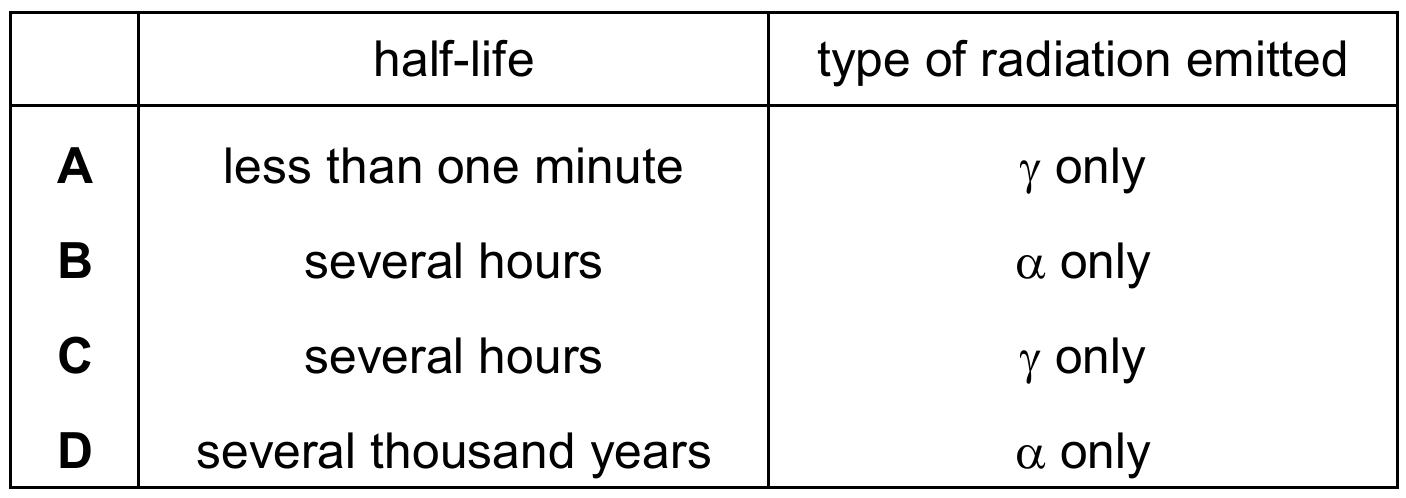
Which properties must a radioisotope have for its radiation to make it suitable to kill bacteria in food?

Most-appropriate topic codes (Cambridge IGCSE Physics 0625):

TOPIC 5.2.4: Half-life (Explain how the type of radiation and half-life determine use for irradiating food)
▶️ Answer/Explanation
Correct Option: C

Detailed solution:

To kill bacteria in food, the radiation must be highly penetrating to reach all parts of the packaging. Gamma (γ) radiation is used because it has the highest penetrating power, whereas alpha (α) radiation is easily blocked by paper or skin. A half-life of several hours is sufficient for the industrial process of irradiation; however, extremely short half-lives (less than one minute) would result in the source losing its activity too quickly to be practical for consistent use. Conversely, while very long half-lives exist, γ emitters with moderate half-lives provide a high enough activity level to effectively sterilize the product. Based on these requirements, option C is the most suitable choice.
Question 37

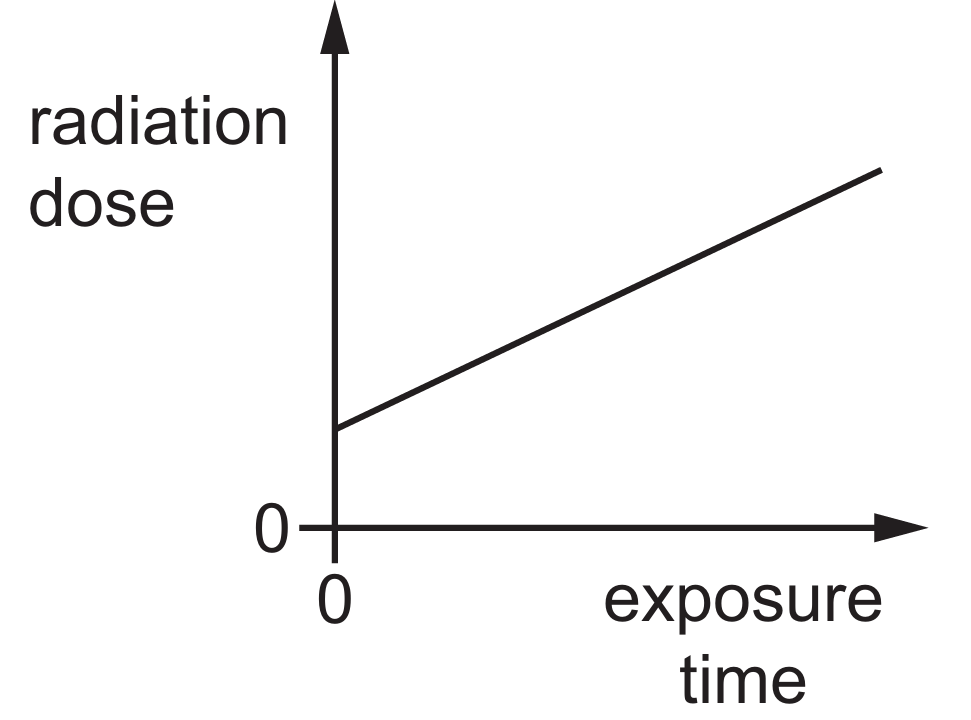
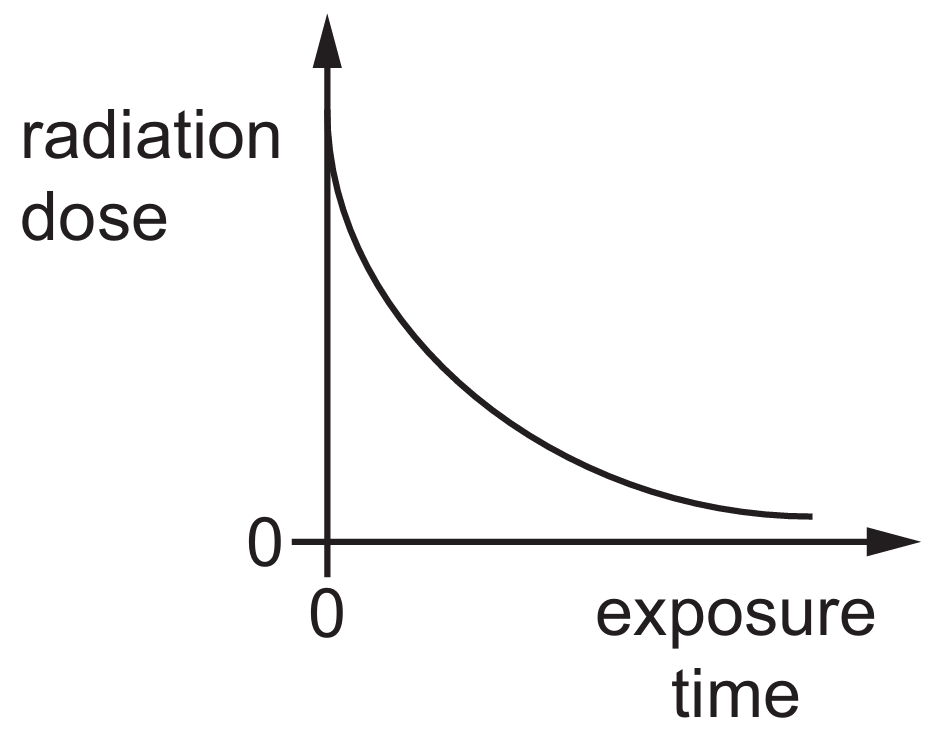
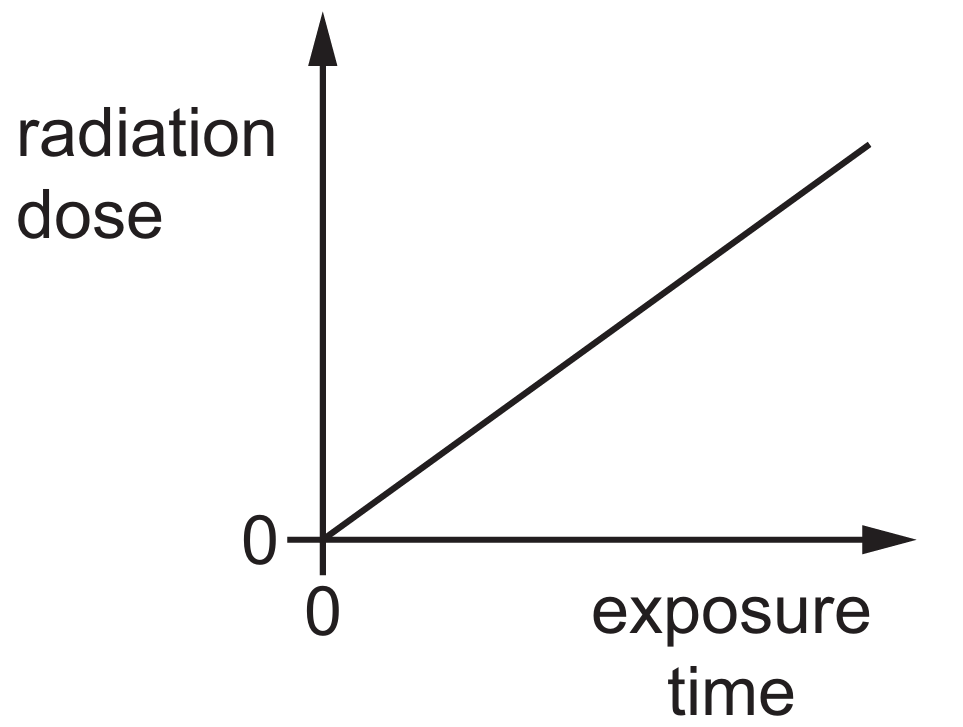
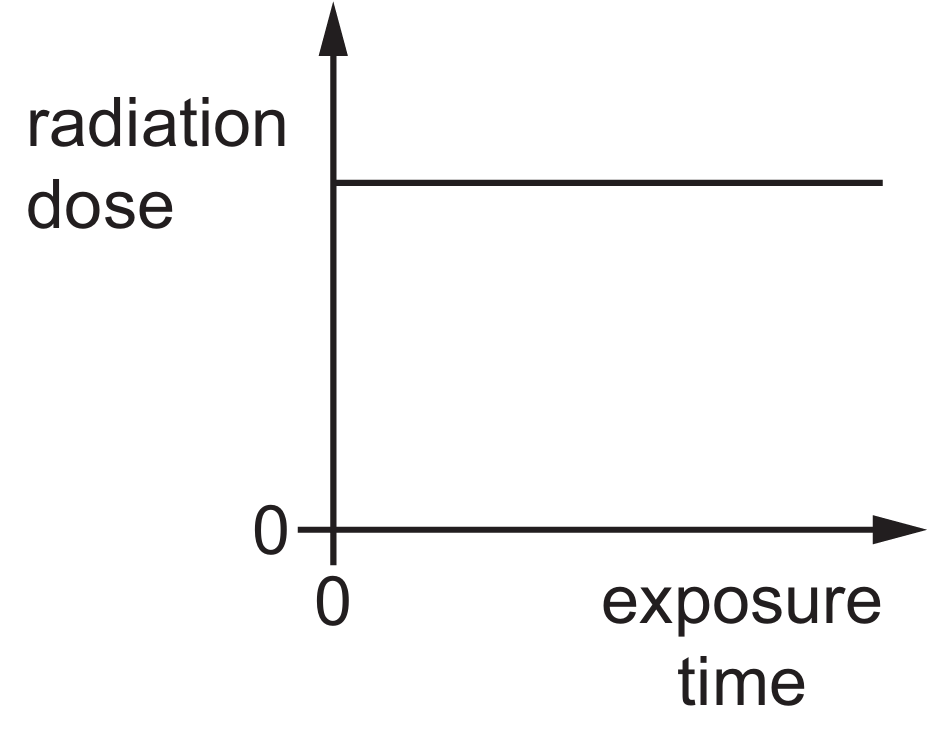
A student tries to predict the effect of exposure time on the radiation dose received from a source of ionising radiation. Radiation dose measures the amount of ionising radiation received by a living organism.
Which graph shows the correct trend between the variables?
A.
B.
C.
D.

Most-appropriate topic codes (Cambridge IGCSE Physics 0625):

TOPIC 5.2.5: Safety precautions (Explain safety precautions for all ionising radiation in terms of reducing exposure time)
▶️ Answer/Explanation
Correct Option: A

Detailed solution:

Radiation dose is defined as the total amount of energy absorbed by an organism per unit mass.
Since the source emits radiation at a relatively constant rate, the total dose accumulated is directly proportional to the duration of exposure, t.
Mathematically, this relationship can be expressed as Dose∝time, which results in a linear trend.
At an exposure time of t=0, the radiation dose received must also be 0, meaning the graph must pass through the origin.
Graph A correctly illustrates this direct proportionality, where the dose increases steadily starting from zero.
Options B, C, and D are incorrect as they suggest constant, pre-existing, or decreasing doses over time.

Question 38

A satellite is in orbit around the Earth. The orbit has radius $r$ and period $T$. Which expression gives the orbital speed of the satellite?
A. $\frac{r}{2\pi T}$
B. $\frac{T}{2\pi r}$
C. $\frac{2\pi r}{T}$
D. $\frac{2\pi T}{r}$

Most-appropriate topic codes (Cambridge IGCSE Physics 0625):

TOPIC 6.1.1: The Earth (Define average orbital speed from the equation $v=\frac{2\pi r}{T}$)
▶️ Answer/Explanation
Correct Option: C

Detailed solution:

Average speed is defined as the total distance travelled divided by the total time taken.
For a satellite in a circular orbit, the distance travelled in one complete revolution is the circumference of the circle, given by $2\pi r$.
The time taken for one complete orbit is defined as the orbital period, $T$.
By substituting these into the speed formula $v = \frac{\text{distance}}{\text{time}}$, we get the expression $v = \frac{2\pi r}{T}$.
This matches Option C, which is the standard formula for calculating orbital speed in the syllabus.

Question 39

Comets move round the Sun. Which statement describes the orbit of a comet?
A. The orbit is circular with the Sun at the centre of the circle.
B. The orbit is circular with the Sun not at the centre of the circle.
C. The orbit is elliptical with the Sun at the centre of the ellipse.
D. The orbit is elliptical with the Sun not at the centre of the ellipse.

Most-appropriate topic codes (Cambridge IGCSE Physics 0625):

TOPIC 6.1.2: The Solar System (Know that planets, minor planets and comets have elliptical orbits, and recall that the Sun is not at the centre)
▶️ Answer/Explanation
Correct Option: D

Detailed solution:

According to Kepler’s First Law and the IGCSE syllabus, comets move in highly elongated elliptical orbits.
In an elliptical orbit, the Sun is located at one of the two focal points (foci) of the ellipse.
Because the Sun is at a focus rather than the geometric center, it is not at the center of the orbital path.
This eccentricity explains why a comet’s distance r from the Sun varies significantly throughout its period T.
Therefore, statement D correctly identifies both the elliptical shape and the off-center position of the Sun.
Options A and B are incorrect as orbits are not circular, and C is incorrect because the Sun is not centered.

Question 40

A galaxy is at a distance of $60$ million light-years from the Earth. The galaxy is moving away at a speed of $1300\text{ km/s}$.

One light-year is about $9.5 \times 10^{12}\text{ km}$.
There are about $3.2 \times 10^{7}$ seconds in one year.

Which expression can be used to estimate the age of the Universe in years?
A. $\frac{60 \times 10^{6} \times 3.2 \times 10^{7}}{1300 \times 9.5 \times 10^{12}}$
B. $\frac{60 \times 10^{6} \times 9.5 \times 10^{12}}{1300 \times 3.2 \times 10^{7}}$
C. $\frac{1300 \times 9.5 \times 10^{12}}{60 \times 10^{6} \times 3.2 \times 10^{7}}$
D. $\frac{1300 \times 3.2 \times 10^{7}}{60 \times 10^{6} \times 9.5 \times 10^{12}}$

Most-appropriate topic codes (Cambridge IGCSE Physics 0625):

TOPIC 6.2.3: The Universe (Estimate for the age of the Universe $\frac{d}{v} = \frac{1}{H_{0}}$)
▶️ Answer/Explanation
Correct Option: B

Detailed solution:

The age of the Universe is estimated using the formula $t = \frac{d}{v}$.
The distance $d$ in km is $(60 \times 10^{6}\text{ light-years}) \times (9.5 \times 10^{12}\text{ km/light-year})$.
The recession speed $v$ is $1300\text{ km/s}$. Dividing $d$ by $v$ gives the age in seconds.
To convert the age from seconds to years, we divide the result by $3.2 \times 10^{7}\text{ s/year}$.
The final expression is $\text{Age} = \frac{60 \times 10^{6} \times 9.5 \times 10^{12}}{1300 \times 3.2 \times 10^{7}}$, which matches Option B.

Scroll to Top