Question 1
Most-appropriate topic codes (Cambridge IGCSE Physics 0625):
▶️ Answer/Explanation
Detailed solution:
A vector quantity is defined as having both magnitude and direction. Acceleration is a vector because it is the rate of change of velocity, which includes direction. Force is also a vector as it is defined by its magnitude and the specific direction in which it acts, represented by $F = ma$. Conversely, density ($\rho = \frac{m}{V}$) and pressure ($p = \frac{F}{A}$) are scalar quantities because they only possess magnitude. Since Option A lists two quantities that both require direction to be fully described, it is the correct choice.
Question 2
Most-appropriate topic codes (Cambridge IGCSE Physics 0625):
▶️ Answer/Explanation
Detailed solution:
Acceleration is defined as the change in velocity per unit time, expressed as a= Δt Δv .
On a speed-time graph, the vertical axis represents speed (v) and the horizontal axis represents time (t).
The gradient (slope) of the line is calculated as run rise , which corresponds to Δtime Δspeed .
Deceleration is simply negative acceleration, occurring when the gradient of the speed-time graph is negative.
Therefore, the magnitude of deceleration is determined by calculating the gradient of the graph.
Option A refers to distance travelled, while options C and D only represent changes in single variables.
Question 3
Most-appropriate topic codes (Cambridge IGCSE Physics 0625):
▶️ Answer/Explanation
Detailed solution:
Weight is the gravitational force acting on an object with mass. It is calculated using the formula $W = m \times g$, where $m$ is the mass and $g$ is the acceleration of free fall (gravitational field strength).
Given: Mass $m = 600\text{ kg}$ and acceleration of free fall on Mars $g = 4.0\text{ m/s}^{2}$.
Substituting the values into the equation: $W = 600\text{ kg} \times 4.0\text{ m/s}^{2} = 2400\text{ N}$.
Thus, the weight of the space probe on the surface of Mars is $2400\text{ N}$, which corresponds to option C.
Question 4


Most-appropriate topic codes (Cambridge IGCSE Physics 0625):
▶️ Answer/Explanation
Detailed solution:
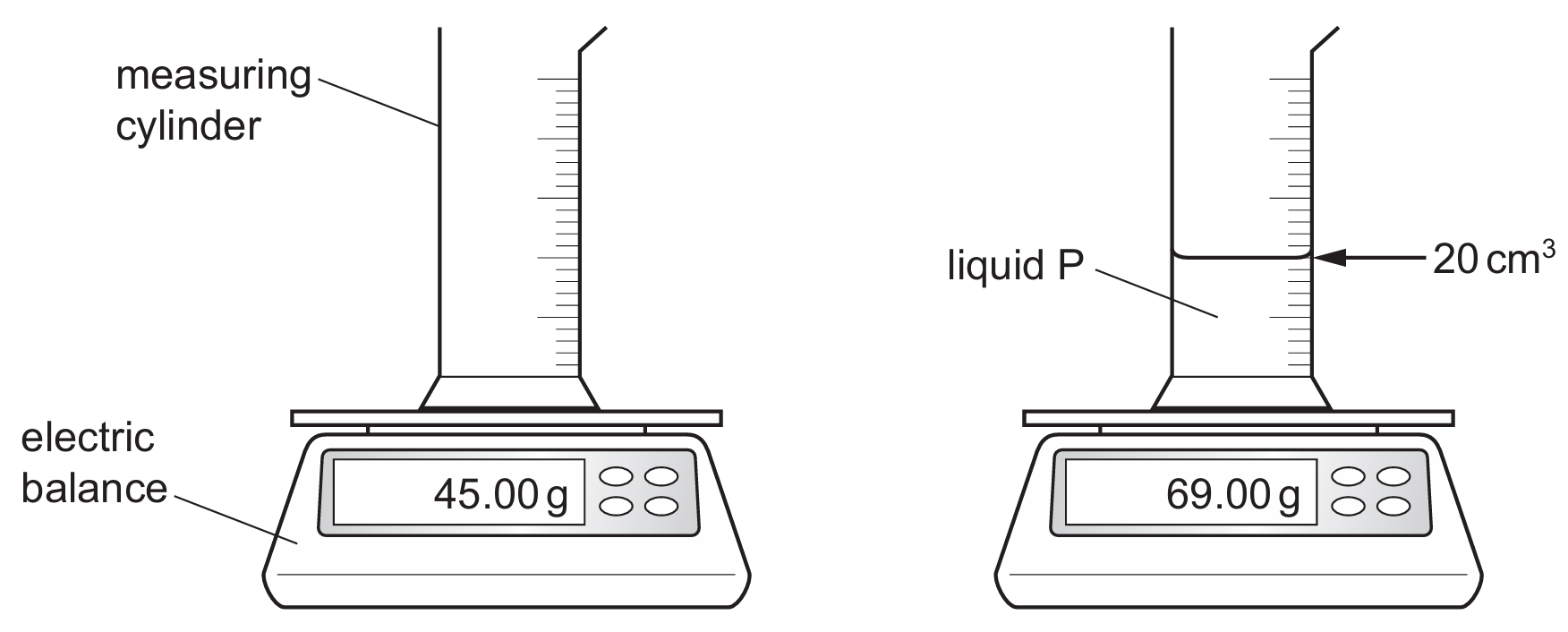
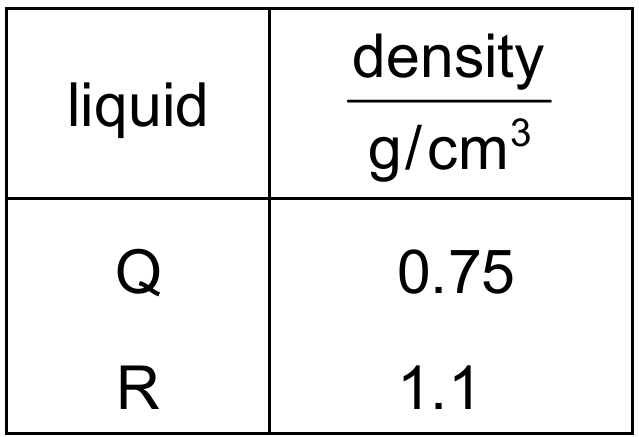
First, calculate the density of liquid P using ρ= V m . The mass of liquid P is 69.00 g−45.00 g=24.00 g and its volume is 20 cm 3 , giving ρ P = 20 24.00 =1.2 g/cm 3 .
Comparing all densities: ρ Q =0.75 g/cm 3 , ρ R =1.1 g/cm 3 , and ρ P =1.2 g/cm 3 .
Liquids with lower density float above those with higher density.
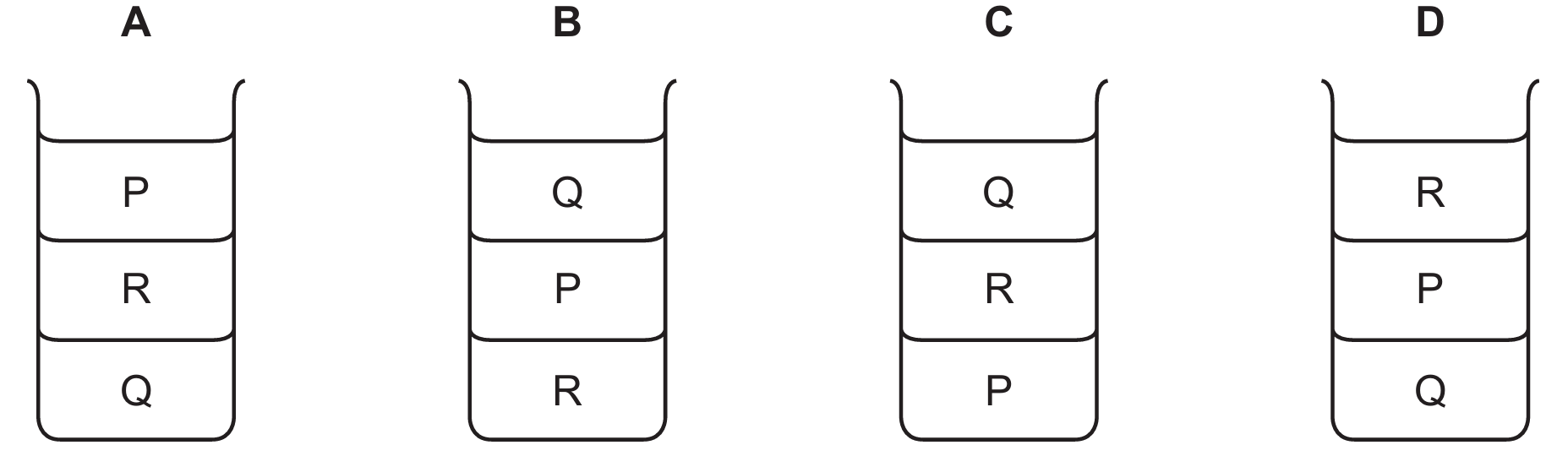
The correct order from top to bottom (lowest to highest density) is Q, then R, then P.
This sequence matches diagram C.
Question 5

Most-appropriate topic codes (Cambridge IGCSE Physics 0625):
▶️ Answer/Explanation
Detailed solution:
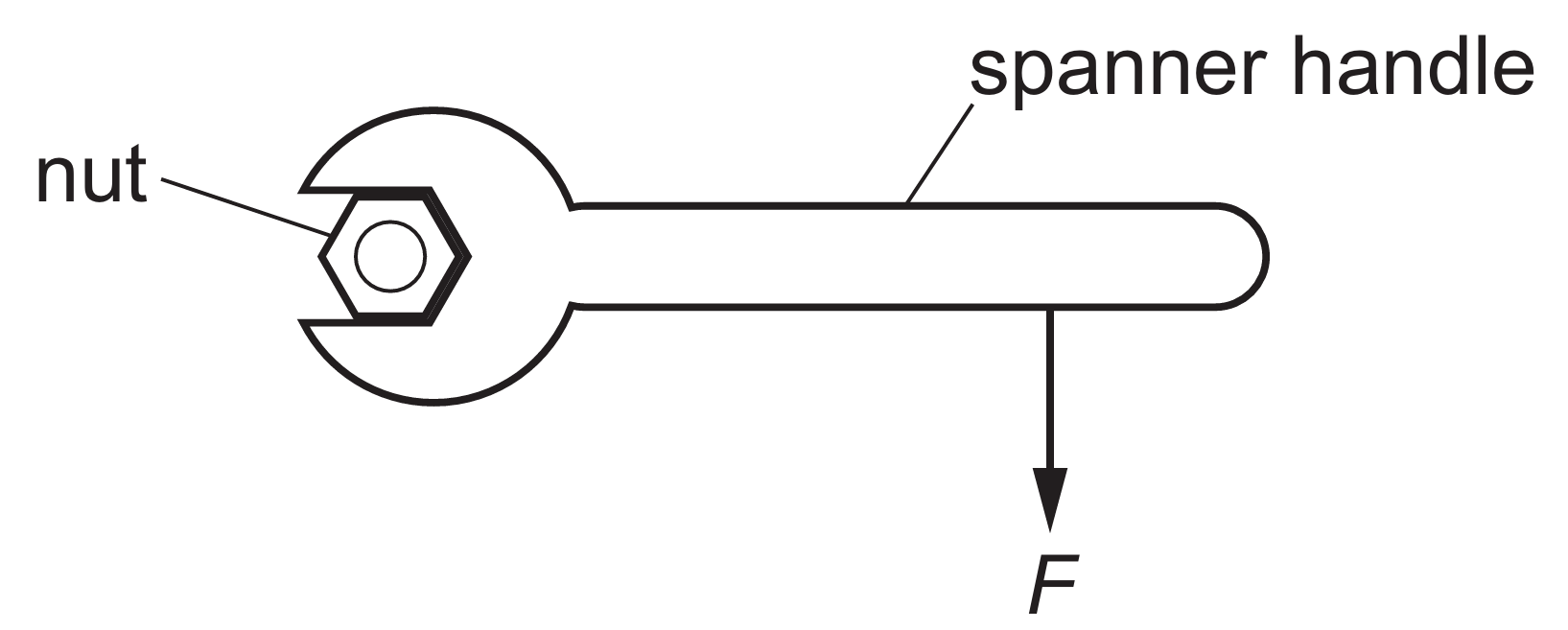
The moment of a force is defined by the equation $M = F \times d$, where $d$ is the perpendicular distance from the pivot (the nut) to the line of action of the force.
To increase the moment while keeping the force $F$ constant, the distance $d$ must be increased.
Moving the force to the right-hand end of the handle maximizes this distance, thereby increasing the turning effect.
Option B results in zero moment because the force passes through the pivot ($d = 0$), and option D decreases $d$.
Option C affects friction but does not change the calculated moment of the applied force $F$.
Question 6

Most-appropriate topic codes (Cambridge IGCSE Physics 0625):
▶️ Answer/Explanation
Detailed solution:
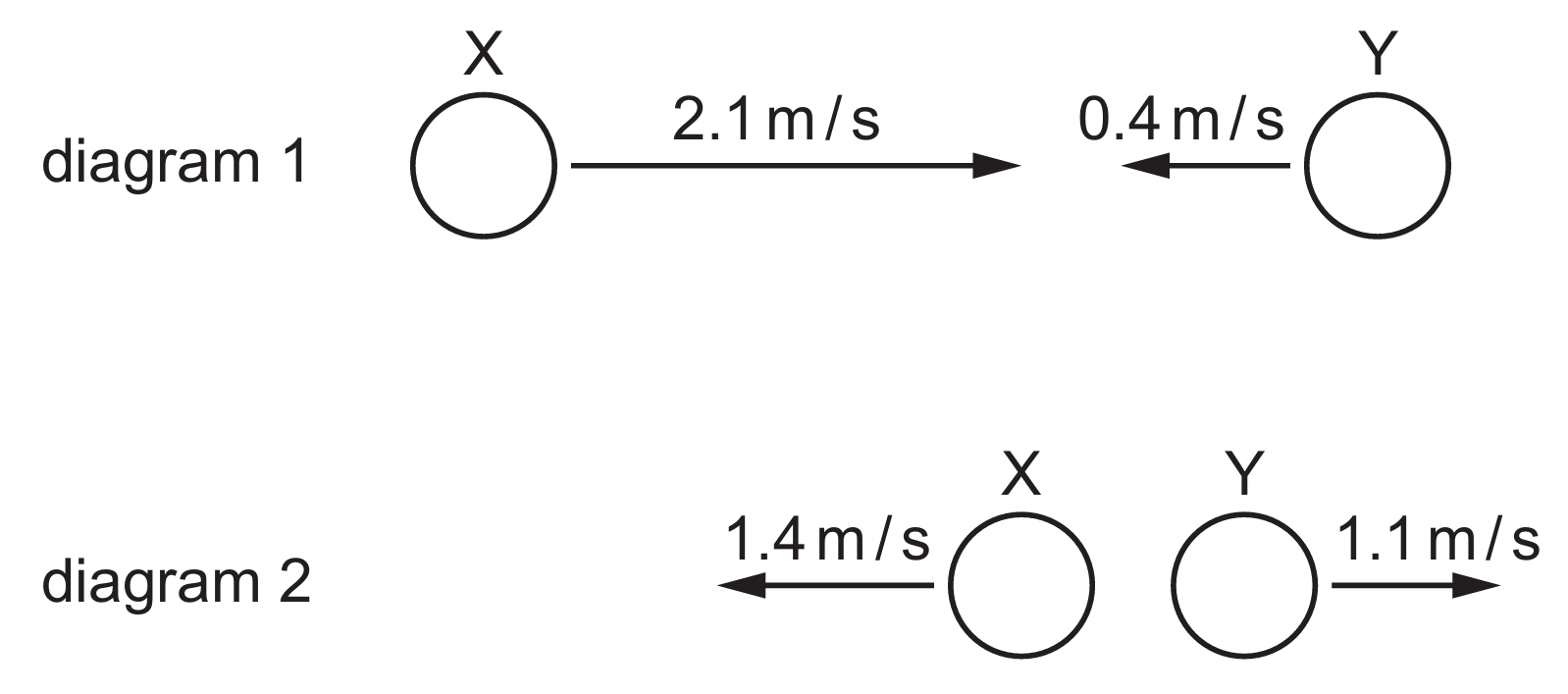
Using the principle of conservation of momentum, total initial momentum equals total final momentum: $m_x u_x + m_y u_y = m_x v_x + m_y v_y$.
Taking the right direction as positive: $m_x = 0.15~kg$, $u_x = 2.1~m/s$, $u_y = -0.4~m/s$, $v_x = -1.4~m/s$, and $v_y = 1.1~m/s$.
Substituting the values: $(0.15 \times 2.1) + (m_y \times -0.4) = (0.15 \times -1.4) + (m_y \times 1.1)$.
$0.315 – 0.4m_y = -0.21 + 1.1m_y$.
Rearranging gives $0.315 + 0.21 = 1.1m_y + 0.4m_y$, which simplifies to $0.525 = 1.5m_y$.
Solving for $m_y$: $m_y = \frac{0.525}{1.5} = 0.35~kg$.
Question 7

Most-appropriate topic codes (Cambridge IGCSE Physics 0625):
▶️ Answer/Explanation
Detailed solution:
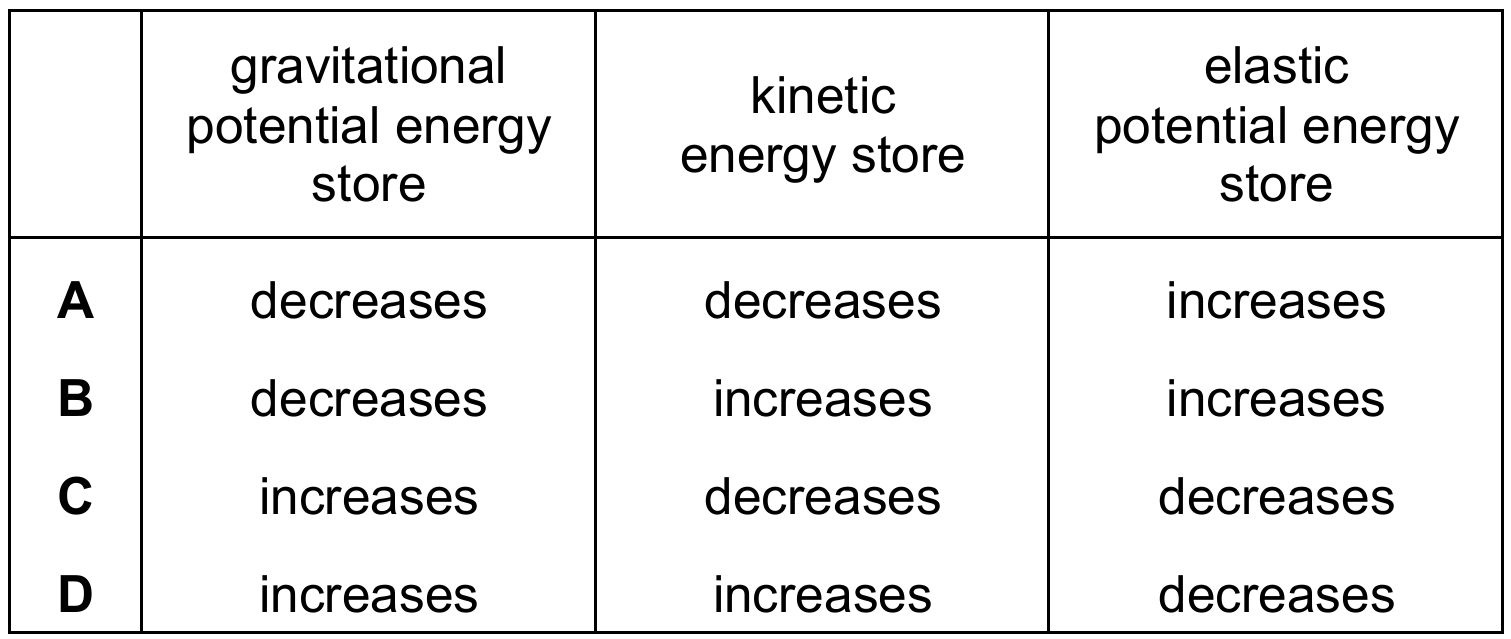
When released from the lowest point, the mass moves upwards. Since the height $h$ increases, the gravitational potential energy ($\Delta E_{p} = mg\Delta h$) increases.
The mass accelerates from rest, so its velocity $v$ increases, causing the kinetic energy ($E_{k} = \frac{1}{2}mv^{2}$) to increase.
The spring’s extension $x$ decreases as it returns toward its equilibrium position, leading to a decrease in the elastic potential energy ($E_{e} = \frac{1}{2}kx^{2}$).
Therefore, the correct sequence of energy changes is GPE increases, KE increases, and EPE decreases, matching row D.
Question 8
Most-appropriate topic codes (Cambridge IGCSE Physics 0625):
▶️ Answer/Explanation
Detailed solution:
Kinetic energy is the energy an object possesses due to its motion, defined by $E_{k} = \frac{1}{2}mv^{2}$.
Wind is the movement of air masses; therefore, the energy resource itself consists of moving matter with velocity $v$.
In contrast, coal stores energy as chemical energy, and nuclear fission involves energy stored within the atomic nucleus.
Solar energy is transferred via electromagnetic radiation (light and infrared waves) rather than being stored as bulk motion.
Since wind is the only resource listed that is inherently defined by the motion of mass, it is the correct choice.
Therefore, Option D accurately identifies the resource that stores kinetic energy.
Question 9

Most-appropriate topic codes (Cambridge IGCSE Physics 0625):
▶️ Answer/Explanation
Detailed solution:
The pressure in a liquid is calculated using the formula $p = \rho g h$, where $\rho$ is density, $g$ is gravitational field strength, and $h$ is depth.
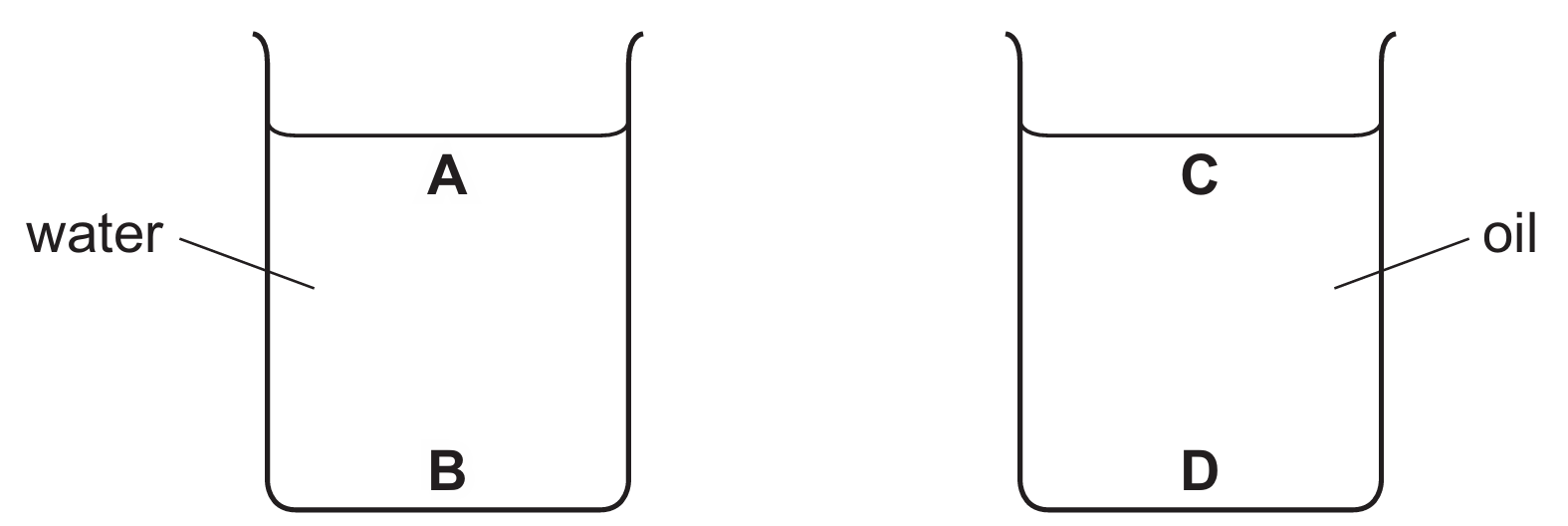
Pressure increases with depth, so positions B and D at the bottom of the beakers will have higher pressure than A and C.
Since both liquids have the same depth $h$, the pressure depends entirely on the density $\rho$ of the liquid.
Water has a higher density ($\rho_{water} = 1000~kg/m^{3}$) compared to oil ($\rho_{oil} = 920~kg/m^{3}$), leading to greater pressure.
Therefore, the pressure is greatest at the bottom of the water beaker, which is position B.
Question 10
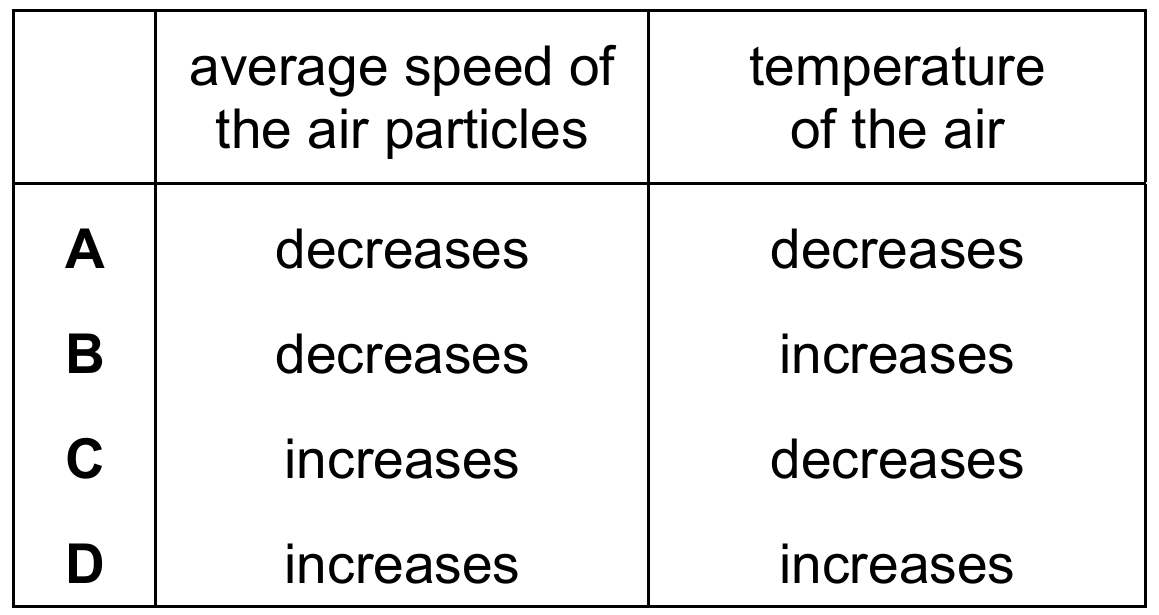
The pressure of the air in a car tyre rises after a long journey. This is caused by a change in the average speed of the air particles and a change in the temperature of the air in the tyre.
Which row describes the changes that have caused the air pressure in the tyre to rise?

Most-appropriate topic codes (Cambridge IGCSE Physics 0625):
▶️ Answer/Explanation
Detailed solution:
According to the kinetic particle model, the temperature of a gas is a measure of the average kinetic energy ($E_{k} = \frac{1}{2}mv^{2}$) of its particles. During a long journey, friction between the tyre and the road transfers energy to the air inside, increasing its temperature. As temperature increases, the average speed $v$ of the air particles also increases. These faster-moving particles collide with the tyre walls more frequently and with greater force, resulting in an increase in pressure. Therefore, both the average speed and the temperature must increase to cause the observed rise in pressure.
Question 11
Most-appropriate topic codes (Cambridge IGCSE Physics 0625):
▶️ Answer/Explanation
Detailed solution:
Water exists as a liquid between its melting point ($0^{\circ}\text{C}$) and its boiling point ($100^{\circ}\text{C}$) at standard atmospheric pressure.
To convert these values to the Kelvin scale, we use the formula $T\text{ (in K)} = \theta\text{ (in }^{\circ}\text{C)} + 273$.
The melting point in Kelvin is $0 + 273 = 273\text{ K}$, and the boiling point is $100 + 273 = 373\text{ K}$.
Therefore, water is in the liquid state within the temperature range of $273\text{ K}$ to $373\text{ K}$.
Option D correctly identifies this specific interval on the absolute temperature scale.
Question 12


Most-appropriate topic codes (Cambridge IGCSE Physics 0625):
▶️ Answer/Explanation
Detailed solution:
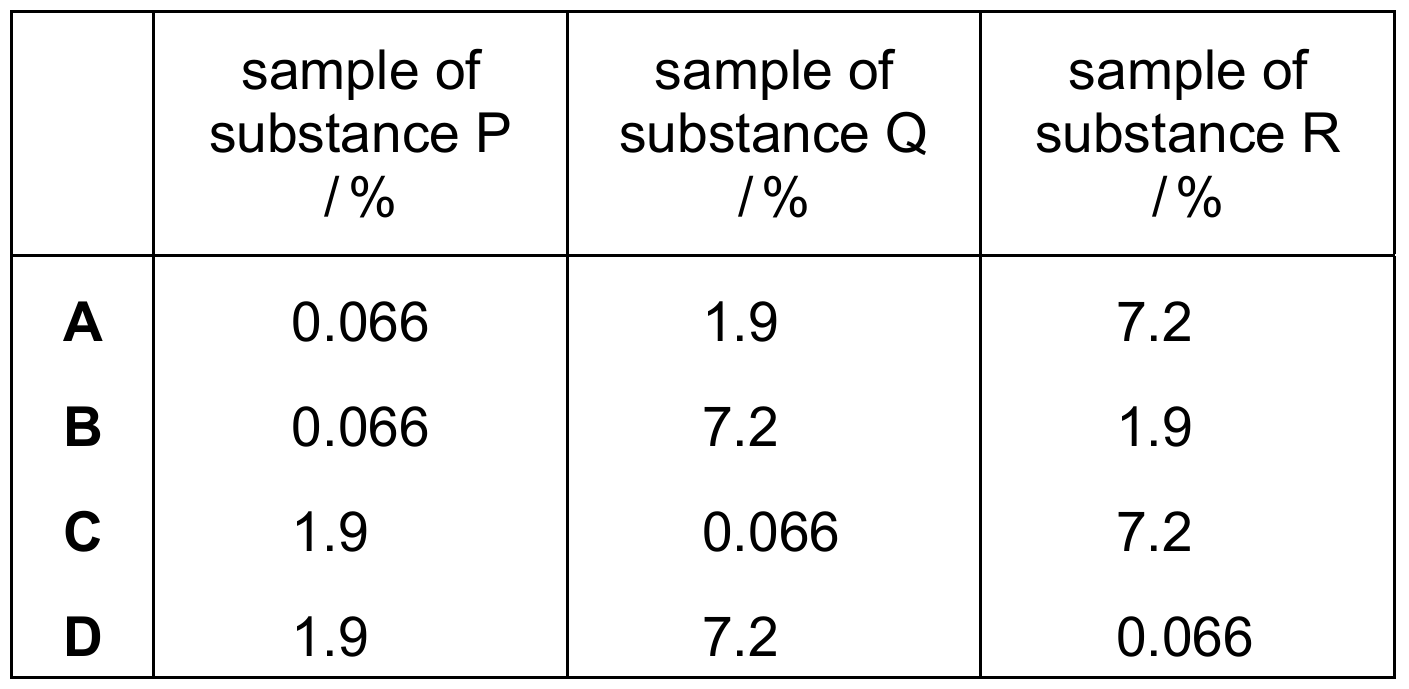
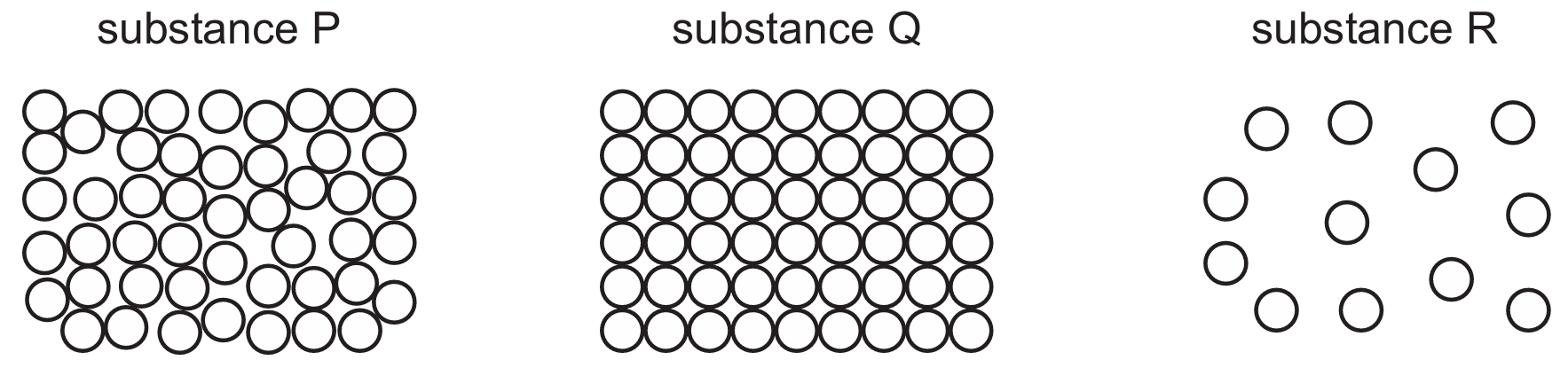
Based on the particle diagrams, substance $Q$ is a solid (regularly arranged), $P$ is a liquid (randomly arranged but touching), and $R$ is a gas (widely spaced).
Gases expand significantly more than liquids, and liquids expand more than solids for the same temperature increase.
Therefore, the order of percentage increase in volume must be: $\text{Gas } (R) > \text{Liquid } (P) > \text{Solid } (Q)$.
Comparing the values: $7.2\% > 1.9\% > 0.066\%$.
This matches Row C, where $R = 7.2\%$, $P = 1.9\%$, and $Q = 0.066\%$.
Question 13
Most-appropriate topic codes (Cambridge IGCSE Physics 0625):
▶️ Answer/Explanation
Detailed solution:
The energy transferred ($\Delta E$) during a temperature change is calculated using the formula $\Delta E = mc\Delta\theta$.
The mass of the water $m$ is $0.25$ kg, and the specific heat capacity $c$ is $4200$ J / (kg °C).
The change in temperature $\Delta\theta$ is the difference between the initial and final temperatures: $60$ °C $- 20$ °C $= 40$ °C.
Substituting these values into the equation: $\Delta E = 0.25 \times 4200 \times 40$.
This simplifies to $\Delta E = 1050 \times 40$, which equals $42\,000$ J.
Therefore, $42\,000$ J of thermal energy was transferred to the surroundings, matching option B.
Question 14
Most-appropriate topic codes (Cambridge IGCSE Physics 0625):
▶️ Answer/Explanation
Detailed solution:
When a pure solid reaches its melting point, the thermal energy provided is used to overcome the intermolecular forces holding the particles in a fixed lattice.
During this phase change, the internal potential energy of the particles increases, but their average kinetic energy remains constant.
Since temperature is a measure of the average kinetic energy of the particles, the temperature does not rise during the transition from solid to liquid.
This plateau on a heating curve continues until the entire substance has finished melting.
Therefore, for a pure substance, the temperature remains at a constant value $T_{melt}$ throughout the melting process.
Consequently, statement D is the only correct description of this physical phenomenon.
Question 15
Most-appropriate topic codes (Cambridge IGCSE Physics 0625):
▶️ Answer/Explanation
Detailed solution:
Thermal energy naturally flows from regions of higher temperature to lower temperature via conduction through solids.
Since the middle of the filament is at a very high temperature and the ends are cooler, energy is conducted toward the base.
Option B is incorrect because the rate of radiation depends on temperature; therefore, the hotter middle radiates more energy than the cooler ends.
Option C is incorrect as energy is also transferred via infrared radiation (heat) and conduction, not just visible light.
Option D is incorrect because power is proportional to the square of the voltage, $P = \frac{V^{2}}{R}$.
If the potential difference $V$ is halved to $\frac{V}{2}$, the power output becomes $\frac{1}{4}$ of its original value, assuming resistance $R$ is constant.
Question 16

Most-appropriate topic codes (Cambridge IGCSE Physics 0625):
▶️ Answer/Explanation
Detailed solution:
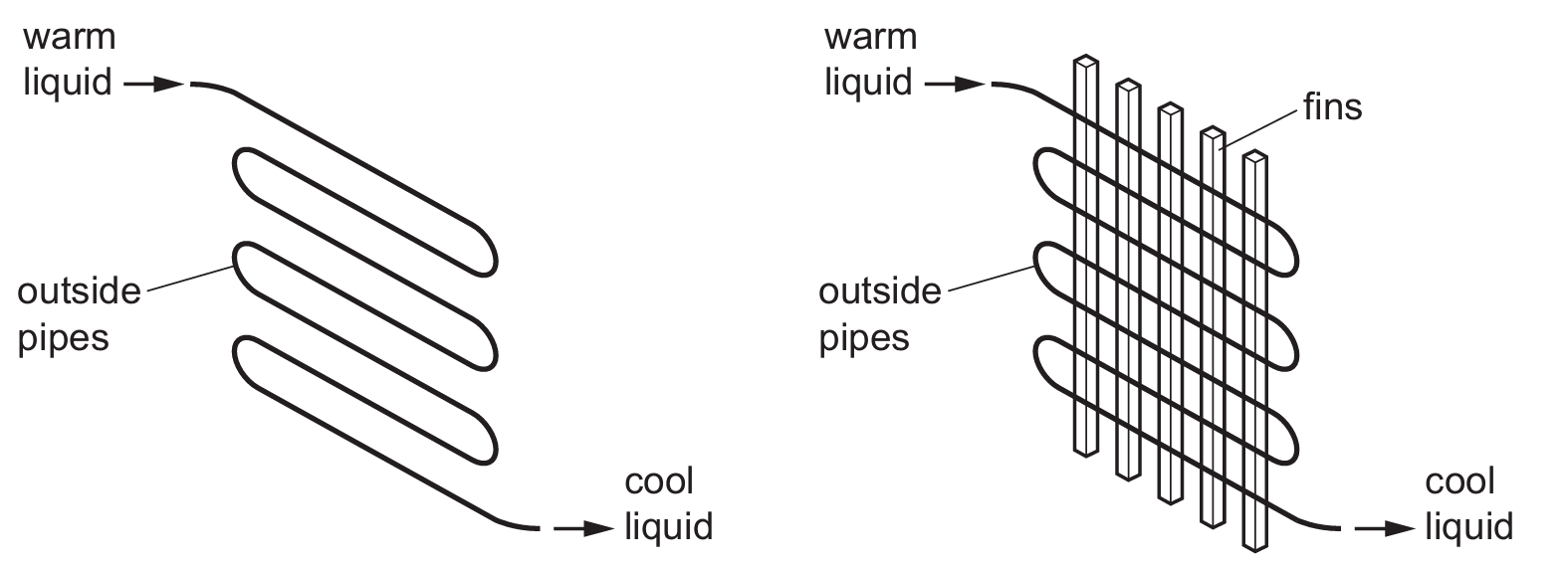
To cool the liquid quickly, the rate of thermal energy transfer to the surroundings must be maximized. Surface color significantly affects this; dull black surfaces are the best emitters of infrared radiation compared to shiny silver ones. Additionally, attaching copper fins increases the total surface area $A$ available for both radiation and convection. Since the rate of emission is directly proportional to the surface area, the design with fins provides a higher cooling rate. Therefore, the combination of a black surface for high emissivity and fins for increased area ensures the most rapid cooling.
Question 17
Most-appropriate topic codes (Cambridge IGCSE Physics 0625):
▶️ Answer/Explanation
Detailed solution:
First, determine the frequency f of the wave using the formula f= time taken number of waves .
Given 16 waves in 20 s, f= 20 16 =0.8 Hz.
Next, convert the wave speed v from km/s to m/s: v=6.0 km/s=6000 m/s.
Using the wave equation v=fλ, rearrange it to solve for wavelength: λ= f v .
Substituting the values, λ= 0.8 6000 =7500 m.
In scientific notation, this is expressed as 7.5×10 3 m, which matches option D.
Question 18
Most-appropriate topic codes (Cambridge IGCSE Physics 0625):
▶️ Answer/Explanation
Detailed solution:
In a longitudinal wave, the vibration of particles is parallel to the direction of energy transfer (propagation).
Sound waves are the primary example of longitudinal waves as they consist of compressions and rarefactions.
Option A is incorrect because seismic S-waves are transverse, meaning vibrations occur at $90^{\circ}$ to propagation.
Option D is incorrect because it describes a transverse wave, not a longitudinal one.
Option C is a false generalization; amplitude and wavelength $\lambda$ are independent physical properties of a wave.
Therefore, statement B is the only scientifically accurate description provided.
Question 19
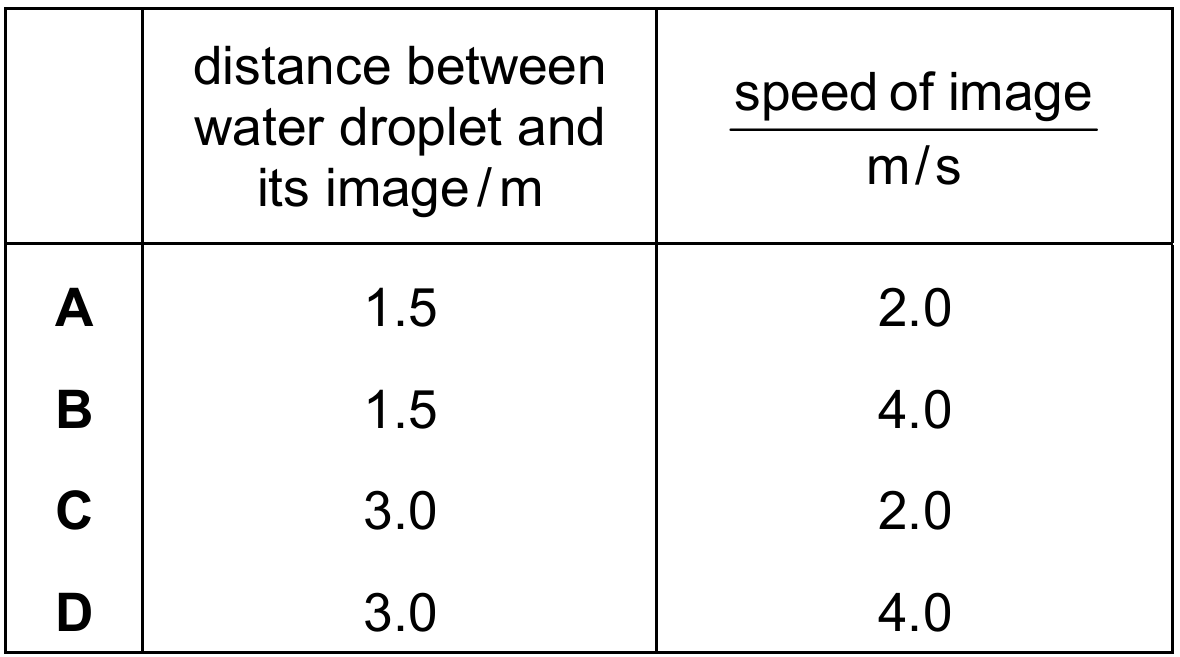
A water droplet is falling towards a horizontal plane mirror. At one moment, the droplet is a distance of $1.5 \text{ m}$ above the mirror and falling at a speed of $2.0 \text{ m/s}$.
What is the distance between the droplet and its image and what is the speed of the image at this moment?

Most-appropriate topic codes (Cambridge IGCSE Physics 0625):
▶️ Answer/Explanation
Detailed solution:
In a plane mirror, the image is the same distance behind the mirror as the object is in front of it. Since the droplet is $1.5 \text{ m}$ above the mirror, the image is $1.5 \text{ m}$ below it, making the total distance $1.5 \text{ m} + 1.5 \text{ m} = 3.0 \text{ m}$. The speed of the image relative to the mirror is identical to the speed of the object relative to the mirror, which is $2.0 \text{ m/s}$. While the relative speed between the droplet and image is $4.0 \text{ m/s}$, the question asks for the “speed of the image,” which is measured relative to the mirror. Thus, the correct values are $3.0 \text{ m}$ and $2.0 \text{ m/s}$.
Question 20

Most-appropriate topic codes (Cambridge IGCSE Physics 0625):
▶️ Answer/Explanation
Detailed solution:
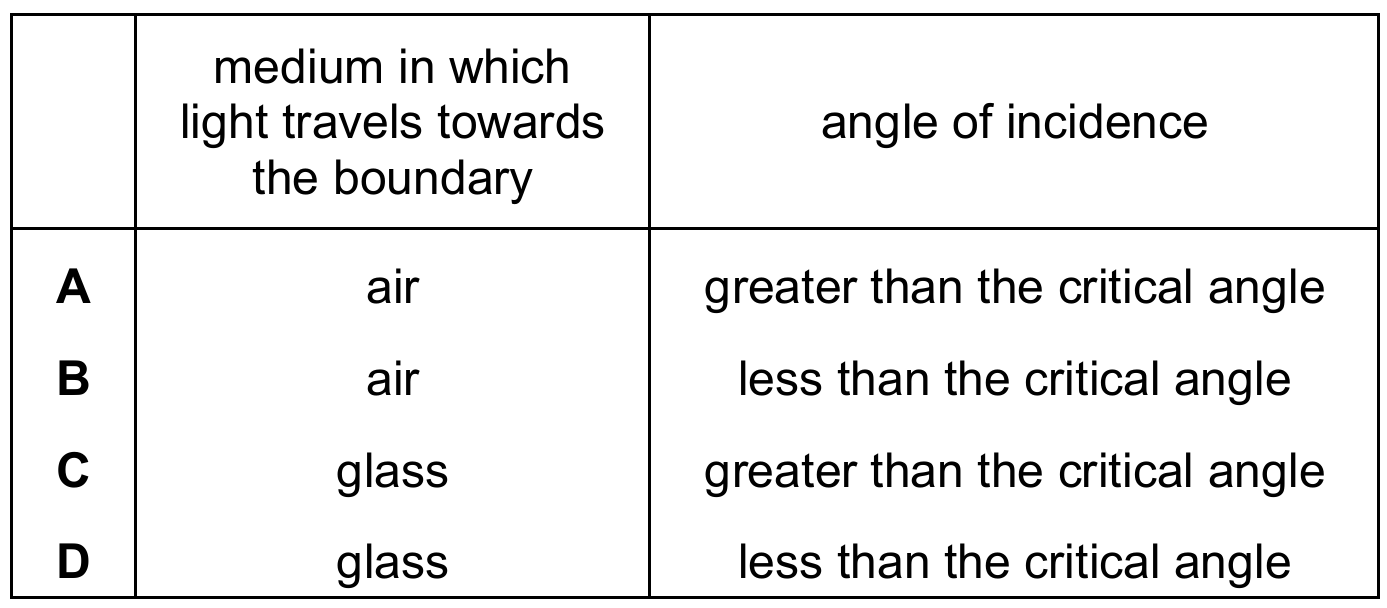
Total internal reflection (TIR) occurs only when light travels from an optically denser medium to a less dense medium, such as from glass to air.
For TIR to happen, the angle of incidence $i$ must be greater than the critical angle $c$ for that specific boundary, such that $i > c$.
In this scenario, glass is the denser medium ($n_{glass} \approx 1.5$) compared to air ($n_{air} \approx 1.0$).
If the light starts in air (options A and B), it is entering a denser medium and will only undergo refraction toward the normal.
Therefore, the light must be traveling in glass and the angle of incidence must exceed the critical angle.
This corresponds precisely to the conditions described in Row C.
Question 21

Most-appropriate topic codes (Cambridge IGCSE Physics 0625):
▶️ Answer/Explanation
Detailed solution:
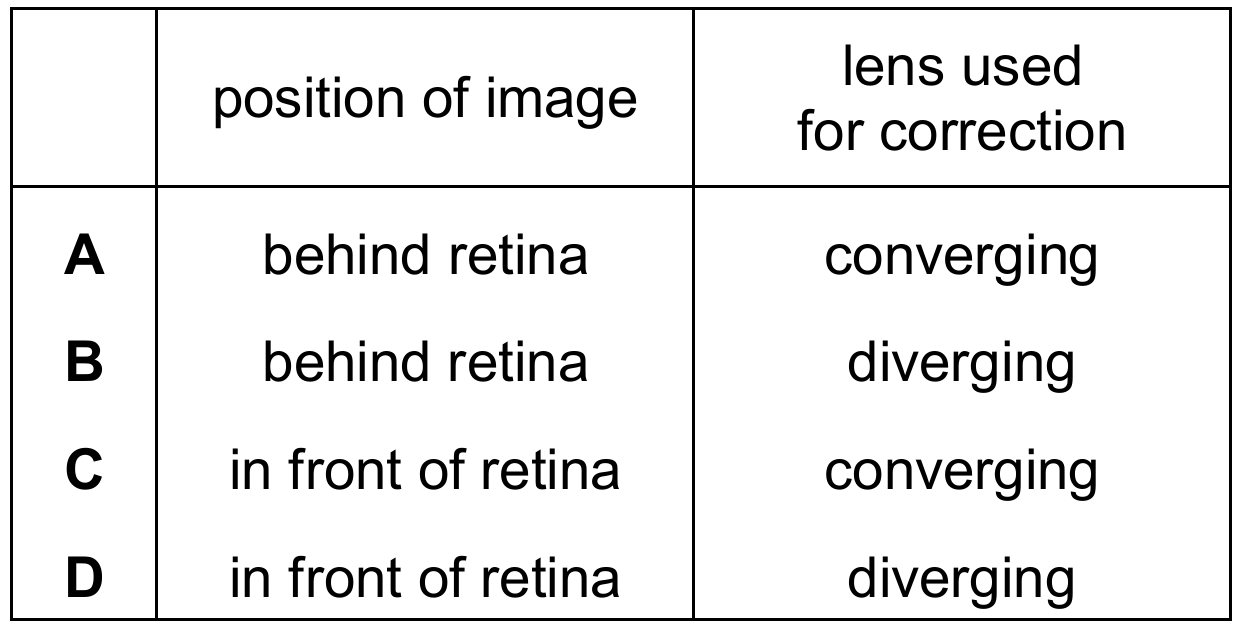
In a long-sighted eye, the lens system is too weak or the eyeball is too short, causing light rays from near objects to focus behind the retina.
To correct this, the overall refractive power of the eye must be increased to bring the focal point forward.
A converging lens (convex lens) is used because it provides additional refraction, bending the rays inward before they enter the eye.
This ensures that the light rays converge exactly on the retina, producing a sharp image for close-up vision.
Therefore, Row A correctly identifies both the image position and the required corrective lens type.
Question 22
Most-appropriate topic codes (Cambridge IGCSE Physics 0625):
▶️ Answer/Explanation
Detailed solution:
Infrared radiation is an electromagnetic wave, which travels at the speed of light in a vacuum, c=3.0×10 8 m/s.
The refractive index n of a medium is defined by the ratio n= v c , where v is the speed in the medium.
Rearranging the formula to solve for the speed in glass, we get v= n c .
Substituting the given values, v= 1.5 3.0×10 8 m/s .
This calculation yields v=2.0×10 8 m/s.
Therefore, option B is the correct speed of the radiation within the glass medium.
Question 23
Most-appropriate topic codes (Cambridge IGCSE Physics 0625):
▶️ Answer/Explanation
Detailed solution:
Sound is a longitudinal wave consisting of oscillations in the medium’s pressure and density.
A compression is a region where the particles are pushed closer together, resulting in high pressure and a higher density ($\rho$).
Conversely, a rarefaction is a region where the particles are spread further apart, leading to low pressure and a lower density.
Wavelength ($\lambda$) is defined as the distance between two successive compressions or rarefactions, not a property of a single region.
Thus, the density of air is greater in a compression than in a rarefaction, making option C the correct choice.
Question 24
2. Electromagnets are temporary magnets.
3. A magnet can be used to induce magnetism in an iron bar.
Most-appropriate topic codes (Cambridge IGCSE Physics 0625):
▶️ Answer/Explanation
Detailed solution:
Statement $1$ is correct because steel is a hard magnetic material used to make permanent magnets as it retains magnetism well. Statement $2$ is correct as electromagnets consist of a coil around a soft iron core, which only acts as a magnet when an electric current $I$ flows, making them temporary. Statement $3$ is correct because a process called magnetic induction allows a permanent magnet to align the magnetic domains in a nearby unmagnetised iron bar. Since all three statements are scientifically accurate according to the syllabus, the correct choice is $1, 2 \text{ and } 3$.
Question 25
Most-appropriate topic codes (Cambridge IGCSE Physics 0625):
▶️ Answer/Explanation
Detailed solution:
The e.m.f. ($E$) is the work done per unit charge by the source: $E = \frac{W_{total}}{Q} = \frac{120\text{ J}}{50\text{ C}} = 2.4\text{ V}$.
To find the p.d. ($V$) across one lamp, we first determine the charge $Q_{L}$ passing through each lamp.
Since the lamps are identical and in parallel, the total charge $50\text{ C}$ splits equally, so $Q_{L} = \frac{50\text{ C}}{2} = 25\text{ C}$.
The p.d. across one lamp is the work done per unit charge through that lamp: $V = \frac{W_{lamp}}{Q_{L}} = \frac{40\text{ J}}{25\text{ C}} = 1.6\text{ V}$.
In a parallel arrangement, the p.d. across each branch is the same, so $V$ remains $1.6\text{ V}$ for the pair.
Thus, $E = 2.4\text{ V}$ and $V = 1.6\text{ V}$, which corresponds to option B.
Question 26

Most-appropriate topic codes (Cambridge IGCSE Physics 0625):
▶️ Answer/Explanation
Detailed solution:
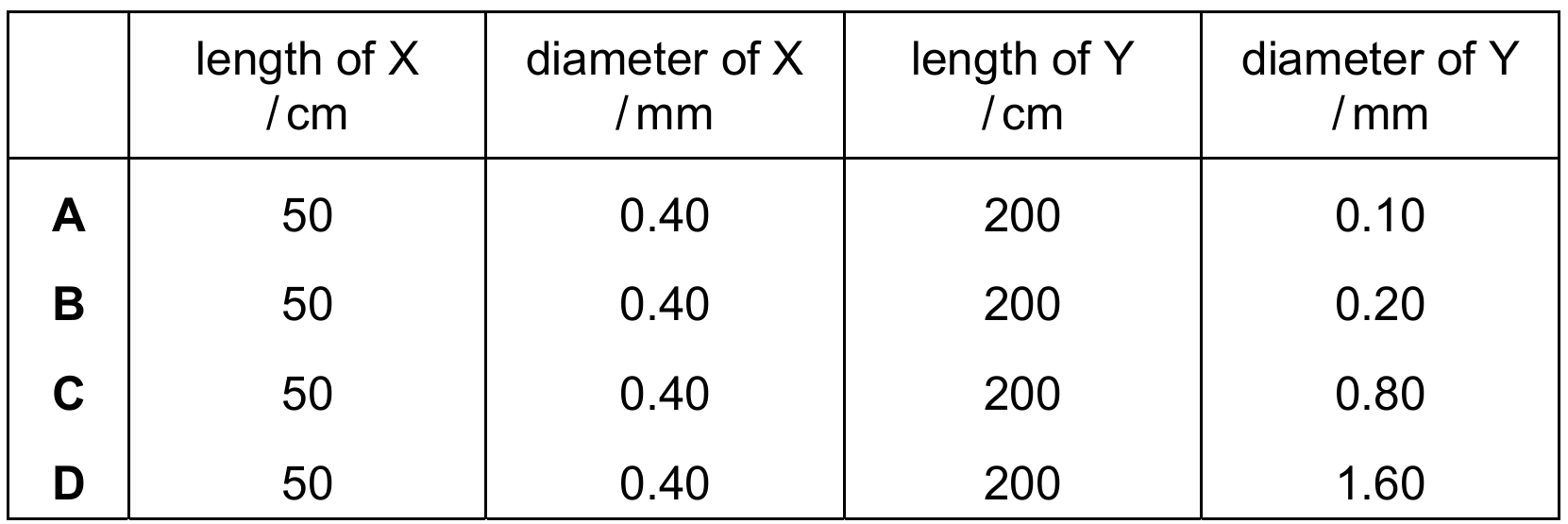
Resistance $R$ is proportional to length $L$ and inversely proportional to cross-sectional area $A$, where $A = \frac{\pi d^{2}}{4}$. Thus, $R \propto \frac{L}{d^{2}}$.
For wires $X$ and $Y$ to have the same resistance ($R_{X} = R_{Y}$), the ratio $\frac{L_{X}}{d_{X}^{2}}$ must equal $\frac{L_{Y}}{d_{Y}^{2}}$.
The length of $Y$ ($200\text{ cm}$) is $4$ times the length of $X$ ($50\text{ cm}$), so $L_{Y} = 4L_{X}$.
To keep resistance constant, $d_{Y}^{2}$ must also be $4$ times $d_{X}^{2}$, meaning $d_{Y} = \sqrt{4} \times d_{X} = 2d_{X}$.
Given $d_{X} = 0.40\text{ mm}$, the diameter of $Y$ must be $0.40\text{ mm} \times 2 = 0.80\text{ mm}$.
This matches the values provided in Row C.
Question 27


Most-appropriate topic codes (Cambridge IGCSE Physics 0625):
▶️ Answer/Explanation
Detailed solution:
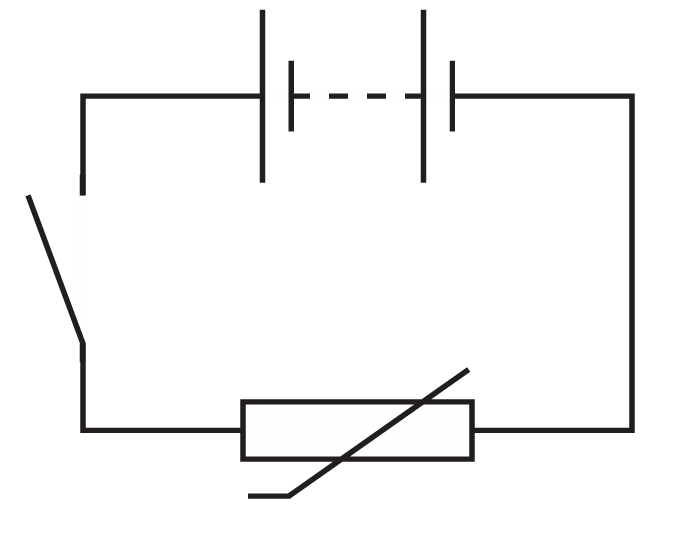
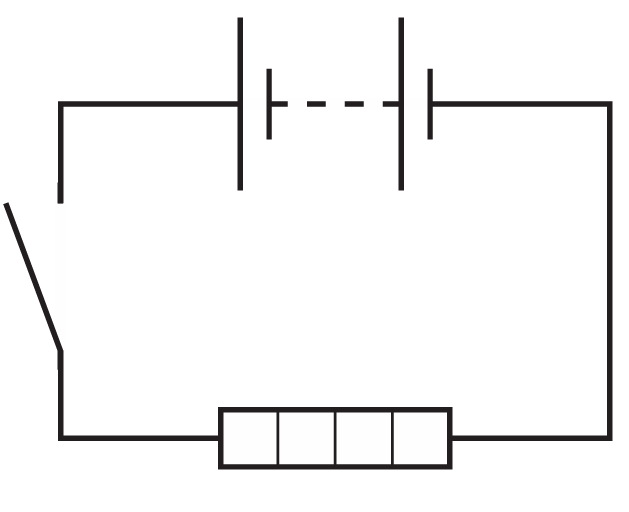
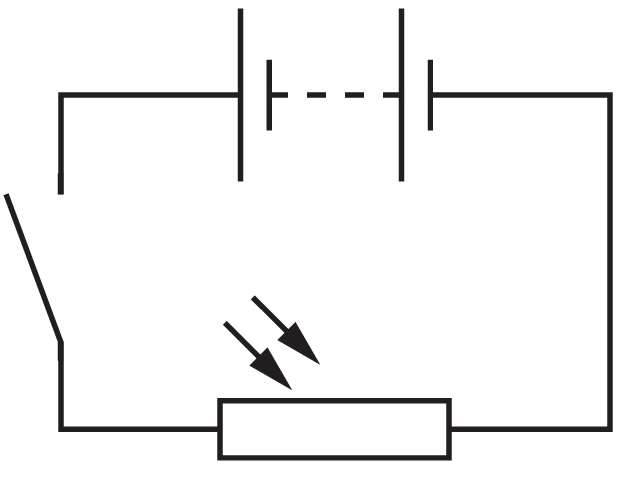
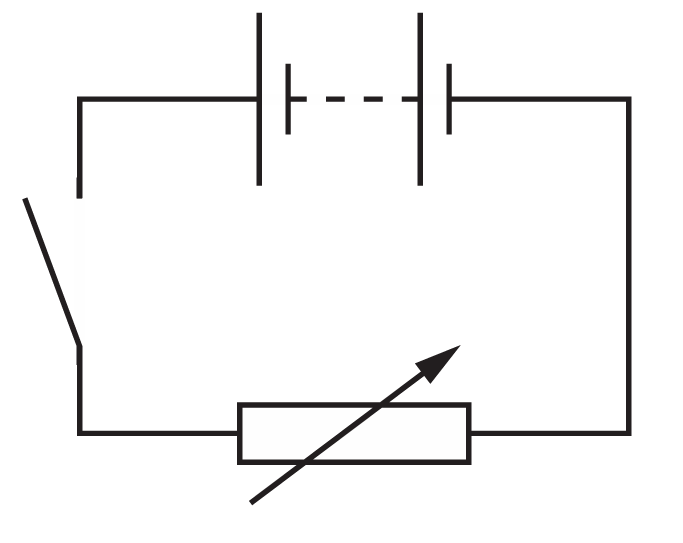
An LDR (light-dependent resistor) is represented by a standard rectangle symbol for a resistor with two incoming arrows pointing toward it, symbolizing light energy falling on the component.
In Circuit A, the diagonal arrow through the rectangle represents a variable resistor, where resistance is manually adjusted.
In Circuit B, the rectangle with a flat-bottomed diagonal line represents a thermistor, which changes resistance based on temperature.
In Circuit C, the rectangle with internal vertical bars represents a heater component.
Circuit D correctly displays the LDR symbol, indicating its resistance will decrease as the light intensity increases.
Therefore, Circuit D is the only diagram containing a light-dependent resistor as per the IGCSE standard symbols.
Question 28
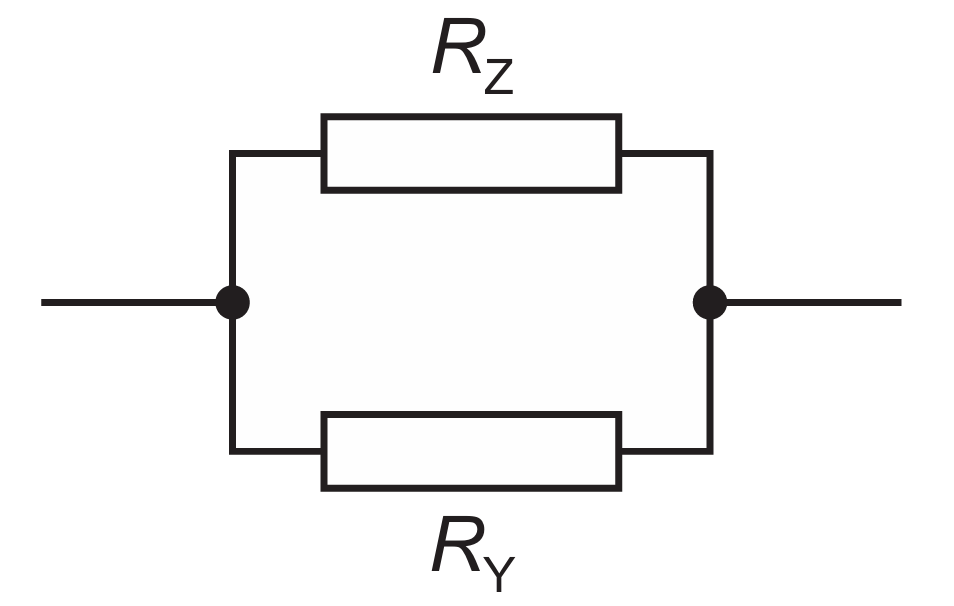
A teacher asks three students to write down an equation to determine the combined resistance $R_{C}$ of resistors with resistances $R_{Y}$ and $R_{Z}$.

Most-appropriate topic codes (Cambridge IGCSE Physics 0625):
▶️ Answer/Explanation
Detailed solution:
The diagram shows two resistors, $R_{Y}$ and $R_{Z}$, connected in a parallel arrangement.
For resistors in parallel, the reciprocal of the combined resistance $R_{C}$ is the sum of the reciprocals of the individual resistances.
This is mathematically expressed as $\frac{1}{R_{C}} = \frac{1}{R_{Y}} + \frac{1}{R_{Z}}$, which matches the equation provided by student 1.
Student 2 is incorrect because their equation suggests the reciprocal of the sum, which applies to neither standard circuit type.
Student 3 is incorrect because they equated the total resistance directly to the sum of reciprocals without taking the final reciprocal.
Therefore, only student 1 has provided the correct relationship for a parallel circuit.
Question 29
Most-appropriate topic codes (Cambridge IGCSE Physics 0625):
▶️ Answer/Explanation
Detailed solution:
Double-insulated appliances are designed with non-conducting outer casings, such as plastic, which act as a second layer of insulation.
Because the casing cannot become live even if an internal fault occurs, an earth wire is not required for safety.
Consequently, these appliances use a two-core cable containing only the live and neutral wires, with $0$ earth connection.
A fuse is still necessary in the live wire to protect the circuit from excess current, making option C incorrect.
Option D is incorrect because every appliance requires a neutral wire to complete the circuit and allow current to flow.
Thus, option A is the only statement that correctly describes the wiring of a double-insulated device.
Question 30
A length of wire moves across the space between the poles of a magnet. A voltmeter measures the electromotive force (e.m.f.) generated between the two ends of the wire.
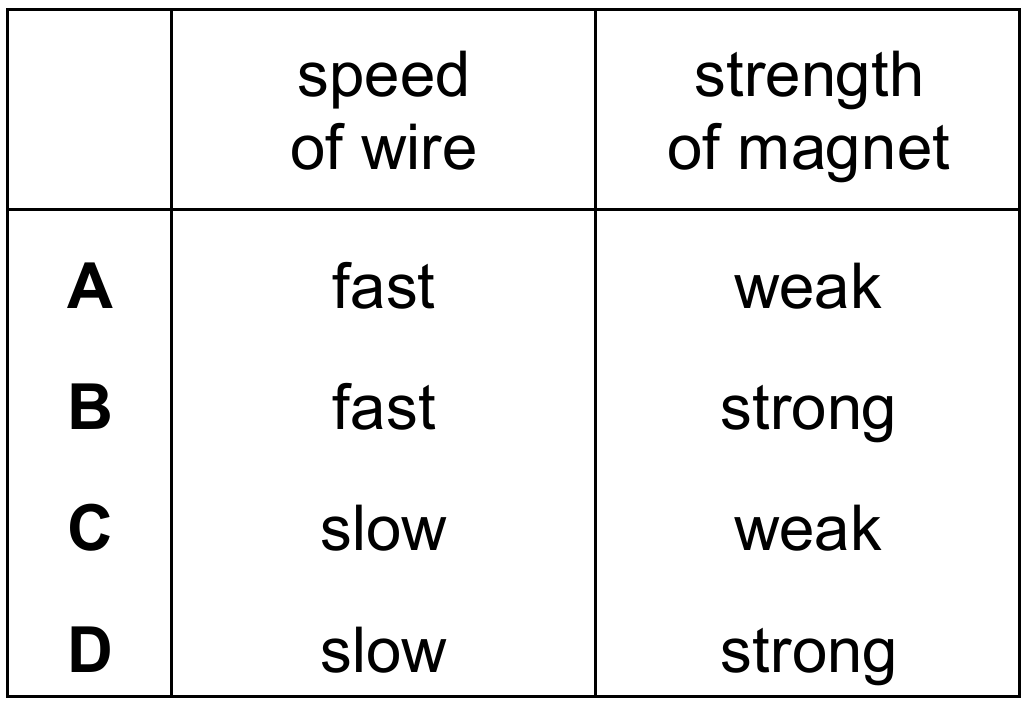
What gives the highest reading on the voltmeter?

Most-appropriate topic codes (Cambridge IGCSE Physics 0625):
▶️ Answer/Explanation
Detailed solution:
Electromagnetic induction occurs when a conductor cuts through magnetic field lines, inducing an $e.m.f.$.
The magnitude of this induced $e.m.f.$ is directly proportional to the rate at which the magnetic flux is cut.
Increasing the speed of the wire increases the rate of cutting, leading to a higher voltmeter reading.
Using a stronger magnet increases the density of field lines, meaning more lines are cut per second.
Therefore, the maximum $e.m.f.$ is generated when the wire moves fast through a strong magnetic field.
This makes Row B the correct choice for obtaining the highest reading.
Question 31

Most-appropriate topic codes (Cambridge IGCSE Physics 0625):
▶️ Answer/Explanation
Detailed solution:
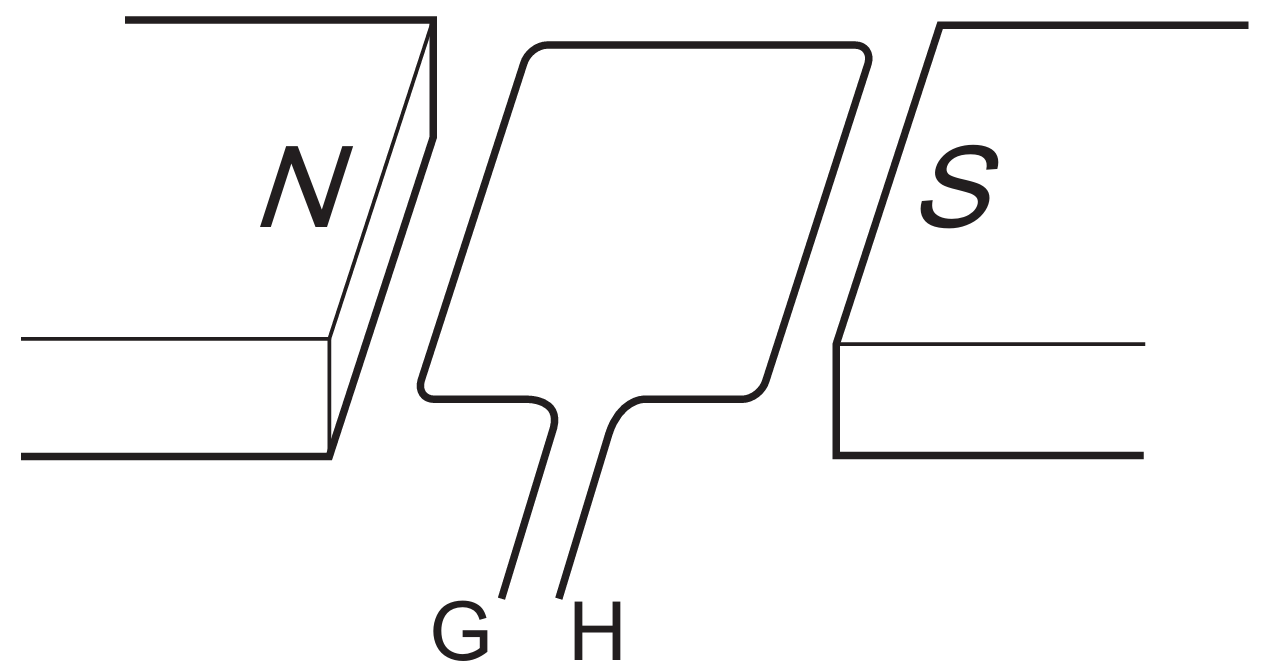
A simple alternating current (a.c.) generator works on the principle of electromagnetic induction.
As the coil rotates within the magnetic field, the magnetic flux linkage changes, inducing an electromotive force ($e.m.f.$).
To maintain an alternating output in the external circuit, the ends of the coil must stay connected to the same side of the circuit throughout the rotation.
This is achieved using slip rings, which allow the induced current to reverse direction every half-turn ($180^{\circ}$).
In contrast, a commutator is used in d.c. motors or generators to reverse connections and provide unidirectional current.
Therefore, slip rings must be connected at points $G$ and $H$ to provide an a.c. output.
Question 32

Most-appropriate topic codes (Cambridge IGCSE Physics 0625):
▶️ Answer/Explanation
Detailed solution:
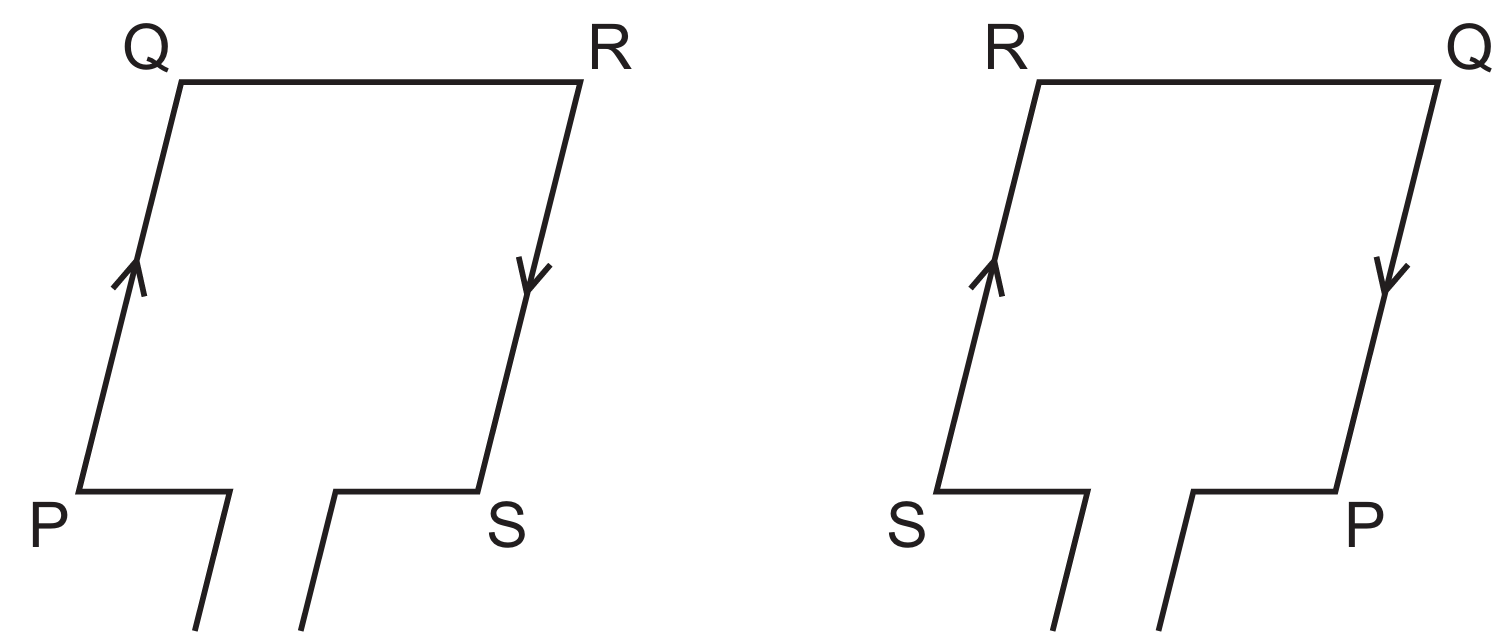
To ensure a d.c. motor continues to rotate in one direction, the force on the coil must be reversed every half-turn ($180^{\circ}$).
The split-ring commutator is the specific component designed to reverse the direction of the current in the coil at this interval.
As the coil passes the vertical position, the gaps in the split ring align with the brushes, momentarily breaking the circuit.
Upon further rotation, each half of the commutator connects with the opposite brush, reversing the current flow from $PQRS$ to $SRQP$.
This reversal maintains a constant direction of the turning effect (torque) acting on the coil.
While the brushes provide the electrical contact, the “splitting” mechanism of the commutator is what performs the actual reversal.
Question 33

Most-appropriate topic codes (Cambridge IGCSE Physics 0625):
▶️ Answer/Explanation
Detailed solution:
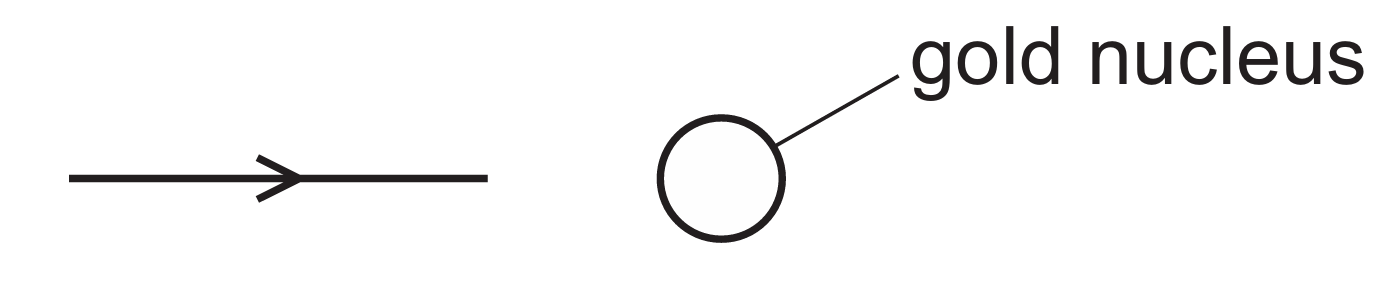
The $\alpha$-particle and the gold nucleus both possess a positive charge ($+2e$ and $+79e$ respectively).
As the $\alpha$-particle travels directly toward the center of the nucleus, it experiences a strong electrostatic force of repulsion.
Since the path is headed straight for the center, the repulsive force acts exactly opposite to the particle’s direction of motion.
This causes the particle to slow down, momentarily stop, and then be repelled directly backward ($180^{\circ}$ deflection).
Option B correctly describes this “back-scattering” effect observed in the Rutherford scattering experiment.
Other paths (A or C) would only occur if the particle was off-center or if the nucleus was not positively charged.
Question 34
A teacher writes the nuclide equation for a fusion reaction:
$$\text{}^{2}_{1}\text{H} + \text{}^{X}_{1}\text{H} \rightarrow \text{}^{4}_{2}\text{Q} + \text{}^{1}_{0}\text{n}$$
What is the missing number $X$ and the missing element $Q$?

Most-appropriate topic codes (Cambridge IGCSE Physics 0625):
▶️ Answer/Explanation
Detailed solution:
In a nuclear equation, the total nucleon number ($A$) and proton number ($Z$) must be conserved.
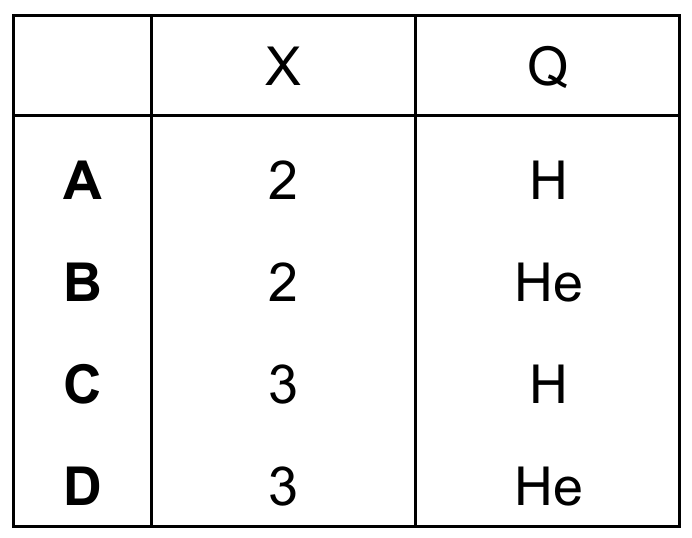
For the top numbers (nucleon number): $2 + X = 4 + 1$, which simplifies to $2 + X = 5$, giving $X = 3$.
For the bottom numbers (proton number): $1 + 1 = 2 + 0$, which is $2 = 2$, confirming the balance.
The element $Q$ has a proton number ($Z$) of $2$.
Since Helium ($\text{He}$) is the element with $Z = 2$, $Q$ must be $\text{He}$.
Therefore, the missing values are $X = 3$ and $Q = \text{He}$, matching Row D.
Question 35
Most-appropriate topic codes (Cambridge IGCSE Physics 0625):
▶️ Answer/Explanation
Detailed solution:
Background radiation refers to the low-level ionizing radiation constantly present in the environment from natural and artificial sources. Natural contributors include cosmic rays (high-energy electromagnetic rays and particles), food and drink containing radioactive isotopes like $K-40$, and rocks containing uranium or thorium. Radon gas, mentioned in the stem, is also a primary natural source. Conversely, seismic waves are mechanical waves that travel through the Earth’s layers due to geological activity; they do not involve nuclear decay or ionizing radiation. Therefore, seismic waves do not contribute to the detected count rate of background radiation.
Question 36


Most-appropriate topic codes (Cambridge IGCSE Physics 0625):
▶️ Answer/Explanation
Detailed solution:
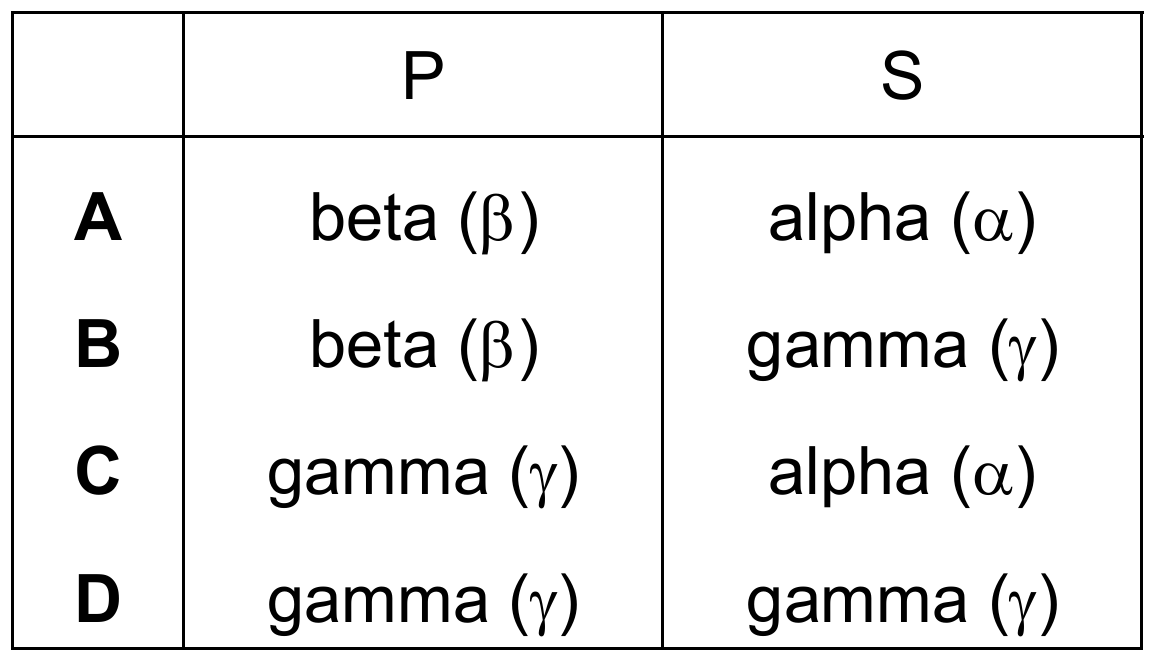
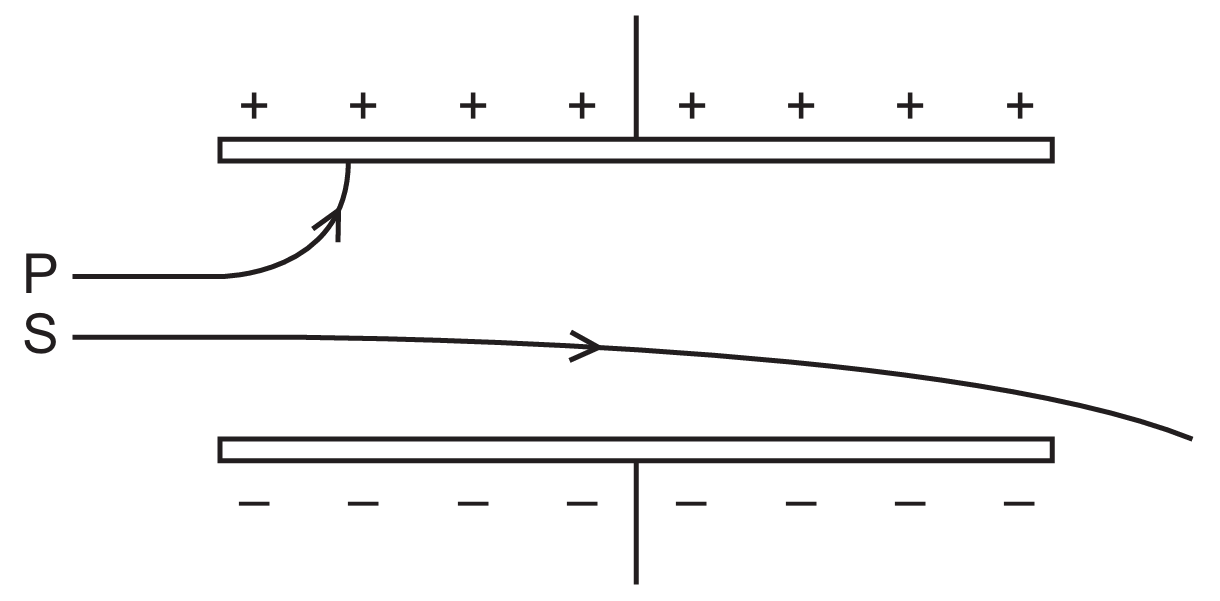
The direction of deflection in an electric field depends on the charge of the radiation. Beam P is deflected toward the positive $(+)$ plate, indicating it carries a negative charge; $\beta$-particles (electrons) are negatively charged and thus attracted to the positive plate. Beam S is deflected toward the negative $(-)$ plate, indicating a positive charge; $\alpha$-particles consist of two protons and two neutrons, giving them a $+2e$ charge. Notably, $\beta$-particles show a larger deflection than $\alpha$-particles because they have a much smaller mass. $\gamma$-radiation carries no charge and would travel straight through without any deflection.
Question 37
Most-appropriate topic codes (Cambridge IGCSE Physics 0625):
▶️ Answer/Explanation
Detailed solution:
In beta ($\beta^-$) decay, an unstable nucleus typically has an excess of neutrons.
To reach a more stable state, a neutron within the nucleus transforms into a proton.
During this process, a high-energy electron (the beta particle) is emitted from the nucleus.
The nuclear equation for this fundamental change is represented as: $n \rightarrow p + e^-$.
This results in the atomic number $Z$ increasing by $1$, while the nucleon number $A$ remains constant.
Therefore, the correct description of the change is $neutron \rightarrow proton + electron$.
Question 38
Most-appropriate topic codes (Cambridge IGCSE Physics 0625):
▶️ Answer/Explanation
Detailed solution:
The gravitational field strength $g$ around a planet is inversely related to the distance from the planet’s center. As the distance increases, the value of $g$ decreases. The problem states the probe starts at the point furthest from the planet (lowest $g$) and moves toward the point nearest the planet (highest $g$). Consequently, the measured values must appear in increasing order. Comparing the options, only Option A shows a sequence where values rise from $6.3\text{ N/kg}$ to $20\text{ N/kg}$. Therefore, Option A correctly represents the order of measurements taken by the probe.
Question 39
Most-appropriate topic codes (Cambridge IGCSE Physics 0625):
▶️ Answer/Explanation
Detailed solution:
To convert a distance from meters to light-years, we use the defined value for one light-year: 1 ly=9.5×10 15 m.
The distance d in light-years is calculated by dividing the total distance in meters by the value of one light-year.
Distance in ly= 9.5×10 15 m/ly 6.6×10 20 m .
Performing the division: 9.5 6.6 ≈0.6947 and 10 15 10 20 =10 5 .
This results in 0.6947×10 5 , which simplifies in standard form to 6.9×10 4 light-years.
Therefore, Option B is the correct numerical value for this astronomical distance.
Question 40
Most-appropriate topic codes (Cambridge IGCSE Physics 0625):
▶️ Answer/Explanation
Detailed solution:
A supernova occurs at the end of the life cycle of a high-mass star.
After a red supergiant exhausts its nuclear fuel, it collapses and explodes as a supernova.
This violent explosion leaves behind a dense remnant at the center.
Depending on the remaining mass, the remnant becomes either a neutron star or a black hole.
Options B and C are stages that occur before the explosion, while option D is the remnant of a low-mass star.
Thus, a neutron star is the only possible result of a supernova listed here.