Home / 0625_w25_qp_23

Question 1

When a pendulum passes a marker, a timer displays 1 minute 30 seconds. The pendulum passes the marker 12 more times from the same direction. On the final pass, the timer displays a time of 2 minutes 18 seconds. What is the time period of oscillation of the pendulum?
A. $4.0$ s
B. $4.4$ s
C. $7.5$ s
D. $12$ s

Most-appropriate topic codes (Cambridge IGCSE Physics 0625):

TOPIC 1.1: Physical quantities and measurement techniques (Determine an average value for a short interval of time by measuring multiples)
▶️ Answer/Explanation
Correct Option: A

Detailed solution:

First, calculate the total time elapsed: $2$ min $18$ s ($138$ s) minus $1$ min $30$ s ($90$ s) equals $48$ s.
Since the pendulum passes the marker $12$ more times from the same direction, it has completed $n = 12$ full oscillations.
The time period $T$ is defined as the total time $t$ divided by the number of oscillations $n$.
Using the formula $T = \frac{t}{n}$, we get $T = \frac{48\text{ s}}{12}$.
This results in a time period of $4.0$ s per oscillation.
Therefore, the correct period of oscillation is $4.0$ s, matching option A.

Question 2

A car driver applies the brakes to bring a car to rest with a constant deceleration of $4.0~m/s^{2}$ in a time of $8.0~s$.

What is the average speed of the car during this time?
A. $4.0~m/s$
B. $8.0~m/s$
C. $16~m/s$
D. $32~m/s$

Most-appropriate topic codes (Cambridge IGCSE Physics 0625):

TOPIC 1.2: Motion (Define speed, velocity, and acceleration; recall and use motion equations)
▶️ Answer/Explanation
Correct Option: C

Detailed solution:

First, find the initial speed $u$ using the acceleration formula $a = \frac{v – u}{t}$. Since the car comes to rest, final speed $v = 0~m/s$, so $-4.0 = \frac{0 – u}{8.0}$, giving $u = 32~m/s$.
For constant acceleration (or deceleration), the average speed is the arithmetic mean of the initial and final speeds: $v_{avg} = \frac{u + v}{2}$.
Substituting the values: $v_{avg} = \frac{32 + 0}{2} = 16~m/s$.
Alternatively, the distance travelled is $s = ut + \frac{1}{2}at^{2} = (32)(8) + \frac{1}{2}(-4)(8)^{2} = 128~m$.
The average speed is then $\frac{\text{total distance}}{\text{total time}} = \frac{128~m}{8.0~s} = 16~m/s$.
This confirms that option C is the correct answer.

Question 3

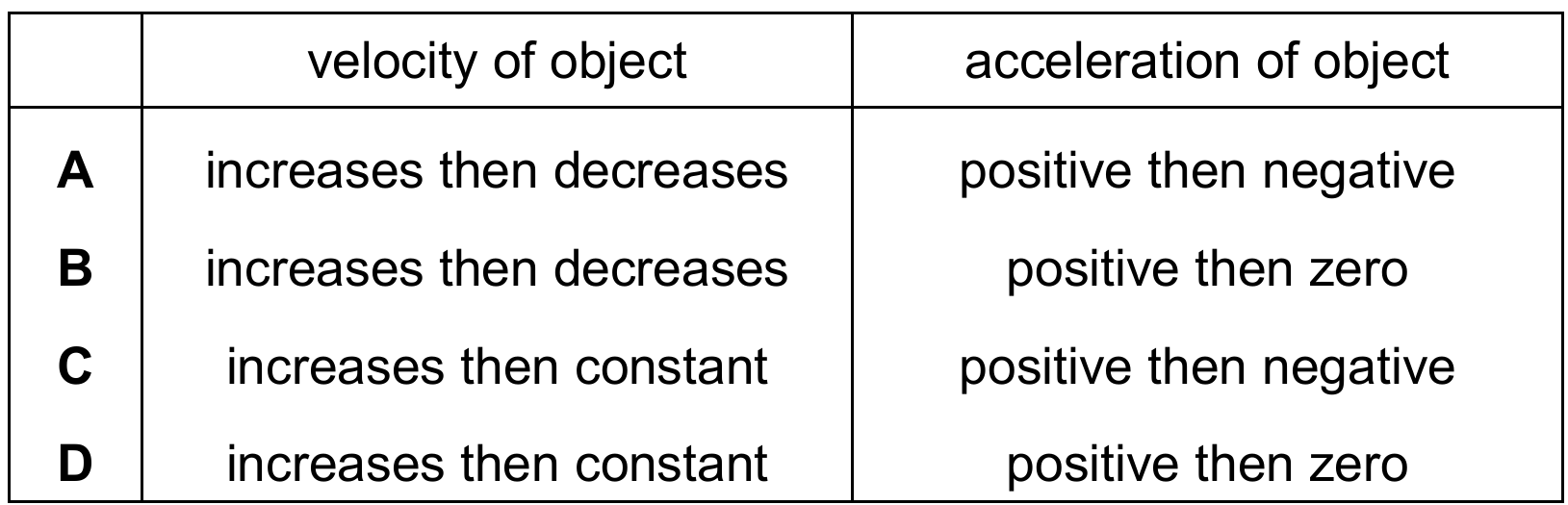
An object is falling in a uniform gravitational field. After a certain time, it reaches terminal velocity. Which row is correct?

Most-appropriate topic codes (Cambridge IGCSE Physics 0625):

TOPIC 1.2: Motion (Describe the motion of objects falling in a uniform gravitational field… including reference to terminal velocity)
▶️ Answer/Explanation
Correct Option: D

Detailed solution:

When an object falls, gravity causes it to accelerate, so its velocity initially increases. As speed grows, air resistance (drag) also increases, reducing the resultant force $F = ma$. Eventually, the upward drag equals the downward weight, resulting in a net force of $0\text{ N}$. At this point, acceleration becomes $0\text{ m/s}^{2}$ and the object maintains a steady speed known as terminal velocity. Thus, the velocity increases then remains constant, while acceleration is initially positive and then becomes zero. This matches the data provided in Row D.
Question 4

Which measuring instrument is used to compare masses?
A. balance
B. protractor
C. stop-watch
D. voltmeter

Most-appropriate topic codes (Cambridge IGCSE Physics 0625):

TOPIC 1.3: Mass and weight (Know that weights and masses may be compared using a balance)
▶️ Answer/Explanation
Correct Option: A

Detailed solution:

Mass is a measure of the quantity of matter in an object, while weight is the force exerted by a gravitational field.
A balance is the standard instrument used to compare an unknown mass against known reference masses or to measure the gravitational pull on an object.
In contrast, a protractor is used to measure angles in degrees ($^{\circ}$), a stop-watch measures time intervals ($t$) in seconds ($s$), and a voltmeter measures potential difference ($V$) in volts ($V$).
According to the syllabus, weights and masses are specifically compared using a balance.
Therefore, option A is the only instrument designed for this physical quantity.

Question 5

Three different liquids are poured into a tall beaker. The liquids do not mix.

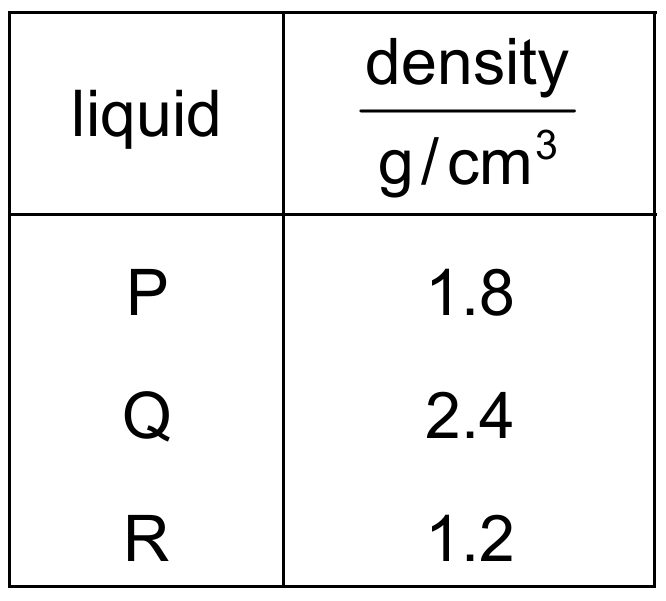
The liquid densities are shown in the table:

What is the correct order of the liquids from the top of the beaker to the bottom?

A. P→Q→R
B. Q→P→R
C. Q→R→P
D. R→P→Q

Most-appropriate topic codes (Cambridge IGCSE Physics 0625):

TOPIC 1.4: Density (Determine whether one liquid will float on another liquid based on density data)
▶️ Answer/Explanation
Correct Option: D

Detailed solution:

When immiscible liquids are placed in a container, they settle into layers based on their densities. The liquid with the lowest density floats at the top, while the liquid with the highest density sinks to the bottom. Comparing the given values: ρ R ​ =1.2 g/cm 3 is the lowest, ρ P ​ =1.8 g/cm 3 is intermediate, and ρ Q ​ =2.4 g/cm 3 is the highest. Therefore, the arrangement from top to bottom is Liquid R, followed by Liquid P, and finally Liquid Q at the base. This corresponds to the order R→P→Q, which matches option D.
Question 6

A car is moving in a straight line on a level road. Its engine provides a forward force on the car. A second force of equal size acts on the car in the opposite direction.

Which statement describes what happens?
A. The car changes direction.
B. The car moves at a constant speed.
C. The car slows down.
D. The car speeds up.

Most-appropriate topic codes (Cambridge IGCSE Physics 0625):

TOPIC 1.5.1: Effects of forces (Object remains at constant speed unless acted on by a resultant force)
▶️ Answer/Explanation
Correct Option: B

Detailed solution:

The car is subject to two forces of equal magnitude acting in opposite directions, meaning the resultant force $F_{res} = 0$.
According to Newton’s First Law, an object continues to move at a constant speed in a straight line if the resultant force is zero.
Since the car was already moving, the lack of a net force means there is no acceleration ($a = \frac{F}{m} = 0$).
Therefore, the velocity remains unchanged, and the car continues to move at a constant speed.
Options C and D are incorrect because they require a non-zero resultant force to cause acceleration or deceleration.
Option A is incorrect as no sideways force is acting to change the car’s direction.

Question 7

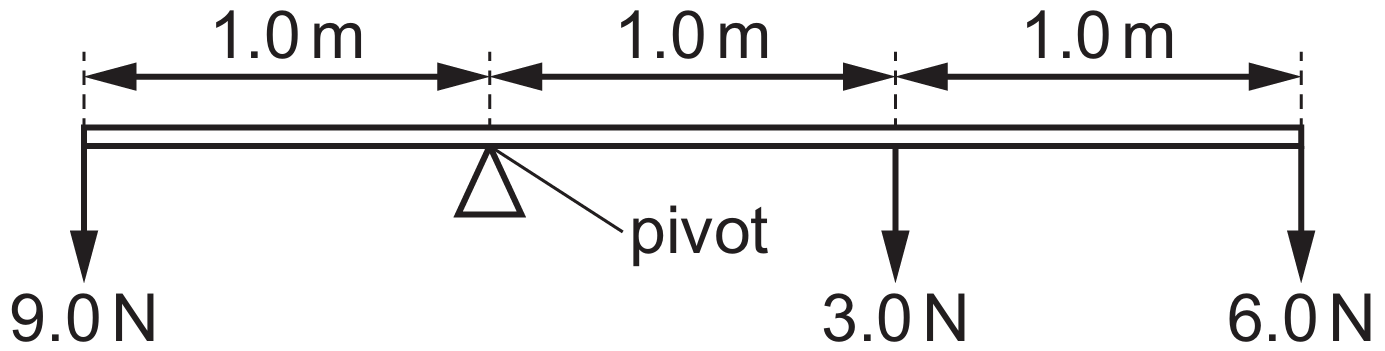
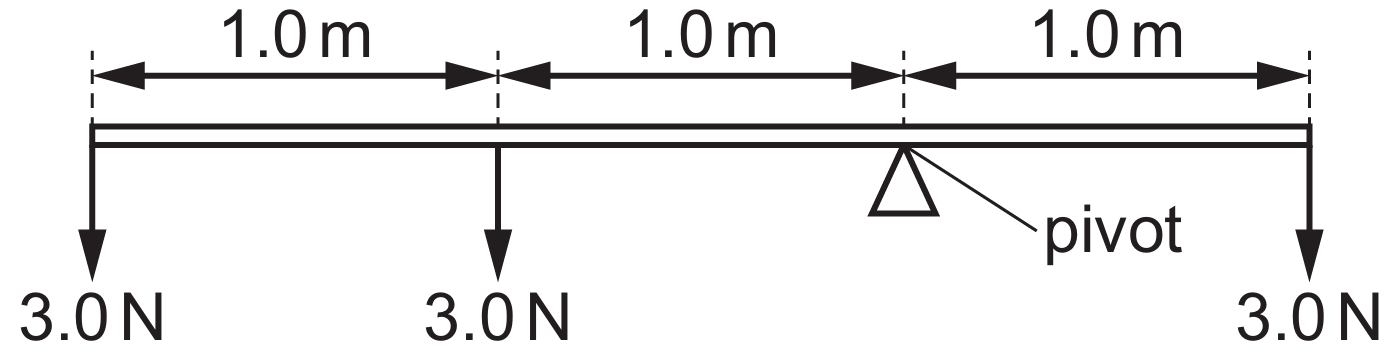
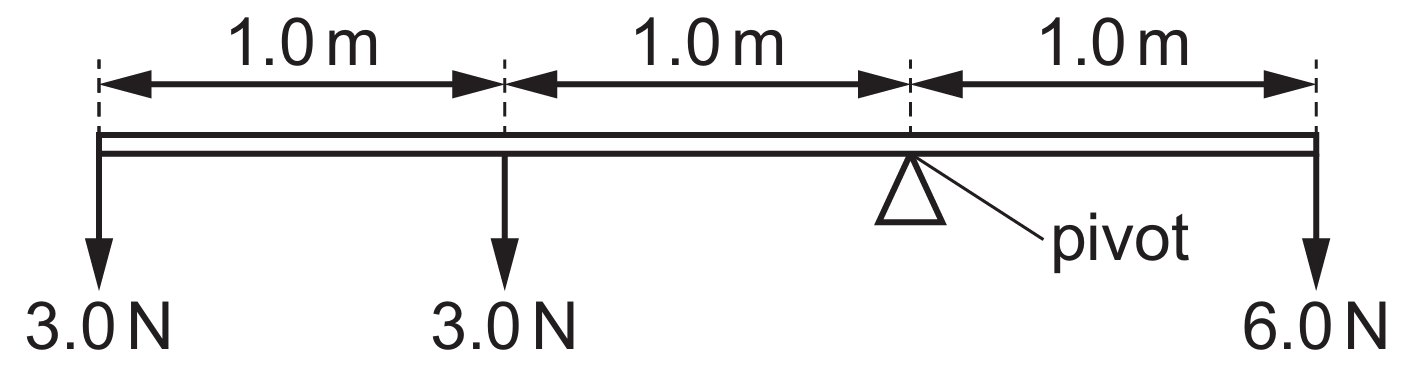
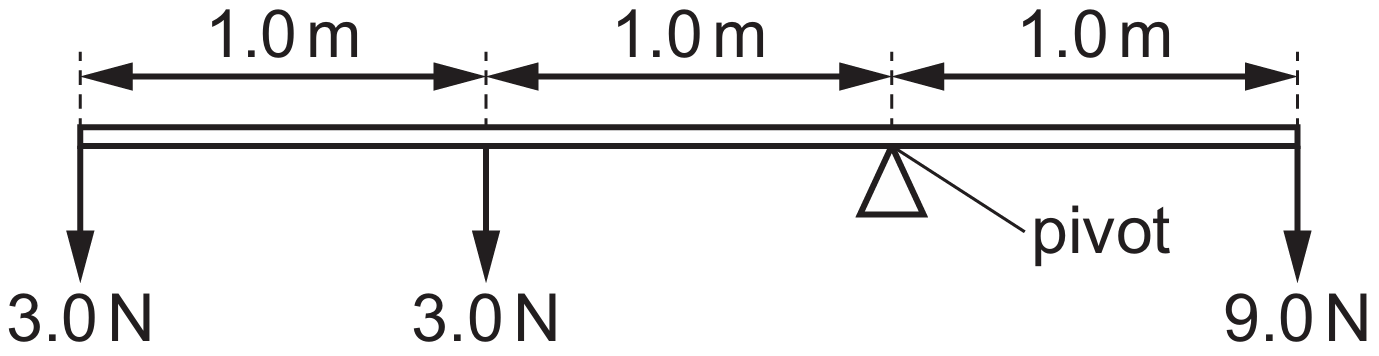
Which beam is balanced? (Ignore the weight of the beam.)
A.
B.
C.
D.

Most-appropriate topic codes (Cambridge IGCSE Physics 0625):

TOPIC 1.5.2: Turning effect of forces (Apply the principle of moments)
▶️ Answer/Explanation
Correct Option: B

Detailed solution:

For a beam to be balanced, the total anticlockwise moment must equal the total clockwise moment about the pivot.
The moment of a force is calculated as $\text{Moment} = \text{Force} \times \text{perpendicular distance from pivot}$.
In Option B, the anticlockwise moments are $(3.0\text{ N} \times 2.0\text{ m}) + (3.0\text{ N} \times 1.0\text{ m}) = 6.0\text{ Nm} + 3.0\text{ Nm} = 9.0\text{ Nm}$.
The clockwise moment is $9.0\text{ N} \times 1.0\text{ m} = 9.0\text{ Nm}$.
Since $9.0\text{ Nm} = 9.0\text{ Nm}$, the resultant moment is zero and the beam is balanced.
Other options result in unequal moments, causing the beam to rotate.
Question 8

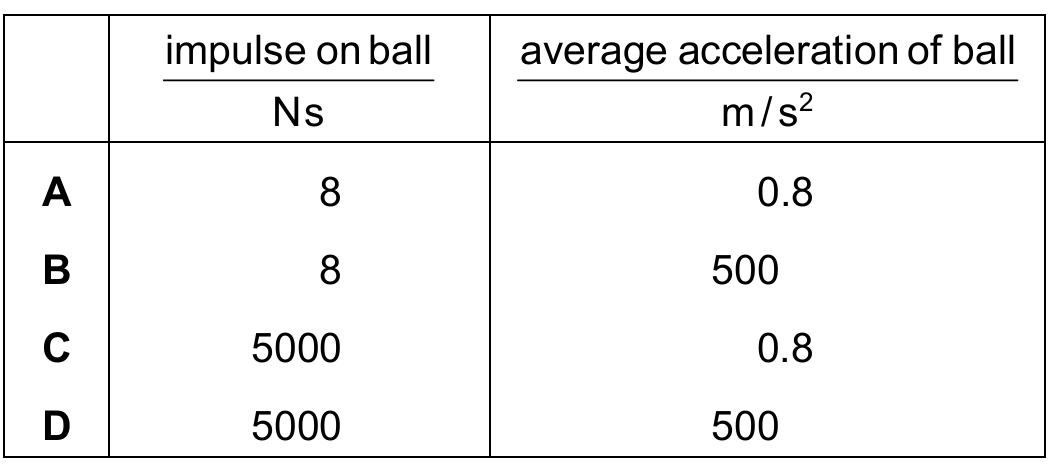
A ball is at rest on the ground. A boy kicks the ball. The boy’s boot is in contact with the ball for a time of 0.040 s. The average force on the ball is 200 N. The ball leaves the boy’s boot with a speed of 20 m/s. Which row gives the impulse of the boot on the ball and the average acceleration of the ball during the time of 0.040 s?

Most-appropriate topic codes (Cambridge IGCSE Physics 0625):

TOPIC 1.2: Motion (Define acceleration as change in velocity per unit time)
TOPIC 1.6: Momentum (Define impulse as force x time)
▶️ Answer/Explanation
Correct Option: B

Detailed solution:

Impulse is defined as the product of the average force and the time interval: Impulse=FΔt.
Substituting the given values: Impulse=200 N×0.040 s=8 Ns.
Average acceleration is defined as the change in velocity per unit time: a= Δt Δv ​ .
The ball starts from rest (u=0 m/s) and reaches v=20 m/s, so Δv=20 m/s−0 m/s=20 m/s.
Calculating acceleration: a= 0.040 s 20 m/s ​ =500 m/s 2 .
Comparing these results with the table, Row B is the only correct match.
Question 9

Which device transfers energy from a chemical energy store to a kinetic energy store?
A. an a.c. generator
B. a battery-powered torch
C. a car engine
D. a wind-up mechanical clock

Most-appropriate topic codes (Cambridge IGCSE Physics 0625):

TOPIC 1.7.1: Energy (Describe how energy is transferred between stores)
▶️ Answer/Explanation
Correct Option: C

Detailed solution:

A car engine burns fuel (fossil fuels or biofuels), which contains energy in a chemical store. This combustion process releases energy that is then transferred to move the pistons and wheels, creating kinetic energy ($E_{k} = \frac{1}{2}mv^{2}$). Option A involves mechanical to electrical transfer, while Option B transfers chemical energy to an electrical and then light/thermal store. Option D involves elastic potential energy. Therefore, the car engine is the only device listed that primarily converts a chemical store into a kinetic store to provide motion.

Question 10

For which energy resource is the Sun the main source?
A. geothermal
B. nuclear
C. tidal
D. wind

Most-appropriate topic codes (Cambridge IGCSE Physics 0625):

TOPIC 1.7.3: Energy resources (Know that radiation from the Sun is the main source of energy for all our energy resources except geothermal, nuclear and tidal)
▶️ Answer/Explanation
Correct Option: D

Detailed solution:

The Sun is the primary source of energy for most Earth-based resources, including wind.
Wind is produced by the uneven heating of the Earth’s atmosphere by solar radiation.
This temperature differential causes air to move, creating kinetic energy that we harness as wind power.
In contrast, geothermal energy originates from the Earth’s internal heat, and nuclear energy comes from atomic nuclei.
Tidal energy is primarily driven by the gravitational pull of the Moon and the Sun, not solar radiation.
Therefore, according to the syllabus, geothermal, nuclear, and tidal are the three specific exceptions.
As a result, wind is the only resource listed that is directly derived from solar energy.

Question 11

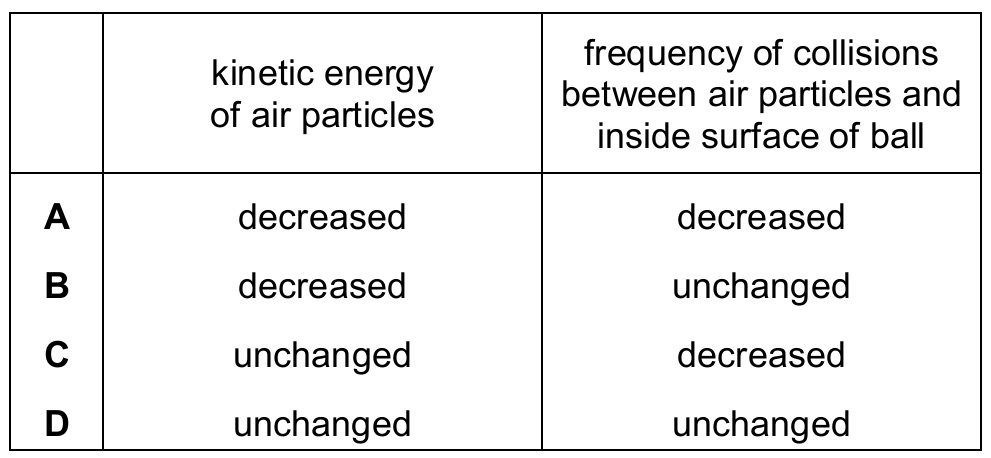
A football is inflated in a warm room and then taken outside where the temperature is much lower. The pressure and temperature inside the ball both decrease. The volume of the ball is unchanged.
Which row explains the decrease in pressure in terms of the movement of air particles?

Most-appropriate topic codes (Cambridge IGCSE Physics 0625):

TOPIC 2.1.2: Particle model (Relationship between motion of particles and temperature)
▶️ Answer/Explanation
Correct Option: A

Detailed solution:

Temperature is a measure of the average kinetic energy (E k ​ ) of the particles; as temperature decreases, the particles move slower and their kinetic energy decreases.
Since the particles move more slowly at a lower temperature, they take longer to travel across the ball and hit the walls.
This leads to a decrease in the frequency of collisions between the air particles and the inside surface of the ball.
Pressure in a gas is caused by these collisions; fewer and less forceful impacts result in lower pressure.
Because both the kinetic energy and the collision frequency decrease, Row A provides the correct explanation.
This follows the kinetic particle model where P∝T for a constant volume.
Question 12

A fixed mass of gas has a volume of $25~cm^{3}$. The pressure of the gas is $100~kPa$. The volume of the gas is slowly decreased by $15~cm^{3}$ at constant temperature. What is the change in pressure of the gas?
A. $67~kPa$
B. $150~kPa$
C. $170~kPa$
D. $250~kPa$

Most-appropriate topic codes (Cambridge IGCSE Physics 0625):

TOPIC 2.1.3: Gases and the absolute scale of temperature (Recall and use the equation $pV = \text{constant}$)
▶️ Answer/Explanation
Correct Option: B

Detailed solution:

At constant temperature, a fixed mass of gas follows Boyle’s Law: $P_{1}V_{1} = P_{2}V_{2}$.
Initial values are $P_{1} = 100~kPa$ and $V_{1} = 25~cm^{3}$. The volume decreases by $15~cm^{3}$, so $V_{2} = 25 – 15 = 10~cm^{3}$.
Rearranging to find the new pressure: $P_{2} = \frac{P_{1}V_{1}}{V_{2}} = \frac{100 \times 25}{10} = 250~kPa$.
The question asks for the change in pressure: $\Delta P = P_{2} – P_{1} = 250~kPa – 100~kPa = 150~kPa$.
Thus, the change in pressure is $150~kPa$, which corresponds to option B.

Question 13

The specific heat capacity of ice is $2000~\text{J/kg}^{\circ}\text{C}$.Which thermal energy is required to raise the temperature of $100~\text{g}$ of ice by $5^{\circ}\text{C}$?
A. $40~\text{J}$
B. $100~\text{J}$
C. $1000~\text{J}$
D. $4000~\text{J}$

Most-appropriate topic codes (Cambridge IGCSE Physics 0625):

TOPIC 2.2.2: Specific heat capacity (Recall and use the equation $\Delta E = mc\Delta\theta$)
▶️ Answer/Explanation
Correct Option: C

Detailed solution:

To find the thermal energy ($\Delta E$), we use the specific heat capacity formula: $\Delta E = mc\Delta\theta$.
First, convert the mass from grams to kilograms: $m = 100~\text{g} = 0.1~\text{kg}$.
The specific heat capacity $c$ is given as $2000~\text{J/kg}^{\circ}\text{C}$ and the change in temperature $\Delta\theta$ is $5^{\circ}\text{C}$.
Substitute the values into the equation: $\Delta E = 0.1~\text{kg} \times 2000~\text{J/kg}^{\circ}\text{C} \times 5^{\circ}\text{C}$.
Calculating the product: $\Delta E = 200 \times 5 = 1000~\text{J}$.
This matches Option C, representing the energy required to raise the temperature of the ice.

Question 14

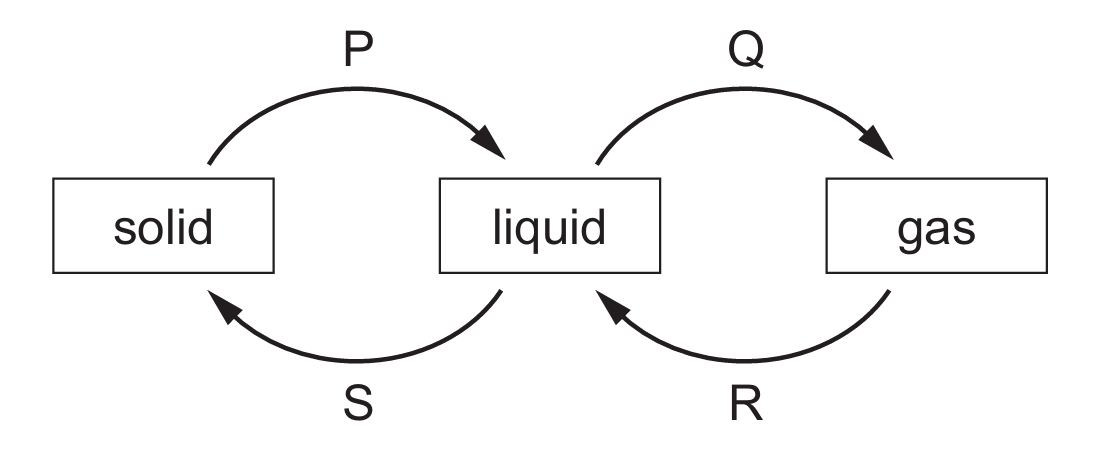
The diagram shows four labelled changes of state, $P$, $Q$, $R$ and $S$, between solid, liquid and gas.
Which changes need an energy input?
A. $P$ and $Q$
B. $Q$ and $R$
C. $R$ and $S$
D. $S$ and $P$

Most-appropriate topic codes (Cambridge IGCSE Physics 0625):

TOPIC 2.2.3: Melting, boiling and evaporation (Describe melting and boiling in terms of energy input)
▶️ Answer/Explanation
Correct Option: A

Detailed solution:

Changes of state that require an input of thermal energy are those where particles must overcome attractive forces to increase their separation.
Process $P$ represents melting (solid to liquid), and process $Q$ represents boiling or evaporation (liquid to gas).
In both $P$ and $Q$, energy is absorbed to break or weaken the bonds between particles, increasing their internal potential energy.
Conversely, processes $R$ (gas to liquid) and $S$ (liquid to solid) involve the release of energy as particles move closer together.
Therefore, only $P$ and $Q$ require an external energy input to proceed.
This matches Option A, identifying the endothermic transitions in the heating curve cycle.
Question 15

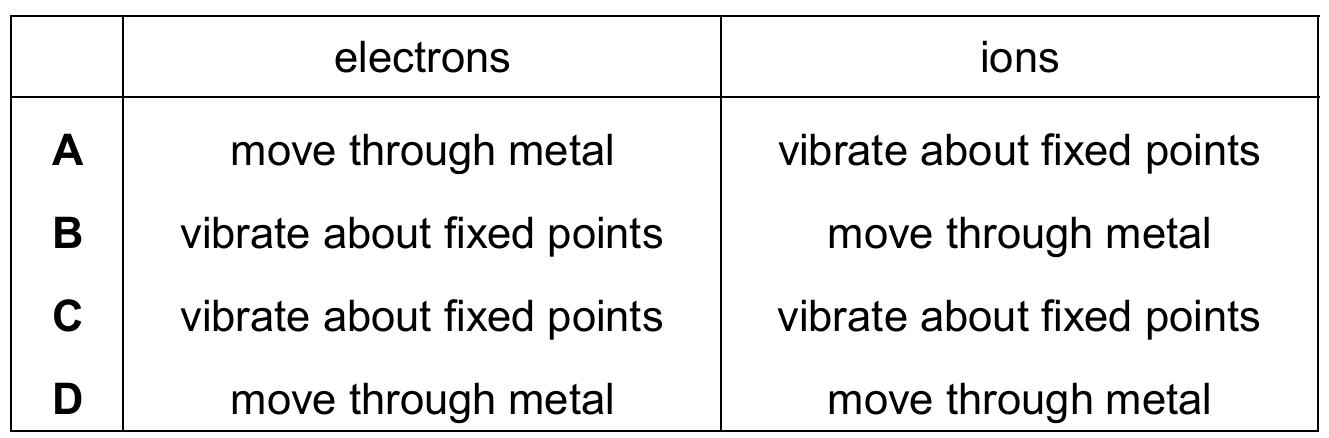
Which row about the movement of electrons and ions during conduction of thermal energy through a metal is correct?

Most-appropriate topic codes (Cambridge IGCSE Physics 0625):

TOPIC 2.3.1: Conduction (Thermal conduction in all solids in terms of atomic or molecular lattice vibrations and also in terms of the movement of free (delocalised) electrons in metallic conductors)
▶️ Answer/Explanation
Correct Option: A

Detailed solution:

In a metal, thermal conduction occurs via two main mechanisms: lattice vibrations and electron transfer.
The positive ions are held in a regular lattice structure and can only vibrate about their fixed positions.
When heated, these ions gain kinetic energy and pass vibrations to neighbors via collisions.
Metals also contain delocalised (free) electrons that are not bound to specific atoms.
These electrons gain energy, move rapidly through the metal lattice, and transfer thermal energy much faster than vibrations alone.
Thus, electrons move through the metal while ions remain vibrating at fixed points, making Row A correct.
Question 16

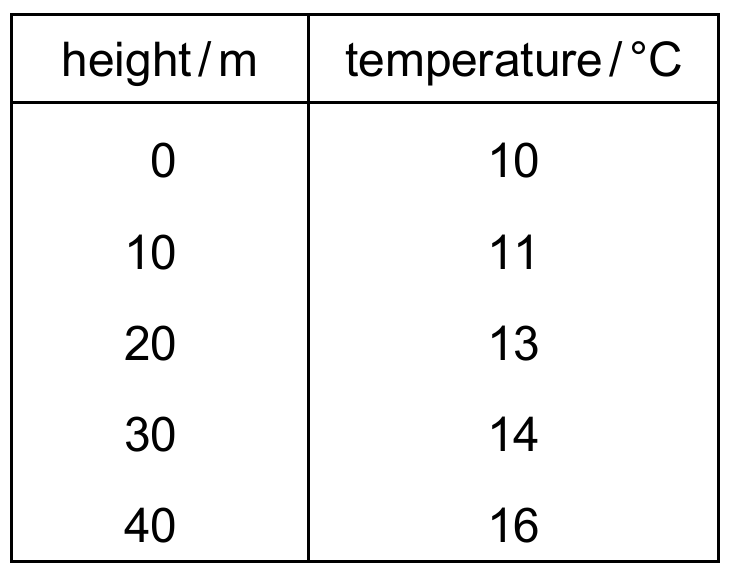
A scientist measures the air temperature at different heights from the floor in a cave. The results are recorded in the table.
Why does altering the height affect the temperature of the air?
A. The particles in warm air have less energy than the particles in cool air.
B. The particles in cool air are further apart than the particles in warm air.
C. Warm air is less dense than cool air.
D. Cool air rises above warm air.

Most-appropriate topic codes (Cambridge IGCSE Physics 0625):

TOPIC 2.3.2: Convection (Explain convection in liquids and gases in terms of density changes)
▶️ Answer/Explanation
Correct Option: C

Detailed solution:

The table shows that as height increases from $0~m$ to $40~m$, the temperature rises from $10^{\circ}C$ to $16^{\circ}C$.
This phenomenon occurs due to convection, where warmer air expands, causing its volume to increase.
Since $\rho = \frac{m}{V}$, an increase in volume results in a decrease in density $\rho$ for a fixed mass of air.
Because warm air is less dense than cool air, it experiences an upward buoyant force and rises.
This explains why the highest temperatures are recorded at the greatest heights in the cave.
Options A and B are scientifically incorrect, while D contradicts the physical behavior of fluids.
Question 17

Star $X$ has a larger diameter than star $Y$ but they both emit radiation with the same power. Which statement is correct?
A. The surface temperature of $X$ is less than the surface temperature of $Y$.
B. The surface temperatures of $X$ and $Y$ are the same.
C. The surface temperature of $X$ is greater than the surface temperature of $Y$.
D. The surface areas of $X$ and $Y$ are the same.

Most-appropriate topic codes (Cambridge IGCSE Physics 0625):

TOPIC 2.3.3: Radiation (Describe how the rate of emission of radiation depends on the surface temperature and surface area)
TOPIC 6.2.1: The Sun as a star
▶️ Answer/Explanation
Correct Option: A

Detailed solution:

The total power $P$ emitted by a star depends on its surface area $A$ and its surface temperature $T$.
Since star $X$ has a larger diameter than star $Y$, it has a significantly larger surface area ($A_X > A_Y$).
The problem states both stars emit the same total power, so $P_X = P_Y$.
For a larger object to emit the same total energy as a smaller one, its emission per unit area must be lower.
Since the rate of emission increases with temperature, star $X$ must be cooler to compensate for its larger size.
Therefore, the surface temperature of $X$ is less than the surface temperature of $Y$.

Question 18

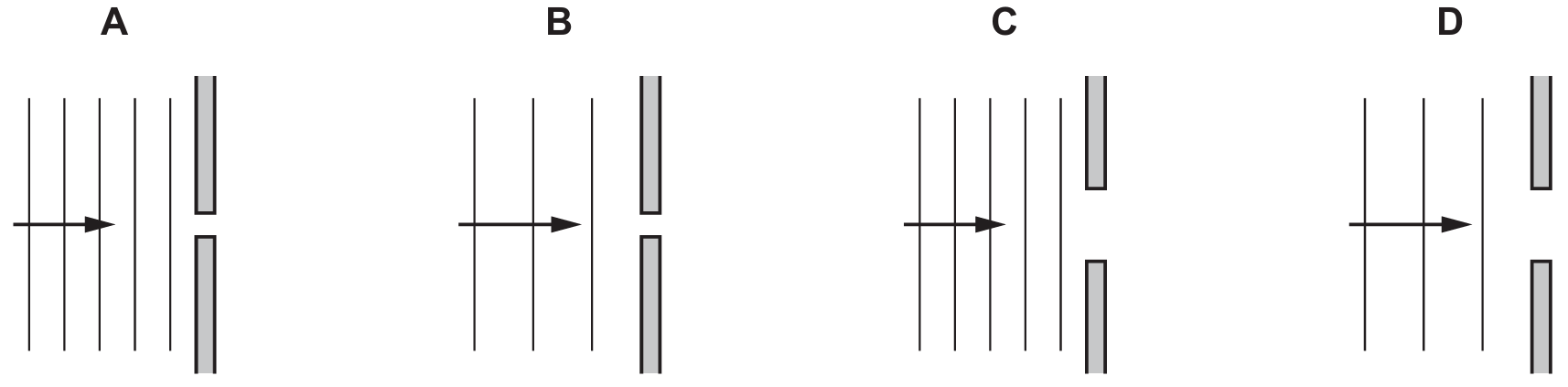
When water waves pass through a gap, they diffract.
The diagrams show wavefronts approaching a gap.
In which diagram will the diffraction be least?

Most-appropriate topic codes (Cambridge IGCSE Physics 0625):

TOPIC 3.1: General properties of waves (Describe how wavelength and gap size affects diffraction through a gap)
▶️ Answer/Explanation
Correct Option: C

Detailed solution:

Diffraction is the spreading of waves as they pass through a gap or around an edge.
The degree of diffraction depends on the ratio of the wavelength $\lambda$ to the gap width $d$.
Maximum diffraction occurs when the gap width is approximately equal to the wavelength ($d \approx \lambda$).
Conversely, diffraction is least significant when the gap is much wider than the wavelength ($d \gg \lambda$).
In diagram C, the wavefronts are close together (small $\lambda$) and the gap is large (wide $d$).
Therefore, diagram C represents the conditions where the waves will spread out the least after passing through the gap.
Question 19

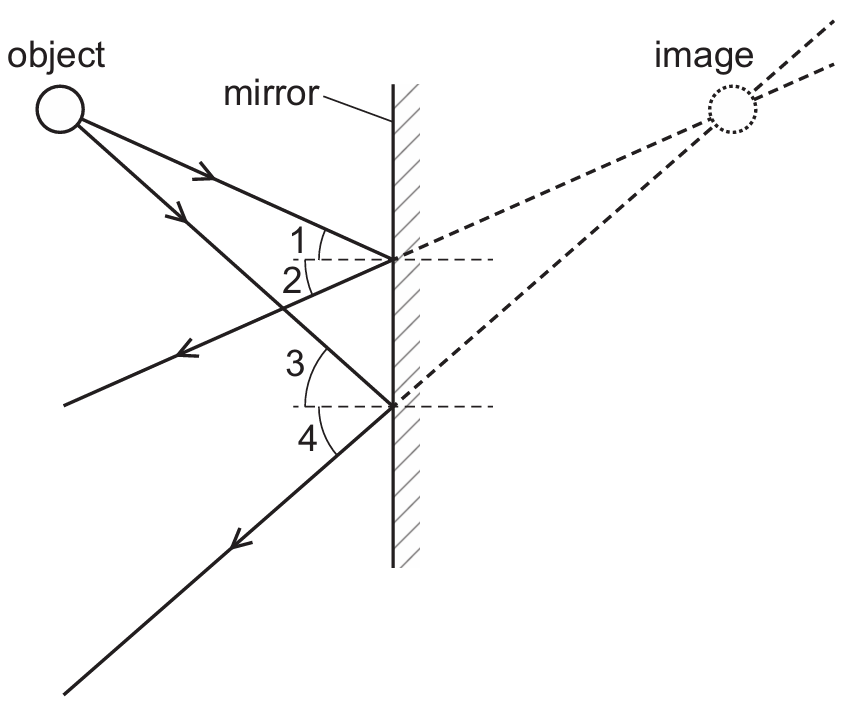
The diagram shows a scale drawing of the formation of an image by the reflection of light from a plane mirror.
What are the relationships between the labelled angles?
A. angle 1=angle 2, and angle 3=angle 4
B. angle 1=angle 3, and angle 2=angle 4
C. angle 1=angle 4, and angle 3=angle 2
D. angle 1=angle 2=angle 3=angle 4

Most-appropriate topic codes (Cambridge IGCSE Physics 0625):

TOPIC 3.2.1: Reflection of light (Law of reflection: angle of incidence = angle of reflection)
▶️ Answer/Explanation
Correct Option: A

Detailed solution:

According to the law of reflection, for any ray of light striking a plane mirror, the angle of incidence i is equal to the angle of reflection r, measured from the normal.
In the provided diagram, the dashed lines perpendicular to the mirror surface represent the normals at the points of incidence.
For the first ray, angle 1 is the angle of incidence and angle 2 is the angle of reflection, therefore angle 1=angle 2.
For the second ray, angle 3 is the angle of incidence and angle 4 is the angle of reflection, therefore angle 3=angle 4.
Since each individual reflection must independently obey this law, the only correct relationship is found in option A.
Question 20

The speed of light in a vacuum is 3.0×10 8 m/s. The speed of light in glass is 2.2×10 8 m/s. A light ray in a vacuum enters glass with an angle of incidence of 40 ∘ . What is the angle of refraction within the glass?
A. 28°
B. 29°
C. 55°
D. 61°

Most-appropriate topic codes (Cambridge IGCSE Physics 0625):

TOPIC 3.2.2: Refraction of light (Refractive index as ratio of speeds; n= sinr sini ​ )
▶️ Answer/Explanation
Correct Option: A

Detailed solution:

First, calculate the refractive index n using the speeds of light: n= speed in glass speed in vacuum ​ = 2.2×10 8 3.0×10 8 ​ ≈1.364.
Next, apply Snell’s Law: n= sinr sini ​ , where i=40 ∘ and r is the angle of refraction.
Rearranging the formula gives sinr= n sin40 ∘ ​ = 1.364 0.6428 ​ ≈0.4713.
Taking the inverse sine, r=arcsin(0.4713)≈28.1 ∘ .
Rounding to the nearest whole number, the angle of refraction is 28 ∘ .
Thus, option A is the correct answer.

Question 21

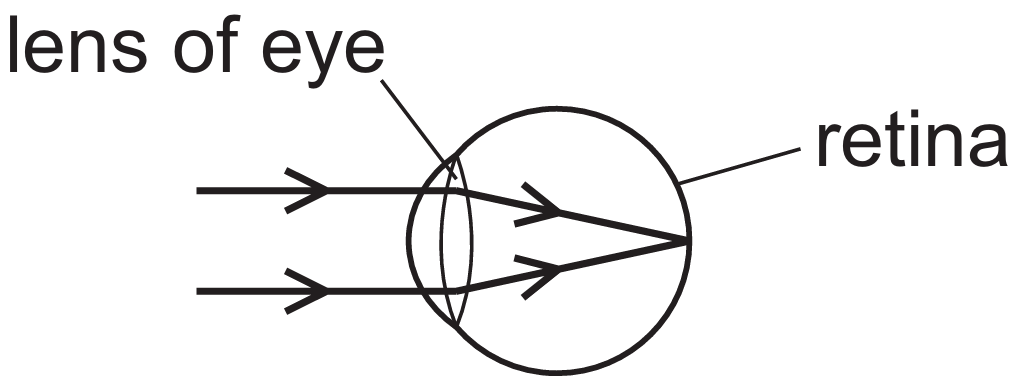
The diagram shows a human eye that correctly focuses the light on the retina.
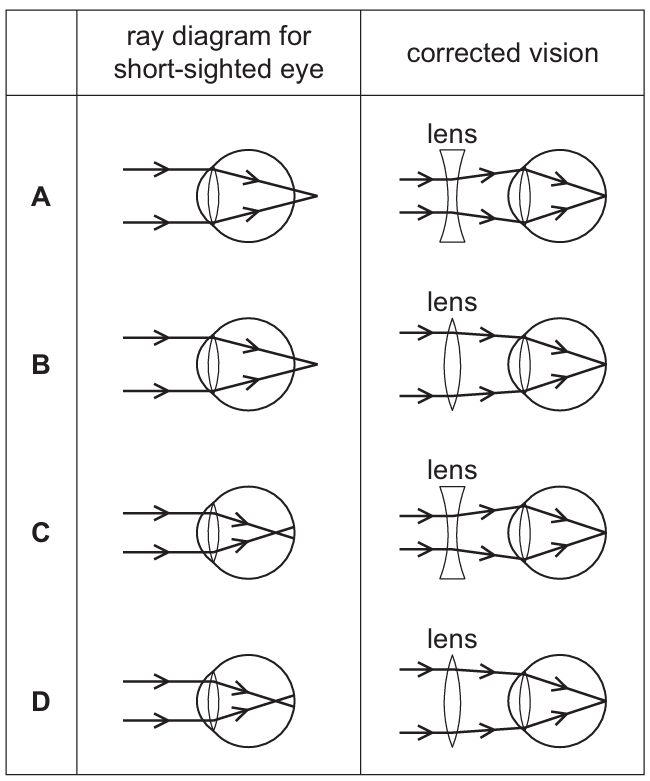
Which row shows a short-sighted eye and use of the correct lens to focus the image?

Most-appropriate topic codes (Cambridge IGCSE Physics 0625):

TOPIC 3.2.3: Thin lenses (Describe the use of converging and diverging lenses to correct long-sightedness and short-sightedness)
▶️ Answer/Explanation
Correct Option: C

Detailed solution:

Short-sightedness (myopia) occurs when the eye’s lens is too strong or the eyeball is too long, causing light rays from distant objects to focus in front of the retina rather than directly on it.
To correct this, a concave (diverging) lens is placed in front of the eye to spread the incoming parallel light rays slightly before they enter the eye.
This divergence allows the eye’s internal lens to focus the light further back, exactly onto the surface of the retina for a clear image.
In the provided table, Row C correctly illustrates the focal point being in front of the retina and the use of a diverging lens for correction.
Rows A and B are incorrect because they show long-sightedness, while Row D suggests an incorrect lens type for myopia.
Question 22

Visible light, X-rays and microwaves are all components of the electromagnetic spectrum.
Which statement about the waves is correct?
A. In a vacuum, microwaves travel faster than visible light and have a shorter wavelength than visible light.
B. In a vacuum, microwaves travel at the same speed as visible light and have a shorter wavelength than visible light.
C. In a vacuum, X-rays travel faster than visible light and have a shorter wavelength than visible light.
D. In a vacuum, X-rays travel at the same speed as visible light and have a shorter wavelength than visible light.

Most-appropriate topic codes (Cambridge IGCSE Physics 0625):

TOPIC 3.3: Electromagnetic spectrum (Know that all electromagnetic waves travel at the same high speed in a vacuum)
▶️ Answer/Explanation
Correct Option: D

Detailed solution:

All electromagnetic waves, including X-rays and visible light, travel at the same speed in a vacuum, approximately $3.0 \times 10^{8} m/s$.
The electromagnetic spectrum is ordered by increasing frequency and decreasing wavelength: radio, microwave, infrared, visible, ultraviolet, X-ray, and gamma ray.
Since X-rays have a much higher frequency than visible light, they must have a shorter wavelength according to the wave equation $v = f \lambda$.
Microwaves, conversely, have a lower frequency and thus a longer wavelength than visible light.
Option D is correct because it accurately identifies that X-rays travel at the same speed as visible light but possess a shorter wavelength.

Question 23

Both the amplitude and the frequency of a sound wave decrease.
What happens to the sound that is heard?
A. The sound is louder and has a higher pitch.
B. The sound is louder and has a lower pitch.
C. The sound is quieter and has a higher pitch.
D. The sound is quieter and has a lower pitch.

Most-appropriate topic codes (Cambridge IGCSE Physics 0625):

TOPIC 3.4: Sound (Describe how changes in amplitude and frequency affect the loudness and pitch of sound waves)
▶️ Answer/Explanation
Correct Option: D

Detailed solution:

The loudness of a sound wave is determined by its amplitude; a decrease in amplitude results in a quieter sound.
The pitch of a sound is determined by its frequency, where f= T 1 ​ .
When the frequency decreases, the number of vibrations per second is lower, resulting in a lower pitch.
Since the question states both properties decrease, the sound becomes both quieter and lower in pitch.
This corresponds exactly to the description provided in Option D.
Therefore, the observed change is a quieter sound with a lower pitch.

Question 24

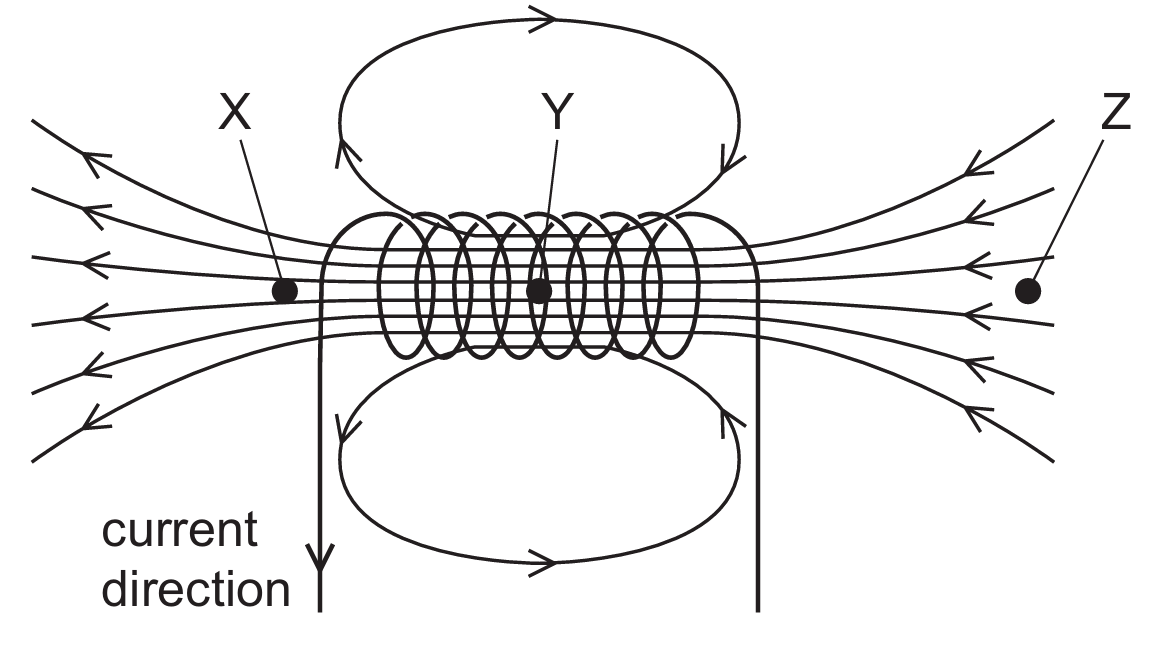
The diagram shows the magnetic field due to a current in a solenoid.
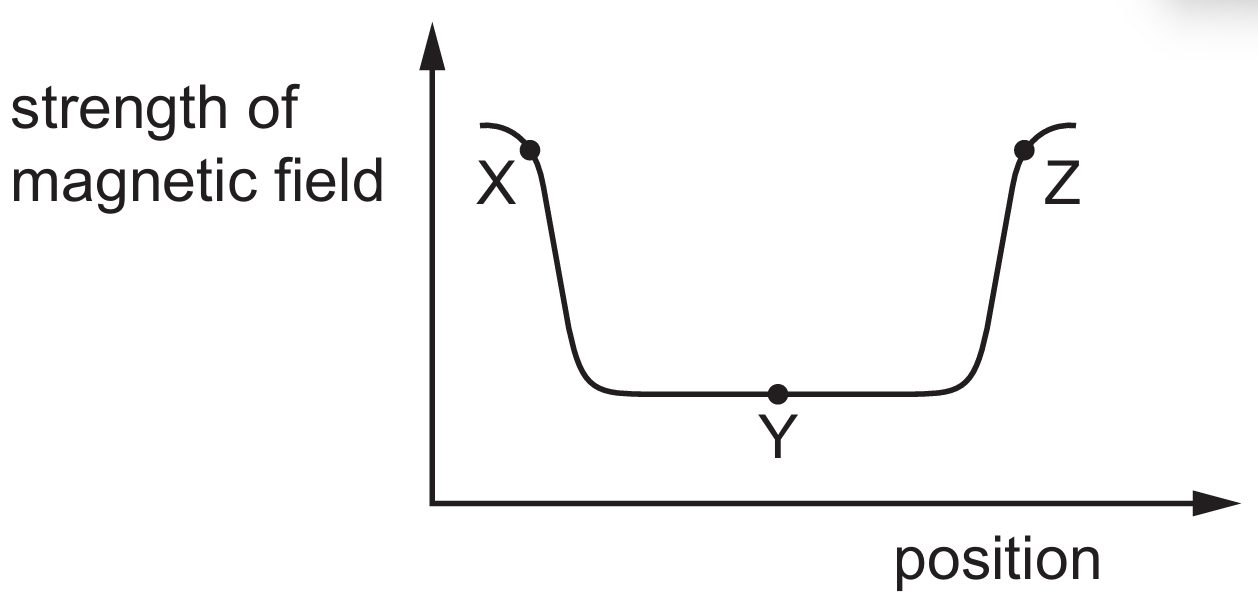
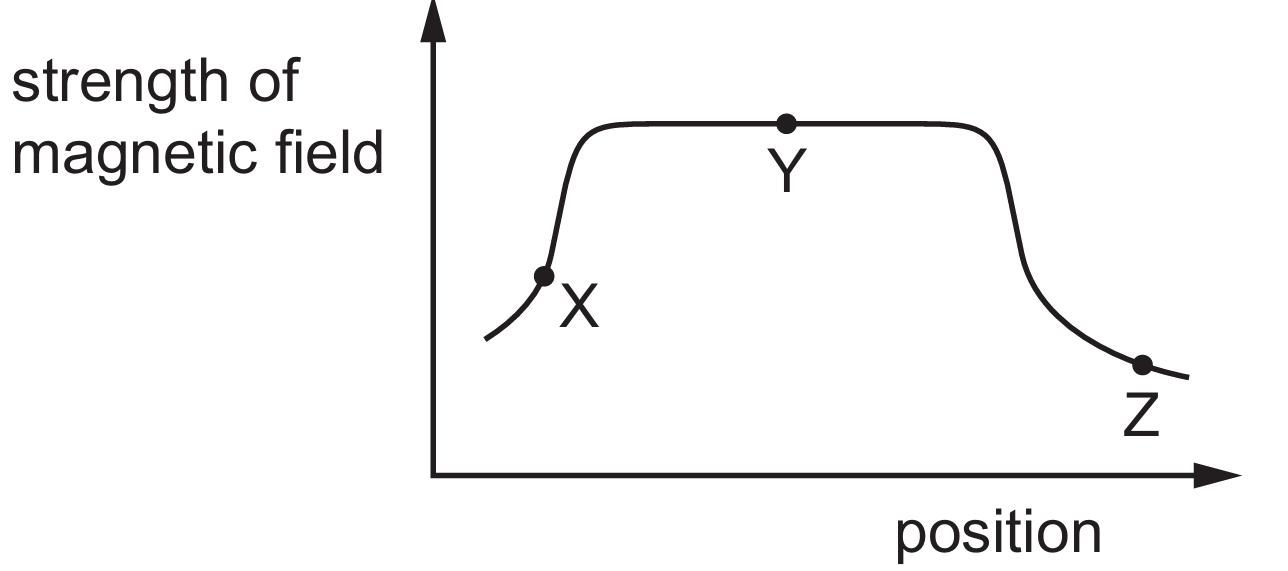
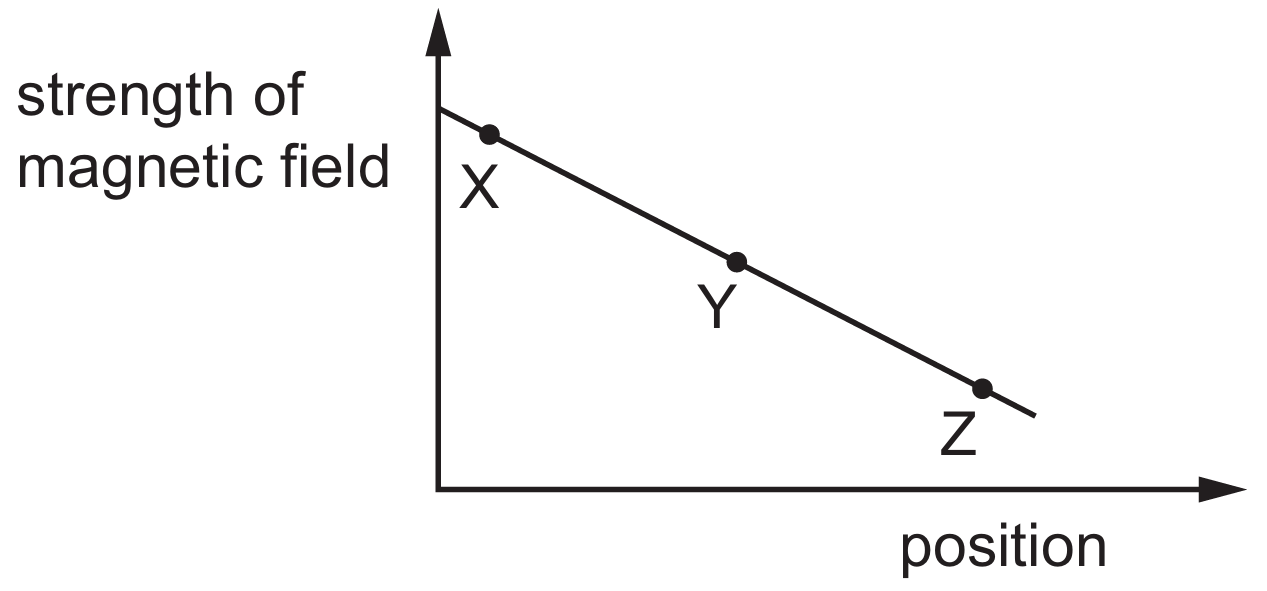
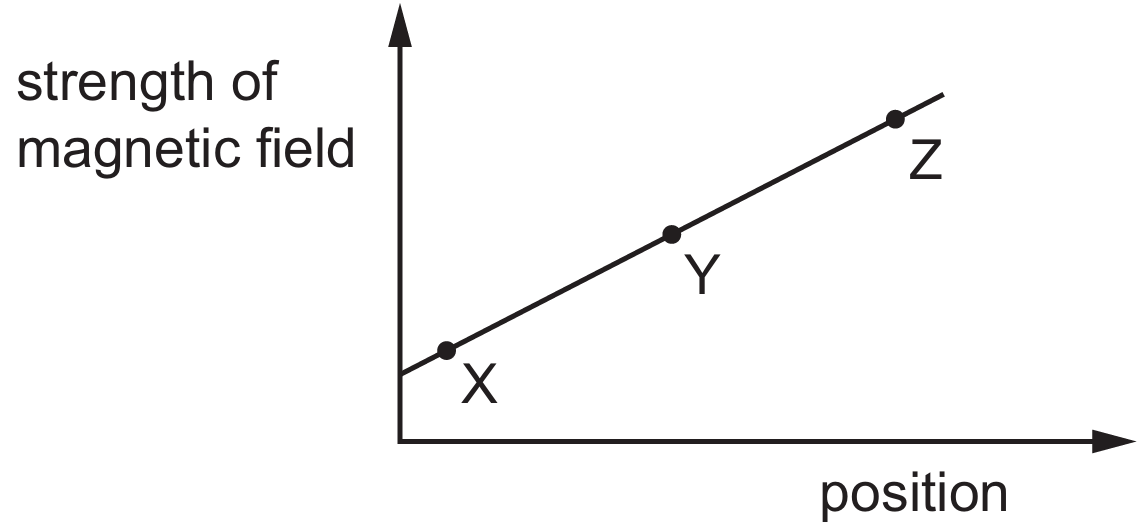
Which graph represents the strength of the magnetic field at positions $X$, $Y$ and $Z$?
A.
B.
C.
D.

Most-appropriate topic codes (Cambridge IGCSE Physics 0625):

TOPIC 4.1: Simple phenomena of magnetism (Relative strength represented by spacing of field lines)
TOPIC 4.5.3: Magnetic effect of a current (Field due to currents in solenoids)
▶️ Answer/Explanation
Correct Option: C

Detailed solution:

The strength of a magnetic field is indicated by the density or spacing of the magnetic field lines. Inside the solenoid at position $Y$, the field lines are straight, parallel, and very close together, representing a strong and uniform magnetic field. As we move to positions $X$ and $Z$ at the ends of the solenoid, the field lines begin to diverge and spread out into the surrounding space. This increased spacing indicates that the magnetic field strength decreases significantly outside the coils compared to the center. Graph $C$ correctly illustrates this by showing a high, flat peak at $Y$ and lower values at $X$ and $Z$.
Question 25

Why does a plastic rod become negatively charged when it is rubbed with a cloth?
A. The rod gains electrons.
B. The rod gains protons.
C. The rod loses electrons.
D. The rod loses protons.

Most-appropriate topic codes (Cambridge IGCSE Physics 0625):

TOPIC 4.2.1: Electric charge (Explain that charging of solids by friction involves only a transfer of negative charge (electrons))
▶️ Answer/Explanation
Correct Option: A

Detailed solution:

Charging by friction involves the transfer of $electrons$ between two insulating materials.
Protons are bound tightly within the nucleus and do not move during the charging process.
An object becomes negatively charged if it gains $electrons$, which carry a relative charge of $-1$.
In this case, friction causes $electrons$ to move from the cloth onto the plastic rod.
Since the rod now has an excess of negative charges, its net charge becomes negative.
Therefore, the rod becomes negatively charged because it gains $electrons$.

Question 26

There is an electric current in a circuit with a battery. This question refers to the positive and negative terminals of the battery.
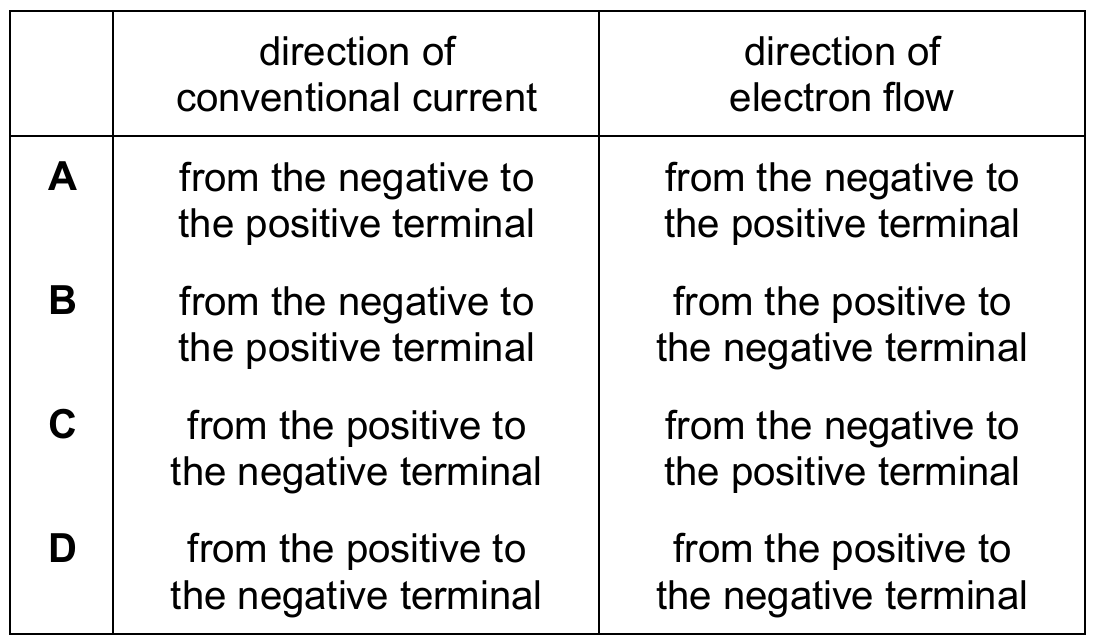
Which row correctly describes the directions of the conventional current and the electron flow in the circuit?

Most-appropriate topic codes (Cambridge IGCSE Physics 0625):

TOPIC 4.2.2: Electric current (State that conventional current is from positive to negative and that the flow of free electrons is from negative to positive)
▶️ Answer/Explanation
Correct Option: C

Detailed solution:

Conventional current is defined by historical convention as the flow of positive charge, moving from the positive ($+$) terminal to the negative ($-$) terminal.
In metallic conductors, current is actually the movement of free electrons, which are negatively charged particles.
Because opposite charges attract and like charges repel, electrons flow away from the negative terminal and toward the positive terminal.
Thus, the direction of electron flow is from the negative ($-$) terminal to the positive ($+$) terminal, which is opposite to the conventional current.
This distinction is essential for analyzing circuit diagrams and using the equation $I = \frac{Q}{t}$.
Option C correctly matches both of these physical directions.
Question 27

Which electrical quantity is defined in terms of the energy supplied by a source in driving charge round a complete circuit?
A. current
B. electromotive force
C. potential difference
D. power

Most-appropriate topic codes (Cambridge IGCSE Physics 0625):

TOPIC 4.2.3: Electromotive force and potential difference (Define electromotive force (e.m.f.) as the electrical work done by a source in moving a unit charge around a complete circuit)
▶️ Answer/Explanation
Correct Option: B

Detailed solution:

Electromotive force (e.m.f.) is the energy provided by a source, such as a battery, per unit charge.
It is mathematically defined by the equation E= Q W ​ , where W is the electrical work done and Q is the charge.
While potential difference (p.d.) also uses V= Q W ​ , it refers specifically to energy transferred per unit charge passing between two points.
The phrase “driving charge round a complete circuit” uniquely identifies the total energy input from the source.
Current is the rate of flow of charge, I= t Q ​ , and power is the rate of energy transfer, P= t ΔE ​ .
Therefore, the description matches the definition of electromotive force, making Option B the correct choice.

Question 28

A torch has a simple circuit with a $3.0\text{ V}$ battery and a lamp. There is a $20\text{ mA}$ current in the lamp. How much energy is transferred to the lamp in $5.0\text{ minutes}$?
A. $0.30\text{ J}$
B. $18\text{ J}$
C. $60\text{ J}$
D. $0.30\text{ kJ}$

Most-appropriate topic codes (Cambridge IGCSE Physics 0625):

TOPIC 4.2.5: Electrical energy and electrical power (Recall and use the equation $E = IVt$)
▶️ Answer/Explanation
Correct Option: B

Detailed solution:

First, convert all units to SI: current $I = 20\text{ mA} = 0.020\text{ A}$ and time $t = 5.0\text{ mins} = 5.0 \times 60 = 300\text{ s}$.
The electrical energy transferred is calculated using the formula $E = VIt$, where $V$ is potential difference.
Substituting the values: $E = 3.0\text{ V} \times 0.020\text{ A} \times 300\text{ s}$.
Calculating the product gives $E = 0.06 \times 300 = 18\text{ J}$.
This matches Option B exactly.

Question 29

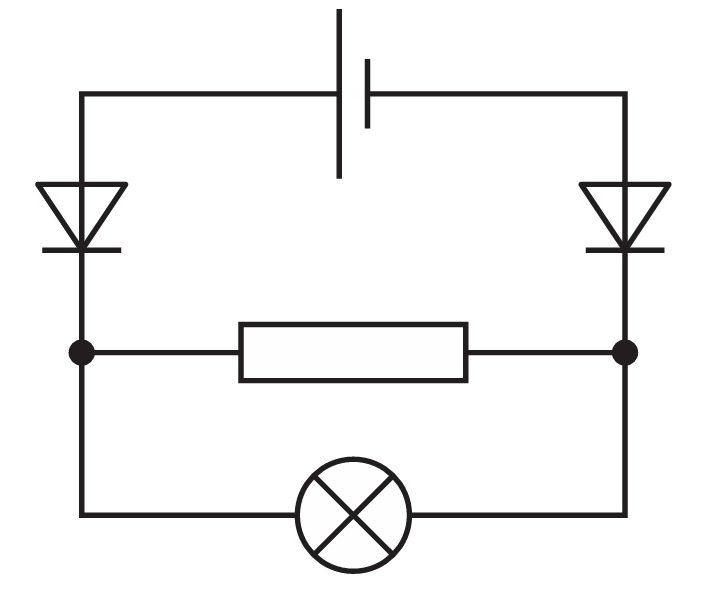
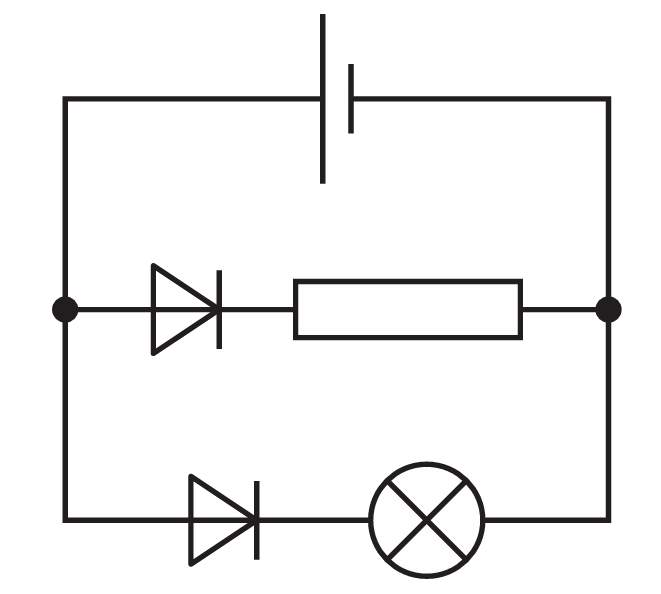
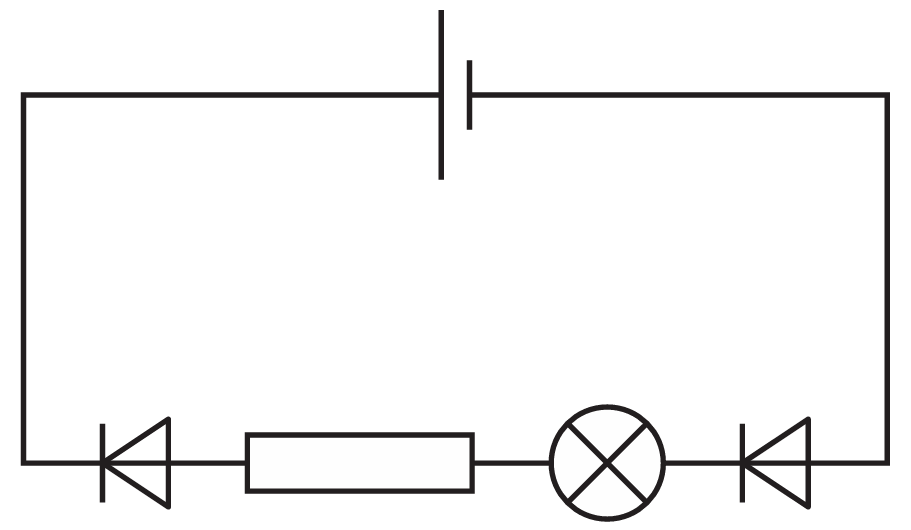
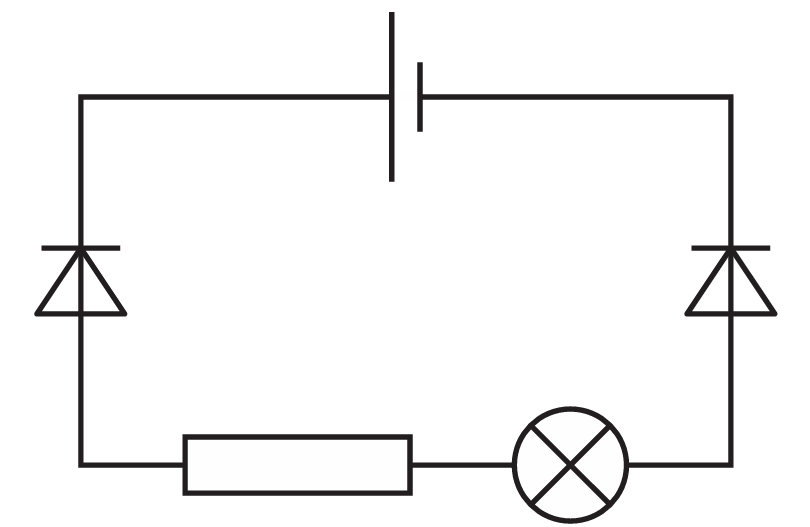
In which circuit does the lamp light?
A.
B.
C.
D.

Most-appropriate topic codes (Cambridge IGCSE Physics 0625):

TOPIC 4.3.1: Circuit diagrams and circuit components (Diodes and LEDs)
▶️ Answer/Explanation
Correct Option: D

Detailed solution:

A diode allows current to flow only in the direction of the arrow in its symbol (forward bias).
Current flows from the positive terminal (longer line) to the negative terminal (shorter line) of the battery.
In circuits $A$, $B$, and $C$, at least one diode is reverse-biased, creating an open circuit that prevents current from reaching the lamp.
In circuit $D$, the diode in the bottom branch is forward-biased, allowing current to flow through the lamp.
The parallel branch with the resistor and another forward-biased diode does not prevent the lamp from lighting.
Therefore, only in circuit $D$ does a complete path exist for current to energize the lamp.
Question 30

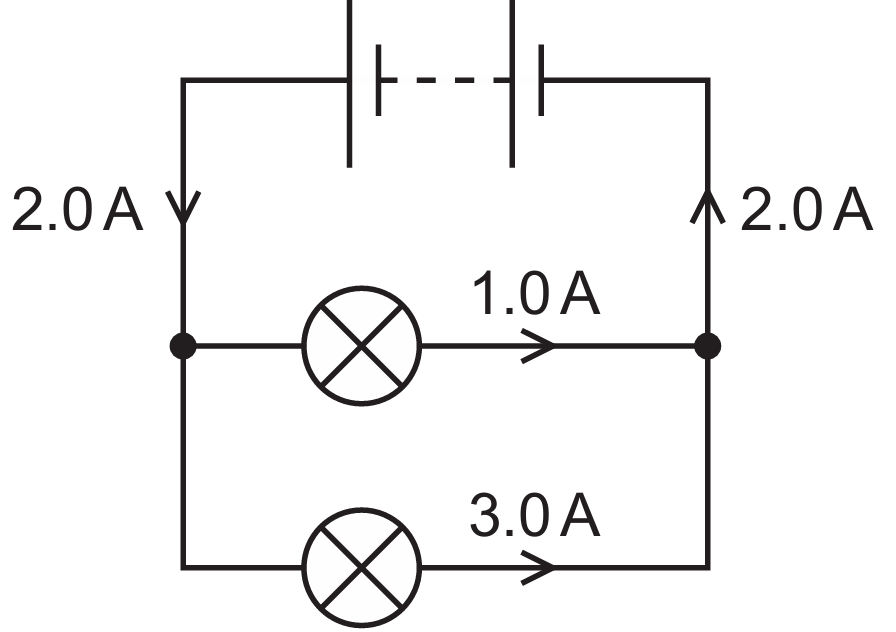
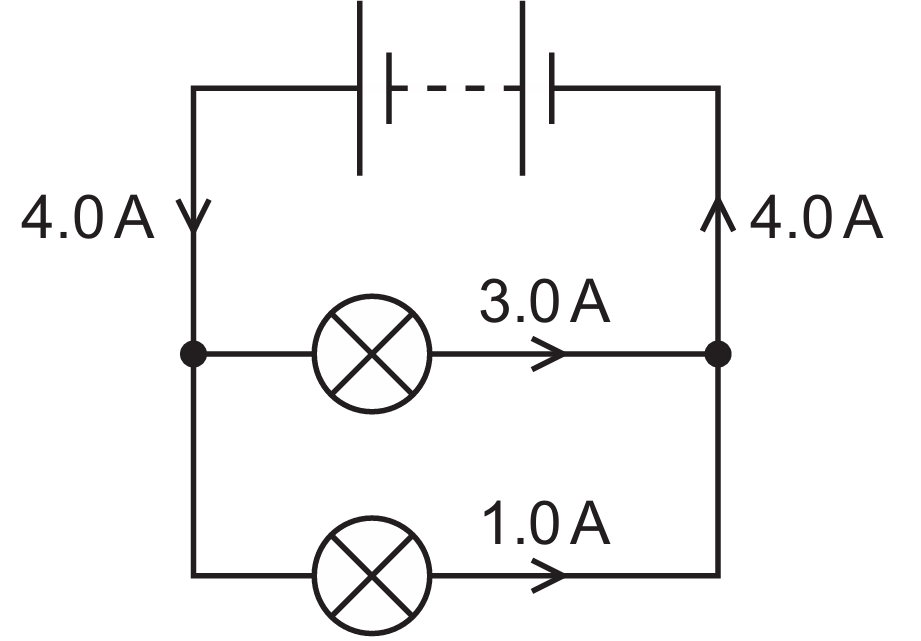
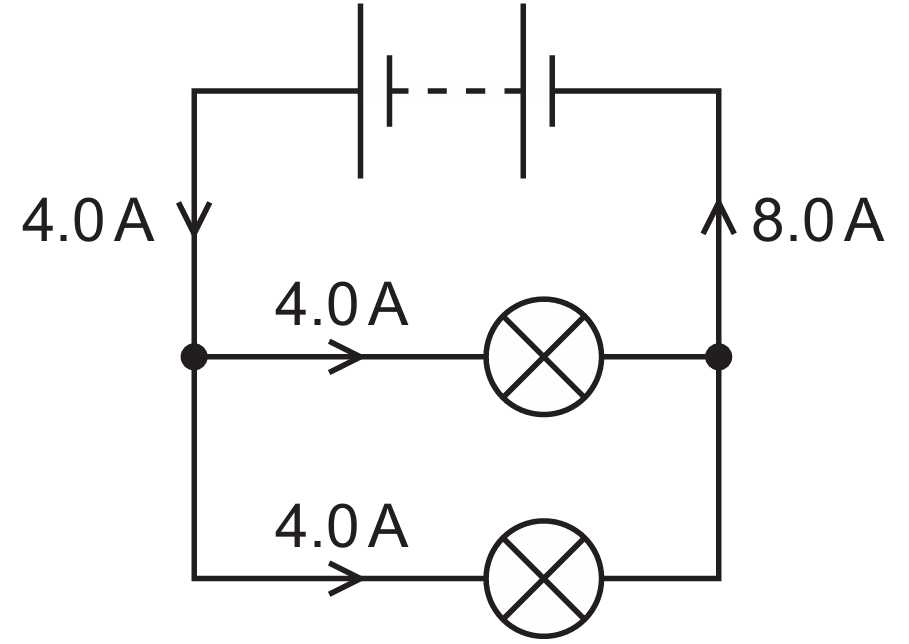
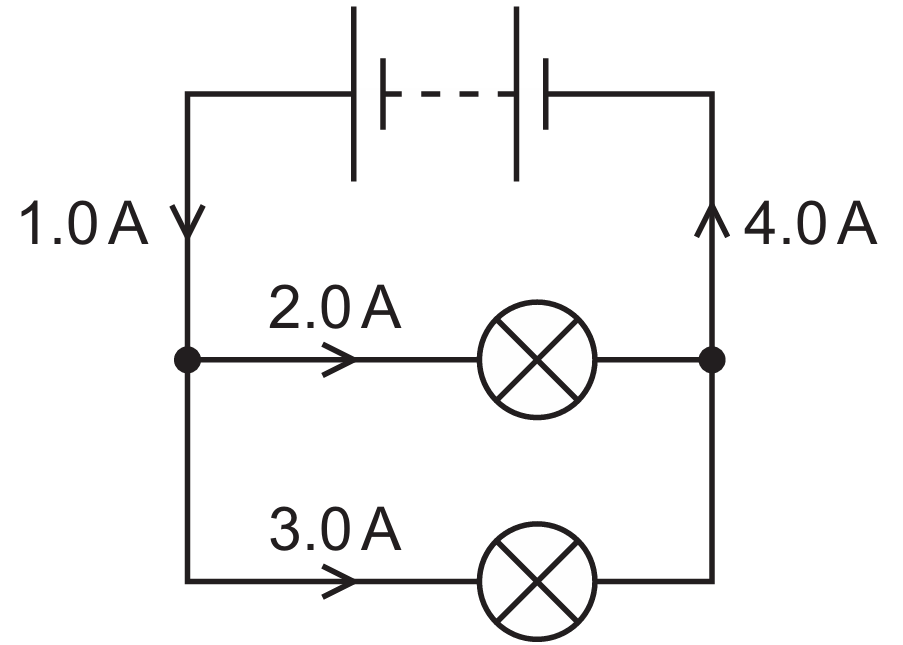
Which circuit shows possible correct values for the currents?
A.
B.
C.
D.

Most-appropriate topic codes (Cambridge IGCSE Physics 0625):

TOPIC 4.3.2: Series and parallel circuits (The sum of the currents entering a junction is equal to the sum of the currents that leave the junction)
▶️ Answer/Explanation
Correct Option: D

Detailed solution:

In a parallel circuit, the total current $I_{total}$ leaving the source must equal the sum of the currents in the individual branches, $I_{1} + I_{2}$.
According to the law of conservation of charge, the current entering a junction must equal the current leaving it ($I_{in} = I_{out}$).
In Option D, the total current is $4.0\text{ A}$, which splits into two branches of $3.0\text{ A}$ and $1.0\text{ A}$.
Since $3.0\text{ A} + 1.0\text{ A} = 4.0\text{ A}$, the values are mathematically consistent and satisfy the junction rule.
Options A, B, and C fail because the sum of branch currents does not equal the main circuit current shown.
Therefore, circuit D is the only one displaying physically possible current values.
Question 31

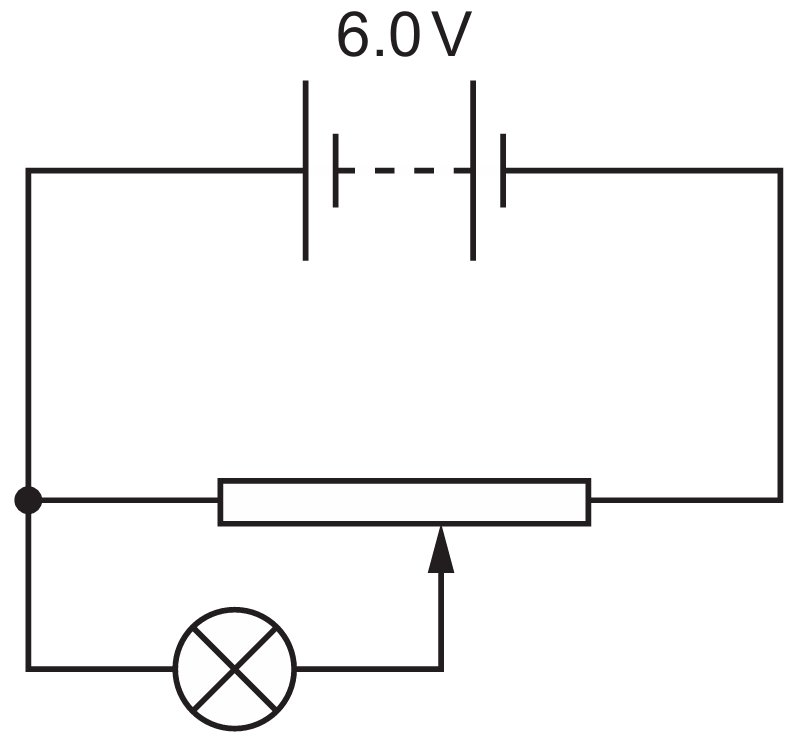
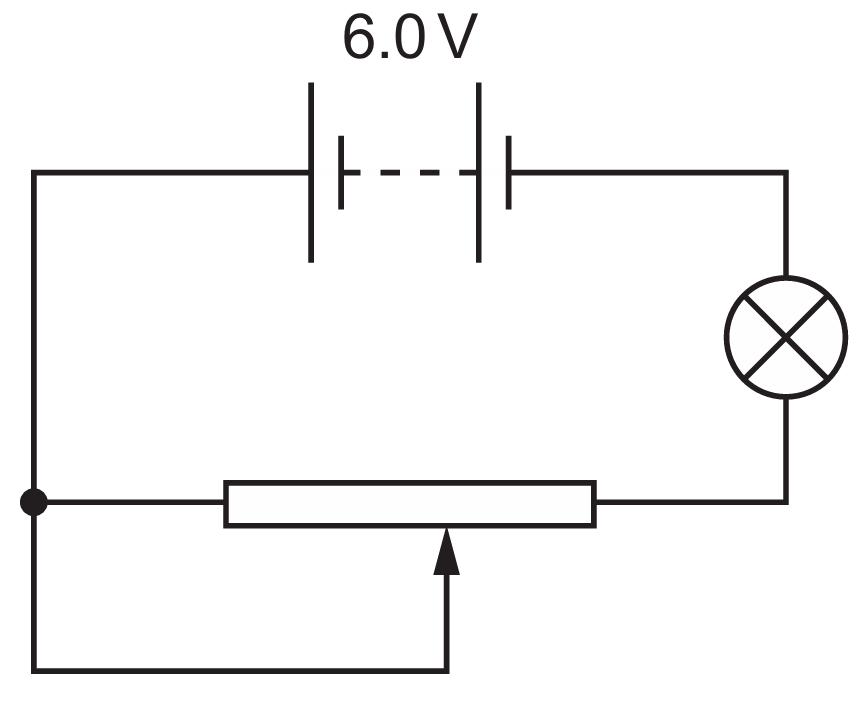
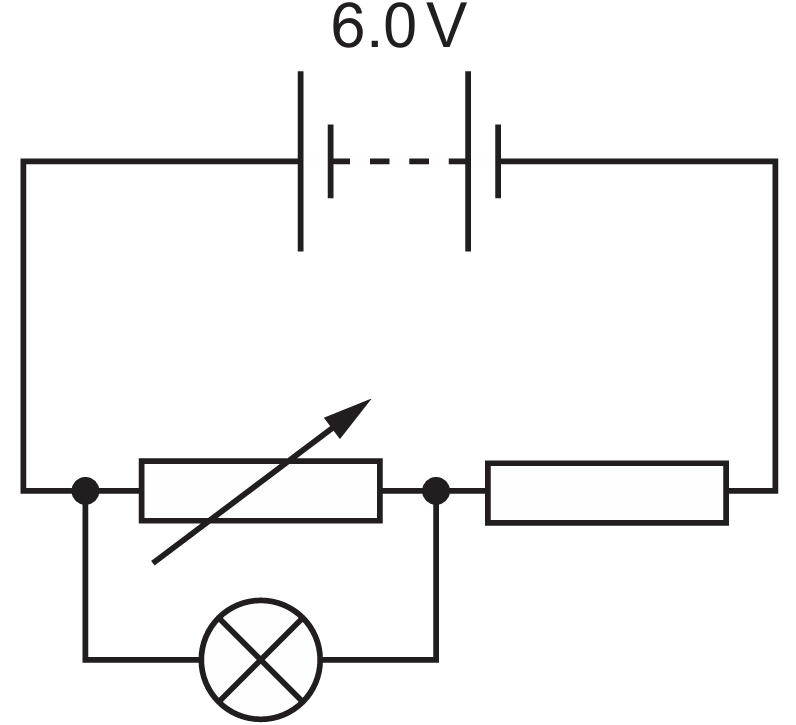
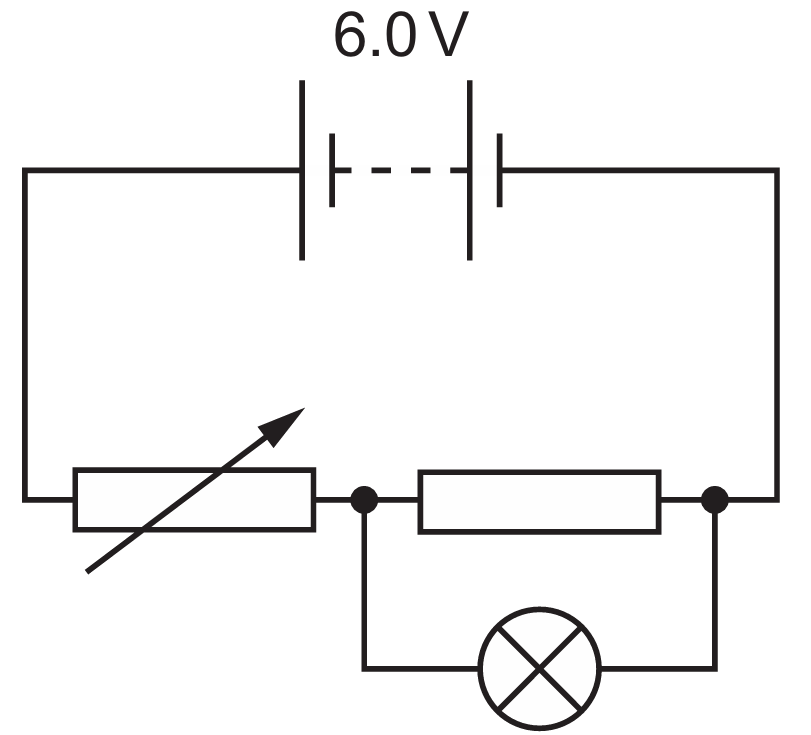
The circuit diagrams show circuits that can control the potential difference (p.d.) across a lamp. Which circuit allows the p.d. across the lamp to be varied from $0\text{ V}$ to $6.0\text{ V}$?
A.
B.
C.
D.

Most-appropriate topic codes (Cambridge IGCSE Physics 0625):

TOPIC 4.3.3: Action and use of circuit components (Describe the action of a variable potential divider)
▶️ Answer/Explanation
Correct Option: C

Detailed solution:

To vary the potential difference (p.d.) from $0\text{ V}$ up to the full source voltage of $6.0\text{ V}$, a potentiometer (potential divider) arrangement is required.
In Circuit C, the lamp is connected in parallel with a variable length of the resistance wire using a sliding contact.
When the slider is at the far left, the lamp is short-circuited, resulting in a p.d. of $0\text{ V}$.
Moving the slider to the far right places the lamp across the entire resistance, giving it the full $6.0\text{ V}$ of the battery.
Circuits A and B use variable resistors in series, which cannot achieve $0\text{ V}$ as the fixed resistor or lamp always retains some p.d.
Circuit D is incorrectly wired as the lamp is in the main branch, preventing the full range of control.
Question 32

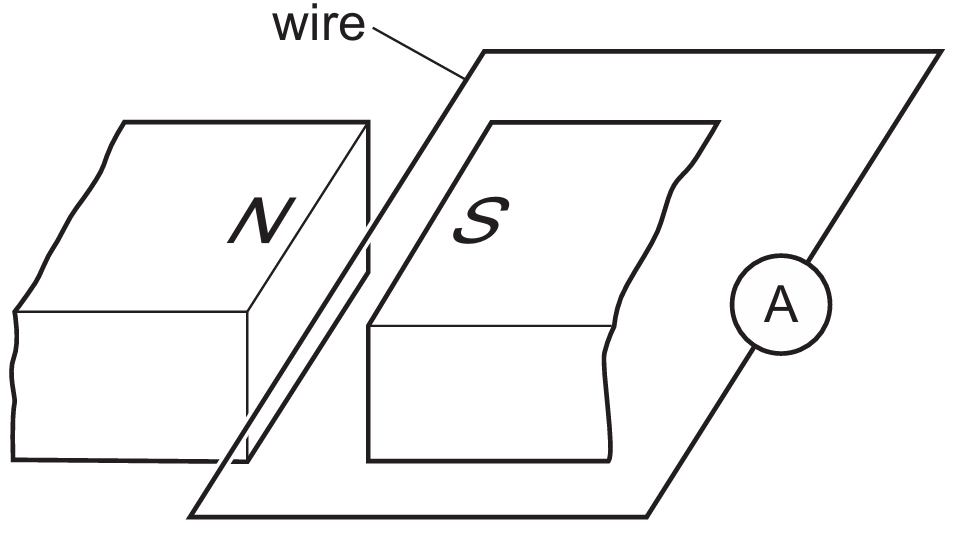
The diagram shows a wire between two magnetic poles. The wire is connected in a circuit with an ammeter.
The wire is moved downwards, towards the bottom of the page. A current is induced in the wire.
In which direction is the force on the wire caused by this current?
A. towards the bottom of the page
B. towards the left of the page
C. towards the right of the page
D. towards the top of the page

Most-appropriate topic codes (Cambridge IGCSE Physics 0625):

TOPIC 4.5.1: Electromagnetic induction (Direction of an induced e.m.f. opposes the change causing it)
▶️ Answer/Explanation
Correct Option: D

Detailed solution:

This question is governed by Lenz’s Law, which states that the direction of an induced current is such that it creates a magnetic effect to oppose the change that produced it. The “change” in this scenario is the downward motion of the wire through the magnetic field. To oppose this downward movement, the induced current must generate a magnetic force acting in the opposite direction. Since the wire is being moved toward the bottom of the page, the opposing force must act toward the top of the page. This ensures the principle of conservation of energy is upheld by requiring work to be done against this resistive force.
Question 33

Some students set up an experiment to measure the count rate for a radioactive source.
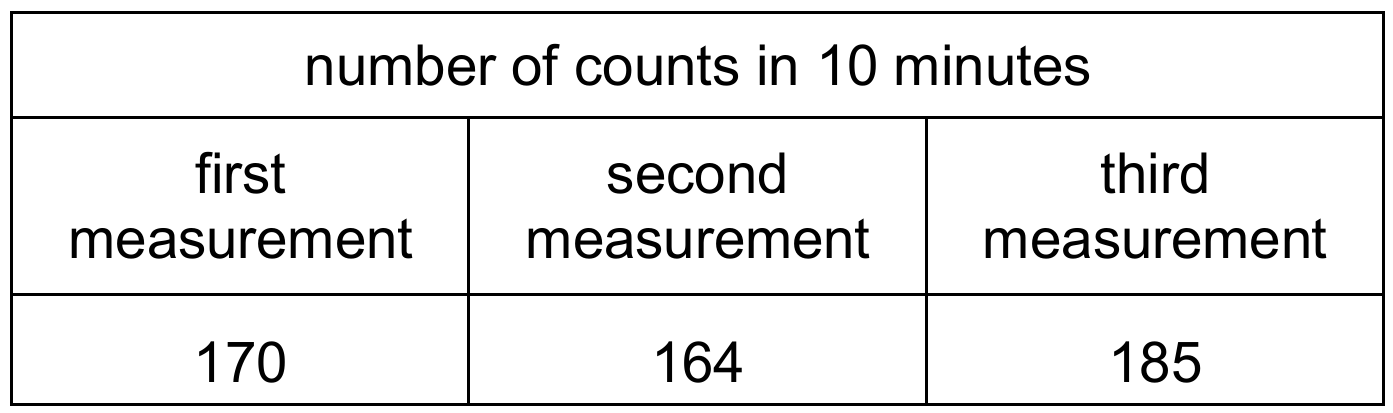
First, they measure the radioactive background count rate in the laboratory by taking three measurements. Each measurement is taken over a 10-minute period.
The table shows their results.
Next, the students measure the counts near the radioactive source. This count rate is measured as 949 counts per minute. What is the corrected count rate for the source?
A. 932 counts per minute
B. 776 counts per minute
C. 430 counts per minute
D. 78 counts per minute

Most-appropriate topic codes (Cambridge IGCSE Physics 0625):

TOPIC 5.2.1: Detection of radioactivity (Use measurements of background radiation to determine a corrected count rate)
▶️ Answer/Explanation
Correct Option: A

Detailed solution:

First, calculate the average background count over 10 minutes: $\frac{170 + 164 + 185}{3} = 173$ counts.
Convert this to a background count rate per minute: $\frac{173}{10} = 17.3$ counts per minute.
The measured total count rate near the source is $949$ counts per minute.
The corrected count rate is found by subtracting the background rate from the total rate: $949 – 17.3 = 931.7$ counts per minute.
Rounding to the nearest whole number gives $932$ counts per minute.
This matches Option A, which represents the true activity of the source alone.
Question 34

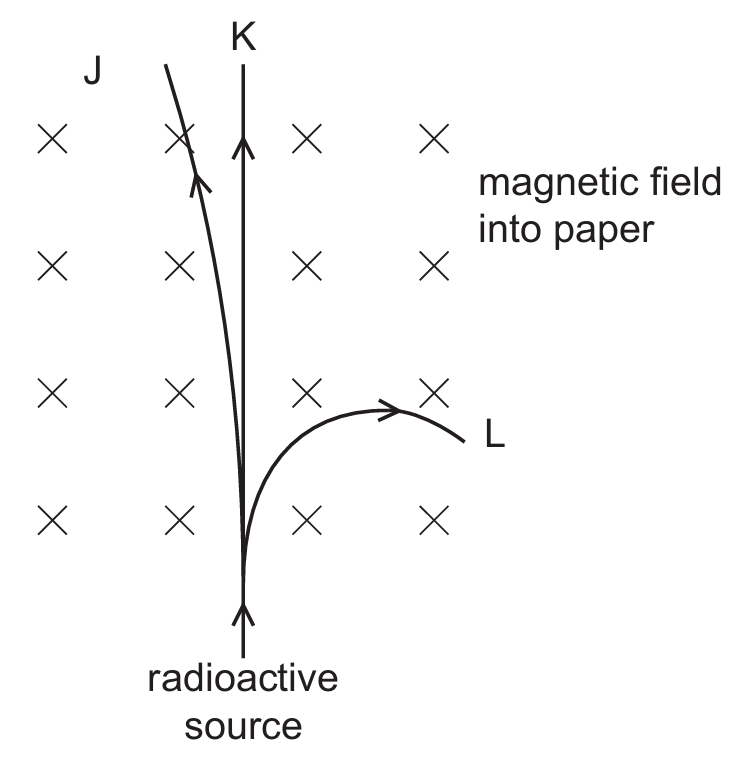
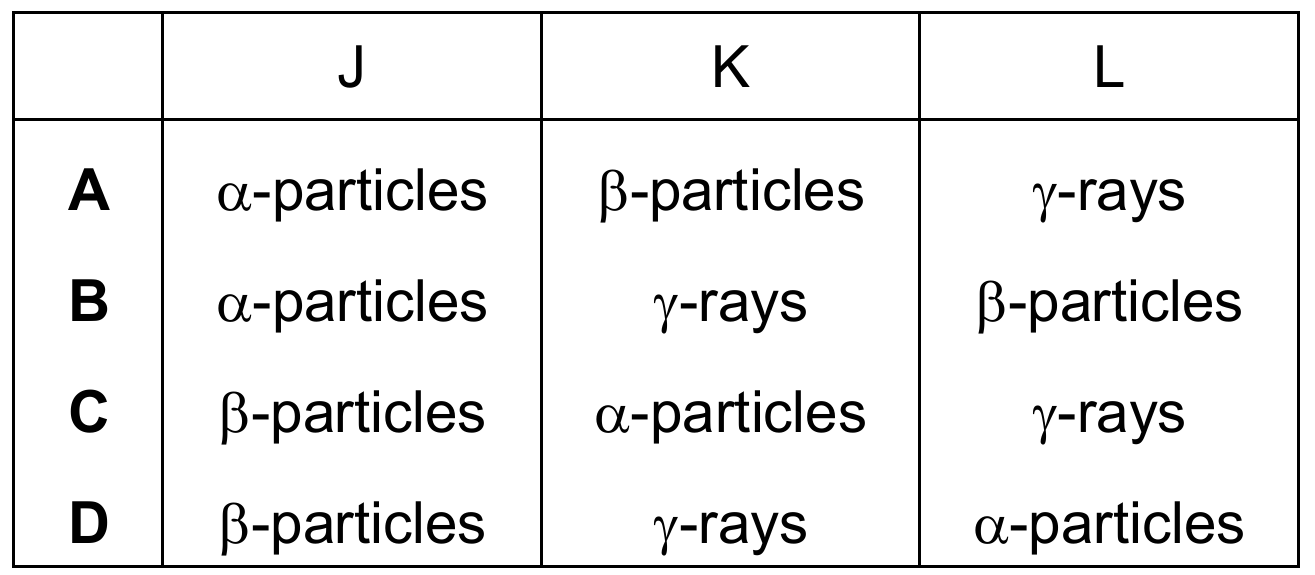
A radioactive source emits $\alpha$-particles, $\beta$-particles and $\gamma$-rays into a vacuum where there is a magnetic field.
The magnetic field acts perpendicularly into the plane of the paper.
The paths $J$, $K$ and $L$ of the three types of radiation through the magnetic field are shown.
Which radiation follows path $J$, path $K$ and path $L$?

Most-appropriate topic codes (Cambridge IGCSE Physics 0625):

TOPIC 5.2.2: The three types of nuclear emission (Describe the deflection of $\alpha$-particles, $\beta$-particles and $\gamma$-radiation in magnetic fields)
▶️ Answer/Explanation
Correct Option: B

Detailed solution:

$\gamma$-rays have no charge, so they are not deflected by magnetic fields and follow the straight path $K$.
Using Fleming’s Left-Hand Rule, where the magnetic field (Index finger) points into the paper and current (Middle finger) represents positive charge flow upward:
$\alpha$-particles are positively charged, so the force (Thumb) acts to the left, corresponding to path $J$.
$\beta$-particles are negatively charged, so the equivalent current is downward, resulting in a force to the right, corresponding to path $L$.
$\beta$-particles also have less mass than $\alpha$-particles, leading to the more significant deflection seen in path $L$.
Therefore, path $J$ is $\alpha$, $K$ is $\gamma$, and $L$ is $\beta$, which matches Option B.
Question 35

Radioactive decay is a change in an unstable nucleus which may result in emission of alpha-particles or beta-particles.
Which statement describes how these emissions happen?
A. Alpha emission is a spontaneous and random process but beta emission is not.
B. Alpha emission and beta emission are both spontaneous and random processes.
C. Beta emission is a spontaneous and random process but alpha emission is not.
D. Neither alpha emission nor beta emission are spontaneous and random processes.

Most-appropriate topic codes (Cambridge IGCSE Physics 0625):

TOPIC 5.2.2: The three types of nuclear emission (Describe the emission of radiation from a nucleus as spontaneous and random in direction)
TOPIC 5.2.3: Radioactive decay (Know that these changes are spontaneous and random)
▶️ Answer/Explanation
Correct Option: B

Detailed solution:

Radioactive decay is the process by which an unstable atomic nucleus loses energy by emitting radiation.
A key characteristic of all nuclear decay, including $\alpha$-decay and $\beta$-decay, is that it is spontaneous.
This means the decay occurs without any external trigger and cannot be affected by physical conditions like temperature or pressure.
Furthermore, the process is random, meaning it is impossible to predict exactly which nucleus in a sample will decay at any given moment.
Since these fundamental properties apply to all types of nuclear emissions, both alpha and beta processes share these traits.
Therefore, Statement B is the only accurate description of how these emissions occur.

Question 36

Which change occurs in the nucleus of a radioactive atom when a beta-particle is emitted?
A. neutron → alpha-particle
B. neutron → proton + electron
C. proton → neutron
D. proton → neutron + electron

Most-appropriate topic codes (Cambridge IGCSE Physics 0625):

TOPIC 5.2.3: Radioactive decay (The following change in the nucleus occurs during β-emission: neutron → proton + electron)
▶️ Answer/Explanation
Correct Option: B

Detailed solution:

Beta decay (β − ) occurs when a nucleus has an excess of neutrons, making it unstable.
During this process, a neutron in the nucleus transforms into a proton and an electron.
The newly formed proton remains within the nucleus, increasing the atomic number by 1.
The electron, known as the beta-particle, is ejected from the nucleus at high speed.
This nuclear transformation is represented by the equation: n→p+e − .
Consequently, Option B accurately describes the fundamental change occurring inside the nucleus.

Question 37

A radioactive source that emits $\alpha$-particles, $\beta$-particles and $\gamma$-radiation is stored safely in a container. From which material should the container be made?
A. aluminium
B. copper
C. paper
D. lead

Most-appropriate topic codes (Cambridge IGCSE Physics 0625):

TOPIC 5.2.2: The three types of nuclear emission (Relative penetrating abilities)
TOPIC 5.2.5: Safety precautions (Using shielding to absorb radiation)
▶️ Answer/Explanation
Correct Option: D

Detailed solution:

To store a source emitting all three types of radiation safely, the shielding must stop the most penetrating type, which is $\gamma$-radiation.
While paper (Option C) stops $\alpha$-particles and a few millimetres of aluminium (Option A) stop $\beta$-particles, they are easily penetrated by $\gamma$-rays.
Lead is a very dense material with a high atomic number, making it highly effective at absorbing ionising radiation.
A thick layer of lead is required to significantly reduce the intensity of $\gamma$-radiation to safe levels.
Therefore, a lead container ensures that $\alpha$, $\beta$, and $\gamma$ emissions are all successfully contained.
This aligns with safety protocols for reducing exposure to ionising nuclear radiations.

Question 38

An artificial satellite orbits planet X at a distance $r = 7.0 \times 10^{6}$ m from the centre of planet X. The average orbital speed $v$ of the satellite is $3500$ m/s. What is the orbital period?
A. 21 minutes
B. 52 minutes
C. 1 hour and 45 minutes
D. 3 hours and 29 minutes

Most-appropriate topic codes (Cambridge IGCSE Physics 0625):

TOPIC 6.1.1: The Earth (Define average orbital speed from the equation $v = \frac{2\pi r}{T}$)
▶️ Answer/Explanation
Correct Option: D

Detailed solution:

The average orbital speed is given by the formula $v = \frac{2\pi r}{T}$, where $T$ is the orbital period.
Rearranging for $T$, we get $T = \frac{2\pi r}{v} = \frac{2 \times \pi \times 7.0 \times 10^{6}}{3500}$.
Calculating this gives $T \approx 12566.37$ seconds.
To convert seconds into minutes, divide by $60$: $12566.37 \div 60 \approx 209.44$ minutes.
To find hours, divide by $60$ again: $209.44 \div 60 \approx 3.49$ hours, which is $3$ hours and $0.49 \times 60 \approx 29$ minutes.
Thus, the orbital period is approximately $3$ hours and $29$ minutes, matching Option D.

Question 39

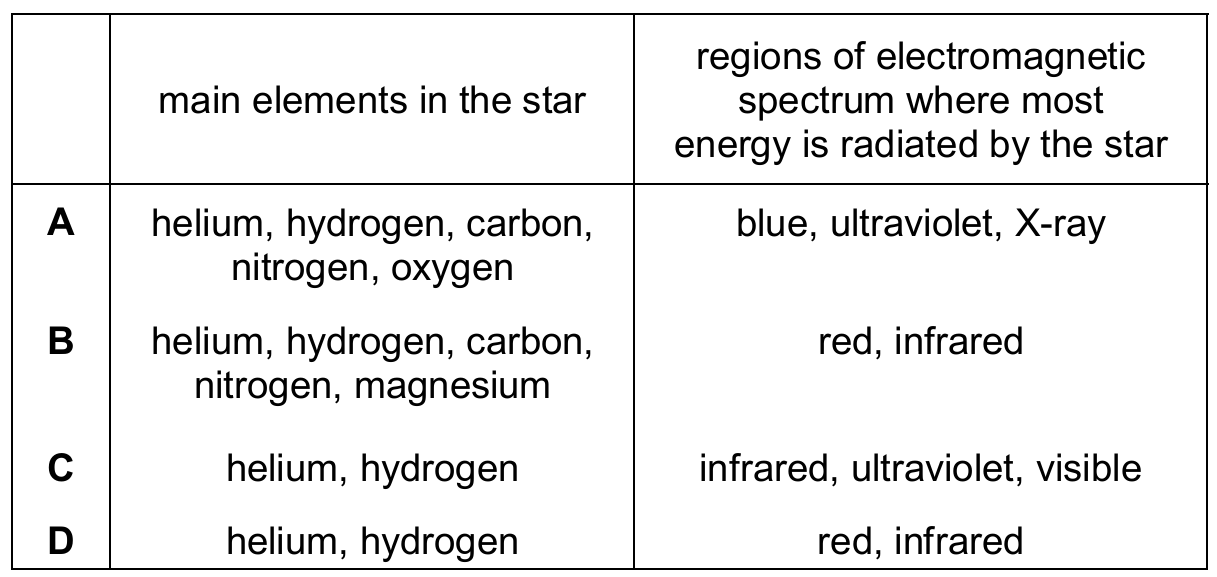
The table lists data about four different stars.
Which star is the Sun?

Most-appropriate topic codes (Cambridge IGCSE Physics 0625):

TOPIC 6.2.1: The Sun as a star (Hydrogen, helium, and radiation regions)
▶️ Answer/Explanation
Correct Option: C

Detailed solution:

The Sun is a medium-sized star composed primarily of the elements hydrogen and helium.
It radiates energy across the electromagnetic spectrum, specifically in the infrared, visible light, and ultraviolet regions.
Options A and B are incorrect because they include heavy elements like carbon, nitrogen, and oxygen as “main” components.
Option D is incorrect because it misses the visible and ultraviolet components of the Sun’s radiation.
Row C perfectly aligns with the syllabus definition of the Sun’s composition and emission characteristics.
Therefore, the correct row identifying the Sun is C.

Question 40

What can be formed directly following a supernova?
A. a nebula and a neutron star
B. a nebula and a white dwarf
C. a red supergiant and a neutron star
D. a red supergiant and a protostar

Most-appropriate topic codes (Cambridge IGCSE Physics 0625):

TOPIC 6.2.2: Stars (Describe the life cycle of a star)
▶️ Answer/Explanation
Correct Option: A

Detailed solution:

A supernova occurs at the end of the life cycle of a high-mass star after it has expanded into a red supergiant.
The violent explosion of the supernova disperses the outer layers of the star, creating a nebula containing hydrogen and new heavier elements.
Depending on the remaining mass of the core, the explosion leaves behind either a dense neutron star or a black hole at its center.
A white dwarf is formed from a less massive star via a planetary nebula, not a supernova.
Therefore, the two products formed directly from the explosion are a nebula and a neutron star.
This sequence aligns with the stellar evolution pathway for massive stars where $M > 8$ solar masses.

Scroll to Top