
Question 1
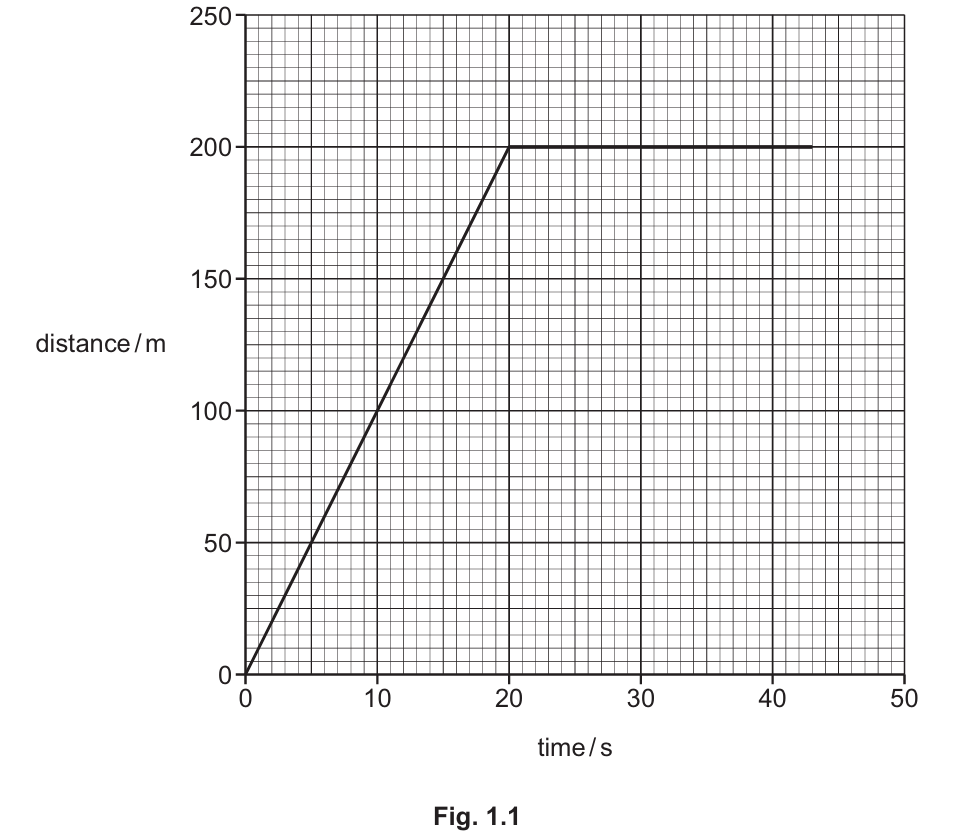
(i) between $\text{time} = 0$ and $\text{time} = 20\text{ s}$
(ii) between $\text{time} = 20\text{ s}$ and $\text{time} = 40\text{ s}$.
Most-appropriate topic codes (Cambridge IGCSE Physics 0625):
• Topic $1.2$ — Motion (Parts $\mathrm{(a)}$, $\mathrm{(b)(i)}$, $\mathrm{(b)(ii)}$)
▶️ Answer/Explanation
(a)
For the correct answer:
$10\text{ m/s}$
The speed of an object is determined by calculating the gradient (slope) of a straight-line section on a distance-time graph. To find the speed between $0$ and $10\text{ s}$, identify the corresponding coordinates on the graph: $(0\text{ s}, 0\text{ m})$ and $(10\text{ s}, 100\text{ m})$. Using the speed formula $v = \frac{\Delta s}{\Delta t}$, the calculation is $v = \frac{100\text{ m} – 0\text{ m}}{10\text{ s} – 0\text{ s}} = 10\text{ m/s}$.
(b)(i)
For the correct answer:
constant speed OR steady speed OR uniform speed
Between $0$ and $20\text{ s}$, the graph displays a straight, upwardly inclined line with a constant, positive gradient. In a distance-time graph, a straight diagonal line indicates that the object is covering equal distances in equal intervals of time, meaning the cyclist is travelling at a constant speed.
(b)(ii)
For the correct answer:
stationary OR stopped
Between $20\text{ s}$ and $40\text{ s}$, the line on the graph is perfectly horizontal (a gradient of zero). This demonstrates that the total distance remains fixed at $200\text{ m}$ and is no longer increasing as time progresses. Therefore, the cyclist is not moving and is completely stationary.
Question 2
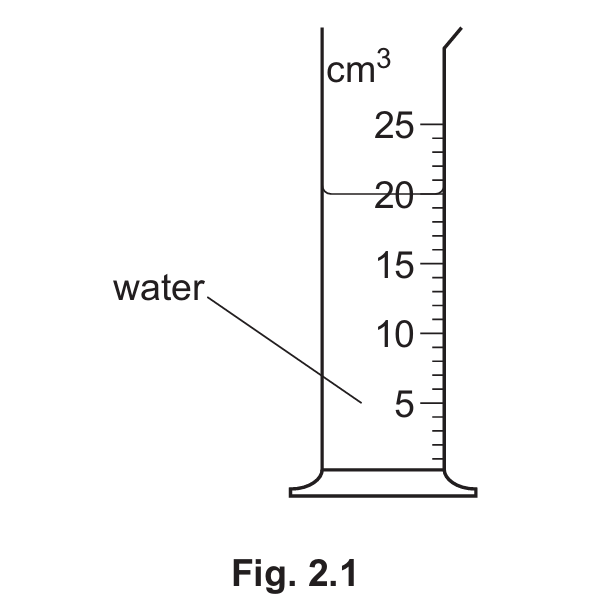
(ii) A teacher plans to measure the average volume of one drop of water. The teacher collects some drops of water as they fall into a different measuring cylinder. All the drops of water are the same volume.
Here is the teacher’s data:
number of drops of water = 120
volume of water in the measuring cylinder = 24 cm³
Calculate the volume of one drop of water.
Most-appropriate topic codes (Cambridge IGCSE Physics 0625):
• Topic 1.1 — Physical quantities and measurement techniques (Parts (a)(i), (a)(ii))
• Topic 1.4 — Density (Part (b))
▶️ Answer/Explanation
(a)(i)
For the correct answer:
20 cm³
To determine the volume, you must read the scale on the measuring cylinder at the bottom of the meniscus (the curved surface of the liquid). In Fig. 2.1, the liquid level aligns perfectly with the major grid line marked 20. Since the unit indicated at the top of the cylinder is cm³, the total volume is simply read as 20 cm³.
(a)(ii)
For the correct answer:
0.20 cm³
To calculate the average volume of a single drop, divide the total volume of water collected by the total number of drops. The formula is $V = \frac{\text{Total Volume}}{\text{Number of drops}}$. Substituting the teacher’s data gives $V = \frac{24}{120}$. Calculating this yields 0.20 cm³. This technique of measuring multiples reduces the percentage error when determining very small quantities.
(b)
For the correct answer:
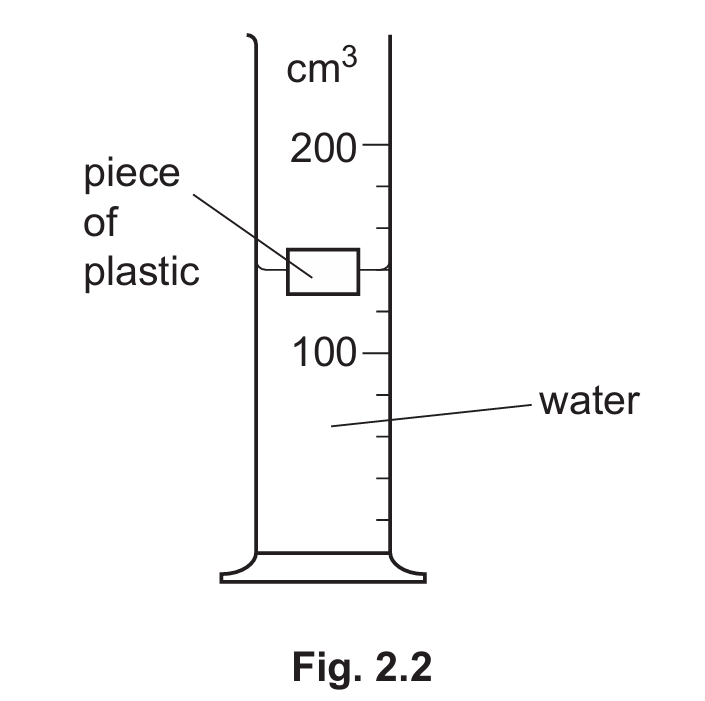
density of the plastic is: less / lower
evidence: it floats (on water)
The physical principle of buoyancy states that an object will float in a fluid only if its density is less than the density of that fluid. Looking at Fig. 2.2, the piece of plastic is clearly resting on the surface of the water rather than sinking to the bottom. This visual evidence of floating directly proves that the plastic has a lower density than the surrounding water.
Question 3
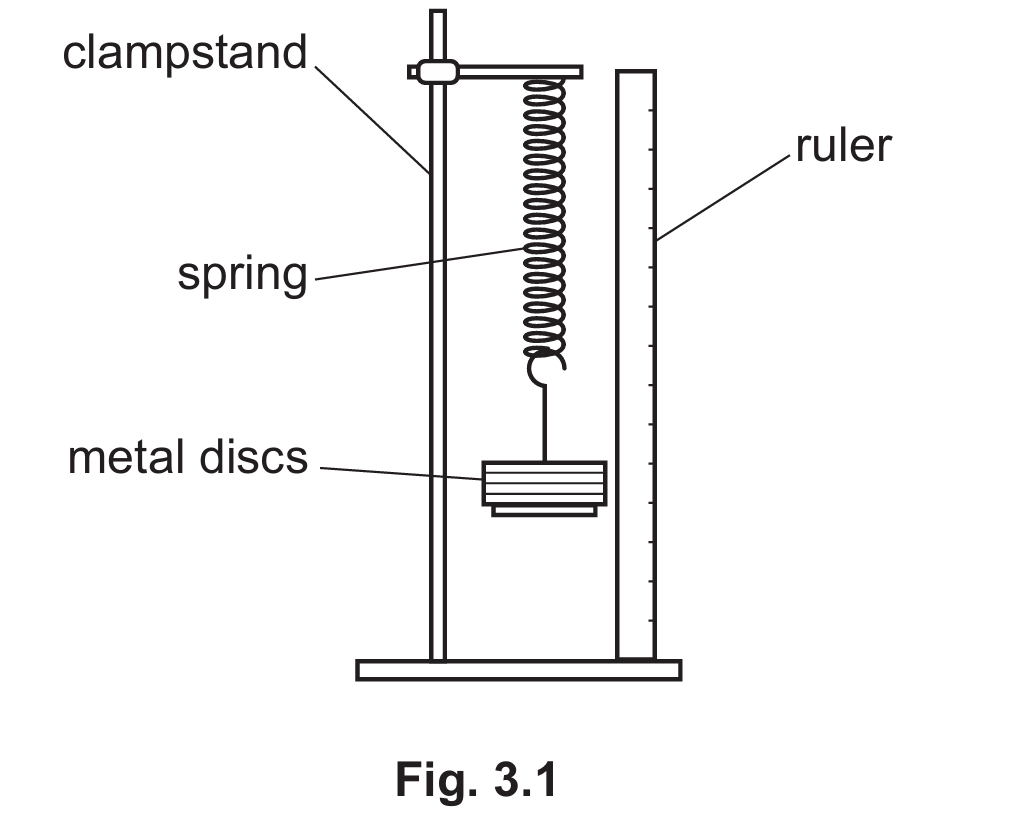
Calculate the weight of the metal disc.
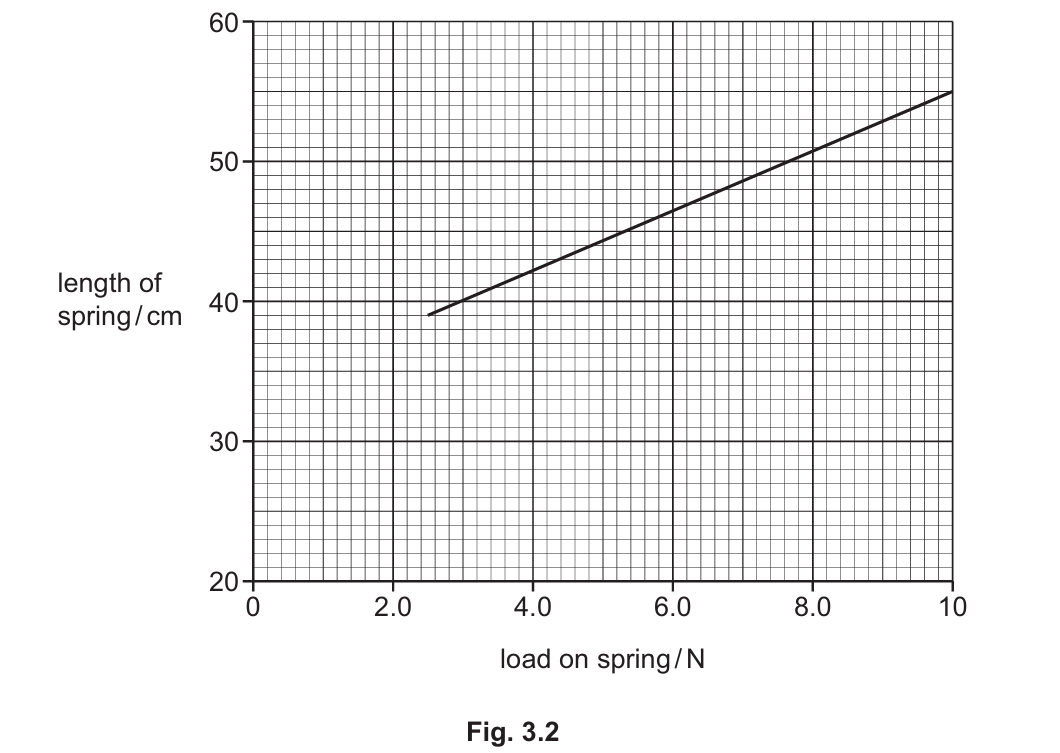
Show your working on Fig. 3.2.
Show your working on Fig. 3.2.
Most-appropriate topic codes (Cambridge IGCSE Physics 0625):
• Topic 1.3 — Mass and weight (Part (a))
• Topic 1.5.1 — Effects of forces (Parts (b)(i), (b)(ii))
▶️ Answer/Explanation
(a)
For the correct answer:
2.5 N
Weight is the gravitational force acting on an object, which can be calculated using the equation $W = mg$. According to the syllabus, the acceleration of free fall $g$ near the Earth’s surface is approximately 9.8 m/s². Substituting the given mass into the equation gives $W = 0.25 \times 9.8 = 2.45$ N. This value is typically rounded to 2.5 N to match the two significant figures of the provided mass.
(b)(i)
For the correct answer:
48.5 cm
To find the length at a specific load, locate 7.0 N on the x-axis and draw a vertical line straight up to intersect the plotted graph line. From that point of intersection, draw a horizontal line directly to the left to read the corresponding value on the y-axis. The line meets the y-axis exactly halfway between the 48 cm and 49 cm grid marks, indicating a length of 48.5 cm.
(b)(ii)
For the correct answer:
33.5 cm
A load of zero corresponds to the y-intercept (where the x-axis value is 0 N). Because the plotted line does not extend all the way to the y-axis, you must use a straight edge to extrapolate the existing line backwards until it intersects the y-axis. Reading the scale at this intersection gives the original, unstretched length of the spring, which is 33.5 cm.
Question 4
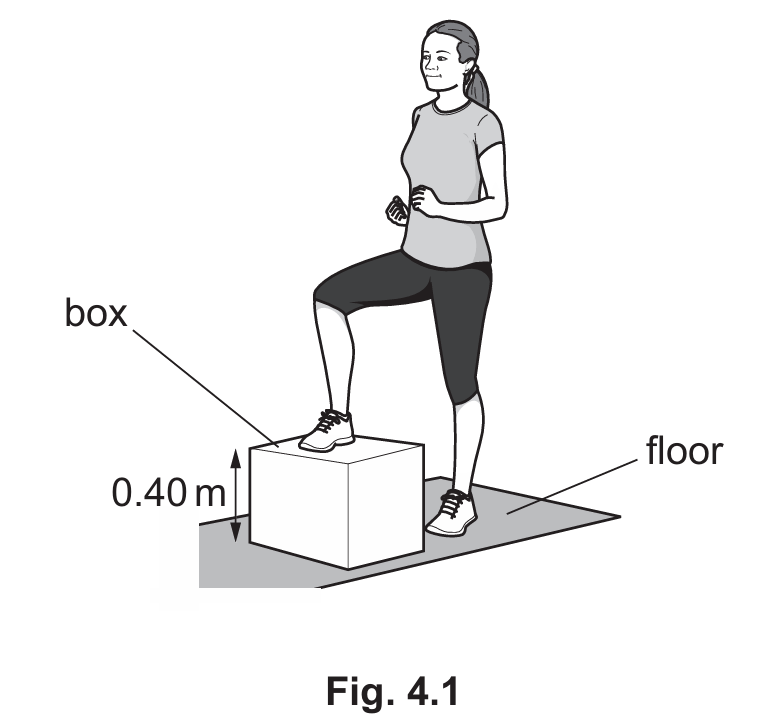
Most-appropriate topic codes (Cambridge IGCSE Physics 0625):
• Topic $1.7.2$ — Work (Part $\mathrm{(a)(i)}$)
• Topic $1.7.1$ — Energy (Part $\mathrm{(a)(ii)}$)
• Topic $1.7.4$ — Power (Part $\mathrm{(b)}$)
▶️ Answer/Explanation
(a) (i)
For the correct answer:
$240\text{ J}$
Work done is calculated using the formula $W = Fd$, where $F$ is the force applied and $d$ is the distance moved in the direction of the force. The upward force required is equal to the student’s weight, which is $600\text{ N}$. The vertical distance moved is the height of the box, $0.40\text{ m}$. Substituting these values yields $W = 600\text{ N} \times 0.40\text{ m} = 240\text{ J}$.
(a) (ii)
For the correct answer (any two from the following):
kinetic energy (store) / gravitational potential energy (store) / thermal/internal energy (store)
As the student steps up, her movement requires a change in speed, transferring energy to the kinetic energy store. At the same time, her height above the ground increases, which transfers energy to the gravitational potential energy store. The physical exertion of the exercise also raises her body temperature, transferring energy into the thermal (internal) energy store.
(b)
For the correct answer:
$120\text{ W}$
Power is defined as the rate at which energy is transferred or the rate at which work is done. It can be calculated using the equation $P = \frac{\Delta E}{t}$, where $\Delta E$ is the energy transferred and $t$ is the time taken. Substituting the given values into the formula gives $P = \frac{3600\text{ J}}{30\text{ s}} = 120\text{ W}$.
Question 5
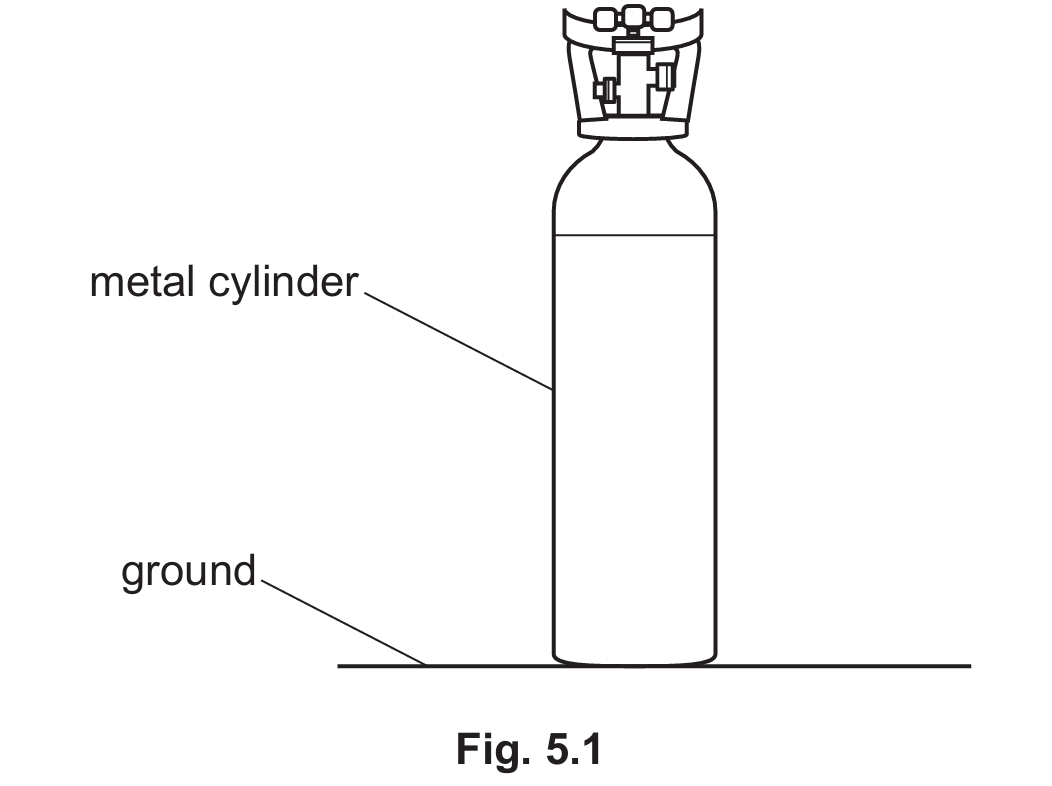
(c) The weight of the metal cylinder is $420\text{ N}$. The area of the metal cylinder in contact with the ground is $300\text{ cm}^2$.
Calculate the pressure on the ground due to the metal cylinder.
Most-appropriate topic codes (Cambridge IGCSE Physics 0625):
• Topic $2.1.2$ — Particle model (Parts $\mathrm{(a)}$, $\mathrm{(b)}$)
• Topic $1.8$ — Pressure (Part $\mathrm{(c)}$)
▶️ Answer/Explanation
(a)
For the correct answer:
Particles are fixed in a regular lattice pattern, close together, and can only vibrate.
The metal cylinder is a solid. In a solid state, particles are arranged in a highly ordered, regular lattice structure. Because of strong intermolecular forces, they are packed very closely together compared to liquids or gases. These particles do not possess the translational kinetic energy to move around freely; instead, they simply vibrate back and forth in their fixed positions.
(b)
For the correct answer:
Gas particles move at high speeds randomly, constantly colliding with the walls to create a force, resulting in pressure.
In a gas, particles have high kinetic energy and move randomly at very high speeds. As they move within the container, they constantly collide with the inner walls of the metal cylinder. Each individual collision exerts a tiny force on the surface. Since pressure is defined as the total force exerted per unit area ($p = \frac{F}{A}$), the combined force of these frequent, high-speed particle collisions over the inner surface area results in the overall gas pressure.
(c)
For the correct calculated value:
$1.4\text{ N/cm}^2$
Pressure is defined as the normal force applied per unit area. We calculate this using the formula $p = \frac{F}{A}$, where the force $F$ is the weight of the metal cylinder ($420\text{ N}$) and $A$ is the contact area with the ground ($300\text{ cm}^2$). Substituting the given values into the equation, we determine the pressure to be $p = \frac{420}{300} = 1.4\text{ N/cm}^2$.
Question 6

(b) The frequency of an electromagnetic wave is $2.0 \times 10^{6}\text{ Hz}$. The speed of the wave in a medium is $2.8 \times 10^{8}\text{ m/s}$.
Calculate the wavelength of the wave.
Most-appropriate topic codes (Cambridge IGCSE Physics 0625):
• Topic 3.3 — Electromagnetic spectrum (Parts (a)(i), (a)(ii), (a)(iii))
• Topic 3.1 — General properties of waves (Part (b))
▶️ Answer/Explanation
(a)(i)
For the correct answer:
region 1: ultraviolet (or UV rays)
region 2: X-rays
The electromagnetic spectrum, ordered by increasing frequency (and decreasing wavelength), follows this sequence: radio waves, microwaves, infrared, visible light, ultraviolet, X-rays, and gamma rays. Because region 1 and region 2 fall sequentially between visible light and gamma rays, they correspond directly to ultraviolet and X-rays.
(a)(ii)
For a correct answer:
Sterilising food or medical equipment OR detection/treatment of cancer.
Gamma rays have exceedingly high energy and penetrating power, allowing them to destroy bacteria and living cells. This unique property makes them highly useful for sterilising heat-sensitive medical dressings and equipment, as well as being heavily utilized in targeted radiotherapy to safely destroy cancerous cells.
(a)(iii)
For a correct answer:
Mutation of cells/DNA OR damage to cells/DNA.
Because gamma rays possess high frequency and photon energy, they are a dangerous form of ionising radiation. When they penetrate human tissue, they can rapidly ionise atoms within DNA molecules, which can lead to severe cellular mutations, radiation sickness, or an increased likelihood of developing cancer.
(b)
For the correct answer:
$1.4 \times 10^{2}\text{ m}$
The relationship between wave speed ($v$), frequency ($f$), and wavelength ($\lambda$) is expressed by the wave equation $v = f\lambda$. By rearranging the formula to solve for wavelength, we obtain $\lambda = \frac{v}{f}$. Substituting the given numerical values into the equation, we calculate $\lambda = \frac{2.8 \times 10^{8}\text{ m/s}}{2.0 \times 10^{6}\text{ Hz}}$, which yields a wavelength of $1.4 \times 10^{2}\text{ m}$.
Question 7
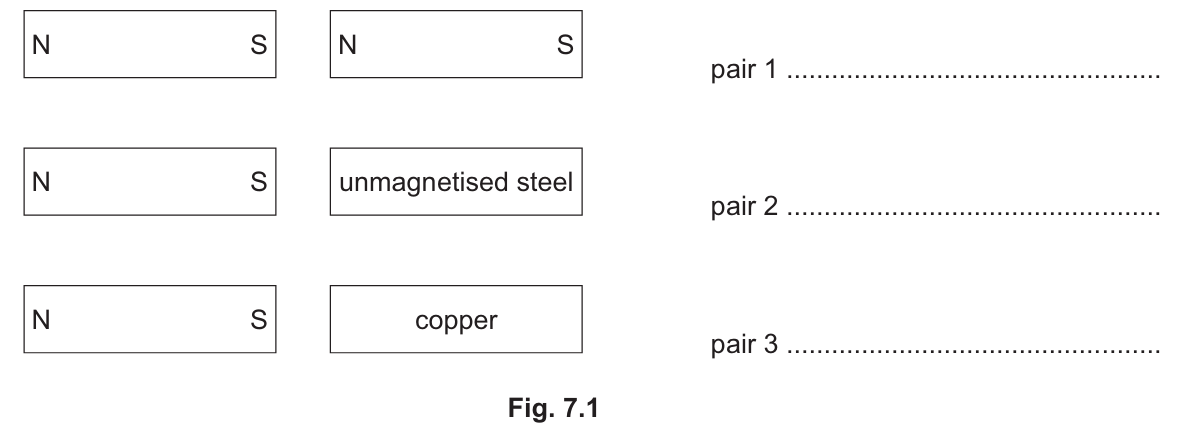
Most-appropriate topic codes (Cambridge IGCSE Physics 0625):
• Topic $4.1$ — Simple phenomena of magnetism (Parts $\mathrm{(a)}$, $\mathrm{(b)}$)
• Topic $4.2.1$ — Electric charge (Part $\mathrm{(c)(i)}$)
• Topic $4.2.2$ — Electric current (Part $\mathrm{(c)(ii)}$)
▶️ Answer/Explanation
(a)
pair $1$: attractive force
pair $2$: attractive force
pair $3$: no force
Explanation: For pair $1$, the south pole (S) of the first magnet faces the north pole (N) of the second. Since opposite poles attract, an attractive force acts between them. For pair $2$, steel is a magnetic material; placing it near a permanent magnet induces an opposite pole on the near side, resulting in an attractive force. For pair $3$, copper is a non-magnetic material. It cannot be permanently or temporarily magnetised, hence it experiences zero magnetic force.
(b)
Answer: A region or area in which a magnetic pole (or a magnetic material) experiences a force.
Explanation: A magnetic field represents the space surrounding a magnet where its influence can be felt. If another magnet or a magnetic material (like iron or steel) enters this specific region, the field exerts an attractive or repulsive magnetic force on it.
(c)(i)
electrically conducting material: copper (or iron, steel, aluminium, etc.)
electrically insulating material: plastic (or glass, rubber, wood, etc.)
Explanation: Materials that allow electric charge to flow freely through them are conductors, with metals like copper being prime examples. Insulators are materials that resist the flow of electric charge, such as rubber or plastic, making them ideal for coating wires.
(c)(ii)
Answer: They contain electrons (or charges/ions) that are free to move throughout the material.
Explanation: Electrical conductors, particularly metals, have loosely bound outer electrons that form a “sea” of delocalised free electrons. When a potential difference (voltage) is applied, these free electrons easily drift through the lattice from atom to atom, allowing an electric current to flow.
Question 8
(a) The potential difference (voltage) across a component is 72 V. The current in the component is 0.024 A.
Calculate the resistance of the component.
(b) The television uses a transformer. The input voltage ($V_{\text{p}}$) to the transformer is 120 V. The number of turns ($N_{\text{p}}$) on the input coil is 560. The number of turns ($N_{\text{s}}$) on the output coil is 70.
Calculate the output voltage ($V_{\text{s}}$) of the transformer.
(c) The potential difference (voltage) across a resistor is 64 V. The current in the resistor is 2.2 mA.
Calculate the power of the resistor.
(d) The energy used by the television in one hour is 0.14 kWh. The cost of one kWh of energy is 36 cents.
Calculate the cost of using the television for 6.0 hours.
Most-appropriate topic codes (Cambridge IGCSE Physics 0625):
• Topic 4.2.4 — Resistance (Part (a))
• Topic 4.5.6 — The transformer (Part (b))
• Topic 4.2.5 — Electrical energy and electrical power (Parts (c), (d))
▶️ Answer/Explanation
(a)
For the correct answer:
3000 Ω
To find the resistance, we use Ohm’s law, which states that resistance is the ratio of potential difference to current, given by the formula $R = \frac{V}{I}$. Substituting the provided values, we divide 72 V by 0.024 A. Performing this calculation yields a final resistance of 3000 Ω.
(b)
For the correct answer:
15 V
A transformer operates on the principle that the ratio of voltages equals the ratio of turns in its coils, expressed as $\frac{V_{\text{p}}}{V_{\text{s}}} = \frac{N_{\text{p}}}{N_{\text{s}}}$. Rearranging this equation to solve for the output voltage gives $V_{\text{s}} = V_{\text{p}} \times \left(\frac{N_{\text{s}}}{N_{\text{p}}}\right)$. Substituting the values, we multiply 120 V by the ratio of 70 over 560, yielding an output voltage of 15 V.
(c)
For the correct answer:
0.14 W
The electrical power dissipated by a resistor is calculated using the formula $P = IV$. First, ensure the current is in standard SI units by converting 2.2 mA to 0.0022 A. Multiplying this current by the potential difference of 64 V results in 0.1408 W, which simplifies to two significant figures as 0.14 W.
(d)
For the correct answer:
30 cents
First, calculate the total energy consumed by the television by multiplying its hourly energy usage by the total operating time: 0.14 kWh/hour multiplied by 6.0 hours gives a total of 0.84 kWh. To find the total cost, multiply this total energy by the unit cost. Calculating 0.84 kWh multiplied by 36 cents per kWh results in 30.24 cents, which is correctly rounded down to 30 cents.
Question 9
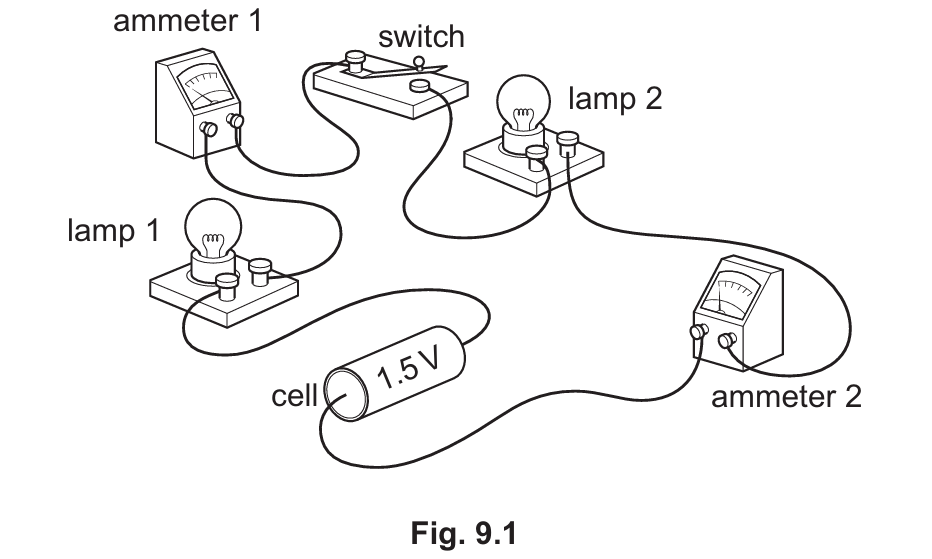
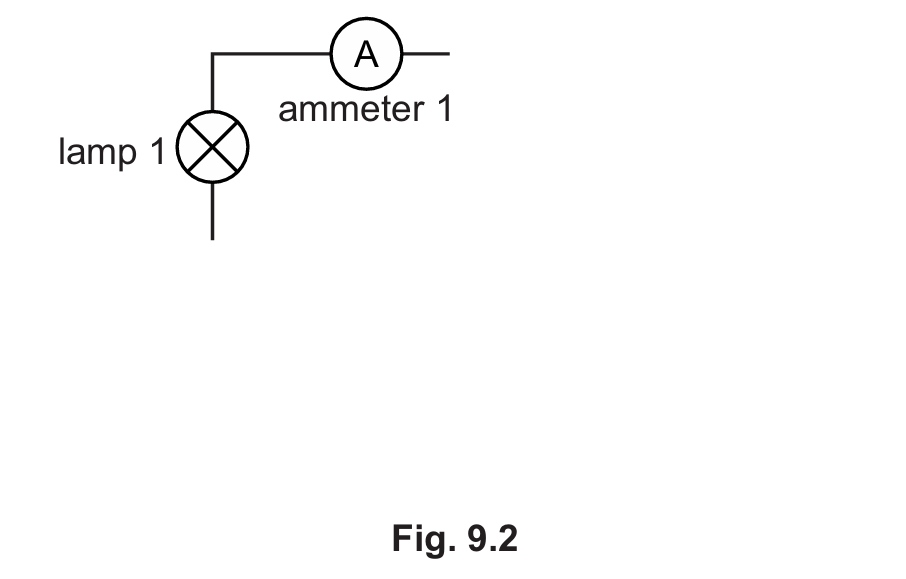
Most-appropriate topic codes (Cambridge IGCSE Physics 0625):
• Topic 4.3.2 — Series and parallel circuits (Parts a, b, c)
• Topic 4.2.4 — Resistance (Part b)
• Topic 4.3.1 — Circuit diagrams and circuit components (Part c)
▶️ Answer/Explanation
(a)
For the correct answer:
series
The components in Fig. 9.1 are connected one after the other in a single, continuous loop. Because there is only one path for the electric current to flow from the positive to the negative terminal of the cell, this arrangement is defined as a series circuit.
(b)
For the correct answer:
$16\ \Omega$
In a series circuit, the total combined resistance is simply the sum of the individual resistances in the loop. Using the formula $R_{\text{total}} = R_1 + R_2$, and knowing each lamp has a resistance of $8.0\ \Omega$, we calculate $R_{\text{total}} = 8.0\ \Omega + 8.0\ \Omega = 16\ \Omega$.
(c)
For the correct answer:
Symbol for switch seen, symbol for cell seen, and symbols connected to give a series circuit.
To complete the circuit diagram accurately, you must draw the standard electrical symbols for the missing components: a cell (a long thin line and a shorter thick line) and a switch (a break in the line with a movable gate). These symbols must be connected in a single continuous loop (in series) with the existing lamp and ammeter to reflect the physical circuit shown in Fig. 9.1.
Question 10
Most-appropriate topic codes (Cambridge IGCSE Physics 0625):
• Topic 5.1.2 — The nucleus (Parts (a), (b))
• Topic 5.2.4 — Half-life (Part (c))
▶️ Answer/Explanation
(a)
For the correct answer:
$^{223}_{88}\text{Ra}$
The standard nuclide notation is written as $^A_Z X$, where $X$ is the chemical symbol, $A$ is the nucleon number (mass number), and $Z$ is the proton number (atomic number). For the given isotope, the chemical symbol is Ra, the nucleon number is 223, and the proton number is 88. Substituting these values into the standard format yields the correct nuclide notation $^{223}_{88}\text{Ra}$.
(b)
For the correct answer:
135
The nucleon number ($A$) represents the total count of protons and neutrons combined in the nucleus. The proton number ($Z$) represents only the number of protons. To find the number of neutrons ($N$), we subtract the proton number from the nucleon number using the formula $N = A – Z$. For radium-223, this calculation is 223 – 88 = 135 neutrons.
(c)
For the correct calculated value:
33 days
First, we determine the number of half-lives required for the sample to decay from 32 mg to 4 mg. The mass halves with each passing half-life: 32 mg decays to 16 mg, then to 8 mg, and finally to 4 mg. This decay sequence requires exactly 3 half-lives. Given that one half-life is 11 days, the total time elapsed is calculated as $3 \times 11 = 33$ days.
Question 11
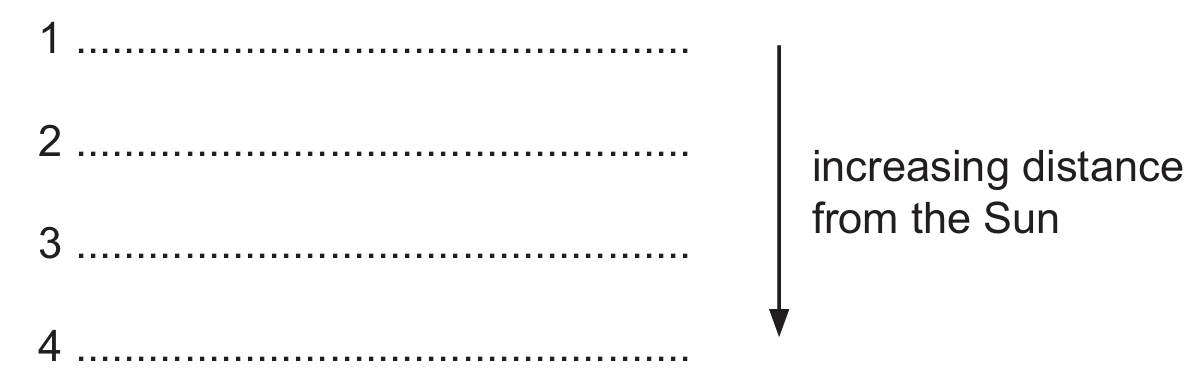
(c) A device on the surface of Mars sends a radio wave to the Earth. The distance from Mars to the Earth is $1.3 \times 10^{11}\text{ m}$. The speed of the radio wave is $3.0 \times 10^{8}\text{ m/s}$.
Calculate the time taken for the radio wave to travel from Mars to the Earth.
Most-appropriate topic codes (Cambridge IGCSE Physics 0625):
• Topic $6.1.2$ — The Solar System (Parts $\mathrm{(a)}$, $\mathrm{(b)}$, $\mathrm{(c)}$)
• Topic $1.2$ — Motion (Part $\mathrm{(c)}$)
▶️ Answer/Explanation
(a)
For the correct answer:
Earth has a greater mass OR reverse argument.
The gravitational field strength at the surface of a planet is directly dependent on the mass of the planet. Because Earth has a significantly greater mass than Mars, it exerts a stronger gravitational pull on objects at its surface. Therefore, Earth’s surface gravitational field strength is higher than that of Mars.
(b)
For the correct answer:
$1.$ Jupiter
$2.$ Saturn
$3.$ Uranus
$4.$ Neptune
The solar system is composed of inner rocky planets and outer gaseous planets. The four planets located further from the Sun than Mars are known as gas giants and ice giants. In order of increasing distance from the Sun, these planets are Jupiter, Saturn, Uranus, and Neptune.
(c)
For the correct calculated value:
$430\text{ s}$
The time taken for the radio wave to travel can be calculated using the speed equation $v = \frac{d}{t}$, which can be rearranged to find time as $t = \frac{d}{v}$. Substituting the given distance $d = 1.3 \times 10^{11}\text{ m}$ and wave speed $v = 3.0 \times 10^{8}\text{ m/s}$ yields $t = \frac{1.3 \times 10^{11}}{3.0 \times 10^{8}}$. This division results in $433.33\text{ s}$, which rounds to $430\text{ s}$ to two significant figures.