
Question 1
Most-appropriate topic codes (Cambridge IGCSE Physics 0625):
• Topic $1.2$ — Motion (Parts $\mathrm{(a)}$ and $\mathrm{(b)}$)
▶️ Answer/Explanation
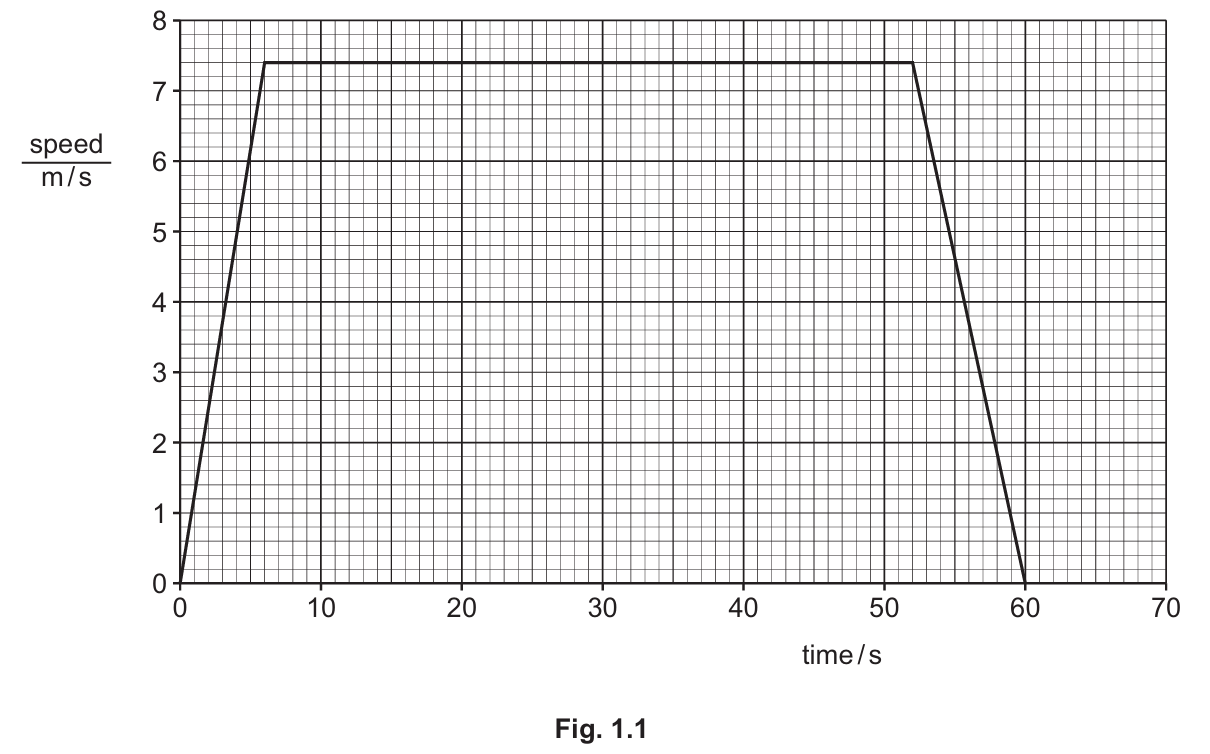
(a)(i)
For the correct answer:
$6.2\text{ m/s}$
To find the speed at $t = 5.0\text{ s}$, locate $5.0$ on the time (horizontal) axis and draw a vertical line up to the graph. From that point, draw a horizontal line to the speed (vertical) axis. The scale on the y-axis has $10$ small squares for every $1\text{ m/s}$, meaning each small square represents $0.1\text{ m/s}$. The reading intersects exactly $2$ small squares above the $6\text{ m/s}$ mark, yielding $6.2\text{ m/s}$.
(a)(ii)
For the correct answer:
Deceleration or slowing down
Between $t = 52\text{ s}$ and $t = 60\text{ s}$, the speed-time graph shows a straight line with a negative gradient. A decreasing speed over time indicates that the cyclist is decelerating. Because the slope is a straight line, it represents a constant deceleration down to $0\text{ m/s}$.
(a)(iii)
For the correct answer:
$22\text{ m}$
The distance travelled is equal to the area under the speed-time graph for the given time interval. The shape formed between $t = 0$ and $t = 6.0\text{ s}$ is a right-angled triangle with a base $b = 6.0\text{ s}$ and a height $h = 7.4\text{ m/s}$. Using the area formula $\frac{1}{2}bh$, the distance is $\frac{1}{2} \times 6.0 \times 7.4 = 22.2\text{ m}$, which is acceptable as $22\text{ m}$.
(b)
For the correct answer:
$4.3\text{ m/s}$
Average speed is calculated by dividing the total distance travelled by the total time taken. Using the equation $v = \frac{d}{t}$, we substitute the given values: distance $d = 560\text{ m}$ and time $t = 130\text{ s}$. This calculation gives an average speed of $\frac{560}{130} \approx 4.307\text{ m/s}$, which is written as $4.3\text{ m/s}$ to two significant figures.
Question 2
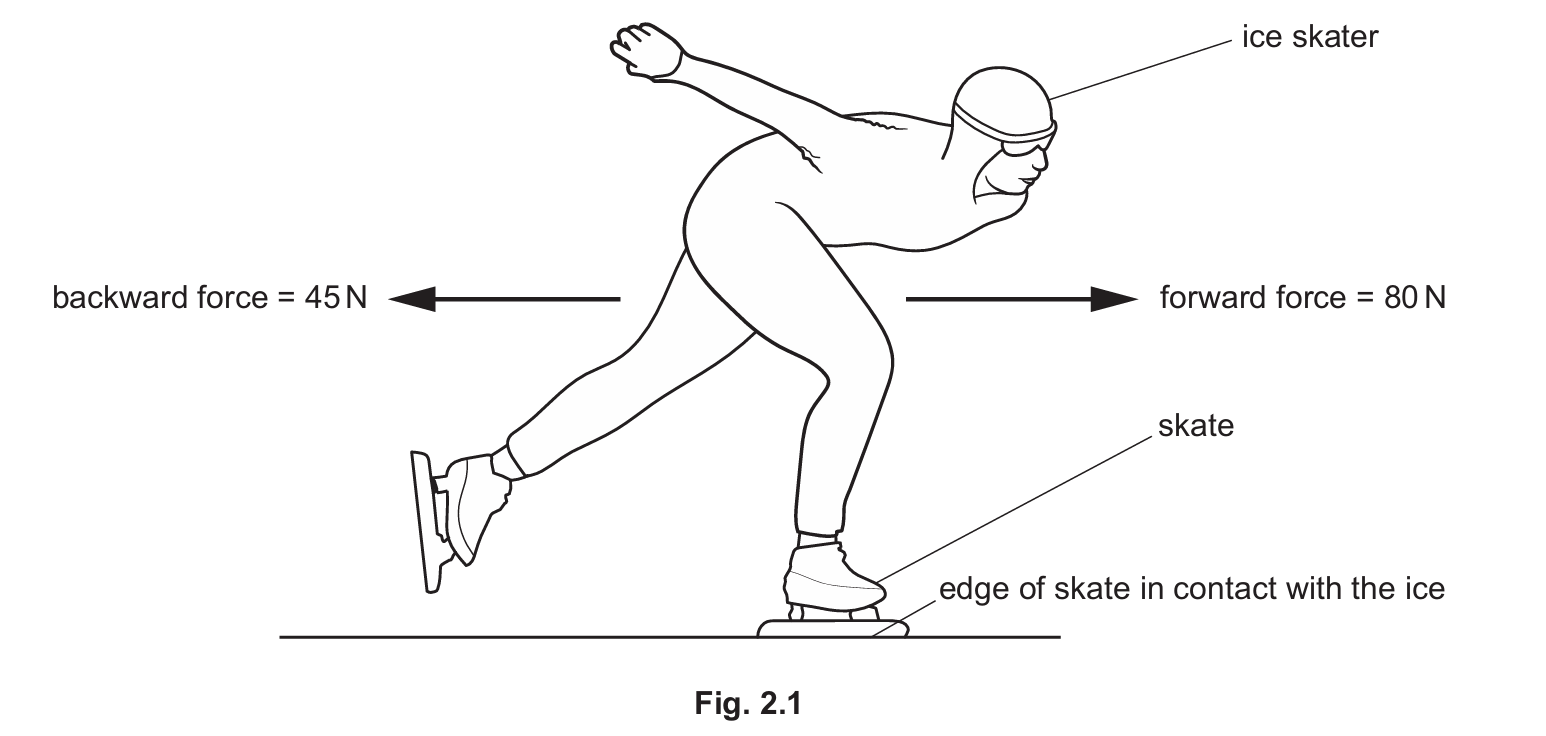
The area of the skate in contact with the ice is 6.2 cm2.
Calculate the pressure on the surface of the ice exerted by the skate. Give your answer to two significant figures.
Calculate the mass of the ice skater. Give your answer to two significant figures.
Most-appropriate topic codes (Cambridge IGCSE Physics 0625):
• Topic 1.5.1 — Effects of forces (Part (a))
• Topic 1.8 — Pressure (Part (b))
• Topic 1.3 — Mass and weight (Part (c))
▶️ Answer/Explanation
(a)
For the correct answer:
resultant horizontal force = 35 N
direction = forwards / to the right
The resultant force is the overall single force acting on an object when all individual forces are combined. Since the forces are acting in opposite horizontal directions, you subtract the smaller backward force from the larger forward force (80 – 45). The resulting force is 35 N, and it acts in the direction of the larger force, which is forwards (or to the right).
(b)
For the correct answer:
110 N/cm2
Pressure is defined as the force applied perpendicular to the surface of an object per unit area. Using the pressure formula $p = \frac{F}{A}$, we divide the force (which is the weight of the skater, 700 N) by the contact area (6.2 cm2). This calculation yields approximately 112.9 N/cm2. Rounding this to two significant figures gives 110 N/cm2.
(c)
For the correct answer:
71 kg
Mass and weight are related by the equation $W = mg$, where $g$ is the gravitational field strength (approximately 9.8 N/kg on Earth). Rearranging this formula to solve for mass gives $m = \frac{W}{g}$. Dividing the 700 N weight by 9.8 N/kg gives a mass of roughly 71.42 kg. Rounded to two significant figures, the mass is 71 kg.
Question 3
Most-appropriate topic codes (Cambridge IGCSE Physics 0625):
• Topic 1.7.1 — Energy (Parts (a), (b))
• Topic 1.7.2 — Work (Part (c)(i))
• Topic 1.7.4 — Power (Part (c)(ii))
▶️ Answer/Explanation
(a)
For the correct answer:
Energy cannot be created or destroyed. It can only be transferred or transformed from one form to another.
The principle of conservation of energy is a fundamental law in physics. It implies that the total energy in an isolated system remains constant over time. While energy can change its store (e.g., from chemical to thermal), the total amount of energy before and after the transfer must be exactly the same.
(b)
For the correct answer:
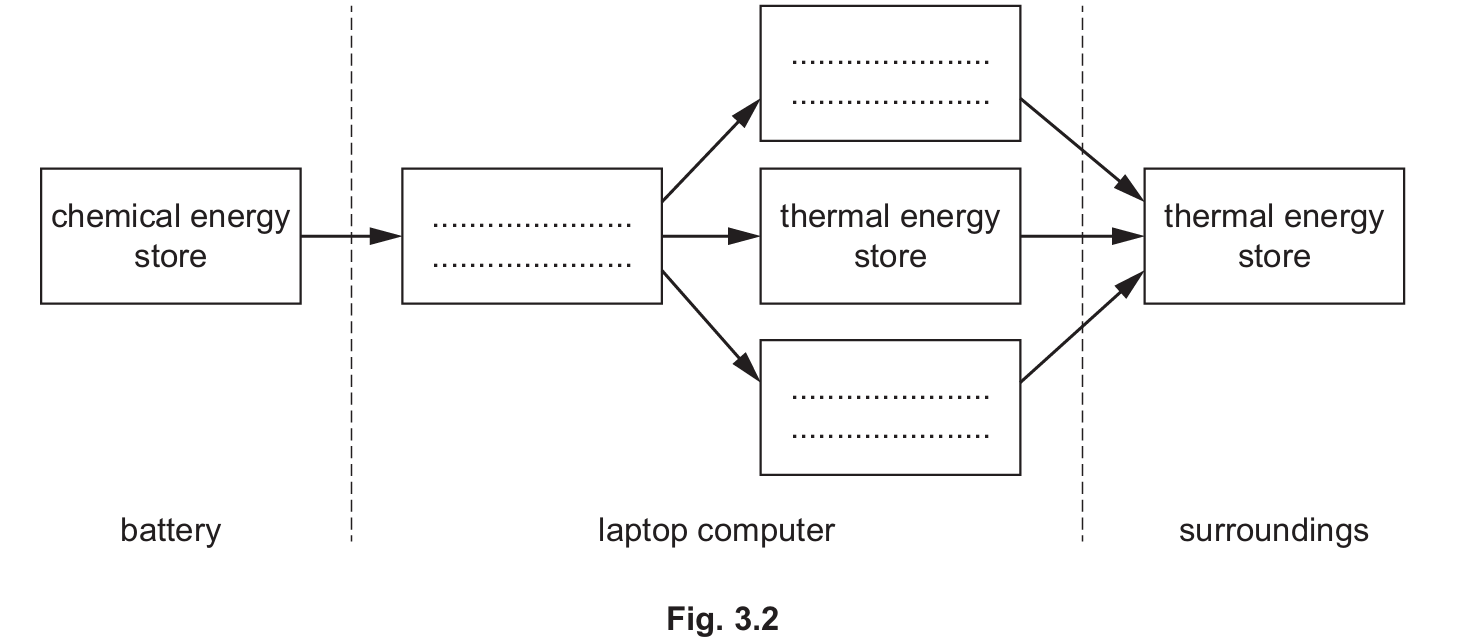
First box (battery to laptop): Electrical energy (or electrical working)
Top/Bottom boxes (laptop to surroundings): Light energy AND Sound energy
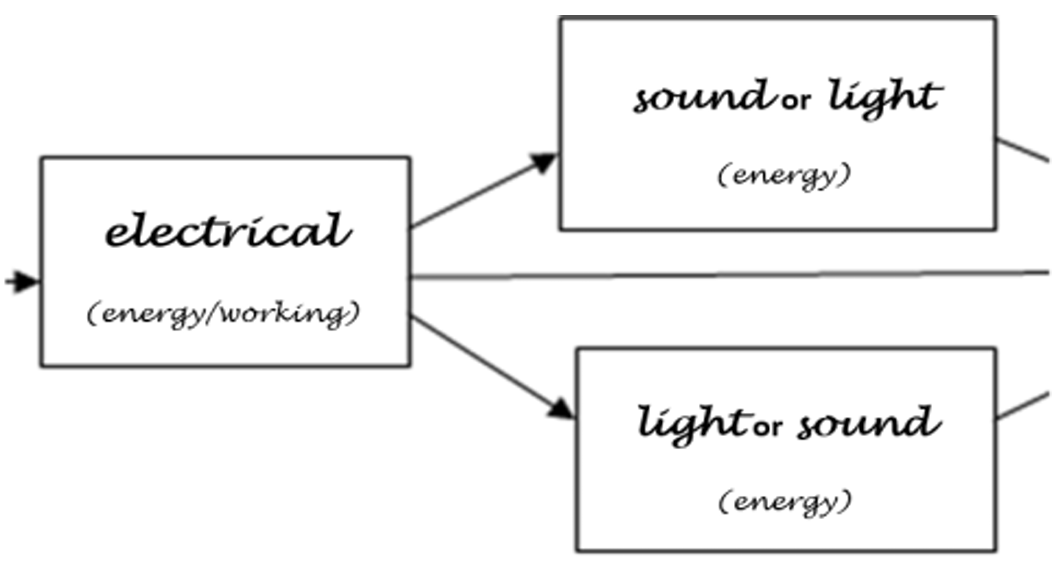
A battery stores chemical energy, which is transferred to the laptop computer via an electrical working pathway (electrical energy). The laptop utilizes this energy to perform its functions, which results in the emission of light (from the screen) and sound (from the speakers) into the surroundings. Any wasted energy is dissipated as thermal energy.
(c)(i)
For the correct calculated value:
$12900\text{ J}$
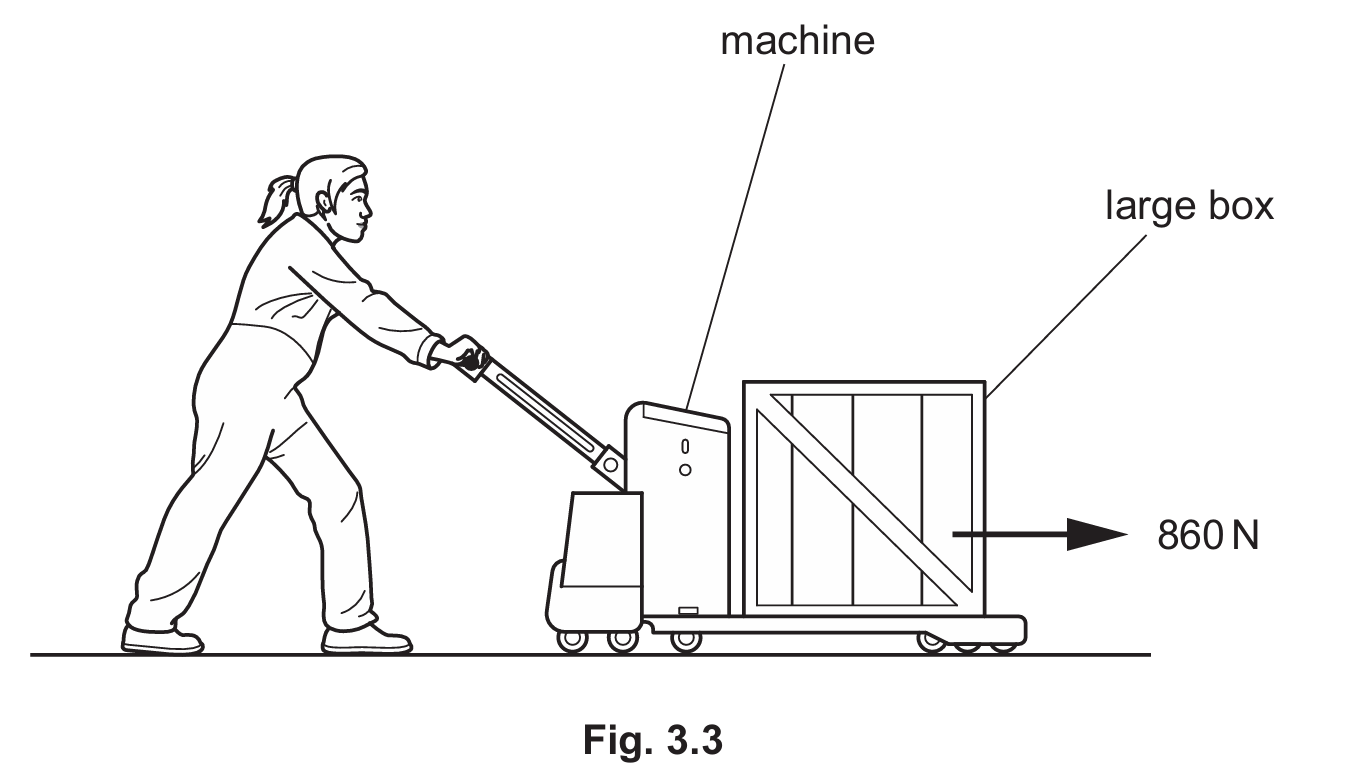
Work done is calculated using the formula $W = F \times d$, where $F$ is the applied force and $d$ is the distance moved in the direction of the force. Substituting the given values yields $W = 860\text{ N} \times 15\text{ m} = 12900\text{ J}$. This confirms the statement, as $12900\text{ J}$ is approximately $13000\text{ J}$ when rounded to two significant figures.
(c)(ii)
For the correct calculated value and unit:
$720\text{ W}$
Power is defined as the rate at which work is done, given by the equation $P = \frac{W}{t}$. Using the exact work done calculated in the previous part ($12900\text{ J}$) and the time taken ($18\text{ s}$), the power is $P = \frac{12900\text{ J}}{18\text{ s}} = 716.67\text{ W}$. Rounding this to an appropriate number of significant figures gives $720\text{ W}$ (Watts).
Question 4
(a) Fig. 4.1 shows a demonstration using a noisy toy.
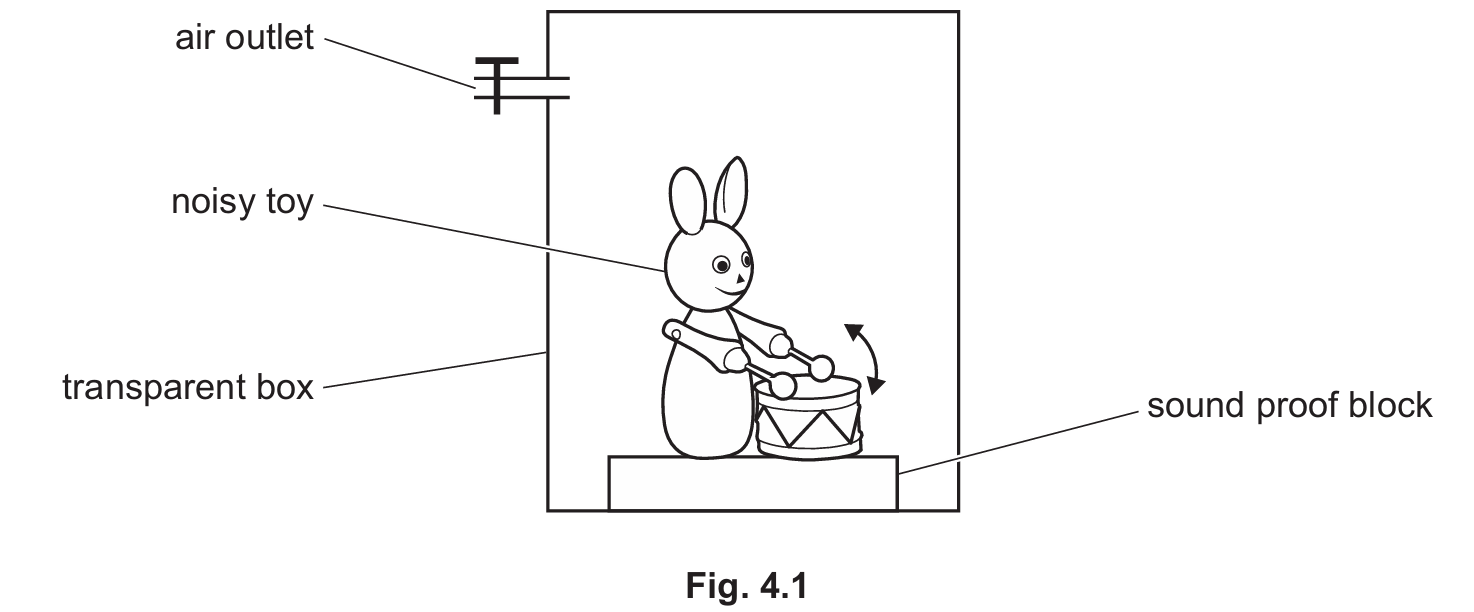
The teacher puts the noisy toy into a sealed, transparent case that contains air. The teacher removes the air from inside the case.
The sound of the noisy toy becomes quieter until the students cannot hear it. The students can see the toy moving, but cannot hear it, because light and sound have different properties.
State three differences between the properties of light and the properties of sound.
Most-appropriate topic codes (Cambridge IGCSE Physics 0625):
• Topic 3.1 — General properties of waves (Parts (a), (c))
• Topic 3.3 — Electromagnetic spectrum (Part (a))
• Topic 3.4 — Sound (Parts (a), (b))
▶️ Answer/Explanation
(a)
For the correct answer (any three of the following):
• Light can travel through a vacuum, but sound needs a medium.
• Light is a transverse wave, whereas sound is a longitudinal wave.
• Light is an electromagnetic wave, whereas sound is a mechanical wave.
• Light travels at a much higher speed than sound.
When air is removed from the case, a vacuum is created. Light is an electromagnetic wave, meaning it does not require a physical medium and can easily travel through the vacuum, so the toy can still be seen. In contrast, sound is a mechanical wave that relies on the collision of particles to propagate; without air particles, the sound cannot travel. Additionally, light travels as transverse waves, while sound propagates as longitudinal waves.
(b)
For the correct answer:
Two groups of students stand at a measured distance of at least $100\text{ m}$ apart (measured with a tape or trundle wheel). One group makes a visible loud noise, such as banging two wooden blocks together. The other group starts a stopwatch when they see the blocks collide and stops it when they hear the sound. The process is repeated to find an average time, and the speed is calculated using $v = \frac{d}{t}$.
This direct observation method utilizes the vast difference between the speed of light and the speed of sound. Because light reaches the observers almost instantaneously, the visual cue serves as a highly accurate start signal. Measuring the time delay until the slower sound wave arrives provides the travel time $t$. Dividing the known distance $d$ by this average time $t$ yields a reliable estimate of the speed of sound in air.
(c)
For the correct calculated value:
$1.3\text{ m}$
The fundamental relationship between the speed, frequency, and wavelength of any wave is given by the wave equation $v = f\lambda$. To find the wavelength ($\lambda$), we rearrange the equation to $\lambda = \frac{v}{f}$. Substituting the given values into the formula, we get $\lambda = \frac{340}{260}$. Evaluating this fraction gives approximately $1.307\text{ m}$, which rounds down to $1.3\text{ m}$ using two significant figures.
Question 5
Most-appropriate topic codes (Cambridge IGCSE Physics 0625):
• Topic $1.4$ — Density (Parts $\mathrm{(a)(i)}$, $\mathrm{(a)(ii)}$)
• Topic $2.1.1$ — States of matter (Part $\mathrm{(b)(i)}$)
• Topic $2.1.2$ — Particle model (Part $\mathrm{(b)(ii)}$)
• Topic $2.2.3$ — Melting, boiling and evaporation (Part $\mathrm{(c)}$)
▶️ Answer/Explanation
(a)(i)
For the correct answer:
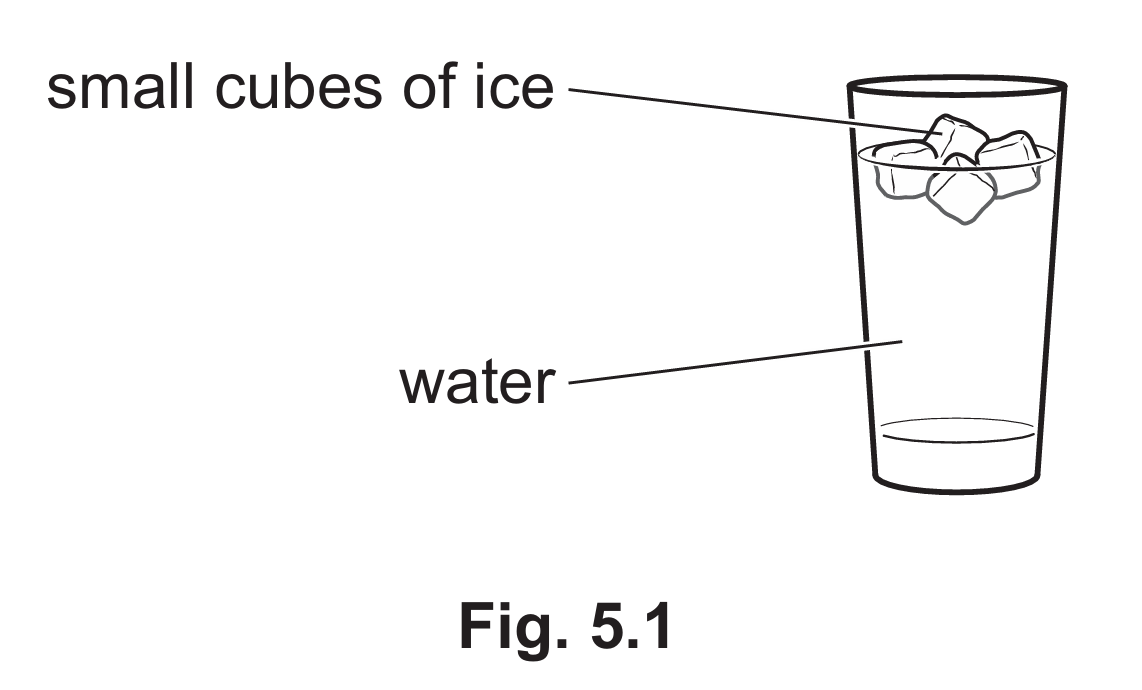
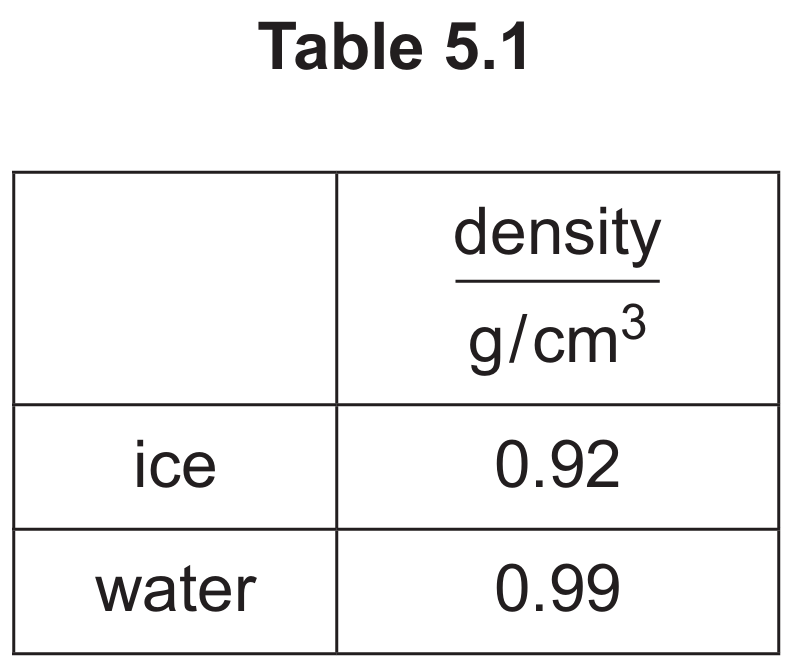
Ice is less dense than water.
The density of ice is $0.92\text{ g/cm}^3$, which is less than the density of water ($0.99\text{ g/cm}^3$). Objects with a lower density than the fluid they are placed in will experience an upthrust greater than their weight when fully submerged. Because ice is less dense than water, it floats on the surface.
(a)(ii)
For the correct answer:
$3.1\text{ g}$
To find the mass, we use the density formula $\rho = \frac{m}{V}$, which rearranges to $m = \rho \times V$. Substituting the given values for the ice cube, we get $m = 0.92\text{ g/cm}^3 \times 3.4\text{ cm}^3$. Calculating this yields a mass of $3.128\text{ g}$, which rounds to $3.1\text{ g}$ to two significant figures.
(b)(i)
For the correct answer:
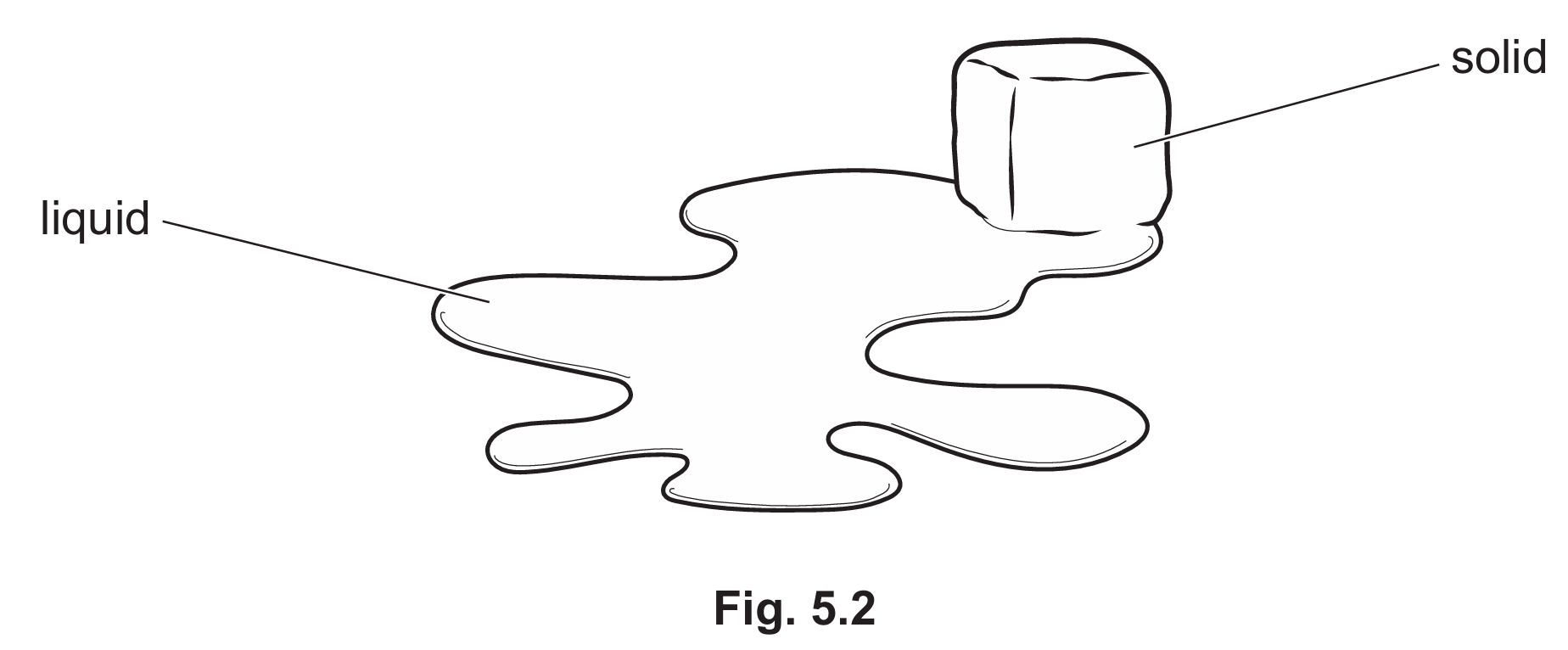
Melting
Melting is the physical process where a substance changes from a solid state to a liquid state. This occurs when the internal energy of the solid increases, usually by the application of heat, until it reaches its melting point.
(b)(ii)
For the correct answer:
Arrangement: regular in solid, random in liquid.
Motion: vibrate in solid, move around / flow over each other in liquid.
In a solid state, particles are arranged in a regular, fixed lattice and can only vibrate around fixed positions. As the ice melts into a liquid, the particles gain energy and the arrangement becomes random and irregular. The particles are no longer fixed and can now freely move around and slide past one another.
(c)
For the correct answer:
Evaporation
Evaporation is the process where molecules at the surface of a liquid gain enough kinetic energy to escape into the air as a gas. Unlike boiling, this process can happen at any temperature below the boiling point, eventually leaving the floor dry as all the water turns into water vapour.
Question 6
Most-appropriate topic codes (Cambridge IGCSE Physics 0625):
• Topic $3.2.3$ — Thin lenses (Parts $\mathrm{(a)}$, $\mathrm{(b)}$, $\mathrm{(c)}$, $\mathrm{(d)}$, $\mathrm{(e)}$)
▶️ Answer/Explanation
(a)
For the correct answer:
principal axis
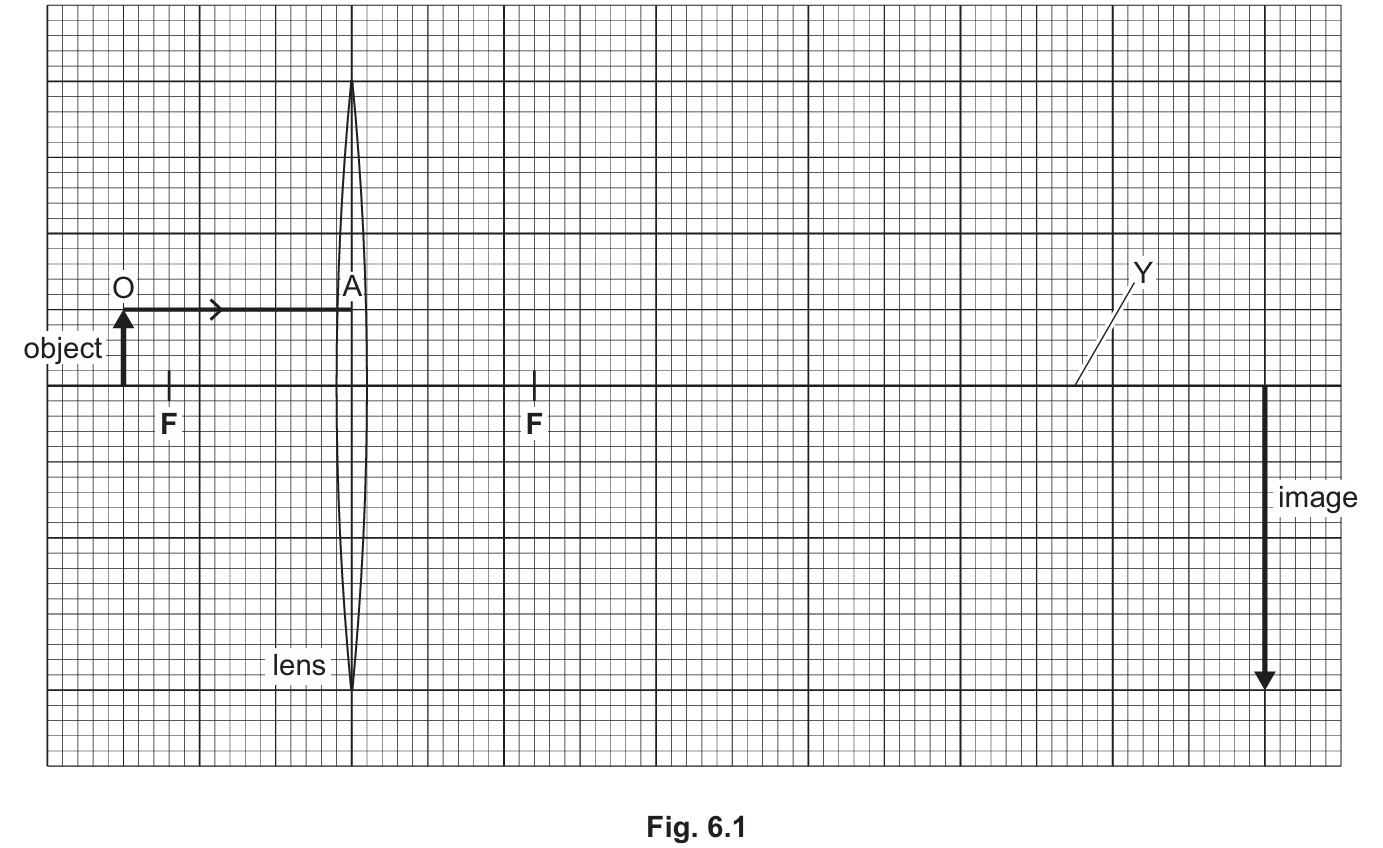
The line $Y$ passes symmetrically through the optical center of the lens and is perpendicular to the lens plane. In optics, this central horizontal reference line is called the principal axis, and it serves as the baseline for all height and distance measurements.
(b)
For the correct answer:
principal focus or principal focii or focal point(s)
The points labeled $F$ represent the positions where incident rays traveling parallel to the principal axis will perfectly converge after passing through the lens. These are specifically known as the principal foci or focal points, located at a distance $f$ from the optical center.
(c)
For the correct answer:
ray continued through $F$ to top of image
According to the standard rules of ray diagrams for a converging lens, any incident ray that travels parallel to the principal axis (such as ray $OA$) will be refracted through the principal focus $F$ on the opposite side. Thus, the ray must be drawn from point $A$, passing exactly through $F$, until it meets the tip of the image arrow.
(d)
For the correct answer:
one of the following:
• ray from top of object to centre of lens and continued to top of image
or
• ray from top of object through $F$ to lens and horizontal paraxial ray from lens to top of image
To find the image mathematically and visually, a second principal ray is needed. You can draw a ray from the object tip $O$ directly through the optical center of the lens; this ray travels in a straight line without any deviation. Alternatively, a ray passing through the first focal point $F$ before hitting the lens will emerge parallel to the principal axis. Either correctly drawn ray will intersect at the exact tip of the image.
(e)
For the correct answer:
real
An image formed by the actual intersection of light rays on the opposite side of the lens from the object is defined as a real image. Because it is formed by converging light rays, a real image can be projected onto a screen. Since the diagram shows rays physically meeting to form an inverted image, it must be real.
Question 7
The reading on the voltmeter is $5.8\text{ V}$.
Calculate the resistance of the lamp.
Most-appropriate topic codes (Cambridge IGCSE Physics 0625):
• Topic $4.3.2$ — Series and parallel circuits (Parts $\mathrm{(a)}$, $\mathrm{(c)}$)
• Topic $4.2.4$ — Resistance (Part $\mathrm{(b)(i)}$)
• Topic $4.2.5$ — Electrical energy and electrical power (Part $\mathrm{(b)(ii)}$)
▶️ Answer/Explanation
(a)
For the correct answer:
$6.0\text{ V}$
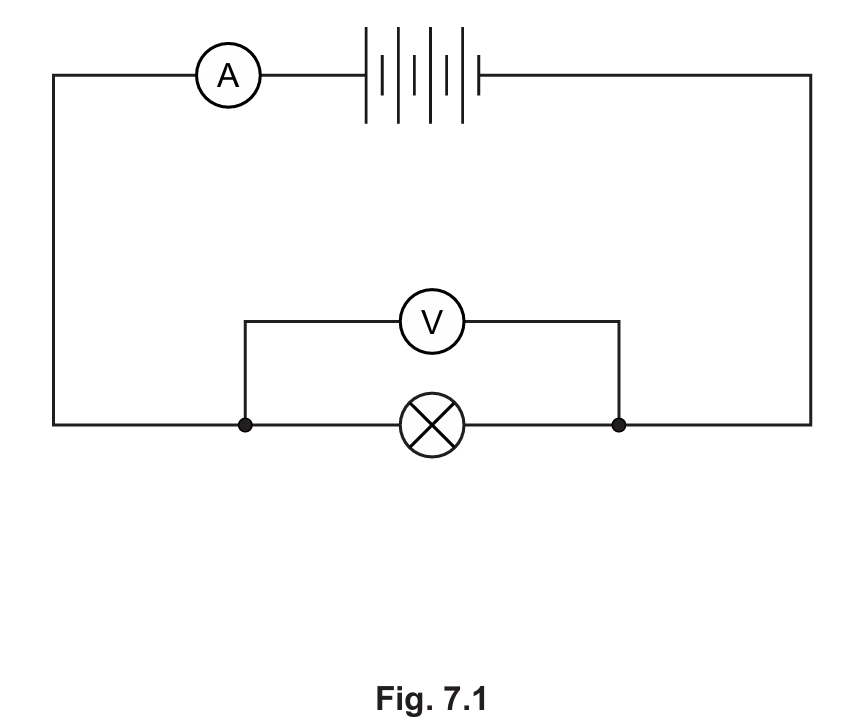
The four cells are connected in series. The total potential difference (e.m.f.) of a battery composed of cells connected in series is simply the sum of their individual potential differences. Therefore, the total potential difference is calculated as $4 \times 1.5\text{ V} = 6.0\text{ V}$.
(b)(i)
For the correct answer:
$9.1\ \Omega$
According to Ohm’s law, the resistance $R$ of a component is the ratio of the potential difference $V$ across it to the current $I$ passing through it, given by the equation $R = \frac{V}{I}$. Substituting the given values into the formula yields $R = \frac{5.8\text{ V}}{0.64\text{ A}} \approx 9.0625\ \Omega$, which is correctly rounded to $9.1\ \Omega$ to match the two significant figures of the given data.
(b)(ii)
For the correct answer:
$520\text{ J}$
The electrical energy $E$ transferred by a component in a circuit can be determined using the formula $E = V I t$, where $V$ is the potential difference, $I$ is the current, and $t$ is the time in seconds. Substituting the provided values gives $E = 5.8\text{ V} \times 0.64\text{ A} \times 140\text{ s} = 519.68\text{ J}$, which rounds to $520\text{ J}$.
(c)
For the correct answer:
Lamp drawn in parallel with the original lamp.
To increase the total current measured by the ammeter without altering the power supply, the overall resistance of the circuit must be decreased. Connecting a second lamp in parallel with the original lamp creates an alternative path for the current, which reduces the total equivalent resistance of the circuit and naturally leads to a larger current flowing from the source.
Question 8
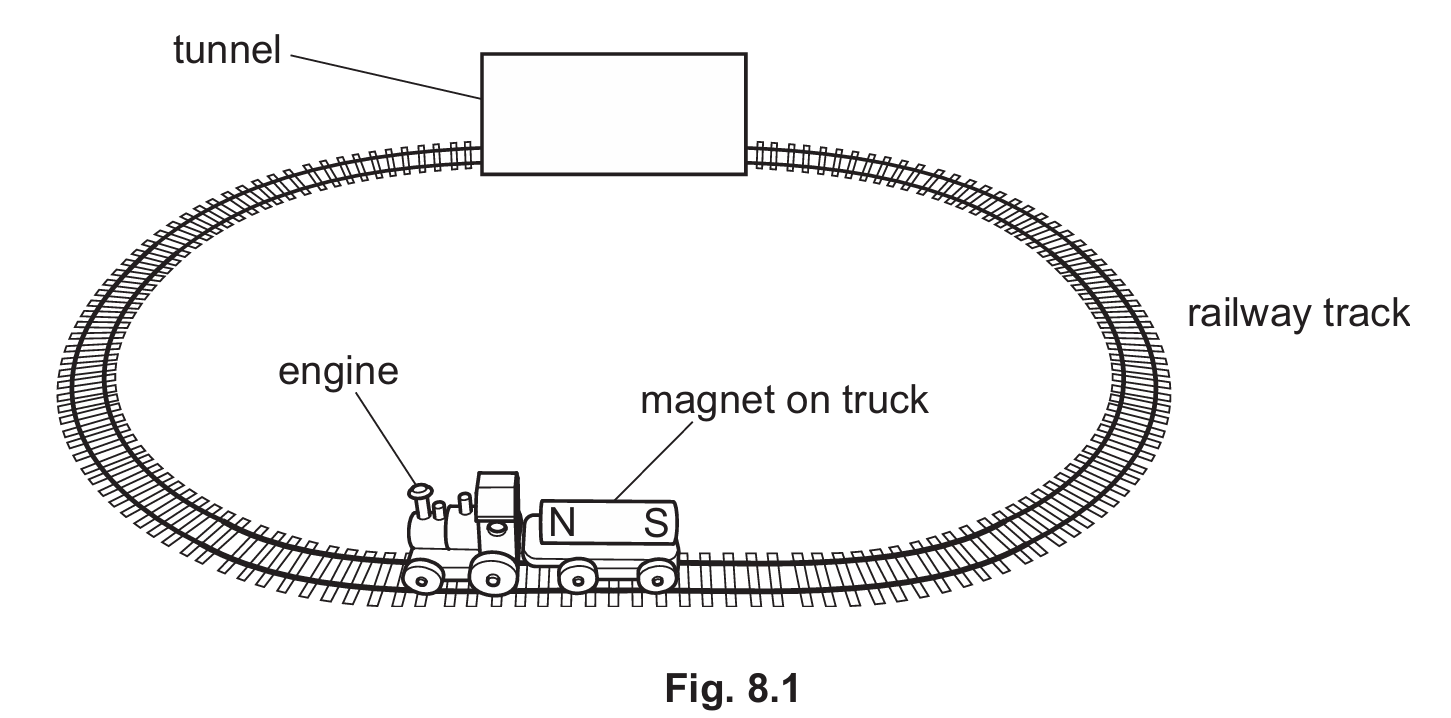
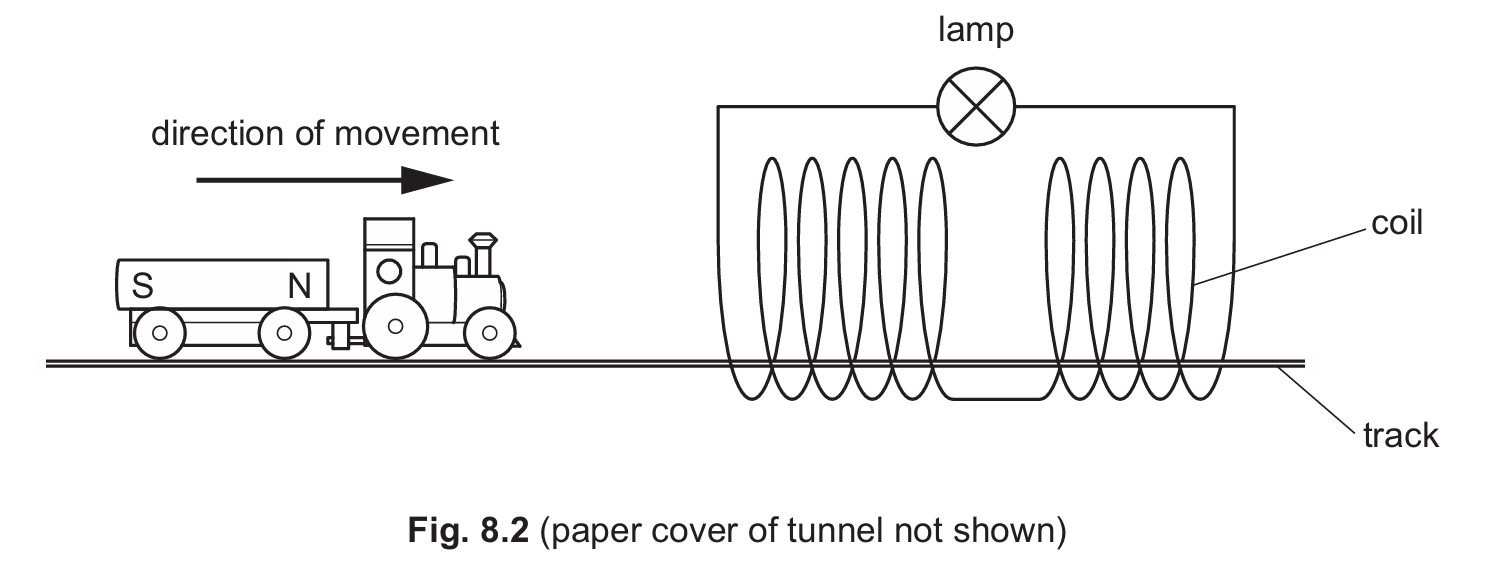
The tunnel consists of a coil of wire that is covered in paper. The ends of the coil are connected to a lamp.
When the toy train moves through the coil of wire, the lamp becomes bright.
State which metals are used in a transformer.
Most-appropriate topic codes (Cambridge IGCSE Physics 0625):
• Topic 4.5.1 — Electromagnetic induction (Parts (a)(i), (a)(ii))
• Topic 4.5.6 — The transformer (Parts (b)(i), (b)(ii))
▶️ Answer/Explanation
(a)(i)
For the correct answer:
The magnetic field from the magnet links with or cuts the coil. The relative movement between the magnetic field and the coil induces an $e.m.f.$ (voltage/current) in the coil.
Explanation: As the magnet on the train moves towards and through the coil, its magnetic field lines cut across the turns of the wire. According to the principles of electromagnetic induction, this relative motion between a magnetic field and a conductor induces an electromotive force ($e.m.f.$) across the coil. Because the coil is connected to a closed circuit containing the lamp, this induced voltage drives an electric current, causing the lamp to light up.
(a)(ii)
For the correct answer:
Use a stronger magnet, make the train move faster, or add more coils/turns.
Explanation: The magnitude of the induced $e.m.f.$ is directly proportional to the rate at which the magnetic field lines are cut. You can increase this rate by making the train move faster (increasing relative speed) or by using a stronger magnet (providing more field lines to cut). Additionally, increasing the number of turns in the coil means more wires are cutting the field simultaneously, which proportionally increases the total induced voltage.
(b)(i)
For the correct answer:
Soft iron.
Explanation: The core of a transformer is typically made of soft iron. Soft iron is chosen because it is a temporary magnetic material, meaning it can be easily magnetized and demagnetized. As the alternating current changes direction in the primary coil, the soft iron core efficiently channels the changing magnetic field to the secondary coil with minimal energy loss.
(b)(ii)
For the correct answer:
Copper.
Explanation: The coils (or windings) of a transformer are made of copper wire. Copper is utilized because it is an excellent electrical conductor with very low electrical resistance. This low resistance minimizes power loss in the form of thermal energy (where $P = I^{2}R$) as the current flows through the coils, maximizing the transformer’s efficiency.
Question 9
Most-appropriate topic codes (Cambridge IGCSE Physics 0625):
• Topic $5.2.2$ — The three types of nuclear emission (Part $\mathrm{(a)}$)
• Topic $5.1.2$ — The nucleus (Part $\mathrm{(b)(i)}$)
• Topic $5.2.4$ — Half-life (Part $\mathrm{(b)(ii)}$)
▶️ Answer/Explanation
(a)
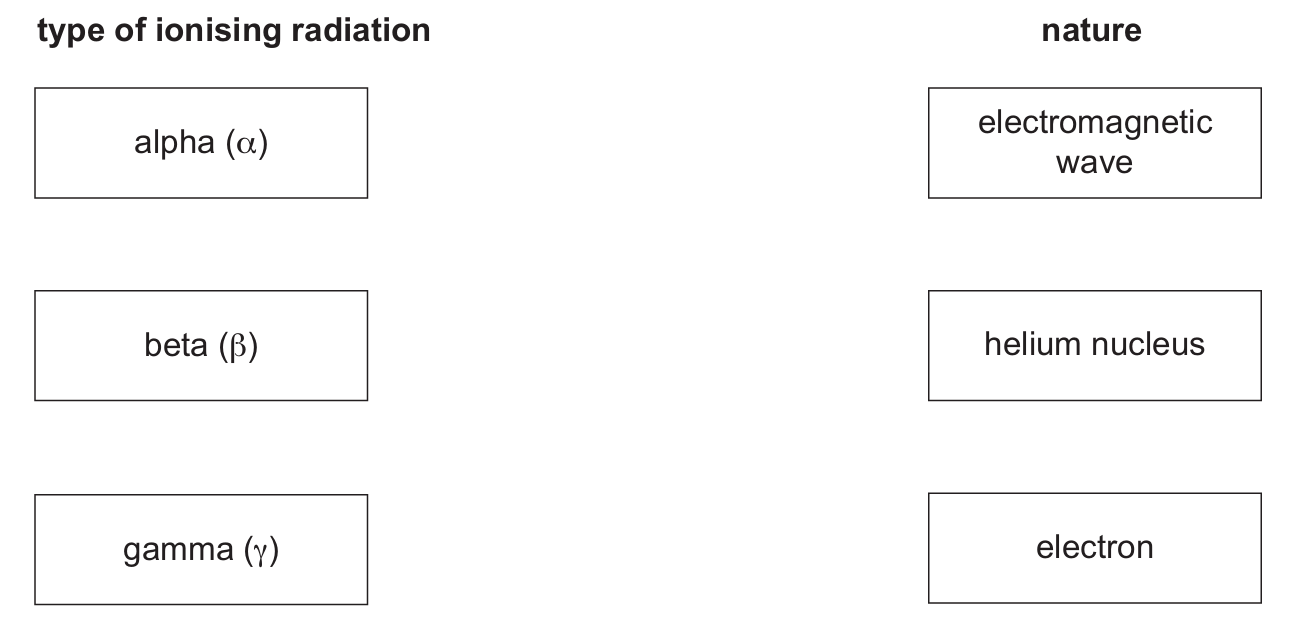
For the correct matching: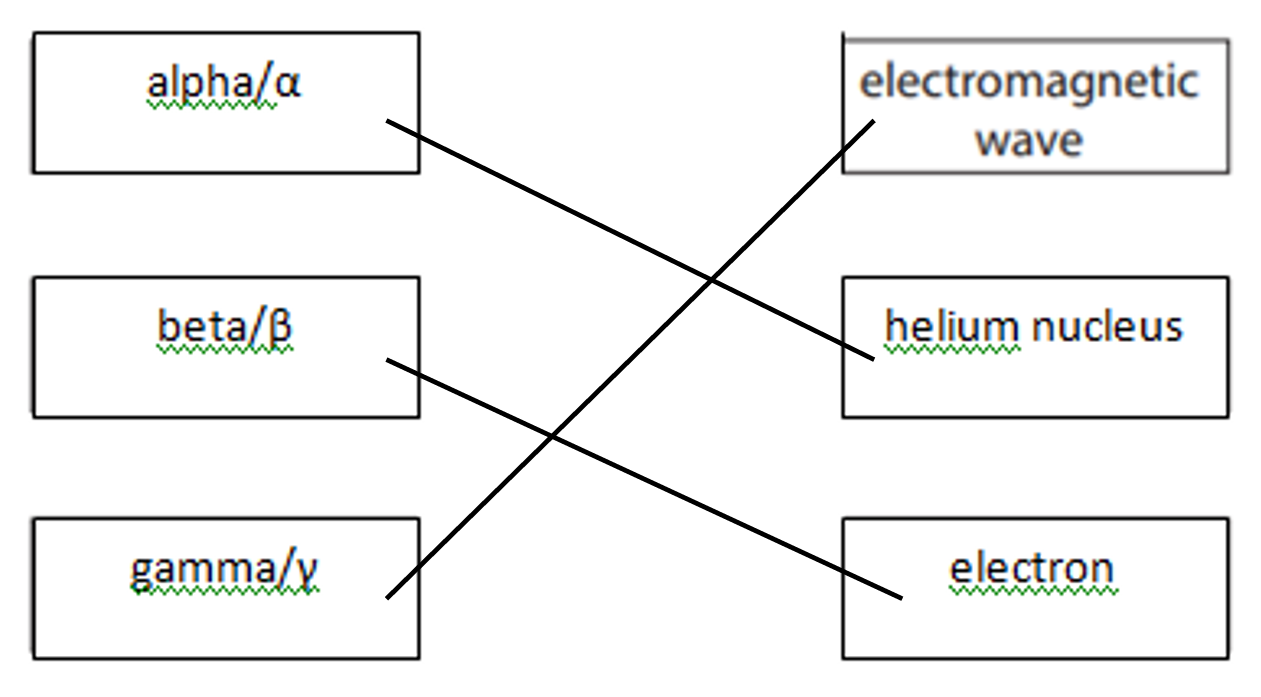
The nature of the three types of ionising radiation is a fundamental concept in nuclear physics. An alpha ($\alpha$) particle consists of two protons and two neutrons, making it structurally identical to a helium nucleus. A beta ($\beta$) particle is a high-energy, high-speed electron that is emitted from the nucleus during radioactive decay. Gamma ($\gamma$) radiation, unlike the other two, is not a particle with rest mass but a high-frequency electromagnetic wave.
(b)(i)
For the correct answer:
(Atoms with) same number of protons / proton number / atomic number / $Z$
Different number of neutrons / nucleon number / mass number / $A$
Isotopes are defined as atoms of the exact same element that have the same proton number (often denoted as atomic number, $Z$) but a different nucleon number (mass number, $A$). This means they possess the identical number of protons in their nucleus, which is the characteristic that defines the element itself. However, they differ in the number of neutral particles (neutrons) they contain, which changes their overall atomic mass.
(b)(ii)
For the correct answer:
$8\text{ days}$
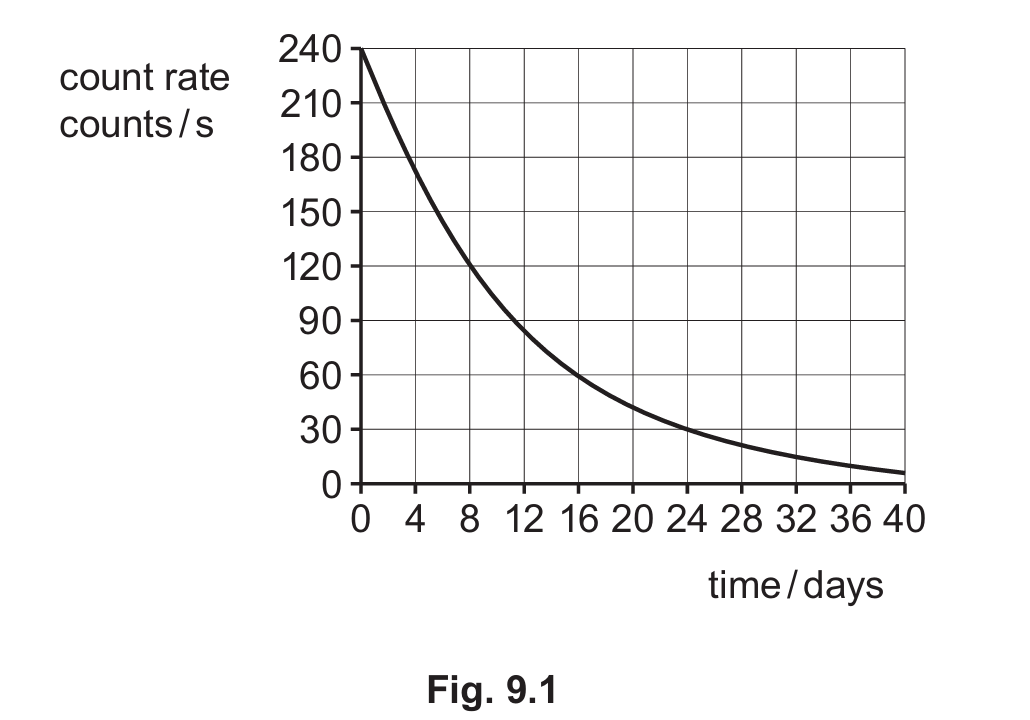
Half-life is defined as the time taken for the count rate (or activity) of a specified radioactive sample to decrease to exactly half of its initial value. Observing the provided decay curve, the initial count rate at $t = 0\text{ days}$ is $240\text{ counts/s}$. Half of this initial value is $120\text{ counts/s}$. Tracing $120\text{ counts/s}$ on the y-axis to the curve and reading the corresponding time on the x-axis gives $8\text{ days}$. Repeating this, the time to drop from $120$ to $60\text{ counts/s}$ is the duration between $8\text{ days}$ and $16\text{ days}$, confirming the half-life is indeed $8\text{ days}$.
Question 10
Most-appropriate topic codes (Cambridge IGCSE Physics $0625$):
• Topic $6.1.2$ — The Solar System (Part $(a)$)
• Topic $6.2.3$ — The Universe (Part $(b)$)
▶️ Answer/Explanation
(a)(i)
For the correct answer:
dust
According to the accretion model of the Solar System, the Sun and planets originated from a massive interstellar cloud. This nebula consisted primarily of hydrogen gas and microscopic solid particles known as dust. Over millions of years, these materials clumped together to form larger celestial bodies.
(a)(ii)
For the correct answer:
gravity
The fundamental force responsible for the formation of stars and planetary systems is gravity. As the interstellar cloud of gas and dust became sufficiently dense, its own mutual gravitational attraction caused it to collapse inward, pulling the surrounding material closer together.
(a)(iii)
For the correct answer:
disc
As the gravitational collapse occurred, the initial rotation of the cloud caused it to flatten out due to the conservation of angular momentum. This resulted in a spinning, flattened structure known as an accretion disc, from which the planets eventually condensed and formed their orbits.
(b)
For the correct answer:
evidence: red shift seen or increase in the observed wavelength of electromagnetic radiation.
explanation: galaxies are moving away from each other, which means the Universe is expanding, suggesting all matter once started from a single point.
The primary evidence supporting the Big Bang Theory is the observation of cosmic redshift, where the wavelength of light from distant galaxies is stretched towards the red end of the spectrum. This shift indicates that galaxies are moving away from us in all directions, and the expansion of the Universe implies that all matter and energy were once concentrated at a single, infinitely dense point.