Home / 0625_w25_qp_41

Question 1

A train travels with a constant velocity of $56\text{ m/s}$ on a horizontal track. The mass of the train is $440000\text{ kg}$.
(a) State the difference between the velocity of the train and its speed.
(b) Calculate the kinetic energy stored in the moving train.
(c) (i) The train has a uniform deceleration of $1.2\text{ m/s}^2$. Calculate the constant braking force which brings the train to rest.
(ii) Calculate the distance travelled by the train as it comes to rest.

Most-appropriate topic codes (Cambridge IGCSE Physics 0625):

• Topic $1.2$ — Motion (Part $\mathrm{(a)}$)
• Topic $1.7.1$ — Energy (Part $\mathrm{(b)}$)
• Topic $1.5.1$ — Effects of forces (Part $\mathrm{(c)(i)}$)
• Topic $1.7 .2$ — Work (Part $\mathrm{(c)(ii)}$)

▶️ Answer/Explanation

(a)
For the correct answer:
Velocity is a vector quantity and has a specific direction, whereas speed is a scalar quantity and does not.

Velocity is a vector quantity, which means it requires both a magnitude (size) and a specific direction to be fully described. In contrast, speed is a scalar quantity, meaning it only has a magnitude.

(b)
For the correct answer:
$6.9\times10^8\text{ J}$

The kinetic energy of a moving object can be calculated using the formula $E_k=\frac{1}{2}mv^2$. Given the train’s mass $m=440000\text{ kg}$ and velocity $v=56\text{ m/s}$, we substitute: $E_k=0.5\times440000\times(56)^2=689920000\text{ J}$, which is $6.9\times10^8\text{ J}$ to two significant figures.

(c)(i)
For the correct answer:
$5.3\times10^5\text{ N}$

According to Newton’s second law, $F=ma$. Using the given mass $m=440000\text{ kg}$ and the uniform deceleration $a=1.2\text{ m/s}^2$, we get $F=440000\times1.2 = 528000\text{ N}$, which rounds to $5.3\times10^5\text{ N}$.

(c)(ii)
For the correct answer:
$1300\text{ m}$

Using the principle of conservation of energy, where the work done by the brakes equals the train’s kinetic energy ($W=Fd=\Delta E$). Rearranging for distance $d$ gives $d=\frac{E_k}{F}$. Substituting the values: $d=\frac{689920000}{528000}\approx1306.6\text{ m}$. Rounding to two significant figures gives $1300\text{ m}$.

Question 2

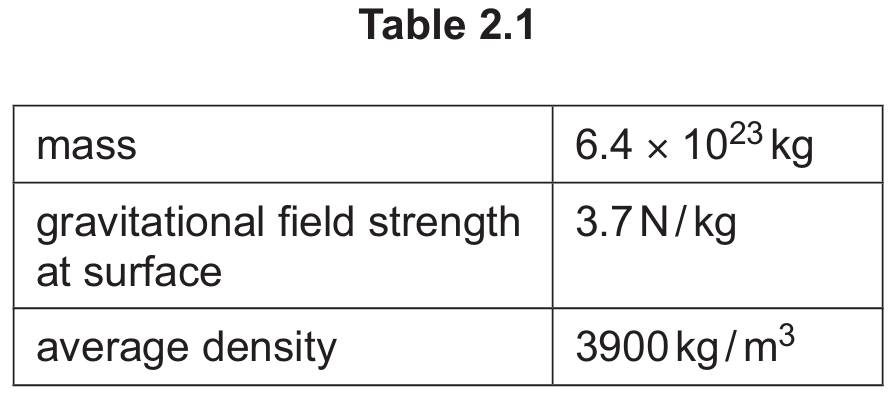
Table 2.1 contains information about the planet Mars.
(a) Define gravitational field strength.

(b) (i) An object has a weight of $42\text{ N}$ at the surface of the Earth.

              Calculate the weight of the object at the surface of Mars.

     (ii) Calculate the volume of Mars.
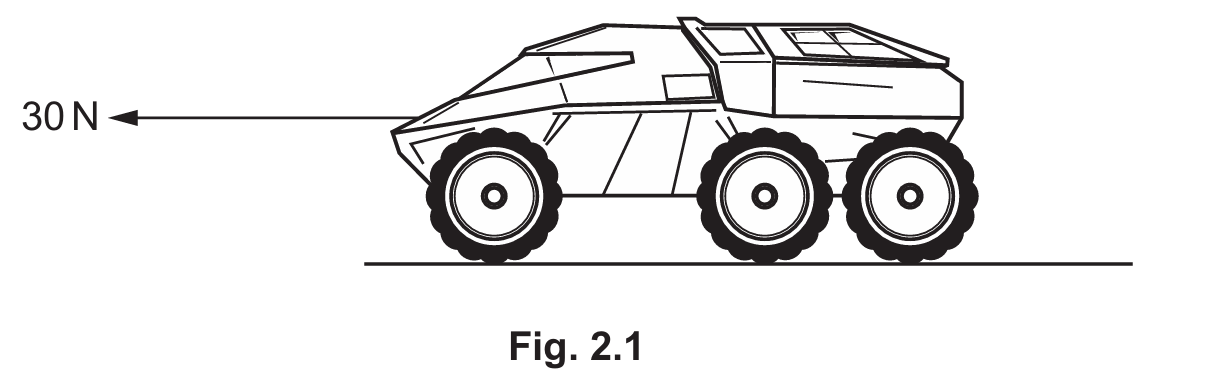
(c) Fig. 2.1 shows a space buggy that is tested on Earth. The buggy is travelling at a constant speed in a straight line. The driving force on the buggy is $30\text{ N}$.
     (i) Draw and label one arrow on Fig. 2.1 to show the size and direction of the resistive forces on the buggy.

     (ii) Air resistance on Mars is less than air resistance on Earth.
          The same driving force, $30\text{ N}$, is exerted on the buggy on Mars.

          1. State the effect this has on the resultant force on the buggy on Mars.

          2. State the relationship between resistive forces, driving force and resultant force.

Most-appropriate topic codes (Cambridge IGCSE Physics 0625):

• Topic $1.3$ — Mass and weight (Parts $\mathrm{(a)}$, $\mathrm{(b)(i)}$)
• Topic $1.4$ — Density (Part $\mathrm{(b)(ii)}$)
• Topic $1.5.1$ — Effects of forces (Part $\mathrm{(c)}$)

▶️ Answer/Explanation
Part (a)

Correct Answer: Force per unit mass (on an object in a gravitational field).

Detailed solution: Gravitational field strength, denoted by $g$, defines the intensity of a gravitational field. It is formally defined as the gravitational force ($W$, or weight) exerted on an object per unit of its mass ($m$). This relationship is represented by the equation $g = \frac{W}{m}$, typically measured in $\text{N/kg}$.

Part (b)(i)

Correct Answer: $16\text{ N}$

Detailed solution: First, calculate the invariant mass of the object using Earth’s gravitational field strength ($g \approx 9.8\text{ N/kg}$). Using $m = \frac{W}{g}$, we find $m = \frac{42}{9.8} \approx 4.286\text{ kg}$. To find the weight on Mars, multiply this mass by the gravitational field strength on Mars ($3.7\text{ N/kg}$) provided in the table. So, $W = mg = 4.286 \times 3.7 = 15.86\text{ N}$, which rounds to $16\text{ N}$.

Part (b)(ii)

Correct Answer: $1.6 \times 10^{20}\text{ m}^3$

Detailed solution: The formula for density is $\rho = \frac{m}{V}$. Rearranging this to solve for volume gives $V = \frac{m}{\rho}$. Substitute the values for Mars from Table 2.1 into the rearranged equation: $V = \frac{6.4 \times 10^{23}}{3900}$. Calculating this yields approximately $1.641 \times 10^{20}\text{ m}^3$, which accurately rounds to $1.6 \times 10^{20}\text{ m}^3$.

Part (c)(i)

Correct Answer: An arrow drawn parallel to the driving force, pointing to the right, and labelled $30\text{ N}$.

Detailed solution: Newton’s First Law states that if an object travels at a constant speed in a straight line, the resultant (net) force acting on it must be zero. Since the driving force is $30\text{ N}$ to the left, the resistive forces (like friction and air resistance) must perfectly balance it. Therefore, an equal and opposite force of $30\text{ N}$ must act to the right.

Part (c)(ii)

Correct Answer:
1. The resultant force increases (or there is now a resultant force in the direction of the driving force).
2. Resultant force = driving force $-$ resistive force(s).

Detailed solution: 1. Because the resistive force on Mars is smaller but the driving force is still $30\text{ N}$, the forces are no longer balanced, resulting in a net force forward. 2. For forces acting along the same straight line in opposite directions, the resultant magnitude is simply the difference between the forward force (driving) and the backward force (resistive).
Question 2

Table 2.1 contains information about the planet Mars.
(a) Define gravitational field strength.

(b) (i) An object has a weight of $42\text{ N}$ at the surface of the Earth.

              Calculate the weight of the object at the surface of Mars.

     (ii) Calculate the volume of Mars.
(c) Fig. 2.1 shows a space buggy that is tested on Earth. The buggy is travelling at a constant speed in a straight line. The driving force on the buggy is $30\text{ N}$.
     (i) Draw and label one arrow on Fig. 2.1 to show the size and direction of the resistive forces on the buggy.

     (ii) Air resistance on Mars is less than air resistance on Earth.
          The same driving force, $30\text{ N}$, is exerted on the buggy on Mars.

          1. State the effect this has on the resultant force on the buggy on Mars.

          2. State the relationship between resistive forces, driving force and resultant force.

Most-appropriate topic codes (Cambridge IGCSE Physics 0625):

• Topic $1.3$ — Mass and weight (Parts $\mathrm{(a)}$, $\mathrm{(b)(i)}$)
• Topic $1.4$ — Density (Part $\mathrm{(b)(ii)}$)
• Topic $1.5.1$ — Effects of forces (Part $\mathrm{(c)}$)

▶️ Answer/Explanation
Part (a)

Correct Answer: Force per unit mass (on an object in a gravitational field).

Detailed solution: Gravitational field strength, denoted by $g$, defines the intensity of a gravitational field. It is formally defined as the gravitational force ($W$, or weight) exerted on an object per unit of its mass ($m$). This relationship is represented by the equation $g = \frac{W}{m}$, typically measured in $\text{N/kg}$.

Part (b)(i)

Correct Answer: $16\text{ N}$

Detailed solution: First, calculate the invariant mass of the object using Earth’s gravitational field strength ($g \approx 9.8\text{ N/kg}$). Using $m = \frac{W}{g}$, we find $m = \frac{42}{9.8} \approx 4.286\text{ kg}$. To find the weight on Mars, multiply this mass by the gravitational field strength on Mars ($3.7\text{ N/kg}$) provided in the table. So, $W = mg = 4.286 \times 3.7 = 15.86\text{ N}$, which rounds to $16\text{ N}$.

Part (b)(ii)

Correct Answer: $1.6 \times 10^{20}\text{ m}^3$

Detailed solution: The formula for density is $\rho = \frac{m}{V}$. Rearranging this to solve for volume gives $V = \frac{m}{\rho}$. Substitute the values for Mars from Table 2.1 into the rearranged equation: $V = \frac{6.4 \times 10^{23}}{3900}$. Calculating this yields approximately $1.641 \times 10^{20}\text{ m}^3$, which accurately rounds to $1.6 \times 10^{20}\text{ m}^3$.

Part (c)(i)

Correct Answer: An arrow drawn parallel to the driving force, pointing to the right, and labelled $30\text{ N}$.

Detailed solution: Newton’s First Law states that if an object travels at a constant speed in a straight line, the resultant (net) force acting on it must be zero. Since the driving force is $30\text{ N}$ to the left, the resistive forces (like friction and air resistance) must perfectly balance it. Therefore, an equal and opposite force of $30\text{ N}$ must act to the right.

Part (c)(ii)

Correct Answer:
1. The resultant force increases (or there is now a resultant force in the direction of the driving force).
2. Resultant force = driving force $-$ resistive force(s).

Detailed solution: 1. Because the resistive force on Mars is smaller but the driving force is still $30\text{ N}$, the forces are no longer balanced, resulting in a net force forward. 2. For forces acting along the same straight line in opposite directions, the resultant magnitude is simply the difference between the forward force (driving) and the backward force (resistive).
Question 4

(a) A 12 V, 50 W immersion heater is used to heat 0.15 kg of water in a beaker. The water is initially at a room temperature of 20 °C. The specific heat capacity of water is 4200 J / (kg °C).

Calculate the energy supplied to raise the temperature of the water from 20 °C to 58 °C.

(b) The immersion heater is removed from the beaker.

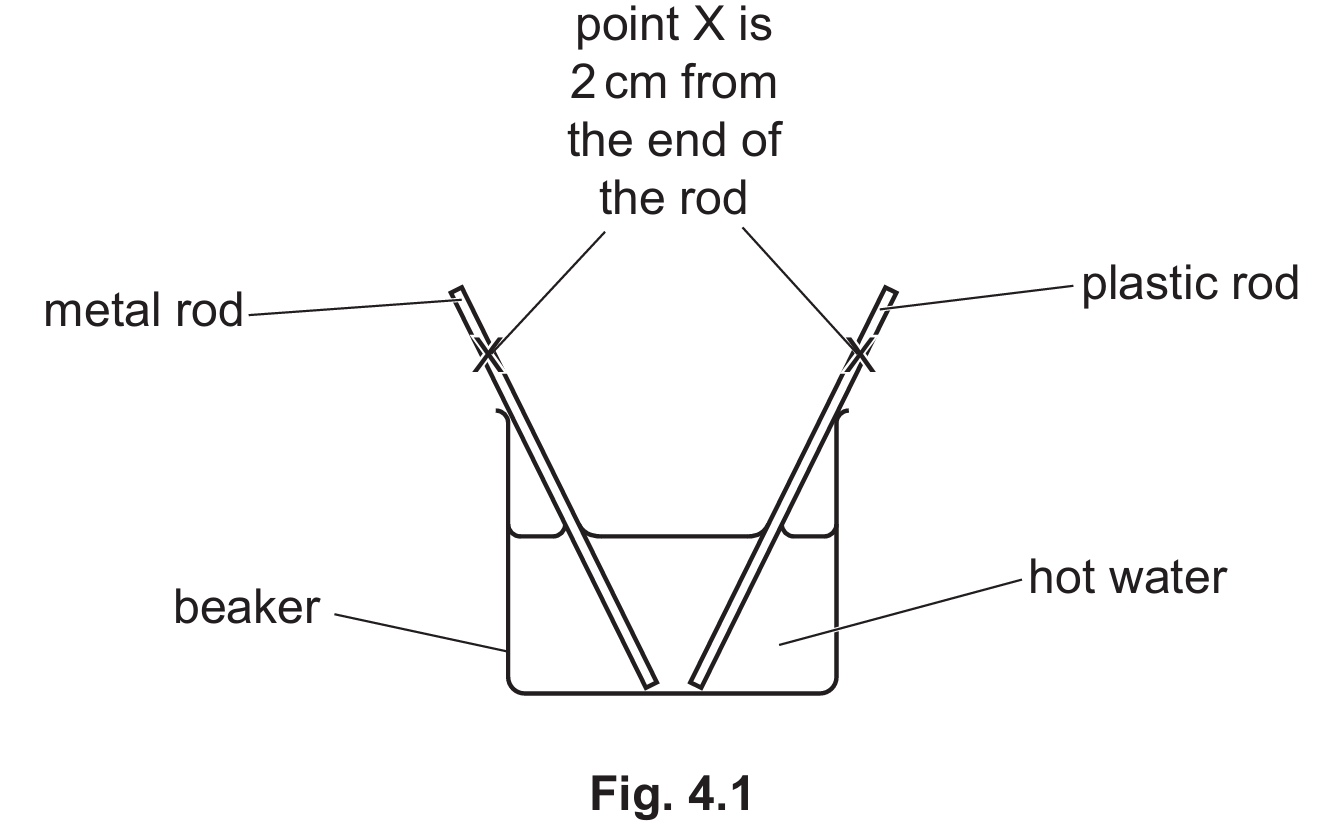
One metal rod and one plastic rod are placed in the beaker of hot water as shown in Fig. 4.1. The rods are at room temperature (20 °C) before they are placed into the beaker.

Describe how the temperature of point X on each rod changes after the rods are placed in the beaker. Explain your answer.

Most-appropriate topic codes (Cambridge IGCSE Physics 0625):

• Topic $2.2.2$ — Specific heat capacity (Part $\mathrm{(a)}$)
• Topic $2.3.1$ — Conduction (Part $\mathrm{(b)}$)

▶️ Answer/Explanation

(a)
For the correct answer:
$24000\text{ J}$ or $2.4 \times 10^4\text{ J}$

To find the energy supplied to the water, we use the specific heat capacity formula: $\Delta E = mc\Delta\theta$. First, calculate the change in temperature ($\Delta\theta$) by subtracting the initial temperature from the final temperature: $58\text{ }^\circ\text{C} – 20\text{ }^\circ\text{C} = 38\text{ }^\circ\text{C}$. Then, substitute the given values into the equation: mass $m = 0.15\text{ kg}$, specific heat capacity $c = 4200\text{ J}/(\text{kg }^\circ\text{C})$, and $\Delta\theta = 38\text{ }^\circ\text{C}$. This gives $\Delta E = 0.15 \times 4200 \times 38 = 23940\text{ J}$. Rounding to an appropriate number of significant figures yields $24000\text{ J}$.

(b)
For the correct answer:
The temperature of point X on the metal rod increases faster than on the plastic rod.

Both rods will experience an increase in temperature at point X over time as thermal energy is transferred from the hot water by conduction. However, the metal rod is a good thermal conductor, while the plastic rod is a thermal insulator. In the metal rod, thermal energy is transferred rapidly due to the movement of free (delocalised) electrons. The plastic rod lacks these free electrons and relies on slower lattice vibrations to transfer thermal energy, resulting in a slower temperature rise at point X.

Question 5

A dolphin communicates with other dolphins underwater by emitting sounds in the range 7–15 kHz.
(a) State the value of the speed of sound in air and state how the speed of sound in water differs from the speed of sound in air.
(b) State and explain if humans with normal hearing can hear all the sounds emitted by the dolphin.

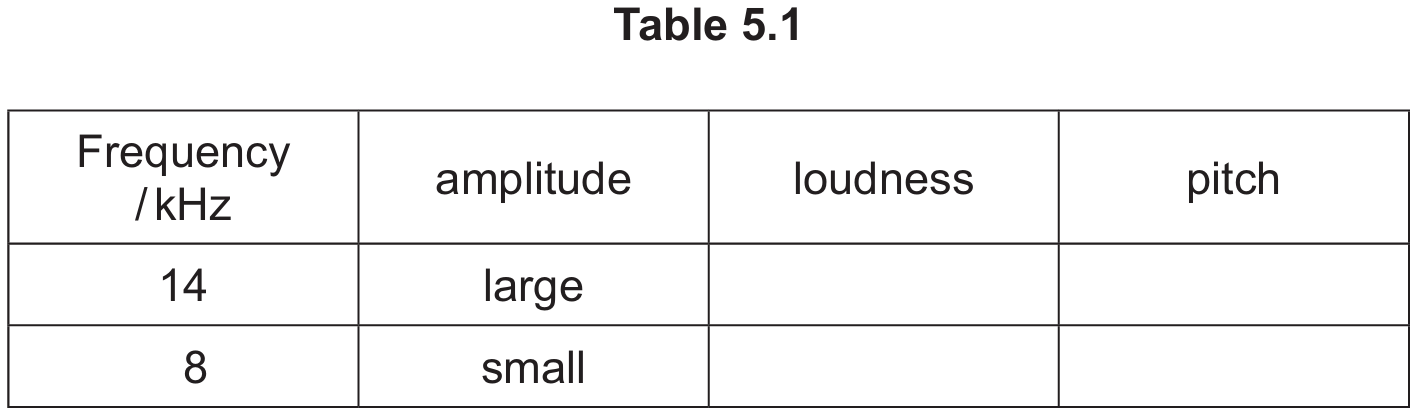
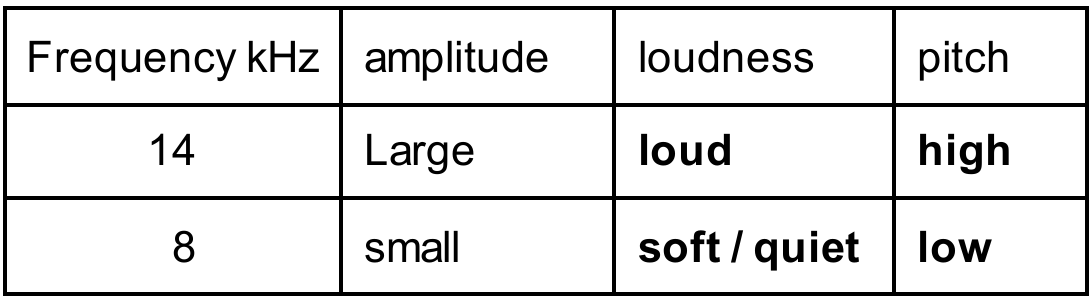
(c) Complete Table 5.1 to describe differences in loudness and pitch of two different dolphin sounds.

(d) Complete the sentences to describe how sound is transmitted through water.

Sound waves are made of vibrating ……………………………………………….. which produce compressions and rarefactions. A compression is a region of ……………………………………………….. and a rarefaction is a region of ……………………………………………….. . The sound waves travel ……………………………………………….. to the direction of the vibrations.

Most-appropriate topic codes (Cambridge IGCSE Physics 0625):

• Topic $3.4$ — Sound (Parts $\mathrm{(a)}$, $\mathrm{(b)}$, $\mathrm{(c)}$)
• Topic $3.1$ — General properties of waves (Part $\mathrm{(d)}$)

▶️ Answer/Explanation

(a)
For the correct answer:
$330\text{–}350\text{ m/s}$. Speed in water is faster than in air.

The speed of sound in air is approximately $330\text{–}350\text{ m/s}$. Sound is a mechanical wave; because particles in liquids are more densely packed than in gases, the speed of sound is significantly higher in water.

(b)
For the correct answer:
Yes, humans can hear them. Range ($20\text{ Hz}$ to $20\text{ kHz}$) includes $7\text{–}15\text{ kHz}$.

The human hearing range is $20\text{ Hz}$ to $20000\text{ Hz}$. Since the dolphin sounds ($7000\text{ Hz}$ to $15000\text{ Hz}$) fall within this window, they are audible.

(c)
For the correct table values:
Loud/High Pitch and Quiet/Low Pitch

Amplitude determines loudness (larger amplitude = louder). Frequency determines pitch (higher frequency = higher pitch).

(d)
For the correct sequence:
particles, high pressure, low pressure, parallel.

Sound waves are longitudinal. They consist of particles vibrating parallel to the wave direction, creating high-pressure compressions and low-pressure rarefactions.

Question 6

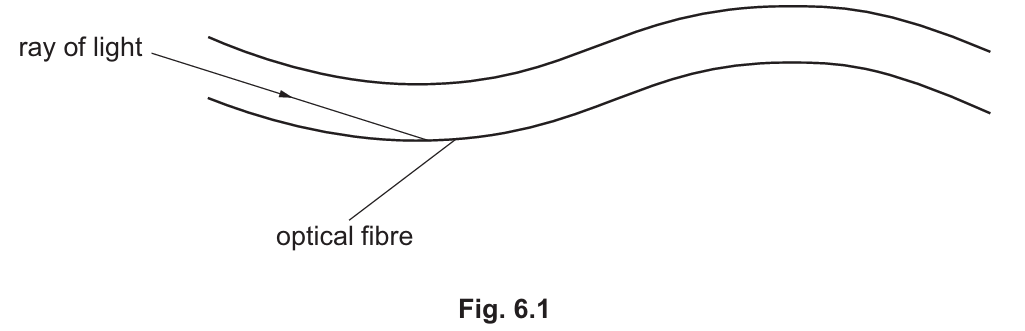
Fig. 6.1 shows part of an optical fibre used in high-speed broadband communication.
(a) State two advantages of using optical fibres in high-speed data transmission compared to electrical signals sent on copper wires.
(b) (i) The optical fibre is made of glass with a refractive index of 1.4. Calculate the critical angle $c$.
(ii) State the meaning of critical angle.
(iii) On Fig. 6.1, label the angle of incidence of the ray of light as it hits the wall of the glass fibre. Draw the continuation of the ray until it leaves the glass fibre.

Most-appropriate topic codes (Cambridge IGCSE Physics 0625):

• Topic $3.3$ — Electromagnetic spectrum (Part $\mathrm{(a)}$)
• Topic $3.2.2$ — Refraction of light (Parts $\mathrm{(b)(i)}$, $\mathrm{(b)(ii)}$, $\mathrm{(b)(iii)}$)

▶️ Answer/Explanation

Part (a)
Correct Answer: Faster data transmission (higher rates) and less data/signal loss.

Optical fibres utilize visible light or infrared radiation for transmission. These electromagnetic waves have much higher frequencies compared to electrical signals in copper wires, allowing them to carry significantly larger amounts of data at faster rates. Furthermore, optical fibres suffer from very little signal loss (attenuation) over long distances.

Part (b)(i)
Correct Answer: $46^\circ$

The critical angle $c$ is related to the refractive index $n$ by $n = \frac{1}{\sin c}$. Rearranging gives $\sin c = \frac{1}{n}$. Substituting $n = 1.4$:
$\sin c = \frac{1}{1.4} \approx 0.714$
$c = \sin^{-1}(0.714) \approx 45.6^\circ \approx 46^\circ$.

Part (b)(ii)
Correct Answer: The angle of incidence at which the angle of refraction is exactly $90^\circ$.

The critical angle is defined as the specific angle of incidence that results in an angle of refraction of exactly $90^\circ$ (the light travels along the boundary). If the angle of incidence exceeds this value, total internal reflection occurs.

Part (b)(iii)
Correct Answer: Angle of incidence marked between the normal and the incident ray; ray shown reflecting off the internal walls.

To label the angle, draw a normal perpendicular to the boundary at the point of incidence. The angle between the ray and this normal is the angle of incidence. The ray should then be drawn reflecting back into the glass (total internal reflection) because the angle of incidence is greater than the critical angle.

Question 7

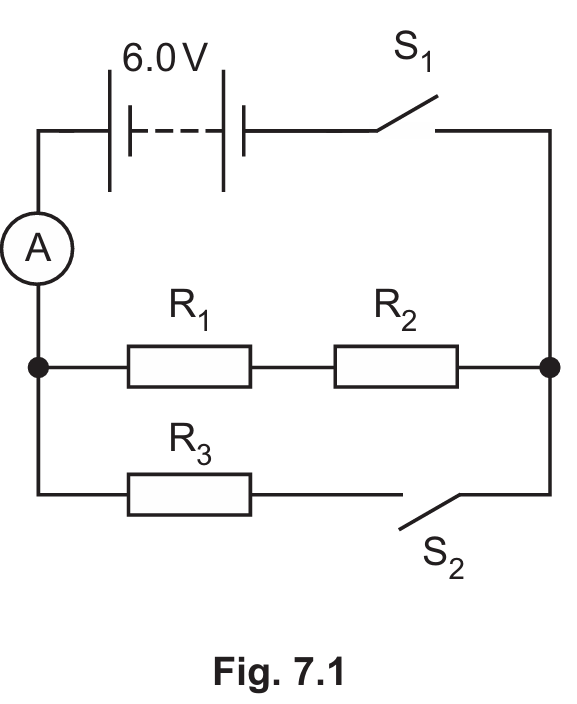
Fig. 7.1 shows a circuit containing a 6.0 V battery of cells and three identical resistors.
(a) $S_1$ is closed and $S_2$ is open. The current in the ammeter is 0.080 A. Calculate the resistance of $R_1$.
(b) $S_1$ and $S_2$ are both closed.
(i) Determine the reading on the ammeter. Show your working.
(ii) Explain in terms of work done and potential difference why there is a larger heating effect in $R_3$ than in $R_1$.

Most-appropriate topic codes (Cambridge IGCSE Physics 0625):

• Topic $4.2.4$ — Resistance (Part $\mathrm{(a)}$)
• Topic $4.3 .2$ — Series and parallel circuits (Part $\mathrm{(b)(i)}$)
• Topic $4.2 .3$ — Electromotive force and potential difference (Part $\mathrm{(b)(ii)}$)

▶️ Answer/Explanation

(a)
For the correct answer:
$38\ \Omega$ (or $37.5\ \Omega$)

When $S_1$ is closed and $S_2$ is open, the current only flows through the top branch containing $R_1$ and $R_2$ in series. Since the two resistors are identical, the total potential difference of $6.0\text{ V}$ is shared equally, meaning the potential difference across $R_1$ is $3.0\text{ V}$. Using the formula $R = \frac{V}{I}$, the resistance of $R_1$ is calculated as $\frac{3.0\text{ V}}{0.080\text{ A}} = 37.5\ \Omega$.

(b)(i)
For the correct answer:
$0.24\text{ A}$

When both switches are closed, $R_3$ is connected in parallel with the top branch. The potential difference across the lower branch ($R_3$) is the full $6.0\text{ V}$. Since $R_3$ is identical to $R_1$, its resistance is $37.5\ \Omega$. The current through the lower branch is $I = \frac{V}{R} = \frac{6.0\text{ V}}{37.5\ \Omega} = 0.16\text{ A}$. The total ammeter reading is the sum of the currents in both parallel branches: $0.080\text{ A} + 0.16\text{ A} = 0.24\text{ A}$.

(b)(ii)
For the correct answer:
The potential difference across $R_3$ is larger than the potential difference across $R_1$, so more work is done passing charge through $R_3$.

In this parallel circuit, the potential difference across $R_3$ is the full $6.0\text{ V}$. Conversely, the potential difference across $R_1$ is only $3.0\text{ V}$ because it shares the total voltage with $R_2$. Potential difference is defined as the work done per unit charge ($V = \frac{W}{Q}$). Since $R_3$ has a larger potential difference, more work is done by the charges passing through it, transferring more energy and resulting in a larger heating effect.

Question 8

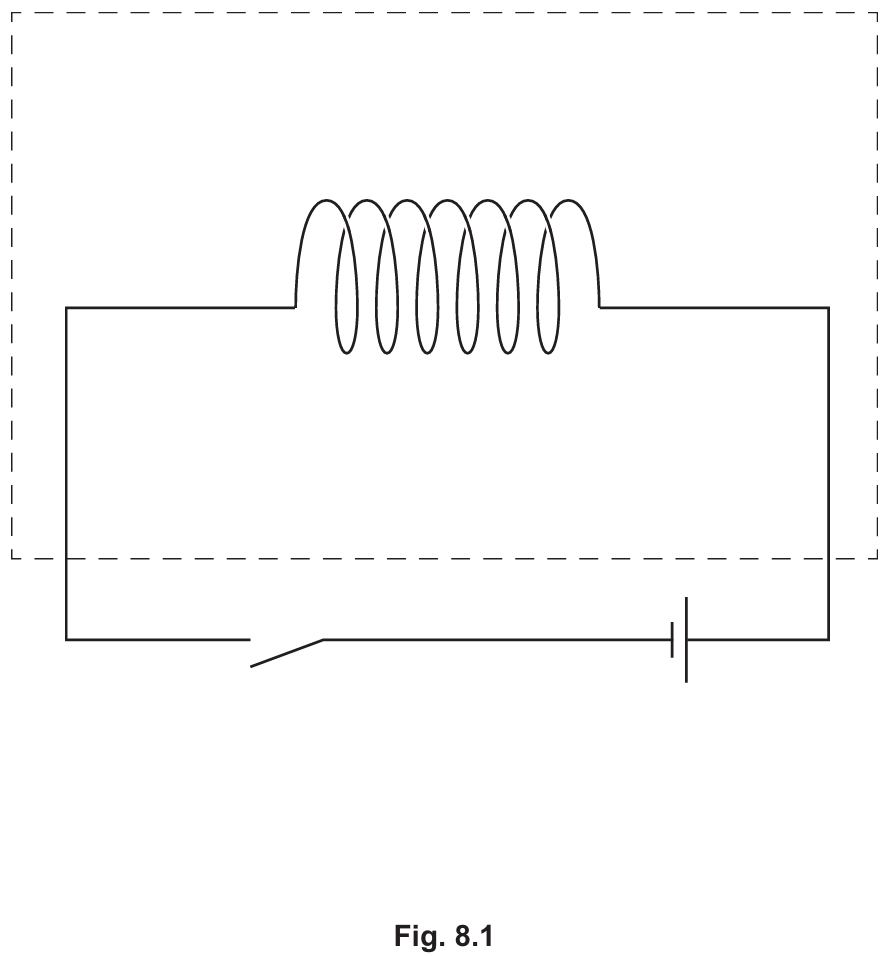
Fig. 8.1 shows a solenoid.
(a) (i) Draw on Fig. 8.1 four complete magnetic field lines that show the pattern and direction of the magnetic field inside and outside the solenoid.
(ii) Mark a point inside the box in Fig. 8.1 where the magnetic field is strong. Label this point B.

Explain how the diagram shows that the magnetic field is strong at B.

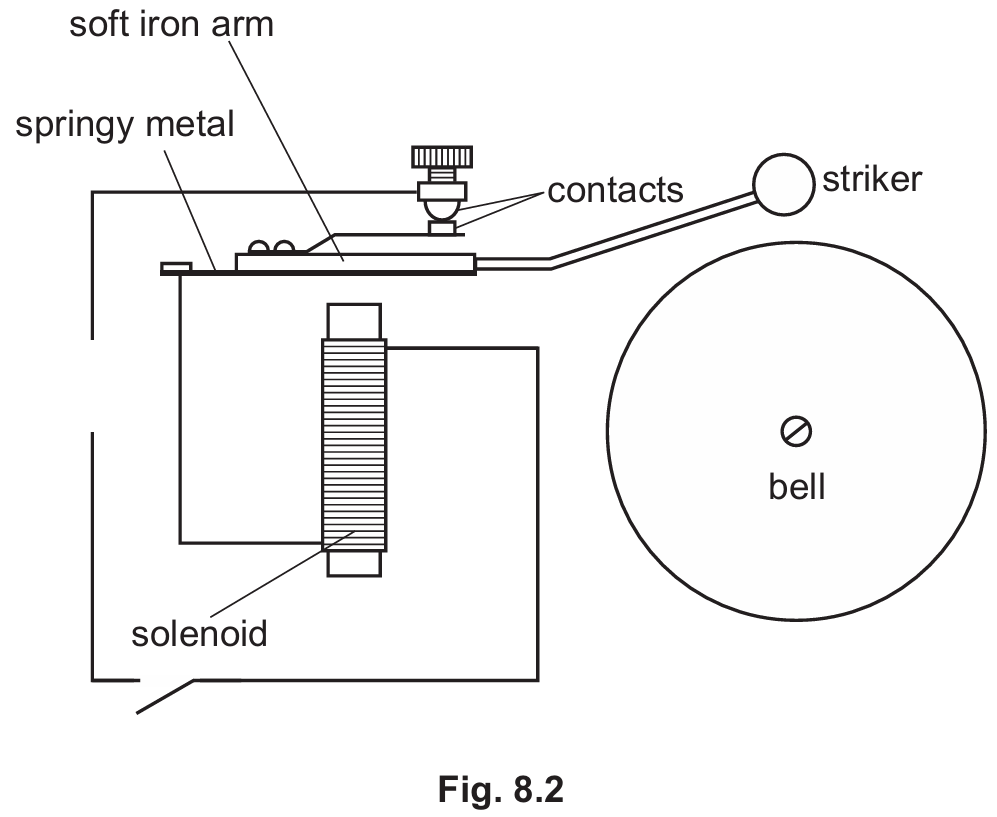
(b) Fig. 8.2 shows a solenoid in an electric circuit for a bell.

(i) Complete the circuit in Fig. 8.2 with the symbol for a direct current (d.c.) power supply.
(ii) Explain why the soft iron arm pivots, making the striker hit the bell when the switch is closed.
(iii) Explain why the arm pivots back to its original position after the striker hits the bell.

Most-appropriate topic codes (Cambridge IGCSE Physics 0625):

• Topic $4.5.3$ — Magnetic effect of a current (Part $\mathrm{(a)(i)}$)
• Topic $4.1$ — Simple phenomena of magnetism (Parts $\mathrm{(a)(ii)}$, $\mathrm{(b)(ii)}$, $\mathrm{(b)(iii)}$)
• Topic $4.3 .1$ — Circuit diagrams and circuit components (Part $\mathrm{(b)(i)}$)

▶️ Answer/Explanation

Part (a)(i)
Correct Answer: Four parallel lines inside the solenoid, curving symmetrically outside without crossing. Arrows point away from the left end and towards the right end.

Detailed solution: Inside the solenoid, the magnetic field is uniform, represented by evenly spaced, parallel lines. Outside, the field lines curve from the North pole to the South pole. Since the conventional current flows from the positive terminal and up the front of the coils, the right-hand grip rule dictates that the left end acts as the North pole. Therefore, arrows on the external lines must point away from the left and towards the right.

Part (a)(ii)
Correct Answer: Point B marked inside the solenoid or near the poles. Explanation: The magnetic field lines are closest together at these locations.

Detailed solution: The strength of a magnetic field is visually represented by the density of its field lines. Where the field lines are drawn closest together, the magnetic field is at its strongest. In a solenoid, this occurs uniformly inside the core and immediately at the polar ends.

Part (b)(i)
Correct Answer:

Detailed solution: The standard symbol for a d.c. power supply consists of two terminals (or the long and short line for a cell/battery). Connecting this provides the necessary potential difference to drive the current through the solenoid.

Part (b)(ii)
Correct Answer: The solenoid becomes an electromagnet and attracts the soft iron arm.

Detailed solution: When the switch is closed, current flows through the solenoid, turning it into an electromagnet. The resulting magnetic field attracts the soft iron arm, pulling it toward the core and causing the striker to hit the bell.

Part (b)(iii)
Correct Answer: The contacts break, stopping the current; the electromagnet loses its magnetism, and the springy metal pulls the arm back.

Detailed solution: When the arm moves, the circuit is broken at the contact point. The current stops, the electromagnet loses its magnetism, and the springy metal strip returns the arm to its original position.

Question 9

(a) Describe the structure of an atom of helium-$4$, $^4_2\text{He}$.
(b) The Sun is a medium-sized star powered by nuclear fusion reactions which release energy.
    (i) State what happens during nuclear fusion reactions which form helium.
    (ii) State two regions of the electromagnetic spectrum by which the Sun radiates most of its energy.
(c) Describe what happens to a star when most of the fuel in its centre has been converted to helium.

Most-appropriate topic codes (Cambridge IGCSE Physics 0625):

• Topic $5.1.1$ — The atom (Part $\mathrm{(a)}$)
• Topic $6.2.1$ — The Sun as a star (Parts $\mathrm{(b)(i)}$, $\mathrm{(b)(ii)}$)
• Topic $6.2.2$ — Stars (Part $\mathrm{(c)}$)

▶️ Answer/Explanation

(a)
A central nucleus containing $2$ protons and $2$ neutrons, with $2$ electrons orbiting outside the nucleus. Protons are positively charged and electrons are negatively charged.

The nuclide notation $^4_2\text{He}$ indicates a nucleon number (mass number) of $4$ and a proton number (atomic number) of $2$. This means the central nucleus consists of $2$ positively charged protons and $4 – 2 = 2$ neutral neutrons. Orbiting this nucleus are $2$ negatively charged electrons, balancing the positive charge of the protons to make the atom electrically neutral overall.

(b)(i)
Hydrogen nuclei join together.

In the extreme high-temperature and high-pressure environment of the Sun’s core, stable nuclear fusion occurs. During this process, lighter hydrogen nuclei collide with enough kinetic energy to overcome electrostatic repulsion and join together to form a heavier helium nucleus. This joining of nuclei is accompanied by a massive release of energy.

(b)(ii)
Infrared, visible, and ultraviolet (any two).

The Sun emits a wide range of electromagnetic radiation due to its extremely hot surface temperature. However, the vast majority of this emitted energy falls into three specific regions of the electromagnetic spectrum: the infrared region, the visible light region, and the ultraviolet region.

(c)
The star expands and forms a red giant (if it is a less massive star) or a red supergiant (if it is a more massive star).

When a star eventually runs out of primary hydrogen fuel in its core, the inward gravitational forces briefly overcome the outward thermal pressure, causing the core to compress. This compression heats up the surrounding shell, leading to the rapid expansion of the star’s outer layers. Depending on its initial mass, the star will swell to become either a red giant or a red supergiant.

Question 10

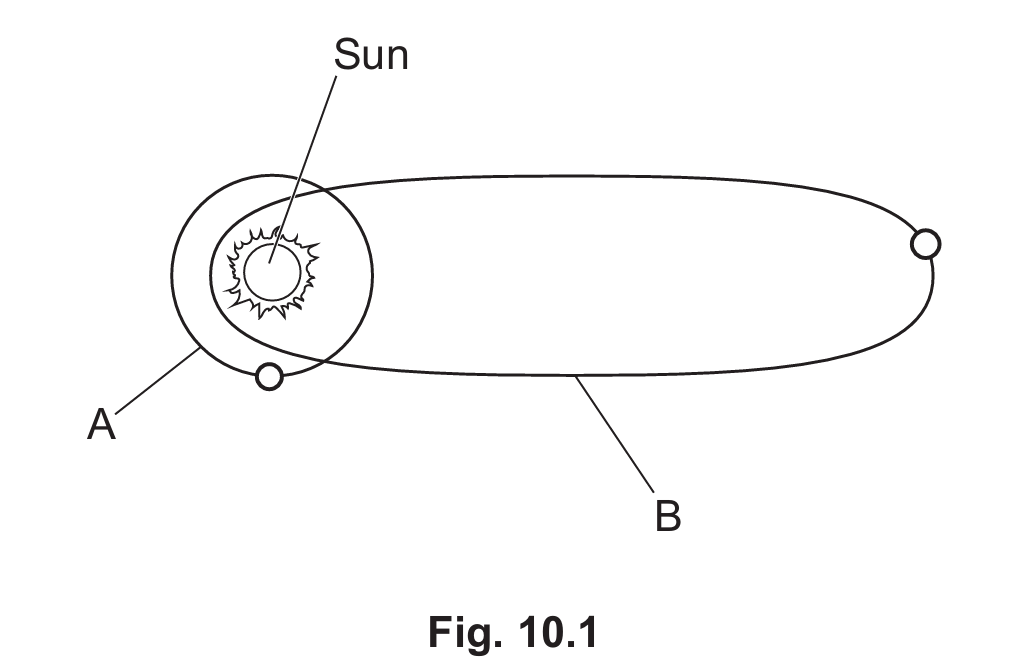
Fig. 10.1 shows the orbit of the Earth and the orbit of a comet around the Sun.
(a) State which orbit, A or B, is the orbit of the comet. Explain your answer.
(b) Describe and explain how the motion of the comet changes as it orbits the Sun.
(c) At one position in its orbit, the comet is $6.6 \times 10^{-6}$ light-years away from the Earth.
(i) State the meaning of light-year.
(ii) Determine the distance in metres between the comet and the Earth.

Most-appropriate topic codes (Cambridge IGCSE Physics 0625):

• Topic $6.1.2$ — The Solar System (Parts $\mathrm{(a)}$, $\mathrm{(b)}$)
• Topic $6.2.2$ — Stars (Part $\mathrm{(c)}$)

▶️ Answer/Explanation

(a)
For the correct answer:
Orbit B

Orbit B represents the comet because it is highly elliptical (oval-shaped), whereas planetary orbits like Earth’s (Orbit A) are nearly circular. In an elliptical orbit, the Sun is located at one focus rather than the geometric centre.

(b)
For the correct answer:
The comet speeds up as it approaches the Sun and slows down as it moves away.

As the comet moves closer to the Sun, its gravitational potential energy ($GPE$) decreases. According to the principle of conservation of energy, this loss in $GPE$ is converted into kinetic energy ($KE$). Therefore, the comet’s velocity $v$ increases, reaching its maximum speed at the point of closest approach.

(c)(i)
For the correct answer:
The distance travelled by light in a vacuum in one year.

A light-year is a unit of astronomical distance. It is defined as the total distance that light travels through a vacuum during one Earth year ($365.25$ days).

(c)(ii)
For the correct calculated value:
$6.3 \times 10^{10}\text{ m}$

One light-year is approximately $9.5 \times 10^{15}\text{ m}$. To find the distance: $\text{Distance} = (6.6 \times 10^{-6}) \times (9.5 \times 10^{15}) = 6.27 \times 10^{10}\text{ m}$, which rounds to $6.3 \times 10^{10}\text{ m}$.

Scroll to Top