Home / 0654_m22_qp_12

Question 1

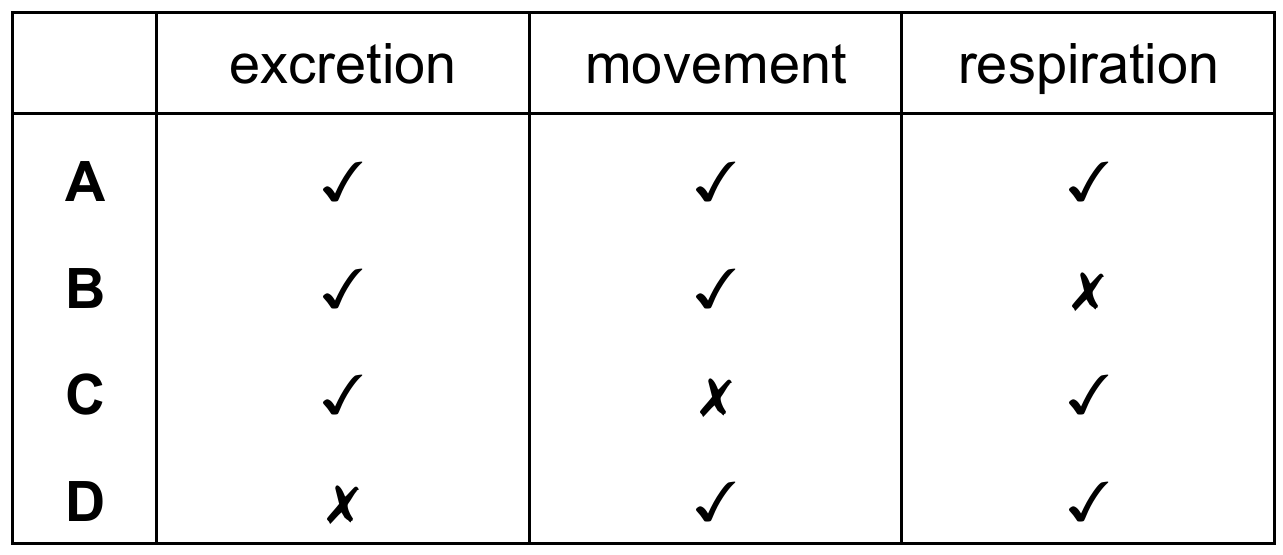
Which processes occur in both animals and plants?

Most-appropriate topic codes (Cambridge IGCSE Co-ordinated Sciences 0654):

Topic B1.1: Characteristics of living organisms — Identify excretion, movement, respiration and other life processes common to animals and plants.
▶️ Answer/Explanation
Excretion and respiration occur in both animals and plants, since all living organisms must remove metabolic waste and release energy from food.
Movement in plants is usually confined to growth responses (tropisms) rather than whole-organism locomotion, so it is not considered a shared process in the same way.
Row A is the only option in the table that correctly marks excretion and respiration as occurring in both, while movement is not ticked for plants.
Answer: (A)

Question 2

Which statements about osmosis are correct?

  1. Osmosis requires a membrane.
  2. Water can move out of cells by osmosis.
  3. Water can move into cells by osmosis.

A. 1 and 2 only
B. 1 and 3 only
C. 1, 2 and 3
D. 2 and 3 only

Most-appropriate topic codes (Cambridge IGCSE Co-ordinated Sciences 0654):

Topic B3.2: Osmosis — Describe osmosis as the diffusion of water across a partially permeable membrane.
▶️ Answer/Explanation
Osmosis is defined as the net movement of water molecules across a partially permeable membrane.
Water moves out of cells by osmosis when the external solution has a lower water potential (more concentrated), and into cells when the external solution has a higher water potential (more dilute).
All three statements — the need for a membrane, and movement of water both out of and into cells — are therefore correct.
Answer: (C)

Question 3

Which chemical element is found in all proteins, but not in all carbohydrates or fats?

A. carbon
B. hydrogen
C. oxygen
D. nitrogen

Most-appropriate topic codes (Cambridge IGCSE Co-ordinated Sciences 0654):

Topic B4.1: Biological molecules — Know the chemical elements present in carbohydrates, fats and proteins.
▶️ Answer/Explanation
Carbohydrates and fats are made only of carbon, hydrogen and oxygen.
Proteins are made of carbon, hydrogen, oxygen, and additionally nitrogen (found in the amino group of every amino acid).
Nitrogen is therefore the element present in all proteins but not present in carbohydrates or fats.
Answer: (D)

Question 4

The Pompeii worm lives in deep-sea hydrothermal vents where average temperatures are often as high as 68°C.

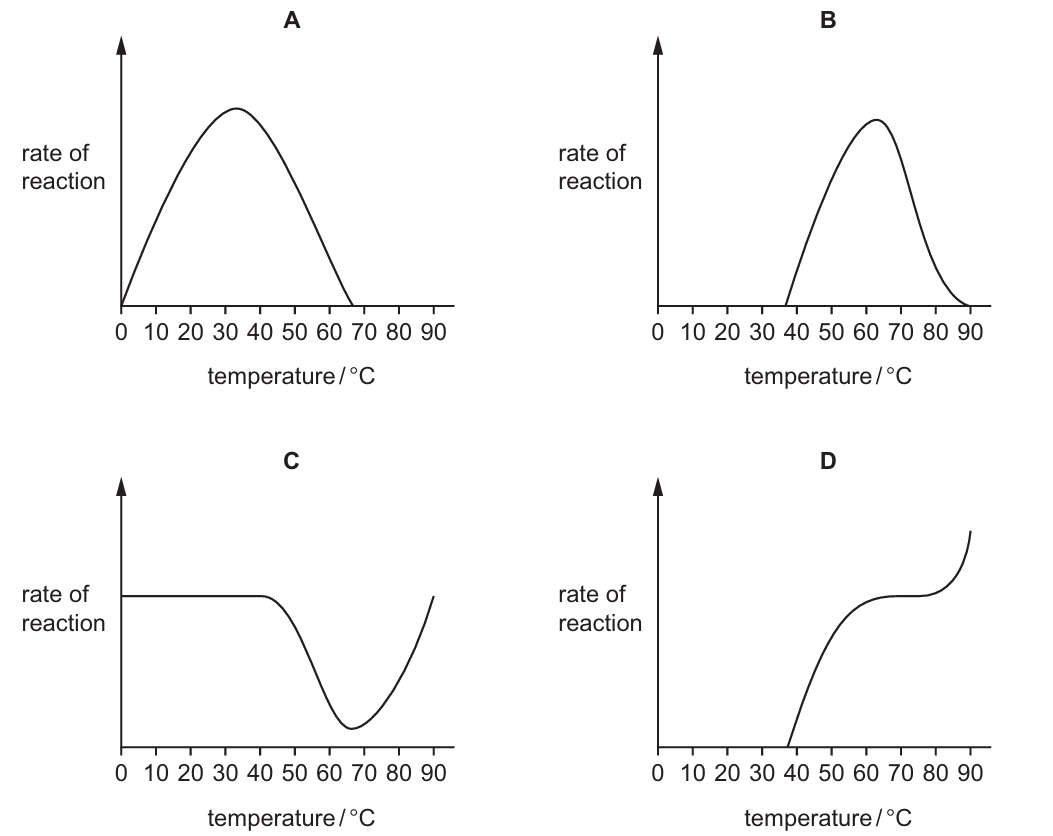
Which graph represents the activity of enzymes found in the Pompeii worm?

Most-appropriate topic codes (Cambridge IGCSE Co-ordinated Sciences 0654):

Topic B5.1: Enzymes — Describe the effect of temperature on enzyme activity, including the concept of a temperature optimum.
▶️ Answer/Explanation
Enzymes have an optimum temperature at which their rate of reaction is highest, and this optimum reflects the normal environment of the organism.
Since the Pompeii worm lives at temperatures around 68°C, its enzymes must have an unusually high optimum temperature compared with typical organisms.
Graph B shows the rate of reaction peaking at a high temperature (close to 68°C) before denaturation causes a sharp fall, matching this worm’s enzymes.
Answer: (B)

Question 5

Which ion is important for chlorophyll production in plants?

A. calcium
B. iron
C. magnesium
D. nitrate

Most-appropriate topic codes (Cambridge IGCSE Co-ordinated Sciences 0654):

Topic B6.1: Photosynthesis — Know the importance of magnesium ions and nitrate ions for healthy growth in plants.
▶️ Answer/Explanation
Chlorophyll is the green pigment in chloroplasts that absorbs light energy for photosynthesis.
Magnesium is a structural component of the chlorophyll molecule itself, so a deficiency of magnesium ions leads to yellowing of leaves (chlorosis).
Nitrate is instead needed for making amino acids and proteins, and iron/calcium are not part of the chlorophyll structure.
Answer: (C)

Question 6

What is assimilation?

A. the movement of digested food molecules into the cells of the body where they are used, becoming part of the cells
B. the movement of digested food molecules through the wall of the intestine into the blood
C. the passing out of food that has not been digested, as faeces, through the anus
D. the taking of food and drink into the body through the mouth

Most-appropriate topic codes (Cambridge IGCSE Co-ordinated Sciences 0654):

Topic B7.3: Digestion — Define assimilation as the uptake and use of nutrients by the cells of the body.
▶️ Answer/Explanation
Ingestion is taking food into the mouth, absorption is movement of digested food into the blood, and egestion is passing out undigested food as faeces.
Assimilation is the final stage, where absorbed nutrients move into body cells and are used, becoming part of those cells (e.g. amino acids built into new proteins).
Option A describes exactly this process, distinguishing it from simple absorption in option B.
Answer: (A)

Question 7

In which conditions will the rate of transpiration be greatest?

A. 10°C and high humidity
B. 10°C and low humidity
C. 30°C and high humidity
D. 30°C and low humidity

Most-appropriate topic codes (Cambridge IGCSE Co-ordinated Sciences 0654):

Topic B8.3: Transpiration — Describe the effects of temperature and humidity on the rate of transpiration.
▶️ Answer/Explanation
Higher temperatures increase the rate of evaporation of water from the leaf’s mesophyll cells and increase the kinetic energy of water vapour molecules, speeding up diffusion out of the stomata.
Low humidity means the air outside the leaf holds less water vapour, creating a steeper concentration gradient for diffusion from the leaf’s air spaces to the atmosphere.
Combining high temperature with low humidity therefore produces the greatest possible transpiration rate.
Answer: (D)

Question 8

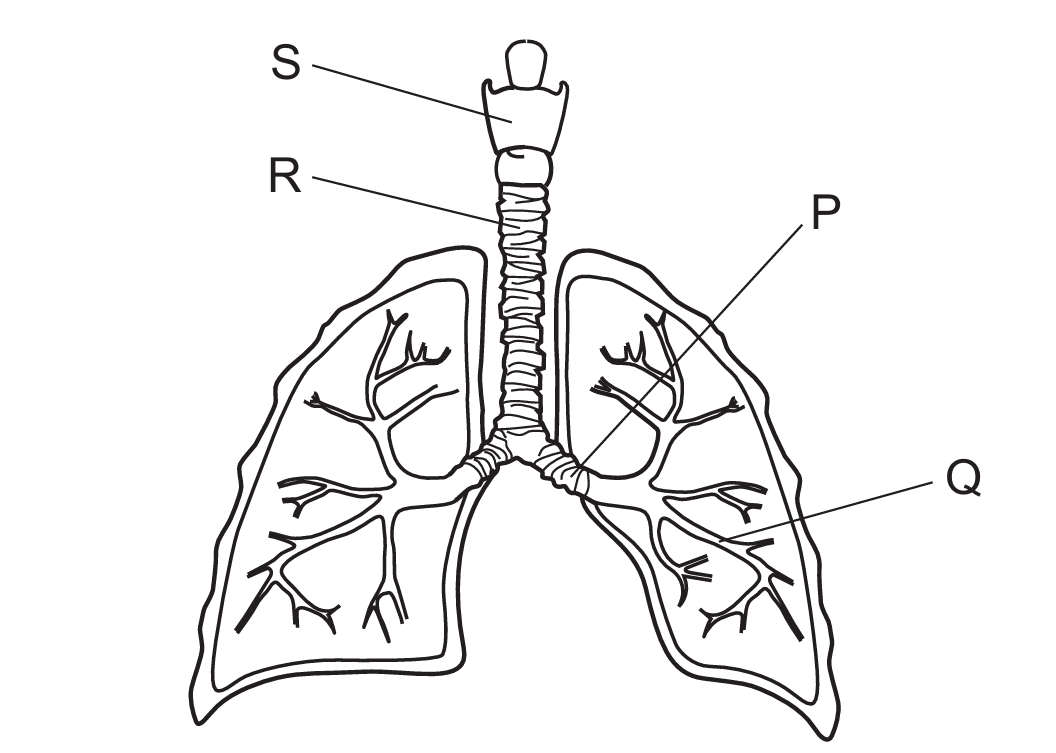
The diagram shows the main structures in the breathing system of humans, labelled P, Q, R and S.

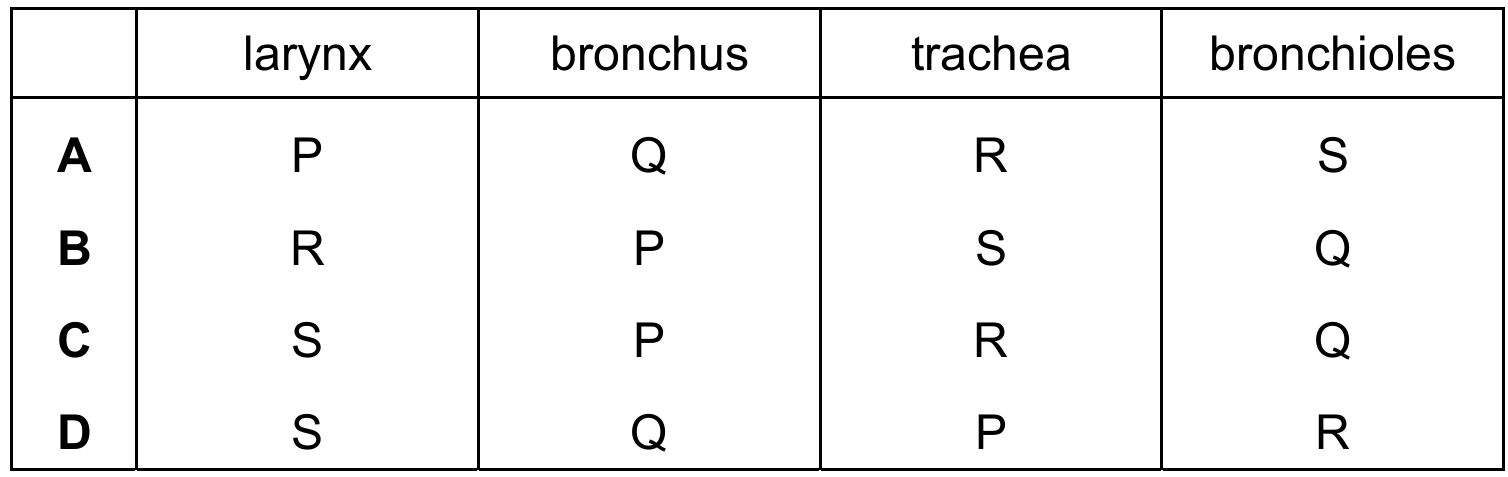
Which row identifies the larynx, bronchus, trachea and bronchioles?

Most-appropriate topic codes (Cambridge IGCSE Co-ordinated Sciences 0654):

Topic B11.1: Gas exchange in humans — Identify and label the larynx, trachea, bronchi, bronchioles and alveoli on a diagram of the breathing system.
▶️ Answer/Explanation
Air travels in order from the larynx (voice box, top of the airway) down into the trachea (windpipe), which splits into two bronchi, which further divide into narrower bronchioles.
Matching this order onto the diagram’s labelled structures S, P, R and Q gives the correct sequence: larynx = S, bronchus = P, trachea = R, bronchioles = Q.
Answer: (C)

Question 9

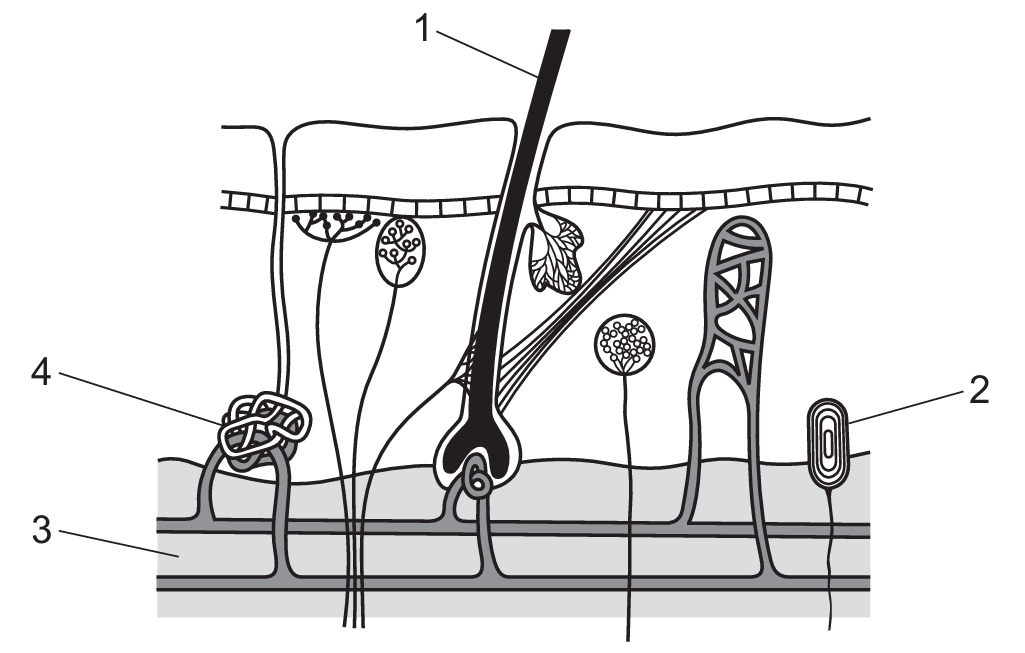
The diagram shows a section through the skin.

Which labelled structures help to maintain body temperature in the cold?

A. 1 and 3
B. 1 and 4
C. 2 and 3
D. 3 and 4

Most-appropriate topic codes (Cambridge IGCSE Co-ordinated Sciences 0654):

Topic B13.3: Homeostasis — Explain how the skin (vasoconstriction, hair erector muscles, sweat glands) helps regulate body temperature.
▶️ Answer/Explanation
In cold conditions, blood vessels near the skin surface constrict (vasoconstriction) to reduce heat loss by directing blood flow deeper into the body.
Hair erector muscles also contract, pulling hairs upright to trap an insulating layer of air near the skin surface.
The two labelled structures corresponding to a constricted blood vessel and an erected hair are the ones that help retain heat in the cold.
Answer: (A)

Question 10

During the menstrual cycle, an egg is released at ovulation.

The egg passes out of the body if it is not fertilised.

What is the correct order of structures through which the egg passes?

A. cervix → oviduct → uterus → vagina
B. oviduct → uterus → cervix → vagina
C. oviduct → vagina → cervix → uterus
D. uterus → oviduct → vagina → cervix

Most-appropriate topic codes (Cambridge IGCSE Co-ordinated Sciences 0654):

Topic B15.4: Sexual reproduction in humans — Describe the pathway of an unfertilised egg through the female reproductive system.
▶️ Answer/Explanation
An egg is released from the ovary into the oviduct (fallopian tube), where fertilisation would normally occur.
If unfertilised, it continues into the uterus, then passes through the narrow cervix, and finally leaves the body via the vagina.
This gives the order oviduct → uterus → cervix → vagina.
Answer: (B)

Question 11

Which statement is correct?

A. An allele is a version of a gene.
B. DNA is only found in gametes.
C. A gene is a length of DNA that codes for fats.
D. Cells of human males contain two X chromosomes.

Most-appropriate topic codes (Cambridge IGCSE Co-ordinated Sciences 0654):

Topic B16.1: Chromosomes and genes — Define the terms gene and allele, and know the sex chromosome combinations in humans.
▶️ Answer/Explanation
An allele is defined as an alternative version of a gene, arising from a difference in DNA base sequence at the same gene location.
DNA is present in almost all body cells (not only gametes), genes code for proteins (not fats directly), and human males have one X and one Y chromosome, not two X chromosomes.
Only the statement about alleles being versions of genes is scientifically correct.
Answer: (A)

Question 12

The diagram shows a food chain:

beech tree → insect → shrew → owl

Which statement is correct?

A. The beech tree is a consumer.
B. The insect is a producer.
C. The owl is a carnivore.
D. The shrew is a herbivore.

Most-appropriate topic codes (Cambridge IGCSE Co-ordinated Sciences 0654):

Topic B18.2: Food chains and food webs — Define producer, consumer, herbivore and carnivore, and identify them within a food chain.
▶️ Answer/Explanation
The beech tree is a producer (makes its own food by photosynthesis), and the insect is a primary consumer/herbivore, not a producer.
The shrew eats insects, making it a carnivore rather than a herbivore, and the owl eats the shrew, so the owl is also a carnivore.
Since the owl feeds on another animal (the shrew), it is correctly classified as a carnivore.
Answer: (C)

Question 13

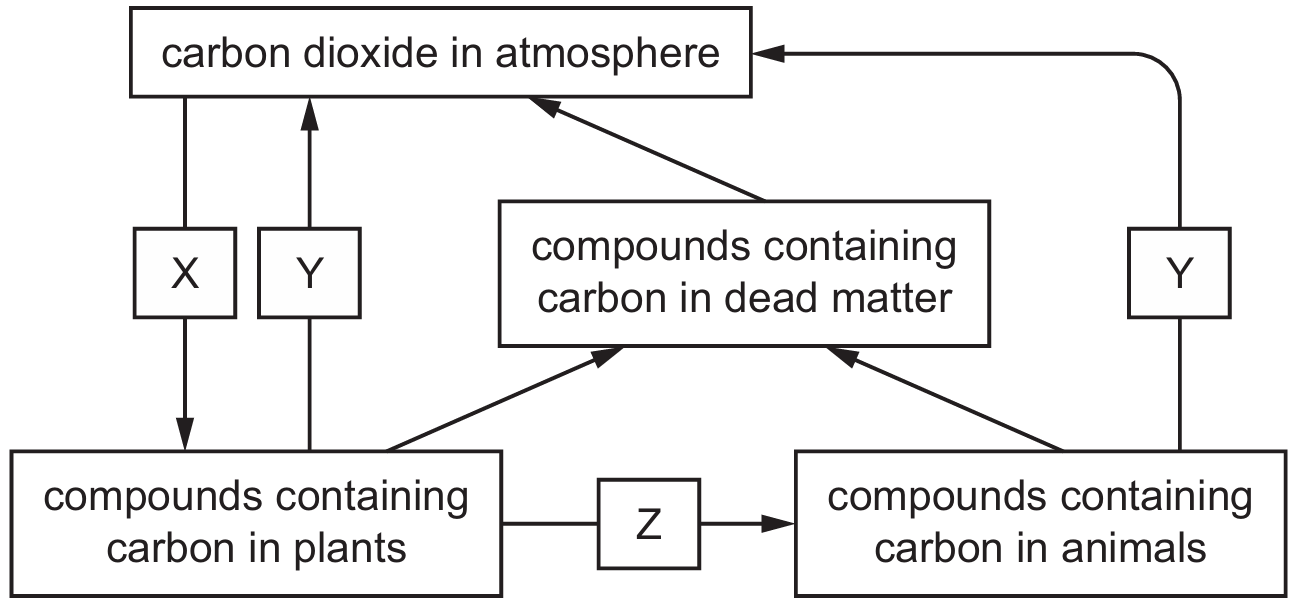
The diagram shows part of the carbon cycle.

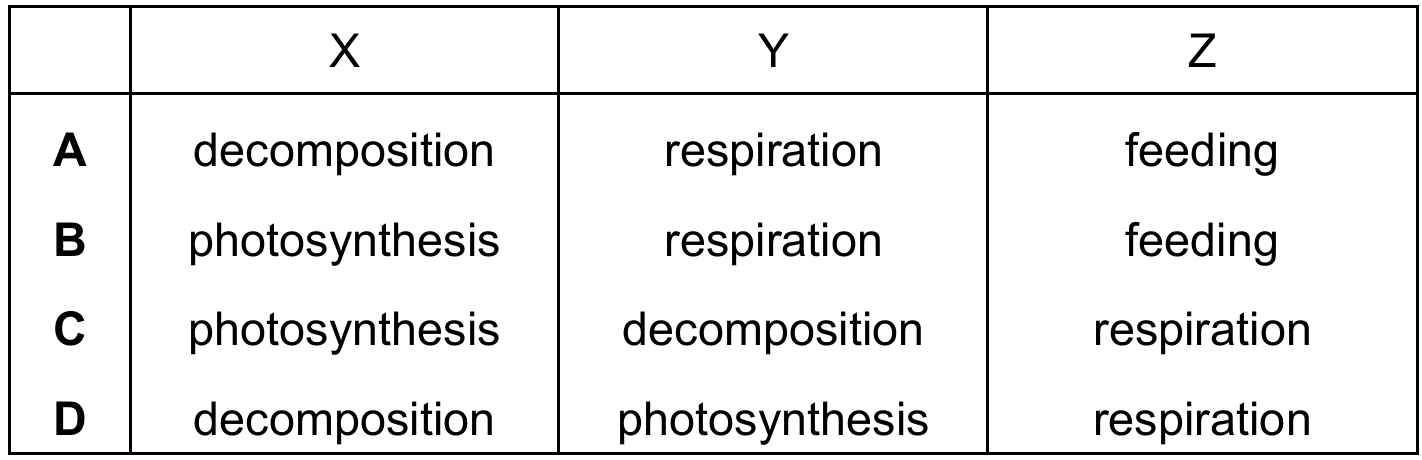
What are processes X, Y and Z?

Most-appropriate topic codes (Cambridge IGCSE Co-ordinated Sciences 0654):

Topic B18.3: Carbon cycle — Describe the roles of photosynthesis, respiration and feeding in cycling carbon between the atmosphere, plants and animals.
▶️ Answer/Explanation
Carbon dioxide from the atmosphere enters plants through photosynthesis (process X), building carbon compounds in plant tissue.
Carbon then passes from plants to animals through feeding (one of the Y arrows), while respiration in both plants and animals releases carbon dioxide back to the atmosphere (the other Y arrow).
This matches X = photosynthesis, Y = respiration, Y = feeding.
Answer: (B)

Question 14

Substance P is separated into different parts using simple physical techniques.

Substance Q is only separated into simpler parts using chemical processes.

Substance R is not separated into simpler parts by either physical or chemical processes.

Which type of substance are P, Q and R?

A. compound, mixture, element
B. element, compound, mixture
C. mixture, element, compound
D. mixture, compound, element

Most-appropriate topic codes (Cambridge IGCSE Co-ordinated Sciences 0654):

Topic C2.1: Elements, compounds and mixtures — Distinguish between elements, compounds and mixtures based on how they can be separated.
▶️ Answer/Explanation
A mixture (P) can be separated using physical methods such as filtration or distillation, since its components are not chemically bonded.
A compound (Q) can only be broken down into simpler substances by chemical reactions, as its atoms are chemically bonded together.
An element (R) cannot be broken down further by either physical or chemical means, since it consists of only one type of atom.
Answer: (D)

Question 15

Propene, \( C_3H_6 \), burns in excess oxygen to form carbon dioxide and water.

\( wC_3H_6 + xO_2 \rightarrow yCO_2 + zH_2O \)

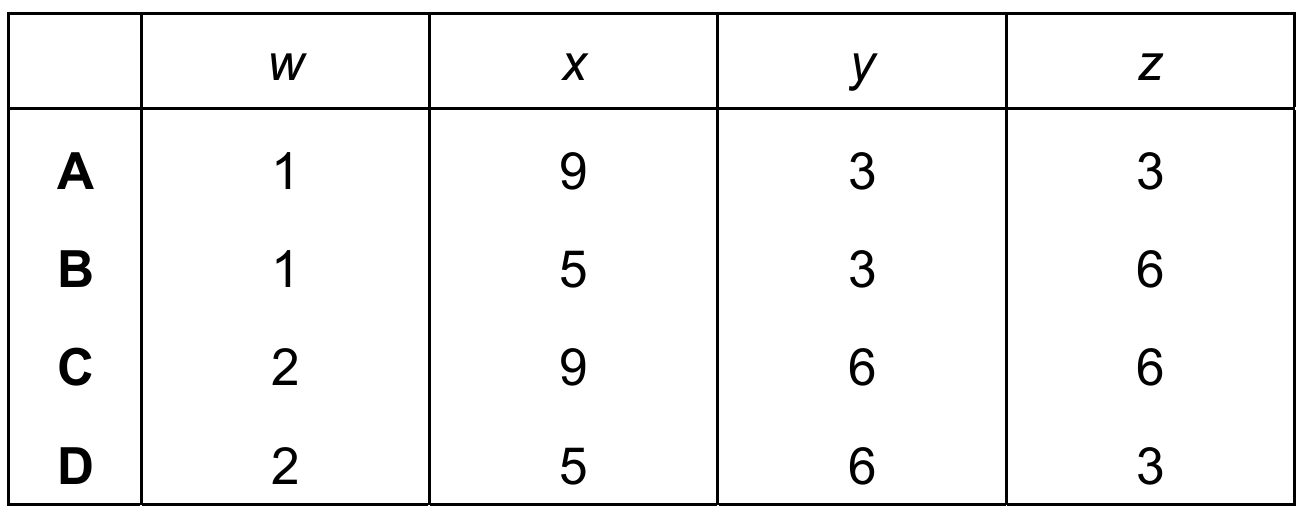
Which values of w, x, y and z balance this equation?

Most-appropriate topic codes (Cambridge IGCSE Co-ordinated Sciences 0654):

Topic C3.1: Formulas — Construct and balance chemical equations, including for combustion reactions.
▶️ Answer/Explanation
Balancing carbon first: \( C_3H_6 \) has 3 carbons, so \( y = 3 \) for \( CO_2 \); balancing hydrogen: 6 hydrogens need \( z = 3 \) for \( H_2O \) (since each \( H_2O \) has 2 H).
Balancing oxygen: the right side has \( (3\times2) + (3\times1) = 9 \) oxygen atoms, requiring \( x = 4.5 \) if \( w=1 \); doubling everything to avoid fractions gives \( w=2, x=9, y=6, z=6 \).
This gives the fully balanced equation \( 2C_3H_6 + 9O_2 \rightarrow 6CO_2 + 6H_2O \).
Answer: (C)

Question 16

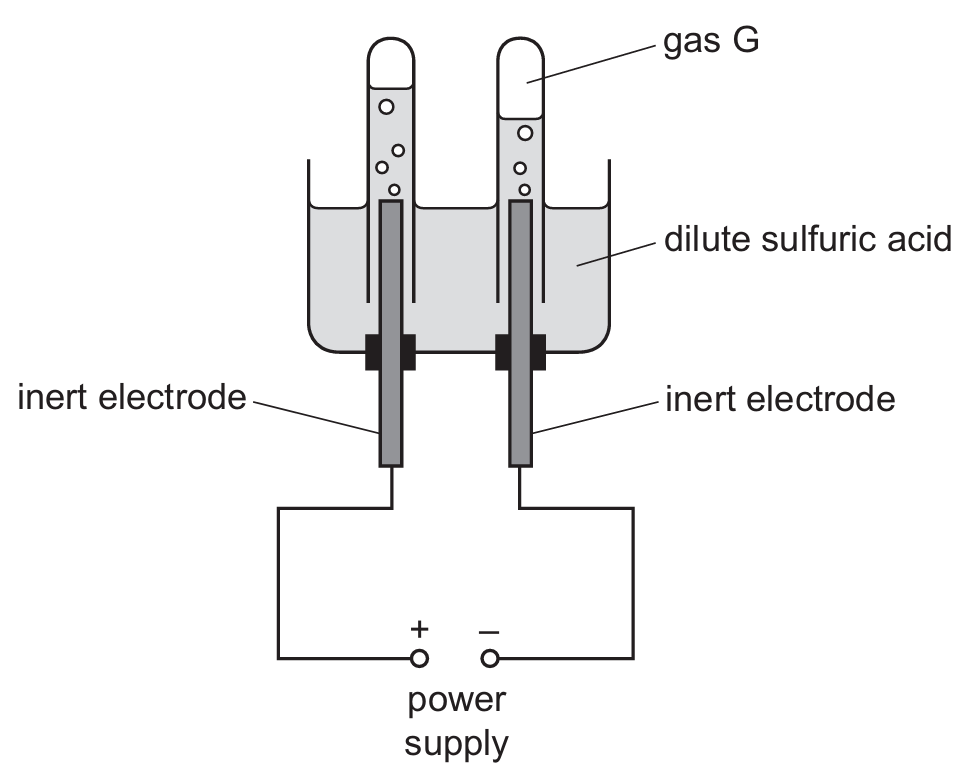
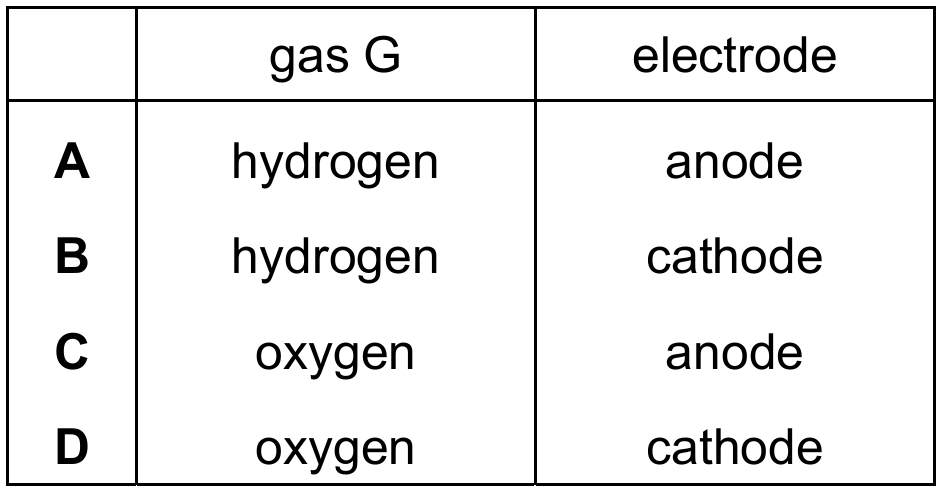
The diagram shows the electrolysis of dilute sulfuric acid using inert electrodes, producing gas G at one electrode.

Gas G ignites with a ‘pop’ when it is tested with a lighted splint.

What is gas G and at which electrode is it formed?

Most-appropriate topic codes (Cambridge IGCSE Co-ordinated Sciences 0654):

Topic C4.1: Electrolysis — Describe the electrolysis of dilute sulfuric acid using inert electrodes, and identify the products at each electrode.
▶️ Answer/Explanation
A gas that ignites with a ‘pop’ when tested with a lighted splint is the standard test result for hydrogen gas.
During electrolysis, positively charged hydrogen ions (\(H^+\)) are attracted to the negative electrode (cathode), where they gain electrons and are reduced to hydrogen gas.
Gas G is therefore hydrogen, formed at the cathode.
Answer: (B)

Question 17

Ammonium nitrate is dissolved in a beaker of water.

The temperature of the water decreases by 5°C.

Which type of reaction occurs?

A. endothermic
B. exothermic
C. oxidation
D. reduction

Most-appropriate topic codes (Cambridge IGCSE Co-ordinated Sciences 0654):

Topic C5.1: Exothermic and endothermic reactions — Identify endothermic reactions as those that take in thermal energy from the surroundings, decreasing temperature.
▶️ Answer/Explanation
A decrease in temperature during a process shows that thermal energy has been taken in from the surroundings rather than released.
Reactions or processes that absorb thermal energy from the surroundings, lowering the temperature, are classified as endothermic.
Since dissolving ammonium nitrate here causes the water to cool, this is an endothermic process, not exothermic, oxidation or reduction.
Answer: (A)

Question 18

Which reaction is not a redox reaction?

A. iron oxide + carbon → iron + carbon dioxide
B. silver nitrate + sodium chloride → silver chloride + sodium nitrate
C. copper oxide + hydrogen → copper + water
D. magnesium + oxygen → magnesium oxide

Most-appropriate topic codes (Cambridge IGCSE Co-ordinated Sciences 0654):

Topic C6.3: Redox — Identify reduction and oxidation occurring simultaneously in a redox reaction, in terms of oxygen/electron transfer.
▶️ Answer/Explanation
Options A, C and D all involve a substance gaining or losing oxygen (reduction and oxidation happening together), so they are redox reactions.
The reaction between silver nitrate and sodium chloride is a precipitation (double decomposition) reaction, where ions simply swap partners to form insoluble silver chloride, with no change in oxidation state.
No oxygen transfer or electron transfer occurs in this reaction, so it is not a redox reaction.
Answer: (B)

Question 19

Which test and its result identifies aqueous bromide ions?

A. adding acidified aqueous silver nitrate forming a cream precipitate
B. adding acidified aqueous silver nitrate forming a white precipitate
C. adding aluminium foil and heating with sodium hydroxide forming a gas that turns red litmus paper blue
D. adding dilute acid forming a gas that produces a white precipitate when bubbled through limewater

Most-appropriate topic codes (Cambridge IGCSE Co-ordinated Sciences 0654):

Topic C12.5: Identification of ions and gases — Describe the test for halide ions using acidified silver nitrate solution.
▶️ Answer/Explanation
Adding acidified silver nitrate solution to a halide solution produces a precipitate whose colour identifies the specific halide present.
Chloride ions give a white precipitate, bromide ions give a cream precipitate, and iodide ions give a yellow precipitate.
Option C describes the test for ammonium ions, and option D describes the test for a carbonate, so the correct test and result for bromide is option A.
Answer: (A)

Question 20

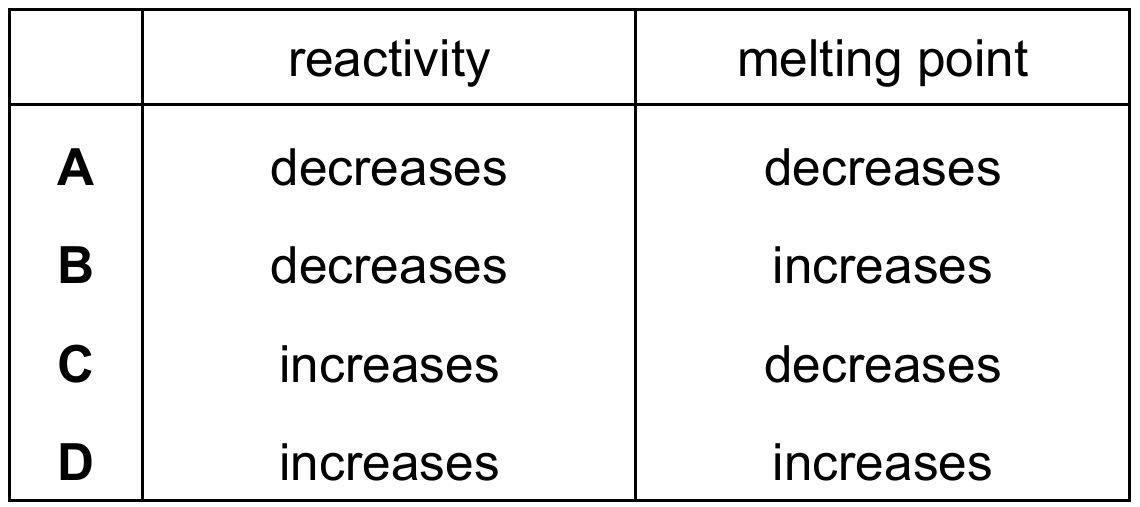
Which row about the trends in the elements going down Group I of the Periodic Table is correct?

Most-appropriate topic codes (Cambridge IGCSE Co-ordinated Sciences 0654):

Topic C8.2: Group I properties — Describe the trends in reactivity and melting point of the alkali metals down Group I.
▶️ Answer/Explanation
Going down Group I, the outer electron becomes further from the nucleus and more shielded, so it is lost more easily, making the elements more reactive.
At the same time, the metallic bonding becomes weaker as the atoms get larger, so less energy is needed to melt the metal, and melting point decreases down the group.
This gives increasing reactivity and decreasing melting point.
Answer: (C)

Question 21

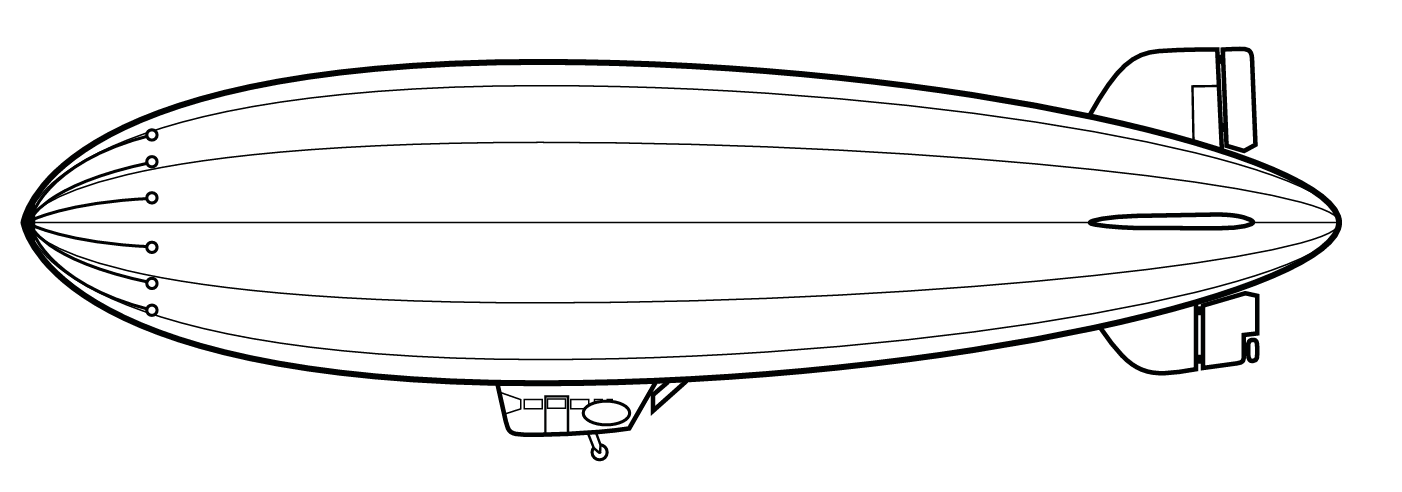
An airship containing an unreactive gas floats in air, as shown.

Which gas is used to fill the airship?

A. carbon dioxide
B. helium
C. hydrogen
D. nitrogen

Most-appropriate topic codes (Cambridge IGCSE Co-ordinated Sciences 0654):

Topic C8.5: Noble gases — Know the uses of noble gases, including helium in airships, based on their unreactivity and low density.
▶️ Answer/Explanation
Helium is a noble gas, meaning it is chemically unreactive (inert) due to its full outer electron shell.
It is also much less dense than air, allowing airships filled with it to float, and unlike hydrogen it is non-flammable, making it much safer to use.
Carbon dioxide and nitrogen are both denser than helium and would not provide the same lift.
Answer: (B)

Question 22

Duralumin and magnalium are alloys used in the manufacture of aircraft.

They both contain aluminium and another metallic element.

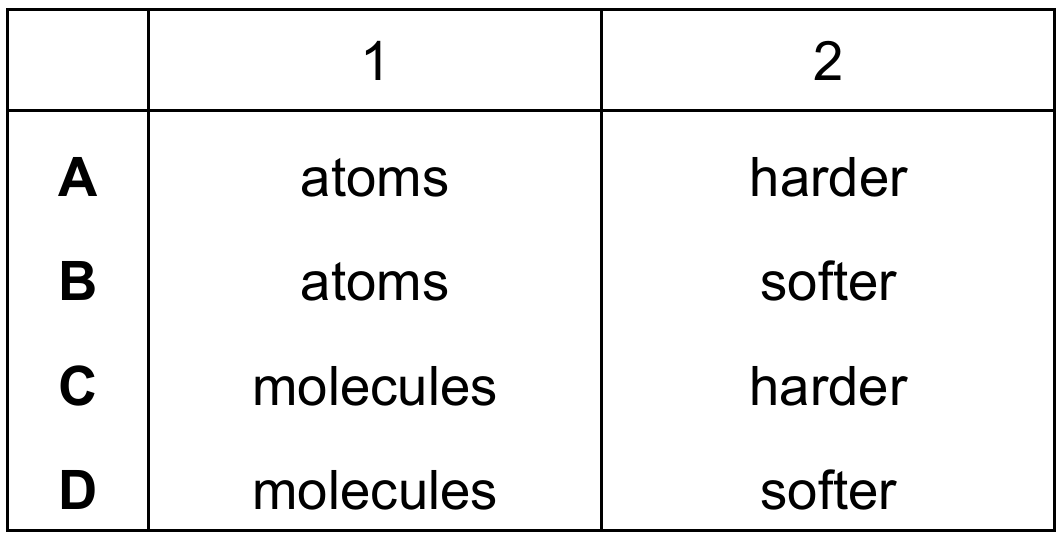
The alloys are made up of ……1…… of each element.

They are used because they are ……2…… than the pure metals.

Which words complete gaps 1 and 2?

Most-appropriate topic codes (Cambridge IGCSE Co-ordinated Sciences 0654):

Topic C9.3: Alloys and their properties — Explain why alloys, made of atoms of different elements, are harder than the pure metal.
▶️ Answer/Explanation
Metals and alloys are giant structures of atoms, not molecules, so alloys are correctly described as being made up of atoms of each element.
In a pure metal, atoms are all the same size and can slide over one another easily, but alloying introduces atoms of a different size that disrupt this regular arrangement.
This disruption prevents layers of atoms from sliding smoothly, making the alloy harder than the pure metal.
Answer: (A)

Question 23

Which metal is extracted from its ore by heating with carbon?

A. copper
B. magnesium
C. potassium
D. sodium

Most-appropriate topic codes (Cambridge IGCSE Co-ordinated Sciences 0654):

Topic C9.6: Extraction of metals — Relate the method of extraction of a metal to its position in the reactivity series.
▶️ Answer/Explanation
Metals less reactive than carbon can be extracted from their ores by heating (reduction) with carbon, since carbon can displace them from their oxides.
Copper is below carbon in the reactivity series, so it can be extracted this way, whereas magnesium, sodium and potassium are all more reactive than carbon.
Metals more reactive than carbon must instead be extracted by electrolysis.
Answer: (A)

Question 24

Anhydrous cobalt(II) chloride changes colour when water is added.

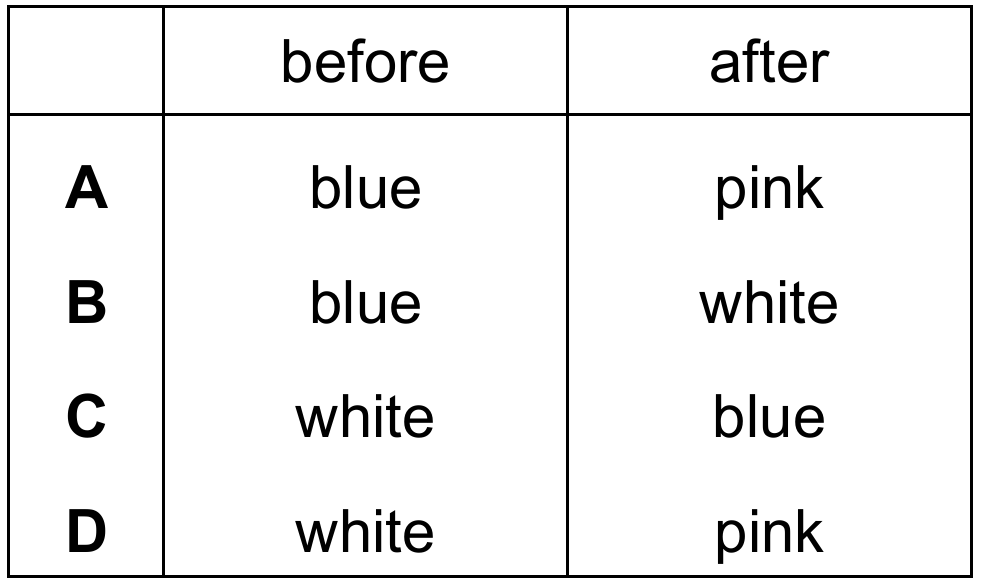
Which row shows the colour before and after water is added?

Most-appropriate topic codes (Cambridge IGCSE Co-ordinated Sciences 0654):

Topic C10.1: Water — Describe the chemical test for water using anhydrous cobalt(II) chloride.
▶️ Answer/Explanation
Anhydrous cobalt(II) chloride is blue in its dry, water-free form.
When water is added, it absorbs water molecules and turns pink, forming hydrated cobalt(II) chloride.
This blue-to-pink colour change is the standard chemical test for the presence of water.
Answer: (A)

Question 25

Which substances neutralise acids?

  1. lime
  2. limestone
  3. calcium hydroxide

A. 1 and 2 only
B. 1 and 3 only
C. 2 and 3 only
D. 1, 2 and 3

Most-appropriate topic codes (Cambridge IGCSE Co-ordinated Sciences 0654):

Topic C7.1: Characteristic properties of acids and bases — Know that metal oxides, hydroxides and carbonates act as bases and neutralise acids.
▶️ Answer/Explanation
Lime (calcium oxide) is a metal oxide and calcium hydroxide is a metal hydroxide, both of which are bases that react with and neutralise acids.
Limestone (calcium carbonate) is a metal carbonate, and carbonates also react with and neutralise acids, releasing carbon dioxide gas in the process.
All three substances are therefore capable of neutralising acids.
Answer: (D)

Question 26

Butane is a hydrocarbon.

What is the word equation for the complete combustion of butane?

A. butane + oxygen → carbon + water
B. butane + oxygen → carbon dioxide + carbon monoxide + water
C. butane + oxygen → carbon dioxide + water
D. butane + oxygen → carbon monoxide + water

Most-appropriate topic codes (Cambridge IGCSE Co-ordinated Sciences 0654):

Topic C11.3: Fuels — Describe the complete and incomplete combustion of hydrocarbon fuels.
▶️ Answer/Explanation
Complete combustion occurs when a hydrocarbon burns in a plentiful (excess) supply of oxygen.
Under these conditions, all the carbon in the fuel is fully oxidised to carbon dioxide, and all the hydrogen is oxidised to water, with no carbon monoxide or soot (carbon) produced.
Incomplete combustion, which produces carbon monoxide or carbon, only occurs with a limited oxygen supply.
Answer: (C)

Question 27

Which statement about poly(ethene) is correct?

A. It is an alkene.
B. It is formed in a reaction called cracking.
C. It is obtained from the bitumen fraction of petroleum.
D. It is made by an addition reaction.

Most-appropriate topic codes (Cambridge IGCSE Co-ordinated Sciences 0654):

Topic C11.7: Polymers — Describe the formation of poly(ethene) from ethene by addition polymerisation.
▶️ Answer/Explanation
Poly(ethene) is a polymer, not an alkene itself — it is made from many ethene (an alkene) monomer molecules joining together.
Cracking is the process that produces smaller alkenes like ethene from larger hydrocarbons, while poly(ethene) is instead produced from ethene by an addition reaction, with monomers joining without any small molecule being lost.
It is not obtained from the bitumen fraction, since that fraction is used for surfacing roads.
Answer: (D)

Question 28

Which expression is the definition of density?

A. \( \dfrac{\text{mass}}{\text{volume}} \)
B. \( \dfrac{\text{volume}}{\text{mass}} \)
C. area × mass
D. mass × volume

Most-appropriate topic codes (Cambridge IGCSE Co-ordinated Sciences 0654):

Topic P1.4: Density — Define density as mass per unit volume, \( \rho = \frac{m}{V} \).
▶️ Answer/Explanation
Density is defined as the mass of a substance per unit volume it occupies.
This is written as \( \text{density} = \dfrac{\text{mass}}{\text{volume}} \), with units such as \( g/cm^3 \) or \( kg/m^3 \).
None of the other expressions correctly represent this physical quantity.
Answer: (A)

Question 29

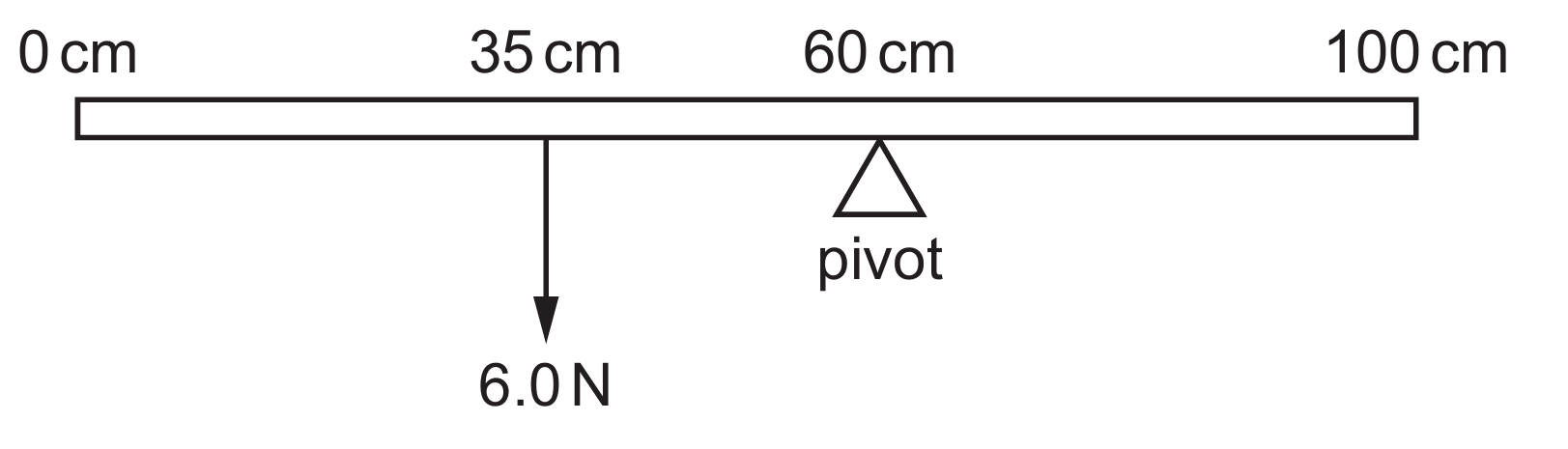
The diagram shows a metre rule with a pivot at the 60 cm mark. A force of 6.0 N is applied at the 35 cm mark in the direction shown.

What is the moment of the 6.0 N force about the pivot?

A. 150 Ncm
B. 210 Ncm
C. 360 Ncm
D. 390 Ncm

Most-appropriate topic codes (Cambridge IGCSE Co-ordinated Sciences 0654):

Topic P1.5.2: Turning effect of forces — Calculate the moment of a force using moment = force × perpendicular distance from the pivot.
▶️ Answer/Explanation
The moment of a force is calculated using \( \text{moment} = \text{force} \times \text{perpendicular distance from the pivot} \).
The perpendicular distance between the 35 cm mark (where the force acts) and the 60 cm pivot is \( 60 – 35 = 25\text{ cm} \).
So the moment is \( 6.0\text{ N} \times 25\text{ cm} = 150\text{ Ncm} \).
Answer: (A)

Question 30

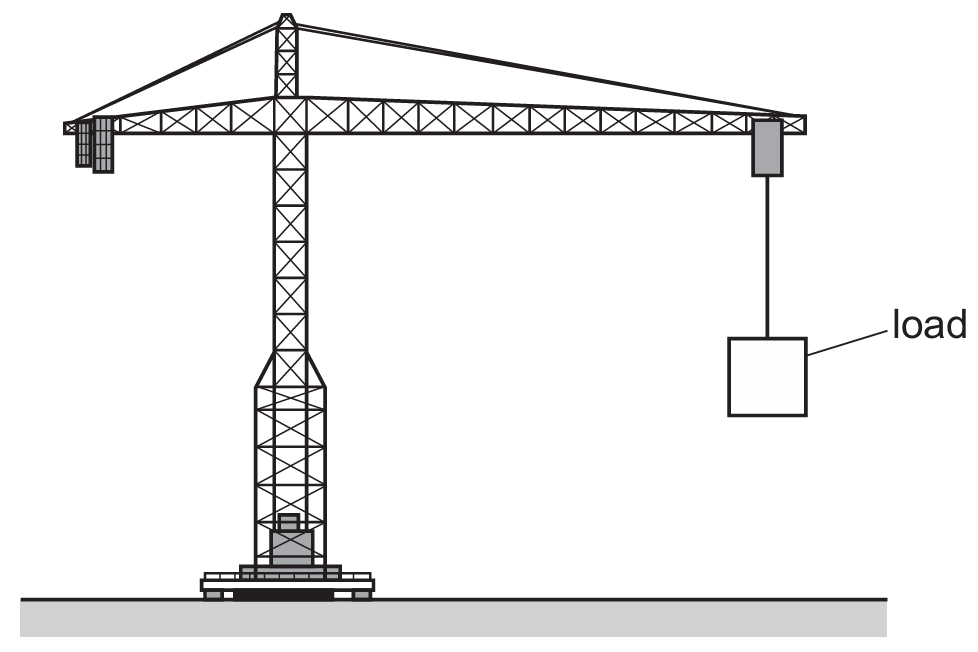
A crane does work on a load by lifting it vertically upwards.

Which action decreases the work done on the load?

A. lifting the load higher
B. lifting the load more slowly
C. reducing the mass of the load
D. using a more powerful crane

Most-appropriate topic codes (Cambridge IGCSE Co-ordinated Sciences 0654):

Topic P1.6.2: Work — Calculate work done using work = force × distance moved in the direction of the force.
▶️ Answer/Explanation
Work done is calculated as \( \text{work} = \text{force} \times \text{distance moved} \), where the force needed equals the weight of the load.
Lifting the load higher increases distance (more work), and the speed of lifting or the power of the crane affects only how quickly work is done, not the total amount of work.
Reducing the mass of the load reduces its weight, and therefore reduces the force needed, decreasing the total work done.
Answer: (C)

Question 31

Which source of energy is non-renewable?

A. hydroelectric
B. nuclear fission
C. tides
D. waves

Most-appropriate topic codes (Cambridge IGCSE Co-ordinated Sciences 0654):

Topic P1.6.3: Energy resources — Distinguish between renewable and non-renewable energy resources.
▶️ Answer/Explanation
Hydroelectric, tidal and wave power are all renewable resources, since they rely on natural processes (water flow, tides, waves) that are continuously replenished.
Nuclear fission instead relies on a finite supply of uranium fuel that is mined from the Earth and cannot be replenished once used.
This makes nuclear fission the only non-renewable energy source in the list.
Answer: (B)

Question 32

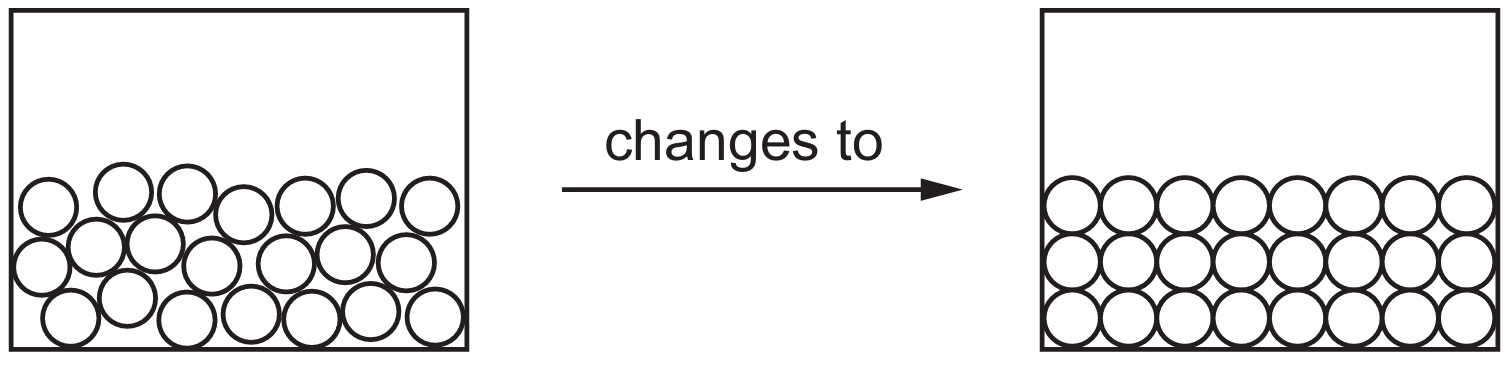
The diagram shows the change in the arrangement of the atoms in a substance that is changing state.

What is the change of state?

A. boiling
B. condensation
C. melting
D. solidification

Most-appropriate topic codes (Cambridge IGCSE Co-ordinated Sciences 0654):

Topic P2.1.1: States of matter — Know the terms for changes in state between solids, liquids and gases.
▶️ Answer/Explanation
The particle diagram shows a change from a more randomly arranged, freely-moving state to a tightly packed, regularly-ordered state.
This ordered, closely-packed arrangement with particles only vibrating in fixed positions is characteristic of a solid.
A liquid changing into this solid arrangement is the process of solidification (freezing).
Answer: (D)

Question 33

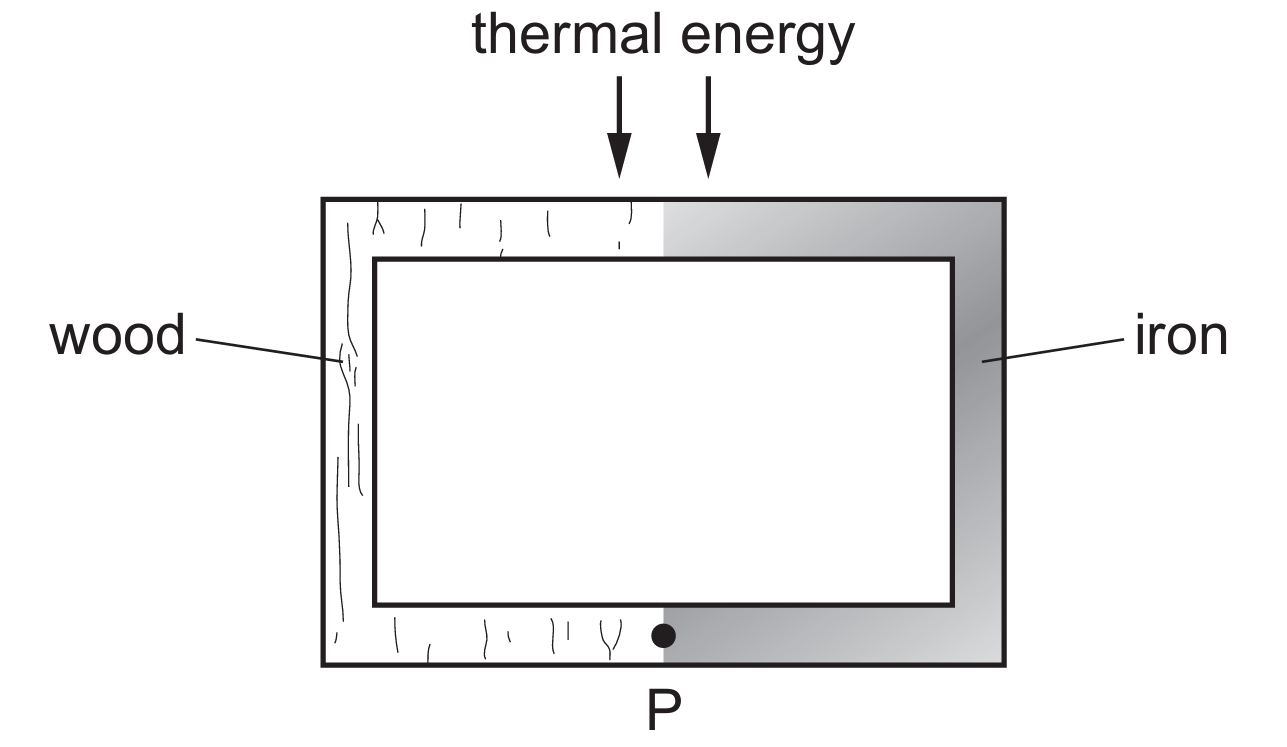
The diagram shows an object made partly of wood and partly of iron. Thermal energy is supplied in the position shown. Point P is marked at the bottom of the object.

How does most thermal energy reach point P?

A. by conduction through the iron
B. by conduction through the wood
C. by convection through the iron
D. by convection through the wood

Most-appropriate topic codes (Cambridge IGCSE Co-ordinated Sciences 0654):

Topic P2.3.1: Conduction — Identify good and bad thermal conductors, and describe conduction through solids.
▶️ Answer/Explanation
Thermal energy travels through solids by conduction, since convection requires a fluid (liquid or gas) that can circulate, which is not possible in a solid object.
Iron, as a metal, is a good thermal conductor due to its free (delocalised) electrons that transfer energy quickly, whereas wood is a poor conductor (a good insulator).
Most thermal energy therefore reaches point P by conduction through the iron rather than through the wood.
Answer: (A)

Question 34

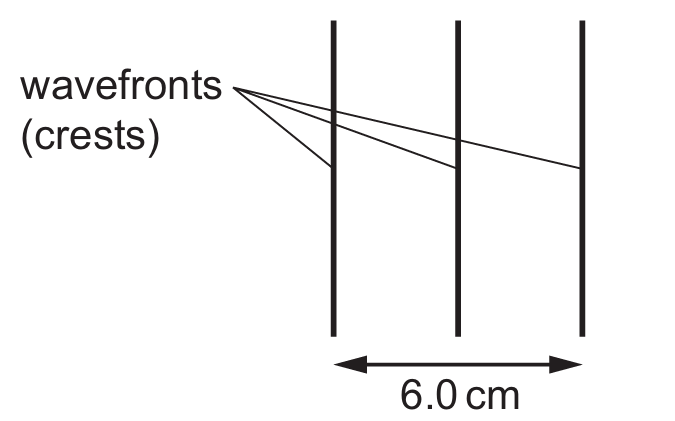
The diagram shows a water wave seen from above.

One wavefront (crest) is made every 0.50 s.

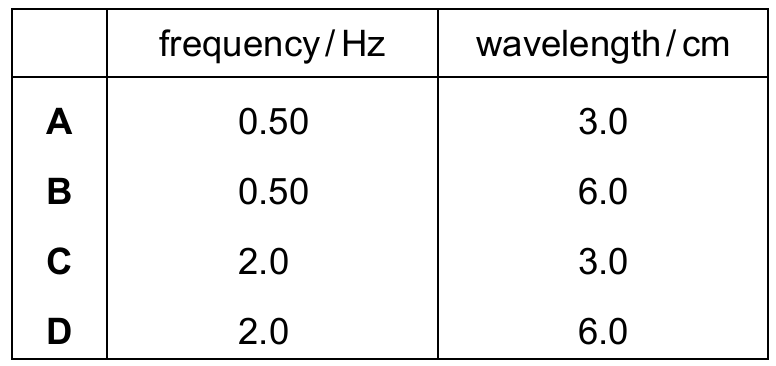
What is the frequency of the wave and what is its wavelength?

Most-appropriate topic codes (Cambridge IGCSE Co-ordinated Sciences 0654):

Topic P3.1: General properties of waves — Calculate frequency and wavelength, and relate them using wave speed = frequency × wavelength.
▶️ Answer/Explanation
Frequency is the number of wavefronts (crests) produced per second, so \( f = \dfrac{1}{0.50\text{ s}} = 2.0\text{ Hz} \).
The diagram shows 6.0 cm spanning two full wavelengths, so one wavelength is \( \dfrac{6.0}{2} = 3.0\text{ cm} \).
This gives a frequency of 2.0 Hz and a wavelength of 3.0 cm.
Answer: (C)

Question 35

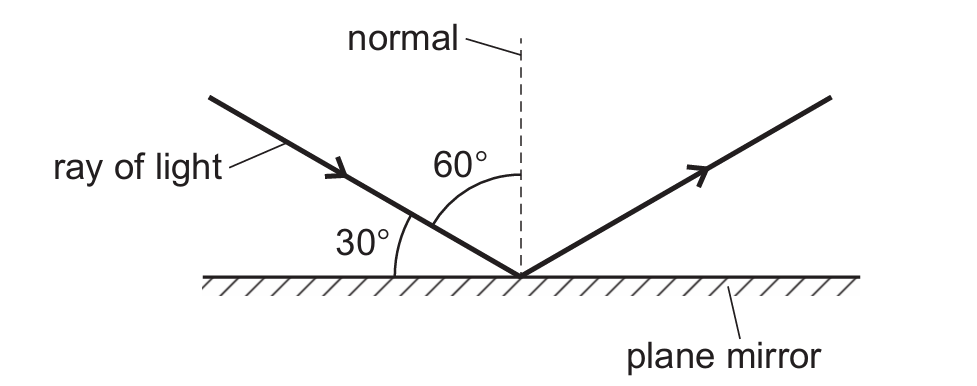
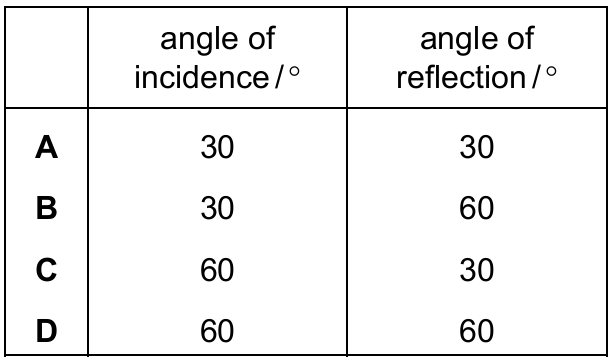
The diagram shows a ray of light which is reflected from a plane mirror.

What is the angle of incidence and what is the angle of reflection?

Most-appropriate topic codes (Cambridge IGCSE Co-ordinated Sciences 0654):

Topic P3.2.1: Reflection of light — Apply the law of reflection, stating that the angle of incidence equals the angle of reflection, both measured from the normal.
▶️ Answer/Explanation
Angles of incidence and reflection are always measured from the normal, a line perpendicular to the mirror surface at the point of reflection, not from the mirror surface itself.
The 60° marked in the diagram is measured from the normal, giving both the angle of incidence and the angle of reflection as 60°, in line with the law of reflection.
The 30° shown is the angle between the ray and the mirror surface, not the angle used in the law of reflection.
Answer: (D)

Question 36

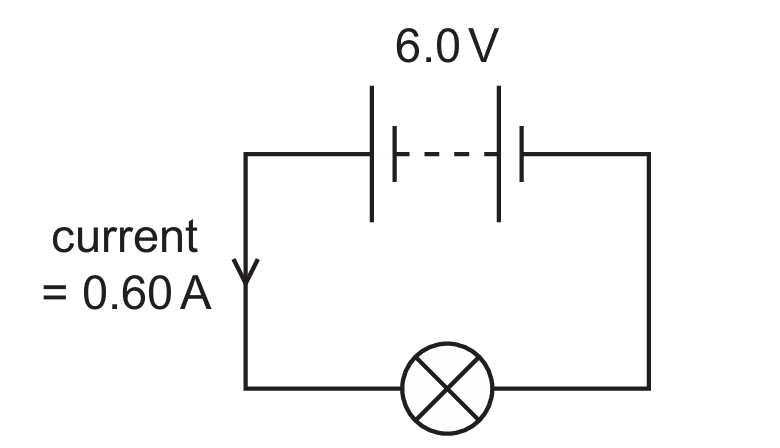
A 6.0 V battery is connected to a lamp. The current in the circuit is 0.60 A.

What is the resistance of the lamp?

A. 0.10 Ω
B. 3.6 Ω
C. 10 Ω
D. 36 Ω

Most-appropriate topic codes (Cambridge IGCSE Co-ordinated Sciences 0654):

Topic P4.2.4: Resistance — Calculate resistance using resistance = voltage ÷ current.
▶️ Answer/Explanation
Resistance is calculated using \( R = \dfrac{V}{I} \), where V is the voltage across the component and I is the current through it.
Substituting the given values gives \( R = \dfrac{6.0\text{ V}}{0.60\text{ A}} = 10\ \Omega \).
This is the resistance of the lamp in this circuit.
Answer: (C)

Question 37

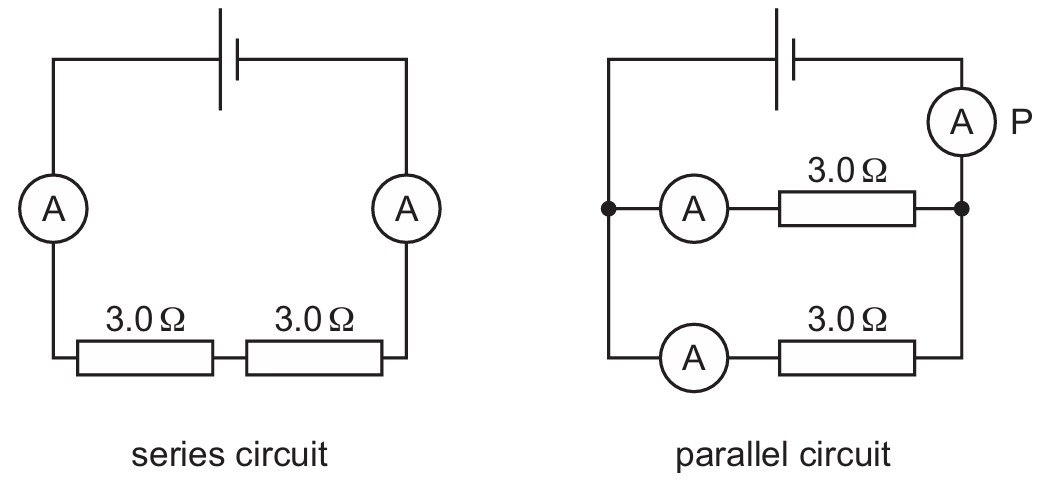
The diagrams show a series circuit and a parallel circuit, each containing two 3.0 Ω resistors and ammeters. One ammeter in the parallel circuit is labelled P.

Which statement is correct?

A. The total resistance of the series circuit is 3.0 Ω.
B. The total resistance of the parallel circuit is 6.0 Ω.
C. In the series circuit, the readings on the ammeters are the same.
D. In the parallel circuit, the reading on ammeter P is less than the reading on either of the other two ammeters.

Most-appropriate topic codes (Cambridge IGCSE Co-ordinated Sciences 0654):

Topic P4.3.2: Series and parallel circuits — Compare current and resistance behaviour in series versus parallel circuits.
▶️ Answer/Explanation
In a series circuit, current has only one path to flow through, so the current (and therefore the ammeter reading) is the same at every point in the circuit.
The series circuit’s total resistance is actually \( 3.0 + 3.0 = 6.0\ \Omega \), and the parallel circuit’s total resistance is \( 1.5\ \Omega \) (less than either resistor), so options A and B are incorrect.
In the parallel circuit, ammeter P (measuring the total current from the supply) reads the sum of the two branch currents, so it reads more, not less, than the branch ammeters.
Answer: (C)

Question 38

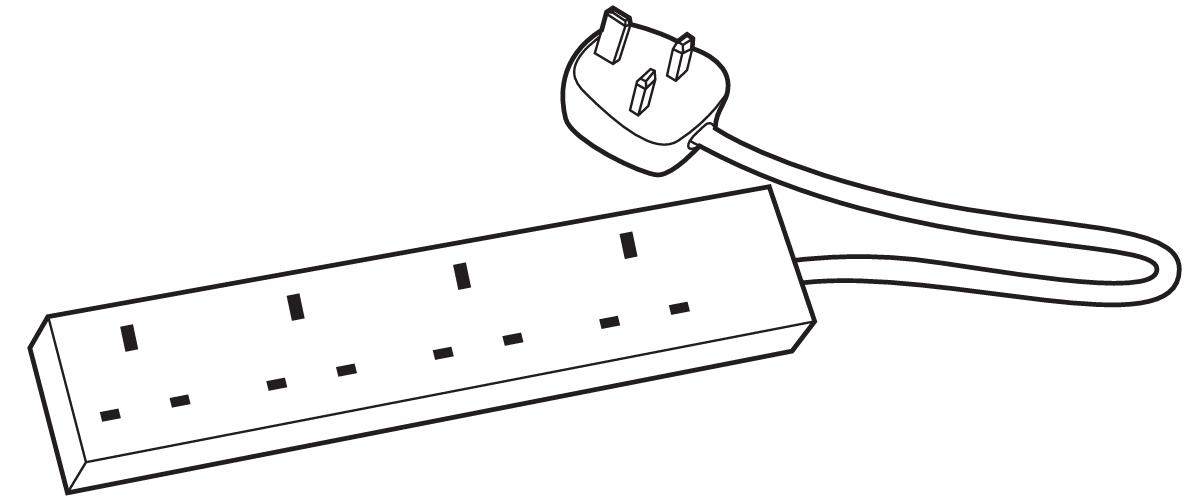
An electrical extension block has four sockets, a cable which can safely take a current of 6 A, and a plug. It is protected by a fuse rated at 5 A.

The extension block is used with four appliances and the 5 A fuse blows. The owner replaces the 5 A fuse with a 13 A fuse.

Why is the extension block now dangerous?

A. The appliances may not receive enough current.
B. The cable may overheat before the fuse blows.
C. The sockets may burn out before the fuse blows.
D. The 13 A fuse may blow too soon.

Most-appropriate topic codes (Cambridge IGCSE Co-ordinated Sciences 0654):

Topic P4.4: Electrical safety — Explain the purpose of fuses in protecting circuits and cables from excessive current.
▶️ Answer/Explanation
A fuse is meant to blow (melt) and break the circuit before the current gets high enough to damage the cable, since the cable is only rated to safely carry up to 6 A.
The original 5 A fuse blew because the current drawn already exceeded a safe level, so replacing it with a 13 A fuse allows a current well above the cable’s 6 A safe rating to flow without the fuse breaking the circuit.
This means the cable itself could overheat and potentially cause a fire before the oversized fuse ever blows.
Answer: (B)

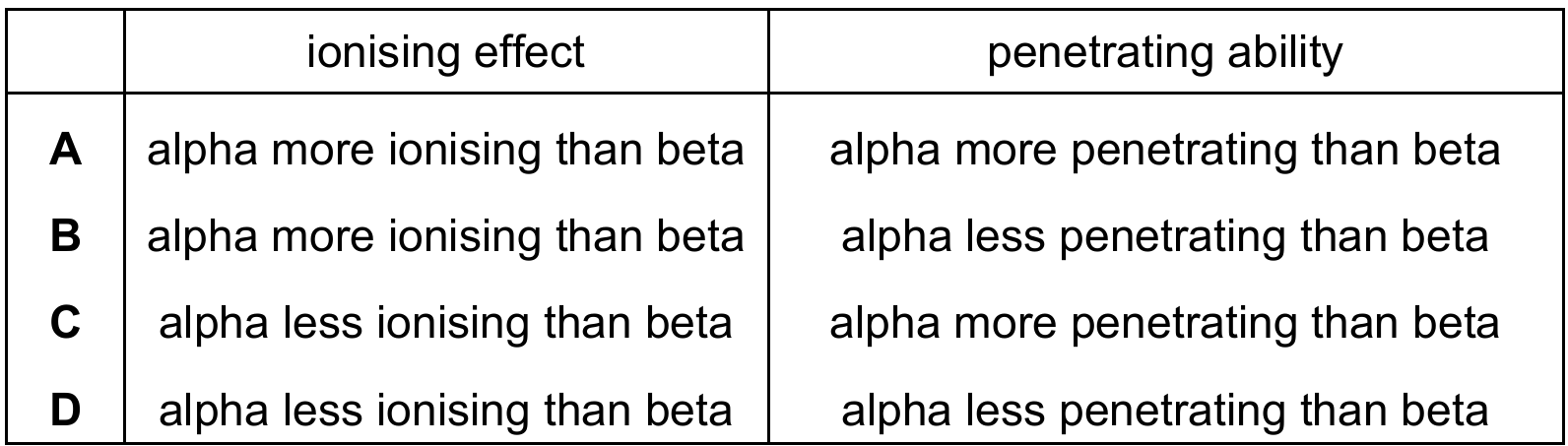
Question 39

How do the ionising effect and the penetrating ability of alpha-emissions compare with those of beta-emissions?

Most-appropriate topic codes (Cambridge IGCSE Co-ordinated Sciences 0654):

Topic P5.2.2: The three types of nuclear emission — Compare the ionising power and penetrating ability of alpha, beta and gamma radiation.
▶️ Answer/Explanation
Alpha particles are large and heavily charged, so they interact strongly with atoms they pass, making them highly ionising, but this also means they lose their energy very quickly.
Because of this rapid energy loss, alpha particles can only travel a short distance and are stopped easily (e.g. by paper or skin), making them far less penetrating than beta particles.
Beta particles are smaller and less charged, so they ionise less per collision but travel further, making them more penetrating than alpha.
Answer: (B)

Question 40

A radioactive isotope has a half-life of 18 years. A sample contains 80 million atoms of this isotope.

How long does it take for the number of atoms of this isotope in the sample to decrease to 10 million?

A. 2.25 years
B. 6.0 years
C. 54 years
D. 180 years

Most-appropriate topic codes (Cambridge IGCSE Co-ordinated Sciences 0654):

Topic P5.2.4: Half-life — Calculate the number of half-lives elapsed and the corresponding time, given the half-life of an isotope.
▶️ Answer/Explanation
Each half-life reduces the number of remaining atoms by half: 80 million → 40 million (1 half-life) → 20 million (2 half-lives) → 10 million (3 half-lives).
Three half-lives have elapsed to reach 10 million atoms from the original 80 million.
Total time = \( 3 \times 18\text{ years} = 54\text{ years} \).
Answer: (C)
Scroll to Top