Home / 0654_s22_qp_12

Question 1

Which statement about the characteristics of living organisms is correct?

A. Excretion is the chemical reactions in cells that release energy.
B. Nutrition is the taking in of materials for energy, growth and development.
C. Respiration is the process that makes more of the same kind.
D. Sensitivity is the removal of toxic materials and excess substances.

Most-appropriate topic codes (Cambridge IGCSE Co-ordinated Sciences 0654):

Topic B1.1: Characteristics of living organisms — defining nutrition, respiration, excretion and sensitivity.
▶️ Answer/Explanation
Each option mismatches its term with the wrong definition, except one.
Excretion is actually the removal of waste products of metabolism, not the release of energy — that is respiration.
Respiration is the breakdown of nutrients to release energy, not reproduction.
Sensitivity is detecting and responding to stimuli, not removing waste.
Nutrition correctly means taking in materials for energy, growth and development.
Answer: (B)

Question 2

Which statement about cells is correct?

A. Cell membranes are found only in animal cells.
B. Cell membranes are found only in plant cells.
C. Cell walls are found only in animal cells.
D. Cell walls are found only in plant cells.

Most-appropriate topic codes (Cambridge IGCSE Co-ordinated Sciences 0654):

Topic B2.1: Cell structure — comparing plant and animal cell components.
▶️ Answer/Explanation
Cell membranes are present in both plant and animal cells, so A and B are wrong.
Cell walls are present only in plant cells, not animal cells, so C is wrong.
Therefore cell walls being found only in plant cells is the correct statement.
Answer: (D)

Question 3

Which reagent is used to test for the presence of protein in a food sample?

A. Benedict’s solution
B. biuret
C. ethanol
D. iodine

Most-appropriate topic codes (Cambridge IGCSE Co-ordinated Sciences 0654):

Topic B4.1: Biological molecules — food tests, biuret test for proteins.
▶️ Answer/Explanation
Benedict’s solution tests for reducing sugars, not protein.
Ethanol is used in the emulsion test for fats and oils.
Iodine solution tests for starch, turning blue-black if present.
The biuret test is the correct reagent for protein, giving a purple/violet colour change.
Answer: (B)

Question 4

Catalase is an enzyme that breaks down hydrogen peroxide to form a foam of water and oxygen.
The maximum height of the foam produced at different temperatures in a given length of time is measured.
The rate of the reaction is proportional to the height of foam.
The table shows the results.

Which conclusion can be drawn from these results?

A. Increasing the temperature decreases the rate of the reaction up to 50 °C.
B. Increasing the temperature decreases the rate of the reaction up to 60 °C.
C. Increasing the temperature increases the rate of the reaction up to 40 °C.
D. Increasing the temperature increases the rate of the reaction up to 50 °C.

Most-appropriate topic codes (Cambridge IGCSE Co-ordinated Sciences 0654):

Topic B5.1: Enzymes — effect of temperature on enzyme (catalase) activity.
▶️ Answer/Explanation
Foam height rises steadily from 10 °C to 40 °C \( (1.2 \to 3.1 \to 4.2 \to 5.4) \), showing increasing rate.
From 40 °C to 50 °C the height falls to 3.6, and by 60 °C it is 0, showing the enzyme has denatured.
So the rate increases only up to 40 °C, after which it falls.
Answer: (C)

Question 5

The diagram shows an investigation into factors affecting photosynthesis.

The tubes are left for 24 hours after which the leaves are tested with iodine solution.

How many of these leaves turn blue-black when tested with iodine solution?

A. 1
B. 2
C. 3
D. 4

Most-appropriate topic codes (Cambridge IGCSE Co-ordinated Sciences 0654):

Topic B6.1: Photosynthesis — testing leaves for starch, effect of chlorophyll and carbon dioxide.
▶️ Answer/Explanation
The white leaf has no chlorophyll, so it cannot photosynthesise and stays iodine-negative.
The leaf covered in aluminium foil is denied light, so no starch forms there either.
The leaf in the tube with sodium hydroxide has no carbon dioxide available, so it also fails to make starch.
Only the plain green leaf exposed to light and carbon dioxide photosynthesises and turns blue-black with iodine.
Answer: (A)

Question 6

The diagram shows part of the digestive system.

Which labelled parts produce digestive enzymes, absorb water and store bile?

Most-appropriate topic codes (Cambridge IGCSE Co-ordinated Sciences 0654):

Topic B7.3: Digestion — functions of the stomach/pancreas/small intestine, gall bladder and large intestine.
▶️ Answer/Explanation
In this diagram, the labelled part corresponding to the stomach/pancreas region produces digestive enzymes.
The labelled part corresponding to the large intestine absorbs water from undigested food.
The labelled part corresponding to the gall bladder stores bile before release into the small intestine.
Matching these functions to R, S and P respectively gives the correct row.
Answer: (C)

Question 7

Which changes increase the rate of transpiration?

  1. increasing temperature
  2. increasing humidity
  3. decreasing temperature
  4. decreasing humidity

A. 1 and 2
B. 1 and 4
C. 2 and 3
D. 3 and 4

Most-appropriate topic codes (Cambridge IGCSE Co-ordinated Sciences 0654):

Topic B8.3: Transpiration — effect of temperature and humidity on transpiration rate.
▶️ Answer/Explanation
Increasing temperature gives water molecules more kinetic energy, speeding up evaporation and diffusion out of the stomata.
Decreasing humidity increases the concentration gradient between the leaf’s air spaces and the surrounding air, so water vapour diffuses out faster.
Increasing humidity or decreasing temperature would both slow transpiration instead.
Answer: (B)

Question 8

When a person exercises for 10 minutes, what is the effect on the depth and rate of their breathing?

Most-appropriate topic codes (Cambridge IGCSE Co-ordinated Sciences 0654):

Topic B11.1: Gas exchange in humans — effect of physical activity on rate and depth of breathing.
▶️ Answer/Explanation
Exercise increases carbon dioxide concentration in the blood from higher muscle respiration.
This is detected by the brain, which signals the breathing muscles to work harder.
Both the rate (breaths per minute) and depth (volume per breath) of breathing increase to supply more oxygen and remove more carbon dioxide.
Answer: (D)

Question 9

What is a hormone?

A. a chemical substance, produced by a gland, which alters the activity of target organs
B. a protein that acts as a biological catalyst
C. a thread-like structure of DNA, carrying genetic information in the form of genes
D. an electrical signal that travels along a nerve cell to an effector

Most-appropriate topic codes (Cambridge IGCSE Co-ordinated Sciences 0654):

Topic B13.2: Hormones — definition of a hormone and its role in the body.
▶️ Answer/Explanation
Option B describes an enzyme, not a hormone.
Option C describes a chromosome, and option D describes a nerve impulse.
A hormone is correctly defined as a chemical substance produced by a gland that is carried in the blood and alters the activity of specific target organs.
Answer: (A)

Question 10

Which statement about asexual reproduction is correct?

A. It involves the fusion of gametes from one parent.
B. It involves the fusion of gametes from two parents.
C. It produces offspring which are genetically different.
D. It produces offspring which are genetically identical.

Most-appropriate topic codes (Cambridge IGCSE Co-ordinated Sciences 0654):

Topic B15.1: Asexual reproduction — production of genetically identical offspring from one parent.
▶️ Answer/Explanation
Asexual reproduction does not involve gametes or fertilisation at all, so A and B are wrong.
Because only one parent is involved and there is no fusion of genetic material from two sources, the offspring are clones of the parent.
This means the offspring are genetically identical, not different.
Answer: (D)

Question 11

Selection in chickens has produced individuals that lay more eggs per week.

What is required for this to occur?

Most-appropriate topic codes (Cambridge IGCSE Co-ordinated Sciences 0654):

Topic B17.2: Selection — selective breeding by artificial selection to improve domesticated animals.
▶️ Answer/Explanation
Chickens reproduce sexually, so the offspring show genetic variation for farmers to choose from.
Farmers then deliberately breed together the hens that lay the most eggs — this is selective breeding, driven by human selection rather than natural selection.
Repeating this over generations increases the egg-laying trait in the population.
Answer: (C)

Question 12

The diagram shows a food chain.

dandelion plant → slug → blackbird → fox

Which organisms are consumers?

A. dandelion plant only
B. fox only
C. blackbird and slug only
D. slug, blackbird and fox

Most-appropriate topic codes (Cambridge IGCSE Co-ordinated Sciences 0654):

Topic B18.2: Food chains and food webs — identifying producers and consumers.
▶️ Answer/Explanation
The dandelion plant is a producer since it makes its own food by photosynthesis, not a consumer.
The slug (herbivore), blackbird (which eats the slug) and fox (which eats the blackbird) all obtain energy by feeding on other organisms.
This makes all three of them consumers in the food chain.
Answer: (D)

Question 13

The diagram shows part of the carbon cycle.

Which arrow represents plant respiration?

Most-appropriate topic codes (Cambridge IGCSE Co-ordinated Sciences 0654):

Topic B18.3: Carbon cycle — photosynthesis, respiration and carbon compound transfers.
▶️ Answer/Explanation
Plant respiration releases carbon dioxide back into the air, so it must be represented by an arrow pointing from “carbon compounds in plants” to “carbon compounds in the air”.
This is distinct from photosynthesis, which is an arrow in the opposite direction (air to plants).
Matching this direction to the labelled arrows in the diagram identifies the correct one.
Answer: (B)

Question 14

Which piece of apparatus is used to measure the change in the volume of a liquid most accurately?

Most-appropriate topic codes (Cambridge IGCSE Co-ordinated Sciences 0654):

Topic C12.1: Experimental design — apparatus for accurate measurement of volume (burette).
▶️ Answer/Explanation
A burette has fine graduations (usually to 0.1 cm³) and a tap, allowing precise measurement of the volume of liquid delivered.
Beakers and measuring cylinders have wider graduations and are far less precise for measuring small changes in volume.
The burette is therefore the apparatus of choice when accuracy in measuring volume change matters.
Answer: (C)

Question 15

Some physical and chemical changes are listed.

  1. burning methane
  2. dissolving sugar in water
  3. evaporating ethanol
  4. rusting iron

Which changes are chemical changes?

A. 1 and 2
B. 1 and 4
C. 2 and 3
D. 3 and 4

Most-appropriate topic codes (Cambridge IGCSE Co-ordinated Sciences 0654):

Topic C6.1: Physical and chemical changes — distinguishing between the two types of change.
▶️ Answer/Explanation
Burning methane forms new substances, carbon dioxide and water, so it is a chemical change.
Rusting iron forms a new substance, iron oxide, so it is also a chemical change.
Dissolving sugar and evaporating ethanol are both physical changes, since no new substance is formed and the changes are reversible.
Answer: (B)

Question 16

Which equation is balanced?

A. \( 2H_2 + O_2 \rightarrow 2H_2O_2 \)
B. \( MgO + 2H_2SO_4 \rightarrow MgSO_4 + 2H_2O \)
C. \( Na + H_2O \rightarrow NaOH + H_2 \)
D. \( Na_2CO_3 + 2HCl \rightarrow 2NaCl + H_2O + CO_2 \)

Most-appropriate topic codes (Cambridge IGCSE Co-ordinated Sciences 0654):

Topic C3.1: Formulas — balancing and interpreting symbol equations.
▶️ Answer/Explanation
In option A, the product should be \( 2H_2O \), not \( 2H_2O_2 \), so oxygen atoms don’t balance.
In option B, \( MgO \) needs only 1 \( H_2SO_4 \) to balance, not 2.
In option C, sodium reacting with water produces \( 2Na + 2H_2O \rightarrow 2NaOH + H_2 \); as written with 1 Na it doesn’t balance.
Checking option D: 2 Na, 1 C, 3 O and 2 Cl atoms appear on both sides, so it is correctly balanced.
Answer: (D)

Question 17

The diagram shows the electrolysis of dilute sulfuric acid using inert electrodes.

Which row shows the products formed at each electrode and describes the bonding in sulfuric acid?

Most-appropriate topic codes (Cambridge IGCSE Co-ordinated Sciences 0654):

Topic C4.1: Electrolysis — products at electrodes during electrolysis of dilute sulfuric acid.
▶️ Answer/Explanation
At the cathode (negative electrode), positive hydrogen ions gain electrons and hydrogen gas is produced.
At the anode (positive electrode), hydroxide/sulfate-derived ions lose electrons and oxygen gas is produced.
Sulfuric acid, \( H_2SO_4 \), is a molecular acid built from covalent bonds, not an ionic compound.
Answer: (A)

Question 18

Which word describes reactions that give out heat energy?

A. endothermic
B. exothermic
C. oxidation
D. reduction

Most-appropriate topic codes (Cambridge IGCSE Co-ordinated Sciences 0654):

Topic C5.1: Chemical energetics — exothermic and endothermic reactions.
▶️ Answer/Explanation
Endothermic reactions take in heat energy from the surroundings, the opposite of what’s described here.
Oxidation and reduction describe electron/oxygen transfer, not heat energy change.
Exothermic is the correct term for reactions that release (give out) heat energy to the surroundings.
Answer: (B)

Question 19

When solid pieces of calcium carbonate are added to dilute hydrochloric acid in a flask, carbon dioxide gas is given off.
The mass of the flask and its contents are measured over time.

Two different experiments are carried out. In both experiments the acid is in excess.
The results of these two experiments are shown.

Which statement explains the different shapes of the curves?

A. Experiment 2 uses a catalyst.
B. Experiment 2 uses acid at a higher temperature.
C. Experiment 2 uses acid that is more dilute.
D. Experiment 2 uses powdered calcium carbonate.

Most-appropriate topic codes (Cambridge IGCSE Co-ordinated Sciences 0654):

Topic C6.2: Rate of reaction — interpreting graphs from mass-loss experiments.
▶️ Answer/Explanation
Experiment 2’s curve reaches the same final mass loss faster than experiment 1, showing a higher rate but the same total amount of gas produced.
A more dilute acid or a catalyst would not increase the rate in this way, and a catalyst does not apply to this reaction type as tested here.
Using powdered calcium carbonate increases the surface area, so the same mass of reactant reacts faster while producing the same total volume of gas.
Answer: (D)

Question 20

When aqueous potassium hydroxide is warmed with ammonium chloride, a gas is given off.

Which test result identifies the gas?

A. It bleaches pH paper.
B. It turns anhydrous cobalt(II) chloride blue.
C. It turns universal indicator red.
D. It turns red litmus blue.

Most-appropriate topic codes (Cambridge IGCSE Co-ordinated Sciences 0654):

Topic C12.5: Identification of ions and gases — test for ammonia gas using damp red litmus paper.
▶️ Answer/Explanation
Warming an ammonium salt with an alkali releases ammonia gas.
Bleaching pH paper is a test for chlorine, and cobalt(II) chloride turning blue is a test for water.
Ammonia is alkaline, so it turns red litmus paper blue, not universal indicator red.
Answer: (D)

Question 21

A gas is used in welding metals together at high temperatures.
The gas is used to provide an inert atmosphere.

What is the gas?

A. argon
B. carbon dioxide
C. fluorine
D. oxygen

Most-appropriate topic codes (Cambridge IGCSE Co-ordinated Sciences 0654):

Topic C8.5: Noble gases — argon as an unreactive gas used to provide an inert atmosphere.
▶️ Answer/Explanation
Carbon dioxide, fluorine and oxygen are all reactive and would react with hot metal during welding.
Argon is a noble gas, meaning it is unreactive due to its full outer shell of electrons.
This makes argon the correct choice to shield molten metal from reacting with air during welding.
Answer: (A)

Question 22

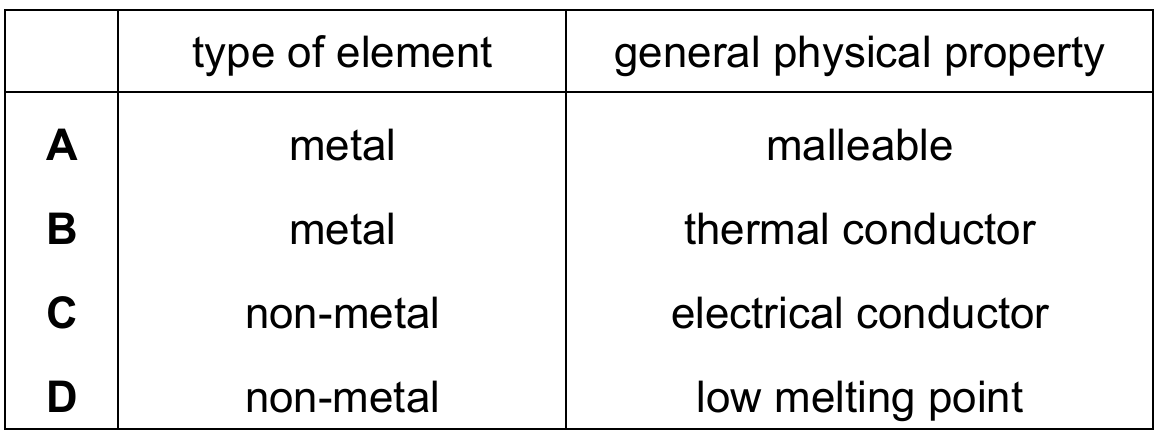
Which row does not link a general physical property to the type of element?

Most-appropriate topic codes (Cambridge IGCSE Co-ordinated Sciences 0654):

Topic C9.1: Properties of metals — comparing physical properties of metals and non-metals.
▶️ Answer/Explanation
Metals are correctly malleable and good thermal conductors, so rows A and B are correctly linked.
Non-metals generally have low melting points compared with metals, so row D is also a correct link.
However, non-metals are generally poor electrical conductors (with the exception of graphite), so linking “non-metal” with “electrical conductor” is incorrect.
Answer: (C)

Question 23

Which row describes a transition element?

Most-appropriate topic codes (Cambridge IGCSE Co-ordinated Sciences 0654):

Topic C8.4: Transition elements — high melting points and good electrical conductivity.
▶️ Answer/Explanation
Transition elements are metals, so they must conduct electricity — this rules out rows A and D.
Transition elements are also known for having high melting points, similar to real examples like iron (melting point 1538 °C).
A melting point of only 181 °C is too low to be typical of a transition metal, which rules out row B.
Answer: (C)

Question 24

The diagram shows a metal being extracted from its powdered ore using carbon.

What happens to the ore in this reaction?

A. It burns.
B. It decomposes.
C. It is oxidised.
D. It is reduced.

Most-appropriate topic codes (Cambridge IGCSE Co-ordinated Sciences 0654):

Topic C6.3: Redox — extraction of metals from their oxides by reduction using carbon.
▶️ Answer/Explanation
Metal ores are usually metal oxides, and carbon removes the oxygen from the metal oxide to leave the pure metal.
Since the ore loses oxygen in this reaction, it is reduced, while the carbon is oxidised to carbon dioxide.
It does not burn or thermally decompose in this specific reaction type.
Answer: (D)

Question 25

Which colour change is observed when water is tested using copper(II) sulfate?

A. blue → pink
B. blue → white
C. white → blue
D. white → pink

Most-appropriate topic codes (Cambridge IGCSE Co-ordinated Sciences 0654):

Topic C10.1: Water — chemical test for water using anhydrous copper(II) sulfate.
▶️ Answer/Explanation
Anhydrous copper(II) sulfate is white, since it contains no water of crystallisation.
When water is added, it forms hydrated copper(II) sulfate, which is blue.
So the colour change observed is white turning to blue, confirming the presence of water.
Answer: (C)

Question 26

Why do farmers add limestone to soil?

A. It acts as a fertiliser.
B. It adds nitrogen to the soil.
C. It decreases the pH of the soil.
D. It increases the pH of the soil.

Most-appropriate topic codes (Cambridge IGCSE Co-ordinated Sciences 0654):

Topic C7.1: Characteristic properties of acids and bases — limestone as a base used to neutralise acidic soil.
▶️ Answer/Explanation
Limestone (calcium carbonate) is a base, not a fertiliser and it contains no nitrogen.
When soil is too acidic, a base is added to neutralise the excess acid.
Neutralising an acid raises the pH towards neutral, so limestone increases the pH of acidic soil.
Answer: (D)

Question 27

What are the products of the complete combustion of ethanol?

A. carbon dioxide and hydrogen
B. carbon dioxide and water
C. carbon monoxide and hydrogen
D. carbon monoxide and water

Most-appropriate topic codes (Cambridge IGCSE Co-ordinated Sciences 0654):

Topic C11.6: Alcohols — complete combustion of ethanol.
▶️ Answer/Explanation
Complete combustion occurs when there is a plentiful supply of oxygen.
Ethanol, \( C_2H_5OH \), contains carbon, hydrogen and oxygen, so complete combustion converts all the carbon to carbon dioxide and all the hydrogen to water.
Carbon monoxide would only form from incomplete combustion, and hydrogen gas is not a combustion product.
Answer: (B)

Question 28

What does the area under a speed–time graph represent?

A. acceleration
B. average speed
C. distance travelled
D. total time taken

Most-appropriate topic codes (Cambridge IGCSE Co-ordinated Sciences 0654):

Topic P1.2: Motion — calculating distance travelled from the area under a speed–time graph.
▶️ Answer/Explanation
The gradient of a speed–time graph gives acceleration, not the area.
Speed multiplied by time gives distance, and since the area under the graph is essentially speed × time for each strip, it represents the total distance travelled.
This applies whether the motion is at constant speed or constant acceleration.
Answer: (C)

Question 29

The diagrams show the two forces acting on four objects P, Q, R and S.

Which two objects experience equal resultant forces acting in the same direction?

A. P and Q
B. P and R
C. Q and R
D. Q and S

Most-appropriate topic codes (Cambridge IGCSE Co-ordinated Sciences 0654):

Topic P1.5.1: Effects of forces — determining the resultant of two forces acting along the same line.
▶️ Answer/Explanation
Resultant force is the difference between two opposing forces, taken in the direction of the larger force.
For P: \( 12N – 4N = 8N \) in the direction of the 12 N force; for Q: \( 12N – 4N = 8N \), also in the direction of its own 12 N force.
Checking directions carefully, Q and S both give a resultant of \( 8N \) acting in the same direction as each other, while P and R give resultants in the opposite sense to one another.
Answer: (D)

Question 30

A student lifts a box vertically from the floor and places it on a table.

Which two quantities must be known in order to calculate the work done on the box by the student?

A. the force used to lift the box and the height of the table
B. the force used to lift the box and the time taken to lift the box
C. the volume of the box and the height of the table
D. the volume of the box and the time taken to lift the box

Most-appropriate topic codes (Cambridge IGCSE Co-ordinated Sciences 0654):

Topic P1.6.2: Work — using the equation \( W = Fd \) for mechanical work done.
▶️ Answer/Explanation
Work done is calculated using \( W = F \times d \), where F is force and d is the distance moved in the direction of the force.
Volume and time are not part of this equation, so any option including them can be ruled out.
The distance moved vertically corresponds to the height of the table, so the force used to lift the box and the height of the table are the two quantities needed.
Answer: (A)

Question 31

Which energy resource does not use a turbine and generator to produce electricity?

A. geothermal
B. nuclear fission
C. solar cells
D. wind

Most-appropriate topic codes (Cambridge IGCSE Co-ordinated Sciences 0654):

Topic P1.6.3: Energy resources — how each energy resource generates electricity.
▶️ Answer/Explanation
Geothermal energy heats water to steam that drives a turbine and generator, and nuclear fission also heats water to steam for the same purpose.
Wind directly turns the blades of a turbine connected to a generator.
Solar cells convert light energy directly into electricity using the photovoltaic effect, with no turbine or generator involved at all.
Answer: (C)

Question 32

What are used as the fixed points on the Celsius scale of temperature?

Most-appropriate topic codes (Cambridge IGCSE Co-ordinated Sciences 0654):

Topic P2.2.2: Melting, boiling and evaporation — fixed points of the Celsius scale.
▶️ Answer/Explanation
Salt solution and ethanol are not used to define fixed points, since impurities and different substances shift melting and boiling points.
The Celsius scale is standardised using pure substances at standard atmospheric pressure.
The lower fixed point is the melting point of pure ice (0 °C), and the upper fixed point is the boiling point of pure water (100 °C).
Answer: (D)

Question 33

What happens to the temperature of a substance as it is melting and as it is boiling?

Most-appropriate topic codes (Cambridge IGCSE Co-ordinated Sciences 0654):

Topic P2.2.2: Melting, boiling and evaporation — energy input during melting and boiling without temperature change.
▶️ Answer/Explanation
During melting and boiling, the energy supplied is used to overcome the forces of attraction between particles, not to increase their kinetic energy.
Because kinetic energy does not increase during these changes of state, the temperature stays constant throughout.
This means there is no change in temperature during either melting or boiling.
Answer: (D)

Question 34

A thin, converging lens produces an inverted, enlarged image of an object.

The image is formed on a screen.

F is a principal focus of the lens.

Which labelled point is a possible position for the object?

Most-appropriate topic codes (Cambridge IGCSE Co-ordinated Sciences 0654):

Topic P3.2.3: Thin converging lens — ray diagrams and characteristics of images formed.
▶️ Answer/Explanation
A converging lens forms a real, inverted, enlarged image only when the object is placed between one and two focal lengths from the lens.
If the object is beyond two focal lengths, the image is diminished; inside one focal length, the image becomes virtual and upright.
The labelled point that lies between the principal focus F and twice the focal length from the lens is therefore the correct position.
Answer: (B)

Question 35

Which statement about the electromagnetic spectrum is correct?

A. Gamma-radiation has a lower frequency than visible light.
B. Infrared radiation has a higher frequency than radio waves.
C. Microwaves have a smaller wavelength than ultraviolet radiation.
D. X-rays have a larger wavelength than visible light.

Most-appropriate topic codes (Cambridge IGCSE Co-ordinated Sciences 0654):

Topic P3.3: Electromagnetic spectrum — order of regions by frequency and wavelength.
▶️ Answer/Explanation
The spectrum in order of increasing frequency is: radio, microwave, infrared, visible, ultraviolet, X-ray, gamma.
Gamma radiation has a higher frequency than visible light, not lower, so A is wrong; ultraviolet has a smaller wavelength than microwaves, so C is wrong; X-rays have a smaller wavelength than visible light, so D is wrong.
Infrared sits above radio waves in the frequency order, so infrared correctly has a higher frequency than radio waves.
Answer: (B)

Question 36

A student rubs a balloon against her hair. Electrons are transferred from the hair onto the balloon, and the hair and the balloon both become charged.

The hair is now attracted to the balloon.

Which row shows the charges on the hair and on the balloon after rubbing?

Most-appropriate topic codes (Cambridge IGCSE Co-ordinated Sciences 0654):

Topic P4.2.1: Electrical charge — charging by friction and transfer of electrons.
▶️ Answer/Explanation
Electrons are transferred away from the hair onto the balloon, so the hair loses negative charge and becomes positively charged.
The balloon gains extra electrons, so it becomes negatively charged.
Since positive and negative charges attract each other, this matches the observation that the hair is attracted to the balloon.
Answer: (C)

Question 37

A student connects a circuit to determine the resistance of a resistor.

Which circuit enables the current in the resistor and the potential difference (p.d.) across it to be measured?

Most-appropriate topic codes (Cambridge IGCSE Co-ordinated Sciences 0654):

Topic P4.3.1: Circuit diagrams and construction — correct placement of ammeters and voltmeters.
▶️ Answer/Explanation
To measure current, the ammeter must be connected in series with the resistor so the same current flows through both.
To measure potential difference, the voltmeter must be connected in parallel across the resistor only.
The correct circuit places the ammeter in series with the resistor and the voltmeter in parallel across just the resistor.
Answer: (A)

Question 38

Which row shows how lamps are connected in a lighting circuit in a house and gives an advantage of connecting them in this way?

Most-appropriate topic codes (Cambridge IGCSE Co-ordinated Sciences 0654):

Topic P4.3.2: Series and parallel circuits — advantage of connecting household lamps in parallel.
▶️ Answer/Explanation
House lighting circuits connect lamps in parallel, not in series, so options C and D can be ruled out.
In a parallel circuit, each lamp gets the full supply voltage across it (rather than sharing it), so B is incorrect.
Because each lamp is on its own branch, it can be switched on or off independently without affecting the others.
Answer: (A)

Question 39

The diagram shows a circuit containing an electric heater, a motor and a fuse.

The current in the heater is 6.0 A and the current in the motor is 2.0 A.

What is an appropriate rating for the fuse?

A. 2 A
B. 4 A
C. 6 A
D. 10 A

Most-appropriate topic codes (Cambridge IGCSE Co-ordinated Sciences 0654):

Topic P4.4: Electrical safety — choosing an appropriate fuse rating.
▶️ Answer/Explanation
Since the heater and motor are on parallel branches of the main supply, the total current drawn is \( 6.0A + 2.0A = 8.0A \).
A fuse must be rated just above the normal operating current so it doesn’t blow during normal use, but still trips quickly if there’s a fault.
A 6 A fuse would blow immediately since the total current already exceeds it, while a 10 A fuse allows normal operation and still protects against excess current.
Answer: (D)

Question 40

An atom of beryllium is represented by \( ^{9}_{4}Be \).

How many neutrons are in the nucleus of this type of beryllium atom?

A. 4
B. 5
C. 9
D. 13

Most-appropriate topic codes (Cambridge IGCSE Co-ordinated Sciences 0654):

Topic P5.1: The nucleus — calculating number of neutrons using nucleon and proton numbers.
▶️ Answer/Explanation
The nucleon number (mass number), 9, is the total number of protons and neutrons in the nucleus.
The proton number (atomic number), 4, gives the number of protons.
Number of neutrons = nucleon number − proton number = \( 9 – 4 = 5 \).
Answer: (B)
Scroll to Top