

▶️ Answer/Explanation
Foam height rises steadily from 10 °C to 40 °C \( (1.2 \to 3.1 \to 4.2 \to 5.4) \), showing increasing rate.
From 40 °C to 50 °C the height falls to 3.6, and by 60 °C it is 0, showing the enzyme has denatured.
So the rate increases only up to 40 °C, after which it falls.
✅ Answer: (C)
From 40 °C to 50 °C the height falls to 3.6, and by 60 °C it is 0, showing the enzyme has denatured.
So the rate increases only up to 40 °C, after which it falls.
✅ Answer: (C)

▶️ Answer/Explanation
The white leaf has no chlorophyll, so it cannot photosynthesise and stays iodine-negative.
The leaf covered in aluminium foil is denied light, so no starch forms there either.
The leaf in the tube with sodium hydroxide has no carbon dioxide available, so it also fails to make starch.
Only the plain green leaf exposed to light and carbon dioxide photosynthesises and turns blue-black with iodine.
✅ Answer: (A)
The leaf covered in aluminium foil is denied light, so no starch forms there either.
The leaf in the tube with sodium hydroxide has no carbon dioxide available, so it also fails to make starch.
Only the plain green leaf exposed to light and carbon dioxide photosynthesises and turns blue-black with iodine.
✅ Answer: (A)


▶️ Answer/Explanation
In this diagram, the labelled part corresponding to the stomach/pancreas region produces digestive enzymes.
The labelled part corresponding to the large intestine absorbs water from undigested food.
The labelled part corresponding to the gall bladder stores bile before release into the small intestine.
Matching these functions to R, S and P respectively gives the correct row.
✅ Answer: (C)
The labelled part corresponding to the large intestine absorbs water from undigested food.
The labelled part corresponding to the gall bladder stores bile before release into the small intestine.
Matching these functions to R, S and P respectively gives the correct row.
✅ Answer: (C)

▶️ Answer/Explanation
Exercise increases carbon dioxide concentration in the blood from higher muscle respiration.
This is detected by the brain, which signals the breathing muscles to work harder.
Both the rate (breaths per minute) and depth (volume per breath) of breathing increase to supply more oxygen and remove more carbon dioxide.
✅ Answer: (D)
This is detected by the brain, which signals the breathing muscles to work harder.
Both the rate (breaths per minute) and depth (volume per breath) of breathing increase to supply more oxygen and remove more carbon dioxide.
✅ Answer: (D)

▶️ Answer/Explanation
Chickens reproduce sexually, so the offspring show genetic variation for farmers to choose from.
Farmers then deliberately breed together the hens that lay the most eggs — this is selective breeding, driven by human selection rather than natural selection.
Repeating this over generations increases the egg-laying trait in the population.
✅ Answer: (C)
Farmers then deliberately breed together the hens that lay the most eggs — this is selective breeding, driven by human selection rather than natural selection.
Repeating this over generations increases the egg-laying trait in the population.
✅ Answer: (C)

▶️ Answer/Explanation
Plant respiration releases carbon dioxide back into the air, so it must be represented by an arrow pointing from “carbon compounds in plants” to “carbon compounds in the air”.
This is distinct from photosynthesis, which is an arrow in the opposite direction (air to plants).
Matching this direction to the labelled arrows in the diagram identifies the correct one.
✅ Answer: (B)
This is distinct from photosynthesis, which is an arrow in the opposite direction (air to plants).
Matching this direction to the labelled arrows in the diagram identifies the correct one.
✅ Answer: (B)

▶️ Answer/Explanation
A burette has fine graduations (usually to 0.1 cm³) and a tap, allowing precise measurement of the volume of liquid delivered.
Beakers and measuring cylinders have wider graduations and are far less precise for measuring small changes in volume.
The burette is therefore the apparatus of choice when accuracy in measuring volume change matters.
✅ Answer: (C)
Beakers and measuring cylinders have wider graduations and are far less precise for measuring small changes in volume.
The burette is therefore the apparatus of choice when accuracy in measuring volume change matters.
✅ Answer: (C)


▶️ Answer/Explanation
At the cathode (negative electrode), positive hydrogen ions gain electrons and hydrogen gas is produced.
At the anode (positive electrode), hydroxide/sulfate-derived ions lose electrons and oxygen gas is produced.
Sulfuric acid, \( H_2SO_4 \), is a molecular acid built from covalent bonds, not an ionic compound.
✅ Answer: (A)
At the anode (positive electrode), hydroxide/sulfate-derived ions lose electrons and oxygen gas is produced.
Sulfuric acid, \( H_2SO_4 \), is a molecular acid built from covalent bonds, not an ionic compound.
✅ Answer: (A)


▶️ Answer/Explanation
Experiment 2’s curve reaches the same final mass loss faster than experiment 1, showing a higher rate but the same total amount of gas produced.
A more dilute acid or a catalyst would not increase the rate in this way, and a catalyst does not apply to this reaction type as tested here.
Using powdered calcium carbonate increases the surface area, so the same mass of reactant reacts faster while producing the same total volume of gas.
✅ Answer: (D)
A more dilute acid or a catalyst would not increase the rate in this way, and a catalyst does not apply to this reaction type as tested here.
Using powdered calcium carbonate increases the surface area, so the same mass of reactant reacts faster while producing the same total volume of gas.
✅ Answer: (D)
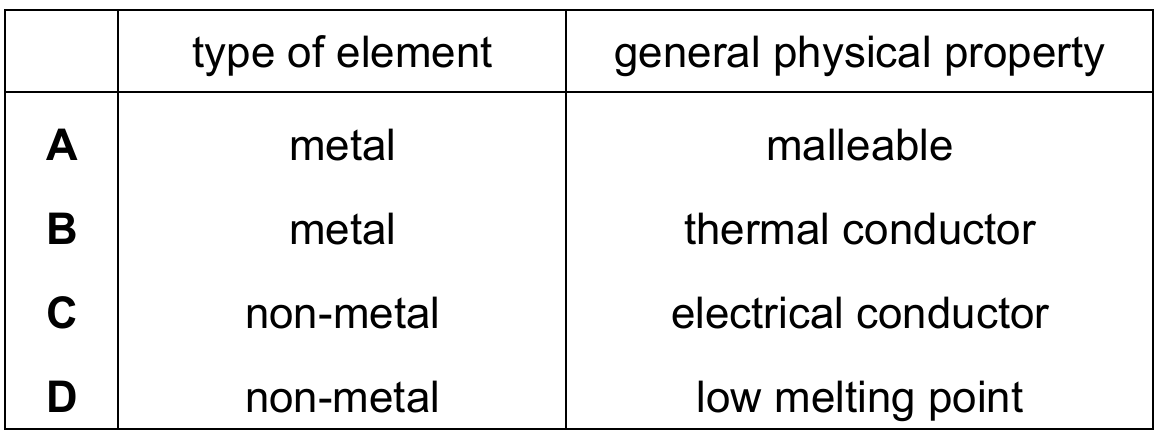
▶️ Answer/Explanation
Metals are correctly malleable and good thermal conductors, so rows A and B are correctly linked.
Non-metals generally have low melting points compared with metals, so row D is also a correct link.
However, non-metals are generally poor electrical conductors (with the exception of graphite), so linking “non-metal” with “electrical conductor” is incorrect.
✅ Answer: (C)
Non-metals generally have low melting points compared with metals, so row D is also a correct link.
However, non-metals are generally poor electrical conductors (with the exception of graphite), so linking “non-metal” with “electrical conductor” is incorrect.
✅ Answer: (C)

▶️ Answer/Explanation
Transition elements are metals, so they must conduct electricity — this rules out rows A and D.
Transition elements are also known for having high melting points, similar to real examples like iron (melting point 1538 °C).
A melting point of only 181 °C is too low to be typical of a transition metal, which rules out row B.
✅ Answer: (C)
Transition elements are also known for having high melting points, similar to real examples like iron (melting point 1538 °C).
A melting point of only 181 °C is too low to be typical of a transition metal, which rules out row B.
✅ Answer: (C)

▶️ Answer/Explanation
Metal ores are usually metal oxides, and carbon removes the oxygen from the metal oxide to leave the pure metal.
Since the ore loses oxygen in this reaction, it is reduced, while the carbon is oxidised to carbon dioxide.
It does not burn or thermally decompose in this specific reaction type.
✅ Answer: (D)
Since the ore loses oxygen in this reaction, it is reduced, while the carbon is oxidised to carbon dioxide.
It does not burn or thermally decompose in this specific reaction type.
✅ Answer: (D)

▶️ Answer/Explanation
Resultant force is the difference between two opposing forces, taken in the direction of the larger force.
For P: \( 12N – 4N = 8N \) in the direction of the 12 N force; for Q: \( 12N – 4N = 8N \), also in the direction of its own 12 N force.
Checking directions carefully, Q and S both give a resultant of \( 8N \) acting in the same direction as each other, while P and R give resultants in the opposite sense to one another.
✅ Answer: (D)
For P: \( 12N – 4N = 8N \) in the direction of the 12 N force; for Q: \( 12N – 4N = 8N \), also in the direction of its own 12 N force.
Checking directions carefully, Q and S both give a resultant of \( 8N \) acting in the same direction as each other, while P and R give resultants in the opposite sense to one another.
✅ Answer: (D)

▶️ Answer/Explanation
Salt solution and ethanol are not used to define fixed points, since impurities and different substances shift melting and boiling points.
The Celsius scale is standardised using pure substances at standard atmospheric pressure.
The lower fixed point is the melting point of pure ice (0 °C), and the upper fixed point is the boiling point of pure water (100 °C).
✅ Answer: (D)
The Celsius scale is standardised using pure substances at standard atmospheric pressure.
The lower fixed point is the melting point of pure ice (0 °C), and the upper fixed point is the boiling point of pure water (100 °C).
✅ Answer: (D)

▶️ Answer/Explanation
During melting and boiling, the energy supplied is used to overcome the forces of attraction between particles, not to increase their kinetic energy.
Because kinetic energy does not increase during these changes of state, the temperature stays constant throughout.
This means there is no change in temperature during either melting or boiling.
✅ Answer: (D)
Because kinetic energy does not increase during these changes of state, the temperature stays constant throughout.
This means there is no change in temperature during either melting or boiling.
✅ Answer: (D)

▶️ Answer/Explanation
A converging lens forms a real, inverted, enlarged image only when the object is placed between one and two focal lengths from the lens.
If the object is beyond two focal lengths, the image is diminished; inside one focal length, the image becomes virtual and upright.
The labelled point that lies between the principal focus F and twice the focal length from the lens is therefore the correct position.
✅ Answer: (B)
If the object is beyond two focal lengths, the image is diminished; inside one focal length, the image becomes virtual and upright.
The labelled point that lies between the principal focus F and twice the focal length from the lens is therefore the correct position.
✅ Answer: (B)


▶️ Answer/Explanation
Electrons are transferred away from the hair onto the balloon, so the hair loses negative charge and becomes positively charged.
The balloon gains extra electrons, so it becomes negatively charged.
Since positive and negative charges attract each other, this matches the observation that the hair is attracted to the balloon.
✅ Answer: (C)
The balloon gains extra electrons, so it becomes negatively charged.
Since positive and negative charges attract each other, this matches the observation that the hair is attracted to the balloon.
✅ Answer: (C)

▶️ Answer/Explanation
To measure current, the ammeter must be connected in series with the resistor so the same current flows through both.
To measure potential difference, the voltmeter must be connected in parallel across the resistor only.
The correct circuit places the ammeter in series with the resistor and the voltmeter in parallel across just the resistor.
✅ Answer: (A)
To measure potential difference, the voltmeter must be connected in parallel across the resistor only.
The correct circuit places the ammeter in series with the resistor and the voltmeter in parallel across just the resistor.
✅ Answer: (A)

▶️ Answer/Explanation
House lighting circuits connect lamps in parallel, not in series, so options C and D can be ruled out.
In a parallel circuit, each lamp gets the full supply voltage across it (rather than sharing it), so B is incorrect.
Because each lamp is on its own branch, it can be switched on or off independently without affecting the others.
✅ Answer: (A)
In a parallel circuit, each lamp gets the full supply voltage across it (rather than sharing it), so B is incorrect.
Because each lamp is on its own branch, it can be switched on or off independently without affecting the others.
✅ Answer: (A)

▶️ Answer/Explanation
Since the heater and motor are on parallel branches of the main supply, the total current drawn is \( 6.0A + 2.0A = 8.0A \).
A fuse must be rated just above the normal operating current so it doesn’t blow during normal use, but still trips quickly if there’s a fault.
A 6 A fuse would blow immediately since the total current already exceeds it, while a 10 A fuse allows normal operation and still protects against excess current.
✅ Answer: (D)
A fuse must be rated just above the normal operating current so it doesn’t blow during normal use, but still trips quickly if there’s a fault.
A 6 A fuse would blow immediately since the total current already exceeds it, while a 10 A fuse allows normal operation and still protects against excess current.
✅ Answer: (D)