
▶️ Answer/Explanation
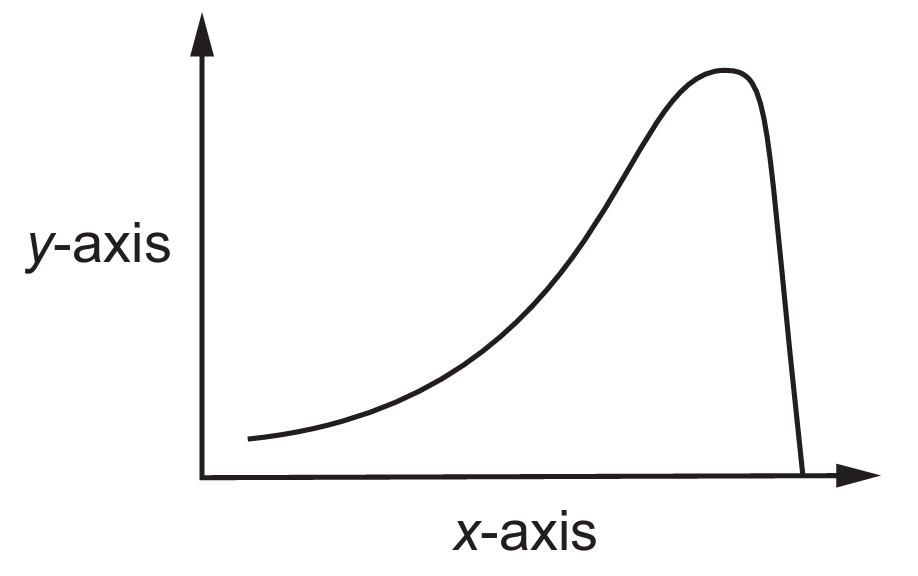
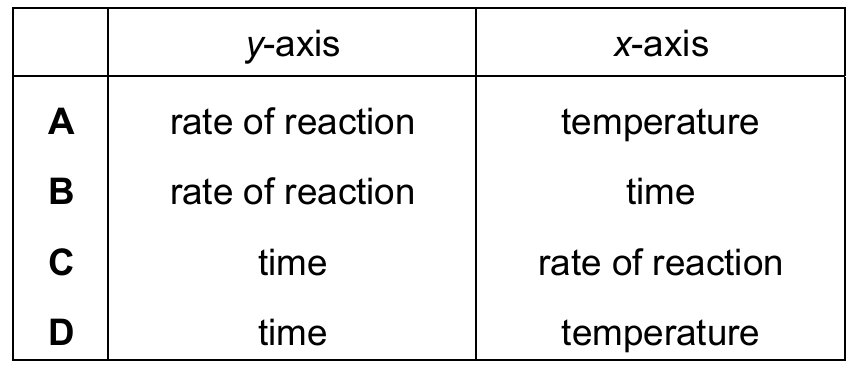
Enzyme-activity graphs plot the dependent variable, rate of reaction, on the y-axis.
The independent variable being changed, temperature, is plotted on the x-axis.
The curve typically rises to an optimum then falls sharply as the enzyme denatures at high temperature.
✅ Answer: (A)
The independent variable being changed, temperature, is plotted on the x-axis.
The curve typically rises to an optimum then falls sharply as the enzyme denatures at high temperature.
✅ Answer: (A)
▶️ Answer/Explanation
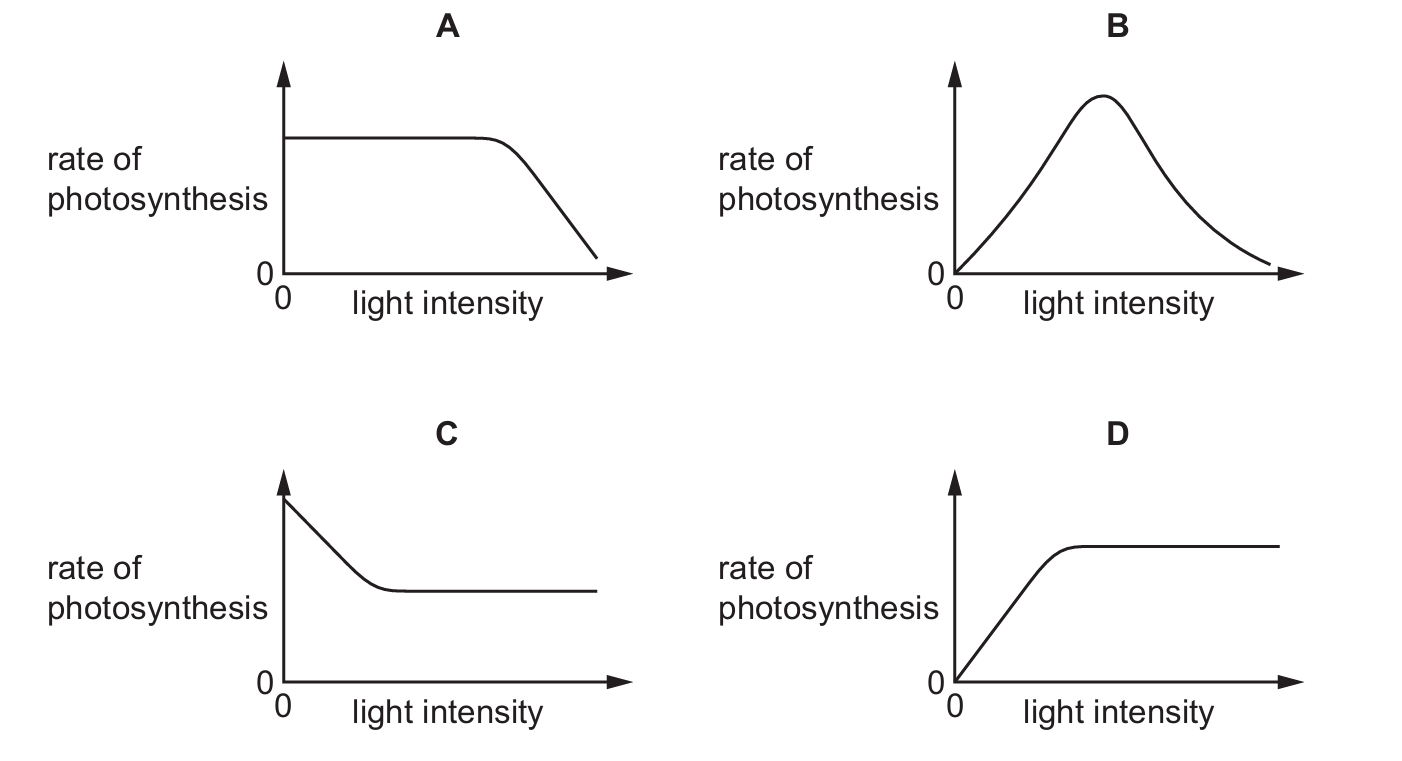
As light intensity increases from zero, the rate of photosynthesis rises proportionally at first.
Eventually another factor, such as carbon dioxide concentration or temperature, becomes limiting.
Beyond this point the rate levels off and stays constant even as light intensity keeps increasing, giving a curve that rises then plateaus.
✅ Answer: (D)
Eventually another factor, such as carbon dioxide concentration or temperature, becomes limiting.
Beyond this point the rate levels off and stays constant even as light intensity keeps increasing, giving a curve that rises then plateaus.
✅ Answer: (D)
▶️ Answer/Explanation
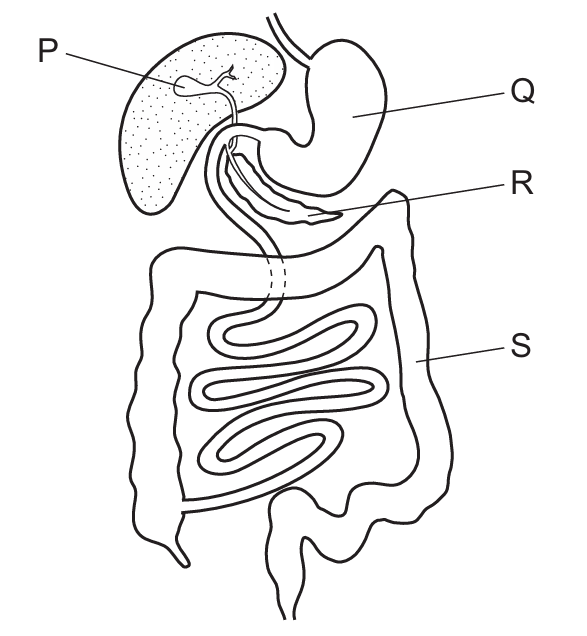
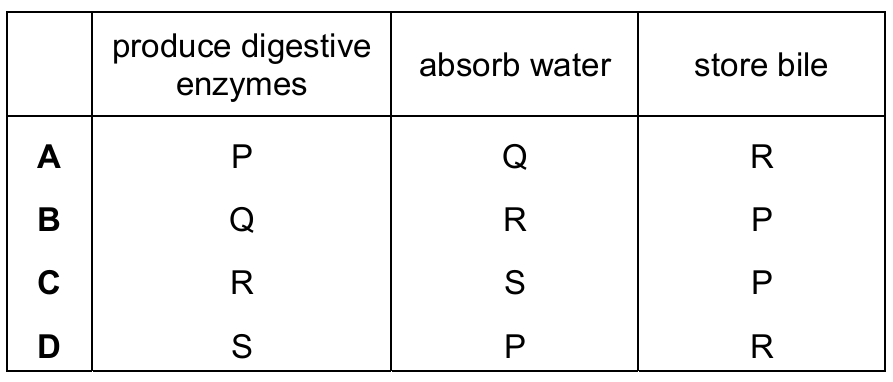
In the digestive system diagram, R is the labelled part corresponding to the small intestine, which secretes digestive enzymes.
S corresponds to the large intestine, which absorbs water from undigested food.
P corresponds to the gall bladder, which stores bile produced by the liver before it is released into the small intestine.
✅ Answer: (C)
S corresponds to the large intestine, which absorbs water from undigested food.
P corresponds to the gall bladder, which stores bile produced by the liver before it is released into the small intestine.
✅ Answer: (C)
▶️ Answer/Explanation
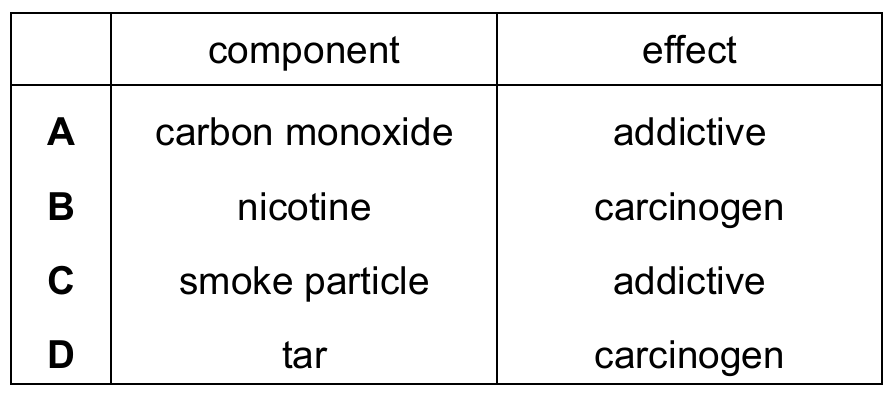
Carbon monoxide reduces the oxygen-carrying capacity of blood rather than being addictive.
Nicotine is the addictive component of tobacco smoke, not a carcinogen.
Smoke particles and tar together are linked to lung damage, with tar specifically identified as a carcinogen that can cause cancer.
✅ Answer: (D)
Nicotine is the addictive component of tobacco smoke, not a carcinogen.
Smoke particles and tar together are linked to lung damage, with tar specifically identified as a carcinogen that can cause cancer.
✅ Answer: (D)

▶️ Answer/Explanation
Between 30 and 60 minutes the graph shows blood glucose concentration rising back up during continued exercise.
Adrenaline released during exercise stimulates the liver to break down glycogen into glucose, raising blood glucose levels.
Increased insulin release would lower blood glucose rather than raise it, so option 3 does not fit the observed rise.
✅ Answer: (A)
Adrenaline released during exercise stimulates the liver to break down glycogen into glucose, raising blood glucose levels.
Increased insulin release would lower blood glucose rather than raise it, so option 3 does not fit the observed rise.
✅ Answer: (A)
▶️ Answer/Explanation
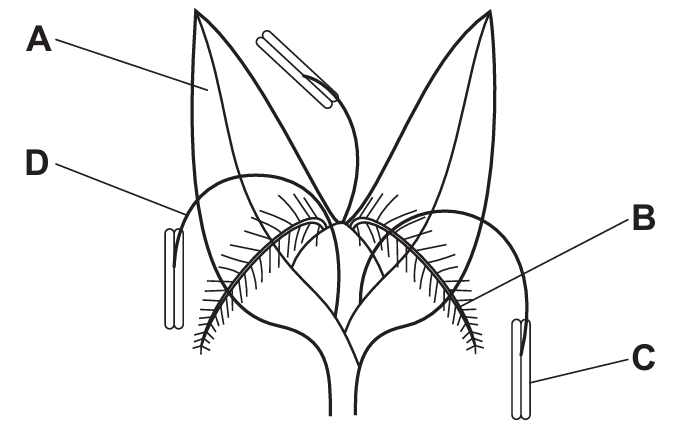
The stigma is the structure that receives pollen grains during pollination.
In wind-pollinated flowers, the stigma is typically large, feathery, and exposed outside the flower to catch airborne pollen.
This is distinct from the anther, which produces pollen, and the ovary, which contains the ovules.
✅ Answer: (B)
In wind-pollinated flowers, the stigma is typically large, feathery, and exposed outside the flower to catch airborne pollen.
This is distinct from the anther, which produces pollen, and the ovary, which contains the ovules.
✅ Answer: (B)
▶️ Answer/Explanation
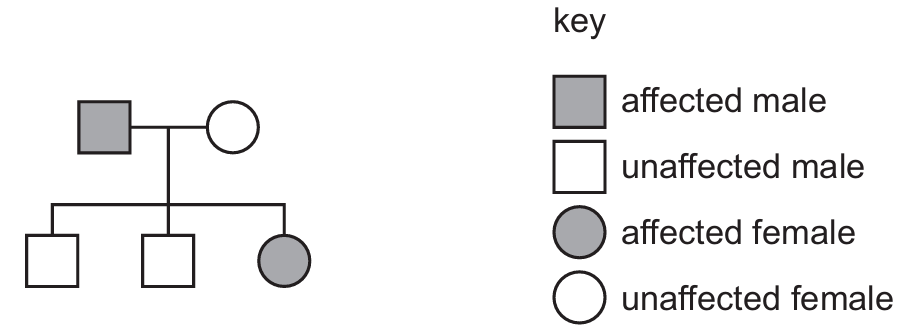
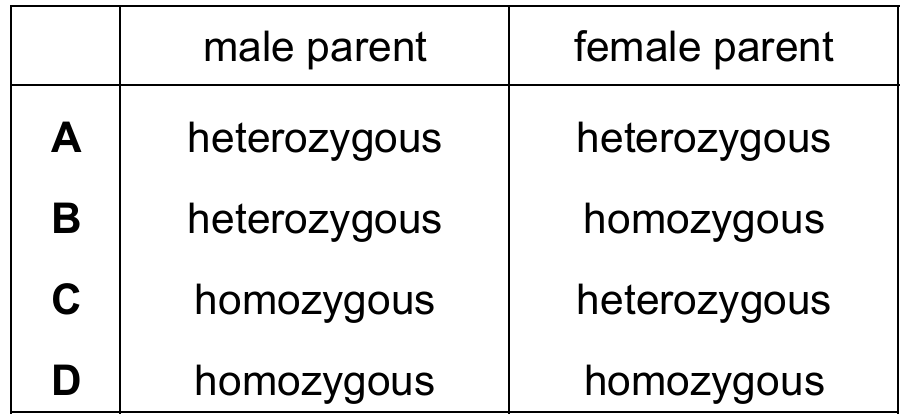
Cystic fibrosis is caused by a recessive allele, so an affected child must inherit one recessive allele from each parent.
If both unaffected parents in the pedigree have an affected child, both parents must carry the recessive allele while showing the unaffected phenotype.
This means both parents are heterozygous, i.e. carriers, for the cystic fibrosis allele.
✅ Answer: (A)
If both unaffected parents in the pedigree have an affected child, both parents must carry the recessive allele while showing the unaffected phenotype.
This means both parents are heterozygous, i.e. carriers, for the cystic fibrosis allele.
✅ Answer: (A)
▶️ Answer/Explanation
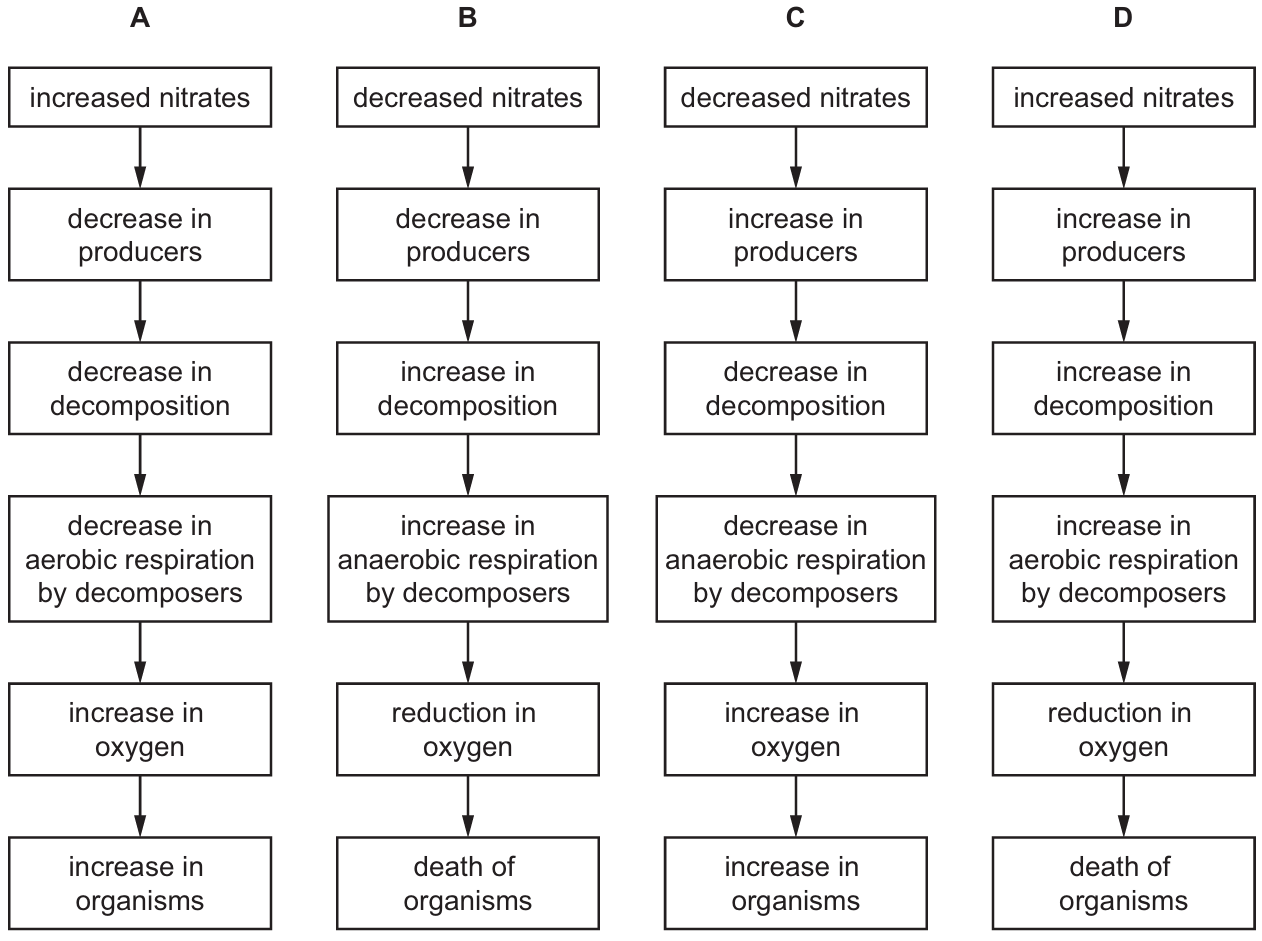
Eutrophication starts with increased nitrates entering water, usually from fertiliser runoff, which causes producers such as algae to increase rapidly.
This algal bloom blocks light, causing plant death and increased decomposition as decomposers respire aerobically to break down the extra dead matter.
This increased aerobic respiration by decomposers depletes dissolved oxygen, leading to the death of aquatic organisms such as fish.
✅ Answer: (D)
This algal bloom blocks light, causing plant death and increased decomposition as decomposers respire aerobically to break down the extra dead matter.
This increased aerobic respiration by decomposers depletes dissolved oxygen, leading to the death of aquatic organisms such as fish.
✅ Answer: (D)
▶️ Answer/Explanation
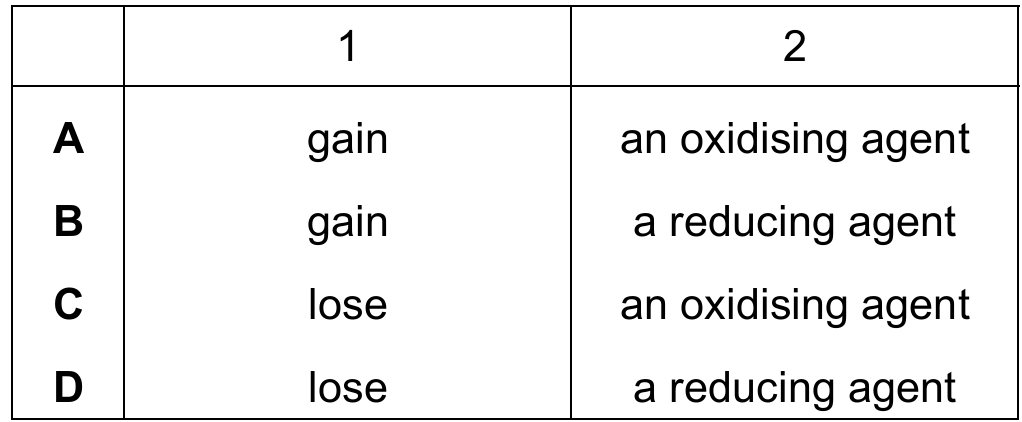
Sodium atoms each lose one electron to form \(\text{Na}^+\) ions, since sodium is being oxidised in this reaction.
Chlorine molecules gain those electrons to form \(\text{Cl}^-\) ions, meaning chlorine is reduced.
A substance that is reduced (gains electrons) while causing another substance to be oxidised is called an oxidising agent, so chlorine acts as the oxidising agent.
✅ Answer: (C)
Chlorine molecules gain those electrons to form \(\text{Cl}^-\) ions, meaning chlorine is reduced.
A substance that is reduced (gains electrons) while causing another substance to be oxidised is called an oxidising agent, so chlorine acts as the oxidising agent.
✅ Answer: (C)
▶️ Answer/Explanation
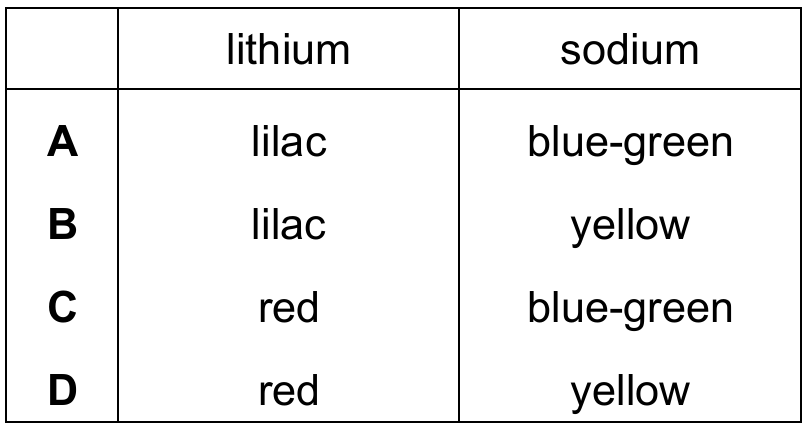
Lithium compounds produce a characteristic red flame colour in a flame test.
Sodium compounds produce a characteristic persistent yellow flame colour.
This rules out lilac (a potassium flame colour) and blue-green (a copper flame colour), leaving red and yellow as the correct pairing.
✅ Answer: (D)
Sodium compounds produce a characteristic persistent yellow flame colour.
This rules out lilac (a potassium flame colour) and blue-green (a copper flame colour), leaving red and yellow as the correct pairing.
✅ Answer: (D)
▶️ Answer/Explanation
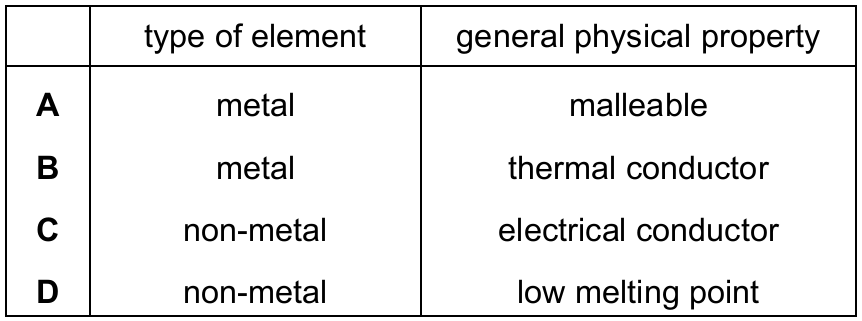
Metals are generally malleable and good thermal conductors, so rows A and B correctly link property to element type.
Non-metals typically have low melting points compared to metals, so row D is also a correct link.
Non-metals are generally poor electrical conductors, not good ones (except graphite), so row C incorrectly links electrical conductor to non-metal.
✅ Answer: (C)
Non-metals typically have low melting points compared to metals, so row D is also a correct link.
Non-metals are generally poor electrical conductors, not good ones (except graphite), so row C incorrectly links electrical conductor to non-metal.
✅ Answer: (C)
▶️ Answer/Explanation
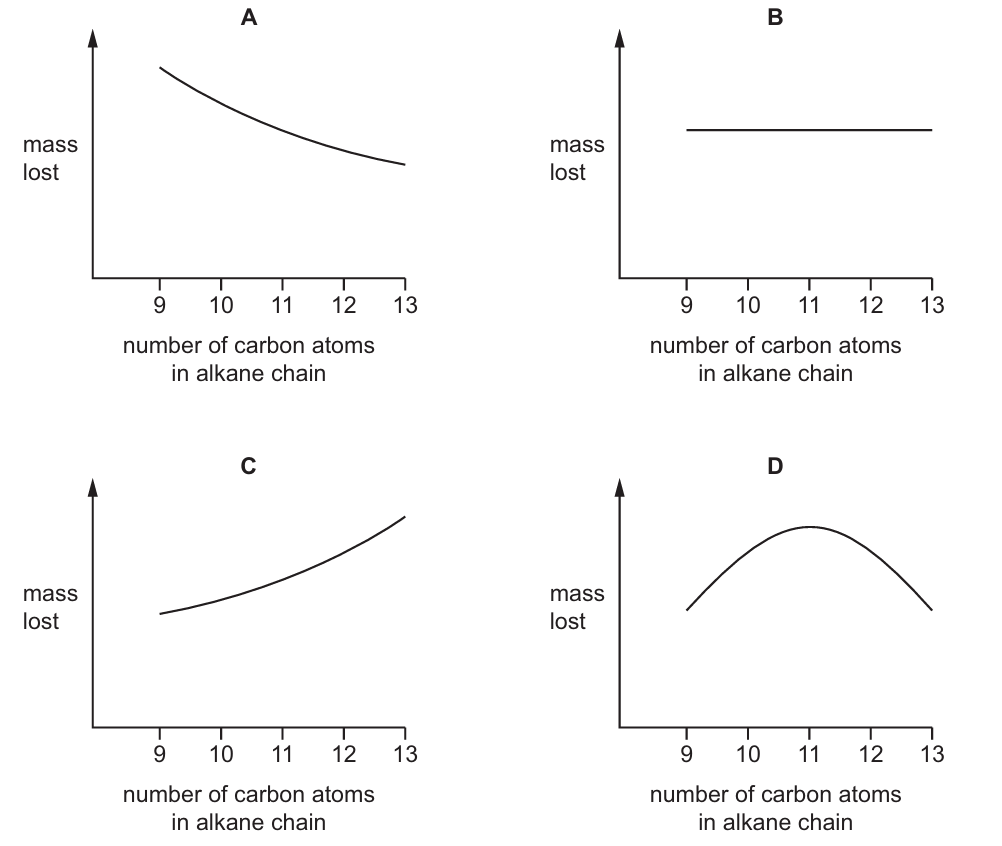
Longer alkane chains have stronger intermolecular (van der Waals) forces due to a greater number of electrons and surface area of contact between molecules.
Stronger intermolecular forces mean more energy is needed for molecules to escape into the gas phase, so evaporation is slower.
This means mass lost through evaporation decreases steadily as the number of carbon atoms in the chain increases, giving a downward-sloping line.
✅ Answer: (A)
Stronger intermolecular forces mean more energy is needed for molecules to escape into the gas phase, so evaporation is slower.
This means mass lost through evaporation decreases steadily as the number of carbon atoms in the chain increases, giving a downward-sloping line.
✅ Answer: (A)
▶️ Answer/Explanation
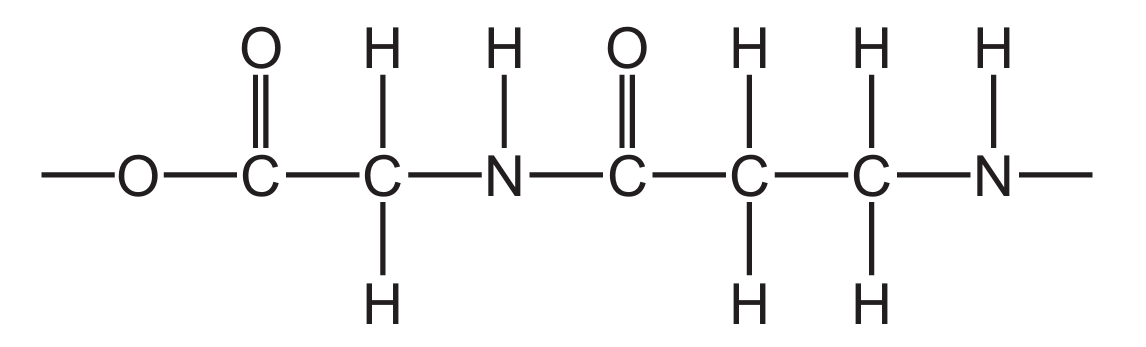
The repeat unit shown contains amide (\(-\text{CONH}-\)) linkages joining carbon chains of different lengths on either side, so this is a condensation polymer formed from two different amino-acid-like monomers rather than a diamine-diacid pair.
Each monomer here contains both an amine group (\(-\text{NH}_2\)) and a carboxylic acid group (\(-\text{CO}_2\text{H}\)) on the same molecule, since the polymer alternates between two distinct amino-acid-type units of different chain lengths.
Options A, B, and C describe diamine + diacid monomer pairs (like nylon), which don’t match the mixed-length, single-monomer-type linkage pattern shown, whereas \(\text{HO}_2\text{CCH}_2\text{NH}_2\) and \(\text{HO}_2\text{CCH}_2\text{CH}_2\text{NH}_2\) fit the structure.
✅ Answer: (D)
Each monomer here contains both an amine group (\(-\text{NH}_2\)) and a carboxylic acid group (\(-\text{CO}_2\text{H}\)) on the same molecule, since the polymer alternates between two distinct amino-acid-type units of different chain lengths.
Options A, B, and C describe diamine + diacid monomer pairs (like nylon), which don’t match the mixed-length, single-monomer-type linkage pattern shown, whereas \(\text{HO}_2\text{CCH}_2\text{NH}_2\) and \(\text{HO}_2\text{CCH}_2\text{CH}_2\text{NH}_2\) fit the structure.
✅ Answer: (D)

▶️ Answer/Explanation
The resultant force is found by subtracting the resistive force from the driving force: \(3000 – 2500 = 500\ \text{N}\).
Using \(F = ma\), rearranged to \(a = \frac{F}{m}\), gives \(a = \frac{500}{1000} = 0.5\ \text{m/s}^2\).
This resultant force acts in the direction of motion, so the car accelerates forward at 0.50 m/s².
✅ Answer: (A)
Using \(F = ma\), rearranged to \(a = \frac{F}{m}\), gives \(a = \frac{500}{1000} = 0.5\ \text{m/s}^2\).
This resultant force acts in the direction of motion, so the car accelerates forward at 0.50 m/s².
✅ Answer: (A)
▶️ Answer/Explanation
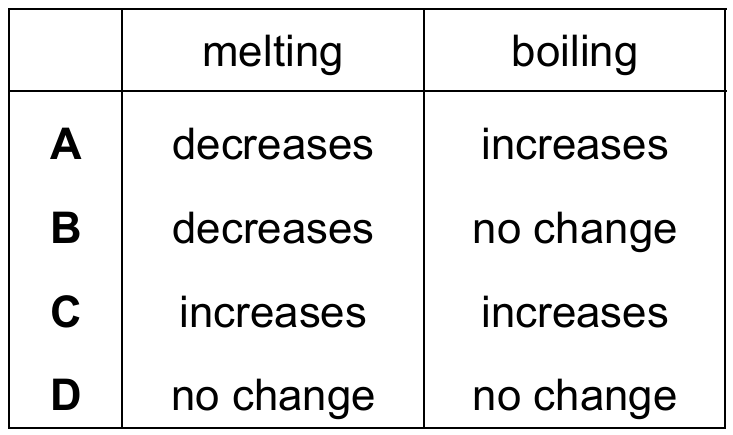
During melting, energy supplied is used entirely to overcome the forces holding particles in a fixed arrangement, not to increase kinetic energy.
The same applies during boiling, where energy breaks intermolecular forces to separate particles into a gas.
Since none of the added energy increases particle kinetic energy during either process, temperature stays constant throughout both melting and boiling.
✅ Answer: (D)
The same applies during boiling, where energy breaks intermolecular forces to separate particles into a gas.
Since none of the added energy increases particle kinetic energy during either process, temperature stays constant throughout both melting and boiling.
✅ Answer: (D)
▶️ Answer/Explanation
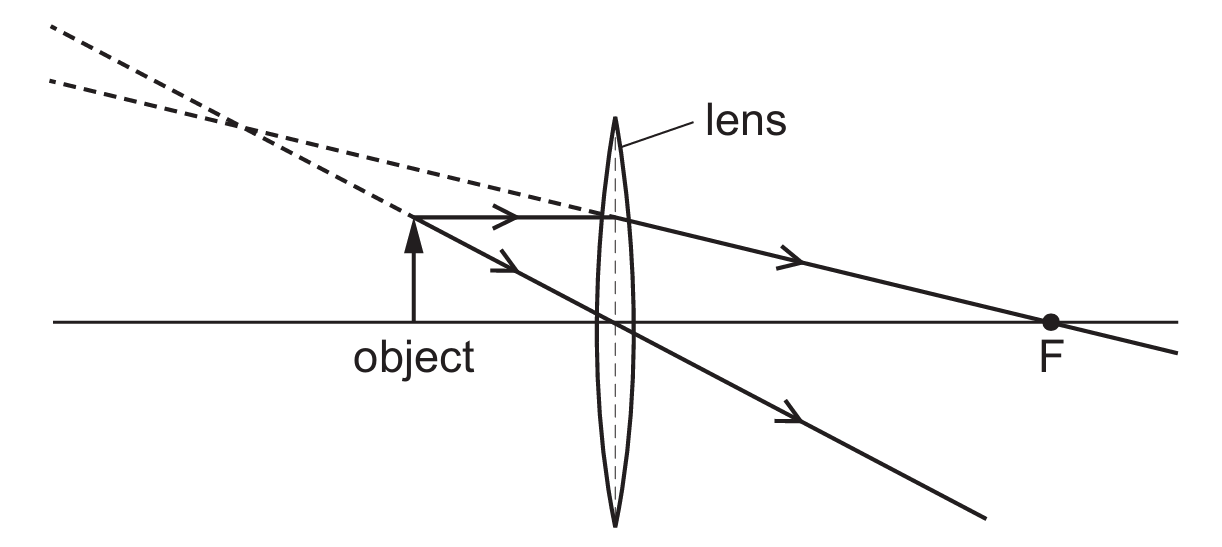
With the object placed close to the lens between the principal focus F and the lens itself, the rays diverge after passing through and don’t actually converge on the far side.
This means the image formed is virtual, since it can’t be projected onto a screen.
An object placed inside the focal length of a converging lens always produces an image that is enlarged and upright compared to the object.
✅ Answer: (B)
This means the image formed is virtual, since it can’t be projected onto a screen.
An object placed inside the focal length of a converging lens always produces an image that is enlarged and upright compared to the object.
✅ Answer: (B)
▶️ Answer/Explanation
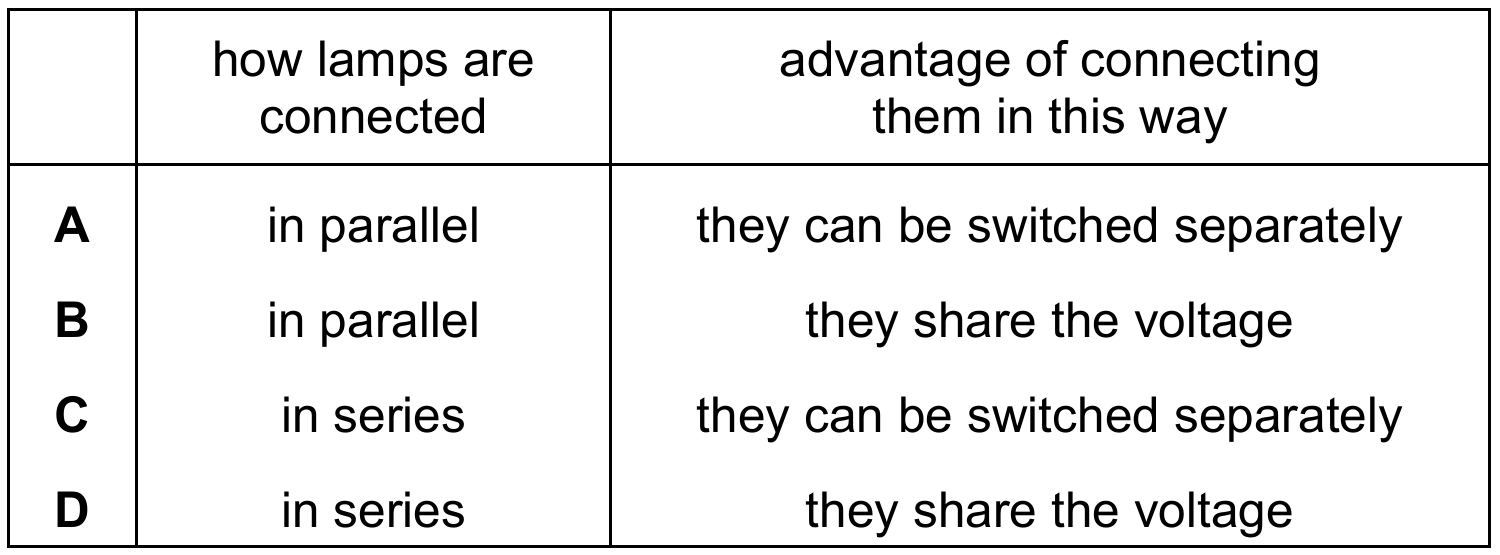
House lighting circuits connect lamps in parallel so that each lamp receives the full supply voltage independently.
Because each lamp is on its own separate branch, individual lamps can be switched on or off without affecting the others.
If lamps were connected in series instead, turning one lamp off would break the circuit and turn off all the other lamps too.
✅ Answer: (A)
Because each lamp is on its own separate branch, individual lamps can be switched on or off without affecting the others.
If lamps were connected in series instead, turning one lamp off would break the circuit and turn off all the other lamps too.
✅ Answer: (A)
▶️ Answer/Explanation
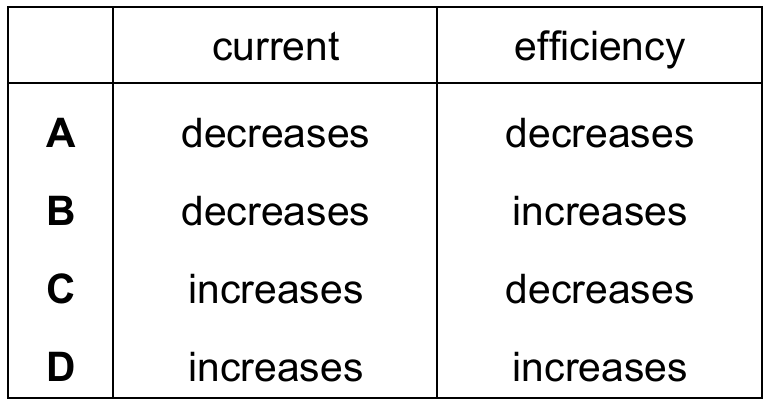
Since power equals voltage multiplied by current, increasing voltage for the same transmitted power means the current must decrease.
Energy lost as heat in the cables depends on current squared multiplied by resistance, so a lower current greatly reduces these losses.
Reducing energy losses in the cables increases the overall efficiency of energy transfer.
✅ Answer: (B)
Energy lost as heat in the cables depends on current squared multiplied by resistance, so a lower current greatly reduces these losses.
Reducing energy losses in the cables increases the overall efficiency of energy transfer.
✅ Answer: (B)
▶️ Answer/Explanation
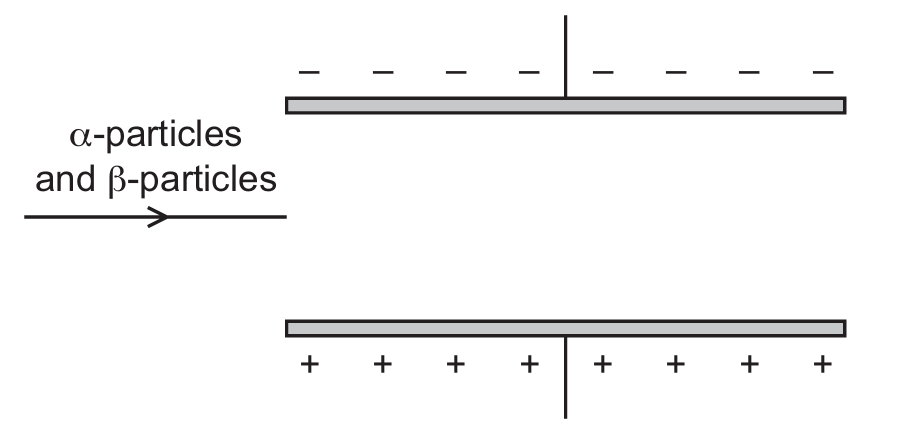
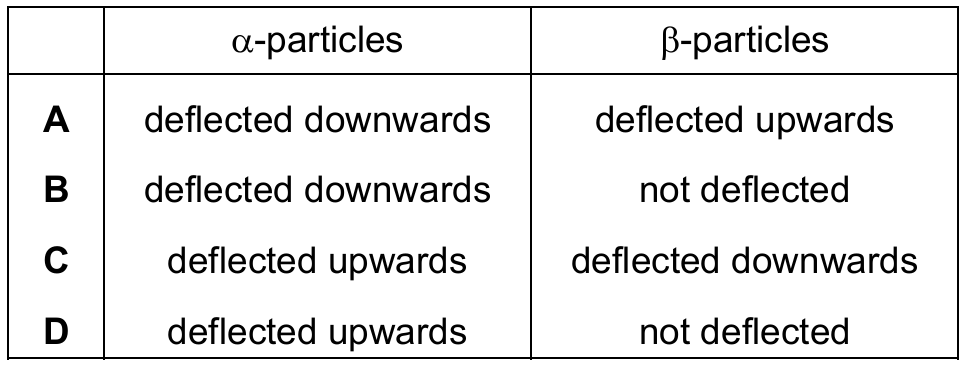
The diagram shows the top plate positive and the bottom plate negative, so positive charges are pulled towards the bottom (negative) plate.
Alpha particles are positively charged, so they are deflected downwards towards the negative plate.
Beta particles are negatively charged, so they are deflected in the opposite direction, upwards towards the positive plate.
✅ Answer: (A)
Alpha particles are positively charged, so they are deflected downwards towards the negative plate.
Beta particles are negatively charged, so they are deflected in the opposite direction, upwards towards the positive plate.
✅ Answer: (A)