
Question 1

The students press a button as quickly as possible after the button lights up.
Table 1.1 shows the results.

In this reaction, suggest the name of the:
effector ………………………….
coordinator. ………………………….
Most-appropriate topic codes (Cambridge IGCSE Co-ordinated Sciences 0654):
• Topic B13.1 — Coordination and response (Parts (a)(i), (a)(ii), (a)(iii), (a)(iv), (b)(ii))
• Topic B1.1 — Characteristics of living organisms / data handling (Part (b)(i))
▶️ Answer/Explanation
(a)(i) B
The motor neurone carries impulses from the central nervous system to an effector.
In Fig. 1.1, neurone B has the long axon and structure typical of a motor neurone.
(a)(ii) As electrical signals
Nerve impulses travel along neurones as electrical signals.
These signals result from the movement of ions across the neurone’s membrane, generating an action potential that passes along the axon.
(a)(iii) Sensory neurone; relay neurone
The sensory neurone carries the impulse from the receptor to the spinal cord.
The relay neurone connects the sensory neurone to the motor neurone within the spinal cord.
(a)(iv) automatic; rapid
A reflex action happens without conscious thought, so it is automatic.
It also happens very quickly to protect the body, so it is rapid.
(b)(i) 0.15 s
Average = \( \frac{0.15 + 0.15 + 0.16 + 0.16 + 0.15}{5} \).
Average = \( \frac{0.77}{5} = 0.154 \, \text{s} \).
To two significant figures, this rounds to \( 0.15 \, \text{s} \).
(b)(ii) effector: muscles (in the hand/finger); coordinator: brain/CNS
The effector is the muscle that carries out the response, here the muscles of the hand/finger pressing the button.
The coordinator processes the information from the eye and decides the response; in a voluntary reaction this is the brain (CNS), unlike a simple reflex arc where the spinal cord alone is enough.
Question 2
During this reaction, a gas and an aqueous solution of a salt are made.
State the method used to remove the unreacted solid magnesium from the reaction mixture.
State two other ways of decreasing the rate of this reaction.

Most-appropriate topic codes (Cambridge IGCSE Co-ordinated Sciences 0654):
• Topic C2.1 — Elements, compounds and mixtures (Part (a))
• Topic C9.4 — Reactivity series (Part (b)(i)–(iii))
• Topic C6.2 — Rate of reaction (Part (b)(iv))
• Topic C9.3 — Alloys and their properties (Part (c))
▶️ Answer/Explanation
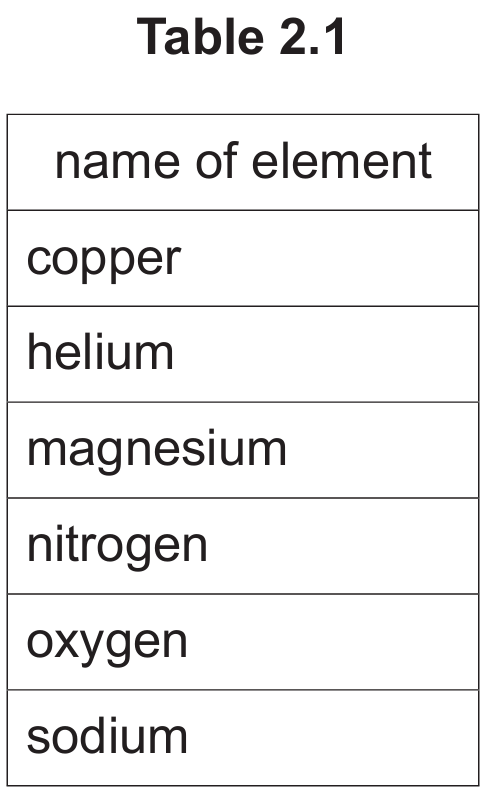
(a)(i) Copper and magnesium (or sodium)
Metallic elements are good conductors of heat and electricity, malleable and ductile.
Copper, magnesium, and sodium in Table 2.1 all display these metallic properties, so any two may be given.
(a)(ii) Nitrogen
Clean, dry air is approximately \( 78\% \) nitrogen, \( 21\% \) oxygen, and \( 1\% \) other gases.
Nitrogen is therefore the element making up 78% of clean air.
(a)(iii) Helium
Noble gases are unreactive elements found in Group VIII (Group 0) of the Periodic Table.
Helium is the only noble gas listed in Table 2.1.
(a)(iv) Copper
Transition elements are found in the central block of the Periodic Table and often form coloured compounds.
Copper is the transition element in the list.
(b)(i) \( \text{H}_2 \)
Magnesium reacts with dilute hydrochloric acid to release hydrogen gas.
The chemical formula of hydrogen gas is \( \text{H}_2 \).
(b)(ii) Magnesium chloride
Magnesium (a metal) reacting with hydrochloric acid forms a chloride salt.
The salt produced is magnesium chloride, \( \text{MgCl}_2 \).
(b)(iii) Filtration
The unreacted solid magnesium is insoluble, while the magnesium chloride solution is soluble.
Filtration separates the insoluble solid from the solution.
(b)(iv) Decrease the surface area/increase particle size of magnesium; decrease the temperature
A smaller surface area means fewer collisions between reacting particles per second, slowing the reaction.
A lower temperature means particles have less kinetic energy and collide less frequently and with less energy, also slowing the reaction.
(c)(i) A mixture of a metal with one or more other elements
An alloy is a mixture of metals, or a mixture of a metal and another element.
Alloys are often made to improve on the properties of the pure metal, such as strength.
(c)(ii) 1840 kg
Magnesium makes up \( 92\% \) of the alloy by mass.
Mass of magnesium = \( \frac{92}{100} \times 2000 = 1840 \, \text{kg} \).
Question 3

State one harmful effect of ionising radiation on humans.


State the two measurements that she makes.
Describe how she uses these measurements to calculate the speed of sound.
Most-appropriate topic codes (Cambridge IGCSE Co-ordinated Sciences 0654):
• Topic P3.3 — Electromagnetic spectrum (Part (a))
• Topic P3.4 — Sound (Part (b))
▶️ Answer/Explanation
(a)(i) Diagnosing broken bones
X-rays pass more easily through soft tissue than through dense bone.
This difference in absorption allows X-ray images to show the position and condition of bones, helping to diagnose fractures.
(a)(ii) X-rays placed between visible light and γ-radiation, next to γ-radiation
The electromagnetic spectrum is ordered by increasing frequency: radio waves, microwaves, infrared, visible light, ultraviolet, X-rays, γ-radiation.
X-rays have a higher frequency than ultraviolet but a lower frequency than γ-radiation, so they are placed in the box next to γ-radiation.
(a)(iii) Cancer/mutation
Ionising radiation has enough energy to remove electrons from atoms and damage DNA.
This DNA damage can cause mutations, which may lead to cancer.
(b)(i)
Amplitude is the distance between the top and the middle of a wave.
Frequency is the number of waves passing a point every second.
Wavelength is the distance between the tops of two consecutive waves.
(b)(ii) 20 Hz to 20,000 Hz
A healthy human ear can typically detect sounds from \( 20 \, \text{Hz} \) up to \( 20\,000 \, \text{Hz} \).
Sounds below this range are infrasound, and sounds above are ultrasound.
(b)(iii) Measure distance and time; speed = distance ÷ time
The student measures the distance travelled by the sound and the time taken for it to travel that distance.
She then calculates the speed of sound using \( \text{speed} = \frac{\text{distance}}{\text{time}} \).
Question 4

The enzyme with the lowest optimum pH is enzyme …………………………..
The two enzymes with the same optimum pH are enzymes …………………………… and ……………………………
The enzyme that works best in neutral conditions is enzyme ……………………………
Enzymes are proteins that function as ……………………………………. catalysts.
Most-appropriate topic codes (Cambridge IGCSE Co-ordinated Sciences 0654):
• Topic B5.1 — Enzymes (Parts (a), (b), (c))
• Topic B4.1 — Biological molecules (Parts (d), (e))
▶️ Answer/Explanation
(a) B; A and C; E
Reading the bar chart, enzyme B has the lowest optimum pH at about 1.5.
Enzymes A and C both have an optimum pH of 8.
Enzyme E has an optimum pH of 7, which is neutral.
(b) Temperature
Enzyme activity is also affected by temperature.
Too low a temperature slows the reaction, while too high a temperature denatures the enzyme.
(c) Biological
Enzymes are proteins produced by living organisms that speed up chemical reactions.
They are described as biological catalysts because they work in the same way as chemical catalysts but are made by cells.
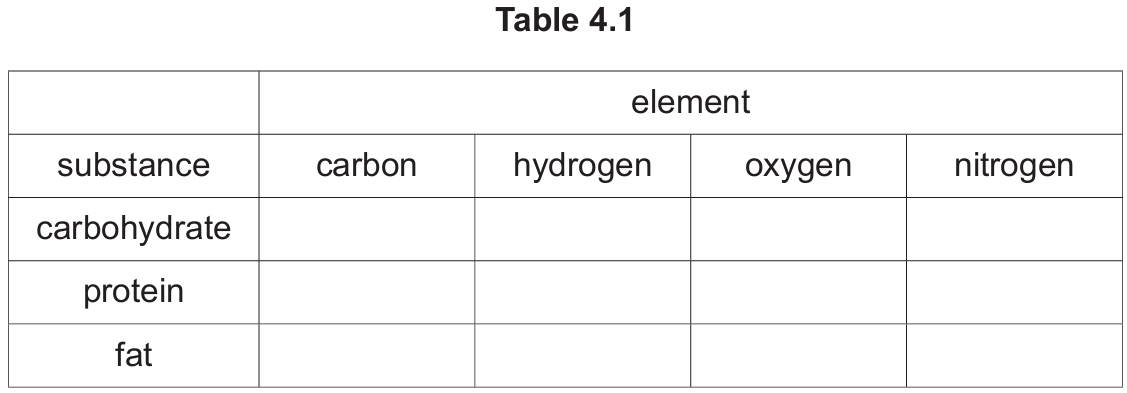
(d)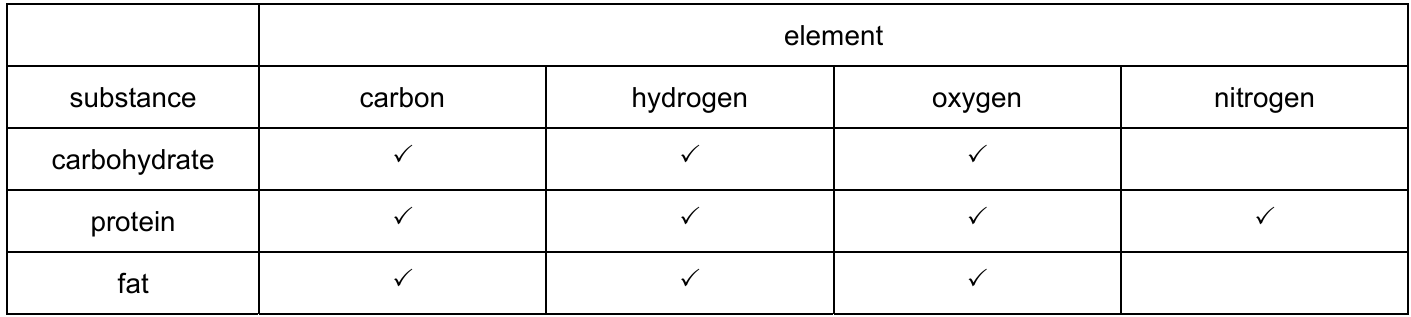
Carbohydrate is made from carbon, hydrogen, and oxygen only.
Protein is made from carbon, hydrogen, oxygen, and nitrogen.
Fat is made from carbon, hydrogen, and oxygen only.
(e)(i) Glucose
Starch is a polysaccharide made of many glucose molecules joined together.
These glucose units are linked by condensation reactions to form the long starch chain.
(e)(ii) Glycogen
Glycogen is a carbohydrate, being the storage polysaccharide found in animals.
Amino acids and fatty acids are not carbohydrates, and oil is a lipid.
Question 5
Describe the reaction, if any, for each metal.
Copper(II) sulfate, carbon dioxide and water are made.

State the name of one other greenhouse gas.
State the number of different elements and the total number of atoms shown in this formula.
Most-appropriate topic codes (Cambridge IGCSE Co-ordinated Sciences 0654):
• Topic C9.4 — Reactivity series (Part (a))
• Topic C7.3 — Preparation of salts (Part (b))
• Topic C9.6 — Extraction of metals (Part (c))
▶️ Answer/Explanation
(a) Calcium: gas evolved/metal dissolves/white insoluble solid forms; copper: no change
Calcium is reactive enough to react with cold water, producing hydrogen gas and calcium hydroxide.
Copper is unreactive and does not react with cold water, so no change is observed.
(b)(i) copper carbonate + sulfuric acid → copper sulfate + carbon dioxide + water
Copper carbonate reacts with the acid in a typical carbonate–acid reaction.
This produces a salt (copper sulfate), carbon dioxide gas, and water.
(b)(ii) Methane
Methane is a common greenhouse gas alongside carbon dioxide.
Other acceptable answers include water vapour or nitrous oxide.
(b)(iii) Number of elements = 3; number of atoms = 6
\( \text{CuSO}_4 \) contains three different elements: copper, sulfur, and oxygen.
Counting atoms gives \( 1 \, \text{Cu} + 1 \, \text{S} + 4 \, \text{O} = 6 \) atoms in total.
(c)(i) Loss of oxygen
In the equation, CuO loses its oxygen atom to become Cu.
Since reduction is defined as the loss of oxygen, this shows CuO is reduced.
(c)(ii) Gives out (thermal) energy
An exothermic reaction transfers thermal energy to the surroundings.
This usually causes the temperature of the surroundings to increase.
(c)(iii) Iron
Iron is less reactive than carbon, so it can be extracted from its ore by heating with carbon.
This is the basis of the blast furnace method of iron extraction.
Question 6
Suggest why the farmer should have an alternative method of generating electricity rather than relying on just solar energy.
Four forces, A, B, C and D, are acting on the tractor.

The weight of the tractor is 40,000 N.
The gravitational field strength, \( g \), is 10 N/kg.
State the value of force D.
Explain your answer.
State the form of energy stored in the diesel fuel.
Fig. 6.2 shows the speed-time graph for the tractor.

Most-appropriate topic codes (Cambridge IGCSE Co-ordinated Sciences 0654):
• Topic P1.6.3 — Energy resources (Part (a))
• Topic P1.5.1 — Effects of forces (Part (b))
• Topic P1.6.1 — Energy (Part (c))
• Topic P1.2 — Motion (Part (d))
▶️ Answer/Explanation
(a) Electricity will not be generated at night
Solar panels only produce electricity when there is sufficient sunlight.
An alternative source ensures the farm still has power at night or during cloudy weather.
(b)(i) C
Weight always acts vertically downwards on an object.
In Fig. 6.1, force C points downwards, so it represents the weight of the tractor.
(b)(ii) 4000 kg
Using \( W = mg \), rearranged to \( m = \frac{W}{g} \).
\( m = \frac{40\,000}{10} = 4000 \, \text{kg} \).
(b)(iii) 2000 N; because the tractor moves at constant speed
At constant speed, there is no resultant force acting on the tractor.
So the forward force B must be balanced exactly by the opposing force D, making \( D = 2000 \, \text{N} \).
(c) Chemical (potential) energy
Fuels like diesel store energy in the chemical bonds of their molecules.
This chemical potential energy is released and converted to kinetic energy during combustion.
(d)(i) 2.0 m/s
Reading the graph, the horizontal section representing constant maximum speed sits at \( 2.0 \, \text{m/s} \).
This is the highest value reached on the speed axis.
(d)(ii) X marked between 0–5 s or 15–20 s
Changing speed corresponds to the sloped sections of the graph.
These occur between 0 s and 5 s (accelerating) and between 15 s and 20 s (decelerating).
(d)(iii) 5 m
Distance travelled equals the area under the speed-time graph.
Between 15 s and 20 s this is a triangle: \( \text{distance} = \frac{1}{2} \times 5 \times 2 = 5 \, \text{m} \).
Question 7

Most-appropriate topic codes (Cambridge IGCSE Co-ordinated Sciences 0654):
• Topic B11.1 — Gas exchange in humans (Parts (a), (b))
• Topic B9.3 — Blood vessels (Part (c))
• Topic B9.4 — Blood (Part (d))
• Topic B13.2 — Hormones (Part (e))
▶️ Answer/Explanation
(a)(i) and (ii) Rib and diaphragm correctly labelled
The rib is one of the curved bones forming the ribcage around the lungs.
The diaphragm is the sheet of muscle located beneath the lungs, forming the floor of the thorax.
(b) Inspired air has more oxygen and less carbon dioxide and water vapour than expired air
During gas exchange, oxygen diffuses from inhaled air into the blood, while carbon dioxide diffuses from the blood into the air.
Expired air also gains water vapour from the moist lining of the lungs, so it is more oxygen-poor and richer in carbon dioxide and water vapour than inspired air.
(c) Pulmonary vein/pulmonary artery
The pulmonary artery carries deoxygenated blood from the heart to the lungs.
The pulmonary vein carries oxygenated blood from the lungs back to the heart.
(d)(i) Red blood cells
Red blood cells contain haemoglobin, which binds to oxygen.
This allows oxygen to be transported efficiently around the body.
(d)(ii) Plasma
Plasma is the liquid part of the blood.
It carries dissolved substances such as hormones, nutrients, and waste products.
(e) Adrenaline
Adrenaline is released by the adrenal glands in response to stress or danger.
It prepares the body for a ‘fight or flight’ response by increasing heart rate and redirecting blood to the muscles.
Question 8


- anode
- cathode
- electrolyte.
Most-appropriate topic codes (Cambridge IGCSE Co-ordinated Sciences 0654):
• Topic C8.3 — Group VII properties (Part (a))
• Topic C2.5 — Simple molecules and covalent bonds (Part (b))
• Topic C4.1 — Electrolysis (Part (c))
▶️ Answer/Explanation
(a)(i) Chlorine – gas; iodine – solid
Chlorine has a low boiling point and exists as a gas at room temperature.
Iodine has a much higher melting point and exists as a solid at room temperature.
(a)(ii) \( \text{Br}_2 \)
Halogens exist as diatomic molecules, with two atoms joined by a single covalent bond.
For bromine, this gives the formula \( \text{Br}_2 \).
(a)(iii) Seven/VII
The halogens are found in Group VII (Group 17) of the Periodic Table.
Elements in this group have seven electrons in their outer shell.
(a)(iv) 53
In a neutral atom, the number of electrons equals the number of protons (the proton/atomic number).
Iodine has a proton number of 53, so it has 53 electrons.
(b) Covalent; between two non-metals/electrons are shared
Chlorine and hydrogen are both non-metals.
When non-metals bond, they share pairs of electrons, forming a covalent bond.
(c)(i) Anode: C; cathode: E; electrolyte: D
The anode is the positive electrode, connected to the positive terminal of the supply.
The cathode is the negative electrode, and the electrolyte is the molten compound (D) that conducts the current via its ions.
(c)(ii) Bromine; lead
At the anode, bromide ions lose electrons (oxidation) to form bromine gas.
At the cathode, lead ions gain electrons (reduction) to form molten lead metal.
Question 9

the copper saucepan
the water.
The current in the copper wire is 0.5 A.
The potential difference (p.d.) across the copper wire is 4.0 V.
Calculate the resistance of the wire.
State the unit of your answer.

State how this observation would change if the current is reversed.
Most-appropriate topic codes (Cambridge IGCSE Co-ordinated Sciences 0654):
• Topic C1.1 — States of matter (Part (a))
• Topic P2.3.4 — Consequences of thermal energy transfer (Part (b))
• Topic P4.2.4 — Resistance (Part (c))
• Topic P4.5.4 — Force on a current-carrying conductor (Part (d))
▶️ Answer/Explanation
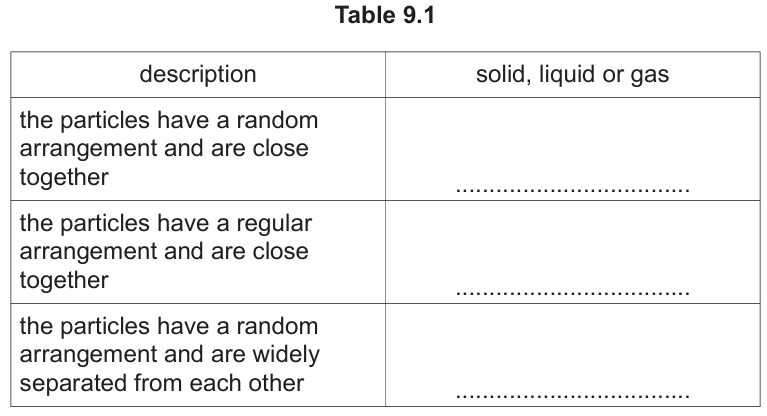
(a) Random and close = liquid; regular and close = solid; random and widely separated = gas
In a liquid, particles are close together but can move past one another, giving a random arrangement.
In a solid, particles are close together in a fixed, regular arrangement, while in a gas they are far apart and move randomly.
(b)(i) Copper saucepan: conduction; water: convection
Heat travels through the solid copper saucepan by conduction, as vibrating particles pass energy to neighbouring particles.
Heat travels through the water by convection, as warmer, less dense water rises and cooler water sinks, setting up a circulating current.
(b)(ii) Plastic is an insulator
Plastic is a poor conductor of heat, unlike copper which conducts heat very well.
Using plastic for the handle keeps it cool enough to hold safely.
(c) 8 Ω
Using Ohm’s law, \( R = \frac{V}{I} \).
\( R = \frac{4.0}{0.5} = 8 \, \Omega \).
(d) The wire moves downwards/the opposite way
The direction of the force on a current-carrying wire in a magnetic field depends on the direction of the current.
Reversing the current reverses the direction of the force, so the wire moves downwards instead of upwards.
Question 10

where photosynthesis occurs …………………………………….
the part which controls the cell’s activities …………………………………….
where water vapour is lost from the leaf. …………………………………….
The student removes different substances from the environment the plant is in.
They then record if the plant photosynthesises.
Table 10.1 shows a summary of their results.

Predict the effect on photosynthesis if the investigation is repeated with no light.
Give a reason for your answer.
Most-appropriate topic codes (Cambridge IGCSE Co-ordinated Sciences 0654):
• Topic B6.1 — Photosynthesis (Parts (a), (b), (c))
• Topic B8.1 — Xylem and phloem (Part (d))
▶️ Answer/Explanation
(a)(i) Photosynthesis: C; controls cell activities: A; water vapour lost: F
Photosynthesis occurs mainly in the palisade mesophyll cells (C), which contain many chloroplasts.
The nucleus (A) controls the cell’s activities, and water vapour is lost through the stomata (F) in the lower epidermis.
(a)(ii) Lower epidermis
Part E forms the bottom layer of cells of the leaf.
This layer is called the lower epidermis and contains the stomata.
(b)(i) Oxygen
Removing oxygen only still allowed the plant to photosynthesise (result: yes).
This shows oxygen is not required as a raw material for photosynthesis.
(b)(ii) Prediction: no photosynthesis; reason: light is required
Light provides the energy needed to drive the light-dependent reactions of photosynthesis.
Without light, these reactions cannot occur, so photosynthesis stops.
(c)(i) Magnesium
Magnesium ions are a key component of the chlorophyll molecule.
Without enough magnesium, plants cannot make sufficient chlorophyll and become chlorotic (yellowing).
(c)(ii) Root hair cell
Root hair cells have a large surface area for absorption.
Mineral ions enter the plant through these cells, often by active transport.
(d) Transport of sucrose and amino acids
Phloem tissue transports dissolved food, mainly sucrose and amino acids, around the plant.
This process, called translocation, moves substances from sources (like leaves) to sinks (like roots and growing regions).
Question 11

State the name of the other product made in this reaction.
State what is meant by a compound.
Complete Fig. 11.2.
Show the outer-shell electrons only.

Most-appropriate topic codes (Cambridge IGCSE Co-ordinated Sciences 0654):
• Topic C11.4 — Alkanes, C11.5 — Alkenes (Parts (a), (b), (d))
• Topic C2.1 — Elements, compounds and mixtures (Part (c))
• Topic C2.5 — Simple molecules and covalent bonds (Part (e))
▶️ Answer/Explanation
(a)(i) S
An alkene contains at least one carbon-carbon double bond.
Molecule S shows a \( \text{C=C} \) double bond, identifying it as the alkene.
(a)(ii) Q
Ethanol contains an -OH (hydroxyl) group attached to a carbon chain.
Molecule Q shows this \( \text{-C-C-O-H} \) structure, identifying it as ethanol.
(a)(iii) R
Natural gas is composed mainly of methane, \( \text{CH}_4 \).
Molecule R is a single carbon atom bonded to four hydrogen atoms, matching methane.
(a)(iv) P and R
Saturated hydrocarbons contain only single carbon-carbon bonds and no other functional groups.
P (propane) and R (methane) both fit this description, while Q contains oxygen and S contains a double bond.
(b) Water
Complete combustion of a hydrocarbon produces carbon dioxide and water.
Since R is methane, its complete combustion produces \( \text{CO}_2 \) and \( \text{H}_2\text{O} \).
(c) A compound contains two or more elements chemically combined
In a compound, atoms of different elements are joined together by chemical bonds.
This is different from a mixture, where substances are not chemically bonded and can be separated by physical means.
(d) \( \text{C}_3\text{H}_8 \)
Molecule P shows a chain of three carbon atoms, each surrounded by hydrogen atoms to complete four bonds.
Counting all atoms gives the formula \( \text{C}_3\text{H}_8 \), which is propane.
(e) One bonding pair per hydrogen; all electrons shown correctly
Molecule R is methane, \( \text{CH}_4 \).
Each hydrogen atom shares one pair of electrons with the central carbon atom, giving four single covalent bonds.
Question 12
State the name of the charged particles that have been removed from the car.
The lamps are connected in parallel.
Complete the circuit diagram in Fig. 12.1 to show two lamps connected in parallel both controlled by one switch.
The battery has been drawn for you.
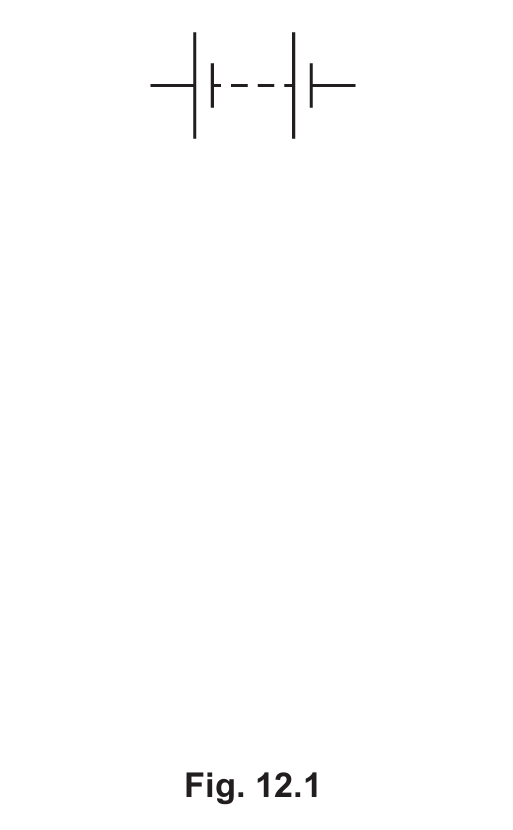
Fig. 12.2 shows a wheel nut being loosened by a spanner.

Calculate the moment of this force on the wheel nut in Nm.
Fig. 12.3 shows the driver looking into a plane mirror.
He can see the reflection of a street lamp.

smaller upside down
Most-appropriate topic codes (Cambridge IGCSE Co-ordinated Sciences 0654):
• Topic P4.2.1 — Electrical charge (Part (a))
• Topic P4.3.2 — Series and parallel circuits (Part (b))
• Topic P1.5.2 — Turning effect of forces (Part (c))
• Topic P3.2.1 — Reflection of light (Part (d))
▶️ Answer/Explanation
(a) Electrons
A positively charged object has lost negatively charged particles.
Since electrons carry negative charge, removing them from the car leaves it with an overall positive charge.
(b) Two lamps connected in parallel, controlled by a single switch in the main circuit
In a parallel circuit, each lamp is connected across its own branch, joined at common points to the battery.
Placing the switch in the main line (before the branches split) allows it to control both lamps simultaneously.
(c) 660 Nm
Moment = force × perpendicular distance from the pivot.
Converting 55 cm to metres gives \( 0.55 \, \text{m} \), so moment = \( 1200 \times 0.55 = 660 \, \text{Nm} \).
(d)(i) Normal
Line XY is drawn perpendicular to the mirror surface at the point of reflection.
This perpendicular reference line is called the normal.
(d)(ii) Angle of incidence labelled between the incident ray and the normal
The angle of incidence is measured from the incident ray to the normal, on the same side as the incoming ray.
It should be labelled \( i \) at this position in Fig. 12.3.
(d)(iii) Same size; laterally inverted
A plane mirror always produces an image that is the same size as the object.
The image is also laterally inverted, meaning left and right appear reversed.