Question 1
What is meant by respiration?
A. protein synthesis
B. sweating to lose heat
C. the function of lungs
D. the release of energy
Most-appropriate topic codes (Cambridge IGCSE Co-ordinated Sciences 0654):
▶️ Answer/Explanation
These reactions break down nutrient molecules (such as glucose) to release energy.
This released energy is used for metabolism, i.e. all the chemical processes needed to keep the organism alive.
✅ Answer: (D)
Question 2
The diagram shows a cell with a magnification of ×1000. The width of the image is 45 mm.

What is the actual width of the cell?
A. 45 mm
B. 4.5 mm
C. 0.45 mm
D. 0.045 mm
Most-appropriate topic codes (Cambridge IGCSE Co-ordinated Sciences 0654):
▶️ Answer/Explanation
Rearranging gives \( \text{actual size} = \frac{\text{image size}}{\text{magnification}} \).
Substituting values: \( \frac{45}{1000} = 0.045 \) mm.
✅ Answer: (D)
Question 3
Linoleic acid is a fatty acid.
Which larger molecule may contain linoleic acid?
A. glycogen
B. oil
C. protein
D. starch
Most-appropriate topic codes (Cambridge IGCSE Co-ordinated Sciences 0654):
▶️ Answer/Explanation
Lipids form when fatty acids combine chemically with glycerol through a condensation reaction: \( \text{glycerol} + 3\,\text{fatty acid} \rightarrow \text{lipid} + 3\,\text{H}_2\text{O} \).
Oils are simply lipids that are liquid at room temperature, so oil is the larger molecule that may contain linoleic acid.
✅ Answer: (B)
Question 4
Which type of molecule are enzymes?
A. amino acids
B. carbohydrates
C. fats
D. proteins
Most-appropriate topic codes (Cambridge IGCSE Co-ordinated Sciences 0654):
▶️ Answer/Explanation
Their protein structure gives them a specific 3D active site that binds only to a complementary substrate molecule.
✅ Answer: (D)
Question 5
Which two arrows represent photosynthesis?

A. 1 and 3
B. 1 and 4
C. 2 and 3
D. 2 and 4
Most-appropriate topic codes (Cambridge IGCSE Co-ordinated Sciences 0654):
▶️ Answer/Explanation
This means carbon dioxide must move from the air into the plant, and oxygen must move from the plant into the air.
Arrows 1 (CO₂ in) and 4 (O₂ out) represent this exchange.
✅ Answer: (B)
Question 6
A person has a low red blood cell count and is constipated.
Which row shows the components that may be in short supply in this person’s diet?

Most-appropriate topic codes (Cambridge IGCSE Co-ordinated Sciences 0654):
▶️ Answer/Explanation
Constipation suggests a shortage of fibre, since fibre adds bulk to help food move through the gut.
Row C shows iron and fibre as the deficient components.
✅ Answer: (C)
Question 7
What is the sequence of blood vessels that a red blood cell passes through as it travels from the vena cava to the kidney?
A. pulmonary artery → pulmonary vein → aorta → renal artery
B. pulmonary artery → pulmonary vein → aorta → renal vein
C. pulmonary vein → pulmonary artery → aorta → renal artery
D. pulmonary vein → pulmonary artery → aorta → renal vein
Most-appropriate topic codes (Cambridge IGCSE Co-ordinated Sciences 0654):
▶️ Answer/Explanation
It returns via the pulmonary vein to the heart, then leaves through the aorta.
From the aorta, oxygenated blood reaches the kidney via the renal artery.
✅ Answer: (A)
Question 8
In the diagram of the human breathing system, which structures are correctly labelled?

A. alveoli and bronchiole
B. alveoli and trachea
C. bronchus and bronchiole
D. bronchus and trachea
Most-appropriate topic codes (Cambridge IGCSE Co-ordinated Sciences 0654):
▶️ Answer/Explanation
Bronchioles end in tiny air sacs called alveoli, where gas exchange takes place.
In the diagram, only the alveoli and the trachea are correctly labelled.
✅ Answer: (B)
Question 9
What are the effects of adrenaline?

Most-appropriate topic codes (Cambridge IGCSE Co-ordinated Sciences 0654):
▶️ Answer/Explanation
It increases breathing rate and pulse rate to deliver more oxygen and glucose to the muscles.
It also widens the pupils to improve vision in an emergency.
✅ Answer: (D)
Question 10
In a plant, what leads to offspring that are genetically identical to the parent?
A. asexual reproduction
B. insect pollination
C. seed germination
D. sexual reproduction
Most-appropriate topic codes (Cambridge IGCSE Co-ordinated Sciences 0654):
▶️ Answer/Explanation
Because there is no mixing of genetic material from two parents, the offspring are genetically identical to the parent (clones).
✅ Answer: (A)
Question 11
The diagram shows eggs and sperm containing sex chromosomes.

Which row gives the correct combination of sex chromosomes for a male and female offspring?

Most-appropriate topic codes (Cambridge IGCSE Co-ordinated Sciences 0654):
▶️ Answer/Explanation
A male offspring \( (XY) \) results from an X-egg combining with a Y-sperm, while a female offspring \( (XX) \) results from an X-egg combining with an X-sperm.
Row B shows the correct sperm-egg combinations for each.
✅ Answer: (B)
Question 12
How do herbivores get their energy?
A. by eating animals and plants
B. by eating animals only
C. by eating plants only
D. directly from sunlight
Most-appropriate topic codes (Cambridge IGCSE Co-ordinated Sciences 0654):
▶️ Answer/Explanation
Since they consume plants directly, they obtain all their energy solely by eating plants.
✅ Answer: (C)
Question 13
The graph shows the change in atmospheric carbon dioxide levels over time.

A reduction of which process could cause the change in carbon dioxide shown?
A. combustion
B. decomposition
C. photosynthesis
D. respiration
Most-appropriate topic codes (Cambridge IGCSE Co-ordinated Sciences 0654):
▶️ Answer/Explanation
Photosynthesis removes CO₂ from the atmosphere: \( 6CO_2 + 6H_2O \xrightarrow{\text{light}} C_6H_{12}O_6 + 6O_2 \).
A reduction in photosynthesis (e.g. through deforestation) means less CO₂ is removed, explaining the rising trend.
✅ Answer: (C)
Question 14
An aqueous salt solution contains an insoluble impurity.
Which processes are used to obtain pure salt crystals?
A. distillation then crystallisation
B. distillation then chromatography
C. filtration then crystallisation
D. filtration then chromatography
Most-appropriate topic codes (Cambridge IGCSE Co-ordinated Sciences 0654):
▶️ Answer/Explanation
The filtrate (pure salt solution) is then evaporated/crystallised to obtain pure salt crystals.
✅ Answer: (C)
Question 15
The element phosphorus burns in air, as shown: \( 4P + 5O_2 \rightarrow P_4O_{10} \).
What does the formula \( P_4O_{10} \) show?
A. a mixture of atoms of two elements
B. a mixture of molecules of two elements
C. a molecule of a compound
D. an atom of a compound
Most-appropriate topic codes (Cambridge IGCSE Co-ordinated Sciences 0654):
▶️ Answer/Explanation
Since phosphorus and oxygen are different elements joined by covalent bonds, this represents a single molecule of a compound.
✅ Answer: (C)
Question 16
Which row describes an atom that has the nucleon number 24?

Most-appropriate topic codes (Cambridge IGCSE Co-ordinated Sciences 0654):
▶️ Answer/Explanation
For a neutral atom, the number of electrons always equals the number of protons.
Row B (12 protons, 12 neutrons, 12 electrons) gives \( 12+12 = 24 \), matching a neutral magnesium atom.
✅ Answer: (B)
Question 17
Lithium is in Group I and bromine is in Group VII of the Periodic Table.
What is the formula of lithium bromide?
A. \( LiBr \)
B. \( LiBr_2 \)
C. \( Li_2Br \)
D. \( Li_2Br_2 \)
Most-appropriate topic codes (Cambridge IGCSE Co-ordinated Sciences 0654):
▶️ Answer/Explanation
Bromine (Group VII) forms an ion with a single negative charge: \( Br^- \).
Since the charges are equal and opposite, they combine in a 1:1 ratio to give the formula LiBr.
✅ Answer: (A)
Question 18
Which diagram shows equipment used to electroplate nickel with copper?

Most-appropriate topic codes (Cambridge IGCSE Co-ordinated Sciences 0654):
▶️ Answer/Explanation
The electrolyte must be aqueous copper chloride, not molten, so that copper ions are free to move and be deposited onto the cathode.
Diagram D shows copper as the anode and nickel as the cathode in an aqueous solution.
✅ Answer: (D)
Question 19
Which statement about exothermic and endothermic reactions is correct?
A. An endothermic reaction involves heat energy being taken in by the reactants.
B. An exothermic reaction involves heat energy being taken in by the products.
C. In an endothermic reaction, the temperature of the reaction mixture increases.
D. In an exothermic reaction, the temperature of the reaction mixture decreases.
Most-appropriate topic codes (Cambridge IGCSE Co-ordinated Sciences 0654):
▶️ Answer/Explanation
This heat energy is absorbed by the reactants to break bonds, which is why the temperature of the mixture actually decreases.
✅ Answer: (A)
Question 20
Which statement shows that methane, \( CH_4 \), is oxidised when it burns?
A. The products of the reaction are gaseous.
B. The products of the reaction are water and carbon dioxide.
C. The reaction is exothermic.
D. The total number of oxygen atoms has increased during the reaction.
Most-appropriate topic codes (Cambridge IGCSE Co-ordinated Sciences 0654):
▶️ Answer/Explanation
When methane burns: \( CH_4 + 2O_2 \rightarrow CO_2 + 2H_2O \), carbon and hydrogen atoms gain oxygen atoms to form the products.
Since the products are water and carbon dioxide, this confirms oxygen has been gained by methane.
✅ Answer: (B)
Question 21
Magnesium chloride is prepared by reacting an excess of insoluble magnesium oxide with dilute hydrochloric acid.
Which processes are used to obtain pure crystals of magnesium chloride from the reaction mixture?
- distillation
- evaporation
- filtration
A. 1 followed by 2
B. 3 followed by 2
C. 3 followed by 1
D. 1 followed by 3, followed by 2
Most-appropriate topic codes (Cambridge IGCSE Co-ordinated Sciences 0654):
▶️ Answer/Explanation
The remaining magnesium chloride solution is then evaporated to concentrate it, allowing crystals to form on cooling.
✅ Answer: (B)
Question 22
The properties of some substances are listed.
- form acidic oxides
- have high melting points
- act as catalysts
- form coloured compounds
What are the properties of transition metals?
A. 1, 2 and 3
B. 1, 2 and 4
C. 1, 3 and 4
D. 2, 3 and 4
Most-appropriate topic codes (Cambridge IGCSE Co-ordinated Sciences 0654):
▶️ Answer/Explanation
They commonly act as catalysts in industrial reactions, such as iron in the Haber process.
They also form coloured compounds because of their variable oxidation states.
✅ Answer: (D)
Question 23
Which statement describes a chemical test for water?
A. Add blue cobalt(II) chloride.
B. Add blue copper(II) sulfate.
C. Measure the boiling point.
D. Use universal indicator.
Most-appropriate topic codes (Cambridge IGCSE Co-ordinated Sciences 0654):
▶️ Answer/Explanation
This colour change is a reliable chemical test that specifically confirms the presence of water, unlike a physical test such as measuring the boiling point.
✅ Answer: (A)
Question 24
Which statement about sulfur is correct?
A. It is a metallic element.
B. It is used to make sulfuric acid.
C. It is in Group VII of the Periodic Table.
D. An atom of sulfur contains 32 electrons.
Most-appropriate topic codes (Cambridge IGCSE Co-ordinated Sciences 0654):
▶️ Answer/Explanation
It is a key raw material used industrially to manufacture sulfuric acid, \( H_2SO_4 \), via the Contact Process.
✅ Answer: (B)
Question 25
Which statements about limestone are correct?
- Its main constituent is calcium oxide.
- It can be used to manufacture lime.
- It thermally decomposes to release carbon dioxide.
- It is used to neutralise alkaline soils.
A. 1 and 2
B. 1 and 4
C. 2 and 3
D. 3 and 4
Most-appropriate topic codes (Cambridge IGCSE Co-ordinated Sciences 0654):
▶️ Answer/Explanation
Limestone is heated to manufacture lime (calcium oxide), which also releases carbon dioxide: \( CaCO_3 \rightarrow CaO + CO_2 \).
Statements 2 and 3 correctly describe this thermal decomposition process.
✅ Answer: (C)
Question 26
Petroleum is separated into fractions by fractional distillation.
Information about uses of some fractions and positions in the fractionating column where they are collected is shown.

Which rows are correct?
A. 1 and 2
B. 1 and 4
C. 2 and 3
D. 3 and 4
Most-appropriate topic codes (Cambridge IGCSE Co-ordinated Sciences 0654):
▶️ Answer/Explanation
Naphtha is used to make chemicals and is collected below gasoline, while refinery gas is used for heating/cooking and is collected at the top of the column.
Rows 3 and 4 correctly describe these two fractions.
✅ Answer: (D)
Question 27
Which process forms ethanol?
A. combustion
B. cracking
C. distillation
D. fermentation
Most-appropriate topic codes (Cambridge IGCSE Co-ordinated Sciences 0654):
▶️ Answer/Explanation
This biological process is the standard method used to produce ethanol.
✅ Answer: (D)
Question 28
The graph shows how the speed of an object varies with time.

What is the distance moved by the object between time 0 s and time 10 s?
A. 30 m
B. 40 m
C. 50 m
D. 80 m
Most-appropriate topic codes (Cambridge IGCSE Co-ordinated Sciences 0654):
▶️ Answer/Explanation
The graph shows a trapezium shape between 2.0 m/s and 8.0 m/s over 10 s.
Area \( = \frac{1}{2}(2.0+8.0)\times10 = 50 \) m.
✅ Answer: (C)
Question 29
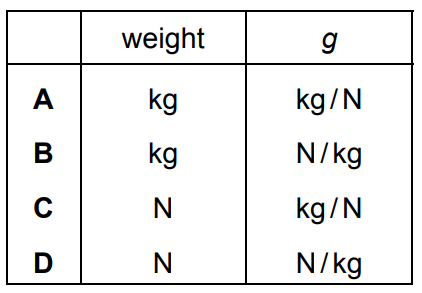
The weight of an object of mass m is given by the expression \( mg \).
Which row gives the units for weight and \( g \)?

Most-appropriate topic codes (Cambridge IGCSE Co-ordinated Sciences 0654):
▶️ Answer/Explanation
Since \( g = \frac{\text{weight}}{\text{mass}} \), the units of \( g \) must be \( N/kg \).
Row D correctly shows N for weight and N/kg for \( g \).
✅ Answer: (D)
Question 30
The diagrams show all the forces acting on each of four objects.
Which object is not in equilibrium?

Most-appropriate topic codes (Cambridge IGCSE Co-ordinated Sciences 0654):
▶️ Answer/Explanation
Checking each diagram, the forces on object D do not balance to zero horizontally and vertically.
✅ Answer: (D)
Question 31
The diagram shows a triangular sheet of metal with sides of length 50 cm, 40 cm and 30 cm. The sheet is free to move about a pivot at the top corner, as shown.

A cord is attached to the bottom left corner of the sheet and pulled with a horizontal force of 5.0 N to the left.
What is the moment of the 5.0 N force about the pivot?
A. 150 N cm
B. 200 N cm
C. 250 N cm
D. 600 N cm
Most-appropriate topic codes (Cambridge IGCSE Co-ordinated Sciences 0654):
▶️ Answer/Explanation
The perpendicular distance from the pivot to the line of action of the horizontal force is the vertical side of the triangle, 40 cm.
So moment \( = 5.0 \times 40 = 200 \) N cm.
✅ Answer: (B)
Question 32
A skier starts from rest at P, accelerates down a slope and then comes to rest at Q.

Which series of energy transfers takes place?
A. elastic potential (strain) energy → kinetic energy → thermal energy
B. gravitational potential energy → kinetic energy → thermal energy
C. kinetic energy → elastic potential (strain) energy → thermal energy
D. kinetic energy → gravitational potential energy → thermal energy
Most-appropriate topic codes (Cambridge IGCSE Co-ordinated Sciences 0654):
▶️ Answer/Explanation
As the skier moves down the slope, this converts into kinetic energy.
At Q, the skier comes to rest, so the kinetic energy is converted into thermal energy through friction.
✅ Answer: (B)
Question 33
Which term describes a gas changing into a liquid?
A. boiling
B. condensation
C. evaporation
D. melting
Most-appropriate topic codes (Cambridge IGCSE Co-ordinated Sciences 0654):
▶️ Answer/Explanation
This change of state is called condensation.
✅ Answer: (B)
Question 34
A man stands 420 m away from a high wall. He bangs a drum once and starts a stop-watch at the same time. \
When he hears an echo from the wall, the stop-watch reads 2.4 s.
What is the speed of sound, calculated from this information?
A. 87.5 m/s
B. 175 m/s
C. 330 m/s
D. 350 m/s
Most-appropriate topic codes (Cambridge IGCSE Co-ordinated Sciences 0654):
▶️ Answer/Explanation
Speed is calculated using \( \text{speed} = \frac{\text{distance}}{\text{time}} = \frac{840}{2.4} \).
This gives a speed of 350 m/s.
✅ Answer: (D)
Question 35
A student stands in front of a plane mirror on a wall.
Which statement about the image of the student is not correct?
A. The image is laterally inverted (left to right).
B. The image is smaller than the student.
C. The image is upright.
D. The student and the image are equal distances from the mirror.
Most-appropriate topic codes (Cambridge IGCSE Co-ordinated Sciences 0654):
▶️ Answer/Explanation
The image is also upright, laterally inverted, and the same distance behind the mirror as the object is in front of it.
Statement B is not correct, since the image is not smaller than the student.
✅ Answer: (B)
Question 36
Two insulators are charged by rubbing them with a cloth. After this, the charged insulators repel each other.
Which statement is a possible description of how the insulators become charged?
A. One gained electrons and the other gained protons.
B. One gained electrons and the other lost electrons.
C. They both lost electrons.
D. They both lost protons.
Most-appropriate topic codes (Cambridge IGCSE Co-ordinated Sciences 0654):
▶️ Answer/Explanation
For the two insulators to repel, they must end up with the same sign of charge.
If both lost the same amount of electrons, both become positively charged with the same sign, so they repel.
✅ Answer: (C)
Question 37
A battery of e.m.f. V is connected across a resistor of resistance R. There is a current in the resistor.

Which row shows two changes that both increase the current in the resistor?

Most-appropriate topic codes (Cambridge IGCSE Co-ordinated Sciences 0654):
▶️ Answer/Explanation
To increase the current, V must increase and/or R must decrease.
Row C shows an increase in V combined with a decrease in R, which both act to increase the current.
✅ Answer: (C)
Question 38
Fuses are used in domestic electric circuits.
Which statement about fuses is correct?
A. A fuse is connected in the live wire.
B. A fuse is connected in the neutral wire.
C. A 3.0 A fuse produces a current of exactly 3.0 A in the circuit.
D. A 3.0 A fuse produces a minimum current of 3.0 A in the circuit.
Most-appropriate topic codes (Cambridge IGCSE Co-ordinated Sciences 0654):
▶️ Answer/Explanation
This ensures that if excessive current flows and the fuse blows, the live supply is cut off, making the appliance safe to touch.
✅ Answer: (A)
Question 39
A straight wire carries a current into the page.
Which diagram shows the pattern and direction of the magnetic field around the wire due to the current?

Most-appropriate topic codes (Cambridge IGCSE Co-ordinated Sciences 0654):
▶️ Answer/Explanation
The direction of these field lines is given by the right-hand grip rule, based on the direction of current flow.
For current flowing into the page, applying the right-hand rule gives the pattern and direction shown in diagram A.
✅ Answer: (A)
Question 40
A radioactive isotope has a half-life of 3.0 days. A sample contains 4000 atoms of this isotope.
How many atoms of the isotope remain after 6.0 days?
A. 0
B. 500
C. 1000
D. 2000
Most-appropriate topic codes (Cambridge IGCSE Co-ordinated Sciences 0654):
▶️ Answer/Explanation
After 3.0 days (1 half-life): \( 4000 \div 2 = 2000 \) atoms remain.
After 6.0 days (2 half-lives): \( 2000 \div 2 = 1000 \) atoms remain.
✅ Answer: (C)
