

▶️ Answer/Explanation
Cells specialised for diffusion (such as root hair cells and alveolar cells) are flattened, elongated, or have projections that increase their surface area relative to volume.
Cells 1 and 4 in the diagram show this type of shape, unlike the more compact/rounded cells 2 and 3.
A larger surface area speeds up the rate of diffusion of substances into and out of the cell.
✅ Answer: (B)
Cells 1 and 4 in the diagram show this type of shape, unlike the more compact/rounded cells 2 and 3.
A larger surface area speeds up the rate of diffusion of substances into and out of the cell.
✅ Answer: (B)

▶️ Answer/Explanation
An egg contains protein and fat but no starch and no reducing sugar, so Benedict’s test stays blue (no sugar) and the iodine test stays yellow-brown/orange (no starch).
The biuret test turns purple because protein is present, and the ethanol emulsion test produces a white emulsion because fat is present.
Only row A shows this exact combination of results.
✅ Answer: (A)
The biuret test turns purple because protein is present, and the ethanol emulsion test produces a white emulsion because fat is present.
Only row A shows this exact combination of results.
✅ Answer: (A)

▶️ Answer/Explanation
Lowering the temperature below the optimum reduces the kinetic energy of enzyme and substrate molecules, so collisions happen less frequently.
This means the formation of product decreases, since fewer successful enzyme-substrate collisions occur.
The active site’s shape is unaffected by cooling (only high temperatures denature it), so it shows no change.
✅ Answer: (A)
This means the formation of product decreases, since fewer successful enzyme-substrate collisions occur.
The active site’s shape is unaffected by cooling (only high temperatures denature it), so it shows no change.
✅ Answer: (A)

▶️ Answer/Explanation
Glucose molecules made in photosynthesis can be joined together to form starch, which is the plant’s main storage carbohydrate.
X represents the addition of a nitrogen-containing substance (such as nitrate ions) needed to convert glucose into amino acids, so X is not magnesium or iron.
Y, formed by joining many glucose molecules, is therefore starch and not an oil molecule.
✅ Answer: (C)
X represents the addition of a nitrogen-containing substance (such as nitrate ions) needed to convert glucose into amino acids, so X is not magnesium or iron.
Y, formed by joining many glucose molecules, is therefore starch and not an oil molecule.
✅ Answer: (C)

▶️ Answer/Explanation
Photosynthesis requires a continuous input of light energy to build glucose from carbon dioxide and water, so it is an endothermic process.
Respiration breaks down glucose and releases energy overall for the cell to use, making it exothermic.
Only row C shows respiration as exothermic and photosynthesis as endothermic.
✅ Answer: (C)
Respiration breaks down glucose and releases energy overall for the cell to use, making it exothermic.
Only row C shows respiration as exothermic and photosynthesis as endothermic.
✅ Answer: (C)

▶️ Answer/Explanation
Pollination is defined as the transfer of pollen grains from the anther (male part) to the stigma (female part) of a flower.
In the diagram, this corresponds to the labelled structure representing the stigma, which is the receptive surface at the top of the carpel.
Reaching any other structure (ovary, ovule, ovary wall) would not count as pollination itself.
✅ Answer: (B)
In the diagram, this corresponds to the labelled structure representing the stigma, which is the receptive surface at the top of the carpel.
Reaching any other structure (ovary, ovule, ovary wall) would not count as pollination itself.
✅ Answer: (B)

▶️ Answer/Explanation
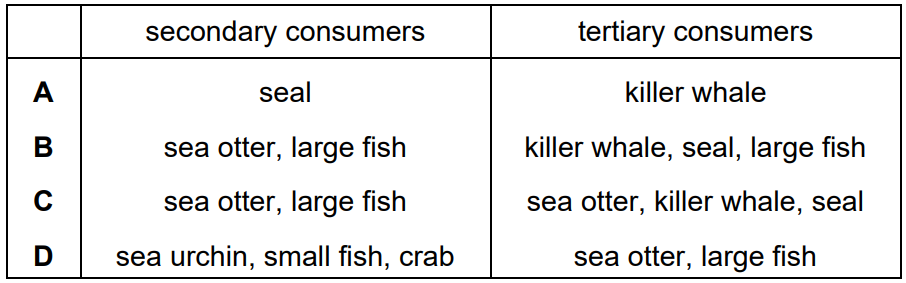
Kelp is the producer, so organisms that eat kelp directly (like the sea urchin) are primary consumers, and organisms that eat those primary consumers are secondary consumers.
Tracing the web, the sea otter and large fish each eat primary consumers, making them secondary consumers, while the sea otter, killer whale and seal all feed at a level higher again in different branches, making them tertiary consumers too.
Only the combination in row C, “sea otter, large fish” as secondary and “sea otter, killer whale, seal” as tertiary, correctly reflects an organism occupying more than one trophic level in a web.
✅ Answer: (C)
Tracing the web, the sea otter and large fish each eat primary consumers, making them secondary consumers, while the sea otter, killer whale and seal all feed at a level higher again in different branches, making them tertiary consumers too.
Only the combination in row C, “sea otter, large fish” as secondary and “sea otter, killer whale, seal” as tertiary, correctly reflects an organism occupying more than one trophic level in a web.
✅ Answer: (C)
▶️ Answer/Explanation
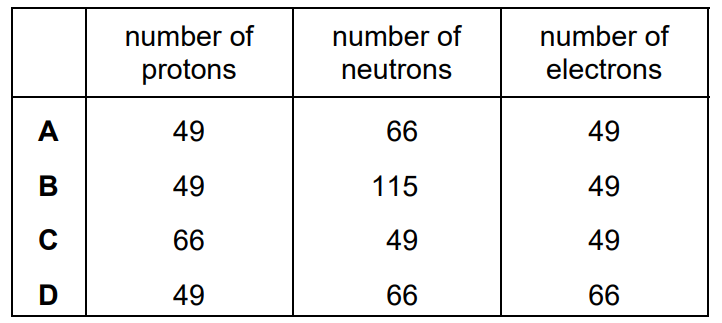
The atomic number, \( 49 \), gives the number of protons, which for a neutral atom also equals the number of electrons.
The number of neutrons is found using \( \text{neutrons} = \text{nucleon number} – \text{atomic number} = 115 – 49 = 66 \).
So this atom has 49 protons, 66 neutrons and 49 electrons.
✅ Answer: (A)
The number of neutrons is found using \( \text{neutrons} = \text{nucleon number} – \text{atomic number} = 115 – 49 = 66 \).
So this atom has 49 protons, 66 neutrons and 49 electrons.
✅ Answer: (A)

▶️ Answer/Explanation
Increasing temperature gives particles more kinetic energy, so they move faster and collide with each other more often, increasing the frequency of collisions.
The extra kinetic energy also means each collision happens with greater force, increasing the energy of the collisions.
Both frequency and energy of collisions increase with temperature, which is why reaction rate rises as temperature rises.
✅ Answer: (D)
The extra kinetic energy also means each collision happens with greater force, increasing the energy of the collisions.
Both frequency and energy of collisions increase with temperature, which is why reaction rate rises as temperature rises.
✅ Answer: (D)

▶️ Answer/Explanation
Transition elements are well known for forming brightly coloured compounds, such as blue copper(II) sulfate or purple potassium manganate(VII), not colourless ones.
They do have high densities, high melting points, and many act as catalysts (e.g. iron, nickel, platinum), so statements A, C and D are all correct.
The claim that they “always” form colourless compounds is the incorrect statement.
✅ Answer: (B)
They do have high densities, high melting points, and many act as catalysts (e.g. iron, nickel, platinum), so statements A, C and D are all correct.
The claim that they “always” form colourless compounds is the incorrect statement.
✅ Answer: (B)

▶️ Answer/Explanation
Limestone is chemically known as calcium carbonate, \( CaCO_3 \), not calcium oxide.
On heating, it undergoes thermal decomposition according to \( CaCO_3 \rightarrow CaO + CO_2 \), producing both calcium oxide and carbon dioxide as products.
Only the row naming limestone as calcium carbonate and listing both products matches this correctly.
✅ Answer: (B)
On heating, it undergoes thermal decomposition according to \( CaCO_3 \rightarrow CaO + CO_2 \), producing both calcium oxide and carbon dioxide as products.
Only the row naming limestone as calcium carbonate and listing both products matches this correctly.
✅ Answer: (B)

▶️ Answer/Explanation
But-2-ene, \( CH_3-CH=CH-CH_3 \), has its double bond between carbons 2 and 3, with a methyl group attached to each of these carbons.
In addition polymerisation, the double bond opens up and the monomers join through single bonds, so the repeat unit must show a methyl group (\( CH_3 \)) branching off each backbone carbon in the chain.
Only the structure that keeps both methyl side-groups on adjacent backbone carbons correctly represents the polymer of but-2-ene.
✅ Answer: (D)
In addition polymerisation, the double bond opens up and the monomers join through single bonds, so the repeat unit must show a methyl group (\( CH_3 \)) branching off each backbone carbon in the chain.
Only the structure that keeps both methyl side-groups on adjacent backbone carbons correctly represents the polymer of but-2-ene.
✅ Answer: (D)
▶️ Answer/Explanation
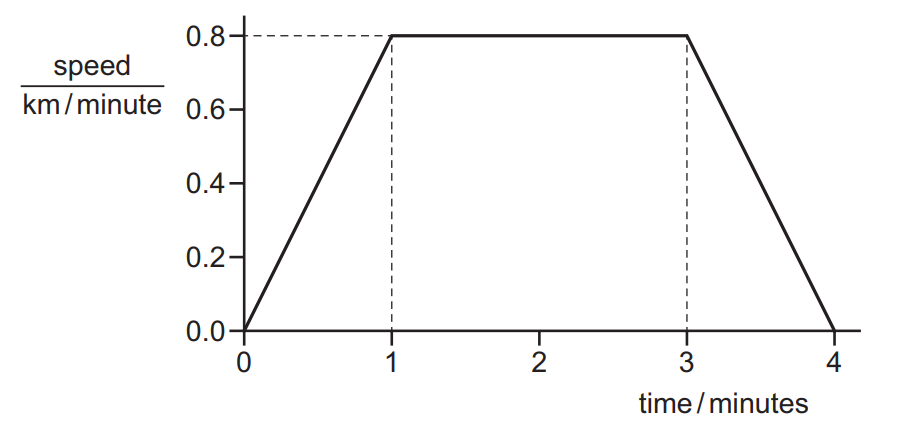
The distance travelled is equal to the total area under a speed–time graph.
The graph rises from \( 0 \) to \( 0.8 \) km/minute over the first minute, stays constant at \( 0.8 \) km/minute for the next two minutes, then falls back to \( 0 \) over the final minute, giving areas of \( 0.4 + 1.6 + 0.4 \) km.
Adding these together, \( 0.4 + 1.6 + 0.4 = 2.4 \) km.
✅ Answer: (C)
The graph rises from \( 0 \) to \( 0.8 \) km/minute over the first minute, stays constant at \( 0.8 \) km/minute for the next two minutes, then falls back to \( 0 \) over the final minute, giving areas of \( 0.4 + 1.6 + 0.4 \) km.
Adding these together, \( 0.4 + 1.6 + 0.4 = 2.4 \) km.
✅ Answer: (C)

▶️ Answer/Explanation
The base of the box in contact with the ground has an area \( A = 0.50\ m \times 0.40\ m = 0.20\ m^2 \).
Pressure is defined as \( P = \dfrac{F}{A} \), so rearranging gives \( F = P \times A \).
Substituting the values, \( F = 50\ Pa \times 0.20\ m^2 = 10\ N \), which is the weight of the box.
✅ Answer: (B)
Pressure is defined as \( P = \dfrac{F}{A} \), so rearranging gives \( F = P \times A \).
Substituting the values, \( F = 50\ Pa \times 0.20\ m^2 = 10\ N \), which is the weight of the box.
✅ Answer: (B)


▶️ Answer/Explanation
Arrow P shows particles becoming more spread out and disordered, going from a closely packed regular arrangement to a widely spaced random one — this is evaporation, a change from liquid to gas.
Arrow Q shows particles becoming more ordered and closely packed, going from a disordered liquid arrangement to a fixed regular one — this is solidification, a change from liquid to solid.
Only the row pairing P with evaporation and Q with solidification matches the diagrams.
✅ Answer: (B)
Arrow Q shows particles becoming more ordered and closely packed, going from a disordered liquid arrangement to a fixed regular one — this is solidification, a change from liquid to solid.
Only the row pairing P with evaporation and Q with solidification matches the diagrams.
✅ Answer: (B)

▶️ Answer/Explanation
As light travels from the less dense air into the denser glass, it slows down and bends towards the normal at the first surface.
As it then leaves the glass and re-enters air at the second (parallel) surface, it speeds up again and bends away from the normal by the same angle.
This produces an emerging ray that is parallel to, but laterally displaced from, the original incident ray — only one diagram shows this correctly.
✅ Answer: (A)
As it then leaves the glass and re-enters air at the second (parallel) surface, it speeds up again and bends away from the normal by the same angle.
This produces an emerging ray that is parallel to, but laterally displaced from, the original incident ray — only one diagram shows this correctly.
✅ Answer: (A)

▶️ Answer/Explanation
At position P, between \( f \) and \( 2f \), a converging lens forms a real, enlarged image.
When the object moves to position Q, inside the focal length \( f \), the lens can no longer converge the rays to a real point, so a virtual image forms instead.
A virtual image formed by a converging lens with the object inside the focal length is always magnified, so the image remains enlarged throughout.
✅ Answer: (D)
When the object moves to position Q, inside the focal length \( f \), the lens can no longer converge the rays to a real point, so a virtual image forms instead.
A virtual image formed by a converging lens with the object inside the focal length is always magnified, so the image remains enlarged throughout.
✅ Answer: (D)

▶️ Answer/Explanation
An ammeter must be connected in series in the main circuit loop so that the full current flowing through the resistor also flows through it.
A voltmeter must be connected in parallel across the resistor, so it measures the potential difference between its two ends without diverting current from the main circuit.
Only one circuit diagram shows the ammeter in series and the voltmeter in parallel in this way.
✅ Answer: (A)
A voltmeter must be connected in parallel across the resistor, so it measures the potential difference between its two ends without diverting current from the main circuit.
Only one circuit diagram shows the ammeter in series and the voltmeter in parallel in this way.
✅ Answer: (A)

▶️ Answer/Explanation
First find the current using \( I = \dfrac{V}{R} = \dfrac{12}{3.0} = 4.0\ A \).
Electrical power is given by \( P = VI = 12 \times 4.0 = 48\ W \).
Energy transferred is \( E = Pt = 48 \times 10 = 480\ J \).
✅ Answer: (D)
Electrical power is given by \( P = VI = 12 \times 4.0 = 48\ W \).
Energy transferred is \( E = Pt = 48 \times 10 = 480\ J \).
✅ Answer: (D)

▶️ Answer/Explanation
A current-carrying solenoid produces a magnetic field pattern very similar to that of a bar magnet, with field lines emerging from one end (north pole) and curving round to enter the other end (south pole).
Inside the solenoid, the field lines run parallel to the axis and are evenly spaced, showing a strong, uniform field.
Only one diagram correctly shows this bar-magnet-like pattern both inside and outside the coil.
✅ Answer: (D)
Inside the solenoid, the field lines run parallel to the axis and are evenly spaced, showing a strong, uniform field.
Only one diagram correctly shows this bar-magnet-like pattern both inside and outside the coil.
✅ Answer: (D)


▶️ Answer/Explanation
Part X, in contact with the brushes, is the split-ring commutator, not a step-down transformer (which is an entirely different component used to change a.c. voltage).
Its role is to reverse the direction of current flowing through the coil every half turn.
This keeps the turning forces on each side of the coil acting in the same rotational direction, allowing the motor to spin continuously rather than oscillating back and forth.
✅ Answer: (B)
Its role is to reverse the direction of current flowing through the coil every half turn.
This keeps the turning forces on each side of the coil acting in the same rotational direction, allowing the motor to spin continuously rather than oscillating back and forth.
✅ Answer: (B)


▶️ Answer/Explanation
The positively charged \( \alpha \)-particles are attracted towards the negative (upper) plate, while the negatively charged \( \beta \)-particles are attracted towards the positive (lower) plate, so they deflect in opposite directions.
\( \beta \)-particles have a much smaller mass than \( \alpha \)-particles but carry a comparable magnitude of charge, so for the same field they experience a much greater deflection.
This means \( \beta \)-particles bend towards the lower plate and \( \alpha \)-particles towards the upper plate, with \( \beta \)-particles deflected more.
✅ Answer: (D)
\( \beta \)-particles have a much smaller mass than \( \alpha \)-particles but carry a comparable magnitude of charge, so for the same field they experience a much greater deflection.
This means \( \beta \)-particles bend towards the lower plate and \( \alpha \)-particles towards the upper plate, with \( \beta \)-particles deflected more.
✅ Answer: (D)