
Question 1

that attracts insects
that produces pollen
where fertilisation occurs.


Calculate the number of bacteria after 4 hours if you start with one bacterium.
Most-appropriate topic codes (Cambridge IGCSE Co-ordinated Sciences 0654):
• Topic B15.3 — Sexual reproduction in plants (Part (a))
• Topic B15.4 — Sexual reproduction in humans (Part (b))
• Topic B15.1 / B15.2 — Asexual and sexual reproduction (Part (c))
• Topic B15.1 — Asexual reproduction (Part (d))
• Topic B1.1 — Characteristics of living organisms (Part (e))
▶️ Answer/Explanation
(a) A ; E ; C
Petal (A) is the large, often brightly coloured part that attracts insects.
Anther (E) produces pollen grains containing the male gametes.
Fertilisation occurs inside the ovary (C), where the ovule is located.
(b) oviduct
In humans, the sperm fertilises the egg in the oviduct (fallopian tube).
This lies between the ovary and the uterus.
(c)

Sexual reproduction involves the fusion of gametes, so “involves gametes” is ticked only for sexual reproduction.
Both types of reproduction pass on genetic information from parent(s) to offspring.
Only asexual reproduction produces offspring genetically identical to the parent, since no fusion of gametes occurs.
(d) 256
In \(4\) hours there are \( \dfrac{4 \times 60}{30} = 8 \) divisions.
Number of bacteria \( = 2^{8} = 256\).
Each division doubles the population, starting from one bacterium.
(e) Any three from: movement, respiration, sensitivity, growth, excretion, nutrition
These are the recognised characteristics shared by all living organisms.
Reproduction, given in the question, is one of these seven characteristics.
Any three others (e.g. movement, respiration, sensitivity) are accepted.
Question 2
ammonium nitrate
carbon dioxide
lead bromide
sodium chloride
sulfur dioxide
Each compound may be used once, more than once or not at all.
State which compound:
State three general physical properties of solid metals.
Table 2.1 shows the percentage composition of duralumin.


Explain why duralumin does not have a precise melting point.
Most-appropriate topic codes (Cambridge IGCSE Co-ordinated Sciences 0654):
• Topic C2.1 — Elements, compounds and mixtures (Part (a)(i))
• Topic C7.3 — Preparation of salts (Part (a)(ii))
• Topic C7.2 — Oxides (Part (a)(iii))
• Topic C10.2 — Air quality and climate (Part (a)(iv))
• Topic C9.6 — Extraction of metals (Part (a)(v))
• Topic C9.1 — Properties of metals (Part (b))
• Topic C9.3 — Alloys and their properties (Part (c))
▶️ Answer/Explanation
(a)(i) lead bromide
Lead has a \(2+\) charge and bromide has a \(1-\) charge.
Two bromide ions balance one lead ion, giving \(\text{PbBr}_2\).
(a)(ii) ammonium nitrate
Ammonium salts react with alkalis to release ammonia gas on heating.
Ammonium nitrate is the only ammonium salt in the list.
(a)(iii) carbon dioxide / sulfur dioxide
Non-metal oxides dissolve in water to form acidic solutions.
Both \(\text{CO}_2\) and \(\text{SO}_2\) are non-metal oxides, so either is accepted.
(a)(iv) carbon dioxide
\(\text{CO}_2\) absorbs infrared radiation reflected from the Earth’s surface.
This traps thermal energy in the atmosphere, contributing to the greenhouse effect.
(a)(v) aluminium oxide
Bauxite is the ore from which aluminium is extracted.
Its main component is aluminium oxide, \(\text{Al}_2\text{O}_3\).
(b) Any three from: conducts heat, conducts electricity, malleable, high melting/boiling point
Solid metals share physical properties due to metallic bonding.
Free-moving delocalised electrons allow good thermal and electrical conductivity.
The regular layered structure allows metals to be bent or hammered into shape (malleable).
(c)(i) 19 kg
Aluminium makes up 95% of the alloy by mass.
Mass of aluminium \( = \dfrac{95}{100} \times 20 = 19 \, \text{kg}\).
(c)(ii) Duralumin is not a pure substance
Duralumin is a mixture (alloy) of aluminium, copper and magnesium, not a single pure substance.
Each component metal has a different melting point.
The mixture therefore melts gradually over a range of temperatures rather than at one fixed point.
Question 3
Calculate the average speed of the spacecraft in km / s.
The gravitational force on unit mass, \(g\), is 10 N / kg.
Fig. 3.1 shows an incomplete electromagnetic spectrum.
Write radio waves in the correct position in Fig. 3.1.

The rock contains iron-60, a radioactive isotope.
β-particles are identical in nature to ………………………………… .
β-particles have a single ………………………………… charge.
Most-appropriate topic codes (Cambridge IGCSE Co-ordinated Sciences 0654):
• Topic P1.2 — Motion (Part (a))
• Topic P1.3 — Mass and weight (Part (b))
• Topic P3.3 — Electromagnetic spectrum (Part (c)(i))
• Topic P3.4 — Sound (Part (c)(ii))
• Topic P5.2.2 — The three types of nuclear emission (Part (d))
▶️ Answer/Explanation
(a) 1.37 km/s
78 hours \( = 78 \times 3600 = 280\,800\) seconds.
Speed \( = \dfrac{\text{distance}}{\text{time}} = \dfrac{384\,000}{280\,800} = 1.37 \, \text{km/s}\).
(b)(i) 900 N
Weight \( = \text{mass} \times g\).
Weight \( = 90 \times 10 = 900 \, \text{N}\).
(b)(ii) 90 kg
Mass is the amount of matter in a body and does not change with location.
The astronaut’s mass on the Moon is the same as on Earth, 90 kg.
(c)(i) Radio waves have the lowest frequency
The spectrum is arranged in order of increasing frequency, with X-rays and visible light already placed.
Radio waves belong in the right-hand box, since they have the lowest frequency of all electromagnetic waves.
(c)(ii) Sound waves need a medium to travel
Sound is a mechanical wave that requires particles of a medium to vibrate.
Space is a vacuum, so sound waves cannot travel between the astronaut and Earth.
(d)(i) Atoms of the same element with different numbers of neutrons
Isotopes have the same number of protons (same atomic number).
They have different numbers of neutrons, giving different mass numbers.
(d)(ii) electrons; negative
β-particles are fast-moving electrons emitted from the nucleus.
They carry a single negative charge.
Fig. 4.1 is a bar chart of the results.

number of new HIV infections in 1998
number of new HIV infections in 2002

Most-appropriate topic codes (Cambridge IGCSE Co-ordinated Sciences 0654):
• Topic B10.1 — Diseases and immunity (Part (a))
• Topic B9.4 — Blood (Part (b))
• Topic B9.2 — Heart (Part (c))
▶️ Answer/Explanation
(a)(i) 52%
Infections in 1998 \(= 4600\); infections in 2002 \(= 7000\).
Percentage increase \( = \dfrac{7000-4600}{4600} \times 100 = 52\%\).
(a)(ii) Any three from: increased education/awareness, use of condoms, screening of blood transfusions, use of clean needles, increased screening
Public health measures reduce the spread of HIV between people.
Better awareness and safer practices lower the rate of new infections.
Screening programmes help identify and reduce transmission earlier.
(b) cell type A: red blood cell — transport of oxygen; cell type B: white blood cell — production of antibodies / phagocytosis
Red blood cells (A) contain haemoglobin, which binds oxygen for transport around the body.
White blood cells (B) defend the body against pathogens.
They do this either by producing antibodies (lymphocytes) or by engulfing pathogens (phagocytes).
(c) heart
The heart is a muscular pump that contracts rhythmically.
This contraction pushes blood through the blood vessels around the body.
Question 5
Look at the symbol equation for the reaction between hydrogen and oxygen.
This equation is not balanced.
Oxygen is also made.
Balance the symbol equation for this reaction.
Show only the outer-shell electrons.

Most-appropriate topic codes (Cambridge IGCSE Co-ordinated Sciences 0654):
• Topic C10.2 — Air quality and climate (Part (a))
• Topic C8.5 — Noble gases (Part (b))
• Topic C6.1 — Physical and chemical changes (Parts (c)(i)–(ii))
• Topic C2.5 — Simple molecules and covalent bonds (Parts (c)(iii)–(iv))
• Topic C10.1 — Water (Part (c)(v))
▶️ Answer/Explanation
(a) oxygen = 21%; nitrogen = 78%
Clean, dry air is mostly nitrogen and oxygen.
These are the standard accepted percentages by volume.
(b) e.g. name: argon; use: filling filament lamps
Noble gases are unreactive (inert), which makes them useful in specific applications.
Argon is used inside filament lamps to prevent the hot filament from reacting with oxygen.
(c)(i) The number of oxygen atoms differs on each side
On the left-hand side there are 2 oxygen atoms (from \(\text{O}_2\)).
On the right-hand side there is only 1 oxygen atom (in \(\text{H}_2\text{O}\)), so the equation is unbalanced.
(c)(ii) \(2\text{H}_2\text{O}_2 \rightarrow 2\text{H}_2\text{O} + \text{O}_2\)
Placing a coefficient of 2 in front of both \(\text{H}_2\text{O}_2\) and \(\text{H}_2\text{O}\) balances the atoms.
This gives 4 H atoms and 4 O atoms on each side.
(c)(iii) 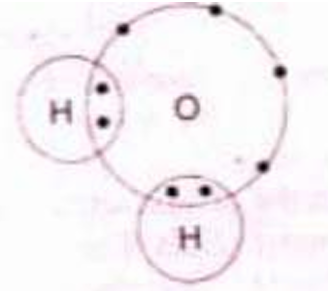
Each hydrogen atom shares one electron with oxygen to form a covalent bond.
Oxygen keeps two lone (non-bonding) pairs of outer-shell electrons.
(c)(iv) covalent (bonds)
Covalent bonding involves the sharing of electron pairs between non-metal atoms.
Hydrogen and oxygen are both non-metals, forming covalent bonds in water.
(c)(v) anhydrous copper sulfate turns from white to blue (or cobalt chloride paper turns from blue to pink)
Water reacts with anhydrous copper(II) sulfate to form hydrated copper sulfate.
The colour change from white to blue confirms the presence of water.
Question 6

The average density of the elephant is \(1030 \, \text{kg/m}^3\).
Calculate the mass of the elephant.
Complete the diagrams in Fig. 6.1 to show the arrangement of molecules in liquid water and in water vapour.

Most-appropriate topic codes (Cambridge IGCSE Co-ordinated Sciences 0654):
• Topic P3.4 — Sound (Part (a))
• Topic P1.4 — Density (Part (b))
• Topic P2.2.2 — Melting, boiling and evaporation (Part (c))
▶️ Answer/Explanation
(a)(i) bat
Pitch corresponds to frequency; a higher frequency means a higher pitch.
The bat has the highest highest-frequency limit (200 000 Hz) of the animals listed.
(a)(ii) elephant
Frequency range = highest frequency − lowest frequency.
The elephant’s range, \(12\,000 – 5 = 11\,995\, \text{Hz}\), is the smallest of the five animals.
(a)(iii) 20 Hz to 20 000 Hz
This is the standard accepted audible frequency range for human hearing.
(b) 3500 kg
Mass \( = \text{density} \times \text{volume}\).
Mass \( = 1030 \times 3.4 = 3502 \approx 3500 \, \text{kg}\).
(c)(i) Fastest-moving molecules escape from the surface of the liquid
Molecules in a liquid have a range of speeds.
The most energetic molecules at the surface can escape into the air as vapour.
(c)(ii) Evaporation has a cooling effect
As the fastest molecules leave, the average energy (and temperature) of the remaining water falls.
This cools the elephant’s skin and helps it lose excess body heat.
(c)(iii) Liquid: molecules touching in a random arrangement; vapour: molecules widely spaced in a random arrangement
In the liquid, molecules stay close together and are in constant contact.
In the vapour, molecules move freely and are much further apart, with no more than about seven shown.
Question 7
Define the term variation.
Table 7.1 shows the results.

Choose words from the list.
Each word can be used once, more than once or not at all.
The lion has very sharp, pointed teeth suitable for catching and eating other animals.

The lions with sharp, pointed teeth were better at catching and killing other animals for food.
The lions without sharp, pointed teeth adapted / died / survived. The lions with sharp, pointed teeth passed on their alleles / cells / sex to their offspring.
This occurred over many days / hours / generations until eventually, all the lions had sharp, pointed teeth.
Most-appropriate topic codes (Cambridge IGCSE Co-ordinated Sciences 0654):
• Topic B17.1 — Variation (Parts (a)–(b))
• Topic B17.2 — Selection (Part (c))
▶️ Answer/Explanation
(a) Differences between individuals (of the same species)
Variation describes the natural differences that exist between organisms of the same species.
These differences can be genetic, environmental, or both.
(b)(i) 150.0–154.9 cm
This height range has the highest number of students (8) in Table 7.1.
(b)(ii) phenotypes; two
Continuous variation shows a full spread of measurable values rather than distinct categories.
The data show a range of phenotypes between two extremes (the shortest and tallest height ranges).
(b)(iii) e.g. tongue rolling / blood group / ABO blood group
Discontinuous variation produces distinct categories with no intermediate values.
Tongue rolling is a common example: a person either can or cannot roll their tongue.
(c)(i) carnivore
A carnivore is an animal that obtains its energy by feeding on other animals.
(c)(ii) died; alleles; generations
Lions without sharp teeth were less successful at catching prey and so were more likely to die.
Survivors with sharp teeth passed on the alleles for this trait to their offspring.
Over many generations, this advantageous trait became common throughout the population.
(c)(iii) natural selection
This process, where advantageous traits become more common over generations, is called natural selection.
Question 8

State the name of one other fossil fuel.

Most-appropriate topic codes (Cambridge IGCSE Co-ordinated Sciences 0654):
• Topic C11.3 — Fuels (Part (a))
• Topic C11.5 — Alkenes (Part (b))
• Topic C11.7 — Polymers (Part (c))
▶️ Answer/Explanation
(a)(i) coal / natural gas
Fossil fuels form over millions of years from the remains of dead organisms.
Coal, natural gas, and petroleum are the three main fossil fuels.
(a)(ii) fractional distillation
Petroleum is heated and separated based on the different boiling points of its components.
Fractions with lower boiling points rise higher and are collected near the top of the column.
(a)(iii) e.g. gasoline / naphtha / bitumen
Only refinery gas and diesel oil are shown in Fig. 8.1.
Any other fraction from the fractional distillation column, such as gasoline, is accepted.
(a)(iv) refinery gas: heating and cooking; diesel oil: fuel for diesel engines
Refinery gas is used as bottled gas for domestic heating and cooking.
Diesel oil is used as a fuel to power diesel engines, such as those in trucks.
(b)

Ethene has one fewer pair of hydrogen atoms compared with ethane.
The two carbon atoms are joined by a carbon–carbon double bond, \(\text{C}=\text{C}\).
(c)(i) poly(ethene)
Many ethene monomers join together to form the polymer poly(ethene), commonly known as polythene.
(c)(ii) addition (polymerisation)
In addition polymerisation, monomers with a C=C double bond join together.
No other product is formed, unlike condensation polymerisation.
Question 9

Most-appropriate topic codes (Cambridge IGCSE Co-ordinated Sciences 0654):
• Topic P4.3 — Electrical circuits (Parts (a)–(b))
• Topic P1.6.1 — Energy (Part (c))
▶️ Answer/Explanation
(a)(i) 0.6 A
Lamps X and Y are connected in series with the ammeters.
In a series circuit, the current is the same at every point, so \(A_1\) also reads 0.6 A.
(a)(ii) Voltmeter connected in parallel across lamp Y
A voltmeter must be connected in parallel with the component it is measuring.
It should be drawn directly across lamp Y using the correct circuit symbol (a circle with a V inside).
(b) 2.4 V
Potential difference \( = \text{current} \times \text{resistance}\).
P.D. across Y \( = 0.6 \times 4 = 2.4 \, \text{V}\).
(c)(i) light; thermal (heat)
A filament lamp converts electrical energy into both light and thermal energy.
Most of the energy is actually released as heat rather than light.
(c)(ii) chemical (potential) energy
The battery stores energy chemically.
This chemical energy store decreases as it is converted into electrical energy in the circuit.
Question 10

- ………………………………… contraction
- protein …………………………………
- ……………………………….. division
Most-appropriate topic codes (Cambridge IGCSE Co-ordinated Sciences 0654):
• Topic B3.1 — Diffusion (Part (a))
• Topic B12.1 — Respiration (Part (b))
▶️ Answer/Explanation
(a)(i) Arrow drawn from outside cell to inside cell (left to right)
Oxygen moves by diffusion, from a region of high concentration to a region of low concentration.
Since concentration is higher outside the cell, the net movement is from left to right.
(a)(ii) cell membrane
The line labelled X separates the outside of the cell from the inside.
This structure is the cell membrane, which controls the movement of substances into and out of the cell.
(a)(iii) similarity: both involve random movement of particles down a concentration gradient; difference: osmosis is the movement of water only, across a partially permeable membrane
Both diffusion and osmosis involve particles moving randomly from high to low concentration.
However, osmosis specifically refers to the movement of water molecules across a partially permeable membrane.
(b)(i) carbon dioxide; water
Aerobic respiration is the breakdown of glucose using oxygen.
The word equation is: glucose + oxygen → carbon dioxide + water (+ energy).
(b)(ii) muscle contraction; protein synthesis; cell division
Energy released from respiration is used for many active processes in the body.
These include muscle contraction, building large molecules such as proteins, and cell division for growth and repair.
Question 11
State the number of electrons in this calcium atom.

Most-appropriate topic codes (Cambridge IGCSE Co-ordinated Sciences 0654):
• Topic C2.2 — Atomic structure and the Periodic Table (Part (a))
• Topic C6.1 — Physical and chemical changes (Part (b))
• Topic C2.1 — Elements, compounds and mixtures (Part (c))
▶️ Answer/Explanation
(a)(i) 20 electrons
In a neutral atom, the number of electrons equals the number of protons.
Since calcium has 20 protons, it also has 20 electrons.
(a)(ii) 18 electrons
A \(\text{Ca}^{2+}\) ion has lost 2 electrons compared with the neutral atom.
Number of electrons \(= 20 – 2 = 18\).
(b)(i) calcium carbonate → calcium oxide + carbon dioxide
This is the standard thermal decomposition reaction of calcium carbonate on heating.
(b)(ii) Carbon dioxide gas is released into the air
Carbon dioxide escapes as a gas during the reaction.
This mass is lost from the solid, so the calcium oxide formed weighs less than the original calcium carbonate.
(b)(iii) Energy is taken in (from the surroundings)
An endothermic reaction absorbs thermal energy from its surroundings.
This is why continuous heating is needed to keep the decomposition going.
(b)(iv) e.g. neutralising acidified soil / as a building material
Limestone has several uses beyond lime production.
It is commonly used to neutralise acidic soils in agriculture, or as a building material.
(b)(v) To increase the surface area, so the reaction is faster
Breaking the limestone into smaller pieces increases its total surface area.
A larger surface area means more particles are exposed to heat, increasing the rate of reaction.
(c)(i) three
The formula \(\text{CaCO}_3\) contains calcium, carbon, and oxygen — three different elements.
(c)(ii) five
There is 1 calcium atom, 1 carbon atom, and 3 oxygen atoms.
Total number of atoms \(= 1 + 1 + 3 = 5\).
Question 12


Most-appropriate topic codes (Cambridge IGCSE Co-ordinated Sciences 0654):
• Topic P1.6.3 — Energy resources (Part (a))
• Topic P1.2 — Motion (Part (b))
• Topic P3.2.2 — Refraction of light (Part (c))
• Topic P3.1 — General properties of waves (Part (d))
▶️ Answer/Explanation
(a)

Coal and natural gas are fossil fuels and are non-renewable.
Hydroelectric (HEP) and tidal energy are naturally replenished and are renewable, like solar (given).
(b)(i) section Q and 1 m/s (or section S and 5 m/s)
A constant speed is shown by a horizontal (flat) section on a speed–time graph.
Section Q is flat at 1 m/s, and section S is flat at 5 m/s; either is accepted.
(b)(ii) section R
Acceleration is represented by the gradient of a speed–time graph.
Section R has the steepest gradient, so it shows the greatest acceleration.
(b)(iii) 150 m
Distance travelled equals the area under a speed–time graph.
For section P (a triangle): distance \( = \dfrac{1}{2} \times 1 \times 300 = 150 \, \text{m}\).
(c)(i) Both rays meet at F after passing through the lens
A converging (convex) lens bends parallel light rays inward.
Both rays should be drawn meeting at the single point F on the principal axis.
(c)(ii) principal focus
The point where parallel rays converge after passing through a convex lens is called the principal focus.
(d)(i) B
Amplitude is the maximum displacement of the wave from its rest (undisturbed) position.
Letter B shows this vertical distance from the centre line to the peak.
(d)(ii) E
Wavelength is the distance between two corresponding points on consecutive waves, such as crest to crest.
Letter E shows this distance across one complete wave cycle.