Question 1
What is a characteristic of all living organisms?
A. excretion
B. digestion
C. photosynthesis
D. sexual reproduction
Most-appropriate topic codes (Cambridge IGCSE Co-ordinated Sciences 0654):
▶️ Answer/Explanation
Digestion only occurs in animals that ingest food; photosynthesis is exclusive to plants and algae; sexual reproduction is not universal (some organisms reproduce asexually).
✅ Answer: (A)
Question 2
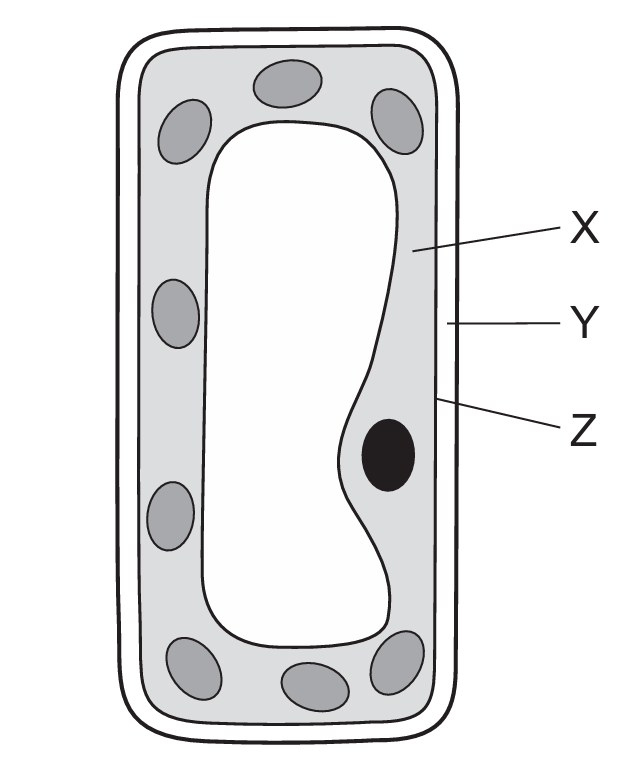
The diagram shows a typical plant cell.

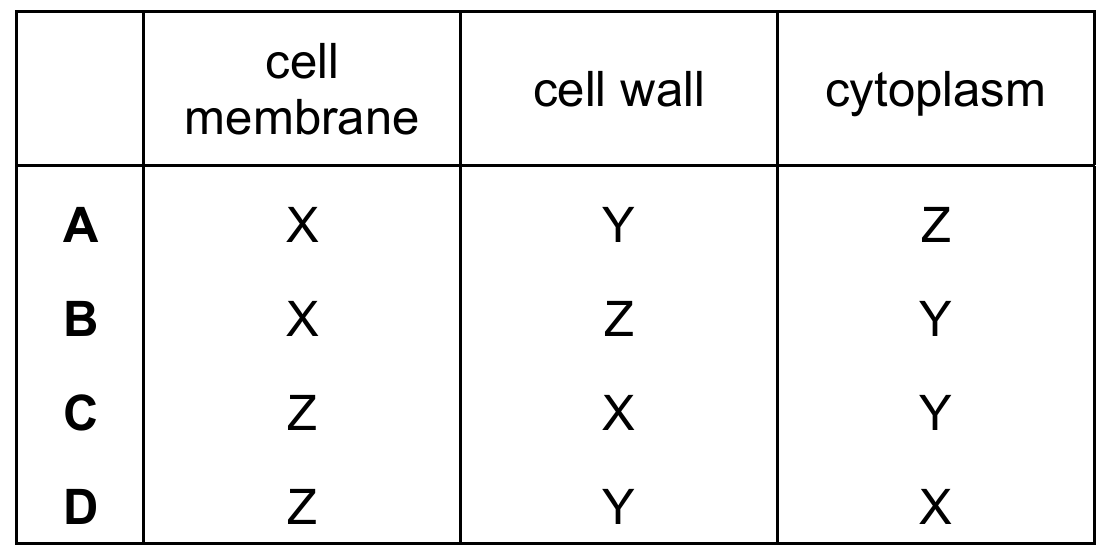
Which row is correct?

Most-appropriate topic codes (Cambridge IGCSE Co-ordinated Sciences 0654):
▶️ Answer/Explanation
The cell wall (made of cellulose) is a structure present only in plant cells, providing rigidity and structural support.
✅ Answer: (D)
Question 3
Which smaller molecules make up larger fat molecules?
A. glucose and amino acids
B. glucose and fatty acids
C. glycerol and amino acids
D. glycerol and fatty acids
Most-appropriate topic codes (Cambridge IGCSE Co-ordinated Sciences 0654):
▶️ Answer/Explanation
Glucose and amino acids are the monomers of carbohydrates and proteins respectively — not fats.
✅ Answer: (D)
Question 4
Which type of molecules are enzymes?
A. carbohydrates
B. fats
C. oils
D. proteins
Most-appropriate topic codes (Cambridge IGCSE Co-ordinated Sciences 0654):
▶️ Answer/Explanation
Their protein nature gives them a specific 3D active site shape that is complementary to their substrate, enabling catalysis.
✅ Answer: (D)
Question 5
The rate of photosynthesis of an aquatic plant is measured by counting the number of bubbles of oxygen produced every minute, as shown. The rate is measured at different light intensities.

Which two variables need to be kept constant?
A. size of plant and temperature of the water
B. light intensity and size of the boiling tube
C. size of plant and size of the boiling tube
D. temperature of the water and light intensity
Most-appropriate topic codes (Cambridge IGCSE Co-ordinated Sciences 0654):
▶️ Answer/Explanation
The size of the plant determines how much photosynthesis can occur, and temperature affects the rate of enzyme-controlled reactions; both must be kept constant to ensure a fair test.
✅ Answer: (A)
Question 6
Starch is mixed with saliva and placed into a bag made of a partially permeable membrane. The bag is placed into a tube filled with water, as shown.

After one hour, sugar molecules are found in the water outside the bag. Which process has taken place inside the bag?
A. assimilation
B. digestion
C. egestion
D. ingestion
Most-appropriate topic codes (Cambridge IGCSE Co-ordinated Sciences 0654):
▶️ Answer/Explanation
The resulting sugars are small enough to pass through the partially permeable membrane into the water outside, confirming that chemical digestion occurred inside the bag.
✅ Answer: (B)
Question 7
What is transported by red blood cells?
A. glucose
B. insulin
C. oxygen
D. urea
Most-appropriate topic codes (Cambridge IGCSE Co-ordinated Sciences 0654):
▶️ Answer/Explanation
Glucose, insulin, and urea are dissolved in the plasma and transported in solution — not inside red blood cells.
✅ Answer: (C)
Question 8
A person inflates a balloon by breathing into it.
What is the composition of the air in the balloon?

Most-appropriate topic codes (Cambridge IGCSE Co-ordinated Sciences 0654):
▶️ Answer/Explanation
Nitrogen remains largely unchanged at ~79% since the body does not use it, and the correct row in the table reflecting these values is C.
✅ Answer: (C)
Question 9
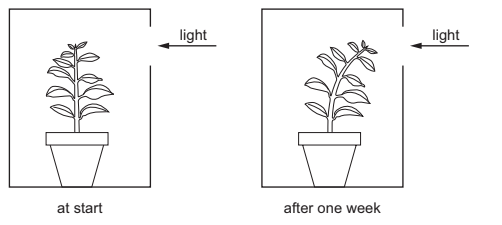
A plant is placed in a box. The box has a hole so that the plant is illuminated from one side. The plant is observed after one week. The result is shown.

What explains the growth of the plant after one week?
A. Plant shoots grow towards light, showing phototropism.
B. Plant shoots grow towards gravity, showing gravitropism.
C. Plant shoots grow towards light, showing gravitropism.
D. Plant shoots grow towards gravity, showing phototropism.
Most-appropriate topic codes (Cambridge IGCSE Co-ordinated Sciences 0654):
▶️ Answer/Explanation
Gravitropism refers to growth in response to gravity, not light, so options B, C, and D are incorrect.
✅ Answer: (A)
Question 10
Which row is correct for sexual reproduction?

Most-appropriate topic codes (Cambridge IGCSE Co-ordinated Sciences 0654):
▶️ Answer/Explanation
Row C correctly identifies that sexual reproduction involves two parents, fusion of gametes, and genetically varied offspring.
✅ Answer: (C)
Question 11
The graph shows the masses of samples of two different types of potato, Y and Z.

What is shown by the graph?
A. Genes do not affect the mass of potatoes.
B. Type Y potatoes show continuous variation.
C. Type Z potatoes are smaller than type Y.
D. Type Z potatoes show discontinuous variation.
Most-appropriate topic codes (Cambridge IGCSE Co-ordinated Sciences 0654):
▶️ Answer/Explanation
Type Z may overlap in range with Y, so we cannot conclude Z are always smaller; and discontinuous variation would show distinct separate bars, not a smooth curve.
✅ Answer: (B)
Question 12
A food chain is shown.
plant → insect → songbird → hawk
Which statements are correct?
- The hawk is a consumer.
- The insect is a carnivore.
- The songbird is a herbivore.
- The plant is a producer.
A. 1 and 2
B. 1 and 4
C. 2 and 3
D. 2 and 4
Most-appropriate topic codes (Cambridge IGCSE Co-ordinated Sciences 0654):
▶️ Answer/Explanation
Statement 2 is incorrect — the insect eats the plant, so it is a herbivore, not a carnivore; Statement 3 is incorrect — the songbird eats the insect (an animal), so it is a carnivore, not a herbivore.
✅ Answer: (B)
Question 13
Which process removes carbon dioxide from the atmosphere?
A. combustion
B. decomposition
C. photosynthesis
D. respiration
Most-appropriate topic codes (Cambridge IGCSE Co-ordinated Sciences 0654):
▶️ Answer/Explanation
Combustion, decomposition, and respiration all release \(\text{CO}_2\) back into the atmosphere, so they are the opposite process.
✅ Answer: (C)
Question 14
Cyclopentane is a hydrocarbon. The melting point of cyclopentane is –94 °C and its boiling point is 49 °C.
In process 1, the temperature of cyclopentane changes from 55 °C to 45 °C.
In process 2, the temperature of cyclopentane changes from –100 °C to –90 °C.
Which row identifies the changes in processes 1 and 2?

Most-appropriate topic codes (Cambridge IGCSE Co-ordinated Sciences 0654):
▶️ Answer/Explanation
In process 2, warming from –100 °C (below melting point of –94 °C → solid state) to –90 °C (above melting point → liquid state) is melting (solid → liquid).
✅ Answer: (D)
Question 15
Which statements about chemical changes are correct?
- The separation of petroleum into gasoline, naphtha and diesel is a chemical change.
- The separation of water into hydrogen and oxygen is a chemical change.
- In a chemical change, a new substance is always formed.
- In a chemical change, heat is always released.
A. 1 and 2
B. 1 and 4
C. 2 and 3
D. 3 and 4
Most-appropriate topic codes (Cambridge IGCSE Co-ordinated Sciences 0654):
▶️ Answer/Explanation
Statement 3 is always true by definition of a chemical change; statement 4 is incorrect because some chemical changes are endothermic (absorb heat).
✅ Answer: (C)
Question 16
Which elements react together to form an ionic compound?
A. carbon and oxygen
B. nitrogen and hydrogen
C. potassium and bromine
D. sodium and lithium
Most-appropriate topic codes (Cambridge IGCSE Co-ordinated Sciences 0654):
▶️ Answer/Explanation
Carbon + oxygen, and nitrogen + hydrogen both form covalent compounds (non-metal + non-metal); sodium + lithium are both metals and do not form ionic compounds with each other.
✅ Answer: (C)
Question 17
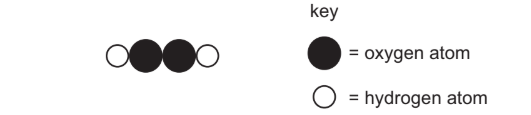
Hydrogen peroxide is a compound. A molecule of hydrogen peroxide can be represented as shown.

What is the formula of hydrogen peroxide?
A. HO
B. H₂O₂
C. H₂O
D. 2OH
Most-appropriate topic codes (Cambridge IGCSE Co-ordinated Sciences 0654):
▶️ Answer/Explanation
\(\text{H}_2\text{O}\) is water (only 1 oxygen atom per molecule), while HO and 2OH are not valid molecular formulas for this compound.
✅ Answer: (B)
Question 18
When concentrated aqueous sodium chloride is electrolyzed using inert electrodes, the remaining solution turns red litmus paper to blue.
Which substance causes this colour change?
A. chlorine
B. hydrogen
C. hydrochloric acid
D. sodium hydroxide
Most-appropriate topic codes (Cambridge IGCSE Co-ordinated Sciences 0654):
▶️ Answer/Explanation
Sodium hydroxide is a strong alkali — it turns red litmus blue; chlorine and hydrogen are gases that escape, and hydrochloric acid is acidic (would turn blue litmus red).
✅ Answer: (D)
Question 19
When aqueous sodium hydroxide reacts with dilute hydrochloric acid, the temperature of the reaction mixture increases.
Ice cubes take in energy when they melt.
Which row is correct?

Most-appropriate topic codes (Cambridge IGCSE Co-ordinated Sciences 0654):
▶️ Answer/Explanation
Ice melting absorbs energy from the surroundings (temperature drops around it) — this is an endothermic process; Row B correctly classifies NaOH + HCl as exothermic and ice melting as endothermic.
✅ Answer: (B)
Question 20
Dilute hydrochloric acid reacts with calcium carbonate. The equation for the reaction is shown.
\(\text{CaCO}_3 + 2\text{HCl} \rightarrow \text{CaCl}_2 + \text{CO}_2 + \text{H}_2\text{O}\)
Which change increases the rate of the reaction?
A. decreasing the temperature of the hydrochloric acid
B. increasing the concentration of the hydrochloric acid
C. increasing the size of the calcium carbonate particles
D. increasing the volume of the hydrochloric acid
Most-appropriate topic codes (Cambridge IGCSE Co-ordinated Sciences 0654):
▶️ Answer/Explanation
Decreasing temperature slows the reaction; larger particles reduce surface area (slower rate); increasing volume decreases concentration if the same amount of acid is diluted — none of these increase the rate.
✅ Answer: (B)
Question 21
Which reactions involve oxidation?
- \(\text{C} + \text{O}_2 \rightarrow \text{CO}_2\)
- \(2\text{NaOH} + \text{H}_2\text{SO}_4 \rightarrow \text{Na}_2\text{SO}_4 + 2\text{H}_2\text{O}\)
- \(2\text{Mg} + \text{O}_2 \rightarrow 2\text{MgO}\)
- \(\text{CaCO}_3 \rightarrow \text{CaO} + \text{CO}_2\)
A. 1 and 3
B. 1 and 4
C. 2 and 3
D. 2 and 4
Most-appropriate topic codes (Cambridge IGCSE Co-ordinated Sciences 0654):
▶️ Answer/Explanation
Reaction 2 is a neutralisation (acid-base) reaction with no oxygen transfer; reaction 4 is thermal decomposition with no net gain of oxygen by any element.
✅ Answer: (A)
Question 22
Salts are made when four substances react separately with dilute hydrochloric acid.
- magnesium
- magnesium carbonate
- magnesium hydroxide
- magnesium oxide
Which substances produce a gas when reacted with dilute hydrochloric acid?
A. 1 and 2
B. 1 and 3
C. 2 and 4
D. 3 and 4
Most-appropriate topic codes (Cambridge IGCSE Co-ordinated Sciences 0654):
▶️ Answer/Explanation
Magnesium hydroxide and magnesium oxide are bases — they react with HCl to produce only salt and water, with no gas evolved.
✅ Answer: (A)
Question 23
Lead has a high density of 11.3 g/cm³. Lead(II) iodide is a bright yellow solid.
Which property of lead is not a property of a transition element?
A. Lead conducts electricity.
B. Lead forms alloys.
C. Lead has a relatively low melting point.
D. Lead(II) oxide is basic.
Most-appropriate topic codes (Cambridge IGCSE Co-ordinated Sciences 0654):
▶️ Answer/Explanation
Conducting electricity, forming alloys, and having basic oxides are all typical properties of transition metals, so those are not the odd one out.
✅ Answer: (C)
Question 24
Which statements about the noble gas helium are correct?
- It is unreactive.
- Atoms of helium have two electrons in their outer electron shell.
- Atoms of helium have incomplete outer electron shells.
- The formula of helium gas is He₂.
A. 1 and 2
B. 1 and 4
C. 2 and 3
D. 3 and 4
Most-appropriate topic codes (Cambridge IGCSE Co-ordinated Sciences 0654):
▶️ Answer/Explanation
Statement 3 is incorrect (the outer shell is complete, not incomplete), and statement 4 is incorrect (helium is monatomic — He, not He₂).
✅ Answer: (A)
Question 25
Water vapour, carbon dioxide and the noble gases are removed from a 100 cm³ sample of clean air. What is the remaining volume?
A. 1 cm³
B. 21 cm³
C. 78 cm³
D. 99 cm³
Most-appropriate topic codes (Cambridge IGCSE Co-ordinated Sciences 0654):
▶️ Answer/Explanation
The removed components total roughly 1 cm³, so the remaining volume is approximately \(100 – 1 = 99 \text{ cm}^3\).
✅ Answer: (D)
Question 26
Which statement about manufacturing processes is correct?
A. Limestone is manufactured from calcium oxide.
B. Limestone is manufactured from acidic waste products.
C. Ethene is manufactured by addition polymerisation.
D. Sulfuric acid is manufactured from sulfur.
Most-appropriate topic codes (Cambridge IGCSE Co-ordinated Sciences 0654):
▶️ Answer/Explanation
Limestone is a naturally occurring mineral (\(\text{CaCO}_3\)), not manufactured; ethene is produced by cracking, not by addition polymerisation (which produces poly(ethene) from ethene).
✅ Answer: (D)
Question 27
Which molecule reacts with aqueous bromine?

Most-appropriate topic codes (Cambridge IGCSE Co-ordinated Sciences 0654):
▶️ Answer/Explanation
Alkanes (saturated molecules with only C–C single bonds) do not react with bromine water under normal conditions, so the other options showing only single bonds would not decolourise it.
✅ Answer: (B)
Question 28
A car travels at constant speed. It is at point X at time = 0.
Which distance–time graph and speed–time graph represent the motion of the car?

Most-appropriate topic codes (Cambridge IGCSE Co-ordinated Sciences 0654):
▶️ Answer/Explanation
The car starts at point X (not at zero distance), so the distance–time graph starts above the origin — option A shows both these features correctly.
✅ Answer: (A)
Question 29
The diagrams show all the forces acting on three objects, X, Y and Z.

Which of the objects experience a resultant force?
A. X, Y and Z
B. X only
C. Y and Z only
D. Y only
Most-appropriate topic codes (Cambridge IGCSE Co-ordinated Sciences 0654):
▶️ Answer/Explanation
A non-zero resultant force causes acceleration (change in speed or direction) according to Newton’s Second Law \(F = ma\).
✅ Answer: (C)
Question 30
A student places four identical beakers on a bench.
Two beakers contain salt water of density 1.1 g/cm³ and two beakers contain pure water of density 1.0 g/cm³. The quantity of water in each beaker is shown.
Which beaker exerts the greatest pressure on the bench?

Most-appropriate topic codes (Cambridge IGCSE Co-ordinated Sciences 0654):
▶️ Answer/Explanation
Beaker A contains the largest volume of salt water (highest density), giving it the greatest mass and therefore the greatest weight and pressure on the bench.
✅ Answer: (A)
Question 31
The power rating of an electric kettle is 1500 W.
What does this mean?
A. The kettle requires 1500 J to boil water.
B. The kettle takes 1500 s to boil water.
C. The kettle transfers 1500 J of energy every second.
D. The weight of the kettle is 1500 N.
Most-appropriate topic codes (Cambridge IGCSE Co-ordinated Sciences 0654):
▶️ Answer/Explanation
The other options confuse power with total energy (A), time (B), or weight (D) — none of which is the definition of power rating.
✅ Answer: (C)
Question 32
A glass jar in a warm room has a metal lid that is easy to remove.

The jar with the lid on is left in a refrigerator overnight.
In the morning, the lid of the jar is difficult to remove.
Which statement is an explanation of what happens when the jar is in the refrigerator?
A. The glass jar contracted more than the metal lid.
B. The metal lid contracted more than the glass jar.
C. The glass jar expanded more than the metal lid.
D. The metal lid expanded more than the glass jar.
Most-appropriate topic codes (Cambridge IGCSE Co-ordinated Sciences 0654):
▶️ Answer/Explanation
This means the lid shrinks tightly onto the glass neck, making it much harder to remove — the opposite occurs when heated (lid expands more, loosening it).
✅ Answer: (B)
Question 33
A beaker contains water that is all at 20 °C.
A convection current is started in the water, as shown in the diagram.
Four points are labelled W, X, Y and Z.

Which two actions can each, on their own, cause this convection current?
A. cooling the water at W or heating the water at Y
B. cooling the water at W or heating the water at Z
C. cooling the water at X or heating the water at Y
D. cooling the water at X or heating the water at Z
Most-appropriate topic codes (Cambridge IGCSE Co-ordinated Sciences 0654):
▶️ Answer/Explanation
Both actions independently set up the same clockwise circulation pattern shown, confirming option D is correct.
✅ Answer: (D)
Question 34
Which type of electromagnetic wave is emitted by a television remote controller?
A. gamma (γ)-rays
B. infrared
C. ultraviolet
D. X-rays
Most-appropriate topic codes (Cambridge IGCSE Co-ordinated Sciences 0654):
▶️ Answer/Explanation
Gamma rays and X-rays are ionising radiation (dangerous), while ultraviolet is used in sterilisation and banknote checking — none of these are used in TV remotes.
✅ Answer: (B)
Question 35
An electric bell is suspended by a rubber band in a glass jar. The hammer hits the bell and makes it ring.

A pump removes air from the jar. The hammer still hits the bell but no sound can be heard.
Why does this happen?
A. A medium is needed to transmit sound waves.
B. The bell cannot vibrate in a vacuum.
C. The pitch of the sound is now outside the range of human hearing.
D. There cannot be an electric current in a vacuum.
Most-appropriate topic codes (Cambridge IGCSE Co-ordinated Sciences 0654):
▶️ Answer/Explanation
The bell still vibrates (as the hammer still strikes it), ruling out option B; the electric current and pitch are unaffected by the absence of air, ruling out C and D.
✅ Answer: (A)
Question 36
A cell is connected in a circuit.
Which statement describes how the electromotive force (e.m.f.) of the cell is measured?
A. It is measured in newtons using a newton meter connected in parallel with the cell.
B. It is measured in newtons using a newton meter connected in series with the cell.
C. It is measured in volts using a voltmeter connected in parallel with the cell.
D. It is measured in volts using a voltmeter connected in series with the cell.
Most-appropriate topic codes (Cambridge IGCSE Co-ordinated Sciences 0654):
▶️ Answer/Explanation
Connecting a voltmeter in series would drastically reduce current flow and give an incorrect reading; parallel connection ensures it measures the full potential difference across the cell terminals.
✅ Answer: (C)
Question 37
In the circuits shown, all the resistors are identical. Which circuit has the smallest combined resistance?

Most-appropriate topic codes (Cambridge IGCSE Co-ordinated Sciences 0654):
▶️ Answer/Explanation
Circuit B shows the greatest number of resistors connected in parallel, yielding the smallest total resistance of all the options shown.
✅ Answer: (B)
Question 38
The maximum current in an electric circuit is 10 A.
What is the most appropriate rating of a fuse for this circuit?
A. 5 A
B. 9 A
C. 13 A
D. 25 A
Most-appropriate topic codes (Cambridge IGCSE Co-ordinated Sciences 0654):
▶️ Answer/Explanation
A 13 A fuse is the lowest standard rating above 10 A — it allows normal operation while melting quickly if a fault causes the current to rise significantly above 10 A, giving optimal protection.
✅ Answer: (C)
Question 39
A current-carrying wire passes through a flat card. The arrow on the wire shows the direction of the current. Which diagram shows the pattern of the magnetic field on the card and the direction of the magnetic field lines?

Most-appropriate topic codes (Cambridge IGCSE Co-ordinated Sciences 0654):
▶️ Answer/Explanation
Only diagram D shows concentric circular field lines in the correct anticlockwise direction consistent with the given current direction.
✅ Answer: (D)
Question 40
A radioactive material has a half-life of 4.0 days. The rate of emission of radiation from a sample of the material is 32 emissions per minute.
What was the rate of emission from the sample 8.0 days earlier?
A. 8.0 emissions per minute
B. 128 emissions per minute
C. 256 emissions per minute
D. 1024 emissions per minute
Most-appropriate topic codes (Cambridge IGCSE Co-ordinated Sciences 0654):
▶️ Answer/Explanation
This can be verified by working forward: \(128 \xrightarrow{\times\frac{1}{2}} 64 \xrightarrow{\times\frac{1}{2}} 32\) — after two half-lives (8 days), the rate drops from 128 to 32, confirming the answer.
✅ Answer: (B)
